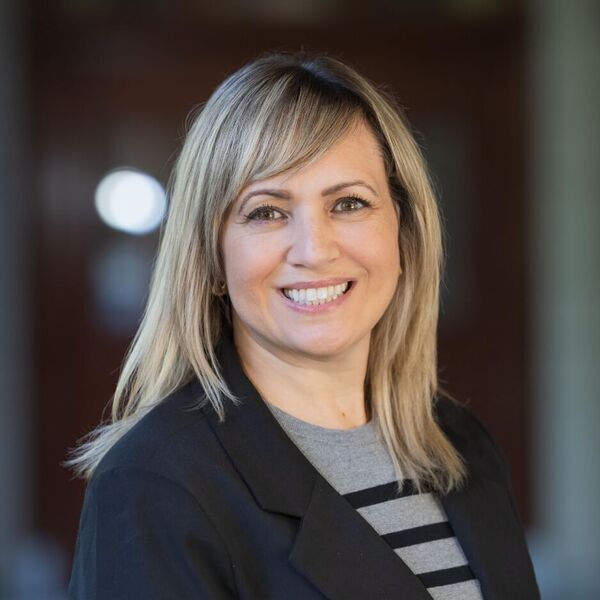
tag:law.nd.edu,2005:/news-events/newstag:law.nd.edu,2005:/latestThe Law School | News2026-10-15T19:47:00-04:00Notre Dame Law School at the University of Notre Dame in Notre Dame, Indianatag:law.nd.edu,2005:News/1860432026-10-15T19:47:00-04:002026-10-15T19:53:10-04:00Angela Colmenero ’04 J.D. confirmed as Federal District Court Judge in TexasAngela Colmenero ’04 J.D.
The United States Senate confirmed Notre Dame Law School alumna Angela Colmenero ’04 J.D. to the U.S. District Court for the Southern District of Texas on September 23, 2026.
Colmenero most recently served as deputy chief of staff in the office of Texas Governor Greg Abbott. She also served as interim attorney general of Texas in 2023. Earlier in her career she worked as a trial practice associate at Jones Day in Dallas and as an associate at Lynn Tillotson Pinker & Cox, LLP, also in Dallas. After graduating from Notre Dame Law School in 2004, she clerked for Chief Judge A. Joe Fish of the U.S. District Court for the Northern District of Texas.
President Donald Trump nominated Colmenero to fill the vacancy created when Judge Lee Rosenthal assumed senior status. Colmenero brings nearly two decades of public service in Texas to her new role on the federal bench.
The U.S. District Court for the Southern District of Texas is one of 94 U.S. district courts. Colmenero will preside in the Houston Division of the U.S. District Court for the Southern District of Texas, which covers 13 counties.
]]>
Notre Dame Law Schooltag:law.nd.edu,2005:News/1862102026-10-12T17:00:00-04:002026-10-12T17:00:29-04:00Notre Dame Law School and partner institutions Bucerius Law School and Bocconi Law School host inaugural workshop on democratic backsliding in America and EuropeSpeakers, students, and attendees of the inaugural workshop on democratic backsliding at the University of Notre Dame’s London campus
Notre Dame Law School, Bucerius Law School, and Bocconi Law School brought together leading scholars and legal experts from the United States and Europe for an inaugural workshop examining threats to democracy, the rule of law, judicial independence, and civil and human rights.
“The Dangers of Democratic Backsliding in America and Europe,” held October 3 at the University of Notre Dame’s London campus, marked the first time Notre Dame Law School has co-sponsored an event of this scope with two major law schools outside of the United States. The workshop served as the inaugural gathering of the Legal Forum for International and Comparative Law.
The workshop was led by Professor Jimmy Gurulé of Notre Dame Law School in collaboration with Bucerius Law School and Bocconi Law School. Professor Axel Kämmerer of Bucerius Law School coordinated the participation of European scholars and legal experts. Together, the three institutions brought scholars and legal experts from Germany, Hungary, Italy, Poland, and the United States to London for a comparative examination of contemporary challenges to democratic institutions and the role of legal frameworks in safeguarding democratic governance.
Professor Jimmy Gurulé
"Democratic systems in America and Europe face erosion from within as fundamental norms around the separation of powers, judicial independence, and rule of law are under attack,” said Gurulé. “The inaugural Legal Forum on International and Comparative Law provided an important venue for experts from the United States and four European countries to discuss the dangers of democratic backsliding and strategies to counter such threats. Obviously, there is much that we can learn from talking and listening to one another."
The Legal Forum for International and Comparative Law was designed to create a forum for academics from European law schools and the United States to discuss and debate critical legal issues affecting their respective countries. It also sought to deepen Notre Dame Law School’s partnerships with Bucerius and Bocconi and further elevate the Law School’s presence in Europe through its historic Notre Dame London Law Programme.
These objectives of the workshop align with the Law School's Global Lawyering Initiative, a central priority of Joseph A. Matson Dean and Professor of Law G. Marcus Cole. The initiative connects faculty and students with institutions around the world to promote scholarly collaboration, academic exchanges, and engagement with legal questions that transcend national boundaries.
The workshop took place amid broader international concern about the strength of democratic and rule-of-law institutions. According to the World Justice Project’s 2025 Rule of Law Index, 68 percent of countries surveyed experienced a decline in rule-of-law performance, including widespread declines in measures of judicial independence, checks on government power, and fundamental rights. Freedom House similarly reported in 2026 that global freedom had declined for the 20th consecutive year. Against that backdrop, the workshop examined how these challenges are taking shape within different national and legal systems, and what comparative legal scholarship can contribute to understanding them.
Judge Robert S. Lasnik of the U.S. District Court for the Western District of Washington
The day-long workshop opened with remarks from Gurulé before the first panel, “Threats to the Rule of Law and an Independent Judiciary.” Notre Dame Law Professor Stephen Smith discussed threats to an independent and impartial criminal justice system, while Gurulé addressed threats to international law. Judge Robert S. Lasnik of the U.S. District Court for the Western District of Washington spoke about threats to an independent judiciary. Bocconi Law Professor Graziella Romeo offered a comparative perspective on constitutional cultures, the rule of law, and the politics of judicial independence. Joel Day, managing director of the University of Notre Dame’s Democracy Initiative, served as commentator following the morning panel session.
Across the morning discussion, speakers approached questions of institutional independence from different legal perspectives, examining the roles of criminal justice systems, international law, courts, and constitutional structures in maintaining the rule of law.
Fruzsina Kinga Gárdos-Orosz, secretary of state for public administration in the Hungarian Ministry of Justice, delivered the keynote address, “Restoring Constitutional Democracy: Constitutional Democracy in Hungary—A Historical Chance, A Historical Duty.”
The afternoon discussion shifted from institutional structures to questions of accountability, civil and human rights, and the legal mechanisms available for responding to democratic backsliding.
Associate Professor Jennifer McAward speaking during the second panel
The second panel, “Threats to Civil and Human Rights and Legal Strategies Against Democratic Backsliding,” featured Notre Dame Law Associate Professor Jennifer McAward, director of Notre Dame’s Klau Institute for Civil and Human Rights, who discussed accountability and impunity. Irena Lipowicz, professor emeritus at Warsaw University, former ombudsperson of the Polish Parliament, and former ambassador, examined how administrative structures in Poland can foster democratic backsliding.
Bocconi Law Professor Justin O. Frosini discussed the ways populist movements can undermine European constitutional systems, while Kämmerer examined the threat of democratic backsliding in Germany and the search for constitutional responses. Lasnik served as commentator after the second panel session.
“It was a privilege to participate in this conference and to learn from our distinguished colleagues on such important and topical issues,” said McAward. “This is an important time to collaborate across national contexts and learn from each other about historical and legal responses to democratic backsliding.”
Pictured from left to right: Professor Axel Kämmerer, Associate Professor Jennifer McAward, Joel Day, Professor Jimmy Gurulé, Judge Robert S. Lasnik, Professor Irena Lipowicz, and Professor Justin O. Frosini
Speakers and attendees continued the comparative discussion during an open question-and-answer session that included panelist dialogue and audience commentary. Day then delivered a short talk on “Promoting Democracy Through the Democracy Initiative” before Kämmerer delivered closing remarks.
The inaugural workshop brought together scholars and legal experts from different countries, institutions, and legal traditions, creating a space for comparative inquiry and international exchange. Its comparative approach allowed participants to examine how pressures on democratic institutions can take different forms across national legal systems while also identifying questions shared across jurisdictions, including judicial independence, government accountability, fundamental rights, and the effectiveness of legal safeguards. The discussions in London underscored the value of sustained dialogue among legal traditions in order to better understand shared challenges across borders and consider how law can respond to them.
]]>
Arienne Calingotag:law.nd.edu,2005:News/1859102026-10-01T08:40:00-04:002026-10-01T08:40:16-04:00Notre Dame Exoneration Justice Clinic continues annual summer internship program with students from Notre Dame, St. Olaf College, Kenya, and MexicoA group of EJC summer interns at the Notre Dame Exoneration Justice Clinic
This summer, the Notre Dame Exoneration Justice Clinic (EJC) welcomed a diverse cohort of 14 student interns from the University of Notre Dame, St. Olaf College, Strathmore Law School in Nairobi, Kenya, and the National Autonomous University of Mexico (UNAM) in Mexico City, Mexico. The interns worked primarily on intake cases, allowing them to review several requests for legal representation and make recommendations on whether to accept or reject cases based on a rigorous screening process. In addition, the interns were assigned to assist in ongoing EJC cases, providing them with a comprehensive understanding of the overall process of building a case.
This summer’s cohort of EJC interns included third-year Notre Dame Law School student Zoë Bonnichsen and second-year law students, Aaron Qiao, Maggie Feighery, and Jack Puricelli; undergraduate Notre Dame students, Victor Kaminski, Caroline Petrikas, and Marco Gonzalez; undergraduate St. Olaf College students, Alex Hollie, Emma Linder, and Sarah Degand; Strathmore Law School exchange students, Anisa Ali and Gina Mulaku, from Nairobi, Kenya; and UNAM exchange students, Diana Bolaños Cuevas and Griselda Santos Garnica, from Mexico City, Mexico.
“Our obligation to our clients does not end at the end of the academic year. We have an obligation to our clients every month of the year,” said Professor Jimmy Gurulé, founder and director of Notre Dame Law School’s Exoneration Justice Clinic. He added that the annual summer internship program provides "intensified participation for the students.”
Each year, the program includes Notre Dame Law students who continue their involvement in the EJC during the academic year.
2L Maggie Feighery speaks during the EJC welcome picnic for summer interns
One of those students, 2L Maggie Feighery, reflected on the hands-on experience the summer program provides. “The EJC is unique in that we get outside of the classroom setting of hypotheticals and distant case studies and we are working with real clients whose lives are affected by the work we’re doing in this office every day,” said Feighery.
This summer's cohort also included students from Strathmore Law School in Kenya and UNAM in Mexico. "This is an opportunity for the EJC to train foreign students,” said Gurulé. “We are taking our experience and we're sharing it with foreign students. The hope would be that they take the education they receive and enhance their efforts back at their home site."
Gina Mulaku, one of the two exchange students from Strathmore Law School who participated in the program, reflected on the practical experience she gained through the EJC. “The activities that we take part in at the Exoneration Justice Clinic at Notre Dame Law School are very practical, and so I’m able to learn and see how investigations are carried out and how a real setting trial is done in the American law system,” said Mulaku. “I believe this will help me further my law studies in that now, I’m able to make a good decision on what I want to do in the future.”
Mulaku added, “Also, I am learning a lot about what it means to be an ethical lawyer, or what it means to do proper investigations in a case, what it means to follow the law and, at the end, always promote access to justice to everyone. I believe that that will enable me to be a great lawyer in the future.”
EJC summer interns who worked on cases for the Program for the Defense of Mexican Nationals (PDM)
Griselda Carina Santos Garnica, one of the two exchange students from UNAM who participated in the program, said, “The difference is that in the classroom we learn all of the theoretical and written aspects, while in the clinic, we have the opportunity to put all of that knowledge into practice. I believe it is a wonderful way to contribute and to help people who need our assistance.”
The UNAM students worked on cases involving Mexican nationals wrongfully convicted of a crime they did not commit. Their work was conducted through the Program for the Defense of Mexican Nationals (PDM), a dimension of the EJC that provides legal assistance to Mexican nationals facing criminal charges or wrongful convictions.
The interns gained hands-on experience throughout the summer through their work on a variety of EJC cases and projects.
The main responsibility of the interns was to assist the clinic in deciding which cases to accept for legal representation, primarily by reviewing requests that the EJC received from Indiana prison inmates. The interns evaluated the inmates’ claims of innocence to determine their credibility. They assessed whether or not the EJC could prove the inmates’ actual innocence and explored potential avenues that the clinic could pursue to prove their innocence. To conduct their preliminary evaluations, the interns used a comprehensive intake process, developed by the EJC, that is guided by about a dozen objective factors and criteria. After conducting their evaluations, the interns reviewed correspondence, a detailed questionnaire from each inmate, and trial transcripts to look for evidence of wrongful conviction.
Strathmore Law School exchange student Anisa Ali speaks during the EJC welcome picnic for summer interns alongside fellow Strathmore exchange student Gina Mulaku
The interns then prepared detailed recommendation memos for Gurulé and the clinic’s attorneys to review, allowing them to enhance their legal writing skills. The clinic also held intake meetings, where the interns delivered an oral presentation to defend their recommendation.
In addition, the students attended a lunch seminar with Rachel Schneider '23 J.D., a former EJC alum who is now a prosecutor. They also met with EJC client Iris Seabolt, attended a murder trial in St. Joseph County court, and made prison visits to meet with clients. The students who worked on PDM cases got to visit the Mexican consulate in Chicago, as well.
The Notre Dame Exoneration Justice Clinic has received approximately 850 requests for legal representation since its opening in the fall of 2020. The EJC accepts around 3 percent of requests. Currently, the clinic is actively engaged in approximately 17 cases.
Learn more about Notre Dame Exoneration Justice Clinic at exoneration.nd.edu.
EJC interns reflect on their experiences during the summer program
Interns reflected on their experiences working with the EJC and what they learned from the clinic's hands-on approach to legal education.
Aaron Qiao
2L at Notre Dame Law School and Notre Dame Exoneration Justice Clinic Student
“What I would like to tell a prospective student about the EJC summer program is that if you want your mission in the legal field to be about justice and about doing right, and if you are interested in the criminal field, this is one of the best opportunities to do for your first summer, just because you have a very well-guided understanding by the faculty and the staff here to get a full, comprehensive understanding of the criminal legal system.”
St. Olaf College undergraduate student Alex Hollie works alongside fellow EJC summer interns
Alex Hollie
St. Olaf College Undergraduate Student
“This experience is different from a traditional classroom setting because we’re directly involved in people’s lives and if they’ll be able to retain post-conviction relief.”
Caroline Petrikas
University of Notre Dame Undergraduate Student
“Participating in the EJC summer internship is exposing me to a new area and helping me move beyond just the theoretical in classrooms to the actual, tangible challenges in our political system. As a Political Science major, I think we often talk about a lot of the discriminatory or prejudice issues with the system, but I think it’s much different to learn about those than it is to actually see how they’re being addressed in cases and the challenges that everybody is facing. This experience is helping me understand them beyond the classroom in a more physical sense.”
“I just want to thank Professor Steven Landis in the Political Science department and Professor Gurulé for all of their work in setting up this partnership and for extending the opportunity to me. I am very grateful for this opportunity. I want to thank Professor Gurulé, as without his leadership and guidance, the clinic would not be here today.”
UNAM exchange students Diana Estefanía Bolaños Cuevas and Griselda Carina Santos Garnica work on cases through the PDM
Diana Estefanía Bolaños Cuevas
National Autonomous University of Mexico (UNAM) Exchange Student
“First, I would like to thank Professor Jimmy Gurulé for this experience, and also Dr. Imer Flores from UNAM for trusting us with this project. It is a great initiative for both universities. I would also like to thank my family for their support and for helping me achieve yet another meaningful experience.”
“I believe the experience in the EJC will help me tremendously, not only professionally but also personally and academically, since I am able to compare different legal systems and interact with many peers who share similar professional aspirations.”
Griselda Carina Santos Garnica
National Autonomous University of Mexico (UNAM) Exchange Student
“I would like to thank UNAM for creating these partnerships with other universities. I believe they are greatly needed, at least in our country. At Notre Dame, I would like to thank Professor Jimmy Gurulé for choosing UNAM and, in this case, for selecting me to be part of this project. I would also like to thank Joshua Kuiper. He has truly been a tremendous help. At Notre Dame, he is always very attentive to us as exchange students. They have helped us tremendously throughout this entire clinical experience.”
2L Jack Puricelli and Notre Dame undergraduate student Marco Gonzalez work alongside one another during the EJC summer internship program
Jack Puricelli
2L at Notre Dame Law School and Notre Dame Exoneration Justice Clinic Student
“I’m a Catholic. I’m a Christian. I strongly believe that the law should be a tool of mercy. I came to law school because I knew law was a vocation for me, so working in the EJC summer internship program furthers that goal of learning how to use the law as a tool of justice and a tool of mercy.”
Marco Gonzalez
University of Notre Dame Undergraduate Student
“The EJC summer internship program is going to prepare me for a future in law because I’m doing a lot of intake work, reading through a lot of cases, and going through a lot of different aspects of the law that are really helping me understand the criminal justice system. I would tell a prospective EJC student that this work is awesome because it’s fulfilling and interesting, you learn a lot, and you actually get to help real people along the way.”
]]>
Arienne Calingotag:law.nd.edu,2005:News/1858132026-09-28T16:42:00-04:002026-09-28T16:46:09-04:00Notre Dame Law Amicus Brief Urges Supreme Court to Address Religious Exclusions in Higher Education Funding
Notre Dame Law School faculty and programs filed an amicus brief with the U.S. Supreme Court in Hall v. Fleming and Johnson v. Fleming in support of petitioners Bethany Hall and Cameron Johnson, urging the Court to hear challenges to Virginia higher-education funding restrictions and reconsider Locke v. Davey (U.S. 2004).
Hall and Johnson are students at Liberty University who were denied funding through Virginia’s Tuition Assistance Grant Program (VTAG), which provides financial assistance to Virginia residents attending eligible private colleges and universities in the state. Hall initially qualified for the grant while majoring in Music Education but became ineligible after changing her major to Youth Ministries and later Music & Worship. Johnson, who is majoring in Pastoral Leadership, was similarly denied a VTAG award because Virginia classifies his program as religious training or theological education. Both students argue that excluding them from otherwise available tuition assistance because of their religious studies violates the First Amendment’s Free Exercise Clause.
In Locke, the Supreme Court upheld a Washington state scholarship program that excluded students pursuing degrees in devotional theology designed to prepare them for the ministry. The amicus brief argues that Locke is in tension with the Supreme Court’s more recent religious-freedom decisions, which have held that the government generally may not exclude religious institutions or individuals from otherwise available public benefits because of their religious status or exercise. The brief argues that, despite the Court’s efforts to limit Locke to the narrow context of training for the ministry, the decision continues to provide governments with a “permission structure” for excluding religious students and institutions from educational funding programs.
The brief points to dozens of state and federal laws and regulations that the amici argue improperly restrict public benefits for students pursuing higher education on the basis of religion. These include provisions that exclude students because they attend certain categories of institutions (seminaries, divinity schools, or religious colleges and universities); prohibit funding for degrees or courses involving theology, religious studies, or religious instruction; and restrict access to other forms of educational assistance, including work-study and child-care grants, for students studying religious subjects. In Indiana, for example, the brief identifies the EARN Indiana work-study program, which prohibits participating students from performing work involving “sectarian activities.”
The issues raised in the brief also reflect recent developments at the federal level. Last month, the Department of Justice’s Office of Legal Counsel issued an Opinion concluding that religious restrictions on generally available federal funding programs are presumptively unconstitutional. Nicole Garnett, Helfand, and Meiser recently wrote about the Opinion’s broad implications in a City Journal article, “The Department of Justice Strengthens Religious Freedom.”
“The Supreme Court has made clear that when the government creates public programs that enlist private organizations to advance important public policy objectives like education, the Free Exercise Clause prohibits it from discriminating against religious organizations,” Professor Garnett observed. “It also prohibits the government from requiring them to refrain from religious conduct or instruction as a condition of their participation. Locke sits uncomfortably with this rule. It has sown confusion; dozens of state and federal laws discriminate against religious institutions and religious conduct in ways that cannot possibly be justified under Locke. The Court should abandon Locke to ensure the government does not unconstitutionally consign religious believers to second-class citizenship.”
Second-year law students Matthew Krauter and Braden Daniels also assisted with the amicus brief.
“Our brief spotlights how states coast to coast aren't getting the Supreme Court's message that religious discrimination has no place in education funding,” said Krauter. “Overturning Locke v. Davey may be the only way to end that confusion and ensure all students have equal access to the education they deserve.”
Krauter added, “Leaving bad precedent on the books has real costs. The students in these cases aren't alone. Students of all faith traditions are losing out on scholarships and support solely because of where they choose to study or the religious nature of their studies. The Supreme Court should confirm that this unconstitutional discrimination cannot continue any longer.”
“Locke’s effects extend well beyond the narrow circumstances of the case itself. By permitting governments to exclude students pursuing religious studies from scholarship programs that are otherwise available to their peers, confusion around Locke has allowed religious students to bear a financial penalty because of their religious commitments,” said Daniels. “We hope the Court will take this opportunity to clarify that students should not be denied equal access to public educational benefits simply because they choose to pursue a religious course of study.”
The amicus brief asks the Supreme Court to grant the petitions and reconsider Locke, arguing that religious exclusions from higher-education funding remain widespread despite the Court’s more recent Free Exercise decisions. According to the brief, the Court’s efforts to narrow Locke have not prevented governments from continuing to exclude religious students and institutions from otherwise available educational benefits.
]]>
Arienne Calingotag:law.nd.edu,2005:News/1856452026-09-28T09:09:36-04:002026-09-28T09:09:36-04:00Four First-Year Students Named 2026–27 Murphy Fellows
First-year students Nicholas Bianco, Kathleen Farnan, Matthew Sawtelle, and Noel Vanderbilt have been named Notre Dame Law School’s 2026–27 Murphy Fellows. The Murphy Fellowship gives students opportunities to participate in programming that explores the intersection of law and religion and participate in the Law School’s Program on Church, State & Society and Lindsay and Matt Moroun Religious Liberty Clinic.
The Murphy Fellowship honors Edward J. Murphy, a Catholic legal scholar and former Notre Dame Law School professor. A prominent scholar of contract law, Murphy joined the faculty in 1957 and became the Law School’s first chaired professor in 1979, when he was appointed the John N. Matthews Professor of Law. The fellowship carries forward Murphy’s dedication to legal education and the Catholic intellectual tradition, both of which remain central to Notre Dame Law School’s mission.
“Notre Dame Law School is enriched, and our mission is enhanced, by the Murphy Fellows program,” said Professor Richard Garnett, director of the Notre Dame Program on Church, State & Society. “Thanks to generous benefaction, we are able to provide financial support to high-achieving students with a demonstrated interest in, and commitment to, religious freedom and church-state relations.”
Meet the 2026–27 Fellows
Nicolas Bianco
Nicholas Bianco
Originally from Long Island, New York, Nicholas Bianco attended Fordham University (Rose Hill). As a law student, Nicholas wants to pursue an education that develops more than technical legal knowledge. Preparing for a career in the high-stakes field of law, he wants to remain “oriented toward the common good.”
At Notre Dame Law School he has found that broader formation. “I appreciate the goals of Catholic formation dedicated to service, respect for human dignity, and the development of the whole person. I have already gotten the sense that the faculty and other students at Notre Dame share that same passion,” he said. As a Murphy Fellow, Nicholas hopes to explore the importance of interfaith dialogue while learning from faculty, visiting speakers, and other Murphy Fellows.
Kathleen Farnan
Kathleen Farnan
Kathleen Farnan came to the University of Notre Dame from Pittsburgh, Pennsylvania as an undergraduate and studied philosophy, theology, and constitutional studies. She was also a Sorin Fellow with the de Nicola Center for Ethics and Culture. She returned to Notre Dame for law school because she wanted to attend a school where faith was prioritized in academic formation. “At the Law School the professors and students are encouraged to see the study of law as a way to live out Christ’s command to love,” she said.
The Murphy Fellowship focuses on building a community of students and faculty interested in the intersection between law and religion. As a Murphy Fellow, Kathleen finds that she is surrounded by people “who see law as a vocation.”
Matthew Sawtelle
Matthew Sawtelle
Matthew Sawtelle studied philosophy at The Catholic University of America. Originally from Dallas, he taught for two years at St. John the Beloved Academy in McLean, Virginia, before working for a year at The Federalist Society in Washington, D.C.
In choosing Notre Dame Law School, Matthew wanted to learn how his calling as a lawyer fit into his primary vocation as husband and father. He said, “I think Notre Dame Law School is one of the few places where that goal, to subordinate the practice of law to the higher goal of holiness, not only makes sense but is also explicitly part of the school's mission.” Matthew says his whole family has been welcomed into the Law School community.
Matthew hopes the Murphy Fellowship will provide opportunities to learn about the “sacred rights of conscience that underlie religious freedom.” He looks forward to collaborating with the Religious Liberty Clinic and gaining practical experience protecting those rights.
Noel Vanderbilt
Noel Vanderbilt
Originally from Saugatuck, Michigan, Noel Vanderbilt earned her B.A. in creative writing and political science from Hope College. Before attending law school, she worked at a law firm as a legal assistant and at Hope College as a research and program assistant.
Noel was drawn to Notre Dame Law School because of its “commitment to asking the deeper questions behind the ‘black letter’ law.” She appreciates that the community at Notre Dame fosters conversations about how their work in the law protects human dignity and promotes human flourishing.
Following the Law School's mission of integrating faith and reason, Noel hopes to be formed not only into an excellent lawyer, but a “faithful advocate.” As a Murphy Fellow, Noel is excited to learn from the faculty, clinical programs, and the “vibrant, thoughtful Murphy community.”
]]>
Sophie Millertag:law.nd.edu,2005:News/1854562026-09-25T11:58:00-04:002026-10-19T22:42:36-04:00Dean’s Initiative for Leadership and Scholarly Excellence Welcomes Second Cohort to Notre Dame Law SchoolSecond LSE cohort
This summer marked the second year of the Leadership and Scholarly Excellence (LSE) program, which Dean G. Marcus Cole launched in 2025 to equip first-year law students for academic and professional success. The program took place during the two weeks before classes began, with the goal of providing foundational support for incoming J.D. students who may have had less exposure to the legal profession.The initiative offers mentorship and special guidance in academic and professional settings, as well as an immersive experience of classes with a small cohort of peers before the semester begins.
"Our goal with LSE is simple: we want our students' success at Notre Dame Law School and beyond to reflect their incredible journeys here and their future contributions to the legal profession, not how much they happened to be exposed to the legal profession before they arrived," said Professor Kristina Swanson, who serves as the faculty director of LSE. "The program is designed to provide the LSE cohort with tools, confidence, and a sense of belonging that will help them thrive from day one."
LSE encompasses four pillars: scholarly excellence, leadership and professionalism, support, and connection. Beyond the two week pre-orientation intensive, LSE furthers its goals with monthly follow-up programming for the cohort. The intensive immersion exposes students to both the academic expectations of the first-year curriculum and core competencies essential to success in law school. There are also exclusive monthly activities and programming on academic success, professional development, and leadership skills throughout the students’ first year of law school.
Dean G. Marcus Cole welcomes the LSE cohort on the first day of the program
This year, the cohort experienced sample lectures including Contracts with Dean Cole, Legal Writing with Professor Swanson, Property with Professor Julian Velasco, and Civil Procedure with Professor Haley Proctor. These mock classes allowed students an introduction to legal reading and writing and helped prepare them for the curriculum of a law student. Through various other panels, workshops, and individual meetings with previous LSE participants who are now mentors, the students also gained insight into career discernment in the legal field, wellness services, and academic and exam preparation tactics.
This combination of academic preparation, professional development, and mentorship equipped the second LSE cohort to enter the academic year with an understanding of what to expect from law school and a network of support that will continue throughout their first year.
Key Takeaways and Reflections from LSE Participants and Mentors
1L Ellys Sabet
The LSE cohort pictured with Justice Brett Kavanaugh following a conversation and Q&A with the students
“The LSE program was certainly one of the most enriching and enjoyable experiences I got to have the pleasure of participating in at the start of law school. We were afforded direct access to faculty and professors who gave us all meaningful guidance and advice, but we were also able to get to know them outside of the classroom, which helped break down any fear of approaching them and in showing us all how they are directly invested in your success as a student. Being able to meet a small cohort of other students who were just as excited and hopeful about the law school journey was incredibly supportive, as it really did serve as an early support system that has turned into many friendships that I know I'll rely on for the next three years, and beyond.”
1L Emma Nelson
“The LSE program invariably changed my experience at Notre Dame. Going to law school over 2,000 miles away from home, I nervously anticipated all of the new environments I would have to adjust to: educational, social, and physical. The variety of programming LSE provided equipped me with not only academic preparation strategies, but also a fantastic group of fast-friends, and a sense of familiarity with the university and its faculty that I was able to take into my first day confidently.”
1L Julio Salazar
“LSE set me up for success in my first two weeks of law school. I felt prepared, confident, and familiar which helped me settle into the busyness of NDLS. I also appreciated getting to know some professors before starting - thank you LSE!”
2L Isabella Fischer, Mentor
Christine Holst-Haley, director of student services, addresses the students at their first monthly meeting, a lunch with last year's LSE cohort
“It has been incredibly rewarding to work with the new LSE cohort this year. They are bright, enthusiastic, and kind, and I am grateful to be able to welcome them to NDLS, make space for their questions, and support them through their law school journey, just as my mentor and the LSE program did for me last year.”
2L Kellen Whalum, Mentor
“My experience as an LSE mentor for the 2026-27 cohort has been wonderful. It was my ambition to transform my title from 'mentor' into 'friend', as friendship is such a crucial part of law school. The openness of this year's cohort has allowed that. LSE is a distinguished program that enables connections to be built that can only become stronger as the year progresses and I am so grateful to have been chosen to usher in some of the new students.”
2L Tyler Beamish, Mentor
“The best part of being a mentor is meeting the new cohort and seeing reflections of how far we (last year's cohort) have come since our time in the LSE program. As a mentor, you get asked a lot of the same questions we were asking last year, and being able to answer some of those questions is a full-circle moment. This year's cohort is an incredibly impressive group of individuals, and I am grateful for the opportunity to be a part of their law school experience!”
]]>
Ali Hoeflingtag:law.nd.edu,2005:News/1857162026-09-23T15:55:00-04:002026-09-23T16:02:02-04:00Notre Dame Law School professors examine history, tradition, and the future of Establishment Clause litigation
On September 21, Notre Dame Law School professors John Meiser and Dennis Wieboldt discussed recent litigation involving public religious displays and the Supreme Court’s shift toward a history and tradition approach to Establishment Clause litigation. Co-sponsored by the Program on Church, State & Society, Lindsay and Matt Moroun Religious Liberty Clinic, and Center for Citizenship and Constitutional Government, the event drew many students, faculty, and members of the law school and greater university communities. Professor Sherif Girgis moderated the discussion.
In Kennedy v. Bremerton School District (2022), the U.S. Supreme Court instructed lower courts to interpret the federal Establishment Clause in accordance with history and tradition. Since then, lawsuits have been filed across the nation that have raised difficult questions about what exactly this new methodology means for the constitutionality of public religious displays like the Ten Commandments. And even some state courts interpreting their state establishment clauses are also now turning to history to determine the constitutionality of contemporary religious displays.
Meiser began the discussion by explaining how courts had approached Establishment Clause cases before Kennedy. For decades, courts relied on the framework established in Lemon v. Kurtzman, which asked whether a government action had a secular purpose and effect and whether it created excessive entanglement between government and religion. Later, this three-part “Lemon test” began to also focus on whether a reasonable observer would view a government action as an impermissible endorsement of religion.
In Kennedy, however, the Supreme Court rejected the Lemon framework and instructed courts to look instead to “historical practices and understandings” when interpreting the Establishment Clause.
Meiser said the shift created two significant questions for lower courts: how to treat decades of Establishment Clause decisions decided under the Lemon framework and how courts should determine the relevant historical understanding in new cases.
Meiser explained that the history and tradition approach does not require courts to find an exact historical equivalent before determining whether a government action violates the Establishment Clause.
“Justice Barrett, for example, has been very clear that we're not looking for a one-to-one historical twin,” Meiser said. “That can't be the test. It would be too artificial.”
Meiser thus rejected an approach that would limit Establishment Clause analysis to a fixed list of historical practices that have been identified in other cases and earlier scholarly work.
“It can't possibly be what the court has asked us to do with this move to history,” Meiser said. “That would just entrench rules against six very particular forms of law and then suggest that nothing else can ever constitute an establishment.”
Instead, Meiser argued, the Supreme Court has asked courts to determine what core principles can be drawn from historical practices and then determine how those principles apply to contemporary circumstances. He acknowledged that this can be a difficult task and that courts must refrain from defining principles too abstractly as to undermine the historical method itself.
“I think the rejection of religiously coercive practices is one principle the court has signaled it will enforce,” Meiser said. “The harder question is what that means.”
Addressing the Ten Commandments litigation, Meiser suggested that this principle should at least be understood to prohibit the government from using its coercive power to require children to receive devotional religious instruction. In Meiser’s view, some of the new Ten Commandments laws cross that line.
Wieboldt turned to Fitzmaurice v. Quincy, a recent case before the Massachusetts Supreme Judicial Court involving the proposed construction of statues of St. Michael the Archangel and St. Florian on the exterior of a public safety building.
Wieboldt explained that the Massachusetts Supreme Judicial Court considered whether there was a history and tradition of the state erecting public displays of religious figures analogous to the proposed statues. The court concluded that there was not a sufficient tradition of displaying Catholic figures in the relevant context.
But Wieboldt noted that the court’s historical analysis did not fully account for Massachusetts’ history of anti-Catholicism.
“The reason there’s no history and tradition in Massachusetts of displaying St. Michael or other figures associated with the Catholic Church is that Massachusetts had a long history of anti-Catholicism,” Wieboldt said. “So we shouldn’t be surprised that there isn’t a robust eighteenth- and nineteenth-century tradition of erecting those kinds of figures.” He then noted that this presents a problem for courts of how to avoid giving legally operative effect to now-abandoned traditions of discrimination.
Wieboldt suggested that courts could address this problem by construing historical traditions at somewhat higher levels of generality. Rather than asking whether there is a history of displaying Catholic figures specifically, courts could ask whether there is a history of displaying religious figures in public architecture, as he argued in a recent essay for the legal magazine Law & Liberty.
That approach, he said, could allow courts to use history and tradition without giving legally operative effect to historical practices that arose from religious discrimination.
The discussion also examined the role of historians in the new approach to Establishment Clause cases. Girgis asked Wieboldt about criticism from historians that history and tradition methodologies can obscure the normative judgments that judges make when selecting and interpreting historical evidence.
Wieboldt acknowledged that judges using history and tradition methodologies can sometimes mask those judgments.
“When you're dealing with historical materials, you always have choices to make about what materials to look at, which actors to look at, and how broadly to construe historical traditions,” Wieboldt said. “Those choices are necessarily informed by first-order judgments about how to read the historical record.”
He pointed to Fitzmaurice as an example of how those choices can affect a court’s analysis. The Massachusetts court was aware of the state’s history of religious discrimination, he said, but its opinion
did not fully address the legal significance of that history.
Wieboldt emphasized that acknowledging the role of judgment in historical analysis does not mean that history and tradition methodologies are necessarily illegitimate. He added that all legal tests—whether interest balancing, history and tradition, or otherwise—always rest ultimately on normative judgments.
Following the discussion, students had the opportunity to ask Meiser and Wieboldt additional questions during a question-and-answer session. This gave students an opportunity to further explore the history and tradition approach to Establishment Clause litigation and its implications.
]]>
Elyse Paultag:law.nd.edu,2005:News/1854972026-09-23T15:20:00-04:002026-09-23T15:20:30-04:00Professor Stephen Tierney elected fellow of British Academy
Professor Stephen Tierney KC (Hon) FRSE, global distinguished professor of law at the Notre Dame London Law Programme, has been elected a fellow of the British Academy.
Founded in 1902, the British Academy is the United Kingdom’s national academy for the humanities and social sciences. Its Fellowship consists of more than 1,800 scholars recognized for outstanding contributions to the humanities and social sciences. Fellows actively support the Academy’s work by evaluating research grant applications, contributing to policy research initiatives, and representing their fields both nationally and internationally.
Fellows are nominated and elected based on exceptional academic achievement. Each year, a select number of new Fellows are elected through a rigorous selection process.
Professor Tierney is one of 58 UK scholars elected to the Fellowship this year, joining just one other scholar from the University of Edinburgh. The new Fellows represent 28 universities across the United Kingdom.
Tierney’s scholarship examines constitutional theory and the role of the state, with particular attention to how constitutions respond to evolving political and social conditions. His work has explored the constitutional implications of nationalism, referendums, and federalism, including through three monographs published by Oxford University Press over the past two decades.
He is also a professor of constitutional theory at the University of Edinburgh Law School. He was appointed Honorary King’s Counsel in 2024 and is a Fellow of the Royal Society of Edinburgh. His academic career includes senior research fellowships with both the British Academy and the Economic and Social Research Council.
]]>
Annika Johnsontag:law.nd.edu,2005:News/1856292026-09-18T13:40:00-04:002026-09-21T09:30:12-04:00Indiana Court of Appeals Affirms New Trial for Notre Dame Exoneration Justice Clinic Client Jason HubbellMembers of the EJC team, from left to right: Eric Wahoff '25 J.D., Megan Sarsfield '25 J.D., Alex Ragland '26 J.D., 2L Katherine Mojica, Jason Hubbell, Autumn Chassie '26 J.D., EJC staff attorney Lenora Popken, Adam Miller '25 J.D., EJC staff attorney Kevin Murphy, and adjunct professor of law Elliot Slosar
The Indiana Court of Appeals has affirmed a lower court ruling granting Jason Hubbell a new trial, a client of the Notre Dame Exoneration Justice Clinic (EJC) who has spent more than 28 years in prison for the 1997 murder of Sharon Myers.
In a September 1 published opinion, the Court of Appeals affirmed Bartholomew County Circuit Court Judge Kelly S. Benjamin’s ruling that the State of Indiana violated Hubbell’s constitutional rights by withholding material exculpatory evidence from his defense. The appellate court explained that the case against Hubbell at his 1999 trial was “not strong” and that the suppressed evidence undermined confidence in Hubbell’s conviction.
“This is a major victory. Jason has been in prison well over 25 years,” said Professor Jimmy Gurulé, faculty director of the Notre Dame Exoneration Justice Clinic. “The critical evidence that the State withheld was evidence that pointed to the actual killer of Sharon Myers. Had that evidence been presented to the jury at trial, Jason wouldn’t have been convicted. What happened to Jason is a tragic miscarriage of justice.”
Hubbell was convicted in 1999 of the 1997 abduction and murder of Myers in Columbus, Indiana, and sentenced to 75 years in prison. The EJC began representing Hubbell on a pro bono basis in October 2022.
In September 2025, Benjamin vacated Hubbell’s conviction and granted him a new trial after finding that the State had violated his constitutional rights under Brady v. Maryland by withholding material exculpatory evidence. The State subsequently appealed the decision.
The withheld evidence implicated Michael Dean Overstreet, who was convicted of the 1997 abduction, rape, and murder of Kelly Eckart and sentenced to death. The murders of Myers and Eckart shared significant similarities. Both women were strangled with ligatures made from their own clothing, and the women were killed within two miles of each other in the Atterbury Wildlife Preserve.
Among the undisclosed evidence were statements from Overstreet’s then-wife that, on the day Myers disappeared, Overstreet left home unusually early in a white cargo van and returned later that evening disheveled and covered in blood. The court also discussed statements from a former co-worker who told investigators that Overstreet had said he was having an affair with a woman named Sharon in Columbus and had gotten her pregnant.
During a five-day evidentiary hearing in February 2025, EJC attorneys and students presented evidence concerning Overstreet’s involvement in Myers’s murder. Hubbell’s original trial counsel testified that, had the undisclosed evidence been available before Hubbell’s trial, he would have investigated Overstreet and presented him to the jury as an alternate suspect.
In its opinion, the Court of Appeals concluded that the evidence withheld by the State was material and exculpatory. The court noted that eyewitnesses described a blond man with Myers shortly before her disappearance, while Hubbell has brown hair. The evidence implicating Overstreet was consistent with a white cargo van seen by eyewitnesses, and pubic hairs near Myers’s body did not match Hubbell.
“As a result of the State’s suppression of the exculpatory evidence, we must conclude that our confidence in Hubbell’s conviction has been undermined,” the appellate court wrote.
Judge Paul Mathias authored the majority opinion, with Judge Mary DeBoer concurring. Judge Dana Kenworthy concurred in the result in a separate opinion, agreeing that the State failed to disclose exculpatory evidence, that the evidence was material, and that Hubbell should receive a new trial.
EJC staff attorney and term teaching professor Kevin Murphy ’14 J.D. led the investigation and litigation of Hubbell’s case, with critical assistance from EJC legal assistant Anne Peterson ’93, ’02 J.D.; EJC staff attorney Lenora Popken ’20 J.D.; adjunct professor of law Elliot Slosar; and EJC investigator Christian Sheckler. Alex Ragland ‘26 J.D., Autumn Chassie ‘26 J.D., third-year law student Ella Cain, second-year law student Aaron Qiao, and Notre Dame undergraduate student Victor Kaminski all assisted with preparing the briefing on appeal.
Sarah P. Hogarth ’15 J.D. and other attorneys at McDermott Will & Schulte provided invaluable assistance to the EJC with the appeal. The Court of Appeals opinion lists Gurulé, Murphy, Popken, and Hogarth as attorneys for Hubbell.
Since its founding, the EJC has remained committed to criminal justice reform, litigating wrongful conviction cases, and educating the public about miscarriages of justice.
Learn more about the Notre Dame Exoneration Justice Clinic at exoneration.nd.edu.
]]>
Arienne Calingotag:law.nd.edu,2005:News/1854982026-09-14T12:58:00-04:002026-09-14T13:58:42-04:00Notre Dame Law School's Religious Liberty Clinic requests emergency relief from U.S. Supreme Court to protect Orthodox Jew's religious exercise
Yesterday, Notre Dame Law School’s Lindsay and Matt Moroun Religious Liberty Clinic filed an emergency application to the U.S. Supreme Court. The application requests that the Court stay a New York state trial court order that directly intrudes on the free exercise of Samuel Strulovitch, an observant Orthodox Jew, by compelling him to violate his religious beliefs.
Consistent with his beliefs, Strulovitch brought a monetary dispute between two Jewish parties to a rabbinical court known as a beis din. He believes that his faith requires him to attempt to have the parties voluntarily agree to resolve the dispute under Jewish law.
The beis din, on its own initiative, then issued a seruv—a religious censure—against the other party, who had obtained a civil order enjoining Strulovitch from fulfilling his obligation under Jewish law to seek resolution in the rabbinical court. In the words of the rabbinic judges, they issued the seruv in response to the “chutzpah of enjoining a litigant from pursuing his Halachic [Jewish legal] rights to” adjudication of a dispute under Jewish law. Strulovitch believes that the beis din was right, as a matter of his understanding of Jewish law, to issue the seruv.
But a New York court has enjoined Strulovitch from seeking to resolve the dispute before the beis din. Worse still, the trial court has ordered Strulovitch to “take all steps necessary” to convince the beis din to withdraw the seruv, which he believes the rabbinical panel properly issued.
The application argues that this order squarely violates the First Amendment. Without the Supreme Court’s intervention, Strulovitch remains subject to an order that forbids him from practicing his faith in the manner he believes it requires. And it affirmatively conscripts him to lobby leaders of his own religion to change their minds on a matter of religious law that he believes they got right.
Alongside attorneys from Dechert LLP, including counsel of record and Notre Dame alumnus Michael McGinley, and Yitzchak Eliezer Soloveichik of Bronstein, Gewirtz & Grossman, LLC, our Clinic represents Strulovitch before the U.S. Supreme Court.
“The state court’s order violates the First Amendment several times over,” said Meredith Kessler, managing attorney for the Clinic. “And it does this by impermissibly interfering with the religious affairs of an ecclesiastical body, which is beyond the power of civil courts.”
John Meiser, Faculty Director of the Clinic, added, “A court cannot forbid a believer from bringing a question to his own rabbis, let alone enlist him in an effort to change their minds on a matter of Jewish law. We hope the Supreme Court will correct this intrusion into affairs at the heart of the First Amendment.”
About the Notre Dame Law School Religious Liberty Clinic
The Lindsay and Matt Moroun Religious Liberty Clinic is a teaching law practice that educates, forms, and prepares Notre Dame law students to become the rising generation of religious liberty leaders by training students in the practice of law as they defend religious freedom for all people.
Under the guidance of Law School faculty and staff, students work on a broad variety of legal matters to promote religious freedom on behalf of individuals and organizations of all beliefs—both domestically and abroad. The Clinic represents clients from all faith traditions to promote not only the freedom for people to hold religious beliefs but also their fundamental right to express those beliefs and to live according to them. Learn more about the work of the Clinic here.
Originally published by Notre Dame Law School at religiousliberty.nd.edu on September 09, 2026.
]]>
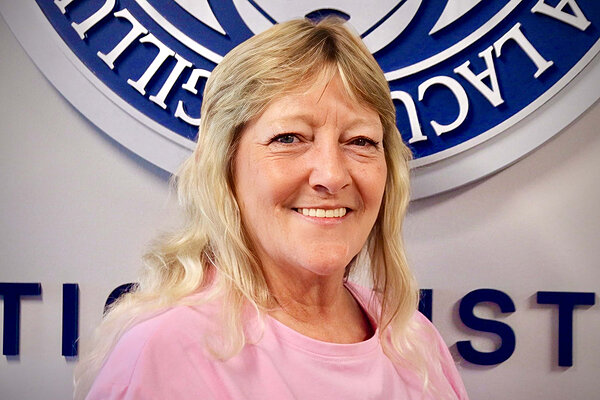
Notre Dame Law Schooltag:law.nd.edu,2005:News/1852422026-09-02T13:17:00-04:002026-09-03T10:28:30-04:00Notre Dame Exoneration Justice Clinic Client Iris Seabolt ExoneratedNotre Dame Exoneration Justice Clinic (EJC) client Iris Seabolt at the clinic
Notre Dame Exoneration Justice Clinic (EJC) client Iris Seabolt has been fully exonerated more than two decades after she was wrongfully convicted of felony murder in Elkhart, Indiana.
Special Prosecutor Nelson Chipman, the elected prosecutor of Marshall County, moved to dismiss the case against Seabolt, and, onSeptember 2, 2026, Elkhart Superior Court Judge Christopher Spataro granted the motion to dismiss, bringing to an end a case that began more than 25 years ago. Judge Spataro previously vacated Seabolt's conviction in April 2026 after finding that constitutional violations, including the State's failure to disclose critical exculpatory evidence, undermined her conviction.
In 2004, Seabolt was convicted of felony murder in connection with the August 2000 killing of A.J. Williams in Elkhart. After the State presented its case at trial, Seabolt entered a guilty plea and was later sentenced to 45 years in prison. She attempted to withdraw her plea at sentencing, stating that her guilty plea was coerced and maintaining her innocence, but the request was denied.
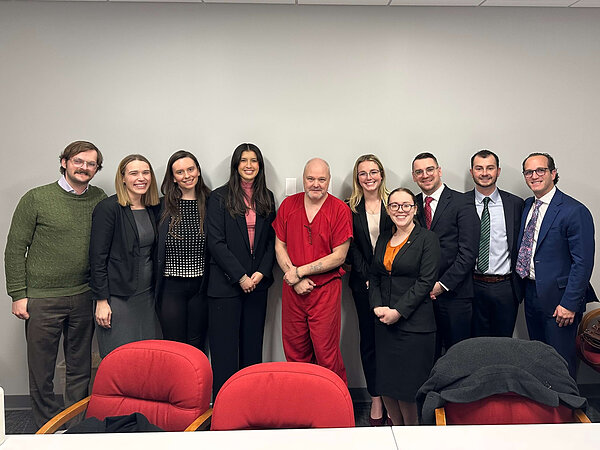
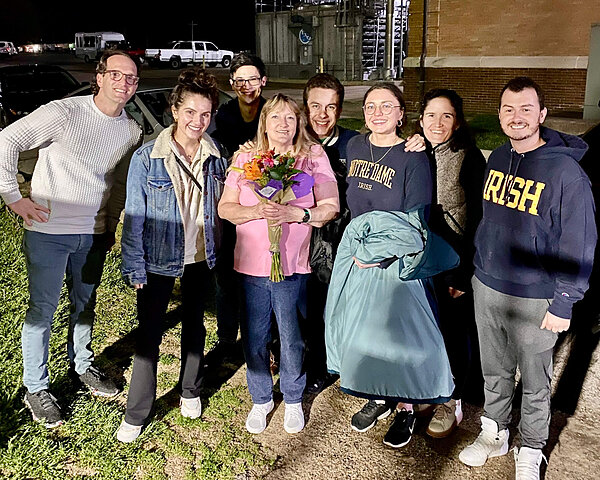
EJC staff attorneys (Elliot Slosar, Kevin Murphy, Nikolai Stieglitz, and Molly Campbell) and students (Riley Realing, Gordon McCormack, and Rachel Schneider) welcome Seabolt upon her release from prison.
Seabolt was released on parole in May 2022 after serving nearly 19 years in prison. At 12:01 a.m. on May 5, 2022, EJC students and attorneys greeted Seabolt as she walked free from Madison Correctional Facility.
Although she had regained her freedom from prison, her murder conviction remained in place for nearly four more years as the EJC continued to litigate her claims of innocence. While this litigation continued, EJC students assisted Seabolt with her reentry and reintegration into society.
“All of my success is due to the help and the friendships that have come out of this horrible situation,” said Seabolt.
EJC students and attorneys helped Seabolt secure housing, transportation, and other resources as she adjusted to life outside prison.
“They helped me find resources that I wouldn't have known how to find because I had been away so long,” she said.
Seabolt also recalled the moment she learned that the EJC would take her case after years of trying to find someone who would listen to her claims of innocence.
“Of course I cried because I spent so many years just trying to get somebody to listen,” she said.
Seabolt with EJC staff attorneys and students at the Indiana Supreme Court for oral argument in 2024
The EJC filed Seabolt's petition for post-conviction relief in June 2021. The petition presented newly discovered evidence, including recantations from key witnesses and evidence of gross police and prosecutorial misconduct in the investigation and prosecution of her case.
In April 2026, Judge Spataro granted Seabolt's petition, vacated her conviction, and ordered a new trial. The court found that the State withheld material exculpatory and impeachment evidence, including evidence concerning misconduct by former Elkhart Police Department Detective Stephen Rezutko, who played a significant role in the investigation and development of witness testimony against Seabolt.
According to court pleadings submitted by the EJC, there was no forensic evidence linking Seabolt to the crime, and the State's case relied heavily on jailhouse informants. Evidence uncovered during post-conviction proceedings showed that Rezutko fabricated witness statements, including by sharing details of the crime with informants to shape their statements and testimony. The State also failed to disclose a video-recorded interrogation of Seabolt's co-defendant threatening to have him “strap[ped]” to a “gurney” and executed if he did not cooperate with the prosecution, a video which Rezutko had previously testified did not exist. Finally, the State failed to disclose internal affairs records documenting that Rezutko had paid his informants in homicide cases for sexual acts.
In his order vacating Seabolt's conviction, Judge Spataro wrote, "The State's blatant violation of Seabolt's rights under the Due Process Clause voids her conviction and, therefore, voids her plea."
For Professor Jimmy Gurulé, founder and director of the Notre Dame Exoneration Justice Clinic, Seabolt's exoneration underscores several significant issues surrounding her case and other wrongful convictions in Elkhart County.
First, the dismissal fully vindicates Seabolt after more than two decades of maintaining her innocence and nearly 19 years of wrongful incarceration.
“Dozens of law students worked on Iris Seabolt’s case over several years. These students used their legal knowledge and training to correct the miscarriage of justice Iris suffered. These students should be commended for their hard work,” Gurulé stated.
Seabolt with EJC staff attorney Lenora Popken
Among those students was Lenora Popken ’20 J.D., now a staff attorney with the EJC, who began working on Seabolt's case during her first year at Notre Dame Law School.
“After nearly 20 years of wrongful imprisonment, the world finally knows what we have always known—that Iris is innocent,” Popken said. “Fighting alongside her since my first year of law school has been the privilege of a lifetime. Iris’s unwavering strength throughout this decades-long legal battle is nothing short of extraordinary. Today is about long-overdue justice for her, and I am deeply honored to stand with her as both her attorney and her friend.”
Second, beyond Seabolt's case, Gurulé is calling for an independent investigation of every post-conviction case involving Rezutko, with a special prosecutor appointed to conduct the investigation, in light of the malfeasance uncovered in Seabolt's case and evidence of misconduct in other wrongful conviction cases in Elkhart County.
Rezutko has been involved in at least four proven wrongful convictions in Elkhart. Internal affairs investigations also documented misconduct during his tenure with the Elkhart Police Department. In Seabolt's case, Judge Spataro found that she had been deprived of evidence that could have been used to challenge both the State's case and Rezutko's credibility.
Finally, Seabolt's case adds to a troubling history of wrongful convictions in Elkhart County. According to the National Registry of Exonerations, Seabolt’s exoneration marks the eighth exoneration in Elkhart County since 1989. There are now more proven wrongful convictions in Elkhart County than any other county in Indiana, including Marion County.
“Elkhart County holds the record of being the exoneration capital of Indiana,” said Gurulé.
Seabolt's exoneration marks the EJC's fifth exoneration, after the exonerations of Reginald "Reggie" Dillard in February 2026, Kara Beaty in April 2025, Anthony Bedolla in August 2024, and Andy Royer in July 2021.
Clinic investigator Christian Sheckler, executive assistant Anne Peterson, and staff attorneys Lenora Popken and Kevin Murphy with Seabolt
Gurulé praised the EJC team that investigated and litigated Seabolt’s case, which included staff attorney and term teaching professor Kevin Murphy '14 J.D., staff attorney Lenora Popken '20 J.D., executive assistant Anne Peterson ‘92, ‘02 J.D., adjunct professor Elliot Slosar, and at least 11 EJC students since 2021. Exoneration Project investigator Patti Fayed also worked on Seabolt’s case.
“I am so proud of the army of Notre Dame Law School students who fought for justice for Iris over the past several years,” Murphy said. “Their work was in the best tradition of Notre Dame lawyers.”
For Seabolt, her exoneration brings not only the clearing of her name, but gratitude for the people who stood beside her throughout the process.
“I am thankful to God for finally clearing my name and for using the people that He used to do it, because now, I have a whole other family,” Seabolt said.
Since its founding, the EJC has remained committed to criminal justice reform, litigating wrongful conviction cases, and educating the public about miscarriages of justice.
Learn more about the Notre Dame Exoneration Justice Clinic at exoneration.nd.edu.
EJC staff attorneys and students with Seabolt at a celebration of her exoneration
Reflections from Exoneration Justice Clinic Students
Rachel Schneider ‘23 J.D.
"Being there at midnight at a Southern Indiana prison to see Iris released from custody is a memory I will cherish forever. Iris is the most selfless, kind, hilarious, and most deserving woman I’ve met. While the courts cannot give her back the decades Elkhart stole from her, I am so happy that this day has come and I could not be prouder to have had a small role in her case. I carry my memories of Iris and the injustices she’s faced with me every day."
Riley Realing ‘23 J.D.
"Working on Iris's case was one of the most meaningful experiences of my law school career. I will never forget driving down to the Kentucky border the day she was released to pick her up at exactly 12:01 a.m. It was so special to be there and welcome her home."
Iris Seabolt's Current Student Team: Third-year law students Jake Mequet, Anna Capps, and Thatcher Maconga
"It has been a privilege to assist with Iris's representation and to work alongside the EJC attorneys, staff, and students whose dedication and resolve made this result possible. Working on Iris's case has been one of the most fulfilling parts of our law school experience. We are grateful to have played even a small part in the effort to bring Iris the justice she deserves."
]]>
Arienne Calingotag:law.nd.edu,2005:News/1851982026-09-01T10:38:00-04:002026-09-01T10:39:06-04:00Law professor Randy Kozel to succeed Tricia Bellia as Chair of Faculty Board on Athletics and NCAA Faculty Athletics Representative University President Rev. Robert A. Dowd, C.S.C., has appointed Randy Kozel, the Fritz Duda Family Law Professor, to succeed Tricia Bellia, the William J. and Dorothy K. O’Neill Professor of Law, as chair of the University of Notre Dame’s Faculty Board on Athletics and its NCAA faculty athletics representative. Kozel’s appointment is effective Feb. 1, 2027.
“Randy is an outstanding teacher, scholar and administrator whose commitment to academic integrity and student development will serve the University well in this role,” Father Dowd said. “I am grateful to Randy for accepting this appointment and delighted that he will have the opportunity to work alongside Tricia in this period of transition. Tricia’s service in this role over the past 17 years has been exemplary. She has led the Faculty Board with her characteristic wisdom, integrity and dedication, and has also been extraordinarily influential on a national level at a time of dramatic change in college athletics, earning the deep respect both of her colleagues at Notre Dame and her peers at other institutions.”
Pete Bevacqua, vice president and James E. Rohr Director of Athletics, offered similar praise.
“We look forward to working with Randy as we pursue our mission to provide the best student-athlete experience in the country,” Bevacqua said. “Randy’s expertise and leadership make him a valued partner to athletics and a worthy successor to Tricia, who worked tirelessly and consistently to help Notre Dame lead in the college athletics space.”
“Randy is the perfect fit for this role,” Bellia said. “At this time of rapid change in intercollegiate athletics, Randy will ensure that our faculty has a voice in critical decisions and will uphold the University’s uncompromising commitment to the academic, athletic and personal growth of our student-athletes. I look forward to working with him in the months to come.”
A member of the Law School faculty since 2011, Kozel teaches and researches in fields including constitutional law, trademark law and contract law. He spent nine years serving as associate dean of the Law School and directs the Program on Constitutional Structure. He served on the Faculty Board on Athletics from 2019 to 2025, including as chair of its academic integrity subcommittee.
Kozel received his undergraduate degree from the University of Wisconsin-Madison and his J.D. from Harvard Law School. Before arriving at Notre Dame, he clerked at a federal court of appeals and at the U.S. Supreme Court, worked as a litigator in a law firm, and served as special counsel to the general counsel at General Electric Co.
“I’m honored to serve in this role and grateful to Father Dowd for his trust in me,” Kozel said. “I look forward to working with our outstanding faculty, coaches, athletics staff and University partners to ensure, as Pete Bevacqua recently described it, ‘the holistic success of our students in the classroom, on the field and beyond.’”
He added, “I’m fortunate to benefit from the guidance of Tricia Bellia, whose service as chair has been truly exceptional.”
The Faculty Board on Athletics serves as the principal advisory group to Notre Dame’s president on educational issues related to athletics. The board is composed of 15 members: seven elected from the University’s teaching and research faculty; four appointed by the president (three from the teaching and research faculty and one from the student body); and four ex officio members — the vice president for student affairs, the director of athletics, the director of academic services for student-athletes, and a representative from the president’s office.
The board ensures that the University’s athletics program operates in consonance with Notre Dame’s educational mission, gathers faculty input on critical decisions about Notre Dame’s athletics program, nurtures Notre Dame’s commitment to academic integrity within the athletics program, and promotes student-athletes’ welfare and educational success. Among its activities, the board monitors data on the admission of student-athletes and their academic performance, progress toward degrees and graduation rates. It also assesses the effectiveness of institutional support for student-athletes.
The board’s activities closely match the responsibilities of the NCAA faculty athletics representative, who also is expected to advise the president, to help shape University policies affecting student-athletes and to work with other University leaders to address matters of mutual concern regarding the academic opportunities, challenges and performance of student-athletes. The faculty athletics representative also functions as a principal link between the institution and the NCAA and the Atlantic Coast Conference.
Originally published by Erin Blasko at news.nd.edu on August 27, 2026.
]]>
Erin Blaskotag:law.nd.edu,2005:News/1851582026-08-31T10:13:00-04:002026-08-31T10:13:43-04:00ND Law Professor Nicole Garnett Participates in United Nations Consultation on Educational Pluralism
Notre Dame Law School Professor Nicole Stelle Garnett traveled to the United Nations in Geneva, Switzerland to participate in the first Open Consultation on proposed Guiding Principles on Educational Pluralism, an international effort to develop guiding principles for educational systems that embrace a diversity of school providers and educational approaches.
Garnett, who serves on the steering committee for this initiative, joined a diverse group of experts at the consultation, including two United Nations Special Rapporteurs: Farida Saheed, Special Rapporteur on the Right to Education, and Alexandra Xanthaki, Special Rapporteur on Cultural Rights. The gathering marked the first in a series of international consultations designed to gather feedback on proposed Guiding Principles on Educational Pluralism before they are finalized.
The proposed principles seek to articulate a shared framework for how governments can support and regulate a diversity of educational options while at the same time guaranteeing all children the right to education.
“By educational pluralism, we mean that the government funds schools and it regulates schools and it operates schools, but it doesn't just exclusively fund the schools that it operates,” Garnett said. “The Principles embrace the plural delivery and public funding of a variety of types of schools, including religious schools and other private schools.”
The questions at the center of the project are increasingly relevant in the United States, Garnett noted, as parental choice programs expand across the country. But they carry particular significance internationally, where private and faith-based schools often play a central role in educating children.
“In many parts of the world, especially in the global South, faith-based schools have long been the primary provider of education ” she said. “If we take away the funding, these schools, which excel the critical task of educating the poorest children, may close. If they do, kids who need education the most will lose a lifeline.”
The consultation in Geneva brought together experts from a range of disciplines and perspectives, including United Nations personnel and scholars working in education and human rights from around the globe. Their varied expertise and regional experiences informed discussions surrounding the proposed principles.
Among the broader questions shaping the conversation are how governments should allocate public educational resources, the extent to which private and faith-based schools should be required to follow the same curriculum and practices as government-operated schools, and how educational systems can preserve meaningful diversity and distinctiveness while ensuring quality and accountability.
For Garnett, one of the most important aspects of the effort is recognizing that educational institutions can serve students because they have distinct missions, including religious missions.
“One reason faith-based schools may be so good at educating disadvantaged children because of their religious identity. They understand that the children entrusted to their care are children of God, and that they therefore have the responsiblity–the duty–of ensuring that the children reach their full potential,” she said. “If we force these schools to conform to the same rules that govern public schools, then it takes away the distinctiveness that animates their purpose.” Garnett remarked, “I want to ensure that faith-based schools have the freedom to be fully themselves,” she said. “And I don't want these schools to go away because the kids are going to lose their opportunity to learn.”
The international dimension of the project also underscores the varying circumstances in which religious and other non-governmental schools operate. While private schools in the United States typically enjoy substantial autonomy and religious liberty, Garnett said that schools in other parts of the world can face more restrictions.
“Making the case for pluralism is very important because some faith-based institutions operate under legal circumstances where their freedom is dramatically constrained,” she said.
Garnett's involvement in the initiative builds on her scholarship and work in education law and policy. She became connected to the project through her international work on Catholic schools and religious liberty as well as collaborations with scholars and education leaders around the world.
Her commitment to the work is informed by the Catholic understanding of the dignity of the human person and preferential option for the poor. Her work on the Guiding Principles, and commitment to educational pluralism more broadly, is motivated by her desire that families, particularly those with limited resources, have meaningful educational opportunities and access to the schools that will serve them best.
In the months ahead, regional consultations on the Guiding Principles will continue across the globe, after which the steering committee and its partners will incorporate feedback and further refine them.
For Garnett, the project represents an opportunity to contribute to a global conversation about how educational systems can better serve children and families while recognizing the important role that diverse communities and institutions play in education.
]]>
Elyse Paultag:law.nd.edu,2005:News/1849282026-08-26T16:23:00-04:002026-08-26T16:23:29-04:00Notre Dame J.S.D. Candidates Present at the World Congress of Constitutional Law and ICONS
Notre Dame J.S.D. Candidates Present at the World Congress of Constitutional Law
This summer, Notre Dame Law J.S.D. candidates Felipe Lyon Errázuriz, Ángel Muñoz-Carpintero, and Valentina Salazar presented their work at the 2026 World Congress of Constitutional Law (WCCL) hosted by Externado University in Bogotá, Colombia. The WCCL brings together more than 2,000 academics, legal professionals, and government officials from around the world interested in discussing and analyzing issues related to the theory, philosophy, practical problems, and contemporary challenges of constitutional law and human rights. This event takes place every four years and is partly promoted by the International Association of Constitutional Law (IACL).
Valentina Salazar presented her doctoral research in three different panels related to comparative law and new technologies. First, she shared her paper “From Ally to Enemy in a Click” on the use of artificial intelligence for judicial decision making at the international level in the panel “Rule of law, science, and technology.” She then participated in one of the Max Planck Institute for Public International Law workshops on “Regional comparative law,” showing how her project on a "Theory of Precedent for the Inter-American Court of Human Rights" could contribute to a better understanding of the Americas as a legal community. Finally, she presented her paper on the use of the role of the Colombian Constitutional Court in strengthening judicial reasoning in the panel “Contributions of Latin American constitutionalism to comparative law.”
“Attending and presenting my work at the WCCL was an exceptional opportunity to challenge my assumption with the questions and comments of experienced academics from all around the world," said Salazar. "It was also an amazing space for meaningful connections that I believe will lead to future projects related to international tribunals, new technologies, and human rights. I am grateful for the support that I received from the Klau Institute for Civil and Human Rights that allowed me to take part in this important event.”
Ángel Muñoz-Carpintero presented his work-in-progress paper titled “The Theseus Ship: The New Rule of Law in Nicaragua.” The paper explores the 2025 sweeping constitutional reforms of the Nicaraguan Constitution under the lens of the constitutional dismemberment framework, identifying the intersections of the rule of law, militarism, and constitutional dismemberment that the 2025 constitutional reforms in Nicaragua reveal. The paper was presented at the workshop "Constitution-Making and Constitutional Reform: Amendment, Dismemberment, and Replacement."
“After attending and presenting at the WCCL, I came back to Notre Dame with renewed energy to continue my research agenda, inspired by the amazing scholarship that is being produced world-wide in evermore important matters of constitutional and international law," said Muñoz-Carpintero. "I am grateful for the support that I received from the Kellogg Institute for International Studies, which allowed me to go to Bogotá and present my work.”
Felipe Lyon Errázuriz presented a draft of his dissertation’s second chapter in the workshop “Human Duties: An Important Constitutional Issue?”. He proposed to revive the idea of duties to the community, an understudied concept in constitutionalism that could help illuminate current questions about the responsibility of big techs in the free speech environment. Lyon Errázuriz was also one of the 100 conference participants selected for the “Mini Public on Democracy as a Human Right,” an unprecedented deliberative exercise whose results are expected to be published in the following months. He was appointed to the panel that discussed potential risks of enshrining democracy as a right and institutional ways of preventing them.
“Presenting in such a specialized panel allowed me to dig deep into some of the toughest questions of my project and to discuss specific methodological improvements with some of the best comparative constitutional scholars in the world," said Lyon Errázuriz. "Also, it was satisfactory to see how my J.S.D. peers also thrived in their presentations. I thank both the Kellogg and Klau Institutes for supporting my participation, which will enrich my future academic work.”
Notre Dame J.S.D. Candidates Present at ICONS
From June 29 to July 1, 2026, the University College Dublin’s Sutherland School of Law held the International Society of Public Law (ICON-S) annual conference: “Reimagining Public Law for a Fractured World—Technology, Identity & Truth.” Every year, this conference brings together some of the most prestigious academic work in the areas of constitutional, international, and public law. Notre Dame Law doctoral candidates Juan Carlos Gazmuri and Felipe Lyon Errázuriz participated in this year’s edition with great success.
Both Lyon Errázuriz and Gazmuri shared a workshop on the lessons and questions left by the two failed constitution-making processes that their home country, Chile, underwent between 2019 and 2023. The panel—chaired by former expert commissioner for the 2023 process and constitutional law professor, Catalina Salem from the Universidad del Desarrollo, Chile—featured works in progress by four early-career Chilean scholars and generated great interest. Gazmuri presented a paper analyzing the influence of constituent power theory on both constitution-making processes, whereas Lyon Errázuriz’s piece showed the impact that the mandatory nature of the 2022 and 2023 ratification referendums might have had on their respective constitutional drafts, their electoral rejection, and their aftermath.
Additionally, they presented parts of their doctoral theses in specialized workshops. Gazmuri presented his work on “Political parties, digitalization, and democratic backsliding,” providing evidence that the decline and desinstitutionalization of political parties are highly predictive of a country’s likelihood of experiencing democratic backsliding. From there, he discussed potential tools that constitutional and electoral design can use to address these challenges. His panel featured constitutional scholars from Greece, Brazil, and Belgium. Lyon Errázuriz presented his piece “Responsibility of Tech Companies on the Free Speech Environment: A Fundamental Duties Perspective,” in which he proposes a framework based on constitutional duties to establish big tech’s liability regarding defamation and other harmful alterations of the truth happening in their platforms.
Lyon Errázuriz said, “It was a privilege to represent Notre Dame Law School and share my work in this prestigious conference. ICON-S allows you to engage with early-career and top-notch consolidated scholars in a unique way, which leaves me with great energy to continue my research. I’m grateful for all the support from Notre Dame Law School and the Kellogg Institute, for allowing me to participate on such a stage not only with my doctoral project, but also with a contribution to the Chilean academic debate.”
Gazmuri added, "Notre Dame Law School and the Kellogg Institute for International Studies have given me a unique opportunity to engage with constitutional scholars from around the world, for which I am deeply grateful. These conferences provide us with a valuable opportunity to learn from colleagues and to enrich our research.”
Across both conferences, the Notre Dame J.S.D. candidates presented their research alongside and engaged with scholars representing universities and institutions across Colombia, Chile, Italy, Spain, Greece, Brazil, Belgium, Hong Kong, the United States, and other countries and regions.
]]>
Notre Dame Law Schooltag:law.nd.edu,2005:News/1850432026-08-25T16:37:00-04:002026-08-25T16:50:12-04:00Notre Dame Law School Welcomes Visiting Faculty for the 2026–27 Academic Year
Four visiting faculty members join the Notre Dame Law School community for the 2026–27 academic year, including two new and two returning faculty members. Andrew Torrance and Dennis J. Wieboldt III join the Law School as visiting faculty this year, while Frederick Mostert and Daniel Slate return to the Law School for the 2026–27 academic year. Mostert previously served as a visiting professor of law in fall 2025 and also serves as an adjunct professor for the Notre Dame London Law Programme. Slate joined the Law School as a visiting assistant professor during the 2024–25 academic year. Together, they bring expertise spanning intellectual property, technology and artificial intelligence, constitutional law and legal history, and law and religion.
Visiting Faculty
Frederick Mostert
Frederick Mostert joins the Law School as a visiting professor of law for Fall 2026 and previously served as a visiting professor in Fall 2025. He is a professor of practice for the Notre Dame London Law Programme. He is also a professor of practice at the Dickson Poon School of Law, King’s College London, and a research fellow at the Oxford Intellectual Property Research Centre.
Mostert has advised global organizations, including the World Intellectual Property Organization and the European Union Intellectual Property Office. Frederick was inducted into the Intellectual Property Hall of Fame in 2015, which honors those who have helped to establish intellectual property as one of the key business assets of the 21st century. His pro bono work has included assisting President Nelson Mandela, the Shaolin Monks, and First Nations communities in Canada. He earned a LL.M. from Columbia Law School and a LL.D. from the University of Johannesburg.
Daniel Slate
Daniel Slate, visiting assistant professor of law, researches and writes on law and technology, emergency powers, and constitutional history. His technology law scholarship is informed by previous experience in the software industry, where he worked in product management, business development, and privacy and civil liberties roles. In the past year, his article Infringed has been cited in federal judicial opinions and at oral argument before the United States Supreme Court in Wolford v. Lopez.
Slate is a faculty affiliate of the AI Trust and Reliability Lab and the Human-Centered Responsible AI Lab at Notre Dame’s Data, AI, and Computing Initiative. He earned his B.A. in philosophy, with honors and distinction, J.D., and Ph.D. in political science from Stanford University and also studied in yeshivot in Israel.
Andrew Torrance
Andrew Torrancejoins Notre Dame Law School as a visiting professor of law. He is the Paul E. Wilson Distinguished Professor of Law and Associate Dean of Graduate and International Law at the University of Kansas School of Law, as well as a visiting scholar in Behavioral and Policy Sciences at the MIT Sloan School of Management. Torrance teaches and writes in patent law, intellectual property, innovation, food and drug regulation, biotechnology and biodiversity law, and the empirical, experimental, and big-data study of legal systems. His recent scholarship increasingly focuses on the law and governance of artificial intelligence, including the legal treatment of training data, regulation of autonomous systems, and the role advanced AI could play within legal and social systems.
Torrance founded the Biolaw conference and co-founded PatCon, an annual patent scholarship conference. From 2019 to 2021, he led intellectual property at the Eli and Edythe Broad Institute of MIT and Harvard, and he has delivered approximately 400 scholarly presentations and guest lectures in more than a dozen countries. He was elected to the American Law Institute in 2022 and previously served as a policy advisor on the Technology, Media, and Telecommunications Committee of then-presidential candidate Barack Obama in 2008. Torrance earned his B.S. from Queen’s University in Canada, his J.D. from Harvard Law School, and his Ph.D. in biology from Harvard University.
Dennis J. Wieboldt III
Dennis J. Wieboldt IIIjoins Notre Dame Law School as a visiting assistant professor of law and serves as the Robert E. Rodes, Jr. Fellow in Law and Religion, a fellowship supported by the Law School’s Program on Church, State & Society. He is also completing his Ph.D. in history at the University of Notre Dame. Wieboldt writes in the areas of constitutional law and legal history, with a particular focus on the First Amendment’s Religion Clauses, and has authored more than 30 academic articles, book reviews, and other essays.
Wieboldt came to Notre Dame in 2023 as the first student to concurrently pursue a J.D./Ph.D. in history. He earned his J.D. magna cum laude from Notre Dame Law School in 2026, receiving the Award for Outstanding Achievement in the Program of Law, Ethics & Public Policy, as well as the A. Harold Weber Writing Award and the Patricia O’Hara Scholarship and Leadership Award. He previously earned his B.A. summa cum laude and Phi Beta Kappa and his M.A. in history from Boston College. Wieboldt also serves as the Leep Family Rector of Graham Family Hall at Notre Dame and is a non-resident research fellow of the Georgetown Center for the Constitution.
]]>
Notre Dame Law Schooltag:law.nd.edu,2005:News/1849132026-08-21T14:58:00-04:002026-08-25T10:00:21-04:00Notre Dame Law School Welcomes New Faculty Members for 2026–27 Academic Year
Notre Dame Law School is pleased to welcome six new faculty members for the 2026–27 academic year. Collectively, they bring extensive scholarly, teaching, and practical experience across a wide range of legal fields.
“Our new faculty bring extraordinary breadth to Notre Dame Law School, with expertise spanning business law and entrepreneurship, legal philosophy, federal courts, and legal writing, while sharing a deep commitment to excellence in scholarship and teaching,” said G. Marcus Cole, the Joseph A. Matson Dean and Professor of Law. “I am excited for the contributions they will make to our intellectual community, the students they will teach, and our mission to educate lawyers and leaders who will become forces for good.”
New Faculty Members
Ahson Azmat
Ahson Azmathas joined the Law School as an associate professor of law. He specializes in business law and private law theory, with specific interests in securities and antitrust litigation, corporate disclosure, and fiduciary duties. Azmat has practiced as a commercial litigator in New York after clerking for the U.S. Court of Appeals for the Second Circuit, with extensive stand-up trial, discovery, and appellate experience. At Notre Dame, he will be teaching Contracts, Business Associations, and other courses. Azmat’s scholarship has been published in the Harvard Law Review, Oxford University Press, and the Journal of Tort Law. His current research interests include corporate fraud, causation, and analytic jurisprudence.
Azmat earned an A.B. from Princeton University, a J.D. from Harvard Law School, and a Ph.D. from Harvard University. He has also served as a non-resident Research Fellow at Georgetown University.
Anne Choike
Anne Choikehas joined the faculty as a clinical professor of law and founding director of the Notre Dame Entrepreneurship Law and Policy Clinic. She has founded, directed, and taught in transactional law clinics at multiple law schools, supervising student attorneys in advising clients ranging from mission-driven startups and nonprofits to small businesses. Choike’s current scholarship interests include clinical pedagogy; the intersection of corporate and securities law with local government law; and feminist legal theory and methods.
Among her other prior faculty appointments, Choike previously visited the Law School in 2025, where she co-taught the Community Development Clinic with Professor Jim Kelly. Prior to her career in academia, she practiced as an associate at Jenner & Block and Stroock & Stroock & Lavan in New York City, where she represented Fortune 50 companies, financial institutions, and private equity-backed companies in capital markets and strategic transactions. She also serves as Of Counsel at Peak Legal, a Warsaw-based law firm specializing in complex technology projects.
She earned a B.A. from Cornell University, a J.D. from the University of Michigan Law School, and a M.U.P. from the University of Michigan.
“I am thrilled to return to Notre Dame Law School and contribute to the impressive recent growth of the clinical law program, and offer more transactional law opportunities for the school’s students. Serving entrepreneurs—locally, nationally, and internationally—whose legal needs are unmet, and preparing the next generation of lawyers to do so, is at the heart of my teaching, research, and service," said Choike. "I believe deeply that business law can be a means of advancing human flourishing: that ventures are inherently human, deals are inherently relational, and lawyers can help entrepreneurs build businesses that reflect their values and contribute to their communities. Notre Dame Law School’s distinctive commitment to educating a different kind of lawyer makes it an unparalleled place to bring together rigorous business-law training and an authentic orientation toward service.”
Will Kamin
Will Kaminhas joined the full-time faculty as an associate professor of law after serving as a visiting associate professor of law at the Law School during the 2025-2026 academic year. He teaches and writes in the areas of habeas corpus, federal courts, civil procedure, and legal history. His scholarship on habeas corpus has been published or is forthcoming in the Stanford Law Review, the University of Pennsylvania Law Review, and the University of California, Davis Law Review. Before entering academia, Kamin clerked for Judge Richard J. Sullivan of the U.S. Court of Appeals for the Second Circuit and Judge Diarmuid F. O’Scannlain of the U.S. Court of Appeals for the Ninth Circuit.
He earned a B.A. from Amherst College and his J.D. from Yale Law School.
“Teaching (and writing) at Notre Dame Law School has long been a dream for me, and I feel profoundly blessed to be joining the regular faculty here. As a visitor at Notre Dame last year, I was consistently blown away by both the brilliance and the kindness of my colleagues and students alike. I was especially excited to see how many students are now coming to NDLS with an interest in pursuing vocations in legal academia, and I relish the opportunity to help such students find their voices as young scholars," said Kamin.
Margaret Martin
Margaret Martinhas joined the Law School faculty as a professor of law after serving as a visiting associate professor of law at Notre Dame Law School during the 2025-2026 academic year. She previously served as an associate professor at the Faculty of Law at the University of Western Ontario, where she researched and taught legal philosophy, international criminal law, criminal theory, Canadian constitutional law, and the history of political thought. She is on the board of the Canadian Journal of Law and Jurisprudence, Jurisprudence, and the American Journal of Jurisprudence. Martin has also held fellowships at the University of Toronto and Corpus Christi College at the University of Cambridge and was a visiting professor at the Universidade Federal de Minas Gerais in Brazil in 2024.
She is the author of Judging Positivism (Hart Publishing, 2014) which is a contribution to the modern debate about legal positivism.
She earned a B.A. in Philosophy and English Literature and a M.A. in Philosophy, both from McMaster University. She has a Ph.D. from the University of Cambridge, Faculty of Law, and a Master of Studies of Law from the University of Toronto, Faculty of Law.
"Notre Dame is a very special place. The faculty and the students I have met here are exceptional in every way. It is exciting to join a community that is committed to academic excellence and to the pursuit of the common good," said Martin.
Sarah Pojanowski
Sarah Pojanowskihas joined the faculty as an assistant teaching professor. She previously taught Legal Writing at the Law School in an adjunct capacity. She began her legal career at Heller Ehrman LLP, where she practiced general litigation, antitrust, and trade regulation law, and later continued her antitrust practice at Paul Hastings LLP. She then served for 16 years as general counsel of Selected Independent Funeral Homes. Her teaching and research interests include clear written communication, small business law, death care law, and consumer protection law.
She earned her undergraduate degree from Concord College and her J.D. from Harvard Law School.
Micah Quigley
Micah Quigleyhas joined the faculty as an associate professor of law. He teaches or writes about remedies, habeas corpus, federal courts, and jurisprudence. His scholarship has appeared in the University of Pennsylvania Law Review and the George Mason Law Review, among others. He is also a non-resident research fellow at the Georgetown Center for the Constitution. Before joining the Law School faculty, he was a non-resident fellow at the Stanford Constitutional Law Center and practiced law in Washington, D.C. Quigley clerked for Judge Andrew Oldham on the U.S. Court of Appeals for the Fifth Circuit, Judge Neomi Rao on the U.S. Court of Appeals for the D.C. Circuit, and Justice Neil Gorsuch on the U.S. Supreme Court.
He studied political science and philosophy at Grove City College, and earned his J.D. from the University of Chicago Law School.
]]>
Notre Dame Law Schooltag:law.nd.edu,2005:News/1849492026-08-20T13:29:00-04:002026-08-20T14:56:10-04:00ND Law Professor Jimmy Gurulé Leads Trainings for Mexican Foreign Affairs Officials and Advances the Program for the Defense of Mexican NationalsProfessor Jimmy Gurulé and Katie Takeuchi meet with Undersecretary Cristina Planter Riebeling in Mexico City to discuss the Program for the Defense of Mexican Nationals
Notre Dame Law Professor Jimmy Gurulé, founder and director of the Notre Dame Exoneration Justice Clinic (EJC), conducted two four-hour training sessions on August 13-14 at Mexico's Directorate-General for Consular Protection and Strategic Planning, a division of the country's Secretaría de Relaciones Exteriores (Ministry of Foreign Affairs). Katie Takeuchi, staff attorney at the EJC, joined Gurulé in Mexico City to facilitate the sessions. The training covered major causes of wrongful conviction, procedures for evaluating cases for the Program for the Defense of Mexican Nationals (PDM), and an overview of the American criminal justice system. Fifteen members of Mexico's Ministry of Foreign Affairs participated in the first day of training.
In fall 2023, Mexico's Ministry of Foreign Affairs awarded the EJC a $3 million grant to administer the PDM, a program that provides legal assistance to Mexican nationals facing criminal charges or wrongful convictions in the United States. The program is essential to ensuring that Mexican nationals in the United States receive fair and effective legal representation in a political climate that is hostile to immigrants. The PDM is supported by the Directorate-General for Consular Protection and Strategic Planning, which oversees consular protection and legal assistance for Mexican nationals abroad.
Professor Jimmy Gurulé and Katie Takeuchi pictured with Director General Vanessa Calva Ruiz and her staff at the Directorate-General for Consular Protection and Strategic Planning in Mexico City
In addition to the training sessions, Gurulé and Takeuchi met with Cristina Planter Riebeling, Undersecretary for North America at the Ministry of Foreign Affairs, and Vanessa Calva Ruiz, Director General of Consular Protection and Strategic Planning.
“The PDM has attracted a high level of interest and attention within the Ministry of Foreign Affairs,” said Gurulé.
Planter Riebeling expressed strong support for the PDM and asked how her office could further support the program and help ensure its continued success. Gurulé said Planter Riebeling described the PDM as one of the Ministry of Foreign Affairs' top priority programs.
Following the meeting, Planter Riebeling wrote, “The meeting provided an opportunity to highlight the important results achieved through the program and discuss next steps.” She also expressed appreciation for the “excellent collaboration” that the Ministry of Foreign Affairs has developed with Gurulé and his team.
Professor Jimmy Gurulé and Katie Takeuchi in a meeting with Undersecretary Cristina Planter Riebeling, Director General Vanessa Calva Ruiz, and other Ministry of Foreign Affairs officials
“I'm in regular communication with Director General Vanessa Calva Ruiz and her staff on the cases that we're accepting for legal representation, giving them updates on the progress that we're making,” said Gurulé.
During their visit to Mexico City, Gurulé and Takeuchi also met with Maria Mercedes Salmon, director of Notre Dame Mexico, and Dr. Imer Flores, research professor of law at the National Autonomous University of Mexico (UNAM) Faculty of Law, to discuss their support for the PDM.
Gurulé and Takeuchi met with Salmon to discuss the future of the PDM and Notre Dame Law School's growing presence in Mexico. “The PDM is one of the crown jewels of Notre Dame's presence in Mexico City,” Gurulé said.
Their meeting with Flores focused on ways to further strengthen the relationship between Notre Dame Law School and the UNAM Faculty of Law, particularly through the EJC's summer internship program. This summer, two UNAM students participated in the program on Notre Dame's campus.
“Overall, I thought it was a very productive visit,” said Gurulé. “In our short two-and-a-half-year relationship with the Directorate-General for Consular Protection and Strategic Planning, we've had a really substantial caseload. The PDM is really functioning. It's being fully implemented and operating on all cylinders.”
]]>
Arienne Calingotag:law.nd.edu,2005:News/1846242026-08-07T15:16:00-04:002026-08-23T19:48:39-04:00Notre Dame Law School Welcomes Global Visiting Faculty for Fall 2026
As we usher in the new academic year at Notre Dame Law School, International and Graduate Programs (IGP) is pleased to announce the new cohort of Global Visitors for the Fall 2026 semester. Every year, we host scholars and jurists from around the world, including faculty from our esteemed Notre Dame London Law Programme, academics from partner schools, as well as special guests and colleagues of our own Notre Dame Law faculty.
Under Dean G. Marcus Cole’s leadership, the Law School has cultivated a dynamic global partnership program. At the time of publication, we have 13 partnerships with institutions across three continents, including 12 law schools and one high court. This Fall, we will welcome six scholars from five of our partner schools located in Brazil, Germany, Ireland, and Kenya. We are lucky to enjoy ever-deepening ties with our long-term partners, just as we continue to strengthen new relationships.
Our honored guests this Fall include a distinguished international arbitrator, an expert in family studies and ethics, a consultant for top global organizations like the World Bank, and several other accomplished scholars across a diverse array of disciplines including privacy law, constitutional studies, financial regulation, and digital platform governance.
We at IGP are so excited to welcome this cohort to our community and to help foster new connections and experiences through our Fall slate of global programming opportunities. A few of these incoming scholars will deliver courses on their areas of expertise, allowing students to enrich their schedules with studies in African Human Rights Law, Comparative Constitutional Law, and International Commercial Arbitration. In addition, this cohort will deliver workshop presentations, chair panel discussions, and provide mentorship to our doctoral students.
Stefan Kröll (Professor for International Dispute Resolution, Bucerius Law School): Professor Dr. Kröll will teach a 1-credit course on International Commercial Arbitration, drawing on his years of expertise in the field as both a scholar and as an arbitrator for cases involving various global institutions including the International Chamber of Commerce, the United Nations Commission on International Trade Law, and the Vienna International Arbitral Centre, among others. October 5 – October 28, 2026.
Jane Wathuta (Dean of Law School and Director of the Institute for Family Studies & Ethics, Strathmore University): Dr. Wathuta’s current research project is "The African Woman in Her Strength: The Evolution of Women in the Legal Profession and Policymaking in Kenya." The project combines doctrinal legal research, historical analysis, and policy review in order to trace the increasing number of women practicing the legal profession in Kenya and seeks to explain the forces and patterns driving that increase. October 26 – November 5, 2026.
Global Visiting Professor of Law
Stephan Wernicke(Professor of Law, Humboldt-Universität zu Berlin): Professor Dr. Wernicke will present on his research project, “EU Inc. — A New European Corporate Legal Form,” as a guest in Notre Dame Law School’s Law and Economics Seminar. During his visit, he will also conduct research for a monograph on “European Law and European Normative Thinking.” September 14 – September 24, 2026.
Global Visiting Associate Professors of Law
Paul Yowell(Associate Professor of Law, Oriel College at Oxford): Professor Yowell will teach a 1-credit course on “Comparative Constitutional Law.” In addition to his professorship at Oxford, he is also a Global Associate Professor of Law with the Notre Dame London Law Programme. September 7 – 23, 2026.
Clara Martins Pereira (Associate Professor of Financial Law, Durham University): Professor Martins Pereira will present her article, “Artificial Intelligence and the future of financial stability: regulatory and supervisory gaps in the UK framework,” at Notre Dame Law School's Faculty Colloquium. She is also a Global Associate Professor of Law with the Notre Dame London Law Programme. September 7 – September 18, 2026.
Róisín Costello (Deputy Director of the Trinity Centre for Constitutional Law and Assistant Professor of EU and International Law, Trinity College Dublin): Dr. Costello will present research from her monograph project, “Transatlantic dialogues: the development of privacy in the common law world 1600 - 1850,” as part of the IGP Forum series of workshops. In addition, she will participate in a panel discussion for the American Conference for Irish Studies - Midwest and South Regional Conference; as well as deliver a talk on Indigenous language rights and policy issues, co-sponsored by the Irish Language Initiatives. September 21 – October 1, 2026.
Ivar Hartmann (Associate Professor of Law, Insper São Paulo): Professor Hartmann will deliver a research presentation as part of the IGP Forum series. Drawing from his expertise in the field of digital platform governance, Professor Hartmann’s research provides novel quantitative data about the Meta Oversight Board and interrogates the merits of the popular analogy that Meta is the “Supreme Court for online speech.” October 5 – October 12, 2026.
Enrico Andreoli (Associate Professor, University of Verona): Professor Andreoli will develop his ongoing monograph project which investigates the role of unwritten constitutional law across five jurisdictions: the United Kingdom, United States, Canada, Australia, and New Zealand. November 9 – November 19, 2026.
Global Visiting Fellow in Law
Allan Mukuki (Doctoral Fellow and Director of Global Partnerships, Strathmore Law School): While at Notre Dame Law School, Professor Mukuki will teach a 1-credit course on “African Human Rights Law.” In addition, he will present a research paper as part of the IGP Forum series. His paper, “Protection-Sensitive Mobility and Responsibility-Sharing in the East African Community: Towards a Regional Model for Refugee Management,” examines the legal and institutional possibilities for developing common refugee management mechanisms within the East African Community. November 3 – 19, 2026.
]]>
Notre Dame Law Schooltag:law.nd.edu,2005:News/1855002026-07-21T14:02:20-04:002026-09-28T14:01:00-04:00Notre Dame Law School’s Religious Liberty Clinic, Bellwether International, and Lantos Foundation publish report reviewing campaign that contributed to release of prisoner of conscience
Notre Dame Law School’s Lindsay and Matt Moroun Religious Liberty Clinic, Bellwether International, and the Lantos Foundation for Human Rights and Justice released the second annual Religious Prisoners of Conscience: An Advocacy Brief Prepared for the IRF Summit Community. These organizations have played a central role in supporting the International Religious Freedom Summit’s 2026 Religious Prisoners of Conscience Campaign, which advocates on behalf of individuals imprisoned for exercising their freedom of religion or belief.
That campaign contributed to China’s release of Pastor Ezra Jin Mingri on July 3. Pastor Jin founded Zion Church, one of China’s largest unregistered Protestant churches, and was detained in October 2025 alongside other church leaders during a nationwide crackdown. Chinese authorities accused him of illegally using information networks to conduct church activities.
As part of the 2026 campaign, Religious Liberty Clinic students Aleah Schrock ’27 J.D. and Isabella Fazio ’26 J.D., supervised by Clinic attorney Kimberlie Orr, contributed to the campaign’s research and advocacy efforts. The students examined cases involving religious prisoners of conscience from around the world, including the circumstances of individual prisoners, the laws used to justify their detention, and broader patterns of religious repression. They also consulted with international stakeholders and assessed opportunities for diplomatic advocacy.
That research informed the selection of Pastor Jin and Fayzulla Agzamov of Uzbekistan for focused advocacy. The IRF Summit and its partners then pursued coordinated international advocacy on behalf of both men. In Pastor Jin’s case, the campaign complemented broader advocacy by the Human Rights Foundation, Freedom House, and others, as well as a public call from President Donald Trump for his release. Agzamov remains imprisoned, and advocacy for his release continues.
The advocacy brief places the campaign within a broader examination of the imprisonment of people for their religious beliefs and activities worldwide. Drawing on information from the U.S. Commission on International Religious Freedom’s prisoners of conscience database, the brief identifies patterns in how governments restrict religious practice and examines the legal mechanisms used to imprison or prosecute members of religious communities. These include laws that directly criminalize religious conduct as well as broadly written or selectively enforced laws used to target religious minorities. The brief is intended to support more effective international advocacy on behalf of religious prisoners of conscience.
“Our students had the opportunity to put rigorous research into practice alongside experienced international religious freedom advocates,” Orr said. “Pastor Jin’s release is a powerful reminder of what sustained, collaborative advocacy can achieve and why this work matters for people imprisoned for their faith.”
“People imprisoned for their faith have few options when their domestic legal systems restrict freedom of religion or belief,” Schrock said. “This type of advocacy can be one of the only remaining avenues for freedom, but it does not guarantee any particular result. That makes Pastor Jin’s release incredibly good news.”
About the Notre Dame Law School Religious Liberty Clinic
The Lindsay and Matt Moroun Religious Liberty Clinic is a teaching law practice that educates, forms, and prepares Notre Dame law students to become the rising generation of religious liberty leaders by training students in the practice of law as they defend religious freedom for all people.
Under the guidance of Law School faculty and staff, students work on a broad variety of legal matters to promote religious freedom on behalf of individuals and organizations of all beliefs—both domestically and abroad. The Clinic represents clients from all faith traditions to promote not only the freedom for people to hold religious beliefs but also their fundamental right to express those beliefs and to live according to them. Learn more about the work of the Clinic here.
]]>
Notre Dame Law Schooltag:law.nd.edu,2005:News/1830492026-07-16T13:59:00-04:002026-08-03T13:28:29-04:00Defenders of religious liberty join for the sixth annual Notre Dame Religious Liberty Summit
Each year, Notre Dame Law School hosts the Notre Dame Religious Liberty Summit, bringing together scholars, advocates, and faith leaders for discussions on complex religious liberty issues and the future of religious freedom in the United States and around the world.
This year the sixth annual Notre Dame Religious Liberty Summit featured over 20 speakers in 6 panel discussions on topics such as the religious foundations of the American Revolution, religious freedom and the making of free societies, and localism, state political experimentation, and religious freedom. Over 100 leading defenders of religious liberty gathered in Chicago, Illinois for the summit.
Notre Dame Law School Dean G. Marcus Cole delivers opening remarks at the 2026 Notre Dame Religious Liberty Summit.
Dean G. Marcus Cole, the Joseph A. Matson Dean and Professor of Law, introduced the theme in his opening remarks.
“The theme of this year’s summit is ‘We Hold These Truths…’ As we celebrate the 250th anniversary of the birth of our nation – the first nation in the history of the world to be founded upon the core principle of religious freedom – it is appropriate that we do so here in Chicago, a city in which virtually every faith in the world is represented,” said Dean Cole.
“The purpose of the Notre Dame Religious Liberty Summit is to explore issues, ideas, and strategies toward the protection and promotion of religious liberty, here in the United States and around the world.”
The panel discussions were grounded in the broader context of the nation’s 250th anniversary of the Declaration of Independence and reflected on the enduring principles of human dignity, freedom of conscience, and the God-given right of every person to live according to their beliefs.
Professor Melissa Moschella speaks during the panel session “The Laws of Nature and of Nature's God: Natural Law and Rights."
In the first panel, “The Laws of Nature and of Nature's God: Natural Law and Rights,” Professor Melissa Moschella, a professor of philosophy at the University of Notre Dame, spoke on the sacred importance of religious liberty in our nation.
“If in line with the natural law tradition and the view of religion dominant in our nation's founding, we can understand religion as something objectively and distinctively valuable for human beings, not only as one among many goods that contribute to human fulfillment, but as a good that plays an architectonic that is a governing and structuring role in the good life. Then justice, and by extension law, requires giving it its special treatment in accordance with its special role in good life.”
In a keynote address, Dr. Jacqueline Rivers, the executive director of the Seymour Institute for Black Church and Policy Studies, spoke about the importance of engaging the Black Church in the defense of religious freedom.
"For African Americans, the relationship to religious freedom is quite complicated. As we celebrate the 250th anniversary of the signing of the Declaration of Independence and as we reflect on these truths that we hold to be self-evident, we need to recognize that for African Americans, for Black people, for enslaved Africans at the time of the founding, they were actually denied religious freedom.” said Rivers.
"We call on all the fighters for religious freedom to engage a powerful ally—the Black Church—by standing with us in the challenges we face."
Third-year law student Mintae Cha speaks during the panel session "The Religious Foundations of the American Revolution."
Additional panels were held on the second day of the summit including, “The Religious Foundations of the American Revolution” with Mr. Mintae Cha, a third-year law student at Notre Dame Law School, Professor Daniel Slate (Notre Dame Law School), and Professor John Witte (Emory University School of Law). The session was chaired by Professor Nicole Garnett (Notre Dame Law School).
The third panel of the day featured a discussion on "Religious Freedom and the Making of Free Societies." Attendees heard from Professor Daniel Philpott (University of Notre Dame), Professor Allen Hertzke (University of Oklahoma), and Ms. Samah Norquist (Religious Freedom and Foreign Policy Expert). The session was chaired by Professor Rick Garnett (Notre Dame Law School).
The summit’s final day of academic programming featured a discussion on the “Localism, State Political Experimentation, and Religious Freedom” with insights from Professor Chris Lund (Wayne State University Law School), Professor Phillip Muñoz (University of Notre Dame), and Professor Mark Storslee (University of North Carolina School of Law). The session was chaired by Professor John Meiser (Notre Dame Law School).
“State religion isn't like zoning or tax policies. Experimentation sometimes teaches us something, but basic rights are not things we should experiment with. If religion is a fundamental right, if it's a universal right, then it should be enjoyed universally,” shared panelist Chris Lund.
Professor John Meiser, director of the Lindsay and Matt Moroun Religious Liberty Clinic, speaks during the panel session “Localism, State Political Experimentation, and Religious Freedom."
"The heart of [the Declaration] was not simply protecting freedom in the abstract but indeed protecting the right of a people to independently govern themselves. It was a reaction against not just a political system that suppressed freedom but that violated the very idea that a community governs itself – and to resist a distant authority from outside," said Meiser.
Rabbi Meir Soloveichik of Congregation Shearith Israel delivered a keynote address on the final day of the summit. Rabbi Soloveichik serves as the rabbi of Congregation Shearith Israel, the oldest Jewish congregation in the United States, and as the director of the Zahava and Moshael Straus Center for Torah and Western Thought at Yeshiva University.
“America looked to the Jewish story as an indication of divine blessing and therefore as a source of inspiration for the sort of country America was called to be. The Jews were to be welcomed in America, Washington decided, not only because of the idea, but also because of the way in which the Jewish story inspired America itself,” said Soloveichik. "America's unity was never meant to come from sameness, but from a shared commitment to enduring principles."
“The warmth that Jews experienced in the nascent nation that was the United States can only be fully understood if we understand the way in which many founders and America in general saw the story of biblical Israel as a source of inspiration.”
Rabbi Meir Soloveichik of Congregation Shearith Israel delivers a keynote address.
Drawing on the ideas of the late Chief Rabbi Lord Jonathan Sacks, Rabbi Soloveichik argued that American society, from the Pilgrim Fathers onward, was based on the concept of covenant as set out in the Tanakh, the Hebrew Bible, particularly in Exodus and Deuteronomy. He then quoted Rabbi Sacks, describing the United States as "that rare phenomenon: a covenant society. Covenant societies represent conscious new beginnings. They are founded on an idea, dedicated to a proposition."
"The rights we enjoy as Americans are fragile. They must be cherished, protected, and taught from generation to generation, because what may appear ordinary to us is actually extraordinary," said Soloveichik.
During lunch on Wednesday, participants enjoyed a screening of the trailer for the film “American Martyr: The Stanley Rother Story,”a feature-length documentary. The film tells the true story of Blessed Stanley Rother, an American priest from Oklahoma who was martyred after returning to Guatemala during the country's civil war, refusing to abandon the Indigenous people he served.
The trailer screening was followed by remarks from Michael Scaperlanda, chancellor for the Archdiocese of Oklahoma City. The documentary is heavily rooted in the work of Scaperlanda and his wife, María Ruiz Scaperlanda, who has spent decades championing Blessed Stanley Rother's legacy. Her book, “The Shepherd Who Didn't Run: Blessed Stanley Rother, Martyr from Oklahoma,” serves as a foundational text on his life.
Additional panels were held during the day, including “Religious Freedom and Abundance” offering insights from Professor Angela Carmella (University of Seton Hall Law School), Professor John Infranca (Suffolk University), and Mr. Jim Towey (Aging with Dignity). The session was chaired by Fr. Patrick Reidy, C.S.C. (Notre Dame Law School).
Sr. Petra Nielsen speaks during the panel session “Religious Freedom and the Catholic Mission in a Secular Age."
Lastly, “Religious Freedom and the Catholic Mission in a Secular Age” featured insights into religious freedom from a Catholic perspective. Panelists included Sr. Marie Morgan (Franciscan Alliance Inc.), Sr. Petra Nielsen (Franciscan Alliance Inc.), Fr. Jordi Pujol (Pontifical University of Santa Croce), Bishop Robert McClory (Diocese of Gary), and was chaired by Msgr. John Paul Kimes (Notre Dame Law School).
The Summit’s culminating event was the Religious Liberty Gala and Awards Dinner held on Wednesday, July 8.
During the dinner, the 2026 Notre Dame Prize for Religious Liberty was presented to the Becket Fund for Religious Liberty, a nonprofit public interest law firm based in Washington, D.C. with a mission to protect the free expression of all faiths.
Mark Rienzi, president and CEO of the Becket Fund for Religious Liberty, accepts the 2026 Notre Dame Prize for Religious Liberty on behalf of the entire team at Becket.
Mark Rienzi, president and CEO, accepted the award on behalf of the Becket Fund.
"An award to the Becket Fund should be an award to the team at Becket,” said Rienzi. This is an ensemble effort. This is not any one person. The Becket Fund, from the start, has been a collection of highly talented people who decided to jump in and do a big thing together, and it really is a privilege and a blessing to be part of the team at Becket."
"Religious liberty helps real people, and it helps real people live out their faith... Religious liberty protects good things, and it makes those good things happen... It's a great joy and privilege for us to get to work on that."
The 2026 Religious Liberty Scholarship Award was presented to John Witte of Emory University School of Law. A leading specialist in legal history, human rights, religious freedom, marriage and family law, and law and religion, Witte has published over 300 articles, 18 journal symposia, and 45 books.
“Faith is the foundation of freedom, and religious freedom is the cornerstone of human rights. And orderly freedom, in turn, is the essential condition for the flourishing of both families and of faith in humanity. I am profoundly grateful for the 45 years of work that the good Lord has given me to do in this field,” said Witte.
Summit attendees enjoyed a dinner cruise on the Chicago River and Lake Michigan.
The Summit also included cultural experiences for attendees, including a tour of the Field Museum, a natural history museum located in downtown Chicago, and a dinner cruise on the Chicago River and Lake Michigan. These opportunities provided a chance for continued dialogue among participants.
"The purpose of the Notre Dame Religious Liberty Summit is to serve as a forum to exchange ideas and discuss issues and to develop strategies to advance the fight for religious freedom in the United States and around the world,” said Dean Cole. “The summit and the conversations that we're having are central to our mission, both our Catholic mission as a law school, but also our mission and our vocation with regard to religious liberty.”
More stories and news about the 2026 Notre Dame Religious Liberty Summit: