tag:kroc.nd.edu,2005:/news-events/newstag:kroc.nd.edu,2005:/latestKroc Institute for International Peace Studies | News2026-04-08T17:29:00-04:00Notre Dame's Kroc Institute is a leading center for the study of violent conflict and strategies for peace. Offers PhD, MA, BA degrees in peace studies.tag:kroc.nd.edu,2005:News/1806862026-04-08T17:29:00-04:002026-04-08T17:31:04-04:00Annual Notre Dame Student Peace Conference arrives to the Kroc Institute, April 10-11
Now in its 33rd year, the 2026 Notre Dame Student Peace Conference is set to take place Friday and Saturday, April 10-11 and again will offer a variety of presentations and talks on peacebuilding topics led by emerging scholars from the United States and around the world.
"New Game, New Peaces: Strategies for a Shifting Field" is the theme of this year's student peace conference.
Hosted by the Kroc Institute for International Peace Studies, activities and presentations over the two-day gathering will be held in the Hesburgh Center for International Peace Studies and Jenkins-Nanovic Halls, with select sessions held live via Zoom.
“We’re really looking forward to this year’s conference, especially given the breadth of topics to be presented, all of which touch on the very real world peacebuilding issues we face today,” said Anna Van Overberghe, assistant director of Academic Administration and Undergraduate Studies, who advises the student organizers.
She also highlighted the importance of the experiential learning and skills-building that the conference offers, which is the bedrock of undergraduate peace studies at the Kroc Institute, part of the Keough School of Global Affairs. As a discipline and program, peace studies values the connection between theory and practice; students graduate with experience and training they can apply throughout their lives in other situations and arenas.
“The Notre Dame Student Peace Conference purposefully integrates this into its program,” said Van Overberghe. “It’s a unique intersection of classroom learning and real-world learning.”
The annual conference is organized by student leaders and aims to provide space for undergraduate and graduate students representing universities and colleges spanning the globe to engage on topics related to peacebuilding, social justice and conflict transformation.
With the theme “New Game, New Peaces: Strategies for a Shifting Field,” this year’s conference will offer close to 60 presentations over the two days. More than 150 participants have registered to attend on campus, representing a collective total of 57 colleges and universities from 18 countries.
This year’s event has been organized by co-chairsCoby McKeown (B.A. ‘26, majoring in English/creative writing and peace studies) and Faiza Filali (B.A. ‘26, a Glynn Family Honors Program student majoring in political science and minoring in peace studies, Asian studies and Korean studies). With support from Kroc Institute administration, the co-chairs managed all conference logistics, from the call for proposals, to registration, to the session schedule and confirmation of the keynote address.
This year’s keynote address, “Youth-(l)ed Futures of Peace and Security,” will be given by Siobhan McEvoy-Levy, professor of peace and conflict studies and political science at Butler University and the director of the Desmond Tutu Peace Lab, and currently a visiting research fellow at the Kroc Institute.
“I’ve had a really fun time organizing this event, and it’s also sharpened my skills in solving all kinds of logistics challenges,” said McKeown. “There were a lot of moving pieces, but we were able to fit them all together in a way that I think we’re really happy with, so I’m very psyched for how this conference will turn out.”
Added Filali, “I can’t believe that the conference is actually happening this weekend. The last six months of bringing our conference dreams to life have been surreal, and I’m so excited to see the reactions of attendees and presenters. This experience has improved my abilities in logistics and behind-the-scenes operations, and I have gratitude for the people who’ve been helping us every step of the way and who do this work regularly.”
]]>
Kate Chestertag:kroc.nd.edu,2005:News/1806092026-04-03T16:43:00-04:002026-04-03T16:43:05-04:00The talent behind the Notre Dame Student Peace Conference: Meet this year’s student organizersAs the much-anticipated annual Notre Dame Student Peace Conference approaches, I visited with its 2026 student organizers Coby McKeown (B.A. ’26 – majoring in English/Creative Writing and Peace Studies) and Faiza Filali (B.A. ’26 – a Glynn Family Honors Program student majoring in Political Science and minoring Peace Studies, Asian Studies, and Korean Studies) to get a preview of what to expect this year.
Q: Let’s talk about this year’s conference theme, “New Game, New Peaces: Strategies for a Shifting Field,” which seems both important and timely. How did you land on this thematic arch? What was the consideration process that went into this choice?
Coby: Our main aim with our conference theme was to capture this dual trend of both shifting global politics and, concomitant with that, a changing peace studies field. We found that using “game” and “gaming” terminology became a generative metaphor for thinking about how the “old rules” have changed, and for considering what important pieces now exist on this new board. We also thought that game pieces would be an engaging set of symbols to get conference presenters and attendees to think about peacebuilding in a fun and interactive way!
Faiza: I think what was special about this topic was that it came out of a conversation about dystopian fiction and how social media and social culture have started to jokingly refer to our current international order and domestic politics as a means to cope with current anxiety. Being in both peace studies and security studies, I have spent most, if not all, of my time over the past few years discussing this transition into global and domestic politics, which leaves us almost always wondering what’s next. I am exposed to both ends of the proverbial stick, but I think I really wanted to encourage a peace studies perspective, as the literature and curriculum in peace studies could face significant challenges in relevance and adaptation in today’s politics. I was really excited to see our presenters (and hopefully attendees) take such diverse approaches to peacebuilding and peace studies.
This year's Notre Dame Student Peace Conference co-chairs, Faiza Filali (left) and Coby McKeown (right).
Q: Describe the conference line-up and the activities you’ve organized. What can attendees look forward to at this year’s conference? And in what ways do these activities support the conference theme?
Coby: We have a really exciting schedule planned over the two-day conference; from workshops on meditation and mindfulness, to films that explore the environment and art, to panels that address gendered, indigenous, youth, community, and technology-based approaches to peacebuilding, to a poster session with an impressive 14 presenters! And I’m personally very excited for our keynote speaker, Siobhan McEvoy-Levy, who will be giving a talk about youth and peacebuilding. So many of our presenters are approaching this field in creative and novel ways––exactly the energy that we need in an era that makes many of the “old methods” obsolete, or at least not as effective as they once were.
Faiza: I am so excited for our schedule! We’ve worked to create a great selection of presentations, panels, and sessions to immerse attendees and presenters in both the themes of the conference and the changing flows of peacebuilding. I am super excited about how many students we’ve been able to bring from outside Notre Dame, to weave their perspectives and experiences into our understanding of peace studies.
Q: Planning a large conference like this is a big undertaking! What enticed you to apply to co-chair this year’s conference during your senior year? And have you had fun leading this event?
Coby: The annual student peace conference has always been a meaningful experience for me. I’ve been able to meet many amazing people, and it’s also been an opportunity for me to learn how to present my research and put it in conversation with the field. In applying for the co-chair position, I wanted to ensure that this special space at Notre Dame was available and as well-run as it could be, so that other students could have the wonderful experiences that I’ve had.
Faiza: I actually hadn’t intended to apply for the position! I’ve spent a lot of time away from campus studying abroad, and the conference has always been a great opportunity for me to reconnect with Notre Dame and feel like I’m part of the community once again. The chance to lead that same conference was what won me over, though. Senior year has definitely been busy, but this has been an amazing experience and opportunity to try and give back to a program that has given me so much.
Q: What has the planning process been like? And what have you learned through the process of leading such an important event – both logistically and personally?
Coby: I would say that the planning process has gone fairly smoothly, and I think a lot of this is because lessons learned from past conferences have been integrated and help to streamline the process. If I’m ever unsure about something, I can always check how previous co-chairs did it! And our advisor, Anna Van Overberghe, has been enormously helpful in the planning, as well. I think that attention to detail is something I’ve learned to be very cognizant of; when you’re dealing with an email that will be sent to hundreds of people, or with a schedule that has to fit 60 presentations, a simple mistake or a detail overlooked can have large effects that are a headache to deal with later on!
Faiza: Planning the conference has been really fun. Honestly, I look back on all of the steps we’ve taken toward April 10, and I can’t believe how fast time has flown. We’ve both been actively involved in the program and the conference over our four years here, so that definitely eased a lot of the planning. As Coby shared, the extensive archive of previous conferences served as a reference whenever we were unsure, or unfamiliar with a process or decision. Anna (Van Overberghe) has been amazing in making sure Coby and I have stayed on a straight path, balancing the conference's overall strategic interests with our own wants and goals. From the schedule details and logo design to catering choices and logistics, we’ve had so much help from Kroc Institute staff to make our vision for the conference come true.
Q: How can students get involved in this year’s conference? Are there any key deadlines they should be aware of?
Coby: All students are welcome to attend and participate in the conference; they can register here. The deadline is just before the conference, April 9, so be sure to register sooner rather than later! The conference is totally free, and registration gives you access to our dinner, breakfast, and lunch, as well as a bunch of very cool swag! We are also looking for student volunteers to help with various low-pressure tasks like setting up/down and tabling at the sign-in desk. The more hands that we have, the easier it will be for us to run the conference as smoothly as possible, and the better the experience will be for everyone. Volunteering can also give you insight into the behind-the-scenes of running the conference if you have interest in organizing it in future years. Students interested in volunteering can fill out this form here.
Faiza: Reiterating what Coby said, students are welcome to volunteer and register to attend the conference, and we really hope they do. So many people have put so much of their time, energy, and ideas into this conference, we feel that anyone who attends will benefit from the educational opportunities and the overall experience.
Q: What are your hopes for this year’s conference – and the takeaways that you want conference attendees to leave with?
Coby: As Pope Leo recently wrote in his 2026 World Day of Peace address, as peacebuilders in an era of chaos and deep injustice, we should seek to strengthen initiatives of hope and creativity. This conference is a space to hold critical conversations in that regard. We’re bringing together a collective of ideas, perspectives, and experiences that will enrich and enlighten each other, and ideally help to clarify the best pathways to pursue peace against violence and upheaval. I hope that attendees leave with a renewed sense of inspiration and an expanded moral imagination that will drive them in their commitment to peace and justice.
Faiza: The world we’re living in is one that feels extremely out of our control. Now, perhaps more than ever, we must come together and work to prevent our sense of community and collectivity from falling apart.
Our world has never necessarily been in our control. From wars and politics to climate and global industry, our sense of society is always in a back-and-forth between reactive and innovative, offensive and defensive. This conference is our opportunity to communicate through that stress, discuss our limitations and strengths, and brainstorm what we can offer to the current political game, especially when we aren’t sure what all the pieces are. I hope attendees and participants will come together to realize that our burden is shared and that we are still capable of hope. This opportunity, hopefully, will drive a collective, greater sentiment to global peace and justice.
Q: Finally, you’re both set to graduate in May. What are your plans after Notre Dame, and how will what you’ve learned through peace studies and/or co-chairing this conference help you moving forward?
Coby: After graduation in May, I’m planning to move to Boston with my partner and ideally do editorial work, or really any position I can find to get my foot in the door in the publishing field. Through peace studies, I’ve learned of the integral values of narrative, truthtelling, memory, and history in the construction of peace, and I hope to align whatever profession I end up in with the goal of building positive communication and relationality between ourselves and others. I’ve also had to send quite a lot of emails in my position as co-chair, so if I ever get an email job… I will be ready.
Faiza: I can’t believe May and the end of our time at Notre Dame are coming so soon! I’ll be attending graduate school in the fall. I’ve yet to decide where and if I’ll go straight into a doctoral program or take some time to travel and do a master’s. I’ve still got some time to parse through my offers, so hopefully, that will be my after-conference project. Regardless of where I go and which program I end up in, I know that peace studies will always inform and guide my professional path. This program has greatly shaped my understanding of how people, institutions, and nations work together throughout their histories and in their collective understanding of togetherness. This conference, as well, has given me a great opportunity to gain experience in more behind-the-scenes and logistical work, allowing me to build confidence in my ability to contribute to a future organization beyond just academic responsibilities. Regardless, while I am sad to leave Notre Dame, I am so excited for what’s to come.
]]>
Kate Chestertag:kroc.nd.edu,2005:News/1805872026-04-01T17:50:00-04:002026-04-01T17:50:34-04:00Notre Dame gathers experts to strengthen American peacebuildingLiz Hume, executive director of the Alliance For Peacebuilding, speaks during a panel discussion while Keough School visiting professor of the practice Peter Quaranto, left, and professor emeritus George A. Lopez, right, listen.
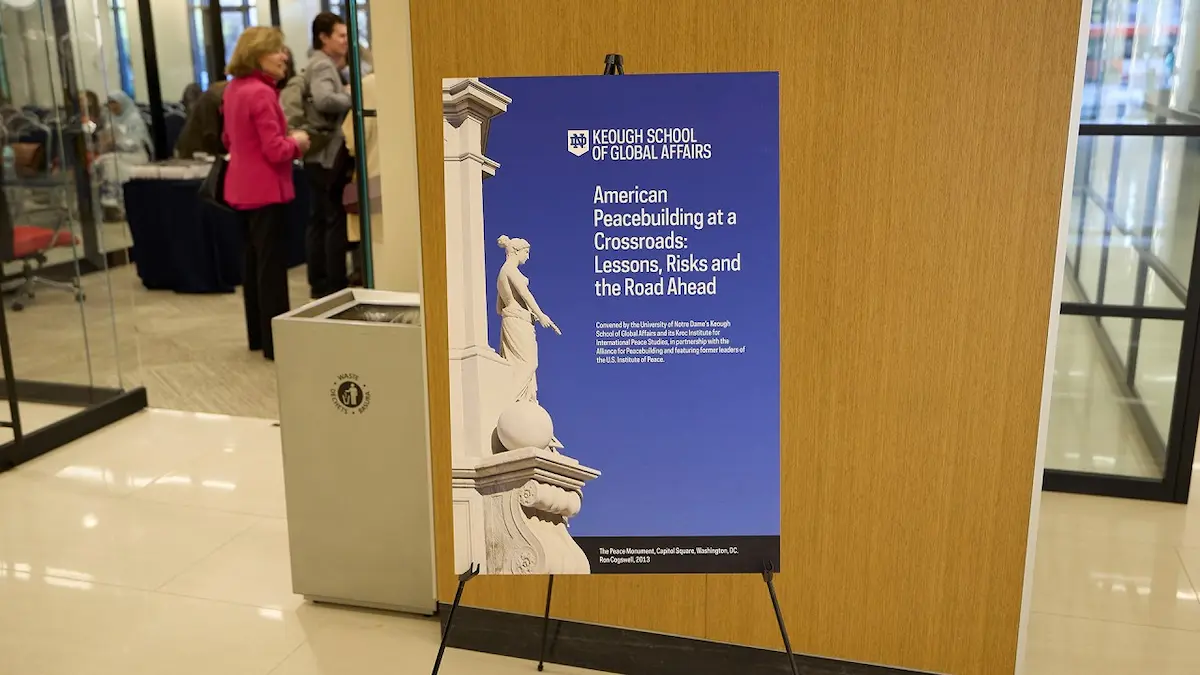
Amid record levels of global conflict and reduced funding, the University of Notre Dame convened peacebuilding scholars and leaders March 10 in Washington, D.C., to explore strategies for adapting in a volatile world.
The gathering focused on a forward-looking agenda in a time of disruption, outlining proactive approaches to meet today’s challenges. Contributors emphasized framing peacebuilding as a crucial national security investment, building a broader coalition to combat growing skepticism and developing innovative strategies.
“As a field, peacebuilding has developed valuable knowledge, research and practical solutions,” said Peter Quaranto, visiting professor of the practice and distinguished global policy fellow at the Keough School. “But it must adapt and innovate to be relevant in the current political and conflict landscape.”
Connecting peace to national security
Discussion acknowledged the twin challenges peacebuilding must confront. Globally, there are now more than 60 conflicts — including a widening regional war with Iran — the most since World War II. At the same time, many traditional institutions that support peacebuilding face funding uncertainty and structural changes.
Retired Navy Admiral Gary Roughead, right, talks with former Ambassador George Moose, chair emeritus of the United States Institute of Peace. Roughead urged policymakers and practitioners to connect peacebuilding to national security.
In this environment, speakers said it is more important than ever to demonstrate how peacebuilding can provide a return on investment for the United States by reinforcing national security.
Retired Navy Admiral Gary Roughead, the conference’s keynote speaker, detailed a growing list of threats that could contribute to worsening conflict, including climate change, artificial intelligence and an eroding nuclear deterrence framework. Given these challenges, he said the United States should invest in preventative soft power to better protect its security.
“The United States faces a strategic and moral imperative to invest deliberately in peacebuilding,” Roughead said. “Peacebuilding complements national defense.”
Proactive national security requires input from the legislative branch that is now sorely lacking, according to former U.S. Senator Russ Feingold and former Ambassador Mark A. Green, president emeritus of the Woodrow Wilson International Center for Scholars. They called for Congress to reassert its constitutional authority in deciding whether the country goes to war. The United States has not had a formal declaration of war since World War II and Congress has largely deferred to the president on conflicts, Feingold said, but a more proactive Congress could keep the United States out of unpopular wars.
Building a broader coalition
While strengthening the national security case for peacebuilding is critical, speakers said rebuilding domestic support for the field may be just as important.
That starts with addressing Americans’ declining trust in public institutions and foreign investments. A recent Pew study found that only 22 percent of Americans say they trust the federal government to do the right thing (down from about 75 percent 60 years ago). Meanwhile, Gallup has found that only 45 percent of U.S. adults now say they trust the federal government to handle international problems.
Against that backdrop of deep skepticism, peacebuilding must engage with a broader cross-section of society, speakers said. That includes incorporating perspectives from different communities, including grassroots activists, veterans and people of faith. Panelists also urged practitioners to apply global peacebuilding experiences, skills and tools to address growing conflicts and polarization within the United States and strengthen American democracy.
Jake Harriman, a Marine Corps veteran and the founder of More Perfect Union, explored the concept of peacebuilding at home during his remarks. When he returned to the United States in 2015 after years of military service and sustainable development work, he was shocked by the extreme rhetoric and growing polarization he witnessed. That led him to start the civic organization, which facilitates trust and consensus building by connecting people with different backgrounds and views, enabling them to work together on service projects, shared activities and civic engagement.
“Step one has to be bringing Americans together in compelling ways to give them a seat at the table to do things in their community together and to humanize the other side again,” Harriman said. “We have to get people talking to other Americans who don’t look, act or think like them.”
Globally, coalition building should include giving Indigenous communities a seat at the table, speakers said. Approximately 80 percent of the world's conflicts are in sensitive biodiversity hotspots where Indigenous people live, according to Binalakshmi (Bina) Nepram, founder of the Global Network of Indigenous Peacebuilders, Mediators and Negotiators. Yet peacebuilding often overlooks perspectives from the people who are most affected.
Innovating to meet today’s challenges
While inclusive coalitions and clearer security arguments can strengthen the case for peacebuilding, practitioners and policymakers must also devote serious attention to innovation, speakers said. In a skeptical, more-with-less environment, they emphasized that business as usual won’t be enough to elevate the field.
Education was one area speakers said could benefit from fresh thinking. George A. Lopez, the Rev. Theodore M. Hesburgh, C.S.C., Professor Emeritus of Peace Studies at the Keough School, called for educators to think more broadly about how they can train effective global citizens — not only frontline diplomats and practitioners, but also professionals who will bring critical peace perspectives to their careers in a variety of fields, including including medicine, law and finance.
Lisa Schirch, the Richard G. Starmann, Sr. Professor of the Practice of Peace Studies at the Keough School, stressed the need for technological innovation that supports problem-solving and consensus in a polarized world.
Technology is also ripe for innovation, speakers said. Lisa Schirch, the Richard G. Starmann, Sr. Professor of the Practice of Peace Studies at the Keough School, pointed to an emerging class of deliberative technologies that are meant to serve as an alternative to toxic social media. That means prioritizing problem-solving and surfacing areas of consensus rather than using rage-bait tactics and us-vs.-them framing to monetize users' attention.
Philanthropy could also benefit from new approaches. Emma Belcher, president of Ploughshares, a grantmaking organization that works to reduce the threat of nuclear weapons, noted that organizations that fund peacebuilding are asked to simultaneously serve as "firefighters and architects.” She called for more strategic investments to address root causes rather than simply throwing money at a succession of crises.
The conference showcased deep expertise from scholars as well as former legislators, diplomats and practitioners. Speakers drew on decades of experience with institutions including the United States Institute of Peace, the American Peacebuilding Alliance and the U.S. Department of State, as well as universities and private foundations.
Throughout the conference, speakers returned to a common theme: American peacebuilding must evolve to address a more volatile global environment. That means demonstrating its value to national security, building broader domestic and global support and developing new tools and approaches that will help policymakers and practitioners respond to emerging challenges.
The conference is part of broader work to inform peace policy and practice. The Keough School and its Kroc Institute, in partnership with the Alliance for Peacebuilding, will continue to foster conversations about how to sustain and reorient peacebuilding expertise to meet evolving global and national challenges, including more discussion with current U.S. and global officials.
“We face unprecedented levels of conflict with devastating humanitarian and human rights consequences, as well as serious strategic implications,” Quaranto said. “These conversations can help inform a research and action agenda to guide the future of peacebuilding.”
Watch: American Peacebuilding at a Crossroads: Lessons, Risks and the Road Ahead
Originally published by Josh Stowe at keough.nd.edu on March 26, 2026.
]]>
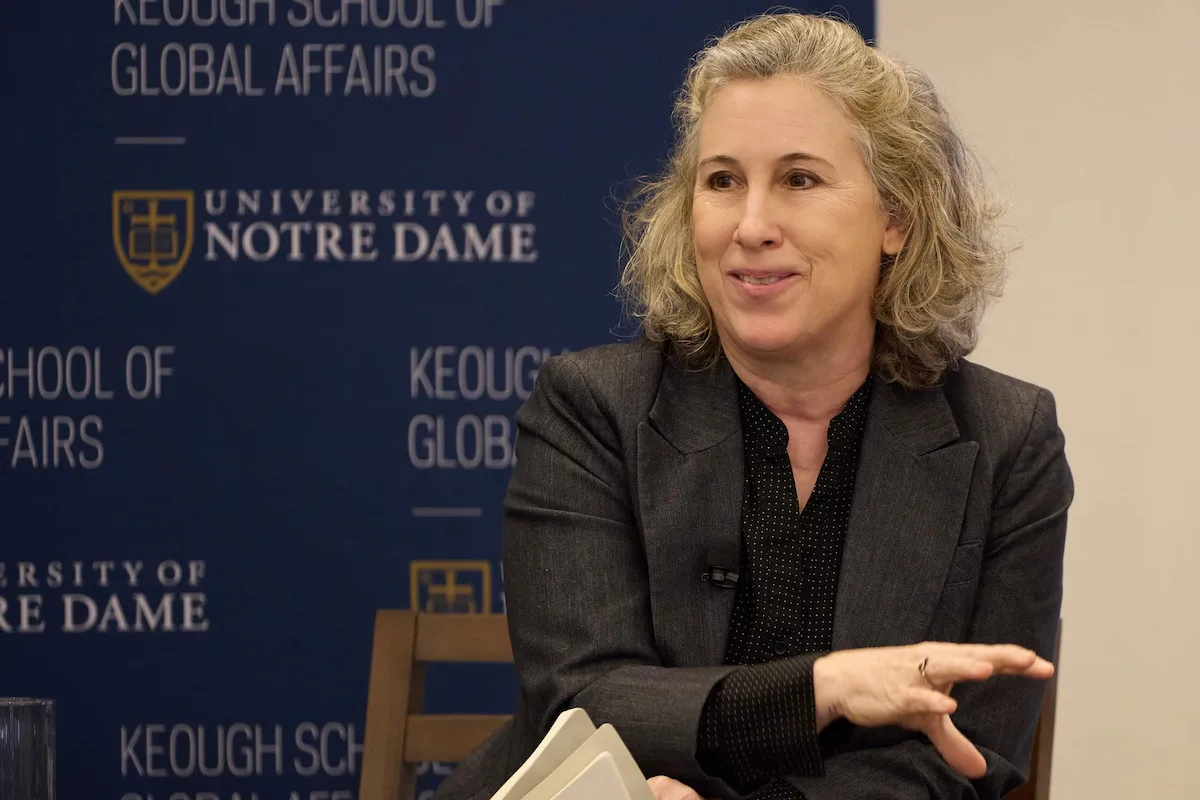
Josh Stowetag:kroc.nd.edu,2005:News/1795742026-02-26T18:19:00-05:002026-02-27T20:52:32-05:00A Q&A with Ambassador Samantha Power, featured speaker of the Kroc Institute's Hesburgh Lecture in Ethics and Public PolicyFollowing are questions posed to the Honorable Samantha Power, the 2026 featured speaker of the Hesburgh Lecture in Ethics and Public Policy, and her responses by email.
This annual event, now in its 32nd year, will take place Thursday, March 5 at 4 p.m. in McKenna Hall, Rms. 215-216, and will be livestreamed.
The Honorable Samantha Power
On the Intersection of Ethics and Policy
Q: Your lecture is part of an annual series founded in 1995 and honoring Rev. Theodore M. Hesburgh, C.S.C., former president of the University of Notre Dame and a global champion of peace and justice. In this spirit – and in today's complex geopolitical landscape – what do you believe is the most critical public policy challenge facing the next generation of global leaders?
A: My heart goes out to the next generation of leaders because we live in the age of the so-called “poly-crises,” where the challenges of global hunger, spiraling conflict, extreme poverty, climate change, and even the latest technological revolution are interlinked. It is easy to feel small or powerless when staring out at the magnitude of these challenges. The key is for the next generation to recognize that, while they are inheriting a very messy world, they each have a key role to play in making a difference. That will almost certainly entail “shrinking the change” and seeking to impact a specific aspect of a specific challenge, but I would encourage students to take their pick – there are sadly plenty of problems-in-need-of-solving to go around!
On the Future of Democracy and Technology
Q: How can universities like Notre Dame help ensure that emerging technologies, such as artificial intelligence, protect rather than undermine democratic values?
A: I would probably start by generating more awareness – and seeking to forge greater consensus – around the democratic values themselves. For example, if we can agree on the importance of the integrity of information as a foundation for informed democratic choice, then perhaps there can be an embrace of labeling deep fakes. If we can agree on the importance of deliberation across political divides, maybe voters will be more alert to the risk of tech companies using LLMs (Large Language Models) and their algorithms to precisely tailor information to fan prejudices or push people to extremes. In the near term, it seems easier to imagine constructive actions by institutions and citizens than by gridlocked and often captured individuals in Congress or the White House. The technology will be as democracy-eroding or democracy-enhancing as the American people demand.
On Lessons from Global Development
Q: Drawing on your experience as Administrator of USAID, what distinguishes foreign assistance that builds long-term resilience from aid that delivers either short-term results or long-term dependency?
A: Let me first note that it has been more than a year since Donald Trump and Elon Musk dismantled USAID, an agency that since it was created by President Kennedy in 1961 had been eradicating poverty and disease and supporting education and the rule of law around the world. A peer-reviewed estimate in The Lancet estimates that "feeding USAID to the wood-chipper" (as Musk described it) will result in the deaths of around 14 million individuals between now and 2030. This destruction is inflicting colossal short-term pain, but it is also doing nothing to build long-term resilience. We had instituted a set of reforms at USAID that had the agency on a solid path – increasing private sector contributions by 42%, scrutinizing our investments to be sure they were cost-effective, sunsetting key programs and shifting more resources toward host governments and local organizations and away from large international organizations and U.S.-based contractors. Emergency humanitarian assistance is important because it keeps people alive amid conflicts like those in Gaza, Sudan and Ukraine, but longer-term investments in development are the kind that helped eradicate smallpox and nearly rid the world of polio. They are also the kind that helped spur India’s Green Revolution and were positioning USAID to support farmers around the world to withstand the horrific effects of increased flooding and drought. Without these development investments, the world is not only less compassionate – it is becoming a lot more dangerous.
On Individual Agency and Public Service
Q: In your memoir, “The Education of an Idealist,” you address the question, "What can one person do?" What specific advice would you give to Notre Dame students as they go out into the 'real world' after graduation, especially those interested in pursuing a career in public service? How can they maintain resolve to be a force for good in the world, and not become disillusioned or overwhelmed by the many global crises and unrest at play today?
A: As I described in “The Education of an Idealist,” I have been blessed to have had many kinds of rewarding roles outside of government – war correspondent, magazine columnist, human rights advocate, and professor. But no role has been more meaningful than the opportunities I have been given to serve my country – first as a human rights adviser to President Obama, then as UN Ambassador and most recently as USAID Administrator. Some people go into public service out of a sense of responsibility – perhaps abiding by the biblical saying from Luke, “those to whom much is given, much is required” – and that is admirable. But one way people can maintain resilience through the ups and downs is to focus on the joy one feels working with colleagues to solve the toughest problems of our time and to try to improve the circumstances of others. Waking up every day and knowing that the work you do has a chance to matter to specific individuals can put a spring in your step, no matter how slow progress can sometimes feel. When I was at USAID, and my kids would ask me where I was going in the morning, instead of saying, “I have to go to work,” I would say, “I get to go to work.” I believe that spirit – of joy and gratitude – can carry a person through even dark and difficult days. But I admit it can sometimes take discipline to summon that spirit.
On the Future and Focus of American Peacebuilding
Q: The Kroc Institute is convening a gathering at the Keough School of Global Affairs office in Washington, DC on March 10 called "American Peacebuilding at a Crossroads." From your perspective having worked inside and outside government, where should the U.S. focus its efforts to best support local sustainable peace today?
A: Both Democratic and Republican administrations have focused on the three Ds – Defense, Diplomacy, and Development – essential for peace around the world and our own national security. If we care about peace and security, we need to make investments in all three domains. General Jim Mattis once famously said, “If you don't fund the State Department fully, then I need to buy more ammunition.” He and other military leaders have echoed this perspective when it comes to foreign assistance. Yet the current administration has made mammoth cuts in both diplomacy and economic development overseas, at the very time that China is expanding its engagements. I would offer a few reflections.
First, we obviously need to do a better job bridging our partisan political divides – and cooling temperatures – here at home. Political disagreement is not only increasingly entrenched; we are seeing a growing number of acts of political violence. We have to nip that in the bud, and our political leaders have to add balm – not gasoline – to our disagreements.
Second, while it is important to adapt our diplomatic training and our development assistance to better meet the current moment, that is a medium-term enterprise. We cannot await significant structural change before we show up for vulnerable communities in the way that we had been for more than six decades. When U.S. officials play a key role in brokering a ceasefire, as they did in Gaza, we need to be able to make swift investments in order to rapidly improve conditions on the ground. One reason the Gaza ceasefire is fraying is the U.S. had destroyed the infrastructure at USAID that could have supported the peace.
And third, peace can’t only be the work of governments. The United States government must use its convening power to enlist the private sector, diaspora groups, and other nations in this demanding cause. I always felt my responsibility at USAID was to turn every taxpayer dollar into at least $3 dollars by leveraging our investments to get others to contribute. I believe that hustle and “development diplomacy” will be essential going forward given the scale of the challenges and resource demands confronting the world.
The Kroc Institute for International Peace Studies, part of the Keough School of Global Affairs, established the annual Hesburgh Lecture in Ethics and Public Policy in 1995 to honor the Rev. Theodore M. Hesburgh, C.S.C., president emeritus of Notre Dame, a global champion of peace and justice, and the founder of the Kroc Institute. Each year a distinguished scholar, policymaker, and/or peace advocate is invited by the Kroc Institute director to deliver a major lecture on an issue related to ethics and public policy in the context of peace and justice.
]]>
Kate Chestertag:kroc.nd.edu,2005:News/1794922026-02-24T13:05:00-05:002026-02-24T13:05:14-05:00How one international Ph.D. student is bridging the gap between practice and research
There are a lot of ways to make a difference. In times of crisis, some people take an on-the-ground approach, working to directly provide aid to those in need. Others assume a bigger picture perspective to solve problems, analyzing why they occurred in the first place and what can be done to remedy them in the future.
Eskandar Ataallah wanted to do both.
When conflict broke out in his homeland, Syria, rather than flee, he chose to stay and be a helping hand. He spent over eight years working in the humanitarian field, organizing and providing relief to the most vulnerable families and individuals. But he also felt a desire to tie his field work to an academic background. He wanted to study peace—and learn how it could be implemented in his home country.
For Ataallah, it’s about closing the gap between experience and research. The practitioner and the academic bring different, necessary knowledge and skills to the table. And while the two can function as separate roles, Ataallah sees great value in uniting them. “It’s a huge gap,” he says, remarking on what it was like to be in a classroom where conflict and war was being discussed in theory—and knowing what it was like firsthand. Even after starting in the MGA program, Ataallah was helping to coordinator relief efforts in Syria following the 2023 earthquaks—a feat he was able to do from South Bend due to the networks he’d created while doing humanitarian work.
“It is challenging because the lived experience is very different from the theoretical frameworks, which is understandable. And there is something that you cannot capture through academia and through research, which is how we experienced the conflict.”
Fortunately, he’s found the classroom to be an excellent environment in which to bridge that gap through thoughtful dialogue and discussion, both with his fellow students and the professors opening up the space. What’s more, he’s been able to widen the context of these discussions by taking courses across a range of departments. So far in his first year, he’s taken classes in computer science, sociology, economics, and of course, peace studies. “The interdisciplinary approach is something that you really can't find anywhere, which is the strength of the program here,” he says.
Ataallah’s initial research focus was on the intersection of artificial intelligence and peacebuilding—exploring how AI can be harnessed to prevent conflict, strengthen social cohesion, and support inclusive peace processes—but he’s since refined it for a very important reason: he needs something practical. “Whenever we came up with our results, the dynamics changed and our results would be irrelevant. Since I'm a practitioner, it is very critical to me to do something that we can use.” That’s why he’s shifted his approach to include an economic focus, using his bachelor’s degree in economics, and narrowing the scope of his studies to examine the consequences of the international economic sanctions on the people of Syria and the political landscape as a whole.
While he’s still at the start of his Ph.D. journey, Ataallah is already taking advantage of all the opportunities in front of him—from applying to be an affiliate with the Kellogg Institute to securing a fellowship with the Salam Institute for Peace and Justice, a non-profit organization focused on social cohesion in Syria. While these additional roles keep him busy, Ataallah sees them as opportunities to learn more—and stresses that the support of his department and the International Student & Scholar Affairs (ISSA) team were invaluable in his pursuit of these opportunities.
He also credits the ISSA team for providing continuous support in a multitude of ways, from helping with the logistical side of traveling to organizing grocery store trips for international students. Going to Walmart is an easy task for someone who’s lived here for years and has a car, but for international students like Ataallah, it makes a huge difference. “They really considered what kind of challenges we might have, and they did something about it.”
But the significance of those simple resources, like trips to the store and funds for winter clothing, goes beyond the acts themselves. “The thing is, they're not just doing it for us. They made us think about other people, and how we will pay it forward—which is what's happening for me now.” After being here for a number of years, Ataallah now has a car himself, and because he knows what it’s like to rely on public transportation or Uber, he often offers rides to his friends when they need one. “They made us be better people by just doing small things for us,” he says.
Ultimately, that’s where his academic pursuit is leading him—to the best version of himself. He started by gaining hard-earned skills through years of hands-on work. Now he’s developing the theory behind that important work, and ideally, solutions for sowing peace. But for Ataallah, the mission guiding his research is innate, not learned: “People in need? Help them. It’s as simple as this.”
Originally published by Jessie Carson at global.nd.edu on February 23, 2026.
]]>
Jessie Carsontag:kroc.nd.edu,2005:News/1794142026-02-20T14:37:00-05:002026-02-20T15:54:40-05:00Tattoos on the body and the heartGraduate Justice Fellow Joachim Ozonze pursues vocation of healing justice
(The following article first appeared on Feb. 12, 2026, on the website of the Institute for Social Concerns at the University of Notre Dame. Joachim Ozonze is pursuing his Ph.D. in peace studies and theology with the Kroc Institute for International Peace Studies, part of the Keough School of Global Affairs).
Growing up in Nigeria, Joachim Ozonze witnessed the lingering, ghostly legacy of the Nigerian Civil War. Though the conflict formally ended in 1970, Joachim grew up in a landscape where hatred and precarity were still palpable. He saw how violence was not merely an event in the past but a pedagogy—a way of teaching people that certain lives were disposable. This violence became socialized and inscribed through communal memories and rituals that left scars on both individual bodies and the collective moral imagination.
Fr. Joachim Ozonze in Los Angeles
As a child, Joachim responded to the call to become a priest, which he describes as less of a personal career choice than a divine invitation. “When people ask me why I chose to be a priest,” Joachim reflects, “I answer that the real question is why the Lord chose me to be a priest. Becoming a priest was simply my response to that call.”
As a priest, Joachim sought alternative rituals of healing for his community, which led him on a journey of discernment. His vocational path eventually led him to the University of Notre Dame, where he enrolled in the joint Ph.D. program in theology and peace studies at the Kroc Institute. Initially, his research focused on the historical trauma of the Civil War. However, in late 2021, a new crisis interrupted his academic plans. Social media began erupting with videos of “Cane Deliverance”—a ritual in Southeastern Nigeria where local vigilantes tied methamphetamine users to wooden beams and publicly flogged them.
The screams in those videos acted as a new calling for Joachim. He felt a deep vocational pull to pivot his research away from the history of the Civil War and toward the modern drug crisis that resulted from it. He recognized the cane as a ritual pharmakon—a desperate communal attempt at a cure that was itself a poison, further inscribing violence onto the very bodies it sought to deliver. Through immersive ethnography, Joachim sought to disrupt this cycle by developing a framework for what he calls healing justice.
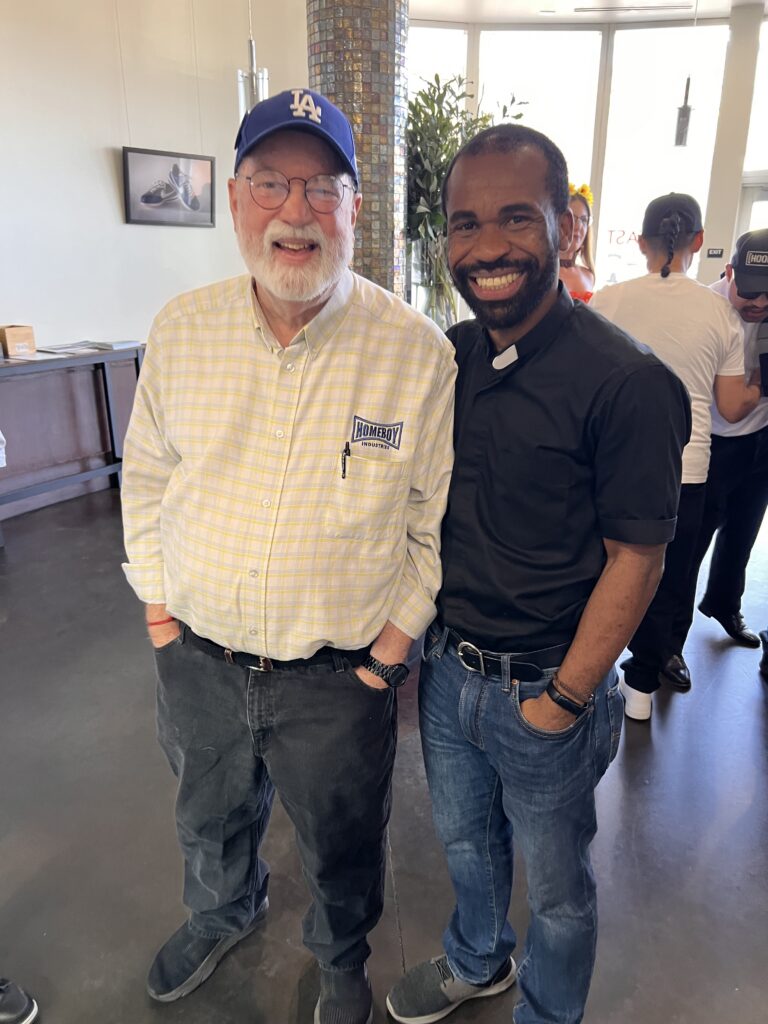
Ozonze (right) with Fr. Gregory Boyle at Homeboy Industries
In fall 2022, Joachim joined the inaugural cohort of the Graduate Justice Fellowship at the Institute for Social Concerns, where he experienced yet another turning point in his vocational journey. Joining an interdisciplinary community of graduate and professional students—poets, engineers, and lawyers—to explore questions of moral purpose, Joachim was able to turn the ethnographic lens inward. He began to recognize himself not just as an observer but as a site in which the multiple worlds he is researching intersect.
“I’m so glad the institute isn’t afraid to talk about vocation,” Joachim reflects. “It was so helpful for me to ask: Who am I? Why am I doing this?”
In answering those questions during the fellowship, Joachim discovered that his vocation as a priest and his vocation as a scholar are inextricably linked. When a friend heard his proposed dissertation title, “Tattooed on Our Bodies: Inscribed Violence and Performing Healing,” the friend asked if he had ever read Father Gregory Boyle’s Tattoos on the Heart. Joachim hadn’t, but upon reading it, he found a kindred spirit. He realized that the inscriptions of the cane in Nigeria and the gang tattoos of Los Angeles were two sides of the same coin: marks of disposability that required a ritual of kinship to erase.
Joachim reached out to Homeboy Industries—the gang intervention program founded by Fr. Boyle—to learn how they rewrite identity.
“I love the idea of tattooing as a metaphor for unpacking how violence becomes inscribed upon bodies and how they can be rewritten,” Joachim says. “I wanted to understand how the ideals of Homeboy Industries are written into the institution and the people.”
“I love the idea of tattooing as a metaphor for unpacking how violence becomes inscribed upon bodies and how they can be rewritten. I wanted to understand how the ideals of Homeboy Industries are written into the institution and the people.”
Joachim was given complete access to Homeboy Industries in East Los Angeles. Throughout November 2025, Joachim lived in the local Jesuit community, worked alongside the “homies,” and interviewed those willing to share their story. He paid close attention to the daily rituals, particularly the “morning meeting.”
“Everyone—trainees, staff, and Father Greg—says the same thing: ‘The morning meeting is where Homeboy happens,’” Joachim says. He found that the ritual formed him as much as the participants. On days when he felt weary or broken, it was the desire to be in that circle of kinship that offered the strength to move forward.
Joachim spent some of his time shadowing Dr. Troy, a Jamaican-American doctor who provides laser tattoo removals. Watching the tenderness with which Dr. Troy worked, Joachim realized it was a powerful drama of reinscription. Through the process of inscribing and reinscribing, young men and women were able to say no to an old identity of violence while claiming a new identity of belovedness.
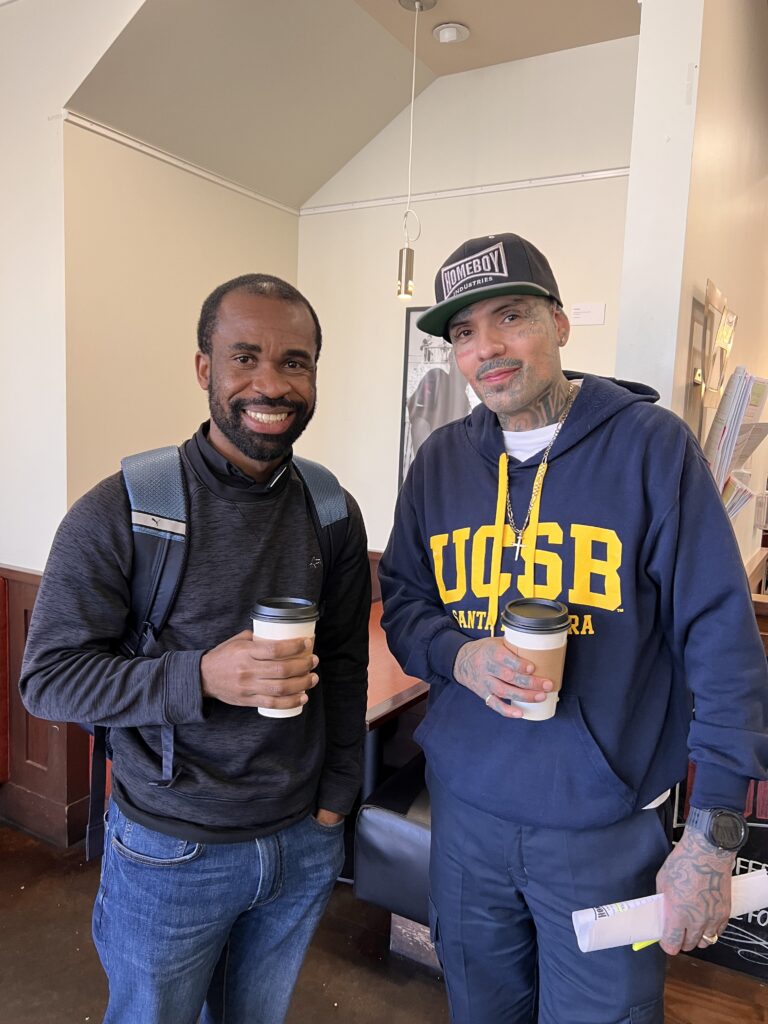
Joachim(left) with Homeboy Industries employee
Joachim realized that this is what it means to be tattooed on the heart.
“In my Igbo language, we use the word Ifunaya for love,” he says. “It literally means, ‘I see you in my eyes.’ It means that you have entered into my eyes and become a part of me, just as I have become a part of you.”
After his time at Homeboy, Joachim updated his dissertation into a multi-sited ethnography that weaves together his experiences in Southeastern Nigeria, East Los Angeles, and himself. He now views his vocation as one of encounter with the interconnecting moral worlds he inhabits.
Joachim credits the Graduate Justice Fellowship for highlighting the significance of this proximity. “Proximity and encounter are risky because they change us,” he says. “But for me, that’s the whole point.”
“I am so grateful for the formation I experienced at the Institute for Social Concerns,” he concludes. “Being with people from different disciplines was like sprinkles of water. When those sprinkles are brought together, they can flood the ground. It’s a community.”
Interested in joining the Graduate Justice Fellowship? Read more and watch for the application for the 2026–27 cohort to open mid-spring.
]]>
Cramer, Davidtag:kroc.nd.edu,2005:News/1792072026-02-15T16:40:00-05:002026-02-15T16:40:10-05:00Roberto (Bear) Guerra tapped for 2026 Kroc Institute Distinguished Alumni Award
Roberto (Bear) Guerra, an award-winning photographer and visuals editor whose work contemplates human connections – to each other and to the natural world – has been selected as the recipient of the Kroc Institute’s 2026 Distinguished Alumni Award. Established in 2004, the award honors peace studies graduates whose careers and lives exemplify the ideals of international peacebuilding.
Roberto (Bear) Guerra, recipient of the Kroc Institute 2026 Distinguished Alumni Award.
Guerra graduated from Notre Dame in 1995 with a Bachelor of Arts degree in anthropology and a concentration in peace studies. Throughout his career, he has sought to address contemporary social, cultural and environmental issues in his photography, ranging from short-term editorial assignments and work for non-profit organizations, to long-term, in-depth documentary projects.
“It’s an absolute delight to honor Bear, who is the first photographer and visual artist to receive the Distinguished Alumni Award,” said Anne Hayner, associate director of alumni relations at the Kroc Institute. “There are many ways to weave peacebuilding into our lives, and Bear does it beautifully, stitching together art and contemporary issues that invite conversation and learning.”
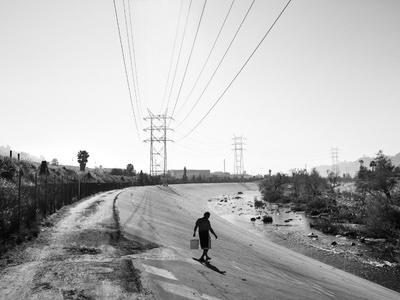
José Carlos, a houseless immigrant from Guatemala, walks toward the Los Angeles River.
A meaningful project for Guerra is one that enables him to illustrate the concept of intersection – of human lives and personal stories with the natural world, and technological progress and its impact, both positive and negative, to all parties. Examples of this include four recent projects with Emergence Magazine: on the Los Angeles River, as a symbol of both the destructive side of progress and the human need to connect with nature; on light pollution and loss of the night sky; on the rights of nature and importance of the saguaro cactus for the Sonoran Desert ecosystem; and how climate change is altering monsoon season in Southern Arizona. Another example is “Going Gray in LA,” a photographic, print, and audio series of stories about aging in place that he and his wife and collaborator, Ruxandra Guidi, produced. The project was developed for the Los Angeles public radio station KCRW, and showed the lives of older adults from working class and immigrant communities in Los Angeles, a city characterized by a high cost of living, poor transportation, and portrayal as a "capital of youth.”
“I have the Kroc Institute to thank for a quote I heard here as a student,” said Guerra. “It was from Pope Paul VI, ‘If you want peace, work for justice.’
“Hearing that was a light bulb moment for me; to this day, I think of that quote in my work because as a photographer, when I’ve covered a story involving conflict of some sort there’s generally a justice issue at the root,” he said.
Yet conflict represents connection, and to Guerra, it creates an opportunity to cast a spotlight on an issue and tell a story about people, space, place, history and today’s world.
“We are so interconnected, on so many levels, and my challenge to myself is how can visual storytelling connect the dots? To create a fuller picture of what’s at play, and in doing that, advocate for justice?”
A native of San Antonio who now lives in Tucson, Guerra is more or less a self-taught photographer; the only photography class he’s ever taken was at Notre Dame, “Introduction to Black-and-White Photography.” But his interest in the field started when he was a young boy.
“My dad had a coffee table book, An Uncertain Grace by the Brazilian documentary photographer Sebastião Salgado, on display at home. I remember growing up, looking at that book over and over – it never got old. Salgado captured the Indigenous cultures of the Americas, poverty, inequity and inequality, but he did so in a way that celebrated their beauty. It wasn’t patronizing. His photography resonated with me deeply, even as a kid, and I wanted to learn more about what was outside the frame of the photos,” said Guerra.
Mr. and Mrs. Zhou in their Los Angeles-area apartment.
After graduating from Notre Dame, he landed a paid internship in Chicago with Amnesty International. When that finished, Guerra taught English overseas, an experience leading him to photography as a means to answer questions he had about the world – a growing list ignited by wanting to learn more about other cultures outside his own.
Returning to Texas, Guerra worked in a photo lab, then assisted editorial and commercial photographers, and gradually built a portfolio shooting photos for local publications in Austin. From there he assembled a mix of work and editorial assignments, as he and his wife were finding their footing in journalism.
Today, he is the visuals editor at High Country News, a distinguished non-profit media voice founded in 1970 and dedicated to providing comprehensive coverage and insights of the Western United States. He is also a board member and producer at Homelands Productions, an award-winning nonprofit journalism collaborative, and with Guidi, co-founded Fonografia Collective, which produces local and international print, radio, and multimedia stories about human rights and social justice.
Among Guerra’s many honors and awards are the American Society of Magazine Editors, Readers’ Choice, Best News and Politics Cover, 2025; American Photography Award, 2024 and 2015; and Austin Visual Arts Association (TX) - "Artist of the Year, Photography,” 2009.
And what life lessons does he plan to share with attendees to his talk at the Kroc Institute on Feb. 24, especially with Notre Dame students?
Guerra took his time to answer thoughtfully.
“For one, that life isn’t linear – I had no plans growing up that I’d make my living as a photographer. Secondly, that change is natural and normal; for instance, technology and societal developments are expected. Progress can offer incredible potential, but it’s a double-edged sword if not thought of critically given the impact it can have.
“And finally, that there are so many direct and indirect methods to work toward peace. It can take a lot of different forms, and art is an underrepresented method to raise awareness and make our world a more peaceful one.
“And for that, we need to support our storytellers. They are a vital component to building empathy and connecting to others.”
Background on photos:
Los Angeles River: The majority of the river is encased in concrete, aside from an 11-mile stretch known as Glendale Narrows that allows the underground water table to rise close to the surface. This creates a natural soft bottom, constant flow of water and flourishing, non-native plant and animal species, offering a glimpse of what this habitat might have been like prior to the river's channelization.
"Going Gray in LA": Mr. and Mrs. Zhou were told to leave their apartment in a single room occupancy building in the Lincoln Heights neighborhood of Los Angeles after the building was sold in 2016. A grassroots organization, Chinatown Community for Equitable Development, educated the Zhous and other senior tenants in the building about their rights, enabling them to successfully remain in their homes.
]]>
Kate Chestertag:kroc.nd.edu,2005:News/1791452026-02-12T14:48:00-05:002026-02-12T14:48:29-05:00Summer opportunity for doctoral students to study international mediation in Geneva, Switzerland
The Kroc Institute for International Peace Studies has paired up with the Geneva Graduate Institute and its Centre on Conflict, Development and Peacebuilding to offer a summer Ph.D. course on international mediation.
Laurie Nathan
“International Mediation: Theory, Cases and Skills” will take place in person in Geneva, June 22-26, 2026. The course covers academic, policy and practitioner perspectives on international mediation. Students will review scholarly literature, explore relevant theories, and learn from senior mediators and professors from around the world.
This is the sixth year that the course has been offered by the Kroc Institute but the first time in partnership with the Geneva Institute; in past years, the Kroc Institute co-hosted the course with Peace Research Institute Oslo, and it was held in Norway.
Sara Hellmüller
“As always, we aim to strike a balance between theory and practice with the course, enabling our students to gain skills in conflict analysis and when mediating between conflict parties,” said Laurie Nathan, director of the Mediation Program at the Kroc Institute. “We’ll also emphasize the importance of building trust and rapport with conflict parties, meaning students will learn the ‘why’ through theory and the ‘how’ through skills building,” he said.
Nathan will co-lead this summer’s course with Sara Hellmüller, research professor of International Relations and Political Science at the Centre on Conflict, Development and Peacebuilding.
“International Mediation: Theory, Cases and Skills” is a Ph.D.-level course. Preference will be given to applicants who are currently registered in a Ph.D. program, those who have recently completed a Ph.D., or who have substantial practitioner experience. Accreditation of the course for degree purposes is determined by the students’ universities; at the University of Notre Dame, the 3-credit course is officially recognized. There is no registration fee, although participants must cover the costs of their travel and accommodation.
The deadline to apply is Sunday, March 1, 2026. For more details about the course and to access application instructions, click here or contact Nathan at Laurie.N.Nathan.4@nd.edu.
]]>
Kate Chestertag:kroc.nd.edu,2005:News/1790112026-02-06T12:39:00-05:002026-02-06T12:39:28-05:00Kroc Institute welcomes four visiting research fellows in spring 2026
Four research scholars and practitioners from around the world have joined the Kroc Institute for International Peace Studies in spring 2026, to begin their terms as visiting research fellows on campus.
The opportunity to study at the Keough School of Global Affairs’ Kroc Institute comes from the Institute’s Visiting Research Fellows Program, which attracts outstanding peace studies scholars to the University of Notre Dame for up to two semesters. Fellows actively integrate their research with ongoing Institute research initiatives and participate in events and lectures as part of the Institute’s learning community.
The new fellows will join current fellows Vera Brandner and Katie Conlon, who arrived at the beginning of the fall 2025 semester for the full 2025-26 academic year. Mujahid Osman, who earned a Master of Global Affairs degree in International Peace Studies from the Keough School in 2019, was a fellow for the fall 2025 semester. His research focused on his book project, “Witnessing for God: Living Out Islamic Ethics in Cape Town.”
Spring 2026 visiting research fellows (left to right): Doğukan Cansin Karakuş, Prakash Bhattarai, Siobhán McEvoy-Levy and Francisco Diez.
“We are fortunate to have such an outstanding group of peace researchers on site this year,” said Asher Kaufman, John M. Regan, Jr. director of the Kroc Institute and professor of History and Peace Studies.
“The Visiting Research Fellows Program supports one the Institute’s main objectives, which is to enhance and grow our scholarly research. Their research contributes to the peacebuilding field, and we collectively benefit from this exchange,” he said.
Following are the Institute's newest fellows. To learn more about their backgrounds, click here to read their full profiles.
Prakash Bhattarai (spring 2026) is the alumni visiting research fellow representative, having earned his master’s in Peace Studies from the Kroc Institute in 2010. A social scientist by training and education, Bhattarai has 20 years of leadership and professional experience working in social policy, conflict resolution, human rights, and governance in Nepal and the Asia Pacific region. He is the executive director and founder of the Centre for Social Change in Kathmandu, Nepal, a leading non-profit research and advocacy institute working on issues around governance, peacebuilding, labor, migration, climate change, and civic engagement. While at the Kroc Institute, Bhattarai’s research will examine how post-conflict governance arrangements in Nepal (2006-2024) have contributed to preventing the resurgence of large-scale armed violence and maintaining peace since the country’s Comprehensive Peace Accord in November 2006. Bhattarai earned his Ph.D. in Peace and Conflict Studies at the University of Otago, Dunedin, New Zealand in 2014.
Francisco Diez (spring 2026-fall 2026) is a longtime mediator with extensive experience working in Latin America with governments, international and national nongovernmental organizations – The Carter Center, The Whitaker Peace and Development Initiative, Fundación Esquel, Participación Ciudadana in Ecuador, and others – universities, and international organizations.
Among his many professional assignments, Diez was the coordinator of the Regional Support Network for the United Nations Development Programme (UNDP) Democratic Dialogue Program for Latin America and the Caribbean from 2002 to 2004, providing support on peacebuilding processes to the UNDP national offices. He served as The Carter Center representative in Latin America from 2007 to 2010, where he was charged with oversight of the Venezuela, Bolivia and Ecuador programs. While there he created the Binational Dialogue Group for Ecuador and Colombia and served as the mediator between both governments.
From 2014 to 2019, Diez served as a representative for the Kroc Institute’s Peace Accords Matrix program advising the Office of the High Commissioner for Peace in Colombia, and helping to create the Barometer Project there to monitor the implementation of the country’s 2016 peace accord. Representing the Kroc Institute, he was a special advisor on the Alianza Civica movements in Nicaragua, and advised the UN resident coordinator on mediation in Ecuador during the 2018 crisis.
While at the Kroc Institute, Diez intends to draft a comprehensive and practice-oriented handbook on conflict transformation and peacebuilding offering tools, strategies and techniques. The guide will be designed as a resource for practitioners and scholars involved in conflict prevention, national dialogues, peace agreement implementation, and international mediation.
Doğukan Cansin Karakuş (spring 2026) is a postdoctoral researcher specializing in mediation, ceasefires, and peace agreements in civil wars. He holds a postdoctoral position at Germany’s European Centre for Minority Issues, is an affiliated visiting researcher at the Department of Peace and Conflict Research at Uppsala University in Sweden, and is a lecturer at Germany’s Heidelberg University. An author of many peer-reviewed academic journal articles, Karakuş seeks to develop a mediation framework while at the Kroc Institute by addressing the critical question: Under what conditions can third-party mediation effectively facilitate the transition from ceasefires to comprehensive peace agreements in armed civil conflicts? Karakuş earned his Ph.D. in 2020 from Georg-August University Göttingen, part of which was done at Uppsala University.
Siobhán McEvoy-Levy (spring 2026) is a professor of Political Science and Peace and Conflict Studies at Butler University in Indianapolis, as well as the director of the University’s Desmond Tutu Peace Lab. Her research focuses on young people’s involvement in conflict and everyday peacebuilding, pop culture and art activism, and the uses of public space for addressing violence, trauma and structural inequalities. While at the Kroc Institute, she will focus on how certain methods/mediums of art used in activism have ideological, ethical and material effects, and how these support or detract from movements, campaigns, and the practice of peace. McEvoy-Levy earned her Ph.D. in History and International Relations from the University of Cambridge in 1999.
]]>
Kate Chestertag:kroc.nd.edu,2005:News/1788122026-01-30T16:04:00-05:002026-01-30T16:21:25-05:00Kroc Institute to welcome three Catholic Relief Services research fellows in spring 2026
Thanks to the Kroc Institute-Catholic Relief Services (CRS) Peacebuilding Fellowship, three visiting scholars will join the Kroc Institute for International Peace Studies on campus in spring 2026 to pursue independent research projects.
The long–running fellowship program between the Kroc Institute and CRS began in 2006. Its aim is to host a CRS staff person (or a member of a partner organization engaged in peacebuilding) for a short-term research and writing post at the Kroc Institute, part of the Keough School of Global Affairs at the University of Notre Dame. The opportunity gives the fellow a chance to reflect on and strengthen their peacebuilding work, translate their work into scholarship or policy documents, or do valuable, big picture planning for more engaged and sustained peacebuilding.
The fellowship will be divided between two projects this year, with one project conducted by a team of CRS staffers.
“We had one of our strongest applicant pools for this year’s fellowships, which made the final choices difficult,” said Caesar Montevecchio, assistant director of the Kroc Institute’s Catholic Peacebuilding Network, which sponsors the fellowship program.
“That said, the research proposals from the fellows selected are so tightly aligned with CPN’s research areas – specifically, extractives and environmental peacebuilding, and the leadership role of women in the Church and peacebuilding – that we felt it was prudent to open this year’s fellowship to multiple candidates.”
Following are this year’s Kroc-CRS fellows:
Isabel Aguilar Umaña
Isabel Aguilar Umaña and Cecilia Margarita Suárez have been actively engaged in peacebuilding efforts with CRS in Latin America and the Caribbean – Suárez since 2013 and Aguilar Umaña since 2015.
Suárez has served as the CRS Mexico and Latin America Peacebuilding Platform manager since 2020 and as the Mexico country manager since 2013. Aguilar Umaña is the technical director for the Peace, Social Cohesion and Justice Platform for the CRS Latin America and Caribbean Regional Office, after serving as its regional advisor on Violence Prevention and Peacebuilding from 2015 to 2024.
In 2020, they co-designed and launched the CRS/LACRO Platform for Peace, Social Cohesion, and Justice—a regional initiative that promotes horizontal exchange among faith-based institutions and integrates social cohesion and justice into CRS programming. The platform engages more than 80 strategic allies, promotes 24 peacebuilding methodologies, and sustains the “Walking Toward Peace” community of practice, where 16 organizations collaborate to strengthen capacities and advocate for peace within and beyond the Church.
Cecilia Margarita Suárez
While at the Kroc Institute, Aguilar Umaña and Suárez will examine how gender-transformative methodologies within faith-based institutions—particularly the Catholic Church—can elevate women as strategic peacebuilders and catalyze systemic change across Latin America and the Caribbean. Using a methodology that addresses trauma healing and economic empowerment, they will analyze the impact of women-led support groups in combination with Savings and Internal Lending Communities that have enabled women to assume leadership roles to address development and humanitarian challenges.
They will divide their fellowship in two-week increments, with Aguilar Umaña at the Kroc Institute from Feb. 16-27, followed by Suárez from March 16-30.
Rev. Michael K. A. Quaicoe
Rev. Michael K. A. Quaicoe is a Catholic priest in the Archdiocese of Cape Coast in Ghana who serves as the director of the Directorate for Governance, Justice and Peace for the Ghana Catholic Bishops’ Conference. He is also the Catholic Chaplain to the Parliament of Ghana and a visiting lecturer at St. Paul’s Catholic Seminary in Sowutuom near Accra.
While at the Kroc Institute, Fr. Quaicoe will work on a study to explore the Catholic Church’s support of Ghana’s fight against illegal and irresponsible mining, locally known as galamsey. Illegal mining is both an environmental and economic concern, and is at odds with the protection of security, justice, and peace. Backed by Catholic Social Teaching, knowledge in integral ecology, and the Theology of Just Peace, the Church in Ghana endeavours to wage a strategic peacebuilding campaign to safeguard the environment and human dignity.
Fr. Quaicoe will analyze the Ghana Catholic Bishops’ Conference’s Justice and Peace structures and how it employs faith, moral authority, and community engagement to counter environmental degradation. His study will also address the Church’s mediation with and among state agencies, traditional leaders, civil society, and mining communities, situating this within formal and informal peace processes that link ecological justice to social cohesion. The end result will be a policy-oriented research paper that articulates a model of “ecological reconciliation,” with peace being inseparable from environmental stewardship.
He will be with the Kroc Institute from April 13-May 4.
Supporting scholarly research is a key objective of the Kroc Institute, with research fellowships being integral to this commitment. This year’s Kroc-CRS fellows will join six other scholars currently at the Kroc Institute, here through the Institute’s Visiting Research Fellows Program.
]]>
Kate Chestertag:kroc.nd.edu,2005:News/1787462026-01-28T11:17:00-05:002026-02-04T10:47:03-05:00New tool tracks cross-border pollution, revealing unequal distribution of risk, responsibility
Microscopic airborne particles known as PM 2.5 contribute to 100,000 premature deaths in the United States each year. A new University of Notre Dame study finds that 40 percent of these deaths can be attributed to pollution that crosses state lines, highlighting the impact of the problem and pinpointing which states are responsible.
Each year, a form of air pollution known as PM 2.5 contributes to 100,000 premature deaths in the United States and 4 million globally.
The study, published in Environmental Research Letters, provides a tool to quantify responsibility for PM 2.5 pollution, a type of fine particulate matter. It comes amid renewed debate over pollution regulations in the United States. In January, the Environmental Protection Agency said it will stop calculating the economic value of health benefits — including lives saved and health care costs avoided — from air pollution rules targeting ozone and PM 2.5.
“Our analysis gives states an evidence-based way to demonstrate when cross-state pollution exceeds safe thresholds and threatens public health,” Marcantonio said. “Rather than relying solely on an economic evaluation, policymakers can use clear data on health risks to guide decisions that protect vulnerable residents and communities.”
The new study translates the concept of an airshed — a geographical area where air moves together as a single unit, similar to hydrology’s concept of a watershed— into a practical framework that regulators around the world can use.
“Our study introduces a simpler, data-driven framework that policymakers and regulators can readily adapt,” Crippa said. “This is an important improvement upon previous studies, which have had limited scalability and adaptability.”
Findings underscore pollution’s unequal impact
The study highlights the inequality of pollution in the United States. Researchers found that:
The percentage of premature deaths attributed to cross-state PM 2.5 pollution has remained constant at approximately 40 percent since 1998, even though air pollution has fallen by 35 percent in the same time period.
More than half of U.S. states are net exporters of air pollution; roughly a third are net zero contributors, meaning they are neither importers nor exporters; and the remainder, less than a fifth, are net importers.
Florida stands out as the largest exporter of cross-state pollution (affecting Georgia and the Carolinas), followed by Vermont and Iowa.
Exporters include a number of states across the Upper Midwest, the Mid-Atlantic and the Southeast — including Wisconsin, Michigan, Indiana, Ohio, Kentucky, West Virginia, Virginia, Tennessee, Mississippi, Alabama and South Carolina — as well as California, Oregon and Washington on the West Coast.
Instead of relying primarily on complex chemical transport models, the authors drew on the concept of an airshed to design a simpler, data-driven approach. They highlighted concentrations of PM 2.5 that exceed established safety thresholds and mapped how these particulates, pushed by prevailing winds, cross state lines, harming communities in which they did not originate.
The research builds upon previous work, which has documented that major air polluters are more likely to be located near a state’s downwind borders than other types of polluters. This dynamic allows states to economically benefit from industry while avoiding the health issues that come with it.
“Our findings underscore the unequal distribution of both health risk and responsibility across state lines,” Marcantonio said.
Informing policy to address pollution
Crippa and Marcantonio want their work to inform policy both in the United States, where legal challenges are the main barriers to regulation, and in other global contexts, where a lack of resources is the main barrier.
“Ultimately, we want to provide an evidence-based approach to protecting public health and supporting human dignity.”
In the United States, air pollution regulation faces legal and political challenges. Traditionally, it has been decentralized and the Clean Air Act’s “Good Neighbor” provision has been the strongest regulatory tool. In 2024, the Supreme Court paused an updated Environmental Protection Agency plan aimed at strengthening that provision and addressing shortcomings in state plans.
In lower-resource contexts outside the United States, regulators often have limited access to complex, resource-intensive air quality models. But they face a similar public health problem: pollution that crosses political boundaries and harms other communities.
Whether the regulatory challenges are legal or technological, Crippa and Marcantonio said their work can provide a more timely and complete picture of pollution’s impact, furnishing policymakers with data that can help them protect vulnerable downwind communities.
Regulators can use new research by Paola Crippa and Drew Marcantonio to measure responsibility for deadly air pollution that crosses political boundaries.
The researchers are extending their work globally through a multi-year project co-led with Danielle Wood, director of the Notre Dame Global Adaptation Initiative, focused on how pollution that originates in mega-cities affects other communities.
“Our research can inform policy and help regulators prioritize permitting, monitoring and enforcement activities,” Marcantonio said. “Ultimately, we want to provide an evidence-based approach to protecting public health and supporting human dignity.”
Contact: Tracy DeStazio, associate director of media relations, 574-631-9958 or tdestazi@nd.edu
How PM 2.5 harms public health
Each year, PM 2.5 contributes to 4 million deaths globally.
Particles are 30 times thinner than a strand of human hair — small enough to enter the lungs and bloodstream.
PM 2.5 affects the lungs, heart and brain, contributing to cancer, COPD, stroke and cognitive decline.
It disproportionately affects vulnerable communities worldwide.
Pregnant women, children, seniors, and people with asthma, diabetes, obesity, or kidney disease face higher risks.
Originally published by Josh Stowe at keough.nd.edu on January 28, 2026.
]]>
Josh Stowetag:kroc.nd.edu,2005:News/1786242026-01-22T11:55:00-05:002026-01-22T13:53:49-05:00“New Game, New Peaces: Strategies for a Shifting Field,” the theme for the 2026 Notre Dame Student Peace Conference
The calendar reads “January,” but preparation for the annual spring 2026 Notre Dame Student Peace Conference is well underway.
Set to take place Friday and Saturday, April 10 and 11, this year’s conference tackles complex issues in light of global paradigm shifts impacting the peacebuilding field. With the theme “New Game, New Peaces: Strategies for a Shifting Field,” the conference will address changes to international order that are dissolving well-established norms and law, rendering them ineffectual and archaic.
The event is open to undergraduate and graduate students from all fields of study, in the United States and abroad. In addition to attending, students are invited to submit proposals for presentations that analyze these changing “rules of the game” or discuss innovative solutions and vocabularies to build new approaches to peace and justice. Proposals may be based on original research, experiential learning, peace work and practice, and/or theoretical analysis. Click here for more information; proposal submissions are due Monday, Jan. 26 at 11:59 p.m./ET.
“Innovation and adaptivity is needed in the peacebuilding field now more than ever before,” said Anna Van Overberghe, assistant director of Academic Administration and Undergraduate Studies at the Kroc Institute for International Peace Studies, part of the Keough School of Global Affairs.
“We encourage students interested in working in this field to come to the conference and contribute to groundbreaking approaches for peacebuilding that respond to the shifts we’re seeing globally.
“Students represent the next generation, the future, and we welcome their creativity and ideas to reimagine peacebuilding to meet new needs,” she said.
The conference is organized and directed by student leaders with the help of dedicated faculty and staff like Van Overberghe. This year’s organizers are seniors Coby McKeown, Class of 2026 and majoring in English and peace studies, and Faiza Filali, Class of 2026, majoring in political science with minors in peace studies, Asian studies, Korean studies, and Irish studies.
Once finalized, the conference schedule will feature keynote addresses, panel sessions, round-tables, and student presentations that address this year’s theme, as well as current regional and international conflicts at play.
Launched in 1993 as a single-day symposium to celebrate the 10th anniversary of undergraduate peace studies at Notre Dame, the conference has evolved into an annual two-day academic event that attracts student participants from all over the world. Its goal is to create space for academic and professional dialogue on issues of peacebuilding, justice, and conflict transformation. Thanks to the generosity of Joan B. Kroc, founder of the Kroc Institute, and her endowment, there is no registration fee for the conference. Materials and meals are also provided.
Registration is required and will open in early February. For more information about the conference overall, click here.
]]>
Kate Chestertag:kroc.nd.edu,2005:News/1782882026-01-07T18:37:00-05:002026-01-07T18:37:48-05:00Reflections on the 17th Biennial Conference of the International Association of Genocide Scholars
When Professor Ernesto Verdeja approached the Kroc Institute about co-sponsoring the 17th Biennial Conference of the International Association of Genocide Scholars (IAGS), it was an easy yes.
"We’re a leading center in the study of causes of violent conflict and strategies for sustainable peace,” said Asher Kaufman, John M. Regan, Jr. director of the Kroc Institute, part of the Keough School of Global Affairs, and a professor of History and Peace Studies.
"With the theme ‘The Challenge of ‘Never Again’: Engaging with Protection and Prevention of Genocide,’ this conference directly connects to an integral part of the Kroc Institute’s normative approach,” he said.
Founded in 1994, the IAGS is a global, interdisciplinary, non-partisan organization dedicated to advancing research, teaching, and preventing genocide. Its biennial conference provides a platform for scholars, academics, mass atrocity specialists, artists, and journalists to share insights and develop approaches to studying genocide and mass atrocities. The 2025 conference took place Oct. 20-24 and was hosted by the Johannesburg Holocaust & Genocide Centre in Johannesburg, South Africa, known as a place of memory, education, dialogue, and lessons for humanity.
"The IAGS conference is one of only two major international gatherings on genocide and mass atrocities research,” said Verdeja, an associate professor of Peace Studies and Global Politics and the director of Undegraduate Studies at the Kroc Institute.
"Having the Kroc Institute’s presence and sponsorship helps to elevate its recognition of this global research topic.”
(clockwise, left to right) Ernesto Verdeja, Ashley Greene (Ph.D. ‘16), Sarah Crane (Ph.D. ‘24), keynote speaker Jeff Sizemore, and Kristina Hook (Ph.D. '20).
In addition to co-sponsoring the conference, the Kroc Institute had representation by its alumni base at the gathering: Ashley Greene (Ph.D. ‘16), chair and director of Graduate Programs for the Department of Holocaust and Genocide Studies, Cohen Institute for Holocaust and Genocide Studies, Keene State College (New Hampshire); Kristina Hook (Ph.D. ‘20), assistant professor of Conflict Management, School of Conflict Management, Peacebuilding and Development at Kennesaw (Georgia) State University; and Sarah Crane (Ph.D. ‘24), visiting assistant professor of Holocaust and Genocide Studies, University of Cincinnati.
Especially significant was that the conference took place in South Africa, a country with a complex history of racial division and reconciliation.
"This served as a powerful backdrop for discussions on the global challenges of genocide and atrocity prevention,” said Verdeja, with the conference offering space for reflection on how to strengthen international efforts to protect vulnerable populations and ensure that the promise of "Never Again" is realized.
Verdeja, who serves on the IAGS research brief editorial board, as well as on the advisory board of its international journal, Genocide Studies and Prevention, presented at the gathering. His talk, "Artificial Intelligence and Violent Instability Early Warning: Opportunities and Pitfalls,” addressed the impact of new technology and precursors to violence, with a focus on genocide and civil society.
Ernesto Verdeja leads a workshop as part of the 17th annual IAGS conference.
Verdeja estimated 300 attended the conference overall, representing a large contingent of scholars and practitioners from the continent. He also had the chance to meet with colleagues onsite from the Auschwitz Institute for the Prevention of Genocide and Mass Atrocities, another co-sponsor of the IAGS conference. Verdeja serves on this organization’s international advisory board.
"The IAGS conference offers an international, scholarly space where people from various disciplines can come together to discuss similarities and differences of mass violence and mass atrocities,” Verdeja said. He added that over the years, the organization and the conference have attracted more practitioners, "which generates valuable interaction for academics and scholars with those working directly in the field about large, sustained crimes against humanity.”
With a massive decline in funding and support for human rights and atrocity prevention, would the need for gatherings like the IAGS conference be even more critical now?
Verdeja agreed wholeheartedly.
"Globally, we’re seeing an uptick in nationalism, the erosion of multilateralism, and the inability of the UN Security Council to maintain security and address atrocities – with its own members contributing to them,” he said.
"It’s not a stretch to say that everyone working in this field is distressed. Our international organizations and mechanisms for atrocity prevention have weakened over the past 10 years, and worsened considerably in the last four to five years.”
Sarah Crane (Ph.D. '24) and Ernesto Verdeja.
Yet Verdeja maintains hope for a better future.
"I was inspired to see so many of our alumni at the conference; they represent the ripple effect of the Kroc Institute – peacebuilders who will share their learnings with their networks, post-conference, and extend our peacebuilding reach,” he said.
"Among attendees there was a lot of creative thinking and discussion about human healing and dealing with legacies of violence, as well as the need for stronger social movements committed to atrocity prevention.
"Overall, we have a collective belief in the power of change,” said Verdeja. "South Africa’s Apartheid Museum is a beautiful, uplifting example of what is possible. It illustrates the rise and fall of apartheid in 20th century South Africa; it’s astounding and shows how transformation can happen.”
]]>
Kate Chestertag:kroc.nd.edu,2005:News/1779662025-12-15T17:02:00-05:002026-01-05T08:19:39-05:00The UN Security Council Resolution on Gaza: Age of Consent or Recipe for Conflict?The following op-ed written by Mediation Program Director Laurie Nathan originally appeared on the Peace Research Institute Oslo website on Dec. 8, 2025:
On 17 November, the UN Security Council (UNSC) issued Resolution 2803, endorsing US President Trump’s 20-point plan for Gaza. The resolution envisages a Board of Peace (BoP) to govern Gaza as an interim administration, as well as the establishment of an International Stabilization Force (ISF) mandated to ensure stability, demilitarization and the disarmament of Hamas and other armed groups.
Gaza City. Courtesy of Palestinian News & Information Agency (Wafa) in contract with APAimages (Creative Commons).
The fundamental problem with both the UN resolution and the Trump plan is that they are not grounded in the consent of the people and political actors in Gaza. They sidestep the essential task of promoting local cooperation and legitimacy. Consequently, the BoP and ISF will be viewed by many Palestinians as instruments of coercion and occupation. They are likely to be met with violent resistance.
This is not a viable path to peace, security and stability. It is a recipe for further conflict.
Coercive disarmament: mission impossible
Resolution 2803 asserts that “the parties have accepted” Trump’s plan. This is patently false. In October, Hamas officials stated that they had not agreed to disarm and that the mediators had not discussed the ISF with them. Senior Hamas members have repeatedly expressed opposition to disarmament.
Hamas’ response to the UN resolution was consistent: “Any discussion regarding the issue of arms must remain an internal national matter linked to a political process that guarantees the end of the occupation, the establishment of the [Palestinian] state and self-determination.” Making the ISF responsible for “disarming the resistance” strips the international force of its neutrality and “turns it into a party to the conflict in favor of the [Israeli] occupation”.
Although Resolution 2803 claims that “the parties” have accepted the Trump plan, it also recognizes the untruth of this claim and anticipates Palestinian resistance: it empowers the ISF to "use all necessary measures", which is UN-speak for employing force.
But force is unlikely to succeed. The Israeli Defence Force (IDF) has waged war against Hamas for over two years, deploying thousands of troops and dropping over 100,000 tons of ammunition on Gaza. By October 2025, according to Amnesty International, the IDF invasion had led to repeated mass displacement, extensive destruction of civil infrastructure, deliberate starvation, over 65,000 people killed and over 200,000 injured.
Despite the scale of this violence, the IDF failed to disarm Hamas. How, then, is the ISF expected to do better? Unlike the IDF, the ISF will lack the cohesion of a unified national army. It will instead comprise a group of countries (not yet unidentified) that have no partisan desire to perpetuate further violence in Gaza. For the ISF, coercive disarmament is not just improbable; it is mission impossible.
Occupation by other means
The BoP will be chaired by President Trump and is expected to include former British prime minister Tony Blair. It will constitute the primary governing body of Gaza. Subordinate to this body, according to the Trump plan, there will be a “technocratic, apolitical Palestinian committee, responsible for delivering the day-to-day running of public services and municipalities”.
It remains to be seen whether any credible Palestinians are willing to serve on this technocratic committee and report to a non-Palestinian political overlord. It also remains to be seen whether they have any local legitimacy. Hamas has already rejected the BoP as an “international guardianship mechanism”.
For Palestinians deeply frustrated, infuriated and humiliated by decades of Israeli occupation, the BoP and ISF will look like the continuation of the occupation through new structures. The UNSC’s endorsement does not legitimize these structures; it only discredits the Council.
The imperative of consent
The Trump plan and the UNSC resolution ignore the rich experience of disarmament in other conflicts. One of the disregarded major lessons is that disarmament in places emerging from conflict is not a stand-alone activity. It is a component of a broader process of ‘disarmament, demobilization and reintegration’ (DDR), which in turn is part of the broader field of ‘security sector reform’ (SSR).
The point is that DDR and SSR are fundamentally interconnected, political and complex, with intersecting security, economic, social and technical dimensions. A superficial approach to disarmament is naïve and dangerous.
Another major lesson is the principle of ‘no ownership, no commitment’. This is an eminently pragmatic imperative: if disarmament and security reform do not have the consent of local actors, including armed groups, the process will be haphazard and resisted.
Successful disarmament in Colombia, Northern Ireland and South Africa was not imposed by external powers. It was the product of protracted negotiations among the main conflict parties. And it succeeded because it took place in the context of negotiations that were intended to achieve, and did in fact achieve, a political resolution of the conflict.
The path to peace
The Trump plan and the UNSC resolution are plagued by flaws. The so-called Comprehensive Plan to End the Gaza Conflict is not remotely comprehensive; it is one of weakest ceasefire plans on record from a technical and political viewpoint. The UN resolution violates the UN Charter and international law, and does not provide an unequivocal commitment to Palestinian statehood and self-determination.
Any serious attempt to implement the plan, and to make the adjustments that are required, must be based on negotiations with Palestinian political actors. Such negotiations will be difficult and will not guarantee success. But without them, failure of the plan and enduring misery for the people of Gaza are almost certain.
The elusive grand bargain remains the only viable path to peace and collective security: disarmament and demilitarization in return for Palestinian statehood.
Professor Laurie Nathan is Director of the Mediation Program of the Kroc Institute for International Peace Studies at the University of Notre Dame. He has written extensively on mediation, ceasefires and security arrangements.
]]>
kroc.nd.edutag:kroc.nd.edu,2005:News/1779562025-12-15T16:09:00-05:002025-12-15T16:10:01-05:00Uzra Zeya, Kroc Institute Advisory Board member, honored with United Nations Association diplomacy awardUzra Zeya, president and CEO of Human Rights First and a member of the Kroc Institute Advisory Board, was named the recipient of the 2025 F. Allen “Tex” Harris Diplomacy Award by the United Nations Association of the National Capital Area. Her honor was celebrated at the organization’s annual Human Rights Awards Reception, which took place Dec. 10 at the United Nations Foundation office in Washington, DC. It was one of five awards acknowledged at the reception, which commemorates the United Nations General Assembly’s adoption of the Universal Declaration of Human Rights on Dec. 10, 1948, in Paris.
“Congratulations to Uzra on this well deserved honor,” said Paddy Mullen, chair of the Kroc Institute Advisory Board. “With a wealth of knowledge and experience in the realm of international peace and human rights, Urzra is the perfect choice for this award.”
Uzra Zeya was honored with the F. Allen “Tex” Harris Diplomacy Award presented to her by longtime friend and colleague, and former recipient of the award, Scott Busby.
The F. Allen "Tex" Harris Diplomacy Award is presented to current or former American diplomats who have advocated respect in American diplomacy for international human rights as defined by the UN Charter, the Universal Declaration of Human Rights and other international human rights treaties and instruments. They’ve made significant achievements in human rights through the use of diplomacy, as well as demonstrated leadership in the diplomatic community on human rights issues.
Zeya is an internationally renowned foreign policy and non-profit leader with decades of expertise at the forefront of international peace, security, and human rights. Prior to leading Human Rights First, she served as U.S. Under Secretary for Civilian Security, Democracy, and Human Rights from 2021 to 2025. In this Senate-confirmed role, she led U.S. global diplomatic efforts to strengthen democracy, advance universal human rights, support refugees, promote rule of law and counternarcotics cooperation, fight corruption and intolerance, bolster civil society, and counter human trafficking. Zeya rejoined the Kroc Institute board in January 2025 after first serving in 2020 until being tapped by the U.S. Department of State for her Under Secretary position.
Uzra Zeya accepts the 2025 F. Allen “Tex” Harris Diplomacy Award from the United Nations Association of the National Capital Area.
“This award is very meaningful,” said Zeya, “as it honors not only my work, but also reflects the values and mission of Human Rights First, which I joined in April after having served as an American diplomat for many years.
“At Human Rights First, we see three urgent, overlapping imperatives: to defend the targeted, to protect democracy, and to lead on international human rights as the United States steps back from this role.
“Being honored with this award is a beautiful reminder of the importance of human rights for everyone – and to keep up the fight to make this a reality. Together, we should welcome refugees and other immigrants who enrich our communities and national prosperity. And together, we must defend the freedoms and rights enshrined in our Constitution – and reflected in the Universal Human Rights Declaration adopted 77 years ago – that are the ultimate source of our national strength.”
]]>
Kate Chestertag:kroc.nd.edu,2005:News/1772152025-12-11T10:02:00-05:002025-12-17T14:15:37-05:00Kroc Institute alumnus Frank Castillo (M.A. '90) profiled as part of "Sacred Stories" Advent seriesFollowing is a story about Kroc Institute alumnus Frank Castillo (M.A. '90), who also earned his bachelor's degree from Notre Dame in 1981 and went on to earn his medical degree. His segment is part of "Sacred Stories of Notre Dame: A Sacred Advent Journey" produced by the Notre Dame Alumni Association.
After two near-fatal accidents almost stopped Dr. Frank Castillo ’81, ’90 M.A. in his tracks, he transferred to Notre Dame, placed his future in God’s hands, and kept moving ahead both in faith and in life. Today, against all odds, he’s a physician:
“My Sacred Story is about perseverance and hope over a lifetime in prayer. I do not claim to fully understand the power of prayer in its many forms, but I do know that prayer gets results, even if in ways we do not expect.”
In this holy season of Advent, we begin to ponder the mystery of God’s incarnation. In the fullness of time, Christ entered our humanity, choosing to dwell among us and to bear every joy and sorrow of the human experience. Even now, Christ desires to be near us, to share in every step with love that redeems and restores. How does this fact renew our hope, even in the midst of the trials of our lives?
]]>
Kate Chestertag:kroc.nd.edu,2005:News/1768982025-11-30T22:49:00-05:002025-11-30T22:49:14-05:00Peter Wallensteen honored by the Peace Science Society for research contributionsPeter Wallensteen receives the 2025 Founder's Medal from the Peace Science Society (International).
Peter Wallensteen, a leading peace researcher known around the world for his contributions to the peace studies field, was honored at the 59th annual North American Meeting of the Peace Science Society (International), where he received the organization’s 2025 Founder’s Medal. The gathering took place Nov. 13-15 in Orlando, Fla., with the University of Central Florida hosting, and featured six workshops, 72 paper presentations, and 27 poster presentations.
From 2006 to 2018, Wallensteen was the Richard G. Starmann, Sr. Research Professor of Peace Studies at the Kroc Institute for International Peace Studies, part of the University of Notre Dame’s Keough School of Global Affairs. He serves on the Kroc Institute’s advisory board and is professor emeritus at the Department of Peace and Conflict Research at Sweden’s Uppsala University, where he directed the Uppsala Conflict Data Program until 2015 and continues to lead the Special Program on the Implementation of Targeted Sanctions.
"Peter’s win is a well-deserved honor,” said Asher Kaufman, John M. Regan, Jr. Director of the Kroc Institute and Professor of History and Peace Studies. “He is one of the lumineries of our field. We, at the Kroc Institute, are grateful for his teaching and mentoring of our students and his current service on our advisory board.”
(left to right) Peter Wallensteen and Laurie Nathan.
The Founder’s Medal recognizes distinguished, lifelong academic contributions and service to peace research. Wallensteen has been a pioneer in collecting data on conflict and was instrumental in the development of the Department of Peace and Conflict Research at Uppsala University and lending his expertise at the Kroc Institute.
After the Florida meeting, Wallensteen flew to the University of Notre Dame, where he and Laurie Nathan, director of the Kroc Institute’s Mediation Program, led a session on Nov. 18 on the value of international mediation, “Is International Mediation Still Relevant?” Wallensteen shared insight from his recent book co-authored with Isak Svensson, The Peacemaking Mandate, which covers the mediation experiences of Nordic countries over the past 80 years and offers general conclusions that are relevant to contemporary international mediation.
Students listen to Peter Wallensteen and Laurie Nathan speak about the role and importance of international mediation.]]>
Kate Chestertag:kroc.nd.edu,2005:News/1767572025-11-21T13:51:00-05:002025-11-21T13:51:33-05:00Conference in Rome underscores theology’s crucial role in migration research and policy
Mass migration has become an urgent issue in all regions of the world, and one of the most challenging issues of our time. Factors such as war, poverty, and climate change are driving vulnerable people to leave their homelands, and feeding a growing backlash in countries that are receiving migrants and refugees.
Experts at a recent conference in Rome suggested that theology may offer insights into some of these global problems. In particular, they emphasized how theology can reorient and reshape public conversations about migration by centering them on human dignity.
Cardinal Fabio Baggio, left, and Rev. Daniel Groody, C.S.C.
“Migration, a Pilgrimage of Hope” was held Oct. 21-23 at Pontifical Urban University in partnership with the Scalabrini International Migration Institute and the University of Notre Dame. The conference brought together more than 200 scholars, theologians, and religious leaders as well as representatives of NGOs, faith-based organizations, and migrant and refugee communities from every continent.
Rev. Daniel Groody, C.S.C., played a leading role in organizing the conference, which was held under the auspices of the Vatican’s Dicastery for Promoting Integral Human Development, the Council of the Bishops’ Conferences of Europe, the International Union of Superiors General, and the Union Superiors General.
“Migration is one of the most challenging, complex, and important issues of our times. It is complex because it is studied by virtually every discipline, but it is simple because it speaks to the core of the value of human life,” said Groody, the University of Notre Dame’s vice president and associate provost for undergraduate education as well as a professor of theology and global affairs.
Groody said theology is often left out of conversations about migration, but it can play a crucial role by providing moral and ethical frameworks for studying the issue, spiritual resources to respond to migrants with compassion, and a counternarrative to those who dehumanize, demean, and degrade migrants. “Theology can enrich the discussions around migration,” he said, “by focusing on human dignity and the call to understand what it means to be human before God.”
Attendees at “Migration, a Pilgrimage of Hope” visit Casa Scalabrini 634 in Rome.
‘An extraordinary opportunity’
“Migration, a Pilgrimage of Hope” featured two days of multidisciplinary panel discussions at Pontifical Urban University plus a third day dedicated to site visits in Rome. Conference attendees visited Casa Scalabrini 634, a place of welcome where refugees can find help starting their new lives, and Borgo Laudato Si’ in Castel Gandolfo, which is dedicated to ecological education and inspired by Pope Francis’s Laudato Si’ encyclical.
“Forced migration is fast becoming normal, but let us not forget it is forced,” Cardinal Luis Antonio Gokim Tagle, pro-prefect of the Dicastery for Evangelization and Grand Chancellor of Pontifical Urban University, said at the conference’s opening session. “In this context, the Church is called not only to react but to be present in a prophetic way — offering places of welcome, human promotion, paths of integration, and words of hope.”
Cardinal Tagle added that people of faith are also called to learn from migrants, as they can teach important lessons about hope. “Migration, in fact, is not only a challenge but an extraordinary opportunity to renew the Church’s missionary enthusiasm, to live the Gospel of encounter more authentically,” he said.
Associate Professor of Global Affairs Abby Córdova
Several experts from the Keough School of Global Affairs built on these theological insights by explaining how dignity-first perspectives can translate into concrete policy and educational strategies.
On the conference’s first day, Associate Professor of Global Affairs Abby Córdova, Professor of Migration Amy Hsin, and Erin Corcoran, an associate teaching professor and executive director of the Kroc Institute, spoke on interdisciplinary panels about welcoming, protecting, promoting, and integrating migrants. The panels also included Alexander Kustov, an assistant professor of political science at the University of North Carolina at Charlotte, who will join the Keough School faculty this spring.
Córdova presented her research on correcting misperceptions about undocumented immigrants in Mexico, where the government has taken an increasingly militarized approach to immigration enforcement. She emphasized the importance of highlighting migrants’ economic contributions as well as their resilience. “They thrive under very hard conditions,” Córdova said.
Professor of Migration Amy Hsin
Hsin shared findings from a study of undocumented young adults in New York City, showing how education can serve as a democratizing force by offering undocumented youth the opportunity to realize their potential, even within a system that often marginalizes them. At the same time, punitive immigration policies — especially those that expand police surveillance and immigration enforcement — create fear and discourage students from participating fully in college life.
“Schools promote human dignity by recognizing potential over immigration status,” Hsin said. “This shows that when you give people opportunities, they are able to flourish and contribute to the community in meaningful ways.”
Kustov delved into research that was the basis for his recent book, In Our Interest: How Democracies Make Immigration Popular. He described the rise of far-right political parties in Europe and the United States, and the connection between that rise and anti-immigration sentiment.
Still, he noted, “For a lot of people, their opposition to immigration is not categorical; it's conditional. ... A lot of people support immigration when they truly believe it’s beneficial to their country and their communities.” He said this research shows the importance of communicating national benefits effectively when trying to persuade people to support immigration.
A need for ‘new moral leadership’
Corcoran discussed how the global crackdown on migrants and the increased securitization of immigration policy have spread fear in immigrant communities. “The ‘othering’ of immigrants is dangerous,” she said. “I think the rhetoric leads people to become numb to the treatment of immigrants.”
This is a moment for faith leaders to step up, Corcoran added.
Erin Corcoran, executive director of the Kroc Institute for International Peace Studies, speaks at Pontifical Urban University.
“What’s happening in the United States is coming from the highest levels of leadership,” she said. “There needs to be an awakening of new moral leadership, and I think the Church has an important role to play in that.”
The second day of the conference included discussion groups that aimed to foster dialogue among theologians, social scientists, and scholars from related fields on the complex realities of migration.
Tom Hare, program manager in the Keough School’s Pulte Institute for Global Development and co-director of its Central America Research Alliance, discussed “the right to stay” as a theory of migration and its roots in Catholic social thought. Josie Soehnge Cohen, a Ph.D. student in anthropology at Notre Dame, presented her research on the role of faith-based groups along the U.S.-Mexico border.
Rev. Joseph Corpora, C.S.C., also attended the conference and shared his reflections from working with immigrants as a parish priest, at Notre Dame, and on the southern border. “When we do not welcome immigrants and refugees, not only are we refusing to live the Gospel, and not taking seriously the teachings of the Church,” Corpora said, “we are depriving ourselves of riches and blessings and gifts and graces that come from immigrants.”
Jennifer Mason McAward, associate professor of law and director of the Klau Institute, said the conference made it possible for a global group of scholars to build solidarity across borders and form new partnerships that will lead to valuable research and policy proposals in years to come.
“Migration is a fundamentally human issue that affects the world’s most vulnerable people,” McAward said. “It’s absolutely vital that we respond to these realities in ways that protect human dignity and promote integral human development.”
Originally published by Kevin Allen at klau.nd.edu on November 20, 2025.
]]>
Kevin Allentag:kroc.nd.edu,2005:News/1766102025-11-17T18:15:00-05:002025-11-17T18:15:27-05:00Notre Dame Faculty Contribute to Dialogue on Artificial Intelligence at the Vatican
Fifty global experts gathered at the Vatican's historic Casina Pio IV on October 16–17 to explore how artificial intelligence can advance peace, social justice, and human dignity.
The conference, “Digital Rerum Novarum: Artificial Intelligence for Peace, Social Justice, and Integral Human Development," was co-sponsored by Notre Dame Law School and the Pontifical Academy of Social Sciences (PASS). It brought together theologians, philosophers, economists, social scientists, technologists, and policymakers to analyze AI's opportunities and risks.
The University of Notre Dame had a significant and multidisciplinary presence at the gathering, with faculty from the Law School, College of Arts & Letters, College of Engineering, and Keough School of Global Affairs contributing as organizers, panelists, and discussants.
Through a variety of sessions, participants explored the most effective ways to ensure that emerging digital culture remains truly human–characterized by authentic encounter, care for the vulnerable, and respect for human dignity–through open dialogue on spiritual, ethical, legal, political, sociological, economic, and cultural dimensions of AI.
Professor Lisa Schirch
Aligned with the Catholic Church’s 2025 Jubilee Year and the PASS’s commitment to social justice and integral human development, the seminar reflected on the calls of the late Pope Francis, and recently Pope Leo XIV to steer artificial intelligence toward human-centered ends.
Drawing on Catholic social thought, the seminar centered on four major themes: Catholic Social Teaching in the Age of AI; Global Governance and AI Regulation; AI for a New Era of Social Harmony; and AI, Work, and Integral Ecology. Participants examined how artificial intelligence can advance peace, justice, and human dignity.
Discussions included the emergence of a de facto AI arms race and the respective roles of national and international governance structures. They also discussed equitable access, environmental sustainability, and the ethical use of data, with particular attention to protecting the most vulnerable. Speakers emphasized that human beings must always retain final authority over the use and governance of AI.
Professor Paolo Carozza
Notre Dame Law School Professor Paolo Carozza, also a member of PASS, served as a principal organizer of the seminar and delivered opening remarks, along with Cardinal Peter Turkson, Chancellor of PASS, and Sister Helen Alford, O.P., President of PASS.
Notre Dame faculty participants included:
Paolo Carozza, Professor of Law at Notre Dame Law School, Concurrent Professor of Political Science in the College of Arts and Letters, and a faculty fellow of the Kellogg Institute for International Studies Panels on AI for Integral Human Development and Towards International Standards and Governance for Responsible AI (chair)
Nitesh Chawla, Frank M. Freimann Professor of Computer Science and Engineering in the College of Engineering, founding director, Lucy Family Institute for Data & Society and Lucy Family Director for Data and AI Academic Strategy, University of Notre Dame Panel on Sustainable AI
Perla Khattar, Doctorate of Juridical Sciences Candidate at Notre Dame Law School and IBM Research Extern
Mary Ellen O’Connell, Robert & Marion Short Professor of Law at Notre Dame Law School and Concurrent Professor of International Peace Studies in the Kroc Institute for International Peace Studies in the Keough School of Global Affairs Panel on Governing the Risks of AI as a Weapon
Brett Savoie, Coyle Mission Collegiate Professor of Engineering, Chemical and Biomolecular Engineering in the College of Engineering
Paul Scherz, Our Lady of Guadalupe Professor of Theology in the College of Arts and Letters Panel on AI and Cognitive Integrity
Lisa Schirch, Richard G. Starmann, Sr. Professor of the Practice of Peace Studies in the Keough School of Global Affairs Panel on Social Peace in Digital Networks
O. Carter Snead, Charles E. Rice Professor of Law at Notre Dame Law School Panel on AI and Cognitive Integrity
Tim Weninger, Associate Professor, Computer Science and Engineering in the College of Engineering Panel on Social Peace in Digital Networks
Professor Nitesh Chawla
An outcome of the seminar was the establishment of the Latin American AI Network for Integral Human Development, a cross-institutional effort to foster collaboration on AI development. The network will meet to exchange knowledge and will encourage broad regional participation.
Read reflections and key takeaways from some of the conference participants below.
Paolo Carozza, Professor of Law at Notre Dame Law School, Concurrent Professor of Political Science in the College of Arts and Letters, and a faculty fellow of the Kellogg Institute for International Studies
“The important role and responsibility that the University of Notre Dame as a whole has in this area was very evident at the seminar, where our faculty members from various disciplines contributed key insights from their expertise. In that collaboration, Notre Dame has a unique capacity to generate deep ethical reflection, consistent with the Catholic social tradition, on the challenges of AI.”
Nitesh Chawla, Frank M. Freimann Professor of Computer Science and Engineering in the College of Engineering, founding director, Lucy Family Institute for Data & Society and Lucy Family Director for Data and AI Academic Strategy, University of Notre Dame
"Gathering at the Vatican highlighted the Catholic Church’s universal embrace of diverse peoples and disciplines in pursuit of the common good. The conference offered a deeply meaningful opportunity to reflect on a plurality of perspectives as we considered how AI can promote peace, social justice, and integral human development."
Perla Khattar, Doctorate of Juridical Sciences Candidate at Notre Dame Law School and IBM Research Extern
“Working on the organization of the Digital Rerum Novarum conference was an intellectually transformative experience. For the first time, I was invited to look at artificial intelligence and technology through the lens of human dignity and the human person—a perspective deeply rooted in Catholic social thought and one that is urgently needed in today’s fast-evolving technology industry. One of my favorite parts of the process was tracing Pope Leo XIV’s speeches and publications on artificial intelligence since the beginning of his pontificate to better understand how his engagement with artificial intelligence consistently centers the human person. Bringing together scholars, theologians, technologists, and policymakers under the umbrella of Notre Dame’s deep academic and ethical tradition was a rare opportunity to foster genuine interdisciplinary dialogue at the Vatican.”
Mary Ellen O’Connell, Robert & Marion Short Professor of Law at Notre Dame Law School and Concurrent Professor of International Peace Studies in the Kroc Institute for International Peace Studies in the Keough School of Global Affairs
“In the shadow of St. Peter's, my argument for preserving peace, human rights and the natural environment by adapting AI from offensive military uses to defense found new receptivity. The Vatican is fostering the answers to the planet-ending, humanity-ending potential of AI.”
Brett Savoie,Coyle Mission Collegiate Professor of Chemical and Biomolecular Engineering; Director of the University of Notre Dame Scientific Artificial Intelligence Initiative
“The distinctive depth of Notre Dame expertise was on full display at the Digital Rerum Novarum conference. AI is not one thing, it is many things and yet the university was able to respond to the Pontifical Academy’s call for experts at this important forum.”
Paul Scherz, Our Lady of Guadalupe Professor of Theology in the College of Arts and Letters
"The conference was a great opportunity to bring theological reflections on the Church's anthropological and social teachings into dialogue with other disciplines like law and computer science as the Church attempts to confront the challenges and opportunities of the rapid development of AI."
Lisa Schirch, Richard G. Starmann, Sr. Professor of the Practice of Peace Studies in the Keough School of Global Affairs
"Catholic Social Teaching is deeply relevant to AI, a tool that could revitalize democracy through large-scale public deliberation on issues like climate and immigration—but also poses serious risks to undermine it."
O. Carter Snead, Charles E. Rice Professor of Law at Notre Dame Law School
"It was a great honor to join my Notre Dame colleagues in this important interdisciplinary opportunity at the Vatican to take up the challenge posed by the Holy Father to think together about how to ensure that AI is developed in a way that respects human dignity and serves the common good. For my part, I brought the insights from my work in bioethics and made the case that an anthropology of embodiment offers a useful framework for the protection of persons and promotion of human flourishing (through love and friendship) in this fraught domain."
Tim Weninger, Associate Professor, Computer Science and Engineering in the College of Engineering
“Artificial Intelligence is transforming how we perceive the world; it's changing the ways that we interact with and talk to one another," said Tim Weninger, associate professor of Computer Science and Engineering. "It is important for foundational institutions like the Catholic Church to step up to provide moral guidance in a world profoundly changed by this impactful technology. Our goal is to help in that endeavor and I believe we're making great progress."
Originally published by Notre Dame Law School at law.nd.edu on November 17, 2025.
]]>
Notre Dame Law Schooltag:kroc.nd.edu,2005:News/1765662025-11-14T23:41:00-05:002025-11-14T23:41:07-05:00Keough School student dialogue event bridges political divides Some 30 Notre Dame students participated in the Keough School's structured lunchtime discussion on current political issues. Before small-group conversations took place, students met informally with Keough School Dean Mary Gallagher (at right).
As the U.S. reckons with a national political culture defined by deep division, the Keough School of Global Affairs convened nearly 30 Notre Dame students last week for thoughtful, structured conversations focused on politics. Moderated by members of BridgeND, the lunchtime discussions brought together student leaders from across the political spectrum — College Democrats and College Republicans, Democracy Fellows,Tocqueville Fellows,global affairs majors and students in the Master of Global Affairs program — to exchange views on pressing political challenges shaping the United States and other countries.
Keough School Dean Mary Gallagher opened the event by welcoming students and highlighting the importance of civil engagement. Assistant Dean for Academic Affairs Dory Mitros Durham praised the participants, who were nominated by their respective programs, for their willingness to confront difficult topics through respectful discussion.
“You are here because you have already demonstrated commitment to thoughtful dialogue and political engagement,” Durham said. “We wanted to create a space where students could engage each other not as partisans, but as citizens — people who care deeply about the future of our democracy. My hope is that you all leave today with renewed conviction that disagreement can be productive when it’s grounded in respect.”
At each table, moderators from BridgeND, Notre Dame’s bipartisan political discussion group, guided conversations on topics ranging from the ongoing U.S. government shutdown to immigration policy to recent election results in New Jersey, Virginia and New York City.
Ryan Lally, a Tocqueville Fellow majoring in classics and Spanish with a minor in theology, observed that for many students, the government shutdown seemed distant from everyday campus life.
“Most Notre Dame students are sheltered from the effects of the government shutdown,” Lally said, noting that for many, the impacts feel abstract.
Global affairs major Max Kitchell shares insights from his small group's discussion about the recent U.S. government shutdown.
Global affairs major Max Kitchell agreed, pointing out that the only direct effects he’d heard about were among ROTC students, who had encountered difficulties registering for classes or accessing transcripts during the shutdown.
Christina Ayón, a junior studying global affairs and peace studies with a minor in Latino studies, expressed concern that the preservation of air travel was viewed by many Americans as the most pressing reason to end the shutdown. She steered the conversation towards the human toll behind the current political stalemates.
“If either side concedes, it’s seen as a political loss,” Ayón said. “It’s sad we’re talking about planes instead of people — who are the American people worthy enough to end the shutdown for? What about those who have no food or aren’t getting paid?”
Students also engaged in spirited discussion on the morality and legality of immigration enforcement. Alexandra Funk, political director of the College Democrats and a political science and history major, voiced concern about the erosion of constitutional norms.
“ICE is ignoring constitutional principles,” Funk said. “No matter your political stance, that’s important. The U.S. Constitution is being completely ignored, and it sets a dangerous precedent.”
Mustafa Hess, a global affairs major with minors in French in peace studies, discusses recent ICE raids in Chicago in a one of many small-group conversations at the event that were moderated by members of BridgeND.
Mustafa Hess, a global affairs major with minors in French and peace studies, referenced the ICE raids in nearby Chicago and lamented that more people were not protesting the government agency’s actions.
“Here we are, two hours away and not doing anything about it,” Hess said.
Ignacio Guarachi, a master of global affairs student from Ecuador, shared his experiences discussing immigration during informal conversations with Americans.
“You have no idea how many people said to me, ‘You changed my mind,’” Guarachi said. “Political discourse has become so radicalized. Most people don’t get the chance to interact with someone from Ecuador — ever. When you talk to someone one-on-one, you see them as a human being.”
For Guarachi, meaningful change begins with conversation.
“People should make up their own minds based on personal interactions, not just what they see in the media,” he said.
As the event concluded, students lingered in conversation — a small sign, perhaps, of dialogue’s enduring power even in polarized times, and a signal that meaningful change often begins outside Washington, around the table.
“When students engage each other across political divides with curiosity and respect, they show what’s possible for our country,” Durham said. “Productive dialogue like this isn’t just about understanding one another — it’s about finding the common ground we need to move forward in a productive and fruitful way that benefits us all.”
After their structured small-group conversations, students took advantage of a special photo op overlooking Notre Dame. Stadium.
Originally published by Renée LaReau at keough.nd.edu on November 14, 2025.