<?xml version="1.0" encoding="UTF-8"?>
<?xml-stylesheet type="text/xsl" media="screen" href="/~d/styles/rss2full.xsl"?><?xml-stylesheet type="text/css" media="screen" href="http://feeds.feedburner.com/~d/styles/itemcontent.css"?><rss xmlns:content="http://purl.org/rss/1.0/modules/content/" xmlns:wfw="http://wellformedweb.org/CommentAPI/" xmlns:dc="http://purl.org/dc/elements/1.1/" xmlns:atom="http://www.w3.org/2005/Atom" xmlns:sy="http://purl.org/rss/1.0/modules/syndication/" xmlns:slash="http://purl.org/rss/1.0/modules/slash/" xmlns:feedburner="http://rssnamespace.org/feedburner/ext/1.0" version="2.0">

<channel>
	<title>Don't Eat The Fruit</title>
	
	<link>http://donteatthefruit.com</link>
	<description>Technology is Fast, but Redemption is Slow</description>
	<lastBuildDate>Wed, 24 Feb 2010 19:45:16 +0000</lastBuildDate>
	<generator>http://wordpress.org/?v=2.9.2</generator>
	<language>en</language>
	<sy:updatePeriod>hourly</sy:updatePeriod>
	<sy:updateFrequency>1</sy:updateFrequency>
			<atom10:link xmlns:atom10="http://www.w3.org/2005/Atom" rel="self" type="application/rss+xml" href="http://feeds.feedburner.com/DontEatTheFruit" /><feedburner:info uri="donteatthefruit" /><atom10:link xmlns:atom10="http://www.w3.org/2005/Atom" rel="hub" href="http://pubsubhubbub.appspot.com/" /><item>
		<title>New and Upcoming Books on Technology, Media, and Faith</title>
		<link>http://feedproxy.google.com/~r/DontEatTheFruit/~3/P7uPhjkIMe4/</link>
		<comments>http://donteatthefruit.com/2010/02/new-and-upcoming-books-on-technology-media-and-faith/#comments</comments>
		<pubDate>Wed, 24 Feb 2010 13:01:59 +0000</pubDate>
		<dc:creator>John Dyer</dc:creator>
				<category><![CDATA[Books and Texts]]></category>

		<guid isPermaLink="false">http://donteatthefruit.com/?p=661</guid>
		<description><![CDATA[	For the past few years, there has been growing interest in thinking about technology and media through a Christian lens. From the churches who are hiring an increasing number of technically-oriented staff to the parents who sits across a digital divide form his child to the business people making technology decisions that will impact customers, employees, [...]]]></description>
			<content:encoded><![CDATA[	<p>For the past few years, there has been growing interest in thinking about technology and media through a Christian lens. From the churches who are hiring an increasing number of technically-oriented staff to the parents who sits across a digital divide form his child to the business people making technology decisions that will impact customers, employees, and the environment, we all need help thinking well about technology.</p>
	<p>Below are some recent and upcoming books on technology that I thought would be helpful to point out. I have not yet read the recent works, but I have read a few of the manuscripts of the forthcoming books. (Note: many are affiliate links to Amazon)</p>
	<h3>Recent Works</h3>
	<ol>
	<li><em><a href="http://www.amazon.com/Wired-Intimacy-Pornography-Hijacks-Brain/dp/0830837000/?tag=donteatthefruit-20"><img class="alignright size-medium wp-image-745" title="wired-for-intimacy" src="http://donteatthefruit.com/wp-content/uploads/2010/02/wired-for-intimacy-400x600.jpg" alt="" width="240" height="360" /></a><a href="http://www.amazon.com/Reboot-Refreshing-Faith-High-tech-World/dp/0817015655/?tag=donteatthefruit-20">Reboot: Refreshing Your Faith in a High-tech World</a></em> (Peggy Kendall) &#8211; I&#8217;ll be posting a review of this book next month, but I thought I&#8217;d mention it ahead of time for those that want to check it out.</li>
	<li><em><a href="http://www.amazon.com/gp/product/0830837000?tag=donteatthefruit-20">Wired for Intimacy: How Pornography Hijacks the Male Brain</a></em> (William M. Struthers) &#8211; Pornography itself is an important subject, but most Christian works focus on the moral aspects rather than the technological itself. Struthers is a neurologist and a believer, and I hope his work is beneficial for the church in helping to understand that the damage pornography does is serious. (See <a href="http://rhettsmith.com/2010/02/22/are-you-doing-enough-to-educate-adolescents-on-technology-and-pornography/">Rhett Smith for more on pornography and adolescents</a>).</li>
	</ol>
	<h3>Forthcoming Books</h3>
	<p><span id="more-661"></span></p>
	<ol>
	<li><em><a href="http://www.amazon.com/Prophetically-Incorrect-Christian-Introduction-Criticism/dp/1587432765/?tag=donteatthefruit-20">Prophetically Incorrect: A Christian Introduction to Media Criticism</a></em> (Paul Patton &amp; Robert Woods) &#8211; coming August 2010, this work with forward from media scholar Quentin Schultze, looks to be a more academic in nature considering the media in relation to the mediums of prophecy and revelation.</li>
	<li><em><a href="http://www.amazon.com/Shallows-What-Internet-Doing-Brains/dp/0393072223/?tag=dontteatthefruit-20">The Shallows: What the Internet is Doing to Our Brains</a></em> (Nicholas Carr) &#8211; Nicholas Carr (blog: <a href="http://www.roughtype.com/">Rough Type</a>) is not a believer to my knowledge, but his famous article &#8220;<a href="http://www.theatlantic.com/doc/200807/google">Is Google Making Us Stupid</a>?&#8221; in the Atlantic has spurred all kinds of debate on the Internet&#8217;s effect on the human brain, and his book level treatment promises to be an important reference point in the debate.</li>
	<li><em><strong>Why Johnny Can&#8217;t Sing Hymns<span style="font-style: normal;"><span style="font-weight: normal;"> (David Gordon)</span></span></strong></em> A follow up to his 2009 book <em><a href="http://www.amazon.com/Why-Johnny-Cant-Preach-Messengers/dp/1596381167/?tag=donteatthefruit-20">Why Johnny Can&#8217;t Preach: How the Media Have Shaped the Messengers</a><span style="font-style: normal;"> (my <a href="http://donteatthefruit.com/2009/03/why-johnny-cant-preach-the-media-have-shaped-the-messengers/">review</a>)</span>,</em> Gordon uses the tools of media ecology to show why and how today&#8217;s church goers have come to prefer pop-style songs in church. I have read his manuscript, and while I know that many people will disagree with some of his points, his overall arguments is very persuasive which makes this book a must-read for all worship leaders and Sunday morning planners.</li>
	<li><em><strong>Reclaiming the Future: biblical guidelines for technology and culture</strong> </em>(Jack Swearengen)<em> </em>- This book is unique in that it doesn&#8217;t come from a theologian, pastor, or Christian personality, but rather a materials scientist working in arms control and nuclear dismantlement. I have also read this manuscript, and I can say it does an excellent job of showing what&#8217;s going on with technology in the larger world-level scale.</li>
	<li><em><a href="http://www.challies.com/archives/the-next-story/the-next-story-the-next-book.php">The Next Story</a> </em>(Tim Challies) Tim Challies has one of the most popular Christian blogs on the whole entire internet. He is a fellow web developer, and a fine Christian thinker, deeply steeped in Reformed theology.</li>
	<li><em><a href="http://lessonsfrombabel.com/">God In the Tubes: Using the Internet and Social Media for Ministry in a Post-Web Site World</a></em> (Dave Bourgeois) &#8211; From BIOLA professor Dave Bourgeois whose book will come out of a class he is teaching in Summer 2010 called <a href="http://genesys11.com/lessonsfrombabel/2010/02/11/online-course-for-summer-2010-using-the-internet-and-social-media-for-ministry/">Using the Internet and Social Media for Ministry</a>.</li>
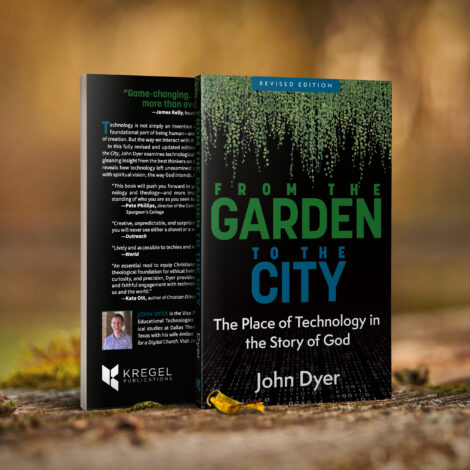
	<li><em><strong>From the Garden to the City</strong></em> (John Dyer). Finally, I want to let you know that I&#8217;ll be publishing a book sometime in the next year or so that will give an introduction to the importance of technology in our lives and faith, surface some of the most important issues we face, and hopefully offer some constructive solutions.</li>
	</ol>
	<p>If you know of any other books on the subject, let me know and I&#8217;ll add them to the list.
</p>
<div class="feedflare">
<a href="http://feeds.feedburner.com/~ff/DontEatTheFruit?a=P7uPhjkIMe4:3H752yirUI0:D7DqB2pKExk"><img src="http://feeds.feedburner.com/~ff/DontEatTheFruit?i=P7uPhjkIMe4:3H752yirUI0:D7DqB2pKExk" border="0"></img></a> <a href="http://feeds.feedburner.com/~ff/DontEatTheFruit?a=P7uPhjkIMe4:3H752yirUI0:yIl2AUoC8zA"><img src="http://feeds.feedburner.com/~ff/DontEatTheFruit?d=yIl2AUoC8zA" border="0"></img></a> <a href="http://feeds.feedburner.com/~ff/DontEatTheFruit?a=P7uPhjkIMe4:3H752yirUI0:I9og5sOYxJI"><img src="http://feeds.feedburner.com/~ff/DontEatTheFruit?d=I9og5sOYxJI" border="0"></img></a>
</div><img src="http://feeds.feedburner.com/~r/DontEatTheFruit/~4/P7uPhjkIMe4" height="1" width="1"/>]]></content:encoded>
			<wfw:commentRss>http://donteatthefruit.com/2010/02/new-and-upcoming-books-on-technology-media-and-faith/feed/</wfw:commentRss>
		<slash:comments>16</slash:comments>
		<feedburner:origLink>http://donteatthefruit.com/2010/02/new-and-upcoming-books-on-technology-media-and-faith/</feedburner:origLink></item>
		<item>
		<title>Presentation: Technology in the Kingdom, Society, and Your Life</title>
		<link>http://feedproxy.google.com/~r/DontEatTheFruit/~3/FnULE_Vmkl4/</link>
		<comments>http://donteatthefruit.com/2010/02/presentation-technology-in-the-kingdom-society-and-your-life/#comments</comments>
		<pubDate>Sun, 21 Feb 2010 21:21:37 +0000</pubDate>
		<dc:creator>John Dyer</dc:creator>
				<category><![CDATA[Tools for Tech Thinking]]></category>

		<guid isPermaLink="false">http://donteatthefruit.com/?p=742</guid>
		<description><![CDATA[	Two weeks ago, I gave a breakout session for the Electronic Gospel conference put on by Dallas Theological Seminary and headlined by Shane Hipps.
	You can order the audio of the keynotes and breakout sessions (including Scott McClellan of Collide magazine and Bill Buchanan from Irving Bible Church) from the Center for Christian Leadership resource center, but [...]]]></description>
			<content:encoded><![CDATA[	<p><img class="alignright size-full wp-image-743" title="Electronic Gospel" src="http://donteatthefruit.com/wp-content/uploads/2010/02/featuredArt_eg.jpg" alt="" width="301" height="183" />Two weeks ago, I gave a breakout session for the Electronic Gospel conference put on by <a href="http://www.dts.edu/">Dallas Theological Seminary</a> and headlined by <a href="http://www.shanehipps.com">Shane Hipps</a>.</p>
	<p>You can <a href="http://cclstore.dts.edu/pc-48-8-the-electronic-gospel-how-technology-shapes-our-faith.aspx">order the audio</a> of the keynotes and breakout sessions (including Scott McClellan of <em><a href="http://www.collidemagazine.com/">Collide </a></em><a href="http://www.collidemagazine.com/">magazine</a> and Bill Buchanan from <a href="http://www.irvingbible.org/">Irving Bible Church</a>) from the <a href="http://cclstore.dts.edu/pc-48-8-the-electronic-gospel-how-technology-shapes-our-faith.aspx">Center for Christian Leadership resource center</a>, but I&#8217;m posting my slides here since I haven&#8217;t posted a talk in a while.</p>
	<p>Here&#8217;s what&#8217;s in it:</p>
	<ul>
	<li>00:00-07:41 &#8211; Introduction of me and the topic</li>
	<li>07:42-22:38 &#8211; Technology in the Biblical Story (with a 5 minute audience discussion)</li>
	<li>22:39-36:50 &#8211; Technology in Society, theory from Postman, McLuhan, Ellul, etc.</li>
	<li>36:51-53:21 &#8211; Technology in Your Life</li>
	</ul>
	<p><span id="more-742"></span></p>
	<h3>Presentation: Technology in the Kingdom, Society, and Your Life</h3>
	<div id="__ss_3228351" style="width: 425px; text-align: left;"><a style="font: 14px Helvetica,Arial,Sans-serif; display: block; margin: 12px 0 3px 0; text-decoration: underline;" title="Technology in the Kingdom, Society, and Your Life" href="http://www.slideshare.net/johndyer/using-technology-without-technology-using-you-3228351">Technology in the Kingdom, Society, and Your Life</a><object style="margin: 0px;" classid="clsid:d27cdb6e-ae6d-11cf-96b8-444553540000" width="425" height="355" codebase="http://download.macromedia.com/pub/shockwave/cabs/flash/swflash.cab#version=6,0,40,0"><br />
<param name="allowFullScreen" value="true" />
<param name="allowScriptAccess" value="always" />
<param name="src" value="http://static.slidesharecdn.com/swf/ssplayer2.swf?doc=technologywantstoeatyou-100219154758-phpapp01&amp;stripped_title=using-technology-without-technology-using-you-3228351" />
<param name="allowfullscreen" value="true" /><embed style="margin: 0px;" type="application/x-shockwave-flash" width="425" height="355" src="http://static.slidesharecdn.com/swf/ssplayer2.swf?doc=technologywantstoeatyou-100219154758-phpapp01&amp;stripped_title=using-technology-without-technology-using-you-3228351" allowscriptaccess="always" allowfullscreen="true"></embed></object><span style="font-family: tahoma, arial; font-size: 11px;">View more <a style="text-decoration: underline;" href="http://www.slideshare.net/">presentations</a> from <a style="text-decoration: underline;" href="http://www.slideshare.net/johndyer">John Dyer</a>.</span></div>
	<p>Hope you find it helpful! I&#8217;d love to hear if you have any opinions about the material.
</p>
<div class="feedflare">
<a href="http://feeds.feedburner.com/~ff/DontEatTheFruit?a=FnULE_Vmkl4:imZ-yBCXK_4:D7DqB2pKExk"><img src="http://feeds.feedburner.com/~ff/DontEatTheFruit?i=FnULE_Vmkl4:imZ-yBCXK_4:D7DqB2pKExk" border="0"></img></a> <a href="http://feeds.feedburner.com/~ff/DontEatTheFruit?a=FnULE_Vmkl4:imZ-yBCXK_4:yIl2AUoC8zA"><img src="http://feeds.feedburner.com/~ff/DontEatTheFruit?d=yIl2AUoC8zA" border="0"></img></a> <a href="http://feeds.feedburner.com/~ff/DontEatTheFruit?a=FnULE_Vmkl4:imZ-yBCXK_4:I9og5sOYxJI"><img src="http://feeds.feedburner.com/~ff/DontEatTheFruit?d=I9og5sOYxJI" border="0"></img></a>
</div><img src="http://feeds.feedburner.com/~r/DontEatTheFruit/~4/FnULE_Vmkl4" height="1" width="1"/>]]></content:encoded>
			<wfw:commentRss>http://donteatthefruit.com/2010/02/presentation-technology-in-the-kingdom-society-and-your-life/feed/</wfw:commentRss>
		<slash:comments>3</slash:comments>
		<feedburner:origLink>http://donteatthefruit.com/2010/02/presentation-technology-in-the-kingdom-society-and-your-life/</feedburner:origLink></item>
		<item>
		<title>Responding to Constant Images of Mass Suffering: Haiti, Technology, and Repentance</title>
		<link>http://feedproxy.google.com/~r/DontEatTheFruit/~3/bR7DFwi90yg/</link>
		<comments>http://donteatthefruit.com/2010/02/haiti-suffering-and-repentance/#comments</comments>
		<pubDate>Wed, 17 Feb 2010 14:33:06 +0000</pubDate>
		<dc:creator>John Dyer</dc:creator>
				<category><![CDATA[Our Technological World]]></category>
		<category><![CDATA[Spiritual Formation]]></category>

		<guid isPermaLink="false">http://donteatthefruit.com/?p=730</guid>
		<description><![CDATA[	Haiti and Suffering
	Since the horrible earthquake in Haiti, it has been encouraging to see the incredible outpouring of support and mobilization using all available resources and technology. The devastation there is so terrible it is impossible to fathom, and it confirms the faith of Haitian Christians as nothing less than miraculous.
	These events also bring up [...]]]></description>
			<content:encoded><![CDATA[	<h3>Haiti and Suffering</h3>
	<p><a href="http://www.dts.edu/haiti/"><img class="aligncenter size-medium wp-image-733" title="haiti-banner" src="http://donteatthefruit.com/wp-content/uploads/2010/02/haiti-banner-520x234.jpg" alt="Link goes to DTS's Hait Disaster Relief Fund" width="520" height="234" /></a>Since the horrible earthquake in Haiti, it has been encouraging to see the incredible outpouring of support and mobilization using all available resources and technology. The devastation there is so terrible it is impossible to fathom, and it confirms the faith of Haitian Christians as nothing less than miraculous.</p>
	<p>These events also bring up one of the difficulties we face in the media age – our inability as humans to deal with suffering on a worldwide scale. It is hard enough to face the horror of our loved ones dying, but no human can withstand multiplying that emotion 250,000 times.</p>
	<p>Media ecologists talk about the difficulty this way. In an oral culture, people form a tightly knit community physically and emotional connected to every event that happens within their tribe. In a print culture, individuals are disconnected by the medium of print which allows us to gain knowledge of suffering while alone decoding the characters on a page. Today, in a visual/digital culture, we are re-connected to those around us via the speed of Internet and we are re-engaged emotionally through the power of images. Yet we are also disconnected because the suffering we see is of those unknown to us and with whom we are not physically present. (for another take, see <a href="http://www.challies.com/archives/articles/neil-postman-on-the-earthquake-in-haiti.php">Tim Challies</a>)</p>
	<p>The natural response to being bombarded emotionally (through images) and continuously (through electronic speed) with the totality of human suffering is to simply become numb to it. Certainly, many of us give our money, time, and prayers to help those who are in pain, but without being there we cannot fully engage. I can read about what friends like <a href="http://www.rhettsmith.com/">Rhett Smith</a>, <a href="http://www.larsrood.com/">Lars Rood</a>, <a href="http://www.studentministry.org/">Tim Schmoyer</a>, and others feel on the ground, but I cannot absorb their experience through web pages and YouTube videos. I admire their courage and resolve, but I feel helpless at the same time.</p>
	<h3>Haiti and Repentance</h3>
	<p>Thankfully, I believe there is another response other than becoming numb and cynical or languishing in helplessness. First, we can involve ourselves in such pain by “looking after orphans and widows in their distress” (James 1:27). Giving money is not the same as being there, but it is better than doing nothing and it does answer Jesus’ call, “For I was hungry and you gave me something to eat” (Matt 25:35).<span id="more-730"></span></p>
	<p>In addition to such support, there is another less apparent response that Jesus tells us about in Luke 13.</p>
	<p>When I was a student at Texas A&amp;M, I experienced a really fun year – 1998 the Big 12 championship – and a year of senseless tragedy – 1999 the year the Aggie Bonfire fell and crushed 12 students. Many students and parents were left asking why something so terrible happened.</p>
	<p>Jesus addressed a similar event in Luke 13:4-5 where a tower fell and killed 18 people. Jesus challenged the commonly held idea that those 18 sinned and the tower was their judgment (an idea Pat Roberson shamefully repeated about Haiti) by asking, “Do you think really think this happened to those people because they were any worse than you?”</p>
	<p>Jesus continues and says something like, “Of course not, but this event should remind you of the sin in the world and the sin in your own life and cause you to repent of your own sins. Don’t worry about those people’s sin, worry about your own.”</p>
	<h3>The Most Repentant People of All Time?</h3>
	<p>I didn’t personally know any of students killed in the Aggie Bonfire tragedy, but I felt close to them since we saw their pictures daily for the next few years. Yet I also remember praying that God would allow me to feel more empathy and emotion for them. It seems strange now, but I felt guilty for not being sad enough.</p>
	<p>Looking back, I think I had it backwards.</p>
	<p>Jesus does not ask me to emotionally engage every tragic event that happens to distant people I do not know. Instead, he asks me to be available to those around me. There is suffering all around me if I just look up from my laptop and iPhone for a few moments.</p>
	<p>For those far off, I have only four options: pray, send money, go, or repent.</p>
	<p>We are constantly surrounded by images of tragedy &#8211; robberies, murder, earthquakes, terrorism, crashes, cancer, and on and on &#8211; but we almost never ever choose that last option.</p>
	<p>We have an endless stream of reasons to repent, so rather than feel helpless to do something or guilty about our emotions, let us all join together and allow our media technology to call us not into numbness and cynicism, but into godly repentance.
</p>
<div class="feedflare">
<a href="http://feeds.feedburner.com/~ff/DontEatTheFruit?a=bR7DFwi90yg:SdOpOWb73a4:D7DqB2pKExk"><img src="http://feeds.feedburner.com/~ff/DontEatTheFruit?i=bR7DFwi90yg:SdOpOWb73a4:D7DqB2pKExk" border="0"></img></a> <a href="http://feeds.feedburner.com/~ff/DontEatTheFruit?a=bR7DFwi90yg:SdOpOWb73a4:yIl2AUoC8zA"><img src="http://feeds.feedburner.com/~ff/DontEatTheFruit?d=yIl2AUoC8zA" border="0"></img></a> <a href="http://feeds.feedburner.com/~ff/DontEatTheFruit?a=bR7DFwi90yg:SdOpOWb73a4:I9og5sOYxJI"><img src="http://feeds.feedburner.com/~ff/DontEatTheFruit?d=I9og5sOYxJI" border="0"></img></a>
</div><img src="http://feeds.feedburner.com/~r/DontEatTheFruit/~4/bR7DFwi90yg" height="1" width="1"/>]]></content:encoded>
			<wfw:commentRss>http://donteatthefruit.com/2010/02/haiti-suffering-and-repentance/feed/</wfw:commentRss>
		<slash:comments>6</slash:comments>
		<feedburner:origLink>http://donteatthefruit.com/2010/02/haiti-suffering-and-repentance/</feedburner:origLink></item>
		<item>
		<title>Twitter and Forgiveness, Jetpacks and Change</title>
		<link>http://feedproxy.google.com/~r/DontEatTheFruit/~3/w5zd7E63zFE/</link>
		<comments>http://donteatthefruit.com/2010/02/twitter-and-forgiveness-jetpacks-and-change/#comments</comments>
		<pubDate>Thu, 11 Feb 2010 14:29:12 +0000</pubDate>
		<dc:creator>John Dyer</dc:creator>
				<category><![CDATA[Our Technological World]]></category>

		<guid isPermaLink="false">http://donteatthefruit.com/?p=723</guid>
		<description><![CDATA[	In case you missed them, I&#8217;d like to point you to a few articles I wrote for Collide Magazine over the past few months.
	I Will Remember Your Tweets No More
	In this article, I looked at what it means to forgive in a world where our computers remember everything we do. Should we just blow people [...]]]></description>
			<content:encoded><![CDATA[	<p><a href="http://www.collidemagazine.com/"><img class="alignright size-full wp-image-728" title="collide-2010-02" src="http://donteatthefruit.com/wp-content/uploads/2010/02/collide-2010-02.jpg" alt="" width="192" height="238" /></a>In case you missed them, I&#8217;d like to point you to a few articles I wrote for <a href="http://www.collidemagazine.com/">Collide Magazine</a> over the past few months.</p>
	<p><a href="http://www.collidemagazine.com/article/291/i-will-remember-your-tweets-no-more"><strong>I Will Remember Your Tweets No More</strong></a></p>
	<p>In this article, I looked at what it means to forgive in a world where our computers remember everything we do. Should we just blow people off who annoy us? Probably not. But should we remove all record of wrong from our hard drives either?</p>
	<blockquote><p>For Christians, this means that the Internet’s ability to help us remember rightly is a chance to practice a theologically-informed, true kind of forgiveness. Rather than downplay an incident or cut people off every time they annoy us, we have the chance to look at the past with Google-like accuracy and choose to stop holding those wrongs against those who harmed us. Instead of constantly blocking, de-following, and un-friending, we can choose to see people and their wrong through the blood of Christ.</p></blockquote>
	<p><a href="http://www.collidemagazine.com/article/296/its-2010-wheres-my-jetpack"><strong>It&#8217;s 2010, Where&#8217;s My Jetpack?</strong></a></p>
	<p>In an article that&#8217;s quite a bit lighter than the previous one, I attempt to look into the future and imagine what it would really be like when and if we ever get our jetpacks by applying Neil Postman&#8217;s <em><a href="http://www.mat.upm.es/~jcm/neil-postman--five-things.html">Five Things We Need To Know About Technological Change</a></em>.</p>
	<blockquote><p>What new technology are you considering adding to your life, your family, or your church? It might not be as cool as the mythical jetpack, but it will likely bring some change to your life and the life of those around you. It might be helpful to run your new stuff through these five questions.</p></blockquote>
	<p>Hope you enjoy them!
</p>
<div class="feedflare">
<a href="http://feeds.feedburner.com/~ff/DontEatTheFruit?a=w5zd7E63zFE:oF-zaFxma0o:D7DqB2pKExk"><img src="http://feeds.feedburner.com/~ff/DontEatTheFruit?i=w5zd7E63zFE:oF-zaFxma0o:D7DqB2pKExk" border="0"></img></a> <a href="http://feeds.feedburner.com/~ff/DontEatTheFruit?a=w5zd7E63zFE:oF-zaFxma0o:yIl2AUoC8zA"><img src="http://feeds.feedburner.com/~ff/DontEatTheFruit?d=yIl2AUoC8zA" border="0"></img></a> <a href="http://feeds.feedburner.com/~ff/DontEatTheFruit?a=w5zd7E63zFE:oF-zaFxma0o:I9og5sOYxJI"><img src="http://feeds.feedburner.com/~ff/DontEatTheFruit?d=I9og5sOYxJI" border="0"></img></a>
</div><img src="http://feeds.feedburner.com/~r/DontEatTheFruit/~4/w5zd7E63zFE" height="1" width="1"/>]]></content:encoded>
			<wfw:commentRss>http://donteatthefruit.com/2010/02/twitter-and-forgiveness-jetpacks-and-change/feed/</wfw:commentRss>
		<slash:comments>2</slash:comments>
		<feedburner:origLink>http://donteatthefruit.com/2010/02/twitter-and-forgiveness-jetpacks-and-change/</feedburner:origLink></item>
		<item>
		<title>Billy Graham on Technology as a Pointer to Christ</title>
		<link>http://feedproxy.google.com/~r/DontEatTheFruit/~3/dPhu4mfPD3w/</link>
		<comments>http://donteatthefruit.com/2010/01/billy-graham-on-technology-as-a-pointer-to-christ/#comments</comments>
		<pubDate>Wed, 27 Jan 2010 12:30:06 +0000</pubDate>
		<dc:creator>John Dyer</dc:creator>
				<category><![CDATA[Quotes]]></category>

		<guid isPermaLink="false">http://donteatthefruit.com/?p=665</guid>
		<description><![CDATA[	Billy Graham is an amazing communicator, and his 1998 TED talk on technology and faith (embedded below) is no exception. In it he is witty, articulate, and convicting.
	His basic message is simple: technology brings amazing benefits to humanity, but it&#8217;s failure to alleviate the brokenness of the human heart ultimately point us to our need for a [...]]]></description>
			<content:encoded><![CDATA[	<p><img class="size-full wp-image-712 alignright" title="billy-graham-ted" src="http://donteatthefruit.com/wp-content/uploads/2010/02/billy-graham-ted.png" alt="" width="330" height="254" />Billy Graham is an amazing communicator, and his 1998 TED talk on technology and faith (embedded below) is no exception. In it he is witty, articulate, and convicting.</p>
	<p>His basic message is simple: technology brings amazing benefits to humanity, but it&#8217;s failure to alleviate the brokenness of the human heart ultimately point us to our need for a Savior.</p>
	<p>What I appreciate most about his talk is that Graham did not give it to a church audience who would immediately agree with him. Instead in his audiences are some of the greatest technological minds ever gathered, many of whom are no friends of religion. It&#8217;s a classic example of how a speaker can appeal to an audience&#8217;s sensibilities, gain a sense of trust, and then finally address the person of Jesus Christ. <span id="more-665"></span></p>
	<h3>Billy Graham&#8217;s 1998 TED Talk on Technology and Faith</h3>
	<p><object classid="clsid:d27cdb6e-ae6d-11cf-96b8-444553540000" width="334" height="326" codebase="http://download.macromedia.com/pub/shockwave/cabs/flash/swflash.cab#version=6,0,40,0"><br />
<param name="allowFullScreen" value="true" />
<param name="wmode" value="transparent" />
<param name="bgColor" value="#ffffff" />
<param name="flashvars" value="vu=http://video.ted.com/talks/dynamic/BillyGraham_1998-medium.flv&amp;su=http://images.ted.com/images/ted/tedindex/embed-posters/BillyGraham-1998.embed_thumbnail.jpg&amp;vw=320&amp;vh=240&amp;ap=0&amp;ti=308&amp;introDuration=16500&amp;adDuration=4000&amp;postAdDuration=2000&amp;adKeys=talk=billy_graham_on_technology_faith_and_suffering;year=1998;theme=technology_history_and_destiny;theme=bold_predictions_stern_warnings;theme=what_s_next_in_tech;theme=is_there_a_god;event=TED1998;&amp;preAdTag=tconf.ted/embed;tile=1;sz=512x288;" />
<param name="src" value="http://video.ted.com/assets/player/swf/EmbedPlayer.swf" />
<param name="bgcolor" value="#ffffff" />
<param name="allowfullscreen" value="true" /><embed type="application/x-shockwave-flash" width="334" height="326" src="http://video.ted.com/assets/player/swf/EmbedPlayer.swf" flashvars="vu=http://video.ted.com/talks/dynamic/BillyGraham_1998-medium.flv&amp;su=http://images.ted.com/images/ted/tedindex/embed-posters/BillyGraham-1998.embed_thumbnail.jpg&amp;vw=320&amp;vh=240&amp;ap=0&amp;ti=308&amp;introDuration=16500&amp;adDuration=4000&amp;postAdDuration=2000&amp;adKeys=talk=billy_graham_on_technology_faith_and_suffering;year=1998;theme=technology_history_and_destiny;theme=bold_predictions_stern_warnings;theme=what_s_next_in_tech;theme=is_there_a_god;event=TED1998;&amp;preAdTag=tconf.ted/embed;tile=1;sz=512x288;" bgcolor="#ffffff" wmode="transparent" allowfullscreen="true"></embed></object></p>
	<p>Personally, I found it very moving to see how Billy Graham&#8217;s life of integrity gained him this rare audience. He used a subject the audience was interested in &#8211; technology &#8211; and took the time to validate its importance while also gently showing how its limitations direct us to the Savior. Amen, Billy.
</p>
<div class="feedflare">
<a href="http://feeds.feedburner.com/~ff/DontEatTheFruit?a=dPhu4mfPD3w:gY1jdPUwmlo:D7DqB2pKExk"><img src="http://feeds.feedburner.com/~ff/DontEatTheFruit?i=dPhu4mfPD3w:gY1jdPUwmlo:D7DqB2pKExk" border="0"></img></a> <a href="http://feeds.feedburner.com/~ff/DontEatTheFruit?a=dPhu4mfPD3w:gY1jdPUwmlo:yIl2AUoC8zA"><img src="http://feeds.feedburner.com/~ff/DontEatTheFruit?d=yIl2AUoC8zA" border="0"></img></a> <a href="http://feeds.feedburner.com/~ff/DontEatTheFruit?a=dPhu4mfPD3w:gY1jdPUwmlo:I9og5sOYxJI"><img src="http://feeds.feedburner.com/~ff/DontEatTheFruit?d=I9og5sOYxJI" border="0"></img></a>
</div><img src="http://feeds.feedburner.com/~r/DontEatTheFruit/~4/dPhu4mfPD3w" height="1" width="1"/>]]></content:encoded>
			<wfw:commentRss>http://donteatthefruit.com/2010/01/billy-graham-on-technology-as-a-pointer-to-christ/feed/</wfw:commentRss>
		<slash:comments>19</slash:comments>
		<feedburner:origLink>http://donteatthefruit.com/2010/01/billy-graham-on-technology-as-a-pointer-to-christ/</feedburner:origLink></item>
		<item>
		<title>Who’s Your Favorite Online Person You’ve Never Met?</title>
		<link>http://feedproxy.google.com/~r/DontEatTheFruit/~3/BOAXXhpwHVk/</link>
		<comments>http://donteatthefruit.com/2010/01/whos-your-favorite-online-person-youve-never-met/#comments</comments>
		<pubDate>Wed, 20 Jan 2010 12:00:51 +0000</pubDate>
		<dc:creator>John Dyer</dc:creator>
				<category><![CDATA[Our Technological World]]></category>

		<guid isPermaLink="false">http://donteatthefruit.com/?p=632</guid>
		<description><![CDATA[	Have you ever had the chance to meet someone in person that you&#8217;ve only met online?
	If you have, you know that strange feeling of trying to match a person&#8217;s picture to the body in front of you. It&#8217;s exciting as if you&#8217;re meeting a celebrity, and yet terrifying at the same time. Will we be best [...]]]></description>
			<content:encoded><![CDATA[	<p>Have you ever had the chance to meet someone in person that you&#8217;ve only met online?</p>
	<p>If you have, you know that strange feeling of trying to match a person&#8217;s picture to the body in front of you. It&#8217;s exciting as if you&#8217;re meeting a celebrity, and yet <a href="http://answers.yahoo.com/question/index?qid=20090704184633AA730Vd">terrifying at the same time</a>. Will we be best friends? What if we don&#8217;t really hit it off, and we disagree on everything when we actually talk? What if I can&#8217;t be my online self or they don&#8217;t seem to be theirs?</p>
	<p>Most of the time, though, it&#8217;s a total blast to share a meal together and spend some quality time in real life with people you only know online. Here&#8217;s what happened for me last year:</p>
	<h3>2009: John &amp; Rhett</h3>
	<p><img class="aligncenter size-medium wp-image-709" title="John Dyer, Rhett Smith, and John Saddington" src="http://donteatthefruit.com/wp-content/uploads/2010/01/johndyer_rhettsmith_johnsaddington-520x302.jpg" alt="I'm the least good looking white guy" width="520" height="302" /></p>
	<p>In early 2009, I met <a href="http://johnsaddington.com/">John Saddington</a> and <a href="http://rhettsmith.com">Rhett Smith</a> in person for the first time. I had corresponded online with John for several years (2005?) and Rhett and I had twittered a bit, but this was the first time we all were able to meet in person (one of <a href="http://rhettsmith.com/2008/11/17/taking-online-community-offline-my-2009-goal-is/">Rhett&#8217;s goals</a>).<span id="more-632"></span></p>
	<p>At first, from a distance, I thought, &#8220;Wow. Rhett is better looking online than in real life.&#8221; Then I came up close and thought, &#8220;Whoa, he&#8217;s jacked and I was wrong &#8211; he is <em>better </em>looking in real life than his picture.&#8221; I also quickly realized that the kindness and warmth you see from Rhett online in his blog posts and tweets comes across even stronger in person. Since then, our wives and kids and met, and I even had the chance to have lunch with his dad which allowed me to see even more about who Rhett really is.</p>
	<p>As for John, we had been emailing long before things like twitter, facebook, and gravatar were common enough to have a common mental picture of what someone looked like. Instead, my &#8220;image&#8221; of him was more related to what I thought his personality and temperament would be like. Since I had only a few emails to go by, it was fascinating to match the Human3rror in my mind to the John Saddington in front of me. It was great to sit back and watch how he could be intense and still relaxed, quiet and yet funny, kind yet with strong opinions. All that&#8217;s there online, but  I appreciated getting to see it all together at once, and still know there&#8217;s tons of cool stuff about John I don&#8217;t know.</p>
	<h3>2010: ???</h3>
	<p>Looking back at that time, I think John and Rhett were the two people that I knew only online that I most wanted to meet in person some day. I&#8217;m sure glad that we had the chance, and that they still seem to like me now that we&#8217;ve hung out a few times.</p>
	<p>Today, one person that I know only through writing, but would love to meet in person is <a href="http://www.mereorthodoxy.com/">Matt Lee Anderson</a>. Of course, there are tons of big name web celebrities that would be fun to meet, but Matt is someone that I&#8217;ve actually been able to engage on a thoughtful level and dialog with about various issues. I think I know someone of his sharp mind and general kindness, but I also know that I won&#8217;t really have the whole picture without meeting him in person some time. And I genuinely look forward to that day.</p>
	<p>Another person with whom I&#8217;ve corresponded quite a bit is <a href="http://ryanburns.me/">Ryan Burns</a> of Logos Software. Unlike Matt whom I&#8217;ve spent more time discussing ideas, I&#8217;ve &#8220;watched&#8221; major events in Ryan&#8217;s life unfold online as he attended seminary, left, started up various web ventures, moved to Logos, and so on. I would love to put a meal between the two of us one day.</p>
	<h3>How About You?</h3>
	<p>So do you have a person you only know online that you&#8217;d like to meet in person sometime your? I don&#8217;t mean someone that you&#8217;ve heard about, but someone that you&#8217;ve had some great conversations with through some medium &#8211; pen pals, email, blog comments, twitter, etc. &#8211; with whom you&#8217;d love to be able to sit down share a meal.</p>
	<p>Who&#8217;s the person you&#8217;d love to someday say, &#8220;Remember the time when we&#8230;?&#8221;
</p>
<div class="feedflare">
<a href="http://feeds.feedburner.com/~ff/DontEatTheFruit?a=BOAXXhpwHVk:vMQmdaNqT-0:D7DqB2pKExk"><img src="http://feeds.feedburner.com/~ff/DontEatTheFruit?i=BOAXXhpwHVk:vMQmdaNqT-0:D7DqB2pKExk" border="0"></img></a> <a href="http://feeds.feedburner.com/~ff/DontEatTheFruit?a=BOAXXhpwHVk:vMQmdaNqT-0:yIl2AUoC8zA"><img src="http://feeds.feedburner.com/~ff/DontEatTheFruit?d=yIl2AUoC8zA" border="0"></img></a> <a href="http://feeds.feedburner.com/~ff/DontEatTheFruit?a=BOAXXhpwHVk:vMQmdaNqT-0:I9og5sOYxJI"><img src="http://feeds.feedburner.com/~ff/DontEatTheFruit?d=I9og5sOYxJI" border="0"></img></a>
</div><img src="http://feeds.feedburner.com/~r/DontEatTheFruit/~4/BOAXXhpwHVk" height="1" width="1"/>]]></content:encoded>
			<wfw:commentRss>http://donteatthefruit.com/2010/01/whos-your-favorite-online-person-youve-never-met/feed/</wfw:commentRss>
		<slash:comments>16</slash:comments>
		<feedburner:origLink>http://donteatthefruit.com/2010/01/whos-your-favorite-online-person-youve-never-met/</feedburner:origLink></item>
		<item>
		<title>What Does It Mean to “Religiously Self-identify” Online?</title>
		<link>http://feedproxy.google.com/~r/DontEatTheFruit/~3/Q8CKNPHAVvc/</link>
		<comments>http://donteatthefruit.com/2010/01/what-does-it-mean-to-religiously-self-identify-online/#comments</comments>
		<pubDate>Sat, 16 Jan 2010 19:22:25 +0000</pubDate>
		<dc:creator>John Dyer</dc:creator>
				<category><![CDATA[Our Technological World]]></category>

		<guid isPermaLink="false">http://donteatthefruit.com/?p=681</guid>
		<description><![CDATA[	In an aticle entitled Religious Self-Profiling ChristianityToday.com reports that &#8220;Christian&#8221; is still the most frequent religious label on Facebook, many people choose not to use it. I am quoted on the second page, and I wanted to give some additional commentary on what I said there.
	So, What Do You Do?
	When someone asks me what I do [...]]]></description>
			<content:encoded><![CDATA[	<blockquote><p>In an aticle entitled <a href="http://www.christianitytoday.com/ct/2010/january/20.14.html">Religious Self-Profiling</a> ChristianityToday.com reports that &#8220;Christian&#8221; is still the most frequent religious label on Facebook, many people choose not to use it. I am quoted on the second page, and I wanted to give some additional commentary on what I said there.</p></blockquote>
	<h3>So, What Do You Do?</h3>
	<p><img class="size-full wp-image-687 alignright" title="Priest Collar" src="http://donteatthefruit.com/wp-content/uploads/2010/01/priest_collar.jpg" alt="" width="234" height="249" />When someone asks me what I do for a living, my answer depends on what I know about the person.</p>
	<p>For most people I just say, &#8220;web programmer.&#8221; But if someone doesn&#8217;t seem terribly computer savvy I attempt to simplify saying, &#8220;I make websites.&#8221; On the other hand, if I know someone does computer work of some kind I get more specific and say I love to work with JavaScript on the front end, but I do a lot of backend programming in C# and some PHP, Ruby, other languages.</p>
	<p>In other words, how I answer depends on the person asking and the context in which he or she asks.</p>
	<p><strong>Online vs. Offline Identity</strong></p>
	<p>When it comes to religious identification things get a little trickier, and many people have attempted to explain the move away from &#8220;Christian&#8221; to terms like &#8220;Christ follower.&#8221; That is an interesting discussion (recently I made<a href="http://www.hippypastornamegenerator.com"> hippypastornamegenerator.com</a> to poke fun at our pomo resistance to traditional terms like &#8220;Christian&#8221; and &#8220;pastor&#8221;), but what I&#8217;m interested in here is how online profiles as a technology has influenced and shaped that larger issue of identity.</p>
	<p>Let&#8217;s contrast how the technology of a website profile differs from a face-to-face interaction.</p>
	<p><span id="more-681"></span></p>
	<table>
	<thead>
	<tr>
	<th width="50%">Offline</th>
	<th width="50%">Online</th>
	</tr>
	</thead>
	<tbody>
	<tr>
	<th>Contextual</th>
	<th>Decontextual</th>
	</tr>
	<tr>
	<td>In the story above, the way I describe my job is tied to a specific setting, time, and individual. The words I use are tied to a a specific  context.</td>
	<td>In contrast, a website profile is completely decontextualized &#8211; that is, it is removed from any specific situation, time, or person. It is purely abstract, and it only gives one answer regardless of the setting, time, or person.</td>
	</tr>
	<tr>
	<th>Oral</th>
	<th>Text-Based</th>
	</tr>
	<tr>
	<td>When face-to-face, we use the spoken word in a dialog. Speech has a give and take, and we adapt what we say to the other person&#8217;s understanding and based how they react. The spoken word also has a difference sense of permanence than written words.</td>
	<td>Online we currently are limited to text-based descriptions of ourselves. This may not seem significant, but linguistic studies show that the mind interprets an individual word sitting on a line differently than a word situated within in a sentence and a sentence within a conversation.</td>
	</tr>
	<tr>
	<th>Asked</th>
	<th>Declared</th>
	</tr>
	<tr>
	<td>In person, subjects like jobs, religion, and politics usually don&#8217;t come up until one person asks another about it. We usually don&#8217;t immediately declare such affiliations unless there is some kind of special circumstance</td>
	<td>In the online world, our profiles don&#8217;t wait until someone asks us about these thing. Instead, the technology of the profile declares without being asked.</td>
	</tr>
	</tbody>
	</table>
	<p>This means that online and offline identification are quite different. The technology of the profile introduces an alternate way of sharing one&#8217;s identity with another person. The identity presented is shaped by and confined to what the technology can and cannot do. Our identities are also shaped by what the profile chooses to emphasize. For example, Facebook puts religion and politics next one another reinforcing that they are related either in meaning, significance, or both.</p>
	<h3>Working Within and Against Technology</h3>
	<p>In the fall 0f 2008, I changed my view to say</p>
	<blockquote><p>Political View: Someone will be president<br />
Religious View: Someone else will be King</p></blockquote>
	<p>It seems a little childish to me now, but at the time I was attempting to work within the system&#8217;s constraints (politics and religion are linked) and contextualize my answers to address the current political climate in which both major parties emphasized that their &#8220;hope&#8221; lay in who was president. I wanted to reframe the discussion in a way that put my hope in Christ as King over which candidate would eventually run the United States.</p>
	<p>In other situations, I&#8217;m happy to use the term &#8220;Christian&#8221; or &#8220;evangelical&#8221; (no need for <a href="http://www.hippypastornamegenerator.com">hippypastornamegenerator.com</a> names) or even to discuss the candidate for whom I voted, but it&#8217;s not something that I think the technology of profiles is particularly well suited for.</p>
	<p>So how do you identify online? Do you use traditional terms offline? What limitations do online profiles have? What advantages do you see?</p>
	<blockquote><p><strong>Update</strong>: As my <a href="http://donteatthefruit.com/2010/01/whos-your-favorite-online-person-youve-never-met/">dear friend</a> Matt Anderson <a href="http://mereorthodoxy.com/?p=2243">points out</a>, online and offline identification cannot always be cleanly separated as I argue here. The offline world has quite a bit of <em>involuntary disclosure</em> as well.</p>
	<p>I agree with him, and the photo on this post along with my comment about priest&#8217;s collars in Christianity Today was meant to suggest that. The things we wear (priest collars, Rosaries, job uniforms, athletic clothing, grubby garments vs. high fashion attire, etc.) and our bodily distinctives (gender, tallness or shortness, missing limbs, colored hair, the color of our skin, etc.) often &#8220;declare&#8221; in a non &#8220;oral&#8221; and &#8220;decontextualized&#8221; way much about our identity.</p>
	<p>However, in regards to the specific case of online religious and political identity, facebook does reframe these parts of ourselves in a way that is distinct from what we do offline. A priest can choose when and where (i.e. in what context) to wear his collar just as an Applebee&#8217;s employee can take off her vest of flare before going to a funeral. In contrast, a website profile can only &#8220;be&#8221; or &#8220;have&#8221; one religious identification. It cannot choose based on context because there is only one context &#8211; the website itself.</p></blockquote>
<div class="feedflare">
<a href="http://feeds.feedburner.com/~ff/DontEatTheFruit?a=Q8CKNPHAVvc:2G0527H6Q0U:D7DqB2pKExk"><img src="http://feeds.feedburner.com/~ff/DontEatTheFruit?i=Q8CKNPHAVvc:2G0527H6Q0U:D7DqB2pKExk" border="0"></img></a> <a href="http://feeds.feedburner.com/~ff/DontEatTheFruit?a=Q8CKNPHAVvc:2G0527H6Q0U:yIl2AUoC8zA"><img src="http://feeds.feedburner.com/~ff/DontEatTheFruit?d=yIl2AUoC8zA" border="0"></img></a> <a href="http://feeds.feedburner.com/~ff/DontEatTheFruit?a=Q8CKNPHAVvc:2G0527H6Q0U:I9og5sOYxJI"><img src="http://feeds.feedburner.com/~ff/DontEatTheFruit?d=I9og5sOYxJI" border="0"></img></a>
</div><img src="http://feeds.feedburner.com/~r/DontEatTheFruit/~4/Q8CKNPHAVvc" height="1" width="1"/>]]></content:encoded>
			<wfw:commentRss>http://donteatthefruit.com/2010/01/what-does-it-mean-to-religiously-self-identify-online/feed/</wfw:commentRss>
		<slash:comments>12</slash:comments>
		<feedburner:origLink>http://donteatthefruit.com/2010/01/what-does-it-mean-to-religiously-self-identify-online/</feedburner:origLink></item>
		<item>
		<title>Have You Ever Wished You Had an “I Give Online” Token?</title>
		<link>http://feedproxy.google.com/~r/DontEatTheFruit/~3/UkxmisRZyiA/</link>
		<comments>http://donteatthefruit.com/2010/01/have-you-ever-wished-you-had-a-i-give-online-token/#comments</comments>
		<pubDate>Mon, 11 Jan 2010 12:20:32 +0000</pubDate>
		<dc:creator>John Dyer</dc:creator>
				<category><![CDATA[Spiritual Formation]]></category>

		<guid isPermaLink="false">http://donteatthefruit.com/?p=638</guid>
		<description><![CDATA[	
	Last November, Christianity Today asked me to write a short piece that answered the question, &#8220;Which new technologies hold the most promise—and the most peril—for use in church ministries?&#8221;
	Instead of discussing a particular technology (as Brad Abare and Mark Keller helpfully did), I said:
	I believe that the technology that has the most promise in the [...]]]></description>
			<content:encoded><![CDATA[	<p><img class="aligncenter size-medium wp-image-640" title="Offering Plate" src="http://donteatthefruit.com/wp-content/uploads/2010/01/Offering-Plate-520x349.jpg" alt="" width="520" height="349" /></p>
	<p>Last November, Christianity Today asked me to <a href="http://www.christianitytoday.com/ct/2009/november/27.63.html">write a short piece</a> that answered the question, &#8220;Which new technologies hold the most promise—and the most peril—for use in church ministries?&#8221;</p>
	<p>Instead of discussing a particular technology (as <a href="http://www.christianitytoday.com/ct/2009/november/25.62.html" target="_blank">Brad Abare</a> and <a href="http://www.christianitytoday.com/ct/2009/november/26.62.html" target="_blank">Mark Keller</a> helpfully did), I said:</p>
	<blockquote><p>I believe that the technology that has the most promise in the church is not the latest thing that comes off the assembly line. Rather, it is the technology—any technology—that church leaders openly discuss with other leaders and with their congregations. Conversely, the technology that is most perilous for a church is the one that leaders immediately adopt without thinking through and addressing how it will subtly reshape our spiritual lives.</p></blockquote>
	<p>I went on to give the example of how a seemingly unimportant technology like online giving is worth thinking through spiritually:</p>
	<blockquote><p>For years my wife and I would spend the final minutes before leaving for church frantically searching for our checkbook. So when our church announced that we could set up automatic draft payments, we jumped at the chance to streamline our life and give more consistently.</p>
	<p>After a little while, though, we noticed that our new plan was changing our giving in ways we hadn&#8217;t expected. Every week, when the person next to me passed the offering plate, I started to wish secretly that I had an &#8220;I give online&#8221; token so that he or she would know we were faithfully paying customers. A few months later, when our pastor gave a sermon on the joy of giving, I started wondering if we were missing out on the intimacy with God that can come through repetitive acts of devotion. Instead of worshiping through sacrifice, I seemed to be sacrificing the chance to worship for a little convenience.</p></blockquote>
	<p><span id="more-638"></span>The point isn&#8217;t that there is a problem with online giving itself. The problem was with my approach to the technology. I didn&#8217;t think it through spiritually or communally. Instead, I simply decided that convenience was the only criteria I would use to evaluate the technology.</p>
	<p>With online giving, the dollar amount I give is the same (or more since I never miss a payment) and yet Jesus himself argued that the <em>amount</em> we give is irrelevant. It&#8217;s <em>how</em> we give that matters to him (Luke 21:1-4). Back when we used checks, I kind of liked the idea that people would see me pulling out my checkbook and trying to write the numbers down before the plate arrived. Now that we use automatic draft, I wonder what the people around me are thinking when I don&#8217;t put anything in the plate. In addition, I feel as though we are missing out on a regular, sacrificial act of worship since giving is not a conscious act for us.</p>
	<p>[<em>Update</em>: Just to clarify, we ultimately choose to keep using online giving, but we did so after thinking it through more carefully. My encouragement is to make your choice with more thoughtful criteria than just what's newer or more convenient. Some of the commenters below offer some great suggestions.]</p>
	<p>Again, the point is not that one technology &#8211; cash, checks, or automatic draft &#8211; is better than the other. It&#8217;s that the technology we use is never spiritually neutral. Rather, each technology presents us with a different set of spiritual choices. This means that when we neglect to think about our technology, we are neglecting to think spiritually.</p>
	<p>Though we ultimately chose to stick with automatic draft, here&#8217;s a letter from someone who read the article and decided she needed to do something about it:</p>
	<blockquote><p>Hi, John,</p>
	<p>I thought you might enjoy knowing how you had influenced me.  Today I decided to set up my tithe on a weekly basis instead of the automatic credit card draw as  had been the case for the last two years.  When I read your article pertaining to the issue, several weeks ago, it hit a strong chord in me.  I knew it was the answer to that niggling angst I&#8217;d been experiencing every time the collection plate was passed.  I hadn&#8217;t given it any thought once I sent in my commitment.  It was automatic; it wasn&#8217;t a decision.  Decisions are far better.  It calls for an interaction between me and God.  What a concept!</p>
	<p>Happy 2010!<br />
Sandy</p></blockquote>
	<p>How about you? What technology do you use to give? How does your technological choice help you grow in intimacy with God and maximally glorify him?</p>
	<p><strong>Update</strong>: <a href="http://www.mrshields.com/">Adam Shields</a> pointed out that some churches do in fact have &#8220;I give online&#8221; cards. See the 8th comment on <a href="http://blog.christianitytoday.com/women/2010/01/confession_i_stopped_giving_to_1.html#comment-440140">this post</a> as well as the the second to last question on <a href="http://aldersgate.net/308565.ihtml">this church&#8217;s giving page</a>.
</p>
<div class="feedflare">
<a href="http://feeds.feedburner.com/~ff/DontEatTheFruit?a=UkxmisRZyiA:98TBiYxqHZE:D7DqB2pKExk"><img src="http://feeds.feedburner.com/~ff/DontEatTheFruit?i=UkxmisRZyiA:98TBiYxqHZE:D7DqB2pKExk" border="0"></img></a> <a href="http://feeds.feedburner.com/~ff/DontEatTheFruit?a=UkxmisRZyiA:98TBiYxqHZE:yIl2AUoC8zA"><img src="http://feeds.feedburner.com/~ff/DontEatTheFruit?d=yIl2AUoC8zA" border="0"></img></a> <a href="http://feeds.feedburner.com/~ff/DontEatTheFruit?a=UkxmisRZyiA:98TBiYxqHZE:I9og5sOYxJI"><img src="http://feeds.feedburner.com/~ff/DontEatTheFruit?d=I9og5sOYxJI" border="0"></img></a>
</div><img src="http://feeds.feedburner.com/~r/DontEatTheFruit/~4/UkxmisRZyiA" height="1" width="1"/>]]></content:encoded>
			<wfw:commentRss>http://donteatthefruit.com/2010/01/have-you-ever-wished-you-had-a-i-give-online-token/feed/</wfw:commentRss>
		<slash:comments>28</slash:comments>
		<feedburner:origLink>http://donteatthefruit.com/2010/01/have-you-ever-wished-you-had-a-i-give-online-token/</feedburner:origLink></item>
		<item>
		<title>God Does Not Post to YouTube? Dr. Read Schuchardt on the Morality of Media</title>
		<link>http://feedproxy.google.com/~r/DontEatTheFruit/~3/dMKDgzzo5QQ/</link>
		<comments>http://donteatthefruit.com/2010/01/prof-schuchardt-cuts-to-the-moral-heart-of-media/#comments</comments>
		<pubDate>Mon, 04 Jan 2010 12:30:22 +0000</pubDate>
		<dc:creator>John Dyer</dc:creator>
				<category><![CDATA[Spiritual Formation]]></category>

		<guid isPermaLink="false">http://donteatthefruit.com/?p=612</guid>
		<description><![CDATA[	A reader named Adam posted a few videos from Wheaton College of Professor Read Schuchardt&#8217;s chapel presentation in which he addresses several issues with our media and electronically saturated culture (see his notes for additional quotes from the lectures) . For some background, Dr. Schuchardt is a well known in the Media Ecology Society and is [...]]]></description>
			<content:encoded><![CDATA[	<p>A reader named Adam <a href="http://thesecondeclectic.blogspot.com/2009/07/notes-from-media-lecture.html">posted</a> a few videos from <a href="http://www.wheaton.edu">Wheaton College</a> of Professor Read Schuchardt&#8217;s chapel presentation in which he addresses several issues with our media and electronically saturated culture (see <a href="http://thesecondeclectic.blogspot.com/2009/07/notes-from-media-lecture.html">his notes for additional quotes</a> from the lectures) . For some background, Dr. Schuchardt is a well known in the Media Ecology Society and is a keen observer of electronic culture, though he himself chooses not to have a TV at home for he and his five kids. Below are two short videos that some great one-liners and observations of media culture.</p>
	<h3>God Does Not Post to YouTube</h3>
	<p><object width="520" height="415"><br />
<param name="movie" value="http://www.youtube.com/v/DL52fveMhb8&#038;fs=1"></param>
<param name="allowFullScreen" value="true"></param>
<param name="allowscriptaccess" value="always"></param><embed src="http://www.youtube.com/v/DL52fveMhb8&#038;fs=1" type="application/x-shockwave-flash" width="520" height="415" allowscriptaccess="always" allowfullscreen="true"></embed></object></p>
	<p>Highlights:</p>
	<ul>
	<li>From Neil Postman, &#8221;it&#8217;s a strange injunction to include as a part of an ethical system [the commandment against images] unless the author assumed a connection between the forms of human communication and the quality of a culture.&#8221;</li>
	<li>Video screens may condition us to be willing to listen only if we can tolerate looking.</li>
	<li>We live now in an age that says: &#8220;A picture never lies. Seeing is believing.&#8221; This is the opposite of faith. This is proof. Faith is the evidence of things not seen.</li>
	<li>You have to be there. You have to speak in as un-mediated a manner as possible. And you have to do the work of the gospel.</li>
	</ul>
	<h3>No Attention Span Needed</h3>
	<p><object width="520" height="415"><br />
<param name="movie" value="http://www.youtube.com/v/EXFurJKnLdc&#038;fs=1"></param>
<param name="allowFullScreen" value="true"></param>
<param name="allowscriptaccess" value="always"></param><embed src="http://www.youtube.com/v/EXFurJKnLdc&#038;fs=1" type="application/x-shockwave-flash" width="520" height="415" allowscriptaccess="always" allowfullscreen="true"></embed></object></p>
	<p>Highlights:</p>
	<ul>
	<li>In a world where everything is vying for your attention, nothing has the power to grab you.</li>
	<li>It&#8217;s easy for advertisers to create desires you didn&#8217;t have to make you buy products you don&#8217;t need with money you haven&#8217;t earned to buy impress people you can&#8217;t stand.</li>
	<li>Everyone benefits from this system &#8211; except for you.</li>
	<li>Twitter is addictive, powerful, and entertaining. Since when did addictive, powerful, and entertaining become the measure of goodness, truth, or beauty? The Bible is really only one of those.</li>
	<li>If we care about what we take into our mouths, we should also care about our media diets &#8211; what we take into our minds.</li>
	<li>Google puffs up, but love builds up.</li>
	</ul>
	<blockquote><p>I found these via <a href="http://thesecondeclectic.blogspot.com/">Adam&#8217;s blog The Second Eclectic</a>, so please go check out his site. It&#8217;s full of great observations and comments on media culture.</p></blockquote>
<div class="feedflare">
<a href="http://feeds.feedburner.com/~ff/DontEatTheFruit?a=dMKDgzzo5QQ:XQz6guvASAk:D7DqB2pKExk"><img src="http://feeds.feedburner.com/~ff/DontEatTheFruit?i=dMKDgzzo5QQ:XQz6guvASAk:D7DqB2pKExk" border="0"></img></a> <a href="http://feeds.feedburner.com/~ff/DontEatTheFruit?a=dMKDgzzo5QQ:XQz6guvASAk:yIl2AUoC8zA"><img src="http://feeds.feedburner.com/~ff/DontEatTheFruit?d=yIl2AUoC8zA" border="0"></img></a> <a href="http://feeds.feedburner.com/~ff/DontEatTheFruit?a=dMKDgzzo5QQ:XQz6guvASAk:I9og5sOYxJI"><img src="http://feeds.feedburner.com/~ff/DontEatTheFruit?d=I9og5sOYxJI" border="0"></img></a>
</div><img src="http://feeds.feedburner.com/~r/DontEatTheFruit/~4/dMKDgzzo5QQ" height="1" width="1"/>]]></content:encoded>
			<wfw:commentRss>http://donteatthefruit.com/2010/01/prof-schuchardt-cuts-to-the-moral-heart-of-media/feed/</wfw:commentRss>
		<slash:comments>14</slash:comments>
		<feedburner:origLink>http://donteatthefruit.com/2010/01/prof-schuchardt-cuts-to-the-moral-heart-of-media/</feedburner:origLink></item>
		<item>
		<title>Top 9 Posts of 2009</title>
		<link>http://feedproxy.google.com/~r/DontEatTheFruit/~3/84M5189Ql_c/</link>
		<comments>http://donteatthefruit.com/2010/01/top-9-posts-of-2009/#comments</comments>
		<pubDate>Fri, 01 Jan 2010 14:48:45 +0000</pubDate>
		<dc:creator>John Dyer</dc:creator>
				<category><![CDATA[Quotes]]></category>

		<guid isPermaLink="false">http://donteatthefruit.com/?p=621</guid>
		<description><![CDATA[	
	Photo: http://www.flickr.com/photos/15097772@N08/3469571036/
	
	Read the Bible: Greek and Hebrew Reader&#8217;s Edition &#8211; Happily, this post that demonstrates my occupation (web programming) and my thinking about how use technology well was by far the most popular post this year.
	On the Tornado, Piper, and Godwin&#8217;s Law &#8211; My goal in this post was to show that the speed of [...]]]></description>
			<content:encoded><![CDATA[	<p><img class="aligncenter size-medium wp-image-626" title="3469571036_5ac9e14ab1_b" src="http://donteatthefruit.com/wp-content/uploads/2010/01/3469571036_5ac9e14ab1_b-e1262362942193-520x339.jpg" alt="" width="520" height="339" /></p>
	<p>Photo: <a href="http://www.flickr.com/photos/15097772@N08/3469571036/">http://www.flickr.com/photos/15097772@N08/3469571036/</a></p>
	<ol>
	<li><a href="http://donteatthefruit.com/2009/04/read-the-bible-greek-and-hebrew-reading-experiment/">Read the Bible: Greek and Hebrew Reader&#8217;s Edition</a> &#8211; Happily, this post that demonstrates my occupation (web programming) and my thinking about how use technology well was by far the most popular post this year.</li>
	<li><a href="http://donteatthefruit.com/2009/08/on-tornadoes-piper-and-godwins-law/">On the Tornado, Piper, and Godwin&#8217;s Law</a> &#8211; My goal in this post was to show that the speed of Internet communications often leads to misunderstandings and angry words.</li>
	<li><a href="http://donteatthefruit.com/2009/04/bibletech2009-technology-is-not-neutral-how-bible-technology-shapes-our-faith/">BibleTech 2009 &#8211; Technology is Not Neutral: How Bible Technology Shapes Your Faith</a> &#8211; This presentation on oral, print, and digital Bible technology was one of the first I gave in 2009.</li>
	<li><a href="http://donteatthefruit.com/2009/03/why-johnny-cant-preach-the-media-have-shaped-the-messengers/">Why Johnny Can&#8217;t Preach Review</a> &#8211; This is a great little book that introduces media ecology and applies it to preaching. He next book is called &#8220;Why Johnny Can&#8217;t Sing Hyms&#8221;</li>
	<li><a href="http://donteatthefruit.com/2009/03/why-johnny-cant-preach-the-media-have-shaped-the-messengers/">TwitterVoice3D</a> &#8211; Again, I&#8217;m glad that a programming project would make it in the top posts list. Here, I tried to visually and orally demonstrated how out of control and disconnected Twitter can make us feel.</li>
	<li><a href="http://donteatthefruit.com/2009/06/stop-bringing-your-bible-to-church/">Stop Bringing Your Bible to Church</a> &#8211; An experiment in experiencing the Bible orally instead of in print or on screen &#8211; just like believers did from Moses to Luther.</li>
	<li><a href="http://donteatthefruit.com/2009/09/pornography-is-not-just-about-lust/">Pornography Is Not Just About Lust</a> &#8211; Exploring the emotional power of images and story. Cross posted at www.XXXChurch.com</li>
	<li><a href="http://donteatthefruit.com/2009/06/dostoyevskys-1984-saved-him-from-our-brave-new-world/">Dostoevsky’s 1984 Saved Him from Our Brave New World</a> &#8211; Combining the introduction to Postman&#8217;s <em>Amusing Ourselves to Death</em> with Dostoevsky&#8217;s prison time.</li>
	<li><a href="http://donteatthefruit.com/2009/05/how-to-become-a-technological-idiot-in-one-easy-step-think-like-a-christian/">How to Become a Technological Idiot in One Easy Step: Think Like a Christian</a> &#8211; Why does Christian moral thinking sometimes prevent us from thinking well about technology?</li>
	</ol>
	<p>Thanks to all you readers for making these posts popular! If you have a favorite posts that wasn&#8217;t here or something you&#8217;d love to see covered here, please let me know in the comments.</p>
	<p>Happy New Year!
</p>
<div class="feedflare">
<a href="http://feeds.feedburner.com/~ff/DontEatTheFruit?a=84M5189Ql_c:A9DWFqpl3TI:D7DqB2pKExk"><img src="http://feeds.feedburner.com/~ff/DontEatTheFruit?i=84M5189Ql_c:A9DWFqpl3TI:D7DqB2pKExk" border="0"></img></a> <a href="http://feeds.feedburner.com/~ff/DontEatTheFruit?a=84M5189Ql_c:A9DWFqpl3TI:yIl2AUoC8zA"><img src="http://feeds.feedburner.com/~ff/DontEatTheFruit?d=yIl2AUoC8zA" border="0"></img></a> <a href="http://feeds.feedburner.com/~ff/DontEatTheFruit?a=84M5189Ql_c:A9DWFqpl3TI:I9og5sOYxJI"><img src="http://feeds.feedburner.com/~ff/DontEatTheFruit?d=I9og5sOYxJI" border="0"></img></a>
</div><img src="http://feeds.feedburner.com/~r/DontEatTheFruit/~4/84M5189Ql_c" height="1" width="1"/>]]></content:encoded>
			<wfw:commentRss>http://donteatthefruit.com/2010/01/top-9-posts-of-2009/feed/</wfw:commentRss>
		<slash:comments>1</slash:comments>
		<feedburner:origLink>http://donteatthefruit.com/2010/01/top-9-posts-of-2009/</feedburner:origLink></item>
	</channel>
</rss><!-- WP Super Cache is installed but broken. The path to wp-cache-phase1.php in wp-content/advanced-cache.php must be fixed! -->