Warning: Cannot modify header information - headers already sent by (output started at /home/spapadim/bitquill.net/blog/wp-config.php:2) in /home/spapadim/bitquill.net/blog/wp-includes/feed-atom.php on line 8
b i t q u i l l » Sci & Tech Search for Terrestrial Intelligence 2010-02-25T07:14:18Z http://www.bitquill.net/blog/?feed=atom WordPress spapadim http://www.bitquill.net/ <![CDATA[Mobile OCR input: “Fully automatic” and reality]]> http://www.bitquill.net/blog/?p=119 2009-09-03T13:41:23Z 2009-09-01T18:06:08Z Recently I’ve been toying around with WordSnap OCR (project page, source code, app on Android Market), an app for OCR-based camera input on Android. In the process, I found out a few things about “smart” versus “fast”.

At least in data mining, “fully automatic” is an often unquestioned holy grail.  There are certainly several valid reasons for this, such as if you’re trying to scan huge collections of books such as this, or index images from your daily life like this.  In this case, you use all the available processing power to make as few errors as possible (i.e., maximize accuracy).

However, if the user is sitting right in front of your program, watching your algorithms and their output, things are a little different. No matter how smart your algorithm is, some errors will occur. This tends to annoy users. In that sense, actively involved users are a liability. However, they can also be an asset: since they’re sitting there anyway, waiting for results, you may as well get them really involved. If you have cheap but intelligent labor ready and willing, use it! The results will be better or, at the very least, no worse.  Also, users tend to remember the failures. So, even if end results were similar on average, allowing users to correct failures as early as possible will make them happier.

Instead of making algorithms as smart as possible, the goal now is to make them as fast as possible, so that they produce near-realtime results that don’t have to be perfect; they just shouldn’t be total garbage. When I started playing with the idea for WordSnap, I was thinking how to make the algorithms as smart as possible.  However, for the reasons above, I soon changed tactics.

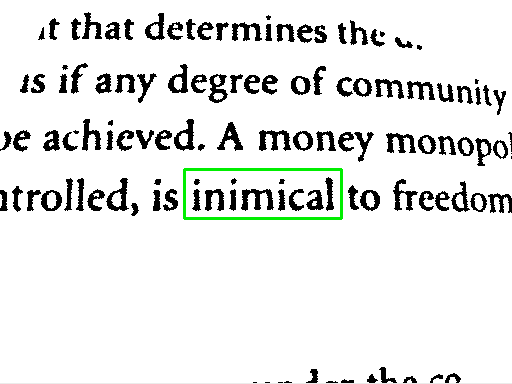
The rest of this post describes some of the successful design decisions but,  more importantly, the failures in the balance between “automatic” and “realtime guidance”. The story begins with the following example image:

Original image

Incidentally, this image was the inspiration for WordSnap: I wanted to look up “inimical” but I was too lazy to type. Also, for the record, WordSnap uses camera preview frames, which are semi-planar YUV data at HVGA resolution (480×320). This image is a downsampled (512×384) full-resolution photograph taken with the G1 camera (2048×1536); most experiments here were performed before WordSnap existed in any usable form. Finally, I should point out that OCR isn’t really my area; what I describe below is based on common sense rather than knowledge of prior art, although just before writing this post I did try a quick review of the literature.

Binarization

A basic operation for OCR is binarization: mapping grayscale intensities between 0 and 255 to just two values: black (0) and white (1).  Only then can we start talking about shapes (lines, words, characters, etc).  One of the most widely used binarization algorithms is Otsu’s method.  It picks a single, global threshold so that it maximizes the within-class (black/white) variance, or equivalently maximizes the across-class variance. This is very simple to implement, very fast and works well for flatbed scans, which have uniform illumination.

However, camera images are not uniformly illuminated. The example image may look fine to human eyes, but it turns out that even for this image no global threshold is suitable (click on image for animation showing various global thresholds):

Binarization with global threshold

If you looked at the animation carefully, you might have noticed that at some point, at least the word of interest (“inimical”) is correctly binarized in this picture.  However, if the lighting gradient were steeper, this would not be possible. Incidentally, ZXing uses Otsu’s method for binarization, because of it is fast. So, if you wondered why barcode scanning sometimes fails, now you know.

So, a slightly smarter approach is needed: instead of using one global threshold, the threshold should be determined individually for each pixel (i,j). A natural threshold t(i,j) is the mean intensity μw(i,j) of pixels within a w×w neighborhood around pixel (i,j).  The key operation here is mean filtering: convolving the original image with a w×w matrix with constant entries 1/w2.

The problem is that, using pure Java running on Dalvik, mean filtering is prohibitively slow.  First, Dalvik is fully interpreted (no JIT, yet). Firthermore, the fact that Java bytes are always signed doesn’t help: casting to int and masking off the 24 most significant bits almost doubles running time.

Method Dalvik (msec) JNI (msec) Speedup
Naïve 109,882 ± 4,813 1,712 ± 261 64×
Sliding 2,435 ± 141 71 ± 19 34×

JNI to the rescue. The table above shows speedups for two implementations. The naïve approach uses a triple nested loop and has complexity O(w2mn), where m and n is the image height and width, respectively (m = 348, n = 512 in this example). The 1-D equivalent would simply be:

for i = 0 to N-1:
   s = 0
   for j = max(i-r,0) to min(i+r,N-1):
      s += a[j]

where w = 2r+1 is the window size. The second implementation updates the sums incrementally, based on the values of adjacent windows. The complexity now is just O(mn). An interesting aside is the relative performance of two implementations for sliding window sums (where w = 2r+1 is the window size). The first checks border conditions inside each iteration:

Initialize s = sum(a[0]..a[r])
for i = 1 to N-1:
   if i > r:
      s -= a[i-r-1]
   if i < N-r:
      s += a[i+r]

The second moves the border condition checks outside the loop which, if you think about it for a second, amounts to:

Initialize s = sum(a[0]..a[r])
for i = 1 to r:
   s += a[i+r]
for i = r+1 to N-r-1:
   s -= a[i-r-1]
   s += a[i+r]
for i = N-r to N-1:
   s -= a[i-r-1]

Among these two, the first one is faster, at least on a laptop running Sun’s JVM with JIT (I didn’t time Dalvik or JNI). I’m guessing that the second one messes loop unrolling, but I haven’t checked my guess.

It turns out that there is a very similar approach in the literature, called Sauvola’s method. Furthermore, there are efficient methods to compute it, using integral images. These are simply the 2-D generalization of partial sums. In 1-D, if partial sums are pre-computed, window sums can be estimated in O(1) time using the simple observation that sum(i…j) = sum(1..j) – sum(1..i-1).

Savuola’s method also computes local variance σw(i,j), and uses a relative threshold t(i,j) = μw(i,j)(1 + λσw(i,j)/127). WordSnap uses the global variance and an additive threshold t(i,j) = μw(i,j) + λσglobal, but after doing a contrast stretch of the original image (i.e., linearly mapping minimum intensity to 0 and maximum to 255). Doing floating point math or 64-bit integer arithmetic is much more expensive, hence the additive threshold. Furthermore, WordSnap does not use integral images because the same runtime can be achieved without the need to allocate a large buffer. Memory allocation on a mobile device is not cheap: the time needed to allocate a 480×320 buffer of 32-bit integers (about 600KB total) varies significantly depending on how much system memory is available, whether the garbage collector is triggered and so on, but on average it’s about half a second on the G1. Even though most buffers can be allocated once, startup time is important for this application: if it takes more than 2-3 seconds to start scanning, the user might as well have typed the result.

Anyway, here is the final result of locally adaptive thresholding:

Binarization with local mean filter

Conclusion: In this case we needed the slightly smarter approach, so we invested the time to implement it efficiently. WordSnap currently uses a 21×21 neighborhood.  Altogether, binarization takes under 100ms.

Skew

Another problem is that the orientation of the text lines may not be aligned with image edges.  This is called skew and makes recognition much harder.

Initially, I set out to find a way to correct for skew.  After a few searches on Google, I came across the Hough transform.  The idea is simple.  Sayyou want to detect a curve desribed by a set of parameters. E.g., for a line, those would be distance ρ from origin and slope θ. For each black pixel, find the parameter values for all possible curves to which this pixel may belong. For a line, that’s all angles θ from 0 to 180 degrees, and all distances ρ from 0 to sqrt(m2+n2).  Then, compute the density distribution of parameter tuples.  If a line (ρ00) is present in the image, then the parameter density distribution should have a local maximum at (ρ00).

If we apply this approach to our example image, the first maximum is detected at an angle of 20 degrees. Here is the image counter-rotated by that amount:

After rotating by angle detected using Hough transform

Success!  However, computing the Hough transform is too slow!  Typical implementations bucketize the parameter space. This would require a buffer of about 180×580 32-bit integers (for a 480×320 image), or about 410KB. In addition, it would require trigonometric operations or lookups to find the buckets for each pixel, not to mention counter-rotation. There are obvious optimizations one can try, such as computing histograms at multiple resolutions to progressively prune the parameter space.  Still, the cost implied by back-of-the envelope calculations put me off from even trying to implement this on the phone. Instead, why not just try to use the users:

Finder alignment guides

Conclusion: Simple approach with help from user wins, and the computer doesn’t even have to do anything to solve the problem! Incidentally, the guideline width is determined by the size of typical newsprint text at the smallest distance that the G1′s camera can focus.

Font size

Next, we need to detect individual words.  The approach WordSnap uses is to dilate the binary image with a rectangular structuring element (in the following image, the size 7×7), and then expand a rectangle (shown in green) until it covers the connected component which, presumably, is one word.

Dilation with 7x7 rectangle

However, the size of the structuring element should really depend on the inter-word spacing, which in turn depends on the typeface as well as the distance of the camera from the text.  For example, if we use a 5×5 element, we would get the following:

Dilation with 5x5 rectangular element

I briefly toyed with two ideas for font size detection.  The first is to do a Fourier transform.  Presumably the first spatial frequency mode would correspond to inter-word and/or inter-line spacing and the second mode to inter-character spacing. But that assumes we apply Fourier to a “large enough” portion of the image, and things start becoming complicated.  Not to mention computationally expensive.

The second approach (which also appears to be the most common?) is to to hierarchical grouping. First expand rectangles to cover individual letters (or, sometimes, ligatures), then compute histogram of horizontal distances and re-group into word rectangles, and so on.  This is also non-trivial.

Instead, WordSnap uses a fixed dilation radius.  The implementation is optimized to allow near-realtime annotation of the detected word extent.  This video should give you an idea:

Conclusion: Simple wins again, but this time we have to do something (and let the user help with the rest). But, instead of trying to be smart and find the best parameters given the camera position, we try to be fast: fix the parameters and let the user find the camera position that works given the parameters. WordSnap uses a 5×5 rectangular structuring element, although you can change that to 3×3 or 7×7 in the preferenfces screen. Altogether, word extent detection takes about 150-200ms, although it could be significantly optimized, if necessary, by using only JNI only, instead of a mix of pure Java and JNI calls.


I’m now looking into the possibility of moving OCR into the “live” loop: as you move the camera, the phone shows not only the word extent rectangle, but also the recognized word.  Perhaps as a hyperlink to Google, or along with Google Translate results.  Then I can justifiably use the buzzword of the day, “augmented reality”!  It looks that it might just be possible, but let me get back to you in a week or two.  :)

Postscript: Some of the papers referenced were pointed out to me by Hideaki Goto, who started and maintains WeOCR. Also, skew detection and correction experiments are based on this quick-n-dirty Python script (needs OpenCV and it ain’t pretty!). Update (9/2): Fixed really stupid mistake in parametrization of line.

]]>
12
spapadim http://www.bitquill.net/ <![CDATA[Hello Android]]> http://www.bitquill.net/blog/?p=65 2009-05-09T23:17:21Z 2009-05-06T16:20:05Z After blabbering about Android, I decided to get my hands a little dirty and actually write some code. For various reasons, I won’t describe the app (it was a “weekend hack” anyway), but hopefully my first impressions will be clear even without a specific context.

Overall, the Android APIs are quite impressive, even though some edges are still rough.  It was reasonably easy to get up to speed, even though my prior experience on mobile application frameworks was zero.  The toughest part was getting used to the heavily event-based programming style, as well as the idea that your code may be interrupted, killed and restarted at any time.

Activity lifecycle. Although Android supports multitasking and concurrency, on a mobile device with limited memory and no swap it’s likely that the O/S will have to kill some or all of your tasks to reclaim resources needed by higher-priority, user-visible processes (e.g., an incoming phone call).  If you have non-persistent or external state, such as open database connections or separate threads that fetch data in the background, things may get a little tricky. Although Android has auxiliary features such as managed cursors and dialogs, you still need to know they exist and use them properly.

However, even things like screen orientation changes are handled by terminating and restarting any affected activities. At first, while spending a couple of hours to figure out why my app was crashing when I opened the keyboard, I bitched about this. Apparently, I wasn’t the only one who was confused. To my surprise, I found that many Android Market apps crash when the screen is rotated.  Some Market apps even come with grave-sounding warnings that, e.g., “the life counter [sic] resets on screen orientation change =/ Will fix for new version.” Luckily, I also found numerous good posts about orientation changes, such as this or this (the series by Mark Murphy are pretty good, by the way), as well as a post on the official blog.

In retrospect, handling orientation changes in this way is a good thing: it forces app developers to be prepared. After I fixed my code to handle orientation changes gracefully, I found that I was also ready to properly handle other sources of interruption: when an incoming call came as I was testing my app, everything worked out beautifully.

Now, whenever I download an app, I perform the following test: I flip the keyboard open when the app executes a background operation, even if I don’t need to type anything.  If the app crashes or gets into an inconsistent state (something that happens surprisingly often), that’s a strong indication that the code is not very robust.

Event handling. For APIs that are so heavily event-based, one of my gripes was that some (but not all) event handlers are based on inheritance rather than delegation. These design choices are probably due to performance reasons that may be specific to Dalvik, the Android VM which is motivated partly for non-technical reasons

However, inheritance sometimes complicates things. For example, Android supports managed cursors and dialogs via methods in the base Activity class. On more than one occasion I found that managed threads would also be nice.  Implementing this requires hooking into the activity lifecycle events (and has, on occasion, been over-engineered to death). Because there are several Activity subclasses (e.g., ListActivity, PreferenceActivity, etc), there is no simple way to extend them all. If lifecycle events were handled via delegates, it would be possible to implement a background UI thread manager as, say, an activity decorator that can be added to any activity instance.  

The delegation-based event model was introduced in Java 1.1 precisely to address such shortcomings of the inheritance-based model. But, being pragmatic about performance on current mobile devices, I should probably not complain too much.  Still, some API design choices seem a bit arbitrary, perhaps even Microsoft-esque: why would performance be an issue with lifecycle events (which are presumably rare, but handlers use inheritance) but not with click events (which are presumably more frequent, but handlers use delegation)?

Data sync and caching. Another gripe was the lack of syncable content providers, something I’ve mentioned before. Also, content providers aren’t really appropriate for network-hosted data. The requirement that content providers use an integer primary key (row ID) is reasonable for local databases and simplifies the APIs, but requires some book-keeping when that’s not the “natural” primary key.

Ideally, I’d like to see some support for caching remote data on the SD card (which would require gracefully handling card removal, and transparently fetching data either from the cache or the network). Although the core APIs provide all that is necessary to implement this from scratch, it was getting too complicated for my simple “weekend hack” app, so I decided to drop it.

I hope that, in the near future, porting web apps to mobile devices will become easier with the support for offline applications and client-side storage in HTML5, as well the proposed geolocation APIs (all of which are already part of Google Gears). An application manifest might include “web activities”, translating intents into HTTP POST requests, while granting device access permissions to those activities (e.g., see promising hacks such as OilCan). Porting might then involve little more than writing a new stylesheet. Perhaps that’s where Palm is going with its WebOS which apparently supports both “native application” and “web application” models, but information is rather thin at the moment.

Epilogue. My first Android app was an interesting learning experience, not only from a technical standpoint (perhaps more on this in another post). I also found that Android is quite stable. I sometimes used my phone for live debugging, forcefully killing threads and processes through ADB.  Let me put it this way: if it wasn’t for the RC33 OTA update, my phone would now have an uptime of a few months. For a piece of software that barely existed a year ago, this is impressive.

There is plenty of documentation available, but at times it can take some searching to find the necessary information.  However, since Android is open-source, it’s always possible to consult the source code itself (which is fairly well-written and documented).

Note: This post was mostly written sometime around February. Since then I had no time to try SDK v1.5, but I believe most points above are still relevant.

]]>
1
spapadim http://www.bitquill.net/ <![CDATA[Revised thoughts on Android]]> http://www.bitquill.net/blog/?p=63 2009-01-30T15:24:33Z 2008-12-01T15:17:49Z The post I wrote a few days ago about Android is all over the place. The right elements are in that post, but my composition and conclusions are somewhat incoherent. Perhaps I have been partly infected by the conventional thinking (of, e.g., various older, big corporations) and missed the obvious.

First, in a networked environment, it is common standards, rather than a single, common software platform, which further enable information sharing. So, Google may be doing Android for precisely the opposite reason than I originally suggested: to avoid the emergence of a single, dominant, proprietary platform. Chrome may exist for a similar reason. After all, Android serves a purpose similar to a browser, but for mobile devices with various sensing modalities.

Finally, mobile is arguably an important area and Google probably wants to encourage diversity and experimentation which, as I wrote in a previous post, is a pre-requisite for innovation. This is in contrast to the established mentality summarized by the quote I previously mentioned, to “find an idea and ask yourself: is the potential market worth at least one billlion dollars? If not, then walk away.” In fairness, this approach is appropriate to preserve the status quo. (By the way, in the same public speech, the person who gave this advice also responded to a question about competition by saying with commendable directness that “Look: we’ll all be dead some day.  But there’s a lot of money to be made until then.”)  But for innovation of any kind, one should “ask ‘why not?’ instead of ‘why should we do it?’” as Jeff Bezos said, or “innovate toward the light, not against the darkness” as Ray Ozzie said.

]]>
2
spapadim http://www.bitquill.net/ <![CDATA[On data ownership in a networked world]]> http://www.bitquill.net/blog/?p=7 2008-11-22T17:20:59Z 2008-11-21T01:02:45Z Every piece of content has a creator and owner (in this post, I will assume they are by default the same entity). I do not mean ownership in the traditional sense of, e.g., stashing a piece of paper in a drawer, but in the metaphysical sense that each artifact is forever associated with one or more “creators.”

This is certainly true of the end-products of intellectual labor, such as the article you are reading. However, it is also true of more mundane things, such as checkbook register entries or credit card activity. Whenever you pay a bill or purchase an item, you implicitly “create” a piece of content: the associated entry in your statement.  This has two immediately identifiable “creators”: the payer (you) and the payee.  The same is true for, e.g., your email, your IM chats, your web searches, etc. Interesting tidbit: over 20% of search terms entered daily in Google are new, which would imply roughly 20 million new pieces of content per day, or over 7 billion (over twice the earth’s population) per year—all this from just one activity on one website.

When I spend a few weeks working on, say, a research paper, I have certain expectations and demands about my rights as a “creator.” However, I give almost no thought to my rights on the trail of droppings (digital or otherwise) that I “create” each day, by searching the web, filling up the gas tank, getting coffee, going through a toll booth, swiping my badge, and so on.  However, with the increasing ease of data collection and distribution in digital form, we should re-think our attitudes towards “authorship”.

Unique identity

People call me “Spiros”, my identity documents list me as “Spyridon Papadimitriou” and on most online sites I’m registered as spapadim.  However, sometimes I’m s_papadim or spiros_papadimitriou, and so on.  Like most people, I lost track of all my accounts a time ago.  Vice versa, I’m not the only “Spiros Papadimitriou” in the real world.  For example, I occasionally get confused with my cousin, and receive comments about my interesting architectural designs!  Nor am I the only spapadim on the net.

A framework and mechanisms that allow (but do not enforce) asserting and verifying which of those labels (i.e., names, userids, etc) refer to the same entity (i.e., me) is missing. However, this is a prerequisite: how can we talk about data ownership and tackle portability, transparency and accountability, if we have to jump through countless hoops just to prove identity?

Some people, especially in the US, may object or even outright panic at the thought of such a global identifier.  In Greece, and in much of Europe, we’ve had national identity cards for decades.  Which is fine, as long as you know they exist and what are permissible uses-in other words, as long as transparency is ensured.  Furthermore, the illusion of privacy should not be confused with privacy itself—if in doubt, I suggest reading “Database Nation” (official site).  Its examples are largely US-centric, but the lessons are not.

OpenID (despite some shortcomings) and OAuth are emerging as open standards for authentication and authorization.  OpenID allows reuse of authentication credentials from one site on others: I can reuse, say, my Google username and password to log in to other sites (e.g., to leave a comment on this blog), without having to create yet another account from scratch.  OAuth resembles Kerberos’s ticket granting service but for the web, permitting other web services to ask for access to a subset of personal information: I could allow Facebook to access only my Google addressbook and not, potentially, all of my data on any Google service.  OpenID and OAuth can, at least in principle, work together.

Both high-profile individual developers and major companies are involved in these efforts.  For example, Yahoo! already supports OpenID and plans to support OAuth as well, while Google supports OAuth directly and OpenID indirectly in various ways.  Wide adoption of these standards would be a major step forwards for data portability and web interoperability.  However, I suspect they fall slightly short of providing a truly permanent and global personal identity.  What if, for any reason, my Yahoo! account disappears, either because I decided to shut it down or because Yahoo! went bust?

I was going to suggest a DNS-based solution and I was surprised when I found that the generic top-level domain .name has been instituted since 2001 to provide URIs for personal identities. You can register for a free three-month trial on FreeYourID (after that, it’s $11/year). What’s more, their service already provides OpenID authentication. In principle, this should allow easy switching of authentication and authorization service providers. Just as I can still keep the “label” for this site even if I move to a different web host, I can still keep my personal “label” no matter who I choose to manage my personal information.  So, now my universal username is spiros.papadimitriou.name, any emails sent to spiros@papadimitriou.name will find their way to me, you can call me on Skype using spiros.papadimitriou.name/call, and so on.

With such a unique identity tied to authorization and authentication services, the Giant Global Graph and its materializations would be one step closer to becoming really useful. If I want to use my identity to log and controll access to my data, I should be able to prove my claims.  Currently, FOAF and XFN allow assertion of relationshipt but provide no way to verify them.

Data portability

The point of this mental exercise so far is the following: A unique identity that can be verifiably associated with each and every data item that I produce is a prerequisite for making data ownership claims. Subsequently, we need to ask what fundamental rights should be associated with data ownership.  The first is the right to keep my information with me or, in other words, “data portability”. Just as I can freely move my money from one financial institution to another, I should be able to move any of my information from one data warehouse to another.

For example, consider my web search history. I don’t think I need to argue about the importance of historical information to improve search quality. If I decide for any reason to move to another search provider, I should be able to carry along all the information that’s directly associated with me.  This should include my search keyword history, as well as any additional information I may have contributed.

The actual details, however, may not be that straightforward.  Take, say, the third hit on a Google search.  Who is the “creator”?  Me by entering the search keywords, Google by producing the search results in response to those keywords, or the person who wrote the web page that contains them in the first place?  Similarly, when I buy gas, who is the “creator” of the transaction entry: me, Mobil, or American Express?

Even though intuition can often be wrong, my intuitive response to the Google search example would be that both I and Google have an ownership claim on this particular search, which includes the query keywords as well as a ranking of URLs.  On the other hand, the person who wrote the contents of, say, the third URL has ownership claims only on those, and not the search results.  Furthermore, the thousands of people that provided feedback to Google’s ranking algorithms by clicking on this URL on similar searches have ownership claims on those searches, but not on mine.

Finally, those two ownership claims (on keywords and on rankings) should probably not be treated the same.  If they were, then, say, MS Live could effectively copy Google by getting many users to move.  It seems reasonable to have the right to move my search history, but not the actual search results. However, I can imagine that some form of ownership claim on the rankings may be useful for other personal rights.

This is a highly idealized example and I’m not sure what an appropriate litmus test for ownership is, but some form of legal consensus must be in place.

Transparency

The second fundamental right is that I should know who is using my personal information and how. For example, if an insurance company accesses my credit history to give me a rate quote, I can find this out. It may not be a completely painless process but it is certainly possible today, with a regulatory framework that ensures this.  Similar regulations should be instituted to cover any and all forms of access to personal information.

Data access should be fully transparent to all parties involved. If the an insurance company accesses my medical records, I should know this.  If the government does a background check on me, I should know this too.  Transparency is a prerequisite for accountability. Otherwise, individuals have very limited power to protect themselves from improper uses of their personal information.

Concluding remarks

Much of the privacy research in computer science seems to assume that we can keep the existing legal and regulatory frameworks intact. Computer scientists taking such a position is even sadder than lawyers doing so; we have no excuse of failing to understand the technical issues. We cannot and should not make this assumption. Technical solutions should be subsidiary to new regulations.  But that doesn’t mean technologists cannot lead.  We should work towards supporting full transparency (for both individuals, as well as governments and corporations) rather than opacity and I’m currently in favor of a “shoot first, ask questions later” approach (and help lawmakers figure out the answers). After all, if there is anything that the DRM wars have taught us, it’s that information really wants to be free. Why do we think it’s technically hard (to say the least) to prevent copying of music, movies and software but we still think it may be possible to prevent copying of personal information? As I pointed out in an older post, it’s usually the use and not the possession of information that’s the problem.

My point in this post is simple: we should not fight the wrong war. Instead, we need an easy way to make data ownership claims, and use this to enforce at least two fundamental rights: the ability to keep any personal data with us, and the ability to know who is using this data and how.

Postscript. This post was wallowing for a while as a draft (originally separated from this post, then forgotten).  Since then, a recent MIT TR article discusses some aspects of data ownership.  Even better, I have since found an excellent short piece in the same issue by Esther Dyson, with which I could not agree more.

Update. After posting this last night, I did some further Googling and found another piece by Esther Dyson in the Scientific American. If you’ve read through my ramblings so far, then I’d urge you to read her article; she’s a much better writer than me, and has apparently been thinking about these issues for almost a decade, way before many people even knew what the Internet is. I should probably follow her more closely myself, as I agree disturbingly often with what I’ve read from her so far.

]]>
1
spapadim http://www.bitquill.net/ <![CDATA[First thoughts on Android]]> http://www.bitquill.net/blog/?p=57 2009-01-30T15:24:08Z 2008-11-20T04:59:42Z Update: I’ll keep this post for the record, even though I’ve completely changed my mind.

T-Mobile G1I recently upgraded to a T-Mobile G1 (aka. HTC Dream), running Android.  The G1 is a very nice and functional device. It’s also compact and decent looking, but perhaps not quite a fashion statement: unlike the iPhone my girlfriend got last year, which was immediately recognizable and a stare magnet, I pretty much have to slap people on the face with the G1 to make them look at it.  Also, battery life is acceptable, but just barely.  But this post is not about the G1, it’s about Android, which is Google’s Linux-based, open-source mobile application platform.

I’ll start with some light comments, by one of the greatest entertainers out there today: Monkey Boy made fun of the iPhone in January, stating that “Apple is selling zero phones a year“. Now he’s making similar remarks about Android, summarized by his eloquent “blah dee blah dee blah” argument.  Less than a year after that interview, the iPhone is ahead of Windows Mobile in worldwide market share of smartphone operating systems (7M versus 5.5M devices). Yep, this guy sure knows how entertain—even if he makes a fool of himself and Microsoft.

Furthermore, Monkey Boy said that “if I went to my shareholder meeting [...] and said, hey, we’ve just launched a new product that has no revenue model! [...] I’m not sure that my investors would take that very well. But that’s kind of what Google’s telling their investors about Android.”  Even if this were true, perhaps no revenue model is better than a simian model.

Anyway, someone from Microsoft should really know better—and quite likely he does, but can’t really say it out loud. There are some obvious parallels between Microsoft MS-DOS and Google Android:

  • Disruptive technology: In the 80s, it was the personal computer.  Today, many think it is “cloud computing” (or “services”, or “ubiquitous computing”, or “utility computing”, or whatever else you want to call it).
  • Commodity infrastructure: In the 80s, PC-compatibles became a commodity through standardization of the hardware platform and fierce competition that drove prices (and profit margins) down. Today, network infrastructure (the Internet at the core, and mobile devices on the fringes) as well as systems software (LAMP) are facing similar pressures.
  • Common software platform: MS-DOS was the engine that fueled the growth of the personal computer.  For cloud computing, there is still some way to go (which Android hopes to help pave).
  • Revenue model: Microsoft made a profit out of every PC sold. In today’s networked world, profit should come from services offered over the network and accessed via a multitude of devices (including mobile phones), rather than from selling software licenses.

An executive once said that money is really made by controlling the middleware platform. Lower levels of the stack face high competition and have low profit margins.  Higher levels of the stack (except perhaps some key applications) are too special-purpose and more of a niche.  The sweet-spot lies somewhere in the middle. This is where MS-DOS was and where Android wants to be.

Microsoft established itself by providing the platform for building applications on the “revolution” of its day, the personal computer. MS-DOS became the de-facto standard, much more open than anything else at that time. Subsequently, Microsoft took a cut of the profits out of each PC sold ever since. Taiwanese “PC-compatibles” helped fuel Microsoft’s (as well as Intel’s) growth. The rest is history.

In “cloud” computing, the ubiquitous, commodity infrastructure is the network.  This enables access to applications and information from any networked device. Even though individual components matter, it is common standards, rather than a single, common software platform, which further enable information sharing. If you believe that the future will be the same as the past, i.e., selling shrink-wrapped applications and software licenses, then Android not only has no revenue model, but has no hope of ever coming up with one. Ballmer would be absolutely right.  But if there is a shift towards network-hosted data and applications, money can be made whenever users access those.  There are plenty of obvious examples which could be profitable: geographically targeted advertising, smart shopping broker/assistant (see below), mobile office and add-on services, online games (location based or not), and so on. It’s not clear whether Google plans to get directly involved in those (I would doubt it), or just stay mostly on the back end and provide an easy-to-use “cloud infrastructure” for application developers.

The services provided by network operators are becoming commodities. This is nothing new. A quote I liked is that “ISPs have nothing to offer other than price and speed“.  I wouldn’t really include security in their offerings, as it is really an end-to-end service. As for devices, there is already evidence that commoditization similar to that of PC-compatibles may happen. Just one month after Android was open-sourced, Chinese manufacturers have started deploying it on smartphones. Even big manufacturers are quickly getting in the game; for example, Huawei recently announced an Android phone. Most cellphones are already manufactured in China anyway.  The iPhone is assembled in Shenzhen, where Huawei’s headquarters are also located (coincidence?). The Chinese already have a decent track record when it comes to building hardware and it’s only a matter of time until they fully catch up.

So, it’s quite simple: Android wants to be for ubiquitous services as MS-DOS was for personal computers. But Microsoft in the 80s did not really start out by saying “our revenue model is this: we’ll build a huge user base at all costs, which will subsequently allow us to get $200 out of each and every PC sold”?  Not really.  Similarly, Google is not going to say that “we want to build a user base, so we can make a profit from all services hosted on the [our?] cloud and accessed via mobile devices [and set-top boxes, and cars, and...].”  Such an announcement would be premature, and one of the surest ways to scare off your user base: unless Google first provides more evidence that it means no evil, the general public will tend to assume the worst.

The most interesting feature of Android is it’s component-based architecture, as pointed out by some of the more insightful blog posts. Components are like iGoogle gadgets, only Android calls them “activities.” Applications themselves are built using a very browser-like metaphor: a “task” (which is Android-speak for running applications) is simply a stack of activites, which users can navigate backwards and forwards. The platform already has a set of basic activities that handle, e.g., email URLs, map URLs, calendar URLs, Flickr URLs, Youtube URLs, photo capture, music files, and so on. Any application can seamlessly invoke any of these reusable activities, either directly or via a registry of capabilities (which, roughly speaking, are called “intents”). The correspondence between a task and an O/S process is not necessarily one-to-one. Processes are used behind the scenes, for security and resource isolation purposes. Activities invoked by the same task may or may not run in the same process.

In addition to activities and intents, Android also supports other types of components, such as “content providers” (to expose data sources, such as your calendar or todo list, via a common API), “services” (long-running background tasks, such as a music player, which can be controlled via remote calls) and “broadcast receivers” (handlers for external events, such as receiving an SMS).

I think that Google is really pushing Android because it needs a component-based platform, and not so much to avoid the occasional snafu. If embraced by developers, this is the major ace up Android’s sleeve.  Furthermore, the open source codebase is the strongest indication (among several) that Google has no intention to tightly regulate application frameworks like Apple, or to leverage it’s position to attack the competition like Microsoft has done in the past.  Google wants to give itself enough leverage to realize it’s cloud-based services vision. If others benefit too, so much the better—Google is still too young to be “evil“.  After all, as Jeff Bezos said, “like our retail business, [there] is not going to be one winner. [...] Important industries are rarely made by single companies.” I find the comparison to retail interesting. In fact, it is quite likely that many “cloud services” themselves will also become commodities.

I’d wager that really successful Android applications won’t be just applications, but components with content provided over the network. A shopping list app is nice. It was exciting in the PalmPilot era, a decade ago. But a shopping list component, accessible from both my laptop and my cellphone, able to automatically pull good deals from a shopping component, and allow a navigation component to alert me that the supermarket I’m about to drive by has items I need—well, that would be great! Android is built with that vision in mind, even though it’s not quite there yet.

It’s kind of disappointing, but not surprising, that many app developers do not yet think in terms of this component-based architecture. In fairness, there are already efforts, such as OpenIntents, to build collections of general-purpose intents. Furthermore, the sync APIs are not (yet) for the faint of heart. Even Google-provided services could perhaps be improved. For example, Google Maps does not synchronize stored locations with the web-based version. When I recently missed a highway exit on the way to work and needed to get directions, I had to pull over and re-type the full address. Neither does it expose those locations via a data provider. When I installed Locale, I had to manually re-enter most of “My Locations” from the web version of Google Maps. So, there are clearly some rough edges that I’m sure will be smoothed out.  After all, there have been other rough edges, such as forgotten debugging hooks, something I find more amusing than alarming or embarrassing and certainly not the “Worst. Bug. Ever.

Android has a lot of potential, but it still needs work and Google should move fast. The top two items on my wish list would be:

  1. Release a “signature” device (or two), like the Motorola Razr was a couple of years ago and the Apple iPhone was last year. The G1 is really nice, but not enough.  A device that people desire may be neither a necessary nor a sufficient condition for success, but it will sure help as a vehicle to move Android forward in market share.
  2. Expand the set of available activities and content providers, and release an easy-to-use data sync service and API. In principle, everything that is an iGoogle gadget should also be an Android activity, sharing the same data sources. This is at the core of what “cloud computing” is about.  After all, you could think of Android as a glorified modern browser for devices with small screens, intermittent network connectivity, location sensors, and so on.

I suspect it might not be that hard to build a Google gadget container for Android.  Google Gears is already there and some form of interaction with the local device via Javascript is already allowed.  Many gadgets don’t need that much screen real estate anyway, so this may be an interesting hack to try out.

But not many people will buy an Android device for what it could do some day. Google has created a lot of positive buzz, backed by a few actual features. Now it needs some sexy devices and truly interesting apps, to really jumpstart the necessary network effect. Building the smart shopping list app should be as easy as building the dumb one. In the longer run, the set of devices on which Android is deployed should be expanded.  Move beyond cell phones, to in-car computers, set-top boxes, and so on (Microsoft Windows does both cars and set-top boxes already, but with limited success so far)—in short, anything that can be used to access network-hosted data and applications.

]]>
2
spapadim http://www.bitquill.net/ <![CDATA[Randy Pausch in CACM]]> http://www.bitquill.net/blog/?p=54 2008-10-08T14:51:30Z 2008-10-08T14:51:30Z The September issue of CACM has a one-page, seven-question interview with Randy Pausch. It is definitely worth reading, so I’ll give you a sneak peek (unfortunately, CACM is not “open access”):

What about advice for CS teachers and professors?

That it’s time for us to start being more honest with ourselves about what our field is and how we should approach teaching it. Personally, I think that if we had named the field “Information Engineering” as opposed to “Computer Science,” we would have had a better culture for the discipline. For example, CS departments are notorious for not instilling concepts like testing and validation the way many other engineering disciplines do.

Is there anything you wish someone had told you before you began your own studies?

Just that being technically strong is only one aspect of an education.

[...]

Alice has proven phenomenally successful at teaching young women, in particular, to program. What else should we be doing to get more women engaged in computer science?

Well, it’s important to note that Alice works for both women and men. I think female-specific “approaches” can be dangerous for lots of reasons, but approaches like Alice, which focus on activities like storytelling, work across gender, age, and cultural background. It’s something very fundamental to want to tell stories. And Caitlin Kelleher’s dissertation did a fantastic job of showing just how powerful that approach is.

The interview was conducted a few weeks before his death. I’ll just say that, somehow, I suspect someone not in his position would never have said at least one of these things.  It’s a sad thought, but Randy’s message is, as always, positive.

]]>
0
spapadim http://www.bitquill.net/ <![CDATA[Data harvesting with MapReduce]]> http://www.bitquill.net/blog/?p=17 2008-10-21T01:38:05Z 2008-09-11T17:04:51Z Combine harvesters
(original image source)

“The combine harvester, [...] is a machine that combines the tasks of harvesting, threshing and cleaning grain crops.” If you have acres upon acres of wheat and want to separate the grain from the chaff, a group of combines is what you really want. If you have a bonsai tree and want to trim it, a harvester may be less than ideal.

MapReduce is like a pack of harvesters, well-suited for weeding through a huge volumes of data, residing on a distributed storage system. However, a lot of machine learning work is more akin to trimming bonsai into elaborate patterns. Vice versa, it’s not uncommon to see trimmers used to harvest a wheat field. Well-established and respected researchers, as recently as this year write in their paper “Planetary Scale Views on a Large Instant-messaging Network“:

We gathered data for 30 days of June 2006. Each day yielded about 150 gigabytes of compressed text logs (4.5 terabytes in total). Copying the data to a dedicated eight-processor server with 32 gigabytes of memory took 12 hours. Our log-parsing system employed a pipeline of four threads that parse the data in parallel, collapse the session join/leave events into sets of conversations, and save the data in a compact compressed binary format. This process compressed the data down to 45 gigabytes per day. Processing the data took an additional 4 to 5 hours per day.

Doing the math, that’s five full days of processing to parse and compress the data on a beast of a machine. Even more surprisingly, I found this exact quote singled out among all the interesting results in the paper! Let me make clear that I’m not criticizing the study; in fact, both the dataset and the exploratory analysis are interesting in many ways. However, it is somewhat surprising that, at least among the research community, such a statement is still treated more like a badge of honor rather than an admission of masochism.

The authors should be applauded for their effort. Me, I’m an impatient sod. Wait one day for the results, I think I can do that. Two days, what the heck. But five? For an exploratory statistical analysis? I’d be long gone before that. And what if I found a serious bug half way down the road? That’s after more than two days of waiting, in case you weren’t counting. Or what if I decided I needed a minor modification to extract some other statistic? Wait another five days? Call me a Matlab-spoiled brat, but forget what I said just now about waiting one day. I changed my mind already. A few hours, tops. But we need a lot more studies like this. Consequently, we need the tools to facilitate them.

Hence my decision to frolic with Hadoop. This post focuses on exploratory data analysis tasks: the kind I usually do with Matlab or IPython/SciPy scripts, which involve many iterations of feature extraction, data summarization, model building and validation. This may be contrary to Hadoop’s design priorities: it is not intended for quick turnaround or interactive response times with modestly large datasets. However, it can still make life much easier.

Scale up on large datasets

First, we start with a very simple benchmark, which scans a 350GB text log. Each record is one line, consisting of a comma-separated list of key=value pairs. The job extracts the value for a specific key using a simple regular expression and computes the histogram of the corresponding values (i.e., how many times each distinct value appears in the log). The input consists of approximately 500M records and the chosen key is associated with about 130 distinct values.

Scalability: histogram

The plot above shows aggregate throughput versus number of nodes. HDFS and MapReduce cluster sizes are always equal, with HDFS rebalanced before each run. The job uses a split size of 256MB (or four HDFS blocks) and one reducer. All machines have a total of four cores (most Xeon, a few AMD) and one local disk. Disks range from ridiculously slow laptop-type drives (the most common type), to ridiculously fast SAS drives. Hadoop 0.16.2 (yes, this post took a while to write) and Sun’s 1.6.0_04 JRE were used in all experiments.

For such an embarrassingly parallel task, scaleup is linear. No surprises here, but it’s worth pointing out some numbers. As you can see from the plot, extracting simple statistics from this 350GB dataset took less than ten minutes with 39 nodes, down from several hours on one node. Without knowing the details of how the data were processed, if we assume similar throughput, then processing time of the raw instant messaging log could be roughly reduced from five days to just a few hours. In fact, when parsing a document corpus (about 1TB of raw text) to extract a document-term graph, we witnessed similar scale-up, going down from well over a day on a beast of a machine, to a couple of hours on the Hadoop cluster.

Hadoop is also reasonably simple to program with. It’s main abstraction is natural, even if your familiarity with functional programming concepts is next to none. Furthermore, most distributed execution details are, by default, hidden: if the code runs correctly on your laptop (with a smaller dataset, of course), then it will run correctly on the cluster.

Single core performance

Linear scaleup is good, but how about absolute performance? I implemented the same simple benchmark in C++, using Boost for regex matching. For a rough measure of sustained sequential disk throughput, I simply cat the same large file to /dev/null.

I collected measurements from various machines I had access to: (i) a five year old Mini-ITX system I use with my television at home, running Linux FC8 for this experiment, (ii) a two year old desktop at work, again with FC8, (iii) my three year old Thinkpad running Windows XP and Cygwin, and (iv) a recent IBM blade running RHEL4.

Single core performance

The hand-coded version in C++ is about 40% faster on the older machines and 33% faster on the blade [Note: I'm missing the C++ times for my laptop and it's drive crashed since then -- I was too lazy to reload the data and rerun everything, so I simply extrapolated from single-thread Hadoop assuming a 40% improvement, which seems reasonable enough for these back-of-the-envelope calculations]. Not bad, considering that Hadoop is written in Java and also incurs additional overheads to process each file split separately.

Perhaps I’m flaunting my ignorance but, surprisingly, this workload was CPU-bound and not I/O-bound—with the exception of my laptop, which has a really crappy 2.5″ drive (and Windows XP). Scanning raw text logs is a rather representative workload for real-world data analysis (e.g., AWK was built at AT&T for this purpose).

The blade has a really fast SAS drive (suspiciously fast, except perhaps if it runs at 15K RPM) and the results are particularly instructive. The drive reaches 120MB/sec sustained read throughput. Stated differently, the 3GHz CPU can only dwell on each byte for 24 cycles on average, if it’s to keep up with the drive’s read rate. Even on the other machines, the break-even point is between 30-60 cycles [Note: The laptop drive seems to be an exception, but I wouldn't be so sure that at least part of the inefficiency isn't due to Cygwin].

On the other hand, the benchmark throughput translates into 150-500 cycles per byte, on average. If I get the chance, I’d like to instrument the code with PAPI, validate these numbers and perhaps obtain a breakdown (into average cycles for regex state machine transition per byte, average cycles for hash update per record, etc). I would never have thought the numbers to be so high and I still don’t quite believe it. In any case, if we believe these measurements, at least 4-6 cores are needed to handle the sequential read throughput from a single drive!

The common wisdom in algorithms and databases textbooks, as far as I remember, was that when disk I/O is involved, CPU cycles can be more or less treated as a commodity. Perhaps this is an overstatement, but I didn’t expect it to be so off the mark.

This also raises another interesting question, which was the original motivation for measuring on a broad set of machines: what would be the appropriate cost-performance balance between CPU and disk for a purpose-built machine? I thought one might be able to get away with a setup similar to active disks: a really cheap and power-efficient Mini-ITX board, attached to a couple of moderately priced drives. For example, see this configuration, which was once used in the WayBack machine (I just found out that the VIA-based models have apparently been withdrawn, but the pages are still there for now). This does not seem to be the case.

The blades may be ridiculously expensive, perhaps even a complete waste of money for a moderately tech-savvy person. However, you can’t just throw together any old motherboard and hard disk, and magically turn them into a “supercomputer.” This is common sense, but some of the hype might have you believe the opposite.

Performance on smaller datasets

Once the original, raw data is processed, the representation of the features relevant to the analysis task typically occupies much less space. In this case, a bipartite graph extracted from the same 350GB text logs (the details don’t really matter for this discussion) takes up about 3GB, or two orders of magnitude less space.

Scalability: coclustering iteration

The graph shows aggregate throughput for one iteration of an algorithm similar to k-means clustering. This is fundamentally very similar to computing a simple histogram. In both cases, the output size is very small compared to the input size: the histogram has size proportional to the number of distinct values, whereas the cluster centers occupy space proportional to k. Furthermore, both computations iterate over the entire dataset and perform a hash-based group-by aggregation. For k-means, each point is “hashed” based on its distance to the closest cluster center, and the aggregation involves a vector sum.

Nothing much to say here, except that the linear scaleup tapers off after about 10-15 nodes, essentially due to lack of data: the fixed per-split overheads start dominating the total processing time. Hadoop is not really built to process datasets of modest size, but fundamentally I see nothing to prevent MapReduce from doing so. More importantly, when the dataset becomes really huge, I would expect Hadoop to scale almost-linearly with more nodes.

Hadoop can clearly help pre-process the raw data quickly. Once the relevant features are extracted, they may occupy at least an order of magnitude less space. It may be possible to get away with single-node processing on the appropriate representation of the features, at least for exploratory tasks.  Sometimes it may even be better to use a centralized approach.

Summary

My focus is on exploratory analysis of large datasets, which is a pre-requisite for the design of mining algorithms. Such tasks typically involve (i) raw data pre-processing and feature extraction stages, and (ii) model building and testing stages. Distributed data processing platforms and, in particular, Hadoop are well-suited for such tasks, especially the feature extraction stages.  In fact, tools such as Sawzall (which is akin to AWK, but on top of Google’s MapReduce and protocol buffers), excel at the feature extraction and summarization stages.

The original, raw data may reside in a traditional database, but more often than not they don’t: packet traces, event logs, web crawls, email corpora, sales data, issue-tracking ticket logs, and so on. Hadoop is especially well-suited for “harvesting” those features out of the original data. In its present form, it can also help in model building stages, if the dataset is really large.

In addition to reducing processing time, Hadoop is also quite easy to use. My experience is that the programming effort compares very favorably to the usual approach of writing my own, quick Python scripts for data pre-processing. Furthermore, there are ongoing efforts for even further simplification (e.g., Cascading and Pig).

I was somewhat surprised with the CPU vs I/O trade-offs for what I would consider real-world data processing tasks. Perhaps also influenced by the original work on active disks (one of the inspirations for MapReduce), which suggested using the disk controller to process data. However, there is a cross-over point for the performance of active disks versus centralized processing; I was way off with my initial guess on how much CPU power it takes for a reasonably low cross-over point (which is workload-dependent, of course, and any results herein should be treated as indicative and not conclusive).

Footnote: For what it’s worth, I’ve put up some of the code (and hope to document it sometime). Also, thanks to Stavros Harizopoulos for pointing out the simple cycles-per-byte metric.

]]>
1
spapadim http://www.bitquill.net/ <![CDATA[“Beyond Relational Databases”]]> http://www.bitquill.net/blog/?p=32 2008-11-22T17:22:04Z 2008-08-21T16:20:59Z The article “Beyond Relational Databases” by Margo Seltzer in the July 2008 issue of CACM claims that “there is more to data access than SQL.”  Although this is a fairly obvious statement, the article is well-written and worth a read.  The main message is simple: bundling data storage, indexing, query execution, transaction control, and logging components into a monolithic system and wrapping them with a veneer of SQL is not the best solution to all data management problems. Consequently, the author makes a call for solutions based on a modular approach, using open components.

However, the article offers no concrete examples at all, so I’ll venture a suggestion. In a growing open source ecosystem of scalable, fault-tolerant, distributed data processing and management components, MapReduce is emerging as a predominant elementary abstraction for distributed execution of a large class of data-intensive processing tasks. It has attracted a lot of attention, proving both a source for inspiration, as well as target of polemic by prominent database researchers.

In database terminology, MapReduce is an execution engine, largely unconcerned about data models and storage schemes.  In the simplest case, data reside on a distributed file system (e.g., GFS, HDFS, or KFS) but nothing prevents pulling data from a large data store like BigTable (or HBase, or Hypertable), or any other storage engine, as long as it

  • Provides data de-clustering and replication across many machines, and
  • Allows computations to execute on local copies of the data.

Arguably, MapReduce is powerful both for the features it provides, as well as for the features it omits, in order to provide a clean and simple programming abstraction, which facilitates improved usability, efficiency and fault-tolerance.

Most of the fundamental ideas for distributed data processing are not new.  For example, a researcher involved in some of the projects mentioned once said, with notable openness and directness, that “people think there is something new in all this; there isn’t, it’s all Gamma“—and he’s probably right.  Reading the original Google papers, none make a claim to fundamental discoveries.  Focusing on “academic novelty” (whatever that may mean) is irrelevant.  Similarly, most of the other criticisms in the irresponsibly written and oft (mis)quoted blog post and its followup miss the point.  The big thing about the technologies mentioned in this post is, in fact, their promise to materialize Margo Seltzer’s vision, on clusters of commodity hardware.

Michael Stonebraker and David DeWitt do have a valid point: we should not fixate on MapReduce; greater things are happening. So, if we are indeed witnessing the emergence of an open ecosystem for scalable, distributed data processing, what might be the other key components?

Data types: In database speak, these are known as “schemas.” Google’s protocol buffers the underlying API for data storage and exchange.  This is also nothing radically new; in essence, it is a binary XML representation,  somewhere between the simple XTalk protocol which underpins Vinci and the WBXML tokenized representation (both slightly predating protocol buffers and both now largely defunct).  In fact, if I had to name a major weakness in the open source versions of Google’s infrastructure (Hadoop, HBase, etc), it would be the lack of such a common data representation format.  Hadoop has Writable, but that is much too low-level (a data-agnostic, minimalistic abstraction for lightweight, mutable, serializable objects), leading to replication of effort in many projects that rely on Hadoop (such as Nutch, Pig, Cascading, and so on).  Interestingly, the rcc record compiler component (which seems to have fallen in disuse) was once called Jute with possibly plans grander than what came to be.  So, I was pleasantly surprised when Google decided to open-source protocol buffers a few days ago—although it may now turn out to be too little too late.

Data access: In the beginning there was BigTable, which has been recently followed by HBase and Hypertable.  It started fairly simple, as a “is a sparse, distributed, persistent multidimensional sorted map” to quote the original paper.  It is now part of the Google App Engine and even has support for general transactions. HBase, at least as of version 0.1 was relatively immature, but there is a flurry of development and we should expect good things pretty soon, given the Hadoop team’s excellent track record so far.  While writing this post, I remembered an HBase wish list item which, although lower priority, I had found interesting: support for scripting languages, instead of HQL. Turns out this has already been done (JIRA entry and wiki entries).  I am a fan of modern scripting languages and generally skeptical about new special-purpose languages (which is not to say that they don’t have their place).

Job and schema management: Pig, from the database community, is described as a parallel dataflow engine and employs yet another special-purpose language which tries to look a little like SQL (but it is no secret that it isn’t). Cascading has received no attention in the research community, but it merits a closer look. It is based on a “build system” metaphor, aiminig to be the equivalent of Make or Ant for distributed processing of huge datasets.  Instead of introducing a new language, it provides a clean Java API and also integrates with scripting languages that support functional programming (at the moment, Groovy).  As I have used neither Cascading nor Pig at the moment, I will reserve any further comparisons.  It is worth noting that both projects build upon Hadoop core and do not integrate, at the moment, with other components, such as HBase. Finally, Sawzall deserves an honorable mention, but I won’t discuss it further as it is a closed technology.

Indexing: Beyond lookups based on row keys in BigTable, general support for indexing is a relatively open topic.  I suspect that IR-style indices, such as Lucene, have much to offer (something that has not gone unnoticed)—more on this in another post.

A number of other projects are also worth keeping an eye on, such as CouchDB, Amazon’s S3, Facebook’s Hive, and JAQL (and I’m sure I’m missing many more).  All of them are, of course, open source.

]]>
0
spapadim http://www.bitquill.net/ <![CDATA[The Fall of CAPTCHAs – really?]]> http://www.bitquill.net/blog/?p=44 2008-11-22T17:22:28Z 2008-07-17T06:56:43Z I recently saw a Slashdot post dramatically titled “Fallout From the Fall of CAPTCHAs“, citing an equally dramatic article about “How CAPTCHA got trashed“.  Am I missing something? Ignoring their name for a moment, CAPTCHAs are computer programs, following specific rules, and therefore they are subject to the same cat-and-mouse games that all security mechanisms go through. Where exactly is the surprise? So Google’s or Yahoo’s current versions were cracked.  They’ll soon come up with new tricks, and still newer ones after those are cracked, and so on.

In fact, I was always confused about one aspect of CAPTCHAs. I thought that a Turing test is, by definition, administered by a human, so a “completely-automated Turing-test” is an oxymoron, something like a “liberal conservative”. An unbreakable authentication system based on Turing tests should rely fully on human computation: humans should also be at the end that generates the tests. Let humans come up with questions, using references to images, web site content, and whatever else they can think of.  Then match these to other humans who can gain access to a web service by solving the riddles. Perhaps the tests should also be somehow rated, lest the simple act of logging in turns into an absurd treasure hunt. I’m not exactly sure if and how this could be turned into an addictive game, but I’ll leave that to the experts.  The idea is too obvious to miss anyway.

CAPTCHAs, even in their current form, have led to numerous contributions.  A non-exclusive list, in no particular order:

  1. They have a catchy name. That counts a lot. Seriously. I’m not joking; if you don’t believe me, repeat out loud after me: “I have no idea what ‘onomatopoeia’ is—I’d better MSN-Live it” or “… I’d better Yahoo it.”  Doesn’t quite work, does it?
  2. They popularized an idea which, even if not entirely new, was made accesible to webmasters the world over, and is now used daily by thousands if not millions of people.  What greater measure of success can you think of for a technology?
  3. Sowed the seeds for Luis von Ahn’s viral talk on human computation, which has featured in countless universities, companies and conferences.  Although not professionally designed, the slides’ simplicity matches their content in a Jobs-esque way. As for delivery and timing, Steve might even learn something from this talk (although, in fairness, Steve Jobs probably doesn’t get the chance to introduce the same product hundreds of times).

So is anyone really surprised that the race for smarter tests and authentication mechanisms has not ended, and probably never will? (Incidentally, the lecture video above is from 2006, over three years after the first CAPTCHAs were succesfully broken by another computer program—see also CVPR 2003 paper—.  There are no silver bullets, no technology is perfect, but some are really useful. Perhaps CAPTCHAs are, to some extent, victim of their own hype which, however, is instrumental and perhaps even necessary for the wide adoption of any useful technology.  I’m pretty sure we’ll see more elaborate tests soon, not less.

]]>
0
spapadim http://www.bitquill.net/ <![CDATA[Web science: what and how?]]> http://www.bitquill.net/blog/?p=24 2008-11-22T17:34:12Z 2008-07-04T04:02:41Z From the article “Web Science: An Interdisciplinary Approach to Understanding the Web” in the July issue CACM (which, by the way, looks quite impressive after the editorial overhaul!):

At the micro scale, the Web is an infrastructure of artificial languages and protocols; it is a piece of engineering. [...] The macro system, that is, the use of the micro system by many users interacting with one another in often-unpredicted ways, is far more interesting in and of itself and generally must be analyzed in ways that are different from the micro system. [...] The essence of our understanding of what succeeds on the Web and how to develop better Web applications is that we must create new ways to understand how to design systems to produce the effect we want.  The best we can do today is design and build in the micro, hoping for the best, but how do we know if we’ve built in the right functionality to ensure the desired macroscale effects? How do we predict other side effects and the emergent properties of the macro? [...] Given the breadth of the Web and its inherently multi-user (social) nature, its science is necessarily interdisciplinary, involving at least mathematics, CS, artificial intelligence, sociology, psychology, biology and economics.

This is a noble goal indeed. The Wikipedia article on sociology sounds quite similar on many aspects:

Sociologists research macro-structures and processes that organize or affect society [...] And, they research micro-processes [...] Sociologists often use  quantitative methods—such as social statistics or network analysis—to investigate the structure of a social process or describe patterns in social relationships. Sociologists also often use qualitative methods—such as focused interviews, group discussions and ethnographic methods—to investigate social processes.

First, we have to keep in mind that the current Western notion of “science” is fairly recent.  Furthermore, it has not always been the case that technology follows science. As an example, in the book “A People’s History of Science” by Clifford Conner, one can find the following quotation from Gallileo’s Two New Sciences, about Venice’s weapons factory (the Arsenal):

Indeed, I myself, being curious by nature, frequently visit this place for the mere pleasure of observing the work of those who, on account of their superiority over other artisans, we call “first rank men.” Conference with them has often helped me in the investigation of certain effects, including not only those which are striking, but also those which are recondite and almost incredible.

Later on, Conner says (p.284), quoting again Gallileo himself from the same source:

[Gallileo] demonstrated mathematically that “if projectiles are fired … all having the same speed, but each having a different elevation, the maximum range … will be obtained when the elevation is 45°: the other shots, fired at angles greater or less will have a shorter range. But in recounting how he arrived at that conclusion, he revealed that his initial inspiration came from discussions at the Arsenal: “From accounts given by gunners, I was already aware of the fact that in the use of cannons and mortars, the maximum range, that is the one in which the shot goes the farthest, is obtained when the elevation is 45°.” Although Gallileo’s mathematical analysis of the problem was a valuable original contribution, it did not tell workers at the Arsenal anything htey had not previously learned by empirical tests, and had little effect on the practical art of gunnery.

In any case, facilitating “technology” or “engineering” is certainly not the only good reason to pursue scientific knowledge. Conversely, although “pure science” certainly has an important role, it is not the only ingredient of technological progress (something I’ve alluded to in a previous post about, essentially, the venture capital approach to research).  Furthermore, some partly misguided opinions about the future of science have brightly shot through the journalistic sphere.

However, if, for whatever reason, we decide to go the way of science (a worthy pursuit), then I am reminded of the following interview of Richard Feynman by the BBC in 1981 (full programme):

Privacy concerns notwithstanding, the web gives us unprecedented opportunities to collect measurements in quantities and levels of detail that simply were not possible when the venerable state-of-the-art involved, e.g., passing around written notes among a few people. So, perhaps we can now check hypotheses more vigorously and eventually formulate universal laws (in the sense of physics).  Perhaps the web will allow us to prove Feynman wrong.

I’m not entirely convinced that it is possible to get quantitative causal models (aka. laws) of this sort. But if it is, then we need an appropriate experimental apparatus for large-scale data analysis to test hypotheses—what would be, say, the LHC-equivalent for web science?  (Because, pure science seems to have an increasing need for powerful apparatuses.) I’ll write some initial thoughts and early observations on this in another post.

I’m pretty sure that my recent posts have been doing circles around something, but I’m not quite sure yet what that is.  In any case, all this seems an interesting direction worth pursuing.  Even though Feynman was sometimes a very hard critic, we should pehaps remember his words along the way.

]]>
1
spapadim http://www.bitquill.net/ <![CDATA[The bless of dimensionality]]> http://www.bitquill.net/blog/?p=18 2008-11-22T17:35:00Z 2008-06-25T06:09:49Z The cover story in Wired by Chris Anderson, “The End of Theory” relies on a silent assumption, which may be obvious but is still worth stating. The reason that such a “petabyte approach” works is that reality occupies only a tiny fraction of the space of all possibilities.  For example, the human genome consists of about three billion base pairs.  However, not every billion-lengths string of four symbols corresponds to a viable organism, much less an existing one or a human individual.  In other words, the intrinsic dimensionality of your sample (the human population) is much smaller than the raw dimensionality of the possibilities (about 4^3,2000,000 strings).

I won’t try to justify “traditional” models. But I also wouldn’t go so far as to say that models will disappear, just that many will be increasingly statistical in nature. If you can throw the dice a large enough number of times, it doesn’t matter whether “God” plays them or not.  The famous quote by Einstein suggests that quantum mechanics was originally seen as a cop-out by some: we can’t find the underlying “truth”, so we settle with probability distributions for position and momentum.  However, this was only the beggining.

Still, we need models.  Going back to the DNA example, I suspect that few people models the genome as a single, huge, billion-length string.  That is not a very useful random variable.  Chopping it up into pieces with different functional significance and coming up with the appropriate random variables, so one can draw statistical inferences, sounds very much like modeling to me.

Furthermore, hypothesis testing and confidence intervals won’t go away either.  After all, anyone who has taken a course in experimental physics knows that repeating a measurement and calculating confidence intervals based on multiple data points is a fundamental part of the process (and also the main motivating force in the original development of statistics).  Now we can collect petabytes of data points.  Maybe there is a shift in balance between theory (in the traditional, Laplacian sense, which I suspect is what the article really refers to) and experiment.  But the fundamental principles remain much the same.

So, perhaps more is not fundamentally different after all, and we still need to be careful not to overfit.  I’ll leave you with a quote from “A Random Walk down Wall Street” by Burt Malkiel (emphasis mine):

[...] it’s sometimes possible to correlate two completely unrelated events.  Indeed, Mark Hulbert reports that stock-market researcher David Leinweber found that the indicator most closely correlated with the S&P 500 Index is the volume of butter production in Bangladesh.

Dimensionality may be a bless, but it can still be a curse sometimes.

]]>
1
spapadim http://www.bitquill.net/ <![CDATA[Research and new media: the academic clowd]]> http://www.bitquill.net/blog/?p=13 2008-11-22T17:35:10Z 2008-06-24T03:55:54Z I have a little secret: Slashdot may have lost its lustre now, but back in 2001, shortly after returning from my refreshing internship at Almaden, I posted a question to “Ask Slashdot” for the first and last time. I posed the question rather poorly and was ignored. Although I could not find exactly what I wrote back then, it was something along the lines of “why aren’t academic venues more like SourceForge?” You have to remember that this was the early 2000′s, when large and transparent user communities existed only in the technical sphere, and things like SourceForge were the prototypical sites for online focused communities. So why couldn’t academia and the research community open things up a bit more, and leverage new media to set up virtual forums for world-wide lively discussions and collaborations?

Fast-forward seven years. I got a feeling of deja-vu when I saw two recent blog posts and a Slashdot post. The first two question specific aspects of current publishing practices, while the “Ask Slashdot” post wonders whether academic journals are obsolete. The technologies and media have changed dramatically since then, but the essence remains the same.

Going over the comments on Slashdot, even though there are some surprisingly (for Slashdot) insightful ones, there is also one fundamental misconception. I was genuinely surprised at its prevalence. Many commenters seem to identify the general notion of “peer evaluation” with the specific mechanisms currently employed to do it. Is the current way of doing things so deeply entrenched, that people are blind to other possibilities?

Quoting a random vicious comment: “The purpose of restricting published work to that which has passed peer review is to ensure that results do not become obsolete. They must uphold the same quality standards that we expect from all scientific disciplines—not blog-style fads that have become popular and at some stage will cease to be popular.” I wonder if commenter has ever written a blog himself, or whether he even just taken a look at, say, Technorati: there are over four million blogs out there and 99% have just one reader (the author). Very few blogs are popular (i.e., the actually read by a significant number of people). An explosion in quantity of published content does not imply a proprtional explosion in its consumption; quite the contrary. If anything, there is more competition for attention, not less.

Another commenter said that “there isn’t any direct communication between reviewers and submitters.” Not so. Take a look at Julian Besag’s “On the Statistical Analysis of Dirty Pictures” (unfortunately JSTOR is restricted-access, but maybe your institution has a subscription), published in the Journal of the Royal Statistical Society as recently as 1986. The actual paper is 21 pages, while the other 23 pages are devoted to an open discussion. This looks oddly familiar (deja vu again): it looks like very popular blogs, which often have comment sections larger than the original posts. A free and open discussion of ideas has always been an organic part of the research process. A few centuries ago, scientific articles appeared with a date on which they were “read” to the community (just take a look at, e.g., the an issue of the Philosophical Transactions of the Royal Society).

Research on the web

Reaching far out into the long tail of ideas, which I also discussed in a previous post, should arguably be a top priority for research. In other endeavors it is an important means to success (financial or otherwise), but in academia and the research community it is usually an end in itself. The web itself was originally conceived as a venue for the exchange of scientific ideas, but even its creators probably did not envision the full potential nor realize all the implications of democratizing publication.

Modern technology allows more researchers (whether they work for startups, academic institutions, or large corporations) to try out more ideas. In other words, the production of research output is scaling up to unprecedented levels. However, I strongly suspect that traditional ways for evaluating research will not scale for much longer, being unable to keep up with the explosive growth in the rate of new ideas.

The typical process for evaluating and disseminating research—at least in computer science with which I am familiar—seems to be the following (with perhaps a few exceptions). First you come up with an interesting idea. Next, you build a story around it and do the minimal work to support that story. If everything works out, you write it up and submitted to a conference or, more rarely, a journal. On average, three people (chosen largely at random) review your work, making some comments in private. Once your work is published, you move on to the next paper.

I would simply name two artifacts as the main “products” of computer science research: papers and software. The latter is often overlooked, but it’s at least as important as the first. Anyway, what might be the state-of-the-art media for each of those artifacts?

There are some well-known efforts to use the web for the former. For example, there is arXiv for physics and sciences, CoRR for computer science, and PLOS for life sciences. There is also VideoLectures for open access to some talks. All of these, however, largely mirror the established ways of doing things: they are still built using the paradigm of a “library”. Although very important steps in the right direction, they perhaps play second fiddle to traditional media (there is a reason that arXiv is called a “pre-print server”) and thus fail to fully realize the potential offered by the rapidly emerging social media.

Things are perhaps a little more advanced for software artifacts. There are SourceForge, Google Code, and countless other similar sites for hosting source code, tracking issues and holding online discussions. There is also Freshmeat, Ohloh, and other project directories, as well as source code search engines such as Koders. However, none of these (or, as far as I know, anything similar) have been widely embraced by the research community.

Enough about today. It is more interesting to try and imagine how all these things, and more, may come together in the future.

The academic clowd scenario

Shamelessly copying this post, let’s imagine the academic clowd (cloud + crowd).

You have a great new idea and decide to try it out. You write a proof-of-concept implementation and run it on the cloud, using large datasets that also live out there. The implementation itself is available to the clowd, which can analyze the revision control logs and find out who really worked on what.

Your idea works and you decide to write a research article about it. The clowd knows what papers you wrote, who are your co-authors and which conferences and journals you publish in (cf. DBLP). It also knows the content of your papers (cf. CiteSeer). So, when you publish your new article, it compares it with the existing literature and finds the most relevant experts (in terms of content, co-citations, venues of publication, etc) to evaluate your work. It knows who your close friends and relatives are (from Facebook) and automatically excludes them from the list of potential reviewers. It also exlcudes your co-authors from the past three years. Then, it solicits reviews from those experts. Of course, it also allows others who are interested to participate in the discusssion.

In addition to the original paper, all review comments are public and can be moderated (say, similar to Digg or to Slashdot, but perhaps in a more principled and civilized manner). Thus, the review comments are ranked for their correctness, originality and usefulness. These rankings propagate to the papers they refer to.

You present your work in public and the video of your lecture is on the clowd, exposing you to a much larger audience. Anyone can also comment on it and respond to it. The videos are linked to each other, as well as to the articles and to the implementations. They are organized into thousands “virtual research tracks” with several tens of talks in each. “Best of” virtual conference compilations appear on the clowd.

Rising papers and their authors get introduced to each other by the clowd. You can easily find ten potential new collaborators with mutual interests. You try out more things together, write more articles, and so on …until one day you all save the world together (well, maybe not, but it would be nice! :-) .

So, what will the future really look like?

Well, who knows? I’m pretty sure the above scenario will seem as ridiculous in ten years, as the SourceForge ideal looks today (what was I thinking then?). Nonetheless, I believe it should be part of the current vision for research. I don’t think that the web and social media will lead to less selection via peer evaluation. Quite the contrary. Nor do I think that they will lead to less elitism. This follows from simple math. Taking the simplistic but common measure of “acceptance ratio”, the numerator cannot grow much, because people’s capacity to absorb information will not grow that much. But, if the potential to produce published content makes the denominator grow to infinity, then the ratio has to approach zero. Methods for evaluating research output need to scale up to this level of filtering, and I simply don’t think that the current way of evaluating research can achieve this.

]]>
1
spapadim http://www.bitquill.net/ <![CDATA[The long tail of ideas]]> http://www.bitquill.net/blog/?p=14 2008-11-22T17:35:29Z 2008-06-11T01:04:58Z It’s not clear how you measure the size of an idea. Is it billions of generated revenue? Is it number of papers published? Number of citations? Brain-ounces (whatever that is)? But, let’s say that based on any or all of these measures, some ideas are big and some are small. The long tail applies here too: a few ideas make it big, but most of them remain small. But how do we find these big ideas?

I’ve heard the following piece of advice several times over the past few years, and more recently in a talk by one VP. It goes something like this: “Find an idea an ask yourself: is the potential market worth at least one billion [sic] dollars? If not, then walk away.” This is very similar to something I read in one of Seth Godin’s riffs, about a large consulting company recommending to a large book publisher that they should “only publish bestsellers.” They would, if they knew in advance which books would be bestsellers. But, in reality, this advice is simply absurd.

For example, who thought back in the 90′s that search would be so important, with search marketing worth about 10 billion and expected to exceed 80 billion within 10 years? Nobody, and perhaps following the above advice, projects such as CLEVER and it’s follow-up (which put a “business intelligence” spin to search), WebFountain, went nowhere. The only thing that went somewhere is the researchers; they moved to Google, Yahoo! and Microsoft.

When I onced talked to someone from WebFountain, two things he said struck me and I still remember them after several years. First, the cost of crawling a reasonable fraction of the web and maintaining an index was quite small (a handful of machines, a T1 pipe and maybe one sysadm). Second, it turns out that back then WebFountain received some flak for “starting small.”

In other words, the engineers seemed to recognize they were starting at the far end of the tail, and decided to put some wheels on their idea and see how to move it up towards the head, growing along the way. But management wanted more to justify the project. Four wheels is just a car, but how about four hundred? “Is this something really big or isn’t it? If it is, then why 10 machines and not 300? Why 5 people and not 50? Why just make 3 features that work, instead of design and advertise 30 or 50?” As far as I can tell as an outsider, this is what happened and such an over-planning (combined, perhaps, with rather poor execution on the development side) did not lead to the expected results.

Perhaps such a mentality would have made sense a few decades ago, when computing power was far from a commodity, barriers to entry were large, and supercomputing was thriving. These days however, instead of asking “how much is this idea worth”, it’s better to ask “how much does it cost to try this idea?” and strive to make the answer “almost zero.” You don’t know in advance what will be big—that was always true. You should not start big because it’s not cost-efficient—that was not always possible, but it is today. Start big and you will likely end up small (like countless startups from the bubble-era); but start small and you may end up big. Google just appeared one day and did only one thing (search) for many years; Amazon sold only books; and so on.

Barriers to entry should not be made artificially high. Some companies seem to recognize this better than others (although this may be changing as they grow), and strive to provide an infrastructure, environment and culture that makes it easy to try out many new things by starting small and cheap. And other companies are enabling the masses to do the same.

I’m not saying that you should try every idea, even if it seems clearly unpromising. I’m also not saying that any idea can become big or that, once an idea becomes big, it will still cost zero to scale it up. But, technology, if properly used and combined with the right organizational structures, allows more ideas from the long tail to be tried out, at minimal cost. You’re expected to fail most of the time, but if the cost to try is near-zero, it doesn’t matter.

]]>
3
spapadim http://www.bitquill.net/ <![CDATA[Data Mining: “I’m feeling lucky” ?]]> http://www.bitquill.net/blog/?p=8 2008-11-22T17:35:39Z 2008-06-06T03:05:22Z In an informal presentation on MapReduce that I recently gave, I included the following graphic, to summarize the “holy grail” of systems vs. mining:

Systems vs. Data mining

This was originally inspired by a quote that I read sometime ago:

Search is more about systems software than algorithms or relevance tricks.

How often do you click the “lucky” button, instead of “search”? Incidentally, I would be very interested in finding some hard numbers on this (I couldn’t)—but that button must exist for good reason, so a number of people must be using it. Anyway, I believe it’s a safe assumption that “search” gets clicked more often than “lucky” by most people. And when you click “search”, you almost always expect to get something relevant, even if not perfectly so.

In machine learning or data mining, the holy grail is to invent algorithms that “learn from the data” or that “discover the golden nugget of information in the massive rubble of data”. But how often have you taken a random learning algorithm, fed it a random dataset, and expected to get something useful. I’d venture a guess: not very often.

So it doesn’t quite work that way. The usefulness of the results is a function of both the data and the algorithm. That’s common sense: drawing any kind of inference involves both (i) making the right observations, and (ii) using them in the right way. I would argue that in most succesful applications, it’s the data takes center stage, rather than the algorithms. Furthermore, mining aims to develop the analytic algorithms, but systems development is what enables running those algorithms on the appropriate and, often, massive data sets. So, I do not see how the former makes sense without the latter. In research however, we sometimes forget this, and simply pick our favorite hammer and clumsily wield it in the air, ignoring both (i) the data collection and pre-processing step, and (ii) the systems side.

It may be that “I’m feeling lucky” often hits the target (try it, you may be surprised). However, in machine learning and mining research, we sometimes shoot the arrow first, and paint the bullseye around it. There are many reasons for this, but perhaps one stands out. A well-known European academic (from way up north) once said that his government’s funding agency once criticized him for succeeding too often. Now, that’s something rare!

]]>
0
spapadim http://www.bitquill.net/ <![CDATA[The shift from private to public channels of information]]> http://www.bitquill.net/blog/?p=5 2008-11-22T17:35:49Z 2008-06-05T16:24:58Z Many discussions about privacy these days obsess over the shifting balance between public and private channels of information, while missing the real issues and opportunities.

The information landscape is unquestionably changing. We are experiencing the emergence and rapid proliferation of social media, such as instant messaging (e.g., IRC, Jabber et al., AIM, MSN, Skype), sharing sites (e.g., Flickr, Picasa, YouTube, Plaxo), blogs (e.g., Blogger, WordPress, LiveJournal) and forums (e.g., Epinions), wikis (e.g., Wikipedia, PBWiki), microblogs (e.g., Twitter, Jaiku), social networks (e.g., MySpace, Facebook, Ning), and so on. Also, much financial information (e.g., your bank’s website or Quicken) as well as health records are or soon will be online.

A rather obvious distinction is between public vs. private channels of information or content:

  • In public channels, the default policy on data sharingis “opt-in”.
  • In private channels, the default is “opt-out” (along with some, hopefully enforceable, guarantees that this is the case).

Most people, at least of a certain age, take the former for granted. However, this is changing. Just a couple of decades back, schoolchildren would keep journals (you know, those with a locket and “Hello Kitty” or “Transformers” on the cover). These days they are on MySpace and Twitter, and they do not assume “opt-out” is the default. Quoting from the article “The Talk of Town: You” (subscriber-only access) in the MIT Technology Review:

New York‘s reporter made a big deal about how “the kids” made her “feel very, very old.” Not only did they casually accept that the record of their lives could be Googled by anyone at any time, but they also tended to think of themselves as having an audience. Some even considered their elders’ expectations about privacy to be a weird, old-fogey thing—a narcissistic hang-up.

Said differently, an increasing fraction of content is produced in public, rather than private channels and “opt-in” is becoming the norm rather than the exception. Social aggregation sites, such as Profilactic, are a step towards easy access to this corpus. Despite some alarmism about blogs, Twitter, MySpace profiles, etc, all this information is, by definition, in public channels. Perhaps soon 99% of information will be in public channels.

So, which information channels should be perceived as public? Many people have a knee-jerk reaction when it comes to thinking of what should be private. For example, this blog is clearly a public channel. But how about your health records? In an interesting opinion about making health records public, most commenters’ expressed a fear of being denied health coverage by an insurance company. However, this is more an indication of a broken healthcare system, than of a problem with making this data public. Most countries (the U.S. included) are behind in this area, but others (such as the Scandinavians or Koreans) are making important steps forward. Now, how about your financial records? For example, credit reporting already relies on aggregation and analysis of publicly available data. How about your company’s financial records? Or how about your phonecall records? Or your images captured by surveillance cameras? The list can go on forever.

We should avoid that knee-jerk reaction and carefully consider what can be gained by moving to public channels, as well as what technology and regulation is required to make this work. The benefits can be substantial; for example, the success of the open source movement is largely due to switching to public, transparent channels of communication, as well as open standards. Openness is usually a good thing.

Even in the enterprise world of grownups, tools such as SmallBlue (aka. Atlas) are effectively changing the nature of intra-company email from a private to a (partially) public channel. The alternative would be to establish new public channels and favor their use over the older, “traditional” (and usually private) channels. Both approaches are equivalent.

Moreover, how should we deal with the information in private channels? The danger with private channels arises when privacy is breached. If that happens, not only do you get a false sense of security when you have none, but you may also have a very hard time proving that it happened. However, the notion itself of a “breach” in public channels is clearly meaningless. In that sense, public channels are a safer option and should be carefully considered.

Even when the data itself is private, who is accessing it and for what purpose should be public information. The MIT TR article continues to mention David Brin’s opinion that

“[...] our only real choice is between a society that offers the illusion of privacy, by restricting the power of surveillance to those in power, and one where the masses have it too.”

The need for full transparency on data how they are used is more pressing than ever. Ensuring that individuals’ rights are not violated requires less secrecy, not more. A recent CACM article by a gang of CS authority figures makes a similar case (although their proposal for an ontology-based heavyweight scheme for all data out there is somewhat dubious; it might make sense for the 1% niche of sensitive data, though). Interestingly, one of their key examples is essentially about health records and they also come to the same conclusion, i.e., that the problem is inappropriate use of the data.

I actually look forward to the day I’ll be able to type “creator:spapadim@bitquill.net” on Google (as well as any other search engine) and find all the content that I ever produced. And going one step beyond that, also find the “list of citations” (i.e., all the content that referenced or used my data), like I can find for my research papers on Google scholar, or for posts on this blog with trackbacks. Although I cannot grasp all the implications, it would at least mean we’ve addressed most of these issues and the world is a more open, democratic place. McLuhan’s notion of the global village is more relevant than ever, but his doom and gloom is largely misplaced; let’s focus on the positive potential instead.

]]>
1