Thanks for the invitation to speak, the whole talk is here.
]]>Abstract:
We separately identify two mechanisms underlying peer effects in farm households' adoption of a new crop. A farmer can follow his peers to adopt a new crop because he learns knowledge about the new crop from them (social learning) and because he wants to avoid the damage caused by the practice conflicting with theirs (externalities). Using an agent-based model, we simulate the two mechanisms on a multiplex network consisting of two types of social relationships. The simulation model is estimated using detailed data of social networks, adoption and relevant socio-economic characteristics from 10 villages in China. We find that social learning -- in this case, the sharing of experiential resources -- among family members and production externalities between contiguous land plots both significantly influence farmers' adoption. Furthermore, sharing of experiential resources plays a significant role in the entire diffusion process and dominates the early phase, whereas externalities only matter in the late phase. This study shows the roles peer effects play in shaping diffusion can occur through different mechanisms and can vary as the diffusion proceeds. The work also suggests that agent-based models can help disentangle the role of social interactions in promoting or hindering diffusion
]]>Abstract
]]>We compare two small open economics, Iceland and Ireland, that experienced a capital inflow through their banking systems in the period preceding the 2008 financial crises but differ in their currency arrangements. Both countries have mostly recovered from their respective crises, but the differences in the way their economies adjusted are interesting. The evidence suggests that changes in the real exchange rate served as the adjusting mechanism for Iceland's current account while in Ireland domestic demand compression served as the main adjustment mechanism. We also explore the adjustment to the crisis in three other Eurozone economies and find that they were similar to the one in Ireland.
]]>
And yeah, I get that the least productive thing you can do is write about productivity. But there you go. Have a read here if you like.
]]>(Apparently Limerick is in the UK now!)
]]>In which a camera man faints halfway through--he's OK though, I checked afterwards!
]]>There are two Irelands. The one concerned with the big-picture stuff, the macro-economic story, will celebrate outgoing Minister for Finance Michael Noonan, and it will do it by mentioning official statistics. The other Ireland, the one concerned with micro-economic issues of household debt, inequality, child poverty and homelessness, might damn him.
He took over as Minister for Finance with the freedom of a huge parliamentary majority, but under the constraint of having to implement an austerity programme under way before even the troika arrived.
This is not something our official history seems to have grasped: his predecessor, Brian Lenihan jr, began implementing an austerity programme well before the troika came to town. Very hard decisions had to be made by Noonan and his colleagues, but ultimately there was always the big bad troika to point towards if decisions had to be justified to ordinary Irish people.
The government implemented austerity policies comprehensively, and was rewarded by the troika with a deal on the promissory notes – for which we can thank Noonan’s relationship with former ECB board member Jörg Asmussen – and better terms and conditions on the repayment of our debt. The troika’s fiscal shackles have been replaced by the fiscal rules which constrain Europe’s finance ministries from deficit spending.
It is important to note that Noonan’s formal role is different from his predecessor. Lenihan had control over both taxation and spending policy. His brief was enormous, and the two neglected aspects of this brief – public sector reform and the management of Ireland’s international relationships – are partitioned in the current set-up.
The Minister for Finance has two big jobs: getting taxes into the country’s coffers and dealing with the international financial aspects of funding a small open economy.
The Minister for Public Expenditure and Reform, currently Paschal Donohoe, spends what the Minister for Finance gives him and tries to keep the reform agenda going within the public sector.
Noonan delivered seven budgets in six years. One was a handbrake-style supplementary budget, but each of them changed the nature of Ireland’s taxation system incrementally.
When Noonan took over Finance in early 2011, it was understood that increases in taxation would be coming, and because of the structure of our economy and the nature of who is taxed, these increases would have to be to income tax first and foremost. One way to measure that is in terms of the tax wedge.
The tax wedge is a measure of the tax on labour income, which includes the tax paid by both the employee and the employer. Think about it as the ratio of total taxes divided by total labour costs.
Ireland has a very low tax wedge relative to the rest of Europe because employers contribute much less to the pot than in other countries. In Ireland in 2011, the tax wedge for a single worker was 25.8 per cent. Today, it is 27.1 per cent.
Bread and butter
Noonan removed hundreds of thousands of people from universal social charge taxes, the finest and most progressive income tax Ireland has ever seen, and a truly hated one as a result of its completeness.
He introduced Vat exemptions on tourism and hospitality, which increased employment in this area, but which have probably run their course as a policy. He did deals with sectors in exchange for their help in managing the economy.
I recall attending one meeting which Noonan addressed, where he was questioned on the pension levy he introduced to fund changes to other parts of the taxation system. The speaker, a passionate advocate of private pensions, railed at Noonan for plundering the pension pots of the private sector. (The levy was originally applied at a rate of 0.6 per cent every year on the value of pension assets.)
Noonan stood, impassive, as the man wound down, and then deftly cut the legs out from under him. “Spoken like a man who only has half the story. Go back and ask your friends in the pension sector for the other half.” The man sat down and looked like he needed a hug.
In Europe, Noonan won the approval of just about everybody for his handling of the Irish economy.
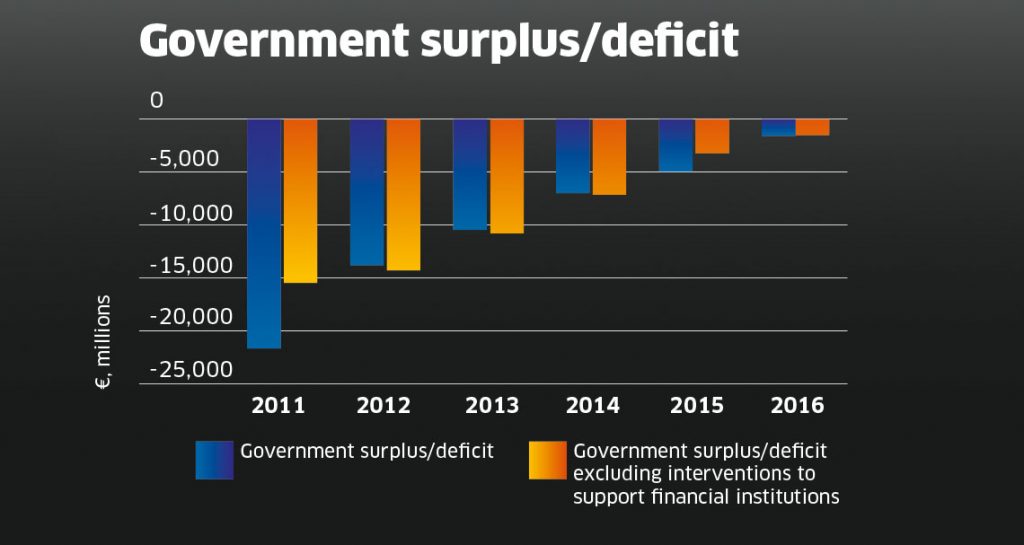
The figure shows the government deficit shrinking over Noonan’s time, and it shows the deficit with and without bailing out the banks.
I spoke with one French economist working at the European Commission who attended meetings with Noonan who said of him: “Monsieur Noonan, he does not fuck around.”
This is true. Despite not being in the best of health, Noonan has continued to try to keep Ireland as open for business as possible, given the current circumstances. He recognised the need for Ireland to be at the front of changes to the global taxation system and a key partner in the OECD’s Base Erosion Profit Sharing scheme.
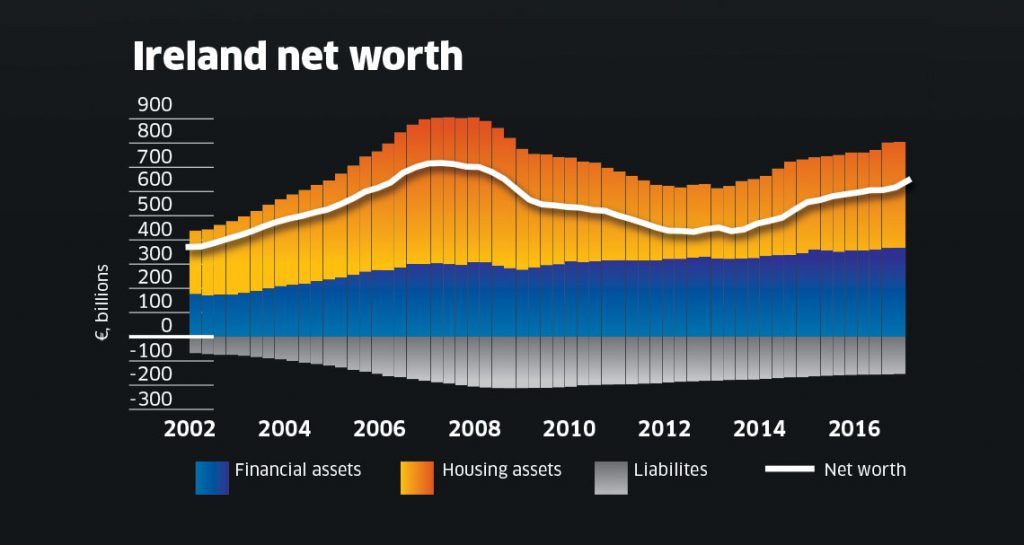
The figures show the rebound of the economy in terms of its assets and liabilities – household net worth has jumped markedly since 2012, and employment has increased markedly, even though credit extended to households is back at 2005 levels.
In terms of macroeconomics, and the bigger picture, Noonan can be declared a winner, especially for those people who own houses and financial assets. Household net worth is calculated as the sum of household housing and financial assets minus their liabilities. Ireland’s net worth is around €663 billion. When Noonan took over, it was €469 billion.
So what is Noonanomics? It is a cautious combination of carefully judged sectoral policies – Vat breaks for tourism, Knowledge Boxes for research and development – combined with handshake deals with the key players in these sectors.
Noonan’s voice, and his stature as Minister for Finance, helps makes these policies possible. It does not hurt, when doing these deals, that Noonan sounds like he might murder you for sport as he stares at you like a maths teacher from the 1950s.
Noonan was dropped into the Programme for Government negotiations when they had stalled. Reports are that he basically stared at the Independent Alliance, told them he’d have plenty of money for their pet projects, and that was that. Deal done.
Remember, Noonan is constrained by the fiscal rules and by the amount of money he has to try to tax. He also can only change the taxation system incrementally. And he can’t change the corporate tax system. Given these constraints, sectoral policy-making is the bread and butter of his policy-making.
Children of austerity
Noonan’s role as Fine Gael talisman is a million miles from his disastrous turn as leader of Fine Gael in the early 2000s, and his term as Minister for Health which, but for the global economic crisis, would be his legacy.
Had he retired as Minister for Finance before the 2016 election, he would have been beatified. But his handling of the fiscal space debate, his role in changing Nama’s terms of reference to speed up asset disbursal, his courting of vulture funds to bring funding into Ireland, his recent treatment of the Public Accounts Committee over Nama, his series of regressive budgets and his insistence on winnowing the tax base by removing the USC all stain that macroeconomic copybook.
I said at the outset of this piece that there were two Irelands, the one from the macroeconomic view, and the one from the microeconomic. If Noonan’s legacy is an economy with better fundamentals and a near-zero primary budget deficit, it is also of an economy that has not recovered equally.
A new book entitled Children of Austerity, published by Unicef, pulls out the salient points. In 2008, 18 per cent of all our children lived in relative poverty. By the end of the austerity period, that number had shot up to 29 per cent, and the composition of those children who were in poverty had changed too, with the proportion of children living in jobless households rising very sharply over the crisis.
In 2008, only 15 per cent of all households with children reported living in conditions of material deprivation. By the end of the crisis, that was closer to 30 per cent.
The key immiserating measures? Budget 2011: cuts in welfare for working age of 4 per cent, child benefit cut by 10 per cent. Budget 2012: increases in income taxes, introduction of household charges, cuts in fuel allowances, cuts in pensions and restrictions of tax reliefs, reduction of back to school payments, cut in child benefits for families with over three children. Budget 2013 began a clawback of some of these measures, but they all have yet to be restored. Ireland’s relatively generous welfare system stopped the crisis being even harder on families, but some of these measures – like reducing medical cards – could have been avoided.
Ireland’s tax base is too narrow. We rely on income tax, Vat and customs and excise duties to make up the bulk of the money the state uses to fund its services. The introduction of a property tax was successful. The introduction of a water tax was not, to put it mildly. Thousands of litres of ink have been spent on analysing that particular failure, but Noonan’s lack of influence in stopping such a bad policy getting off a discussion paper and into policy was notable.
Yes, there are two Irelands. At the national and international level, despite the failings of Nama and the presence of vulture funds within Ireland’s economy, Noonan leaves office with his job done and his head held high. At the microeconomic level, however, the children of austerity will not thank him.
]]>In 1696, the great mathematician Sir Isaac Newton retired from scientific work and took up a sinecure as warden, and later master, of the Royal Mint.
The word ‘sinecure’ literally means ‘without a care’. The wardenship of the mint was a do-nothing job for a man who had achieved more than most by the time he was 55. Newton had, among many other things, invented the calculus. He was both the first scientist and the last magician.
Thanks to Newton, humanity now knew why there were tides, could predict the movement of planets, and understood the nature of light, heat and motion. He delved deeply into alchemy and into spirituality at the same time. Not bad, as lives go.
So Newton, his scientific work well behind him, got a nice job looking after the currency of the empire. At the time coins were made of gold and silver, which were clipped and destroyed regularly, thus reducing their value. His knowledge of chemistry and metallurgy helped him redesign the manner in which coins are made.
Newton changed the chemical composition of the coins and added specially grooved edges so it would be obvious if they had been clipped. Take out a coin from your pocket and look at the edges. They have grooves in them in part because of the tradition begun by Newton. He also changed how the coins were ‘struck’, imprinted with the face of the king, the date and so on.
Coins used to be struck by hand, using big hammers. Newton invented coin presses powered by - you guessed it - donkeys. His coins were of impeccable quality and were far less likely to be clipped or counterfeited. Anyone interested in this time in Newton’s life should read JH Craig’s Newton at the Mint. It’s a small book, but well worth your time.
It seems incredible now, but the mint in the 17th century was mostly crewed by people who did not have permanent jobs or even long association with it. The incentives to do a bad job and to be corrupt were manifold.
Newton changed that, prosecuting wrongdoing, bringing higher levels of training into the mint by creating security of tenure in exchange for having a permanent position, both for donkeys and their keepers. In that way, he helped create the foundations of a civil service.
In Newton’s mint you have the three main elements you still see today: a deep and lasting vocational connection to the workings of the state, a guarantee of work into the future, an expectation of higher training. And a few donkeys.
✽ ✽ ✽
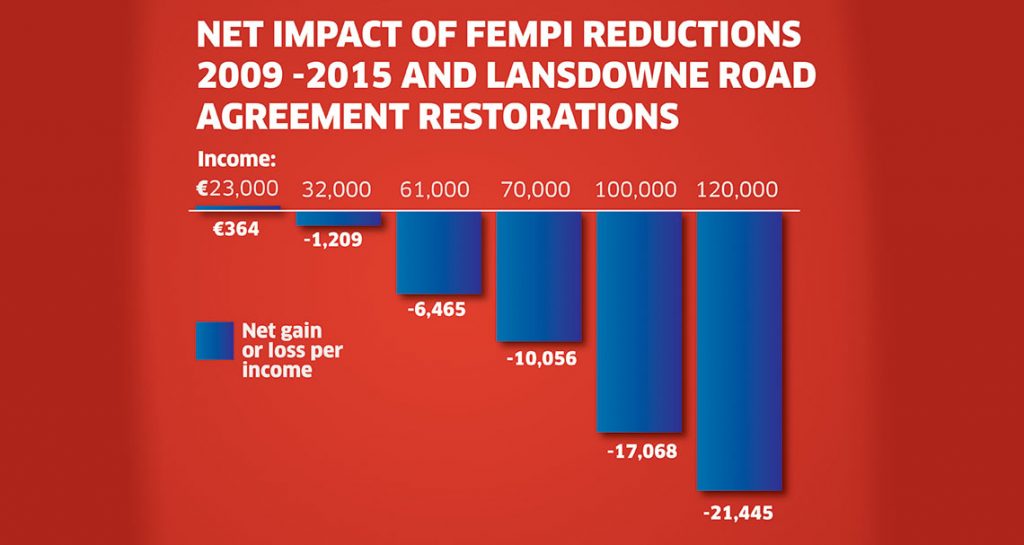
On the individual level, a public sector worker on €32,000 lost some €1,200 between the cuts and the restorations, while a public sector worker on €100,000 lost about €17,000.
Post-emergency pension drama
That emergency has passed - for the state, if not for all its citizens - but many of the pay reductions remain, especially for those public sector workers on about €40,000 or more. Those on lower pay scales have seen their cuts largely reversed. The question for the minister and his officials is: how quickly will pay be restored, and in exchange for which productivity changes to which elements of the service?
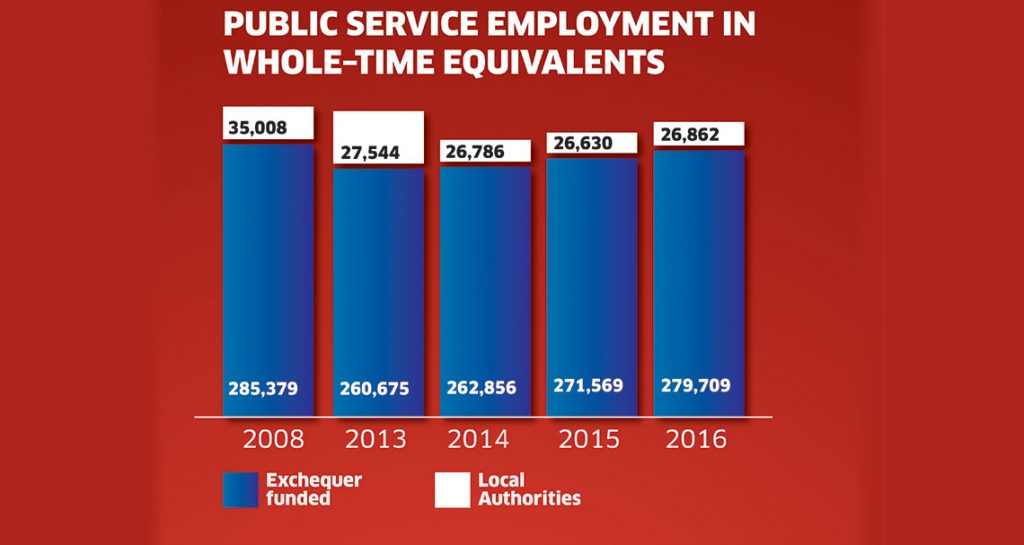
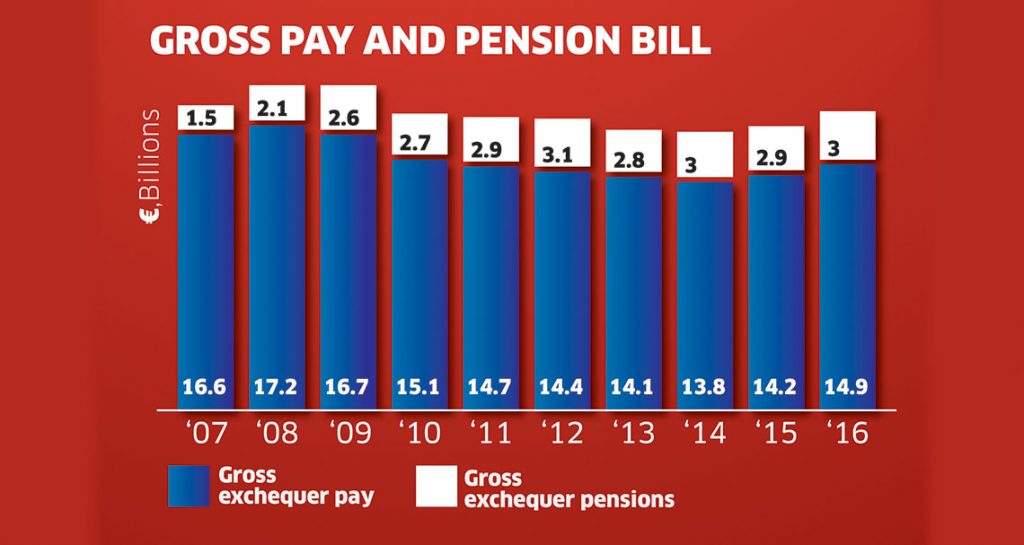
People will remember that in 2008 we had about 320,000 public sector workers. There are about 306,000 today. The gross pay bill for these workers, including the pensions of all of the retired workers, who are paid from current taxation and not a specific pension pot, was €18.1 billion in 2007, and is €17.9 billion today. The net figure is far lower when you consider how much tax those earning over €40,000 pay back to the government, but this is harder to calculate. The pension costs have risen, as many in 2009 and 2010 chose to retire on larger pensions.
Demographic changes alone mean that pension servicing costs will rise. The old age dependency ratio is the ratio of those over 75 to those between 25 and 69. In 1975 this ratio was 13. By 2050 it will be 21.
There are only three solutions to containing the cost explosion in public sector pensions: reduce the expenditure by reducing the pension amount, grow the economy more rapidly than the pensions grow, or isolate and study the old so it can be determined what nutrients they have that might be extracted for our personal use.
Killing and eating the old, as Homer Simpson suggested, doesn’t seem like a runner politically (or at least not in the era of minority government). The long run growth rate of a highly developed economy like Ireland’s is between 2 and 3 per cent per year. The pension bill will certainly grow faster than that by 2025, let alone 2050.
In its submission to the commission, the Department of Public Expenditure itself estimated the differential in employer contribution between a private sector pension and a pre-2013 public sector pension on average at +18 per cent, and in some cases +46 per cent for hospital consultants. The post-2013 scheme is much closer to a private sector model and carries a +2 per cent difference on average.
Consider the following thought experiment: allow private sector workers to enrol in the pre-2013 public sector pension scheme and let them pay the going rate. There would be a deluge of people willing to do so for a defined benefit scheme where the provider is very unlikely to go broke (that said, we’ve done it three times since independence).
The resulting influx might well change how those on low to middle incomes save for their pension, but it would make funding other services like hospitals and roads much more difficult. This would probably also be true for the post-2013 scheme - people are living longer and those on defined benefit schemes have a much better chance of living well into their retirement than if they are on low and middle incomes. Obviously those on higher incomes are probably better off in the private sector, as the salaries they can earn there are far higher than in the public sector.
It’s not pay, it’s not pensions, it’s tenure
The commission did a great job outlining the evidence base for the negotiations to come. They are also publishing all of their workings and assumptions, which as a measure of transparency in policymaking is brilliant.
The one area they did not examine is the benefit of long-term permanency and security of tenure.
Some public sector workers are still effectively unfireable, and their status insulates them against movements in the business cycle, which is a massive benefit in terms of being able to save less, apply for credit more easily, and plan at longer time spans. This benefit was not priced by the commission.
In terms of organisational change, it also slows things down. Workers with security of tenure who perform well are not a problem, of course: they will continue to be assets to the state. However, workers who are not performing well also stay within the system, which calcifies it to a certain extent.
Consider another thought experiment. How much money would you have to offer a public sector worker to remove their tenure? That is, to move them to a contract where, subject to the needs of the organisation, that worker can be let go like a private sector worker? Here you would have to add up all the years of foregone wages, discounted appropriately, and get a sense of how likely someone is to be let go.
To take an example, I’m 38, and I expect to work another 30 years. The cost for me would be enormous, and this is an unpriced benefit every public sector worker enjoys that isn’t yet well understood by the commission.
The first key here to understanding the difference in public sector pay, terms, and conditions is that they are all paid for by the private sector. Private sector workers fund the whole thing, and they have a right to be enraged when a public sector worker, just by dint of a job choice, enjoys a stream of lifetime benefits they do not. The commission has made most of these benefits clear, and has clearly been at pains to be as fair to every element of the system as it could reasonably be, which is not an easy job.
The second key to understanding is this: the wages of the public sector are spent on the goods and services the private sector sells. One sector’s income is another’s expenditure. Cutting one entails cuts to the other. So balance is everything and will be vital in the forthcoming negotiations.
Decent wages, terms and conditions for all
We are one of the wealthiest countries in the world. Workers should enjoy wages commensurate with their productivity and skill levels, and generous terms and conditions. They should look forward to long retirements paid for by their work and by their employers. This should be true regardless of whether they work in the private sector or the public sector. James Connolly in the early 20th century had it right: the cause of labour is the cause of Ireland. The real discussion should be why so many in the private sector have no pensions, and no relative security of tenure.
Newton had it right too in the late 17th century: those in service of the state should be well trained, and well paid.
In the 21st century I want an Ireland of educated people who do remarkable things with their hands and their minds, and are rewarded for doing so, when they are young and when they are old.
The closer we get to removing the general exasperation the public has with public sector workers, some of which is based on poor data and misinformation, the closer we are to figuring out what kind of Ireland allows everyone to prosper.
]]>The day after the Brexit vote, as Britain’s political class sat paralysed in shock, waiting for Bank of England governor Mark Carney to save them, Enda Kenny appeared to the press with a very large and detailed list of priorities by government department.
Kenny’s performance wasn’t statesman-like: he was a statesman that day. The contrast between our two islands was almost jarring. Britain had no plan, but we had.
In the weeks following the Brexit vote, the EU laid out its negotiating priorities, and has stuck to them since. Only one element has changed: Ireland is now front and centre. President of the EU council Donald Tusk said last week: “It is clear that progress on people, money and Ireland must come first.”
The government, and its diplomatic arm in particular, has love-bombed the capitals of Europe, making the case for Ireland. It succeeded brilliantly in the formal inclusion of the ‘Kenny text’ into the EU’s negotiating parameters, agreed by the heads of state at a recent summit.
It’s worth repeating the Kenny text in full.
“The European Council acknowledges that the Good Friday Agreement expressly provides for an agreed mechanism whereby a united Ireland may be brought about through peaceful and democratic means. In this regard, the European Council acknowledges that, in accordance with international law, the entire territory of such a united Ireland would thus be part of the European Union.”
The Kenny text provides for a means to ensure the Good Friday Agreement isn’t undermined by any negotiation, and for a way to negotiate clearly on the border arrangements between the Republic and the North.
Yes, it’s only a start, but it’s the best possible start.
A win for Kenny of historical significance
It is important to note the historic significance of the Article 50 negotiations and to place them in their correct context. The kingdoms of Ireland and Great Britain were united in 1801 by acts of the Irish and British parliaments.
The 1921 Anglo-Irish Treaty marked the beginning of the Irish secession, which is in many ways analogous to today’s Article 50 process, but with much less complexity. Westminster passed the Irish Free State Constitution Act in 1922.
That act provided for a common travel area between Britain, Ireland, the Channel Islands and the Isle of Man. The starting point of any negotiation in 2017 and 2018 is to hew as closely as possible to the 1922 arrangement, which underpins a common labour market.
Given the range of forces allied against it, the government did an amazing job, pushing the need for 26 other states with their own diverse (and insular) needs to think about Ireland as hard as they could. Recently in this column I was deeply sceptical of its ability to do this, given the competing claims and individual national interests at play. I was wrong to be so cynical. The government, and Enda Kenny, prevailed.
In a stream of nearly relentless criticism of the government, we have to acknowledge the good work done here. There was no pre-ordained outcome: it was not inevitable that Europe would care at all about Ireland. The government did its job, and did it well. I know unalloyed praise for the government sometimes feels like listening to cats barking, but there shouldn’t be an asymmetry between how we view the successes and failures of any government.
One part of the problem is that when the government succeeds, it typically does so quietly. Really good public policy is like really good plumbing, or software: it just works. We only notice either when they seize up.
It is amazing how politics moves. Had he left office in February, Enda Kenny would be remembered for his catastrophic mishandling of the Sergeant Maurice McCabe affair. Just two months later, as he prepares to leave office following the Kenny text, he has the successful parameters for the Brexit negotiation to bookend a remarkable political career. It doesn’t erase the failures of the past, of course, but history will judge him differently as a result of the Kenny text.
Context matters. The state will endure beyond any of us, and beyond any individual taoiseach. Whoever holds that high office has to consider fiscal matters above almost every other issue.
The state expects to lose up to 3 per cent of GDP over ten years as a result of Brexit, and this might cost Ireland 40,000 jobs, mostly in indigenous sectors. For a sense of scale, there are about 400,000 jobs directly dependent on the trading relationship Ireland has with Britain.
The British people are convulsed by a post-imperial fantasy sold to them by right-wing newspapers. The Article 50 negotiations are going to be very hard for them as this fantasy is dispelled. The Irish are their greatest allies within the EU-26 negotiating team, because our incentives now align perfectly with theirs. The softer the Brexit, the better it is for Ireland.
Brexit is expected to have a negative impact on Ireland’s balance of payments - the difference between what it sells to the world, and what it buys from the world.
I’ve mentioned in this column many times that Ireland’s largest export by value is, in fact, pharmaceuticals, and Belgium is our largest trading partner as a result. Agriculture is a huge sector in Ireland by value, and it employs about 170,000 people. These people produce almost one-fifth of the beef used by McDonald’s in Europe. They produce about one tenth of all the baby formula consumed in the world. All from a country with a population the size of Manchester. For many of them, Brexit represents a massive challenge to their livelihoods.
Budget 2018 must be framed as the Brexit budget which will react to protect the interests of those most affected by the now likely hard Brexit. But for a Brexit budget, you need fiscal space. And that seems to be disappearing.
A fiscal puzzle - and the answer isn’t jobs
You don’t try to figure out what’s going on in an economy by using one measure. Firstly, most economic data is rubbish by scientific standards, and usually collected for some other purpose. Secondly, the figures are usually for one sector or one industry, or survey-based and sometimes biased.
Despite their deficiencies, however, they measure the same complex system, so typically they move together. When we see industrial production increasing by 2.6 per cent in March 2017, and the Live Register total decreasing by 4,600 for a 6.2 per cent unemployment rate in April 2017, when we see Vat receipts up by €602 million or 14.5 per cent in annual terms, we can speculate that more people are working, and they are buying more things. We should therefore expect to see more taxes being paid from income.
Here’s the puzzle: income taxes increased by only €14 million to €1.7 billion in April, and this increase is below target, the second such miss this year. Excise and corporation taxes are down also, but these are not ‘smooth’ taxes such as income and so we shouldn’t take a miss too seriously.
What we should focus on are the income tax receipts. More people in work should, all things being equal, correspond to more people paying income taxes. But it hasn’t.
Three explanations are likely.
First, it could be that many of the new jobs created are low-paid and so don’t attract a significant amount of income tax.
This is a bad thing for many reasons, and Brexit is one of them. Low-paid jobs are bad for social mobility, family formation and social cohesion, and they are obviously not great when it comes to income taxes.
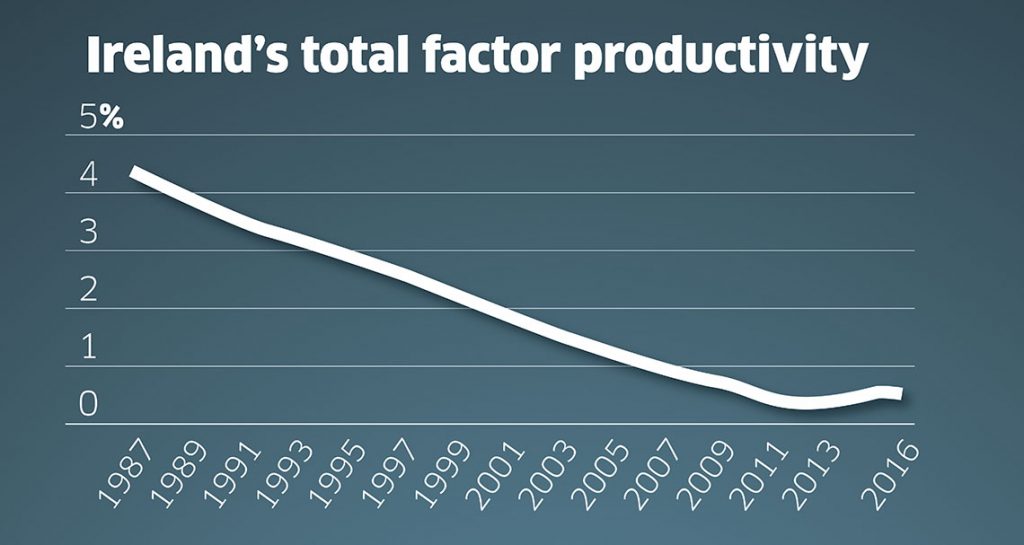
Low-paid jobs are typically low-productivity jobs. They are the first to go if there is any shock to the business, such as the one we know Brexit will create. Ireland desperately needs an increase in productivity.
The chart shows one measure of productivity growth called ‘total factor productivity’. In 1987, Ireland’s total factor productivity grew by 4.5 per cent. In 2016, it grew by 0.55 per cent. In the long run, you don’t get growth without increases in productivity.
Second, it could be that many of the new jobs don’t have enough hours associated with them, or that they are just taxed in a different way, that is, using PRSI and PAYE rather than USC.
The number of average weekly paid hours has increased from 31.8 hours in 2009 to 32.1 hours in 2016, and average total labour costs are up. The composition of these hours worked and the wages paid might have changed post-crisis, but we don’t have evidence of that yet.
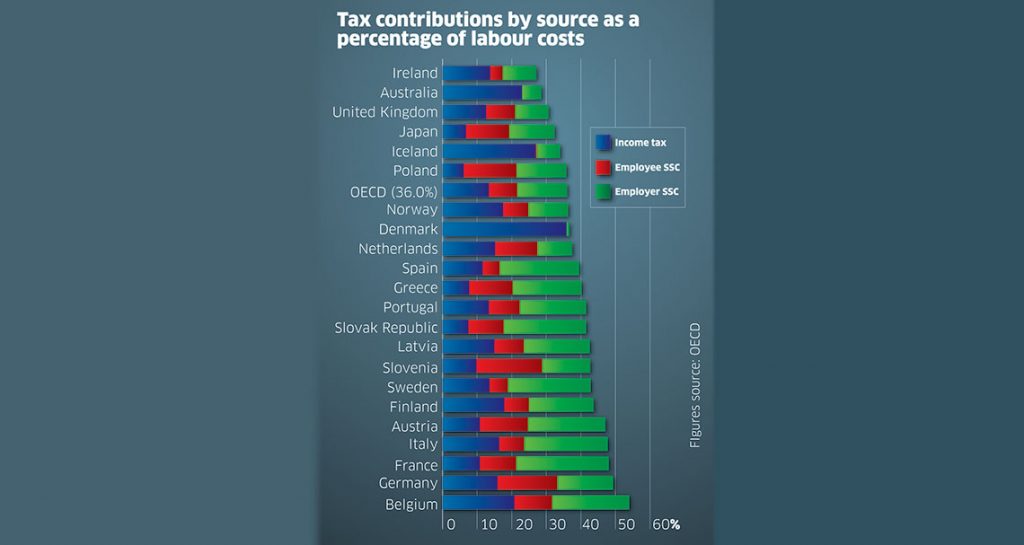
Third, it is possible that the nature of our tax system has changed. The tax wedge is a measure of the tax on labour income, which includes the tax paid by both the employee and the employer. Of 35 OECD member countries in 2016, Ireland had the 29th lowest tax wedge. The average single worker in Ireland faces a tax wedge of 27 per cent in 2016 compared with the OECD average of 36.0 per cent. The tax wedge has risen from 22 per cent in 2008 to 27 per cent in 2016.
Ireland is not a high-tax country for many of its workers, despite what many believe. The table shows how much workers and corporations pay towards their social security contributions as a percentage of labour costs. Ireland is bottom of the list.
The structure of our tax system is why calls to pay for everything from ‘general taxation’ won’t all work: not enough of us pay enough into the pool of taxable funds to resource things such as hospitals, schools and roads.
You can achieve a single-payer system for most social services if households, firms and the import/export sector are taxed at a fairly high rate, but we all know that won’t fly.
Brexit will take more jobs away in trade displacement and uncertainty than it gives in foreign direct investment. Our tax system will probably not be able to deliver enough funds to guard against the worst effects of Brexit. Our government has shown it can get the job done when it comes to Brexit. The next key test will be Budget 2018.
]]>Last week two former Goldman Sachs bankers, Secretary of the Treasury Steven Mnuchin and National Economic Council Director Gary Cohn took to the stage in the White House to announce the outline of President Donald Trump’s tax plan. And what an outline it was.
Just one page, consisting mostly of bullet points, white space and magical thinking. It was, frankly, embarrassing. I was mortified for them. Really. There were actually fewer details than the Trump campaign plan had.
The Republican Party has had many years to work on this. The administration has had seven months. The last big tax reform was from 1984 to 1986 under President Reagan. Later President Clinton altered the tax code in 1993. President Obama increased taxes on the very wealthy to pay for the Affordable Care Act. President Trump made tax reform a large part of his election platform. And after nearly 100 days in office the head honchos came with a few bullet points.
Magical thinking creates causal relationships between actions and events where none exist. Trump’s magical thinking is that in decreasing taxes massively, the economy will grow, and then the size of the unbound economy, taxed at a lower rate, will be enough to recoup any losses.
Put another way, the idea is that high marginal tax rates severely reduce the incentives for people to work and so by cutting tax rates you are stimulating people to work harder and earn more income, thus raising revenue. This is magical thinking and it has never worked. Like, ever. This is also one of the very few things economists can claim to ‘know’ with some certainty.
Economists should be humble people. We got almost everything wrong in the run-up to the crisis, and even the good advice we gave during the crisis was largely ignored. The current moment is a time of rebuilding in economics generally.
There are, however, a few things economists do know.
We know trade between nations makes most people better off, most of the time.
We know people should specialise in what they do best, and most of the time they should buy in the specialised expertise of others via a market mechanism when they need it.
We know the government is an agent of stability and the redistributive engine of a civilised society.
We know any money spent on early childhood education pays for itself ten times over.
We know that massively cutting taxes and expecting growth to plug the gap just doesn’t work. It is a conservative dream, a fantasy on a par with the belief that the poor are lazy and the ‘tough love’ required is to simply cut their benefits, after which they’ll all go out and get jobs.
Evidence falsifies these claims, especially in the labour market. An extensive literature in labour economics has shown that there is very little impact of taxes on the amount of labour supplied for most people, particularly for prime age working men.
In fairness, the Republican Party has never been big on evidence.
Enriching the already rich
The key points of the plan for Ireland are in the corporate sphere. First, what wasn’t in the outline was as significant as what was: there was no indication of the ‘border adjustment tax’ we discussed in this column a few weeks ago, presumably because very strong lobbying by companies such as Walmart, America’s largest importer of goods and services, made the policy a non-starter in a Congress controlled by corporate interests.
The federal rate of corporation tax will be lowered from 35 per cent to 15 per cent, and there will be a one-off amnesty on US corporate funds held abroad, in places like Ireland. The US has an estimated $2.6 trillion in (yes, trillion, twelve zeroes) overseas retained earnings. A one-off (say) 10 per cent tax could raise $260 billion in tax, or roughly one year’s corporate tax revenue in the US.
Yet more magical thinking in the form of ‘patriotism’ was invoked to show how this money would be fuelled into productive, job-creating economic capital like factories and roads, and not simply end up as dividends for rich people and pension funds. This, by the way, was precisely what happened the last time there was a massive tax amnesty in the 2000s under George W Bush. The Bush amnesty saw sharp increases in share buybacks, dividend pay outs, and mergers and acquisitions. Job creation did not feature strongly, but wealth creation for the already wealthy did, big league.
The two amigos last week gave no indication of how they’d stop this vast increase in the wealth of the top 10 per cent of households, while systematically defunding programs that help the bottom 90 per cent.
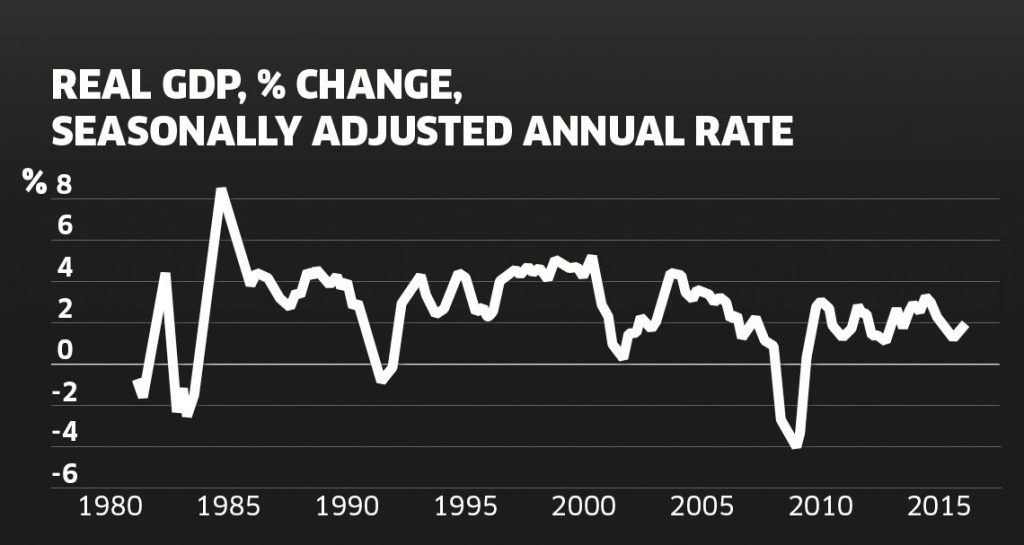
The US economy needs to grow by nearly 4 per cent per year for a decade to make Trump’s numbers work. Look at the figure, which shows the US growth record. It hasn’t grown by 4 per cent since 2002.
The press corps, seemingly inured to this kind of nonsense from the Trump administration, didn’t burst out laughing. They treated the display of one page of bullet points fairly seriously.
The two men spoke for about 15 minutes. At question time, it was amazing how little detail the two most senior economic policymakers in America had on the policies they were announcing. They were asked questions like: in the new three rate personal tax structure, reduced from seven rates, what income bands would apply? They said they didn’t know, it was being worked out.
They were asked about rich people simply moving their money into company structures to save tax, thus causing a massive budget deficit to balloon? They didn’t know. When asked why they were repealing an estate tax which only hits millionaires and the children of millionaires, they flubbed the answer, and said they didn’t have the equation to hand.Here’s an equation. No detail = no plan.
Every country spends its taxes on government expenditure programmes like health, education, defence, and social security. When the amount being spent is greater than the amount the government gets in taxes, the government has to either print money or borrow from the rest of the world. The United States does both, and it has a truly gigantic budget deficit.
Politics over economics
The United States is not Ireland, so its budget deficits do not, in practice, matter. It can create money out of thin air, holds the world’s reserve currency, and so it has the ability to sustain budget deficits more or less forever.
The economics of the budget deficit are not important. The politics are. The Republican party has styled itself as anti-deficit for many years, though in practice the deficit has increased under Republicans and decreased under Democrats. The US has a ‘debt ceiling’ which it continually raises, and this debt ceiling is an instrument of incredible leverage by the Congress over the president.
Under Obama it was actually used to shut down the US government for a short space of time, meaning people didn’t get paid and services didn’t get delivered. President Trump’s plan will explode the deficit. The US Congressional Budget Office projects that the federal debt will grow by $10 trillion over the next decade, and it is at $4 trillion now. There is an old idea in economics. A financial balance is the difference between what you spend and what you take in.
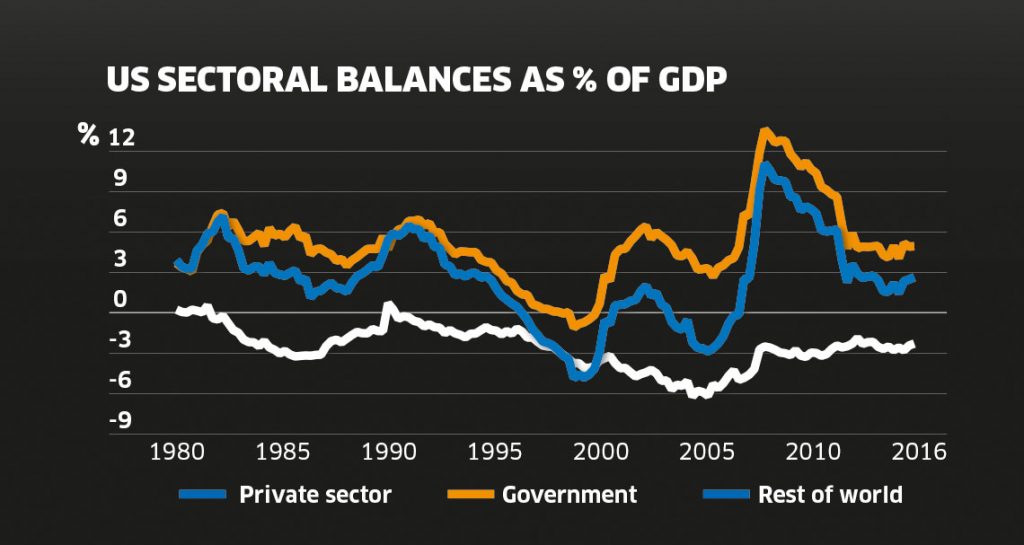
So for the government the balance is government expenditure minus taxes. For the private sector, firms and households, the balance is the amount invested minus the amount saved. The rest of the world’s financial balance is the difference between exports and imports. The idea is that the sum of the private sector’s financial balance, the government’s financial balance, and the rest of the world’s financial balance have to equal zero.
So imagine there are no exports and imports and the economy is like North Korea, and both the private sector and the government are in perfect balance. If the government decides to borrow massively, its balance has to be negative, but because it will have to borrow from the private sector for investment, the private sector balance will have to swing up positively in response. The sum of all three balances will still equal zero.
The sectoral balances graph at left shows those of the United States from 1980 to today expressed as a fraction of economic output. When the government’s balance is above zero, the amount of government spending is greater than the amount it gets in tax, so it’s a deficit.
You can see the vast increase in the deficit from 2000 to 2007 as a result of the various wars the US was involved in. You can see the decrease in the deficit brought about by Obama. You can also see the large increase in investment in the private sector in 2008 as Obama bailed out the banks and the auto industry, and the subsequent decrease in investment to its current low level. The rest of the world has been tipping along throughout the entire period, simply because the US is so large it imports only about 15 per cent of what it needs.
The forgotten stay forgotten
Now let’s think about the Trump ‘plan’ in terms of the sectoral balances. It will massively increase the difference between government spending and tax revenue. The government balance will shoot up again, this time higher than the 2008 spike. The private sector will benefit massively, shooting up as well, but it won’t be the average household who benefits. It will be multinationals, large firms and the rich. The forgotten men and women stay forgotten.
The importance of the Trump ‘plan’ in terms of Ireland is simple: it will create a vast sucking noise as the funds which enrich the IFSC and other business-friendly financial services destinations head back to the US. If the tax code is changed to remove loopholes where US firms can hold retained earnings offshore, we might see a dent in our US foreign direct investment.
Luckily, we have Brexit (never thought I’d hear myself say that), and this means Ireland remains a key access point for the European Union, which we know is a key driver of FDI here.
Our corporate tax rate will still be lower than the 15 per cent charged in the US, and probably lower still if you consider effective tax rates. Trump’s tax ‘plan’ may well be a threat, but only if it turns into an actual plan. We have to await the detail to understand its likely impact. When it comes to tax, the devil is in the detail, not the dynamic.
]]>Politics is about decisions, and when you decide, you must divide. British prime minister Theresa May last week decided to call a snap election more than 1,000 days before she was required to by law, simply because the polls told her she could. Today, May faces a divided House of Commons and commands a slim majority of only 17 MPs.
She is defeated in the House of Lords semi-regularly. She knows she will need more support to push through the tough times that Brexit will surely usher in for the denizens of Perfidious Albion and their Irish cousins across the sea. And so to the ballot boxes they go.
I like that old trope ‘Perfidious Albion’ as a piece of language. It’s a pejorative that dresses up the idea that the British are sneaky and treacherous in fancy language. A famously chubby Frenchman on the losing side of an engagement with the sneaky Brits in the 19th century is the supposed father of the slur, so it’s usually used in the context of international affairs.
Personally, I think the British are a great people, who created the industrial revolution and gave prosperity to more than a quarter of the planet, but I must admit I can’t resist a good phrase, especially when it is loaded with history.
The ‘Albion’ part comes from a story of England’s creation. More of a founding myth, the story goes that before there were men, before the Romans came to conquer, there were the denizens of Albion, the ancient name for the island of England, Scotland, and Wales. The denizens of Albion were descended from giants, the sons and daughters of Albina, a Greek princess who, to put it mildly, had notions about her.
Albion was a land of giants, soldiers from the Trojan war, and even dragons before the Romans came. As founding myths go, it’s pretty cool. The defeated Frenchman’s slur conjures an image of greatness in the blood, of nobility and magic, along with treachery in dealings with those not of the island of Albina.
On September 3, 2016, the British prime minister swore a hole through a copper pot that there would be no snap election. Speaking to the BBC’s Andrew Marr, she said: “I’m not going to be calling a snap election. I’ve been very clear that I think we need that period of time, that stability, to be able to deal with the issues that the country is facing and have that election in 2020.”
Perfidious Theresa
The electoral logic is simple, and as much of a calculated gamble as you can get in politics. The polls, which readers of this column know to take with a barrel of salt, not a pinch, translate into a resounding Conservative victory.
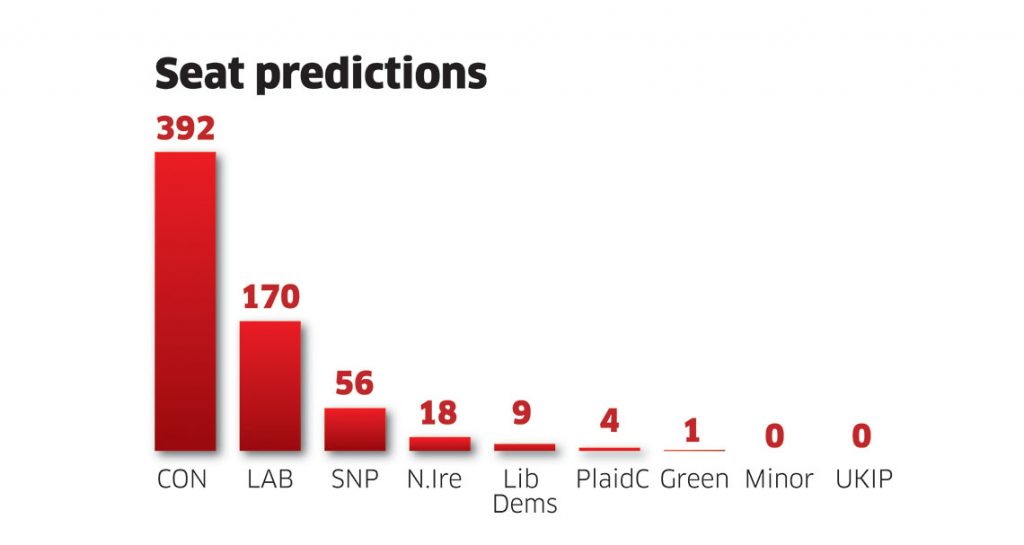
If the current polls were reflected on polling day, they would return over 390 seats for an enormous Conservative majority of well over 100 MPs. It would be an imperial moment for the Conservative Party from 2017 to 2022. Labour, already weak and divided with a deeply unpopular leader, would be decimated. Jeremy Corbyn, probably the Conservative Party’s greatest electoral asset, would be removed. The Liberal Democrats would feast on Labour’s guts, as would all the smaller parties.
May’s message is very simple: we must negotiate the best Brexit deal. The EU will surely come at us hard. Give us a strong hand, the other crowd are messers you wouldn’t put in charge of a shop till, never mind a country. She calls them the ‘coalition of chaos’. That’s an ungainly phrase but it does get across the idea that Labour plus the Scottish Nationalist Party plus the Liberal Democrats plus the kitchen sink is all that stands as an alternative to the Conservative hegemony, and the times ahead are going to be rough.
That her party created the conditions of uncertainty and the rough times ahead that she now stands to benefit from electorally is beside the point, and is not mentioned.
The right-wing press are strongly on May’s side. The Daily Mail, once a fascist mouthpiece, now brands those who side against May as “saboteurs”. “Crush pro-EU saboteurs, PM,” advises the Sun. The language used by the newspapers echoes revolutionary Leninism which advances the idea of an authoritarian vanguard, and so is the imagery. Cartoons of May show her cut from granite, or made of metal.
MP Jo Cox was killed by a man reacting to language and images like that on June 16, 2016. That’s how this campaign starts, with talk of saboteurs and unity, of sovereignty and the world ending in chaos if Theresa isn’t given her imperial half-decade. Rhetorically, British election campaigns only go one way: down. I’m genuinely scared to see what depths this one will plumb after last year’s Brexit referendum.
Perhaps acknowledging the rhetoric was likely to get some of them hurt, MPs from all parties piled opprobrium on the Daily Mail. There aren’t enough zeroes after the decimal point to estimate the chances of the paper’s language moderating.
Friedrich von Hayek, not my favourite thinker, got it bang on when writing about the connection between xenophobia and authoritarianism. “The contrast between ‘we’ and ‘they’”, Hayek wrote, “the common fight against those outside the group, seems to be an essential ingredient . . . [for] the unreserved allegiances of huge masses. From [the authoritarian’s] point of view it has the great advantage of leaving them greater freedom of action than almost any positive programme”. May’s first stump speech sought to portray the election as an ‘us’ versus ‘them’ moment in British history, and it is freedom of action she is working to secure.
May’s decision is being spun as good news for Ireland. This is a mistake. The idea is that, somehow, Ireland will benefit from Perfidious Theresa because she will be able to force through a moderate Brexit, one with some limits to migration, and some tariffs and levies, sure, but not a full-blown ‘hard’ Brexit.
The logic is that May’s re-election is good for Ireland because she will have the strength internally in her party to allow concessions on things like migration and pension payments to the EU. The hard-line Brexiteers won’t be able to touch her. Ireland will benefit from a softer Brexit as we still trade large amounts with Britain. There’s a charm to the idea, and a certain logic, but it is a fiction, like ‘soft landings’ we were all going to have in 2007 and 2008. At least five arguments militate against this line of magical thinking.
First off, more Brexit hardliners will be elected to the Palace of Westminster, not less. There will be over 300 of them, all pledged in their manifestos to implement Brexit. Second, May has political cover for any Brexit-related result, and so crashing out of the customs union, the single market, the passporting regime for financial services, all of it, can be sacrificed on the altar of a pure break, simply because a mandate can be claimed for it. Third, Britain is not the entity with the power in this negotiation. It is the EU, and the election does not change the calculus of power in any way. Fourth, while her officials get the Brexit negotiation process up and running, May is wasting months of negotiating time. Fifth, the election exposes everyone to yet more uncertainty.
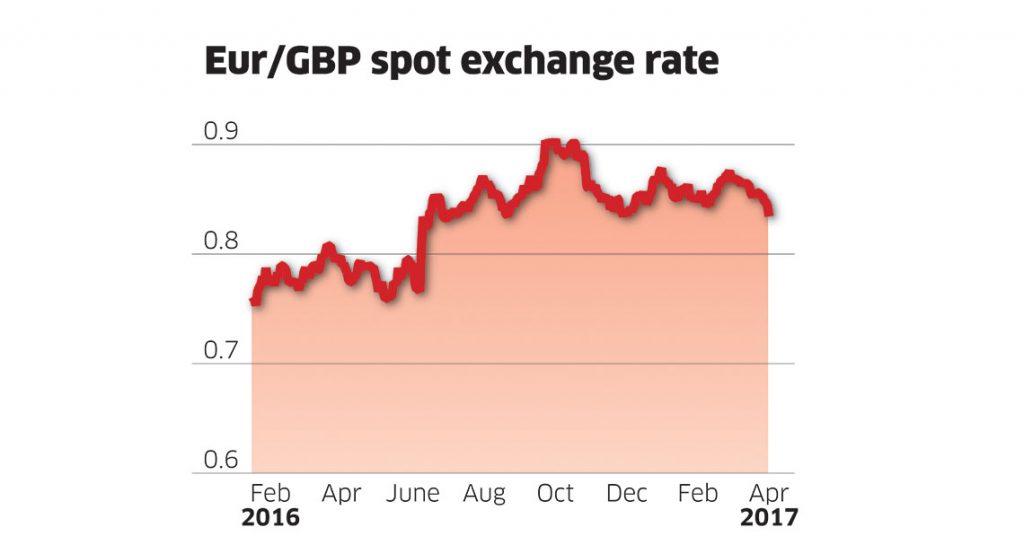
This macroeconomic uncertainty is usually expressed quickly through the febrile exchange rates between sterling and the euro, shown in the figure with the axis starting 0.75 euro per British pound to show the changes more clearly. The chart starts from the first day of 2016 to show how quickly things can change. Last Thursday saw the British pound to euro exchange rate fall from its 2017 highs as traders sold their sterling in profit-taking. The euro benefited a bit from the latest French presidential election polls showing a slim lead for pro-business and pro-EU Emmanuel Macron.
Only one in four Irish companies hedge their currency exposure, meaning their slim margins are likely to disappear if sterling falls further. A fall in sterling does three things. It increases the cost of Irish goods going into Britain and increases competition on Irish shelves from British products. A fall in sterling drives retail activity of Irish consumers cross-border and, especially, online.
Brexit may well mean a permanently weaker sterling, and this means the only way to increase profit margins will be to drive down costs, diversify into other markets, or seek state supports of some kind. In addition to the permanently lower level, the currency will be more volatile. This means signing a contract on a Monday may be very different from signing the same contract on a Friday.
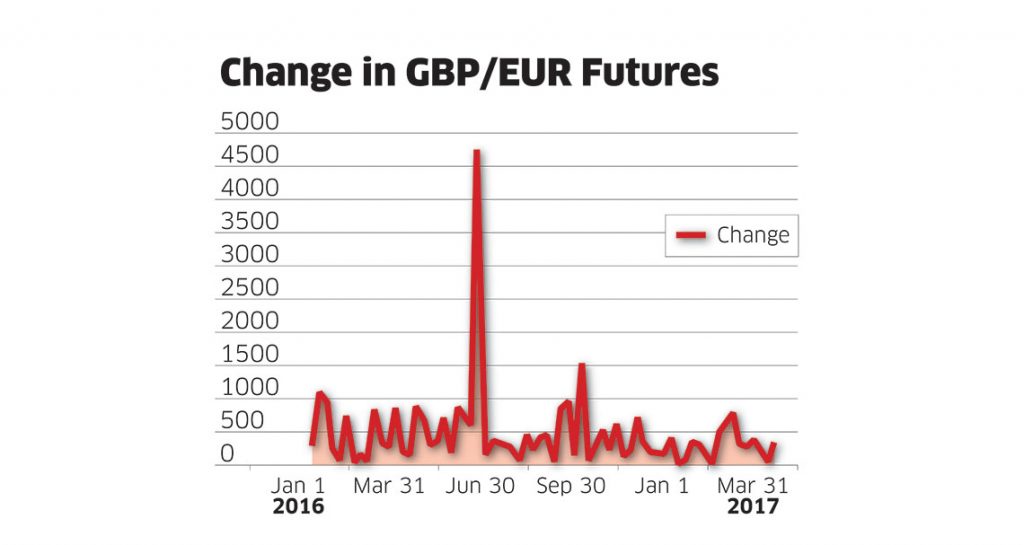
The figure shows the change in the futures market for sterling relative to euro. A futures market sells commodities for delivery in the future. You buy €100 worth of British points and get it delivered in a month to you, but at today’s price. A futures market is a way of offsetting some of the movements in the currencies you’re trading in. These markets have existed for centuries.
The chart shows you a monthly futures market. Bigger movements imply more uncertainty. No prizes for figuring out what the big spike is. The snap election brought back a smaller version of that kind of uncertainty again.
So this is where Perfidious Theresa has left us. Volatility, uncertainty, and the prospect of a hard Brexit nearer, not further away. Her benefit, our cost. Negotiations in the North are at a standstill and await the election results, but it is unlikely the peace process figured much in the decision to go hard for a greater parliamentary majority. The 2017 election will be the North’s fourth election in two years, not including the EU referendum.
The election results come with high stakes for the residents of Northern Ireland. In the event of direct rule, Northern Ireland will end up relying on a fractured minority of politicians to stand up to an imperious Conservative government that has given it no indication of having a post-Brexit plan which takes the welfare of Northern Ireland into account, some 56 per cent of Northern Ireland voted to Remain in the EU last June, and it is clear they will be stuck with a hard Brexit to implement.
In the Republic, our ability to adjust in the face of uncertainty like this is probably our greatest asset. Tiny open economies like Ireland must adjust to fit the world. It won’t fit us. The sectors most in Brexit’s firing line need a range of supports to access markets, and Enterprise Ireland is the agency to deliver this. It needs resources on tap from the government now and in the next budget, and on an all-island footing. That’s the right decision to make for Ireland, and probably the only positive decision we can make in any case. May, meanwhile, will get to decide what she thinks is best for Albion until 2022.
]]>