tag:green.nd.edu,2005:/newstag:green.nd.edu,2005:/latestCampus Sustainability | News2026-05-15T15:22:00-04:00Taking sustainability seriously is inherent in our Catholic mission. tag:green.nd.edu,2005:News/1817822026-05-15T15:22:00-04:002026-05-15T15:22:46-04:00Notre Dame’s Kyle Doudrick named to EPA Science Advisory BoardKyle Doudrick, associate professor in the Department of Civil and Environmental Engineering and Earth Sciences at the University of Notre Dame, has been selected to serve on the Science Advisory Board of the United States Environmental Protection Agency (EPA). The board, which consists of 37 members from a broad range of scientific disciplines, provides scientific advice to EPA leadership.
Kyle Doudrick
"I'm honored to have been selected to serve on the EPA Science Advisory Board,” Doudrick said. “The board plays an important role in providing independent, research-based guidance on complex environmental issues, helping ensure that decisions are informed by the best available evidence and remain practical for communities."
Doudrick, a faculty affiliate of Notre Dame Energy and Notre Dame’s Environmental Change Initiative, is the only academic researcher among the selected board members from the state of Indiana.
An environmental engineer, Doudrick specializes in emerging contaminants of concern in drinking water, including per- and polyfluoroalkyl substances (PFAS)—also called “forever chemicals”—and micro- and nanoplastics. His work focuses on identifying viable, cost-effective solutions to treat emerging contaminants and improve conventional water treatment processes.
“We aim to target and eliminate these contaminants in ways that are both effective and fiscally responsible, which is increasingly important as utilities and regulators navigate these challenges,” Doudrick said. His lab is currently working on multiple PFAS-related projects, including a study of PFAS leaching from contaminated pavements into the surrounding environment.
"Kyle Doudrick’s appointment to the EPA's Science Advisory Board is outstanding news for public health and the environment," said Patricia J. Culligan, the Matthew H. McCloskey Dean of the College of Engineering. "His expertise on the critical environmental problems of microplastics and PFAS will be critical to protecting vital resources upon which we all depend."
Doudrick earned undergraduate and masters degrees in civil engineering at the University of Memphis. He completed his doctoral studies in environmental engineering at Arizona State University. He joined the faculty at Notre Dame in 2014.
The University of Notre Dame is a private research and teaching university inspired by its Catholic mission. Located in South Bend, Indiana, its researchers are advancing human understanding through research, scholarship, education, and creative endeavor in order to be a repository for knowledge and a powerful means for doing good in the world. For more information, please visit NDR's website or NDR's LinkedIn.
Originally published by Erin Fennessy at research.nd.edu on April 30, 2026.
]]>
Erin Fennessytag:green.nd.edu,2005:News/1815392026-05-08T08:53:00-04:002026-05-08T08:53:46-04:00McCourtney East becomes Notre Dame's first LEED Platinum-certified building
As of Earth Day 2026, McCourtney East became the first building on campus to achieve LEED Platinum certification. Platinum is the highest possible rating that a building can achieve. Led by Senior Director and Associate University Architect Mike Daly with support from the BSA design team and construction manager Shiel Sexton, this building project is a testament to the dedication of everyone in the Facilities Design and Operations team, who are working to build a more resilient and sustainable campus. Among a myriad of sustainable features, some highlights of the project include:
41% water savings via low-flow fixtures.
LED lighting is 56% better than Indiana's energy code standard.
A heat recovery system exists to capture waste heat to pre-cool and pre-heat air for the laboratories.
89% of the project waste was diverted from the landfill by separating waste streams where feasible, and engaging a local partner to separate co-mingled materials further.
The geothermal campus heating water system was extended to the building to provide high-efficiency building heating and to move away from campus steam generation.
29% of the previously disturbed site area was restored with native or adapted vegetation.
Biophilic design principles were incorporated with the exterior courtyard design, as well as bringing the site design into the building via layout, material selection, views of the exterior, and daylighting.
Short- and long-term bicycle storage were provided alongside shower facilities to encourage building occupants to bike to campus.
Stay tuned for more news coming soon on the LEED-Platinum certification of McCourtney East.
]]>
Olivia Farringtontag:green.nd.edu,2005:News/1814782026-05-06T16:36:00-04:002026-05-07T14:24:30-04:00Third Annual Sustainability Celebration honors a decade of impact & campus partners
On Earth Day, students, faculty, staff, and members of the Michiana community gathered for Notre Dame’s Third Annual Sustainability Celebration to honor the collective achievements of campus sustainability champions and recognize both external and internal partners who are part of Notre Dame’s ongoing journey to care for our common home. This year's gathering had a notable reason to celebrate: It's been ten years since Notre Dame's original Sustainability Strategy was published, and much has changed in the last decade.
During the celebration, University President Rev. Robert A. Dowd, C.S.C., offered reflections on the many sustainability achievements thus far, as well as the continuing work ahead for Notre Dame.
Reflections of progress
Before assuming his presidential role, Father Dowd was an original member of the Sustainability Strategy Standing Committee, which published the University’s first Sustainability Strategy a decade ago.
“Pope Francis’ encyclical Laudato si’ was a call to all of us, and we have done our best to answer that call,” he said.
Father Dowd reflected on his time as a member of the Committee and the process of envisioning possibilities for a more sustainable campus, saying, “We came up with all kinds of ideas, but of course, putting those ideas into action in the real world is the real heavy lifting.”
Father Dowd shared examples of the University’s commitment to sustainable endeavors, recounting the detailed work of special projects, including the hydroelectric facility and advancing decarbonization, achieving LEED building certifications, establishing sustainability-focused academic programs, and reducing food waste.
“We’re still at the very beginning of this work, and it’s going to be an ongoing effort to translate research and education into transformative action. I know, based on my conversation with Pope Leo, that [sustainability] matters to him,” said Father Dowd. “We must continue building on the legacy of Pope Francis and Laudato si’, ensuring that we are caring for our common home and caring for one another with special attention to those who are most vulnerable among us.”
Honoring external partners
Now in its seventh year, the External Partnership Sustainability Awards honored five campus partners. The award categories recognize the holistic nature of sustainability work, keeping in mind the three sustainability pillars: ecological, human, and economic health. Procurement Services and Notre Dame Sustainability presented repurposed slate roof tile plaques to five deserving organizations. The awardees were as follows:
Business Furnishings received the “Bridging to Business” Award. This recognition honors a local small business partner who not only provides the University with the highest level of customer service, but also serves as a model partner for other businesses in the region. Business Furnishings has consistently helped to repurpose and reuse furniture items from one project to another, saving money and supporting sustainability through circular use. Their work alongside the University has extended the lifespan of furniture across dozens of buildings and counting.
Leanpath received the “Innovative Food Solutions” Award. This company provides and supports the software and equipment that the University uses to track and categorize food waste in the Dining Halls. Using the Leanpath system, Notre Dame’s culinary teams receive real-time data to make informed decisions that help avoid food waste before it happens. Avoiding food waste through meal planning is considered one of the most effective ways to keep food out of the landfill.
Paramount Coffee was recognized for the “Human Rights and Social Responsibility” Award. Through this partnership, the University can serve coffee sourced directly from farms with traceable supply chains, supporting a respect for both the land and the people working on the coffee farms. Coffee is a crop that has considerable sustainability implications, and Paramount is a company dedicated to prioritizing both people and planet as a part of its business practices.
LiveRoof was honored with the “Resilience and Climate Impact Reduction” Award, which recognizes an outstanding partner whose work supports the areas of climate change mitigation and adaptation. Currently, Notre Dame has over 212,000 square feet of green roofs spanning across ten different buildings. Since 2009, LiveRoof has been instrumental in designing, installing, and maintaining these systems.
Finally, R&R Excavating was recognized with the “Operational Excellence” Award. R&R has been a major contributor to several sustainability projects executed by the University’s Utilities team, including South Campus Geothermal, ND Hydro, and West Campus Solar. Throughout these projects, R&R has acted as an extension of the University’s team, helping navigate complex challenges to deliver innovative and often collaborative solutions. This partner’s work aligns closely with the University’s long-term goals and operational mission. Their contributions have helped the University to reduce carbon emissions by 48% since 2005, as Notre Dame continues working to achieve carbon neutrality by 2050.
Recognizing internal sustainability champions
With the introduction of alcohol at the Stadium in fall 2025, it became critical to further refine the collection process of recyclable materials during game days and special events. Alcohol sales mean a higher number of recyclable materials are making their way into the Stadium—with the increased potential of not making it to a recycling bin. Collecting recyclables for large-scale events is no easy task; it is laborious work that requires dedication, consistency, and a desire for continuous improvement. Committed to reducing waste and increasing recycling collection, the Stadium Operations team stepped up to the challenge, increasing recycling by 80% from the 2024 to the 2025 football season. Through their efforts, the Stadium Operations team demonstrated the power of partnership to advance a common goal.
A wide variety of other internal partners were also recognized in verbal remarks, including student sustainability leaders such as the Sustainability Commissioners, Green Team members, and undergraduate and graduate student government leadership. Additionally, all current and past members of the Sustainability Strategy Standing Committee and Small Working Groups were recognized for their invaluable work to advance sustainability on campus.
As the University looks toward the future, the Third Annual Sustainability Celebration served as both a reflection on a decade of progress and a source of enthusiasm for the work yet to come. By honoring the synergy between innovative external partners and dedicated internal teams, coupled with the dedication of campus leadership, the University is well-positioned to meet the challenges of the next decade and beyond.
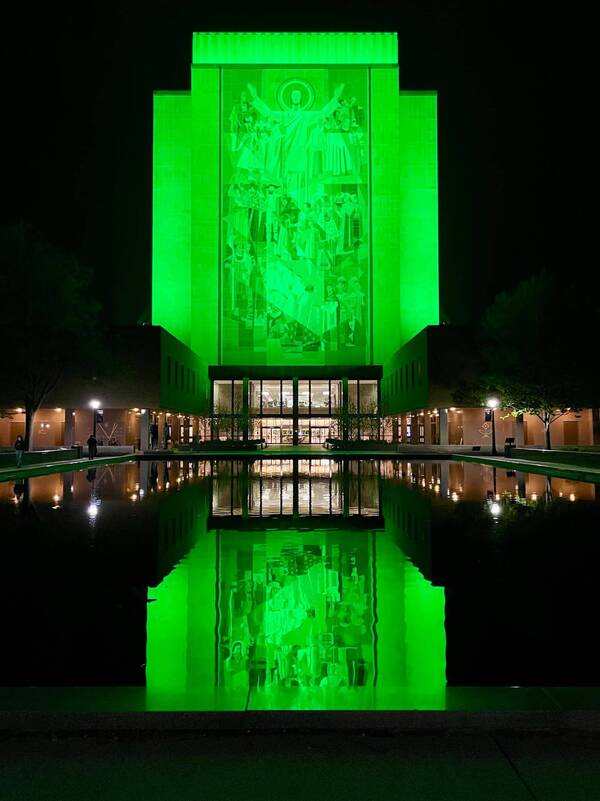
Hesburgh Library's "Word of Life" mural glows vibrant green in honor of Earth Day.
External Partner Sustainability Awardees are selected through an open nomination process for the Notre Dame Community. Students, faculty, and staff are eligible to nominate partners as a part of the annual process. Nominations are reviewed by a committee of students, faculty, and staff.
Year-round, Notre Dame Sustainability encourages the campus community to celebrate and elevate internal colleagues for consideration in our Sustainability Spotlight! You can nominate them to be featured in our monthly newsletter, The Green Ambassador. To stay up to speed with what is happening on campus, join the newsletter mailing list. Learn more about employee opportunities for sustainability involvement by visiting our staff and faculty resources page.
]]>
Olivia Farrington & John Kalemkeriantag:green.nd.edu,2005:News/1812932026-04-30T13:28:00-04:002026-05-05T09:49:09-04:00Sustainability Spotlight: Emily Held
Emily Held is an electrical engineer on campus. Notre Dame Sustainability sat down with Emily to learn more about her and discuss her role in shaping sustainability on campus through her work in Utilities.
1. Tell us about yourself & your work on campus.
I am an electrical engineer with the Utilities department, where I’ve been since September of 2022. I support all things electrical in nature, like primary power to new construction, lighting controls installations and upgrades, power generation and distribution on campus, as well as a big focus on LED conversions across campus.
2. Share a bit about your work as it specifically relates to energy conservation work on campus.
I work a lot on LED conversions to existing buildings. To get the most payback, both financially and from an energy standpoint, we are working in phases of multiple buildings at once.
3. Can you share some examples of Notre Dame's energy conservation work?
We’ve successfully converted some of the larger buildings on campus, like Debartolo Hall and Stinson Remick, to LED by bypassing the existing ballast and putting in new LED lamps, which is way more cost-effective than a new LED fixture. We are targeting larger buildings that are primarily on/off lights to really maximize efficiency. We work closely with UND Maintenance and our campus partners to count and source the LED solutions, and run payback analysis. Once the payback analysis is complete, our campus partner, Navarre Services, gets to work. Another example is lighting controls – turning lights off when they aren’t in use. There’s some older versions that are now obsolete, leaving a lot of lights on 24/7. We are actively working to upgrade these to our current campus standard, and get back to using occupancy sensors to control lights, instead of relying on people to remember to turn them off, or having lights on 24/7, especially when not needed.
4. What is your favorite aspect of your job?
My favorite thing about my job is how many people on campus are impacted by what I do every day, but behind the scenes. There’s so much thought that goes into something seemingly simple, like lights turning on and off, to ensure they work when needed, but still making sure that it’s not wasteful. It’s great to work with so many people both in FDO and across campus that all have seemingly competing priorities, but coming together especially for these important sustainability projects.
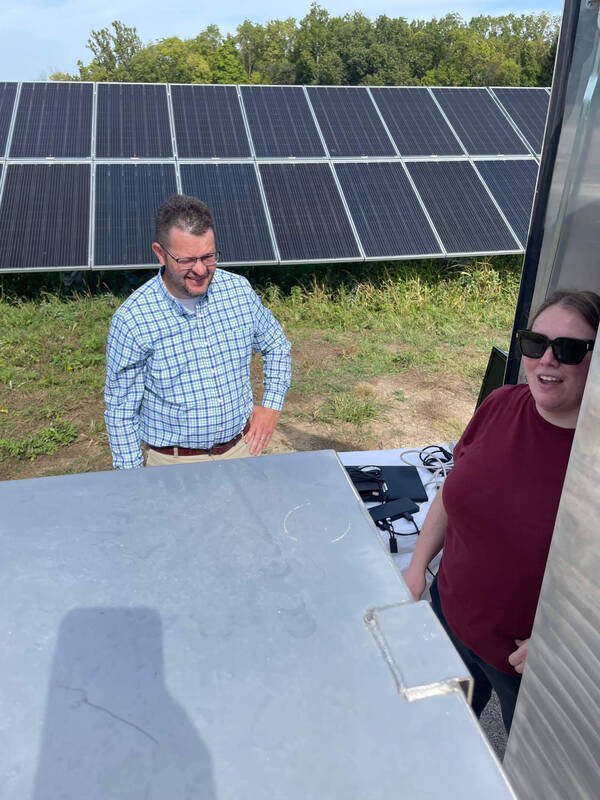
Emily Held and fellow electrical engineer Justin Paton (left) supporting the Solar Field Walk & Talk event during Season of Creation 2025.
5. What is one sustainability tip/action would you recommend people take on in their daily lives, whether at home or on campus, related to conserving energy and reducing emissions?
I myself have definitely focused on lights. At home, I always make sure we only have on the lights we need, and turn them off when leaving the room – even on campus in rooms where there’s a sensor or a timer – it may not seem like much, but 10 minutes of a handful of lights on in an empty room is a measurable amount of electricity used! It will add up.
6. What gives you hope for the future?
What gives me hope for the future is the little actions. It can feel really challenging at times, but seeing the work of others like those featured in the Sustainability Spotlight, some random advancement in medicine or technology, or even a small act of kindness. All of those little actions I can see every day are measurable, and every little action I can do is too, and I know I’m not alone in doing it. If we all keep going and keep doing the little measurable things, it may just add up to be enough to change the world.
Did you know? Notre Dame has achieved a 48% carbon reduction (2005), continuing on the path to achieve carbon neutrality by 2050. Learn more about campus decarbonization by viewing our greenhouse gas emissions page.
]]>
Olivia Farringtontag:green.nd.edu,2005:News/1812442026-04-29T11:40:00-04:002026-04-29T11:40:18-04:00ND Works Podcast: Green roofs at Notre Dame with Tony Polotto
In this episode of NDWorks Podcast, host Natalie Davis Miller sits down with Tony Polotto, the senior director of construction and quality assurance in the office of facilities design and operations. Polotto brings years of experience in a number of areas to our conversation about sustainability and green roofs on campus.
This episode of NDWorks Podcast was edited by Michael Wiens, with original music by Alex Mansour and additional music provided by Universal Production Music.
Originally published by Natalie Davis Miller, NDWorks at ndworks.nd.edu on April 27, 2026.
]]>
Natalie Davis Miller, NDWorkstag:green.nd.edu,2005:News/1811932026-04-28T12:57:00-04:002026-04-28T12:57:17-04:00Notre Dame Ecologist Jennifer Tank receives the 2026 Award of Excellence from the Society for Freshwater ScienceJennifer L. Tank
The Society for Freshwater Science (SFS) is the leading international organization advancing the science of freshwater ecosystems – from organisms to landscapes – and connecting that science to resource managers, policymakers, and the public. The Award of Excellence is presented annually to a single recipient for exceptional and career-long contributions to freshwater science.
"Jennifer Tank’s career has had a profound impact on freshwater science, advancing our understanding of aquatic ecosystems while also shaping how that knowledge is applied in practice," said Steve Corcelli, William K. Warren Foundation Dean of the College of Science. "Her work stands out for its scientific depth and reach, bringing together researchers, policymakers, and communities to address urgent challenges in water quality and environmental stewardship. This honor is a fitting recognition of a career defined by excellence, collaboration, and lasting influence."
Tank has contributed significantly to the SFS via science leadership, service, and contributions to foundational and applied freshwater science. Notably, she served as the Society’s President in 2019, became an SFS Fellow in 2020, and received the SFS Environmental Stewardship Award in 2022.
"I am deeply honored to receive this recognition from a society that has shaped my scientific identity and where my students and postdocs have built theirs,” said Tank. “Innovative freshwater science has never been more urgently needed, and I am grateful to be recognized for work that bridges what we discover in the field with what land managers need to make better decisions. This award belongs to every student and collaborator who has ever waded into a stream with me."
Advancing Science at the Intersection of Agriculture and Freshwater
Tank's research contributions have advanced scientific understanding of the ecology and biogeochemistry of streams and rivers and have directly influenced stream management and policy. She has published more than 220 peer-reviewed journal articles and her research has been cited nearly 25,000 times.
Her research spans the fundamental processes that keep streams healthy – how nutrients cycle, how organic matter breaks down, how stream communities respire – as well as emerging challenges like the spread of antimicrobial resistance genes, the use of environmental DNA for species detection, and how Arctic systems are responding to a warming climate. Combining innovative field experiments, high-frequency monitoring, and modeling, her work addresses some of the most pressing questions in freshwater ecology.
A Career of Scientific Leadership and Mentorship: Translating Science into Action
A recognized leader in translational ecology, Tank has spent her career connecting science to real-world decisions and the people who make them – a commitment that was deepened by her experience as a Leopold Leadership Fellow.
Through the long-running Indiana Watershed Initiative, Tank has worked directly with farmers to demonstrate how conservation practices such as cover crops and two-stage ditches reduce nutrient loss from agricultural fields to streams. The results of her work have informed federal and state conservation policy and reflect her broader mission to find win-win solutions that reduce nutrient runoff while supporting the productive, profitable agriculture that feeds the world.
Tank earned her doctorate from Virginia Tech and served as a postdoctoral fellow on the first Lotic Intersite Nitrogen eXperiment (LINX) at Oak Ridge National Laboratory. Throughout her career at Notre Dame, she has graduated 19 doctoral students, with four more doctoral students currently in progress, and has mentored 10 postdoctoral researchers.
Tank will be formally recognized at the SFS 2026 Annual Meeting in Spokane, Washington, in May 2026.
]]>
Alex Hardytag:green.nd.edu,2005:News/1808862026-04-27T15:05:00-04:002026-04-27T15:05:15-04:00A University-wide commitment: Sustainability in research and practice at Notre Dame
For well over a decade, Notre Dame has advanced sustainability across campus operations and through its academic mission, building a strong foundation that has expanded in recent years through new initiatives, partnerships, and a renewed institutional focus on sustainability as part of Notre Dame 2033: A Strategic Framework.
Pope Francis’s 2015 encyclical, Laudato si’, subtitled “On care for our common home,” inspires Notre Dame’s approach to all this work, from food waste diversion, green roofs, and renewable energy to a new global alliance for sustainability research and education in partnership with the Vatican.
Whether biking to work, researching water quality, or managing campus recycling bins, every member of the Notre Dame community plays a part in our sustainability efforts. As University President Rev. Robert A. Dowd, C.S.C., recently said at Notre Dame’s sustainability summit in Rome, “Let us answer Pope Francis’s call to think boldly, to act courageously, and to work together to build a more just and sustainable world.”
Sustainability research, education, and action
In the academic core, this effort is led by the Just Transformations to Sustainability Initiative (JTS), one of several University-wide strategic initiatives that have been launched over the past two years as part of the framework. JTS brings together scholar-teachers from colleges, schools, centers, and institutes across campus with partners from around the world to advance transformative solutions for a more just and sustainable future.
Strong foundation
“Notre Dame has been engaged in sustainability research and education for many years across a wide range of disciplines, with important work already underway in many areas, from historians investigating the origins of climate change to freshwater ecology to sustainable built environments,” said John T. McGreevy, the Charles and Jill Fischer Provost. “The Just Transformations to Sustainability Initiative allows us to build on that foundation—bringing this work into closer conversation, strengthening partnerships, and extending the reach of our scholarship.”
Partnership with the Vatican
Nearly 100 researchers and institutional leaders representing more than 60 universities from more than 30 different countries gathered at the Laudato si’ Village in Castel Gandolfo, the pontifical summer residence outside of Rome, to establish the Global Alliance for Laudato si’. (Photo by Alessandro Sgarito)
One significant development is Notre Dame’s selection as the lead university partner for the Vatican’s Laudato Si’ Center for Higher Education. In March, JTS and the center launched the Global Alliance for Laudato Si’, an international network of sustainability leaders in academia and beyond dedicated to supporting integral ecology and global sustainability.
They gathered for an inaugural meeting March 9–10 at the Laudato Si’ Village in Castel Gandolfo, the pontifical summer residence outside of Rome. Nearly 100 researchers and institutional leaders—representing more than 60 universities across Europe, Asia, the Americas, and Africa, as well as major international organizations—gathered to develop a shared research and action agenda and a long-term vision for the alliance.
“We feel that Notre Dame, a leading Catholic research university, is positioned to assist the Holy See in its objective to seek transformative change in a manner consistent with the best available science, as well as the foundational elements of integral ecology and integral human development,” said Arun Agrawal, JTS director and Pulte Family Professor of Development Policy in the Keough School of Global Affairs.
Regional and local efforts
In addition to global initiatives, JTS also strengthens regional collaboration through efforts such as the Midwest Sustainability Platform for Research and Curricular Innovation. This platform brings together leading universities across the Midwest to address region-specific challenges, including climate impacts, agricultural sustainability, and energy transitions. Through workshops and shared research agendas, participants identify opportunities for collaboration that enhance both local impact and broader systemic change.
Locally, JTS builds upon a strong foundation of existing partnerships across Notre Dame’s campus, including with several of Notre Dame’s colleges and schools and research centers and institutes such as ND Energy, the Environmental Change Initiative, and the Eck Institute for Global Health. Through its Nurturing Excellence in Sustainability program, JTS has invested in research collaborations co-produced and co-led by Notre Dame faculty and community leaders in South Bend.
"The course was deeply meaningful to me, as it helped me see a clear path for integrating sustainability into both my future career and everyday life,” said Eleanor Smith (right), a civil engineering student who participated in the weeklong immersive learning course on the principles of integral ecology.
Student engagement
In addition to spurring new collaborations that advance leading-edge research and knowledge creation, the initiative has created new programs aimed at cultivating and supporting a growing network of Notre Dame students dedicated to building a more just and sustainable world, both during their time at Notre Dame and through their future careers.
“The course was deeply meaningful to me, as it helped me see a clear path for integrating sustainability into both my future career and everyday life,” said Eleanor Smith, a civil engineering student who participated in the pilot. “Being in such a unique environment, reconnecting with nature and others, and engaging with the vision of Pope Francis was incredibly inspiring.”
On the heels of Pope Francis’s encyclical Laudato si’, the University took a definitive step toward embracing integral ecology by publishing Notre Dame’s original 2016 Comprehensive Sustainability Strategy and further establishing small working groups to prioritize key focus areas of sustainability. Today, as Notre Dame celebrates a decade of impact since the strategy was first envisioned, the progress made across campus operations serves as a testament to the University’s collective commitment to care for our common home.
Operational sustainability at Notre Dame is not the work of a single office; rather, it is deeply integrated into the fabric of campus through units such as Facilities Design and Operations, Building Services, and Notre Dame Dining. By weaving sustainability into the daily functions of the University, Notre Dame has moved from high-level goals to tangible, measurable results. Reflecting on this decade of growth, four key areas stand out as pillars of operational success in our journey so far.
Decarbonization and energy transition
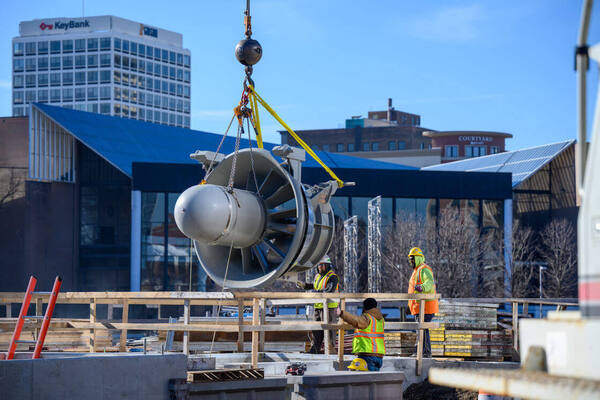
The University has made massive strides in campus decarbonization. Through an array of strategies—including the expansion of geothermal, the operation of the hydroelectric power plant at Seitz Park, solar arrays, and retrocommissioning buildings for efficiencies—Notre Dame has significantly reduced carbon emissions by 48 percent from the 2005 baseline.
Food waste recovery and diversion
Notre Dame recognizes the gift of food, and appreciates the intensive amount of human labor and natural resources needed to bring nourishment from the farm to the table. By implementing robust food waste diversion programs, including partnering with Cultivate Food Rescue and implementing the use of Grind2Energy systems and anaerobic digestion, the University has donated more than 453,000 meals to the surrounding community and diverted thousands of tons of organic waste from landfills.
LEED-certified buildings
Notre Dame’s physical landscape is evolving to meet the highest standards of efficiency and stewardship. While the campus footprint has grown by more than 22 percent, annual emissions have decreased by 25 percent over the past decade, thanks in part to the building standards that the Facilities Design and Operations team has established, which strive to achieve LEED (Leadership in Energy and Environmental Design) certification. Today, the University has a portfolio of 26 LEED-certified buildings. Among many qualifying features, LEED-certified structures are designed to optimize water usage, minimize energy consumption through efficiency technologies, support human health, and reduce negative environmental impacts.
Expansion of green roofs
Across the campus skyline, a growing number of vegetative “green” roofs sit atop campus buildings. Over the past 10 years, green roofs have been established to cover 206,000 square feet of campus buildings. Green roofs—such as the expansive installation on the Joyce Center—do more than just provide aesthetic beauty from above. They have the capacity to manage stormwater runoff, reduce the urban heat island effect, support local pollinators, and provide natural insulation for the buildings.
The road ahead
Although campus sustainability efforts have come a long way, there is still much progress to be made. New climate action planning processes are underway, focusing on even more ambitious outcomes. Currently, Notre Dame Sustainability is partnering with key units across campus to continue work in campus food systems and landfill waste reduction. As the ND Sustainability team looks toward the next decade, it continues to be guided by its mission to ensure that Notre Dame remains a leader in operational sustainability.
Stay up-to-date with the latest operational sustainability news at green.nd.edu.
]]>
Olivia Farrington & Emily Monacellitag:green.nd.edu,2005:News/1810932026-04-24T15:29:00-04:002026-04-24T15:29:12-04:00Earth Month at Notre Dame: Recreo Coffee
"A Name, a Face, and a Place" for Every Cup—Meet Recreo Coffee
At Notre Dame, we are proud to serve farm-direct, single-origin Recreo Coffee in select on-campus retail locations, such as Decio Cafe and Charron Family Commons.
Farm-Direct means that this coffee is traceable to the exact farm it was grown in. Farm-Direct is an initiative begun in 2018 by Bob Fish, CEO of Biggby Coffee, and his wife Michelle. Together, they founded One BIGG Island in Space (OBIIS) as an entity that works on developing close relationships with responsible coffee farmers around the world, many of them with small family farms. They aim to ensure that producers can sell their coffee at fair prices that create financial stability for farmers, their families, and their communities while supporting a more resilient coffee supply chain. OBIIS has a rigorous process of vetting individual farm partners for their quality, sustainability, and labor standards, among other criteria.
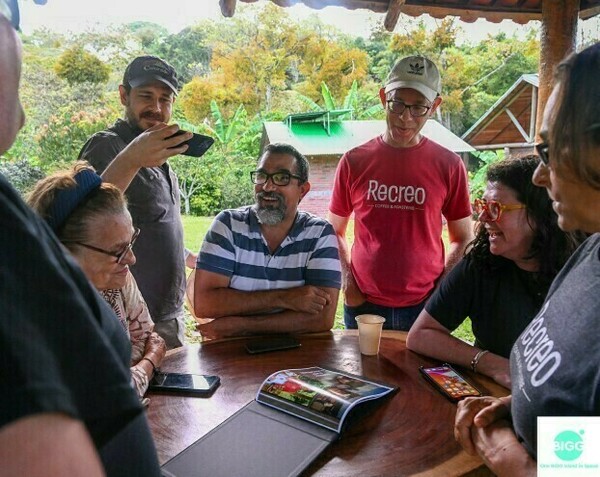
El Recreo Estate is a family-owned farm in the mountains of Jinotega, Nicaragua. In 2019, it became one of OBIIS’s first Farm-Direct partners. It’s owned by Leana and Carlos Ferrey and managed by their daughter and her husband, Miriam and Hector Morales, who split their time between Nicaragua and Boston, where they own a cafe. The farm has produced premium coffee since 1972, with its roots in the civil war-torn community that it helped rebuild.
Recreo is a model of both social impact and environmental stewardship. They maintain their land’s health through soil and water management, reforestation and protection of their native ecosystem, and regenerative practices. They employ over 40 permanent families and about 200 seasonal workers, all of whom receive wages, free housing, and three shared meals a day. They ensure employees maintain a high standard of living, providing a school for children, a health center, and retirement housing. They constantly work to improve and expand available benefits.
Their Boston cafe, Recreo Coffee & Roasterie, is located in my own neighborhood of West Roxbury, only a short walk away from my house. The cafe has been referred to as the “living room of West Roxbury,” and for good reason. I remember spending afternoons here in high school and having the cafe be a popular meeting place for community organizations I was a part of. I was always so inspired by Recreo’s mission and the real ways they change people’s lives; my respect for them has only deepened as I’ve learned more.
The journey of Notre Dame’s Recreo Coffee looks a little different. Our beans are roasted just a few hours north of campus in Lansing, Michigan, at Paramount Coffee. This partnership helps shorten the supply chain by sending beans directly to the roaster, and ensures our coffee is always fresh.
The story of Recreo Coffee is one of hope, resilience, and community. We are honored to be a part of this story through our partnership with Paramount Coffee and are excited to see what the future holds for the Recreo family.
Call to Action
This week’s Call to Action is a simple one! Go and try Recreo Coffee.
Originally published by Annika Singh at dining.nd.edu on April 15, 2026.
]]>
Annika Singhtag:green.nd.edu,2005:News/1810922026-04-24T15:27:00-04:002026-04-24T15:27:40-04:00Sustainable Starts with You: 7 Ways to Eat Green On Campus
This week of earth month is all about how you, a member of our community at Notre Dame, can make a difference through the choices you make in the dining halls, at Grab & Go, or at our retail locations.
The good news? Sustainable eating doesn’t require a complete lifestyle overhaul. In fact, small, intentional, and consistent choices can have a meaningful impact. Here are a few easy ways to make your meals on campus more environmentally friendly:
Be Mindful at Self-Serve Stations
Dining halls offer flexibility and a variety of choices—but it’s easy to take more than you’ll eat. Start with smaller portions, even if you don’t fill up your whole plate, and always feel free to go back for seconds if you’re still hungry. This option is the magic of our buffet-style dining halls!
Build Your Plate with Purpose
Think of your plate as an opportunity to balance both nutrition and sustainability. To start, you can learn more about the powerhouse plant-based options at the dining hall salad bars. Adding edamame, chickpeas, or beans to your plate—just to name a few examples—can keep you feeling full for hours, give you the energy and nutrients you need, and cut down on your portions of animal proteins.
Go for “Low-Impact Swaps”
You don’t have to give up your favorite meals—just tweak them. Try choosing chicken instead of beef, or a veggie-packed pasta instead of a meat-heavy one. Even swapping dairy milk for oat or soy milk in your coffee can make a difference. This approach not only reduces your environmental footprint but also introduces more variety into your diet.
Think Seasonal and Rotational
Menus often shift with the seasons—take advantage of that! Seasonal foods typically require fewer resources to grow and transport. Trying what’s new or featured each week also helps diversify your diet and reduce reliance on the same high-demand ingredients.
Use Reusables When You Can
Whether you’re grabbing coffee or taking food to-go, opting for reusable containers, mugs, or utensils helps cut down on single-use waste. Look for the posters in retail locations, dining halls, and even academic buildings indicating that reusable coffee cups can be used here. When grabbing food to-go, having a reusable fork or straw in your bag means you don’t need to create extra waste with your meal. If eating a sit-down meal, bring your own container instead of relying on plastic to-go boxes for your leftovers. Keeping a reusable item in your backpack makes this an easy habit. Free giveaways on campus for travel mugs, reusable bags, and more make it an affordable one!
Combine Convenience with Conscious Choices
Short on time? Grab & Go doesn’t have to mean unsustainable. Look for items with minimal or recyclable packaging, or choose options that include more plant-based ingredients. Convenience and sustainability can go hand in hand.
Stay Curious
Sustainable eating is not about perfection—it’s about awareness and progress. Ask questions about where your food comes from, try new ingredients, and remain open to change. Moving towards a more sustainable future through our food is all about considering new options and trying to adopt new habits, even if it feels uncomfortable at first. The more informed your choices, the greater your impact.
Every meal is a chance to contribute to a more sustainable campus. By making thoughtful decisions, whether big or small, you’re helping shape a dining culture that supports both people and the planet.
Originally published by Annika Singh at dining.nd.edu on April 23, 2026.
]]>
Annika Singhtag:green.nd.edu,2005:News/1808402026-04-15T15:25:00-04:002026-04-15T15:25:26-04:00Transforming sacrifice zones into sacred zones
Ryan Juskus approaches environmental justice as integral to human dignity
April 15, 2026
For Ryan Juskus, assistant professor of the practice at the Institute for Social Concerns, the true cost of our global energy systems is best seen not in atmospheric charts but in the mines, extraction sites, and waste pits of marginalized areas like Appalachia or the Amazon.
As Juskus argues in a recent article, by focusing exclusively on the “hole in the sky,” we risk overlooking the immediate, existential crises occurring in “the holes in the ground.” He suggests these physical excavations are almost always accompanied by holes in our society: deep economic, social, and racial inequalities.
Juskus’s research explores the concept of “sacrifice zones”—geographic areas systematically degraded so that other parts of society can remain green and comfortable. Drawing on the insights of Black and Latin American theologians, he describes sacrifice zones as a form of “putting people on a cross.” In his framework, the goal of environmental justice is not merely to manage a global crisis but to “take people down from the cross” by restoring dignity and justice to the people in regions that have been sacrificed.
This approach reflects the etymological roots of the word sacrificium—to make sacred. Juskus argues that, by refusing to sacrifice a neighbor for a landfill or a power plant, the pursuit of environmental justice becomes a vital way to recognize and restore the sacredness of the human person.
“The vision of turning sacrifice zones into sacred zones reflects the narrative logic of Jesus’s love for creatures who are caught up in polluted ecologies of false sacrifice.” — Ryan Juskus
Juskus’s perspective aligns seamlessly with the approach to justice central to the Institute for Social Concerns and further contributes to its research. By prioritizing engagement with those most affected by injustice and examining questions of justice through the lens of Catholic social tradition (CST), the institute provides Juskus with interdisciplinary interlocutors who are bringing both their intellectual acumen and their faith commitments to bear on the most urgent signs of the times.
Since joining the institute in the fall of 2024, Juskus has developed courses that challenge students to interrogate their perspectives through the lens of CST. In his course Decarbonizing Catholicism, he bridges CST with the energy humanities—a field that examines how human culture and energy systems shape one another. The course asks a provocative question: To what degree was the development of CST influenced by the fossil fuel era of the Industrial Revolution? Conversely, Juskus pushes students to see how the Church’s ancient wisdom, which predates the steam engine, can serve as a guide for living well in a world after oil.
The connection between faith and justice solidified for Juskus during fieldwork in Birmingham, Alabama. There, he met an environmental justice activist named Sarah, whose commitment to Appalachia was rooted in a deep, personal spirituality. Sarah had participated in a series of projects across Appalachia organized by the Christian environmental organization Restoring Eden. When Juskus asked how she persisted against insurmountable opposition, she explained her belief that Jesus was to be found not in the halls of power but among vulnerable populations in North Birmingham and the mountains.
Juskus believes today’s students are hungry for this kind of good news—that the pursuit of environmental justice need not be opposed to faith commitments but can be an expression of them. “They see a world on fire,” he says. “They want to know what to say yes to.”
Juskus’s research suggests that environmental justice requires a fundamental shift in environmental politics, moving away from technocratic management toward a model grounded in human rights and human dignity. By synthesizing ethnographic fieldwork with theological analysis, his research at the Institute for Social Concerns is generating the critical insights needed to transform sacrifice zones into communities defined by their inherent sacredness.
Originally published April 15, 2026, at https://socialconcerns.nd.edu/happenings/institute-stories/.
]]>
Cramer, Davidtag:green.nd.edu,2005:News/1805532026-04-01T11:46:00-04:002026-04-01T11:46:02-04:00Vice president and associate provost Rev. Daniel Groody, C.S.C., appointed by Pope Leo XIV to Dicastery for Promoting Integral Human Development
Pope Leo XIV has appointed Rev. Daniel Groody, C.S.C., the vice president and associate provost for undergraduate education and professor of theology and global affairs at the University of Notre Dame, as a member of the Dicastery for Promoting Integral Human Development, the Vatican announced today.
Established by the late Pope Francis in 2016, the Dicastery for Promoting Integral Human Development supports the Church’s worldwide efforts in the areas of human dignity and human rights, economic justice, care for creation, migration and displacement, as well as peace, conflict and humanitarian crises.
As a dicastery member, Father Groody will contribute to the body’s ongoing discernment process that will help orient the Church’s mission and priorities. He will continue in his roles at Notre Dame while serving the dicastery.
While numerous Notre Dame faculty members have served the Vatican as consultants to dicasteries and have been named to pontifical academies and commissions, Father Groody’s appointment is a distinct honor, noted University President Rev. Robert A. Dowd, C.S.C.
“To be called upon by the Holy See to serve in this capacity is a testament to Father Groody’s deep commitment to leadership in service of the most vulnerable among us. This appointment is also an affirmation of Notre Dame’s ongoing contributions to Catholic social thought, to integral ecology and to forming leaders dedicated to the common good,” Father Dowd said. “I am profoundly grateful for Father Groody’s dedication to the University and to the Church, and I am confident that his leadership will be a tremendous blessing as he helps to guide the Church in these areas.”
The most notable precedent in Notre Dame history is the appointment of then-President Rev. Theodore M. Hesburgh, C.S.C., as a member of the Pontifical Council for Culture by Pope St. John Paul II in 1983.
“I am truly honored and humbled by Pope Leo’s appointment,” Father Groody said. “My vocation is to serve, together with my colleagues at Notre Dame and around the world. The work of the Dicastery for Promoting Integral Human Development is vital to informing the Church’s response to the world’s most vulnerable people and the most pressing global challenges of our time.”
Father Groody’s academic and pastoral work has focused in part on migration, theology, refugees and human displacement — areas that are directly relevant to the mandate of the Dicastery for Promoting Integral Human Development. An internationally recognized expert on migration, Father Groody is also an award-winning author, teacher and documentary film producer. He has written four books and numerous articles and has edited or co-edited five books. His works have been translated into nine languages.
Father Groody’s most recent book, “A Theology of Migration: The Bodies of Refugees and the Body of Christ,” includes an introduction written by Pope Francis and received first-place recognition from the Catholic Press Association.
This announcement follows Father Groody’s appointment under Pope Francis in 2025 to the General Council of the Laudato Si’ Higher Education Center in Castel Gandolfo, which is now known as Borgo Laudato Si’.
Contact: Carrie Gates, associate director of media relations, 574-993-9220, c.gates@nd.edu
Originally published by Carrie Gates at news.nd.edu on March 30, 2026.
]]>
Carrie Gatestag:green.nd.edu,2005:News/1804192026-03-30T13:55:00-04:002026-03-30T14:00:31-04:00Sustainability Spotlight: Ben Wood
Ben Wood is the Assistant Director for Residential Facilities in the Office of Residential Life. Notre Dame Sustainability sat down with Ben to learn more about him and discuss his role in shaping sustainability on campus through his work in the Office of Residential Life.
Tell us about yourself & your work on campus.
I have been with the University since 2019, all with the Office of Residential Life. I started out as the Assistant Director for Summer Housing. In the fall of 2023, I had the opportunity to transition into my current role as Assistant Director for Residential Facilities. When I am not on campus, I am joyfully consumed with family life, cherishing moments with my wife and children…whether in the kitchen feeling inspired to try a new home recipe, or spending time outside enjoying what the natural world has to offer! In my current role, I serve as Residential Life’s key liaison to several campus partners in maintaining the buildings that house our storied hall communities, as well as coordinating transitions that occur with our living spaces. I do this work in support of the hall staff and students who reside in those hall communities.
Share a little bit about your work as it specifically relates to orchestrating move-out and the donations collection process.
When I transitioned into this role, the responsibility of student move-in and move-out also came into my area of responsibility. There was not just the responsibility of ensuring students had an efficient system of being able to park up at the hall, move out their belongings, and drive away to their next adventure; there also came a familiar partnership with Building Services in making possible a donations collection process.
When did move-out donations start, and how have you seen them improve over the past few years?
The move-out donations process started about one year prior to me taking on my current role. It began with our Goodwill Bin donation program in the halls, having large blue bins strategically placed in every residence hall community. Since then, we have explored, or streamlined, with key campus partners and organizations, additional donation opportunities universally in the halls. Those include, or have included: non-perishable food donations and leftover school supply donations. We have also utilized move-out donation processes beyond the large spring semester move-out, to include the December student move-out. I’m excited to see what more donation processes we can add to the halls in the future!
What are your favorite aspects of working on campus?
I feel I have too many aspects to list, especially working at Notre Dame. I really have enjoyed the opportunity in Residential Life to have the ability to change my scenery from day-to-day, visiting our residence halls as needed, related to my role. Some days are busier than others, but I enjoy the fast pace that comes with happenings in our department. I enjoy the vibrancy of our hall communities, especially the people I get to work with on a daily basis, to support our residential communities! I also appreciate the beauty and vibrance of our campus, no matter the season or weather.
How can campus constituents, whether it's students, faculty, or staff, support a more sustainable move-out process?
I think starting with our faculty and staff: give our students support and grace, especially as they live by the cadence of moving in and out of our halls each year. It can be stressful to manage finishing academic obligations and getting organized to move out of their space. The understanding and grace given to our students may allow them to take a moment to slow down, think, and consider the opportunities provided to them to make sustainability-related action a part of their move-out experience. Students feeling rushed may only see the dumpster as their fastest, easiest option to clear items from their room. A moment to consider donating a slightly used pair of shoes, the extra, unopened snacks that can’t fit in a bag, or any other items that might have a second life with someone else, is a moment we need. One small action by each of our almost 7,000 students moving out in May can add up to a larger impact on the greater community!
Is there a sustainability tip or action that you would recommend people take on in their daily lives, whether at home or on campus?
If you have sustainable resources offered to you, please use them. At home, I appreciate living in a municipality that offers curbside recycling and a large container to go with it. I feel our house recycles more than we throw away in the trash. I really enjoy having options on campus and at home to support recycling programs. If you don’t have the ability, or habit, at home to recycle, I recommend you give a chance at recycling when on campus.
Related to sustainability, what gives you hope for the future?
With increased initiative, creativity, and a willingness to give sustainable efforts a try, we can help folks, from all walks of life, find some sustainable action to commit to, whether that would be recycling, composting, gardening, walking… One person can’t do everything, but many people together can do one thing to continue the journey to a more sustainable world.
Did you know? During the 2025 spring move-out, students donated 38,960 pounds of items to Goodwill and nearly 700 pounds of non-perishable food to the local community! Learn more about campus move-out by viewing our move-out page.
]]>
Olivia Farringtontag:green.nd.edu,2005:News/1804142026-03-30T11:25:00-04:002026-03-30T11:26:39-04:00Celebrating Earth Month & Our Common Home
April at Notre Dame is more than just a change in season—it marks the beginning of Earth Month. Rooted in the spirit of Earth Day (April 22), this month-long observance is a time for our campus community to renew its commitment to caring for our common home and embracing the principles of integral ecology.
To signal the start and culmination of this celebration, the iconic Word of Life Mural at the Hesburgh Library will be illuminated in green on the evenings of April 1 and April 22.
Go Behind the Scenes with Earth Month Programming
This year, Notre Dame Sustainability has curated a unique lineup of programming designed for the campus community to connect with one another and learn about the vast projects that often go unseen to the everyday campus constituent. Students, faculty, and staff are invited to engage with the campus and explore its hidden systems. Featured events include: Joyce Center Green Roof Tours; Power Plant Tours; St. Mary’s Lake Litter Pick-Up; Campus Green Tours; and a specially-curated viewing at the Raclin Murphy Museum of Art, exploring the intersection of creativity and water—one of Earth’s precious resources.
A Landmark Year: Celebrating A Decade of Sustainability Impact
The year 2026 marks a significant milestone: a decade since the publication of Notre Dame’s original 2016 Sustainability Strategy. While we look toward the work that remains ahead of us, the past ten years have seen transformative growth. From significant strides in campus decarbonization and food waste mitigation to the expansion of LEED-certified buildings and green roof infrastructure, our collective progress is a testament to the University’s mission.
Join the Celebration
To honor these achievements and the partners who made them possible, Notre Dame Sustainability invites the campus community to the Third Annual Sustainability Celebration on April 22. At the celebration, attendees will have the opportunity to connect with fellow sustainability champions, celebrate both internal and external partnerships, and learn what’s on the horizon for sustainability at the University.
This year’s event carries special significance as we welcome University President Rev. Robert A. Dowd, C.S.C. Fr. Dowd’s connection to sustainability at Notre Dame is deep-rooted. As a founding member of the Sustainability Strategy Standing Committee and chair of one of the original working groups, he was instrumental in laying some of the groundwork for the progress we celebrate today. During the formal portion of the evening, Fr. Dowd will provide closing remarks and reflect on sustainability at Notre Dame.
We Want to Hear From You
As we prepare for the Third Annual Sustainability Celebration, we want to show appreciation to sustainability champions across campus working behind the scenes to carry out the critical work that makes Notre Dame more sustainable. We want to hear from the campus community: What does sustainability at Notre Dame mean to you? What progress are you most proud of? How do you feel most impacted by this work?Take a moment to express your sentiments or gratitude here for the opportunity to be featured.
]]>
Olivia Farringtontag:green.nd.edu,2005:News/1800642026-03-17T15:05:23-04:002026-03-17T15:22:31-04:00Sustainability Spotlight: Joe Rabbitt
Joe Rabbitt (pictured, right) is the Horticulturist in Landscape Services. Notre Dame Sustainability sat down with Joe to learn more about him and discuss his role in shaping sustainability on campus through managing Notre Dame's green spaces.
Tell us about yourself & your work on campus.
I am the Horticulturist for Landscape Services. My team and I are responsible for most things flowering in campus landscapes. We design, plan, install, and maintain all seasonal planting, such as annuals, mums, bulbs, and winter decor. We maintain most perennials and many flowering shrubs, like roses, on campus.
Share a little bit about your work as it specifically relates to the ongoing care of native pollinator gardens on campus.
I serve as a campus liaison with Stantec, the ecosystem restoration contractor that installs and maintains those areas. For other areas that focus on native pollinator plants, we at least maintain, for example, the World Peace Plaza, and sometimes are also responsible for design and installation, like the Class of 1976 Butterfly Garden.
Are there any goals or objectives you can share with us about the future of natives on campus?
Right now, our main project in this area of work is to establish new native pollinators at the solar array installation near WNDU. The species at the site need to be short enough not to obstruct the panels' ability to capture sunlight. A few notable plants include sand coreopsis, purple prairie clover, and hairy aster. Still, we are always looking for opportunities to add to the areas that we already have. Throughout campus, we continue to make a concerted effort in our in-house design projects to include as many native, pollinator-friendly, and water-wise plants as the parameters of the project allow. We often seek ways to include natives in projects, even when they might have a focus on annual plantings.
What is your favorite aspect of working on campus?
Simply the opportunity to plan and maintain spots on campus that we know bring joy to everyone present on campus: faculty, staff, students, and visitors.
What is one sustainability tip would you recommend people take on in their daily lives, whether at home or on campus?
Remember that even little things matter. Simple things can make a difference. I, for example, return one-gallon pots to a perennial nursery that reuses them. The small efforts of individuals really do add up.
Related to sustainability, what gives you hope for the future?
Sustainability is more and more built into the thinking and action of younger generations.
]]>
Olivia Farringtontag:green.nd.edu,2005:News/1799672026-03-13T11:02:41-04:002026-03-17T14:52:12-04:00A Thoughtful Lent: Embracing Sustainable Seafood at Notre Dame Dining
Notre Dame Dining is excited to usher in new sustainable seafood options this year for their menus during Lent. A collaboration with United States fish supplier, Sea to Table, will enable Notre Dame Dining to serve four exciting varieties of fish and shellfish: blue catfish, rockfish, sole, and broken scallops. These four items each have unique sustainability benefits; each of these species is selected for their sustainable harvest practices, helping to reduce overfishing and protect marine ecosystems. Learn more about why this collaboration and these seafood choices are meaningful for our planet and American communities.
Sea to Table is a supplier that works directly with fishermen to provide fresh seafood to chefs and households across the country. All seafood sourced from Sea to Table is domestic, wild, sustainable, and traceable. Sea to Table’s model ensures full transparency about where and how the seafood is caught, which promotes ethical fishing and supports fishermen directly. Additionally, by sourcing domestic wild-caught fish, the program supports regional economies and reduces the carbon footprint associated with long-distance transportation.
Diversifying our seafood consumption is important to reduce the pressure currently placed on heavily-fished species, such as salmon and tuna, and build a more resilient supply chain. Eating lesser-known, locally-caught fish and shellfish can reduce overall environmental impact, as these species are often more abundant and resilient in their ecosystems. As biodiversity declines across the globe, this practice can help protect native species’ habitats while conserving populations of overfished species. In our dining halls, we are also excited to introduce all who enter to new foods with unique flavor profiles and strong nutritional qualities.
Blue Catfish
The first of our new offerings, the blue catfish, is an invasive species found in the Chesapeake Bay in Virginia and Maryland. The resilient species has threatened the area’s local ecosystem and fishing economy as it feeds in great quantities on vegetation, mollusks, and fishes, often out-competing local species such as blue crab and white catfish. By fishing and consuming this species, we can help protect other species and preserve the biodiversity and ecological balance of the Chesapeake’s ecosystem.
Luckily, the blue catfish has an excellent flavor—sweet, mild, and flaky. Its taste is comparable to that of striped bass or rockfish due to their similar diets. Of the four main catfish species found in the United States, blue catfish is often considered the best to eat. It is also highly nutritious, offering 19 grams of protein, alongside only 90 calories and 1.5 grams of fat, in a single serving.
Brown Shrimp
Brown shrimp is a classic and valuable species harvested primarily in the Gulf of Mexico, particularly off the coasts of Texas and Louisiana. This fishery is carefully managed under U.S. regulations by NOAA Fisheries and regional fishery management councils, helping ensure that brown shrimp populations remain healthy and not subject to overfishing. A variety of measures—including harvest permits, seasonal closures, and catch reporting requirements—help maintain sustainable harvest levels while supporting one of the most economically important fisheries in the southeastern United States.
Brown shrimp play an important role in coastal ecosystems. As omnivores, they feed on plankton, algae, worms, and organic matter on the ocean floor, while also serving as a food source for many fish and marine animals. Their life cycle connects offshore waters with coastal estuaries, where young shrimp grow in sheltered nursery habitats before migrating to deeper waters as they mature. These ecological connections make healthy shrimp populations important for maintaining balanced marine food webs.
Commercial fishermen typically harvest brown shrimp using trawl nets that move along the ocean floor. While trawling can raise sustainability concerns, U.S. fisheries have implemented several measures to reduce impacts on ecosystems and other species. For example, shrimp trawlers are required to use sea turtle excluder devices (TEDs) and other bycatch reduction tools (BRDs), and gear modifications such as weak-link tickler chains help limit damage to bottom habitats. In addition, shrimping activity is restricted in certain areas and during specific times of year to protect marine ecosystems.
In the kitchen, brown shrimp are prized for their firm texture and naturally sweet flavor, making them a versatile ingredient in a wide range of dishes. By choosing responsibly managed domestic shrimp from the Gulf of Mexico, we can support American fishing communities while enjoying a flavorful seafood option that reflects thoughtful stewardship of our coastal ecosystems.
Sole
Sole is a flatfish found in the United States Pacific Northwest. It plays an important role in maintaining the health of ocean floor ecosystems by feeding on small invertebrates and helping to regulate seabed communities. The waters off of Oregon and Washington contain an abundance of diverse sole species, including petrale sole and Pacific dover sole. Seafood Watch has assessed the sustainability of all six sole species caught in the U.S. and Canadian Pacific and recommends them all.
Sole is caught using bottom trawls, which complicates the sustainability story; bottom trawling involves dragging heavy nets across the seafloor, possibly disrupting habitats and unintentionally catching other species. However, trawls cause less habitat damage when fishing over soft, sandy, or muddy ocean bottoms on the West Coast. Accordingly, NOAA Fisheries and the North Pacific Fishery Management Council have implemented large closed areas, gear restrictions, and harvest limits in the region in order to minimize bycatch and protect ecosystems.
Known for its tender, fine-textured flesh and subtle, sweet flavor, sole is a favorite among chefs and home cooks alike. Its mild taste makes it an excellent canvas for a variety of preparations. Nutritionally, sole is a lean protein powerhouse that also contains calcium, vitamin D, and other minerals. Enjoying sole not only contributes to responsible seafood consumption but also delights the taste buds and nurtures our bodies.
Broken Scallops
Broken scallops, often overlooked in seafood markets, are scallops that have cracked or fragmented shells but remain perfectly edible and delicious. These scallops typically come from sustainable fisheries where careful harvesting minimizes environmental impact. By choosing broken scallops, we will reduce waste and support a more circular seafood economy, helping to preserve delicate marine ecosystems where scallops play a vital role in filtering water and providing habitat for other species.
Despite their imperfect appearance, broken scallops offer a sweet, tender, and slightly briny flavor that rivals whole scallops. Their texture is delightfully firm yet buttery, making them a versatile ingredient in dishes from seared scallops to creamy seafood pastas. Nutritionally, scallops are an ideal choice: a single serving provides about 20 grams of lean protein, with very low fat and calories. Embracing broken scallops is a great opportunity for us to help protect ocean biodiversity while enjoying a sustainable, nutrient-rich seafood option.
At Notre Dame Dining, we are thrilled to further our commitment to environmental responsibility while supporting small fisheries across our country. In the spirit of reflection and gratitude this Lent season, we would like to encourage thoughtful food choices that benefit the planet and all wildlife. This initiative with Sea to Table not only offers delicious and responsible dining options but also fosters a deeper connection between us and the sources of our food. We hope you enjoy these new meals!
]]>
Annika Singhtag:green.nd.edu,2005:News/1790462026-02-09T11:19:00-05:002026-02-10T12:24:19-05:00Sustainability Spotlight: Jacob Eigenheer
Jacob Eigenheer is a Sous Chef in South Dining Hall. Notre Dame Sustainability sat down with Jacob to learn more about him and discuss his role in shaping sustainability on campus through mitigating food waste.
Tell us about yourself and your work on campus.
I was born and raised in Joliet, Illinois, and have been at Notre Dame since 2017. I originally started cooking for Notre Dame Football before becoming a Sous Chef at South Dining Hall in 2024. As a chef, my passion for food extends to my home life, where I love discovering new dishes that fit a healthy, keto lifestyle. When I'm not cooking, you can find me playing hockey, working out in the gym, gaming on my PC, traveling, or watching Minnesota sports teams.
Tell us about your work as it specifically relates to mitigating food waste.
I focus on working side-by-side with our cooks to monitor production levels and prevent over-preparation. This hands-on approach allows me to mentor the team on creative ways to safely repurpose food. At the end of each shift, we collaborate to decide what can be utilized for future meals and what should be donated to the local food bank. Ultimately, I am proud that we have cultivated a culture where the entire team is actively engaged in minimizing waste.
What is your favorite aspect of your job?
Building relationships is definitely the highlight. While working with the football team, I established a strong partnership with Greg at Cultivate Food Rescue. When I transitioned to the dining hall, we collaborated to establish a schedule where food is rescued nearly every day from both dining halls on campus. Without that personal connection, we wouldn't have achieved the level of success we see today in supporting our community.
What is one sustainability tip/action would you recommend people take on in their daily lives, whether at home or on campus, related to reducing food waste?
My biggest tip is to plan your meals ahead of time. Before I shop, I look at my schedule for the week and realistically ask myself: Will I have time to cook? Will I even feel like it? This mindset comes from respecting the labor behind our food. For example, take a simple tomato. I personally know a farmer named Ryan who spends long hours tending his crop to ensure the best quality. By the time that tomato reaches the grocery store shelf, it represents months of hard work from the farmer, the harvesters, the suppliers, and the grocers. When you view food as the result of someone's hard labor rather than just an ingredient, you're much less likely to let it go to waste.
And one last rule: Don't shop hungry! Everything looks good when you're starving, which leads to buying more than you can eat.
What gives you hope for the future?
My hope comes from seeing people come together to support one another. Everyone is going through something, but a single act of kindness can completely turn a bad day around. I see this resilience every day in our dining hall. I am grateful for a team that does whatever it takes to succeed—from the chefs and managers to the dishwashers and the staff members cleaning our restrooms. To me, it is important to express gratitude to everyone for being here, including our guests. They chose to eat with us today, and that is a blessing. It is this shared willingness to serve and do the hard work that drives our group, and we wouldn't be successful without them.
Notre Dame is committed to reducing food waste and supporting food security in the South Bend-Elkhart region. Learn more about the University's food waste prevention efforts by visiting our Food resource page.
]]>
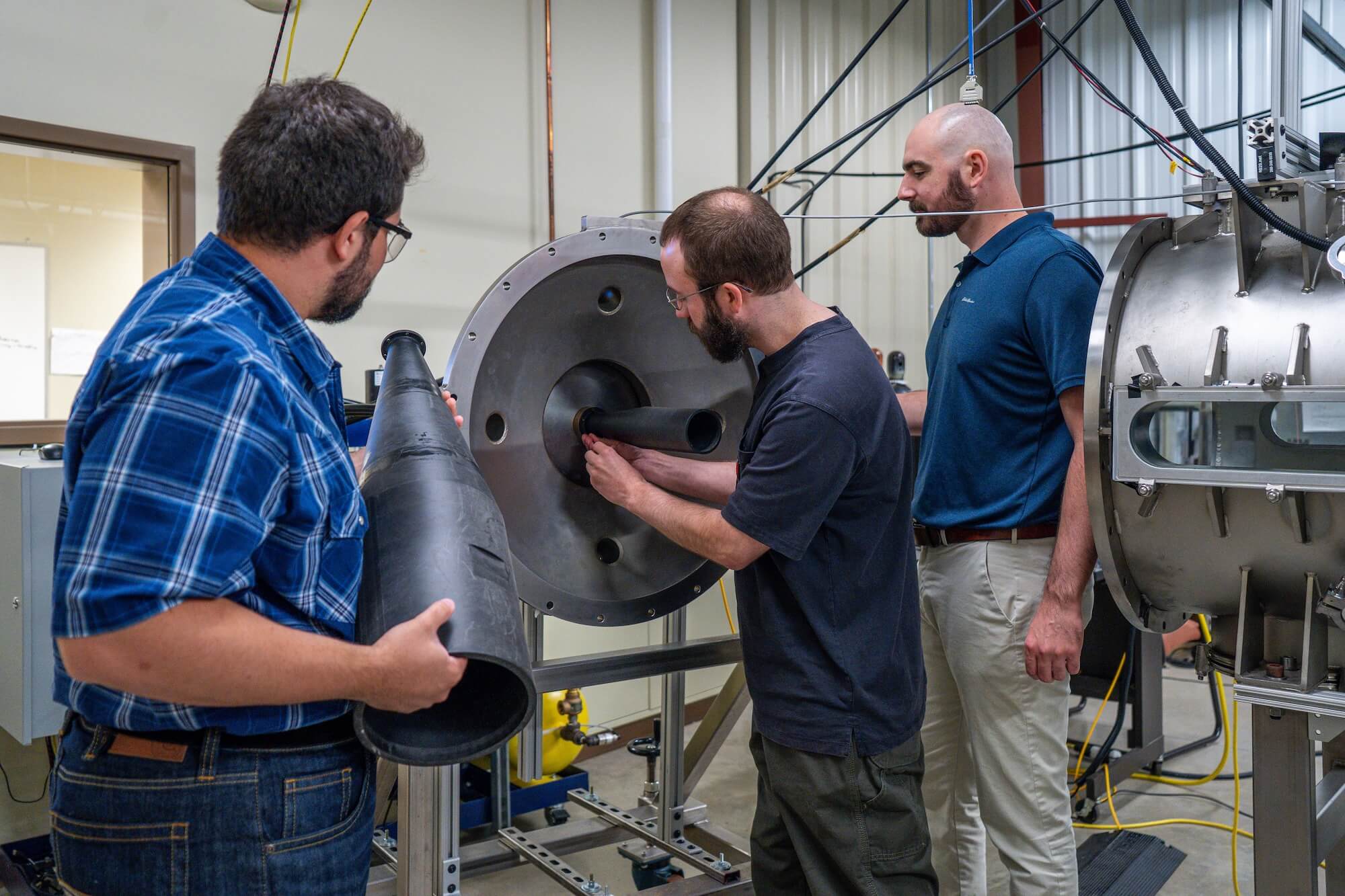
Olivia Farringtontag:green.nd.edu,2005:News/1783372026-01-09T13:45:00-05:002026-01-09T13:46:01-05:00Alumni founder of carbon-capture start-up receives NSF funding to collaborate with Notre Dame researchersGraduate student Alin Stoica, postdoctoral scholar Philip Lax, and Alec Houpt, AME Ph.D. ‘19, swap out nozzles on the High Enthalpy Arc Tunnel (ACT1), also called the ND Arcjet, at Notre Dame’s White Field research facility. Photo by Angelic Rose Hubert.
Alec Houpt, who earned his doctorate from the Department of Aerospace and Mechanical Engineering (AME) at the University of Notre Dame in 2020, will collaborate with Sergey Leonov, research professor in AME, to pursue the development of a supersonic nozzle designed to freeze and capture carbon dioxide and water from industrial exhaust.
Houpt and Leonov, who previously served as Houpt’s doctoral advisor, received Phase I funding from the National Science Foundation’s Small Business Tech Transfer (STTR) program to advance work already underway at Houpt’s startup, Inertial. The project aims to freeze carbon dioxide and water out of industrial exhaust streams by pushing the exhaust through an axisymmetric supersonic nozzle, while swirling the stream to separate the heavier and denser frozen particles from the surrounding gas. The captured carbon, which has been prevented from being emitted into the atmosphere, would then be sold to a downstream customer looking to turn it into a value-added product, like fuel or building materials.
The funds provided in the STTR Phase I grant will bring Houpt’s initial nozzle designs into the supersonic wind tunnels at Notre Dame’s White Field Research Laboratory. Here, Leonov’s research team will test various geometries and swirling rates to optimize nozzle design for the freezing and separation of water and CO2.
Collaborating with Leonov at White Field brings the duo around full circle to the earliest origins of Houpt’s idea for Inertial.
Back in graduate school, Houpt was running an experiment with a Mach-6 supersonic nozzle on the High Enthalpy Arc Tunnel (ACT1) at White Field. When air or any gas moves through a supersonic nozzle, the flow drops in temperature and pressure as the internal energy of the gas is converted into kinetic energy. To prevent freezing on the backend of the nozzle, the temperature of the whole wind tunnel is generally raised with a heating system.
One time, however, the heater didn’t kick on at all and the nozzle flow condensed. Ten years after the fact, Houpt has now returned to his experience with the foggy equipment fluke. Last year, he got together with Leonov and a current postdoctoral scholar, Philip Lax, whose doctoral scholarship focused on condensation in supersonic and hypersonic wind tunnels, to entertain the possibility of a specialized nozzle that is intentionally designed to freeze and capture CO2.
“That's not uncommon for supersonic, hypersonic labs in general, to unintentionally freeze carbon dioxide or whatever their flow gas is,” Houpt explained. “It's never the goal, it’s always an error, but we'd like to flip the script on that.”
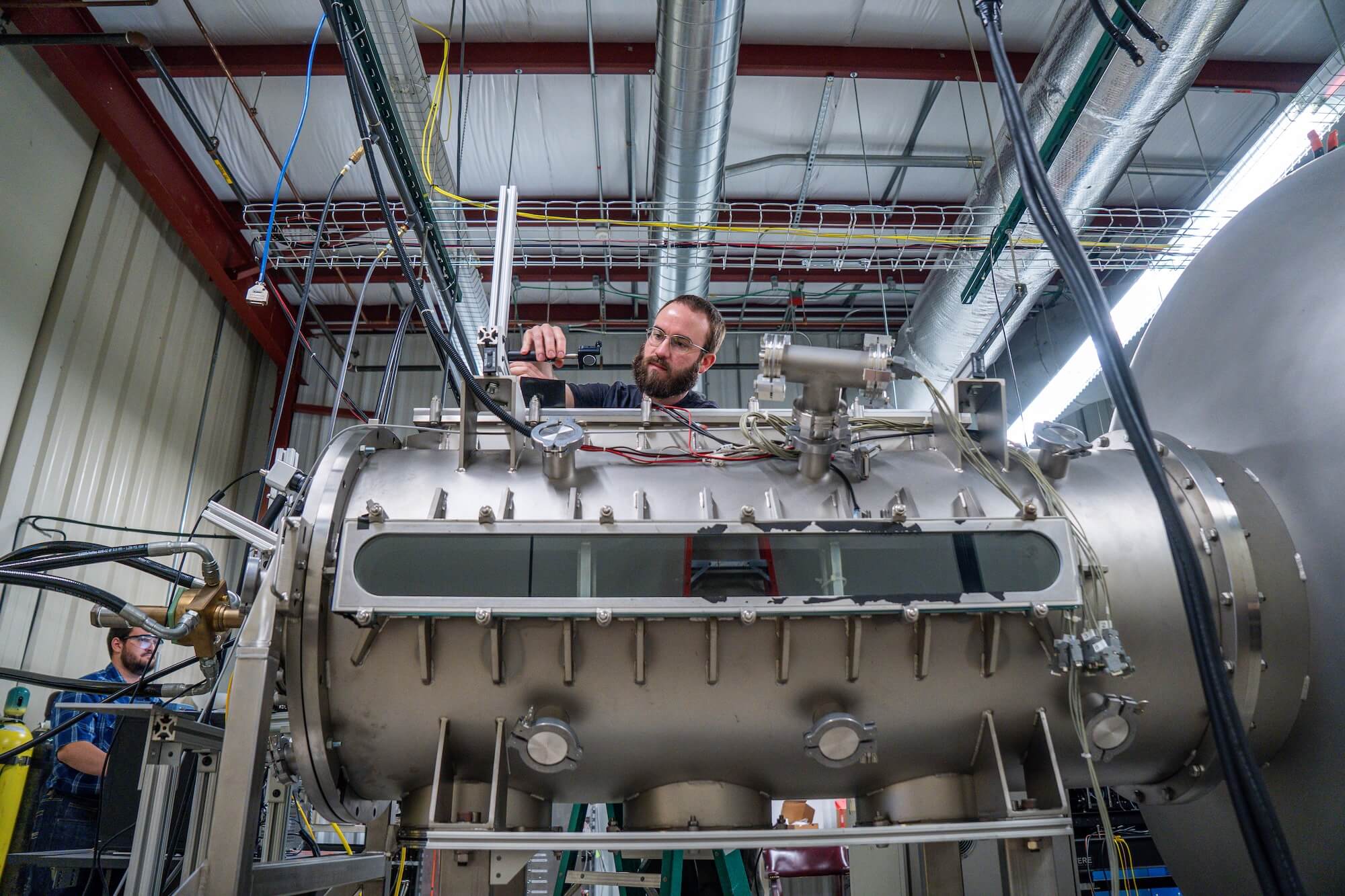
Philip Lax makes adjustments to the High Enthalpy Arc Tunnel (ACT1), also called the ND Arcjet, at Notre Dame’s White Field research facility. Photo by Angelic Rose Hubert.
Wind tunnels are large tube-like structures used to study the aerodynamic properties of objects, such as aircraft and spacecraft, and their components, including engines and nosecones. The tunnel generates a uniform flow of air around a stationary object, which simulates flight in a controlled environment. Researchers can then analyze how air moves in and around an object and optimize designs accordingly.
The characteristics of the industrial exhaust systems Houpt is looking to retrofit are not so different from those of wind tunnels, whose high pressure and uniformity mimic the flow he’s hoping to process from industrial partners.
To control how fast the air flows into the test section of a supersonic wind tunnel, a nozzle contracts the flow until it is moving at the speed of sound, or Mach 1, then expands the stream to accelerate it beyond Mach 1. The nozzles on research wind tunnels like those at White Field are designed to provide the most uniform flow possible. Part of maintaining a predictable, repeatable, uniform flow is avoiding condensation, which can happen if the temperature of the flow drops too drastically during expansion.
The nozzle Houpt is designing will become the centerpiece of a wind tunnel technology retrofitted to the exhaust ducts of power plants and similar industrial facilities. The apparatus will route the flue gas output from plant operations into a compressor, which will increase the pressure, and then push it through the nozzle, first contracting the gas, then expanding it, like a research wind tunnel.
But instead of trying to optimize the gas’ expansion for uniformity, Houpt is seeking to optimize it for phase change. The optimal nozzle will facilitate a conversion from heat energy to kinetic energy so significant that the carbon dioxide and water within the flue gas reliably freezes, a phenomenon which Leonov and Lax documented while developing the Phase I proposal.
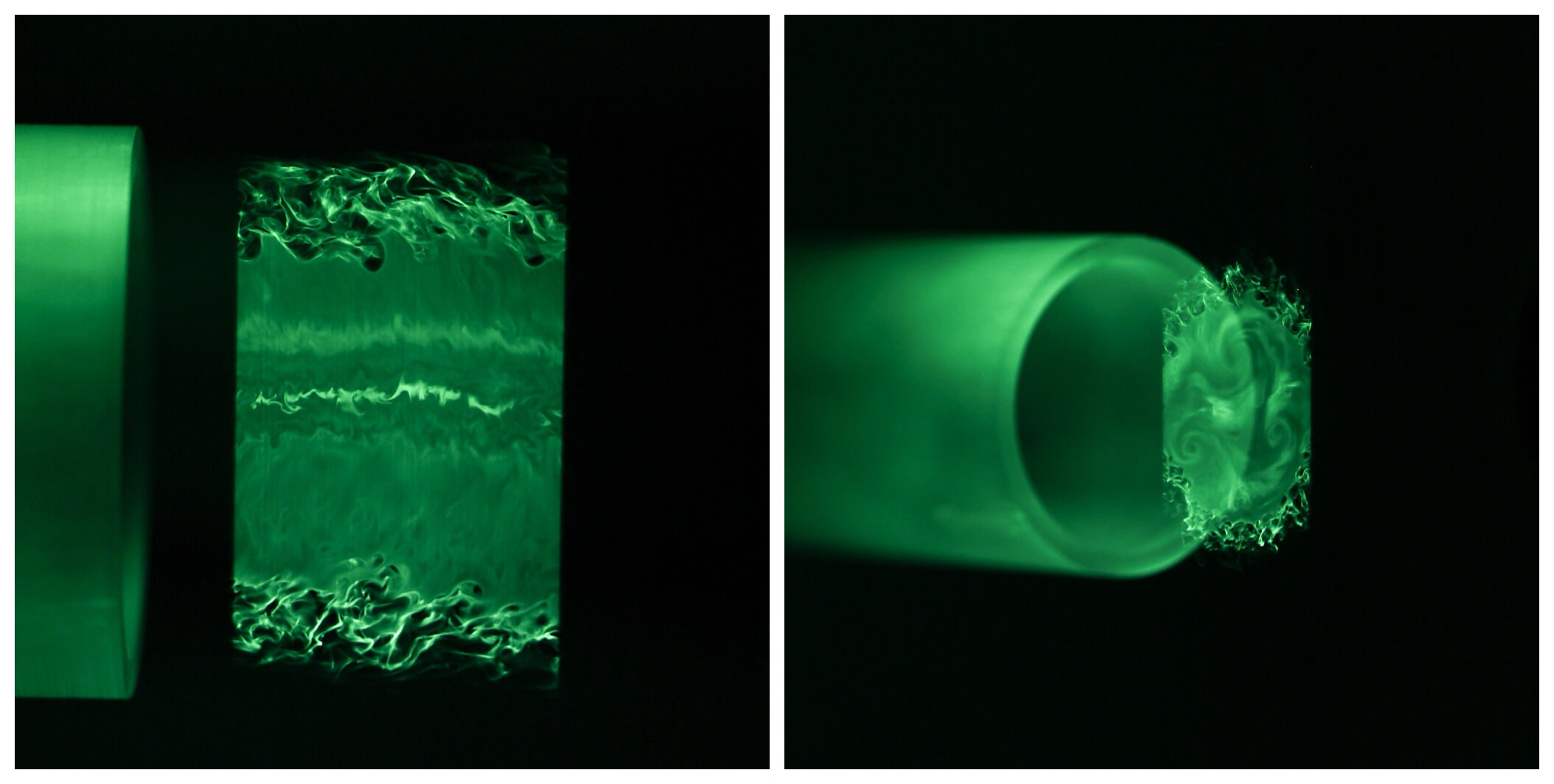
CO2 condensate is visible at the exit of a swirling Mach 6 nozzle, visualized using a nanosecond pulsed 532 nanometer laser sheet. The laser light is scattered by the condensed CO2 particles, then imaged with a high-speed camera. The nozzle is visible on the left due to light scattering. Credit: Philip Lax.
Though proven, freezing is only half the story. Limited experimental work related to actually removing the frozen particles from the larger flow has been performed.
“Right now, the frozen flow just stays in one line once it leaves the nozzle,” Houpt said. “We're swirling everything and trying to get the frozen solids to migrate to the outside, so we can essentially isolate them while letting the rest of the exhaust flow by.”
Houpt's swirling technique aims to take advantage of the fact that frozen particles are heavier and have more momentum than the surrounding gas. When the mixture is spun, everything inside wants to keep moving in a straight line, but the spinning forces them into a circle. This creates a push toward the center of the spin. The heavier particles, however, have more resistance to this inward push, so they end up getting thrown outward to the edges of the spinning flow.
Upcoming experiments will test and refine the geometry of Houpt’s nozzle design, as well as investigate swirling rates, to optimize the inertial separation. Once the first small prototype is perfected, the team can scale up—literally.
“One of the great things about aerospace engineering is that everything's based on ratios,” Houpt said. “So you can perfect the nozzle on a small scale, then just make the area of ratios bigger, and it functions the same.”
While Houpt is only at the threshold of a lengthy technology maturation process, his choice to reconnect with Leonov’s research team and collaborate with Notre Dame engineers reflects his long-term aspirations.
In order for Inertial’s technology to be considered ready for commercial operations, the nozzle must be capable of capturing 1,000 metric tons of carbon dioxide per year. To reach this benchmark, Houpt’s design will be scaled up to at least three times larger than the initial prototype.
“The initial stages of developing, testing, and transitioning from the lab to industry, like in the case of Alec’s system, are critical but challenging to sustain,” Leonov said. “We’re very grateful to have received the funding for collaborative testing with Inertial. Financial support like this is invaluable for pursuing the development of novel technologies to their fullest extent, especially in such a critical area as the mitigation of carbon emissions.”
Leonov added, “One of the great additional benefits of this project is the exposure Notre Dame students will receive to exciting areas of engineering, which will, in turn, be the catalyst for a new generation of highly-skilled engineers to enter the workforce.”
After proving the nozzle design capable at White Field in Phase I—a subscale design which can capture roughly 50 tons of CO2 per year—Houpt will seek Phase II funding from the NSF and a partnership with engineers at Notre Dame Power & Propulsion (ND P&P).
“White Field’s testing capabilities will get Inertial started with the fundamental science and development,” said Joshua Szczudlak, senior associate director at ND P&P. “Our role at P&P is to help Alec move his concept from the benchtop experiment into a larger, practical system. We’re able to leverage both our deep knowledge of turbomachinery and our broader experience in technology transition to support that process, while staying within the Notre Dame ecosystem."
To learn more about Notre Dame Power & Propulsion’s research, please visit ND P&P's website.
The University of Notre Dame is a private research and teaching university inspired by its Catholic mission. Located in South Bend, Indiana, its researchers are advancing human understanding through research, scholarship, education, and creative endeavor in order to be a repository for knowledge and a powerful means for doing good in the world. For more information, please visit NDR's website or NDR's LinkedIn.
Originally published by Erin Fennessy at research.nd.edu on December 08, 2025.
]]>
Erin Fennessytag:green.nd.edu,2005:News/1782212026-01-08T08:00:21-05:002026-01-14T12:59:08-05:00Highlighting progress: Sustainability data demonstrates a year of achievements
Thanks to the collective effort of Notre Dame students, faculty, and staff, our campus has achieved substantial milestones in our sustainability journey over the past year. From the food we eat to the energy that keeps the lights on for late-night study sessions, here are highlights of how Notre Dame is working to care for our common home.
The West Campus Solar Project
Moving along the Saint Mary’s Lake Trail, you may have noticed that the West Campus Solar Project is now officially online! This 46,000-square-foot array provides roughly 1% of our campus electricity, and has the capacity to reduce greenhouse gas emissions by up to 700 tons annually—the equivalent of taking nearly 140 gasoline-powered cars off the road. The site isn't just for power, either. Notre Dame's values continue to be exemplified through this project, as both native, pollinator-friendly species have been planted to support local biodiversity, and the solar panels were purchased from a local supplier that actively prioritizes human dignity as part of its business model. From the University’s collective action to reduce greenhouse gas emissions, Notre Dame has seen a 48% reduction in carbon emissions (2005 baseline).
Students and staff touring the Rockne Memorial green roof in fall 2025.
Green Roofs are Growing
Notre Dame’s skyline is getting greener. Major buildings such as the Rockne Memorial and South Dining Hall are part of an expanding network of vegetative “green” roofs. With over four acres of green roofs now across campus, these roof systems can add longevity to a building’s roof by protecting from thermal shock and UV radiation, support local biodiversity, reduce urban heat island effects, and can help insulate a building to reduce energy demands.
Meanwhile, food that is no longer safe for human consumption, such as plate scraps, is diverted from the landfill via three campus Grind2Energy (G2E) systems. The slurry produced by G2E is then used at a local dairy farm to create energy, fertilizer, and cow bedding. By keeping food waste out of the landfill, G2E helps avoid harmful greenhouse gas emissions, such as methane, which are produced when food decomposes in the landfill. The impact of Notre Dame’s G2E emissions avoidance - in the fall semester alone - is equal to the sequestration of planting 91 acres of forest.
Recycling Rate Increases
Everyday recycling collection and football game day recycling both saw dramatic improvements in diversion rates. Compared to last year, everyday recycling collection in toters around campus increased by 62%, and football gameday recycling improved 98%. These improvements have been made possible through the support of our collective campus community, like students sorting their recyclables in residence halls and collaborative efforts between Stadium Operations, Building Services, and the Sustainability teams working to expand recycling collection.
Keeping up the Momentum in 2026
While individuals may not have the power to create new large-scale infrastructure projects, everyone can contribute to shifting daily habits for more sustainable outcomes. Here is how you can contribute to mindful care of our common home in the next year:
Food Choice: Eat as much as you’d like, but take only what you know you'll eat. Reducing food waste at the source is even better than sending it to G2E or Cultivate.
Sorting Waste: Check the labels on waste bins and sort recyclables that are mostly free of food debris and liquid. Contamination in recycling toters can compromise a load of recyclables, forcing some materials to be rejected and sent to the landfill. When in doubt, check out Notre Dame’s recycling directory.
Power Down: Simple changes like turning off lights and unplugging "vampire" electronics, like chargers or gaming consoles, when you head to class or a meeting, help reduce the overall load on our grid. Did you know? An iPhone charger can draw 135W of power in a month. This may not seem like much power, but multiply that by everyone on campus, and that’s a lot of energy being drawn!
]]>
Olivia Farringtontag:green.nd.edu,2005:News/1770842025-12-05T12:48:00-05:002025-12-05T13:01:58-05:00Sustainability Spotlight: Morgan Munsen
Morgan Munsen is a program manager in the Nanovic Institute for European Studies. Notre Dame Sustainability sat down with Morgan to learn more about her and discuss her role in shaping sustainability on campus.
Tell us a little bit about yourself and your work on campus.
I'm a triple domer, and I studied Neuroscience/Psychology at Notre Dame for my bachelor's, master's, and PhD. Besides loving the study of human behavior, I'm passionate about music: I sing (individual performances and in choral ensembles), play piano, handbells, French Horn, and percussion, and I'm learning the accordion and cornet. On campus, I serve as the senior research and partnerships program manager for the Nanovic Institute for European Studies, directing and supporting research initiatives and partnerships so that the Institute and its partners can realize ambitious research goals. I also manage several important Institute programs, including the prestigious Laura Shannon Book Prize and the Catholic Universities Partnership. I'm a wife, mom of two delightful young boys, and member of Christ the King Catholic Church.
How have you implemented sustainability into your role or office more broadly?
Two years ago, I encouraged the Nanovic Institute to dedicate a new budget line towards research and programming around the topic of sustainability (in line with the University's Just Transformations to Sustainability Initiative and the Sustainability and Environmental Justice priority within the Keough School's Strategic Plan), and I now lead all efforts on this topic within the Institute. Looking back on our first year and a half, there are three signature programs I'd like to highlight:
First, in partnership with Notre Dame Sustainability and Notre Dame Global (Study Abroad), we created a Sustainability Research Fellows program open to students studying abroad in Dublin, Galway, London, and Rome. These students receive funding to create and conduct independent research projects during their semester abroad that allow them to gain cross-cultural insights on sustainability topics that they share in presentations once they return to campus the following semester. The inaugural cohort had diverse projects, from urban agriculture in Rome to citizen science and water quality monitoring in Ireland, ESG investing in the EU to plastics regulation in Galway. The upcoming Spring '26 cohort will investigate topics such as the environmental impact of data centers in Dublin, efforts to improve youth mental health through climate action in London, the growth of sustainable tourism in Rome, and the success of Italian luxury fashion brands in implementing sustainable practices.
Second, in concert with my co-instructor and colleague Roy Kimmey, I designed a research immersion trip in Ireland on the topic of sustainability research, education, advocacy, and policy. In Dublin, students engaged with academics from Trinity College Dublin and Dublin City University, visited the Irish National Archives, and met with both a sitting Irish senator and Dublin city councillor who advocate for sustainable solutions. Moving west, they discussed sustainability initiatives and research with faculty and administrators at the University of Galway. The week concluded with a trip to the island of Inis Oírr to study biodiversity and sustainable farming practices, alongside a visit to the Cliffs of Moher to discuss ecotourism and conservation. Exploring archives, classrooms, and the beautiful Irish countryside provided opportunities for Fellows to gather insights from a variety of key environmental actors in different sectors. This trip served as an important component of their semester-long course in European Studies research methods and as a springboard for the development of their independent research projects.
Third, we partnered with the Keough-Naughton Institute for Irish Studies to bring former Irish Green Party leader Eamon Ryan to campus for an extended visit. During the week he spent with us, he delivered a President's Forum lecture on "Cultivating Hope and Climate Action: What We Can Learn from Ireland", met with sustainability faculty from all across campus, and engaged undergraduate and graduate students on topics from Irish Green Party politics to global climate financing. Eamon was a gracious visitor and provided a lot of food for thought for our campus community.
When did you first become interested in sustainability, and what's your favorite sustainability topic?
I first took on sustainability as a sustained (ha!) and intentional worldview in college when I became a vegetarian. My sister encouraged me to watch the 2014 documentary "Cowspiracy: The Sustainability Secret", and it opened my eyes to the impacts large-scale animal agriculture has on the planet and forced a moral reckoning where I eventually decided I no longer wanted to consume meat. From there, I continued to learn more and more about the global crises we're facing due to human overconsumption, exploitation/extraction, pollution, and general lack of care for our common home, and felt compelled to do my part in my personal and professional life to make a positive impact. As a Catholic, I found much inspiration in Pope Francis' Laudato Si', and have run sustainability action challenges on social media during Lent, incorporating faith, prayer, and works. Right now, my favorite sustainability topic is probably the circular economy, as it involves proper stewardship of resources, creative innovation in systems and processes, and engaging communities. I live out this passion as the founding admin of the South Bend (Far East) Buy Nothing group and member of the admin team of the new group in my hyperlocal area after my recent move.
What is one sustainability tip or action would you recommend people take on in their daily lives, whether at home or on campus?
If you asked me for one sustainability tip, it would be to take your time, money, and effort and become part of some larger organization or movement. Individual actions are important, but I truly believe that the big wins that we need to impact global progress on climate and environmental issues will come from the strategic and coordinated efforts of groups of concerned and educated citizens.
Related to sustainability, what gives you hope for the future?
What gives me hope is that the conversation on sustainability is increasingly including ideas of climate justice, and an insistence on a just transition that sees clearly the unequal impacts of climate change.Do you know an individual or team who should be highlighted for their sustainability work?Submit a nomination for them here! Their story may be shared on our monthly Green Ambassador newsletter.
]]>
Olivia Farringtontag:green.nd.edu,2005:News/1770342025-12-03T16:22:00-05:002026-03-03T11:00:13-05:00As temperatures rise, research points the way to lower energy costs, better living conditions for low-income householdsMing Hu, associate professor of architecture and engineering, and Siavash Ghorbany, doctoral candidate in civil and environmental engineering, collect several monitors from a home in South Bend. The monitors were used to collect data such as temperature, humidity and CO2 levels from the home. (Photo by Matt Cashore/University of Notre Dame)
Due to poor and outdated housing infrastructure and lack of material resources, lower-income individuals are less prepared than those with higher incomes to weather the coming climate crisis — in particular, the increasing risk of heat-related death and illness from longer and hotter summers and more severe heat waves.
But with support from the National Science Foundation (NSF), researchers at the University of Notre Dame — including Ming Hu, associate professor of architecture; Chaoli Wang, professor of computer science and engineering; Matthew Sisk, associate professor of the practice of data science; and Eugenio Acosta, senior associate director of the Fitzgerald Institute for Real Estate — are using data and analytics to lower energy costs and improve living conditions for those living in older, less efficient homes, starting in South Bend.
Ming Hu
Led by Hu, also the dean for research, scholarship and creative work within the School of Architecture, the BUILT2AFFORD initiative is pairing advanced computational technology and strong community partnerships. The goal is to develop, test and validate a tool that uses machine learning and Google Street View to identify housing units suitable for low-cost passive retrofits — things such as improved insulation and air sealing, new windows, upgraded ventilation systems and exterior shading.
The group, which also includes faculty from the Center for Broader Impacts, is partnering with the city of South Bend, the Near Northwest Neighborhood (NNN), South Bend Heritage Foundation and Oldtown Capital Partners to target single-family homes and apartment buildings downtown and on the city’s near northwest side, an economically diverse area with pockets of wealth but high overall levels of poverty.
In lower-income neighborhoods especially, older homes tend to suffer from inadequate insulation; leaky ducts; cracked floors, ceilings and walls; drafty doors and windows; outdated HVAC systems; and other effects of age and disrepair, leading to higher energy costs and less safe and comfortable living conditions.
“We’re all living in the same housing stock. So when there’s research to come up with low-cost solutions to what are probably going to be common issues, it’s really very important to us because, a lot of times, it seems like if you’re trying to scratch the surface of energy efficiency in your home, you’re looking at a $50,000 or $60,000 bill.”
“Generally speaking, older buildings do not have the same thermal properties as newer buildings in terms of absorbing heat and resisting heat transfer from inside to outside and vice versa,” said Hu, who also is a concurrent associate professor of civil and environmental engineering and earth sciences. “So this can create higher risks for indoor heat exposure.”
Pregnant women and children, the elderly and those with respiratory or other health issues are especially vulnerable, Hu said, as are those living in traditionally colder climates, where buildings and other infrastructure are less resilient to extreme heat.
Hu noted that people spend about 80 percent of their time indoors. For elderly people, the number is closer to 90 percent. Our homes, she said, have an outsize influence on our health.
Kathy Schuth, a Notre Dame graduate in architecture, is the executive director of the Near Northwest Neighborhood Inc. She noted that, from a structural standpoint, the neighborhood looks much the same today as it did in the 1920s.
“We’re all living in the same housing stock,” Schuth said. “So when there’s research to come up with low-cost solutions to what are probably going to be common issues, it’s really very important to us because, a lot of times, it seems like if you’re trying to scratch the surface of energy efficiency in your home, you’re looking at a $50,000 or $60,000 bill.”
A data-driven approach
Part of the NSF’s Civic Innovation Challenge, the BUILT2AFFORD project involves the creation of representative layouts for thermal comfort simulations — essentially, models of relative comfort based on a home’s size, layout, location and orientation, among other factors.
To do this, researchers partner with property owners to collect and analyze data from a variety of housing types.
Leveraging multiple computer vision models developed by the team since 2023, they begin by using Google Street View to extract the physical characteristics of housing that influence energy use and indoor thermal comfort. These data points, combined with additional housing property data from open-source databases, form the foundation of the prediction tool BUILT2AFFORD.
To ensure the tool’s accuracy and robustness, the research team conducts field audits. These audits start with the creation of a 3D scan of the relevant house or apartment unit. Next, the team members take thermal images, measure for moisture content and document building materials and insulation. Finally, they place sensors around the house to measure temperature, humidity and air quality for one week.
The resulting data are then analyzed to identify problem spots, with the goal of creating an exposure model to predict risk across housing types.
“The idea is really around, what are low-cost solutions we can use to find where the problems are, and then low-cost solutions that we can use to help address those problems?”
So far, around a dozen property owners, including South Bend Heritage Foundation and Old Town Capital Partners, which owns the Mar-Main apartment building downtown, have agreed to participate in the project.
“The idea is really around, what are low-cost solutions we can use to find where the problems are, and then low-cost solutions that we can use to help address those problems?” said Sisk, the team’s data science professor who leads the Geospatial Analysis and Learning Lab within the Lucy Family Institute for Data & Society. “So it’s largely about targeting resources to the proper locations.”
As a resident of the Near Northwest Neighborhood, Sisk is well aware of the challenges that come with owning and living in an older home. His house, within the Chapin Park Historic District, was built in the late 1800s, before air conditioning, foam insulation and double-pane windows, among other modern materials and conveniences.
“I run into a lot of the same sorts of issues” as other homeowners, Sisk said, “like places that are ridiculously hot for no good reason, that the AC doesn’t do anything for, and it’s basically unmanageable in the summer.”
That said, every house is unique.
Siavash Ghorbany, a doctoral candidate in civil and environmental engineering, uses his cell phone to scan a data monitor at a home in South Bend. (Photo by Matt Cashore/University of Notre Dame)
Early on in their research, Hu and her team collected data from two houses of similar size, age and location — one fully renovated, including new heating and cooling systems and added insulation; the other largely untouched — with surprising results: Compared with the renovated house, the unrenovated house performed much better in terms of temperature and air quality.
Among other things, Hu said, “this just tells us that the conventional wisdom, the conventional solution of just adding insulation everywhere in the house does not necessarily work.”
Reed Lyons is among the homeowners participating in the project, having learned about it during a presentation Hu gave to NNN residents in early October.
A software developer, Lyons lives with his wife and two children in a two-story house on Cottage Grove Avenue. The house was built around 1914. The NNN, as part of its affordable housing program, acquired and renovated the property in 2012. The Lyonses bought it in 2019.
“We’ve noticed some issues with efficiency and some issues with air quality, just knowing that it’s an older home,” Lyons said. “So we’re just curious to see what the data show.”
He said working with Hu and her team — which in addition to Sisk and Wang includes Lucy Graduate Scholar Siavash Ghorbany, a doctoral candidate in civil and environmental engineering; doctoral candidate in computer science Siyuan Yao; and multiple undergraduate research assistants — has been a breeze.
“It’s really been a low investment in terms of our time and resources, and they’ve been really easy and wonderful to work with,” he said.
Notre Dame has a long relationship with the NNN, having partnered with the organization on a number of projects in the past. Notably, the Notre Dame Lead Innovation Team has worked closely with the community development organization and de facto neighborhood association to reduce lead exposure in the neighborhood, particularly among children.
“The NNN is kind of optimal for these kinds of projects,” Sisk said. “They have an extremely engaged neighborhood organization, and their president is an architect by training. They’ve been a key partner for years in many grants and many projects with us.”
For the purposes of this project, Sisk said, the neighborhood is also “very representative” of a Rust Belt neighborhood — socially and economically diverse, with brick-lined streets of well-preserved homes in Craftsman, Tudor and Victorian styles next to “some of the most historically troubled blocks in the city.”
Ming Hu, associate professor of architecture and engineering, Siavash Ghorbany, doctoral candidate in civil and environmental engineering, and Matthew Sisk, associate professor of the practice at the Lucy Family Institute for Data & Society, leave a home in South Bend after collecting a several monitors that were placed there the week before. The monitors were used to collect data such as temperature, humidity and CO2 levels within the home. (Photo by Matt Cashore/University of Notre Dame)
Next steps
In collaboration with the Fitzgerald Institute for Real Estate, Hu and her team are already applying for a phase 2 NSF grant to validate their research, with plans to retrofit a certain number of homes and analyze the results. The grant would pay for at least 80 percent of the cost of the retrofits, with local programs potentially covering the rest.
The city of South Bend, in partnership with enFocus, currently pays for some energy upgrades as part of Greener Homes, a pilot program for low-income, elderly homeowners who are part of Habitat for Humanity of St. Joseph County’s Aging in Place Program. The program was established with support from the Community Foundation of St. Joseph County.
Alexandro Bazán is the director of sustainability for the city.
Working from a lab at Walsh Family Hall of Architecture, Ming Hu, associate professor of architecture and engineering, and Siavash Ghorbany, doctoral candidate in civil and environmental engineering, analyze data as part of a project aimed at reducing energy costs for low-income households in South Bend. (Photo by Matt Cashore/University of Notre Dame)
“The city of South Bend is looking forward to continued collaboration with Notre Dame,” Bazán said, adding, “This project is a great opportunity to advance our community’s goals on climate action.”
Using the indoor heat exposure model, Hu and her team ultimately plan to create an online tool, or dashboard, to quickly and easily identify housing units suitable for passive, low-cost energy upgrades based on design indications, energy efficiency and health risks — without the need to actually enter the homes and collect data.
“The dashboard will be tied to the indoor heat exposure model, so the indoor heat exposure predication is the key,” Hu said.
Separately, Hu is also collecting data outside of South Bend, in Chicago and elsewhere, so that once the dashboard is up, it can be adapted to other regions of the country.
“We’re also committed to a series of training workshops for policymakers, developers and residents to show them how to use the dashboard if they want to,” Hu said. “So that is continued training that is for South Bend and for Indiana in particular.”
Social responsibility
Hu’s research is incredibly timely.
According to the United Nations, by hitting the poorest hardest, climate change increases existing economic inequalities and causes more people to fall into poverty. A World Bank report estimated that an additional 68 million to 135 million people could be pushed into poverty by 2030 because of climate change.
From a public health perspective, a warming planet increases the risk of heat-related illnesses such as heat stroke — particularly among vulnerable populations such as children, pregnant women and older adults. It also worsens air quality, which can lead to asthma attacks and other respiratory issues, and it contributes to unhealthy concentrations of ground-level ozone, which can damage lung tissue, reduce lung function and inflame airways.
“When I was trained, at least at Notre Dame, we were taught a lot about the social responsibility of architecture. The building is not merely an art piece; even when it aspires to be artistic, it serves as civic art, designed with a profound responsibility to its users, rather than existing as a mere monumental sculpture."
Heat even affects sleep, the most fundamental of human needs.
But it’s not just the heat — extreme cold is a concern as well.
“We all have to realize that things are going to be way more variable moving forward,” Sisk said. “We’re going to have weeks of 95-degree summer weather, but then also sub-zero weeks during winter, and we have to be prepared for both, which is super hard.”
According to Hu, the most recent climate report for Indiana predicts average temperatures in the state will rise by 5 to 6 degrees over the next 30 years, increasing the frequency, duration and intensity of heat waves. The average hottest day of the year is projected to increase to 105 degrees.
“Our infrastructure, including our housing, is not built for excessive heat. Our energy grid is not built to accommodate higher peak load during the summertime,” Hu said. “So what we’re worried about is the domino effect. If the grid goes out, there’s no cooling in those houses. What happens if that lasts a couple of weeks? Where do people go?”
A native of China, Hu holds multiple degrees in architecture from Notre Dame and elsewhere. She has a doctorate in civil and environmental engineering from the University of Maryland.
Ming Hu, associate professor of engineering and architecture, and Siavash Ghorbany, doctoral candidate in civil and environmental engineering, collect monitoring equipment from a home in South Bend's Near Northwest Neighborhood, about a mile from campus. The equipment was used to record data such as temperature, humidity and CO2 levels in the home over the course of several days. (Photo by Matt Cashore/University of Notre Dame)
Prior to joining the Notre Dame faculty, she spent several years in private practice, designing signature buildings for high-profile corporate clients and working on urban redevelopment projects around the globe. She also taught at Maryland as well as at Catholic University of America and the Rochester Institute of Technology.
She returned to Notre Dame, she said, out of a sense of social responsibility.
“When I was trained, at least at Notre Dame, we were taught a lot about the social responsibility of architecture. The building is not merely an art piece; even when it aspires to be artistic, it serves as civic art, designed with a profound responsibility to its users, rather than existing as a mere monumental sculpture,” Hu said. “So I always wanted to go back to social responsibility as a part of architecture, and I was always interested in how beauty actually functions. What is the experience of the occupants?”
That same philosophy — consistent with a fundamentally Catholic concern for the common good — animates the Lucy Institute as well.
“This is an ideal situation for a Lucy collaboration project, because we’re very deeply involved in the research part of it, but also in the ‘for societal good’ part,” Sisk said. “This kind of sums up those two sides of what we are designed to do.”
Originally published by Erin Blasko at news.nd.edu on January 02, 2025.