<?xml version="1.0" encoding="UTF-8"?>
<?xml-stylesheet type="text/xsl" href="/stylesheets/feed.atom.xml" media="screen"?>
<feed xml:lang="en-US" xmlns="http://www.w3.org/2005/Atom">
  <id>tag:nanovic.nd.edu,2005:/news</id>
  <link rel="alternate" type="text/html" href="https://nanovic.nd.edu"/>
  <link rel="self" type="application/atom+xml" href="https://nanovic.nd.edu/news.atom"/>
  <id>tag:nanovic.nd.edu,2005:/latest</id>
  <title>Nanovic Institute | News</title>
  <updated>2026-05-26T08:00:00-04:00</updated>
  <link rel="alternate" type="text/html" href="https://nanovic.nd.edu/"/>
  <link rel="self" type="application/atom+xml" href="https://nanovic.nd.edu//news.atom"/>
  <subtitle>The Nanovic Institute for European Studies connects the University of Notre Dame with Europe through academics, grants, research, and global opportunities.</subtitle>
  <entry>
    <id>tag:nanovic.nd.edu,2005:News/182221</id>
    <published>2026-05-26T08:00:00-04:00</published>
    <updated>2026-06-01T16:07:52-04:00</updated>
    <link rel="alternate" type="text/html" href="https://nanovic.nd.edu/news/statement-from-rev-robert-a-dowd-c-s-c-on-the-papal-encyclical-magnifica-humanitas/"/>
    <title>Statement from Rev. Robert A. Dowd, C.S.C., on the papal encyclical Magnifica humanitas</title>
    <summary type="text">
      <![CDATA[“At Notre Dame, our mission as a global Catholic research university compels us to advance Pope Leo XIV’s historic contribution to Catholic social tradition through our research, our teaching, and all of our work in service of the common good. The Holy Father has highlighted the critical role that Catholic scholars and researchers — and all those of goodwill — must play in raising moral questions and actively shaping new technologies to ensure they serve the entire human family.”]]>
    </summary>
    <content type="html">
      <![CDATA[<p>“In <em>Magnifica humanitas</em>, Pope Leo XIV has given us a profound gift: a teaching that reminds us that every human life possesses an inviolable dignity and that safeguarding this dignity must be the foundation of every decision we make as we develop and apply artificial intelligence.</p>
<p>“Signing this encyclical on the 135th anniversary of <em>Rerum Novarum</em>, Pope Leo XIII’s historic letter on the rights of workers, is a deliberate choice. Just as Leo XIII addressed the disorientation of the industrial revolution, Leo XIV calls us to moral clarity and solidarity in the midst of this latest societal transformation, underscoring the urgency of the questions humankind faces.</p>
<p>“At Notre Dame, our mission as a global Catholic research university compels us to advance Pope Leo XIV’s historic contribution to Catholic social tradition through our research, our teaching, and all of our work in service of the common good. The Holy Father has highlighted the critical role that Catholic scholars and researchers — and all those of goodwill — must play in raising moral questions and actively shaping new technologies to ensure they serve the entire human family.”</p>
<div>
<p><strong>Rev. Robert A. Dowd, C.S.C.<br></strong><strong>President, University of Notre Dame</strong></p>
</div>
<p class="attribution">Originally published by <span class="rel-author">Notre Dame News</span> at <span class="rel-source"><a href="https://news.nd.edu/news/statement-from-rev-robert-a-dowd-c-s-c-on-the-papal-encyclical-magnifica-humanitas/">news.nd.edu</a></span> on <span class="rel-pubdate">May 25, 2026</span>.</p>]]>
    </content>
    <link rel="enclosure" type="image/jpeg" href="https://nanovic.nd.edu/assets/661321/pope_leo_father_dowd.jpg" title="University President Rev. Robert A. Dowd, C.S.C., in black clerical attire, broadly smiles while shaking hands with Pope Leo XIV, a smiling man in white papal robes and a white zucchetto."/>
    <author>
      <name>Notre Dame News</name>
    </author>
  </entry>
  <entry>
    <id>tag:nanovic.nd.edu,2005:News/182223</id>
    <published>2026-05-26T08:00:00-04:00</published>
    <updated>2026-06-01T16:11:36-04:00</updated>
    <link rel="alternate" type="text/html" href="https://nanovic.nd.edu/news/notre-dame-experts-respond-to-pope-leo-xivs-encyclical-magnifica-humanitas/"/>
    <title>Notre Dame experts respond to Pope Leo XIV’s encyclical Magnifica humanitas</title>
    <summary type="text">
      <![CDATA[On Monday (May 25), Pope Leo XIV released his first encyclical, Magnifica humanitas (Magnificent humanity), which provides moral guidance to bishops, clergy and the faithful on safeguarding the human person in the time of artificial intelligence (AI). University of Notre Dame faculty experts from the College of Arts and Letters, College of Engineering, Keough School of Global Affairs and Law School offer their insights into the document.]]>
    </summary>
    <content type="html">
      <![CDATA[<p>On Monday (May 25), Pope Leo XIV released his first encyclical, <em>Magnifica humanitas</em> (Magnificent humanity), which provides moral guidance to bishops, clergy and the faithful on safeguarding the human person in the time of artificial intelligence (AI).</p>
<p>The encyclical was officially signed on May 15, the 135th anniversary of Pope Leo XIII’s encyclical responding to the industrial revolution, <em>Rerum novarum</em>.</p>
<p>Below, University of Notre Dame faculty experts from the College of Arts and Letters, College of Engineering, Keough School of Global Affairs and Law School offer their insights into the document.</p>
<h4>Rev. Daniel Groody, C.S.C.</h4>
<figure class="image image-right"><img src="https://news.nd.edu/assets/614237/200x/dan_groody_1200.jpg" alt="Headshot of a priest with a light complexion and gray hair, wearing glasses, a black suit jacket, and a clerical collar, smiling against a gray background." width="200" height="200">
<figcaption></figcaption>
</figure>
<p>Rev. Daniel Groody, C.S.C., serves as vice president and associate provost for undergraduate education and professor of theology and global affairs. In addition to his role at Notre Dame, Father Groody is a member of the Vatican’s Dicastery for Promoting Integral Human Development and plays a key role in Notre Dame’s partnership with the Vatican’s Laudato Si’ Center on issues of integral ecology and global sustainability. His research focuses primarily on migration, theology, refugees and human displacement.</p>
<p>“Pope Leo’s <em>Magnifica humanitas</em> calls us to continually discern what it means to be human before God in a world increasingly shaped by artificial intelligence,” Father Groody said. “While this new digital age offers unprecedented possibilities for development, it simultaneously demands that we rediscover the true contours of our humanity. This authentic identity — rooted in an interior life, a moral conscience, human connections and a transcendent relationship to divine love — can never be quantified, modeled or replicated by machine learning. Against the technocratic impulse to reduce the human person to a mere data point, the encyclical boldly reasserts that we cannot be measured solely by technological acceleration but by holistic human development, human dignity and our commitment to the common good.</p>
<p>“Alongside new innovations, artificial intelligence reveals ancient temptations of radical self-sufficiency and idolatry. Warning against the modern temptation to construct a digital Tower of Babel in the pursuit of technological mastery, Pope Leo calls us instead to channel our energies into building the Kingdom of God and animating a ‘Civilization of Love.’ This sacred task requires an unwavering willingness to denounce the false forms of power that isolate us in algorithmic silos and blind us to our neighbors. In their place, <em>Magnifica humanitas</em> proposes a vision of life firmly anchored in justice, ultimately steering humanity toward the right ordering of our relationships with one another, with technology and with the Creator.”</p>
<h4>Paolo Carozza</h4>
<figure class="image image-right"><img src="https://news.nd.edu/assets/452346/200x/paulo_carozza_portrait.jpg" alt="Paulo Carozza Portrait" width="200" height="200"></figure>
<p>Notre Dame Law School professor, and Nanovic Institute for European Studies Faculty Fellow, Paolo Carozza is a member of the Pontifical Academy of Social Sciences and also the chair of the Meta Oversight Board. Both his research and policy work are focused on the intersection of Catholic social thought and technology, especially social media and AI.</p>
<p><strong> </strong></p>
<p>“I am convinced that this will prove to be a defining document for our era, a profound and prophetic document,” Carozza said. “It is not just for Catholics, but speaks to the concerns of all of humanity.</p>
<p><strong> </strong></p>
<p>“We are living in a time of daily dramatic transformations in every aspect of our lives because of AI, where the very understanding of what it means to be human is being called into question. This is coupled with a real vacuum of moral leadership on the global stage. In that context, Pope Leo is offering a clear, comprehensive and coherent voice urging us to take responsibility for constructing a world in which technology will serve humans rather than degrade them.</p>
<p><strong> </strong></p>
<p>“From here on, I don’t think anyone will be able to speak meaningfully about the future of humanity in the age of AI without coming to terms with this document and taking it seriously. While it is very direct about the many dangers already arising out of algorithmic technologies, it is decidedly not an anti-technology document. The real question is not whether AI is good or bad, but whether the ways we develop and deploy the technology help individuals and communities become more humane, just and participatory, or whether instead they foster exclusion, control and inequality.</p>
<p><strong> </strong></p>
<p>“The overarching core message is that if we are to preserve our humanity, we must not allow people to be reduced to mere data and commodities to be instrumentalized and exploited. It is a very hopeful document, not a doomsaying one. Pope Leo insists that moral progress here is possible, and the negative consequences of AI technologies are far from inevitable.”</p>
<h4>Meghan Sullivan</h4>
<figure class="image image-right"><img src="https://news.nd.edu/assets/660633/200x/meghan_sullivan_1_.jpg" alt="Smiling woman with dark hair, tortoiseshell glasses, a black top, and a gold medallion necklace." width="200" height="200"></figure>
<p>Meghan Sullivan is the Wilsey Family College Professor of Philosophy and director of the Notre Dame Institute for Ethics and the Common Good. She leads a national research and public engagement initiative on AI and human dignity and meets regularly with tech leaders and AI developers in Silicon Valley. In March, Sullivan attended an Anthropic summit to discuss how to guide the moral development of the corporation’s chatbot, Claude.</p>
<p><strong> </strong></p>
<p>“<em>Magnifica humanitas</em> is one of the most compelling and comprehensive treatments of AI ethics I have ever read — and I say that as someone who has spent the past few years immersed in this literature from both philosophical and policy perspectives,” Sullivan said. “Pope Leo XIV grounds AI ethics in the Church’s long-standing social doctrine, which has consistently offered a profound vision of human dignity.</p>
<p><strong> </strong></p>
<p>“Christian tradition has never grounded human dignity in cognitive performance or economic productivity. It has never said: You matter because of what you can do. It says: You matter because of who you are. Someone with a body, mind and soul. Someone built for love. Someone with a mind oriented toward truth, accountable for our choices. We’re vulnerable in a way that these AI models are not. And Pope Leo argues that this special belovedness — made in God’s own image — makes us magnificent.</p>
<p><strong> </strong></p>
<p>“What strikes me most is how practical this document is. It gives concrete guidance to corporate leaders, to policymakers, to educators, to everyday people navigating this technology. For those of us at Notre Dame, the pope’s charge to educational institutions is especially urgent. He argues that schools must resist the pressure to simply accelerate alongside the digital world and instead become irreplaceable centers of human formation — places where knowledge is integrated, where real relationships are built, where students discover the meaning of human dignity.</p>
<p><strong> </strong></p>
<p>“This is exactly the work that Notre Dame’s DELTA network exists to do. With a generous $50.8 million grant from Lilly Endowment Inc., we are going to put this teaching on human dignity and AI into action — across K-12 schools, universities, churches and the public square. Today’s encyclical gives us both the theological framework and the moral insight we need. Notre Dame is ready to help the Church and the world answer Pope Leo’s call.”</p>
<h4>Nitesh Chawla</h4>
<figure class="image image-right"><img src="https://news.nd.edu/assets/452200/200x/nitesh_chawla_expert.jpg" alt="Nitesh Chawla Expert" width="200" height="267"></figure>
<p>Nitesh Chawla, an expert in artificial intelligence, data science and network science, is the Frank M. Freimann Professor of Computer Science and Engineering, director of the Lucy Family Institute for Data &amp; Society and the Lucy Family Director for Data &amp; AI Academic Strategy, leading the Notre Dame Data, AI and Computing Initiative. He uses advancements in AI, data science and network science to pursue common good through interdisciplinary research by collaborating with community and national partners.</p>
<p><strong> </strong></p>
<p>“<em>Magnifica humanitas</em> makes clear that AI cannot be treated as morally neutral,” Chawla said. “Because these systems embody choices about what they measure, ignore and optimize and how they classify people and situations, they must be transparent, accountable and subject to meaningful evaluation.</p>
<p><strong> </strong></p>
<p>“That is the work of Responsible, Inclusive, Safe and Empowering AI — RISE AI — at Notre Dame. Anchored in the Lucy Family Institute for Data &amp; Society, RISE AI asks four practical questions: Who answers for an AI system across its lifecycle? Who is represented and served? Who is protected from harm? Who gains or loses agency? AI governance claims are only as good as the evidence chain that connects them to what the system does. RISE AI builds that chain. That chain runs through audit logs, red-teaming, subgroup performance, accessibility, redress and user-agency measures that show what a system actually does and where its limits are.</p>
<p><strong> </strong></p>
<p>“The encyclical’s most important insistence is that moral and technical questions cannot be separated; they meet in how systems are evaluated, audited, deployed, made contestable and governed. As paragraph 109 puts it, social justice must ‘shape the very design’ of these systems from the outset, not be retrofitted after deployment. That means building AI that is not only powerful but legible, accountable and directed toward integral human development and the common good — making responsibility measurable, inclusion visible, safety testable and empowerment real.</p>
<p><strong> </strong></p>
<p>“As <em>Magnifica humanitas</em> insists, responsibility must be ‘clearly defined at every stage.’”</p>
<h4>Kathleen Sprows Cummings</h4>
<figure class="image image-right"><img src="https://news.nd.edu/assets/452365/200x/kathleen_cummings_portrait.jpg" alt="Headshot of a woman with short, wavy blonde hair, wearing coral drop earrings, thin-framed glasses, and a coral top. She smiles at the camera against a gray background." width="200" height="200">
<figcaption></figcaption>
</figure>
<p>Kathleen Sprows Cummings is a professor of American studies and history and director of the Global Catholic Research Initiative. A papal analyst for NBC/MSNBC, she offered expert commentary during the 2014 canonization of Popes John Paul II and John XXIII, Pope Francis’ U.S. visit in 2015, Pope Francis’ funeral in 2025 and the conclave that elected Pope Leo XIV.</p>
<p><strong> </strong></p>
<p>“‘Age gives way to age,’ wrote Pope Leo XIII in <em>Rerum novarum</em>, ‘but the events of one century are wonderfully like those of another, for they are directed by the Providence of God.’ In <em>Magnifica humanitas</em>, an encyclical dated exactly 135 years after <em>Rerum novarum</em>, Pope Leo XIV also invokes God’s invisible work in history,” Cummings said. “And, like his namesake, he considers the central challenge of the age — in this case, the advent of artificial intelligence — in light of the Church’s timeless principles.</p>
<p><strong> </strong></p>
<p>“More humble in tone than <em>Rerum novarum</em>, <em>Magnifica humanitas</em> is a far more capacious document that operates on several levels at once: an explanation of Catholic social teaching as it has developed since <em>Rerum novarum</em>; an affirmation of the intrinsic, God-given value of each person, which is not tied to what they achieve or produce; a rumination on the wonder and limitations of being human; a meditation on history, including an unflinching acknowledgement of the Church’s complicity in its darker moments; and an invitation to individuals and institutions to think creatively and collaboratively about how to ‘disarm’ new technologies and harness them for good.</p>
<p><strong> </strong></p>
<p>“In his powerful conclusion, Pope Leo entrusts this endeavor to Mary, quoting from the Magnificat, her revolutionary ‘song of hope’ which glorifies the God who delivers the humble and oppressed, dislodges the privileged from their positions of power, and continues to make all things new in this and in every age. In that sense, <em>Magnifica humanitas</em> ultimately offers consolation to a world in desperate need of it.”</p>
<h4>Arun Agrawal</h4>
<figure class="image image-right"><img src="https://news.nd.edu/assets/606552/200x/arun_agrawal_2025.jpg" alt="Headshot of a man with glasses, a salt-and-pepper beard and hair, wearing a navy turtleneck sweater. He smiles warmly at the camera. A blurred hallway is visible in the background." width="200" height="200"></figure>
<p>Arun Agrawal, the Pulte Family Professor of Development Policy and director of the Just Transformations to Sustainability Initiative, studies environmental politics, sustainable development and transformative change. He has spent time with Catholic leaders discussing ways to care for our common home globally and across all disciplines and can address how AI technology is impacting the environment.</p>
<p><strong> </strong></p>
<p>“The words ‘common good’ appear in Pope Leo’s encyclical, <em>Magnifica humanitas</em>, more often than the words ‘artificial intelligence’ or ‘AI,’ more often than ‘church,’ and more often than ‘religion,’” Agrawal said. “In its mention of the common good, the encyclical resonates with Pope Francis’ call for care for our common home. This continuity and this focus on the common — on the community of which we are all a part — is a characteristic feature of what it means to be human, to be part of the interconnectedness of all creation.</p>
<p><strong> </strong></p>
<p>“Fundamentally, the encyclical is a call to heed and act for the common good. It is a call to move away from the kind of politics that advances only the fortune and interests of a select few. Increasingly, our politics pushes to the side the grandeur of humanity and promotes markets that profit the elite instead of supporting the common good.</p>
<p><strong> </strong></p>
<p>“It prophetically recognizes that the ‘invisible hand’ of the market is in fact about the visible hand of politics that helps the marriage of finance and technology. It instead asks for our politics that would direct technology and finance and artificial intelligence to support the common good so as to achieve the grandeur of humanity. It is only by attending to this call that we have any hope of maintaining the dignity of the whole person.”</p>
<p><strong> </strong></p>
<p><em><strong><a href="https://news.nd.edu/our-experts/nd-experts-on-pope-leo-s-ai-encyclical/">Additional Notre Dame experts on the AI encyclical</a> and <a href="https://news.nd.edu/news/statement-from-rev-robert-a-dowd-c-s-c-on-the-papal-encyclical-magnifica-humanitas/">a statement from University President Rev. Robert A. Dowd, C.S.C.</a>, are available.</strong></em></p>
<p><strong><br><em>Contact: </em></strong><em>Carrie Gates, associate director of media relations, 574-993-9220, <a href="mailto:c.gates@nd.edu">c.gates@nd.edu</a></em></p>
<p class="attribution">Originally published by <span class="rel-author">Notre Dame News</span> at <span class="rel-source"><a href="https://news.nd.edu/news/notre-dame-experts-respond-to-pope-leo-xivs-encyclical-magnifica-humanitas/">news.nd.edu</a></span> on <span class="rel-pubdate">May 25, 2026</span>.</p>]]>
    </content>
    <link rel="enclosure" type="image/jpeg" href="https://nanovic.nd.edu/assets/661323/mlc_12226_dome_sunset.jpg" title="Vivid pink and purple sunset sky behind the Golden Dome of Notre Dame's Main Building with the Virgin Mary statue."/>
    <author>
      <name>Notre Dame News</name>
    </author>
  </entry>
  <entry>
    <id>tag:nanovic.nd.edu,2005:News/181941</id>
    <published>2026-05-18T16:38:00-04:00</published>
    <updated>2026-05-20T16:39:32-04:00</updated>
    <link rel="alternate" type="text/html" href="https://nanovic.nd.edu/news/research-fellowship-and-faith-abound-at-the-notre-dame-ukrainian-catholic-university-impact-forum/"/>
    <title>Research, fellowship, and faith abound at the Notre Dame-Ukrainian Catholic University Impact Forum</title>
    <summary type="text">
      <![CDATA[Where can hope be found in wartime? In small victories, certainly. But also in the belief of something bigger, in the hope that peace will prevail. Institutions like the University of Notre Dame and Ukrainian Catholic University would call that faith. For 22 years, Notre Dame has sustained…]]>
    </summary>
    <content type="html">
      <![CDATA[<p>Where can hope be found in wartime? In small victories, certainly. But also in the belief of something bigger, in the hope that peace will prevail. Institutions like the University of Notre Dame and Ukrainian Catholic University would call that faith.</p>
<p>For 22 years, Notre Dame has sustained a partnership with Ukrainian Catholic University (UCU), rooted in a shared Catholic identity. That <a href="https://global.nd.edu/news-events/news/three-new-research-grants-announced-through-notre-dames-partnership-with-ukrainian-catholic-university/">partnership expanded</a> in 2022 after the full-scale Russian invasion of Ukraine, when Notre Dame added new programs and funding for research grants. Sixteen <a href="https://global.nd.edu/research/grants-and-funding/notre-dame-ukrainian-catholic-university-faculty-collaboration-grant/">grants</a>, funded by Notre Dame Global and Notre Dame Research, have been awarded since 2022 to ND and UCU faculty to pursue joint research on concerns central to Ukraine.</p>
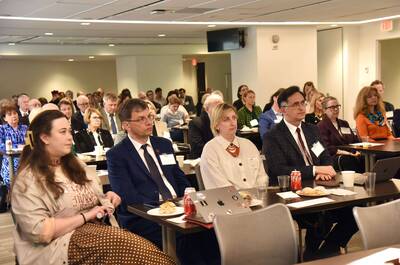
<figure class="image image-right"><img src="https://global.nd.edu/assets/659750/400x/nd_ucu_forum_7.jpeg" alt="Audience sits attentively at tables with laptops in a brightly lit conference room." width="600" height="397"></figure>
<p>Additionally, in 2023, the Nanovic Institute launched the <a href="https://nanovic.nd.edu/about/ukrainian-studies-hub/">Ukrainian Studies Hub</a>—a University-wide initiative that brings together scholars and students focused on Ukraine. The Hub leads education and research initiatives and serves as a platform for building partnerships in Ukraine and responding to the critical challenges facing Ukrainians and the global community. It brings to life Notre Dame’s work as a founding member of the Global Coalition of Ukrainian Studies, and, in partnership with UCU, also hosts a <a href="https://nanovic.nd.edu/events/2027-ukrainian-studies-conference/">biennial conference</a> at Notre Dame.</p>
<p>The vitality and continued growth of this university partnership were evident at the recent gathering of the Notre Dame and UCU community in Washington, D.C. Over 100 people came together for <a href="https://nanovic.nd.edu/events/2026/04/20/ukraine-impact-forum-faith-and-resilience/">The Ukraine Impact Forum: Faith &amp; Resilience</a>. The forum took place at Notre Dame’s Washington Office, providing a vital nonpartisan venue for US and Ukrainian leaders to engage, and was co-organized by <a href="https://global.nd.edu/">Notre Dame Global</a>, the <a href="https://keough.nd.edu/">Keough School of Global Affairs</a>, the <a href="https://nanovic.nd.edu/">Nanovic Institute for European Studies</a>, <a href="https://research.nd.edu/">Notre Dame Research</a>, and <a href="https://ucu.edu.ua/en/">Ukrainian Catholic University</a>. It brought together faculty and staff from both institutions, civic activists, partners, politicians, and Notre Dame alumni. The goal of the forum was not only to present on joint research projects, but also “to impact policy and future research, start conversations, and engage colleagues and partners around the world,” as <a href="https://global.nd.edu/about/people/michael-pippenger/">Michael Pippenger</a>, Notre Dame’s vice president &amp; associate provost for internationalization, shared in his opening remarks.</p>
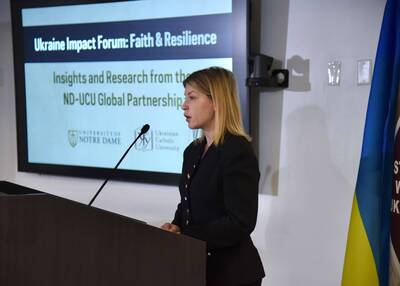
<figure class="image image-left"><img src="https://global.nd.edu/assets/659740/400x/nd_ucu_forum_2.jpeg" alt='Woman speaks at a podium before a screen displaying "Ukraine Impact Forum: Faith &amp; Resilience" with Notre Dame and UCU logos.' width="600" height="429">
<figcaption>Ambassador Olha Stefanishyna</figcaption>
</figure>
<p>Other key speakers included Ambassador Olha Stefanishyna, Ukraine’s Ambassador to the United States; Archbishop Borys Gudziak, Metropolitan-Archbishop of the Ukrainian Catholic Archeparchy of Philadelphia and UCU president; Taras Dobko, UCU rector; Yaroslav Prytula, UCU senior vice-rector and provost; Sophia Opatska, UCU vice-rector of strategic development; Jeffrey Rhoads, John and Catherine Martin Vice President for Research at Notre Dame; and Mary Gallagher, dean of Notre Dame’s <a href="https://keough.nd.edu/">Keough School of Global Affairs</a>. The forum was also honored to welcome senior government officials, including Naz Durakoğlu, Staff Director, Senate Foreign Relations Committee.</p>
<p>Throughout the course of the day’s events—filled with fireside chats, talks, and presentations—a clear thread emerged. This was a partnership grounded in faith and energized by putting that faith into action.</p>
<p>During her remarks, Ambassador Stefanishyna spoke to the importance of not just academic diplomacy but faith diplomacy: “In times of uncertainty, faith remains the only ground which keeps us united.” She also discussed universities’ role in conflicts, stating that the shared objective of universities is to “translate research into politics and insights into action.” She noted how universities in Ukraine, such as UCU, are turning their experience of crisis into actionable knowledge—exemplified through Ukraine becoming more technologically advanced due to the war.</p>
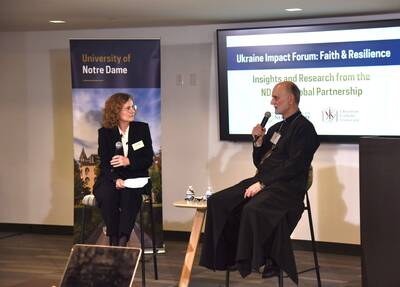
<p>When asked during his conversation with Dean Gallagher what Catholic universities specifically can do in the midst of conflict, Archbishop Gudziak answered, “Do what we do, but do it heart to heart.” Catholic universities are as well-positioned as other universities to provide partnership, research, and resources to those in need. But a Catholic foundation allows institutions to go one step further, emphasizing “integral human development.” This holistic approach recognizes that lasting recovery depends on the development of the whole person, and that researchers at ND and UCU consider data in the context of the human lives and communities it represents.</p>
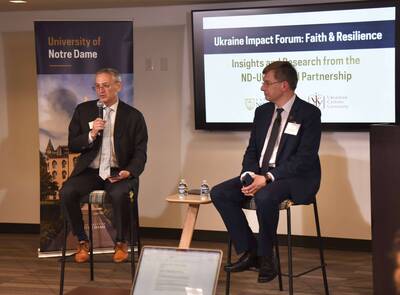
<figure class="image image-right"><img src="https://global.nd.edu/assets/659748/400x/nd_ucu_forum_6.jpeg" alt='Two men in suits sit at a Notre Dame "Ukraine Impact Forum: Faith &amp; Resilience" panel. One speaks into a mic.' width="600" height="442">
<figcaption>Michael Pippenger and Taras Dobko</figcaption>
</figure>
<p>During the fireside chat between Pippenger and Dobko, the two discussed what it means to serve at faith-based institutions in a secular society. “I think faith-based institutions are particularly capable, and they have a mission to increase the number of dedicated and passionate people,” Dobko said. Reflecting on UCU’s role in the current crisis, he shared that “UCU should be a source of hope and a source of unity for the Ukrainian people.” For UCU, putting their faith into action means cultivating hope not just among their students and on their campus, but also putting scholarship, research, and science into action to improve the lives and resilience of the Ukrainian people as a whole.</p>
<p>Pippenger remarked on how Notre Dame has learned from UCU’s ability to reinvent the university to meet the needs of a society under duress, to which Dobko emphasized that universities should be communities that not only teach but also learn. “This learning experience comes from responding to the present,” he says. One of the ways Notre Dame and UCU are fostering hope and reacting to the current situation is through research. As Pippenger shared, “We are being led by our hearts, we’re being led by our faith, but it allows us to do practical work that will be transformative in the secular world.”</p>
<p>Some of that practical work was presented at the forum, where faculty teams—each pairing a Notre Dame faculty member with an UCU colleague—presented updates on their ongoing research projects that involved a diverse set of themes and disciplines related to the ongoing conflict, including collective trauma and healing, ethical infrastructure and moral dimensions of security, data science for the common good, and the role of religious diplomacy in the ongoing war. These projects showcased how collaborative scholarship can be a profound form of solidarity and how the synergy between the spiritual and the empirical served as the forum’s true North Star. By presenting rigorous, policy-relevant findings on the ethical infrastructure of reconstruction alongside the data-driven strategies for human resilience, the ND-UCU researchers demonstrated that faith and scholarship are not at odds; they are the dual engines of Ukraine’s resistance, recovery, and reconstruction. One provides the ‘why’—the inherent dignity and moral security of the person—while the other provides the ‘how’—the technical expertise needed to rebuild a sovereign, flourishing society.<br><br>This resilience is forged in profound sacrifice; as noted during the forum, the UCU community has already lost 38 of its students, alumni, faculty, and staff to Russian attacks—lives that the partnership seeks to honor through its commitment to a free and flourishing Ukraine. Behind <a href="https://ucu.edu.ua/en/news/geroyi-vijny/">each name</a> is a “whole person”—a world of unique talents, deep family bonds, and vocations cut short.</p>
<figure class="image image-left"><img src="https://global.nd.edu/assets/659742/400x/nd_ucu_forum_4.jpeg" alt="A woman with curly hair and glasses, and a bearded priest, both holding microphones, speak at the Notre Dame Ukraine Impact Forum." width="600" height="430">
<figcaption>Dean Mary Gallagher and Archbishop Borys Gudziak</figcaption>
</figure>
<p>In offering closing remarks, <a href="https://nanovic.nd.edu/people/clemens-sedmak/">Clemens Sedmak</a>, director of the Nanovic Institute for European Studies and professor of social ethics at the Keough School, emphasized that research projects like these give people reasons to care and overcome the temptation to indifference in the face of great conflict. “Why should you care?” he asked. “Because people are precious, the stakes are high, and the injustice is grave.”</p>
<p>The participants’ presence at this forum was proof that they understood the imperative, but the work is far from over. As Dean Gallagher reflected on the closing remarks, she asked Archbishop Gudziak whether he had a call to action to offer the group as they considered their own commitments in response to the sessions. He shared three: “Pray, because we've seen too many miracles not to understand that God intervenes in history. Second, advocate, inform, be informed, and inform others. And third, help as you can, everybody according to their talents and their means.”</p>
<p>At the end of the day’s talks, Sedmak asked Archbishop Gudziak to lead the group in a closing prayer before the reception. Archbishop Gudziak approached the mic and, instead of leading the group in a typical spiritual reflection, he invited those present to join in prayerful song in Ukrainian. Within seconds, his voice was joined by the Ukrainian members of the gathering. Reflecting on this moment, Pippenger mentioned, "There was a palpable sense of unity in the room. The participants of the Notre Dame and UCU community were united by their faith, by a commitment to preserving the cultural identity resonating throughout the room, and by a shared desire for the common good of one another."</p>
<p class="attribution">Originally published by <span class="rel-author">Jessie Carson</span> at <span class="rel-source"><a href="https://global.nd.edu/news-events/news/research-fellowship-and-faith-abound-at-the-notre-dame-ukrainian-catholic-university-impact-forum/">global.nd.edu</a></span> on <span class="rel-pubdate">May 18, 2026</span>.</p>]]>
    </content>
    <link rel="enclosure" type="image/jpeg" href="https://nanovic.nd.edu/assets/660442/nd_ucu_forum_4.jpeg" title="A woman with curly hair and glasses, and a bearded priest, both holding microphones, speak at the Notre Dame Ukraine Impact Forum."/>
    <author>
      <name>Jessie Carson</name>
    </author>
  </entry>
  <entry>
    <id>tag:nanovic.nd.edu,2005:News/181562</id>
    <published>2026-05-11T13:52:00-04:00</published>
    <updated>2026-05-20T16:37:26-04:00</updated>
    <link rel="alternate" type="text/html" href="https://nanovic.nd.edu/news/2025-2026-undergraduate-research-conference-awards/"/>
    <title>2025/2026 Undergraduate Research Conference Awards</title>
    <summary type="text">
      <![CDATA[On March 27, 2026, the Nanovic Institute for European Studies hosted the third Undergraduate Research Conference in European Studies. This event, organized around three unique panels throughout…]]>
    </summary>
    <content type="html">
      <![CDATA[<p>On March 27, 2026, the Nanovic Institute for European Studies hosted the third <a href="https://nanovic.nd.edu/events/2025/03/28/2025-nanovic-institute-undergraduate-research-conference-in-european-studies/">Undergraduate Research Conference in European Studies</a>. This event, organized around three unique panels throughout the day, allowed students studying Europe to share their research with peers and the Notre Dame community, including faculty moderators. These panel topics included “Europe Confronts the Refugee Challenge,” “Art and Identity in Contemporary Europe,” and “Belonging and Exclusion at Europe’s Peripheries.”</p>
<p>Today, the institute announces the prize winners from the conference. Student presentations throughout the day were evaluated, and two students were recognized with gold and silver awards.</p>
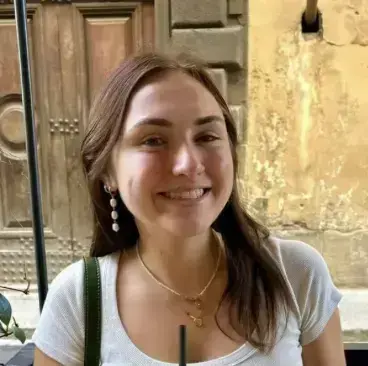
<h4>Gold Award: Abby O’Connor ’26</h4>
<figure class="image image-left"><img src="https://nanovic.nd.edu/assets/659122/gold_award.webp" alt="Smiling young woman with brown hair, white top, and pearl earrings. Historic building facade in soft focus background." width="368" height="366">
<figcaption>Abby O'Connor: Gold Award Winner</figcaption>
</figure>
<p><strong>Abby O'Connor </strong>received the gold award for her paper and presentation: “The Flight of Picasso’s ‘Guernica’: Spain’s Transition to Democracy, Historical Memory, and Integration into the European Community.”</p>
<p>Originally from Toledo, Ohio, Abby is a senior majoring in Art History and Anthropology with a European Studies minor. She has contributed to two Nanovic Institute Research Projects, Fighting for Democracy and Human Rights through the Arts and Sites of Memory in Contemporary Europe, the former involving research in Spain. Abby is currently writing an Honors Art History Senior Thesis focused on contemporary Spanish Basque site-specific sculpture's engagement with local politics, regional identity, and ecology. Beyond her research, she has worked as a student tutor and served as the president of the Art History Club and secretary of FeministND.</p>
<h4> </h4>
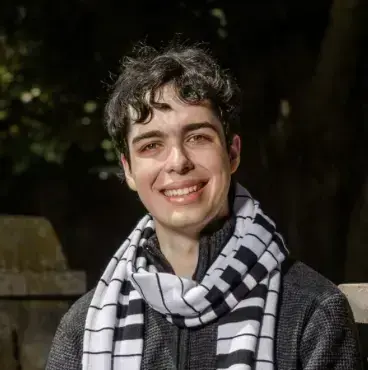
<h4>Silver Award: Ignatius Caro ’29</h4>
<figure class="image image-left"><img src="https://nanovic.nd.edu/assets/659125/silver_award.webp" alt="Young man with dark curly hair smiles, wearing a black and white checkered scarf and dark sweater." width="368" height="370">
<figcaption>Ignatius Caro: Silver Award Winner</figcaption>
</figure>
<p>Ignatius Caro received a silver award for his paper and presentation: “Warsaw and the World: An Ethnographic Analysis of the Globalized Stage of the International Chopin Piano Competition.” </p>
<p>Ignatius Caro is a first-year student studying Chemistry and Piano Performance. He is currently studying catalysis by characterizing novel organometallic structures and reactions while also exploring the various ways in which classical music manifests itself in contemporary Europe and the world. This October, he traveled to Warsaw on his first-ever international flight to research how the global perspectives of the audience and the competitors intersect on the stage of the world's oldest and largest piano competition. He extends his thanks to the Nanovic Institute for European Studies, the Glynn Family Honors Program, and the Notre Dame Arts Initiative for their generous support of his fine arts research.</p>
<hr>
<p>While these two students are officially recognized, the Nanovic Institute offers its sincere congratulations to all the students who participated. We thank all the students for participating and hope it was an impactful part of your Notre Dame journey.</p>
<p>We also look forward to next year's conference. If you are doing research in or about Europe over the next year, watch for a call for proposals or contact <a href="mailto:rkimmey@nd.edu">Dr. Roy Kimmey</a>, senior program manager for student research and academic affairs at the Nanovic Institute.</p>]]>
    </content>
    <link rel="enclosure" type="image/webp" href="https://nanovic.nd.edu/assets/659115/undergraduate_research_conference_.webp" title="Seven students, six women and one man, stand and sit smiling behind a Nanovic Institute table for the 2026 European Studies Conference."/>
    <author>
      <name>Mia Simmons</name>
    </author>
  </entry>
  <entry>
    <id>tag:nanovic.nd.edu,2005:News/181628</id>
    <published>2026-05-05T09:22:00-04:00</published>
    <updated>2026-05-12T09:26:23-04:00</updated>
    <link rel="alternate" type="text/html" href="https://nanovic.nd.edu/news/historian-katlyn-carter-wins-andrew-carnegie-fellowship-for-research-on-truth-in-early-american-politics/"/>
    <title>Historian Katlyn Carter wins Andrew Carnegie Fellowship for research on truth in early American politics</title>
    <summary type="text">
      <![CDATA[Carter, an associate professor in the Department of History, was one of 24 scholars and writers from a record 381 nominees to receive the honor. The fellowship includes a two-year grant of up to $200,000 to support research for her second book, “The Politics of Truth in Early America,” and to develop an undergraduate course aimed at the fellowship’s theme of understanding and addressing political polarization in the United States.]]>
    </summary>
    <content type="html">
      <![CDATA[<figure class="image image-right"><img src="https://news.nd.edu/assets/546009/400x/katlyn_carter_600.jpg" alt="Katlyn Carter 600" width="400" height="488">
<figcaption>Katlyn Carter, associate professor of history</figcaption>
</figure>
<p>University of Notre Dame historian <a href="https://history.nd.edu/people/katlyn-carter/">Katlyn Carter</a> has won a <a href="https://www.carnegie.org/awards/award/andrew-carnegie-fellows/">2026 Andrew Carnegie Fellowship</a>, the Carnegie Corporation of New York announced Tuesday (May 5).</p>
<p>Carter, an associate professor in the <a href="https://history.nd.edu/">Department of History</a> and faculty fellow of the <a href="https://nanovic.nd.edu/">Nanovic Institute for European Studies</a>, was one of 24 scholars and writers from a record 381 nominees to receive the honor. The fellowship includes a two-year grant of up to $200,000 to support research for her second book, “The Politics of Truth in Early America,” and to develop an undergraduate course aimed at the fellowship’s theme of understanding and addressing political polarization in the United States. The stipend is among the most generous of its kind, and previous Carnegie fellows have received numerous honors for their research, such as the Nobel Prize and National Book Award.</p>
<p>“Concern about the declining importance of truth in American politics is a crisis that can feel new to us, but Katlyn’s scholarship is a reminder that this phenomenon has existed since the founding of our country,” said <a href="https://al.nd.edu/about/people/kenneth-scheve/">Kenneth Scheve</a>, the I.A. O’Shaughnessy Dean of the <a href="https://al.nd.edu/">College of Arts &amp; Letters</a> and a professor of political science. “I’m thrilled that the Carnegie Corporation is supporting her vital research on this topic, which will provide a much-needed historical lens to a question that is so fundamental to contemporary social and political life.”</p>
<p>A historian of 18th-century America and France, Carter explores research topics inspired by issues that feel intractable in our politics today, she said.</p>
<p>In her first book, “Democracy in Darkness: Secrecy and Transparency in the Age of Revolutions,” <a href="https://al.nd.edu/news/latest-news/q-a-historian-katlyn-carter-on-studying-democracy-politics-and-truth-in-early-america/">Carter explored</a> how decisions and debates about the place of secrecy in politics during early American and French revolutionary history shaped representative democracy and addressed the realities of what it meant to make government transparent in practice.</p>
<p>The book earned the <a href="https://www.societyforfrenchhistoricalstudies.net/gilbert-chinard-prize">Gilbert Chinard Book Prize</a> from the Society for French Historical Studies, was shortlisted for the Rodel Institute’s <a href="https://rodelinstitute.org/programs/programs-edwards-book-award/">Edwards Book Award</a> for its outstanding contribution to the understanding and practice of democracy and American politics and received an honorable mention for the <a href="https://asecs.org/resources/awards-grants-fellowships/louis-gottschalk-prize/">Louis Gottschalk Prize</a> by the <a href="https://asecs.org/">American Society for 18th Century Studies</a>.</p>
<p>Through that project, Carter began developing questions about the origins of truth and trust as they related to the press and government — specifically in the United States.</p>
<p>“It’s one thing to say this group of people met in secret and talked about this, and that became a flash point. It’s another thing for people to say, ‘those people are lying to you, and I’m telling you the truth,’” Carter said. “And I just started getting really interested in tracing that in early American political debates and rhetoric.”</p>
<p>In “The Politics of Truth in Early America,” Carter will examine those large topics of truth, trust, communication technology and politics in early American history by exploring digital archives and traveling to historic research centers and libraries in Philadelphia, Boston, New York City, London, Paris and Washington, D.C.</p>
<p>She will also take the time to develop a course tentatively titled The Politics of Truth: A History, which will aim to “historicize some of the tough questions that we’re wrestling with today about truth and politics.”</p>
<p>“I want to try to take those challenges and try to break students out of this rigid political binary that we’re in right now by taking these difficult questions and translating them to history,” Carter said. “I just don’t think we can understand these challenges without understanding the history of those problems, of the political system we live in or of the way people have thought about these questions in the past.”</p>
<p>The Carnegie Fellowship class of 2026 is the third cohort focused on developing a body of rigorous, evidence-based research about what can be done to strengthen the forces of cohesion in the United States, an overarching priority for the foundation’s grant-making. The 2026 class also includes Notre Dame alumnus Wayde Marsh, who received a Ph.D. in political science in 2022 and is now an assistant professor of political science at the University of Tennessee, Knoxville.</p>
<p>With support from the Notre Dame <a href="https://provost.nd.edu/">Office of the Provost</a> and the <a href="https://franco.nd.edu/">Franco Family Institute for Liberal Arts and the Public Good</a>, Carter became the fourth Notre Dame faculty member to receive a Carnegie Fellowship. <a href="https://politicalscience.nd.edu/faculty/faculty-list/david-campbell/">David Campbell</a>, the Packey J. Dee Professor of American Democracy, and <a href="https://kroc.nd.edu/faculty-and-staff/atalia-omer/">Atalia Omer</a>, professor of religion, conflict and peace studies in the <a href="https://keough.nd.edu/">Keough School of Global Affairs</a>, both won in 2017, and political scientist Sarah Zukerman Daley <a href="https://al.nd.edu/news/latest-news/political-scientist-sarah-daly-awarded-2018-andrew-carnegie-fellowship/">won in 2018</a>.</p>
<p>“There was a team of people at Notre Dame who are really skilled at what they’re doing and who really helped me deliver the message clearly and connect to the theme of the fellowship,” Carter said. “Important research and scholarship that connects with people and helps inform and work on current challenges takes time. This fellowship actually gives researchers time to read and think, which is increasingly rare in a society that really likes to push for efficiency and going fast. That’s really valuable.”</p>
<p class="attribution">Originally published by <span class="rel-author">Mary Kinney</span> at <span class="rel-source"><a href="https://news.nd.edu/news/historian-katlyn-carter-wins-andrew-carnegie-fellowship-for-research-on-truth-in-early-american-politics/">news.nd.edu</a></span> on <span class="rel-pubdate">May 05, 2026</span>.</p>]]>
    </content>
    <link rel="enclosure" type="image/jpeg" href="https://nanovic.nd.edu/assets/659374/katlyn_carter_1000.jpg" title="Katlyn Carter 1000"/>
    <author>
      <name>Mary Kinney</name>
    </author>
  </entry>
  <entry>
    <id>tag:nanovic.nd.edu,2005:News/181283</id>
    <published>2026-04-27T09:13:00-04:00</published>
    <updated>2026-04-30T09:14:34-04:00</updated>
    <link rel="alternate" type="text/html" href="https://nanovic.nd.edu/news/barbara-jatta-explores-art-as-an-instrument-of-hope-at-forums-closing-event/"/>
    <title>Barbara Jatta explores art as an instrument of hope at Forum’s closing event</title>
    <summary type="text">
      <![CDATA[As part of the Sesquicentennial Celebration of the University of Notre Dame Art Museum, Barbara Jatta, director of the Vatican Museums, spoke on campus Tuesday (April 21) for a conversation titled “Art and the Museum as Instruments of Hope.” The event, which also served as the final keynote event of the 2025-26 Notre Dame Forum on “Cultivating Hope,” explored the intersections of the arts, faith, history, and education.]]>
    </summary>
    <content type="html">
      <![CDATA[<p>As part of the <a href="https://raclinmurphymuseum.nd.edu/about/news/bridging-time-and-place-the-150th-anniversary-of-the-university-of-notre-dame-art-museum/">Sesquicentennial Celebration of the University of Notre Dame Art Museum</a>, Barbara Jatta, director of the Vatican Museums, spoke on campus Tuesday (April 21) for a conversation titled “Art and the Museum as Instruments of Hope.”</p>
<p>The event, which also served as the final keynote event of the 2025-26 Notre Dame Forum on “Cultivating Hope,” explored the intersections of the arts, faith, history, and education.</p>
<p>University President <a href="https://president.nd.edu/about/">Rev. Robert A. Dowd, C.S.C.</a>, welcomed Jatta and noted Notre Dame’s 150-year history with the Vatican Museums.</p>
<p>“That connection began when Notre Dame founder Father Edward Sorin invited Vatican artist Luigi Gregori to campus to serve as artist-in-residence and also director of our art department,” Father Dowd said. “And that single invitation really has shaped Notre Dame’s visual identity.”</p>
<p>Jatta sat down for a conversation with <a href="https://artdept.nd.edu/people/heather-minor/">Heather Hyde Minor</a>, the R.L. Canala Professor of Art History at Notre Dame and former academic director of Notre Dame Rome. Noting that it was the first anniversary of the death of Pope Francis, Hyde Minor and Jatta discussed the challenges and range of emotions over the last year for Jatta and her colleagues with his passing and the election of Pope Leo XIV, which included preparing the Sistine Chapel within the museums for the papal conclave.</p>
<p>Jatta also discussed touring the Raclin Murphy Museum of Art and stated that it is important for a university to have a wide range of collections—as the Raclin Murphy does—to build bridges across cultures.</p>
<p>“From Renaissance times and even before, I can say art was a vehicle to represent the invisible, to represent spiritual values,” Jatta said, “but also to testify to legacy and knowledge and to be part of the values of different cultures and bring them together, and to testify to the truth in Christianity and in the Catholic Church.”</p>
<p>Following the conversation, Jatta took questions from the audience, encouraging students to continue to pursue the arts and humanities.</p>
<p>“What I can tell you, the students, is to never forget the humanistic side of your life,” she said. “Because that will help you to know your history — to know who preceded you, to know the heritage of where you come from or where your ancestors came from or where your country came from. It is so important in order to be a better person.”</p>
<p><a href="https://youtu.be/593uYRMv7MY"><em>Watch a full recording of the conversation. </em></a></p>
<p class="attribution">Originally published by <span class="rel-author">Carrie Gates</span> at <span class="rel-source"><a href="https://news.nd.edu/news/barbara-jatta-explores-art-as-an-instrument-of-hope-at-forums-closing-event/">news.nd.edu</a></span> on <span class="rel-pubdate">April 27, 2026</span>.</p>]]>
    </content>
    <link rel="enclosure" type="image/jpeg" href="https://nanovic.nd.edu/assets/658145/forum_barbara_jatta_1200.jpg" title="Woman in green top and white pants listens to woman in rust pleated pantsuit speaking and gesturing on a stage. Audience looks on."/>
    <author>
      <name>Carrie Gates</name>
    </author>
  </entry>
  <entry>
    <id>tag:nanovic.nd.edu,2005:News/181007</id>
    <published>2026-04-22T15:37:00-04:00</published>
    <updated>2026-04-22T15:37:45-04:00</updated>
    <link rel="alternate" type="text/html" href="https://nanovic.nd.edu/news/sowing-seeds-of-hope-vatican-partnership-advances-global-sustainability/"/>
    <title>Sowing seeds of hope: Vatican partnership advances global sustainability</title>
    <summary type="text">
      <![CDATA[As the Vatican seeks to bring Pope Francis’s vision to life, it has asked the University of Notre Dame—an institution that has also sought to enact the principles of Laudato si’ in its teaching, research, and operations—to serve as an academic partner.]]>
    </summary>
    <content type="html">
      <![CDATA[<figure class="image image-default"><img src="https://news.nd.edu/assets/657229/fullsize/borgo_laudato_si_1200.jpg" alt="Extensive terraced gardens featuring intricate green hedges, yellow, white, and purple flowers, an old stone wall, and tall trees." width="1200" height="800">
<figcaption>The Borgo Laudato Si’, located in the scenic hills of Castel Gandolfo southeast of Rome is home to the Laudato Si’ Higher Education Center. (Photo by Alessandro Sgarito)</figcaption>
</figure>
<p>On February 2, 2023, the late Pope Francis founded the Laudato Si’ Higher Education Center to begin transforming the gardens of Villa Barberini and the Pontifical Villas into a place of training in integral ecology — a framework that seeks to care for both nature and the most vulnerable among us.</p>
<p>“He said, ‘Let’s create an educational center here, but also a spiritual center,’” said Rev. Daniel Groody, C.S.C., the vice president and associate provost for undergraduate education, professor of theology and global affairs, and Nanovic Faculty Fellow at Notre Dame. “Here’s a place to encounter the beauty of nature that God has created — and a place that can facilitate an ecological conversion.”</p>
<p>Pope Leo XIV, who has likewise emphasized sustainability as one of his major priorities, dedicated the Borgo Laudato Si’ last fall, calling it “a seed of hope” that promises to bear the fruits of justice and peace.</p>
<p>As the Vatican seeks to bring Pope Francis’s vision to life, it has asked the University of Notre Dame — an institution that has also sought to enact the principles of <em>Laudato si’</em> in its teaching, research, and operations — to serve as an academic partner.</p>
<p><a href="https://stories.nd.edu/stories/borgo/" class="btn">Read the story</a></p>
<p class="attribution">Originally published by <span class="rel-author">Carrie Gates</span> at <span class="rel-source"><a href="https://news.nd.edu/news/sowing-seeds-of-hope-vatican-partnership-advances-global-sustainability/">news.nd.edu</a></span> on <span class="rel-pubdate">April 22, 2026</span>.</p>]]>
    </content>
    <link rel="enclosure" type="image/jpeg" href="https://nanovic.nd.edu/assets/657248/borgo_laudato_si_1200.jpg" title="Extensive terraced gardens featuring intricate green hedges, yellow, white, and purple flowers, an old stone wall, and tall trees."/>
    <author>
      <name>Carrie Gates</name>
    </author>
  </entry>
  <entry>
    <id>tag:nanovic.nd.edu,2005:News/181010</id>
    <published>2026-04-14T15:49:00-04:00</published>
    <updated>2026-04-22T15:49:56-04:00</updated>
    <link rel="alternate" type="text/html" href="https://nanovic.nd.edu/news/statement-from-university-president-rev-robert-a-dowd-c-s-c-in-support-of-pope-leo-xiv/"/>
    <title>Statement from University President Rev. Robert A. Dowd, C.S.C., in support of Pope Leo XIV</title>
    <summary type="text">
      <![CDATA[“Pope Leo XIV continues to proclaim the Gospel of Christ by upholding human dignity and serving as a tireless advocate for peace. His message transcends partisan political divisions in this or any country and I’m deeply grateful for Pope Leo’s inspiring example. I ask members of the Notre Dame community to pray for peace and work together with all people of goodwill to build a more just and humane world.”    Rev. Robert A. Dowd, C.S.C.President, University of Notre Dame]]>
    </summary>
    <content type="html">
      <![CDATA[<div dir="ltr">
<div>“Pope Leo XIV continues to proclaim the Gospel of Christ by upholding human dignity and serving as a tireless advocate for peace. His message transcends partisan political divisions in this or any country and I’m deeply grateful for Pope Leo’s inspiring example. I ask members of the Notre Dame community to pray for peace and work together with all people of goodwill to build a more just and humane world.”</div>
<div> </div>
<div>
<p><strong>Rev. Robert A. Dowd, C.S.C.<br></strong><strong>President, University of Notre Dame</strong></p>
</div>
</div>
<div>
<div class="adm">
<div id="q_1474" class="ajR h4"></div>
</div>
</div>
<p class="attribution">Originally published by <span class="rel-author">Notre Dame News</span> at <span class="rel-source"><a href="https://news.nd.edu/news/statement-from-university-president-rev-robert-a-dowd-c-s-c-in-support-of-pope-leo-xiv/">news.nd.edu</a></span> on <span class="rel-pubdate">April 13, 2026</span>.</p>]]>
    </content>
    <link rel="enclosure" type="image/jpeg" href="https://nanovic.nd.edu/assets/657252/feature_university_seal.jpg" title="University Seal"/>
    <author>
      <name>Notre Dame News</name>
    </author>
  </entry>
  <entry>
    <id>tag:nanovic.nd.edu,2005:News/181008</id>
    <published>2026-04-02T15:44:00-04:00</published>
    <updated>2026-04-22T15:45:46-04:00</updated>
    <link rel="alternate" type="text/html" href="https://nanovic.nd.edu/news/irish-language-academic-conference-at-notre-dame-london-may-be-first-of-its-kind-in-the-uk/"/>
    <title>Irish-Language Academic Conference at Notre Dame London First of Its Kind in the UK</title>
    <summary type="text">
      <![CDATA[Conference delegates at Notre Dame London  Leading scholars of the…]]>
    </summary>
    <content type="html">
      <![CDATA[<figure class="image image-right"><img src="https://london.nd.edu/assets/652278/fullsize/img_0059.jpeg" alt="About 20 people smiling for the camera in a conference room" width="4017" height="2128">
<figcaption>Conference delegates at Notre Dame London</figcaption>
</figure>
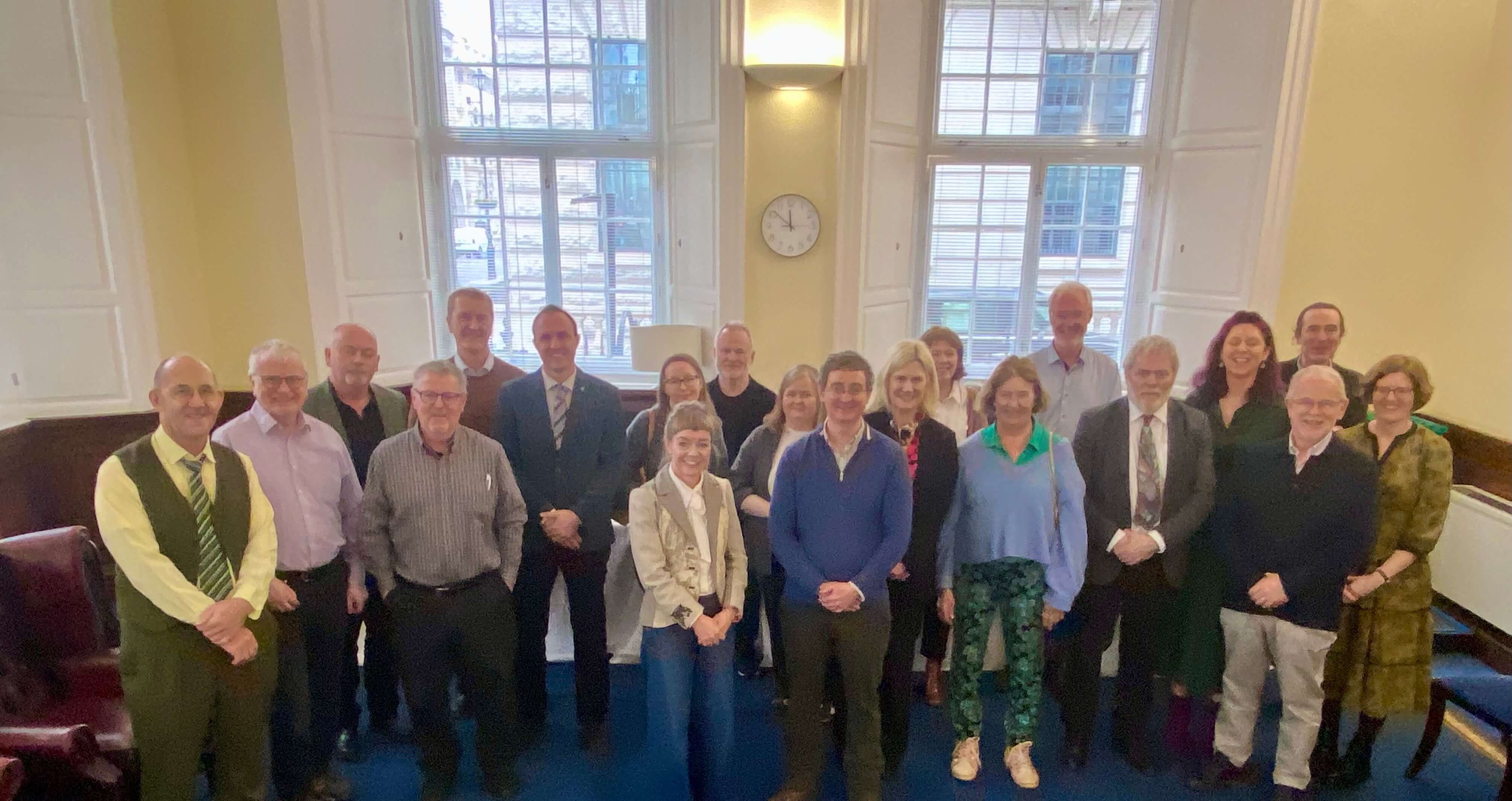
<p>Leading scholars of the Irish language from across Europe and North America gathered in central London last week for In ÉiNDí 2026, an academic seminar conducted entirely in the Irish language and hosted at Notre Dame London.</p>
<p>According to the seminar’s organizer, <a href="https://irishlanguage.nd.edu/people/brian-o-conchubhair/">Brian Ó Conchubhair</a>, Professor of Irish Language and Literature and Nanovic Faculty Fellow at the University of Notre Dame, the gathering is an important moment for Irish-language scholarship in Britain.</p>
<p>“To our knowledge, this may be the first academic conference hosted in the UK that is conducted entirely through Irish,” Ó Conchubhair said. “It reflects the growing international community of scholars who use Irish as a language of research and intellectual exchange.”</p>
<p>Hosting the seminar in London reflects the global reach of Irish-language scholarship. As an international center for the study of Ireland and its language, the University of Notre Dame has long played a leading role in advancing Irish studies beyond Ireland. In ÉiNDí 2026 represents an example of this commitment, bringing scholars together in a global setting to strengthen Irish as a language of research and intellectual exchange. The seminar's organizer, Brian Ó Conchubhair is a fellow of the <a href="https://irishstudies.nd.edu/">Keough-Naughton Institute for Irish Studies</a> in the <a href="https://keough.nd.edu/">Keough School of Global Affairs</a> and a leader of the <a href="https://irishlanguage.nd.edu/">Irish Language Initiative</a> in Notre Dame’s<strong> </strong><a href="al.nd.edu">College of Arts and Letters</a>.</p>
<figure class="image image-left"><img src="https://london.nd.edu/assets/652281/img_0085.jpeg" alt="A woman presents from a podium. Text in Irish language is on screen behind her" width="600" height="450">
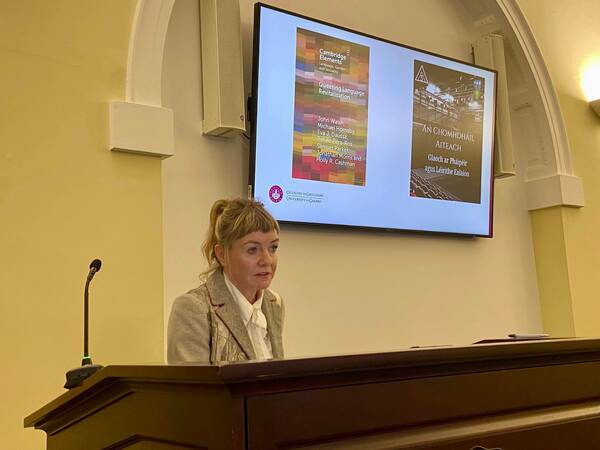
<figcaption>Prof. Rióna Ní Fhrighil, University of Galway, presenting at In ÉiNDí 2026</figcaption>
</figure>
<p>The two-day seminar featured keynote lectures from leading Irish-language scholars, including <a href="https://www.asnc.cam.ac.uk/people/M%C3%A1ire.N%C3%AD_Mhaonaigh/">Máire Ní Mhaonaigh</a> of University of Cambridge, <a href="https://www.smu.ca/irish-studies/padraig-o-siadhail.html">Pádraig Ó Siadhail</a> of University of St Mary’s University Halifax, and <a href="https://www.ucy.ac.cy/directory/en/profile/jlittl01">James Little</a> of the University of Cyprus. Presenters also included scholars from universities across Ireland and beyond, with representatives from every major Irish university participating in the programme.</p>
<p>Beyond textual scholarship, the seminar also explored how Irish-language sources can be used for deeper understanding of broader social and historical questions. Presentations examined topics ranging from the emotional lives reflected in medieval texts to Irish-language responses to global political issues, including reactions to apartheid in South Africa. These topics show that the Irish language has always been a medium for responding to global human rights issues and internal psychological states.</p>
<p>The seminar also addressed contemporary concerns facing Irish-speaking communities. For example, sessions explored topics such as language use in healthcare settings and the ways in which Irish speakers navigate both Gaeltacht (Irish-speaking) communities and the wider English-speaking world.</p>
<figure class="image image-right"><img src="https://london.nd.edu/assets/652282/img_0079.jpeg" alt="A man presents from a podium. Text in Irish language is on screen behind him" width="600" height="450">
<figcaption>Prof. Fionntán de Brún, Maynooth University presenting at In ÉiNDí 2026</figcaption>
</figure>
<p>Discussions highlighted how the field is evolving to reach new generations of scholars and students. Digital tools and resources, such as the Electronic Dictionary of the Irish Language (eDIL), are making centuries of Irish-language material more accessible, helping to connect traditional Irish Studies with the research habits and expectations of a digital-native Generation Z.</p>
<p>“The timing of the event in 2026 is a significant milestone,” said Ó Conchubhair. “With sessions tracing the history of Irish programs from 1972 to 2026, the seminar offers a moment to reflect on more than fifty years of institutional progress. It is both a celebration of survival and an opportunity to think strategically about the future of the language in a globalized world, ensuring that Irish remains a vibrant, intellectual, and research-driven language on the world stage.”</p>
<p><a href="https://irishlanguage.nd.edu/">Learn more</a> about Irish Language Initiatives at Notre Dame. </p>
<p class="attribution">Originally published by <span class="rel-author">Joanna Byrne</span> at <span class="rel-source"><a href="https://london.nd.edu/news-stories/news/irish-language-academic-conference-at-notre-dame-london-may-be-first-of-its-kind-in-the-uk/">london.nd.edu</a></span> on <span class="rel-pubdate">March 17, 2026</span>.</p>]]>
    </content>
    <link rel="enclosure" type="image/jpeg" href="https://nanovic.nd.edu/assets/657250/img_0059.jpeg" title="About 20 people smiling for the camera in a conference room"/>
    <author>
      <name>Joanna Byrne</name>
    </author>
  </entry>
  <entry>
    <id>tag:nanovic.nd.edu,2005:News/180551</id>
    <published>2026-04-01T11:10:00-04:00</published>
    <updated>2026-04-01T11:10:23-04:00</updated>
    <link rel="alternate" type="text/html" href="https://nanovic.nd.edu/news/historian-stephen-kotkin-urges-u-s-to-apply-lessons-of-history-in-shifting-global-order/"/>
    <title>Historian Stephen Kotkin urges U.S. to apply lessons of history in shifting global order</title>
    <summary type="text">
      <![CDATA[Historian…]]>
    </summary>
    <content type="html">
      <![CDATA[<figure class="image image-right"><img src="https://keough.nd.edu/assets/654987/original/stephen_kotkin_notre_dame.webp" alt="Two men on stage. One in a dark suit holds a mic. The other, in gray, gestures while speaking. University of Notre Dame on screen." width="1200" height="800">
<figcaption>Historian Stephen Kotkin recently spoke at Notre Dame as part of the Dean’s Forum on Global Affairs. He explored how the United States can make strategic adjustments as it manages great power competition with China and Russia and a conflict with Iran.</figcaption>
</figure>
<p>The United States can learn from history as it navigates a future geopolitical landscape, historian Stephen Kotkin said during a recent talk at the University of Notre Dame.</p>
<p>At a time when the United States is experiencing great power competition with China and Russia and managing a conflict with Iran, Kotkin, the Kleinheinz Senior Fellow at Stanford University’s Hoover Institution, said the United States has long faced an imperative to make strategic adjustments. These adjustments are coming, finally, well after the time when U.S. economic and military global preeminence has returned to a more historical average after a relatively brief if crucial period of post-Second World War II high, he said.</p>
<p>“The study of history can be valuable for understanding the contemporary world and what the world might become,” Kotkin said during his March 18 lecture. The event was part of the Dean’s Forum on Global Affairs, presented by the University of Notre Dame’s <a href="https://keough.nd.edu">Keough School of Global Affairs</a> with support from its <a href="https://nanovic.nd.edu">Nanovic Institute for European Studies</a>.</p>
<h2>A global rebalancing</h2>
<p>Kotkin based his presentation on the concept of anomalous periods, citing 1919, the time of the Versailles Peace Treaty after the First World War, when both Germany and Russia were, for the first and only time, “flat on their backs” simultaneously. The peace treaty was imposed on Germany and excluded Russia. But at least one, and perhaps both, could be expected to rise again. Both did so, and in a single generation.</p>
<p>Similarly, Kotkin explained, the period immediately after the Second World War was anomalous. He noted that, roughly since 1880, the United States’ share of global GDP has averaged about 25 percent. After World War II, however, this figure jumped significantly to 40 percent, while simultaneously the U.S. share of global manufacturing increased to 50 percent. That is when the U.S. committed to a colossally ambitious postwar order, Kotkin said. </p>
<p>Citing John F. Kennedy’s inaugural address, at the peak of U.S. power, Kotkin underscored the extraordinary confidence the president exuded. “Let every nation know, whether it wishes us well or ill,” Kennedy stated, “that we shall pay any price, bear any burden, meet any hardship, support any friend, oppose any foe to assure the survival and the success of liberty.”</p>
<p>Kotkin stressed that a historical lens could have helped foresee that the time when the U.S. committed to creating and defending a global postwar order was an anomalous period that could not last. More than that, he explained, U.S. leaders did not want to keep this imbalance in place. Instead, they committed to “rebalancing” the scales because they believed promoting global peace and prosperity would ensure U.S. peace and prosperity.</p>
<p>The plan worked well, Kotkin said, and the United States is back at its long-term average of global GDP.</p>
<p>Meanwhile, the U.S. government has announced, many times, that it must rebalance its commitments — but it never did so until now. In Kotkin’s view, this inescapable rebalancing has begun. It is happening haphazardly, even nastily, he said, but it cannot be avoided.</p>
<p>Kotkin noted that the U.S. is not in decline, but its key allies have declined, in relative terms. He cited that Europe’s share of global GDP has decreased over time, from about 30 percent in 1992 to 17 percent today (including the U.K.). Japan’s global share once climbed to nearly 18 percent, but today it is 4 percent. The U.S. share looks set to continue at its 150-year historic average, he said. </p>
<p>In recent years, under both Democratic and Republican leadership, the U.S. military has operated under a policy of maintaining the operational capacity for a single major theater of war at a time, Kotkin said; previously, it had planned to handle multiple conflicts at once. The U.S. continues to have treaty commitments in multiple theaters.</p>
<h2>“Borders of victory” vs. “borders of defeat”</h2>
<p>Kotkin also compared the Cold War — which never became a direct U.S.-Soviet conflict — to today’s conflicts (including Russia’s invasion of Ukraine), which he said carry a higher risk of widening to a Third World War.</p>
<p>The Soviet Union, like the United States, negotiated as a victor against the Axis Powers after the Second World War, Kotkin said. The borders it established were what he characterized as “borders of victory.” It could become, more or less, a status quo power.</p>
<p>In contrast, Kotkin argued that adversaries with “borders of defeat” are far harder to negotiate with, and more likely to spark conflict. He cited Russia’s invasion of Ukraine as an example; the border was created after the independence of Ukraine and the subsequent establishment of a democratic government. For Russia, it is a border of defeat.</p>
<p>Kotkin suggested similarly that Iran and many Arabs view the existence of Israel as a border of defeat — one that must be eliminated — and that Taiwan is the ultimate border of defeat for Communist-run China.</p>
<h2>Preventing a deadly world war</h2>
<p>Kotkin said his greatest concern is the potential for a Third World War, which he believes would be exponentially more catastrophic than the last.</p>
<p>Part of the risk, he said, comes from a few leaders having excessively concentrated power to take actions precipitating a global conflict.</p>
<p>“I worry because it's the biggest possible decision... and one person can make that decision,” Kotkin said, referring to Chinese leader Xi Jinping. Using historical examples from Pearl Harbor to Putin’s war in Ukraine, Kotkin added that world-shattering decisions can be made with little regard for the costs — including the lives of vast numbers of people — by a select few individuals.</p>
<p>Even in the United States, in different ways, he said, there is a concentration of authority in the form of the “imperial presidency,” a term coined some fifty years ago by historian Arthur M. Schlesinger, Jr., to underscore how Congress “has effectively abdicated its power.”</p>
<p>This vacuum, he said, allows the president to take the nation to war without popular support or even debate. When considered in light of the far greater concentrations of power in China and Russia, this could compound the risk of a wider conflict.</p>
<p class="attribution">Originally published by <span class="rel-author">Keith Sayer</span> at <span class="rel-source"><a href="https://keough.nd.edu/news-and-events/news/historian-stephen-kotkin-urges-u-s-to-apply-lessons-of-history-in-shifting-global-order/">keough.nd.edu</a></span> on <span class="rel-pubdate">April 01, 2026</span>.</p>]]>
    </content>
    <link rel="enclosure" type="image/jpeg" href="https://nanovic.nd.edu/assets/654999/stephen_kotkin_notre_dame_1_.jpg" title="Two men on stage. One in a dark suit holds a mic. The other, in gray, gestures while speaking. University of Notre Dame on screen."/>
    <author>
      <name>Keith Sayer</name>
    </author>
  </entry>
  <entry>
    <id>tag:nanovic.nd.edu,2005:News/180451</id>
    <published>2026-03-30T07:11:00-04:00</published>
    <updated>2026-03-31T07:11:21-04:00</updated>
    <link rel="alternate" type="text/html" href="https://nanovic.nd.edu/news/vice-president-and-associate-provost-rev-daniel-groody-c-s-c-appointed-by-pope-leo-xiv-to-dicastery-for-promoting-integral-human-development/"/>
    <title>Vice president and associate provost Rev. Daniel Groody, C.S.C., appointed by Pope Leo XIV to Dicastery for Promoting Integral Human Development</title>
    <summary type="text">
      <![CDATA[Pope Leo XIV has appointed Rev. Daniel Groody, C.S.C., the vice president and associate provost for undergraduate education and professor of theology and global affairs at the University of Notre Dame, as a member of the Dicastery for Promoting Integral Human Development, the Vatican announced today.]]>
    </summary>
    <content type="html">
      <![CDATA[<p>Pope Leo XIV has appointed <a href="https://provost.nd.edu/people/rev-daniel-g-groody-c-s-c/">Rev. Daniel Groody, C.S.C.</a>, the vice president and associate provost for undergraduate education and professor of theology and global affairs at the University of Notre Dame, as a member of the Dicastery for Promoting Integral Human Development, the Vatican announced today.</p>
<p>Established by the late Pope Francis in 2016, the Dicastery for Promoting Integral Human Development supports the Church’s worldwide efforts in the areas of human dignity and human rights, economic justice, care for creation, migration and displacement, as well as peace, conflict and humanitarian crises.</p>
<p>As a dicastery member, Father Groody will contribute to the body’s ongoing discernment process that will help orient the Church’s mission and priorities. He will continue in his roles at Notre Dame while serving the dicastery.</p>
<p>While numerous Notre Dame faculty members have served the Vatican as consultants to dicasteries and have been named to pontifical academies and commissions, Father Groody’s appointment is a distinct honor, noted University President <a href="https://president.nd.edu/about/">Rev. Robert A. Dowd, C.S.C.</a></p>
<p>“To be called upon by the Holy See to serve in this capacity is a testament to Father Groody’s deep commitment to leadership in service of the most vulnerable among us. This appointment is also an affirmation of Notre Dame’s ongoing contributions to Catholic social thought, to integral ecology and to forming leaders dedicated to the common good,” Father Dowd said. “I am profoundly grateful for Father Groody’s dedication to the University and to the Church, and I am confident that his leadership will be a tremendous blessing as he helps to guide the Church in these areas.”</p>
<p>The most notable precedent in Notre Dame history is the appointment of then-President Rev. Theodore M. Hesburgh, C.S.C., as a member of the Pontifical Council for Culture by Pope St. John Paul II in 1983.</p>
<p>“I am truly honored and humbled by Pope Leo’s appointment,” Father Groody said. “My vocation is to serve, together with my colleagues at Notre Dame and around the world. The work of the Dicastery for Promoting Integral Human Development is vital to informing the Church’s response to the world’s most vulnerable people and the most pressing global challenges of our time.”</p>
<p>Father Groody’s academic and pastoral work has focused in part on migration, theology, refugees and human displacement — areas that are directly relevant to the mandate of the Dicastery for Promoting Integral Human Development. An internationally recognized expert on migration, Father Groody is also an award-winning author, teacher and documentary film producer. He has written four books and numerous articles and has edited or co-edited five books. His works have been translated into nine languages.</p>
<p>Father Groody’s <a href="https://news.nd.edu/news/new-book-examines-the-plight-of-migrants-from-a-christian-perspective/">most recent book</a>, “A Theology of Migration: The Bodies of Refugees and the Body of Christ,” includes an introduction written by Pope Francis and received first-place recognition from the Catholic Press Association.</p>
<p>This announcement follows Father Groody’s appointment under Pope Francis in 2025 to the General Council of the Laudato Si’ Higher Education Center in Castel Gandolfo, which is now known as Borgo Laudato Si’.</p>
<p>In that role, Father Groody helps shape the vision, direction and formation of the center, as well as advising on initiatives and global partnerships. He also plays an essential role in Notre Dame’s <a href="https://news.nd.edu/news/notre-dame-partners-with-vatican-to-establish-global-alliance-dedicated-to-integral-ecology-and-global-sustainability/">recently announced partnership with the Vatican’s Laudato Si’ Center to establish a Global Alliance</a> dedicated to integral ecology and global sustainability.</p>
<p><em><strong>Contact: </strong>Carrie Gates, associate director of media relations, 574-993-9220, <a href="mailto:c.gates@nd.edu">c.gates@nd.edu</a></em></p>
<p class="attribution">Originally published by <span class="rel-author">Carrie Gates</span> at <span class="rel-source"><a href="https://news.nd.edu/news/vice-president-and-associate-provost-rev-daniel-groody-c-s-c-appointed-by-pope-leo-xiv-to-dicastery-for-promoting-integral-human-development/">news.nd.edu</a></span> on <span class="rel-pubdate">March 30, 2026</span>.</p>]]>
    </content>
    <link rel="enclosure" type="image/jpeg" href="https://nanovic.nd.edu/assets/654653/pope_leo_father_groody_1200.jpg" title="Pope Leo XIV in white smiles, shaking hands with Father Dan Groody, a priest with grey hair and glasses wearing in black. A large crucifix is nearby."/>
    <author>
      <name>Carrie Gates</name>
    </author>
  </entry>
  <entry>
    <id>tag:nanovic.nd.edu,2005:News/180093</id>
    <published>2026-03-26T08:00:00-04:00</published>
    <updated>2026-03-24T15:29:10-04:00</updated>
    <link rel="alternate" type="text/html" href="https://nanovic.nd.edu/news/a-town-for-all-human-dignity-and-employee-housing-in-bavarian-and-tyrolean-ski-villages/"/>
    <title>A Town for All: Human Dignity and Employee Housing in Bavarian and Tyrolean Ski Villages</title>
    <summary type="text">
      <![CDATA["When a disconnect occurs between those who live in the town and those who work for it, a true community can never be fully formed."  Woven through the streets of ski towns in the Bavarian and Tyrolean regions of Germany and Austria are a variety of building…]]>
    </summary>
    <content type="html">
      <![CDATA[<blockquote class="pull">
<p>"When a disconnect occurs between those who live in the town and those who work for it, a true community can never be fully formed."</p>
</blockquote>
<p>Woven through the streets of ski towns in the Bavarian and Tyrolean regions of Germany and Austria are a variety of building types. Within a five minute walk, one can see civic meeting houses, beautiful Catholic churches, large university buildings, and housing complexes. Urbanists have been studying and taking lessons from these urban environments in order to bring some of these practices to our town structures at home. In towns where this is successful, residents can go about their daily tasks without the use of a car, resulting in stronger communities and healthier environments. Ski towns in Colorado, such as Vail, Aspen, and Steamboat Springs, have adopted these walkable methods with a positive result.</p>
<figure class="image image-left"><a href="https://nanovic.nd.edu/assets/652834/original/gapa_5jpg.jpg"><img src="https://nanovic.nd.edu/assets/652834/400x/gapa_5jpg.jpg" alt="1930s buildings lining the street which connects Garmisch and Partenkirchen." width="400" height="267"></a>
<figcaption>1930s buildings lining the street which connects Garmisch and Partenkirchen.</figcaption>
</figure>
<p>Yet, issues of affordability—and as a result, inclusion of people of all income levels in a community—still prevail in these affluent towns. Due in part to a shortage in housing, but more because of lack of a variety of housing options, many employees in these towns who work on the slopes or in hospitality cannot even live in the towns in which they work. When a disconnect occurs between those who live in the town and those who work for it, a true community can never be fully formed. In order to uphold the human dignity of all who live and work within a community, we can again turn our eyes to the towns abroad which, in their much longer histories, have faced this problem before and adopted effective solutions. In this research trip, I studied the urban structure, architectural form, and building techniques of ski towns in the Bavarian and Tyrolean regions of the Alps in order to examine how they provide a place to live for all residents and create a welcoming community for all.</p>
<figure class="image image-right"><img src="https://nanovic.nd.edu/assets/652842/400x/lu_ftlmalerei_in_gapajpg.jpg" alt="Lüftlmalerei, or house fresco paintings, in Garmisch-
Partenkitchen." width="400" height="267">
<figcaption>Lüftlmalerei, or house fresco paintings, in Garmisch-Partenkitchen.</figcaption>
</figure>
<p>I began my studies in the town of Garmisch-Partenkitchen, in the Bavarian region of Germany. Founded as two towns, Garmisch and Partenkirchen, they were united in 1936 by Hitler in order to host the Winter Olympics. The town of Garmsich sits to the west, while the older town of Partenkitchen is to the east. In the present day, the towns are united by a connecting street lined with buildings from the 1930s. On an urban scale, each town center has one main street, lined with civic and mixed-use commercial and residential buildings. In Garmsich, these buildings are a smaller scale of two to three stories, while in Partenkirchen they go as high as five stories. The buildings are constructed of wood, a resource abundant in the area, and covered in stucco. The art of Lüftlmalerei, or fresco house painting, is used on most buildings in the center of both towns, depicting a variety of scenes from biblical stories to classical motifs of everyday life in the region. These buildings are considered the high style of the region, due to the scale and the intense detail put into their facades.</p>
<figure class="image image-left"><img src="https://nanovic.nd.edu/assets/652838/400x/gapa_4jpg.jpg" alt="A Bavarian home." width="400" height="267">
<figcaption>A Bavarian home.</figcaption>
</figure>
<p>Beyond these main town centers are streets leading up hills towards the mountains with freestanding buildings of the Bavarian housing type. While unassuming and humble in their vernacular form, these buildings were essential to my studies as they provide the housing that can be lacking in American ski towns. Built on a small scale, these buildings are typically constructed with heavy timber frame construction, with the ground floor covered in plaster and the upper floors wooden. On the street, these buildings appear small in scale, with two habitable floors. However, upon further inspection, the small building can hold a high density, with an extra floor or two within the pitched roofs. This is how the town stays relatively dense within a short walking distance of the town center. On these streets, some freestanding buildings are homes for just a single family, while others have many mailboxes outside and host small scale apartments for many residents. Keeping with the mountain urban characteristics, all of these buildings have small yards and porches, which are communal in the apartment buildings and private for the single-family homes.</p>
<figure class="image image-right"><a href="https://nanovic.nd.edu/assets/652839/original/gapa_1jpg.jpg"><img src="https://nanovic.nd.edu/assets/652839/400x/gapa_1jpg.jpg" alt="Walking path between houses in Garmisch-Partenkitchen." width="400" height="267"></a>
<figcaption>Walking path between houses in Garmisch-Partenkitchen.</figcaption>
</figure>
<p>Starting in the town of Garmisch, and weaving through the city into Partenkitchen and eventually to the Olympic Stadium situated south of the town is a walking path. This path works its way through the backyards of these houses, allowing yet another way of walking safely around Garmnisch-Partenkirchen. In this Bavarian town, the integration of walking paths and friendly roads within a short walk of the town center, the density of the housing type, as well as the construction methods that rely on local materials were all important to note and important to consider integrating into ski towns in North America.</p>
<p>St. Anton am Arlberg, a small ski town in the Tyrol region of northern Austria, was my second stop on this trip. The town is known as the “birthplace of modern skiing” due to its influence on ski culture in the United States, as many ski instructors from the area emigrated to the U.S. in the 1930s and helped to popularise the sport. St. Anton follows a similar urban form to many ski towns, with one main street lined with mostly mixed-used residential and commercial buildings, and pockets opening up to small squares for the bases of the ski lifts and gondolas. As a result, many of the buildings on the main street are double-fronted, and the side with views up the mountain is typically reserved for higher-value rooms or nice restaurants. Due to its close proximity to the ski slopes, St. Anton’s vernacular architecture has an abundance of porches, oftentimes on every floor of the buildings. This serves the urban character as well, as even when it was chilly outside there were still a few people out on their porches looking up at the view.</p>
<figure class="image image-left"><a href="https://nanovic.nd.edu/assets/652844/original/st_anton_3jpg.jpg"><img src="https://nanovic.nd.edu/assets/652844/400x/st_anton_3jpg.jpg" alt="Large-scale housing near the slopes of St. Anton." width="400" height="267"></a>
<figcaption>Large-scale housing near the slopes of St. Anton.</figcaption>
</figure>
<p>A major way in which St. Anton differed from Garmisch-Partenkirchen is that the main urban spine continues out of the city from the main street as just one street. In Garmisch-Partenkirchen, many streets branched off from the town center and each other, forming an organic, interconnected street network. On the other hand, in St. Anton, the one road leading out of the town center in both directions resulted in a long progression of homes and apartment buildings leading far out of town, only easily accessible by car. As a result, many cars traveled at high speeds down this road in order to reach either the slopes or their homes faster, making for a potentially unsafe pedestrian walking experience on a road that just barely accommodates two cars side by side. Despite this urban fault, the housing accommodations along these roads were still great examples of high density housing to accommodate a variety of incomes and traditional construction using local materials. The Villa Trier is an elevated vernacular example of this style, and was studied for its excellent construction methods—especially the implementation of wood on the exterior and interior.</p>
<p>At the end of my travels, I was completely inspired by the functional and timeless architecture and urban form of these regions. The connection to the town centers fosters a strong sense of community, and the vernacular architecture, which can be elevated or left in its simplest form, provides a dignified space for all to live with the character of the region. The devotion to creating a strong sense of place for all is important to remember when building in ski towns of North America, and looking to the towns that came before their time is an excellent precedent of how to build.</p>
<figure class="image image-default"><a href="https://nanovic.nd.edu/assets/652852/original/travel_sketches.jpg"><img src="https://nanovic.nd.edu/assets/652852/fullsize/travel_sketches.jpg" alt="Travel sketches by Schnitker in Garmisch-Partenkirchen, St. Anton, and Innsbruck." width="1650" height="1275"></a>
<figcaption>Travel sketches by Schnitker in Garmisch-Partenkirchen, St. Anton, and Innsbruck.</figcaption>
</figure>
<hr>
<div class="_2391c3e5 aa80b1eb _21968e68 _1cab6100 _96d0d3e4 _9f38cae3 _1f686e99">
<div class="_15a4a95c">
<section class="_9728b0a8 _99ea5284 _5eefc582 _8b732545 _3b9a2e72">
<div class="_2391c3e5 aa80b1eb _21968e68 _1cab6100 _96d0d3e4 _9f38cae3 _1f686e99">
<div class="_2391c3e5 _298b2ba2 _21d4dc2b ee6e967b aa80b1eb _21968e68 _1cab6100 _96d0d3e4 _9f38cae3 _1f686e99">
<p><strong>Kate Schnitker ('26)</strong> is a fifth-year student at the University of Notre Dame School of Architecture, pursuing a Bachelor of Architecture with a concentration in Historic Preservation and Restoration. Her studies have focused on classical architecture, traditional building, and urbanism, and she enjoys sketching and watercoloring the architecture and urban landscapes she visits as a way to better understand their character and history. Schnitker traveled to Germany and Austria in Winter 2026 with the support of the Nanovic Institute to study Bavarian and Tyrolean urban development and architecture.</p>
</div>
</div>
</div>
</section>
</div>
</div>
<div class="_2391c3e5 aa80b1eb _21968e68 _1cab6100 _96d0d3e4 _9f38cae3 _1f686e99">
<div class="_15a4a95c">
<div class="c06e4b70" data-display-contents="true">
<section class="_9728b0a8 _99ea5284 _5eefc582 _8b732545 _3b9a2e72 _502c6ced _4927b843">
<div class="_2391c3e5 aa80b1eb _21968e68 _1cab6100 _96d0d3e4 _9f38cae3 _1f686e99">
<div class="c9435ad7 _21d4dc2b _2f2741f6 aa80b1eb _03ec8000 c5a4f8db _3f791675 _9f38cae3 _1f686e99">
<div class="_2391c3e5 aa80b1eb _21968e68 _1cab6100 _96d0d3e4 _9f38cae3 a0072c05"> </div>
</div>
</div>
</div>
</section>
</div>
</div>
</div>]]>
    </content>
    <link rel="enclosure" type="image/jpeg" href="https://nanovic.nd.edu/assets/652834/gapa_5jpg.jpg" title="1930s buildings lining the street which connects Garmisch and Partenkirchen."/>
    <author>
      <name>Kate Schnitker</name>
    </author>
  </entry>
  <entry>
    <id>tag:nanovic.nd.edu,2005:News/180170</id>
    <published>2026-03-20T09:50:00-04:00</published>
    <updated>2026-03-20T09:50:33-04:00</updated>
    <link rel="alternate" type="text/html" href="https://nanovic.nd.edu/news/sister-raffaella-petrini-f-s-e-president-of-the-pontifical-commission-and-governorate-of-vatican-city-state-to-deliver-2026-commencement-address/"/>
    <title>Sister Raffaella Petrini, F.S.E., president of the Pontifical Commission and Governorate of Vatican City State, to deliver 2026 Commencement Address</title>
    <summary type="text">
      <![CDATA[Sister Raffaella Petrini, F.S.E., president of the Pontifical Commission and Governorate of Vatican City State, will be the principal speaker and receive an honorary degree at the University of Notre Dame’s 181st University Commencement Ceremony on May 17, Notre Dame President Rev. Robert A. Dowd, C.S.C., announced today.]]>
    </summary>
    <content type="html">
      <![CDATA[<figure class="image image-right"><img src="https://news.nd.edu/assets/652295/petrini_600.jpg" alt="Smiling sister in a brown religious habit, black veil, glasses, and crucifix necklace, by a bookshelf." width="600" height="732">
<figcaption>Sister Raffaella Petrini, F.S.E., president of the Pontifical Commission and Governorate ofVatican City State</figcaption>
</figure>
<p>Sister Raffaella Petrini, F.S.E., president of the Pontifical Commission and Governorate of Vatican City State, will be the principal speaker and receive an honorary degree at the University of Notre Dame’s 181st University <a href="https://commencement.nd.edu/">Commencement Ceremony </a>on May 17, Notre Dame President <a href="https://president.nd.edu/about/">Rev. Robert A. Dowd, C.S.C.</a>, announced today.</p>
<p>In February 2025, the late Pope Francis appointed Sister Petrini, a member of the religious congregation of the Franciscan Sisters of the Eucharist, to the dual roles of president of the Pontifical Commission for Vatican City State and president of the Governorate of Vatican City State. She is the first woman to hold these top leadership positions in the Vatican. Prior to these appointments, Sister Petrini served as secretary general of the Governorate of Vatican City State.</p>
<p>“Sister Raffaella is an extraordinary leader who works tirelessly for the common good and radiates the peace, love and hope of Christ. As the highest-ranking woman in the Vatican, she embodies the future of women’s leadership in the Church, having served Pope Francis and now Pope Leo with deep wisdom, unfailing dedication and true humility,” Father Dowd said. “It is a privilege to have her address the members of the Class of 2026 and their loved ones who are sure to be inspired by her words and prophetic witness.”</p>
<p>As president of the governorate, Sister Petrini is responsible for the administrative operations of Vatican City State, which has approximately 600 inhabitants and nearly 2,000 employees. Her responsibilities include managing public services; overseeing security, health care and the Vatican Museums; chairing the Pontifical Commission for Vatican City State; and ensuring that all operations align with the pope’s mission.</p>
<p>Sister Petrini is also a member of the Dicastery for Bishops, which assists the pope in the selection and appointment of bishops, and the Administration of the Patrimony of the Apostolic See, the body responsible for managing Vatican finances.</p>
<p>On Feb. 3, Pope Leo XIV appointed Sister Petrini to the Commission for Reserved Matters, the entity responsible for awarding financial contracts in confidential areas of the Vatican.</p>
<p>Born in Rome, Sister Petrini is a distinguished scholar and economist. She holds a degree in political science from Libera Università Internazionale degli Studi Sociali (LUISS) in Rome, a master’s degree in organizational behavior from the University of Hartford and a doctorate in social sciences from the Pontifical University of St. Thomas Aquinas (Angelicum) in Rome. In addition to her responsibilities in the Vatican City State, Sister Petrini is a professor of welfare economics and sociology of economic processes in the Faculty of Social Sciences at the Angelicum.</p>
<p>Sister Petrini visited the Notre Dame campus in November 2023 to present the <a href="https://nanovic.nd.edu/events/keeley-vatican-lecture/integral-human-development-through-a-leadership-of-care-by-sister-raffaella-petrini/">Keeley Vatican Lecture</a> at the Nanovic Institute for European Studies, focusing on integral human development and organizational management rooted in a “leadership of care.”</p>
<p>The 2026 University Commencement Ceremony will be held in Notre Dame Stadium on May 17 beginning at 9 a.m. with the academic procession.</p>
<p><em><strong>Contact: </strong>Carrie Gates, associate director of media relations, <a href="mailto:c.gates@nd.edu">c.gates@nd.edu</a>, 574-993-9220</em></p>
<p class="attribution">Originally published by <span class="rel-author">Notre Dame News</span> at <span class="rel-source"><a href="https://news.nd.edu/news/sister-raffaella-petrini-f-s-e-president-of-the-pontifical-commission-and-governorate-of-vatican-city-state-to-deliver-2026-commencement-address/">news.nd.edu</a></span> on <span class="rel-pubdate">March 19, 2026</span>.</p>]]>
    </content>
    <link rel="enclosure" type="image/jpeg" href="https://nanovic.nd.edu/assets/653246/petrini_1200.jpg" title="Smiling sister in a brown religious habit, black veil, glasses, and crucifix necklace, by a bookshelf."/>
    <author>
      <name>Notre Dame News</name>
    </author>
  </entry>
  <entry>
    <id>tag:nanovic.nd.edu,2005:News/180142</id>
    <published>2026-03-19T10:25:00-04:00</published>
    <updated>2026-03-19T10:26:23-04:00</updated>
    <link rel="alternate" type="text/html" href="https://nanovic.nd.edu/news/timothy-garton-ash-to-address-the-european-crisis-in-barrett-family-lecture-at-notre-dame-london/"/>
    <title>Timothy Garton Ash to address ‘The European Crisis’ in Barrett Family Lecture at Notre Dame London</title>
    <summary type="text">
      <![CDATA[Timothy Garton Ash. Photo provided. …]]>
    </summary>
    <content type="html">
      <![CDATA[<figure class="image image-right"><img src="https://nanovic.nd.edu/assets/653122/ashphoto.jpeg" alt="Timothy Garton Ash with grey hair and brown beard, wearing a dark suit jacket and light pink shirt, with a gentle expression." width="600" height="600">
<figcaption>Timothy Garton Ash. Photo provided.</figcaption>
</figure>
<p>Now in its fifth iteration, the Barrett Family Lecture, organized by the Nanovic Institute for European Studies in Notre Dame’s <a href="https://keough.nd.edu">Keough School of Global Affairs</a>, will welcome Timothy Garton Ash on Thursday, April 9, 2026, at <a href="https://london.nd.edu">Notre Dame London</a>. His lecture, titled “The European Crisis,” will begin at 6:00 p.m. local time.</p>
<p><a href="https://www.timothygartonash.com/">Timothy Garton Ash</a> is professor of European studies and Isaiah Berlin Professorial Fellow Emeritus at St Antony’s College, University of Oxford, and a senior fellow at the Hoover Institution, Stanford University. He is the author of 11 books centered on contemporary Europe from the second half of the 20th century to the present. His most recent book, “Homelands: A Personal History of Europe” (2023), draws on his extensive research and personal experiences of the European continent to deliver a history that is both academically rigorous and deeply felt. He also writes as a columnist for The Guardian.</p>
<p>Garton Ash will speak about a range of dichotomies that challenge Europe today, such as war and peace, including Russia’s invasion of Ukraine, relations with the US and China, liberalism and populism, and integration and disintegration.</p>
<p><a href="https://nanovic.nd.edu/people/clemens-sedmak">Clemens Sedmak</a>, professor of social ethics at the Keough School and the Nanovic Institute’s director, says, “Timothy Garton Ash is an ideal choice of speaker for the Barrett Lecture because his expertise spans so many research priorities and interests of the institute. From the big questions facing contemporary Europe to international diplomacy, and of course, to solidarity with Ukraine, Garton Ash will offer insights into the very foundational questions we seek to explore and bring them together in a fascinating way, highlighting the critical moment for Europe we are in.”</p>
<p><a href="https://nanovic.nd.edu/people/rory-finnin">Rory Finnin</a>, professor of Ukrainian studies at the University of Cambridge and 2025-26 visiting professor at the University of Notre Dame, added, “Timothy Garton Ash is not only a highly distinguished scholar and public intellectual engaged in what he has called the ‘history of the present.’ He is among the most powerful voices articulating the very idea of Europe with moral clarity and strategic wisdom – and reminding us of the stakes of Russia’s aggression in Ukraine.”</p>
<figure class="image image-default"><img src="https://nanovic.nd.edu/assets/651146/barrett_web_generic.jpg" alt='Gold celtic knot next to "THE BARRETT FAMILY LECTURE" in gold text on a white background.' width="600" height="400"></figure>
<p>The <a href="https://nanovic.nd.edu/events/barrett-family-lecture/">Barrett Family Lecture Series</a> was established through the generous support of R. Stephen and Ruth Barrett and aims to bring prominent leaders in the fields of business, politics, and the arts to <a href="https://dublin.nd.edu">Notre Dame Dublin</a> and Notre Dame London to share their views on significant issues related to contemporary Europe with Notre Dame students, faculty, and staff, as well as the wider community.</p>
<p>Previous speakers in this series include:</p>
<ul>
<li dir="ltr" aria-level="1">
<p><a href="https://nanovic.nd.edu/events/barrett-family-lecture/2024-ireland-the-eu-and-the-usa-navigating-the-future-together/">Mairead McGuinness</a> (2024), European Commissioner for Financial Stability, Financial Services, and the Capital Markets Union</p>
</li>
<li dir="ltr" aria-level="1">
<p><a href="https://nanovic.nd.edu/events/barrett-family-lecture/2022---is-there-a-new-world-order/">Chris Patten</a> (2022), Lord Patten of Barnes and Chancellor of Oxford University;</p>
</li>
<li dir="ltr" aria-level="1">
<p><a href="https://nanovic.nd.edu/events/barrett-family-lecture/2018-will-the-eu-survive-brexit/">Catherine Day</a> (2018), former Secretary-General of the European Commission; and</p>
</li>
<li dir="ltr" aria-level="1">
<p><a href="https://nanovic.nd.edu/events/barrett-family-lecture/2015-european-integration-and-the-rise-of-nationalism/">Peter Sutherland, S.C.</a> (2015), then special representative of the Secretary-General of the United Nations for migration and president of the International Catholic Migration Commission.</p>
</li>
</ul>
<p>The Nanovic Institute is thrilled to welcome Timothy Garton Ash as the next speaker in this prestigious series and is grateful to Notre Dame London for hosting this event.</p>
<p><a href="https://nanovic.nd.edu/events/2026/04/09/barrett-family-lecture-the-european-crisis/" class="btn btn-cta btn--cta">See the Event Listing</a></p>]]>
    </content>
    <link rel="enclosure" type="image/jpeg" href="https://nanovic.nd.edu/assets/651146/barrett_web_generic.jpg" title="Gold celtic knot next to &quot;THE BARRETT FAMILY LECTURE&quot; in gold text on a white background."/>
    <author>
      <name>Keith Sayer</name>
    </author>
  </entry>
  <entry>
    <id>tag:nanovic.nd.edu,2005:News/179388</id>
    <published>2026-03-18T11:11:00-04:00</published>
    <updated>2026-03-18T11:11:45-04:00</updated>
    <link rel="alternate" type="text/html" href="https://nanovic.nd.edu/news/impressions-of-sustainable-transport-design-in-dublin-and-antwerp/"/>
    <title>Impressions of Sustainable Transport Design in Dublin and Antwerp</title>
    <summary type="text">
      <![CDATA[Cian Gross in Brussels' Grand-Place on the way to Antwerp.…]]>
    </summary>
    <content type="html">
      <![CDATA[<figure class="image image-left"><a href="https://nanovic.nd.edu/assets/649844/original/img_8167jpg.jpg"><img src="https://nanovic.nd.edu/assets/649844/300x/img_8167jpg.jpg" alt="Cian Gross in Brussels' Grand-Place on the way to Antwerp." width="300" height="225"></a>
<figcaption>Cian Gross in Brussels' Grand-Place on the way to Antwerp.</figcaption>
</figure>
<p>It’s not uncommon in the United States to hear admiration for the high-speed trains and cycling cultures of European cities. With public transport becoming increasingly important in the context of carbon emissions, I wanted to learn more about what makes these systems so effective. With the support of the Nanovic Institute, I was able to document and explore these questions firsthand to inform the design of better transport back home.</p>
<blockquote class="pull">
<p>The ability of trains and buses to act as meeting places and environments for more direct social interaction are essential to their place in the cultural rhythms of a city.</p>
</blockquote>
<p>The first half of my study looked at Dublin, which lies in the middle of the spectrum of transportation development. On my first day, I rode the city’s two tram lines, the Luas Red and the Luas Green, to their endpoints. I observed the tram to facilitate social interaction: people getting on and meeting their friends a few stops later, coworkers riding together on the way home after work, and families venturing into the city center for shopping trips. The ability of trains and buses to act as meeting places and environments for more direct social interaction are essential to their place in the cultural rhythms of a city.</p>
<p>The next day, I woke up early to catch the morning commute in Ballymun, a disadvantaged suburb of North Dublin with a high migrant population. I went to explore how transit infrastructure serves the poorest parts of a city. What I found was eye-opening: poorly lit, monolithic bus stations devoid of signage or art, trash and broken glass littering the area nearby, and walls between social housing divisions and the road where the bus passed. These issues diminish the perceived safety of waiting for the bus, especially for women and the elderly, and present obstacles to accessing the station. Comparing my experience in Ballymun and other disadvantaged neighborhoods with those in wealthier areas, I found these problems to be much more pervasive in the former.</p>
<figure class="image image-left"><a href="https://nanovic.nd.edu/assets/649850/original/img_8145jpg.jpg"><img src="https://nanovic.nd.edu/assets/649850/300x/img_8145jpg.jpg" alt="Legacy Dublin Tram Design at the National Transport Museum in
Howth." width="300" height="400"></a>
<figcaption>Legacy Dublin Tram Design at the National Transport Museum in Howth.</figcaption>
</figure>
<p>While Dublin is more sprawled and less developed in its transportation infrastructure compared to similarly sized European cities, impressive progress and new projects promise to transition the city toward a more sustainable future. By comparison, Antwerp’s transport systems are more developed: the city is more condensed, has 14 tram/pre-metro lines that extend far outside the city center, and is the 4th best cycling city globally, according to the Copenhagen Index.</p>
<blockquote class="pull">
<p>Trams made not having a car not only possible, but easy.</p>
</blockquote>
<p>The tram system in Antwerp is fundamental to the lives of its residents, taking the place of buses as in Dublin. In the bitter cold mornings, commuters met friends on the walk to tram stops. In the afternoons, parents met their children at school and rode back home with them, crowding the carriages with strollers and the sounds of screaming kids. Venturing out to the city’s park-and-ride facilities, I saw how commuters in the suburbs could safely park their car or bike and easily switch to the tram to get into the inner-city. Trams made not having a car not only possible, but easy.</p>
<p>However, these systems were not perfect. Many of the biggest stations that intercept multiple train lines lacked elevators and working escalators, making access difficult for mothers with children, the elderly, and the disabled. Bike parking near stations, especially in the disadvantaged areas like Seefhoek, was inadequate and resulted in dozens of bikes locked to fences and signposts. I also found that the density of stops was too high, especially outside the inner-city, resulting in exceedingly long commute times. Experiencing this firsthand helped clarify what Antwerp’s transport objectives define as their main issue: transit system efficiency and interconnectivity between different modes.</p>
<figure class="image image-right"><a href="https://nanovic.nd.edu/assets/649849/original/img_8204jpg.jpg"><img src="https://nanovic.nd.edu/assets/649849/300x/img_8204jpg.jpg" alt="Antwerpen Centraal Station." width="300" height="400"></a>
<figcaption>Antwerpen Centraal Station.</figcaption>
</figure>
<p>The fastest and easiest way to get around Antwerp was undoubtedly by bike. Thousands of cyclists take to the streets during commute periods and dedicated bike lanes exist on almost every major street, while smaller roads and neighborhoods have special demarcated roads, called Fietsstraat, where cars are not allowed to pass cyclists. Large and secure bike parking facilities exist around the city, and cheap bike rentals are available on every block. Overall, I felt Antwerp truly cares for its cyclists like few other cities.</p>
<p>In many ways, Antwerp serves as a model for transit design globally, but there is still progress to be made. I look forward to seeing how the planned transport policies streamline mobility and make these systems more effective for everyone.</p>
<hr>
<p><strong>Cian Gross '26</strong> is a Notre Dame student from Woodstock, Illinois, majoring in Environmental Engineering and minoring in Energy Studies. He is currently an undergraduate research assistant for the Atmospheric Modeling Group on campus, and in past summers he has served as a Project Development Engineer intern for Envelop Group and a Sustainability intern for the Environmental Defenders of McHenry County. In Winter 2025, he traveled to Belgium and Ireland with support from the Nanovic Institute to study public transportation systems.</p>
<div class="text-right"> </div>]]>
    </content>
    <link rel="enclosure" type="image/jpeg" href="https://nanovic.nd.edu/assets/649844/img_8167jpg.jpg" title="Cian Gross in Brussels' Grand-Place on the way to Antwerp."/>
    <author>
      <name>Cian Gross</name>
    </author>
  </entry>
  <entry>
    <id>tag:nanovic.nd.edu,2005:News/180217</id>
    <published>2026-03-16T16:32:00-04:00</published>
    <updated>2026-03-23T16:32:23-04:00</updated>
    <link rel="alternate" type="text/html" href="https://nanovic.nd.edu/news/rearview-reflections-what-two-uber-rides-taught-me-about-global-affairs/"/>
    <title>Rearview reflections: What two Uber rides taught me about global affairs</title>
    <summary type="text">
      <![CDATA[Notre Dame junior Carolina López shares how two transformative Uber rides in London reshaped her understanding of global affairs and her own Puerto Rican heritage.]]>
    </summary>
    <content type="html">
      <![CDATA[<p><em>Carolina López is a Notre Dame junior majoring in finance and global affairs. She is from Guaynabo, Puerto Rico.</em></p>
<figure class="image image-right"><img src="https://keough.nd.edu/assets/652405/original/carolina_lopez_london_benjamin_gilman_international_scholarship_program.webp" alt="Carolina López smiles in beige jacket with Big Ben and the Palace of Westminster behind her on an overcast day." width="1200" height="675" loading="lazy">
<figcaption>Notre Dame finance and global affairs major Carolina López spent a semester in London through the Benjamin A. Gilman International Scholarship Program, a program of the U.S. Department of State.</figcaption>
</figure>
<p>In my five months living abroad in London, I always thought of home. Not in a nostalgic sense, but in a contemplative one. What could I learn? I thought. What could be useful to me upon my return?</p>
<p>The Benjamin A. Gilman International Scholarship, a State Department program that supports Pell Grant-eligible American undergraduate students, enabled me to study global affairs overseas. In London, my most formative classroom turned out to be the living city beyond the syllabus.</p>
<p>Instead of shying away with my headphones and disappearing into my own world on the 22-minute walk to and from class, I often chose to experience the city unfiltered, absorbing the sounds of the car sirens and the crowded street chatter. Everything I observed became part of my inquiry: the way in which pedestrians moved, the arguments within families overheard in passing, the stride of people rushing to work, whether they empathized or looked away from the homeless people that appeared on nearly every block.</p>
<p>At first, I thought I was observing the behavioral features of Londoners, but London resists that kind of generalization. Most of the people around me had roots elsewhere, their behaviors shaped by migration, history and individual story. The city’s character was shaped not by one culture but by the convergence of many. Being actively conscious of my surroundings gave me an entry point, but not the full picture. Observation only took me so far. In a short amount of time, I realized I would have to do more — that a more authentic understanding would only come through conversation.</p>
<h2>Conversations in the car</h2>
<p>Often it’s easier to express oneself to strangers than to people you’ve known your whole life. This proved true in my encounters with Uber drivers across the city. Of the many rides I took, two conversations stayed with me: one with a young man from Ghana, and another with a woman from Sri Lanka.</p>
<figure class="image image-right"><img src="https://keough.nd.edu/assets/652406/original/westminster_london_pedestrians.webp" alt="A group of pedestrians, including children, crosses a London street. A large red bus and the Elizabeth Tower are behind them." width="1600" height="900" loading="lazy">
<figcaption>Pedestrians stride through the London borough of Westminster during rush hour.</figcaption>
</figure>
<p>It was on my flight back home that I began to understand those conversations in a new way. Removed from the fast pace of the city and constant sensory stimulation, I was left only with memory and reflection, and what had once felt like simple exchanges revealed deeper meaning.</p>
<p>I remembered that when people in London asked me where I was from, I often answered, “I’m from the Caribbean.” It was an expression that almost felt alien as I said it. Not because of shame but because I assumed they wouldn’t know what Puerto Rico was, and I wanted to avoid the moment of forced explanation that followed.</p>
<p>From a Western perspective, it might seem unlikely that Puerto Rico would be so unfamiliar. You might assume it would be obvious, especially given its recent visibility in American media and the music industry. Outside of that context, however, this has not always been the case.</p>
<p>What made these two conversations different was not whether the individuals knew Puerto Rico, but their genuine interest in hearing what I had to say.</p>
<p>The young man from Ghana radiated positivity. When I tried to explain Puerto Rico’s political status as an “unincorporated territory” of the United States, he was confused, but deeply attentive. What began as an explanation turned into an exchange. I asked him how he had ended up living in London, and he explained the diplomatic and historical ties between Ghana and Britain that originated from colonial rule. More than a century after both colonial histories had unfolded, two people who had never met and who came from different parts of the world were connected through histories neither of us had lived, but both had inherited.</p>
<p>I realized how little I knew about Ghana, yet our countries’ stories shared familiar patterns: colonization, remnants of external governance, and the long shadows those histories leave behind. What struck me most was discovering how much we had in common, and how easily a meaningful conversation could emerge between two people who initially appeared so different.</p>
<p>My conversation with the woman from Sri Lanka revealed something else entirely but equally insightful.</p>
<p>I remember reducing Puerto Rico to simply being “an island in the Caribbean,” saying it in a dismissive tone, as if to make it easier and as if it did not require further explanation. In that moment, I heard myself simplifying my motherland. Then, as she described how she hadn’t been able to return home in 30 years, she mentioned that Sri Lanka, too, was an island. In that moment, I realized how little I knew about her country as well. The roles had quietly reversed. I was no longer the one being misunderstood, and instead, I was also the one who did not understand. It became a two-sided learning process.</p>
<p>On my flight back home, I thought about these two individuals. Out of all the people I encountered abroad, these brief conversations — one lasting 15 minutes, the other 30 — left a lasting impression on me. I can barely remember their faces now. As drivers, I never really saw them directly, only their eyes reflected in the rearview mirror. We existed in the same space for a short period of time, shared parts of our histories, and then continued on separate paths, unlikely to ever cross again.</p>
<p>Yet those conversations lingered, slowly transforming my perception of my time abroad. I arrived in London expecting to study global affairs only through lectures and assigned readings. Instead, I encountered it in conversations, in lived experiences, and in the realization that global affairs is not something distant or abstract; it exists in everyday interactions between people carrying their histories with them and sharing them with others.</p>
<p>The informal conversations I had in London have influenced how I understand both the world and my place within it. What I brought home with me was not just academic knowledge, but also a deeper awareness of how interconnected our stories are and how much there is to learn when we are willing to listen to one another.</p>
<p class="attribution">Originally published by <span class="rel-author">Carolina López</span> at <span class="rel-source"><a href="https://keough.nd.edu/news-and-events/news/rearview-reflections-what-two-uber-rides-taught-me-about-global-affairs/">keough.nd.edu</a></span> on <span class="rel-pubdate">March 16, 2026</span>.</p>]]>
    </content>
    <link rel="enclosure" type="image/jpeg" href="https://nanovic.nd.edu/assets/653509/carolina_lopez_london_benjamin_gilman_international_scholarship_program_1_.jpg" title="Carolina López smiles in beige jacket with Big Ben and the Palace of Westminster behind her on an overcast day."/>
    <author>
      <name>Carolina López</name>
    </author>
  </entry>
  <entry>
    <id>tag:nanovic.nd.edu,2005:News/179774</id>
    <published>2026-03-06T14:57:00-05:00</published>
    <updated>2026-03-06T14:58:13-05:00</updated>
    <link rel="alternate" type="text/html" href="https://nanovic.nd.edu/news/notre-dame-law-school-continues-exchange-partnership-with-ukrainian-catholic-university/"/>
    <title>Notre Dame Law School continues exchange partnership with Ukrainian Catholic University</title>
    <summary type="text">
      <![CDATA[For more than two decades, the University of Notre Dame and the Ukrainian Catholic University (UCU) have cultivated strong academic, religious, and cultural ties. This year, Notre Dame Law School continued its partnership with UCU by welcoming two exchange students from Ukraine, Yaroslav Ovcharuk and Iryna Panteleimoniuk, into the Law School community for the semester. Established in 2022, the exchange program has enriched the classroom experience each year by bringing valuable perspectives from Ukraine to Notre Dame Law School.]]>
    </summary>
    <content type="html">
      <![CDATA[<figure class="image image-right"><img src="https://law.nd.edu/assets/651213/cp_1_29_26_law_group_headshots_19_of_25_.jpeg" alt="A young man in a gray suit and a woman in black smile, holding small Ukrainian flags in a library with bookshelves." width="600" height="400">
<figcaption><em>Yaroslav Ovcharuk and Iryna Panteleimoniuk, </em><em>Spring 2026 exchange students</em></figcaption>
</figure>
<p>For more than two decades, the University of Notre Dame and the Ukrainian Catholic University (UCU) have cultivated strong academic, religious, and cultural ties. This year, Notre Dame Law School continued its partnership with UCU by welcoming two exchange students from Ukraine, Yaroslav Ovcharuk and Iryna Panteleimoniuk, into the Law School community for the semester. Established in 2022, the exchange program has enriched the classroom experience each year by bringing valuable perspectives from Ukraine to Notre Dame Law School.</p>
<p>Yaroslav is currently a master’s student at the Faculty of Law of the Ukrainian Catholic University. He completed his bachelor’s degree at UCU Law School in 2025 and in recent years, has been involved in providing legal assistance to service members, veterans, their family members, and persons with war-related disabilities.</p>
<p>Iryna is a third-year law student at the Faculty of Law of UCU, with a primary academic focus in international criminal law. She has been actively involved in student self-government and has been practicing at the UCU Legal Clinic, where she provides pro bono legal aid to veterans and people affected by the war.</p>
<p>Studying here at Notre Dame Law School has been vastly different from Iryna and Yaroslav’s learning experiences in Ukraine amidst the war. Although their university in Ukraine remains open, classes are often disrupted, Yaroslav explained.</p>
<p>“Our students' experience in Ukraine is still affected by the war, including air raids and classes in shelters. Here at Notre Dame, you can focus only on studies, and make some friends,” he said.</p>
<p>Yaroslav fondly described studying at Notre Dame Law School as “a dream.”</p>
<p>“I heard of the great memories and stories from other exchange students about how the Notre Dame mission truly reflects the Ukrainian Catholic University’s institutional mission,” he said.</p>
<p>This influenced Yaroslav to apply for the exchange program, and he has found his experience at Notre Dame Law School to be very valuable.</p>
<figure class="image image-right"><img src="https://law.nd.edu/assets/651219/img_4501.jpg" alt="Young woman in cream sherpa jacket, ponytail, sits at desk with hands clasped, listening. Other students in background." width="600" height="400">
<figcaption><em>Iryna sits alongside fellow students at a Lunch and Learn event with Eka Tkeshelashvili ’01 LL.M.</em></figcaption>
</figure>
<p>Iryna always wanted to study in the United States in order to understand the American legal system and afterwards apply her knowledge and experience to her home in Ukraine. She appreciates the central role of the United States Constitution in many of her classes and emphasizes how she wishes to bring that level of constitutional prevalence back to Ukraine.</p>
<p>This semester, both students are enrolled in different courses which reflect their diverse interests, such as Freedom of Religion, International Law, International Business Transactions, Introduction to Law and Economics, and International Religion and Liberty.</p>
<p>While the two schools have many differences such as size, the ages of students, and the current conditions of Ukraine, Iryna has found that Notre Dame Law School and UCU practice many similar values, with human dignity at the forefront.</p>
<p>“At Notre Dame, it is about the person,” said Iryna. “One of the most important things in the lawyer profession, first of all, is that we need to see a person.”</p>
<p>Iryna has found that the knowledge she can both learn and share is the most rewarding aspect of her experience as an exchange student. In addition to the plethora of knowledge learned from her professors, Iryna finds it especially rewarding to share her experiences of the war in Ukraine with students at Notre Dame.</p>
<p>“In Ukraine, everyone understands what is going on. But witnessing the war and just knowing about it are different things. It is very valuable to share my knowledge with the students here,” she said.</p>
<figure class="image image-left"><img src="https://law.nd.edu/assets/651224/img_3940_2_1_.jpg" alt="Smiling man in brown sweater and woman in white embroidered blouse present at a lecture hall podium." width="600" height="400">
<figcaption><em>Yaroslav and Iryna lead a documentary screening of "2000 Meters to Andriivka" for students at Notre Dame Law School.</em></figcaption>
</figure>
<p>Yaroslav and Iryna have been proactive in leading events and initiatives on campus to raise awareness of the ongoing conflict in Ukraine. On February 24, they hosted a special documentary screening of <em>2000 Meters to Andriivka</em> in solidarity and commemoration of four years since Russia’s full-scale invasion of Ukraine began on February 24, 2022, and the ongoing war. The students also plan to hold a talk on student resilience during wartime in the coming weeks.</p>
<p>In addition to learning from Notre Dame Law School’s exceptional professors, Yaroslav has found improving his communication skills to be a rewarding aspect of his time at Notre Dame.</p>
<p>“We know what is going on back home, but here, we learn the skill to speak about it properly and explain things. And we can learn about experiences from students from different countries,” said Yaroslav.</p>
<p>Outside of the classroom, both students speak fondly of their camaraderie with other exchange students from various backgrounds. Iryna describes her friendships with exchange students from Italy and Germany, stating, “We study together and compare our different systems in law. It is important to share cultures with others.”</p>
<p>Yaroslav and Iryna have especially appreciated how immersed the exchange students are here at Notre Dame Law School. “We get the chance to communicate with everyone and share our experience with students from different countries,” Yaroslav said. They have felt a sense of belonging and found friendships among students from the United States and various other backgrounds.</p>
<p>Upon returning home to Ukraine at the end of this semester, both Iryna and Yaroslav hope to apply their knowledge and experiences from Notre Dame to Ukraine’s current legal system. Iryna hopes to pursue work in human rights and legal assistance for war crimes. Since Ukraine’s legal system is currently struggling and undergoing significant reforms, Yaroslav hopes to help with legal aid and “take our experiences from here to join in the process of reforming Ukraine’s institutions and laws and help people back home.”</p>
<p class="attribution">Originally published by <span class="rel-author">Ali Hoefling</span> at <span class="rel-source"><a href="https://law.nd.edu/news-events/news/notre-dame-law-school-continues-exchange-partnership-with-ukrainian-catholic-university/">law.nd.edu</a></span> on <span class="rel-pubdate">March 06, 2026</span>.</p>]]>
    </content>
    <link rel="enclosure" type="image/jpeg" href="https://nanovic.nd.edu/assets/651459/cp_1_29_26_law_group_headshots_19_of_25_.jpeg" title="A young man in a gray suit and a woman in black smile, holding small Ukrainian flags in a library with bookshelves."/>
    <author>
      <name>Ali Hoefling</name>
    </author>
  </entry>
  <entry>
    <id>tag:nanovic.nd.edu,2005:News/179775</id>
    <published>2026-03-05T14:59:00-05:00</published>
    <updated>2026-03-06T14:59:37-05:00</updated>
    <link rel="alternate" type="text/html" href="https://nanovic.nd.edu/news/center-for-italian-studies-and-hesburgh-libraries-launch-library-acquisitions-grant/"/>
    <title>Center for Italian Studies and Hesburgh Libraries launch library acquisitions grant</title>
    <summary type="text">
      <![CDATA[The Center for Italian Studies, in partnership with the Hesburgh Libraries, is pleased to announce the launch of the new Italian Studies Library Acquisitions Grant. ]]>
    </summary>
    <content type="html">
      <![CDATA[<p>The <a href="https://italianstudies.nd.edu/">Center for Italian Studies</a>, in partnership with the <a href="https://www.library.nd.edu/">Hesburgh Libraries</a>, is pleased to announce the launch of the new Italian Studies Library Acquisitions Grant.</p>
<p>The grant—intended to enhance the research value of the Hesburgh Libraries’ holdings across a wide range of fields associated with Italian studies—invites members of the Notre Dame community to <a href="https://docs.google.com/forms/d/e/1FAIpQLSd_XRriTU3pNjvlVDhUjPfpjfhwVYZmJxYVjN5TDfDmr-jRyw/viewform">submit proposals</a> for materials of rare, unique, or exceptional value that advance research and teaching at the University.</p>
<p>Proposed acquisitions may include: entire collections or other substantial multi-item purchases that address critical needs, unique or rare materials of scholarly or research value, or opportunities not supported by existing departmental or library funds.</p>
<p>“We are so grateful to the Center for Italian Studies for sponsoring this grant,” said <a href="https://directory.library.nd.edu/directory/departments/1">Margaret Meserve</a>, Edward H. Arnold Dean of the Hesburgh Libraries. “The Hesburgh Libraries has a long history of collecting in Italian studies, and we are especially proud of our longstanding partnership with the Devers Program in Dante Studies and the Center for Italian Studies. With the help of this new grant program, we will further strengthen our collections while inviting new opportunities for collaborations with faculty and students in all areas of Italian studies.”</p>
<h4><strong>Premier Italian Collections</strong></h4>
<p>Materials acquired with the grant will be housed and stewarded by the Hesburgh Libraries and the department of <a href="https://rarebooks.library.nd.edu/">Rare Books &amp; Special Collections</a> (RBSC).</p>
<p>RBSC is home to one of the premier collections of Italian literature in the United States. The department currently serves as one of the foremost centers in North America for the study of Dante Alighieri, with more than 3,500 volumes in the <a href="https://rarebooks.library.nd.edu/collections/italian_lit/dante.html">Zahm Dante Collection</a>.</p>
<p>Its holdings encompass works of major medieval and Renaissance Italian authors, such as Petrarch, Boccaccio, Baldassare Castiglione, Ludovico Ariosto, Pietro Bembo and Torquato Tasso; an expansive collection of early Italian printed books, including numerous incunabula and sixteenth-century books; and growing collections of modern literature, including the writings of Primo Levi.</p>
<p>“The Center for Italian Studies is proud to partner with the Hesburgh Libraries in advancing a long-term vision for Italian studies at Notre Dame,” said <a href="https://romancelanguages.nd.edu/people/faculty/theodore-cachey/">Theodore J. Cachey, Jr.</a>, the Pizzo Family Chair in Dante Studies and Ravarino Family Director of Italian and Dante Studies. “Targeted acquisitions—whether rare books, archival materials, or digital initiatives—strengthen the intellectual infrastructure that sustains interdisciplinary research and teaching. This initiative ensures that our collections continue to grow organically, coherently, and ambitiously.”</p>
<h4><strong>Global Research Destination </strong></h4>
<p>The Notre Dame Center for Italian Studies organizes and supports research, education, and outreach initiatives in Italian studies, including those of the Devers Family Program in Dante Studies, together with partners on campus, in Rome, and around the world.</p>
<p>The mission of the center is to support research and education in the languages, cultures, and peoples of Italy’s past, present, and future from a broad array of disciplinary perspectives.</p>
<p>The center supports Notre Dame faculty and students in Italian studies with its annual program of seminars and lectures; the research grants and fellowships it offers; its publications, library resources, and digital humanities initiatives; and through its internal research projects and international collaborations. The center also organizes, sponsors, and co-sponsors outreach activities to celebrate and promote the study of Italy’s languages, cultures, and peoples to Notre Dame faculty and students as well as global communities of scholars.</p>
<h4><strong>Call for Proposals</strong></h4>
<p>The grant application is now open for any member of the University of Notre Dame community whose work supports research or teaching in Italian studies. For more information, <a href="https://drive.google.com/file/d/1r9DAMca1yOFWvKZeI1AiNzYJxqsySUBY/view?usp=sharing">download the call for proposals and submission guidelines</a>.</p>
<p>Interested applicants should submit their proposal using the designated <a href="https://docs.google.com/forms/d/e/1FAIpQLSd_XRriTU3pNjvlVDhUjPfpjfhwVYZmJxYVjN5TDfDmr-jRyw/viewform"><strong>submission form</strong></a> by <strong>Wednesday, April 15.</strong></p>
<p><em>For more information, view the detailed call for proposals or</em> <em>contact </em><a href="https://italianstudies.nd.edu/people/director-and-staff/senior-research-associate/"><em>Demetrio Yocum</em></a><em>, Senior Research Associate, Center for Italian Studies, at dyocum@nd.edu; or </em><a href="https://directory.library.nd.edu/directory/employees/rcelani"><em>Ruben Celani</em></a><em>, Postdoctoral Research Associate in Italian Studies and Zahm Dante Collection Curatorial Fellow, at rcelani@nd.edu.</em></p>
<p class="attribution">Originally published by <span class="rel-author">Hesburgh Libraries</span> at <span class="rel-source"><a href="https://research.nd.edu/news-and-events/news/center-for-italian-studies-and-hesburgh-libraries-launch-library-acquisitions-grant/">italianstudies.nd.edu</a></span> on <span class="rel-pubdate">March 05, 2026</span>.</p>]]>
    </content>
    <link rel="enclosure" type="image/webp" href="https://nanovic.nd.edu/assets/651460/itallian_studies_grantrep.webp" title="On the left is a statue of Dante, leaning forward with his head resting on his hand. On the right is the headline &quot;Italian Studies Library Acquisitions Grant.&quot;"/>
    <author>
      <name>Hesburgh Libraries</name>
    </author>
  </entry>
  <entry>
    <id>tag:nanovic.nd.edu,2005:News/179617</id>
    <published>2026-03-04T08:40:00-05:00</published>
    <updated>2026-03-04T11:47:40-05:00</updated>
    <link rel="alternate" type="text/html" href="https://nanovic.nd.edu/news/nanovic-institute-awards-2026-laura-shannon-prize-to-eric-calderwood-author-of-on-earth-or-in-poems/"/>
    <title>Nanovic Institute awards 2026 Laura Shannon Prize to Eric Calderwood, author of 'On Earth or in Poems'</title>
    <summary type="text">
      <![CDATA[The Nanovic Institute for European Studies, part of the Keough School of Global Affairs at the University of Notre Dame, has awarded the 2026 Laura Shannon Prize in Contemporary European Studies to Eric Calderwood, professor…]]>
    </summary>
    <content type="html">
      <![CDATA[<p>The <a href="https://nanovic.nd.edu/">Nanovic Institute for European Studies</a>, part of the <a href="https://keough.nd.edu/">Keough School of Global Affairs</a> at the University of Notre Dame, has awarded the 2026 Laura Shannon Prize in Contemporary European Studies to Eric Calderwood, professor of comparative and world literature at the University of Illinois Urbana-Champaign, for his book <a href="https://www.hup.harvard.edu/books/9780674980365">“On Earth or in Poems: The Many Lives of al-Andalus,”</a> published by Harvard University Press.</p>
<p>The <a href="https://nanovic.nd.edu/about/laura-shannon-prize/">Laura Shannon Prize</a> is a preeminent prize within the field of European studies. It is awarded each year to the book that best transcends a focus on any one country, state or people, stimulating new ways of thinking about contemporary Europe as a whole. This year’s award cycle considered books in the humanities published in 2024 and 2025. A <a href="https://nanovic.nd.edu/news/2026-laura-shannon-prize-in-contemporary-european-studies-shortlist-named/">shortlist</a> of finalists was previously announced in November 2025.</p>
<h2 dir="ltr">2026 Laura Shannon Prize final jury statement</h2>
<p>Each year, the prize recipient is selected by a jury of accomplished scholars. The 2026 jury included:</p>
<ul>
<li dir="ltr" aria-level="1">
<p><a href="https://nanovic.nd.edu/people/visiting-scholars/magdalena-charzynska-wojcik/">Magdalena Charzyńska-Wójcik</a>, professor and chair, Department of the History of English and Translation Studies, John Paul II Catholic University of Lublin;</p>
</li>
<li dir="ltr" aria-level="1">
<p><a href="https://english.as.virginia.edu/people/rita-felski">Rita Felski</a>, John Stewart Bryan Professor, University of Virginia;</p>
</li>
<li dir="ltr" aria-level="1">
<p><a href="https://romancelanguages.nd.edu/people/joshua-lund/">Joshua Lund</a>, professor of Spanish, University of Notre Dame;</p>
</li>
<li dir="ltr" aria-level="1">
<p><a href="https://germanandslavic.nd.edu/people/robert-norton/">Robert Norton</a>, professor of German studies, University of Notre Dame; and</p>
</li>
<li dir="ltr" aria-level="1">
<p><a href="https://www.qmul.ac.uk/arts/people/academic-and-research-staff/modern-languages-and-comparative-literature/tihanov.html">Galin Tihanov</a>, George Steiner Professor of Comparative Literature, Queen Mary University of London.</p>
</li>
</ul>
<p>In its statement, the final jury commended Calderwood for setting a “new standard for interpreting the ongoing relevance of our foundational political and cultural histories.” They wrote:</p>
<p style="padding-left: 40px;">Alongside its eloquent historiographical achievement for a range of fields, “On Earth or in Poems” is strikingly relevant to our current historical crossroads. It represents the very best of the critical perspectives from the peripheries of Europe: a story emerging from the Western edge of Europe, traveling around the Mediterranean, only to rearticulate its cultural and political challenges in the space-in-between Europe and its essentially migrant history. In this, it amply offers, in the words of the Shannon Prize, “new ways of thinking about contemporary Europe as a whole,” decentering the continent as the provenance of any single cultural, aesthetic or religious tradition…. At a moment when powerful voices are agitating in favor of univocal, hierarchical and ultimately fictional “shared traditions” of Europe, Calderwood provides a response of literal and material shared histories whose contemporary expressions demonstrate multiplicity and defy any neat historical or geographical unities.</p>
<p>They concluded, “In short, it is European Studies at its best in that it aligns effortlessly and traces in admirable depth cultural, political and religious histories, while at the same time examining their relevance for a wider Europe.”</p>
<h2 dir="ltr">Prize lecture to be held next academic year</h2>
<p>The prize will be officially conferred during a public lecture and award ceremony, which will be scheduled during the 2026-27 academic year. The Nanovic Institute will share this date when it has been finalized.</p>
<p>The Laura Shannon Prize has a 17-year history of recognizing high-quality scholarship in European studies. It was made possible by a generous endowment from Laura Shannon (1939-2021) and her husband, Michael, a member of the Notre Dame class of ‘58. Laura Shannon joined the Nanovic Institute’s advisory board in 2003 and faithfully served for many years. Her professional career involved work in social services and family court mediation, and she was a frequent visitor to Europe, where she developed her French language skills. Her daughters, Claire Shannon Kelly and Katie Shannon, continue their parents’ legacy as current members of the institute’s advisory board.</p>
<p>In recent years, the prize has become a critical way to promote ongoing academic partnerships between the institute and leading scholars in European studies. A few key examples include:</p>
<ul>
<li dir="ltr" aria-level="1">
<p>2019 and 2020 recipients <a href="https://www.concordia.ca/faculty/max-bergholz.html">Max Bergholz</a> and <a href="https://history.uchicago.edu/directory/Eleonory-Gilburd">Eleonory Gilburd</a> joining the institute’s graduate workshop in Ireland on academic storytelling in August 2022;</p>
</li>
<li dir="ltr" aria-level="1">
<p>2021 recipient <a href="https://research.manchester.ac.uk/en/persons/peter.gatrell">Peter Gatrell</a> keynoting the institute’s <a href="https://nanovic.nd.edu/events/2023/04/29/conference-reimagining-europe-from-its-peripheries/">Reimagining Europe from Its Peripheries conference</a> in March 2023 and returning to a seminar on storytelling from the margins in August 2025;</p>
</li>
<li dir="ltr" aria-level="1">
<p>2022 recipient <a href="https://lcl.unm.edu/people/faculty/pamela-cheek.html">Pamela Cheek</a> co-leading a working group with the Nanovic Institute beginning in 2025;</p>
</li>
<li dir="ltr" aria-level="1">
<p>2023 recipient <a href="https://history.ucla.edu/person/stella-ghervas/">Stella Ghervas</a> serving as a Nanovic Institute research affiliate and external reviewer; and</p>
</li>
<li dir="ltr" aria-level="1">
<p>2024 recipient <a href="https://www.mmll.cam.ac.uk/ref35">Rory Finnin</a> returning to Notre Dame for its <a href="https://nanovic.nd.edu/events/2025-ukrainian-studies-conference/">Ukrainian Studies Hub conference</a> in March 2025 and as a visiting professor in the 2025-26 academic year.</p>
</li>
</ul>
<p><a href="https://nanovicnd.submittable.com/submit/15e0c8d8-282c-42bb-b751-5406bba55572/laura-shannon-prize-in-contemporary-european-studies">Nominations</a> are currently open through March 31, 2026, for the 2027 Laura Shannon Prize, focused on books within history and the social sciences published in 2024 or 2025. Authors and publishers may submit nominations.</p>
<p>The Nanovic Institute for European Studies is part of the University of Notre Dame’s Keough School of Global Affairs. The Laura Shannon Prize is one way it contributes to the intellectual, cultural and research aims of the school, bringing renowned scholars from around the globe to campus and integrating them into coursework, public events and research projects. It forms a critical bridge between Notre Dame and Europe, enriching the reach of this global University.</p>
<p><strong id="docs-internal-guid-1b6747bf-7fff-76bf-fafe-1101c21b5c1e">For more information about the Nanovic Institute and the Laura Shannon Prize (including <a href="https://nanovic.nd.edu/about/laura-shannon-prize/winners/">past recipients</a>), visit <a href="https://nanovic.nd.edu/prize">nanovic.nd.edu/prize</a>.</strong></p>]]>
    </content>
    <link rel="enclosure" type="image/jpeg" href="https://nanovic.nd.edu/assets/650717/calderwood_web_thumb.jpg" title="Author Eric Calderwood smiles beside his orange book, &quot;On Earth or in Poems,&quot; featuring white stylized script."/>
    <author>
      <name>Keith Sayer</name>
    </author>
  </entry>
  <entry>
    <id>tag:nanovic.nd.edu,2005:News/179776</id>
    <published>2026-03-03T12:00:00-05:00</published>
    <updated>2026-03-06T15:01:22-05:00</updated>
    <link rel="alternate" type="text/html" href="https://nanovic.nd.edu/news/rev-gregory-haake-c-s-c-appointed-vice-president-for-mission-engagement-and-church-affairs/"/>
    <title>Rev. Gregory Haake, C.S.C., appointed vice president for mission engagement and Church affairs</title>
    <summary type="text">
      <![CDATA[University of Notre Dame President Rev. Robert A. Dowd, C.S.C., announced today the appointment of Rev. Gregory P. Haake, C.S.C., as vice president for mission engagement and Church affairs, effective July 1. Father Haake, an associate professor of French and Francophone studies and the religious superior of the Holy Cross priests and brothers at Notre Dame, will succeed Rev. Austin I. Collins, C.S.C., who is stepping down to return to teaching in the Department of Art, Art History and Design and to his work as a sculptor. Father Collins will also serve as special adviser to Father Dowd.]]>
    </summary>
    <content type="html">
      <![CDATA[<figure class="image image-right"><img src="https://news.nd.edu/assets/650878/haake_300.jpg" alt="A priest with red blond hair smiles at the camera. He is wearing a black suit jacket and white clerical collar." width="300" height="366">
<figcaption>Rev. Gregory Haake, C.S.C.</figcaption>
</figure>
<p>University of Notre Dame President <a href="https://president.nd.edu/about/">Rev. Robert A. Dowd, C.S.C.</a>, announced today the appointment of <a href="https://www.nd.edu/about/leadership/presidents-leadership-council-and-deans/gregory-haake/">Rev. Gregory P. Haake, C.S.C.</a>, as vice president for mission engagement and Church affairs, effective July 1. Father Haake, an associate professor of French and Francophone studies and the religious superior of the Holy Cross priests and brothers at Notre Dame, will succeed <a href="https://meca.nd.edu/people/">Rev. Austin I. Collins, C.S.C.</a>, who is stepping down to return to teaching in the Department of Art, Art History and Design and to his work as a sculptor. Father Collins will also serve as special adviser to Father Dowd.</p>
<p>“Knowing that he will build on Father Austin’s many accomplishments as vice president over the past five years, I am delighted that Father Greg has agreed to take on this important leadership role,” Father Dowd said. “Father Greg is widely admired for his scholarly achievements, his deep commitment to Notre Dame’s mission, and his pastoral gifts. He is uniquely situated to work closely with me and with colleagues across the University to steward and deepen Notre Dame’s Catholic mission and to forge strategic partnerships both at the University and beyond in service of the Church. I am truly grateful to both Father Greg and Father Austin, my brother priests in the Congregation of Holy Cross, for their unfailing support and dedicated service.”</p>
<p>A specialist in 16th-century France, Father Haake focuses his research on the intersection of religion, politics and literature — specifically on how discourse can be used to achieve ideological and religious goals. As the religious superior of the Holy Cross priests and brothers at Notre Dame, he has served as an ex officio Fellow and Trustee of the University and as a member of the President’s Leadership Council.</p>
<p>“I am honored by Father Bob’s invitation to serve as the vice president for mission engagement and Church affairs,” Father Haake said. “Notre Dame’s Catholic and Holy Cross mission contributes deeply to what makes this University special and embeds us firmly within the life and tradition of the Church. On both fronts, Notre Dame has unique opportunities, and I look forward to helping the University to fulfill its mission on campus and beyond.”</p>
<p>Father Haake received both a bachelor’s and a Master of Divinity degree from Notre Dame, a Master of Arts from Middlebury College and a doctorate from Stanford University. He was ordained a priest of the Congregation of Holy Cross, the University’s founding order, in 2007, and he joined the faculty at Notre Dame in 2015. Father Haake is a priest-in-residence in Coyle Hall.</p>
<p>Father Collins was appointed vice president for mission engagement in 2021. Among many other accomplishments, he has played an important role in building relationships with Church leaders in the U.S. and around the world and developing programs for faculty and staff aimed at deepening their understanding of Notre Dame’s Catholic mission. Prior to serving as vice president, Father Collins served as religious superior of Holy Cross priests and brothers at Notre Dame and as an ex officio Trustee and Fellow of the University from 2015 to 2020, and as chair of the Department of Art, Art History and Design from 1997 to 2003. Father Collins has been a faculty member since 1985.</p>
<p><em><strong>Contact: </strong>Carrie Gates, associate director of media relations, <a href="mailto:c.gates@nd.edu">c.gates@nd.edu</a>, 574-993-9220</em></p>
<p class="attribution">Originally published by <span class="rel-author">Andrew Barlow</span> at <span class="rel-source"><a href="https://news.nd.edu/news/rev-gregory-haake-c-s-c-appointed-vice-president-for-mission-engagement-and-church-affairs/">news.nd.edu</a></span> on <span class="rel-pubdate">March 03, 2026</span>.</p>]]>
    </content>
    <link rel="enclosure" type="image/jpeg" href="https://nanovic.nd.edu/assets/651462/haake_1200.jpg" title="A priest with red blond hair smiles at the camera. He is wearing a black suit jacket and white clerical collar."/>
    <author>
      <name>Andrew Barlow</name>
    </author>
  </entry>
</feed>