<?xml version="1.0" encoding="UTF-8"?><feed
	xmlns="http://www.w3.org/2005/Atom"
	xmlns:thr="http://purl.org/syndication/thread/1.0"
	xml:lang="en"
	xmlns:georss="http://www.georss.org/georss" xmlns:geo="http://www.w3.org/2003/01/geo/wgs84_pos#" >
	<title type="text">Notes on Disordered Matter</title>
	<subtitle type="text">Addressing confusion about physics of disordered materials, and adding to it... ;-)</subtitle>

	<updated>2025-06-03T09:26:07Z</updated>

	<link rel="alternate" type="text/html" href="https://blog.disorderedmatter.eu" />
	<id>http://blog.disorderedmatter.eu/feed/atom/</id>
	<link rel="self" type="application/atom+xml" href="https://blog.disorderedmatter.eu/feed/atom/" />

	<generator uri="http://wordpress.com/">WordPress.com</generator>
<link rel="search" type="application/opensearchdescription+xml" href="https://blog.disorderedmatter.eu/osd.xml" title="Notes on Disordered Matter" />
<link rel="search" type="application/opensearchdescription+xml" href="https://s1.wp.com/opensearch.xml" title="WordPress.com" />
	<link rel='hub' href='https://blog.disorderedmatter.eu/?pushpress=hub' />
	<entry>
		<author>
			<name>deibel</name>
							<uri>http://www.disorderedmatter.eu</uri>
						</author>

		<title type="html"><![CDATA[Looking for Postdoc for Simulation/ML and Experimentation &#x2013; Printed Organic Solar Cells]]></title>
		<link rel="alternate" type="text/html" href="https://blog.disorderedmatter.eu/2025/06/03/looking-for-postdoc-for-simulation-ml-and-experimentation-printed-organic-solar-cells/" />

		<id>http://deibel.wordpress.com/?p=818</id>
		<updated>2025-06-03T09:26:07Z</updated>
		<published>2025-06-03T09:19:59Z</published>
		<category scheme="https://blog.disorderedmatter.eu" term="community" /><category scheme="https://blog.disorderedmatter.eu" term="organic solar cells" /><category scheme="https://blog.disorderedmatter.eu" term="job offer" />
		<summary type="html"><![CDATA[Rod MacKenzie and I are looking for a postdoctoral researcher, mainly for doing device simulations with Rod&#8217;s OghmaNano combined with machine learning. The position is for more than 2 years, at TU Chemnitz in Germany. We have a strong collaborative team beyond our groups, within the DFG Research Unit P☀PULAR on printed organic solar cells &#8230; <a href="https://blog.disorderedmatter.eu/2025/06/03/looking-for-postdoc-for-simulation-ml-and-experimentation-printed-organic-solar-cells/" class="more-link">Continue reading<span class="screen-reader-text"> "Looking for Postdoc for Simulation/ML and Experimentation &#x2013; Printed Organic Solar&#160;Cells"</span></a>]]></summary>

					<content type="html" xml:base="https://blog.disorderedmatter.eu/2025/06/03/looking-for-postdoc-for-simulation-ml-and-experimentation-printed-organic-solar-cells/"><![CDATA[<p>Rod MacKenzie and I are looking for a postdoctoral researcher, <img style="float: right" title="POPULAR yellow sun.png" src="https://blog.disorderedmatter.eu/wp-content/uploads/2025/06/popular-yellow-sun.png?w=150&#038;h=125" alt="POPULAR yellow sun." width="150" height="125" border="0" />mainly for doing device simulations with Rod&#8217;s <a href="https://www.oghma-nano.com">OghmaNano</a> combined with machine learning. The position is for more than 2 years, at TU Chemnitz in Germany. We have a strong collaborative team beyond our groups, within the <a href="http://popular-printed-photovoltaics.de">DFG Research Unit P<img src="https://s0.wp.com/wp-content/mu-plugins/wpcom-smileys/twemoji/2/72x72/2600.png" alt="☀" class="wp-smiley" style="height: 1em; max-height: 1em;" />PULAR</a> on printed organic solar cells and the ChemDeTOX project on chemical defects in conjugated polymers. If you are interested, please find the details on the <a href="https://mytuc.org/knsv">TU Chemnitz job portal</a> (German and English).</p>
]]></content>
		
					<link rel="replies" type="text/html" href="https://blog.disorderedmatter.eu/2025/06/03/looking-for-postdoc-for-simulation-ml-and-experimentation-printed-organic-solar-cells/#comments" thr:count="0" />
			<link rel="replies" type="application/atom+xml" href="https://blog.disorderedmatter.eu/2025/06/03/looking-for-postdoc-for-simulation-ml-and-experimentation-printed-organic-solar-cells/feed/atom/" thr:count="0" />
			<thr:total>0</thr:total>
			</entry>
		<entry>
		<author>
			<name>deibel</name>
							<uri>http://www.disorderedmatter.eu</uri>
						</author>

		<title type="html"><![CDATA[How to see the temperature dependence of the open-circuit voltage from the ideal diode equation?]]></title>
		<link rel="alternate" type="text/html" href="https://blog.disorderedmatter.eu/2025/05/12/how-to-see-the-temperature-dependence-of-the-open-circuit-voltage-from-the-ideal-diode-equation/" />

		<id>http://deibel.wordpress.com/?p=812</id>
		<updated>2025-05-12T11:24:57Z</updated>
		<published>2025-05-12T10:31:13Z</published>
		<category scheme="https://blog.disorderedmatter.eu" term="organic solar cells" /><category scheme="https://blog.disorderedmatter.eu" term="physics" /><category scheme="https://blog.disorderedmatter.eu" term="device physics" /><category scheme="https://blog.disorderedmatter.eu" term="solar cells" />
		<summary type="html"><![CDATA[The open-circuit voltage is the voltage in the current&#x2013;voltage characteristics of a solar cell that is defined where the current is zero. That means that the (internal) charge carrier generation and recombination rates are equal, so that no net current can flow out of the device. We can simply rearrange the ideal diode equation and &#8230; <a href="https://blog.disorderedmatter.eu/2025/05/12/how-to-see-the-temperature-dependence-of-the-open-circuit-voltage-from-the-ideal-diode-equation/" class="more-link">Continue reading<span class="screen-reader-text"> "How to see the temperature dependence of the open-circuit voltage from the ideal diode&#160;equation?"</span></a>]]></summary>

					<content type="html" xml:base="https://blog.disorderedmatter.eu/2025/05/12/how-to-see-the-temperature-dependence-of-the-open-circuit-voltage-from-the-ideal-diode-equation/"><![CDATA[<p>The open-circuit voltage is the voltage in the current&#x2013;voltage characteristics of a solar cell that is defined where the current is zero. That means that the (internal) charge carrier generation and recombination rates are equal, so that no net current can flow out of the device.</p>
<p>We can simply rearrange the ideal diode equation and solve for the open-circuit voltage. <img src="https://blog.disorderedmatter.eu/wp-content/uploads/2025/05/not-gullible.jpeg?w=225&#038;h=300" alt="" title="not-gullible.jpeg" border="0" width="225" height="300" style="float:right" />The ideal diode equation was discussed with respect to the ideality factor in <a href="https://deibel.wordpress.com/2016/05/14/the-diode-ideality-factor-in-organic-solar-cells-recombination/">this post</a>. The current density is given as</p>
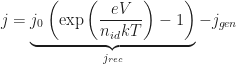
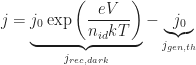
<p><img src="https://s0.wp.com/latex.php?latex=j%28V%29%3Dj_0+%5Cleft%28%5Cexp%5Cleft%28%5Cfrac%7BeV%7D%7Bn_%7Bid%7DkT%7D%5Cright%29-1%5Cright%29+-+j_%5Ctext%7Bgen%7D&#038;bg=ffffff&#038;fg=1a1a1a&#038;s=0&#038;c=20201002" srcset="https://s0.wp.com/latex.php?latex=j%28V%29%3Dj_0+%5Cleft%28%5Cexp%5Cleft%28%5Cfrac%7BeV%7D%7Bn_%7Bid%7DkT%7D%5Cright%29-1%5Cright%29+-+j_%5Ctext%7Bgen%7D&#038;bg=ffffff&#038;fg=1a1a1a&#038;s=0&#038;c=20201002 1x, https://s0.wp.com/latex.php?latex=j%28V%29%3Dj_0+%5Cleft%28%5Cexp%5Cleft%28%5Cfrac%7BeV%7D%7Bn_%7Bid%7DkT%7D%5Cright%29-1%5Cright%29+-+j_%5Ctext%7Bgen%7D&#038;bg=ffffff&#038;fg=1a1a1a&#038;s=0&#038;c=20201002&#038;zoom=4.5 4x" alt="j(V)=j_0 &#92;left(&#92;exp&#92;left(&#92;frac{eV}{n_{id}kT}&#92;right)-1&#92;right) - j_&#92;text{gen}" class="latex" />,</p>
<p>with <img src="https://s0.wp.com/latex.php?latex=V&#038;bg=ffffff&#038;fg=1a1a1a&#038;s=0&#038;c=20201002" srcset="https://s0.wp.com/latex.php?latex=V&#038;bg=ffffff&#038;fg=1a1a1a&#038;s=0&#038;c=20201002 1x, https://s0.wp.com/latex.php?latex=V&#038;bg=ffffff&#038;fg=1a1a1a&#038;s=0&#038;c=20201002&#038;zoom=4.5 4x" alt="V" class="latex" /> the voltage, <img src="https://s0.wp.com/latex.php?latex=e&#038;bg=ffffff&#038;fg=1a1a1a&#038;s=0&#038;c=20201002" srcset="https://s0.wp.com/latex.php?latex=e&#038;bg=ffffff&#038;fg=1a1a1a&#038;s=0&#038;c=20201002 1x, https://s0.wp.com/latex.php?latex=e&#038;bg=ffffff&#038;fg=1a1a1a&#038;s=0&#038;c=20201002&#038;zoom=4.5 4x" alt="e" class="latex" /> elementary charge, <img src="https://s0.wp.com/latex.php?latex=kT&#038;bg=ffffff&#038;fg=1a1a1a&#038;s=0&#038;c=20201002" srcset="https://s0.wp.com/latex.php?latex=kT&#038;bg=ffffff&#038;fg=1a1a1a&#038;s=0&#038;c=20201002 1x, https://s0.wp.com/latex.php?latex=kT&#038;bg=ffffff&#038;fg=1a1a1a&#038;s=0&#038;c=20201002&#038;zoom=4.5 4x" alt="kT" class="latex" /> thermal voltage, <img src="https://s0.wp.com/latex.php?latex=n_%5Cmathrm%7Bid%7D&#038;bg=ffffff&#038;fg=1a1a1a&#038;s=0&#038;c=20201002" srcset="https://s0.wp.com/latex.php?latex=n_%5Cmathrm%7Bid%7D&#038;bg=ffffff&#038;fg=1a1a1a&#038;s=0&#038;c=20201002 1x, https://s0.wp.com/latex.php?latex=n_%5Cmathrm%7Bid%7D&#038;bg=ffffff&#038;fg=1a1a1a&#038;s=0&#038;c=20201002&#038;zoom=4.5 4x" alt="n_&#92;mathrm{id}" class="latex" /> the recombination ideality factor, <img src="https://s0.wp.com/latex.php?latex=j_0&#038;bg=ffffff&#038;fg=1a1a1a&#038;s=0&#038;c=20201002" srcset="https://s0.wp.com/latex.php?latex=j_0&#038;bg=ffffff&#038;fg=1a1a1a&#038;s=0&#038;c=20201002 1x, https://s0.wp.com/latex.php?latex=j_0&#038;bg=ffffff&#038;fg=1a1a1a&#038;s=0&#038;c=20201002&#038;zoom=4.5 4x" alt="j_0" class="latex" /> the dark saturation current, and <img src="https://s0.wp.com/latex.php?latex=j_%5Cmathrm%7Bgen%7D&#038;bg=ffffff&#038;fg=1a1a1a&#038;s=0&#038;c=20201002" srcset="https://s0.wp.com/latex.php?latex=j_%5Cmathrm%7Bgen%7D&#038;bg=ffffff&#038;fg=1a1a1a&#038;s=0&#038;c=20201002 1x, https://s0.wp.com/latex.php?latex=j_%5Cmathrm%7Bgen%7D&#038;bg=ffffff&#038;fg=1a1a1a&#038;s=0&#038;c=20201002&#038;zoom=4.5 4x" alt="j_&#92;mathrm{gen}" class="latex" /> the photogenerated current. For simplicity, the latter is chosen to be voltage independent, and therefore is equal to the short-circuit current <img src="https://s0.wp.com/latex.php?latex=j_%5Cmathrm%7Bsc%7D&#038;bg=ffffff&#038;fg=1a1a1a&#038;s=0&#038;c=20201002" srcset="https://s0.wp.com/latex.php?latex=j_%5Cmathrm%7Bsc%7D&#038;bg=ffffff&#038;fg=1a1a1a&#038;s=0&#038;c=20201002 1x, https://s0.wp.com/latex.php?latex=j_%5Cmathrm%7Bsc%7D&#038;bg=ffffff&#038;fg=1a1a1a&#038;s=0&#038;c=20201002&#038;zoom=4.5 4x" alt="j_&#92;mathrm{sc}" class="latex" />.</p>
<p>As the open-circuit voltage is determined at zero net current, <img src="https://s0.wp.com/latex.php?latex=j%28V_%5Cmathrm%7Boc%7D%29+%3D+0&#038;bg=ffffff&#038;fg=1a1a1a&#038;s=0&#038;c=20201002" srcset="https://s0.wp.com/latex.php?latex=j%28V_%5Cmathrm%7Boc%7D%29+%3D+0&#038;bg=ffffff&#038;fg=1a1a1a&#038;s=0&#038;c=20201002 1x, https://s0.wp.com/latex.php?latex=j%28V_%5Cmathrm%7Boc%7D%29+%3D+0&#038;bg=ffffff&#038;fg=1a1a1a&#038;s=0&#038;c=20201002&#038;zoom=4.5 4x" alt="j(V_&#92;mathrm{oc}) = 0" class="latex" />, we get</p>
<p><img src="https://s0.wp.com/latex.php?latex=j%28V_%5Cmathrm%7Boc%7D%29+%3D+0+%3D+j_0+%5Cleft%28%5Cexp%5Cleft%28%5Cfrac%7BeV_%5Cmathrm%7Boc%7D%7D%7Bn_%7Bid%7DkT%7D%5Cright%29-1%5Cright%29+-+j_%5Ctext%7Bgen%7D&#038;bg=ffffff&#038;fg=1a1a1a&#038;s=0&#038;c=20201002" srcset="https://s0.wp.com/latex.php?latex=j%28V_%5Cmathrm%7Boc%7D%29+%3D+0+%3D+j_0+%5Cleft%28%5Cexp%5Cleft%28%5Cfrac%7BeV_%5Cmathrm%7Boc%7D%7D%7Bn_%7Bid%7DkT%7D%5Cright%29-1%5Cright%29+-+j_%5Ctext%7Bgen%7D&#038;bg=ffffff&#038;fg=1a1a1a&#038;s=0&#038;c=20201002 1x, https://s0.wp.com/latex.php?latex=j%28V_%5Cmathrm%7Boc%7D%29+%3D+0+%3D+j_0+%5Cleft%28%5Cexp%5Cleft%28%5Cfrac%7BeV_%5Cmathrm%7Boc%7D%7D%7Bn_%7Bid%7DkT%7D%5Cright%29-1%5Cright%29+-+j_%5Ctext%7Bgen%7D&#038;bg=ffffff&#038;fg=1a1a1a&#038;s=0&#038;c=20201002&#038;zoom=4.5 4x" alt="j(V_&#92;mathrm{oc}) = 0 = j_0 &#92;left(&#92;exp&#92;left(&#92;frac{eV_&#92;mathrm{oc}}{n_{id}kT}&#92;right)-1&#92;right) - j_&#92;text{gen}" class="latex" />,</p>
<p>which we can rearrange to yield the open-circuit voltage</p>
<p><img src="https://s0.wp.com/latex.php?latex=V_%5Cmathrm%7Boc%7D+%3D+%5Cfrac%7Bn_%7Bid%7DkT%7D%7Be%7D+%5Cln+%5Cleft%28+%5Cfrac%7Bj_%5Ctext%7Bgen%7D+%2B+j_0%7D%7Bj_0%7D+%5Cright%29&#038;bg=ffffff&#038;fg=1a1a1a&#038;s=0&#038;c=20201002" srcset="https://s0.wp.com/latex.php?latex=V_%5Cmathrm%7Boc%7D+%3D+%5Cfrac%7Bn_%7Bid%7DkT%7D%7Be%7D+%5Cln+%5Cleft%28+%5Cfrac%7Bj_%5Ctext%7Bgen%7D+%2B+j_0%7D%7Bj_0%7D+%5Cright%29&#038;bg=ffffff&#038;fg=1a1a1a&#038;s=0&#038;c=20201002 1x, https://s0.wp.com/latex.php?latex=V_%5Cmathrm%7Boc%7D+%3D+%5Cfrac%7Bn_%7Bid%7DkT%7D%7Be%7D+%5Cln+%5Cleft%28+%5Cfrac%7Bj_%5Ctext%7Bgen%7D+%2B+j_0%7D%7Bj_0%7D+%5Cright%29&#038;bg=ffffff&#038;fg=1a1a1a&#038;s=0&#038;c=20201002&#038;zoom=4.5 4x" alt="V_&#92;mathrm{oc} = &#92;frac{n_{id}kT}{e} &#92;ln &#92;left( &#92;frac{j_&#92;text{gen} + j_0}{j_0} &#92;right)" class="latex" />.</p>
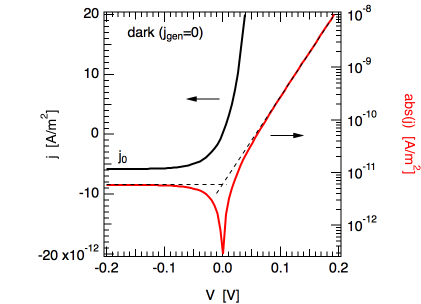
<p>Here, <img src="https://s0.wp.com/latex.php?latex=j_%5Ctext%7Bgen%7D&#038;bg=ffffff&#038;fg=1a1a1a&#038;s=0&#038;c=20201002" srcset="https://s0.wp.com/latex.php?latex=j_%5Ctext%7Bgen%7D&#038;bg=ffffff&#038;fg=1a1a1a&#038;s=0&#038;c=20201002 1x, https://s0.wp.com/latex.php?latex=j_%5Ctext%7Bgen%7D&#038;bg=ffffff&#038;fg=1a1a1a&#038;s=0&#038;c=20201002&#038;zoom=4.5 4x" alt="j_&#92;text{gen}" class="latex" /> is the photocurrent due to solar illumination, and the dark saturation current density <img src="https://s0.wp.com/latex.php?latex=j_0&#038;bg=ffffff&#038;fg=1a1a1a&#038;s=0&#038;c=20201002" srcset="https://s0.wp.com/latex.php?latex=j_0&#038;bg=ffffff&#038;fg=1a1a1a&#038;s=0&#038;c=20201002 1x, https://s0.wp.com/latex.php?latex=j_0&#038;bg=ffffff&#038;fg=1a1a1a&#038;s=0&#038;c=20201002&#038;zoom=4.5 4x" alt="j_0" class="latex" /> is due to excitation of thermal &#8220;black body&#8221; photons from the ambient at, say, room temperature. In the simplest case &#x2013; in the dark where <img src="https://s0.wp.com/latex.php?latex=j_%5Ctext%7Bgen%7D+%3D+0&#038;bg=ffffff&#038;fg=1a1a1a&#038;s=0&#038;c=20201002" srcset="https://s0.wp.com/latex.php?latex=j_%5Ctext%7Bgen%7D+%3D+0&#038;bg=ffffff&#038;fg=1a1a1a&#038;s=0&#038;c=20201002 1x, https://s0.wp.com/latex.php?latex=j_%5Ctext%7Bgen%7D+%3D+0&#038;bg=ffffff&#038;fg=1a1a1a&#038;s=0&#038;c=20201002&#038;zoom=4.5 4x" alt="j_&#92;text{gen} = 0" class="latex" /> &#x2013; we see that <img src="https://s0.wp.com/latex.php?latex=V_%5Cmathrm%7Boc%7D+%3D+0&#038;bg=ffffff&#038;fg=1a1a1a&#038;s=0&#038;c=20201002" srcset="https://s0.wp.com/latex.php?latex=V_%5Cmathrm%7Boc%7D+%3D+0&#038;bg=ffffff&#038;fg=1a1a1a&#038;s=0&#038;c=20201002 1x, https://s0.wp.com/latex.php?latex=V_%5Cmathrm%7Boc%7D+%3D+0&#038;bg=ffffff&#038;fg=1a1a1a&#038;s=0&#038;c=20201002&#038;zoom=4.5 4x" alt="V_&#92;mathrm{oc} = 0" class="latex" />, too. Generally, the thermal generation leading to <img src="https://s0.wp.com/latex.php?latex=j_0&#038;bg=ffffff&#038;fg=1a1a1a&#038;s=0&#038;c=20201002" srcset="https://s0.wp.com/latex.php?latex=j_0&#038;bg=ffffff&#038;fg=1a1a1a&#038;s=0&#038;c=20201002 1x, https://s0.wp.com/latex.php?latex=j_0&#038;bg=ffffff&#038;fg=1a1a1a&#038;s=0&#038;c=20201002&#038;zoom=4.5 4x" alt="j_0" class="latex" /> is much weaker than the solar generation <img src="https://s0.wp.com/latex.php?latex=j_%5Ctext%7Bgen%7D&#038;bg=ffffff&#038;fg=1a1a1a&#038;s=0&#038;c=20201002" srcset="https://s0.wp.com/latex.php?latex=j_%5Ctext%7Bgen%7D&#038;bg=ffffff&#038;fg=1a1a1a&#038;s=0&#038;c=20201002 1x, https://s0.wp.com/latex.php?latex=j_%5Ctext%7Bgen%7D&#038;bg=ffffff&#038;fg=1a1a1a&#038;s=0&#038;c=20201002&#038;zoom=4.5 4x" alt="j_&#92;text{gen}" class="latex" />, therefore</p>
<p><img src="https://s0.wp.com/latex.php?latex=V_%5Cmathrm%7Boc%7D+%5Capprox+%5Cfrac%7Bn_%7Bid%7DkT%7D%7Be%7D+%5Cln+%5Cleft%28+%5Cfrac%7Bj_%5Ctext%7Bgen%7D%7D%7Bj_0%7D+%5Cright%29&#038;bg=ffffff&#038;fg=1a1a1a&#038;s=0&#038;c=20201002" srcset="https://s0.wp.com/latex.php?latex=V_%5Cmathrm%7Boc%7D+%5Capprox+%5Cfrac%7Bn_%7Bid%7DkT%7D%7Be%7D+%5Cln+%5Cleft%28+%5Cfrac%7Bj_%5Ctext%7Bgen%7D%7D%7Bj_0%7D+%5Cright%29&#038;bg=ffffff&#038;fg=1a1a1a&#038;s=0&#038;c=20201002 1x, https://s0.wp.com/latex.php?latex=V_%5Cmathrm%7Boc%7D+%5Capprox+%5Cfrac%7Bn_%7Bid%7DkT%7D%7Be%7D+%5Cln+%5Cleft%28+%5Cfrac%7Bj_%5Ctext%7Bgen%7D%7D%7Bj_0%7D+%5Cright%29&#038;bg=ffffff&#038;fg=1a1a1a&#038;s=0&#038;c=20201002&#038;zoom=4.5 4x" alt="V_&#92;mathrm{oc} &#92;approx &#92;frac{n_{id}kT}{e} &#92;ln &#92;left( &#92;frac{j_&#92;text{gen}}{j_0} &#92;right)" class="latex" />.</p>
<p>is usually a very good approximation.</p>
<p>This simple equation to describe the open-circuit voltage is very general and can describe (outside of the shunt region, which is not considered here) very different solar cell technologies correctly. The reason is that many parameters that differ for different semiconductors are accounted for. So what determines the open-circuit voltage?</p>
<p>At a given temperature, the open circuit voltage is determined by<br />
&#8211; <img src="https://s0.wp.com/latex.php?latex=j_%5Ctext%7Bgen%7D&#038;bg=ffffff&#038;fg=1a1a1a&#038;s=0&#038;c=20201002" srcset="https://s0.wp.com/latex.php?latex=j_%5Ctext%7Bgen%7D&#038;bg=ffffff&#038;fg=1a1a1a&#038;s=0&#038;c=20201002 1x, https://s0.wp.com/latex.php?latex=j_%5Ctext%7Bgen%7D&#038;bg=ffffff&#038;fg=1a1a1a&#038;s=0&#038;c=20201002&#038;zoom=4.5 4x" alt="j_&#92;text{gen}" class="latex" />,<br />
&#8211; <img src="https://s0.wp.com/latex.php?latex=j_0&#038;bg=ffffff&#038;fg=1a1a1a&#038;s=0&#038;c=20201002" srcset="https://s0.wp.com/latex.php?latex=j_0&#038;bg=ffffff&#038;fg=1a1a1a&#038;s=0&#038;c=20201002 1x, https://s0.wp.com/latex.php?latex=j_0&#038;bg=ffffff&#038;fg=1a1a1a&#038;s=0&#038;c=20201002&#038;zoom=4.5 4x" alt="j_0" class="latex" />, and<br />
&#8211; <img src="https://s0.wp.com/latex.php?latex=n_%5Ctext%7Bid%7D&#038;bg=ffffff&#038;fg=1a1a1a&#038;s=0&#038;c=20201002" srcset="https://s0.wp.com/latex.php?latex=n_%5Ctext%7Bid%7D&#038;bg=ffffff&#038;fg=1a1a1a&#038;s=0&#038;c=20201002 1x, https://s0.wp.com/latex.php?latex=n_%5Ctext%7Bid%7D&#038;bg=ffffff&#038;fg=1a1a1a&#038;s=0&#038;c=20201002&#038;zoom=4.5 4x" alt="n_&#92;text{id}" class="latex" /> (which was discussed <a href="https://deibel.wordpress.com/2016/05/14/the-diode-ideality-factor-in-organic-solar-cells-recombination/">previously</a>)..</p>
<p>The generation current density</p>
<p><img src="https://s0.wp.com/latex.php?latex=j_%5Ctext%7Bgen%7D+%3D+e+%5Cint+EQE%28E%29%5C%2C+b_s%28E%29%5C%2C+dE%2C&#038;bg=ffffff&#038;fg=1a1a1a&#038;s=0&#038;c=20201002" srcset="https://s0.wp.com/latex.php?latex=j_%5Ctext%7Bgen%7D+%3D+e+%5Cint+EQE%28E%29%5C%2C+b_s%28E%29%5C%2C+dE%2C&#038;bg=ffffff&#038;fg=1a1a1a&#038;s=0&#038;c=20201002 1x, https://s0.wp.com/latex.php?latex=j_%5Ctext%7Bgen%7D+%3D+e+%5Cint+EQE%28E%29%5C%2C+b_s%28E%29%5C%2C+dE%2C&#038;bg=ffffff&#038;fg=1a1a1a&#038;s=0&#038;c=20201002&#038;zoom=4.5 4x" alt="j_&#92;text{gen} = e &#92;int EQE(E)&#92;, b_s(E)&#92;, dE," class="latex" /></p>
<p>which means it is given by how much of the solar photon flux of the sun, <img src="https://s0.wp.com/latex.php?latex=b_s&#038;bg=ffffff&#038;fg=1a1a1a&#038;s=0&#038;c=20201002" srcset="https://s0.wp.com/latex.php?latex=b_s&#038;bg=ffffff&#038;fg=1a1a1a&#038;s=0&#038;c=20201002 1x, https://s0.wp.com/latex.php?latex=b_s&#038;bg=ffffff&#038;fg=1a1a1a&#038;s=0&#038;c=20201002&#038;zoom=4.5 4x" alt="b_s" class="latex" />, is converted into electrons &#x2013;&nbsp;which is described by the external quantum efficiency <img src="https://s0.wp.com/latex.php?latex=EQE%28E%29&#038;bg=ffffff&#038;fg=1a1a1a&#038;s=0&#038;c=20201002" srcset="https://s0.wp.com/latex.php?latex=EQE%28E%29&#038;bg=ffffff&#038;fg=1a1a1a&#038;s=0&#038;c=20201002 1x, https://s0.wp.com/latex.php?latex=EQE%28E%29&#038;bg=ffffff&#038;fg=1a1a1a&#038;s=0&#038;c=20201002&#038;zoom=4.5 4x" alt="EQE(E)" class="latex" />. The <img src="https://s0.wp.com/latex.php?latex=EQE&#038;bg=ffffff&#038;fg=1a1a1a&#038;s=0&#038;c=20201002" srcset="https://s0.wp.com/latex.php?latex=EQE&#038;bg=ffffff&#038;fg=1a1a1a&#038;s=0&#038;c=20201002 1x, https://s0.wp.com/latex.php?latex=EQE&#038;bg=ffffff&#038;fg=1a1a1a&#038;s=0&#038;c=20201002&#038;zoom=4.5 4x" alt="EQE" class="latex" /> includes reflection losses, the absorptance (in the simplest case 0 below the bandgap and 1 for energies at or higher than the band gap <img src="https://s0.wp.com/latex.php?latex=E_g&#038;bg=ffffff&#038;fg=1a1a1a&#038;s=0&#038;c=20201002" srcset="https://s0.wp.com/latex.php?latex=E_g&#038;bg=ffffff&#038;fg=1a1a1a&#038;s=0&#038;c=20201002 1x, https://s0.wp.com/latex.php?latex=E_g&#038;bg=ffffff&#038;fg=1a1a1a&#038;s=0&#038;c=20201002&#038;zoom=4.5 4x" alt="E_g" class="latex" />), and charge collection losses (for instance due to the <a href="https://deibel.wordpress.com/2025/02/15/transport-resistance-strikes-back/">transport resistance</a>). Essentially, the higher the bandgap <img src="https://s0.wp.com/latex.php?latex=E_g&#038;bg=ffffff&#038;fg=1a1a1a&#038;s=0&#038;c=20201002" srcset="https://s0.wp.com/latex.php?latex=E_g&#038;bg=ffffff&#038;fg=1a1a1a&#038;s=0&#038;c=20201002 1x, https://s0.wp.com/latex.php?latex=E_g&#038;bg=ffffff&#038;fg=1a1a1a&#038;s=0&#038;c=20201002&#038;zoom=4.5 4x" alt="E_g" class="latex" />, the higher <img src="https://s0.wp.com/latex.php?latex=j_%5Ctext%7Bgen%7D&#038;bg=ffffff&#038;fg=1a1a1a&#038;s=0&#038;c=20201002" srcset="https://s0.wp.com/latex.php?latex=j_%5Ctext%7Bgen%7D&#038;bg=ffffff&#038;fg=1a1a1a&#038;s=0&#038;c=20201002 1x, https://s0.wp.com/latex.php?latex=j_%5Ctext%7Bgen%7D&#038;bg=ffffff&#038;fg=1a1a1a&#038;s=0&#038;c=20201002&#038;zoom=4.5 4x" alt="j_&#92;text{gen}" class="latex" /> &#x2013;&nbsp;which leads to a higher open-circuit voltage.</p>
<p>The dark saturation current density in an ideal solar cell <em>without non-radiative losses</em> is essentially given by</p>
<p><img src="https://s0.wp.com/latex.php?latex=j_0+%3D+e+%5Cint+EQE%28E%29%5C%2C+b_a%28E%29%5C%2C+dE.&#038;bg=ffffff&#038;fg=1a1a1a&#038;s=0&#038;c=20201002" srcset="https://s0.wp.com/latex.php?latex=j_0+%3D+e+%5Cint+EQE%28E%29%5C%2C+b_a%28E%29%5C%2C+dE.&#038;bg=ffffff&#038;fg=1a1a1a&#038;s=0&#038;c=20201002 1x, https://s0.wp.com/latex.php?latex=j_0+%3D+e+%5Cint+EQE%28E%29%5C%2C+b_a%28E%29%5C%2C+dE.&#038;bg=ffffff&#038;fg=1a1a1a&#038;s=0&#038;c=20201002&#038;zoom=4.5 4x" alt="j_0 = e &#92;int EQE(E)&#92;, b_a(E)&#92;, dE." class="latex" /></p>
<p>The only difference to the equation for <img src="https://s0.wp.com/latex.php?latex=j_%5Ctext%7Bgen%7D&#038;bg=ffffff&#038;fg=1a1a1a&#038;s=0&#038;c=20201002" srcset="https://s0.wp.com/latex.php?latex=j_%5Ctext%7Bgen%7D&#038;bg=ffffff&#038;fg=1a1a1a&#038;s=0&#038;c=20201002 1x, https://s0.wp.com/latex.php?latex=j_%5Ctext%7Bgen%7D&#038;bg=ffffff&#038;fg=1a1a1a&#038;s=0&#038;c=20201002&#038;zoom=4.5 4x" alt="j_&#92;text{gen}" class="latex" /> is that the photons do not come from the sun anymore, but from the ambient (note the subscript <em>a</em>;). This <img src="https://s0.wp.com/latex.php?latex=b_a%28E%29&#038;bg=ffffff&#038;fg=1a1a1a&#038;s=0&#038;c=20201002" srcset="https://s0.wp.com/latex.php?latex=b_a%28E%29&#038;bg=ffffff&#038;fg=1a1a1a&#038;s=0&#038;c=20201002 1x, https://s0.wp.com/latex.php?latex=b_a%28E%29&#038;bg=ffffff&#038;fg=1a1a1a&#038;s=0&#038;c=20201002&#038;zoom=4.5 4x" alt="b_a(E)" class="latex" /> is just Planck&#8217;s law to describe thermal radiation from black bodies, so everything &#8220;earthly&#8221; around the solar cell that emits at the current temperature <img src="https://s0.wp.com/latex.php?latex=T&#038;bg=ffffff&#038;fg=1a1a1a&#038;s=0&#038;c=20201002" srcset="https://s0.wp.com/latex.php?latex=T&#038;bg=ffffff&#038;fg=1a1a1a&#038;s=0&#038;c=20201002 1x, https://s0.wp.com/latex.php?latex=T&#038;bg=ffffff&#038;fg=1a1a1a&#038;s=0&#038;c=20201002&#038;zoom=4.5 4x" alt="T" class="latex" /> (or <img src="https://s0.wp.com/latex.php?latex=T_a&#038;bg=ffffff&#038;fg=1a1a1a&#038;s=0&#038;c=20201002" srcset="https://s0.wp.com/latex.php?latex=T_a&#038;bg=ffffff&#038;fg=1a1a1a&#038;s=0&#038;c=20201002 1x, https://s0.wp.com/latex.php?latex=T_a&#038;bg=ffffff&#038;fg=1a1a1a&#038;s=0&#038;c=20201002&#038;zoom=4.5 4x" alt="T_a" class="latex" />, the temperature of the ambient). While the sun that generates <img src="https://s0.wp.com/latex.php?latex=j_%5Ctext%7Bgen%7D&#038;bg=ffffff&#038;fg=1a1a1a&#038;s=0&#038;c=20201002" srcset="https://s0.wp.com/latex.php?latex=j_%5Ctext%7Bgen%7D&#038;bg=ffffff&#038;fg=1a1a1a&#038;s=0&#038;c=20201002 1x, https://s0.wp.com/latex.php?latex=j_%5Ctext%7Bgen%7D&#038;bg=ffffff&#038;fg=1a1a1a&#038;s=0&#038;c=20201002&#038;zoom=4.5 4x" alt="j_&#92;text{gen}" class="latex" /> can also be well approximated by a block body and Planck&#8217;s law &#x2013;&nbsp;assuming a black body temperature of the sun of <img src="https://s0.wp.com/latex.php?latex=T_s+%5Capprox+5800+%5Ctext%7B+K%7D&#038;bg=ffffff&#038;fg=1a1a1a&#038;s=0&#038;c=20201002" srcset="https://s0.wp.com/latex.php?latex=T_s+%5Capprox+5800+%5Ctext%7B+K%7D&#038;bg=ffffff&#038;fg=1a1a1a&#038;s=0&#038;c=20201002 1x, https://s0.wp.com/latex.php?latex=T_s+%5Capprox+5800+%5Ctext%7B+K%7D&#038;bg=ffffff&#038;fg=1a1a1a&#038;s=0&#038;c=20201002&#038;zoom=4.5 4x" alt="T_s &#92;approx 5800 &#92;text{ K}" class="latex" />, usually the temperature of the ambient that leads to <img src="https://s0.wp.com/latex.php?latex=j_0&#038;bg=ffffff&#038;fg=1a1a1a&#038;s=0&#038;c=20201002" srcset="https://s0.wp.com/latex.php?latex=j_0&#038;bg=ffffff&#038;fg=1a1a1a&#038;s=0&#038;c=20201002 1x, https://s0.wp.com/latex.php?latex=j_0&#038;bg=ffffff&#038;fg=1a1a1a&#038;s=0&#038;c=20201002&#038;zoom=4.5 4x" alt="j_0" class="latex" /> corresponds to the solar cell temperature&#8230; for instance, <img src="https://s0.wp.com/latex.php?latex=T+%3D+T_a+%5Capprox+300+%5Ctext%7B+K%7D&#038;bg=ffffff&#038;fg=1a1a1a&#038;s=0&#038;c=20201002" srcset="https://s0.wp.com/latex.php?latex=T+%3D+T_a+%5Capprox+300+%5Ctext%7B+K%7D&#038;bg=ffffff&#038;fg=1a1a1a&#038;s=0&#038;c=20201002 1x, https://s0.wp.com/latex.php?latex=T+%3D+T_a+%5Capprox+300+%5Ctext%7B+K%7D&#038;bg=ffffff&#038;fg=1a1a1a&#038;s=0&#038;c=20201002&#038;zoom=4.5 4x" alt="T = T_a &#92;approx 300 &#92;text{ K}" class="latex" />.</p>
<p>With this in mind, we can maybe see already what determines the <em>temperature dependence</em> of the open-circuit voltage! In</p>
<p><img src="https://s0.wp.com/latex.php?latex=V_%5Cmathrm%7Boc%7D%28T%29+%5Capprox+%5Cfrac%7Bn_%7Bid%7D%28T%29kT%7D%7Be%7D+%5Cln+%5Cleft%28+%5Cfrac%7Bj_%5Ctext%7Bgen%7D%7D%7Bj_0%28T%29%7D+%5Cright%29&#038;bg=ffffff&#038;fg=1a1a1a&#038;s=0&#038;c=20201002" srcset="https://s0.wp.com/latex.php?latex=V_%5Cmathrm%7Boc%7D%28T%29+%5Capprox+%5Cfrac%7Bn_%7Bid%7D%28T%29kT%7D%7Be%7D+%5Cln+%5Cleft%28+%5Cfrac%7Bj_%5Ctext%7Bgen%7D%7D%7Bj_0%28T%29%7D+%5Cright%29&#038;bg=ffffff&#038;fg=1a1a1a&#038;s=0&#038;c=20201002 1x, https://s0.wp.com/latex.php?latex=V_%5Cmathrm%7Boc%7D%28T%29+%5Capprox+%5Cfrac%7Bn_%7Bid%7D%28T%29kT%7D%7Be%7D+%5Cln+%5Cleft%28+%5Cfrac%7Bj_%5Ctext%7Bgen%7D%7D%7Bj_0%28T%29%7D+%5Cright%29&#038;bg=ffffff&#038;fg=1a1a1a&#038;s=0&#038;c=20201002&#038;zoom=4.5 4x" alt="V_&#92;mathrm{oc}(T) &#92;approx &#92;frac{n_{id}(T)kT}{e} &#92;ln &#92;left( &#92;frac{j_&#92;text{gen}}{j_0(T)} &#92;right)" class="latex" />,</p>
<p>there is an explicit temperature dependence in the prefactor, <img src="https://s0.wp.com/latex.php?latex=kT&#038;bg=ffffff&#038;fg=1a1a1a&#038;s=0&#038;c=20201002" srcset="https://s0.wp.com/latex.php?latex=kT&#038;bg=ffffff&#038;fg=1a1a1a&#038;s=0&#038;c=20201002 1x, https://s0.wp.com/latex.php?latex=kT&#038;bg=ffffff&#038;fg=1a1a1a&#038;s=0&#038;c=20201002&#038;zoom=4.5 4x" alt="kT" class="latex" />, which &#8220;promises&#8221; increasing open-circuit voltages at higher temperatures, but from measurements we know that the  opposite happens: the open-circuit voltage increases towards <em>lower</em> temperatures!</p>
<p>Except for temperature-dependent changes in the charge collection (or bandgap), <img src="https://s0.wp.com/latex.php?latex=j_%5Ctext%7Bgen%7D&#038;bg=ffffff&#038;fg=1a1a1a&#038;s=0&#038;c=20201002" srcset="https://s0.wp.com/latex.php?latex=j_%5Ctext%7Bgen%7D&#038;bg=ffffff&#038;fg=1a1a1a&#038;s=0&#038;c=20201002 1x, https://s0.wp.com/latex.php?latex=j_%5Ctext%7Bgen%7D&#038;bg=ffffff&#038;fg=1a1a1a&#038;s=0&#038;c=20201002&#038;zoom=4.5 4x" alt="j_&#92;text{gen}" class="latex" /> is (solar cell) temperature independent. The ideality factor can depend on temperature (and, in organic solar cells, even light intensity dependence [<a href="https://doi.org/10.1103/PhysRevLett.130.236403">Saladina 2023</a>]), but does not dominate the temperature dependence of <img src="https://s0.wp.com/latex.php?latex=V_%5Cmathrm%7Boc%7D&#038;bg=ffffff&#038;fg=1a1a1a&#038;s=0&#038;c=20201002" srcset="https://s0.wp.com/latex.php?latex=V_%5Cmathrm%7Boc%7D&#038;bg=ffffff&#038;fg=1a1a1a&#038;s=0&#038;c=20201002 1x, https://s0.wp.com/latex.php?latex=V_%5Cmathrm%7Boc%7D&#038;bg=ffffff&#038;fg=1a1a1a&#038;s=0&#038;c=20201002&#038;zoom=4.5 4x" alt="V_&#92;mathrm{oc}" class="latex" />. The real &#8220;culprit&#8221; is indeed the <em>very important</em> dark saturation current density <img src="https://s0.wp.com/latex.php?latex=j_0&#038;bg=ffffff&#038;fg=1a1a1a&#038;s=0&#038;c=20201002" srcset="https://s0.wp.com/latex.php?latex=j_0&#038;bg=ffffff&#038;fg=1a1a1a&#038;s=0&#038;c=20201002 1x, https://s0.wp.com/latex.php?latex=j_0&#038;bg=ffffff&#038;fg=1a1a1a&#038;s=0&#038;c=20201002&#038;zoom=4.5 4x" alt="j_0" class="latex" />, which describes charge carrier generation (and recombination!) across the bandgap by thermal photons (plus, in real systems, non-radiative processes)!</p>
<p>When we approximate the equation for the ideal dark saturation current density (ideal, because we again neglect non-radiative losses) from above &#x2013; using the Boltzmann approximation instead of the Bose-Einstein statistics that are featured in Planck&#8217;s law &#x2013; we can describe the temperature dependence of <img src="https://s0.wp.com/latex.php?latex=j_0&#038;bg=ffffff&#038;fg=1a1a1a&#038;s=0&#038;c=20201002" srcset="https://s0.wp.com/latex.php?latex=j_0&#038;bg=ffffff&#038;fg=1a1a1a&#038;s=0&#038;c=20201002 1x, https://s0.wp.com/latex.php?latex=j_0&#038;bg=ffffff&#038;fg=1a1a1a&#038;s=0&#038;c=20201002&#038;zoom=4.5 4x" alt="j_0" class="latex" />:</p>
<p><img src="https://s0.wp.com/latex.php?latex=j_0%28T%29+%5Capprox+j_%7B00%7D+%5Cexp+%5Cleft%28+-+%5Cfrac%7BE_g%7D%7Bn%28T%29kT%7D+%5Cright%29+%5Cqquad+%5Cmathrm%7B%28%2A%29%7D&#038;bg=ffffff&#038;fg=1a1a1a&#038;s=0&#038;c=20201002" srcset="https://s0.wp.com/latex.php?latex=j_0%28T%29+%5Capprox+j_%7B00%7D+%5Cexp+%5Cleft%28+-+%5Cfrac%7BE_g%7D%7Bn%28T%29kT%7D+%5Cright%29+%5Cqquad+%5Cmathrm%7B%28%2A%29%7D&#038;bg=ffffff&#038;fg=1a1a1a&#038;s=0&#038;c=20201002 1x, https://s0.wp.com/latex.php?latex=j_0%28T%29+%5Capprox+j_%7B00%7D+%5Cexp+%5Cleft%28+-+%5Cfrac%7BE_g%7D%7Bn%28T%29kT%7D+%5Cright%29+%5Cqquad+%5Cmathrm%7B%28%2A%29%7D&#038;bg=ffffff&#038;fg=1a1a1a&#038;s=0&#038;c=20201002&#038;zoom=4.5 4x" alt="j_0(T) &#92;approx j_{00} &#92;exp &#92;left( - &#92;frac{E_g}{n(T)kT} &#92;right) &#92;qquad &#92;mathrm{(*)}" class="latex" />.</p>
<p>The temperature here is, again, the solar cell&#8217;s and the ambient temperature is equal to it. We assume for simplicity (again a pretty good approximation) that the bandgap <img src="https://s0.wp.com/latex.php?latex=E_g&#038;bg=ffffff&#038;fg=1a1a1a&#038;s=0&#038;c=20201002" srcset="https://s0.wp.com/latex.php?latex=E_g&#038;bg=ffffff&#038;fg=1a1a1a&#038;s=0&#038;c=20201002 1x, https://s0.wp.com/latex.php?latex=E_g&#038;bg=ffffff&#038;fg=1a1a1a&#038;s=0&#038;c=20201002&#038;zoom=4.5 4x" alt="E_g" class="latex" /> is not (or only very weakly) temperature dependent. The prefactor <img src="https://s0.wp.com/latex.php?latex=j_%7B00%7D&#038;bg=ffffff&#038;fg=1a1a1a&#038;s=0&#038;c=20201002" srcset="https://s0.wp.com/latex.php?latex=j_%7B00%7D&#038;bg=ffffff&#038;fg=1a1a1a&#038;s=0&#038;c=20201002 1x, https://s0.wp.com/latex.php?latex=j_%7B00%7D&#038;bg=ffffff&#038;fg=1a1a1a&#038;s=0&#038;c=20201002&#038;zoom=4.5 4x" alt="j_{00}" class="latex" /> is essentially the dark saturation current density at infinite temperature, when the effective density of states is (hypothetically) completely filled, which is reduced by lower temperatures: the thermal photons from the ambient generate electron&#x2013;hole pairs across the bandgap, increasing <img src="https://s0.wp.com/latex.php?latex=j_0&#038;bg=ffffff&#038;fg=1a1a1a&#038;s=0&#038;c=20201002" srcset="https://s0.wp.com/latex.php?latex=j_0&#038;bg=ffffff&#038;fg=1a1a1a&#038;s=0&#038;c=20201002 1x, https://s0.wp.com/latex.php?latex=j_0&#038;bg=ffffff&#038;fg=1a1a1a&#038;s=0&#038;c=20201002&#038;zoom=4.5 4x" alt="j_0" class="latex" /> and &#x2013;&nbsp;as it is in the denominator of the equation for <img src="https://s0.wp.com/latex.php?latex=V_%5Cmathrm%7Boc%7D&#038;bg=ffffff&#038;fg=1a1a1a&#038;s=0&#038;c=20201002" srcset="https://s0.wp.com/latex.php?latex=V_%5Cmathrm%7Boc%7D&#038;bg=ffffff&#038;fg=1a1a1a&#038;s=0&#038;c=20201002 1x, https://s0.wp.com/latex.php?latex=V_%5Cmathrm%7Boc%7D&#038;bg=ffffff&#038;fg=1a1a1a&#038;s=0&#038;c=20201002&#038;zoom=4.5 4x" alt="V_&#92;mathrm{oc}" class="latex" /> &#x2013;&nbsp;decreasing the open-circuit voltage at higher temperatures. We can make this result more transparent when entering the temperature dependent dark saturation current density into the equation for the open-circuit voltage: (For simplicitly, I left the explicit temperature dependence of the ideality factor out, writing <img src="https://s0.wp.com/latex.php?latex=n_%7Bid%7D&#038;bg=ffffff&#038;fg=1a1a1a&#038;s=0&#038;c=20201002" srcset="https://s0.wp.com/latex.php?latex=n_%7Bid%7D&#038;bg=ffffff&#038;fg=1a1a1a&#038;s=0&#038;c=20201002 1x, https://s0.wp.com/latex.php?latex=n_%7Bid%7D&#038;bg=ffffff&#038;fg=1a1a1a&#038;s=0&#038;c=20201002&#038;zoom=4.5 4x" alt="n_{id}" class="latex" /> instead of <img src="https://s0.wp.com/latex.php?latex=n_%7Bid%7D%28T%29&#038;bg=ffffff&#038;fg=1a1a1a&#038;s=0&#038;c=20201002" srcset="https://s0.wp.com/latex.php?latex=n_%7Bid%7D%28T%29&#038;bg=ffffff&#038;fg=1a1a1a&#038;s=0&#038;c=20201002 1x, https://s0.wp.com/latex.php?latex=n_%7Bid%7D%28T%29&#038;bg=ffffff&#038;fg=1a1a1a&#038;s=0&#038;c=20201002&#038;zoom=4.5 4x" alt="n_{id}(T)" class="latex" />.)</p>
<p><img src="https://s0.wp.com/latex.php?latex=V_%5Cmathrm%7Boc%7D%28T%29+%5Capprox+%5Cfrac%7Bn_%7Bid%7DkT%7D%7Be%7D+%5Cln+%5Cleft%28+%5Cfrac%7Bj_%5Ctext%7Bgen%7D%7D%7Bj_%7B00%7D+%5Cexp+%5Cleft%28+-+%5Cfrac%7BE_g%7D%7Bn_%7Bid%7DkT%7D+%5Cright%29%7D+%5Cright%29&#038;bg=ffffff&#038;fg=1a1a1a&#038;s=0&#038;c=20201002" srcset="https://s0.wp.com/latex.php?latex=V_%5Cmathrm%7Boc%7D%28T%29+%5Capprox+%5Cfrac%7Bn_%7Bid%7DkT%7D%7Be%7D+%5Cln+%5Cleft%28+%5Cfrac%7Bj_%5Ctext%7Bgen%7D%7D%7Bj_%7B00%7D+%5Cexp+%5Cleft%28+-+%5Cfrac%7BE_g%7D%7Bn_%7Bid%7DkT%7D+%5Cright%29%7D+%5Cright%29&#038;bg=ffffff&#038;fg=1a1a1a&#038;s=0&#038;c=20201002 1x, https://s0.wp.com/latex.php?latex=V_%5Cmathrm%7Boc%7D%28T%29+%5Capprox+%5Cfrac%7Bn_%7Bid%7DkT%7D%7Be%7D+%5Cln+%5Cleft%28+%5Cfrac%7Bj_%5Ctext%7Bgen%7D%7D%7Bj_%7B00%7D+%5Cexp+%5Cleft%28+-+%5Cfrac%7BE_g%7D%7Bn_%7Bid%7DkT%7D+%5Cright%29%7D+%5Cright%29&#038;bg=ffffff&#038;fg=1a1a1a&#038;s=0&#038;c=20201002&#038;zoom=4.5 4x" alt="V_&#92;mathrm{oc}(T) &#92;approx &#92;frac{n_{id}kT}{e} &#92;ln &#92;left( &#92;frac{j_&#92;text{gen}}{j_{00} &#92;exp &#92;left( - &#92;frac{E_g}{n_{id}kT} &#92;right)} &#92;right)" class="latex" /><br />
<img src="https://s0.wp.com/latex.php?latex=%3D+%5Cfrac%7Bn_%7Bid%7DkT%7D%7Be%7D+%5Cln+%5Cleft%28+%5Cfrac%7Bj_%5Ctext%7Bgen%7D%7D%7Bj_%7B00%7D%7D+%5Cexp+%5Cleft%28%5Cfrac%7BE_g%7D%7Bn_%7Bid%7DkT%7D+%5Cright%29+%5Cright%29&#038;bg=ffffff&#038;fg=1a1a1a&#038;s=0&#038;c=20201002" srcset="https://s0.wp.com/latex.php?latex=%3D+%5Cfrac%7Bn_%7Bid%7DkT%7D%7Be%7D+%5Cln+%5Cleft%28+%5Cfrac%7Bj_%5Ctext%7Bgen%7D%7D%7Bj_%7B00%7D%7D+%5Cexp+%5Cleft%28%5Cfrac%7BE_g%7D%7Bn_%7Bid%7DkT%7D+%5Cright%29+%5Cright%29&#038;bg=ffffff&#038;fg=1a1a1a&#038;s=0&#038;c=20201002 1x, https://s0.wp.com/latex.php?latex=%3D+%5Cfrac%7Bn_%7Bid%7DkT%7D%7Be%7D+%5Cln+%5Cleft%28+%5Cfrac%7Bj_%5Ctext%7Bgen%7D%7D%7Bj_%7B00%7D%7D+%5Cexp+%5Cleft%28%5Cfrac%7BE_g%7D%7Bn_%7Bid%7DkT%7D+%5Cright%29+%5Cright%29&#038;bg=ffffff&#038;fg=1a1a1a&#038;s=0&#038;c=20201002&#038;zoom=4.5 4x" alt="= &#92;frac{n_{id}kT}{e} &#92;ln &#92;left( &#92;frac{j_&#92;text{gen}}{j_{00}} &#92;exp &#92;left(&#92;frac{E_g}{n_{id}kT} &#92;right) &#92;right)" class="latex" /><br />
<img src="https://s0.wp.com/latex.php?latex=%3D+%5Cfrac%7Bn_%7Bid%7DkT%7D%7Be%7D+%5Cln+%5Cleft%28+%5Cexp+%5Cleft%28%5Cfrac%7BE_g%7D%7Bn_%7Bid%7DkT%7D+%5Cright%29+%5Cright%29+%2B+%5Cfrac%7Bn_%7Bid%7DkT%7D%7Be%7D+%5Cln+%5Cleft%28+%5Cfrac%7Bj_%5Ctext%7Bgen%7D%7D%7Bj_%7B00%7D%7D+%5Cright%29&#038;bg=ffffff&#038;fg=1a1a1a&#038;s=0&#038;c=20201002" srcset="https://s0.wp.com/latex.php?latex=%3D+%5Cfrac%7Bn_%7Bid%7DkT%7D%7Be%7D+%5Cln+%5Cleft%28+%5Cexp+%5Cleft%28%5Cfrac%7BE_g%7D%7Bn_%7Bid%7DkT%7D+%5Cright%29+%5Cright%29+%2B+%5Cfrac%7Bn_%7Bid%7DkT%7D%7Be%7D+%5Cln+%5Cleft%28+%5Cfrac%7Bj_%5Ctext%7Bgen%7D%7D%7Bj_%7B00%7D%7D+%5Cright%29&#038;bg=ffffff&#038;fg=1a1a1a&#038;s=0&#038;c=20201002 1x, https://s0.wp.com/latex.php?latex=%3D+%5Cfrac%7Bn_%7Bid%7DkT%7D%7Be%7D+%5Cln+%5Cleft%28+%5Cexp+%5Cleft%28%5Cfrac%7BE_g%7D%7Bn_%7Bid%7DkT%7D+%5Cright%29+%5Cright%29+%2B+%5Cfrac%7Bn_%7Bid%7DkT%7D%7Be%7D+%5Cln+%5Cleft%28+%5Cfrac%7Bj_%5Ctext%7Bgen%7D%7D%7Bj_%7B00%7D%7D+%5Cright%29&#038;bg=ffffff&#038;fg=1a1a1a&#038;s=0&#038;c=20201002&#038;zoom=4.5 4x" alt="= &#92;frac{n_{id}kT}{e} &#92;ln &#92;left( &#92;exp &#92;left(&#92;frac{E_g}{n_{id}kT} &#92;right) &#92;right) + &#92;frac{n_{id}kT}{e} &#92;ln &#92;left( &#92;frac{j_&#92;text{gen}}{j_{00}} &#92;right)" class="latex" /><br />
<img src="https://s0.wp.com/latex.php?latex=%3D+%5Cfrac%7Bn_%7Bid%7DkT%7D%7Be%7D+%5Cfrac%7BE_g%7D%7Bn_%7Bid%7DkT%7D+%2B+%5Cfrac%7Bn_%7Bid%7DkT%7D%7Be%7D+%5Cln+%5Cleft%28+%5Cfrac%7Bj_%5Ctext%7Bgen%7D%7D%7Bj_%7B00%7D%7D+%5Cright%29&#038;bg=ffffff&#038;fg=1a1a1a&#038;s=0&#038;c=20201002" srcset="https://s0.wp.com/latex.php?latex=%3D+%5Cfrac%7Bn_%7Bid%7DkT%7D%7Be%7D+%5Cfrac%7BE_g%7D%7Bn_%7Bid%7DkT%7D+%2B+%5Cfrac%7Bn_%7Bid%7DkT%7D%7Be%7D+%5Cln+%5Cleft%28+%5Cfrac%7Bj_%5Ctext%7Bgen%7D%7D%7Bj_%7B00%7D%7D+%5Cright%29&#038;bg=ffffff&#038;fg=1a1a1a&#038;s=0&#038;c=20201002 1x, https://s0.wp.com/latex.php?latex=%3D+%5Cfrac%7Bn_%7Bid%7DkT%7D%7Be%7D+%5Cfrac%7BE_g%7D%7Bn_%7Bid%7DkT%7D+%2B+%5Cfrac%7Bn_%7Bid%7DkT%7D%7Be%7D+%5Cln+%5Cleft%28+%5Cfrac%7Bj_%5Ctext%7Bgen%7D%7D%7Bj_%7B00%7D%7D+%5Cright%29&#038;bg=ffffff&#038;fg=1a1a1a&#038;s=0&#038;c=20201002&#038;zoom=4.5 4x" alt="= &#92;frac{n_{id}kT}{e} &#92;frac{E_g}{n_{id}kT} + &#92;frac{n_{id}kT}{e} &#92;ln &#92;left( &#92;frac{j_&#92;text{gen}}{j_{00}} &#92;right)" class="latex" /><br />
<img src="https://s0.wp.com/latex.php?latex=%3D+%5Cfrac%7BE_g%7D%7Be%7D+%2B+%5Cfrac%7Bn_%7Bid%7DkT%7D%7Be%7D+%5Cln+%5Cleft%28+%5Cfrac%7Bj_%5Ctext%7Bgen%7D%7D%7Bj_%7B00%7D%7D+%5Cright%29&#038;bg=ffffff&#038;fg=1a1a1a&#038;s=0&#038;c=20201002" srcset="https://s0.wp.com/latex.php?latex=%3D+%5Cfrac%7BE_g%7D%7Be%7D+%2B+%5Cfrac%7Bn_%7Bid%7DkT%7D%7Be%7D+%5Cln+%5Cleft%28+%5Cfrac%7Bj_%5Ctext%7Bgen%7D%7D%7Bj_%7B00%7D%7D+%5Cright%29&#038;bg=ffffff&#038;fg=1a1a1a&#038;s=0&#038;c=20201002 1x, https://s0.wp.com/latex.php?latex=%3D+%5Cfrac%7BE_g%7D%7Be%7D+%2B+%5Cfrac%7Bn_%7Bid%7DkT%7D%7Be%7D+%5Cln+%5Cleft%28+%5Cfrac%7Bj_%5Ctext%7Bgen%7D%7D%7Bj_%7B00%7D%7D+%5Cright%29&#038;bg=ffffff&#038;fg=1a1a1a&#038;s=0&#038;c=20201002&#038;zoom=4.5 4x" alt="= &#92;frac{E_g}{e} + &#92;frac{n_{id}kT}{e} &#92;ln &#92;left( &#92;frac{j_&#92;text{gen}}{j_{00}} &#92;right)" class="latex" /></p>
<p>We see now that the maximum open circuit voltage at zero temperature (in a system described by classical Boltzmann approximation, <img src="https://blog.disorderedmatter.eu/wp-content/uploads/2025/05/voct-for-a-si-h-solar-cell.jpg?w=299&#038;h=271" alt="Voc(T) for a-Si H solar cell." title="Voc(T) for a-Si H solar cell.jpg" border="0" width="299" height="271" style="float:right" />i.e. without the energetic disorder that is an important topic in organic solar cells) is given by the (effective) bandgap of the device &#x2013;&nbsp;usually the bandgap of the active layer material. The open-circuit voltage is <em>reduced</em> at higher temperatures(!) despite the plus sign after the term <img src="https://s0.wp.com/latex.php?latex=E_g%2Fe&#038;bg=ffffff&#038;fg=1a1a1a&#038;s=0&#038;c=20201002" srcset="https://s0.wp.com/latex.php?latex=E_g%2Fe&#038;bg=ffffff&#038;fg=1a1a1a&#038;s=0&#038;c=20201002 1x, https://s0.wp.com/latex.php?latex=E_g%2Fe&#038;bg=ffffff&#038;fg=1a1a1a&#038;s=0&#038;c=20201002&#038;zoom=4.5 4x" alt="E_g/e" class="latex" />: the dark saturation current density <em>at infinite temperature</em> <img src="https://s0.wp.com/latex.php?latex=j_%7B00%7D&#038;bg=ffffff&#038;fg=1a1a1a&#038;s=0&#038;c=20201002" srcset="https://s0.wp.com/latex.php?latex=j_%7B00%7D&#038;bg=ffffff&#038;fg=1a1a1a&#038;s=0&#038;c=20201002 1x, https://s0.wp.com/latex.php?latex=j_%7B00%7D&#038;bg=ffffff&#038;fg=1a1a1a&#038;s=0&#038;c=20201002&#038;zoom=4.5 4x" alt="j_{00}" class="latex" /> is larger than <img src="https://s0.wp.com/latex.php?latex=j_%5Cmathrm%7Bgen%7D&#038;bg=ffffff&#038;fg=1a1a1a&#038;s=0&#038;c=20201002" srcset="https://s0.wp.com/latex.php?latex=j_%5Cmathrm%7Bgen%7D&#038;bg=ffffff&#038;fg=1a1a1a&#038;s=0&#038;c=20201002 1x, https://s0.wp.com/latex.php?latex=j_%5Cmathrm%7Bgen%7D&#038;bg=ffffff&#038;fg=1a1a1a&#038;s=0&#038;c=20201002&#038;zoom=4.5 4x" alt="j_&#92;mathrm{gen}" class="latex" />, and the argument of a natural logarithm with argument smaller than one is negative. This means that the second term on the right-hand side is negative, and <img src="https://s0.wp.com/latex.php?latex=V_%5Cmathrm%7Boc%7D&#038;bg=ffffff&#038;fg=1a1a1a&#038;s=0&#038;c=20201002" srcset="https://s0.wp.com/latex.php?latex=V_%5Cmathrm%7Boc%7D&#038;bg=ffffff&#038;fg=1a1a1a&#038;s=0&#038;c=20201002 1x, https://s0.wp.com/latex.php?latex=V_%5Cmathrm%7Boc%7D&#038;bg=ffffff&#038;fg=1a1a1a&#038;s=0&#038;c=20201002&#038;zoom=4.5 4x" alt="V_&#92;mathrm{oc}" class="latex" /> decreases at higher temperatures.</p>
<p>I&#8217;ll leave it here for now, with two comments: first, there is more to be said about why one <em>always</em> should use the ideality factor in the equation <img src="https://s0.wp.com/latex.php?latex=%5Cmathrm%7B%28%2A%29%7D&#038;bg=ffffff&#038;fg=1a1a1a&#038;s=0&#038;c=20201002" srcset="https://s0.wp.com/latex.php?latex=%5Cmathrm%7B%28%2A%29%7D&#038;bg=ffffff&#038;fg=1a1a1a&#038;s=0&#038;c=20201002 1x, https://s0.wp.com/latex.php?latex=%5Cmathrm%7B%28%2A%29%7D&#038;bg=ffffff&#038;fg=1a1a1a&#038;s=0&#038;c=20201002&#038;zoom=4.5 4x" alt="&#92;mathrm{(*)}" class="latex" /> that gives the temperature dependence of the dark saturation current density! And second, the impact of energetic disorder on <img src="https://s0.wp.com/latex.php?latex=V_%5Cmathrm%7Boc%7D&#038;bg=ffffff&#038;fg=1a1a1a&#038;s=0&#038;c=20201002" srcset="https://s0.wp.com/latex.php?latex=V_%5Cmathrm%7Boc%7D&#038;bg=ffffff&#038;fg=1a1a1a&#038;s=0&#038;c=20201002 1x, https://s0.wp.com/latex.php?latex=V_%5Cmathrm%7Boc%7D&#038;bg=ffffff&#038;fg=1a1a1a&#038;s=0&#038;c=20201002&#038;zoom=4.5 4x" alt="V_&#92;mathrm{oc}" class="latex" /> <em>is</em> very important and leads to changes &#x2013;&nbsp;the devil in the details;)</p>
]]></content>
		
					<link rel="replies" type="text/html" href="https://blog.disorderedmatter.eu/2025/05/12/how-to-see-the-temperature-dependence-of-the-open-circuit-voltage-from-the-ideal-diode-equation/#comments" thr:count="0" />
			<link rel="replies" type="application/atom+xml" href="https://blog.disorderedmatter.eu/2025/05/12/how-to-see-the-temperature-dependence-of-the-open-circuit-voltage-from-the-ideal-diode-equation/feed/atom/" thr:count="0" />
			<thr:total>0</thr:total>
			</entry>
		<entry>
		<author>
			<name>deibel</name>
							<uri>http://www.disorderedmatter.eu</uri>
						</author>

		<title type="html"><![CDATA[Transport resistance strikes back]]></title>
		<link rel="alternate" type="text/html" href="https://blog.disorderedmatter.eu/2025/02/15/transport-resistance-strikes-back/" />

		<id>http://deibel.wordpress.com/?p=806</id>
		<updated>2025-02-15T09:50:20Z</updated>
		<published>2025-02-15T09:40:38Z</published>
		<category scheme="https://blog.disorderedmatter.eu" term="organic solar cells" /><category scheme="https://blog.disorderedmatter.eu" term="transport resistance" />
		<summary type="html"><![CDATA[Since the last time that I wrote on transport resistance as a voltage loss mechanism in organic solar cells, due to low active layer conductivities, we have continued working on it. While we learnt from our valued colleague Prof. Chang-Qi Ma that MoOx diffusion contributes strongly to fill factor losses by thermal degradation &#x2013;&#160;they had &#8230; <a href="https://blog.disorderedmatter.eu/2025/02/15/transport-resistance-strikes-back/" class="more-link">Continue reading<span class="screen-reader-text"> "Transport resistance strikes&#160;back"</span></a>]]></summary>

					<content type="html" xml:base="https://blog.disorderedmatter.eu/2025/02/15/transport-resistance-strikes-back/"><![CDATA[<p>Since the <a href="https://blog.disorderedmatter.eu/2022/05/27/the-transport-resistance-in-organic-solar-cells/">last time that I wrote on transport resistance</a> as a voltage loss mechanism in organic solar cells, due to low active layer conductivities, we have continued working on it. <img src="https://blog.disorderedmatter.eu/wp-content/uploads/2025/02/double-rainbow-2025.jpeg?w=350" alt="double rainbow seen from the institute of physics in Chemnitz" title="double-rainbow-2025.jpeg" border="0" width="350" style="float:right" /><br />
While we learnt from our valued colleague Prof. Chang-Qi Ma that MoOx diffusion contributes strongly to fill factor losses by thermal degradation &#x2013;&nbsp;they had published their convincing results in [<a href="https://doi.org/10.3390/molecules28196856">Qin 2023</a>], under our radar &#x2013; we also understand better how to recognise and comprehend transport resistance losses.</p>
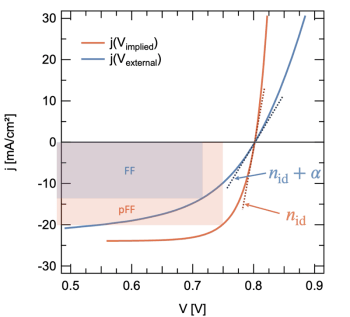
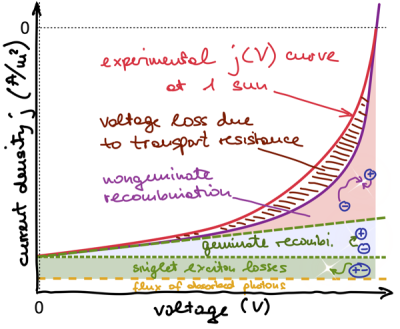
<p>The simplest way to characterise transport resistance is to determine the difference between a normal current density&#x2013;voltage curve under 1 sun, and the <a href="https://blog.disorderedmatter.eu/2022/05/27/the-transport-resistance-in-organic-solar-cells/">suns-Voc curve</a>. The latter is the pair-wise combination of generation current density and open-circuit voltage that is giving one current density-voltage point per light intensity: doing this for a wide range of light-intensities results in a pseudo-JV curve. To compare this suns-Voc curve to the current density&#x2013;voltage curve under 1 sun, it has to downshifted so that the open-circuit voltage of both curves coincide on one point: <img src="https://s0.wp.com/latex.php?latex=j%28V%29+%3D+%280%2C+V_%7Boc%7D%29&#038;bg=ffffff&#038;fg=1a1a1a&#038;s=0&#038;c=20201002" srcset="https://s0.wp.com/latex.php?latex=j%28V%29+%3D+%280%2C+V_%7Boc%7D%29&#038;bg=ffffff&#038;fg=1a1a1a&#038;s=0&#038;c=20201002 1x, https://s0.wp.com/latex.php?latex=j%28V%29+%3D+%280%2C+V_%7Boc%7D%29&#038;bg=ffffff&#038;fg=1a1a1a&#038;s=0&#038;c=20201002&#038;zoom=4.5 4x" alt="j(V) = (0, V_{oc})" class="latex" />. The result could look like the scheme shown in the figure below. I have adapted this figure from Maria&#8217;s new publication on transport resistance losses in organic solar cells [<a href="https://doi.org/10.1088/1361-6633/adb20c">Saladina 2025</a>] (the title is <em>Transport resistance strikes back: unveiling its impact on fill factor losses in organic solar cells</em> ;-). The <img src="https://s0.wp.com/latex.php?latex=j%28V_%5Cmathrm%7Bexternal%7D%29&#038;bg=ffffff&#038;fg=1a1a1a&#038;s=0&#038;c=20201002" srcset="https://s0.wp.com/latex.php?latex=j%28V_%5Cmathrm%7Bexternal%7D%29&#038;bg=ffffff&#038;fg=1a1a1a&#038;s=0&#038;c=20201002 1x, https://s0.wp.com/latex.php?latex=j%28V_%5Cmathrm%7Bexternal%7D%29&#038;bg=ffffff&#038;fg=1a1a1a&#038;s=0&#038;c=20201002&#038;zoom=4.5 4x" alt="j(V_&#92;mathrm{external})" class="latex" /> curve (blue) is the normal JV curve under illumination, where <img src="https://s0.wp.com/latex.php?latex=V_%5Cmathrm%7Bexternal%7D&#038;bg=ffffff&#038;fg=1a1a1a&#038;s=0&#038;c=20201002" srcset="https://s0.wp.com/latex.php?latex=V_%5Cmathrm%7Bexternal%7D&#038;bg=ffffff&#038;fg=1a1a1a&#038;s=0&#038;c=20201002 1x, https://s0.wp.com/latex.php?latex=V_%5Cmathrm%7Bexternal%7D&#038;bg=ffffff&#038;fg=1a1a1a&#038;s=0&#038;c=20201002&#038;zoom=4.5 4x" alt="V_&#92;mathrm{external}" class="latex" /> is the applied voltage. The down-shifted suns-Voc curve corresponds to the <img src="https://s0.wp.com/latex.php?latex=j%28V_%5Cmathrm%7Bimplied%7D%29&#038;bg=ffffff&#038;fg=1a1a1a&#038;s=0&#038;c=20201002" srcset="https://s0.wp.com/latex.php?latex=j%28V_%5Cmathrm%7Bimplied%7D%29&#038;bg=ffffff&#038;fg=1a1a1a&#038;s=0&#038;c=20201002 1x, https://s0.wp.com/latex.php?latex=j%28V_%5Cmathrm%7Bimplied%7D%29&#038;bg=ffffff&#038;fg=1a1a1a&#038;s=0&#038;c=20201002&#038;zoom=4.5 4x" alt="j(V_&#92;mathrm{implied})" class="latex" /> (red); the implied voltage is the voltage without any series-resistance imposed drops. In other words, the <em>externally</em> applied voltage drops over the diode and all series resistances, the external series resistance as well as the transport resistance that comes from a low active layer (or transport layer) conductivity. The <em>implied</em> voltage, as measured by the open-circuit voltage (at zero current, where series resistances do not play a role), corresponds to the voltage without drops over series and transport resistance. <img src="https://blog.disorderedmatter.eu/wp-content/uploads/2025/02/jv-ff-pff.png?w=350" alt="" title="jV-FF-pFF.png" border="0" width="350" style="float:left" /> If a solar cell has a low active layer conductivity and is transport resistance limited, than the measurement of the suns-Voc curve to construct the <img src="https://s0.wp.com/latex.php?latex=j%28V_%5Cmathrm%7Bimplied%7D%29&#038;bg=ffffff&#038;fg=1a1a1a&#038;s=0&#038;c=20201002" srcset="https://s0.wp.com/latex.php?latex=j%28V_%5Cmathrm%7Bimplied%7D%29&#038;bg=ffffff&#038;fg=1a1a1a&#038;s=0&#038;c=20201002 1x, https://s0.wp.com/latex.php?latex=j%28V_%5Cmathrm%7Bimplied%7D%29&#038;bg=ffffff&#038;fg=1a1a1a&#038;s=0&#038;c=20201002&#038;zoom=4.5 4x" alt="j(V_&#92;mathrm{implied})" class="latex" />-curve allows to evaluate the performance of that solar cell <em>as if it did not have any transport resistance losses</em>. One could also say: while the measured <img src="https://s0.wp.com/latex.php?latex=j%28V_%5Cmathrm%7Bexternal%7D%29&#038;bg=ffffff&#038;fg=1a1a1a&#038;s=0&#038;c=20201002" srcset="https://s0.wp.com/latex.php?latex=j%28V_%5Cmathrm%7Bexternal%7D%29&#038;bg=ffffff&#038;fg=1a1a1a&#038;s=0&#038;c=20201002 1x, https://s0.wp.com/latex.php?latex=j%28V_%5Cmathrm%7Bexternal%7D%29&#038;bg=ffffff&#038;fg=1a1a1a&#038;s=0&#038;c=20201002&#038;zoom=4.5 4x" alt="j(V_&#92;mathrm{external})" class="latex" /> curve is transport resistance limited, the pseudo-<img src="https://s0.wp.com/latex.php?latex=j%28V_%5Cmathrm%7Bimplied%7D%29&#038;bg=ffffff&#038;fg=1a1a1a&#038;s=0&#038;c=20201002" srcset="https://s0.wp.com/latex.php?latex=j%28V_%5Cmathrm%7Bimplied%7D%29&#038;bg=ffffff&#038;fg=1a1a1a&#038;s=0&#038;c=20201002 1x, https://s0.wp.com/latex.php?latex=j%28V_%5Cmathrm%7Bimplied%7D%29&#038;bg=ffffff&#038;fg=1a1a1a&#038;s=0&#038;c=20201002&#038;zoom=4.5 4x" alt="j(V_&#92;mathrm{implied})" class="latex" /> curve corresponds to the case of infinite conductivity, but contains the same recombination as the measured curve.</p>
<p>Also indicated in the figure are two further figures-of-merit to distinguish the measured JV curve and the series resistance-free pseudo-JV curve: the slopes around the open circuit voltage (indicated in the figure by <img src="https://s0.wp.com/latex.php?latex=n_%7Bid%7D&#038;bg=ffffff&#038;fg=1a1a1a&#038;s=0&#038;c=20201002" srcset="https://s0.wp.com/latex.php?latex=n_%7Bid%7D&#038;bg=ffffff&#038;fg=1a1a1a&#038;s=0&#038;c=20201002 1x, https://s0.wp.com/latex.php?latex=n_%7Bid%7D&#038;bg=ffffff&#038;fg=1a1a1a&#038;s=0&#038;c=20201002&#038;zoom=4.5 4x" alt="n_{id}" class="latex" /> and <img src="https://s0.wp.com/latex.php?latex=n_%7Bid%7D%2B%5Calpha&#038;bg=ffffff&#038;fg=1a1a1a&#038;s=0&#038;c=20201002" srcset="https://s0.wp.com/latex.php?latex=n_%7Bid%7D%2B%5Calpha&#038;bg=ffffff&#038;fg=1a1a1a&#038;s=0&#038;c=20201002 1x, https://s0.wp.com/latex.php?latex=n_%7Bid%7D%2B%5Calpha&#038;bg=ffffff&#038;fg=1a1a1a&#038;s=0&#038;c=20201002&#038;zoom=4.5 4x" alt="n_{id}+&#92;alpha" class="latex" />), and the fill factors &#x2013; FF and the pseudo-FF. The FF is generally defined as fraction of the power at the maximum power point over the power given by short circuit current times open circuit voltage, <img src="https://s0.wp.com/latex.php?latex=j_%7Bmpp%7D+V_%7Bmpp%7D+%2F+j_%7Bsc%7D+V_%7Boc%7D&#038;bg=ffffff&#038;fg=1a1a1a&#038;s=0&#038;c=20201002" srcset="https://s0.wp.com/latex.php?latex=j_%7Bmpp%7D+V_%7Bmpp%7D+%2F+j_%7Bsc%7D+V_%7Boc%7D&#038;bg=ffffff&#038;fg=1a1a1a&#038;s=0&#038;c=20201002 1x, https://s0.wp.com/latex.php?latex=j_%7Bmpp%7D+V_%7Bmpp%7D+%2F+j_%7Bsc%7D+V_%7Boc%7D&#038;bg=ffffff&#038;fg=1a1a1a&#038;s=0&#038;c=20201002&#038;zoom=4.5 4x" alt="j_{mpp} V_{mpp} / j_{sc} V_{oc}" class="latex" />. The pseudo-FF does essentially the same, but for the series and transport resistance-free pseudo-jV curve. The normal FF (blueish) is <em>not</em> a measure of just recombination, but of recombination <em>and</em> series and transport resistance losses! The pseudo-FF (reddish) is due to <em>only</em> recombination losses. The difference between pFF and FF is, therefore, a measure of the transport resistance losses that the organic solar cell has.</p>
<p>The suns-Voc curve is used in the literature to determine the recombination ideality factor of solar cells. Even on the linear scale, the (inverse) slope of the corresponding <img src="https://s0.wp.com/latex.php?latex=j%28V_%5Cmathrm%7Bimplied%7D%29&#038;bg=ffffff&#038;fg=1a1a1a&#038;s=0&#038;c=20201002" srcset="https://s0.wp.com/latex.php?latex=j%28V_%5Cmathrm%7Bimplied%7D%29&#038;bg=ffffff&#038;fg=1a1a1a&#038;s=0&#038;c=20201002 1x, https://s0.wp.com/latex.php?latex=j%28V_%5Cmathrm%7Bimplied%7D%29&#038;bg=ffffff&#038;fg=1a1a1a&#038;s=0&#038;c=20201002&#038;zoom=4.5 4x" alt="j(V_&#92;mathrm{implied})" class="latex" />-curve around Voc is given by the ideality factor <img src="https://s0.wp.com/latex.php?latex=n_%7Bid%7D&#038;bg=ffffff&#038;fg=1a1a1a&#038;s=0&#038;c=20201002" srcset="https://s0.wp.com/latex.php?latex=n_%7Bid%7D&#038;bg=ffffff&#038;fg=1a1a1a&#038;s=0&#038;c=20201002 1x, https://s0.wp.com/latex.php?latex=n_%7Bid%7D&#038;bg=ffffff&#038;fg=1a1a1a&#038;s=0&#038;c=20201002&#038;zoom=4.5 4x" alt="n_{id}" class="latex" />. The <img src="https://s0.wp.com/latex.php?latex=j%28V_%5Cmathrm%7Bexternal%7D%29&#038;bg=ffffff&#038;fg=1a1a1a&#038;s=0&#038;c=20201002" srcset="https://s0.wp.com/latex.php?latex=j%28V_%5Cmathrm%7Bexternal%7D%29&#038;bg=ffffff&#038;fg=1a1a1a&#038;s=0&#038;c=20201002 1x, https://s0.wp.com/latex.php?latex=j%28V_%5Cmathrm%7Bexternal%7D%29&#038;bg=ffffff&#038;fg=1a1a1a&#038;s=0&#038;c=20201002&#038;zoom=4.5 4x" alt="j(V_&#92;mathrm{external})" class="latex" /> curve has a slope which is given by the ideality factor <em>and</em> a figure-of-merit describing the transport resistance: <img src="https://s0.wp.com/latex.php?latex=%5Calpha&#038;bg=ffffff&#038;fg=1a1a1a&#038;s=0&#038;c=20201002" srcset="https://s0.wp.com/latex.php?latex=%5Calpha&#038;bg=ffffff&#038;fg=1a1a1a&#038;s=0&#038;c=20201002 1x, https://s0.wp.com/latex.php?latex=%5Calpha&#038;bg=ffffff&#038;fg=1a1a1a&#038;s=0&#038;c=20201002&#038;zoom=4.5 4x" alt="&#92;alpha" class="latex" />. It was introduced by [<a href="https://doi.org/10.1038/srep24861">Neher 2016</a>], and I state it here in its general form,<br />
<img src="https://s0.wp.com/latex.php?latex=%5Calpha+%3D+%5Cfrac%7BeL%7D%7BkT%7D+%5Cfrac%7Bj_%5Cmathrm%7Bgen%7D%7D%7B%5Csigma_%7Boc%7D%7D%2C&#038;bg=ffffff&#038;fg=1a1a1a&#038;s=0&#038;c=20201002" srcset="https://s0.wp.com/latex.php?latex=%5Calpha+%3D+%5Cfrac%7BeL%7D%7BkT%7D+%5Cfrac%7Bj_%5Cmathrm%7Bgen%7D%7D%7B%5Csigma_%7Boc%7D%7D%2C&#038;bg=ffffff&#038;fg=1a1a1a&#038;s=0&#038;c=20201002 1x, https://s0.wp.com/latex.php?latex=%5Calpha+%3D+%5Cfrac%7BeL%7D%7BkT%7D+%5Cfrac%7Bj_%5Cmathrm%7Bgen%7D%7D%7B%5Csigma_%7Boc%7D%7D%2C&#038;bg=ffffff&#038;fg=1a1a1a&#038;s=0&#038;c=20201002&#038;zoom=4.5 4x" alt="&#92;alpha = &#92;frac{eL}{kT} &#92;frac{j_&#92;mathrm{gen}}{&#92;sigma_{oc}}," class="latex" /><br />
where the recombination current density equals <img src="https://s0.wp.com/latex.php?latex=j_%5Cmathrm%7Bgen%7D&#038;bg=ffffff&#038;fg=1a1a1a&#038;s=0&#038;c=20201002" srcset="https://s0.wp.com/latex.php?latex=j_%5Cmathrm%7Bgen%7D&#038;bg=ffffff&#038;fg=1a1a1a&#038;s=0&#038;c=20201002 1x, https://s0.wp.com/latex.php?latex=j_%5Cmathrm%7Bgen%7D&#038;bg=ffffff&#038;fg=1a1a1a&#038;s=0&#038;c=20201002&#038;zoom=4.5 4x" alt="j_&#92;mathrm{gen}" class="latex" /> at <img src="https://s0.wp.com/latex.php?latex=V_%7Boc%7D&#038;bg=ffffff&#038;fg=1a1a1a&#038;s=0&#038;c=20201002" srcset="https://s0.wp.com/latex.php?latex=V_%7Boc%7D&#038;bg=ffffff&#038;fg=1a1a1a&#038;s=0&#038;c=20201002 1x, https://s0.wp.com/latex.php?latex=V_%7Boc%7D&#038;bg=ffffff&#038;fg=1a1a1a&#038;s=0&#038;c=20201002&#038;zoom=4.5 4x" alt="V_{oc}" class="latex" />, and <img src="https://s0.wp.com/latex.php?latex=%5Csigma_%7Boc%7D&#038;bg=ffffff&#038;fg=1a1a1a&#038;s=0&#038;c=20201002" srcset="https://s0.wp.com/latex.php?latex=%5Csigma_%7Boc%7D&#038;bg=ffffff&#038;fg=1a1a1a&#038;s=0&#038;c=20201002 1x, https://s0.wp.com/latex.php?latex=%5Csigma_%7Boc%7D&#038;bg=ffffff&#038;fg=1a1a1a&#038;s=0&#038;c=20201002&#038;zoom=4.5 4x" alt="&#92;sigma_{oc}" class="latex" /> is the effective conductivity at open circuit. <img src="https://s0.wp.com/latex.php?latex=L&#038;bg=ffffff&#038;fg=1a1a1a&#038;s=0&#038;c=20201002" srcset="https://s0.wp.com/latex.php?latex=L&#038;bg=ffffff&#038;fg=1a1a1a&#038;s=0&#038;c=20201002 1x, https://s0.wp.com/latex.php?latex=L&#038;bg=ffffff&#038;fg=1a1a1a&#038;s=0&#038;c=20201002&#038;zoom=4.5 4x" alt="L" class="latex" /> is the active layer thickness, and <img src="https://s0.wp.com/latex.php?latex=kT%2Fe&#038;bg=ffffff&#038;fg=1a1a1a&#038;s=0&#038;c=20201002" srcset="https://s0.wp.com/latex.php?latex=kT%2Fe&#038;bg=ffffff&#038;fg=1a1a1a&#038;s=0&#038;c=20201002 1x, https://s0.wp.com/latex.php?latex=kT%2Fe&#038;bg=ffffff&#038;fg=1a1a1a&#038;s=0&#038;c=20201002&#038;zoom=4.5 4x" alt="kT/e" class="latex" /> the thermal voltage. That means, <img src="https://s0.wp.com/latex.php?latex=%5Calpha&#038;bg=ffffff&#038;fg=1a1a1a&#038;s=0&#038;c=20201002" srcset="https://s0.wp.com/latex.php?latex=%5Calpha&#038;bg=ffffff&#038;fg=1a1a1a&#038;s=0&#038;c=20201002 1x, https://s0.wp.com/latex.php?latex=%5Calpha&#038;bg=ffffff&#038;fg=1a1a1a&#038;s=0&#038;c=20201002&#038;zoom=4.5 4x" alt="&#92;alpha" class="latex" /> increases when the active layer conductivity decreases. Correspondingly, the slope of the jV curve under illumination (the <img src="https://s0.wp.com/latex.php?latex=j%28V_%5Cmathrm%7Bexternal%7D%29&#038;bg=ffffff&#038;fg=1a1a1a&#038;s=0&#038;c=20201002" srcset="https://s0.wp.com/latex.php?latex=j%28V_%5Cmathrm%7Bexternal%7D%29&#038;bg=ffffff&#038;fg=1a1a1a&#038;s=0&#038;c=20201002 1x, https://s0.wp.com/latex.php?latex=j%28V_%5Cmathrm%7Bexternal%7D%29&#038;bg=ffffff&#038;fg=1a1a1a&#038;s=0&#038;c=20201002&#038;zoom=4.5 4x" alt="j(V_&#92;mathrm{external})" class="latex" /> curve) becomes less steep and the FF goes down: these are the transport resistance losses.<br />
<img src="https://blog.disorderedmatter.eu/wp-content/uploads/2025/02/ff-vs-voc-due-to-transport-resistance.png?w=350" alt="FF vs Voc due to transport resistance." title="FF-vs-Voc-due-to-transport-resistance.png" border="0" width="350" style="float:right" /> For a selection of devices that we characterised for [<a href="https://doi.org/10.1088/1361-6633/adb20c">Saladina 2025</a>], we show on the right-hand-side the impact of transport resistance on the fill factor. The upper limit of the FF (solid line) can be reached when the recombination ideality is unity and there are no transport resistance losses. The FF (open circles) is often much lower, but in modern devices such as PM6:Y6 it can exceed 75%. The pseudo-FF (filled circle), however, is <em>much</em> closer to the upper limit, and is due to the trap-assisted recombination found in organic solar cells, at ideality factors that are often larger than unity. All in all, the largest loss for the fill factor is the transport resistance loss, essentially the difference between the pseudo-FF and the FF, even for the (not shown here) record-efficiency organic solar cell devices! I believe it makes a lot of sense to quantify the transport resistance in all publications that present the performance organic solar cells, so to avoid drawing wrong conclusions &#x2013; for instance, that a given low fill factor is due to recombination, when the FF loss is likely dominated by low active layer conductivities. This is even more important when looking at the losses of organic solar cells with thicker active layers.</p>
<p>If you want to understand more about the transport resistance loss, I recommend (and self-advertise:) Maria&#8217;s paper, [<a href="https://doi.org/10.1088/1361-6633/adb20c">Saladina 2025</a>]. It contains information on how to predict the pseudo-FF just from the recombination ideality factor, how the conductivity of the active layer can be determined from the transport resistance, that <img src="https://s0.wp.com/latex.php?latex=%5Calpha&#038;bg=ffffff&#038;fg=1a1a1a&#038;s=0&#038;c=20201002" srcset="https://s0.wp.com/latex.php?latex=%5Calpha&#038;bg=ffffff&#038;fg=1a1a1a&#038;s=0&#038;c=20201002 1x, https://s0.wp.com/latex.php?latex=%5Calpha&#038;bg=ffffff&#038;fg=1a1a1a&#038;s=0&#038;c=20201002&#038;zoom=4.5 4x" alt="&#92;alpha" class="latex" /> is actually voltage dependent and not the best measure to describe the FF losses, how energetic disorder influences transport resistance, and how transport resistance losses can be minimised. As always, I am happy to hear your thoughts, in the comments or by email.</p>
]]></content>
		
					<link rel="replies" type="text/html" href="https://blog.disorderedmatter.eu/2025/02/15/transport-resistance-strikes-back/#comments" thr:count="0" />
			<link rel="replies" type="application/atom+xml" href="https://blog.disorderedmatter.eu/2025/02/15/transport-resistance-strikes-back/feed/atom/" thr:count="0" />
			<thr:total>0</thr:total>
			</entry>
		<entry>
		<author>
			<name>deibel</name>
							<uri>http://www.disorderedmatter.eu</uri>
						</author>

		<title type="html"><![CDATA[Pitfalls when measuring recombination lifetimes in organic solar cells]]></title>
		<link rel="alternate" type="text/html" href="https://blog.disorderedmatter.eu/2024/08/22/pitfalls-when-measuring-recombination-lifetimes-in-organic-solar-cells/" />

		<id>http://deibel.wordpress.com/?p=795</id>
		<updated>2024-08-22T11:41:59Z</updated>
		<published>2024-08-22T10:28:47Z</published>
		<category scheme="https://blog.disorderedmatter.eu" term="physics" /><category scheme="https://blog.disorderedmatter.eu" term="device physics" /><category scheme="https://blog.disorderedmatter.eu" term="organic solar cells" />
		<summary type="html"><![CDATA[Six years ago, I came across an interesting publication by David Kiermasch and Kristofer Tvingstedt, [Kiermasch et al 2018], titled Revisiting lifetimes from transient electrical characterization of thin film solar cells; a capacitive concern evaluated for silicon, organic and perovskite devices. It shows that particular in thin film solar cells, the time constant determined by &#8230; <a href="https://blog.disorderedmatter.eu/2024/08/22/pitfalls-when-measuring-recombination-lifetimes-in-organic-solar-cells/" class="more-link">Continue reading<span class="screen-reader-text"> "Pitfalls when measuring recombination lifetimes in organic solar&#160;cells"</span></a>]]></summary>

					<content type="html" xml:base="https://blog.disorderedmatter.eu/2024/08/22/pitfalls-when-measuring-recombination-lifetimes-in-organic-solar-cells/"><![CDATA[<p>Six years ago, I came across an interesting publication by David Kiermasch and Kristofer Tvingstedt, [<a href="http://dx.doi.org/10.1039/c7ee03155f">Kiermasch et al 2018</a>], <a title="View 'Frosch verla&#x308;sst Seerose' on Flickr.com" href="https://www.flickr.com/photos/deibel/53939922214"><img style="float: right;margin: 5px" title="Frosch verla&#x308;sst Seerose" src="https://live.staticflickr.com/65535/53939922214_87bd3d7770.jpg" alt="Frosch verla&#x308;sst Seerose." width="360" border="0" /></a> titled <em>Revisiting lifetimes from transient electrical characterization of thin film solar cells; a capacitive concern evaluated for silicon, organic and perovskite devices</em>. It shows that particular in thin film solar cells, the time constant determined by voltage based techniques &#x2013;&nbsp;open circuit voltage decay (OCVD), transient photovoltage (TPV), intensity modulated photovoltage spectroscopy (IMVS) &#x2013;&nbsp;is in many cases <em>not</em> the recombination lifetime, but corresponds to an RC-time from the device itself. While the authors did not find this effect, they showed impressively how most modern solar cells are limited in this respect, and it has to be verified carefully whether or not the experimentally determined time constants do correspond to <em>recombination</em> lifetimes!</p>
<p>I took this publication very seriously. Below I show you a summary slide I made for my group seminar in the year of publication, 2018.</p>
<p><img loading="lazy" style="display: block;margin-left: auto;margin-right: auto" title="Carstens-tuesday-note-2018.png" src="https://blog.disorderedmatter.eu/wp-content/uploads/2024/08/carstens-tuesday-note-2018.png?w=600&#038;h=472" alt="Carstens tuesday note 2018." width="600" height="472" border="0" /></p>
<p>The shown equation was actually animated, sorry for making your life harder (but mine easier;). Briefly, the idea of why an RC limitation shows up is the following. The charge in the device <img src="https://s0.wp.com/latex.php?latex=Q&#038;bg=ffffff&#038;fg=1a1a1a&#038;s=0&#038;c=20201002" srcset="https://s0.wp.com/latex.php?latex=Q&#038;bg=ffffff&#038;fg=1a1a1a&#038;s=0&#038;c=20201002 1x, https://s0.wp.com/latex.php?latex=Q&#038;bg=ffffff&#038;fg=1a1a1a&#038;s=0&#038;c=20201002&#038;zoom=4.5 4x" alt="Q" class="latex" /> is changing with time during the measurement &#x2013;&nbsp;no matter if the method is a large signal (OCVD) or small signal method (TPC, IMVS):</p>
<p><img src="https://s0.wp.com/latex.php?latex=%5Cfrac%7BdQ%28t%29%7D%7Bdt%7D+%3D+%5Cunderbrace%7B%5Cfrac%7BdQ%28t%29%7D%7Bdt%7D%7D_%7B-%5Cfrac%7BQ%28t%29%7D%7B%5Ctau_%5Ctext%7Brec%7D%7D%7D+-+%5Cunderbrace%7B%5Cfrac%7B%5Cpartial+Q%7D%7B%5Cpartial+V%7D%7D_%7BC%28V%29%7D+%5Cfrac%7Bd+V%28t%29%7D%7Bd+t%7D%2C&#038;bg=ffffff&#038;fg=1a1a1a&#038;s=0&#038;c=20201002" srcset="https://s0.wp.com/latex.php?latex=%5Cfrac%7BdQ%28t%29%7D%7Bdt%7D+%3D+%5Cunderbrace%7B%5Cfrac%7BdQ%28t%29%7D%7Bdt%7D%7D_%7B-%5Cfrac%7BQ%28t%29%7D%7B%5Ctau_%5Ctext%7Brec%7D%7D%7D+-+%5Cunderbrace%7B%5Cfrac%7B%5Cpartial+Q%7D%7B%5Cpartial+V%7D%7D_%7BC%28V%29%7D+%5Cfrac%7Bd+V%28t%29%7D%7Bd+t%7D%2C&#038;bg=ffffff&#038;fg=1a1a1a&#038;s=0&#038;c=20201002 1x, https://s0.wp.com/latex.php?latex=%5Cfrac%7BdQ%28t%29%7D%7Bdt%7D+%3D+%5Cunderbrace%7B%5Cfrac%7BdQ%28t%29%7D%7Bdt%7D%7D_%7B-%5Cfrac%7BQ%28t%29%7D%7B%5Ctau_%5Ctext%7Brec%7D%7D%7D+-+%5Cunderbrace%7B%5Cfrac%7B%5Cpartial+Q%7D%7B%5Cpartial+V%7D%7D_%7BC%28V%29%7D+%5Cfrac%7Bd+V%28t%29%7D%7Bd+t%7D%2C&#038;bg=ffffff&#038;fg=1a1a1a&#038;s=0&#038;c=20201002&#038;zoom=4.5 4x" alt="&#92;frac{dQ(t)}{dt} = &#92;underbrace{&#92;frac{dQ(t)}{dt}}_{-&#92;frac{Q(t)}{&#92;tau_&#92;text{rec}}} - &#92;underbrace{&#92;frac{&#92;partial Q}{&#92;partial V}}_{C(V)} &#92;frac{d V(t)}{d t}," class="latex" /></p>
<p>where the first term on the right hand side represents the recombination rate &#x2013; of which we want to measure the recombination lifetime <img src="https://s0.wp.com/latex.php?latex=%5Ctau_%5Ctext%7Brec%7D&#038;bg=ffffff&#038;fg=1a1a1a&#038;s=0&#038;c=20201002" srcset="https://s0.wp.com/latex.php?latex=%5Ctau_%5Ctext%7Brec%7D&#038;bg=ffffff&#038;fg=1a1a1a&#038;s=0&#038;c=20201002 1x, https://s0.wp.com/latex.php?latex=%5Ctau_%5Ctext%7Brec%7D&#038;bg=ffffff&#038;fg=1a1a1a&#038;s=0&#038;c=20201002&#038;zoom=4.5 4x" alt="&#92;tau_&#92;text{rec}" class="latex" /> &#x2013;&nbsp;and the second term a contribution coming from the response of charge due to the measured signal of the experimental technique: the time variation of the voltage as response to a time dependent light signal (pulsed or modulated). If the latter capacitive term becomes dominant, the recombination lifetime cannot be determined anymore, as is hidden behind the RC time.</p>
<p>As you can see in this slide, based on our data, for P3HT:PCBM (bottom left of the slide) the capacitive (RC) times remain lower than the measured time constants. We can state with some confidence that the RC times do not limit the measured recombination lifetimes. Also, the slopes of <img src="https://s0.wp.com/latex.php?latex=%5Ctau&#038;bg=ffffff&#038;fg=1a1a1a&#038;s=0&#038;c=20201002" srcset="https://s0.wp.com/latex.php?latex=%5Ctau&#038;bg=ffffff&#038;fg=1a1a1a&#038;s=0&#038;c=20201002 1x, https://s0.wp.com/latex.php?latex=%5Ctau&#038;bg=ffffff&#038;fg=1a1a1a&#038;s=0&#038;c=20201002&#038;zoom=4.5 4x" alt="&#92;tau" class="latex" /> vs <img src="https://s0.wp.com/latex.php?latex=V_%7Boc%7D&#038;bg=ffffff&#038;fg=1a1a1a&#038;s=0&#038;c=20201002" srcset="https://s0.wp.com/latex.php?latex=V_%7Boc%7D&#038;bg=ffffff&#038;fg=1a1a1a&#038;s=0&#038;c=20201002 1x, https://s0.wp.com/latex.php?latex=V_%7Boc%7D&#038;bg=ffffff&#038;fg=1a1a1a&#038;s=0&#038;c=20201002&#038;zoom=4.5 4x" alt="V_{oc}" class="latex" /> are different and, in this case, a measure of the recombination order.</p>
<p>In contrast, for the PCDTBT:PC70BM solar cell, for which I took the measured time constants at room temperature from literature, you see that the RC time limits the recombination lifetime, as the measured time constants just correspond to the RC times. This implies that the recombination lifetime is too short to be measured for the given RC limitation.</p>
<p>A nice aspect of the paper by Kiermasch et al. is that it gives a comparatively simple way to estimate the RC times:</p>
<p><img src="https://s0.wp.com/latex.php?latex=%5Ctau_%7BRC%7D+%5Capprox+%5Cfrac%7BC%28V_%7Boc%7D%29%7D%7Bj_%5Ctext%7Bgen%7D%28V_%7Boc%7D%29%7D+%5Cfrac%7BnkT%7D%7Be%7D&#038;bg=ffffff&#038;fg=1a1a1a&#038;s=0&#038;c=20201002" srcset="https://s0.wp.com/latex.php?latex=%5Ctau_%7BRC%7D+%5Capprox+%5Cfrac%7BC%28V_%7Boc%7D%29%7D%7Bj_%5Ctext%7Bgen%7D%28V_%7Boc%7D%29%7D+%5Cfrac%7BnkT%7D%7Be%7D&#038;bg=ffffff&#038;fg=1a1a1a&#038;s=0&#038;c=20201002 1x, https://s0.wp.com/latex.php?latex=%5Ctau_%7BRC%7D+%5Capprox+%5Cfrac%7BC%28V_%7Boc%7D%29%7D%7Bj_%5Ctext%7Bgen%7D%28V_%7Boc%7D%29%7D+%5Cfrac%7BnkT%7D%7Be%7D&#038;bg=ffffff&#038;fg=1a1a1a&#038;s=0&#038;c=20201002&#038;zoom=4.5 4x" alt="&#92;tau_{RC} &#92;approx &#92;frac{C(V_{oc})}{j_&#92;text{gen}(V_{oc})} &#92;frac{nkT}{e}" class="latex" /></p>
<p>Here, <img src="https://s0.wp.com/latex.php?latex=nkT%2Fe&#038;bg=ffffff&#038;fg=1a1a1a&#038;s=0&#038;c=20201002" srcset="https://s0.wp.com/latex.php?latex=nkT%2Fe&#038;bg=ffffff&#038;fg=1a1a1a&#038;s=0&#038;c=20201002 1x, https://s0.wp.com/latex.php?latex=nkT%2Fe&#038;bg=ffffff&#038;fg=1a1a1a&#038;s=0&#038;c=20201002&#038;zoom=4.5 4x" alt="nkT/e" class="latex" /> is the <a href="https://deibel.wordpress.com/2016/05/14/the-diode-ideality-factor-in-organic-solar-cells-recombination">recombination ideality factor</a> times the thermal voltage, <img src="https://s0.wp.com/latex.php?latex=C&#038;bg=ffffff&#038;fg=1a1a1a&#038;s=0&#038;c=20201002" srcset="https://s0.wp.com/latex.php?latex=C&#038;bg=ffffff&#038;fg=1a1a1a&#038;s=0&#038;c=20201002 1x, https://s0.wp.com/latex.php?latex=C&#038;bg=ffffff&#038;fg=1a1a1a&#038;s=0&#038;c=20201002&#038;zoom=4.5 4x" alt="C" class="latex" /> is the voltage dependent capacitance, which can be estimated (as lower bound) by the geometric capacitance of the active layer, <img src="https://s0.wp.com/latex.php?latex=C_%5Ctext%7Bgeo%7D+%3D+%5Cepsilon_r%5Cepsilon_0%2FL&#038;bg=ffffff&#038;fg=1a1a1a&#038;s=0&#038;c=20201002" srcset="https://s0.wp.com/latex.php?latex=C_%5Ctext%7Bgeo%7D+%3D+%5Cepsilon_r%5Cepsilon_0%2FL&#038;bg=ffffff&#038;fg=1a1a1a&#038;s=0&#038;c=20201002 1x, https://s0.wp.com/latex.php?latex=C_%5Ctext%7Bgeo%7D+%3D+%5Cepsilon_r%5Cepsilon_0%2FL&#038;bg=ffffff&#038;fg=1a1a1a&#038;s=0&#038;c=20201002&#038;zoom=4.5 4x" alt="C_&#92;text{geo} = &#92;epsilon_r&#92;epsilon_0/L" class="latex" />, with the dielectric constants (relative and vacuum) and <img src="https://s0.wp.com/latex.php?latex=L&#038;bg=ffffff&#038;fg=1a1a1a&#038;s=0&#038;c=20201002" srcset="https://s0.wp.com/latex.php?latex=L&#038;bg=ffffff&#038;fg=1a1a1a&#038;s=0&#038;c=20201002 1x, https://s0.wp.com/latex.php?latex=L&#038;bg=ffffff&#038;fg=1a1a1a&#038;s=0&#038;c=20201002&#038;zoom=4.5 4x" alt="L" class="latex" /> the active layer thickness (you could also include organic transport layers, but probably not PEDOT:PSS as it has a relative dielectric constant <img src="https://s0.wp.com/latex.php?latex=%5Cgg&#038;bg=ffffff&#038;fg=1a1a1a&#038;s=0&#038;c=20201002" srcset="https://s0.wp.com/latex.php?latex=%5Cgg&#038;bg=ffffff&#038;fg=1a1a1a&#038;s=0&#038;c=20201002 1x, https://s0.wp.com/latex.php?latex=%5Cgg&#038;bg=ffffff&#038;fg=1a1a1a&#038;s=0&#038;c=20201002&#038;zoom=4.5 4x" alt="&#92;gg" class="latex" /> 3). The generation current density can be approximated, in most cases, by the short circuit current density <img src="https://s0.wp.com/latex.php?latex=j_%7Bsc%7D&#038;bg=ffffff&#038;fg=1a1a1a&#038;s=0&#038;c=20201002" srcset="https://s0.wp.com/latex.php?latex=j_%7Bsc%7D&#038;bg=ffffff&#038;fg=1a1a1a&#038;s=0&#038;c=20201002 1x, https://s0.wp.com/latex.php?latex=j_%7Bsc%7D&#038;bg=ffffff&#038;fg=1a1a1a&#038;s=0&#038;c=20201002&#038;zoom=4.5 4x" alt="j_{sc}" class="latex" /> (unless the <a href="https://blog.disorderedmatter.eu/2022/05/27/the-transport-resistance-in-organic-solar-cells/">transport resistance loss</a> is too large:).</p>
<p>Please note, that in this particular RC time where both <img src="https://s0.wp.com/latex.php?latex=R&#038;bg=ffffff&#038;fg=1a1a1a&#038;s=0&#038;c=20201002" srcset="https://s0.wp.com/latex.php?latex=R&#038;bg=ffffff&#038;fg=1a1a1a&#038;s=0&#038;c=20201002 1x, https://s0.wp.com/latex.php?latex=R&#038;bg=ffffff&#038;fg=1a1a1a&#038;s=0&#038;c=20201002&#038;zoom=4.5 4x" alt="R" class="latex" /> and <img src="https://s0.wp.com/latex.php?latex=C&#038;bg=ffffff&#038;fg=1a1a1a&#038;s=0&#038;c=20201002" srcset="https://s0.wp.com/latex.php?latex=C&#038;bg=ffffff&#038;fg=1a1a1a&#038;s=0&#038;c=20201002 1x, https://s0.wp.com/latex.php?latex=C&#038;bg=ffffff&#038;fg=1a1a1a&#038;s=0&#038;c=20201002&#038;zoom=4.5 4x" alt="C" class="latex" /> come from the solar cell itself, the active area cancels out (as both <img src="https://s0.wp.com/latex.php?latex=j&#038;bg=ffffff&#038;fg=1a1a1a&#038;s=0&#038;c=20201002" srcset="https://s0.wp.com/latex.php?latex=j&#038;bg=ffffff&#038;fg=1a1a1a&#038;s=0&#038;c=20201002 1x, https://s0.wp.com/latex.php?latex=j&#038;bg=ffffff&#038;fg=1a1a1a&#038;s=0&#038;c=20201002&#038;zoom=4.5 4x" alt="j" class="latex" /> and <img src="https://s0.wp.com/latex.php?latex=C&#038;bg=ffffff&#038;fg=1a1a1a&#038;s=0&#038;c=20201002" srcset="https://s0.wp.com/latex.php?latex=C&#038;bg=ffffff&#038;fg=1a1a1a&#038;s=0&#038;c=20201002 1x, https://s0.wp.com/latex.php?latex=C&#038;bg=ffffff&#038;fg=1a1a1a&#038;s=0&#038;c=20201002&#038;zoom=4.5 4x" alt="C" class="latex" /> contain it and are in denominator and numerator, respectively). So, in order to reduce the RC time for a given solar cell, the only way seems to either 1. increase the current, by increasing the light intensity, measuring up to higher Voc&#8230; if possible, or 2. reduce the (geometric) capacitance by increasing the device thickness&#8230; a lot.</p>
<p>All of this came to my mind again when looking at IMVS data that we took on PM6:Y12 solar cell devices (made by Chen, measured by Nino with support from Christopher).<br />
<img loading="lazy" style="display: block;margin-left: auto;margin-right: auto" title="PM6-Y12 IMVS RC time vs IMVS time constant.png" src="https://blog.disorderedmatter.eu/wp-content/uploads/2024/08/pm6-y12-imvs-rc-time-vs-imvs-time-constant.png?w=600&#038;h=272" alt="PM6-Y12 IMVS RC time vs IMVS time constant." width="600" height="272" border="0" /><br />
On the left, you see the estimation of the RC time <img src="https://s0.wp.com/latex.php?latex=%5Ctau_%7BRC%7D&#038;bg=ffffff&#038;fg=1a1a1a&#038;s=0&#038;c=20201002" srcset="https://s0.wp.com/latex.php?latex=%5Ctau_%7BRC%7D&#038;bg=ffffff&#038;fg=1a1a1a&#038;s=0&#038;c=20201002 1x, https://s0.wp.com/latex.php?latex=%5Ctau_%7BRC%7D&#038;bg=ffffff&#038;fg=1a1a1a&#038;s=0&#038;c=20201002&#038;zoom=4.5 4x" alt="&#92;tau_{RC}" class="latex" /> after Kiermasch 2018, compared to the measured time constants by IMVS, <img src="https://s0.wp.com/latex.php?latex=%5Ctau_c&#038;bg=ffffff&#038;fg=1a1a1a&#038;s=0&#038;c=20201002" srcset="https://s0.wp.com/latex.php?latex=%5Ctau_c&#038;bg=ffffff&#038;fg=1a1a1a&#038;s=0&#038;c=20201002 1x, https://s0.wp.com/latex.php?latex=%5Ctau_c&#038;bg=ffffff&#038;fg=1a1a1a&#038;s=0&#038;c=20201002&#038;zoom=4.5 4x" alt="&#92;tau_c" class="latex" />. Except for, maybe, low temperatures, the RC times dominate the measured signal at high open circuit voltages, whereas the shunt limits the lifetime determination at lower open <img src="https://s0.wp.com/latex.php?latex=V_%7Boc%7D&#038;bg=ffffff&#038;fg=1a1a1a&#038;s=0&#038;c=20201002" srcset="https://s0.wp.com/latex.php?latex=V_%7Boc%7D&#038;bg=ffffff&#038;fg=1a1a1a&#038;s=0&#038;c=20201002 1x, https://s0.wp.com/latex.php?latex=V_%7Boc%7D&#038;bg=ffffff&#038;fg=1a1a1a&#038;s=0&#038;c=20201002&#038;zoom=4.5 4x" alt="V_{oc}" class="latex" />. A direct comparison is shown on the right hand side, where everything in the shaded triangle is either shunt or RC-limited.</p>
<p>While quite sad, I think this is important: if you want to determine recombination lifetimes in thin film solar cell <em>devices</em>, check for limitations by RC times and shunt.</p>
]]></content>
		
					<link rel="replies" type="text/html" href="https://blog.disorderedmatter.eu/2024/08/22/pitfalls-when-measuring-recombination-lifetimes-in-organic-solar-cells/#comments" thr:count="0" />
			<link rel="replies" type="application/atom+xml" href="https://blog.disorderedmatter.eu/2024/08/22/pitfalls-when-measuring-recombination-lifetimes-in-organic-solar-cells/feed/atom/" thr:count="0" />
			<thr:total>0</thr:total>
			</entry>
		<entry>
		<author>
			<name>deibel</name>
							<uri>http://www.disorderedmatter.eu</uri>
						</author>

		<title type="html"><![CDATA[The transport resistance in organic solar cells]]></title>
		<link rel="alternate" type="text/html" href="https://blog.disorderedmatter.eu/2022/05/27/the-transport-resistance-in-organic-solar-cells/" />

		<id>http://deibel.wordpress.com/?p=773</id>
		<updated>2022-07-01T15:58:56Z</updated>
		<published>2022-05-27T10:52:45Z</published>
		<category scheme="https://blog.disorderedmatter.eu" term="organic solar cells" /><category scheme="https://blog.disorderedmatter.eu" term="transport resistance" />
		<summary type="html"><![CDATA[In one of my last posts on the diode ideality factor (6 years ago&#8230;), I promised to talk about the transport resistance in organic solar cells. I came across it already during my time at IMEC in Leuven, Belgium, around 2004: my colleagues and I worked on an analytic model of the open circuit voltage &#8230; <a href="https://blog.disorderedmatter.eu/2022/05/27/the-transport-resistance-in-organic-solar-cells/" class="more-link">Continue reading<span class="screen-reader-text"> "The transport resistance in organic solar&#160;cells"</span></a>]]></summary>

					<content type="html" xml:base="https://blog.disorderedmatter.eu/2022/05/27/the-transport-resistance-in-organic-solar-cells/"><![CDATA[<p>In one of my last posts on the <a href="https://deibel.wordpress.com/2016/05/14/the-diode-ideality-factor-in-organic-solar-cells-recombination/">diode ideality factor</a> (6 years ago&#8230;), I promised to talk about the transport resistance in organic solar cells. <a title="View 'Cornudella de Montsant' on Flickr.com" href="https://www.flickr.com/photos/deibel/52101442067"><img loading="lazy" border="0" style="float:right;" height="300" src="https://live.staticflickr.com/65535/52101442067_005245db38_w.jpg" alt="Cornudella de Montsant" title="Cornudella de Montsant" width="400" /></a>I came across it already during my time at IMEC in Leuven, Belgium, around 2004: my colleagues and I worked on an analytic model of the open circuit voltage in organic bilayer solar cells. The corresponding paper was published a few years later, [<a href="http://dx.doi.org/10.1103/PhysRevB.77.165332">Cheyns et al 2008</a>], but I have to admit that I did not grasp its importance as a relevant loss mechanism for organic solar cells in general, focussing on <a href="https://deibel.wordpress.com/2010/10/05/hot-ct-complexes-and-geminate-recombination/">geminate</a> and <a href="https://deibel.wordpress.com/2013/08/21/nongeminate-recombination-in-organic-solar-cells-slower-than-expected/">nongeminate recombination</a> &#x2013; until this paper by [<a href="http://dx.doi.org/10.1038/ncomms7951">W&uuml;rfel/Neher et al 2015</a>] came out. I think now I have;)</p>
<p>The transport resistance is an internal resistance in the active layer (or transport layer(s)) of the solar cell, acting like an internal series resistance: It changes the slope of the current density&#x2013;voltage characteristics &#x2013;&nbsp;for instance around the open circuit voltage &#x2013;&nbsp;and thus reduces the fill factor.</p>
<p>If you can live with an effective conductivity <img src="https://s0.wp.com/latex.php?latex=%5Csigma_%5Ctext%7Beff%7D+%3D+e+n_%5Ctext%7Beff%7D+%5Cmu_%5Ctext%7Beff%7D&#038;bg=ffffff&#038;fg=1a1a1a&#038;s=0&#038;c=20201002" srcset="https://s0.wp.com/latex.php?latex=%5Csigma_%5Ctext%7Beff%7D+%3D+e+n_%5Ctext%7Beff%7D+%5Cmu_%5Ctext%7Beff%7D&#038;bg=ffffff&#038;fg=1a1a1a&#038;s=0&#038;c=20201002 1x, https://s0.wp.com/latex.php?latex=%5Csigma_%5Ctext%7Beff%7D+%3D+e+n_%5Ctext%7Beff%7D+%5Cmu_%5Ctext%7Beff%7D&#038;bg=ffffff&#038;fg=1a1a1a&#038;s=0&#038;c=20201002&#038;zoom=4.5 4x" alt="&#92;sigma_&#92;text{eff} = e n_&#92;text{eff} &#92;mu_&#92;text{eff}" class="latex" /> for now, I&#8217;d say that the transport resistance is given as</p>
<p><img src="https://s0.wp.com/latex.php?latex=R_%7Btr%7D%3D+%5Cfrac%7B1%7D%7Be%7D+%5Cint_0%5EL+%5Cfrac%7B1%7D%7Bn_%5Ctext%7Beff%7D%28x%29+%5Cmu_%5Ctext%7Beff%7D%28x%29%7D+%5Ctext%7Bd%7Dx+%5Capprox+%5Cfrac%7BL%7D%7B%5Csigma_%5Ctext%7Beff%7D%7D&#038;bg=ffffff&#038;fg=1a1a1a&#038;s=0&#038;c=20201002" srcset="https://s0.wp.com/latex.php?latex=R_%7Btr%7D%3D+%5Cfrac%7B1%7D%7Be%7D+%5Cint_0%5EL+%5Cfrac%7B1%7D%7Bn_%5Ctext%7Beff%7D%28x%29+%5Cmu_%5Ctext%7Beff%7D%28x%29%7D+%5Ctext%7Bd%7Dx+%5Capprox+%5Cfrac%7BL%7D%7B%5Csigma_%5Ctext%7Beff%7D%7D&#038;bg=ffffff&#038;fg=1a1a1a&#038;s=0&#038;c=20201002 1x, https://s0.wp.com/latex.php?latex=R_%7Btr%7D%3D+%5Cfrac%7B1%7D%7Be%7D+%5Cint_0%5EL+%5Cfrac%7B1%7D%7Bn_%5Ctext%7Beff%7D%28x%29+%5Cmu_%5Ctext%7Beff%7D%28x%29%7D+%5Ctext%7Bd%7Dx+%5Capprox+%5Cfrac%7BL%7D%7B%5Csigma_%5Ctext%7Beff%7D%7D&#038;bg=ffffff&#038;fg=1a1a1a&#038;s=0&#038;c=20201002&#038;zoom=4.5 4x" alt="R_{tr}= &#92;frac{1}{e} &#92;int_0^L &#92;frac{1}{n_&#92;text{eff}(x) &#92;mu_&#92;text{eff}(x)} &#92;text{d}x &#92;approx &#92;frac{L}{&#92;sigma_&#92;text{eff}}" class="latex" /></p>
<p>with the effective carrier concentration <img src="https://s0.wp.com/latex.php?latex=n_%5Ctext%7Beff%7D&#038;bg=ffffff&#038;fg=1a1a1a&#038;s=0&#038;c=20201002" srcset="https://s0.wp.com/latex.php?latex=n_%5Ctext%7Beff%7D&#038;bg=ffffff&#038;fg=1a1a1a&#038;s=0&#038;c=20201002 1x, https://s0.wp.com/latex.php?latex=n_%5Ctext%7Beff%7D&#038;bg=ffffff&#038;fg=1a1a1a&#038;s=0&#038;c=20201002&#038;zoom=4.5 4x" alt="n_&#92;text{eff}" class="latex" />, the effective mobility <img src="https://s0.wp.com/latex.php?latex=%5Cmu_%5Ctext%7Beff%7D&#038;bg=ffffff&#038;fg=1a1a1a&#038;s=0&#038;c=20201002" srcset="https://s0.wp.com/latex.php?latex=%5Cmu_%5Ctext%7Beff%7D&#038;bg=ffffff&#038;fg=1a1a1a&#038;s=0&#038;c=20201002 1x, https://s0.wp.com/latex.php?latex=%5Cmu_%5Ctext%7Beff%7D&#038;bg=ffffff&#038;fg=1a1a1a&#038;s=0&#038;c=20201002&#038;zoom=4.5 4x" alt="&#92;mu_&#92;text{eff}" class="latex" />, and the active layer thickness <img src="https://s0.wp.com/latex.php?latex=L&#038;bg=ffffff&#038;fg=1a1a1a&#038;s=0&#038;c=20201002" srcset="https://s0.wp.com/latex.php?latex=L&#038;bg=ffffff&#038;fg=1a1a1a&#038;s=0&#038;c=20201002 1x, https://s0.wp.com/latex.php?latex=L&#038;bg=ffffff&#038;fg=1a1a1a&#038;s=0&#038;c=20201002&#038;zoom=4.5 4x" alt="L" class="latex" />. For a finite current <img src="https://s0.wp.com/latex.php?latex=j&#038;bg=ffffff&#038;fg=1a1a1a&#038;s=0&#038;c=20201002" srcset="https://s0.wp.com/latex.php?latex=j&#038;bg=ffffff&#038;fg=1a1a1a&#038;s=0&#038;c=20201002 1x, https://s0.wp.com/latex.php?latex=j&#038;bg=ffffff&#038;fg=1a1a1a&#038;s=0&#038;c=20201002&#038;zoom=4.5 4x" alt="j" class="latex" />, the externally applied voltage <img src="https://s0.wp.com/latex.php?latex=V_%5Ctext%7Bext%7D&#038;bg=ffffff&#038;fg=1a1a1a&#038;s=0&#038;c=20201002" srcset="https://s0.wp.com/latex.php?latex=V_%5Ctext%7Bext%7D&#038;bg=ffffff&#038;fg=1a1a1a&#038;s=0&#038;c=20201002 1x, https://s0.wp.com/latex.php?latex=V_%5Ctext%7Bext%7D&#038;bg=ffffff&#038;fg=1a1a1a&#038;s=0&#038;c=20201002&#038;zoom=4.5 4x" alt="V_&#92;text{ext}" class="latex" /> of the <img src="https://s0.wp.com/latex.php?latex=j%28V_%5Ctext%7Bext%7D%29&#038;bg=ffffff&#038;fg=1a1a1a&#038;s=0&#038;c=20201002" srcset="https://s0.wp.com/latex.php?latex=j%28V_%5Ctext%7Bext%7D%29&#038;bg=ffffff&#038;fg=1a1a1a&#038;s=0&#038;c=20201002 1x, https://s0.wp.com/latex.php?latex=j%28V_%5Ctext%7Bext%7D%29&#038;bg=ffffff&#038;fg=1a1a1a&#038;s=0&#038;c=20201002&#038;zoom=4.5 4x" alt="j(V_&#92;text{ext})" class="latex" /> curve (red in the sketch) <img src="https://blog.disorderedmatter.eu/wp-content/uploads/2022/05/iv-contributions-to-current-voltage-characteristics-variation-2.png?w=400" alt="losses in current-voltage characteristics" title="i(v) - contributions to current-voltage characteristics - variation 2.png" border="0" width="400" style="float:left;" /> is reduced by <img src="https://s0.wp.com/latex.php?latex=%5CDelta+V+%3D+V_%5Ctext%7Bext%7D+-+V_%5Ctext%7Bint%7D+%3Dj+R_%7Btr%7D&#038;bg=ffffff&#038;fg=1a1a1a&#038;s=0&#038;c=20201002" srcset="https://s0.wp.com/latex.php?latex=%5CDelta+V+%3D+V_%5Ctext%7Bext%7D+-+V_%5Ctext%7Bint%7D+%3Dj+R_%7Btr%7D&#038;bg=ffffff&#038;fg=1a1a1a&#038;s=0&#038;c=20201002 1x, https://s0.wp.com/latex.php?latex=%5CDelta+V+%3D+V_%5Ctext%7Bext%7D+-+V_%5Ctext%7Bint%7D+%3Dj+R_%7Btr%7D&#038;bg=ffffff&#038;fg=1a1a1a&#038;s=0&#038;c=20201002&#038;zoom=4.5 4x" alt="&#92;Delta V = V_&#92;text{ext} - V_&#92;text{int} =j R_{tr}" class="latex" /> as compared to the transport resistance free case which I call <img src="https://s0.wp.com/latex.php?latex=j%28V_%5Ctext%7Bint%7D%29&#038;bg=ffffff&#038;fg=1a1a1a&#038;s=0&#038;c=20201002" srcset="https://s0.wp.com/latex.php?latex=j%28V_%5Ctext%7Bint%7D%29&#038;bg=ffffff&#038;fg=1a1a1a&#038;s=0&#038;c=20201002 1x, https://s0.wp.com/latex.php?latex=j%28V_%5Ctext%7Bint%7D%29&#038;bg=ffffff&#038;fg=1a1a1a&#038;s=0&#038;c=20201002&#038;zoom=4.5 4x" alt="j(V_&#92;text{int})" class="latex" /> (violet). The reason is that the electron and hole energy levels equivalent to conduction and valence band are more tilted due to the influence of the low conductivity. Rod MacKenzie from Durham used his drift&#x2013;diffusion simulation programme <a href="http://www.gpvdm.com">gpvdm</a> &#x2013; which among many other features allows to use the multiple-trapping-and-release model to account for energetic disorder &#x2013; to calculate an example. In the figure, the energy levels corresponding to conduction and valence band are shown, and the yellow shading between the band edges correspond to the trap populations which I will ignore. So focus on the edges! <img src="https://blog.disorderedmatter.eu/wp-content/uploads/2022/05/rod-bb-without-with-rtr.png?w=598" alt="Band bending due to transport resistance, by Rod MacKenzie using gpvdm" title="Band bending due to transport resistance, by Rod MacKenzie using gpvdm" border="0" width="598" style="float:right;" /> The upper left inset features the band bending of the transport resistance free case at a current&#x2013;voltage point in the fourth quadrant of an illuminated solar cell, <img src="https://s0.wp.com/latex.php?latex=V_%5Ctext%7Bint%7D&#038;bg=ffffff&#038;fg=1a1a1a&#038;s=0&#038;c=20201002" srcset="https://s0.wp.com/latex.php?latex=V_%5Ctext%7Bint%7D&#038;bg=ffffff&#038;fg=1a1a1a&#038;s=0&#038;c=20201002 1x, https://s0.wp.com/latex.php?latex=V_%5Ctext%7Bint%7D&#038;bg=ffffff&#038;fg=1a1a1a&#038;s=0&#038;c=20201002&#038;zoom=4.5 4x" alt="V_&#92;text{int}" class="latex" /> being at 0.8 V. The red lines show that in the bulk, the bands are perfectly flat despite not being at any &#8220;flat band&#8221; voltage. In contrast, the lower left inset shows the band bending for the illuminated current&#x2013;voltage point at the same current, but at <img src="https://s0.wp.com/latex.php?latex=V_%5Ctext%7Bext%7D&#038;bg=ffffff&#038;fg=1a1a1a&#038;s=0&#038;c=20201002" srcset="https://s0.wp.com/latex.php?latex=V_%5Ctext%7Bext%7D&#038;bg=ffffff&#038;fg=1a1a1a&#038;s=0&#038;c=20201002 1x, https://s0.wp.com/latex.php?latex=V_%5Ctext%7Bext%7D&#038;bg=ffffff&#038;fg=1a1a1a&#038;s=0&#038;c=20201002&#038;zoom=4.5 4x" alt="V_&#92;text{ext}" class="latex" /> of 0.69 V. The voltage difference <img src="https://s0.wp.com/latex.php?latex=%5CDelta+V&#038;bg=ffffff&#038;fg=1a1a1a&#038;s=0&#038;c=20201002" srcset="https://s0.wp.com/latex.php?latex=%5CDelta+V&#038;bg=ffffff&#038;fg=1a1a1a&#038;s=0&#038;c=20201002 1x, https://s0.wp.com/latex.php?latex=%5CDelta+V&#038;bg=ffffff&#038;fg=1a1a1a&#038;s=0&#038;c=20201002&#038;zoom=4.5 4x" alt="&#92;Delta V" class="latex" /> of 0.11 V is due to the transport resistance. The two perfectly horizontal red lines, just shifted down from above, now show a discrepancy due to the band bending in the bulk. This tilt sums up to the voltage loss <img src="https://s0.wp.com/latex.php?latex=%5CDelta+V&#038;bg=ffffff&#038;fg=1a1a1a&#038;s=0&#038;c=20201002" srcset="https://s0.wp.com/latex.php?latex=%5CDelta+V&#038;bg=ffffff&#038;fg=1a1a1a&#038;s=0&#038;c=20201002 1x, https://s0.wp.com/latex.php?latex=%5CDelta+V&#038;bg=ffffff&#038;fg=1a1a1a&#038;s=0&#038;c=20201002&#038;zoom=4.5 4x" alt="&#92;Delta V" class="latex" />, and corresponds to a gradient of the quasi-Fermi levels, as discussed clearly in [<a href="http://dx.doi.org/10.1038/ncomms7951">W&uuml;rfel/Neher et al 2015</a>] around Eqn (8). Let me note that the denomination of <img src="https://s0.wp.com/latex.php?latex=V_%5Ctext%7Bint%7D&#038;bg=ffffff&#038;fg=1a1a1a&#038;s=0&#038;c=20201002" srcset="https://s0.wp.com/latex.php?latex=V_%5Ctext%7Bint%7D&#038;bg=ffffff&#038;fg=1a1a1a&#038;s=0&#038;c=20201002 1x, https://s0.wp.com/latex.php?latex=V_%5Ctext%7Bint%7D&#038;bg=ffffff&#038;fg=1a1a1a&#038;s=0&#038;c=20201002&#038;zoom=4.5 4x" alt="V_&#92;text{int}" class="latex" /> as opposed to <img src="https://s0.wp.com/latex.php?latex=V_%5Ctext%7Bext%7D&#038;bg=ffffff&#038;fg=1a1a1a&#038;s=0&#038;c=20201002" srcset="https://s0.wp.com/latex.php?latex=V_%5Ctext%7Bext%7D&#038;bg=ffffff&#038;fg=1a1a1a&#038;s=0&#038;c=20201002 1x, https://s0.wp.com/latex.php?latex=V_%5Ctext%7Bext%7D&#038;bg=ffffff&#038;fg=1a1a1a&#038;s=0&#038;c=20201002&#038;zoom=4.5 4x" alt="V_&#92;text{ext}" class="latex" /> is a bit unfair, as the latter still drops across the whole (active) layer thickness <img src="https://s0.wp.com/latex.php?latex=L&#038;bg=ffffff&#038;fg=1a1a1a&#038;s=0&#038;c=20201002" srcset="https://s0.wp.com/latex.php?latex=L&#038;bg=ffffff&#038;fg=1a1a1a&#038;s=0&#038;c=20201002 1x, https://s0.wp.com/latex.php?latex=L&#038;bg=ffffff&#038;fg=1a1a1a&#038;s=0&#038;c=20201002&#038;zoom=4.5 4x" alt="L" class="latex" /> &#x2013;&nbsp;but the gradient is different. So, can the two different band bendings (upper left and upper right) occur at the same time? No of course not. The lower right shows you how a simulated organic solar cell with realistic parameters looks inside: it is limited by a transport resistance due to low effective conductivity in the active layer, which shows up as tilt in the bands, and implies a gradient in the quasi-Fermi levels. The upper right shows you how the bands <em>looked</em> if the solar cell were not limited by a transport resistance (and how they do look under the special case of open circuit conditions).</p>
<p>Still, the voltage drop due to the transport resistance &#x2013;&nbsp;coming from the low conductivity and leading to the tilted transport levels &#x2013; is real and does reduce the fill factor.</p>
<p>In my recent talk at the MRS Spring meeting (invited! in person! on Hawaii! slides <a href="https://speakerdeck.com/deibel/traps-and-transport-resistance-the-next-frontier-for-stable-state-of-the-art-non-fullerene-acceptor-solar-cells">here</a>:), I showed the approximate difference of the internal and external voltage of a fresh, inverted PM6:Y6 bulk heterojunction solar cell (<img src="https://s0.wp.com/latex.php?latex=L&#038;bg=ffffff&#038;fg=1a1a1a&#038;s=0&#038;c=20201002" srcset="https://s0.wp.com/latex.php?latex=L&#038;bg=ffffff&#038;fg=1a1a1a&#038;s=0&#038;c=20201002 1x, https://s0.wp.com/latex.php?latex=L&#038;bg=ffffff&#038;fg=1a1a1a&#038;s=0&#038;c=20201002&#038;zoom=4.5 4x" alt="L" class="latex" /> = 200 nm, but qualitatively similar for 100 nm) at different light intensities, from 3 micro-suns to 1 sun (300 nW/cm<sup>2</sup> to 100 mW/cm<sup>2</sup>). <img loading="lazy" src="https://blog.disorderedmatter.eu/wp-content/uploads/2022/05/sa-vint-vs-vext.png?w=299&#038;h=272" alt="Sa Vint vs Vext" title="Sa Vint vs Vext.png" border="0" width="299" height="272" style="float:right;" /> The ideal diagonal case where <img src="https://s0.wp.com/latex.php?latex=V_%5Ctext%7Bint%7D%3DV_%5Ctext%7Bext%7D&#038;bg=ffffff&#038;fg=1a1a1a&#038;s=0&#038;c=20201002" srcset="https://s0.wp.com/latex.php?latex=V_%5Ctext%7Bint%7D%3DV_%5Ctext%7Bext%7D&#038;bg=ffffff&#038;fg=1a1a1a&#038;s=0&#038;c=20201002 1x, https://s0.wp.com/latex.php?latex=V_%5Ctext%7Bint%7D%3DV_%5Ctext%7Bext%7D&#038;bg=ffffff&#038;fg=1a1a1a&#038;s=0&#038;c=20201002&#038;zoom=4.5 4x" alt="V_&#92;text{int}=V_&#92;text{ext}" class="latex" /> is only seen for the lowest light intensities. In contrast, at 1 sun illumination, when 0.4 V are applied, the internal voltage is still at around 0.7 V. The fill factor at 1 sun is, by the way, somewhat above 60%, whereas the transport resistance free <em>pseudo fill factor</em> (determined using the Suns-V<sub>oc</sub> method, see below) is above 80%. As If you are interested in the details of this study, please have a look at our <a href="https://arxiv.org/abs/2203.11905">preprint</a>. [Update 2022-07-01]: now published in <a href="https://doi.org/10.1038/s41467-022-31326-z">Nature Communications</a>.</p>
<p>How did we determine the approximate internal voltage, or <img src="https://s0.wp.com/latex.php?latex=j%28V_%5Ctext%7Bint%7D%29&#038;bg=ffffff&#038;fg=1a1a1a&#038;s=0&#038;c=20201002" srcset="https://s0.wp.com/latex.php?latex=j%28V_%5Ctext%7Bint%7D%29&#038;bg=ffffff&#038;fg=1a1a1a&#038;s=0&#038;c=20201002 1x, https://s0.wp.com/latex.php?latex=j%28V_%5Ctext%7Bint%7D%29&#038;bg=ffffff&#038;fg=1a1a1a&#038;s=0&#038;c=20201002&#038;zoom=4.5 4x" alt="j(V_&#92;text{int})" class="latex" />, when we only have direct access to the external (i.e., applied) voltage? Similar to [<a href="http://dx.doi.org/10.1063/1.4862960">Schiefer et al 2014</a>], we used the Suns-V<sub>oc</sub> method as a measure for the series and transport resistance free current&#x2013;voltage characteristics. The idea is in the post on the <a href="https://deibel.wordpress.com/2016/05/14/the-diode-ideality-factor-in-organic-solar-cells-recombination/">diode ideality factor</a>, but before sending you away again I repeat it here: the current density, as given by the diode equation under assumption of the superposition principle,</p>
<p><img src="https://s0.wp.com/latex.php?latex=j+%3D+j_0+%5Cleft%28+%5Cexp%5Cleft%28%5Cfrac%7Bq%28V_%5Ctext%7Bext%7D-jR_s%29%7D%7BnkT%7D+%5Cright%29+-1+%5Cright%29+-+%5Cfrac%7BV_%5Ctext%7Bext%7D-jR_s%7D%7BR_p%7D+-+j_%5Ctext%7Bgen%7D&#038;bg=ffffff&#038;fg=1a1a1a&#038;s=0&#038;c=20201002" srcset="https://s0.wp.com/latex.php?latex=j+%3D+j_0+%5Cleft%28+%5Cexp%5Cleft%28%5Cfrac%7Bq%28V_%5Ctext%7Bext%7D-jR_s%29%7D%7BnkT%7D+%5Cright%29+-1+%5Cright%29+-+%5Cfrac%7BV_%5Ctext%7Bext%7D-jR_s%7D%7BR_p%7D+-+j_%5Ctext%7Bgen%7D&#038;bg=ffffff&#038;fg=1a1a1a&#038;s=0&#038;c=20201002 1x, https://s0.wp.com/latex.php?latex=j+%3D+j_0+%5Cleft%28+%5Cexp%5Cleft%28%5Cfrac%7Bq%28V_%5Ctext%7Bext%7D-jR_s%29%7D%7BnkT%7D+%5Cright%29+-1+%5Cright%29+-+%5Cfrac%7BV_%5Ctext%7Bext%7D-jR_s%7D%7BR_p%7D+-+j_%5Ctext%7Bgen%7D&#038;bg=ffffff&#038;fg=1a1a1a&#038;s=0&#038;c=20201002&#038;zoom=4.5 4x" alt="j = j_0 &#92;left( &#92;exp&#92;left(&#92;frac{q(V_&#92;text{ext}-jR_s)}{nkT} &#92;right) -1 &#92;right) - &#92;frac{V_&#92;text{ext}-jR_s}{R_p} - j_&#92;text{gen}" class="latex" /> (*)</p>
<p>is influenced by the series resistance <img src="https://s0.wp.com/latex.php?latex=R_s&#038;bg=ffffff&#038;fg=1a1a1a&#038;s=0&#038;c=20201002" srcset="https://s0.wp.com/latex.php?latex=R_s&#038;bg=ffffff&#038;fg=1a1a1a&#038;s=0&#038;c=20201002 1x, https://s0.wp.com/latex.php?latex=R_s&#038;bg=ffffff&#038;fg=1a1a1a&#038;s=0&#038;c=20201002&#038;zoom=4.5 4x" alt="R_s" class="latex" /> and parallel resistance <img src="https://s0.wp.com/latex.php?latex=R_p&#038;bg=ffffff&#038;fg=1a1a1a&#038;s=0&#038;c=20201002" srcset="https://s0.wp.com/latex.php?latex=R_p&#038;bg=ffffff&#038;fg=1a1a1a&#038;s=0&#038;c=20201002 1x, https://s0.wp.com/latex.php?latex=R_p&#038;bg=ffffff&#038;fg=1a1a1a&#038;s=0&#038;c=20201002&#038;zoom=4.5 4x" alt="R_p" class="latex" />. At open circuit, <img src="https://s0.wp.com/latex.php?latex=V_%5Ctext%7Bext%7D+%3D+V_%5Ctext%7Bint%7D+%3D+V_%7Boc%7D&#038;bg=ffffff&#038;fg=1a1a1a&#038;s=0&#038;c=20201002" srcset="https://s0.wp.com/latex.php?latex=V_%5Ctext%7Bext%7D+%3D+V_%5Ctext%7Bint%7D+%3D+V_%7Boc%7D&#038;bg=ffffff&#038;fg=1a1a1a&#038;s=0&#038;c=20201002 1x, https://s0.wp.com/latex.php?latex=V_%5Ctext%7Bext%7D+%3D+V_%5Ctext%7Bint%7D+%3D+V_%7Boc%7D&#038;bg=ffffff&#038;fg=1a1a1a&#038;s=0&#038;c=20201002&#038;zoom=4.5 4x" alt="V_&#92;text{ext} = V_&#92;text{int} = V_{oc}" class="latex" />, the current <img src="https://s0.wp.com/latex.php?latex=j%28V_%7Boc%7D%29&#038;bg=ffffff&#038;fg=1a1a1a&#038;s=0&#038;c=20201002" srcset="https://s0.wp.com/latex.php?latex=j%28V_%7Boc%7D%29&#038;bg=ffffff&#038;fg=1a1a1a&#038;s=0&#038;c=20201002 1x, https://s0.wp.com/latex.php?latex=j%28V_%7Boc%7D%29&#038;bg=ffffff&#038;fg=1a1a1a&#038;s=0&#038;c=20201002&#038;zoom=4.5 4x" alt="j(V_{oc})" class="latex" /> is zero,</p>
<p><img src="https://s0.wp.com/latex.php?latex=0+%3D+j_0+%5Cleft%28+%5Cexp%5Cleft%28%5Cfrac%7Bq%28V_%7Boc%7D-0+R_s%29%7D%7BnkT%7D+%5Cright%29+-1+%5Cright%29+-+%5Cfrac%7BV_%7Boc%7D-+0+R_s%7D%7BR_p%7D+-+j_%5Ctext%7Bgen%7D&#038;bg=ffffff&#038;fg=1a1a1a&#038;s=0&#038;c=20201002" srcset="https://s0.wp.com/latex.php?latex=0+%3D+j_0+%5Cleft%28+%5Cexp%5Cleft%28%5Cfrac%7Bq%28V_%7Boc%7D-0+R_s%29%7D%7BnkT%7D+%5Cright%29+-1+%5Cright%29+-+%5Cfrac%7BV_%7Boc%7D-+0+R_s%7D%7BR_p%7D+-+j_%5Ctext%7Bgen%7D&#038;bg=ffffff&#038;fg=1a1a1a&#038;s=0&#038;c=20201002 1x, https://s0.wp.com/latex.php?latex=0+%3D+j_0+%5Cleft%28+%5Cexp%5Cleft%28%5Cfrac%7Bq%28V_%7Boc%7D-0+R_s%29%7D%7BnkT%7D+%5Cright%29+-1+%5Cright%29+-+%5Cfrac%7BV_%7Boc%7D-+0+R_s%7D%7BR_p%7D+-+j_%5Ctext%7Bgen%7D&#038;bg=ffffff&#038;fg=1a1a1a&#038;s=0&#038;c=20201002&#038;zoom=4.5 4x" alt="0 = j_0 &#92;left( &#92;exp&#92;left(&#92;frac{q(V_{oc}-0 R_s)}{nkT} &#92;right) -1 &#92;right) - &#92;frac{V_{oc}- 0 R_s}{R_p} - j_&#92;text{gen}" class="latex" />,</p>
<p>so that the terms including the series resistance (but not the parallel resistance!) become zero as well. Reordering the equation,</p>
<p><img src="https://s0.wp.com/latex.php?latex=j_%5Ctext%7Bgen%7D+%3D+j_0+%5Cleft%28+%5Cexp%5Cleft%28%5Cfrac%7BqV_%7Boc%7D%7D%7BnkT%7D+%5Cright%29+-1+%5Cright%29+-+%5Cfrac%7BV_%7Boc%7D%7D%7BR_p%7D&#038;bg=ffffff&#038;fg=1a1a1a&#038;s=0&#038;c=20201002" srcset="https://s0.wp.com/latex.php?latex=j_%5Ctext%7Bgen%7D+%3D+j_0+%5Cleft%28+%5Cexp%5Cleft%28%5Cfrac%7BqV_%7Boc%7D%7D%7BnkT%7D+%5Cright%29+-1+%5Cright%29+-+%5Cfrac%7BV_%7Boc%7D%7D%7BR_p%7D&#038;bg=ffffff&#038;fg=1a1a1a&#038;s=0&#038;c=20201002 1x, https://s0.wp.com/latex.php?latex=j_%5Ctext%7Bgen%7D+%3D+j_0+%5Cleft%28+%5Cexp%5Cleft%28%5Cfrac%7BqV_%7Boc%7D%7D%7BnkT%7D+%5Cright%29+-1+%5Cright%29+-+%5Cfrac%7BV_%7Boc%7D%7D%7BR_p%7D&#038;bg=ffffff&#038;fg=1a1a1a&#038;s=0&#038;c=20201002&#038;zoom=4.5 4x" alt="j_&#92;text{gen} = j_0 &#92;left( &#92;exp&#92;left(&#92;frac{qV_{oc}}{nkT} &#92;right) -1 &#92;right) - &#92;frac{V_{oc}}{R_p}" class="latex" />,</p>
<p>we have an equation very similar to the diode equation (*). The pairs <img src="https://s0.wp.com/latex.php?latex=j_%5Ctext%7Bgen%7D%28V_%7Boc%7D%29&#038;bg=ffffff&#038;fg=1a1a1a&#038;s=0&#038;c=20201002" srcset="https://s0.wp.com/latex.php?latex=j_%5Ctext%7Bgen%7D%28V_%7Boc%7D%29&#038;bg=ffffff&#038;fg=1a1a1a&#038;s=0&#038;c=20201002 1x, https://s0.wp.com/latex.php?latex=j_%5Ctext%7Bgen%7D%28V_%7Boc%7D%29&#038;bg=ffffff&#038;fg=1a1a1a&#038;s=0&#038;c=20201002&#038;zoom=4.5 4x" alt="j_&#92;text{gen}(V_{oc})" class="latex" /> measured under a wide range of light intensities can, when shifted down by <img src="https://s0.wp.com/latex.php?latex=j_%7Bsc%7D%28%5Ctext%7B1+sun%7D%29&#038;bg=ffffff&#038;fg=1a1a1a&#038;s=0&#038;c=20201002" srcset="https://s0.wp.com/latex.php?latex=j_%7Bsc%7D%28%5Ctext%7B1+sun%7D%29&#038;bg=ffffff&#038;fg=1a1a1a&#038;s=0&#038;c=20201002 1x, https://s0.wp.com/latex.php?latex=j_%7Bsc%7D%28%5Ctext%7B1+sun%7D%29&#038;bg=ffffff&#038;fg=1a1a1a&#038;s=0&#038;c=20201002&#038;zoom=4.5 4x" alt="j_{sc}(&#92;text{1 sun})" class="latex" />, correspond to the so called Suns-V<sub>oc</sub> curve. It represents the <img src="https://s0.wp.com/latex.php?latex=j%28V_%5Ctext%7Bint%7D%29&#038;bg=ffffff&#038;fg=1a1a1a&#038;s=0&#038;c=20201002" srcset="https://s0.wp.com/latex.php?latex=j%28V_%5Ctext%7Bint%7D%29&#038;bg=ffffff&#038;fg=1a1a1a&#038;s=0&#038;c=20201002 1x, https://s0.wp.com/latex.php?latex=j%28V_%5Ctext%7Bint%7D%29&#038;bg=ffffff&#038;fg=1a1a1a&#038;s=0&#038;c=20201002&#038;zoom=4.5 4x" alt="j(V_&#92;text{int})" class="latex" /> curve, as the open circuit voltage is transport resistance free so that (only) there, <img src="https://s0.wp.com/latex.php?latex=%5CDelta+V%3D0&#038;bg=ffffff&#038;fg=1a1a1a&#038;s=0&#038;c=20201002" srcset="https://s0.wp.com/latex.php?latex=%5CDelta+V%3D0&#038;bg=ffffff&#038;fg=1a1a1a&#038;s=0&#038;c=20201002 1x, https://s0.wp.com/latex.php?latex=%5CDelta+V%3D0&#038;bg=ffffff&#038;fg=1a1a1a&#038;s=0&#038;c=20201002&#038;zoom=4.5 4x" alt="&#92;Delta V=0" class="latex" />. The Suns-V<sub>oc</sub> curve is equivalent to the illuminated <img src="https://s0.wp.com/latex.php?latex=j%28V_%5Ctext%7Bext%7D%29&#038;bg=ffffff&#038;fg=1a1a1a&#038;s=0&#038;c=20201002" srcset="https://s0.wp.com/latex.php?latex=j%28V_%5Ctext%7Bext%7D%29&#038;bg=ffffff&#038;fg=1a1a1a&#038;s=0&#038;c=20201002 1x, https://s0.wp.com/latex.php?latex=j%28V_%5Ctext%7Bext%7D%29&#038;bg=ffffff&#038;fg=1a1a1a&#038;s=0&#038;c=20201002&#038;zoom=4.5 4x" alt="j(V_&#92;text{ext})" class="latex" /> curve, but lacks the influence of the series and transport resistance. The generation current <img src="https://s0.wp.com/latex.php?latex=j_%5Ctext%7Bgen%7D+%5Capprox+eGL&#038;bg=ffffff&#038;fg=1a1a1a&#038;s=0&#038;c=20201002" srcset="https://s0.wp.com/latex.php?latex=j_%5Ctext%7Bgen%7D+%5Capprox+eGL&#038;bg=ffffff&#038;fg=1a1a1a&#038;s=0&#038;c=20201002 1x, https://s0.wp.com/latex.php?latex=j_%5Ctext%7Bgen%7D+%5Capprox+eGL&#038;bg=ffffff&#038;fg=1a1a1a&#038;s=0&#038;c=20201002&#038;zoom=4.5 4x" alt="j_&#92;text{gen} &#92;approx eGL" class="latex" /> with the generation rate <img src="https://s0.wp.com/latex.php?latex=G&#038;bg=ffffff&#038;fg=1a1a1a&#038;s=0&#038;c=20201002" srcset="https://s0.wp.com/latex.php?latex=G&#038;bg=ffffff&#038;fg=1a1a1a&#038;s=0&#038;c=20201002 1x, https://s0.wp.com/latex.php?latex=G&#038;bg=ffffff&#038;fg=1a1a1a&#038;s=0&#038;c=20201002&#038;zoom=4.5 4x" alt="G" class="latex" /> is sometimes (ok, often..) approximated by the short circuit current <img src="https://s0.wp.com/latex.php?latex=j_%7Bsc%7D&#038;bg=ffffff&#038;fg=1a1a1a&#038;s=0&#038;c=20201002" srcset="https://s0.wp.com/latex.php?latex=j_%7Bsc%7D&#038;bg=ffffff&#038;fg=1a1a1a&#038;s=0&#038;c=20201002 1x, https://s0.wp.com/latex.php?latex=j_%7Bsc%7D&#038;bg=ffffff&#038;fg=1a1a1a&#038;s=0&#038;c=20201002&#038;zoom=4.5 4x" alt="j_{sc}" class="latex" />.<br />
An example of how a Suns-V<sub>oc</sub> curve looks is shown in my earlier post on the <a href="https://deibel.wordpress.com/2016/05/14/the-diode-ideality-factor-in-organic-solar-cells-recombination/">diode ideality factor</a> in the <a href="https://blog.disorderedmatter.eu/wp-content/uploads/2016/05/jillum.png">third figure</a> (red = illuminated <img src="https://s0.wp.com/latex.php?latex=j%28V_%5Ctext%7Bext%7D&#038;bg=ffffff&#038;fg=1a1a1a&#038;s=0&#038;c=20201002" srcset="https://s0.wp.com/latex.php?latex=j%28V_%5Ctext%7Bext%7D&#038;bg=ffffff&#038;fg=1a1a1a&#038;s=0&#038;c=20201002 1x, https://s0.wp.com/latex.php?latex=j%28V_%5Ctext%7Bext%7D&#038;bg=ffffff&#038;fg=1a1a1a&#038;s=0&#038;c=20201002&#038;zoom=4.5 4x" alt="j(V_&#92;text{ext}" class="latex" />), green symbols = Suns-V<sub>oc</sub> curve).</p>
<p>Of course there is a better way by measuring both the voltage dependent current and luminescence of a solar cell, as done by [<a href="http://dx.doi.org/10.1103/PhysRevApplied.14.014046">Rau et al 2020</a>] on Cu(In,Ga)Se<sub>2</sub> solar cells: from the luminescence, which depends on the quasi-Fermi level splitting, the internal voltage can be determined. For organic solar cells, as singlet and charge transfer exciton photoluminescence need to be separated &#x2013;&nbsp;the internal voltage will be proportional to the latter &#x2013;&nbsp;this is harder and has not been done yet, as far as I know.</p>
<p>How can the impact of the transport resistance on the fill factor, and thus performance, of organic solar cells be minimised? To reduce the transport resistance, the active layer conductivity needs to be increased. This can be done by, either, increasing the charge carrier mobility &#x2013;&nbsp;for a <a href="https://deibel.wordpress.com/2012/01/17/charge-transport-in-disordered-organic-matter-hopping-transport/">molecular hopping system</a> this means reducing static (low <img src="https://s0.wp.com/latex.php?latex=%5Csigma&#038;bg=ffffff&#038;fg=1a1a1a&#038;s=0&#038;c=20201002" srcset="https://s0.wp.com/latex.php?latex=%5Csigma&#038;bg=ffffff&#038;fg=1a1a1a&#038;s=0&#038;c=20201002 1x, https://s0.wp.com/latex.php?latex=%5Csigma&#038;bg=ffffff&#038;fg=1a1a1a&#038;s=0&#038;c=20201002&#038;zoom=4.5 4x" alt="&#92;sigma" class="latex" />) and/or dynamic disorder (low <img src="https://s0.wp.com/latex.php?latex=%5Clambda&#038;bg=ffffff&#038;fg=1a1a1a&#038;s=0&#038;c=20201002" srcset="https://s0.wp.com/latex.php?latex=%5Clambda&#038;bg=ffffff&#038;fg=1a1a1a&#038;s=0&#038;c=20201002 1x, https://s0.wp.com/latex.php?latex=%5Clambda&#038;bg=ffffff&#038;fg=1a1a1a&#038;s=0&#038;c=20201002&#038;zoom=4.5 4x" alt="&#92;lambda" class="latex" />). Or, increasing the carrier concentration &#x2013;&nbsp;e.g. by doping, which is kind of hard in a bulk heterojunction, but starting with the material phase with the lower conductivity could be a viable approach.</p>
<p>Some hat tips here beyond the very nice cooperation of our <a href="https://doi.org/10.1038/s41467-022-31326-z">study</a>: Maria and Rod for feedback to an earlier version of the post, and Julien for being the first commenter on it:)</p>
]]></content>
		
					<link rel="replies" type="text/html" href="https://blog.disorderedmatter.eu/2022/05/27/the-transport-resistance-in-organic-solar-cells/#comments" thr:count="10" />
			<link rel="replies" type="application/atom+xml" href="https://blog.disorderedmatter.eu/2022/05/27/the-transport-resistance-in-organic-solar-cells/feed/atom/" thr:count="10" />
			<thr:total>10</thr:total>
			</entry>
		<entry>
		<author>
			<name>deibel</name>
							<uri>http://www.disorderedmatter.eu</uri>
						</author>

		<title type="html"><![CDATA[Links]]></title>
		<link rel="alternate" type="text/html" href="https://blog.disorderedmatter.eu/2016/06/07/links-3/" />

		<id>http://deibel.wordpress.com/?p=763</id>
		<updated>2016-06-07T16:07:48Z</updated>
		<published>2016-06-07T09:07:24Z</published>
		<category scheme="https://blog.disorderedmatter.eu" term="science&amp;culture" /><category scheme="https://blog.disorderedmatter.eu" term="science" /><category scheme="https://blog.disorderedmatter.eu" term="solar cells" />
		<summary type="html"><![CDATA[Some links collected over the last months. I am sure you have heard of the hybrid perovskite solar cells. Here the current Best Research-Cell Efficiency Chart from NREL: the perovskite efficiencies improved quite rapidly to more than 22% power conversion efficiency (let&#8217;s hope the stability improves as well), but other thin film PV technologies such &#8230; <a href="https://blog.disorderedmatter.eu/2016/06/07/links-3/" class="more-link">Continue reading<span class="screen-reader-text"> "Links"</span></a>]]></summary>

					<content type="html" xml:base="https://blog.disorderedmatter.eu/2016/06/07/links-3/"><![CDATA[<p>Some links collected over the last months.</p>
<ul>
<li>I am sure you have heard of the hybrid perovskite solar cells. Here the current <a href="http://www.nrel.gov/ncpv/images/efficiency_chart.jpg">Best Research-Cell Efficiency Chart</a> from <a href="http://www.nrel.gov">NREL</a>: the perovskite efficiencies improved quite rapidly to more than 22% power conversion efficiency (let&#8217;s hope the stability improves as well), but other thin film PV technologies such as CIGS also gain momentum again, as evidenced by the increasing slope in the chart;-)
<ul>
<li>related to efficiency reporting: NREL article <a href="http://www.nrel.gov/news/features/2016/21635">Claims for Solar Cell Efficiency Put to Test at NREL</a> featuring Keith Emery who is well known for coauthoring the <a href="http://onlinelibrary.wiley.com/doi/10.1002/pip.2728/full">Solar Cell Efficiency Tables</a></li>
<li>For a reading list on hybrid perovskite solar cells (and if you do not mind Mendeley so much), see a large collection at the corresponding <a href="https://www.mendeley.com/groups/4178551/hybrid-perovskite-solar-cells/">Mendeley group</a> initiated by <a href="http://www.bath.ac.uk/chemistry/contacts/academics/aron_walsh/">Aron Walsh</a></li>
</ul>
</li>
<li>Matt Might&#8217;s <a href="http://matt.might.net/articles/productivity-tips-hints-hacks-tricks-for-grad-students-academics/">Productivity tips, tricks and hacks for academics</a>. I linked to this in 2012, but it is regularly updated and also worth to be read again. See also the other <a href="http://matt.might.net/articles/">articles</a> and howtos. Let me highlight the posts <a href="http://matt.might.net/articles/cripple-your-technology/">cripple your technology</a> as productivity boost for focussed work, and <a href="http://matt.might.net/articles/tenure/">How to get tenure</a> in view of an academic career</p>
</li>
<li>
<p><a href="https://terrytao.wordpress.com/career-advice/">Terence Tao&#8217;s Career advice</a>. While focussed on an academic career in mathematics, it is relevant also for natural sciences.</p>
<ul>
<li>By the way, a nice portrait on Terence Tao can be found in the Ney York Times Magazine: <a href="http://www.nytimes.com/2015/07/26/magazine/the-singular-mind-of-terry-tao.html?_r=0">The Singular Mind of Terry Tao</a></li>
</ul>
</li>
<li>I was reminded again by a post of <a href="http://condensedconcepts.blogspot.de">Ross McKenzie</a> of the <a href="https://www.youtube.com/watch?v=0Rnq1NpHdmw">Last Week Tonight</a> Show by the comedian <a href="https://en.wikipedia.org/wiki/John_Oliver_(comedian)">John Oliver</a> on Scientific Studies</p>
</li>
<li>
<p><a href="https://twitter.com/fxcoudert/status/603214287214145537/photo/1">tweet by F X Coudert</a> on a paper retraction: resigning as (co)author afterwards should not be possible!</p>
<ul>
<li>Related from the <a href="http://retractionwatch.com">Retraction Watch</a> Blog: <a href="http://retractionwatch.com/2016/06/04/weekend-reads-how-to-prove-and-find-false-claims-confessions-of-a-wasteful-scientist/">Weekend Reads</a> and a summary of <a href="http://retractionwatch.com/2016/06/02/some-posts-you-may-have-missed-impressive-amounts-of-plagiarism-phd-revocation-a-poll-and-more/">recent posts</a></li>
</ul>
</li>
<li><a href="http://www.feynmanlectures.info">The Feynman lectures on physics</a> for free online reading (probably linked to them before)</p>
</li>
<li>
<p>Kingsreview: <a href="http://kingsreview.co.uk/magazine/blog/2014/02/24/how-academia-and-publishing-are-destroying-scientific-innovation-a-conversation-with-sydney-brenner/#byline">How Academia and Publishing are Destroying Scientific Innovation: A Conversation with Sydney Brenner<br />
</a></p>
</li>
<li>
<p>Patt Thomson on the <a href="https://patthomson.net/2015/04/30/pdf-alibi-syndrome/">pdf alibi syndrome</a>. Know thyself&#8230;</p>
</li>
<li>
<p>A Nature Editorial: <a href="http://www.nature.com/news/take-more-risks-1.18917">Take more risks &#8211; Scientific innovation is being smothered by a culture of conformity</a></p>
</li>
<li>
<p>Nature&#8217;s Monya Baker asks if there is a reproducibility crisis in science: <a href="http://www.nature.com/news/1-500-scientists-lift-the-lid-on-reproducibility-1.19970">1,500 scientists lift the lid on reproducibility</a>. Shows clearly that impact and reporducibility should have a better balance</p>
</li>
<li>
<p>Anonymous academic writes in The Guardian, <a href="http://www.theguardian.com/higher-education-network/2015/sep/04/academics-are-being-hoodwinked-into-writing-books-nobody-can-buy">Academics are being hoodwinked into writing books nobody can buy</a> &#8211; Interesting and somewhat depressing experience regarding the scientific publishing business</p>
</li>
<li>
<p>For beginners and advanced referees: Niklas Elmquist on <a href="https://sites.umiacs.umd.edu/elm/2016/02/01/mistakes-reviewers-make/">Mistakes Reviewers Make</a></p>
</li>
</ul>
<p>I will be at the <a href="http://www.ispac-conferences.org/ISPAC-2016-scientific-program.aspx">ISCPAC 2016</a> meeting next week. In case you are also there, meet up:-)</p>
<p>[2016-06-07 Some Updates in the afternoon;-)]</p>
]]></content>
		
					<link rel="replies" type="text/html" href="https://blog.disorderedmatter.eu/2016/06/07/links-3/#comments" thr:count="0" />
			<link rel="replies" type="application/atom+xml" href="https://blog.disorderedmatter.eu/2016/06/07/links-3/feed/atom/" thr:count="0" />
			<thr:total>0</thr:total>
			</entry>
		<entry>
		<author>
			<name>deibel</name>
							<uri>http://www.disorderedmatter.eu</uri>
						</author>

		<title type="html"><![CDATA[The diode ideality factor in organic solar cells: basics]]></title>
		<link rel="alternate" type="text/html" href="https://blog.disorderedmatter.eu/2016/05/14/the-diode-ideality-factor-in-organic-solar-cells-recombination/" />

		<id>http://deibel.wordpress.com/?p=747</id>
		<updated>2016-05-26T15:16:37Z</updated>
		<published>2016-05-14T14:07:54Z</published>
		<category scheme="https://blog.disorderedmatter.eu" term="organic solar cells" /><category scheme="https://blog.disorderedmatter.eu" term="ideality factor" /><category scheme="https://blog.disorderedmatter.eu" term="nongeminate recombination" />
		<summary type="html"><![CDATA[Where does one start after so long an absence &#8212; meaning only the blog abstinence; I have been working and publishing since last time;-) One of the things which have been on my mind is the ideality factor, a figure of merit for the charge carrier recombination mechanism in a semiconductor diode. In short, a &#8230; <a href="https://blog.disorderedmatter.eu/2016/05/14/the-diode-ideality-factor-in-organic-solar-cells-recombination/" class="more-link">Continue reading<span class="screen-reader-text"> "The diode ideality factor in organic solar cells:&#160;basics"</span></a>]]></summary>

					<content type="html" xml:base="https://blog.disorderedmatter.eu/2016/05/14/the-diode-ideality-factor-in-organic-solar-cells-recombination/"><![CDATA[<p>Where does one start after so long an absence &#8212; meaning only the blog abstinence; I <I>have</I> been working and publishing since last time;-) <a href="https://www.flickr.com/photos/deibel/26892004202" title="View 'Passing by' on Flickr.com"><img loading="lazy" height="333" title="Passing by" alt="Passing by" border="0" style="float:right;margin:5px;" src="https://farm8.staticflickr.com/7182/26892004202_f0bf786867.jpg" width="222" /></a> One of the things which have been on my mind is the ideality factor, a figure of merit for the charge carrier recombination mechanism in a semiconductor diode. In short, a diode ideality factor of 1 is interpreted as direct recombination of electrons and holes across the bandgap. An ideality factor of 2 is interpreted as recombination through defects states, i.e. recombination centres. More on that in a later post, let&#8217;s start with the basics.</p>
<p>A couple of years ago, I wrote about some general properties of <a href="https://deibel.wordpress.com/2008/03/05/intermediate-current-voltage-characeristics-of-organic-solar-cells">current-voltage characteristics of organic solar cells</a>, but did not describe the ideality factor.<sup id="fnref-747-Revisiting"><a href="#fn-747-Revisiting">1</a></sup> I think the ideality factor was mentioned only <a href="https://deibel.wordpress.com/2008/10/10/trimolecular-recombination-really">once</a>, and then without details.</p>
<p>The Shockley diode equation describes the current&#8211;voltage characteristics of a diode,</p>
<p><img src="https://s0.wp.com/latex.php?latex=j%3Dj_0+%5Cleft%28%5Cexp%5Cleft%28%5Cfrac%7BeV%7D%7Bn_%7Bid%7DkT%7D%5Cright%29-1%5Cright%29+-+j_%7Bgen%7D&#038;bg=ffffff&#038;fg=1a1a1a&#038;s=0&#038;c=20201002" srcset="https://s0.wp.com/latex.php?latex=j%3Dj_0+%5Cleft%28%5Cexp%5Cleft%28%5Cfrac%7BeV%7D%7Bn_%7Bid%7DkT%7D%5Cright%29-1%5Cright%29+-+j_%7Bgen%7D&#038;bg=ffffff&#038;fg=1a1a1a&#038;s=0&#038;c=20201002 1x, https://s0.wp.com/latex.php?latex=j%3Dj_0+%5Cleft%28%5Cexp%5Cleft%28%5Cfrac%7BeV%7D%7Bn_%7Bid%7DkT%7D%5Cright%29-1%5Cright%29+-+j_%7Bgen%7D&#038;bg=ffffff&#038;fg=1a1a1a&#038;s=0&#038;c=20201002&#038;zoom=4.5 4x" alt="j=j_0 &#92;left(&#92;exp&#92;left(&#92;frac{eV}{n_{id}kT}&#92;right)-1&#92;right) - j_{gen}" class="latex" />.</p>
<p>Here, <img src="https://s0.wp.com/latex.php?latex=j&#038;bg=ffffff&#038;fg=1a1a1a&#038;s=0&#038;c=20201002" srcset="https://s0.wp.com/latex.php?latex=j&#038;bg=ffffff&#038;fg=1a1a1a&#038;s=0&#038;c=20201002 1x, https://s0.wp.com/latex.php?latex=j&#038;bg=ffffff&#038;fg=1a1a1a&#038;s=0&#038;c=20201002&#038;zoom=4.5 4x" alt="j" class="latex" /> current, <img src="https://s0.wp.com/latex.php?latex=V&#038;bg=ffffff&#038;fg=1a1a1a&#038;s=0&#038;c=20201002" srcset="https://s0.wp.com/latex.php?latex=V&#038;bg=ffffff&#038;fg=1a1a1a&#038;s=0&#038;c=20201002 1x, https://s0.wp.com/latex.php?latex=V&#038;bg=ffffff&#038;fg=1a1a1a&#038;s=0&#038;c=20201002&#038;zoom=4.5 4x" alt="V" class="latex" /> the voltage, <img src="https://s0.wp.com/latex.php?latex=e&#038;bg=ffffff&#038;fg=1a1a1a&#038;s=0&#038;c=20201002" srcset="https://s0.wp.com/latex.php?latex=e&#038;bg=ffffff&#038;fg=1a1a1a&#038;s=0&#038;c=20201002 1x, https://s0.wp.com/latex.php?latex=e&#038;bg=ffffff&#038;fg=1a1a1a&#038;s=0&#038;c=20201002&#038;zoom=4.5 4x" alt="e" class="latex" /> elementary charge, <img src="https://s0.wp.com/latex.php?latex=kT&#038;bg=ffffff&#038;fg=1a1a1a&#038;s=0&#038;c=20201002" srcset="https://s0.wp.com/latex.php?latex=kT&#038;bg=ffffff&#038;fg=1a1a1a&#038;s=0&#038;c=20201002 1x, https://s0.wp.com/latex.php?latex=kT&#038;bg=ffffff&#038;fg=1a1a1a&#038;s=0&#038;c=20201002&#038;zoom=4.5 4x" alt="kT" class="latex" /> thermal voltage, <img src="https://s0.wp.com/latex.php?latex=j_0&#038;bg=ffffff&#038;fg=1a1a1a&#038;s=0&#038;c=20201002" srcset="https://s0.wp.com/latex.php?latex=j_0&#038;bg=ffffff&#038;fg=1a1a1a&#038;s=0&#038;c=20201002 1x, https://s0.wp.com/latex.php?latex=j_0&#038;bg=ffffff&#038;fg=1a1a1a&#038;s=0&#038;c=20201002&#038;zoom=4.5 4x" alt="j_0" class="latex" /> the dark saturation current, and <img src="https://s0.wp.com/latex.php?latex=j_%7Bgen%7D&#038;bg=ffffff&#038;fg=1a1a1a&#038;s=0&#038;c=20201002" srcset="https://s0.wp.com/latex.php?latex=j_%7Bgen%7D&#038;bg=ffffff&#038;fg=1a1a1a&#038;s=0&#038;c=20201002 1x, https://s0.wp.com/latex.php?latex=j_%7Bgen%7D&#038;bg=ffffff&#038;fg=1a1a1a&#038;s=0&#038;c=20201002&#038;zoom=4.5 4x" alt="j_{gen}" class="latex" /> the photogenerated current. If the ideality factor <img src="https://s0.wp.com/latex.php?latex=n_%7Bid%7D&#038;bg=ffffff&#038;fg=1a1a1a&#038;s=0&#038;c=20201002" srcset="https://s0.wp.com/latex.php?latex=n_%7Bid%7D&#038;bg=ffffff&#038;fg=1a1a1a&#038;s=0&#038;c=20201002 1x, https://s0.wp.com/latex.php?latex=n_%7Bid%7D&#038;bg=ffffff&#038;fg=1a1a1a&#038;s=0&#038;c=20201002&#038;zoom=4.5 4x" alt="n_{id}" class="latex" /> was equal to one, one could call this the <I>ideal</I> Shockley equation. It derivation can be found in semiconductor text books, but it can also be derived based on thermodynamic arguments (see <a href="http://eu.wiley.com/WileyCDA/WileyTitle/productCd-3527408576.html">Peter W&uuml;rfel&#8217;s excellent book on the physics of solar cells</a>).</p>
<p>The current <img src="https://s0.wp.com/latex.php?latex=j&#038;bg=ffffff&#038;fg=1a1a1a&#038;s=0&#038;c=20201002" srcset="https://s0.wp.com/latex.php?latex=j&#038;bg=ffffff&#038;fg=1a1a1a&#038;s=0&#038;c=20201002 1x, https://s0.wp.com/latex.php?latex=j&#038;bg=ffffff&#038;fg=1a1a1a&#038;s=0&#038;c=20201002&#038;zoom=4.5 4x" alt="j" class="latex" /> flowing out of the diode is defined to be negative. Essentially, the charge carriers which <I>can</I> flow out are the generated ones (e.g. <img src="https://s0.wp.com/latex.php?latex=j_%7Bgen%7D&#038;bg=ffffff&#038;fg=1a1a1a&#038;s=0&#038;c=20201002" srcset="https://s0.wp.com/latex.php?latex=j_%7Bgen%7D&#038;bg=ffffff&#038;fg=1a1a1a&#038;s=0&#038;c=20201002 1x, https://s0.wp.com/latex.php?latex=j_%7Bgen%7D&#038;bg=ffffff&#038;fg=1a1a1a&#038;s=0&#038;c=20201002&#038;zoom=4.5 4x" alt="j_{gen}" class="latex" />), but reduced by the recombination current. That means,</p>
<p><img src="https://s0.wp.com/latex.php?latex=j%3D%5Cunderbrace%7Bj_0+%5Cleft%28%5Cexp%5Cleft%28%5Cfrac%7BeV%7D%7Bn_%7Bid%7DkT%7D%5Cright%29-1%5Cright%29%7D_%7Bj_%7Brec%7D%7D+-+j_%7Bgen%7D&#038;bg=ffffff&#038;fg=1a1a1a&#038;s=0&#038;c=20201002" srcset="https://s0.wp.com/latex.php?latex=j%3D%5Cunderbrace%7Bj_0+%5Cleft%28%5Cexp%5Cleft%28%5Cfrac%7BeV%7D%7Bn_%7Bid%7DkT%7D%5Cright%29-1%5Cright%29%7D_%7Bj_%7Brec%7D%7D+-+j_%7Bgen%7D&#038;bg=ffffff&#038;fg=1a1a1a&#038;s=0&#038;c=20201002 1x, https://s0.wp.com/latex.php?latex=j%3D%5Cunderbrace%7Bj_0+%5Cleft%28%5Cexp%5Cleft%28%5Cfrac%7BeV%7D%7Bn_%7Bid%7DkT%7D%5Cright%29-1%5Cright%29%7D_%7Bj_%7Brec%7D%7D+-+j_%7Bgen%7D&#038;bg=ffffff&#038;fg=1a1a1a&#038;s=0&#038;c=20201002&#038;zoom=4.5 4x" alt="j=&#92;underbrace{j_0 &#92;left(&#92;exp&#92;left(&#92;frac{eV}{n_{id}kT}&#92;right)-1&#92;right)}_{j_{rec}} - j_{gen}" class="latex" />.</p>
<p>However, the term <img src="https://s0.wp.com/latex.php?latex=j_%7Brec%7D&#038;bg=ffffff&#038;fg=1a1a1a&#038;s=0&#038;c=20201002" srcset="https://s0.wp.com/latex.php?latex=j_%7Brec%7D&#038;bg=ffffff&#038;fg=1a1a1a&#038;s=0&#038;c=20201002 1x, https://s0.wp.com/latex.php?latex=j_%7Brec%7D&#038;bg=ffffff&#038;fg=1a1a1a&#038;s=0&#038;c=20201002&#038;zoom=4.5 4x" alt="j_{rec}" class="latex" /> contains also a negative contribution, <img src="https://s0.wp.com/latex.php?latex=j_0&#038;bg=ffffff&#038;fg=1a1a1a&#038;s=0&#038;c=20201002" srcset="https://s0.wp.com/latex.php?latex=j_0&#038;bg=ffffff&#038;fg=1a1a1a&#038;s=0&#038;c=20201002 1x, https://s0.wp.com/latex.php?latex=j_0&#038;bg=ffffff&#038;fg=1a1a1a&#038;s=0&#038;c=20201002&#038;zoom=4.5 4x" alt="j_0" class="latex" /> times the <img src="https://s0.wp.com/latex.php?latex=-1&#038;bg=ffffff&#038;fg=1a1a1a&#038;s=0&#038;c=20201002" srcset="https://s0.wp.com/latex.php?latex=-1&#038;bg=ffffff&#038;fg=1a1a1a&#038;s=0&#038;c=20201002 1x, https://s0.wp.com/latex.php?latex=-1&#038;bg=ffffff&#038;fg=1a1a1a&#038;s=0&#038;c=20201002&#038;zoom=4.5 4x" alt="-1" class="latex" /> from the bracket. This is the <I>thermal</I> generation current <img src="https://s0.wp.com/latex.php?latex=j_%7Bgen%2Cth%7D+%5Cequiv+j_0&#038;bg=ffffff&#038;fg=1a1a1a&#038;s=0&#038;c=20201002" srcset="https://s0.wp.com/latex.php?latex=j_%7Bgen%2Cth%7D+%5Cequiv+j_0&#038;bg=ffffff&#038;fg=1a1a1a&#038;s=0&#038;c=20201002 1x, https://s0.wp.com/latex.php?latex=j_%7Bgen%2Cth%7D+%5Cequiv+j_0&#038;bg=ffffff&#038;fg=1a1a1a&#038;s=0&#038;c=20201002&#038;zoom=4.5 4x" alt="j_{gen,th} &#92;equiv j_0" class="latex" />, i.e. charge carriers excited across the bandgap just by thermal energy &#8212; and therefore very little. Still, the term is very important, as it is the prefactor of the whole <img src="https://s0.wp.com/latex.php?latex=j%28V%29&#038;bg=ffffff&#038;fg=1a1a1a&#038;s=0&#038;c=20201002" srcset="https://s0.wp.com/latex.php?latex=j%28V%29&#038;bg=ffffff&#038;fg=1a1a1a&#038;s=0&#038;c=20201002 1x, https://s0.wp.com/latex.php?latex=j%28V%29&#038;bg=ffffff&#038;fg=1a1a1a&#038;s=0&#038;c=20201002&#038;zoom=4.5 4x" alt="j(V)" class="latex" /> curve. Without light, i.e. with photocurrent <img src="https://s0.wp.com/latex.php?latex=j_%7Bgen%7D%3D0&#038;bg=ffffff&#038;fg=1a1a1a&#038;s=0&#038;c=20201002" srcset="https://s0.wp.com/latex.php?latex=j_%7Bgen%7D%3D0&#038;bg=ffffff&#038;fg=1a1a1a&#038;s=0&#038;c=20201002 1x, https://s0.wp.com/latex.php?latex=j_%7Bgen%7D%3D0&#038;bg=ffffff&#038;fg=1a1a1a&#038;s=0&#038;c=20201002&#038;zoom=4.5 4x" alt="j_{gen}=0" class="latex" />, we can clarify</p>
<p><img src="https://s0.wp.com/latex.php?latex=j%3D%5Cunderbrace%7Bj_0+%5Cexp%5Cleft%28%5Cfrac%7BeV%7D%7Bn_%7Bid%7DkT%7D%5Cright%29%7D_%7Bj_%7Brec%2Cdark%7D%7D+-+%5Cunderbrace%7Bj_0%7D_%7Bj_%7Bgen%2Cth%7D%7D&#038;bg=ffffff&#038;fg=1a1a1a&#038;s=0&#038;c=20201002" srcset="https://s0.wp.com/latex.php?latex=j%3D%5Cunderbrace%7Bj_0+%5Cexp%5Cleft%28%5Cfrac%7BeV%7D%7Bn_%7Bid%7DkT%7D%5Cright%29%7D_%7Bj_%7Brec%2Cdark%7D%7D+-+%5Cunderbrace%7Bj_0%7D_%7Bj_%7Bgen%2Cth%7D%7D&#038;bg=ffffff&#038;fg=1a1a1a&#038;s=0&#038;c=20201002 1x, https://s0.wp.com/latex.php?latex=j%3D%5Cunderbrace%7Bj_0+%5Cexp%5Cleft%28%5Cfrac%7BeV%7D%7Bn_%7Bid%7DkT%7D%5Cright%29%7D_%7Bj_%7Brec%2Cdark%7D%7D+-+%5Cunderbrace%7Bj_0%7D_%7Bj_%7Bgen%2Cth%7D%7D&#038;bg=ffffff&#038;fg=1a1a1a&#038;s=0&#038;c=20201002&#038;zoom=4.5 4x" alt="j=&#92;underbrace{j_0 &#92;exp&#92;left(&#92;frac{eV}{n_{id}kT}&#92;right)}_{j_{rec,dark}} - &#92;underbrace{j_0}_{j_{gen,th}}" class="latex" />.</p>
<p>so that at negative voltages, <img src="https://s0.wp.com/latex.php?latex=j%3D-j_0&#038;bg=ffffff&#038;fg=1a1a1a&#038;s=0&#038;c=20201002" srcset="https://s0.wp.com/latex.php?latex=j%3D-j_0&#038;bg=ffffff&#038;fg=1a1a1a&#038;s=0&#038;c=20201002 1x, https://s0.wp.com/latex.php?latex=j%3D-j_0&#038;bg=ffffff&#038;fg=1a1a1a&#038;s=0&#038;c=20201002&#038;zoom=4.5 4x" alt="j=-j_0" class="latex" />.<img loading="lazy" src="https://blog.disorderedmatter.eu/wp-content/uploads/2016/05/jdark.png?w=421&#038;h=304" alt="Jdark" title="jdark.png" border="0" width="421" height="304" style="float:left;" /> (Please note that under realistic conditions, <img src="https://s0.wp.com/latex.php?latex=j_0&#038;bg=ffffff&#038;fg=1a1a1a&#038;s=0&#038;c=20201002" srcset="https://s0.wp.com/latex.php?latex=j_0&#038;bg=ffffff&#038;fg=1a1a1a&#038;s=0&#038;c=20201002 1x, https://s0.wp.com/latex.php?latex=j_0&#038;bg=ffffff&#038;fg=1a1a1a&#038;s=0&#038;c=20201002&#038;zoom=4.5 4x" alt="j_0" class="latex" /> is not only pretty small and difficult to measure in principle, it is also hidden behind shunt currents in the device. ) At zero volt, <img src="https://s0.wp.com/latex.php?latex=j%3Dj_0-j_0%3D0&#038;bg=ffffff&#038;fg=1a1a1a&#038;s=0&#038;c=20201002" srcset="https://s0.wp.com/latex.php?latex=j%3Dj_0-j_0%3D0&#038;bg=ffffff&#038;fg=1a1a1a&#038;s=0&#038;c=20201002 1x, https://s0.wp.com/latex.php?latex=j%3Dj_0-j_0%3D0&#038;bg=ffffff&#038;fg=1a1a1a&#038;s=0&#038;c=20201002&#038;zoom=4.5 4x" alt="j=j_0-j_0=0" class="latex" />. Thus, generation = recombination &#8212; or more specifically, thermal generation current = recombination current &#8212; which essentially implies that 0V correspond to the open circuit voltage in the dark.</p>

<p>How can one determine the ideality factor and the dark saturation current (at least in principle, see below for a better way on real devices)? It is common to neglect the thermal generation current (the term -1, multiplied by <img src="https://s0.wp.com/latex.php?latex=j_0&#038;bg=ffffff&#038;fg=1a1a1a&#038;s=0&#038;c=20201002" srcset="https://s0.wp.com/latex.php?latex=j_0&#038;bg=ffffff&#038;fg=1a1a1a&#038;s=0&#038;c=20201002 1x, https://s0.wp.com/latex.php?latex=j_0&#038;bg=ffffff&#038;fg=1a1a1a&#038;s=0&#038;c=20201002&#038;zoom=4.5 4x" alt="j_0" class="latex" />), which is a good approximation for voltages some <img src="https://s0.wp.com/latex.php?latex=kT%2Fe&#038;bg=ffffff&#038;fg=1a1a1a&#038;s=0&#038;c=20201002" srcset="https://s0.wp.com/latex.php?latex=kT%2Fe&#038;bg=ffffff&#038;fg=1a1a1a&#038;s=0&#038;c=20201002 1x, https://s0.wp.com/latex.php?latex=kT%2Fe&#038;bg=ffffff&#038;fg=1a1a1a&#038;s=0&#038;c=20201002&#038;zoom=4.5 4x" alt="kT/e" class="latex" /> larger than 0. Then, calculate the logarithm of the dark current (<img src="https://s0.wp.com/latex.php?latex=j_%7Bgen%7D%3D0&#038;bg=ffffff&#038;fg=1a1a1a&#038;s=0&#038;c=20201002" srcset="https://s0.wp.com/latex.php?latex=j_%7Bgen%7D%3D0&#038;bg=ffffff&#038;fg=1a1a1a&#038;s=0&#038;c=20201002 1x, https://s0.wp.com/latex.php?latex=j_%7Bgen%7D%3D0&#038;bg=ffffff&#038;fg=1a1a1a&#038;s=0&#038;c=20201002&#038;zoom=4.5 4x" alt="j_{gen}=0" class="latex" />),</p>
<p><img src="https://s0.wp.com/latex.php?latex=%5Cln%28j%29+%3D+%5Cln%28j_0%29+%2B%5Cfrac%7Be%7D%7Bn_%7Bid%7DkT%7DV&#038;bg=ffffff&#038;fg=1a1a1a&#038;s=0&#038;c=20201002" srcset="https://s0.wp.com/latex.php?latex=%5Cln%28j%29+%3D+%5Cln%28j_0%29+%2B%5Cfrac%7Be%7D%7Bn_%7Bid%7DkT%7DV&#038;bg=ffffff&#038;fg=1a1a1a&#038;s=0&#038;c=20201002 1x, https://s0.wp.com/latex.php?latex=%5Cln%28j%29+%3D+%5Cln%28j_0%29+%2B%5Cfrac%7Be%7D%7Bn_%7Bid%7DkT%7DV&#038;bg=ffffff&#038;fg=1a1a1a&#038;s=0&#038;c=20201002&#038;zoom=4.5 4x" alt="&#92;ln(j) = &#92;ln(j_0) +&#92;frac{e}{n_{id}kT}V" class="latex" />,</p>
<p>so that the ideality factor can be determined from the inverse slope of the ln(current) at forward bias, and the dark saturation current from the current-axis offset. Let me already tell you that I do not recommend this approach, for reasons written below, and as explained in more detail in a recent paper of Kris Tvingstedt and myself [<a href="http://dx.doi.org/10.1002/aenm.201502230">Tvingstedt/Deibel 2016</a>].</p>
<p>Under illumination and at open circuit conditions, <img src="https://s0.wp.com/latex.php?latex=j%28V_%7Boc%7D%29%3D0&#038;bg=ffffff&#038;fg=1a1a1a&#038;s=0&#038;c=20201002" srcset="https://s0.wp.com/latex.php?latex=j%28V_%7Boc%7D%29%3D0&#038;bg=ffffff&#038;fg=1a1a1a&#038;s=0&#038;c=20201002 1x, https://s0.wp.com/latex.php?latex=j%28V_%7Boc%7D%29%3D0&#038;bg=ffffff&#038;fg=1a1a1a&#038;s=0&#038;c=20201002&#038;zoom=4.5 4x" alt="j(V_{oc})=0" class="latex" />, we can rewrite the Shockley equation as</p>
<p><img src="https://s0.wp.com/latex.php?latex=j_%7Bgen%7D%3Dj_0+%5Cleft%28%5Cexp%5Cleft%28%5Cfrac%7BeV_%7Boc%7D%7D%7Bn_%7Bid%7DkT%7D%5Cright%29-1%5Cright%29&#038;bg=ffffff&#038;fg=1a1a1a&#038;s=0&#038;c=20201002" srcset="https://s0.wp.com/latex.php?latex=j_%7Bgen%7D%3Dj_0+%5Cleft%28%5Cexp%5Cleft%28%5Cfrac%7BeV_%7Boc%7D%7D%7Bn_%7Bid%7DkT%7D%5Cright%29-1%5Cright%29&#038;bg=ffffff&#038;fg=1a1a1a&#038;s=0&#038;c=20201002 1x, https://s0.wp.com/latex.php?latex=j_%7Bgen%7D%3Dj_0+%5Cleft%28%5Cexp%5Cleft%28%5Cfrac%7BeV_%7Boc%7D%7D%7Bn_%7Bid%7DkT%7D%5Cright%29-1%5Cright%29&#038;bg=ffffff&#038;fg=1a1a1a&#038;s=0&#038;c=20201002&#038;zoom=4.5 4x" alt="j_{gen}=j_0 &#92;left(&#92;exp&#92;left(&#92;frac{eV_{oc}}{n_{id}kT}&#92;right)-1&#92;right)" class="latex" />,</p>
<p>which has the same shape as the Shockley equation in the dark. This means that if you measure (<img src="https://s0.wp.com/latex.php?latex=j_%7Bgen%7D%2C+V_%7Boc%7D&#038;bg=ffffff&#038;fg=1a1a1a&#038;s=0&#038;c=20201002" srcset="https://s0.wp.com/latex.php?latex=j_%7Bgen%7D%2C+V_%7Boc%7D&#038;bg=ffffff&#038;fg=1a1a1a&#038;s=0&#038;c=20201002 1x, https://s0.wp.com/latex.php?latex=j_%7Bgen%7D%2C+V_%7Boc%7D&#038;bg=ffffff&#038;fg=1a1a1a&#038;s=0&#038;c=20201002&#038;zoom=4.5 4x" alt="j_{gen}, V_{oc}" class="latex" />) pairs for a (wide) range of different illumination intensities (thus varying <img src="https://s0.wp.com/latex.php?latex=j_%7Bgen%7D&#038;bg=ffffff&#038;fg=1a1a1a&#038;s=0&#038;c=20201002" srcset="https://s0.wp.com/latex.php?latex=j_%7Bgen%7D&#038;bg=ffffff&#038;fg=1a1a1a&#038;s=0&#038;c=20201002 1x, https://s0.wp.com/latex.php?latex=j_%7Bgen%7D&#038;bg=ffffff&#038;fg=1a1a1a&#038;s=0&#038;c=20201002&#038;zoom=4.5 4x" alt="j_{gen}" class="latex" />), the points should overlap with the dark <img src="https://s0.wp.com/latex.php?latex=j%28V%29&#038;bg=ffffff&#038;fg=1a1a1a&#038;s=0&#038;c=20201002" srcset="https://s0.wp.com/latex.php?latex=j%28V%29&#038;bg=ffffff&#038;fg=1a1a1a&#038;s=0&#038;c=20201002 1x, https://s0.wp.com/latex.php?latex=j%28V%29&#038;bg=ffffff&#038;fg=1a1a1a&#038;s=0&#038;c=20201002&#038;zoom=4.5 4x" alt="j(V)" class="latex" /> curve! We&#8217;ll come back to this important point further below. Note that for solar cells with good fill factor, <img src="https://s0.wp.com/latex.php?latex=j_%7Bgen%7D&#038;bg=ffffff&#038;fg=1a1a1a&#038;s=0&#038;c=20201002" srcset="https://s0.wp.com/latex.php?latex=j_%7Bgen%7D&#038;bg=ffffff&#038;fg=1a1a1a&#038;s=0&#038;c=20201002 1x, https://s0.wp.com/latex.php?latex=j_%7Bgen%7D&#038;bg=ffffff&#038;fg=1a1a1a&#038;s=0&#038;c=20201002&#038;zoom=4.5 4x" alt="j_{gen}" class="latex" /> can be approximated by the short circuit current <img src="https://s0.wp.com/latex.php?latex=j_%7Bsc%7D&#038;bg=ffffff&#038;fg=1a1a1a&#038;s=0&#038;c=20201002" srcset="https://s0.wp.com/latex.php?latex=j_%7Bsc%7D&#038;bg=ffffff&#038;fg=1a1a1a&#038;s=0&#038;c=20201002 1x, https://s0.wp.com/latex.php?latex=j_%7Bsc%7D&#038;bg=ffffff&#038;fg=1a1a1a&#038;s=0&#038;c=20201002&#038;zoom=4.5 4x" alt="j_{sc}" class="latex" />.<span id="more-747"></span>&nbsp;</p>
<p><B>Resistance</B></p>
<p>Even a very good <I>real</I> solar cell does not exactly follow the Shockley equation as stated at the beginning. Contact resistances and small shunt currents flowing from electrode to electrode in parallel to the diode (i.e. without rectification) have to be considered. These effects can be approximated by considering a series resistance <img src="https://s0.wp.com/latex.php?latex=R_s&#038;bg=ffffff&#038;fg=1a1a1a&#038;s=0&#038;c=20201002" srcset="https://s0.wp.com/latex.php?latex=R_s&#038;bg=ffffff&#038;fg=1a1a1a&#038;s=0&#038;c=20201002 1x, https://s0.wp.com/latex.php?latex=R_s&#038;bg=ffffff&#038;fg=1a1a1a&#038;s=0&#038;c=20201002&#038;zoom=4.5 4x" alt="R_s" class="latex" /> and a parallel (shunt) resistance <img src="https://s0.wp.com/latex.php?latex=R_p&#038;bg=ffffff&#038;fg=1a1a1a&#038;s=0&#038;c=20201002" srcset="https://s0.wp.com/latex.php?latex=R_p&#038;bg=ffffff&#038;fg=1a1a1a&#038;s=0&#038;c=20201002 1x, https://s0.wp.com/latex.php?latex=R_p&#038;bg=ffffff&#038;fg=1a1a1a&#038;s=0&#038;c=20201002&#038;zoom=4.5 4x" alt="R_p" class="latex" />,</p>
<p><img src="https://s0.wp.com/latex.php?latex=j%3Dj_0+%5Cleft%28%5Cexp%5Cleft%28%5Cfrac%7Be%28V-jR_s%29%7D%7Bn_%7Bid%7DkT%7D%5Cright%29-1%5Cright%29+%2B+%5Cfrac%7BV-jR_s%7D%7BR_p%7D-+j_%7Bgen%7D&#038;bg=ffffff&#038;fg=1a1a1a&#038;s=0&#038;c=20201002" srcset="https://s0.wp.com/latex.php?latex=j%3Dj_0+%5Cleft%28%5Cexp%5Cleft%28%5Cfrac%7Be%28V-jR_s%29%7D%7Bn_%7Bid%7DkT%7D%5Cright%29-1%5Cright%29+%2B+%5Cfrac%7BV-jR_s%7D%7BR_p%7D-+j_%7Bgen%7D&#038;bg=ffffff&#038;fg=1a1a1a&#038;s=0&#038;c=20201002 1x, https://s0.wp.com/latex.php?latex=j%3Dj_0+%5Cleft%28%5Cexp%5Cleft%28%5Cfrac%7Be%28V-jR_s%29%7D%7Bn_%7Bid%7DkT%7D%5Cright%29-1%5Cright%29+%2B+%5Cfrac%7BV-jR_s%7D%7BR_p%7D-+j_%7Bgen%7D&#038;bg=ffffff&#038;fg=1a1a1a&#038;s=0&#038;c=20201002&#038;zoom=4.5 4x" alt="j=j_0 &#92;left(&#92;exp&#92;left(&#92;frac{e(V-jR_s)}{n_{id}kT}&#92;right)-1&#92;right) + &#92;frac{V-jR_s}{R_p}- j_{gen}" class="latex" />.</p>
<p>That means, the internal voltage at the solar cell is reduced by a voltage drop across the series resistance, and the diode current is essentially superpositioned on a shunt current. Here, indeed, the <I>dark</I> current in reverse voltage direction is <I>not</I> <img src="https://s0.wp.com/latex.php?latex=j_0&#038;bg=ffffff&#038;fg=1a1a1a&#038;s=0&#038;c=20201002" srcset="https://s0.wp.com/latex.php?latex=j_0&#038;bg=ffffff&#038;fg=1a1a1a&#038;s=0&#038;c=20201002 1x, https://s0.wp.com/latex.php?latex=j_0&#038;bg=ffffff&#038;fg=1a1a1a&#038;s=0&#038;c=20201002&#038;zoom=4.5 4x" alt="j_0" class="latex" />, but dominated by the shunt current. The exponential regime of the current&#8211;voltage characteristics, from which we determined both the ideality factor and the dark saturation current above, is now partly hidden: at low voltages the shunt resistance dominates the current, and at high voltages the series resistance drags the exponential current into a linear one. The ideality factor could only be determined from the dark characteristics using the &#8220;remaining&#8221; part of the exponential current&#8211;voltage regime. Again, this is not the recommended way of determining the ideality factor.</p>
<p>If we again look at what happens for <img src="https://s0.wp.com/latex.php?latex=j%28V_%7Boc%7D%29%3D0&#038;bg=ffffff&#038;fg=1a1a1a&#038;s=0&#038;c=20201002" srcset="https://s0.wp.com/latex.php?latex=j%28V_%7Boc%7D%29%3D0&#038;bg=ffffff&#038;fg=1a1a1a&#038;s=0&#038;c=20201002 1x, https://s0.wp.com/latex.php?latex=j%28V_%7Boc%7D%29%3D0&#038;bg=ffffff&#038;fg=1a1a1a&#038;s=0&#038;c=20201002&#038;zoom=4.5 4x" alt="j(V_{oc})=0" class="latex" />, we get</p>
<p><img src="https://s0.wp.com/latex.php?latex=j_%7Bgen%7D%3Dj_0+%5Cleft%28%5Cexp%5Cleft%28%5Cfrac%7BeV_%7Boc%7D%7D%7Bn_%7Bid%7DkT%7D%5Cright%29-1%5Cright%29+%2B+%5Cfrac%7BV%7D%7BR_p%7D&#038;bg=ffffff&#038;fg=1a1a1a&#038;s=0&#038;c=20201002" srcset="https://s0.wp.com/latex.php?latex=j_%7Bgen%7D%3Dj_0+%5Cleft%28%5Cexp%5Cleft%28%5Cfrac%7BeV_%7Boc%7D%7D%7Bn_%7Bid%7DkT%7D%5Cright%29-1%5Cright%29+%2B+%5Cfrac%7BV%7D%7BR_p%7D&#038;bg=ffffff&#038;fg=1a1a1a&#038;s=0&#038;c=20201002 1x, https://s0.wp.com/latex.php?latex=j_%7Bgen%7D%3Dj_0+%5Cleft%28%5Cexp%5Cleft%28%5Cfrac%7BeV_%7Boc%7D%7D%7Bn_%7Bid%7DkT%7D%5Cright%29-1%5Cright%29+%2B+%5Cfrac%7BV%7D%7BR_p%7D&#038;bg=ffffff&#038;fg=1a1a1a&#038;s=0&#038;c=20201002&#038;zoom=4.5 4x" alt="j_{gen}=j_0 &#92;left(&#92;exp&#92;left(&#92;frac{eV_{oc}}{n_{id}kT}&#92;right)-1&#92;right) + &#92;frac{V}{R_p}" class="latex" /> :</p>
<p>the term <img src="https://s0.wp.com/latex.php?latex=j+R_s+&#038;bg=ffffff&#038;fg=1a1a1a&#038;s=0&#038;c=20201002" srcset="https://s0.wp.com/latex.php?latex=j+R_s+&#038;bg=ffffff&#038;fg=1a1a1a&#038;s=0&#038;c=20201002 1x, https://s0.wp.com/latex.php?latex=j+R_s+&#038;bg=ffffff&#038;fg=1a1a1a&#038;s=0&#038;c=20201002&#038;zoom=4.5 4x" alt="j R_s " class="latex" /> becomes zero as the open circuit voltage <img loading="lazy" src="https://blog.disorderedmatter.eu/wp-content/uploads/2016/05/jillum.png?w=406&#038;h=346" alt="Jillum" title="jillum.png" border="0" width="406" height="346" style="float:right;" /> is &#8220;measured&#8221; without current flow, so the series resistance does not apply. (Note, although pretty evident I think: all figures in this post show calculated data, not measurements!) However, the shunt resistance still does! Nevertheless, this implies that while the ideality factor determination from the dark current&#8211;voltage characteristics under real conditions is limited by series and shunt resistance, the method using (<img src="https://s0.wp.com/latex.php?latex=j_%7Bgen%7D%2C+V_%7Boc%7D&#038;bg=ffffff&#038;fg=1a1a1a&#038;s=0&#038;c=20201002" srcset="https://s0.wp.com/latex.php?latex=j_%7Bgen%7D%2C+V_%7Boc%7D&#038;bg=ffffff&#038;fg=1a1a1a&#038;s=0&#038;c=20201002 1x, https://s0.wp.com/latex.php?latex=j_%7Bgen%7D%2C+V_%7Boc%7D&#038;bg=ffffff&#038;fg=1a1a1a&#038;s=0&#038;c=20201002&#038;zoom=4.5 4x" alt="j_{gen}, V_{oc}" class="latex" />) pairs is at least not limited by the series resistance! This can also be seen when comparing the dark current-voltage characteristics for an internal voltage <img src="https://s0.wp.com/latex.php?latex=V_%7Bint%7D&#038;bg=ffffff&#038;fg=1a1a1a&#038;s=0&#038;c=20201002" srcset="https://s0.wp.com/latex.php?latex=V_%7Bint%7D&#038;bg=ffffff&#038;fg=1a1a1a&#038;s=0&#038;c=20201002 1x, https://s0.wp.com/latex.php?latex=V_%7Bint%7D&#038;bg=ffffff&#038;fg=1a1a1a&#038;s=0&#038;c=20201002&#038;zoom=4.5 4x" alt="V_{int}" class="latex" /> with the same current plotted at the external voltage <img src="https://s0.wp.com/latex.php?latex=V_%7Bapplied%7D&#038;bg=ffffff&#038;fg=1a1a1a&#038;s=0&#038;c=20201002" srcset="https://s0.wp.com/latex.php?latex=V_%7Bapplied%7D&#038;bg=ffffff&#038;fg=1a1a1a&#038;s=0&#038;c=20201002 1x, https://s0.wp.com/latex.php?latex=V_%7Bapplied%7D&#038;bg=ffffff&#038;fg=1a1a1a&#038;s=0&#038;c=20201002&#038;zoom=4.5 4x" alt="V_{applied}" class="latex" />, which is reduced compared to the internal one by the (series) resistance. As shown in the figure, the fill factor for a measured device (which happens always with the applied voltage, of course;-) is clearly lower as compared to the one plotted against the internal voltage. However, the (<img src="https://s0.wp.com/latex.php?latex=j_%7Bgen%7D%2C+V_%7Boc%7D&#038;bg=ffffff&#038;fg=1a1a1a&#038;s=0&#038;c=20201002" srcset="https://s0.wp.com/latex.php?latex=j_%7Bgen%7D%2C+V_%7Boc%7D&#038;bg=ffffff&#038;fg=1a1a1a&#038;s=0&#038;c=20201002 1x, https://s0.wp.com/latex.php?latex=j_%7Bgen%7D%2C+V_%7Boc%7D&#038;bg=ffffff&#038;fg=1a1a1a&#038;s=0&#038;c=20201002&#038;zoom=4.5 4x" alt="j_{gen}, V_{oc}" class="latex" />) pairs (in the figure approximated by (<img src="https://s0.wp.com/latex.php?latex=j_%7Bsc%7D%2C+V_%7Boc%7D&#038;bg=ffffff&#038;fg=1a1a1a&#038;s=0&#038;c=20201002" srcset="https://s0.wp.com/latex.php?latex=j_%7Bsc%7D%2C+V_%7Boc%7D&#038;bg=ffffff&#038;fg=1a1a1a&#038;s=0&#038;c=20201002 1x, https://s0.wp.com/latex.php?latex=j_%7Bsc%7D%2C+V_%7Boc%7D&#038;bg=ffffff&#038;fg=1a1a1a&#038;s=0&#038;c=20201002&#038;zoom=4.5 4x" alt="j_{sc}, V_{oc}" class="latex" />) are not limited by the (series) resistance and therefore show the higher fill factor. <img loading="lazy" src="https://blog.disorderedmatter.eu/wp-content/uploads/2016/05/n.png?w=406&#038;h=360" alt="n" title="n.png" border="0" width="406" height="360" style="float:left;" /> Similarly, ideality factor should be determined with the (<img src="https://s0.wp.com/latex.php?latex=j_%7Bgen%7D%2C+V_%7Boc%7D&#038;bg=ffffff&#038;fg=1a1a1a&#038;s=0&#038;c=20201002" srcset="https://s0.wp.com/latex.php?latex=j_%7Bgen%7D%2C+V_%7Boc%7D&#038;bg=ffffff&#038;fg=1a1a1a&#038;s=0&#038;c=20201002 1x, https://s0.wp.com/latex.php?latex=j_%7Bgen%7D%2C+V_%7Boc%7D&#038;bg=ffffff&#038;fg=1a1a1a&#038;s=0&#038;c=20201002&#038;zoom=4.5 4x" alt="j_{gen}, V_{oc}" class="latex" />) pairs (yielding <img src="https://s0.wp.com/latex.php?latex=n_%7Boc%7D&#038;bg=ffffff&#038;fg=1a1a1a&#038;s=0&#038;c=20201002" srcset="https://s0.wp.com/latex.php?latex=n_%7Boc%7D&#038;bg=ffffff&#038;fg=1a1a1a&#038;s=0&#038;c=20201002 1x, https://s0.wp.com/latex.php?latex=n_%7Boc%7D&#038;bg=ffffff&#038;fg=1a1a1a&#038;s=0&#038;c=20201002&#038;zoom=4.5 4x" alt="n_{oc}" class="latex" /> in the figure, which corresponds to the &#8220;reference&#8221; for the internal voltage <img src="https://s0.wp.com/latex.php?latex=n_%7Bint%7D&#038;bg=ffffff&#038;fg=1a1a1a&#038;s=0&#038;c=20201002" srcset="https://s0.wp.com/latex.php?latex=n_%7Bint%7D&#038;bg=ffffff&#038;fg=1a1a1a&#038;s=0&#038;c=20201002 1x, https://s0.wp.com/latex.php?latex=n_%7Bint%7D&#038;bg=ffffff&#038;fg=1a1a1a&#038;s=0&#038;c=20201002&#038;zoom=4.5 4x" alt="n_{int}" class="latex" />) and not from the dark characteristics <img src="https://s0.wp.com/latex.php?latex=j%28V_%7Bapplied%7D%29&#038;bg=ffffff&#038;fg=1a1a1a&#038;s=0&#038;c=20201002" srcset="https://s0.wp.com/latex.php?latex=j%28V_%7Bapplied%7D%29&#038;bg=ffffff&#038;fg=1a1a1a&#038;s=0&#038;c=20201002 1x, https://s0.wp.com/latex.php?latex=j%28V_%7Bapplied%7D%29&#038;bg=ffffff&#038;fg=1a1a1a&#038;s=0&#038;c=20201002&#038;zoom=4.5 4x" alt="j(V_{applied})" class="latex" /> (yielding <img src="https://s0.wp.com/latex.php?latex=n_%7Bext%7D&#038;bg=ffffff&#038;fg=1a1a1a&#038;s=0&#038;c=20201002" srcset="https://s0.wp.com/latex.php?latex=n_%7Bext%7D&#038;bg=ffffff&#038;fg=1a1a1a&#038;s=0&#038;c=20201002 1x, https://s0.wp.com/latex.php?latex=n_%7Bext%7D&#038;bg=ffffff&#038;fg=1a1a1a&#038;s=0&#038;c=20201002&#038;zoom=4.5 4x" alt="n_{ext}" class="latex" />. Often less extreme overestimation, but just the same: do not do it;-).</p>
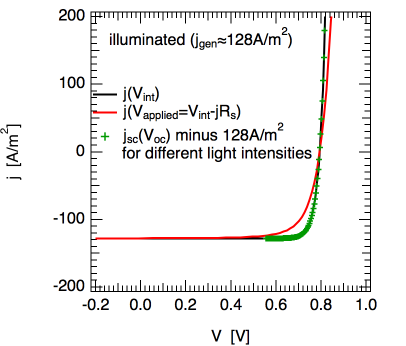
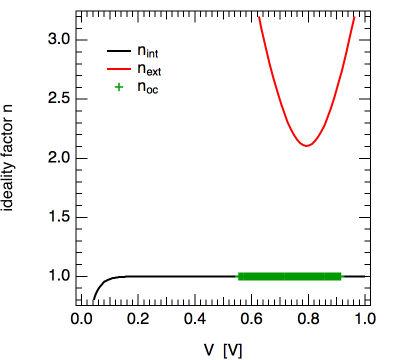
<p>So, what&#8217;s next. I plan to write two more posts on the ideality factor, one on its relation to the recombination rate, and one the transport resistance (see recent papers by [<a href="http://dx.doi.org/10.1038/ncomms7951">W&uuml;rfel/Neher et al 2015</a>] and [<a href="http://dx.doi.org/10.1038/srep24861">Neher/Koster et al 2016</a>].</p>
<p>P.S. Not only finding time to write a blog post is more difficult these days: I have been taking only photographs of my kids &#8211; which I do not post on the internet &#8211; since 2011, but almost no nature or architecture photographs. Thus, not much to lighten the text and equations, but also less distractions ;-)</p>
<p>P.P.S. [Update 2016-05-15] added &#8220;-&#8221; everywhere, terribly sorry!</p>
<div class="footnotes">
<hr />
<ol>
<li id="fn-747-Revisiting">
Revisiting these old posts makes me acutely aware of what I did not know then and do know now a bit more about. E.g. the explanation that crossing point is due to the field dependent separation of polaron pairs is not correct.&#160;<a href="#fnref-747-Revisiting">&#8617;</a>
</li>
</ol>
</div>
]]></content>
		
					<link rel="replies" type="text/html" href="https://blog.disorderedmatter.eu/2016/05/14/the-diode-ideality-factor-in-organic-solar-cells-recombination/#comments" thr:count="2" />
			<link rel="replies" type="application/atom+xml" href="https://blog.disorderedmatter.eu/2016/05/14/the-diode-ideality-factor-in-organic-solar-cells-recombination/feed/atom/" thr:count="2" />
			<thr:total>2</thr:total>
			</entry>
		<entry>
		<author>
			<name>deibel</name>
							<uri>http://www.disorderedmatter.eu</uri>
						</author>

		<title type="html"><![CDATA[Interaction of light with solids in experiment and simulation]]></title>
		<link rel="alternate" type="text/html" href="https://blog.disorderedmatter.eu/2015/02/02/interaction-of-light-with-solids-in-experiment-and-simulation/" />

		<id>http://deibel.wordpress.com/?p=742</id>
		<updated>2015-02-02T09:36:03Z</updated>
		<published>2015-02-02T09:36:02Z</published>
		<category scheme="https://blog.disorderedmatter.eu" term="personal" />
		<summary type="html"><![CDATA[Hi there, sorry for not getting back to you but starting a new group and having new responsibilities (e.g. involvement in new degree programmes for Material Science) can take (part of) the blame. Just as brief progress indicator, here a link to an interview of the Chemnitz University of Technology press office with me. (Photo: &#8230; <a href="https://blog.disorderedmatter.eu/2015/02/02/interaction-of-light-with-solids-in-experiment-and-simulation/" class="more-link">Continue reading<span class="screen-reader-text"> "Interaction of light with solids in experiment and&#160;simulation"</span></a>]]></summary>

					<content type="html" xml:base="https://blog.disorderedmatter.eu/2015/02/02/interaction-of-light-with-solids-in-experiment-and-simulation/"><![CDATA[<p>Hi there, sorry for not getting back to you but starting a new group and having new responsibilities (e.g. involvement in new degree programmes for Material Science) can take (part of) the blame. <img src="https://www.tu-chemnitz.de/tu/aktuelles/2015/1422266162-6371-0.jpg" alt="Photo: Uwe Meinhold" title="Carsten in da lab, messing up the optical axis (Photo: Uwe Meinhold)" border="0" width="300" style="float:right;" /> Just as brief progress indicator, here a <a href="https://www.tu-chemnitz.de/uk/pressestelle/aktuell/1/6371/en">link to an interview</a> of the Chemnitz University of Technology press office with me. (Photo: Uwe Meinhold)</p>
<p>The official short name of <a href="https://www.tu-chemnitz.de/physik/OPKM/">my group is OPKM</a>, for Optics and Photonics of Condensed Matter. For the (very) long official name I refer you to the web page of the <a href="https://www.tu-chemnitz.de/physik/professuren.html.en">Institute of Physics</a> at the TUC;-) The size of my group is growing slowly but steadily, and the lab building shows progress as well: setups for time correlated single photon counting to measure photoluminescence transients &#8211; e.g. to determine charge carrier recombination in perovskite solar cells &#8211; and for confocal measurements of luminescence are already available from my predecessor&#8217;s group: we just adapt them to our needs. Other setups, time resolved and steady state, are being built and come along nicely. Solar cell preparation is still improvised, using the glovebox system of a colleague and the evaporation chamber of another, until we get our own integrated glovebox/evaporator system. One of my main interests is still Organic Photovoltaics, and with my (PhD) background in inorganic photovoltaics I also look at the hybrid perovskite solar cell hype (as a hype is not necessarily a bad thing;-). What also remains is my joy to combine experiments and simulations (macroscopic device simulations, kinetic Monte Carlo simulations) to understand these systems.</p>
<p>If you are interested in joining us: I have two PhD positions available at present. Please check out the <a href="http://www.pro-physik.de/details/stellenmarkt/7278221/2_Wissenschaftliche_Mitarbeiterinnen_50_.html">job offer</a> (german; computer-translated <a href="https://translate.google.com/translate?sl=de&amp;tl=en&amp;js=y&amp;prev=_t&amp;hl=en&amp;ie=UTF-8&amp;u=http%3A%2F%2Fwww.pro-physik.de%2Fdetails%2Fstellenmarkt%2F7278221%2F2_Wissenschaftliche_Mitarbeiterinnen_50_.html&amp;edit-text=">here</a>) and contact me.</p>
<p>Cheers!</p>
]]></content>
		
					<link rel="replies" type="text/html" href="https://blog.disorderedmatter.eu/2015/02/02/interaction-of-light-with-solids-in-experiment-and-simulation/#comments" thr:count="7" />
			<link rel="replies" type="application/atom+xml" href="https://blog.disorderedmatter.eu/2015/02/02/interaction-of-light-with-solids-in-experiment-and-simulation/feed/atom/" thr:count="7" />
			<thr:total>7</thr:total>
			</entry>
		<entry>
		<author>
			<name>deibel</name>
							<uri>http://www.disorderedmatter.eu</uri>
						</author>

		<title type="html"><![CDATA[Restarting in Chemnitz]]></title>
		<link rel="alternate" type="text/html" href="https://blog.disorderedmatter.eu/2014/03/20/restarting-in-chemnitz/" />

		<id>http://deibel.wordpress.com/?p=734</id>
		<updated>2014-03-20T11:29:38Z</updated>
		<published>2014-03-20T11:18:46Z</published>
		<category scheme="https://blog.disorderedmatter.eu" term="personal" /><category scheme="https://blog.disorderedmatter.eu" term="job offer" />
		<summary type="html"><![CDATA[Just a brief note, I moved from W&#252;rzburg to the Institute of Physics at Chemnitz University of Technology this March, starting a new group. At present I have one PhD position open on Organic Photovoltaics &#8211; funded by the University, therefore including some teaching duty in German. Have a look here (in German) or drop &#8230; <a href="https://blog.disorderedmatter.eu/2014/03/20/restarting-in-chemnitz/" class="more-link">Continue reading<span class="screen-reader-text"> "Restarting in Chemnitz"</span></a>]]></summary>

					<content type="html" xml:base="https://blog.disorderedmatter.eu/2014/03/20/restarting-in-chemnitz/"><![CDATA[<p>Just a brief note, <img style="float:right;margin:5px;" src="https://i0.wp.com/www.tu-chemnitz.de/tu/images/logo/tu-chemnitz-de3.png" width="200" border="0" alt="TU Chemnitz Logo" />I moved from W&uuml;rzburg to the Institute of Physics at <a href="https://www.tu-chemnitz.de/physik/index.html.en">Chemnitz University of Technology</a> this March, starting a new group.  At present I have one PhD position open on Organic Photovoltaics &#8211; funded by the University, therefore including some teaching duty in German. Have a look <a href="http://www.tu-chemnitz.de/verwaltung/personal/stellen/212064_2_Ku.php">here</a> (in German) or drop me a <a href="mailto:job20140320tuc@fastmail.fm?subject=job20140320tuc%20Job%20Application">line</a> if you are interested. Cheers,</p>
<p>  Carsten</p>
]]></content>
		
					<link rel="replies" type="text/html" href="https://blog.disorderedmatter.eu/2014/03/20/restarting-in-chemnitz/#comments" thr:count="6" />
			<link rel="replies" type="application/atom+xml" href="https://blog.disorderedmatter.eu/2014/03/20/restarting-in-chemnitz/feed/atom/" thr:count="6" />
			<thr:total>6</thr:total>
			</entry>
		<entry>
		<author>
			<name>deibel</name>
							<uri>http://www.disorderedmatter.eu</uri>
						</author>

		<title type="html"><![CDATA[Links]]></title>
		<link rel="alternate" type="text/html" href="https://blog.disorderedmatter.eu/2013/08/25/links-2/" />

		<id>http://deibel.wordpress.com/?p=731</id>
		<updated>2013-08-25T14:15:13Z</updated>
		<published>2013-08-25T14:15:12Z</published>
		<category scheme="https://blog.disorderedmatter.eu" term="science&amp;culture" />
		<summary type="html"><![CDATA[Some links I found interesting since the last time&#8230; partly older stuff, though. already in 2010, Mitch from the Chemistry-Blog posted the Carreira letter On the way to tenure&#8230; or not: Sean Carrol for Cosmic Variance on How To Get Tenure at a Major Research University Terran Lane On Leaving Academia Radhika Nagpal on The &#8230; <a href="https://blog.disorderedmatter.eu/2013/08/25/links-2/" class="more-link">Continue reading<span class="screen-reader-text"> "Links"</span></a>]]></summary>

					<content type="html" xml:base="https://blog.disorderedmatter.eu/2013/08/25/links-2/"><![CDATA[<p>Some links I found interesting since the <a href="https://blog.disorderedmatter.eu/2012/03/28/again-links-only/">last time</a>&#8230; partly older stuff, though.</p>
<ul>
<li>already in 2010, Mitch from the Chemistry-Blog posted the <a href="http://www.chemistry-blog.com/2010/06/22/something-deeply-wrong-with-chemistry/">Carreira letter</a>
<li>On the way to tenure&#8230; or not:
<ul>
<li>Sean Carrol for Cosmic Variance on <a href="http://blogs.discovermagazine.com/cosmicvariance/2011/03/30/how-to-get-tenure-at-a-major-research-university/#.UhoKtxbJS91">How To Get Tenure at a Major Research University</a>
<li>Terran Lane <a href="http://cs.unm.edu/~terran/academic_blog/?p=113">On Leaving Academia</a>
<li>Radhika Nagpal on <a href="http://blogs.scientificamerican.com/guest-blog/2013/07/21/the-awesomest-7-year-postdoc-or-how-i-learned-to-stop-worrying-and-love-the-tenure-track-faculty-life/">The Awesomest 7-Year Postdoc or: How I Learned to Stop Worrying and Love the Tenure-Track Faculty Life</a>
<li>I also liked the book <a href="http://www.goodreads.com/book/show/587478.A_PhD_Is_Not_Enough">A PhD is not enough: A guide to survival in Science</a> by Peter Feibelman on how to succeed staying permanently in science
		</ul>
<li>Publishing:
<ul>
<li>Brian Doyle for Kenyon Review on <a href="http://www.kenyonreview.org/journal/spring-2008/selections/no/?imm_mid=09d9ca&amp;cmp=em-toc-newsletters-dec11-elist">Rejection letters</a>
<li>Roy F. Baumeister&#8217;s very useful <a href="http://web.mit.edu/ariely/www/MIT/Sample.shtml">Sample Cover Letter for Journal Manuscript Resubmissions</a> ;-)
<li>Nature on <a href="http://dx.doi.org/10.1038/nj7417-591a">Authorship: Who&#8217;s on first?</a>
<li>Michael Nielsen on <a href="http://michaelnielsen.org/blog/three-myths-about-scientific-peer-review/">Three myths about scientific peer review</a>. I like the Einstein quotation a lot!
<li>Joesph Esposito from the scholarly kitchen on <a href="http://scholarlykitchen.sspnet.org/2012/09/17/help-ive-been-plagiarized/">Help! I&rsquo;ve Been Plagiarized</a>. I <a href="https://deibel.wordpress.com/2009/02/27/blog-reference-in-a-book-on-flexible-solar-cells/">know how it is</a>.
<li>Scientific paper on <a href="http://www.plosone.org/article/info%3Adoi%2F10.1371%2Fjournal.pone.0065263">Big Science vs. Little Science: How Scientific Impact Scales with Funding</a> by Fortin and Curry in PLOS one. Answer: little.
		</ul>
<li>Jeff Bezos on 37signals says that <a href="http://37signals.com/svn/posts/3289-some-advice-from-jeff-bezos">people who were right a lot of the time were people who often changed their minds.</a>
<li>jasonya on <a href="http://jasonya.com/wp/scientific-paper-easter-eggs/">Scientific paper easter eggs</a>;-)
<li><a href="http://blogs.smithsonianmag.com/science/2013/08/this-is-how-your-brain-becomes-addicted-to-caffeine/">This Is How Your Brain Becomes Addicted to Caffeine</a> by Joseph Stromberg. In any case, if you are at it also read Michael Haft and Harrison Suarez on <a href="http://www.theatlantic.com/health/archive/2013/08/how-to-make-perfect-coffee/278944/">How to Make Perfect Coffee</a> (in the &#8220;Health&#8221; section of The Atlantic:)
<li>If you are into Lifehacks etc, Cal Newport on how to <a href="http://calnewport.com/blog/2009/06/08/drastically-reduce-stress-with-a-work-shutdown-ritual/">Drastically Reduce Stress with a Work Shutdown Ritual</a></a>
</ul>
]]></content>
		
					<link rel="replies" type="text/html" href="https://blog.disorderedmatter.eu/2013/08/25/links-2/#comments" thr:count="4" />
			<link rel="replies" type="application/atom+xml" href="https://blog.disorderedmatter.eu/2013/08/25/links-2/feed/atom/" thr:count="4" />
			<thr:total>4</thr:total>
			</entry>
		<entry>
		<author>
			<name>deibel</name>
							<uri>http://www.disorderedmatter.eu</uri>
						</author>

		<title type="html"><![CDATA[Nongeminate recombination in organic solar cells &#8211; slower than expected]]></title>
		<link rel="alternate" type="text/html" href="https://blog.disorderedmatter.eu/2013/08/21/nongeminate-recombination-in-organic-solar-cells-slower-than-expected/" />

		<id>http://deibel.wordpress.com/?p=723</id>
		<updated>2014-02-27T21:05:54Z</updated>
		<published>2013-08-21T09:19:06Z</published>
		<category scheme="https://blog.disorderedmatter.eu" term="physics" /><category scheme="https://blog.disorderedmatter.eu" term="nongeminate recombination" /><category scheme="https://blog.disorderedmatter.eu" term="organic solar cells" />
		<summary type="html"><![CDATA[In a &#8220;recent&#8221; post (just 3 posts but 10 months ago;-) I wrote once again on the derivation of the Langevin recombination rate for nongeminate recombination. The question is, is Langevin recombination really what governs the charge carrier loss rate in organic solar cells? Recombination of electrons with holes is usually a 2nd order decay. &#8230; <a href="https://blog.disorderedmatter.eu/2013/08/21/nongeminate-recombination-in-organic-solar-cells-slower-than-expected/" class="more-link">Continue reading<span class="screen-reader-text"> "Nongeminate recombination in organic solar cells &#8211; slower than&#160;expected"</span></a>]]></summary>

					<content type="html" xml:base="https://blog.disorderedmatter.eu/2013/08/21/nongeminate-recombination-in-organic-solar-cells-slower-than-expected/"><![CDATA[<p>In a &#8220;recent&#8221; post (just 3 posts but 10 months ago;-) I wrote once again on the derivation of the <a href="https://blog.disorderedmatter.eu/2012/10/16/nongeminate-recombination-langevin-again-and-beyond-later/">Langevin recombination rate</a> for nongeminate recombination. <a href="http://www.flickr.com/photos/deibel/9559706683" title="View 'Tiger (Zoo Wuppertal)' on Flickr.com"><img style="float:right;margin:5px;" border="0" alt="Tiger (Zoo Wuppertal)" width="300" src="https://i0.wp.com/farm3.staticflickr.com/2849/9559706683_41beb2d12d.jpg" /></a>The question is, is Langevin recombination really what governs the charge carrier loss rate in organic solar cells?</p>
<p>Recombination of electrons with holes is usually a 2nd order decay. As electrons <img src="https://s0.wp.com/latex.php?latex=n&#038;bg=ffffff&#038;fg=1a1a1a&#038;s=0&#038;c=20201002" srcset="https://s0.wp.com/latex.php?latex=n&#038;bg=ffffff&#038;fg=1a1a1a&#038;s=0&#038;c=20201002 1x, https://s0.wp.com/latex.php?latex=n&#038;bg=ffffff&#038;fg=1a1a1a&#038;s=0&#038;c=20201002&#038;zoom=4.5 4x" alt="n" class="latex" /> and holes <img src="https://s0.wp.com/latex.php?latex=p&#038;bg=ffffff&#038;fg=1a1a1a&#038;s=0&#038;c=20201002" srcset="https://s0.wp.com/latex.php?latex=p&#038;bg=ffffff&#038;fg=1a1a1a&#038;s=0&#038;c=20201002 1x, https://s0.wp.com/latex.php?latex=p&#038;bg=ffffff&#038;fg=1a1a1a&#038;s=0&#038;c=20201002&#038;zoom=4.5 4x" alt="p" class="latex" /> are photogenerated pair wise, the respective excess charge carrier concentrations are symmetric, <img src="https://s0.wp.com/latex.php?latex=n%3Dp&#038;bg=ffffff&#038;fg=1a1a1a&#038;s=0&#038;c=20201002" srcset="https://s0.wp.com/latex.php?latex=n%3Dp&#038;bg=ffffff&#038;fg=1a1a1a&#038;s=0&#038;c=20201002 1x, https://s0.wp.com/latex.php?latex=n%3Dp&#038;bg=ffffff&#038;fg=1a1a1a&#038;s=0&#038;c=20201002&#038;zoom=4.5 4x" alt="n=p" class="latex" />. Then a recombination rate <img src="https://s0.wp.com/latex.php?latex=R&#038;bg=ffffff&#038;fg=1a1a1a&#038;s=0&#038;c=20201002" srcset="https://s0.wp.com/latex.php?latex=R&#038;bg=ffffff&#038;fg=1a1a1a&#038;s=0&#038;c=20201002 1x, https://s0.wp.com/latex.php?latex=R&#038;bg=ffffff&#038;fg=1a1a1a&#038;s=0&#038;c=20201002&#038;zoom=4.5 4x" alt="R" class="latex" /> is</p>
<p><img src="https://s0.wp.com/latex.php?latex=R+%3D+k+n+p+%3D+k+n%5E2&#038;bg=ffffff&#038;fg=1a1a1a&#038;s=0&#038;c=20201002" srcset="https://s0.wp.com/latex.php?latex=R+%3D+k+n+p+%3D+k+n%5E2&#038;bg=ffffff&#038;fg=1a1a1a&#038;s=0&#038;c=20201002 1x, https://s0.wp.com/latex.php?latex=R+%3D+k+n+p+%3D+k+n%5E2&#038;bg=ffffff&#038;fg=1a1a1a&#038;s=0&#038;c=20201002&#038;zoom=4.5 4x" alt="R = k n p = k n^2" class="latex" />,</p>
<p>where the recombination prefactor <img src="https://s0.wp.com/latex.php?latex=k&#038;bg=ffffff&#038;fg=1a1a1a&#038;s=0&#038;c=20201002" srcset="https://s0.wp.com/latex.php?latex=k&#038;bg=ffffff&#038;fg=1a1a1a&#038;s=0&#038;c=20201002 1x, https://s0.wp.com/latex.php?latex=k&#038;bg=ffffff&#038;fg=1a1a1a&#038;s=0&#038;c=20201002&#038;zoom=4.5 4x" alt="k" class="latex" /> <em>could</em> be a Langevin prefactor &#8211; more on that later. In a transient experiment with a photogenerating, short laser pulse at <img src="https://s0.wp.com/latex.php?latex=t%3D0&#038;bg=ffffff&#038;fg=1a1a1a&#038;s=0&#038;c=20201002" srcset="https://s0.wp.com/latex.php?latex=t%3D0&#038;bg=ffffff&#038;fg=1a1a1a&#038;s=0&#038;c=20201002 1x, https://s0.wp.com/latex.php?latex=t%3D0&#038;bg=ffffff&#038;fg=1a1a1a&#038;s=0&#038;c=20201002&#038;zoom=4.5 4x" alt="t=0" class="latex" />, the continuity equation for charge carriers (here, e.g. electrons) under open circuti conditions (no external current flow, for instance if the experiment is done on a thin film without electrodes) </p>
<p><img src="https://s0.wp.com/latex.php?latex=%5Cfrac%7Bdn%7D%7Bdt%7D+%3D+G-R&#038;bg=ffffff&#038;fg=1a1a1a&#038;s=0&#038;c=20201002" srcset="https://s0.wp.com/latex.php?latex=%5Cfrac%7Bdn%7D%7Bdt%7D+%3D+G-R&#038;bg=ffffff&#038;fg=1a1a1a&#038;s=0&#038;c=20201002 1x, https://s0.wp.com/latex.php?latex=%5Cfrac%7Bdn%7D%7Bdt%7D+%3D+G-R&#038;bg=ffffff&#038;fg=1a1a1a&#038;s=0&#038;c=20201002&#038;zoom=4.5 4x" alt="&#92;frac{dn}{dt} = G-R" class="latex" /></p>
<p>becomes </p>
<p><img src="https://s0.wp.com/latex.php?latex=%5Cfrac%7Bdn%7D%7Bdt%7D+%3D+-R&#038;bg=ffffff&#038;fg=1a1a1a&#038;s=0&#038;c=20201002" srcset="https://s0.wp.com/latex.php?latex=%5Cfrac%7Bdn%7D%7Bdt%7D+%3D+-R&#038;bg=ffffff&#038;fg=1a1a1a&#038;s=0&#038;c=20201002 1x, https://s0.wp.com/latex.php?latex=%5Cfrac%7Bdn%7D%7Bdt%7D+%3D+-R&#038;bg=ffffff&#038;fg=1a1a1a&#038;s=0&#038;c=20201002&#038;zoom=4.5 4x" alt="&#92;frac{dn}{dt} = -R" class="latex" /></p>
<p>for <img src="https://s0.wp.com/latex.php?latex=t%3E0&#038;bg=ffffff&#038;fg=1a1a1a&#038;s=0&#038;c=20201002" srcset="https://s0.wp.com/latex.php?latex=t%3E0&#038;bg=ffffff&#038;fg=1a1a1a&#038;s=0&#038;c=20201002 1x, https://s0.wp.com/latex.php?latex=t%3E0&#038;bg=ffffff&#038;fg=1a1a1a&#038;s=0&#038;c=20201002&#038;zoom=4.5 4x" alt="t&gt;0" class="latex" /> (as the generation was only at <img src="https://s0.wp.com/latex.php?latex=t%3D0&#038;bg=ffffff&#038;fg=1a1a1a&#038;s=0&#038;c=20201002" srcset="https://s0.wp.com/latex.php?latex=t%3D0&#038;bg=ffffff&#038;fg=1a1a1a&#038;s=0&#038;c=20201002 1x, https://s0.wp.com/latex.php?latex=t%3D0&#038;bg=ffffff&#038;fg=1a1a1a&#038;s=0&#038;c=20201002&#038;zoom=4.5 4x" alt="t=0" class="latex" />).</p>
<p>If all electrons and hole are available for recombination (i.e., can reach all other charge carriers and can be reached by them), then the recombination rate and the continuity equation for <img src="https://s0.wp.com/latex.php?latex=t%3E0&#038;bg=ffffff&#038;fg=1a1a1a&#038;s=0&#038;c=20201002" srcset="https://s0.wp.com/latex.php?latex=t%3E0&#038;bg=ffffff&#038;fg=1a1a1a&#038;s=0&#038;c=20201002 1x, https://s0.wp.com/latex.php?latex=t%3E0&#038;bg=ffffff&#038;fg=1a1a1a&#038;s=0&#038;c=20201002&#038;zoom=4.5 4x" alt="t&gt;0" class="latex" /> yield</p>
<p><img src="https://s0.wp.com/latex.php?latex=%5Cfrac%7Bdn%7D%7Bdt%7D+%3D+k+n%5E2&#038;bg=ffffff&#038;fg=1a1a1a&#038;s=0&#038;c=20201002" srcset="https://s0.wp.com/latex.php?latex=%5Cfrac%7Bdn%7D%7Bdt%7D+%3D+k+n%5E2&#038;bg=ffffff&#038;fg=1a1a1a&#038;s=0&#038;c=20201002 1x, https://s0.wp.com/latex.php?latex=%5Cfrac%7Bdn%7D%7Bdt%7D+%3D+k+n%5E2&#038;bg=ffffff&#038;fg=1a1a1a&#038;s=0&#038;c=20201002&#038;zoom=4.5 4x" alt="&#92;frac{dn}{dt} = k n^2" class="latex" /><span id="more-723"></span>which can be solved analytically:</p>
<p><img src="https://s0.wp.com/latex.php?latex=n%28t%29+%3D+%5Cfrac%7Bn%280%29%7D%7B1+%2B+k+n%280%29+t%7D+%5Cpropto+t%5E%7B-1%7D&#038;bg=ffffff&#038;fg=1a1a1a&#038;s=0&#038;c=20201002" srcset="https://s0.wp.com/latex.php?latex=n%28t%29+%3D+%5Cfrac%7Bn%280%29%7D%7B1+%2B+k+n%280%29+t%7D+%5Cpropto+t%5E%7B-1%7D&#038;bg=ffffff&#038;fg=1a1a1a&#038;s=0&#038;c=20201002 1x, https://s0.wp.com/latex.php?latex=n%28t%29+%3D+%5Cfrac%7Bn%280%29%7D%7B1+%2B+k+n%280%29+t%7D+%5Cpropto+t%5E%7B-1%7D&#038;bg=ffffff&#038;fg=1a1a1a&#038;s=0&#038;c=20201002&#038;zoom=4.5 4x" alt="n(t) = &#92;frac{n(0)}{1 + k n(0) t} &#92;propto t^{-1}" class="latex" />.</p>
<p>That means, on a log-log <img src="https://s0.wp.com/latex.php?latex=n%28t%29&#038;bg=ffffff&#038;fg=1a1a1a&#038;s=0&#038;c=20201002" srcset="https://s0.wp.com/latex.php?latex=n%28t%29&#038;bg=ffffff&#038;fg=1a1a1a&#038;s=0&#038;c=20201002 1x, https://s0.wp.com/latex.php?latex=n%28t%29&#038;bg=ffffff&#038;fg=1a1a1a&#038;s=0&#038;c=20201002&#038;zoom=4.5 4x" alt="n(t)" class="latex" /> plot (or <img src="https://s0.wp.com/latex.php?latex=%5CDelta+OD%28t%29&#038;bg=ffffff&#038;fg=1a1a1a&#038;s=0&#038;c=20201002" srcset="https://s0.wp.com/latex.php?latex=%5CDelta+OD%28t%29&#038;bg=ffffff&#038;fg=1a1a1a&#038;s=0&#038;c=20201002 1x, https://s0.wp.com/latex.php?latex=%5CDelta+OD%28t%29&#038;bg=ffffff&#038;fg=1a1a1a&#038;s=0&#038;c=20201002&#038;zoom=4.5 4x" alt="&#92;Delta OD(t)" class="latex" /> for a transient absorption experiment), the transient due to charge carrier recombination in a second order decay has a slope of -1.</p>
<p>It is no news that slower decays </p>
<p><img src="https://s0.wp.com/latex.php?latex=n%28t%29+%5Cpropto+t%5E%7B-%5Cfrac%7B1%7D%7B%5Cdelta-1%7D%7D&#038;bg=ffffff&#038;fg=1a1a1a&#038;s=0&#038;c=20201002" srcset="https://s0.wp.com/latex.php?latex=n%28t%29+%5Cpropto+t%5E%7B-%5Cfrac%7B1%7D%7B%5Cdelta-1%7D%7D&#038;bg=ffffff&#038;fg=1a1a1a&#038;s=0&#038;c=20201002 1x, https://s0.wp.com/latex.php?latex=n%28t%29+%5Cpropto+t%5E%7B-%5Cfrac%7B1%7D%7B%5Cdelta-1%7D%7D&#038;bg=ffffff&#038;fg=1a1a1a&#038;s=0&#038;c=20201002&#038;zoom=4.5 4x" alt="n(t) &#92;propto t^{-&#92;frac{1}{&#92;delta-1}}" class="latex" /></p>
<p>with higher recombination order <img src="https://s0.wp.com/latex.php?latex=%5Cdelta%3E2&#038;bg=ffffff&#038;fg=1a1a1a&#038;s=0&#038;c=20201002" srcset="https://s0.wp.com/latex.php?latex=%5Cdelta%3E2&#038;bg=ffffff&#038;fg=1a1a1a&#038;s=0&#038;c=20201002 1x, https://s0.wp.com/latex.php?latex=%5Cdelta%3E2&#038;bg=ffffff&#038;fg=1a1a1a&#038;s=0&#038;c=20201002&#038;zoom=4.5 4x" alt="&#92;delta&gt;2" class="latex" /> are reported in literature by transient absorption experiments [<a href="http://dx.doi.org/10.1063/1.1512943">Montanari 2002</a>, <a href="http://dx.doi.org/10.1063/1.1619946">Offermans 2003</a>] and recently also using other techniques, see references in this <a href="https://blog.disorderedmatter.eu/2008/10/10/trimolecular-recombination-really/">post</a>. This corresponds to recombination rates of the empirical form</p>
<p><img src="https://s0.wp.com/latex.php?latex=R+%5Cpropto+n%5E%5Cdelta&#038;bg=ffffff&#038;fg=1a1a1a&#038;s=0&#038;c=20201002" srcset="https://s0.wp.com/latex.php?latex=R+%5Cpropto+n%5E%5Cdelta&#038;bg=ffffff&#038;fg=1a1a1a&#038;s=0&#038;c=20201002 1x, https://s0.wp.com/latex.php?latex=R+%5Cpropto+n%5E%5Cdelta&#038;bg=ffffff&#038;fg=1a1a1a&#038;s=0&#038;c=20201002&#038;zoom=4.5 4x" alt="R &#92;propto n^&#92;delta" class="latex" />. </p>
<p>Clearly, this is not a second order recombination. However, it is very unlikely that more than two charge carriers are involved (c.f. this <a href="https://blog.disorderedmatter.eu/2008/10/10/trimolecular-recombination-really/">post</a>). Thus, can it actually <em>be</em> Langevin recombination?</p>
<p>[<a href="http://dx.doi.org/10.1002/adfm.200901734">Shuttle 2010</a>] proposed that this could still be Langevin recombination, where the order of decay higher than originates from the charge carrier mobility. That implies that all charge carriers can recombine with one another, but the charge carrier mobility in the Langevin prefactor depends on the charge carrier concentration. The latter is credible, as the macroscopic mobility in a system with a lot of charge carrier trapping (and there is! [<a href="http://dx.doi.org/10.1016/j.orgel.2010.07.016">Schafferhans 2010</a>]) can indeed depent on the carrier concentration [<a href="http://dx.doi.org/10.1103/PhysRevLett.91.216601">Tanase 2003</a>, <a href="http://dx.doi.org/10.1103/PhysRevLett.94.206601">Pasveer 2005</a>] &#8211; depending on the density of states distribution [<a href="http://dx.doi.org/10.1103/PhysRevLett.108.226403">Oelerich 2012</a>]. Then,</p>
<p><img src="https://s0.wp.com/latex.php?latex=R+%5Cpropto+%5Cmu%28n%29+n%5E2+%5Cpropto+n%5E%7B%5Ctext%7Bsomething+%7D%3E0%7D+n%5E2+%5Cpropto+n%5E%5Cdelta&#038;bg=ffffff&#038;fg=1a1a1a&#038;s=0&#038;c=20201002" srcset="https://s0.wp.com/latex.php?latex=R+%5Cpropto+%5Cmu%28n%29+n%5E2+%5Cpropto+n%5E%7B%5Ctext%7Bsomething+%7D%3E0%7D+n%5E2+%5Cpropto+n%5E%5Cdelta&#038;bg=ffffff&#038;fg=1a1a1a&#038;s=0&#038;c=20201002 1x, https://s0.wp.com/latex.php?latex=R+%5Cpropto+%5Cmu%28n%29+n%5E2+%5Cpropto+n%5E%7B%5Ctext%7Bsomething+%7D%3E0%7D+n%5E2+%5Cpropto+n%5E%5Cdelta&#038;bg=ffffff&#038;fg=1a1a1a&#038;s=0&#038;c=20201002&#038;zoom=4.5 4x" alt="R &#92;propto &#92;mu(n) n^2 &#92;propto n^{&#92;text{something }&gt;0} n^2 &#92;propto n^&#92;delta" class="latex" />.</p>
<p>That was easy;) </p>
<p>But is it the complete explanation? That may not be the case. We showed last year [<a href="http://dx.doi.org/10.1002/adfm.201103118">Rauh 2012</a>], that often</p>
<p><img src="https://s0.wp.com/latex.php?latex=%5Cfrac%7BR%7D%7Bn%5E2%7D+%5Cnot%5Cpropto+%5Cmu%28n%29&#038;bg=ffffff&#038;fg=1a1a1a&#038;s=0&#038;c=20201002" srcset="https://s0.wp.com/latex.php?latex=%5Cfrac%7BR%7D%7Bn%5E2%7D+%5Cnot%5Cpropto+%5Cmu%28n%29&#038;bg=ffffff&#038;fg=1a1a1a&#038;s=0&#038;c=20201002 1x, https://s0.wp.com/latex.php?latex=%5Cfrac%7BR%7D%7Bn%5E2%7D+%5Cnot%5Cpropto+%5Cmu%28n%29&#038;bg=ffffff&#038;fg=1a1a1a&#038;s=0&#038;c=20201002&#038;zoom=4.5 4x" alt="&#92;frac{R}{n^2} &#92;not&#92;propto &#92;mu(n)" class="latex" />,</p>
<p>opposing the above statement <strong>(1)</strong>. However, a weakness of both studies is that the mobility is not measured directly &#8211;  still to be done.</p>
<p>In the meantime, a very interesting paper [<a href="http://dx.doi.org/10.1103/PhysRevB.83.115209">Kirchartz 2011</a>] (you need to take some time for it, though;-) &#8211; and slightly later also [<a href="http://dx.doi.org/10.1103/PhysRevLett.107.256805">Kuik 2011</a>] &#8211; showed that Langevin recombination and trapping should be combined in a more detailed way. If you consider that some charge carriers, say electrons, in the disordered organic semiconductor are mobile, with density <img src="https://s0.wp.com/latex.php?latex=n_c&#038;bg=ffffff&#038;fg=1a1a1a&#038;s=0&#038;c=20201002" srcset="https://s0.wp.com/latex.php?latex=n_c&#038;bg=ffffff&#038;fg=1a1a1a&#038;s=0&#038;c=20201002 1x, https://s0.wp.com/latex.php?latex=n_c&#038;bg=ffffff&#038;fg=1a1a1a&#038;s=0&#038;c=20201002&#038;zoom=4.5 4x" alt="n_c" class="latex" />, and some are trapped, <img src="https://s0.wp.com/latex.php?latex=n_t&#038;bg=ffffff&#038;fg=1a1a1a&#038;s=0&#038;c=20201002" srcset="https://s0.wp.com/latex.php?latex=n_t&#038;bg=ffffff&#038;fg=1a1a1a&#038;s=0&#038;c=20201002 1x, https://s0.wp.com/latex.php?latex=n_t&#038;bg=ffffff&#038;fg=1a1a1a&#038;s=0&#038;c=20201002&#038;zoom=4.5 4x" alt="n_t" class="latex" />, their sum still equals the overall electron concentration $n$. As long as the charge carriers <img src="https://s0.wp.com/latex.php?latex=n_t&#038;bg=ffffff&#038;fg=1a1a1a&#038;s=0&#038;c=20201002" srcset="https://s0.wp.com/latex.php?latex=n_t&#038;bg=ffffff&#038;fg=1a1a1a&#038;s=0&#038;c=20201002 1x, https://s0.wp.com/latex.php?latex=n_t&#038;bg=ffffff&#038;fg=1a1a1a&#038;s=0&#038;c=20201002&#038;zoom=4.5 4x" alt="n_t" class="latex" /> remain trapped, they are immobile and cannot move towards their recombination partners. That means, they cannot actively contribute to recombination, but can be &#8220;found&#8221; by another (oppositely charged) charge carriers. The recombination rate for recombination of a mobile electron with a trapped hole can be written as</p>
<p><img src="https://s0.wp.com/latex.php?latex=R+%5Cpropto+%5Cmu_e+n_c+p_t&#038;bg=ffffff&#038;fg=1a1a1a&#038;s=0&#038;c=20201002" srcset="https://s0.wp.com/latex.php?latex=R+%5Cpropto+%5Cmu_e+n_c+p_t&#038;bg=ffffff&#038;fg=1a1a1a&#038;s=0&#038;c=20201002 1x, https://s0.wp.com/latex.php?latex=R+%5Cpropto+%5Cmu_e+n_c+p_t&#038;bg=ffffff&#038;fg=1a1a1a&#038;s=0&#038;c=20201002&#038;zoom=4.5 4x" alt="R &#92;propto &#92;mu_e n_c p_t" class="latex" /></p>
<p>or, if electron and hole concentrations as well as their trap distributions are assumed to be the same,</p>
<p><img src="https://s0.wp.com/latex.php?latex=R+%5Cpropto+%5Cmu_c+n_c+n_t&#038;bg=ffffff&#038;fg=1a1a1a&#038;s=0&#038;c=20201002" srcset="https://s0.wp.com/latex.php?latex=R+%5Cpropto+%5Cmu_c+n_c+n_t&#038;bg=ffffff&#038;fg=1a1a1a&#038;s=0&#038;c=20201002 1x, https://s0.wp.com/latex.php?latex=R+%5Cpropto+%5Cmu_c+n_c+n_t&#038;bg=ffffff&#038;fg=1a1a1a&#038;s=0&#038;c=20201002&#038;zoom=4.5 4x" alt="R &#92;propto &#92;mu_c n_c n_t" class="latex" />.</p>
<p>Importantly, the mobility <img src="https://s0.wp.com/latex.php?latex=%5Cmu_c&#038;bg=ffffff&#038;fg=1a1a1a&#038;s=0&#038;c=20201002" srcset="https://s0.wp.com/latex.php?latex=%5Cmu_c&#038;bg=ffffff&#038;fg=1a1a1a&#038;s=0&#038;c=20201002 1x, https://s0.wp.com/latex.php?latex=%5Cmu_c&#038;bg=ffffff&#038;fg=1a1a1a&#038;s=0&#038;c=20201002&#038;zoom=4.5 4x" alt="&#92;mu_c" class="latex" /> is <em>not</em> the measured macroscopic mobility, but the maximum possible mobility without trapping. </p>
<p>With two assumptions, this equation can be brought into the Langevin recombination shape again: (1) the concentration of trapped carriers by far exceeds the mobile ones (which makes sensse as charge carrriers tend to relax down in energy), <img src="https://s0.wp.com/latex.php?latex=n_c+%5Cll+n_t&#038;bg=ffffff&#038;fg=1a1a1a&#038;s=0&#038;c=20201002" srcset="https://s0.wp.com/latex.php?latex=n_c+%5Cll+n_t&#038;bg=ffffff&#038;fg=1a1a1a&#038;s=0&#038;c=20201002 1x, https://s0.wp.com/latex.php?latex=n_c+%5Cll+n_t&#038;bg=ffffff&#038;fg=1a1a1a&#038;s=0&#038;c=20201002&#038;zoom=4.5 4x" alt="n_c &#92;ll n_t" class="latex" />, so that $n_t \approx n$, and (2) the mobility and the actual recombination process are governed by the same density of (trap) states distribution. Then, from the multiple-trapping-and-release model, which I&#8217;ll hopefully write more on another time, the macroscopic mobility <img src="https://s0.wp.com/latex.php?latex=%5Cmu%28n%29&#038;bg=ffffff&#038;fg=1a1a1a&#038;s=0&#038;c=20201002" srcset="https://s0.wp.com/latex.php?latex=%5Cmu%28n%29&#038;bg=ffffff&#038;fg=1a1a1a&#038;s=0&#038;c=20201002 1x, https://s0.wp.com/latex.php?latex=%5Cmu%28n%29&#038;bg=ffffff&#038;fg=1a1a1a&#038;s=0&#038;c=20201002&#038;zoom=4.5 4x" alt="&#92;mu(n)" class="latex" /> is connected to the high local mobility <img src="https://s0.wp.com/latex.php?latex=%5Cmu_c&#038;bg=ffffff&#038;fg=1a1a1a&#038;s=0&#038;c=20201002" srcset="https://s0.wp.com/latex.php?latex=%5Cmu_c&#038;bg=ffffff&#038;fg=1a1a1a&#038;s=0&#038;c=20201002 1x, https://s0.wp.com/latex.php?latex=%5Cmu_c&#038;bg=ffffff&#038;fg=1a1a1a&#038;s=0&#038;c=20201002&#038;zoom=4.5 4x" alt="&#92;mu_c" class="latex" /> by <img src="https://s0.wp.com/latex.php?latex=%5CTheta+%3D+%5Cmu%28n%29%2F%5Cmu_c&#038;bg=ffffff&#038;fg=1a1a1a&#038;s=0&#038;c=20201002" srcset="https://s0.wp.com/latex.php?latex=%5CTheta+%3D+%5Cmu%28n%29%2F%5Cmu_c&#038;bg=ffffff&#038;fg=1a1a1a&#038;s=0&#038;c=20201002 1x, https://s0.wp.com/latex.php?latex=%5CTheta+%3D+%5Cmu%28n%29%2F%5Cmu_c&#038;bg=ffffff&#038;fg=1a1a1a&#038;s=0&#038;c=20201002&#038;zoom=4.5 4x" alt="&#92;Theta = &#92;mu(n)/&#92;mu_c" class="latex" />, and at the same time the so-called trapping factor <img src="https://s0.wp.com/latex.php?latex=%5CTheta%3Dn_c%2Fn&#038;bg=ffffff&#038;fg=1a1a1a&#038;s=0&#038;c=20201002" srcset="https://s0.wp.com/latex.php?latex=%5CTheta%3Dn_c%2Fn&#038;bg=ffffff&#038;fg=1a1a1a&#038;s=0&#038;c=20201002 1x, https://s0.wp.com/latex.php?latex=%5CTheta%3Dn_c%2Fn&#038;bg=ffffff&#038;fg=1a1a1a&#038;s=0&#038;c=20201002&#038;zoom=4.5 4x" alt="&#92;Theta=n_c/n" class="latex" />! Therefore, the last equation can be written as</p>

<p><img src="https://s0.wp.com/latex.php?latex=R+%5Cpropto+%5Cmu_c+n_c+n_t+%5Capprox+%5Cmu_c+n_c+n+%3D+%5Cmu%28n%29+n%5E2&#038;bg=ffffff&#038;fg=1a1a1a&#038;s=0&#038;c=20201002" srcset="https://s0.wp.com/latex.php?latex=R+%5Cpropto+%5Cmu_c+n_c+n_t+%5Capprox+%5Cmu_c+n_c+n+%3D+%5Cmu%28n%29+n%5E2&#038;bg=ffffff&#038;fg=1a1a1a&#038;s=0&#038;c=20201002 1x, https://s0.wp.com/latex.php?latex=R+%5Cpropto+%5Cmu_c+n_c+n_t+%5Capprox+%5Cmu_c+n_c+n+%3D+%5Cmu%28n%29+n%5E2&#038;bg=ffffff&#038;fg=1a1a1a&#038;s=0&#038;c=20201002&#038;zoom=4.5 4x" alt="R &#92;propto &#92;mu_c n_c n_t &#92;approx &#92;mu_c n_c n = &#92;mu(n) n^2" class="latex" />.</p>
<p>Thus, <em>in principle</em> the nongeminate recombination of charge carriers in organic solar cells, even with trapping, <img loading="lazy" src="https://blog.disorderedmatter.eu/wp-content/uploads/2013/08/recombination-of-free-with-trapped-carrier-with-phase-separation-only-after-emission-of-trapped-carrier.jpg?w=200&#038;h=200" alt="Recombination free trapped only after emission" border="0" width="200" height="200" style="float:right;" /><br />
could be described by the Langevin recombination rate. Under these conditions, it is very similar to Shockley-Read-Hall recombination (in contrast to what I wrote in a comment a few years back!).</p>
<p>However, the discrepancy <strong>(1)</strong> mentioned above, <img src="https://s0.wp.com/latex.php?latex=%5Cfrac%7BR%7D%7Bn%5E2%7D+%5Cnot%5Cpropto+%5Cmu%28n%29&#038;bg=ffffff&#038;fg=1a1a1a&#038;s=0&#038;c=20201002" srcset="https://s0.wp.com/latex.php?latex=%5Cfrac%7BR%7D%7Bn%5E2%7D+%5Cnot%5Cpropto+%5Cmu%28n%29&#038;bg=ffffff&#038;fg=1a1a1a&#038;s=0&#038;c=20201002 1x, https://s0.wp.com/latex.php?latex=%5Cfrac%7BR%7D%7Bn%5E2%7D+%5Cnot%5Cpropto+%5Cmu%28n%29&#038;bg=ffffff&#038;fg=1a1a1a&#038;s=0&#038;c=20201002&#038;zoom=4.5 4x" alt="&#92;frac{R}{n^2} &#92;not&#92;propto &#92;mu(n)" class="latex" />, still remains and needs to be resolved. While I believe that Langevin recombination can also in the future be used to describe nongeminate losses in organic solar cells, I think it will have to be further adapted (i.e., also the last equation) &#8211; for instance in view of probably partial phase separation, where not every mobile charge carrier can actually meet a trapped one, if the latter is deep within one material phase [<a href="http://dx.doi.org/10.1002/adfm.201002358">Baumann 2011</a>].</p>
]]></content>
		
					<link rel="replies" type="text/html" href="https://blog.disorderedmatter.eu/2013/08/21/nongeminate-recombination-in-organic-solar-cells-slower-than-expected/#comments" thr:count="6" />
			<link rel="replies" type="application/atom+xml" href="https://blog.disorderedmatter.eu/2013/08/21/nongeminate-recombination-in-organic-solar-cells-slower-than-expected/feed/atom/" thr:count="6" />
			<thr:total>6</thr:total>
			</entry>
		<entry>
		<author>
			<name>deibel</name>
							<uri>http://www.disorderedmatter.eu</uri>
						</author>

		<title type="html"><![CDATA[New life &#8211; again]]></title>
		<link rel="alternate" type="text/html" href="https://blog.disorderedmatter.eu/2013/03/18/new-life-again/" />

		<id>http://deibel.wordpress.com/?p=721</id>
		<updated>2013-03-18T21:58:16Z</updated>
		<published>2013-03-18T21:58:15Z</published>
		<category scheme="https://blog.disorderedmatter.eu" term="personal" />
		<summary type="html"><![CDATA[On 11th of February (my birthday, incidentally), our 2nd child was born: Nicolas Jacob. We are so happy, as is our 2 year old daughter Chiara. Even with only one kid, it was already rather quiet on this blog in the last months (well, 2 years&#8230;). Still, I do have some hope to be able &#8230; <a href="https://blog.disorderedmatter.eu/2013/03/18/new-life-again/" class="more-link">Continue reading<span class="screen-reader-text"> "New life &#8211;&#160;again"</span></a>]]></summary>

					<content type="html" xml:base="https://blog.disorderedmatter.eu/2013/03/18/new-life-again/"><![CDATA[<p>On 11th of February (my birthday, incidentally), our 2nd child was born: Nicolas Jacob. We are so happy, as is our 2 year old daughter <a href="https://blog.disorderedmatter.eu/2011/03/10/new-life-now-for-real/">Chiara</a>. </p>
<p>Even with only one kid, it was already rather quiet on this blog in the last months (well, 2 years&#8230;). Still, I do have some hope to be able to dedicate one or the other quiet minute to write some urgently needed updates to previous posts. All the best, Carsten</p>
]]></content>
		
					<link rel="replies" type="text/html" href="https://blog.disorderedmatter.eu/2013/03/18/new-life-again/#comments" thr:count="9" />
			<link rel="replies" type="application/atom+xml" href="https://blog.disorderedmatter.eu/2013/03/18/new-life-again/feed/atom/" thr:count="9" />
			<thr:total>9</thr:total>
			</entry>
		<entry>
		<author>
			<name>deibel</name>
							<uri>http://www.disorderedmatter.eu</uri>
						</author>

		<title type="html"><![CDATA[Belectric aquires German Konarka Daughter]]></title>
		<link rel="alternate" type="text/html" href="https://blog.disorderedmatter.eu/2012/10/23/belectric-aquires-german-konarka-daughter/" />

		<id>http://deibel.wordpress.com/?p=717</id>
		<updated>2012-10-23T15:50:04Z</updated>
		<published>2012-10-23T15:50:02Z</published>
		<category scheme="https://blog.disorderedmatter.eu" term="applications" /><category scheme="https://blog.disorderedmatter.eu" term="community" /><category scheme="https://blog.disorderedmatter.eu" term="organic solar cells" />
		<summary type="html"><![CDATA[Related to this post on Konarka&#8217;s bankruptcy: According to a range of news sites, including pv-tech.org, the german company Belectric has acquired Konarka Technologies. Find the press release here (pdf). The system integrator Belectric is situated in Lower Franconia, less than 50km from W&#252;rzburg and less than 10km from where I live. Let&#8217;s keep our &#8230; <a href="https://blog.disorderedmatter.eu/2012/10/23/belectric-aquires-german-konarka-daughter/" class="more-link">Continue reading<span class="screen-reader-text"> "Belectric aquires German Konarka&#160;Daughter"</span></a>]]></summary>

					<content type="html" xml:base="https://blog.disorderedmatter.eu/2012/10/23/belectric-aquires-german-konarka-daughter/"><![CDATA[<p>Related to this post on <a href="https://blog.disorderedmatter.eu/2012/06/02/konarka-bankrupt/">Konarka&#8217;s bankruptcy</a>: According to a range of news sites, <a href="http://www.flickr.com/photos/72315236@N00/8116429392" title="View 'Bear Lake in the Rocky Mountains' on Flickr.com"><img loading="lazy" style="float:right;" border="0" alt="Bear Lake in the Rocky Mountains" width="300" src="https://i0.wp.com/farm9.staticflickr.com/8185/8116429392_74c6cc7528.jpg" height="225" /></a>including <a href="http://www.pv-tech.org/news/belectric_acquires_konarka_technologies">pv-tech.org</a>, the german company <a href="http://www.belectric.de">Belectric</a> has acquired Konarka Technologies. Find the <a href="http://www.belectric.com/fileadmin/MASTER/pdf/press_releases/pm_BEL_2012_1022_BELECTRIC_OPV_EN.pdf">press release here</a> (pdf). </p>
<p>The system integrator Belectric is situated in Lower Franconia, less than 50km from W&uuml;rzburg and less than 10km from where I live. Let&#8217;s keep our fingers crossed!</p>
]]></content>
		
					<link rel="replies" type="text/html" href="https://blog.disorderedmatter.eu/2012/10/23/belectric-aquires-german-konarka-daughter/#comments" thr:count="1" />
			<link rel="replies" type="application/atom+xml" href="https://blog.disorderedmatter.eu/2012/10/23/belectric-aquires-german-konarka-daughter/feed/atom/" thr:count="1" />
			<thr:total>1</thr:total>
			</entry>
		<entry>
		<author>
			<name>deibel</name>
							<uri>http://www.disorderedmatter.eu</uri>
						</author>

		<title type="html"><![CDATA[Nongeminate Recombination: Langevin (again) and beyond (later;-)]]></title>
		<link rel="alternate" type="text/html" href="https://blog.disorderedmatter.eu/2012/10/16/nongeminate-recombination-langevin-again-and-beyond-later/" />

		<id>http://deibel.wordpress.com/?p=705</id>
		<updated>2012-11-13T17:11:27Z</updated>
		<published>2012-10-16T13:08:48Z</published>
		<category scheme="https://blog.disorderedmatter.eu" term="physics" /><category scheme="https://blog.disorderedmatter.eu" term="nongeminate recombination" /><category scheme="https://blog.disorderedmatter.eu" term="organic solar cells" />
		<summary type="html"><![CDATA[Nongeminate recombination is the major loss mechanism for state-of-the-art organic solar cells. In an early blog post, I showed how the Langevin recombination was derived. Although there is more to nongeminate recombination than just this mechanism, it is still instructive and also relevant to trap-assisted recombination mechanisms, due to its mobility-containing prefactor. [Nenashev 2010] pointed &#8230; <a href="https://blog.disorderedmatter.eu/2012/10/16/nongeminate-recombination-langevin-again-and-beyond-later/" class="more-link">Continue reading<span class="screen-reader-text"> "Nongeminate Recombination: Langevin (again) and beyond&#160;(later;-)"</span></a>]]></summary>

					<content type="html" xml:base="https://blog.disorderedmatter.eu/2012/10/16/nongeminate-recombination-langevin-again-and-beyond-later/"><![CDATA[<div title="Page 1">
Nongeminate recombination is the major loss mechanism for state-of-the-art organic solar cells. In an <a href="https://blog.disorderedmatter.eu/2008/04/04/recombination-in-low-mobility-semiconductors-langevin-theory/">early blog post</a>, I showed how the Langevin recombination was derived. <a href="http://www.flickr.com/photos/deibel/8093653086/" title="Summer in Lower Franconia "><img loading="lazy" src="https://i0.wp.com/farm9.staticflickr.com/8191/8093653086_eccfb60afb_n.jpg" width="320" height="240" alt="Summer in Lower Franconia" style="margin:5px;float:right;"></a>Although there is more to nongeminate recombination than just this mechanism, it is still instructive and also relevant to trap-assisted recombination mechanisms, due to its mobility-containing prefactor. </p>
<p>[<a href="http://dx.doi.org/10.1063/1.3435469">Nenashev 2010</a>] pointed out that in the derivation of the Langevin recombination,</p>
<blockquote><p>since the electric field scales as r<sup>−2</sup> and the surface area of the sphere scales as <sup>2</sup>, the value of r chosen is unimportant, leading to a simple solution with constant electron den- sity, thus justifying the neglect of diffusion.
</p></blockquote>
</div>
<p><span id="more-705"></span>In Langevin&#8217;s derivation, the radius r<sub>c</sub> where Coulomb energy=thermal energy was chosen, but indeed the terms with r<sub>c</sub> cancel out so that any radius can be selected. Thus, it may make more sense to consider the Langevin recombination in the following way (as I did not use eqnation numbers in the previous post, I will recount the whole stuff again;-):</p>
<p>We consider a mobile hole and a fixed electron. The former drifts towards the latter, just driven by the Coulomb attraction, leading to an electric field felt by the hole of</p>
<p><img src="https://s0.wp.com/latex.php?latex=F%3D%5Cfrac%7Bq%7D%7B4%5Cpi%5Cepsilon+r%5E2%7D&#038;bg=ffffff&#038;fg=1a1a1a&#038;s=0&#038;c=20201002" srcset="https://s0.wp.com/latex.php?latex=F%3D%5Cfrac%7Bq%7D%7B4%5Cpi%5Cepsilon+r%5E2%7D&#038;bg=ffffff&#038;fg=1a1a1a&#038;s=0&#038;c=20201002 1x, https://s0.wp.com/latex.php?latex=F%3D%5Cfrac%7Bq%7D%7B4%5Cpi%5Cepsilon+r%5E2%7D&#038;bg=ffffff&#038;fg=1a1a1a&#038;s=0&#038;c=20201002&#038;zoom=4.5 4x" alt="F=&#92;frac{q}{4&#92;pi&#92;epsilon r^2}" class="latex" /></p>
<p>with elementary charge <img src="https://s0.wp.com/latex.php?latex=q&#038;bg=ffffff&#038;fg=1a1a1a&#038;s=0&#038;c=20201002" srcset="https://s0.wp.com/latex.php?latex=q&#038;bg=ffffff&#038;fg=1a1a1a&#038;s=0&#038;c=20201002 1x, https://s0.wp.com/latex.php?latex=q&#038;bg=ffffff&#038;fg=1a1a1a&#038;s=0&#038;c=20201002&#038;zoom=4.5 4x" alt="q" class="latex" />, the dielectric constant of the medium times vacuum permittivity, <img src="https://s0.wp.com/latex.php?latex=%5Cepsilon&#038;bg=ffffff&#038;fg=1a1a1a&#038;s=0&#038;c=20201002" srcset="https://s0.wp.com/latex.php?latex=%5Cepsilon&#038;bg=ffffff&#038;fg=1a1a1a&#038;s=0&#038;c=20201002 1x, https://s0.wp.com/latex.php?latex=%5Cepsilon&#038;bg=ffffff&#038;fg=1a1a1a&#038;s=0&#038;c=20201002&#038;zoom=4.5 4x" alt="&#92;epsilon" class="latex" />, and the (arbitrary!) electron-hole distance r. The corresponding drift current density for holes is</p>

<p><img src="https://s0.wp.com/latex.php?latex=j%3Dq+p%5Cmu+F+%3D+qp%5Cmu+%5Cfrac%7Bq%7D%7B4%5Cpi%5Cepsilon+r%5E2%7D+%3D+%5Cfrac%7Bq%5E2p%5Cmu%7D%7B4%5Cpi%5Cepsilon+r%5E2%7D&#038;bg=ffffff&#038;fg=1a1a1a&#038;s=0&#038;c=20201002" srcset="https://s0.wp.com/latex.php?latex=j%3Dq+p%5Cmu+F+%3D+qp%5Cmu+%5Cfrac%7Bq%7D%7B4%5Cpi%5Cepsilon+r%5E2%7D+%3D+%5Cfrac%7Bq%5E2p%5Cmu%7D%7B4%5Cpi%5Cepsilon+r%5E2%7D&#038;bg=ffffff&#038;fg=1a1a1a&#038;s=0&#038;c=20201002 1x, https://s0.wp.com/latex.php?latex=j%3Dq+p%5Cmu+F+%3D+qp%5Cmu+%5Cfrac%7Bq%7D%7B4%5Cpi%5Cepsilon+r%5E2%7D+%3D+%5Cfrac%7Bq%5E2p%5Cmu%7D%7B4%5Cpi%5Cepsilon+r%5E2%7D&#038;bg=ffffff&#038;fg=1a1a1a&#038;s=0&#038;c=20201002&#038;zoom=4.5 4x" alt="j=q p&#92;mu F = qp&#92;mu &#92;frac{q}{4&#92;pi&#92;epsilon r^2} = &#92;frac{q^2p&#92;mu}{4&#92;pi&#92;epsilon r^2}" class="latex" /> .</p>
<p>Consequently, the recombination current of <img src="https://s0.wp.com/latex.php?latex=p&#038;bg=ffffff&#038;fg=1a1a1a&#038;s=0&#038;c=20201002" srcset="https://s0.wp.com/latex.php?latex=p&#038;bg=ffffff&#038;fg=1a1a1a&#038;s=0&#038;c=20201002 1x, https://s0.wp.com/latex.php?latex=p&#038;bg=ffffff&#038;fg=1a1a1a&#038;s=0&#038;c=20201002&#038;zoom=4.5 4x" alt="p" class="latex" /> holes flowing into a single sphere around the fixed electron with the radius being the same as the r from above becomes</p>
<p><img src="https://s0.wp.com/latex.php?latex=I_%7Brec%7D+%3D+j+%5Ccdot+4%5Cpi+r%5E2+%3D+%5Cfrac%7Bq%5E2+o+%5Cmu%7D%7B%5Cepsilon%7D+%3D%5Cgamma+q+p&#038;bg=ffffff&#038;fg=1a1a1a&#038;s=0&#038;c=20201002" srcset="https://s0.wp.com/latex.php?latex=I_%7Brec%7D+%3D+j+%5Ccdot+4%5Cpi+r%5E2+%3D+%5Cfrac%7Bq%5E2+o+%5Cmu%7D%7B%5Cepsilon%7D+%3D%5Cgamma+q+p&#038;bg=ffffff&#038;fg=1a1a1a&#038;s=0&#038;c=20201002 1x, https://s0.wp.com/latex.php?latex=I_%7Brec%7D+%3D+j+%5Ccdot+4%5Cpi+r%5E2+%3D+%5Cfrac%7Bq%5E2+o+%5Cmu%7D%7B%5Cepsilon%7D+%3D%5Cgamma+q+p&#038;bg=ffffff&#038;fg=1a1a1a&#038;s=0&#038;c=20201002&#038;zoom=4.5 4x" alt="I_{rec} = j &#92;cdot 4&#92;pi r^2 = &#92;frac{q^2 o &#92;mu}{&#92;epsilon} =&#92;gamma q p" class="latex" /> [Update 13.11.2012, thanks Gebi]</p>
<p>which defines the Langevin recombination prefactor <img src="https://s0.wp.com/latex.php?latex=%5Cgamma+%3D+q%2F%5Cepsilon+%5Ccdot+%5Cmu&#038;bg=ffffff&#038;fg=1a1a1a&#038;s=0&#038;c=20201002" srcset="https://s0.wp.com/latex.php?latex=%5Cgamma+%3D+q%2F%5Cepsilon+%5Ccdot+%5Cmu&#038;bg=ffffff&#038;fg=1a1a1a&#038;s=0&#038;c=20201002 1x, https://s0.wp.com/latex.php?latex=%5Cgamma+%3D+q%2F%5Cepsilon+%5Ccdot+%5Cmu&#038;bg=ffffff&#038;fg=1a1a1a&#038;s=0&#038;c=20201002&#038;zoom=4.5 4x" alt="&#92;gamma = q/&#92;epsilon &#92;cdot &#92;mu" class="latex" />.</p>
<p>In order to define the Langevin recombination rate <img src="https://s0.wp.com/latex.php?latex=R&#038;bg=ffffff&#038;fg=1a1a1a&#038;s=0&#038;c=20201002" srcset="https://s0.wp.com/latex.php?latex=R&#038;bg=ffffff&#038;fg=1a1a1a&#038;s=0&#038;c=20201002 1x, https://s0.wp.com/latex.php?latex=R&#038;bg=ffffff&#038;fg=1a1a1a&#038;s=0&#038;c=20201002&#038;zoom=4.5 4x" alt="R" class="latex" />, we can consider that a recombination current density is defined as</p>
<p><img src="https://s0.wp.com/latex.php?latex=j_%7Brec%7D+%3D+q+R+L+%5Cqquad+%28%2A%29&#038;bg=ffffff&#038;fg=1a1a1a&#038;s=0&#038;c=20201002" srcset="https://s0.wp.com/latex.php?latex=j_%7Brec%7D+%3D+q+R+L+%5Cqquad+%28%2A%29&#038;bg=ffffff&#038;fg=1a1a1a&#038;s=0&#038;c=20201002 1x, https://s0.wp.com/latex.php?latex=j_%7Brec%7D+%3D+q+R+L+%5Cqquad+%28%2A%29&#038;bg=ffffff&#038;fg=1a1a1a&#038;s=0&#038;c=20201002&#038;zoom=4.5 4x" alt="j_{rec} = q R L &#92;qquad (*)" class="latex" /></p>
<p>with active layer thickness <img src="https://s0.wp.com/latex.php?latex=L&#038;bg=ffffff&#038;fg=1a1a1a&#038;s=0&#038;c=20201002" srcset="https://s0.wp.com/latex.php?latex=L&#038;bg=ffffff&#038;fg=1a1a1a&#038;s=0&#038;c=20201002 1x, https://s0.wp.com/latex.php?latex=L&#038;bg=ffffff&#038;fg=1a1a1a&#038;s=0&#038;c=20201002&#038;zoom=4.5 4x" alt="L" class="latex" />. The recombination current per electron, <img src="https://s0.wp.com/latex.php?latex=I_%7Brec%7D&#038;bg=ffffff&#038;fg=1a1a1a&#038;s=0&#038;c=20201002" srcset="https://s0.wp.com/latex.php?latex=I_%7Brec%7D&#038;bg=ffffff&#038;fg=1a1a1a&#038;s=0&#038;c=20201002 1x, https://s0.wp.com/latex.php?latex=I_%7Brec%7D&#038;bg=ffffff&#038;fg=1a1a1a&#038;s=0&#038;c=20201002&#038;zoom=4.5 4x" alt="I_{rec}" class="latex" /> can be generalised to consider a number of electrons <img src="https://s0.wp.com/latex.php?latex=N&#038;bg=ffffff&#038;fg=1a1a1a&#038;s=0&#038;c=20201002" srcset="https://s0.wp.com/latex.php?latex=N&#038;bg=ffffff&#038;fg=1a1a1a&#038;s=0&#038;c=20201002 1x, https://s0.wp.com/latex.php?latex=N&#038;bg=ffffff&#038;fg=1a1a1a&#038;s=0&#038;c=20201002&#038;zoom=4.5 4x" alt="N" class="latex" />, <img src="https://s0.wp.com/latex.php?latex=I_%7Brec%7D+%5Ccdot+N&#038;bg=ffffff&#038;fg=1a1a1a&#038;s=0&#038;c=20201002" srcset="https://s0.wp.com/latex.php?latex=I_%7Brec%7D+%5Ccdot+N&#038;bg=ffffff&#038;fg=1a1a1a&#038;s=0&#038;c=20201002 1x, https://s0.wp.com/latex.php?latex=I_%7Brec%7D+%5Ccdot+N&#038;bg=ffffff&#038;fg=1a1a1a&#038;s=0&#038;c=20201002&#038;zoom=4.5 4x" alt="I_{rec} &#92;cdot N" class="latex" />. Then</p>
<p><img src="https://s0.wp.com/latex.php?latex=j_%7Brec%7D+%3D+%5Cfrac%7BI_%7Brec%7D%5Ccdot+N%7D%7BA%7D+%3D+%5Cfrac%7BI_%7Brec%7D%5Ccdot+N%7D%7BA%7D+%5Cfrac%7BV%7D%7BV%7D&#038;bg=ffffff&#038;fg=1a1a1a&#038;s=0&#038;c=20201002" srcset="https://s0.wp.com/latex.php?latex=j_%7Brec%7D+%3D+%5Cfrac%7BI_%7Brec%7D%5Ccdot+N%7D%7BA%7D+%3D+%5Cfrac%7BI_%7Brec%7D%5Ccdot+N%7D%7BA%7D+%5Cfrac%7BV%7D%7BV%7D&#038;bg=ffffff&#038;fg=1a1a1a&#038;s=0&#038;c=20201002 1x, https://s0.wp.com/latex.php?latex=j_%7Brec%7D+%3D+%5Cfrac%7BI_%7Brec%7D%5Ccdot+N%7D%7BA%7D+%3D+%5Cfrac%7BI_%7Brec%7D%5Ccdot+N%7D%7BA%7D+%5Cfrac%7BV%7D%7BV%7D&#038;bg=ffffff&#038;fg=1a1a1a&#038;s=0&#038;c=20201002&#038;zoom=4.5 4x" alt="j_{rec} = &#92;frac{I_{rec}&#92;cdot N}{A} = &#92;frac{I_{rec}&#92;cdot N}{A} &#92;frac{V}{V}" class="latex" /> .</p>
<p>Replacing <img src="https://s0.wp.com/latex.php?latex=n%3DN%2FV&#038;bg=ffffff&#038;fg=1a1a1a&#038;s=0&#038;c=20201002" srcset="https://s0.wp.com/latex.php?latex=n%3DN%2FV&#038;bg=ffffff&#038;fg=1a1a1a&#038;s=0&#038;c=20201002 1x, https://s0.wp.com/latex.php?latex=n%3DN%2FV&#038;bg=ffffff&#038;fg=1a1a1a&#038;s=0&#038;c=20201002&#038;zoom=4.5 4x" alt="n=N/V" class="latex" /> and <img src="https://s0.wp.com/latex.php?latex=V%2FA%3DL&#038;bg=ffffff&#038;fg=1a1a1a&#038;s=0&#038;c=20201002" srcset="https://s0.wp.com/latex.php?latex=V%2FA%3DL&#038;bg=ffffff&#038;fg=1a1a1a&#038;s=0&#038;c=20201002 1x, https://s0.wp.com/latex.php?latex=V%2FA%3DL&#038;bg=ffffff&#038;fg=1a1a1a&#038;s=0&#038;c=20201002&#038;zoom=4.5 4x" alt="V/A=L" class="latex" />, we get</p>
<p><img src="https://s0.wp.com/latex.php?latex=j_%7Brec%7D+%3D+n+I_%7Brec%7D+L+%3D+n+%5Cgamma+q+p+L+%3D+q+%5Cgamma+n+p+L&#038;bg=ffffff&#038;fg=1a1a1a&#038;s=0&#038;c=20201002" srcset="https://s0.wp.com/latex.php?latex=j_%7Brec%7D+%3D+n+I_%7Brec%7D+L+%3D+n+%5Cgamma+q+p+L+%3D+q+%5Cgamma+n+p+L&#038;bg=ffffff&#038;fg=1a1a1a&#038;s=0&#038;c=20201002 1x, https://s0.wp.com/latex.php?latex=j_%7Brec%7D+%3D+n+I_%7Brec%7D+L+%3D+n+%5Cgamma+q+p+L+%3D+q+%5Cgamma+n+p+L&#038;bg=ffffff&#038;fg=1a1a1a&#038;s=0&#038;c=20201002&#038;zoom=4.5 4x" alt="j_{rec} = n I_{rec} L = n &#92;gamma q p L = q &#92;gamma n p L" class="latex" />.</p>
<p>Comparing this equation to (*), we see that indeed</p>
<p><img src="https://s0.wp.com/latex.php?latex=R+%3D+%5Cgamma+n+p&#038;bg=ffffff&#038;fg=1a1a1a&#038;s=0&#038;c=20201002" srcset="https://s0.wp.com/latex.php?latex=R+%3D+%5Cgamma+n+p&#038;bg=ffffff&#038;fg=1a1a1a&#038;s=0&#038;c=20201002 1x, https://s0.wp.com/latex.php?latex=R+%3D+%5Cgamma+n+p&#038;bg=ffffff&#038;fg=1a1a1a&#038;s=0&#038;c=20201002&#038;zoom=4.5 4x" alt="R = &#92;gamma n p" class="latex" />.</p>
<p>This is the classical result by Langevin, but derived with arbitrary radius as explained in the quote of [<a href="http://dx.doi.org/10.1063/1.3435469">Nenashev 2010</a>]. Thus, the explanation of the Coulomb radius for letting all charge carriers within recombine, and all without getting away, is not quite correct. In the paper by Nenashev et al., even though considering recombination (including diffusion!) in two dimensional systems, a possibly more intuitive approach for calculating an equivalent recombination rate is shown via the time until two charge carriers recombine.</p>
<p>However, Langevin recombination is only a start, as trapping of charge carriers is rather important in disordered organic semiconductors and its applications, e.g. organic solar cells. As a starter, see [<a href="http://dx.doi.org/10.1103/PhysRevB.83.115209">Kirchartz 2011</a>], [<a href="http://dx.doi.org/10.1002/adfm.201200031">Street 2012</a>], [<a href="http://dx.doi.org/10.1103/PhysRevB.86.115302">Foertig 2012</a>] etc.</p>
<p>P.S. Thanks to Jens L for making me aware of the &#8220;useless&#8221; <img src="https://s0.wp.com/latex.php?latex=r_c&#038;bg=ffffff&#038;fg=1a1a1a&#038;s=0&#038;c=20201002" srcset="https://s0.wp.com/latex.php?latex=r_c&#038;bg=ffffff&#038;fg=1a1a1a&#038;s=0&#038;c=20201002 1x, https://s0.wp.com/latex.php?latex=r_c&#038;bg=ffffff&#038;fg=1a1a1a&#038;s=0&#038;c=20201002&#038;zoom=4.5 4x" alt="r_c" class="latex" /> and the Nenashev paper.</p>
]]></content>
		
					<link rel="replies" type="text/html" href="https://blog.disorderedmatter.eu/2012/10/16/nongeminate-recombination-langevin-again-and-beyond-later/#comments" thr:count="13" />
			<link rel="replies" type="application/atom+xml" href="https://blog.disorderedmatter.eu/2012/10/16/nongeminate-recombination-langevin-again-and-beyond-later/feed/atom/" thr:count="13" />
			<thr:total>13</thr:total>
			</entry>
		<entry>
		<author>
			<name>deibel</name>
							<uri>http://www.disorderedmatter.eu</uri>
						</author>

		<title type="html"><![CDATA[Konarka bankrupt]]></title>
		<link rel="alternate" type="text/html" href="https://blog.disorderedmatter.eu/2012/06/02/konarka-bankrupt/" />

		<id>http://deibel.wordpress.com/?p=700</id>
		<updated>2012-06-02T13:32:19Z</updated>
		<published>2012-06-02T13:31:54Z</published>
		<category scheme="https://blog.disorderedmatter.eu" term="community" /><category scheme="https://blog.disorderedmatter.eu" term="organic solar cells" />
		<summary type="html"><![CDATA[Via Juan Bisquert&#8217;s post: solar cell company Konarka filed for bankrupty yesterday according to Businessweek. It is always hard to be the first&#8230; Konarka received its first venture capital in mid 2001. Howard Berke, CEO of Konarka: This is a tragedy for Konarka&#8217;s shareholders and employees and for the development of alternative energy in the &#8230; <a href="https://blog.disorderedmatter.eu/2012/06/02/konarka-bankrupt/" class="more-link">Continue reading<span class="screen-reader-text"> "Konarka bankrupt"</span></a>]]></summary>

					<content type="html" xml:base="https://blog.disorderedmatter.eu/2012/06/02/konarka-bankrupt/"><![CDATA[<p>Via Juan Bisquert&#8217;s <a href="http://juanbisquert.wordpress.com/2012/06/02/the-fall-of-konarka">post</a>: solar cell company <a href="http://www.konarka.com">Konarka</a> filed for bankrupty yesterday according to <a href="http://www.businessweek.com/news/2012-06-01/thin-film-solar-panel-maker-konarka-files-for-bankruptcy">Businessweek</a>. It is always hard to be the first&#8230; Konarka received its first venture capital in mid 2001.</p>
<p>Howard Berke, CEO of Konarka:</p>
<blockquote><p>
	This is a tragedy for Konarka&rsquo;s shareholders and employees and for the development of alternative energy in the U.S.
</p></blockquote>
<p>Let&#8217;s hope that our friends from Konarka find other suitable positions, and that other companies such as <a href="http://www.heliatek.com">Heliatek</a> take up the lead!</p>
<p><a href="http://www.connotea.org/addpopup?continue=confirm&amp;uri=http%3A%2F%2Fblog.disorderedmatter.eu%2F2012%2F06%2F02%2Fkonarka-bankrupt%2F&amp;title=Konarka%20bankrupt%20&laquo;%20Notes%20on%20Disordered%20Matter">Add to Connotea</a></p>
]]></content>
		
					<link rel="replies" type="text/html" href="https://blog.disorderedmatter.eu/2012/06/02/konarka-bankrupt/#comments" thr:count="4" />
			<link rel="replies" type="application/atom+xml" href="https://blog.disorderedmatter.eu/2012/06/02/konarka-bankrupt/feed/atom/" thr:count="4" />
			<thr:total>4</thr:total>
			</entry>
		<entry>
		<author>
			<name>deibel</name>
							<uri>http://www.disorderedmatter.eu</uri>
						</author>

		<title type="html"><![CDATA[Most cited Rep. Prog. Phys. Article In The Last 2 Years]]></title>
		<link rel="alternate" type="text/html" href="https://blog.disorderedmatter.eu/2012/04/02/most-cited-rep-prog-phys-article-in-the-last-2-years/" />

		<id>http://deibel.wordpress.com/?p=682</id>
		<updated>2012-04-02T19:23:16Z</updated>
		<published>2012-04-02T19:20:15Z</published>
		<category scheme="https://blog.disorderedmatter.eu" term="personal" /><category scheme="https://blog.disorderedmatter.eu" term="community" />
		<summary type="html"><![CDATA[:-) Add to Connotea]]></summary>

					<content type="html" xml:base="https://blog.disorderedmatter.eu/2012/04/02/most-cited-rep-prog-phys-article-in-the-last-2-years/"><![CDATA[<p>:-)</p>
<p><a href="http://iopscience.iop.org/0034-4885/"><img loading="lazy" src="https://blog.disorderedmatter.eu/wp-content/uploads/2012/04/most-cited.jpg?w=600&#038;h=224" alt="Most cited" border="0" width="600" height="224" /></a></p>
<p><a href="http://www.connotea.org/addpopup?continue=confirm&amp;uri=http%3A%2F%2Fblog.disorderedmatter.eu%2F2012%2F04%2F02%2Fmost-cited-rep-prog-phys-article-in-the-last-2-years%2F&amp;title=Most%20cited%20Rep%2E%20Prog%2E%20Phys%2E%20Article%20In%20The%20Last%202%20Years%20&laquo;%20Notes%20on%20Disordered%20Matter">Add to Connotea</a></p>
]]></content>
		
					<link rel="replies" type="text/html" href="https://blog.disorderedmatter.eu/2012/04/02/most-cited-rep-prog-phys-article-in-the-last-2-years/#comments" thr:count="4" />
			<link rel="replies" type="application/atom+xml" href="https://blog.disorderedmatter.eu/2012/04/02/most-cited-rep-prog-phys-article-in-the-last-2-years/feed/atom/" thr:count="4" />
			<thr:total>4</thr:total>
			</entry>
		<entry>
		<author>
			<name>deibel</name>
							<uri>http://www.disorderedmatter.eu</uri>
						</author>

		<title type="html"><![CDATA[Again Links Only]]></title>
		<link rel="alternate" type="text/html" href="https://blog.disorderedmatter.eu/2012/03/28/again-links-only/" />

		<id>http://deibel.wordpress.com/?p=674</id>
		<updated>2012-03-28T20:25:21Z</updated>
		<published>2012-03-28T20:19:22Z</published>
		<category scheme="https://blog.disorderedmatter.eu" term="science&amp;culture" />
		<summary type="html"><![CDATA[Although I hope I can post something more substantial next week, but do not want to promise what I may not be able to keep&#8230; Organic solar cells: Press release by Heliatek: organic module production facility opened in Saxony, Germany Science Management and Marketing: Jessica Seeliger for Nature, Scientists must be taught to manage: about &#8230; <a href="https://blog.disorderedmatter.eu/2012/03/28/again-links-only/" class="more-link">Continue reading<span class="screen-reader-text"> "Again Links Only"</span></a>]]></summary>

					<content type="html" xml:base="https://blog.disorderedmatter.eu/2012/03/28/again-links-only/"><![CDATA[<p>Although I hope I can post something more substantial next week, but do not want to promise what I may not be able to keep&#8230;</p>
<p>Organic solar cells:</p>
<ul>
<li><a href="http://www.heliatek.com/?p=1727&amp;lang=en">Press release by Heliatek</a>: organic module production facility opened in Saxony, Germany
</ul>
<p>Science Management and Marketing:</p>
<ul>
<li>Jessica Seeliger for Nature, <a href="http://www.nature.com/news/scientists-must-be-taught-to-manage-1.10334">Scientists must be taught to manage</a>: about skills for starting a lab
<li>Martin Fenner, <a href="http://www.nature.com/nmat/journal/v11/n4/full/nmat3283.html?WT.ec_id=NMAT-201204">One-click science marketing</a>: how to make your research more visible with online tools. Martin Fenner is also a <a href="http://blogs.plos.org/mfenner">blogger</a>. Related: Nature Materials Editorial <a href="http://www.nature.com/nmat/journal/v11/n4/full/nmat3300.html?WT.ec_id=NMAT-201204">The scientific marketplace</a> and an <a href="http://www.nature.com/nmat/journal/v11/n4/full/nmat3276.html?WT.ec_id=NMAT-201204">interview</a> with Mark Kuchner about his book &#8220;Marketing for Scientists&#8221;
<li>I like this one most: <a href="http://en.wikipedia.org/wiki/Richard_Hamming">Richard Hamming</a> about <a href="http://www.cs.virginia.edu/~robins/YouAndYourResearch.html">You and Your Research</a>. See also <a href="http://aclinks.wordpress.com/2009/03/10/richard-hamming-you-and-your-research/">The researcher&#8217;s blog</a> for more relevant links, e.g. a nicely typset transcript of the talk.
<li>Jon Gertner for NY Times, <a href="http://www.nytimes.com/2012/02/26/opinion/sunday/innovation-and-the-bell-labs-miracle.html?_r=3">True Innovation</a>: about how Bell Labs managed to be so innovative
</ul>
<p>Other Stuff:</p>
<ul>
<li>Follow up on the <a href="http://scholarlykitchen.sspnet.org/2012/02/28/more-heat-than-light-the-rwa-miscalculation-may-have-burned-more-than-elsevier/">Elsevier story</a> by Kent Anderson. Related: Elsevier&#8217;s <a href="http://www.elsevier.com/wps/find/intro.cws_home/newmessagerwa">press release</a>, and the <a href="http://www.libraryjournal.com/lj/home/890009-264/periodicals_price_survey_2011_under.html.csp">Price Survey 2011</a> by Library Journal for your reference.
<li>some anti-procrastination tips by Matt Might: <a href="http://matt.might.net/articles/productivity-tips-hints-hacks-tricks-for-grad-students-academics/">Productivity tips, tricks and hacks for academics</a>
<li>another <a href="http://dx.doi.org/10.1038/nature10836">Nature Editorial</a>, here the comment by ars technica: <a href="http://arstechnica.com/science/news/2012/02/science-code-should-be-open-source-according-to-editorial.ars">If you want reproducible science, the software needs to be open source</a><br />
</a></p>
<li>ACSnano Editorial: <a href="http://pubs.acs.org/doi/abs/10.1021/nn3000912">Recycling Is Not Always Good: The Dangers of Self-Plagiarism</a>
</ul>
<p>German physical society (DPG) <a href="http://berlin12.dpg-tagungen.de/index.html">spring meeting in Berlin</a> is still ongoing, although I had to leave already. 6000 (mostly german) physicists on the TU Berlin Campus, nice place to be!</p>
<p><a href="http://www.connotea.org/addpopup?continue=confirm&amp;uri=http%3A%2F%2Fblog.disorderedmatter.eu%2F2012%2F03%2F28%2Fagain-links-only%2F&amp;title=Again%20Links%20Only%20&laquo;%20Notes%20on%20Disordered%20Matter">Add to Connotea</a></p>
]]></content>
		
					<link rel="replies" type="text/html" href="https://blog.disorderedmatter.eu/2012/03/28/again-links-only/#comments" thr:count="1" />
			<link rel="replies" type="application/atom+xml" href="https://blog.disorderedmatter.eu/2012/03/28/again-links-only/feed/atom/" thr:count="1" />
			<thr:total>1</thr:total>
			</entry>
		<entry>
		<author>
			<name>deibel</name>
							<uri>http://www.disorderedmatter.eu</uri>
						</author>

		<title type="html"><![CDATA[Links]]></title>
		<link rel="alternate" type="text/html" href="https://blog.disorderedmatter.eu/2012/02/22/links/" />

		<id>http://deibel.wordpress.com/?p=665</id>
		<updated>2012-03-26T13:52:12Z</updated>
		<published>2012-02-22T14:38:37Z</published>
		<category scheme="https://blog.disorderedmatter.eu" term="science&amp;culture" /><category scheme="https://blog.disorderedmatter.eu" term="organic solar cells" />
		<summary type="html"><![CDATA[and nothing else. Photovoltaics: Science writer Don Monroe summarises recent research on periocally arranged graphene which interesting light absorption properties: Graphene Arrays Could Be Perfect Absorbers MIT technology review&#8217;s Katherine Bourzac on A Leap Forward for Plastic Solar Cells on Yang Yang&#8216;s (UCLA) 10.6% record efficiency organic solar cells based on new polymers from Sumitomo &#8230; <a href="https://blog.disorderedmatter.eu/2012/02/22/links/" class="more-link">Continue reading<span class="screen-reader-text"> "Links"</span></a>]]></summary>

					<content type="html" xml:base="https://blog.disorderedmatter.eu/2012/02/22/links/"><![CDATA[<p>and nothing else.</p>
<p>Photovoltaics:</p>
<ul>
<li>Science writer Don Monroe summarises recent research on periocally arranged graphene which interesting light absorption properties: <a href="http://physics.aps.org/articles/v5/12">Graphene Arrays Could Be Perfect Absorbers</a>
<li>MIT technology review&#8217;s Katherine Bourzac on <a href="http://www.technologyreview.com/energy/39763/">A Leap Forward for Plastic Solar Cells</a> on <a href="http://yylab.seas.ucla.edu/labmembers.aspx?personal=Yang%20Yang">Yang Yang</a>&#8216;s (UCLA) 10.6% record efficiency organic solar cells based on new polymers from <a href="http://www.sumitomo-chem.co.jp/english/">Sumitomo Chemical</a>. See also the <a href="http://newsroom.ucla.edu/portal/ucla/ucla-engineers-create-tandem-polymer-228468.aspx">press release</a> by UCLA
<li> <a href="https://twitter.com/#!/joergheber">@joergheber</a>, <a href="http://www.joerg.heber.name/">editor</a> of Nature Materials, twittered <a href="https://twitter.com/#!/joergheber/status/167286436746366978">his scepticism</a> (not concerning the research, but the outlook) concerning a recent <a href="http://www.eurekalert.org/pub_releases/2012-02/uoc-hct020812.php">press release</a> from University of Cambridge. J&ouml;rg&#8217;s followup message was <a href="https://twitter.com/#!/joergheber/status/167286436746366978">this one&#8230;</a>. Read for yourself, but I think he has a point.
</ul>
<p>Global warming:</p>
<ul>
<li>Climate sceptics on the go, via <a href="">/.</a>: <a href="http://online.wsj.com/article/SB10001424052970204301404577171531838421366.html?mod=WSJ_hp_mostpop_read#">Don&#8217;t Worry About Global Warming, Say 16 Scientists in the WSJ</a>; I am no climate scientist, but what I read usually points in the other direction&#8230; at least judging from most <i>scientists with peer reviewed publications</i> in contrast to non-peer reviewed &#8220;scientists&#8221;. Nevertheless, the scientists cited above seem to be real ones, although (mostly?) not with scientific background related to the global climate
<li>we have a similar discussion here in Germany, with <a href="http://en.wikipedia.org/wiki/RWE">RWE</a> manager <a href="http://www.rwe.com/web/cms/en/66234/rwe/curriculum-vitae-prof-dr-fritz-vahrenholt/"></a>Fritz Vahrenholt</a> writing a book trying to confute evidence of global warming, relating any temperature change to the solar activity: summary by Die Zeit (<a href="http://www.zeit.de/2012/05/RWE-Vahrenholt">german</a>, <a href="http://translate.google.de/translate?sl=de&amp;tl=en&amp;js=n&amp;prev=_t&amp;hl=de&amp;ie=UTF-8&amp;layout=2&amp;eotf=1&amp;u=http%3A%2F%2Fwww.zeit.de%2F2012%2F05%2FRWE-Vahrenholt">google translate</a>) and an article (again Die Zeit) by Toralf Staud, refuting the seven main theses of Vahrenholt ( <a href="http://www.zeit.de/2012/07/Klimawandel-Fakten">german</a>, <a href="http://translate.google.de/translate?sl=de&amp;tl=en&amp;js=n&amp;prev=_t&amp;hl=de&amp;ie=UTF-8&amp;layout=2&amp;eotf=1&amp;u=http%3A%2F%2Fwww.zeit.de%2F2012%2F07%2FKlimawandel-Fakten">google translate</a>).
</ul>
<p>Other stuff:</p>
<ul>
<li>Chronical of higher education summarised the <a href="http://chronicle.com/blogs/wiredcampus/elsevier-publishing-boycott-gathers-steam-among-academics/35216?sid=wc">Elsevier boycott</a>. See also <a href="http://www.economist.com/node/21545974">The Economist</a> and <a href="http://www.nature.com/news/elsevier-boycott-gathers-pace-1.10010">Nature</a>
<li>If you do not boycott Elsevier, you may be interested in the booklet <a href="http://www.info.sciverse.com/ecr_booklet">Charting a Course for a Successful Research Career</a> by Prof. Johnson, available for free on the sciverse website
<li>mini statement about <a href="http://www.academicproductivity.com/2012/the-importance-of-rewriting/">the importance of rewriting</a> for better writing of manuscripts etc
<li>I liked Roman Cortes&#8217; <a href="http://www.romancortes.com/blog/1k-rose/">short note on Monte Carlo methods</a>: beautiful!
<li>douglaswray explains <a href="http://instagr.am/p/nm695/">social media</a>
<li>comment on <a href="http://www.nature.com/naturejobs/science/articles/10.1038/nj7384-265a">balancing collaboration and competition for young scientists</a> by Lydia Murray
<li>Matt Ford, ars technica: <a href="http://arstechnica.com/science/news/2012/02/survival-in-academia-the-tenure-track-not-taken.ars">Survival in academia, the tenure track not taken</a>
<li>Article level metrics (in contrast to impact factor) by <a href="http://altmetric.com">altmetric</a> with their <a href="http://altmetric.com/bookmarklet.php">Bookmarklet</a>
<li><a href="http://www.marco.org/2010/06/16/the-coffee-setup-2010-i-own-a-lot-of-ways-to">The coffee setup 2010</a>, though still uptodate, by Marco Arment
<li>Nature editorial on <a href="http://www.nature.com/nature/journal/v482/n7385/full/482275b.html">Tough choices: Scientists must find ways to make more efficient use of funds &mdash; or politicians may do it for them</a> and Feature <a href="http://www.nature.com/naturejobs/science/articles/10.1038/nj7385-429a">Funding: Got to get a grant</a>
<li>Alternative for your paper collection now also for windows: <a href="http://news.mekentosj.com/2012/02/love-is-contagiousannouncing-papers-for-windows/">Papers by Mekentosj</a>
<li> <a href="http://blogs.nature.com/news/2012/02/young-german-profs-underpaid-court-says.html?utm_source=feedburner&amp;utm_medium=feed&amp;utm_campaign=Feed%3A+news%2Frss%2Fnewsblog+%28News+Blog+-+Blog+Posts%29">German profs underpaid, court says</a> by Quirin Schiermeyer
<li>blog entry by Hamish Johhnston at physicsworld.com on <a href="http://physicsworld.com/blog/2012/02/pondering_the_power_law.html">pondering the power law</a>
</ul>
<p><span style="display:none;">sciseekclaimtoken-4f7073f2d8ca8</span></p>
<p><a href="http://www.connotea.org/addpopup?continue=confirm&amp;uri=http%3A%2F%2Fblog.disorderedmatter.eu%2F2012%2F02%2F22%2Flinks%2F&amp;title=Links%20&laquo;%20Notes%20on%20Disordered%20Matter">Add to Connotea</a></p>
]]></content>
		
					<link rel="replies" type="text/html" href="https://blog.disorderedmatter.eu/2012/02/22/links/#comments" thr:count="0" />
			<link rel="replies" type="application/atom+xml" href="https://blog.disorderedmatter.eu/2012/02/22/links/feed/atom/" thr:count="0" />
			<thr:total>0</thr:total>
			</entry>
		<entry>
		<author>
			<name>deibel</name>
							<uri>http://www.disorderedmatter.eu</uri>
						</author>

		<title type="html"><![CDATA[Links only]]></title>
		<link rel="alternate" type="text/html" href="https://blog.disorderedmatter.eu/2012/01/27/links-only/" />

		<id>http://deibel.wordpress.com/?p=655</id>
		<updated>2012-01-30T09:12:17Z</updated>
		<published>2012-01-27T18:39:55Z</published>
		<category scheme="https://blog.disorderedmatter.eu" term="community" /><category scheme="https://blog.disorderedmatter.eu" term="off topic" />
		<summary type="html"><![CDATA[Hi, a link list just to keep you occupied;-) From December 2011, but nevertheless interesting: critical comment by Joerg Heber, senior editor of Nature Materials, on Organic Solar Cells. Criticism of publisher Elsevier becomes louder again (some history of it in the previous link = Wikipedia entry): the mathematician Gowers speaks out in his blog &#8230; <a href="https://blog.disorderedmatter.eu/2012/01/27/links-only/" class="more-link">Continue reading<span class="screen-reader-text"> "Links only"</span></a>]]></summary>

					<content type="html" xml:base="https://blog.disorderedmatter.eu/2012/01/27/links-only/"><![CDATA[<p>Hi, a link list just to keep you occupied;-)</p>
<ul>
<li>From December 2011, but nevertheless interesting: critical comment by <a href="http://www.joerg.heber.name/">Joerg Heber</a>, senior editor of Nature Materials, on <a href="http://blog.joerg.heber.name/2011/12/02/whither-organic-solar-cells/">Organic Solar Cells</a>.
<li>Criticism of publisher <a href="http://en.wikipedia.org/wiki/Elsevier">Elsevier</a> becomes louder again (some history of it in the previous link = Wikipedia entry): the mathematician Gowers speaks out in his blog post <a href="http://gowers.wordpress.com/2012/01/21/elsevier-my-part-in-its-downfall/">Elsevier &mdash; my part in its downfall</a> (and a follow up post <a href="http://gowers.wordpress.com/2012/01/23/httpthecostofknowledge-com/">here</a>), and PZ Myers rants <a href="http://scienceblogs.com/pharyngula/2012/01/elsevier_evil.php">Elsevier = Evil</a> in his blog. There is even a website where you can sign upto protest against Elsevier&#8217;s practices of driving prices for their journals very high, <a href="http://thecostofknowledge.com/">thecostofknowledge.com</a>. I have to admit I did not do it; just now a book was released by Academic Press (which is an Elsevier brand) with a chapter by me, and also I&#8217;d somehow feel strange to boycott one of the few journals (or even the only one?) on organic electronics by Elsevier, the one <a href="http://www.journals.elsevier.com/organic-electronics/">with just that name</a>. Nevertheless, I agree that information should be made widely available, specifically if funded with public money. That is one of the reasons why I upload most of our articles to the <a href="http://arxiv.org">arXiv.org e-print archive</a>.
<li>Essay by Santiago Alvarez on the wide range of different arrows chemists use&#8230; <a href="http://onlinelibrary.wiley.com/doi/10.1002/anie.201101767/abstract">Chemistry: A Panoply of Arrows</a>.
<li>Adv Funct Mater editorial by Dave Flanagan: <a href="http://onlinelibrary.wiley.com/doi/10.1002/adfm.201290000/abstract">More Fundamental Understanding In Materials Science</a>
<li>Nature News by Jim Giles, <a href="http://www.nature.com/news/going-paperless-the-digital-lab-1.9881">Going paperless: The digital lab</a> on using Ipad as your notebook with commercial labbook software.
<li>Did I link to this nature education piece on <a href="http://www.nature.com/scitable/ebooks/english-communication-for-scientists-14053993/communicating-as-a-scientist-14238273">English communication for scientists</a> already? I particularly liked the comic on the first page;-)
<li><a href="">The voice of science: let&#8217;s agree to disagree</a> by Daniel Sarewitz about the importance of disagreements.
</ul>
<p>Next week a round of referees will come to W&uuml;rzburg to decide on another set of grant proposals, so I&#8217;ll go back to my preparations now&#8230;</p>
<p><a href="http://www.connotea.org/addpopup?continue=confirm&amp;uri=http%3A%2F%2Fblog.disorderedmatter.eu%2F2012%2F01%2F27%2Flinks-only%2F&amp;title=Links%20only%20&laquo;%20Notes%20on%20Disordered%20Matter">Add to Connotea</a></p>
]]></content>
		
					<link rel="replies" type="text/html" href="https://blog.disorderedmatter.eu/2012/01/27/links-only/#comments" thr:count="2" />
			<link rel="replies" type="application/atom+xml" href="https://blog.disorderedmatter.eu/2012/01/27/links-only/feed/atom/" thr:count="2" />
			<thr:total>2</thr:total>
			</entry>
		<entry>
		<author>
			<name>deibel</name>
							<uri>http://www.disorderedmatter.eu</uri>
						</author>

		<title type="html"><![CDATA[Pseudosymmetry of the photocurrent physically relevant?]]></title>
		<link rel="alternate" type="text/html" href="https://blog.disorderedmatter.eu/2012/01/19/pseudosymmetry-of-the-photocurrent-physically-relevant/" />

		<id>http://deibel.wordpress.com/?p=648</id>
		<updated>2012-04-02T12:55:12Z</updated>
		<published>2012-01-19T10:30:14Z</published>
		<category scheme="https://blog.disorderedmatter.eu" term="organic solar cells" /><category scheme="https://blog.disorderedmatter.eu" term="physics" />
		<summary type="html"><![CDATA[Two days ago, a paper considering the role of the &#8220;quasiflat band&#8221; case in bulk heterojunction solar cells by device simulations was published online [Petersen 2012]. It is critical of the pseudosymmetric photocurrent found and interpreted by [Ooi 2008] and later also ourselves [Limpinsel 2010]. In order to focus on the physical relevance of the &#8230; <a href="https://blog.disorderedmatter.eu/2012/01/19/pseudosymmetry-of-the-photocurrent-physically-relevant/" class="more-link">Continue reading<span class="screen-reader-text"> "Pseudosymmetry of the photocurrent physically&#160;relevant?"</span></a>]]></summary>

					<content type="html" xml:base="https://blog.disorderedmatter.eu/2012/01/19/pseudosymmetry-of-the-photocurrent-physically-relevant/"><![CDATA[<p>Two days ago, a paper considering the role of the &#8220;quasiflat band&#8221; case in bulk heterojunction solar cells by device simulations was published online [<a href="http://dx.doi.org/10.1103/PhysRevB.85.045208">Petersen 2012</a>]. It is critical of the pseudosymmetric photocurrent found and interpreted by [<a href="http://dx.doi.org/10.1039/b718563d">Ooi 2008</a>] and later also ourselves [<a href="http://dx.doi.org/10.1103/PhysRevB.81.085203">Limpinsel 2010</a>]. In order to focus on the physical relevance of the (non)symmetry of the photocurrent, the paper by Petersen et al neglects a field dependent photogeneration. As some good points are raised, read the new paper if you are interested in the photocurrent. </p>
<p>[Update 2.4.2012] Another paper showing that band bending is not needed to explain the particular shape of the photocurrent: [<a href="http://dx.doi.org/10.1103/PhysRevB.85.125203">Wehenkel 2012</a>].</p>
<p>I will come back to field dependent photogeneration later, it is still intruiging: also here, the photocurrent should (and will be) complemented by pulsed measurements such as time delayed collection field, see e.g. [<a href="http://dx.doi.org/10.1021/jz200155b">Kniepert 2011</a>].</p>
<p><a href="http://www.connotea.org/addpopup?continue=confirm&amp;uri=http%3A%2F%2Fblog.disorderedmatter.eu%2F2012%2F01%2F19%2Fpseudosymmetry-of-the-photocurrent-physically-relevant%2F&amp;title=Pseudosymmetry%20of%20the%20photocurrent%20physically%20relevant%3F%20&laquo;%20Notes%20on%20Disordered%20Matter">Add to Connotea</a></p>
]]></content>
		
					<link rel="replies" type="text/html" href="https://blog.disorderedmatter.eu/2012/01/19/pseudosymmetry-of-the-photocurrent-physically-relevant/#comments" thr:count="1" />
			<link rel="replies" type="application/atom+xml" href="https://blog.disorderedmatter.eu/2012/01/19/pseudosymmetry-of-the-photocurrent-physically-relevant/feed/atom/" thr:count="1" />
			<thr:total>1</thr:total>
			</entry>
		<entry>
		<author>
			<name>deibel</name>
							<uri>http://www.disorderedmatter.eu</uri>
						</author>

		<title type="html"><![CDATA[Charge transport in disordered organic matter: hopping transport]]></title>
		<link rel="alternate" type="text/html" href="https://blog.disorderedmatter.eu/2012/01/17/charge-transport-in-disordered-organic-matter-hopping-transport/" />

		<id>http://deibel.wordpress.com/?p=639</id>
		<updated>2017-03-27T11:57:32Z</updated>
		<published>2012-01-17T22:53:35Z</published>
		<category scheme="https://blog.disorderedmatter.eu" term="organic solar cells" /><category scheme="https://blog.disorderedmatter.eu" term="physics" /><category scheme="https://blog.disorderedmatter.eu" term="simulations" />
		<summary type="html"><![CDATA[As I won a proposal today, I feel up to contributing once again some physics to this blog&#8230; I know, it has been a long long wait. So today it is time to consider some fundamentals of charge transport, as this is not only important for the extraction of charge carriers from the device (see &#8230; <a href="https://blog.disorderedmatter.eu/2012/01/17/charge-transport-in-disordered-organic-matter-hopping-transport/" class="more-link">Continue reading<span class="screen-reader-text"> "Charge transport in disordered organic matter: hopping&#160;transport"</span></a>]]></summary>

					<content type="html" xml:base="https://blog.disorderedmatter.eu/2012/01/17/charge-transport-in-disordered-organic-matter-hopping-transport/"><![CDATA[<p>As I won a proposal today, I feel up to contributing once again some physics to this blog&#8230; I know, it has been a long long wait. So today it is time to consider some fundamentals of charge transport, as this is not only important for the extraction of charge carriers from the device <a href="http://www.flickr.com/photos/72315236@N00/6716618497" title="View 'PV in Japan' on Flickr.com"><img loading="lazy" style="float:right;margin:5px;" border="0" alt="PV in Japan" width="300" src="https://i0.wp.com/farm8.staticflickr.com/7160/6716618497_e0f6ea640e.jpg" height="225" /></a>(see earlier posts on <a href="https://deibel.wordpress.com/2009/01/31/mobility-and-efficiency-of-polymer-solar-cells/">mobility and efficiency</a>, <a href="https://deibel.wordpress.com/2009/08/26/influence-of-finite-surface-on-efficiency-vs-mobility-of-polymer-solar-cells/">surface recombination velocity</a> and <a href="https://deibel.wordpress.com/2009/07/20/photocurrent-in-organic-solar-cells-part-1/">photocurrent</a>) but also the nongeminate recombination (see e.g. <a href="https://deibel.wordpress.com/2010/07/02/photocurrent-in-organic-solar-cells-part-2/">photocurrent part 2</a> and <a href="https://deibel.wordpress.com/2011/09/07/photocurrent-again/">3</a>).</p>
<p>In disordered systems without long range order &#8211; such as an organic semiconductor which is processed into a thin film by sin coating &#8211; in which charge carriers are localised on different molecular sites, charge transport occurs by a hopping process. Due to the disorder, you can imagine that adjacent molecules are differently aligned and have varying distances across the device. Then, the charge carriers can only move by a combination of tunneling to cover the distance, and thermal activation to jump up in energy. In the 1950s, <a href="http://en.wikipedia.org/wiki/Rudolph_A._Marcus">Rudolph A. Marcus</a> proposed a hopping rate (jumps per second), which is suitable to describe the local charge transport. By the way, he received the <a href="http://www.nobelprize.org/nobel_prizes/chemistry/laureates/1992/">1992 Nobel prize in chemistry</a> for his contributions to this theory of electron transfer reactions in chemical systems.<span id="more-639"></span>The equation he proposed for the hopping rate from site i to site j across the distance <img src="https://s0.wp.com/latex.php?latex=r_%7Bij%7D&#038;bg=ffffff&#038;fg=1a1a1a&#038;s=0&#038;c=20201002" srcset="https://s0.wp.com/latex.php?latex=r_%7Bij%7D&#038;bg=ffffff&#038;fg=1a1a1a&#038;s=0&#038;c=20201002 1x, https://s0.wp.com/latex.php?latex=r_%7Bij%7D&#038;bg=ffffff&#038;fg=1a1a1a&#038;s=0&#038;c=20201002&#038;zoom=4.5 4x" alt="r_{ij}" class="latex" /> is</p>
<p><img src="https://s0.wp.com/latex.php?latex=%5Cnu_%7Bij%7D+%3D+%5Cfrac%7B%7CI_%7Bij%7D%7C%5E2%7D%7B%5Chbar%7D%5Csqrt%7B%5Cfrac%7B%5Cpi%7D%7B%5Clambda+kT%7D%7D%5Cexp+%5Cleft%28+-%5Cfrac%7B%28%5CDelta+G_%7Bij%7D%2B%5Clambda%29%5E2%7D%7B4%5Clambda+kT%7D+%5Cright%29&#038;bg=ffffff&#038;fg=1a1a1a&#038;s=0&#038;c=20201002" srcset="https://s0.wp.com/latex.php?latex=%5Cnu_%7Bij%7D+%3D+%5Cfrac%7B%7CI_%7Bij%7D%7C%5E2%7D%7B%5Chbar%7D%5Csqrt%7B%5Cfrac%7B%5Cpi%7D%7B%5Clambda+kT%7D%7D%5Cexp+%5Cleft%28+-%5Cfrac%7B%28%5CDelta+G_%7Bij%7D%2B%5Clambda%29%5E2%7D%7B4%5Clambda+kT%7D+%5Cright%29&#038;bg=ffffff&#038;fg=1a1a1a&#038;s=0&#038;c=20201002 1x, https://s0.wp.com/latex.php?latex=%5Cnu_%7Bij%7D+%3D+%5Cfrac%7B%7CI_%7Bij%7D%7C%5E2%7D%7B%5Chbar%7D%5Csqrt%7B%5Cfrac%7B%5Cpi%7D%7B%5Clambda+kT%7D%7D%5Cexp+%5Cleft%28+-%5Cfrac%7B%28%5CDelta+G_%7Bij%7D%2B%5Clambda%29%5E2%7D%7B4%5Clambda+kT%7D+%5Cright%29&#038;bg=ffffff&#038;fg=1a1a1a&#038;s=0&#038;c=20201002&#038;zoom=4.5 4x" alt="&#92;nu_{ij} = &#92;frac{|I_{ij}|^2}{&#92;hbar}&#92;sqrt{&#92;frac{&#92;pi}{&#92;lambda kT}}&#92;exp &#92;left( -&#92;frac{(&#92;Delta G_{ij}+&#92;lambda)^2}{4&#92;lambda kT} &#92;right)" class="latex" /> .</p>
<p>Here, <img src="https://s0.wp.com/latex.php?latex=I_%7Bij%7D&#038;bg=ffffff&#038;fg=1a1a1a&#038;s=0&#038;c=20201002" srcset="https://s0.wp.com/latex.php?latex=I_%7Bij%7D&#038;bg=ffffff&#038;fg=1a1a1a&#038;s=0&#038;c=20201002 1x, https://s0.wp.com/latex.php?latex=I_%7Bij%7D&#038;bg=ffffff&#038;fg=1a1a1a&#038;s=0&#038;c=20201002&#038;zoom=4.5 4x" alt="I_{ij}" class="latex" /> is the transfer integral, i.e. the wavefunction overlap between sites i and j, which is proportional to the tunnelling contribution. <img src="https://s0.wp.com/latex.php?latex=%5Clambda&#038;bg=ffffff&#038;fg=1a1a1a&#038;s=0&#038;c=20201002" srcset="https://s0.wp.com/latex.php?latex=%5Clambda&#038;bg=ffffff&#038;fg=1a1a1a&#038;s=0&#038;c=20201002 1x, https://s0.wp.com/latex.php?latex=%5Clambda&#038;bg=ffffff&#038;fg=1a1a1a&#038;s=0&#038;c=20201002&#038;zoom=4.5 4x" alt="&#92;lambda" class="latex" /> is the reorganisation energy related to the polaron relaxation, which is sometimes called self-trapping: the molecule is distorted by the charge, which leads to a (lattice) polarisation, lowering the site energy. <img src="https://s0.wp.com/latex.php?latex=kT&#038;bg=ffffff&#038;fg=1a1a1a&#038;s=0&#038;c=20201002" srcset="https://s0.wp.com/latex.php?latex=kT&#038;bg=ffffff&#038;fg=1a1a1a&#038;s=0&#038;c=20201002 1x, https://s0.wp.com/latex.php?latex=kT&#038;bg=ffffff&#038;fg=1a1a1a&#038;s=0&#038;c=20201002&#038;zoom=4.5 4x" alt="kT" class="latex" /> is the thermal energy and <img src="https://s0.wp.com/latex.php?latex=%5CDelta+G_%7Bij%7D&#038;bg=ffffff&#038;fg=1a1a1a&#038;s=0&#038;c=20201002" srcset="https://s0.wp.com/latex.php?latex=%5CDelta+G_%7Bij%7D&#038;bg=ffffff&#038;fg=1a1a1a&#038;s=0&#038;c=20201002 1x, https://s0.wp.com/latex.php?latex=%5CDelta+G_%7Bij%7D&#038;bg=ffffff&#038;fg=1a1a1a&#038;s=0&#038;c=20201002&#038;zoom=4.5 4x" alt="&#92;Delta G_{ij}" class="latex" /> is due to different energetic contributions, in particular the energy difference between the two sites. In disordered systems, the density of states is often approximated by an exponential or Gaussian distribution, so that the energy of each site is from this distribution. Integrating over all site energies just yields the chosen energy distribution, e.g. a Gaussian, once again. Then, <img src="https://s0.wp.com/latex.php?latex=%5CDelta+G_%7Bij%7D&#038;bg=ffffff&#038;fg=1a1a1a&#038;s=0&#038;c=20201002" srcset="https://s0.wp.com/latex.php?latex=%5CDelta+G_%7Bij%7D&#038;bg=ffffff&#038;fg=1a1a1a&#038;s=0&#038;c=20201002 1x, https://s0.wp.com/latex.php?latex=%5CDelta+G_%7Bij%7D&#038;bg=ffffff&#038;fg=1a1a1a&#038;s=0&#038;c=20201002&#038;zoom=4.5 4x" alt="&#92;Delta G_{ij}" class="latex" /> is  just the energy difference of the two chosen sites. Thus, jumping from one molecular site to the next is proportional to the tunneling term and an exponential term proportional to the site energy difference and the self-trapping of the charge on the initial molecular site.</p>

<p>For a given molecule, the arrangement can be calculated by molecular dynamics, and the transfer integrals between different possible pairs of molecules, constituting sites i and j, respectively, can be calculated by quantum chemistry. A nice application of this approach is shown in [<a href="http://dx.doi.org/10.1103/PhysRevLett.98.227402">Kirkpatrick 2007</a>] for discotic liquid crystals, without considering molecular dynamics in a qualitative way look at [<a href="http://dx.doi.org/10.1103/PhysRevB.83.155208">Stehr 2011</a>].</p>
<p>A simpler but more generic way to calculate a hopping rate is the so-called Miller-Abrahams hopping rate</p>
<p><img src="https://s0.wp.com/latex.php?latex=%5Cnu_%7Bij%7D+%3D+%5Cnu_0+%5Cexp%5Cleft%28-%5Cgamma+r_%7Bij%7D+%5Cright%29+%5Cexp+%5Cleft%28+-%5Cfrac%7B%5CDelta+E_%7Bij%7D%7D%7BkT%7D+%5Cright%29&#038;bg=ffffff&#038;fg=1a1a1a&#038;s=0&#038;c=20201002" srcset="https://s0.wp.com/latex.php?latex=%5Cnu_%7Bij%7D+%3D+%5Cnu_0+%5Cexp%5Cleft%28-%5Cgamma+r_%7Bij%7D+%5Cright%29+%5Cexp+%5Cleft%28+-%5Cfrac%7B%5CDelta+E_%7Bij%7D%7D%7BkT%7D+%5Cright%29&#038;bg=ffffff&#038;fg=1a1a1a&#038;s=0&#038;c=20201002 1x, https://s0.wp.com/latex.php?latex=%5Cnu_%7Bij%7D+%3D+%5Cnu_0+%5Cexp%5Cleft%28-%5Cgamma+r_%7Bij%7D+%5Cright%29+%5Cexp+%5Cleft%28+-%5Cfrac%7B%5CDelta+E_%7Bij%7D%7D%7BkT%7D+%5Cright%29&#038;bg=ffffff&#038;fg=1a1a1a&#038;s=0&#038;c=20201002&#038;zoom=4.5 4x" alt="&#92;nu_{ij} = &#92;nu_0 &#92;exp&#92;left(-&#92;gamma r_{ij} &#92;right) &#92;exp &#92;left( -&#92;frac{&#92;Delta E_{ij}}{kT} &#92;right)" class="latex" />.</p>
<p>Here, the contributions of tunnelling and thermal activation are even more explicit. <img src="https://s0.wp.com/latex.php?latex=%5Cnu_0&#038;bg=ffffff&#038;fg=1a1a1a&#038;s=0&#038;c=20201002" srcset="https://s0.wp.com/latex.php?latex=%5Cnu_0&#038;bg=ffffff&#038;fg=1a1a1a&#038;s=0&#038;c=20201002 1x, https://s0.wp.com/latex.php?latex=%5Cnu_0&#038;bg=ffffff&#038;fg=1a1a1a&#038;s=0&#038;c=20201002&#038;zoom=4.5 4x" alt="&#92;nu_0" class="latex" /> is the maximum hopping rate, sometimes called attempt-to-escape frequency. <img loading="lazy" src="https://blog.disorderedmatter.eu/wp-content/uploads/2012/01/hopping.png?w=300&#038;h=125" alt="Hopping" border="0" width="300" height="125" style="float:right;margin:5px;" /><img src="https://s0.wp.com/latex.php?latex=%5Cgamma&#038;bg=ffffff&#038;fg=1a1a1a&#038;s=0&#038;c=20201002" srcset="https://s0.wp.com/latex.php?latex=%5Cgamma&#038;bg=ffffff&#038;fg=1a1a1a&#038;s=0&#038;c=20201002 1x, https://s0.wp.com/latex.php?latex=%5Cgamma&#038;bg=ffffff&#038;fg=1a1a1a&#038;s=0&#038;c=20201002&#038;zoom=4.5 4x" alt="&#92;gamma" class="latex" /> is the inverse localisation radius, stating how well charge carriers can tunnel across the distance <img src="https://s0.wp.com/latex.php?latex=r_%7Bij%7D&#038;bg=ffffff&#038;fg=1a1a1a&#038;s=0&#038;c=20201002" srcset="https://s0.wp.com/latex.php?latex=r_%7Bij%7D&#038;bg=ffffff&#038;fg=1a1a1a&#038;s=0&#038;c=20201002 1x, https://s0.wp.com/latex.php?latex=r_%7Bij%7D&#038;bg=ffffff&#038;fg=1a1a1a&#038;s=0&#038;c=20201002&#038;zoom=4.5 4x" alt="r_{ij}" class="latex" /> between site i and j. Indeed, the first term denotes the tunneling contribution. The thermal activation comes from a Boltzmann term, where hopping upwards in energy, i.e. <img src="https://s0.wp.com/latex.php?latex=%5CDelta+E_%7Bij%7D&#038;bg=ffffff&#038;fg=1a1a1a&#038;s=0&#038;c=20201002" srcset="https://s0.wp.com/latex.php?latex=%5CDelta+E_%7Bij%7D&#038;bg=ffffff&#038;fg=1a1a1a&#038;s=0&#038;c=20201002 1x, https://s0.wp.com/latex.php?latex=%5CDelta+E_%7Bij%7D&#038;bg=ffffff&#038;fg=1a1a1a&#038;s=0&#038;c=20201002&#038;zoom=4.5 4x" alt="&#92;Delta E_{ij}" class="latex" /> &gt;0: if the hopping process is from an initial state i lower in energy than the final state j, it is made difficult by an exponential penalty. Hopping downwards in energy (<img src="https://s0.wp.com/latex.php?latex=%5CDelta+E_%7Bij%7D&#038;bg=ffffff&#038;fg=1a1a1a&#038;s=0&#038;c=20201002" srcset="https://s0.wp.com/latex.php?latex=%5CDelta+E_%7Bij%7D&#038;bg=ffffff&#038;fg=1a1a1a&#038;s=0&#038;c=20201002 1x, https://s0.wp.com/latex.php?latex=%5CDelta+E_%7Bij%7D&#038;bg=ffffff&#038;fg=1a1a1a&#038;s=0&#038;c=20201002&#038;zoom=4.5 4x" alt="&#92;Delta E_{ij}" class="latex" />&lt;0) is approximated to be always similarly easy: the complete second term, the Boltzmann term, is replaced by <img src="https://s0.wp.com/latex.php?latex=1&#038;bg=ffffff&#038;fg=1a1a1a&#038;s=0&#038;c=20201002" srcset="https://s0.wp.com/latex.php?latex=1&#038;bg=ffffff&#038;fg=1a1a1a&#038;s=0&#038;c=20201002 1x, https://s0.wp.com/latex.php?latex=1&#038;bg=ffffff&#038;fg=1a1a1a&#038;s=0&#038;c=20201002&#038;zoom=4.5 4x" alt="1" class="latex" />. In the Miller-Abrahams rate, the molecular details are usually neglected, so instead of transfer integrals only the attempt-to-escape frequency is approximated. Instead of the reorganisation energy, only energetic site differences derived from a (often Gaussian) density of states distribution are considered.</p>
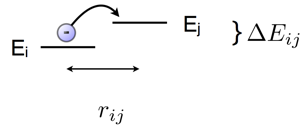
<p>Both models, Marcus and Miller-Abrahams hopping rate, are used in different context and are not exactly equivalent, but will yield similar results under many conditions. Nevertheless, it is probably safe to state that the former has a higher scientific applicability.</p>
<p>Now why is it important to be able to calculate a hopping rate when considering charge transport in organic matter? &#8211; If one knows the number of molecular sites across the device length <img src="https://s0.wp.com/latex.php?latex=L&#038;bg=ffffff&#038;fg=1a1a1a&#038;s=0&#038;c=20201002" srcset="https://s0.wp.com/latex.php?latex=L&#038;bg=ffffff&#038;fg=1a1a1a&#038;s=0&#038;c=20201002 1x, https://s0.wp.com/latex.php?latex=L&#038;bg=ffffff&#038;fg=1a1a1a&#038;s=0&#038;c=20201002&#038;zoom=4.5 4x" alt="L" class="latex" />, which is the conservative estimate of the number of jumps <img src="https://s0.wp.com/latex.php?latex=N&#038;bg=ffffff&#038;fg=1a1a1a&#038;s=0&#038;c=20201002" srcset="https://s0.wp.com/latex.php?latex=N&#038;bg=ffffff&#038;fg=1a1a1a&#038;s=0&#038;c=20201002 1x, https://s0.wp.com/latex.php?latex=N&#038;bg=ffffff&#038;fg=1a1a1a&#038;s=0&#038;c=20201002&#038;zoom=4.5 4x" alt="N" class="latex" /> needed to travel through the whole device, and the time needed per jump <img src="https://s0.wp.com/latex.php?latex=t%3D1%2F%5Cbar%7B%5Cnu_%7Bij%7D%7D&#038;bg=ffffff&#038;fg=1a1a1a&#038;s=0&#038;c=20201002" srcset="https://s0.wp.com/latex.php?latex=t%3D1%2F%5Cbar%7B%5Cnu_%7Bij%7D%7D&#038;bg=ffffff&#038;fg=1a1a1a&#038;s=0&#038;c=20201002 1x, https://s0.wp.com/latex.php?latex=t%3D1%2F%5Cbar%7B%5Cnu_%7Bij%7D%7D&#038;bg=ffffff&#038;fg=1a1a1a&#038;s=0&#038;c=20201002&#038;zoom=4.5 4x" alt="t=1/&#92;bar{&#92;nu_{ij}}" class="latex" />, one can calculate the velocity <img src="https://s0.wp.com/latex.php?latex=v%3DL%2F%28N+t%29+%3D%5Cbar%7B%5Cnu_%7Bij%7D%7D+L%2FN+%3D+%5Cbar%7B%5Cnu_%7Bij%7D%7D+%5Cbar%7Br_%7Bij%7D%7D&#038;bg=ffffff&#038;fg=1a1a1a&#038;s=0&#038;c=20201002" srcset="https://s0.wp.com/latex.php?latex=v%3DL%2F%28N+t%29+%3D%5Cbar%7B%5Cnu_%7Bij%7D%7D+L%2FN+%3D+%5Cbar%7B%5Cnu_%7Bij%7D%7D+%5Cbar%7Br_%7Bij%7D%7D&#038;bg=ffffff&#038;fg=1a1a1a&#038;s=0&#038;c=20201002 1x, https://s0.wp.com/latex.php?latex=v%3DL%2F%28N+t%29+%3D%5Cbar%7B%5Cnu_%7Bij%7D%7D+L%2FN+%3D+%5Cbar%7B%5Cnu_%7Bij%7D%7D+%5Cbar%7Br_%7Bij%7D%7D&#038;bg=ffffff&#038;fg=1a1a1a&#038;s=0&#038;c=20201002&#038;zoom=4.5 4x" alt="v=L/(N t) =&#92;bar{&#92;nu_{ij}} L/N = &#92;bar{&#92;nu_{ij}} &#92;bar{r_{ij}}" class="latex" />. Here, <img src="https://s0.wp.com/latex.php?latex=%5Cbar%7Br_%7Bij%7D%7D&#038;bg=ffffff&#038;fg=1a1a1a&#038;s=0&#038;c=20201002" srcset="https://s0.wp.com/latex.php?latex=%5Cbar%7Br_%7Bij%7D%7D&#038;bg=ffffff&#038;fg=1a1a1a&#038;s=0&#038;c=20201002 1x, https://s0.wp.com/latex.php?latex=%5Cbar%7Br_%7Bij%7D%7D&#038;bg=ffffff&#038;fg=1a1a1a&#038;s=0&#038;c=20201002&#038;zoom=4.5 4x" alt="&#92;bar{r_{ij}}" class="latex" /> is the average distance crossed per single jump. If the velocity is known, also the charge carrier mobility is known, which is a very important figure of merit in semiconductor physics. The mobility <img src="https://s0.wp.com/latex.php?latex=%5Cmu&#038;bg=ffffff&#038;fg=1a1a1a&#038;s=0&#038;c=20201002" srcset="https://s0.wp.com/latex.php?latex=%5Cmu&#038;bg=ffffff&#038;fg=1a1a1a&#038;s=0&#038;c=20201002 1x, https://s0.wp.com/latex.php?latex=%5Cmu&#038;bg=ffffff&#038;fg=1a1a1a&#038;s=0&#038;c=20201002&#038;zoom=4.5 4x" alt="&#92;mu" class="latex" /> relates the drift velocity <img src="https://s0.wp.com/latex.php?latex=v&#038;bg=ffffff&#038;fg=1a1a1a&#038;s=0&#038;c=20201002" srcset="https://s0.wp.com/latex.php?latex=v&#038;bg=ffffff&#038;fg=1a1a1a&#038;s=0&#038;c=20201002 1x, https://s0.wp.com/latex.php?latex=v&#038;bg=ffffff&#038;fg=1a1a1a&#038;s=0&#038;c=20201002&#038;zoom=4.5 4x" alt="v" class="latex" /> to its driving force, the electric field <img src="https://s0.wp.com/latex.php?latex=F&#038;bg=ffffff&#038;fg=1a1a1a&#038;s=0&#038;c=20201002" srcset="https://s0.wp.com/latex.php?latex=F&#038;bg=ffffff&#038;fg=1a1a1a&#038;s=0&#038;c=20201002 1x, https://s0.wp.com/latex.php?latex=F&#038;bg=ffffff&#038;fg=1a1a1a&#038;s=0&#038;c=20201002&#038;zoom=4.5 4x" alt="F" class="latex" />, so that <img src="https://s0.wp.com/latex.php?latex=v+%3D+%5Cmu+F&#038;bg=ffffff&#038;fg=1a1a1a&#038;s=0&#038;c=20201002" srcset="https://s0.wp.com/latex.php?latex=v+%3D+%5Cmu+F&#038;bg=ffffff&#038;fg=1a1a1a&#038;s=0&#038;c=20201002 1x, https://s0.wp.com/latex.php?latex=v+%3D+%5Cmu+F&#038;bg=ffffff&#038;fg=1a1a1a&#038;s=0&#038;c=20201002&#038;zoom=4.5 4x" alt="v = &#92;mu F" class="latex" />. A lot of essential information on charge transport is included in this inconspicuous parameter <img src="https://s0.wp.com/latex.php?latex=%5Cmu&#038;bg=ffffff&#038;fg=1a1a1a&#038;s=0&#038;c=20201002" srcset="https://s0.wp.com/latex.php?latex=%5Cmu&#038;bg=ffffff&#038;fg=1a1a1a&#038;s=0&#038;c=20201002 1x, https://s0.wp.com/latex.php?latex=%5Cmu&#038;bg=ffffff&#038;fg=1a1a1a&#038;s=0&#038;c=20201002&#038;zoom=4.5 4x" alt="&#92;mu" class="latex" />, especially if disorder is considered.</p>
<p>The charge carrier velocity can, thus, be calculated by knowledge of the hopping rate as well as the time for each hop and the number of hops. Also, <img src="https://s0.wp.com/latex.php?latex=v&#038;bg=ffffff&#038;fg=1a1a1a&#038;s=0&#038;c=20201002" srcset="https://s0.wp.com/latex.php?latex=v&#038;bg=ffffff&#038;fg=1a1a1a&#038;s=0&#038;c=20201002 1x, https://s0.wp.com/latex.php?latex=v&#038;bg=ffffff&#038;fg=1a1a1a&#038;s=0&#038;c=20201002&#038;zoom=4.5 4x" alt="v" class="latex" /> can alternatively be determined experimentally by measuring the transit time of charge carriers through a device of known thickness. Thus, a direct comparison of experiment and simulation is possible and desired for grasping how charge transport works. A suitable and very straight forward experiment is the transient photocurrent, also called time-of-flight (TOF) measurement. A fitting computer model is based on a kinetic Monte Carlo simulation, in which a certain spatial and energetic distribution of sites is assumed and the Marcus or Miller-Abrahams hopping rates are calculated.</p>
<p>Next time, I will explain the TOF experiment, and then Monte Carlo simulations. Both together allowed (and still alow) to much better understand charge transport in disordered organic semiconductors.</p>
<p><a href="http://www.connotea.org/addpopup?continue=confirm&amp;uri=http%3A%2F%2Fblog.disorderedmatter.eu%2F2012%2F01%2F17%2Fcharge-transport-in-disordered-organic-matter-hopping-transport%2F&amp;title=Charge%20transport%20in%20disordered%20organic%20matter%3A%20hopping%20transport%20«%20Notes%20on%20Disordered%20Matter">Add to Connotea</a></p>
]]></content>
		
					<link rel="replies" type="text/html" href="https://blog.disorderedmatter.eu/2012/01/17/charge-transport-in-disordered-organic-matter-hopping-transport/#comments" thr:count="7" />
			<link rel="replies" type="application/atom+xml" href="https://blog.disorderedmatter.eu/2012/01/17/charge-transport-in-disordered-organic-matter-hopping-transport/feed/atom/" thr:count="7" />
			<thr:total>7</thr:total>
			</entry>
		<entry>
		<author>
			<name>deibel</name>
							<uri>http://www.disorderedmatter.eu</uri>
						</author>

		<title type="html"><![CDATA[2012]]></title>
		<link rel="alternate" type="text/html" href="https://blog.disorderedmatter.eu/2012/01/17/2012/" />

		<id>http://deibel.wordpress.com/?p=633</id>
		<updated>2012-01-17T21:42:56Z</updated>
		<published>2012-01-17T21:38:30Z</published>
		<category scheme="https://blog.disorderedmatter.eu" term="personal" /><category scheme="https://blog.disorderedmatter.eu" term="off topic" /><category scheme="https://blog.disorderedmatter.eu" term="organic solar cells" />
		<summary type="html"><![CDATA[Hi there, I am late again, but nevertheless: a happy and successful year 2012! I have collected a few links which might or might not interest you. Also, I plan to start with some scientific (background) posts again. Let&#8217;s see how this works out:-) Press release of Heliatek: Heliatek achieves new world record for organic &#8230; <a href="https://blog.disorderedmatter.eu/2012/01/17/2012/" class="more-link">Continue reading<span class="screen-reader-text"> "2012"</span></a>]]></summary>

					<content type="html" xml:base="https://blog.disorderedmatter.eu/2012/01/17/2012/"><![CDATA[<p>Hi there, I am late again, but nevertheless: a happy and successful year 2012! </p>
<p>I have collected a few links which might or might not interest you. Also, I plan to start with some scientific (background) posts again. <a href="http://www.flickr.com/photos/72315236@N00/6716334013" title="View 'Locust in Italy' on Flickr.com"><img loading="lazy" style="float:right;" border="0" alt="Locust in Italy" width="300" src="https://i0.wp.com/farm8.staticflickr.com/7155/6716334013_0df1a544ab.jpg" height="230" /></a>Let&#8217;s see how this works out:-)</p>
<p>Press release of Heliatek: <a href="http://www.heliatek.com/?p=1346&amp;lang=en#">Heliatek achieves new world record for organic solar cells with certified 9.8 % cell efficiency</a>. Evaporated small molecule tandem with area above 1cm<sup>2</sup>. Very good! Also, Mitsubishi Chemical has reached <a href="http://www.m-kagaku.co.jp/english/aboutmcc/RC/special/feature1.html">10.1% efficiency</a> on solution processed small molecules.</p>
<p>Nature looks back at the science year 2011: <a href="http://www.nature.com/news/365-days-images-of-the-year-1.9620">365 days: Images of the year</a>.</p>
<p>Interesting, although not related to physics: <a href="http://www.hrc.utexas.edu/press/releases/2010/dfw/teaching/#syllabus">Syllabus for David Foster Wallace&#8217;s class &#8220;English 102-Literary Analysis: Prose Fiction Fall &#8217;94&#8221;</a>. Clear rules, yeah! Forgot who linked to it, sorry.<span id="more-633"></span>Editorial of Nature Physics: <a href="http://www.nature.com/nphys/journal/v7/n11/full/nphys2147.html?WT.ec_id=NPHYS-201111">How to be popular</a>, i.e. how to write popular science articles for a general non-scientific audience. If you are at talks, also consider to read the requirements of <a href="http://en.wikipedia.org/wiki/Richard_Stallman">Richard Stallman</a>, free software advocate, for <a href="https://secure.mysociety.org/admin/lists/pipermail/developers-public/2011-October/007647.html">his speeches</a>.</p>
<p>Citation science: about the <a href="http://physics.aps.org/synopsis-for/10.1103/PhysRevLett.107.238701">Temporal Effects in the Growth of Networks</a> via physics.aps.org</p>
<p>Tim Vines: <a href="http://scholarlykitchen.sspnet.org/2011/12/08/is-peer-review-a-coin-toss/">Is Peer Review a Coin Toss?</a> &#8211; good question. Also: <a href="http://scholarlykitchen.sspnet.org/2011/12/19/quality-reviewing-declines-with-experience/">Quality Reviewing Declines with Experience</a> by Phil Davis.</p>
<p>Quirin Schiermeier &amp; Katrin Kohnert from Nature: <a href="http://www.nature.com/naturejobs/science/articles/10.1038/nj7376-279a">Germany: Renewables revolution</a></p>
<p><a href="http://thebulletin.org/web-edition/columnists/dawn-stover/the-myth-of-renewable-energy">The myth of renewable energy</a> by the Bulletin of the Atomic Scientists&#8230; bit of propaganda, but always some truth there.</p>
<p><a href="http://cudl.lib.cam.ac.uk/collections/newton">Collection of Newton&#8217;s work</a> at Cambridge Digital Library.</p>
<p>Via Maxine Clarke, Nautilus blog: <a href="http://blogs.nature.com/nautilus/2010/05/howy_jacobs_receives_a_letter_1.html?utm_source=feedburner&amp;utm_medium=feed&amp;utm_campaign=Feed%3A+author%2Frss%2Fnautilus+%28Nautilus+-+Blog+Posts%29">Howy Jacobs receives a letter</a> &#8211; how a director of human services at a university handles cricital feedback in a most kindly manner&#8230; impressive.</p>
<p><a href="http://www.macinchem.org/iphone/mobile-apps.php">Mobile science</a> by maninchem.org: iphone apps for scientists (mostly chemists, though;-) Also, <a href="http://www.tuaw.com/2011/10/28/10-cool-things-you-can-do-with-wolfram-alpha-and-siri/">10 cool things you can do with Wolfram Alpha and Siri</a> by Erica Sadun at tuaw.com.</p>
<p>More on the funny side: </p>
<p><a href="http://scholarlykitchen.sspnet.org/2011/11/25/butt-of-the-joke-a-review-article-parody-proposes-smoking-for-endurance-athletes/">A review article proposes smoking for endurance athletes</a> via Kent Anderson, <a href="scholarlykitchen.sspnet.org">the scholarly kitchen</a>.</p>
<p>Reference to a nice paper by Dennis Upper on &#8220;The unsuccessul self-treatment of a case of writer&#8217;s block&#8221; as <a href="http://catenary.files.wordpress.com/2011/10/upper-1974-the-unsuccessful-self-treatment-of-a-case-of-writers-block.pdf">pdf</a>.</p>
<p>Chemist jokes&#8230; without comment, find them at the  <a href="http://prospect.rsc.org/blogs/cw/2011/07/15/chemistry-jokes/">chemistry world blog</a>.</p>
<p>Quotes:</p>
<p><a href="http://de.wikipedia.org/wiki/Thomas_Henry_Huxley">T. H. Huxley</a> via <a href="https://twitter.com/#!/naturenews/status/132434463765442560">#naturenews</a>:</p>
<blockquote><p>The great tragedy of Science &mdash; the slaying of a beautiful hypothesis by an ugly fact</p></blockquote>
<p><a href="http://en.wikipedia.org/wiki/Oscar_Wilde">Oscar Wilde</a>:</p>
<blockquote><p>What is a cynic? A man who knows the price of everything and the value of nothing.</p></blockquote>
<p><a href="http://en.wikipedia.org/wiki/Daniel_Patrick_Moynihan">Daniel Patrick Moynihan</a>:</p>
<blockquote><p>Everyone is entitled to his own opinion, but not his own facts.</p></blockquote>
<p><a href="http://en.wikipedia.org/wiki/Laurence_J._Peter">Lawrence J. Peter</a>:</p>
<blockquote><p>The way to avoid mistakes is to gain experience. The way to gain experience is to make mistakes.</p></blockquote>
<p><a href="http://www.connotea.org/addpopup?continue=confirm&amp;uri=http%3A%2F%2Fblog.disorderedmatter.eu%2F2012%2F01%2F17%2F2012%2F&amp;title=2012%20&laquo;%20Notes%20on%20Disordered%20Matter">Add to Connotea</a></p>
]]></content>
		
					<link rel="replies" type="text/html" href="https://blog.disorderedmatter.eu/2012/01/17/2012/#comments" thr:count="0" />
			<link rel="replies" type="application/atom+xml" href="https://blog.disorderedmatter.eu/2012/01/17/2012/feed/atom/" thr:count="0" />
			<thr:total>0</thr:total>
			</entry>
		<entry>
		<author>
			<name>deibel</name>
							<uri>http://www.disorderedmatter.eu</uri>
						</author>

		<title type="html"><![CDATA[SPIE Pickings]]></title>
		<link rel="alternate" type="text/html" href="https://blog.disorderedmatter.eu/2011/10/17/spie-pickings/" />

		<id>http://deibel.wordpress.com/?p=617</id>
		<updated>2011-10-17T20:44:14Z</updated>
		<published>2011-10-17T19:53:37Z</published>
		<category scheme="https://blog.disorderedmatter.eu" term="organic solar cells" /><category scheme="https://blog.disorderedmatter.eu" term="community" />
		<summary type="html"><![CDATA[Already 8 weeks past, recently some Videos (well, stills of the slides plus audio) of the Solar and LED Session of the SPIE Optics and Photonics 2011, San Diego went online. Here are two or three which might interest you (well, they got my attention;-) but there is more to be found on the above &#8230; <a href="https://blog.disorderedmatter.eu/2011/10/17/spie-pickings/" class="more-link">Continue reading<span class="screen-reader-text"> "SPIE Pickings"</span></a>]]></summary>

					<content type="html" xml:base="https://blog.disorderedmatter.eu/2011/10/17/spie-pickings/"><![CDATA[<p>Already 8 weeks past, recently some Videos (well, stills of the slides plus audio) of the <a href="http://spie.org/opsolarpresentations.xml">Solar and LED</a> Session of the SPIE Optics and Photonics 2011, San Diego went online.</p>
<p><a href="http://www.flickr.com/photos/72315236@N00/6254726299" title="View 'Happy Family: Apes in Khandala, Maharashtra' on Flickr.com"><img loading="lazy" style="float:right;" border="0" alt="Happy Family: Apes in Khandala, Maharashtra" width="270" src="https://i0.wp.com/farm7.static.flickr.com/6098/6254726299_aa8c65b9a9.jpg" height="180" /></a>Here are two or three which might interest you (well, they got my attention;-) but there is more to be found on the above mentioned web site &ndash; although I had to modify the settings of my ad blocker to be able to watch. No, there are no ads; still&#8230; </p>
<p>Before you scroll down, let me mention some other &#8220;findings&#8221; of potential interest: </p>
<ul>
<li><a href="http://www.renewableenergyworld.com/rea/news/article/2011/09/un-analytics-how-google-went-solar?cmpid=rss">How Google Went Solar</a> by Dan Auld about Big G&#8217;s 1.65MW array, and how to get most out of it.
<li>Then, a nice rant on the climate debate and how news media, trying to be biased, do become very biased&#8230; read <a href="http://theconversation.edu.au/diamond-planets-climate-change-and-the-scientific-method-3329">Diamond planets, climate change and the scientific method</a> by Matthew Bailes. You can see it as a kind of (inofficial) editorial for the last linked article, <a href="http://theconversation.edu.au/whos-your-expert-the-difference-between-peer-review-and-rhetoric-1550">Who&rsquo;s your expert? The difference between peer review and rhetoric</a> by Ove Hoegh-Guldberg.
<li>Another one on organic photovoltaics, <a href="http://www.plusplasticelectronics.com/energy/paper-solar-cells-by-2015-31102.aspx">Paper solar cells by 2015</a> (Disclaimer: I was involved in one of these projects. Um ;-).
<li>Totally unrelated, <a href="http://www.phdcomics.com/comics.php?f=1439">PhDComics on Writing</a> and <a href="http://www.phdcomics.com/comics.php?f=1440">Figures</a>&#8230;
<li>Even more unrelated, and not funny: <a href="http://ergo.human.cornell.edu/CUESitStand.html">Sitting and Standing at work</a>, finally.
<li>The most efficient flexible solar cells are not organic, but made from CIGS: <a href="http://www.nature.com/nmat/journal/vaop/ncurrent/full/nmat3122.html">Highly efficient Cu(In,Ga)Se2 solar cells grown on flexible polymer films</a> (Nat Mater).
<li>Alternatively, <a href="http://www.renewableenergyworld.com/rea/news/article/2011/09/silicon-ink-is-spot-on-nrel-experiments-show?cmpid=rss">Silicon Ink</a> can be used, as Bill Scanlon writes.
<li>Stephen Wolfram on the <a href="http://blog.stephenwolfram.com/2011/08/advance-of-the-data-civilization-a-timeline/">Advance of the Data Civilization: A Timeline<br />
</a></p>
<li><a href="http://cdixon.org/2011/09/28/some-lessons-learned/">Some lessons learned</a> by Chris Dixon; while being about getting a job or your startup funded, it is somewhat applicable to carreers in science.
<li>The Scientist on the <a href="http://the-scientist.com/2011/09/01/poster-perfect/">Perfect Poster</a>.
<li>Nature News on the <a href="http://blogs.nature.com/news/2011/10/why_research_papers_are_retrac.html?utm_source=feedburner&amp;utm_medium=feed&amp;utm_campaign=Feed%3A+news%2Frss%2Fthe_great_beyond+%28Nature+News+Blog+-+Blog+Posts%29">The reasons for retraction</a>.
</ul>
<p>But now to these SPIE presentations [Update: WordPress does not accept the embedded vidos, so here just the links to the videos].</p>
<p>James Durrant, Imperial: <a href="http://videos.spie.org/services/player/bcpid1176234192001?bckey=AQ~~,AAAAoHrMRhk~,T5-k00gMv_uOGaMSkOLlIhwZGIR5TLMe&amp;bclid=0&amp;bctid=1190459835001">Charge photogeneration and recombination in organic solar cells</a><br />
<br /><span id="more-617"></span>Jenny Nelson, Imperial: <a href="http://videos.spie.org/services/player/bcpid1176234192001?bckey=AQ~~,AAAAoHrMRhk~,T5-k00gMv_uOGaMSkOLlIhwZGIR5TLMe&amp;bclid=0&amp;bctid=1190459842001">Modelling charge transport and recombination in organic photovoltaic materials</a></p>
<p>Craig Peters, Stanford: <a href="http://videos.spie.org/services/player/bcpid1176234192001?bckey=AQ~~,AAAAoHrMRhk~,T5-k00gMv_uOGaMSkOLlIhwZGIR5TLMe&amp;bclid=0&amp;bctid=1190459829001">High-efficiency polymer-based OPV with lifetimes approaching 7 years</a>; liked especially the PDS spectra about the impact of degradation on CT states (around position 19min):</p>
<p>Wei You, UNC: <a href="http://videos.spie.org/services/player/bcpid1176234192001?bckey=AQ~~,AAAAoHrMRhk~,T5-k00gMv_uOGaMSkOLlIhwZGIR5TLMe&amp;bclid=0&amp;bctid=1190459832001">Molecular engineering of conjugated polymers for highly efficient bulk-heterojunction solar cells</a> on molecular engineering of conjugated polymers, penne vs spaghetti, reorganisation, and high efficiencies.</p>
<p>Also, there is one from yours truly;-) <a href="http://videos.spie.org/services/player/bcpid1176234192001?bckey=AQ~~,AAAAoHrMRhk~,T5-k00gMv_uOGaMSkOLlIhwZGIR5TLMe&amp;bclid=0&amp;bctid=1190459837001">Impact of trap-assisted recombination on the performance of polymer-fullerene bulk-heterojunction solar cells</a>. Never realised I say &#8220;um&#8221; so much&#8230; Here the slides also on <a href="http://www.slideshare.net/disorderedmatter/20110725-deibel-spie-san-diego">Slideshare</a>.</p>
<p><a href="http://www.connotea.org/addpopup?continue=confirm&amp;uri=http%3A%2F%2Fblog.disorderedmatter.eu%2F2011%2F10%2F17%2Fspie-pickings%2F&amp;title=SPIE%20Pickings%20&laquo;%20Notes%20on%20Disordered%20Matter">Add to Connotea</a></p>
]]></content>
		
					<link rel="replies" type="text/html" href="https://blog.disorderedmatter.eu/2011/10/17/spie-pickings/#comments" thr:count="2" />
			<link rel="replies" type="application/atom+xml" href="https://blog.disorderedmatter.eu/2011/10/17/spie-pickings/feed/atom/" thr:count="2" />
			<thr:total>2</thr:total>
			</entry>
		<entry>
		<author>
			<name>deibel</name>
							<uri>http://www.disorderedmatter.eu</uri>
						</author>

		<title type="html"><![CDATA[1955-2011]]></title>
		<link rel="alternate" type="text/html" href="https://blog.disorderedmatter.eu/2011/10/06/1955-2011/" />

		<id>http://deibel.wordpress.com/?p=615</id>
		<updated>2011-10-06T10:25:33Z</updated>
		<published>2011-10-06T10:25:31Z</published>
		<category scheme="https://blog.disorderedmatter.eu" term="off topic" />
		<summary type="html"><![CDATA[Steve Jobs in the Stanford commencement address 2005: I have looked in the mirror every morning and asked myself: &#8220;If today were the last day of my life, would I want to do what I am about to do today?&#8221; And whenever the answer has been &#8220;No&#8221; for too many days in a row, I &#8230; <a href="https://blog.disorderedmatter.eu/2011/10/06/1955-2011/" class="more-link">Continue reading<span class="screen-reader-text"> "1955-2011"</span></a>]]></summary>

					<content type="html" xml:base="https://blog.disorderedmatter.eu/2011/10/06/1955-2011/"><![CDATA[<p><a href="http://www.apple.com/stevejobs">Steve Jobs</a> in the <a href="http://www.youtube.com/watch?v=UF8uR6Z6KLc">Stanford commencement address 2005</a>:</p>
<blockquote><p>
I have looked in the mirror every morning and asked myself: &#8220;If today were the last day of my life, would I want to do what I am about to do today?&#8221; And whenever the answer has been &#8220;No&#8221; for too many days in a row, I know I need to change something.
</p></blockquote>
]]></content>
		
					<link rel="replies" type="text/html" href="https://blog.disorderedmatter.eu/2011/10/06/1955-2011/#comments" thr:count="1" />
			<link rel="replies" type="application/atom+xml" href="https://blog.disorderedmatter.eu/2011/10/06/1955-2011/feed/atom/" thr:count="1" />
			<thr:total>1</thr:total>
			</entry>
		<entry>
		<author>
			<name>deibel</name>
							<uri>http://www.disorderedmatter.eu</uri>
						</author>

		<title type="html"><![CDATA[Photocurrent again]]></title>
		<link rel="alternate" type="text/html" href="https://blog.disorderedmatter.eu/2011/09/07/photocurrent-again/" />

		<id>http://deibel.wordpress.com/?p=611</id>
		<updated>2012-04-05T13:42:39Z</updated>
		<published>2011-09-07T15:53:13Z</published>
		<category scheme="https://blog.disorderedmatter.eu" term="organic solar cells" /><category scheme="https://blog.disorderedmatter.eu" term="photocurrent" /><category scheme="https://blog.disorderedmatter.eu" term="physics" />
		<summary type="html"><![CDATA[I covered the photocurrent already before, for instance here. I pointed out that from the light intensity dependence of the short circuit current, it is impossible for many typical conditions to unambiguously determine the dominant loss mechanism or even the recombination order (1st (often called monomolecular, but not my favourite term;-) or 2nd order of &#8230; <a href="https://blog.disorderedmatter.eu/2011/09/07/photocurrent-again/" class="more-link">Continue reading<span class="screen-reader-text"> "Photocurrent again"</span></a>]]></summary>

					<content type="html" xml:base="https://blog.disorderedmatter.eu/2011/09/07/photocurrent-again/"><![CDATA[<p>I covered the photocurrent already before, for instance <a href="https://blog.disorderedmatter.eu/2010/07/02/photocurrent-in-organic-solar-cells-part-2/">here</a>. <a href="http://www.flickr.com/photos/72315236@N00/6066144136" title="View 'Market Place in Funchal, Madeira' on Flickr.com"><img loading="lazy" style="float:right;" border="0" alt="Market Place in Funchal, Madeira" width="300" src="https://i0.wp.com/farm7.static.flickr.com/6190/6066144136_74b466e614.jpg" height="200" /></a> I pointed out that from the light intensity dependence of the short circuit current, it is impossible for many typical conditions to unambiguously determine the dominant loss mechanism or even the recombination order (1st (often called monomolecular, but not my favourite term;-) or 2nd order of decay). </p>
<p>If, however, you know (or guess) that the recombination order is two, you can use the above mentioned <img src="https://s0.wp.com/latex.php?latex=j_%7Bsc%7D&#038;bg=ffffff&#038;fg=1a1a1a&#038;s=0&#038;c=20201002" srcset="https://s0.wp.com/latex.php?latex=j_%7Bsc%7D&#038;bg=ffffff&#038;fg=1a1a1a&#038;s=0&#038;c=20201002 1x, https://s0.wp.com/latex.php?latex=j_%7Bsc%7D&#038;bg=ffffff&#038;fg=1a1a1a&#038;s=0&#038;c=20201002&#038;zoom=4.5 4x" alt="j_{sc}" class="latex" /> vs. <img src="https://s0.wp.com/latex.php?latex=P_L&#038;bg=ffffff&#038;fg=1a1a1a&#038;s=0&#038;c=20201002" srcset="https://s0.wp.com/latex.php?latex=P_L&#038;bg=ffffff&#038;fg=1a1a1a&#038;s=0&#038;c=20201002 1x, https://s0.wp.com/latex.php?latex=P_L&#038;bg=ffffff&#038;fg=1a1a1a&#038;s=0&#038;c=20201002&#038;zoom=4.5 4x" alt="P_L" class="latex" /> data to determine which fraction of charges is lost to bimolecular recombination, <img src="https://s0.wp.com/latex.php?latex=%5Ceta_%7Bbr%7D&#038;bg=ffffff&#038;fg=1a1a1a&#038;s=0&#038;c=20201002" srcset="https://s0.wp.com/latex.php?latex=%5Ceta_%7Bbr%7D&#038;bg=ffffff&#038;fg=1a1a1a&#038;s=0&#038;c=20201002 1x, https://s0.wp.com/latex.php?latex=%5Ceta_%7Bbr%7D&#038;bg=ffffff&#038;fg=1a1a1a&#038;s=0&#038;c=20201002&#038;zoom=4.5 4x" alt="&#92;eta_{br}" class="latex" />. This was shown recently by [<a href="http://dx.doi.org/10.1002/adma.201004311">Koster 2011</a>]. For <img src="https://s0.wp.com/latex.php?latex=j_%7Bsc%7D+%5Cpropto+P_L%5E%5Calpha&#038;bg=ffffff&#038;fg=1a1a1a&#038;s=0&#038;c=20201002" srcset="https://s0.wp.com/latex.php?latex=j_%7Bsc%7D+%5Cpropto+P_L%5E%5Calpha&#038;bg=ffffff&#038;fg=1a1a1a&#038;s=0&#038;c=20201002 1x, https://s0.wp.com/latex.php?latex=j_%7Bsc%7D+%5Cpropto+P_L%5E%5Calpha&#038;bg=ffffff&#038;fg=1a1a1a&#038;s=0&#038;c=20201002&#038;zoom=4.5 4x" alt="j_{sc} &#92;propto P_L^&#92;alpha" class="latex" />, they found <img src="https://s0.wp.com/latex.php?latex=%5Ceta_%7Bbr%7D+%3D+%5Calpha%5E%7B-1%7D-1&#038;bg=ffffff&#038;fg=1a1a1a&#038;s=0&#038;c=20201002" srcset="https://s0.wp.com/latex.php?latex=%5Ceta_%7Bbr%7D+%3D+%5Calpha%5E%7B-1%7D-1&#038;bg=ffffff&#038;fg=1a1a1a&#038;s=0&#038;c=20201002 1x, https://s0.wp.com/latex.php?latex=%5Ceta_%7Bbr%7D+%3D+%5Calpha%5E%7B-1%7D-1&#038;bg=ffffff&#038;fg=1a1a1a&#038;s=0&#038;c=20201002&#038;zoom=4.5 4x" alt="&#92;eta_{br} = &#92;alpha^{-1}-1" class="latex" />. Although I was not able to follow the exact derivation (<B>[Update 5.4.2011]</B> it can be derived by solving a simple differential equation, <img src="https://s0.wp.com/latex.php?latex=%5Calpha%3D%281-dR%2FdG%29%2F%281-R%2FG%29%3D%281-%5Ceta_%7Bbr%7D%27%29%2F%281-%5Ceta_%7Bbr%7D%29&#038;bg=ffffff&#038;fg=1a1a1a&#038;s=0&#038;c=20201002" srcset="https://s0.wp.com/latex.php?latex=%5Calpha%3D%281-dR%2FdG%29%2F%281-R%2FG%29%3D%281-%5Ceta_%7Bbr%7D%27%29%2F%281-%5Ceta_%7Bbr%7D%29&#038;bg=ffffff&#038;fg=1a1a1a&#038;s=0&#038;c=20201002 1x, https://s0.wp.com/latex.php?latex=%5Calpha%3D%281-dR%2FdG%29%2F%281-R%2FG%29%3D%281-%5Ceta_%7Bbr%7D%27%29%2F%281-%5Ceta_%7Bbr%7D%29&#038;bg=ffffff&#038;fg=1a1a1a&#038;s=0&#038;c=20201002&#038;zoom=4.5 4x" alt="&#92;alpha=(1-dR/dG)/(1-R/G)=(1-&#92;eta_{br}&#039;)/(1-&#92;eta_{br})" class="latex" />), it seems to work. Easy method, although make sure not to have too much space charge in your device &ndash; even at the contacts, induced by low (ohmic) injection barriers (we compared it to our device simulation, and then you get significant deviations)! In my opinion, the latter point is not stressed enough in the paper, despite the nice approach.<span id="more-611"></span>Concerning my discussion with Robert Street (see the links in the <a href="https://blog.disorderedmatter.eu/2010/07/02/photocurrent-in-organic-solar-cells-part-2/">previous photocurrent blog post</a>) if the dominant nongeminate recombination mechanism is monomolecular or bimolecular, he recently published another paper [<a href="http://dx.doi.org/10.1103/PhysRevB.84.075208">Street 2011</a>]. In this one, Bob claims that the recombination mechanism at short circuit and open circuit conditions are different. This is in opposition to our understanding. Also, the Durrant group is able to reconstruct the whole current-voltage characteristics of state-of-the-art organic solar cells (in which geminate recombination is negligible) by measuring the carrier concentration dependent carrier lifetime, and mapping it on the voltage dependent carrier concentration &ndash; I will not go into detail, have a look at their papers [<a href="http://dx.doi.org/10.1073/pnas.1004363107">Shuttle 2011</a>]. Coming back to Bob Street, in order to explain why he believes that the recombination mechanism is differnt at open and short circuit, he explains</p>
<blockquote><p>
The TPV response is approximately a simple exponential decay, which is strikingly different from the power-law form of the TPC. The time constant decreases from &#8764;1 ms to 18 &#8220;&mu;s for Voc increasing from 0.269 to 0.516 V. Again, this is a completely different result from the form of the photocurrent transients, which have a different magnitude of response time, depend much less on the voltage, and the voltage dependence is in the opposite direction.
</p></blockquote>
<p>As you may know, TPV=transient photovoltage, measured at open circuit, whereas TPC=transient photocurrent is determined under short circuit. One point against his argument is: TPV is a small-signal method, in which Voc is changed only by a few percent due to a (sufficiently weak) laser pulse in addition to bias illumination. Therefore, it decays monoexponentially. In contrast, TPC is a large signal. Bob Street points out that TPC at short circuit decays with a power law. Let me add that is similar to the large-signal method at open circuit, namely the time dependent open circuit voltage. The latter also decays with a power law, and not monoexponentially. Thus, no principal difference between recombination at short circuit and open circuit.</p>
<p>Finally, a nice publication concerning these topics is [<a href="http://dx.doi.org/10.1021/jz201104d">Dibb 2011</a>]. From the abstract,</p>
<blockquote><p>
We show that it is only safe to infer a linear recombination mechanism from a linear dependence of corrected photocurrent on light intensity under the following special conditions: (i) the photogenerated charge carrier density is much larger than the dark carrier density and (ii) the photogenerated carrier density is proportional to the photogeneration rate.
</p></blockquote>
<p>Indeed, it all depends;-)</p>
<p>And lastly (does this come after finally? ;-) a few links I found over the weeks. From the <a href="http://www.coronene.com/blog">Coronene Blog</a>, an excellent parody of <a href="http://www.coronene.com/blog/wp-content/uploads/2011/03/JACS-article.jpg">how to publish high impact papers</a>. An insightful article on <a href="http://www.nature.com/news/2010/101013/full/467775a.html">mistakes in scientific programming</a> by Zeeya Merali in Nature News. A list of the <a href="http://sciencewatch.com/dr/sci/misc/Top100MatSci2000-10/">Top 100 Material Scientists</a>, from Thomson Reuters based on impact factor etc &ndash; despite that, interesting;-) <a href="http://blogs.ch.cam.ac.uk/pmr/2011/07/13/what&rsquo;s-wrong-with-scholarly-publishing-how-it-used-to-be/">What&rsquo;s wrong with scholarly publishing? How it used to be</a> on <a href="http://blogs.ch.cam.ac.uk/pmr">petermr&#8217;s blog</a>. Then: Is there a point in publishing corrections to articles? It seems <a href="http://scholarlykitchen.sspnet.org/2011/07/21/is-something-fishy-going-on-citations-suggest-correction-comes-slowly-if-it-comes-at-all/">not</a> (Scholarly Kitchen)! Infodocket: Google Scholar Citations <a href="http://infodocket.com/2011/07/21/google-scholar-citations-launches-a-look-at-what-microsoft-is-up-to-with-academic-search/">launched</a>. On Nature Chemistry: <a href="http://www.nature.com/nchem/journal/v3/n8/full/nchem.1109.html?WT.ec_id=NCHEM-201108">The art of abstracts</a> (similar to some others, behind the wall&#8230;). You know that I like preprint servers, as they are barrierless: <a href="http://www.nature.com/nature/journal/v476/n7359/full/476145a.html">arXiv just turned 20</a>, written by Paul Ginsparg himself for Nature. Then nice pic: <a href="http://i.imgur.com/3YFTG.jpg">how people in science see each other</a>&#8230;as always, there is some truth to simplifications;-) Nice article by Ben Coldacre on paywalls for science, <a href="http://www.guardian.co.uk/commentisfree/2011/sep/02/bad-science-academic-publishing">Academic publishers run a guarded knowledge economy</a> (Guardian).</p>
<p>That&#8217;s it. If you wonder why I have time to write, I have one month &#8220;off&#8221;: we call it parent time in Germany, it is my part 2 (part 1 was directly after the birth). See you again, still have to finish this other science thing&#8230;</p>
<p><a href="http://www.connotea.org/addpopup?continue=confirm&amp;uri=http%3A%2F%2Fblog.disorderedmatter.eu%2F2011%2F09%2F07%2Fphotocurrent-again%2F&amp;title=Photocurrent%20again%20&laquo;%20Notes%20on%20Disordered%20Matter">Add to Connotea</a></p>
]]></content>
		
					<link rel="replies" type="text/html" href="https://blog.disorderedmatter.eu/2011/09/07/photocurrent-again/#comments" thr:count="30" />
			<link rel="replies" type="application/atom+xml" href="https://blog.disorderedmatter.eu/2011/09/07/photocurrent-again/feed/atom/" thr:count="30" />
			<thr:total>30</thr:total>
			</entry>
		<entry>
		<author>
			<name>deibel</name>
							<uri>http://www.disorderedmatter.eu</uri>
						</author>

		<title type="html"><![CDATA[This and that]]></title>
		<link rel="alternate" type="text/html" href="https://blog.disorderedmatter.eu/2011/07/01/this-and-that/" />

		<id>http://deibel.wordpress.com/?p=603</id>
		<updated>2011-07-01T16:29:43Z</updated>
		<published>2011-07-01T11:32:50Z</published>
		<category scheme="https://blog.disorderedmatter.eu" term="science&amp;culture" /><category scheme="https://blog.disorderedmatter.eu" term="organic solar cells" />
		<summary type="html"><![CDATA[Kid is growing, lack of sleep makes euphoric, but less time is less time;-) The 2010 impact factors were just released by Thomson Reuters, as most of you will know due to the mails sent by almost all publishers to tell about recent boosts of impact for their journals. A sober post was written by &#8230; <a href="https://blog.disorderedmatter.eu/2011/07/01/this-and-that/" class="more-link">Continue reading<span class="screen-reader-text"> "This and that"</span></a>]]></summary>

					<content type="html" xml:base="https://blog.disorderedmatter.eu/2011/07/01/this-and-that/"><![CDATA[<p>Kid is growing, lack of sleep makes euphoric, but less time is less time;-)</p>
<p>The 2010 <a href="http://en.wikipedia.org/wiki/Impact_factor">impact factors</a> were just released by <a href="http://thomsonreuters.com/products_services/science/free/essays/impact_factor/">Thomson Reuters</a>, <a href="http://www.flickr.com/photos/72315236@N00/5890705204" title="View 'Sunset at Ammersee' on Flickr.com"><img style="float:right;" border="0" alt="Sunset at Ammersee" width="270" src="https://i0.wp.com/farm6.static.flickr.com/5184/5890705204_c0336b2bac.jpg" /></a>as most of you will know due to the mails sent by almost all publishers to tell about recent boosts of impact for their journals. A <a href="http://blog.joerg.heber.name/2011/06/29/impact-factor-season/">sober post</a> was written by J&ouml;rg Heber, editor of Nature materials. A brief quote</p>
<blockquote><p>
So what use is the impact factor number? Well, being cynical one could say it is a quick measure for those that don&rsquo;t read the journals but still want to know how good they are on average. The danger is of course that this is then used as a kind of metric to assess the quality of research or to decide on the career of researchers.
</p></blockquote>
<p><span id="more-603"></span>Maybe not so surprisingly, the recent <a href="http://www.nature.com/nmat/journal/v10/n7/full/nmat3063.html">Nature material&#8217;s editorial</a> is about the impact factor as well. It also includes a link to <a>Eigenfactor</a>, which is open and also weights from how &#8220;good&#8221; a journal the reference to the measured publication was made. There, only the <a href="http://www.eigenfactor.org/results.php?fulljournalname1=&amp;rosvcat=PHYSICS&amp;year=2009&amp;resultsperpage=100&amp;issnnumber=&amp;ordering=perarticle&amp;grping=%25&amp;nam=names&amp;Submit=Search">2009 results</a> are up presently.</p>
<p>Concerning organic photovoltaics, the race for higher efficiencies briefly had seemed to have taken another step upwards as compared to the recent non-certified <a href="">above 9%</a> power conversion efficiency to <a href="http://www.electroiq.com/articles/pvw/2011/06/flexible-substrates-offer-cost-efficient-alternatives-for-photovoltaics.html">almost 12%</a>, but I heard that this was a mistake. New competition for organics comes from a startup <a href="http://www.altadevices.com/">Alta devices</a>, which makes solar cells of GaAs by epitaxial liftoff to reduce cost. Does not sound so cost effective, but if they go on to prove it, it&#8217;s ertainly impressive with the <a href="http://www.technologyreview.com/energy/37871/">above 28%</a> efficiency shown by them recently, as reported by Technology Review. Along these lines, flexible CIGS solar cells have hit <a href="http://www.renewableenergyworld.com/rea/news/article/2011/05/record-efficiency-of-18-7-for-flexible-cigs-solar-cells?cmpid=rss">18.7%</a> end of May by the EMPA researchers around Prof. Tiwari. Indium price may be a limiting factor here, but otherwise this thin film polycrystalline technique is another strong competitor. Thus, enough driving force to go bexond 10% for organic solar cells soon:-)</p>
<p>Finally, a nonphysical, but nevertheless important read: <a href="http://www.ncbi.nlm.nih.gov/pubmed/21472486">Traumatic brain injuries in illustrated literature: experience from a series of over 700 head injuries in the Asterix comic books</a> &ndash; enjoy ;-) Thanks to Julien for the hint.</p>
<p>With that, bye for now. Next entry will not be a news summary, I hope, but something more physics related again&#8230;</p>
<p><a href="http://www.connotea.org/addpopup?continue=confirm&amp;uri=http%3A%2F%2Fblog.disorderedmatter.eu%2F2011%2F07%2F01%2Fthis-and-that%2F&amp;title=This%20and%20that%20&laquo;%20Notes%20on%20Disordered%20Matter">Add to Connotea</a></p>
]]></content>
		
					<link rel="replies" type="text/html" href="https://blog.disorderedmatter.eu/2011/07/01/this-and-that/#comments" thr:count="0" />
			<link rel="replies" type="application/atom+xml" href="https://blog.disorderedmatter.eu/2011/07/01/this-and-that/feed/atom/" thr:count="0" />
			<thr:total>0</thr:total>
			</entry>
		<entry>
		<author>
			<name>deibel</name>
							<uri>http://www.disorderedmatter.eu</uri>
						</author>

		<title type="html"><![CDATA[Blue suits him better than pink]]></title>
		<link rel="alternate" type="text/html" href="https://blog.disorderedmatter.eu/2011/05/10/blue-suits-him-better-than-pink/" />

		<id>http://deibel.wordpress.com/?p=599</id>
		<updated>2011-05-10T08:48:00Z</updated>
		<published>2011-05-10T08:47:27Z</published>
		<category scheme="https://blog.disorderedmatter.eu" term="community" /><category scheme="https://blog.disorderedmatter.eu" term="organic solar cells" /><category scheme="https://blog.disorderedmatter.eu" term="personal" />
		<summary type="html"><![CDATA[Children change the life, how very true. Not that I am less interested in Science in general, I do enjoy it! Nevertheless, somehow work seems less important these days &#8211; which maybe I should not admit openly ;-) I received this statement, Blue suits the lecturer better than pink as one of the results of &#8230; <a href="https://blog.disorderedmatter.eu/2011/05/10/blue-suits-him-better-than-pink/" class="more-link">Continue reading<span class="screen-reader-text"> "Blue suits him better than&#160;pink"</span></a>]]></summary>

					<content type="html" xml:base="https://blog.disorderedmatter.eu/2011/05/10/blue-suits-him-better-than-pink/"><![CDATA[<p>Children change the life, how very true. Not that I am less interested in Science in general, <a href="http://www.flickr.com/photos/72315236@N00/5705962431" title="View 'kleine H&auml;nde' on Flickr.com"><img style="float:right;" border="0" alt="kleine H&auml;nde" width="270" src="https://i0.wp.com/farm3.static.flickr.com/2624/5705962431_41564f79ab.jpg" /></a>I do enjoy it! Nevertheless, somehow work seems less important these days &ndash; which maybe I should not admit openly ;-)</p>
<p>I received this statement,</p>
<blockquote><p>Blue suits the lecturer better than pink</p></blockquote>
<p>as one of the results of the lecture evaluation (Atom Physics for &#8220;Teachers to be&#8221;). Yes, I also received some other comments, most positive, some negative, all useful (including that one?;-)</p>
<p>Just to say that I am still amongst the living, here some bits and pieces I found during the last weeks, when time allowed.<span id="more-599"></span>You may have heard of the rumors concerning a new efficiency record. I heard this by way of a discussion on LinkedIn, the information was also on <a href="http://www.crunchgear.com/2011/04/06/mitsubishi-chemical-to-commercialize-printable-solar-cells-next-year/">CrunchGear</a>. 9.2 or 9.3% is the word, made by <a href="http://www.mitsubishichem-hd.co.jp/english/group/strategy/major_project/solar_cell.html">Mitsubishi Chemical</a> in cooperation with the University of Tokyo, probably the group of <a href="http://www.chem.s.u-tokyo.ac.jp/users/common/NakamuraLabE.html">Nakamura</a>. Not sure if this is certified, but it is certainly a follow-up of <a href="http://www.physorg.com/news/2011-03-mitsubishi-chemical-corp-photovoltaic-cell.html">this cell</a>. Artificial leafs where also in the news, see <a href="http://blogs.nature.com/news/2011/03/scientists_announce_first_prac.html?utm_source=feedburner&amp;utm_medium=feed&amp;utm_campaign=Feed%253A+news%252Frss%252Fthe_great_beyond+%2528The+Great+Beyond+-+Blog+Posts%2529">Nature News</a>.</p>
<p>PhD Comics finally tells us <a href="http://www.phdcomics.com/comics.php?f=1431">how grant applications work</a>&#8230; how true! A bit dry reading in comparison may be the <a href="http://www.esf.org/publications">European Peer Review Guide</a>, as reported by <a href="http://www.nature.com/news/2011/110504/full/473017a.html?WT.mc_id=TWT_NatureNews&amp;utm_source=feedburner&amp;utm_medium=twitter&amp;utm_campaign=Feed%3A+yahoo%2FqUaz+%28Nature+news%29">Nature News</a>.</p>
<p>Via <a href="http://science.slashdot.org/story/11/05/01/0245205/Forging-a-Head-The-Upside-of-Scientific-Hoaxes?utm_source=feedburner&amp;utm_medium=feed&amp;utm_campaign=Feed%3A+Slashdot%2FslashdotScience+%28Slashdot%3A+Science%29">Slashdot</a>: <a href="http://sciencecareers.sciencemag.org/career_magazine/previous_issues/articles/2011_04_22/caredit.a1100035">Experimental Error: Forging a Head</a> by &#8220;scientist-comedian&#8221; Adam Ruben. Quite nice:-)</p>
<p>Organic solar cells can become cheaper, as ITO is replaced by printed nano-silver. This step may reduce the cost of the electrode by up to 90%, according to <a href="http://konarka.com">Konarka</a> as reported by <a href="http://www.heise.de/tr/artikel/Kunterbunt-und-klitzeklein-1202726.html">Technology Review</a> (in german, <a href="http://translate.google.de/translate?hl=de&amp;sl=de&amp;tl=en&amp;u=http%3A%2F%2Fwww.heise.de%2Ftr%2Fartikel%2FKunterbunt-und-klitzeklein-1202726.html">translation here</a>). By the way, Germany had a new record for the installed power from renewables, as reported by <a href="http://www.renewableenergyworld.com/rea/news/article/2011/03/new-record-for-german-renewable-energy-in-2010?cmpid=rss">Renewable Energy World</a>. Well, massive funding helps&#8230; and may be a good way to get started.</p>
<p>Two sad but interesting stories about two scientists leaving the world of fundamental research to move on: <a href="http://blog.devicerandom.org/2011/02/18/getting-a-life/">Getting a life</a> (devicerandom blog) and <a href="http://sciencecareers.sciencemag.org/career_magazine/previous_issues/articles/2011_02_04/caredit.a1100011">Falling Off the Ladder: How Not to Succeed in Academia<br />
</a> (published in Science Careers). However, if you decide to stay &ndash; which I hope&#8230; I will:-) &ndash; consider to read this Guardian article on <a href="http://www.guardian.co.uk/science/blog/2011/apr/13/secrets-good-science-writing">Good Science Writing</a> by Tim Radford.</p>
<p>So long, maybe at some point some physics is to come again &ndash; there is always hope;-)</p>
<p><a href="http://www.connotea.org/addpopup?continue=confirm&amp;uri=http%3A%2F%2Fblog.disorderedmatter.eu%2F2011%2F05%2F10%2Fblue-suits-him-better-than-pink%2F&amp;title=Blue%20suits%20him%20better%20than%20pink%20&laquo;%20Notes%20on%20Disordered%20Matter">Add to Connotea</a></p>
]]></content>
		
					<link rel="replies" type="text/html" href="https://blog.disorderedmatter.eu/2011/05/10/blue-suits-him-better-than-pink/#comments" thr:count="1" />
			<link rel="replies" type="application/atom+xml" href="https://blog.disorderedmatter.eu/2011/05/10/blue-suits-him-better-than-pink/feed/atom/" thr:count="1" />
			<thr:total>1</thr:total>
			</entry>
		<entry>
		<author>
			<name>deibel</name>
							<uri>http://www.disorderedmatter.eu</uri>
						</author>

		<title type="html"><![CDATA[New life &#8211; now for real]]></title>
		<link rel="alternate" type="text/html" href="https://blog.disorderedmatter.eu/2011/03/10/new-life-now-for-real/" />

		<id>http://deibel.wordpress.com/?p=597</id>
		<updated>2011-03-10T09:40:42Z</updated>
		<published>2011-03-10T09:40:35Z</published>
		<category scheme="https://blog.disorderedmatter.eu" term="off topic" /><category scheme="https://blog.disorderedmatter.eu" term="personal" />
		<summary type="html"><![CDATA[On the 1st of March, our daughter Chiara Marie was born: we are so happy and overjoyed:-) As you can imagine, there is little time (and there is lack of sleep;-). So please bear with me if there are no posts and replies to questions forthcoming in the next few weeks. All the best, Carsten]]></summary>

					<content type="html" xml:base="https://blog.disorderedmatter.eu/2011/03/10/new-life-now-for-real/"><![CDATA[<p>On the 1st of March, our daughter Chiara Marie was born: we are so happy and overjoyed:-) As you can imagine, there is little time (and there is lack of sleep;-). So please bear with me if there are no posts and replies to questions forthcoming in the next few weeks. All the best, Carsten</p>
]]></content>
		
					<link rel="replies" type="text/html" href="https://blog.disorderedmatter.eu/2011/03/10/new-life-now-for-real/#comments" thr:count="9" />
			<link rel="replies" type="application/atom+xml" href="https://blog.disorderedmatter.eu/2011/03/10/new-life-now-for-real/feed/atom/" thr:count="9" />
			<thr:total>9</thr:total>
			</entry>
		<entry>
		<author>
			<name>deibel</name>
							<uri>http://www.disorderedmatter.eu</uri>
						</author>

		<title type="html"><![CDATA[Comments]]></title>
		<link rel="alternate" type="text/html" href="https://blog.disorderedmatter.eu/2011/02/06/comments/" />

		<id>http://deibel.wordpress.com/?p=593</id>
		<updated>2011-02-06T18:12:59Z</updated>
		<published>2011-02-06T18:12:20Z</published>
		<category scheme="https://blog.disorderedmatter.eu" term="community" /><category scheme="https://blog.disorderedmatter.eu" term="comment" />
		<summary type="html"><![CDATA[I just changed the comment settings: up to now, a WordPress account was needed in order to be able to comment on my posts. Believe me or not, I did not even know about this setting till today. Now, you only have to give your (or some;-) name and an email address (yours? I do &#8230; <a href="https://blog.disorderedmatter.eu/2011/02/06/comments/" class="more-link">Continue reading<span class="screen-reader-text"> "Comments"</span></a>]]></summary>

					<content type="html" xml:base="https://blog.disorderedmatter.eu/2011/02/06/comments/"><![CDATA[<p><a href="http://www.flickr.com/photos/72315236@N00/5422356846" title="View 'Comments?' on Flickr.com"><img loading="lazy" style="float:right;" border="0" alt="Comments?" width="300" src="https://i0.wp.com/farm6.static.flickr.com/5137/5422356846_2d70a7b282.jpg" height="225" /></a> I just changed the comment settings: up to now, a WordPress account was needed in order to be able to comment on my posts. Believe me or not, I did not even know about this setting till today. Now, you only have to give your (or some;-) name and an email address (yours? I do not know). Maybe this lowers the barrier for some of you to ask questions or provide further insights and critical views.</p>
<p>Tomorrow is abstract deadline for the SPIE Optics and Photonics 2011, including the session <a href="http://spie.org/app/program/index.cfm?fuseaction=conferencedetail&amp;export_id=x30628&amp;ID=x10933&amp;redir=x10933.xml&amp;conference_id=945516&amp;event_id=894268">Organic Photovoltaics XII</a>. See you there:-)</p>
<p><a href="http://www.connotea.org/addpopup?continue=confirm&amp;uri=http%3A%2F%2Fblog.disorderedmatter.eu%2F2011%2F02%2F06%2Fcomments%2F&amp;title=Comments%20&laquo;%20Notes%20on%20Disordered%20Matter">Add to Connotea</a></p>
]]></content>
		
					<link rel="replies" type="text/html" href="https://blog.disorderedmatter.eu/2011/02/06/comments/#comments" thr:count="4" />
			<link rel="replies" type="application/atom+xml" href="https://blog.disorderedmatter.eu/2011/02/06/comments/feed/atom/" thr:count="4" />
			<thr:total>4</thr:total>
			</entry>
		<entry>
		<author>
			<name>deibel</name>
							<uri>http://www.disorderedmatter.eu</uri>
						</author>

		<title type="html"><![CDATA[Relax]]></title>
		<link rel="alternate" type="text/html" href="https://blog.disorderedmatter.eu/2011/01/26/relax/" />

		<id>http://deibel.wordpress.com/?p=587</id>
		<updated>2011-01-26T17:09:27Z</updated>
		<published>2011-01-26T16:53:19Z</published>
		<category scheme="https://blog.disorderedmatter.eu" term="off topic" /><category scheme="https://blog.disorderedmatter.eu" term="personal" />
		<summary type="html"><![CDATA[EU proposal submitted today, acceptance rate last year was 7%&#8230; so something for relaxing is required;-) As everybody relaxes differently, you have the choice of looking at the photograph or watching the video Bad project (disclaimer: a parody &#8211; thanks to Thiemo for the link). For unrelated reading, but following up some other notes on &#8230; <a href="https://blog.disorderedmatter.eu/2011/01/26/relax/" class="more-link">Continue reading<span class="screen-reader-text"> "Relax"</span></a>]]></summary>

					<content type="html" xml:base="https://blog.disorderedmatter.eu/2011/01/26/relax/"><![CDATA[<p><a href="http://www.flickr.com/photos/72315236@N00/5390686968" title="View 'Relax' on Flickr.com"><img loading="lazy" style="float:right;" border="0" alt="Relax" width="300" src="https://i0.wp.com/farm6.static.flickr.com/5056/5390686968_11ece8f7a6.jpg" height="225" /></a>EU proposal submitted today, acceptance rate last year was 7%&#8230; so something for relaxing is required;-) As everybody relaxes differently, you have the choice of looking at the photograph or watching the video <a href="http://www.youtube.com/watch?v=Fl4L4M8m4d0">Bad project</a> (disclaimer: a parody &ndash; thanks to Thiemo for the link).</p>
<p>For unrelated reading, but following up some other notes on publishing and peer review (see overview of posts <a href="https://blog.disorderedmatter.eu/2011/01/06/2011/">here</a>), an insightful post by Cameron Neylon: <a href="http://cameronneylon.net/blog/what-is-it-with-researchers-and-peer-review-or-why-misquoting-churchill-does-not-an-argument-make">What is it with researchers and peer review? or; Why misquoting Churchill does not an argument make</a>. If you are researcher, <a href="http://en.wikipedia.org/wiki/Peer_review">peer review</a> is (and will remain) important. Therefore, staying up to date is not only interesting (e.g., you get to see the real Churchill quote;) but also useful to see its pros and cons more clearly. Interesting may be this <a href="http://www.nature.com/nmat">Nature Materials</a> editorial on <a href="http://www.nature.com/nmat/journal/v10/n2/full/nmat2952.html">Transparency in peer review</a> (free with registration). Out of curiosity I just checked: I reviewed 21 papers in 2010, so a couple more than I (or a coauthor) actually submitted, but a lot less than I was asked to review&#8230;</p>
<p><a href="http://www.connotea.org/addpopup?continue=confirm&amp;uri=http%3A%2F%2Fblog.disorderedmatter.eu%2F2011%2F01%2F26%2Frelax%2F&amp;title=Relax%20&laquo;%20Notes%20on%20Disordered%20Matter">Add to Connotea</a></p>
]]></content>
		
					<link rel="replies" type="text/html" href="https://blog.disorderedmatter.eu/2011/01/26/relax/#comments" thr:count="2" />
			<link rel="replies" type="application/atom+xml" href="https://blog.disorderedmatter.eu/2011/01/26/relax/feed/atom/" thr:count="2" />
			<thr:total>2</thr:total>
			</entry>
		<entry>
		<author>
			<name>deibel</name>
							<uri>http://www.disorderedmatter.eu</uri>
						</author>

		<title type="html"><![CDATA[2011]]></title>
		<link rel="alternate" type="text/html" href="https://blog.disorderedmatter.eu/2011/01/06/2011/" />

		<id>http://deibel.wordpress.com/?p=577</id>
		<updated>2011-01-07T11:49:56Z</updated>
		<published>2011-01-06T13:39:53Z</published>
		<category scheme="https://blog.disorderedmatter.eu" term="organic solar cells" /><category scheme="https://blog.disorderedmatter.eu" term="personal" />
		<summary type="html"><![CDATA[A happy and successful new year to you! It is almost three years since I started this blog, this being the 69th post. A lot happened in this time, also for me: both personally (as some of the long term readers now;-) and professionally (despite still being in W&#252;rzburg;-). So, let me thank you, valued &#8230; <a href="https://blog.disorderedmatter.eu/2011/01/06/2011/" class="more-link">Continue reading<span class="screen-reader-text"> "2011"</span></a>]]></summary>

					<content type="html" xml:base="https://blog.disorderedmatter.eu/2011/01/06/2011/"><![CDATA[<p>A happy and successful new year to you! It is almost three years since I started this blog, this being the 69th post. A lot happened in this time, also for me: both personally (as some of the long term readers now;-) and professionally (despite still being in W&uuml;rzburg;-). <a href="http://www.flickr.com/photos/72315236@N00/5329508323" title="View 'Golden Pavilion (Kinkaku-ji)' on Flickr.com"><img loading="lazy" style="float:right;" border="0" alt="Golden Pavilion (Kinkaku-ji)" width="300" src="https://i0.wp.com/farm6.static.flickr.com/5006/5329508323_b6077e36e0.jpg" height="225" /></a> So, let me thank you, valued reader &ndash; and comments contributor, an active participation which I highly appreciate!</p>
<p>Many things I want to write about I have not had time to handle in the recent months. For now, let me start with just briefly revisiting what I have written. Hints of what I will add in the coming weeks and months are to come soon (soon meaning: worst case mid February, as one proposal is submitted by then, lecture is finished and project meeting / seminar talk marathon &#8220;finished&#8221;;-). </p>
<p>Find the overview below.<span id="more-577"></span>All the best, Carsten</p>
<p>Introduction to</p>
<ul>
<li><a href="https://blog.disorderedmatter.eu/2008/02/15/why-disordered-materials/">Disordered Organic Semiconductors</a> and some <a href="https://blog.disorderedmatter.eu/2008/04/15/polaron-polaron-pair-exciton-exciplex/">Definitions</a> for excited states
<li>Basic Function of Organic Solar Cells, <a href="https://blog.disorderedmatter.eu/2008/02/22/how-do-organic-solar-cells-function-part-zero/">Part 0</a>, <a href="https://blog.disorderedmatter.eu/2008/03/02/how-do-organic-solar-cells-function-part-one/">Part 1</a>, <a href="https://blog.disorderedmatter.eu/2008/03/07/how-do-organic-solar-cells-function-part-two/">Part 2</a> and as <a href="https://blog.disorderedmatter.eu/2008/06/05/picture-story-how-do-organic-solar-cells-function/">cartoon</a>
<li><a href="https://blog.disorderedmatter.eu/2008/03/11/optimisation-routes-for-organic-solar-cells-absorption/">Efficiency estimates and optimisation</a>, also for <a href="https://blog.disorderedmatter.eu/2008/03/16/comments-on-estimates-on-the-efficiencies-of-organic-tandem-solar-cells/">Tandem solar cells</a>
<li><a href="https://blog.disorderedmatter.eu/2008/03/05/intermediate-current-voltage-characeristics-of-organic-solar-cells/">Current-Voltage Characteristics</a>
<li><a href="https://blog.disorderedmatter.eu/2008/03/24/for-starters-recombination/">Some Definitions for Recombination</a>, which are slightly outdated, and an Introduction to <a href="https://blog.disorderedmatter.eu/2008/04/04/recombination-in-low-mobility-semiconductors-langevin-theory/">Langevin Theory</a>
<li>Find all of this in concise form in [<a href="http://dx.doi.org/10.1088/0034-4885/73/9/096401">Deibel 2010 Review</a>]
</ul>
<p></p>
<p>Descriptions of</p>
<ul>
<li> <a href="https://blog.disorderedmatter.eu/2009/01/31/mobility-and-efficiency-of-polymer-solar-cells/">Impact of Mobility on Efficiency</a>, also considering <a href="https://blog.disorderedmatter.eu/2009/08/26/influence-of-finite-surface-on-efficiency-vs-mobility-of-polymer-solar-cells/">Finite Surface Recombination</a>
<li> Photocurrent in organic solar cells, <a href="https://blog.disorderedmatter.eu/2009/07/20/photocurrent-in-organic-solar-cells-part-1/">Part 1</a> and <a href="https://blog.disorderedmatter.eu/2010/07/02/photocurrent-in-organic-solar-cells-part-2/">Part 2</a>
</ul>
<p></p>
<p>(Critical) Comments on</p>
<ul>
<li><a href="https://blog.disorderedmatter.eu/2008/03/16/comments-on-estimates-on-the-efficiencies-of-organic-tandem-solar-cells/">Estimates on the Efficiencies of Organic Tandem Solar Cells</a>
<li><a href="https://blog.disorderedmatter.eu/2008/03/17/comment-on-primary-photoexcitation-in-polymerfullerene-blends/">Primary Photoexcitation in Polymer:Fullerene Blends</a>
<li> <a href="https://blog.disorderedmatter.eu/2008/10/10/trimolecular-recombination-really/">Trimolecular Recombination</a>
<li> <a href="https://blog.disorderedmatter.eu/2010/05/06/type-of-polaron-recombination-under-short-circuit-conditions/">Type of Polaron Recombination under Short Circuit Conditions</a>
<li><a href="https://blog.disorderedmatter.eu/2010/09/23/metrics-yet-another-one/">Hot CT complexes and Geminate Recombination</a>
</ul>
<p></p>
<p>News on</p>
<ul>
<li>Efficiencies: <a href="https://blog.disorderedmatter.eu/2008/08/13/brief-headline-organic-bulk-heterojunction-solar-cell-efficiency/">Plextronics 5.94%</a> (August 2008), <a href="https://blog.disorderedmatter.eu/2009/07/08/5-9/">Heliatek 5.9%/6.07%</a> (July 2009), <a href="https://blog.disorderedmatter.eu/2009/12/03/towards-ten-percent-solarmer-hits-7-9-with-plastic-solar-cell/">Solarmer 7.9%</a> (December 2009), <a href="https://blog.disorderedmatter.eu/2010/08/03/new-record-for-organic-solar-cells-and-other-stuff/">Solarmer 8.13%</a> (August 2010), <a href="https://blog.disorderedmatter.eu/2010/09/16/efficiencies-and-other-notes/">Heliatek 7.7% (already shown in <a href="https://blog.disorderedmatter.eu/2010/04/12/mrs-spring-meeting-2010-already-over/">April</a>)</a>; <br />actually, now they are at 8.3% on &gt;1 cm<sup>2</sup> (<a href="https://blog.disorderedmatter.eu/2010/11/09/two-notes/">Heliatek with Tandem</a>, 10/2010, and Konarka with single junction, 11/2010) [<a href="http://dx.doi.org/10.1002/pip.1088">Solar Cell Efficiency Tables V37</a>]
<li>Degradation: <a href="https://blog.disorderedmatter.eu/2008/12/04/to-be-improved-lifetime-of-organic-solar-cells/">Improved Lifetime</a>
<li>Production: <a href="https://blog.disorderedmatter.eu/2008/10/17/mass-production-of-plastic-solar-cells/">organic roll-to-roll</a>, <a href="https://blog.disorderedmatter.eu/2009/01/21/inkjet-printing-of-inorganic-solar-cells/">inkjet printing of inorganic solar cells</a>, <a href="https://blog.disorderedmatter.eu/2009/01/29/industry-again/">organic inks</a>, <a href="https://blog.disorderedmatter.eu/2009/11/28/funding-for-organic-photovoltaics/">Company Funding</a>, <a href="https://blog.disorderedmatter.eu/2010/11/09/two-notes/">Heliatek starts production in 2012</a>
<li>Materials: <a href="https://blog.disorderedmatter.eu/2009/06/16/buckyball-polymers/">Buckyball polymers</a>
</ul>
<p></p>
<p>Links to</p>
<ul>
<li>Scientific Writing and Publishing: <a href="https://blog.disorderedmatter.eu/2008/11/05/it-is-not-only-content-that-counts/">Writing Style</a>, <a href="https://blog.disorderedmatter.eu/2009/09/01/how-to-publish-seriously/">How to publish</a>, <a href="https://blog.disorderedmatter.eu/2009/08/20/how-to-publish-a-scientific-comment/">How to Publish a Scientific Comment</a>, <a href="https://blog.disorderedmatter.eu/2010/09/23/metrics-yet-another-one/">Metrics</a>, <a href="https://blog.disorderedmatter.eu/2010/10/14/publish-like-a-pro/">Publish like a Pro</a>
<li>Academic Productivity: <a href="https://blog.disorderedmatter.eu/2009/05/01/science-30/">Science 3.0?</a>, <a href="https://blog.disorderedmatter.eu/2010/02/08/science-talking-vs-doing-and-status/">Talking vs Doing</a>
</ul>
<p></p>
<p>Personal news</p>
<ul>
<li><a href="https://blog.disorderedmatter.eu/2009/01/07/personal-news-and-a-happy-new-year-2009/">Married</a>&#8230;, and <a href="https://blog.disorderedmatter.eu/2009/07/13/personal-news-married-again/">again</a> ;-)
</ul>
<p></p>
<p>Concerning <a href="https://blog.disorderedmatter.eu/2008/05/20/organic-photovoltaics-publications/">Organic Photovoltaic Publications</a>, the trend continues (using the same search phrases), see the graph. <img loading="lazy" src="https://blog.disorderedmatter.eu/wp-content/uploads/2011/01/opv-in-wos-number-of-publications-per-year-2010.png?w=395&#038;h=383" alt="OPV in WOS (Number of Publications per Year) -2010.png" border="0" width="395" height="383" style="float:center;" /> </p>
<p>Not exponential any more, but still growing steeply&#8230; it is more difficult to measure the quality, though.</p>
<p><a href="http://www.connotea.org/addpopup?continue=confirm&amp;uri=http%3A%2F%2Fblog.disorderedmatter.eu%2F2011%2F01%2F06%2F2011%2F&amp;title=2011%20&laquo;%20Notes%20on%20Disordered%20Matter">Add to Connotea</a></p>
]]></content>
		
					<link rel="replies" type="text/html" href="https://blog.disorderedmatter.eu/2011/01/06/2011/#comments" thr:count="6" />
			<link rel="replies" type="application/atom+xml" href="https://blog.disorderedmatter.eu/2011/01/06/2011/feed/atom/" thr:count="6" />
			<thr:total>6</thr:total>
			</entry>
		<entry>
		<author>
			<name>deibel</name>
							<uri>http://www.disorderedmatter.eu</uri>
						</author>

		<title type="html"><![CDATA[Two notes]]></title>
		<link rel="alternate" type="text/html" href="https://blog.disorderedmatter.eu/2010/11/09/two-notes/" />

		<id>http://deibel.wordpress.com/?p=572</id>
		<updated>2010-11-09T10:27:40Z</updated>
		<published>2010-11-09T10:26:30Z</published>
		<category scheme="https://blog.disorderedmatter.eu" term="organic solar cells" /><category scheme="https://blog.disorderedmatter.eu" term="device physics" /><category scheme="https://blog.disorderedmatter.eu" term="photocurrent" /><category scheme="https://blog.disorderedmatter.eu" term="power conversion efficiency" />
		<summary type="html"><![CDATA[A few weeks ago, Heliatek managed to take the lead for organic solar cell efficiencies, achieving 8.3% confirmed power conversion efficiency on 1.1cm2 active area with vacuum deposited small molecules. The device was a tandem. Thomas K&#246;rner, VP of Sales, marketing and Business Development at Heliatek, added The first products should be coming onto the &#8230; <a href="https://blog.disorderedmatter.eu/2010/11/09/two-notes/" class="more-link">Continue reading<span class="screen-reader-text"> "Two notes"</span></a>]]></summary>

					<content type="html" xml:base="https://blog.disorderedmatter.eu/2010/11/09/two-notes/"><![CDATA[<p>A few weeks ago, <a href="http://www.heliatek.com">Heliatek</a> managed to take the lead for organic solar cell efficiencies, achieving 8.3% confirmed power conversion efficiency on 1.1cm<sup>2</sup> active area with vacuum deposited small molecules. <a href="http://www.flickr.com/photos/72315236@N00/5160437395" title="View 'Madeira Rainbow in Autumn' on Flickr.com"><img loading="lazy" style="float:right;" border="0" alt="Madeira Rainbow in Autumn" width="270" src="https://i0.wp.com/farm5.static.flickr.com/4037/5160437395_20da9a8ae6.jpg" height="180" /></a>The device was a tandem. Thomas K&ouml;rner, VP of Sales, marketing and Business Development at Heliatek, <a href="http://www.heliatek.com/news-19">added</a></p>
<blockquote><p>The first products should be coming onto the market at the start of 2012.</p></blockquote>
<p>Good!</p>
<p>Second, you may remember my post on <a href="https://blog.disorderedmatter.eu/2010/07/02/photocurrent-in-organic-solar-cells-part-2/">photocurrent in organic solar cells</a> back in July. It was inspired by a comment I wrote on a paper by Street et al, who proposed monomolecular recombination to dominate the loss of free charges in organic bulk heterojunction solar cells. My <a href="http://dx.doi.org/10.1103/PhysRevB.82.207301">comment</a> and Bob Street&#8217;s <a href="http://dx.doi.org/10.1103/PhysRevB.82.207302">reply</a> to it are now online at Phys Rev B. I&#8217;ll not comment this interesting exchange any further (unless requested by you;-), so read and think for yourself!</p>
<p><a href="http://www.connotea.org/addpopup?continue=confirm&amp;uri=http%3A%2F%2Fblog.disorderedmatter.eu%2F2010%2F11%2F09%2Ftwo-notes%2F&amp;title=Two%20notes%20&laquo;%20Notes%20on%20Disordered%20Matter">Add to Connotea</a></p>
]]></content>
		
					<link rel="replies" type="text/html" href="https://blog.disorderedmatter.eu/2010/11/09/two-notes/#comments" thr:count="7" />
			<link rel="replies" type="application/atom+xml" href="https://blog.disorderedmatter.eu/2010/11/09/two-notes/feed/atom/" thr:count="7" />
			<thr:total>7</thr:total>
			</entry>
		<entry>
		<author>
			<name>deibel</name>
							<uri>http://www.disorderedmatter.eu</uri>
						</author>

		<title type="html"><![CDATA[Publish like a pro]]></title>
		<link rel="alternate" type="text/html" href="https://blog.disorderedmatter.eu/2010/10/14/publish-like-a-pro/" />

		<id>http://deibel.wordpress.com/?p=564</id>
		<updated>2010-10-14T09:33:54Z</updated>
		<published>2010-10-14T09:32:00Z</published>
		<category scheme="https://blog.disorderedmatter.eu" term="science&amp;culture" />
		<summary type="html"><![CDATA[Today, I saw the article Publish like a pro by Kendall Powell in Nature. Some tips on how to write: You are only as good as your last paper &#8211; previous success does not guarantee future acceptance. You&#8217;ve got to hook the editor with the abstract. Don&#8217;t delete those files. Keep every version. You never &#8230; <a href="https://blog.disorderedmatter.eu/2010/10/14/publish-like-a-pro/" class="more-link">Continue reading<span class="screen-reader-text"> "Publish like a&#160;pro"</span></a>]]></summary>

					<content type="html" xml:base="https://blog.disorderedmatter.eu/2010/10/14/publish-like-a-pro/"><![CDATA[<p>Today, I saw the article <a href="http://links.ealert.nature.com/ctt?kn=170&amp;m=35879536&amp;r=MjA1NTI2NDE0OQS2&amp;b=0&amp;j=ODQxMTY0NzES1&amp;mt=1&amp;rt=0">Publish like a pro</a> by Kendall Powell in <a href="http://www.nature.com/nature">Nature</a>. Some tips on how to write: </p>
<blockquote>
<ul>
<li>You are only as good as your last paper &ndash; previous success does not guarantee future acceptance.<a href="http://www.flickr.com/photos/72315236@N00/5055305464" title="View 'Walking to Schloss Burg' on Flickr.com"><img style="float:right;" border="0" alt="Walking to Schloss Burg" width="270" src="https://i0.wp.com/farm5.static.flickr.com/4086/5055305464_947438d72c.jpg" /></a>
<li>You&rsquo;ve got to hook the editor with the abstract.
<li>Don&rsquo;t delete those files. Keep every version. You never know what aspect you can use for some other piece of writing.
<li>Writing is an amazingly long learning curve. many authors say that they&rsquo;re still getting better as a writer after several decades.
<li>The most significant work is improved by subtraction. Keeping the clutter away allows a central message to be communicated with a broader impact.
<li>Write every day if possible.
<li>once you&rsquo;ve written what you wanted to convey, end it there.
</p></blockquote>
<p>These go hand in hand with this <a href="https://deibel.wordpress.com/2009/09/01/how-to-publish-seriously/">earlier post</a>, although Kendall&#8217;s article does not stop there. Therefore, read it! </p>
<p>Personally, what I need for writing is a quiet, non-distracting environment with the internet switched off.</p>
<p><a href="http://www.connotea.org/addpopup?continue=confirm&amp;uri=http%3A%2F%2Fblog.disorderedmatter.eu%2F2010%2F10%2F14%2Fpublish-like-a-pro%2F&amp;title=Publish%20like%20a%20pro%20&laquo;%20Notes%20on%20Disordered%20Matter">Add to Connotea</a></p>
]]></content>
		
					<link rel="replies" type="text/html" href="https://blog.disorderedmatter.eu/2010/10/14/publish-like-a-pro/#comments" thr:count="2" />
			<link rel="replies" type="application/atom+xml" href="https://blog.disorderedmatter.eu/2010/10/14/publish-like-a-pro/feed/atom/" thr:count="2" />
			<thr:total>2</thr:total>
			</entry>
		<entry>
		<author>
			<name>deibel</name>
							<uri>http://www.disorderedmatter.eu</uri>
						</author>

		<title type="html"><![CDATA[&#8220;Notable Quotables&#8221;]]></title>
		<link rel="alternate" type="text/html" href="https://blog.disorderedmatter.eu/2010/10/10/notable-quotables/" />

		<id>http://deibel.wordpress.com/?p=560</id>
		<updated>2010-10-10T17:27:12Z</updated>
		<published>2010-10-10T17:26:45Z</published>
		<category scheme="https://blog.disorderedmatter.eu" term="off topic" /><category scheme="https://blog.disorderedmatter.eu" term="science&amp;culture" />
		<summary type="html"><![CDATA[Via Scott Berkun, a nice 2007 article by Louis Menand in the New Yorker: Sherlock Holmes never said &#8220;Elementary, my dear Watson.&#8221; Neither Ingrid Bergman nor anyone else in &#8220;Casablanca&#8221; says &#8220;Play it again, Sam&#8221;; Leo Durocher did not say &#8220;Nice guys finish last&#8221;; Vince Lombardi did say &#8220;Winning isn&#8217;t everything, it&#8217;s the only thing&#8221; &#8230; <a href="https://blog.disorderedmatter.eu/2010/10/10/notable-quotables/" class="more-link">Continue reading<span class="screen-reader-text"> "&#8220;Notable Quotables&#8221;"</span></a>]]></summary>

					<content type="html" xml:base="https://blog.disorderedmatter.eu/2010/10/10/notable-quotables/"><![CDATA[<p>Via <a href="http://www.scottberkun.com/blog/2010/quote-of-the-day/">Scott Berkun</a>, a nice 2007 <a href="http://www.newyorker.com/arts/critics/books/2007/02/19/070219crbo_books_menand">article by Louis Menand</a> in the <a href="http://www.newyorker.com">New Yorker</a>: </p>
<blockquote><p>Sherlock Holmes never said &ldquo;Elementary, my dear Watson.&rdquo; <a href="http://www.flickr.com/photos/72315236@N00/5055303650" title="View 'Sea Lion' on Flickr.com"><img style="float:right;" border="0" alt="Sea Lion" width="270" src="https://i0.wp.com/farm5.static.flickr.com/4106/5055303650_3a93d141a9.jpg" /></a>Neither Ingrid Bergman nor anyone else in &ldquo;Casablanca&rdquo; says &ldquo;Play it again, Sam&rdquo;; Leo Durocher did not say &ldquo;Nice guys finish last&rdquo;; Vince Lombardi did say &ldquo;Winning isn&rsquo;t everything, it&rsquo;s the only thing&rdquo; quite often, but he got the line from someone else. Patrick Henry almost certainly did not say &ldquo;Give me liberty, or give me death!&rdquo;; William Tecumseh Sherman never wrote the words &ldquo;War is hell&rdquo;; and there is no evidence that Horace Greeley said &ldquo;Go west, young man.&rdquo; Marie Antoinette did not say &ldquo;Let them eat cake&rdquo;; Hermann G&ouml;ring did not say &ldquo;When I hear the word &lsquo;culture,&rsquo; I reach for my gun&rdquo;; and Muhammad Ali did not say &ldquo;No Vietcong ever called me nigger.&rdquo;</p></blockquote>
<p>In order to have one that <em>was</em> said &ndash; <a href="http://en.wikipedia.org/wiki/Daniel_Patrick_Moynihan">Daniel Patrick Moynihan</a>: </p>
<blockquote><p>Everyone is entitled to his own opinion, but not his own facts.</p></blockquote>
<p><a href="http://www.connotea.org/addpopup?continue=confirm&amp;uri=http%3A%2F%2Fblog.disorderedmatter.eu%2F2010%2F10%2F10%2Fnotable-quotables%2F&amp;title=%22Notable%20Quotables%22%20&laquo;%20Notes%20on%20Disordered%20Matter">Add to Connotea</a></p>
]]></content>
		
					<link rel="replies" type="text/html" href="https://blog.disorderedmatter.eu/2010/10/10/notable-quotables/#comments" thr:count="0" />
			<link rel="replies" type="application/atom+xml" href="https://blog.disorderedmatter.eu/2010/10/10/notable-quotables/feed/atom/" thr:count="0" />
			<thr:total>0</thr:total>
			</entry>
		<entry>
		<author>
			<name>deibel</name>
							<uri>http://www.disorderedmatter.eu</uri>
						</author>

		<title type="html"><![CDATA[Hot CT complexes and Geminate Recombination]]></title>
		<link rel="alternate" type="text/html" href="https://blog.disorderedmatter.eu/2010/10/05/hot-ct-complexes-and-geminate-recombination/" />

		<id>http://deibel.wordpress.com/?p=554</id>
		<updated>2010-10-05T20:25:12Z</updated>
		<published>2010-10-05T19:59:59Z</published>
		<category scheme="https://blog.disorderedmatter.eu" term="organic solar cells" /><category scheme="https://blog.disorderedmatter.eu" term="physics" />
		<summary type="html"><![CDATA[Lately, the notion that geminate recombination in organic solar cells is a major loss mechanism is more and more under fire. Street et al present an &#8220;experimental test&#8221; for geminate recombination [Street 2010a]. They investigate P3HT:PC60BM nor PCDTBT:PC70BM bulkheterojunction solar cells with a transient current technique at 200K and 300K between -1 and 1V external &#8230; <a href="https://blog.disorderedmatter.eu/2010/10/05/hot-ct-complexes-and-geminate-recombination/" class="more-link">Continue reading<span class="screen-reader-text"> "Hot CT complexes and Geminate&#160;Recombination"</span></a>]]></summary>

					<content type="html" xml:base="https://blog.disorderedmatter.eu/2010/10/05/hot-ct-complexes-and-geminate-recombination/"><![CDATA[<p>Lately, the notion that geminate recombination in organic solar cells is a major loss mechanism is more and more under fire. <a href="http://www.flickr.com/photos/72315236@N00/5055302870" title="View 'Foothill Mountains' on Flickr.com"><img style="float:right;" border="0" alt="Foothill Mountains" width="240" src="https://i0.wp.com/farm5.static.flickr.com/4129/5055302870_037df705e5.jpg" /></a>Street et al present an &#8220;experimental test&#8221; for geminate recombination [<a href="http://dx.doi.org/10.1103/PhysRevB.82.121301">Street 2010a</a>]. They investigate P3HT:PC60BM nor PCDTBT:PC70BM bulkheterojunction solar cells with a transient current technique at 200K and 300K between -1 and 1V external voltage bias. The authors conclude that neither exhibit significant geminate recombination, while pointing out that </p>
<blockquote><p>Since the relative importance of geminate or nongeminate recombination depends on the specific materials comprising the cell and possibly on the method of preparation, other cells may or may not have a larger geminate recombination contribution.</p></blockquote>
<p> <span id="more-554"></span>Another recent paper investigates the role of hot charge transfer complexes for the separation yield of photogenerated polaron pairs &ndash; an alternative explanation for the high charge generation efficiency in organic bulk. Lee et al. consider the subgap quantum efficiency and other measures of P3HT:PCBM and PPV:PCBM solar cells [<a href="http://dx.doi.org/10.1021/ja1045742">Lee 2010</a>]. Their conclusion: </p>
<blockquote><p>By varying the excitation wavelengths through the CT band we show that it is the thermally relaxed CT states, not hot CT states, which mediate the conversion between excitons and free charge carriers.</p></blockquote>
<p>The latter finding contradicts the experiments of Imperial College [e.g., <a href="http://dx.doi.org/10.1039/b813815j">Clarke 2009</a>], in which an exponential dependence of the charge generation yield on the excess energy of CT complexes after singlet exciton dissociation was reported (for optical thin films: no voltage bias).</p>
<p>As you may remember, we suggested last year &ndash; based on Monte Carlo simulations &ndash; that the driving force for charge separation is mainly due to delocalisation of charges along the conjugated segments of polymer chains (or, possibly, PCBM nanocrystals) [<a href="http://dx.doi.org/10.1103/PhysRevLett.103.036402">Deibel 2009</a>]. We also did some photocurrent experiments [<a href="http://dx.doi.org/10.1103/PhysRevB.81.085203">Limpinsel 2010</a>]. In both cases, we found that the field dependence of the polaron pair dissociation is very weak in the working regime of organic solar cells at room temperature. The latter two points are important, and another one might be added: for good solar cells. We found that at open circuit, the CT complex dissociation probabilty for a given parameter set was about 50%, whereas it was 60% at short circuit. Clearly, a weak field dependence, but nevertheless: 40% &#8220;field-independent&#8221; loss due to geminate recombination within the narrow field range determined by the fourth quadrant of the current-voltage characteristics. </p>
<p>Our results thus confirm the findings of Street et al, but also (in my opinion) put them in a somewhat larger perspective. Concerning the 2nd paper on hot excitons, I am sure that more work will necessary to determine if (as the work from Imperial college implies) either Voc or jsc can be optimised for a given material, but not both. I am more positive about it (for instance, see [<a href="http://dx.doi.org/10.1002/adma.201000376">Deibel 2010 CT-review</a>]), nevertheless: experiments to come on the field dependence of charge generation, also at low temperature and also for &#8220;bad&#8221; solar cells will, be interesting for seeking a more general understanding of polaron pair dissociation and, thus, geminate recombination.</p>
<p>Thanks to Thomas K for pointing me to the Lee paper.</p>
<p><a href="http://www.connotea.org/addpopup?continue=confirm&amp;uri=http%3A%2F%2Fblog.disorderedmatter.eu%2F2010%2F10%2F05%2Fhot-ct-complexes-and-geminate-recombination%2F&amp;title=Hot%20CT%20complexes%20and%20Geminate%20Recombination%20&laquo;%20Notes%20on%20Disordered%20Matter">Add to Connotea</a></p>
]]></content>
		
					<link rel="replies" type="text/html" href="https://blog.disorderedmatter.eu/2010/10/05/hot-ct-complexes-and-geminate-recombination/#comments" thr:count="6" />
			<link rel="replies" type="application/atom+xml" href="https://blog.disorderedmatter.eu/2010/10/05/hot-ct-complexes-and-geminate-recombination/feed/atom/" thr:count="6" />
			<thr:total>6</thr:total>
			</entry>
		<entry>
		<author>
			<name>deibel</name>
							<uri>http://www.disorderedmatter.eu</uri>
						</author>

		<title type="html"><![CDATA[Metrics &#8211; yet another one]]></title>
		<link rel="alternate" type="text/html" href="https://blog.disorderedmatter.eu/2010/09/23/metrics-yet-another-one/" />

		<id>http://deibel.wordpress.com/?p=548</id>
		<updated>2010-09-22T23:15:59Z</updated>
		<published>2010-09-22T23:14:08Z</published>
		<category scheme="https://blog.disorderedmatter.eu" term="community" />
		<summary type="html"><![CDATA[Just came across a posting on Academic Productivity: the Reader Meter can create an analogue to the h-index (or Hirsch index). Instead of measuring how many papers of a certain researcher are cited how often, it determines &#8211; based on data of the academic reference management software Mendeley &#8211; how many papers have been bookmarked &#8230; <a href="https://blog.disorderedmatter.eu/2010/09/23/metrics-yet-another-one/" class="more-link">Continue reading<span class="screen-reader-text"> "Metrics &#8211; yet another&#160;one"</span></a>]]></summary>

					<content type="html" xml:base="https://blog.disorderedmatter.eu/2010/09/23/metrics-yet-another-one/"><![CDATA[<p><a href="http://www.flickr.com/photos/72315236@N00/5016222234" title="View 'Hungry butterfly' on Flickr.com"><img style="float:right;" border="0" alt="Hungry butterfly" width="300" src="https://i0.wp.com/farm5.static.flickr.com/4086/5016222234_152bdc7a52.jpg" /></a>Just came across a <a href="http://www.academicproductivity.com/2010/readermeter-crowdsourcing-research-impact/?utm_source=feedburner&amp;utm_medium=feed&amp;utm_campaign=Feed:+AcademicProductivity+(Academic+Productivity)">posting</a> on <a href="http://www.academicproductivity.com">Academic Productivity</a>: the <a href="http://readermeter.org">Reader Meter</a> can create an analogue to the <a href="http://en.wikipedia.org/wiki/Hirsch_index">h-index</a> (or Hirsch index). Instead of measuring how many papers of a certain researcher are cited how often, it determines &ndash; based on data of the academic reference management software <a href="http://www.mendeley.com/">Mendeley</a> &ndash; how many papers have been bookmarked by Mendeley users. Certainly, the software is an alpha version, and the original h-index is a more important measure as citations carry more impact than bookmarks. Nevertheless, the additional information is quite interesting, either general or on a per-paper basis concerning readership and nationality (the <a href="http://readermeter.org/Deibel.Carsten/776ffde0-6d00-11df-a2b2-0026b95e3eb7/details">journal entry</a> for my review is not correct, however, but the <a href="http://dx.doi.org/10.1088/0034-4885/73/9/096401">DOI</a> is;-) Find &#8220;my&#8221; Reader Meter entry <a href="http://readermeter.org/Deibel.Carsten">here</a>;-)</p>
<p><a href="http://www.connotea.org/addpopup?continue=confirm&amp;uri=http%3A%2F%2Fblog.disorderedmatter.eu%2F2010%2F09%2F23%2Fmetrics-yet-another-one%2F&amp;title=Metrics%20%2D%20yet%20another%20one%20&laquo;%20Notes%20on%20Disordered%20Matter">Add to Connotea</a></p>
]]></content>
		
					<link rel="replies" type="text/html" href="https://blog.disorderedmatter.eu/2010/09/23/metrics-yet-another-one/#comments" thr:count="2" />
			<link rel="replies" type="application/atom+xml" href="https://blog.disorderedmatter.eu/2010/09/23/metrics-yet-another-one/feed/atom/" thr:count="2" />
			<thr:total>2</thr:total>
			</entry>
		<entry>
		<author>
			<name>deibel</name>
							<uri>http://www.disorderedmatter.eu</uri>
						</author>

		<title type="html"><![CDATA[Efficiencies and other notes]]></title>
		<link rel="alternate" type="text/html" href="https://blog.disorderedmatter.eu/2010/09/16/efficiencies-and-other-notes/" />

		<id>http://deibel.wordpress.com/?p=537</id>
		<updated>2010-09-22T23:16:21Z</updated>
		<published>2010-09-16T08:13:37Z</published>
		<category scheme="https://blog.disorderedmatter.eu" term="community" /><category scheme="https://blog.disorderedmatter.eu" term="organic solar cells" /><category scheme="https://blog.disorderedmatter.eu" term="physics" />
		<summary type="html"><![CDATA[I mentioned the record bulkheterojunction solar cell from Solarmer recently: 8.13%, although on a small area of 0.1cm2. The evporated small molecule solar cells had almost 6% on a ~10 times larger area. On the SPIE Optics&#38;Photonics conference in August in San Diego I heard inofficially that Heliatek achieved more than 6%, but now on &#8230; <a href="https://blog.disorderedmatter.eu/2010/09/16/efficiencies-and-other-notes/" class="more-link">Continue reading<span class="screen-reader-text"> "Efficiencies and other&#160;notes"</span></a>]]></summary>

					<content type="html" xml:base="https://blog.disorderedmatter.eu/2010/09/16/efficiencies-and-other-notes/"><![CDATA[<p>I mentioned the record bulkheterojunction solar cell from Solarmer <a href="https://blog.disorderedmatter.eu/2010/08/03/new-record-for-organic-solar-cells-and-other-stuff/">recently</a>:<a href="http://www.flickr.com/photos/72315236@N00/4994898285" title="View 'On top of the others' on Flickr.com"><img style="float:right;" border="0" alt="On top of the others" width="300" src="https://i0.wp.com/farm5.static.flickr.com/4150/4994898285_112be95e65.jpg" /></a> 8.13%, although on a small area of 0.1cm<sup>2</sup>. The evporated small molecule solar cells had <a href="https://blog.disorderedmatter.eu/2009/07/08/5-9/">almost 6%</a> on a ~10 times larger area. On the SPIE Optics&amp;Photonics conference in August in San Diego I heard inofficially that <a href="http://www.heliatek.com">Heliatek</a> achieved more than 6%, but now on foil. Even better: more than 7% (active area efficiency; about one percent-point less for the complete area) on a module with more than 70cm<sup>2</sup>! This one is not flexible, I believe. Amazing if you consider that the evaporation is by point sources. If these modules are encapsulated, they are said to have an extrapolated lifetime exceeding 10 years. </p>
<p><span id="more-537"></span>Several other topics I originally planned to write about are already outdated in as far as they have been published as papers. It seems that many groups present only work which had been submitted to a journal beforehand &ndash; not a bad thing, as these results are not known to the general public then.</p>
<p>Currently, there is a smaller annual <a href="http://bayern-innovativ.de/organischepv2010en">Conference on Organic Photovoltaics</a> taking place in W&uuml;rzburg. Some well-known invited speakers are here, such as Jenny Nelson (Imperial), Christoph Brabec (N&uuml;rnberg), Serdar Sariciftci (LIOS), Vladimir Dyakonov (W&uuml;rzburg), Peter Erk (BASF), Paul Blom (Holst Centre), Mats Andersson (Chalmers University, Sweden), Frederik Krebs (Risoe), Jens Hauch (Konarka), Martin Pfeiffer (Heliatek) and others. That&#8217;s why I have to stop writing now and start listening;-) So maybe see you here next year on 22nd September 2011.</p>
<p>[<strong>Update 17.9.2010</strong>] Martin Pfeiffer, CTO of <a href="http://www.heliatek.com">Heliatek</a>, presented the above mentioned efficiencies in his talk at yesterday&#8217;s conference. The 7.2% module consists of 7 stripes, each of which yielding about 7.7% individually: clearly, the upscaling losses are quite low. The active material seems to be based on thiophene oligomers. As for the future plans, they plan a proof-of-principle production line with 30cm width roll-2-roll, and throughput of 1 metre per minute. The system is anticipated to be up and running in mid 2011. Also, Pfeiffer promised news concerning higher efficiencies to be presented soon. We are waiting eagerly:-)</p>
<p><a href="http://www.connotea.org/addpopup?continue=confirm&amp;uri=http%3A%2F%2Fblog.disorderedmatter.eu%2F2010%2F09%2F16%2Fefficiencies-and-other-notes%2F&amp;title=Efficiencies%20and%20other%20notes%20&laquo;%20Notes%20on%20Disordered%20Matter">Add to Connotea</a></p>
]]></content>
		
					<link rel="replies" type="text/html" href="https://blog.disorderedmatter.eu/2010/09/16/efficiencies-and-other-notes/#comments" thr:count="0" />
			<link rel="replies" type="application/atom+xml" href="https://blog.disorderedmatter.eu/2010/09/16/efficiencies-and-other-notes/feed/atom/" thr:count="0" />
			<thr:total>0</thr:total>
			</entry>
		<entry>
		<author>
			<name>deibel</name>
							<uri>http://www.disorderedmatter.eu</uri>
						</author>

		<title type="html"><![CDATA[Brief Ad: Organic Solar Cell Review Online [Update]]]></title>
		<link rel="alternate" type="text/html" href="https://blog.disorderedmatter.eu/2010/08/18/brief-ad-organic-solar-cell-review-online/" />

		<id>http://blog.disorderedmatter.eu/?p=522</id>
		<updated>2010-09-21T19:10:47Z</updated>
		<published>2010-08-18T20:12:37Z</published>
		<category scheme="https://blog.disorderedmatter.eu" term="organic solar cells" /><category scheme="https://blog.disorderedmatter.eu" term="physics" />
		<summary type="html"><![CDATA[If interested, find it here (Reports on Progress in Physics 73, 096401 (2010)). Included: how do bulk heterojunctions and bilayers work, how to improve the performance, how to mass print, and a brief section on the cost. I am happy it is finally &#8220;on air&#8221;:) Free from IOP for the first 30 days, if you &#8230; <a href="https://blog.disorderedmatter.eu/2010/08/18/brief-ad-organic-solar-cell-review-online/" class="more-link">Continue reading<span class="screen-reader-text"> "Brief Ad: Organic Solar Cell Review Online&#160;[Update]"</span></a>]]></summary>

					<content type="html" xml:base="https://blog.disorderedmatter.eu/2010/08/18/brief-ad-organic-solar-cell-review-online/"><![CDATA[<p><a href="http://www.flickr.com/photos/72315236@N00/4941057816" title="View 'Sunset in Umbria' on Flickr.com"><img border="0" width="270" style="float:right;" alt="Sunset in Umbria" src="https://i0.wp.com/farm5.static.flickr.com/4120/4941057816_ee5fb82272.jpg" /></a>If interested, find it <a href="http://iopscience.iop.org/0034-4885/73/9/096401">here</a> (Reports on Progress in Physics 73, 096401 (2010)). Included: how do bulk heterojunctions and bilayers work, how to improve the performance, how to mass print, and a brief section on the cost. I am happy it is finally &#8220;on air&#8221;:) Free from IOP for the first 30 days, if you register. Otherwise, choose the arXiv version or drop me a line. As I am on vacation, expect some delay&#8230;</p>
<p>[Update 30.8.2010 ] Back from vacation for already a week: was very relaxing:) In order to avoid another &#8220;ad post&#8221;, I just extend this one a bit: the progress report on charge transfer complexes (submitted to Advanced Materials already in February) is now <a href="http://dx.doi.org/10.1002/adma.201000376">published online</a>. You will not find this one on arXiv, so if you cannot access it, ask me to send you the preprint. As always, I am interested in your opinion and/or criticism!</p>
<p><a href="http://www.connotea.org/addpopup?continue=confirm&amp;uri=http%3A%2F%2Fblog.disorderedmatter.eu%2F2010%2F08%2F30%2Fbrief-ad-organic-solar-cell-review-online%2F&amp;title=Brief%20Ad%3A%20Organic%20Solar%20Cell%20Review%20Online%20%5BUpdate%5D%20&laquo;%20Notes%20on%20Disordered%20Matter">Add to Connotea</a></p>
]]></content>
		
					<link rel="replies" type="text/html" href="https://blog.disorderedmatter.eu/2010/08/18/brief-ad-organic-solar-cell-review-online/#comments" thr:count="3" />
			<link rel="replies" type="application/atom+xml" href="https://blog.disorderedmatter.eu/2010/08/18/brief-ad-organic-solar-cell-review-online/feed/atom/" thr:count="3" />
			<thr:total>3</thr:total>
			</entry>
		<entry>
		<author>
			<name>deibel</name>
							<uri>http://www.disorderedmatter.eu</uri>
						</author>

		<title type="html"><![CDATA[Several people speaking]]></title>
		<link rel="alternate" type="text/html" href="https://blog.disorderedmatter.eu/2010/08/03/several-people-speaking/" />

		<id>http://deibel.wordpress.com/?p=511</id>
		<updated>2010-08-03T14:06:47Z</updated>
		<published>2010-08-03T01:45:59Z</published>
		<category scheme="https://blog.disorderedmatter.eu" term="off topic" /><category scheme="https://blog.disorderedmatter.eu" term="science&amp;culture" />
		<summary type="html"><![CDATA[Adding to my selection of sayings (previously here, here and here;-) Not always very deep, but mostly quite nice. Jack London: You can&#8217;t wait for inspiration. You have to go after it with a club. William Gibson: The future is here. It&#8217;s just not evenly distributed. Niels Bohr: I try never to write more clearly &#8230; <a href="https://blog.disorderedmatter.eu/2010/08/03/several-people-speaking/" class="more-link">Continue reading<span class="screen-reader-text"> "Several people speaking"</span></a>]]></summary>

					<content type="html" xml:base="https://blog.disorderedmatter.eu/2010/08/03/several-people-speaking/"><![CDATA[<p>Adding to my selection of sayings (previously <a href="https://deibel.wordpress.com/2009/03/16/wolfgang-pauli-speaking/">here</a>, <a href="https://deibel.wordpress.com/2009/05/01/science-30/">here</a> and <a href="https://deibel.wordpress.com/2009/12/09/karl-popper-speaking/">here</a>;-) Not always very deep, but mostly quite nice.</p>
<p><a href="http://www.flickr.com/photos/deibel/4855450168/" title="Stanford University by deibel, on Flickr"><img src="https://i0.wp.com/farm5.static.flickr.com/4079/4855450168_c93a02c896.jpg" width="270" align="right" alt="Stanford University" style="margin:5px;" /></a><br />
<a href="http://en.wikipedia.org/wiki/Jack_London">Jack London</a>:</p>
<blockquote><p>You can&rsquo;t wait for inspiration. You have to go after it with a club.</p></blockquote>
<p><a href="http://en.wikipedia.org/wiki/William_Gibson">William Gibson</a>:</p>
<blockquote><p>The future is here. It&#8217;s just not evenly distributed.</p></blockquote>
<p><a href="http://en.wikipedia.org/wiki/Niels_Bohr">Niels Bohr</a>:</p>
<blockquote><p>I try never to write more clearly than I am able to think.</p></blockquote>
<p><a href="http://en.wikipedia.org/wiki/John_von_Neumann">John von Neumann</a>:</p>
<blockquote><p>There is no sense in being precise when you don&#8217;t even know what you are talking about.</p></blockquote>
<p><a href="http://en.wikipedia.org/wiki/Henry_Ford">Henry Ford</a>:</p>
<blockquote><p>If I&rsquo;d listened to customers, I&rsquo;d have given them a faster horse.</p></blockquote>
<p><a href="http://en.wikipedia.org/wiki/Peter_Drucker">Peter Drucker</a>:</p>
<blockquote><p>What everybody knows is frequently wrong.</p></blockquote>
<blockquote><p>Do not believe that it is very much of an advance to do the unnecessary three times as fast.</p></blockquote>
<p><a href="http://www.connotea.org/addpopup?continue=confirm&amp;uri=http%3A%2F%2Fblog.disorderedmatter.eu%2F2010%2F08%2F03%2Fseveral-people-speaking%2F&amp;title=Several%20people%20speaking%20&laquo;%20Notes%20on%20Disordered%20Matter">Add to Connotea</a></p>
]]></content>
		
					<link rel="replies" type="text/html" href="https://blog.disorderedmatter.eu/2010/08/03/several-people-speaking/#comments" thr:count="0" />
			<link rel="replies" type="application/atom+xml" href="https://blog.disorderedmatter.eu/2010/08/03/several-people-speaking/feed/atom/" thr:count="0" />
			<thr:total>0</thr:total>
			</entry>
		<entry>
		<author>
			<name>deibel</name>
							<uri>http://www.disorderedmatter.eu</uri>
						</author>

		<title type="html"><![CDATA[New Record for Organic Solar Cells and other stuff]]></title>
		<link rel="alternate" type="text/html" href="https://blog.disorderedmatter.eu/2010/08/03/new-record-for-organic-solar-cells-and-other-stuff/" />

		<id>http://deibel.wordpress.com/?p=505</id>
		<updated>2010-08-03T14:03:56Z</updated>
		<published>2010-08-03T01:23:57Z</published>
		<category scheme="https://blog.disorderedmatter.eu" term="personal" /><category scheme="https://blog.disorderedmatter.eu" term="applications" /><category scheme="https://blog.disorderedmatter.eu" term="organic solar cells" />
		<summary type="html"><![CDATA[Solarmer did it again: 8.13% power conversion efficiency, certified by NREL, were anounced at the currently running SPIE Optics and Photonics conference in San Diego. I am also here, my talk will be on wednesday afternoon &#8211; but do not expect any breakthroughs in terms of performance from me:-) Maybe there will be more news &#8230; <a href="https://blog.disorderedmatter.eu/2010/08/03/new-record-for-organic-solar-cells-and-other-stuff/" class="more-link">Continue reading<span class="screen-reader-text"> "New Record for Organic Solar Cells and other&#160;stuff"</span></a>]]></summary>

					<content type="html" xml:base="https://blog.disorderedmatter.eu/2010/08/03/new-record-for-organic-solar-cells-and-other-stuff/"><![CDATA[<p><a href="http://www.solarmer.com">Solarmer</a> did it again: <a href="http://www.forbes.com/feeds/businesswire/2010/07/27/businesswire142993163.html">8.13% power conversion efficiency</a>, certified by NREL, were anounced at the currently running <a href="http://spie.org">SPIE Optics and Photonics conference</a> in San Diego. </p>
<p>I am also here, my talk will be on wednesday afternoon &ndash; but do not expect any breakthroughs in terms of performance from me:-) Maybe there will be more news here in the days to come.</p>
<p><a href="http://www.flickr.com/photos/deibel/4855449740/" title="Foothill Mountains - Russian Ridge by deibel, on Flickr"><img src="https://i0.wp.com/farm5.static.flickr.com/4139/4855449740_f15678c87c.jpg" width="270" alt="Foothill Mountains - Russian Ridge" align="right" style="margin:5px;" /></a>In June and July, I was visiting scientist in the group of <a href="http://www.stanford.edu/group/mcgehee/">Mike McGehee</a> at <a href="http://www.stanford.edu">Stanford University</a> for five very interesting weeks. Thanks again for hosting me, and for the interesting discussions we had! I also had a brief visit to <a href="http://www.parc.com/">PARC</a>, the Palo Alto Research Center, for an interesting discussion with Robert Street about the <a href="https://blog.disorderedmatter.eu/2010/07/02/photocurrent-in-organic-solar-cells-part-2/">photocurrent in organic solar cells</a>. We finally agreed to disagree on some issues, but from my point of view, that&#8217;s absolutely fine.</p>
<p>During my Stanford visit, there was fortunately time enough for hiking in the <a href="http://www.openspace.org/">Foothill Mountains</a> as well! Highly recommended. Thanks to Andreas and Verena as well as Matthias for getting me started.</p>
<p><span id="more-505"></span>Another bit, highly unrelated, which you should skip if you are not interested in software related stuff: you may know that I am a Mac user, and since the MRS meeting back in April also a happy iPad owner. One of the favourite programs, exclusively for Mac, is <a href="http://mekentosj.com/papers">Papers</a>, a program to organise and read your scientific articles. It is also available for <a href="http://mekentosj.com/papers/iphone/">iPhone</a>/<a href="http://mekentosj.com/papers/ipad/">iPad</a>, and includes sync to your Mac (WLAN or via iTunes) and online backups (if you like). I mention it now as of last week, the iPhone/iPad version has the ability to add annotations and highlights to the pdfs. As far as I know, these annotations cannot yet be synced, but I am sure it is a top priority for the next version. Just one of the many useful programs assisting scientists to get their work done:-) If you wonder what other software I use, you will notice that I do not mind paying for good software, although a lot of very good freeware is around is well on Macs. My top ten is (disordered;-) <a href="http://www.uoregon.edu/~koch/texshop/">TeXshop</a>, <a href="http://www.marketcircle.com/daylite/">Daylite</a>, <a href="http://www.devon-technologies.com/products/devonthink/">DevonThink Pro Office</a> (or <a href="http://journler.com/">Journler</a>), <a href="http://www.smileonmymac.com/TextExpander/">Textexpander</a>, <a href="http://www.zennaware.com/cornerstone/">Cornerstone</a> (or <a href="http://code.google.com/p/svnx/">svnX</a>), <a href="http://www.red-sweater.com/marsedit/">MarsEdit</a>, <a href="http://www.obdev.at/products/launchbar/">Launchbar</a> (or <a href="http://blacktree.com/?quicksilver">Quicksilver</a>), <a href="http://purgatorydesign.com/Intaglio/">Intaglio</a>, <a href="http://www.dropbox.com/">Dropbox</a>, and <a href="http://macromates.com/">Textmate</a> (or <a href="http://www.barebones.com/products/textwrangler/">TextWrangler</a>). The alternative option is brackets are the programs which are free or shareware programs, whereas I use commercial ones. The ones without alternatives have none (or are free or shareware;-)</p>
<p><a href="http://www.connotea.org/addpopup?continue=confirm&amp;uri=http%3A%2F%2Fblog.disorderedmatter.eu%2F2010%2F08%2F03%2Fnew-record-for-organic-solar-cells-and-other-stuff%2F&amp;title=New%20Record%20for%20Organic%20Solar%20Cells%20and%20other%20stuff%20&laquo;%20Notes%20on%20Disordered%20Matter">Add to Connotea</a></p>
]]></content>
		
					<link rel="replies" type="text/html" href="https://blog.disorderedmatter.eu/2010/08/03/new-record-for-organic-solar-cells-and-other-stuff/#comments" thr:count="1" />
			<link rel="replies" type="application/atom+xml" href="https://blog.disorderedmatter.eu/2010/08/03/new-record-for-organic-solar-cells-and-other-stuff/feed/atom/" thr:count="1" />
			<thr:total>1</thr:total>
			</entry>
		<entry>
		<author>
			<name>deibel</name>
							<uri>http://www.disorderedmatter.eu</uri>
						</author>

		<title type="html"><![CDATA[Photocurrent in organic solar cells &#8211; Part 2 [Update]]]></title>
		<link rel="alternate" type="text/html" href="https://blog.disorderedmatter.eu/2010/07/02/photocurrent-in-organic-solar-cells-part-2/" />

		<id>http://deibel.wordpress.com/?p=494</id>
		<updated>2010-11-02T19:31:30Z</updated>
		<published>2010-07-02T04:06:11Z</published>
		<category scheme="https://blog.disorderedmatter.eu" term="physics" /><category scheme="https://blog.disorderedmatter.eu" term="organic solar cells" />
		<summary type="html"><![CDATA[Almost a year ago, I already discussed the photocurrent in organic bulk heterojunction solar cells. Also, recently I posted about the difficulties to determine the dominant loss mechanism from the short circuit current density dependence on the light intensity. Today, I would like to extend these statements to the photocurrent in somewhat more general terms. &#8230; <a href="https://blog.disorderedmatter.eu/2010/07/02/photocurrent-in-organic-solar-cells-part-2/" class="more-link">Continue reading<span class="screen-reader-text"> "Photocurrent in organic solar cells &#8211; Part 2&#160;[Update]"</span></a>]]></summary>

					<content type="html" xml:base="https://blog.disorderedmatter.eu/2010/07/02/photocurrent-in-organic-solar-cells-part-2/"><![CDATA[<p>Almost a year ago, I already discussed the <a href="https://blog.disorderedmatter.eu/2009/07/20/photocurrent-in-organic-solar-cells-part-1/">photocurrent</a> in organic bulk heterojunction solar cells. Also, recently I posted about the <a href="https://blog.disorderedmatter.eu/2010/05/06/type-of-polaron-recombination-under-short-circuit-conditions/">difficulties to determine the dominant loss mechanism</a> from the short circuit current density dependence on the light intensity. <a href="https://blog.disorderedmatter.eu/wp-content/uploads/2010/07/j-rescaled.jpg"><img src="https://blog.disorderedmatter.eu/wp-content/uploads/2010/07/j-rescaled.jpg?w=300" alt="Photocurrent" border="0" width="300" style="float:right;" /></a>Today, I would like to extend these statements to the photocurrent in somewhat more general terms.</p>
<p>The figure to the right contains the simulated photocurrent for a bulk heterojunction solar cell of 100nm thickness at room temperature. Parameters were chosen according to typical experimentally determined values for P3HT:PCBM solar cells: Bimolecular Langevin recombination with a reduction factor of 0.1 and electron and hole mobility of 10<sup>-4</sup>m<sup>2</sup>/Vs were assumed (is it possible I never discussed this reduction really? Seems so, just mentioned it with references <a href="https://blog.disorderedmatter.eu/2009/01/31/mobility-and-efficiency-of-polymer-solar-cells/">here</a>). The top graph shows the photocurrent, in the lower graph the photocurrent was divided by the illumination density in terms of suns (thus, the current densities given on the y-axis are only correct for 1 sun). Consequently, if the photocurrent scales linearly with the light intensity, all curves should coincide. Let me remind you that this was interpreted by different groups (Street et al. among them, but not the first to follow this explanation) as a sign of first order recombination.<br />
<span id="more-494"></span>For up to one sun, however, despite the fact that only bimolecular recombination is considered, the photocurrent does not clearly deviate from the linear scaling. Slightly above one sun, a deviation becomes apparent for the photocurrent close to the quasi flatband voltage (or the point of optimum symmetry, if you like [<a href="http://dx.doi.org/10.1039/b718563d">Ooi 2008</a>,<a href="http://dx.doi.org/10.1103/PhysRevB.81.085203">Limpinsel 2010</a>]. This can also be seen in the inset. The short circuit current deviates even later.</p>
<p>The reason for these difficulties to pinpoint the bimolecular recombination mechanism just by looking at the photocurrent becomes a little clearer when considering the relative charge carrier losses.<a href="https://blog.disorderedmatter.eu/wp-content/uploads/2010/07/losses-br.jpg"><img src="https://blog.disorderedmatter.eu/wp-content/uploads/2010/07/losses-br.jpg?w=300" alt="Relative bimolecular recombination losses" border="0" width="300" style="float:right;" /></a> In the figure to the right, the illumination density is now on the log x-axis, the reduction factor was varied (different traces). For the typical 0.1 Langevin reduction factor, a charge carrier loss of 10% is only seen at about 10 suns; the corresponding slope of the short circuit current vs. light intensity plot corresponds to 0.9 at this point (where 1 is classically interpreted as meaning 1st order recombination (some would say monomolecular), and 0.5 second order (&#8230; bimolecular)). The losses have to go to around 30% until the slope becomes 0.75. For the parameters considered, this jsc vs generation rate slope actually never goes to 0.5, despite the present bimolecular recombination. Thus, in analogy to the <a href="https://blog.disorderedmatter.eu/2010/05/06/type-of-polaron-recombination-under-short-circuit-conditions/">previous post</a>, the point is that even from the light intensity dependence of the photocurrent it is very difficult for many typical conditions to unambiguously determine the dominant loss mechanism.</p>
<p>If you want to know the juicy details, read on <a href="http://dx.doi.org/10.1103/PhysRevB.82.207301">here</a>. It is a comment to a recent paper of Bob [<a href="http://dx.doi.org/10.1103/PhysRevB.81.205307">Street 2010</a>], which I sent to him before submitting it. I was very positively surprised to see him answer within a day, in a very polite and openminded way! [<strong>Update 2.11.2010</strong>] Our <a href="http://dx.doi.org/10.1103/PhysRevB.82.207301">comment</a> and the <a href="http://dx.doi.org/10.1103/PhysRevB.82.207302">reply</a> of Street are now online!</p>
<p>As a small bonmot, and to point out that I changed the definitions I use describing recombination as compared to an <a href="https://blog.disorderedmatter.eu/2008/03/24/for-starters-recombination/">older post</a>, where I quoted from [<a href="http://www.sciencedirect.com/science/book/9780123965615">Kwan-Chi Kao 2004 (Book)</a>]</p>
<blockquote><p>
The recombination that involves one free carrier at a time, such as indirect revombination through a recombination center (e.g., an electron captures by a recombination center and then recombined with a hole, each process involving only one carrier), is generally referred to as monomolecular recombination.
</p></blockquote>
<p>Now, following the definition typically used by physical chemists (as far as I know), I state that a bimolecular loss process is one where two nongeminate particles recombine. In case that one type of them is much more abundant than the other, for instance because of being trapped, this process may become a first order process instead of the second order process if the concentrations are similar. Nevertheless, I find it more logical (though longer) and more precise to call this process a </a> (of decay) instead of <em>monomolecular recombination</em>. In constrast, I use the latter only for geminate recombination processes. Nevertheless, this distinction is a matter of opinion only. In different books or articles, you&#8217;ll find both terms for the same, so beware.</p>
<p><a href="http://www.connotea.org/addpopup?continue=confirm&amp;uri=http%3A%2F%2Fblog.disorderedmatter.eu%2F2010%2F07%2F02%2Fphotocurrent-in-organic-solar-cells-part-2%2F&amp;title=Photocurrent%20in%20organic%20solar%20cells%20%2D%20Part%202%20&laquo;%20Notes%20on%20Disordered%20Matter">Add to Connotea</a></p>
]]></content>
		
					<link rel="replies" type="text/html" href="https://blog.disorderedmatter.eu/2010/07/02/photocurrent-in-organic-solar-cells-part-2/#comments" thr:count="14" />
			<link rel="replies" type="application/atom+xml" href="https://blog.disorderedmatter.eu/2010/07/02/photocurrent-in-organic-solar-cells-part-2/feed/atom/" thr:count="14" />
			<thr:total>14</thr:total>
			</entry>
		<entry>
		<author>
			<name>deibel</name>
							<uri>http://www.disorderedmatter.eu</uri>
						</author>

		<title type="html"><![CDATA[HOPV2010 conference symposium and minor news]]></title>
		<link rel="alternate" type="text/html" href="https://blog.disorderedmatter.eu/2010/06/15/hopv2010-conference-symposium-and-minor-news/" />

		<id>http://deibel.wordpress.com/?p=465</id>
		<updated>2010-06-15T08:06:21Z</updated>
		<published>2010-06-15T07:44:25Z</published>
		<category scheme="https://blog.disorderedmatter.eu" term="community" /><category scheme="https://blog.disorderedmatter.eu" term="organic solar cells" /><category scheme="https://blog.disorderedmatter.eu" term="personal" />
		<summary type="html"><![CDATA[Three weeks ago I participated in a very nice Conference on Hybrid-Organic Photovoltaics (HOPV2010) in Assisi, Italy. Juan Bisquert, member of the Scientific Commitee, had asked me to organise a discussion panel on Carrier lifetime in bulk heterojunction solar cells. Indeed, a lively exchange of concepts and ideas between the panel &#8211; James Durrant, Germa &#8230; <a href="https://blog.disorderedmatter.eu/2010/06/15/hopv2010-conference-symposium-and-minor-news/" class="more-link">Continue reading<span class="screen-reader-text"> "HOPV2010 conference symposium and minor&#160;news"</span></a>]]></summary>

					<content type="html" xml:base="https://blog.disorderedmatter.eu/2010/06/15/hopv2010-conference-symposium-and-minor-news/"><![CDATA[<p>Three weeks ago I participated in a very nice Conference on Hybrid-Organic Photovoltaics (<a href="http://www.hopv.org/HOPV10/index.php">HOPV2010</a>) in Assisi, Italy<a href="http://www.flickr.com/photos/deibel/4702109311/" title="Assisi by deibel, on Flickr"><img src="https://i0.wp.com/farm5.static.flickr.com/4002/4702109311_c4dcf8f0b8.jpg" width="300" alt="Assisi" style="margin:5px;" align="right" /></a>. <a href="http://www.elp.uji.es/jb.htm">Juan Bisquert</a>, member of the Scientific Commitee, had asked me to organise a discussion panel on <a href="http://www.hopv.org/HOPV10/symposiaA.php">Carrier lifetime in bulk heterojunction solar cells</a>. Indeed, a lively exchange of concepts and ideas between the panel &ndash; <a href="http://www3.imperial.ac.uk/people/j.durrant">James Durrant</a>, <a href="http://www.elp.uji.es/ggb.htm">Germa Garcia Belmonte</a>, <a href="http://lt.wikipedia.org/wiki/Gytis_Ju%C5%A1ka">Gytis Juska</a> and myself &ndash; and the audience developed. I would like to thank the organisers, the panelists and the participants of this symposium once again: it was great! I am not sure if I will be able to summarise some of the discussion highlights here, considering that even this note took me 20 days&#8230; but I strive to improve;-)</p>
<p>Short note: my short review finally came online. Coauthors are <a href="http://www.physik.uni-wuerzburg.de/EP6/index.html">Vladimir Dyakonov</a> and <a href="http://www.wet.ww.uni-erlangen.de/people/personal.shtml/christoph-j.-brabec.shtml">Christoph Brabec</a>. In case you have access to IEEE, find the paper <a href="http://dx.doi.org/10.1109/JSTQE.2010.2048892">here</a>.</p>
<p><a href="http://www.connotea.org/addpopup?continue=confirm&amp;uri=http%3A%2F%2Fblog.disorderedmatter.eu%2F2010%2F06%2F15%2Fhopv2010-conference-symposium-and-minor-news%2F&amp;title=HOPV2010%20conference%20symposium%20and%20minor%20news%20&laquo;%20Notes%20on%20Disordered%20Matter">Add to Connotea</a></p>
]]></content>
		
					<link rel="replies" type="text/html" href="https://blog.disorderedmatter.eu/2010/06/15/hopv2010-conference-symposium-and-minor-news/#comments" thr:count="4" />
			<link rel="replies" type="application/atom+xml" href="https://blog.disorderedmatter.eu/2010/06/15/hopv2010-conference-symposium-and-minor-news/feed/atom/" thr:count="4" />
			<thr:total>4</thr:total>
			</entry>
		<entry>
		<author>
			<name>deibel</name>
							<uri>http://www.disorderedmatter.eu</uri>
						</author>

		<title type="html"><![CDATA[Type of Polaron Recombination under Short Circuit Conditions [Update]]]></title>
		<link rel="alternate" type="text/html" href="https://blog.disorderedmatter.eu/2010/05/06/type-of-polaron-recombination-under-short-circuit-conditions/" />

		<id>http://deibel.wordpress.com/?p=446</id>
		<updated>2010-08-30T18:08:17Z</updated>
		<published>2010-05-06T17:07:51Z</published>
		<category scheme="https://blog.disorderedmatter.eu" term="organic solar cells" /><category scheme="https://blog.disorderedmatter.eu" term="physics" />
		<summary type="html"><![CDATA[As promised, here a glimpse of why I believe that recombination in organic bulk heterojunction solar cells under short circuit conditions (and also at Voc) is not necessarily monomolecular. Sometimes, the short circuit current density vs light intensity is measured, and from the linear scaling a dominant monomolecular recombination is concluded. In (partial) answer, we &#8230; <a href="https://blog.disorderedmatter.eu/2010/05/06/type-of-polaron-recombination-under-short-circuit-conditions/" class="more-link">Continue reading<span class="screen-reader-text"> "Type of Polaron Recombination under Short Circuit Conditions&#160;[Update]"</span></a>]]></summary>

					<content type="html" xml:base="https://blog.disorderedmatter.eu/2010/05/06/type-of-polaron-recombination-under-short-circuit-conditions/"><![CDATA[<p><a href="http://www.flickr.com/photos/72315236@N00/4583998791" title="View 'Eagle (?) in the Everglades' on Flickr.com"><img border="0" width="300" style="float:right;" alt="Eagle (?) in the Everglades" src="https://i0.wp.com/farm5.static.flickr.com/4049/4583998791_a37ff7dac1.jpg" /></a>As <a href="https://blog.disorderedmatter.eu/2010/04/12/mrs-spring-meeting-2010-already-over/">promised</a>, here a glimpse of why I believe that recombination in organic bulk heterojunction solar cells under short circuit conditions (and also at Voc) is not necessarily monomolecular. </p>
<p>Sometimes, the short circuit current density vs light intensity is measured, and from the linear scaling a dominant monomolecular recombination is concluded. In (partial) answer, we have performed some relevant device simulations (thanx to <a href="http://www.google.com/search?q=%22alexander+wagenpfahl%22">wapf</a>). In short, we varied the generation of free charges over four orders of magnitude, assuming different polaron recombination mechanisms. </p>
<p><span id="more-446"></span>In the first figure, we assumed monomolecular recombination with different polaron lifetimes, so that the continuity equation for electrons reads <img src="https://s0.wp.com/latex.php?latex=%5Cfrac%7Bdn%7D%7Bdt%7D+%3D+G+-+%5Cfrac%7Bn%7D%7B%5Ctau%7D+-+%5Cfrac%7B1%7D%7Bq%7D%5Cnabla+j&#038;bg=ffffff&#038;fg=1a1a1a&#038;s=0&#038;c=20201002" srcset="https://s0.wp.com/latex.php?latex=%5Cfrac%7Bdn%7D%7Bdt%7D+%3D+G+-+%5Cfrac%7Bn%7D%7B%5Ctau%7D+-+%5Cfrac%7B1%7D%7Bq%7D%5Cnabla+j&#038;bg=ffffff&#038;fg=1a1a1a&#038;s=0&#038;c=20201002 1x, https://s0.wp.com/latex.php?latex=%5Cfrac%7Bdn%7D%7Bdt%7D+%3D+G+-+%5Cfrac%7Bn%7D%7B%5Ctau%7D+-+%5Cfrac%7B1%7D%7Bq%7D%5Cnabla+j&#038;bg=ffffff&#038;fg=1a1a1a&#038;s=0&#038;c=20201002&#038;zoom=4.5 4x" alt="&#92;frac{dn}{dt} = G - &#92;frac{n}{&#92;tau} - &#92;frac{1}{q}&#92;nabla j" class="latex" />. <img src="https://blog.disorderedmatter.eu/wp-content/uploads/2010/05/jsc-mr.jpg?w=300" alt="Jsc-MR.jpg" border="0" width="300" style="float:left;" /> In <em>all</em> cases, even with negligible monomolecular recombination (longer lifetimes), is the scaling linear. </p>
<p>In the second figure we assumed bimolecular (Langevin type) recombination, using the continuity equation <img src="https://s0.wp.com/latex.php?latex=%5Cfrac%7Bdn%7D%7Bdt%7D+%3D+G+-+%5Czeta+%5Cgamma+np++-+%5Cfrac%7B1%7D%7Bq%7D%5Cnabla+j&#038;bg=ffffff&#038;fg=1a1a1a&#038;s=0&#038;c=20201002" srcset="https://s0.wp.com/latex.php?latex=%5Cfrac%7Bdn%7D%7Bdt%7D+%3D+G+-+%5Czeta+%5Cgamma+np++-+%5Cfrac%7B1%7D%7Bq%7D%5Cnabla+j&#038;bg=ffffff&#038;fg=1a1a1a&#038;s=0&#038;c=20201002 1x, https://s0.wp.com/latex.php?latex=%5Cfrac%7Bdn%7D%7Bdt%7D+%3D+G+-+%5Czeta+%5Cgamma+np++-+%5Cfrac%7B1%7D%7Bq%7D%5Cnabla+j&#038;bg=ffffff&#038;fg=1a1a1a&#038;s=0&#038;c=20201002&#038;zoom=4.5 4x" alt="&#92;frac{dn}{dt} = G - &#92;zeta &#92;gamma np  - &#92;frac{1}{q}&#92;nabla j" class="latex" />. Here, <img src="https://s0.wp.com/latex.php?latex=%5Cgamma&#038;bg=ffffff&#038;fg=1a1a1a&#038;s=0&#038;c=20201002" srcset="https://s0.wp.com/latex.php?latex=%5Cgamma&#038;bg=ffffff&#038;fg=1a1a1a&#038;s=0&#038;c=20201002 1x, https://s0.wp.com/latex.php?latex=%5Cgamma&#038;bg=ffffff&#038;fg=1a1a1a&#038;s=0&#038;c=20201002&#038;zoom=4.5 4x" alt="&#92;gamma" class="latex" /> is the Langevin recombination prefactor, proportional to the charge carrier mobility, and <img src="https://s0.wp.com/latex.php?latex=%5Czeta&#038;bg=ffffff&#038;fg=1a1a1a&#038;s=0&#038;c=20201002" srcset="https://s0.wp.com/latex.php?latex=%5Czeta&#038;bg=ffffff&#038;fg=1a1a1a&#038;s=0&#038;c=20201002 1x, https://s0.wp.com/latex.php?latex=%5Czeta&#038;bg=ffffff&#038;fg=1a1a1a&#038;s=0&#038;c=20201002&#038;zoom=4.5 4x" alt="&#92;zeta" class="latex" /> is the experimentally found reduction factor [<a href="http://dx.doi.org/10.1103/PhysRevB.80.075203">Deibel 2009</a>]. <img src="https://blog.disorderedmatter.eu/wp-content/uploads/2010/05/jsc-br.jpg?w=300" alt="Jsc-BR.jpg" border="0" width="300" style="float:left;" />The static part of the latter (for details read the paper) is about 0.1. In the graph we used a range of <img src="https://s0.wp.com/latex.php?latex=%5Czeta&#038;bg=ffffff&#038;fg=1a1a1a&#038;s=0&#038;c=20201002" srcset="https://s0.wp.com/latex.php?latex=%5Czeta&#038;bg=ffffff&#038;fg=1a1a1a&#038;s=0&#038;c=20201002 1x, https://s0.wp.com/latex.php?latex=%5Czeta&#038;bg=ffffff&#038;fg=1a1a1a&#038;s=0&#038;c=20201002&#038;zoom=4.5 4x" alt="&#92;zeta" class="latex" /> up till 100. This number (actually, everything above 1) is completely unphysical; we just used it here in order to boost the bimolecular recombination. The simulated open circuit voltage vs light intensity (expressed as generation rate) under standard conditions (<img src="https://s0.wp.com/latex.php?latex=%5Czeta&#038;bg=ffffff&#038;fg=1a1a1a&#038;s=0&#038;c=20201002" srcset="https://s0.wp.com/latex.php?latex=%5Czeta&#038;bg=ffffff&#038;fg=1a1a1a&#038;s=0&#038;c=20201002 1x, https://s0.wp.com/latex.php?latex=%5Czeta&#038;bg=ffffff&#038;fg=1a1a1a&#038;s=0&#038;c=20201002&#038;zoom=4.5 4x" alt="&#92;zeta" class="latex" /> =0.1 (updated 15th May: 10 was typo) and illumination of 1 sun, i.e., G=10<sup>28</sup>m<sup>-3</sup>s<sup>-1</sup>) shows very much a slope 1 behaviour. However, there is no monomolecular recombination present in this simulation. Only at 100 suns you see a slight deviation from slope 1 for the typical value of <img src="https://s0.wp.com/latex.php?latex=%5Czeta&#038;bg=ffffff&#038;fg=1a1a1a&#038;s=0&#038;c=20201002" srcset="https://s0.wp.com/latex.php?latex=%5Czeta&#038;bg=ffffff&#038;fg=1a1a1a&#038;s=0&#038;c=20201002 1x, https://s0.wp.com/latex.php?latex=%5Czeta&#038;bg=ffffff&#038;fg=1a1a1a&#038;s=0&#038;c=20201002&#038;zoom=4.5 4x" alt="&#92;zeta" class="latex" />. Only by boosting the bimolecular recombination unnaturally, can the slope 1/2 behaviour be observed at high illumination intensities.</p>
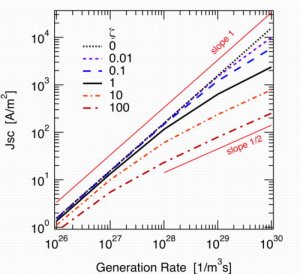

<p>By the way, experimentally the recombination mechanism in these devices is usually found to be bimolecular. See for instance [<a href="http://dx.doi.org/10.1103/PhysRevB.78.113201">Shuttle 2008</a>], [<a href="http://dx.doi.org/10.1063/1.3202389">Foertig 2009</a>] or as an overview the review [<a href="http://dx.doi.org/10.1088/0034-4885/73/9/096401">Deibel 2010</a>] &ndash; the latter is now accepted by <em>Reports on Progress in Physics</em> with minor revisions :-)</p>
<p>My conclusion: under typical conditions and for the bulk heterojunction solar cells I know, is it <em>impossible to distinguish from the short circuit current vs light intensity whether or not recombination is monomolecular or bimolecular</em>, respectively. I am interested in your comments! </p>
<p><strong>[Update 2.7.2010]</strong> I moved my previous comment from here to a new <a href="https://blog.disorderedmatter.eu/2010/07/02/photocurrent-in-organic-solar-cells-part-2/">blog post</a>, with a brief overview on whether or not the whole voltage-dependent photocurrent, as opposed to the short circuit current, gives information on the dominant type of loss in bulk heterojunction solar cells.</p>
<p>For details about the simulation, have a look at these papers [<a href="http://dx.doi.org/10.1002/pssr.200802110">Deibel 2008</a>, <a href="http://dx.doi.org/10.1109/JSTQE.2010.2042142">Wagenpfahl 2010</a>].</p>
<p><a href="http://www.connotea.org/addpopup?continue=confirm&amp;uri=http%3A%2F%2Fblog.disorderedmatter.eu%2F2010%2F05%2F06%2Ftype-of-polaron-recombination-under-short-circuit-conditions%2F&amp;title=Type%20of%20Polaron%20Recombination%20under%20Short%20Circuit%20Conditions%20&laquo;%20Notes%20on%20Disordered%20Matter">Add to Connotea</a></p>
]]></content>
		
					<link rel="replies" type="text/html" href="https://blog.disorderedmatter.eu/2010/05/06/type-of-polaron-recombination-under-short-circuit-conditions/#comments" thr:count="22" />
			<link rel="replies" type="application/atom+xml" href="https://blog.disorderedmatter.eu/2010/05/06/type-of-polaron-recombination-under-short-circuit-conditions/feed/atom/" thr:count="22" />
			<thr:total>22</thr:total>
			</entry>
		<entry>
		<author>
			<name>deibel</name>
							<uri>http://www.disorderedmatter.eu</uri>
						</author>

		<title type="html"><![CDATA[Critical View]]></title>
		<link rel="alternate" type="text/html" href="https://blog.disorderedmatter.eu/2010/05/03/critical-view/" />

		<id>http://deibel.wordpress.com/?p=436</id>
		<updated>2010-05-03T19:48:56Z</updated>
		<published>2010-05-03T19:38:17Z</published>
		<category scheme="https://blog.disorderedmatter.eu" term="organic solar cells" /><category scheme="https://blog.disorderedmatter.eu" term="applications" />
		<summary type="html"><![CDATA[on OPV: read the story on RenewableEnerygWorld.com: Is Organic PV the Future of Solar?. Add to Connotea]]></summary>

					<content type="html" xml:base="https://blog.disorderedmatter.eu/2010/05/03/critical-view/"><![CDATA[<p>on OPV: read the story on <a href="http://www.renewableenergyworld.com">RenewableEnerygWorld.com</a>: </p>
<blockquote><p><a href="http://www.renewableenergyworld.com/rea/news/podcast/2010/05/is-organic-pv-the-future-of-solar-maybe-?cmpid=rss">Is Organic PV the Future of Solar?</a>.
</p></blockquote>
<p><a href="http://www.connotea.org/addpopup?continue=confirm&amp;uri=http%3A%2F%2Fblog.disorderedmatter.eu%2F2010%2F05%2F03%2Fcritical-view%2F&amp;title=Critical%20View%20&laquo;%20Notes%20on%20Disordered%20Matter">Add to Connotea</a></p>
]]></content>
		
					<link rel="replies" type="text/html" href="https://blog.disorderedmatter.eu/2010/05/03/critical-view/#comments" thr:count="0" />
			<link rel="replies" type="application/atom+xml" href="https://blog.disorderedmatter.eu/2010/05/03/critical-view/feed/atom/" thr:count="0" />
			<thr:total>0</thr:total>
			</entry>
		<entry>
		<author>
			<name>deibel</name>
							<uri>http://www.disorderedmatter.eu</uri>
						</author>

		<title type="html"><![CDATA[MRS Spring Meeting 2010&#8230; already over]]></title>
		<link rel="alternate" type="text/html" href="https://blog.disorderedmatter.eu/2010/04/12/mrs-spring-meeting-2010-already-over/" />

		<id>http://deibel.wordpress.com/?p=430</id>
		<updated>2010-05-17T20:40:42Z</updated>
		<published>2010-04-12T00:27:00Z</published>
		<category scheme="https://blog.disorderedmatter.eu" term="science&amp;culture" /><category scheme="https://blog.disorderedmatter.eu" term="organic solar cells" />
		<summary type="html"><![CDATA[Last week, the MRS Spring Meeting took place in San Francisco. It was my first time there, but certainly not the last! I enjoyed it immensely, despite my extensive last minute preparations of the talk I was invited to give&#8230; another first timer for me (on an international conference). In case you are interested, find &#8230; <a href="https://blog.disorderedmatter.eu/2010/04/12/mrs-spring-meeting-2010-already-over/" class="more-link">Continue reading<span class="screen-reader-text"> "MRS Spring Meeting 2010&#8230; already&#160;over"</span></a>]]></summary>

					<content type="html" xml:base="https://blog.disorderedmatter.eu/2010/04/12/mrs-spring-meeting-2010-already-over/"><![CDATA[<p>Last week, the <a href="http://www.mrs.org/s_mrs/sec.asp?CID=25555&amp;DID=292646">MRS Spring Meeting</a> took place in San Francisco. It was my first time there, but certainly not the last! <a href="http://www.flickr.com/photos/72315236@N00/4512314093" title="View 'ruffled feathers' on Flickr.com"><img loading="lazy" border="0" width="270" align="right" alt="ruffled feathers" src="https://i0.wp.com/farm3.static.flickr.com/2306/4512314093_b114562547.jpg" height="180" style="margin:5px;" /></a>I enjoyed it immensely, despite my extensive last minute preparations of the talk I was invited to give&#8230; another first timer for me (on an international conference). In case you are interested, find the slides on <a href="http://www.scribd.com/doc/29755210/deibel2010mrs">scribd</a>. Prof. <a href="http://www.engineering.sdstate.edu/~bommisev/">Venkateswara Bommisetty</a>, one of the organisers of the <a href="http://www.mrs.org/s_mrs/bin.asp?CID=19798&amp;DID=244128&amp;DOC=FILE.PDF">GG symposium</a> told me that the slides of invited talks will also be made available (if the authors agree).</p>
<p>Many interesting talks, too many to go into more detail in the given time!;-) Anyway, it was nice to meet Alex (glidera) and his colleague Bertrand in person, and spend time with Andy B and Tom!</p>
<p>It was difficult (if not impossible) to agree with Alan Heeger and Robert Street on their propositions that monomolecular recombination is the limiting factor for organic bulk heterojunction solar cells at short circuit current under one sun illumination. Thus, despite both of them being well-known and highly respected, I allow myself to express my strong belief (supported by transient experiments and macroscopic simulations;-) that bimolecular polaron recombination is the dominant loss mechanism for free polarons, instead of monomolecular polaron recombination. Maybe more on this later.</p>
<p>During the conference, and featured in the talk of <a href="http://www.iapp.de">Karl Leo</a>, <a href="http://www.heliatek.de">Heliatek</a> announced another efficiency record for small molecule solar cells, enhancing their <a href="https://blog.disorderedmatter.eu/2009/07/08/5-9/">recent achievements</a> to now 7.7% certified efficiency for a tandem cell with 1.1cm<sup>2</sup>. Again, my congratulations, great stuff!<br />
<span id="more-430"></span><br />
[Update 17.5.2010] here the embedded slides:</p>
<iframe class="scribd_iframe_embed" src="https://www.scribd.com/embeds/29755210/content?start_page=1&view_mode=slideshow&access_key=key-1e1bk3c4p5wb4fc2g10k"  data-auto-height="true" scrolling="no" id="scribd_29755210" width="100%" height="500" frameborder="0"></iframe>
		<div style="font-size:10px;text-align:center;width:100%"><a href="https://www.scribd.com/doc/29755210" rel="noopener noreferrer" target="_blank">View this document on Scribd</a></div>
<p><a href="http://www.connotea.org/addpopup?continue=confirm&amp;uri=http%3A%2F%2Fblog.disorderedmatter.eu%2F2010%2F04%2F12%2Fmrs-spring-meeting-2010-already-over%2F&amp;title=MRS%20Spring%20Meeting%202010%2E%2E%2E%20already%20over%20&laquo;%20Notes%20on%20Disordered%20Matter">Add to Connotea</a></p>
]]></content>
		
					<link rel="replies" type="text/html" href="https://blog.disorderedmatter.eu/2010/04/12/mrs-spring-meeting-2010-already-over/#comments" thr:count="4" />
			<link rel="replies" type="application/atom+xml" href="https://blog.disorderedmatter.eu/2010/04/12/mrs-spring-meeting-2010-already-over/feed/atom/" thr:count="4" />
			<thr:total>4</thr:total>
			</entry>
		<entry>
		<author>
			<name>deibel</name>
							<uri>http://www.disorderedmatter.eu</uri>
						</author>

		<title type="html"><![CDATA[Be aware of ads&#8230;]]></title>
		<link rel="alternate" type="text/html" href="https://blog.disorderedmatter.eu/2010/03/01/be-aware-of-ads/" />

		<id>http://deibel.wordpress.com/?p=409</id>
		<updated>2010-06-25T15:36:02Z</updated>
		<published>2010-03-01T21:05:53Z</published>
		<category scheme="https://blog.disorderedmatter.eu" term="organic solar cells" /><category scheme="https://blog.disorderedmatter.eu" term="personal" /><category scheme="https://blog.disorderedmatter.eu" term="physics" />
		<summary type="html"><![CDATA[I finished the Review article I was recently talking about. If you are interested, the preprint can be accessed here (in a few hours, 20:00 EST according to arXiv, so be patient;-) [Update 2nd March 2010] It&#8217;s up:-) Reviews seem to be pretty subjective, and I am sure there are many omissions, but hopefully not &#8230; <a href="https://blog.disorderedmatter.eu/2010/03/01/be-aware-of-ads/" class="more-link">Continue reading<span class="screen-reader-text"> "Be aware of&#160;ads&#8230;"</span></a>]]></summary>

					<content type="html" xml:base="https://blog.disorderedmatter.eu/2010/03/01/be-aware-of-ads/"><![CDATA[<p>I finished the Review article I was <a href="http://www.flickr.com/photos/72315236@N00/4399488666" title="View 'Smurf Organic Solar Cell' on Flickr.com"><img border="0" width="250" align="right" alt="Schlumpf1" src="https://i0.wp.com/farm3.static.flickr.com/2700/4399488666_120a3074a0.jpg" style="margin:5px;" /></a><a href="https://blog.disorderedmatter.eu/2010/02/08/science-talking-vs-doing-and-status/">recently</a> talking about. If you are interested, the preprint can be accessed <a href="http://arxiv.org/abs/1003.0359">here</a> <strike>(in a few hours, 20:00 EST according to arXiv, so be patient;-)</strike> [Update 2nd March 2010] It&#8217;s up:-)</p>
<p>Reviews seem to be pretty subjective, and I am sure there are many omissions, but hopefully not too many inconsistencies. If there are any particular things you do like or do not like, or which are plain wrong: I am happy about every bit of constructive criticism! I submitted the article to Rep. Prog. Phys. It will be peer-reviewed, and I am pretty sure the referees&#8217; comments will make the current version much less final as I&#8217;d like it to be;-)</p>
<p>[Update 25.6.2010] The review was accepted after some minor revisions, and is scheduled for publication by Rep. Prog. Phys. in September (2010).</p>
<p><a href="http://www.connotea.org/addpopup?continue=confirm&amp;uri=http%3A%2F%2Fblog.disorderedmatter.eu%2F2010%2F03%2F01%2Fbe-aware-of-ads%2F&amp;title=Be%20aware%20of%20ads%2E%2E%2E%20&laquo;%20Notes%20on%20Disordered%20Matter">Add to Connotea</a></p>
]]></content>
		
					<link rel="replies" type="text/html" href="https://blog.disorderedmatter.eu/2010/03/01/be-aware-of-ads/#comments" thr:count="2" />
			<link rel="replies" type="application/atom+xml" href="https://blog.disorderedmatter.eu/2010/03/01/be-aware-of-ads/feed/atom/" thr:count="2" />
			<thr:total>2</thr:total>
			</entry>
		<entry>
		<author>
			<name>deibel</name>
							<uri>http://www.disorderedmatter.eu</uri>
						</author>

		<title type="html"><![CDATA[Publications &#8211; Wind of change?]]></title>
		<link rel="alternate" type="text/html" href="https://blog.disorderedmatter.eu/2010/02/24/publications-wind-of-change/" />

		<id>http://deibel.wordpress.com/?p=401</id>
		<updated>2010-02-25T10:37:09Z</updated>
		<published>2010-02-24T22:18:34Z</published>
		<category scheme="https://blog.disorderedmatter.eu" term="science&amp;culture" />
		<summary type="html"><![CDATA[Via Die Zeit and Nature: The DFG, Germany&#8217;s main funding agency, just put down new guidelines for proposals. Starting in July, the proposals should contain only two directly relevant publications per year of requested funding, as well as up to five other papers (presumably the most important ones) covering the researcher&#8217;s general background. Matthias Kleiner, &#8230; <a href="https://blog.disorderedmatter.eu/2010/02/24/publications-wind-of-change/" class="more-link">Continue reading<span class="screen-reader-text"> "Publications &#8211; Wind of&#160;change?"</span></a>]]></summary>

					<content type="html" xml:base="https://blog.disorderedmatter.eu/2010/02/24/publications-wind-of-change/"><![CDATA[<p>Via <a href="http://www.zeit.de/wissen/2010-02/dfg-publikationen-forschung">Die Zeit</a> and <a href="http://www.nature.com/news/2010/100224/full/4631009a.html">Nature</a>:<br />
The DFG, Germany&#8217;s main funding agency, <a href="http://www.flickr.com/photos/72315236@N00/4339834971" title="View '' on Flickr.com"><img border="0" width="300" align="right" alt="" src="https://i0.wp.com/farm3.static.flickr.com/2798/4339834971_9e6404e25a.jpg" style="margin:5px;" /></a> just put down new guidelines for proposals. Starting in July, the proposals should contain only two directly relevant publications per year of requested funding, as well as up to five other papers (presumably the most important ones) covering the researcher&#8217;s general background. Matthias Kleiner, DFG president:</p>
<blockquote><p>
	It is quality, not quantity, which matters.
</p></blockquote>
<p>Good point. Nevertheless, although the publish and perish mentality lately became quite tiring, I wonder if (how quickly) these new conditions will change the mentality of the researchers in general, and in particular the ones who are reviewing the proposals and are sitting in the committees for professorship appointment;-)</p>
<p>[Update 25.2.2010] Find the original DFG statement <a href="http://www.dfg.de/download/pdf/dfg_im_profil/reden_stellungnahmen/2010/statement_qualitaet_statt_quantitaet_mk_100223.pdf">here</a> (pdf, german).</p>
<p><a href="http://www.connotea.org/addpopup?continue=confirm&amp;uri=http%3A%2F%2Fblog.disorderedmatter.eu%2F2010%2F02%2F24%2Fpublications-wind-of-change%2F&amp;title=Publications%20%2D%20Wind%20of%20change%3F%20&laquo;%20Notes%20on%20Disordered%20Matter">Add to Connotea</a></p>
]]></content>
		
					<link rel="replies" type="text/html" href="https://blog.disorderedmatter.eu/2010/02/24/publications-wind-of-change/#comments" thr:count="0" />
			<link rel="replies" type="application/atom+xml" href="https://blog.disorderedmatter.eu/2010/02/24/publications-wind-of-change/feed/atom/" thr:count="0" />
			<thr:total>0</thr:total>
			</entry>
		<entry>
		<author>
			<name>deibel</name>
							<uri>http://www.disorderedmatter.eu</uri>
						</author>

		<title type="html"><![CDATA[Science talking vs doing &#8211; and status]]></title>
		<link rel="alternate" type="text/html" href="https://blog.disorderedmatter.eu/2010/02/08/science-talking-vs-doing-and-status/" />

		<id>http://deibel.wordpress.com/?p=397</id>
		<updated>2010-03-25T13:59:35Z</updated>
		<published>2010-02-08T11:21:44Z</published>
		<category scheme="https://blog.disorderedmatter.eu" term="personal" /><category scheme="https://blog.disorderedmatter.eu" term="science&amp;culture" />
		<summary type="html"><![CDATA[There is an interesting post on The Scholarly Kitchen on Talking About Science vs. Doing Science, a critical view on Web 2.0 for Scientists. Every second spent blogging, chatting on FriendFeed, or leaving comments on a PLoS paper is a second taken away from other activities. Those other activities have direct rewards towards advancement. Actually, &#8230; <a href="https://blog.disorderedmatter.eu/2010/02/08/science-talking-vs-doing-and-status/" class="more-link">Continue reading<span class="screen-reader-text"> "Science talking vs doing &#8211; and&#160;status"</span></a>]]></summary>

					<content type="html" xml:base="https://blog.disorderedmatter.eu/2010/02/08/science-talking-vs-doing-and-status/"><![CDATA[<p>There is an interesting post on <a href="http://scholarlykitchen.sspnet.org">The Scholarly Kitchen</a> on <a href="http://scholarlykitchen.sspnet.org/2010/02/08/science-and-web-2-0-talking-about-science-versus-doing-science/">Talking About Science vs. Doing Science</a>, a critical view on Web 2.0 for Scientists. <a href="http://www.flickr.com/photos/72315236@N00/4340578950" title="View '' on Flickr.com"><img border="0" width="270" align="right" alt="" src="https://i0.wp.com/farm5.static.flickr.com/4057/4340578950_4d4f738803.jpg" style="margin:5px;" /></a></p>
<blockquote><p>
Every second spent blogging, chatting on FriendFeed, or leaving comments on a PLoS paper is a second taken away from other activities.  Those other activities have direct rewards towards advancement.
</p></blockquote>
<p>Actually, this is one of the reasons for the low activity in recent months: I just do not have time for the blog right now &ndash; I believe I can write again end of March or so. Nevertheless, I <em>am</em> active, having written proposals (1 won, 1 open) as well as two review-like papers. One of them is on Organic Bulk Heterojunction Solar Cells, the other on the Role of the Charge Transfer State for Organic Photovoltaics. Writing a third one right now&#8230; Once they are published (if they ever are), I will link to them. You are likely to find some figures etc familiar from the blog&#8230; and finally something to properly reference :-)</p>
<p>[<strong>Update</strong> 25th March 2010] 2nd proposal won as well;-) Also, the CT review was accepted by Adv Mater: if you are interested in the preprint, drop me a line.</p>
<p><a href="http://www.connotea.org/addpopup?continue=confirm&amp;uri=http%3A%2F%2Fblog.disorderedmatter.eu%2F2010%2F02%2F08%2Fscience-talking-vs-doing-and-status%2F&amp;title=Science%20talking%20vs%20doing%20%2D%20and%20status%20&laquo;%20Notes%20on%20Disordered%20Matter">Add to Connotea</a></p>
]]></content>
		
					<link rel="replies" type="text/html" href="https://blog.disorderedmatter.eu/2010/02/08/science-talking-vs-doing-and-status/#comments" thr:count="26" />
			<link rel="replies" type="application/atom+xml" href="https://blog.disorderedmatter.eu/2010/02/08/science-talking-vs-doing-and-status/feed/atom/" thr:count="26" />
			<thr:total>26</thr:total>
			</entry>
		<entry>
		<author>
			<name>deibel</name>
							<uri>http://www.disorderedmatter.eu</uri>
						</author>

		<title type="html"><![CDATA[Karl Popper Speaking]]></title>
		<link rel="alternate" type="text/html" href="https://blog.disorderedmatter.eu/2009/12/09/karl-popper-speaking/" />

		<id>http://deibel.wordpress.com/?p=393</id>
		<updated>2009-12-08T23:29:11Z</updated>
		<published>2009-12-08T23:28:04Z</published>
		<category scheme="https://blog.disorderedmatter.eu" term="off topic" /><category scheme="https://blog.disorderedmatter.eu" term="science&amp;culture" />
		<summary type="html"><![CDATA[From Wikiquote, after reading Scott Berkun. Not funny (as some of these), but thoughful (who&#8217;d have expected that? ;-) Whenever a theory appears to you as the only possible one, take this as a sign that you have neither understood the theory nor the problem which it was intended to solve. If we are uncritical &#8230; <a href="https://blog.disorderedmatter.eu/2009/12/09/karl-popper-speaking/" class="more-link">Continue reading<span class="screen-reader-text"> "Karl Popper Speaking"</span></a>]]></summary>

					<content type="html" xml:base="https://blog.disorderedmatter.eu/2009/12/09/karl-popper-speaking/"><![CDATA[<p>From <a href="http://en.wikiquote.org/wiki/Karl_Popper">Wikiquote</a>, after reading <a href="http://www.scottberkun.com/">Scott Berkun</a>. Not funny (as some of <a href="https://blog.disorderedmatter.eu/2009/03/16/wolfgang-pauli-speaking/">these</a>), but thoughful (who&#8217;d have expected that? ;-)</p>
<blockquote><p>Whenever a theory appears to you as the only possible one, take this as a sign that you have neither understood the theory nor the problem which it was intended to solve.
</p></blockquote>
<blockquote><p>If we are uncritical we shall always find what we want: we shall look for, and find, confirmations, and we shall look away from, and not see, whatever might be dangerous to our pet theories.
</p></blockquote>
<blockquote><p>Science may be described as the art of systematic over-simplification &mdash; the art of discerning what we may with advantage omit.
</p></blockquote>
<p>In his book Making Things Happen, the above-mentioned Scott Berkun summarizes Karl Popper as saying that there are only two kinds of theories: those that are wrong and those that are incomplete.</p>
<p><a href="http://www.connotea.org/addpopup?continue=confirm&amp;uri=http%3A%2F%2Fblog.disorderedmatter.eu%2F2009%2F12%2F09%2Fkarl-popper-speaking%2F&amp;title=Karl%20Popper%20Speaking%20&laquo;%20Notes%20on%20Disordered%20Matter">Add to Connotea</a></p>
]]></content>
		
					<link rel="replies" type="text/html" href="https://blog.disorderedmatter.eu/2009/12/09/karl-popper-speaking/#comments" thr:count="0" />
			<link rel="replies" type="application/atom+xml" href="https://blog.disorderedmatter.eu/2009/12/09/karl-popper-speaking/feed/atom/" thr:count="0" />
			<thr:total>0</thr:total>
			</entry>
		<entry>
		<author>
			<name>deibel</name>
							<uri>http://www.disorderedmatter.eu</uri>
						</author>

		<title type="html"><![CDATA[Towards ten percent&#8230; Solarmer hits 7.9% with plastic solar cell]]></title>
		<link rel="alternate" type="text/html" href="https://blog.disorderedmatter.eu/2009/12/03/towards-ten-percent-solarmer-hits-7-9-with-plastic-solar-cell/" />

		<id>http://deibel.wordpress.com/?p=389</id>
		<updated>2009-12-02T23:36:54Z</updated>
		<published>2009-12-02T23:34:45Z</published>
		<category scheme="https://blog.disorderedmatter.eu" term="applications" /><category scheme="https://blog.disorderedmatter.eu" term="organic solar cells" />
		<summary type="html"><![CDATA[Via pv-tech. Brief note on efficiency record: Solarmer has managed to get an (NREL certified) power conversion efficiency of 7.9% for an organic solar cell&#8230; sounds good, and broke the recent record (by the same company). It is important to mention, though, that the active area was very small with 0.1cm2 (aperture 0.047cm2). Add to &#8230; <a href="https://blog.disorderedmatter.eu/2009/12/03/towards-ten-percent-solarmer-hits-7-9-with-plastic-solar-cell/" class="more-link">Continue reading<span class="screen-reader-text"> "Towards ten percent&#8230; Solarmer hits 7.9% with plastic solar&#160;cell"</span></a>]]></summary>

					<content type="html" xml:base="https://blog.disorderedmatter.eu/2009/12/03/towards-ten-percent-solarmer-hits-7-9-with-plastic-solar-cell/"><![CDATA[<p>Via <a href="http://www.pv-tech.org/news/_a/solarmer_breaks_organic_solar_pv_cell_conversion_efficiency_record_hits_nre/">pv-tech</a>. Brief note on efficiency record: <a href="http://www.solarmer.com/">Solarmer</a> has managed to get an (NREL certified) power conversion efficiency of 7.9% for an organic solar cell&#8230; sounds good, and broke the <a href="http://www.businesswire.com/portal/site/home/permalink/?ndmViewId=news_view&amp;newsId=20091022006774&amp;newsLang=en">recent</a> record (by the same company). It is important to mention, though, that the active area was very small with 0.1cm<sup>2</sup> (aperture 0.047cm<sup>2</sup>).</p>
<p><a href="http://www.connotea.org/addpopup?continue=confirm&amp;uri=http%3A%2F%2Fblog.disorderedmatter.eu%2F2009%2F12%2F03%2Ftowards-ten-percent-solarmer-hits-7-9-with-plastic-solar-cell%2F&amp;title=Towards%20ten%20percent%2E%2E%2E%20Solarmer%20hits%207%2E9%25%20with%20plastic%20solar%20cell%20&laquo;%20Notes%20on%20Disordered%20Matter">Add to Connotea</a></p>
]]></content>
		
					<link rel="replies" type="text/html" href="https://blog.disorderedmatter.eu/2009/12/03/towards-ten-percent-solarmer-hits-7-9-with-plastic-solar-cell/#comments" thr:count="4" />
			<link rel="replies" type="application/atom+xml" href="https://blog.disorderedmatter.eu/2009/12/03/towards-ten-percent-solarmer-hits-7-9-with-plastic-solar-cell/feed/atom/" thr:count="4" />
			<thr:total>4</thr:total>
			</entry>
		<entry>
		<author>
			<name>deibel</name>
							<uri>http://www.disorderedmatter.eu</uri>
						</author>

		<title type="html"><![CDATA[From Newton to Hawking]]></title>
		<link rel="alternate" type="text/html" href="https://blog.disorderedmatter.eu/2009/11/30/from-newton-to-hawking/" />

		<id>http://deibel.wordpress.com/?p=385</id>
		<updated>2009-11-30T16:32:55Z</updated>
		<published>2009-11-30T16:32:13Z</published>
		<category scheme="https://blog.disorderedmatter.eu" term="off topic" /><category scheme="https://blog.disorderedmatter.eu" term="physics" />
		<summary type="html"><![CDATA[Via c&#8217;t: as the British Royal Society turns 350, several historical works are available online for the first time. Not only physics, but also medicine etc&#8230; In the nice timeline, you find Newton&#8217;s theory of light and colour in the year 1672. It links to Phil. Trans. 1 January 1671 vol. 6 no. 69-80 3075-3087. &#8230; <a href="https://blog.disorderedmatter.eu/2009/11/30/from-newton-to-hawking/" class="more-link">Continue reading<span class="screen-reader-text"> "From Newton to&#160;Hawking"</span></a>]]></summary>

					<content type="html" xml:base="https://blog.disorderedmatter.eu/2009/11/30/from-newton-to-hawking/"><![CDATA[<p>Via <a href="http://www.heise.de/newsticker/meldung/Newton-im-Original-lesen-872519.html">c&#8217;t</a>: as <a href="http://www.flickr.com/photos/72315236@N00/4147684662" title="View 'One of Newton's Apples have grown old' on Flickr.com"><img loading="lazy" border="0" width="250" align="right" alt="One of Newton's Apples have grown old" src="https://i0.wp.com/farm3.static.flickr.com/2779/4147684662_4360b2a559.jpg" height="166" style="margin:5px;" /></a>the British <a href="http://royalsociety.org/">Royal Society</a> turns 350, several historical works are <a href="http://trailblazing.royalsociety.org/">available online</a> for the first time. Not only physics, but also medicine etc&#8230; In the nice timeline, you find Newton&#8217;s theory of light and colour in the year 1672. It links to <a href="http://dx.doi.org/10.1098/rstl.1671.0072">Phil. Trans. 1 January 1671 vol. 6 no. 69-80 3075-3087</a>. Quite amazing!</p>
<p><a href="http://www.connotea.org/addpopup?continue=confirm&amp;uri=http%3A%2F%2Fblog.disorderedmatter.eu%2F2009%2F11%2F30%2Ffrom-newton-to-hawking%2F&amp;title=From%20Newton%20to%20Hawking%20&laquo;%20Notes%20on%20Disordered%20Matter">Add to Connotea</a></p>
]]></content>
		
					<link rel="replies" type="text/html" href="https://blog.disorderedmatter.eu/2009/11/30/from-newton-to-hawking/#comments" thr:count="0" />
			<link rel="replies" type="application/atom+xml" href="https://blog.disorderedmatter.eu/2009/11/30/from-newton-to-hawking/feed/atom/" thr:count="0" />
			<thr:total>0</thr:total>
			</entry>
		<entry>
		<author>
			<name>deibel</name>
							<uri>http://www.disorderedmatter.eu</uri>
						</author>

		<title type="html"><![CDATA[Funding for Organic Photovoltaics Company]]></title>
		<link rel="alternate" type="text/html" href="https://blog.disorderedmatter.eu/2009/11/28/funding-for-organic-photovoltaics/" />

		<id>http://deibel.wordpress.com/?p=381</id>
		<updated>2009-11-28T10:10:05Z</updated>
		<published>2009-11-28T10:03:26Z</published>
		<category scheme="https://blog.disorderedmatter.eu" term="applications" /><category scheme="https://blog.disorderedmatter.eu" term="organic solar cells" />
		<summary type="html"><![CDATA[Many people believe that organic photovoltaics companies will have to prove soon that they can come up with commercially viable products within the next two-three years. In this context, Heliatek, a Germany based company developing organic small molecule solar cells with high efficiency, has received 18 Million Euros in a second round of funding from &#8230; <a href="https://blog.disorderedmatter.eu/2009/11/28/funding-for-organic-photovoltaics/" class="more-link">Continue reading<span class="screen-reader-text"> "Funding for Organic Photovoltaics&#160;Company"</span></a>]]></summary>

					<content type="html" xml:base="https://blog.disorderedmatter.eu/2009/11/28/funding-for-organic-photovoltaics/"><![CDATA[<p>Many people believe that organic photovoltaics companies will have to prove soon that <a href="http://www.flickr.com/photos/72315236@N00/4140610368" title="View 'Fliegenpilz im Herbstwald' on Flickr.com (no direct connection between photo and blog content are implied;-)"><img loading="lazy" src="https://i0.wp.com/farm3.static.flickr.com/2561/4140610368_08ab9b96cd.jpg" alt="Fliegenpilz im Herbstwald (no direct connection between photo and blog content are implied;-)" border="0" width="280" height="210" align="right" style="margin:5px;" /></a>they can come up with commercially viable products within the next two-three years. In this context, <a href="heliatek.com">Heliatek</a>, a Germany based company developing organic small molecule solar cells with <a href="https://blog.disorderedmatter.eu/2009/07/08/5-9/">high efficiency</a>, has received 18 Million Euros in a second round of funding from venture capitalists and others. From the <a href="http://www.heliatek.com/downloads/Press_release_closing_HEL25112009_EN.pdf">press release</a>:</p>
<blockquote><p>
Heliatek will be utilizing the new funding primarily to build an initial production facility in Dresden. In this step and right through to mass production, the company will be using its proprietary tandem technology to efficiently produce, flexible and very lightweight PV modules on a film substrate. Their weight will be merely 500 grams per square meter, instead of today&rsquo;s customary 20 kilograms per square meter. This will open up a forward-looking market for mobile applications, for architectural solutions and for independently supplying regions with weak infrastructures.
</p></blockquote>
<p>Indeed, interesting times for OPV &ndash; particularly in view of the commercial aspects! The science aspects are also getting more and more interesting, but unfortunately I thus have less and less time to write about them here&#8230;</p>
<p>P.S. Another company <a href="http://www.solexant.com/">Solexant</a> just starts the production of hybrid solar cells after the process developed by the group of <a href="http://www.cchem.berkeley.edu/pagrp/">Paul Alivisatos</a> at Berkeley, as reported by <a href="http://www.technologyreview.com/business/23980/">Technology Review</a>.</p>
<p><a href="http://www.connotea.org/addpopup?continue=confirm&amp;uri=http%3A%2F%2Fblog.disorderedmatter.eu%2F2009%2F11%2F28%2Ffunding-for-organic-photovoltaics%2F&amp;title=Funding%20for%20Organic%20Photovoltaics%20&laquo;%20Notes%20on%20Disordered%20Matter">Add to Connotea</a></p>
]]></content>
		
					<link rel="replies" type="text/html" href="https://blog.disorderedmatter.eu/2009/11/28/funding-for-organic-photovoltaics/#comments" thr:count="0" />
			<link rel="replies" type="application/atom+xml" href="https://blog.disorderedmatter.eu/2009/11/28/funding-for-organic-photovoltaics/feed/atom/" thr:count="0" />
			<thr:total>0</thr:total>
			</entry>
		<entry>
		<author>
			<name>deibel</name>
							<uri>http://www.disorderedmatter.eu</uri>
						</author>

		<title type="html"><![CDATA[How to publish&#8230; not so seriously]]></title>
		<link rel="alternate" type="text/html" href="https://blog.disorderedmatter.eu/2009/09/24/how-to-publish-not-seriously/" />

		<id>http://deibel.wordpress.com/?p=370</id>
		<updated>2009-09-24T20:06:02Z</updated>
		<published>2009-09-24T19:57:39Z</published>
		<category scheme="https://blog.disorderedmatter.eu" term="science&amp;culture" />
		<summary type="html"><![CDATA[Great comical contribution of Jorge Cham&#8217;s PhD Comics: Nature vs Science Part 1 Part 2 Part 3 Part 4 The Nature Journal liked it, as apparent from their blog post;-) According to Jorge Cham, their general comment was: Use this comic for procrastination or decompression, as you see fit. Add to Connotea]]></summary>

					<content type="html" xml:base="https://blog.disorderedmatter.eu/2009/09/24/how-to-publish-not-seriously/"><![CDATA[<p>Great comical contribution of Jorge Cham&#8217;s <a href="http://www.phdcomics.com">PhD Comics</a>: <a href="http://www.flickr.com/photos/72315236@N00/3859303210" title="View 'Butterfly' on Flickr.com"><img loading="lazy" src="https://i0.wp.com/farm3.static.flickr.com/2617/3859303210_743aa1fdcd.jpg" alt="Butterfly" border="0" width="270" height="180" align="right" style="margin:5px;" /></a>Nature vs Science</p>
<ul>
<li><a href="http://www.phdcomics.com/comics/archive.php?comicid=1199">Part 1</a>
<li><a href="http://www.phdcomics.com/comics/archive.php?comicid=1200">Part 2</a>
<li><a href="http://www.phdcomics.com/comics/archive.php?comicid=1201">Part 3</a>
<li><a href="http://www.phdcomics.com/comics/archive.php?comicid=1208">Part 4</a>
</ul>
<p>The Nature Journal liked it, as apparent from their <a href="http://blogs.nature.com/news/thegreatbeyond/2009/07/science_vs_nature.html">blog post</a>;-) According to Jorge Cham, their general comment was:</p>
<blockquote><p>
Use this comic for procrastination or decompression, as you see fit.
</p></blockquote>
<p><a href="http://www.connotea.org/addpopup?continue=confirm&amp;uri=http%3A%2F%2Fblog.disorderedmatter.eu%2F2009%2F09%2F24%2Fhow-to-publish-not-seriously%2F&amp;title=How%20to%20publish%2E%2E%2E%20not%20so%20seriously%20&laquo;%20Notes%20on%20Disordered%20Matter">Add to Connotea</a></p>
]]></content>
		
					<link rel="replies" type="text/html" href="https://blog.disorderedmatter.eu/2009/09/24/how-to-publish-not-seriously/#comments" thr:count="0" />
			<link rel="replies" type="application/atom+xml" href="https://blog.disorderedmatter.eu/2009/09/24/how-to-publish-not-seriously/feed/atom/" thr:count="0" />
			<thr:total>0</thr:total>
			</entry>
		<entry>
		<author>
			<name>deibel</name>
							<uri>http://www.disorderedmatter.eu</uri>
						</author>

		<title type="html"><![CDATA[How to publish&#8230; seriously]]></title>
		<link rel="alternate" type="text/html" href="https://blog.disorderedmatter.eu/2009/09/01/how-to-publish-seriously/" />

		<id>http://deibel.wordpress.com/?p=360</id>
		<updated>2009-10-07T22:27:09Z</updated>
		<published>2009-09-01T09:11:18Z</published>
		<category scheme="https://blog.disorderedmatter.eu" term="science&amp;culture" />
		<summary type="html"><![CDATA[Less sad than the recent Note on publishing a scientific comment&#8230; As I am in a constant process of trying to understand the requirements for publishing high-impact scientific papers better (slow process&#8230; ;-), I am always eager to see what others write about it. Recently, I linked to some PLOS editorials about Ten simple rules &#8230; <a href="https://blog.disorderedmatter.eu/2009/09/01/how-to-publish-seriously/" class="more-link">Continue reading<span class="screen-reader-text"> "How to publish&#8230;&#160;seriously"</span></a>]]></summary>

					<content type="html" xml:base="https://blog.disorderedmatter.eu/2009/09/01/how-to-publish-seriously/"><![CDATA[<p>Less sad than the recent Note on <a href="https://blog.disorderedmatter.eu/2009/08/20/how-to-publish-a-scientific-comment/">publishing a scientific comment</a>&#8230; <a href="http://www.flickr.com/photos/72315236@N00/3859307140" title="View 'Golden Gate' on Flickr.com"><img loading="lazy" src="https://i0.wp.com/farm3.static.flickr.com/2484/3859307140_76416fbc05.jpg" alt="Golden Gate" border="0" width="270" height="180" align="right" style="margin:5px;" /></a>As I am in a constant process of trying to understand the requirements for publishing high-impact scientific papers better (slow process&#8230; ;-), I am always eager to see what others write <em>about</em> it.</p>
<p>Recently, I linked to some PLOS editorials about <a href="https://blog.disorderedmatter.eu/2009/07/07/ten-simple-rules/">Ten simple rules</a> for nearly everything, including writing papers. </p>
<p>Along this line, the <a href="http://www.phys.s.u-tokyo.ac.jp/gcoe/seminar/PRL_editor_talk.pdf">presentation</a> given by the <a href="http://prl.aps.org/">Phys. Rev. Lett.</a> Editor Manolis Antonoyiannakis in Japan end of last year, is very interesting. In addition to hints for using the right phrasing when writing about scientific results, he also gives some insight &ndash; from the viewpoint of the Editorial Office of a high impact phyics journal &ndash; into the inner workings of paper predecision (by Editor) and general acceptance rate. <span id="more-360"></span>Antonoyiannakis also mentions additional sources, for instance <a href="http://chronicle.com/article/What-Editors-Want/45909/">What editors want</a> by Lynn Worsham (Subscription required; summary <a href="http://www.sfu.ca/biology/faculty/elle/BISC800_Grad-advice/What%20editors%20want%20by%20Lynn%20Worsham.doc">here</a>) and <a href="http://dx.doi.org/10.1002/adma.200400767">Writing a Paper</a> by George M. Whitesides.</p>
<p>[Update 3.9.2009] Other interesting resources: two PRL editorials, <a href="http://prl.aps.org/edannounce/PhysRevLett.100.100001">Successful Letters (Mar 13, 2008)</a> and <a href="http://dx.doi.org/10.1103/PhysRevLett.102.060001">Is PRL Too Large to Have an Impact? (Feb 13, 2009)</a>, <a href="http://www.nature.com/nmat/journal/v7/n7/full/nmat2216.html">interview with Gene Sprouse</a>, Editor-in-Chief of APS publications.</p>
<p>[Update 17.9.2009]: recently published <a href="http://arstechnica.com/science/news/2009/09/a-tale-of-two-papers-peer-review-under-the-microscope.ars">researcher perspective</a> at ArsTechnica.</p>
<p>Afterwards, the only thing left to do is performing significant research, and writing a paper&#8230; ;-)</p>
<p>[Update 8.10.2009] Another question is where to publish. Interesting insights are given by Martin Heintzelman and Diego Nocetti in their paper on <a href="http://www.bepress.com/bejeap/vol9/iss1/art39/?sending=10738">Where should we submit our paper? An analysis of journal submission strategies</a> (via the blog <a href="http://blogs.nature.com/news/thegreatbeyond/2009/10/where_to_publish_your_paper.html">The Great Beyond</a>).</p>
<p><a href="http://www.connotea.org/addpopup?continue=confirm&amp;uri=http%3A%2F%2Fblog.disorderedmatter.eu%2F2009%2F09%2F01%2Fhow-to-publish-seriously%2F&amp;title=How%20to%20publish%2E%2E%2E%20seriously%20&laquo;%20Notes%20on%20Disordered%20Matter">Add to Connotea</a></p>
]]></content>
		
					<link rel="replies" type="text/html" href="https://blog.disorderedmatter.eu/2009/09/01/how-to-publish-seriously/#comments" thr:count="0" />
			<link rel="replies" type="application/atom+xml" href="https://blog.disorderedmatter.eu/2009/09/01/how-to-publish-seriously/feed/atom/" thr:count="0" />
			<thr:total>0</thr:total>
			</entry>
		<entry>
		<author>
			<name>deibel</name>
							<uri>http://www.disorderedmatter.eu</uri>
						</author>

		<title type="html"><![CDATA[Influence of Finite Surface Recombination Velocity on Efficiency vs. Mobility of Polymer Solar Cells]]></title>
		<link rel="alternate" type="text/html" href="https://blog.disorderedmatter.eu/2009/08/26/influence-of-finite-surface-on-efficiency-vs-mobility-of-polymer-solar-cells/" />

		<id>http://deibel.wordpress.com/?p=346</id>
		<updated>2010-03-03T09:23:44Z</updated>
		<published>2009-08-26T13:58:56Z</published>
		<category scheme="https://blog.disorderedmatter.eu" term="physics" /><category scheme="https://blog.disorderedmatter.eu" term="organic solar cells" />
		<summary type="html"><![CDATA[Just a quick addition to Mobility and Efficiency of Polymer Solar Cells. You might remember that with increasing mobility, the open circuit voltage Voc, however, decreases steadily. Actually, the slope steepness is maximum due to our implicit assumption of ideal charge extraction ; for a realistic charge extraction (= finite surface recombination), the Voc slope &#8230; <a href="https://blog.disorderedmatter.eu/2009/08/26/influence-of-finite-surface-on-efficiency-vs-mobility-of-polymer-solar-cells/" class="more-link">Continue reading<span class="screen-reader-text"> "Influence of Finite Surface Recombination Velocity on Efficiency vs. Mobility of Polymer Solar&#160;Cells"</span></a>]]></summary>

					<content type="html" xml:base="https://blog.disorderedmatter.eu/2009/08/26/influence-of-finite-surface-on-efficiency-vs-mobility-of-polymer-solar-cells/"><![CDATA[<p>Just a quick addition to <a href="https://blog.disorderedmatter.eu/2009/01/31/mobility-and-efficiency-of-polymer-solar-cells/">Mobility and Efficiency of Polymer Solar Cells</a>. You might remember that with increasing mobility, the</p>
<blockquote><p><a href="http://www.flickr.com/photos/72315236@N00/3858513819" title="View 'Parrot in Flight' on Flickr.com"><img loading="lazy" src="https://i0.wp.com/farm3.static.flickr.com/2668/3858513819_d0fcca868e.jpg" alt="Parrot in Flight" border="0" width="270" height="180" align="right" style="margin:5px;" /></a><br />
open circuit voltage Voc, however, decreases steadily. Actually, the slope steepness is maximum due to our implicit assumption of ideal charge extraction ; for a realistic charge extraction (= finite surface recombination), the Voc slope with mobility is weaker&#8230; or even constant for zero surface recombination. The fill factor is maximum at intermediate charge carrier mobilities, not far from the experimentally found values!
</p></blockquote>
<p>As we were finally able to calculate the open circuit voltage with a surface recombination less than infinity (thanks to Alexander Wagenpfahl),<br />
I can show you how it looks. ([<B>Update</B> 3rd March 2010] For details, have a look here: [<a href="http://dx.doi.org/10.1109/JSTQE.2010.2042142">Wagenpfahl 2010</a>, <a href="http://arxiv.org/abs/1001.4963">arxiv</a>])<span id="more-346"></span><img src="https://blog.disorderedmatter.eu/wp-content/uploads/2009/08/eta_vs_mu_smin.png?w=270" alt="eta_vs_mu_Smin.png" border="0" width="270" align="right" style="margin:5px;" /><br />
In the figure, the power conversion efficiency is again plotted vs. charge carrier mobility. Here, in we made the assumption that the majorities (=electrons at the electron injecting contact, or holes at the hole injecting contact) maintain an infinite surface recombination velocity, whereas the minorities (=electrons at the hole injecting contact, and &#8230;) have a surface recombination velocity S<sub>min</sub> of 10<sup>50</sup>m/s (=infinity in terms of the simulation) or 10<sup>-4</sup>m/s. As you can see, the assumption of infinite surface recombination for electrons and holes leads to the reduction of the power conversion efficiency. This effect comes almost exclusively from a reduction of the open circuit voltage. If the minority surface recombination velocity is lowered drastically, than the open circuit voltage does not break down for high mobilities, and the power conversion efficiency remains high&#8230; but does not increase much any more. </p>
<p>There is almost no work an surface recombination in organic solar cells, essentially only the model by Scott and Malliaras [<a href="http://dx.doi.org/10.1016/S0009-2614(98)01277-9">Scott 1999</a>]. For typical mobilities, the surface recombination velocity after their considerations comes out at 10<sup>-2</sup>m/s or so. Nevertheless, experimental work is lacking so far. Taking into account that conjugated polymers and such do not have dangling bonds, however, a low surface recombination velocity is certainly more probable than a high one. Thus, the publications predicting a lowering of the efficiency at high mobility [<a href="10.1063/1.2711534">Mandoc 2007</a>, <a href="10.1002/pssr.200802110">Deibel 2008</a>] should be reconsidered (I&#8217;d like to point out that we already mentioned the effect, but were not able to calculate it at that time&#8230; ;-). Recently, a finite surface recombination influencing the efficiency <em>was</em> considered by [<a href="http://dx.doi.org/10.1063/1.3013904">Kirchartz 2008</a>]. </p>
<p><a href="http://www.connotea.org/addpopup?continue=confirm&amp;uri=http%3A%2F%2Fblog.disorderedmatter.eu%2F2009%2F08%2F26%2Finfluence-of-finite-surface-on-efficiency-vs-mobility-of-polymer-solar-cells%2F&amp;title=Influence%20of%20Finite%20Surface%20on%20Efficiency%20vs%2E%20Mobility%20of%20Polymer%20Solar%20Cells%20&laquo;%20Notes%20on%20Disordered%20Matter">Add to Connotea</a></p>
]]></content>
		
					<link rel="replies" type="text/html" href="https://blog.disorderedmatter.eu/2009/08/26/influence-of-finite-surface-on-efficiency-vs-mobility-of-polymer-solar-cells/#comments" thr:count="6" />
			<link rel="replies" type="application/atom+xml" href="https://blog.disorderedmatter.eu/2009/08/26/influence-of-finite-surface-on-efficiency-vs-mobility-of-polymer-solar-cells/feed/atom/" thr:count="6" />
			<thr:total>6</thr:total>
			</entry>
		<entry>
		<author>
			<name>deibel</name>
							<uri>http://www.disorderedmatter.eu</uri>
						</author>

		<title type="html"><![CDATA[How to Publish a Scientific Comment&#8230;]]></title>
		<link rel="alternate" type="text/html" href="https://blog.disorderedmatter.eu/2009/08/20/how-to-publish-a-scientific-comment/" />

		<id>http://deibel.wordpress.com/?p=339</id>
		<updated>2009-08-20T05:25:05Z</updated>
		<published>2009-08-20T05:21:13Z</published>
		<category scheme="https://blog.disorderedmatter.eu" term="science&amp;culture" />
		<summary type="html"><![CDATA[Via the blog Dynamics of Cats: How to publish a scientific comment in 123 Easy Steps by Prof. Rick Trebino. I do not have first hand experience myself, but the described exchange between commentator and editor is very interesting, and indeed very disturbing for an open-minded scientist! See also a comment on Trebino&#8217;s essay in &#8230; <a href="https://blog.disorderedmatter.eu/2009/08/20/how-to-publish-a-scientific-comment/" class="more-link">Continue reading<span class="screen-reader-text"> "How to Publish a Scientific&#160;Comment&#8230;"</span></a>]]></summary>

					<content type="html" xml:base="https://blog.disorderedmatter.eu/2009/08/20/how-to-publish-a-scientific-comment/"><![CDATA[<p>Via the blog <a href="http://scienceblogs.com/catdynamics/2009/08/how_to_publish_a_scientific_co.php">Dynamics of Cats</a>: <a href="http://scienceblogs.com/catdynamics/upload/2009/08/how_to_publish_a_scientific_co/How%20to%20Publish%20a%20Comment.pdf">How to publish a scientific comment in 123 Easy Steps</a> by <a href="http://www.physics.gatech.edu/people/faculty/rtrebino.html">Prof. Rick Trebino</a>. I do not have first hand experience myself, but the described exchange between commentator and editor is very interesting, and indeed very disturbing for an open-minded scientist! See also a comment on Trebino&#8217;s essay in the blog <a href="http://scienceblogs.com/ethicsandscience/2009/08/the_saga_of_the_journal_commen.php">Adventures in Ethics and Science</a>. </p>
<p><a href="http://www.connotea.org/addpopup?continue=confirm&amp;uri=http%3A%2F%2Fblog.disorderedmatter.eu%2F2009%2F08%2F20%2Fhow-to-publish-a-scientific-comment%2F&amp;title=How%20to%20Publish%20a%20Scientific%20Comment%2E%2E%2E%20&laquo;%20Notes%20on%20Disordered%20Matter">Add to Connotea</a></p>
]]></content>
		
					<link rel="replies" type="text/html" href="https://blog.disorderedmatter.eu/2009/08/20/how-to-publish-a-scientific-comment/#comments" thr:count="1" />
			<link rel="replies" type="application/atom+xml" href="https://blog.disorderedmatter.eu/2009/08/20/how-to-publish-a-scientific-comment/feed/atom/" thr:count="1" />
			<thr:total>1</thr:total>
			</entry>
		<entry>
		<author>
			<name>deibel</name>
							<uri>http://www.disorderedmatter.eu</uri>
						</author>

		<title type="html"><![CDATA[Photocurrent in organic solar cells &#8211; Part 1]]></title>
		<link rel="alternate" type="text/html" href="https://blog.disorderedmatter.eu/2009/07/20/photocurrent-in-organic-solar-cells-part-1/" />

		<id>http://deibel.wordpress.com/?p=323</id>
		<updated>2010-07-19T02:26:46Z</updated>
		<published>2009-07-20T13:55:55Z</published>
		<category scheme="https://blog.disorderedmatter.eu" term="physics" /><category scheme="https://blog.disorderedmatter.eu" term="organic solar cells" />
		<summary type="html"><![CDATA[In at least two previous posts (Picture Story and How do organic solar cells function &#8211; Part 1), I highlighted the field dependence of the photocurrent in organic solar cells, and its connection to the polaron pair dissociation. Actually, there is more to it. The field dependence of the photocurrent is due to different contributions: &#8230; <a href="https://blog.disorderedmatter.eu/2009/07/20/photocurrent-in-organic-solar-cells-part-1/" class="more-link">Continue reading<span class="screen-reader-text"> "Photocurrent in organic solar cells &#8211; Part&#160;1"</span></a>]]></summary>

					<content type="html" xml:base="https://blog.disorderedmatter.eu/2009/07/20/photocurrent-in-organic-solar-cells-part-1/"><![CDATA[<p>In at least two previous posts (<a href="https://deibel.wordpress.com/2008/06/05/picture-story-how-do-organic-solar-cells-function/">Picture Story</a> and <a href="https://deibel.wordpress.com/2008/03/02/how-do-organic-solar-cells-function-part-one/">How do organic solar cells function &ndash; Part 1</a>), I highlighted the field dependence of the photocurrent in organic solar cells, and its connection to the polaron pair dissociation. Actually, there is more to it.</p>
<p>The field dependence of the photocurrent is due to different contributions:</p>
<ul>
<li>polaron pair dissociation (bulk heterojunctions and bilayers)
<li>polaron recombination (mostly bulk heterojunctions)
<li>charge extraction (bulk heterojunctions and bilayers)
</ul>
<p>An experimental curve of the photocurrent of a P3HT:PCBM solar cell is shown in the figure (relative to the point of optimum symmetry, as described by [<a href="http://dx.doi.org/10.1039/b718563d">Ooi 2008</a>]. The symbols show our experimental data, the green curve a fit with two of the contributions mentioned above: polaron pair dissociation (after [<a href="http://dx.doi.org/10.1063/1.447243">Braun 1984</a>]) and charge extraction (after [<a href="http://dx.doi.org/10.1063/1.330111">Sokel 1982</a>]). Both models are simplified, but more on that later. Polaron recombination has been covered before (<a href="https://deibel.wordpress.com/2008/04/04/recombination-in-low-mobility-semiconductors-langevin-theory/">here</a> and <a href="https://deibel.wordpress.com/2008/10/10/trimolecular-recombination-really/">here</a>); <img loading="lazy" src="https://blog.disorderedmatter.eu/wp-content/uploads/2009/07/photocurrent-fit.jpg?w=270&#038;h=242" alt="photocurrent-fit.jpg" border="0" width="270" height="242" align="right" style="margin:5px;" />it is pretty low in state-of-the-art bulk heterojunction solar cells, and has therefore been neglected. For now, lets concentrate on the contribution from polaron pair dissociation. For the sample shown in the figure, the separation yield approaches 60% at short circuit current (at about 0.6V on the rescaled voltage axis, 0V corresponding to the flatband case). The question is, why is it so high in polymer-fullerene solar cells, considering that a charge pair has a binding energy og almost half an electron Volt at 1 nm distance, and that recombination is on the order of nanoseconds [<a href="http://dx.doi.org/10.1021/ja8012598">Veldman 2008</a>].</p>
<p><span id="more-323"></span>A powerful way to gain new insight into the mechanisms governing polaron pair dissociation is by using Monte Carlo simulations. We recently applied this technique to explain the origin of the high polaron pair dissociation yield found experimentally in polymer-fullerene solar cells [<a href="http://dx.doi.org/10.1103/PhysRevLett.103.036402">Deibel 2009a</a>]. We will give an introduction to Monte Carlo simulations another time &ndash; for now only stating that some information can be found in our paper, and more details on the principle in [<a href="http://dx.doi.org/10.1063/1.2222041">Houili 2006</a>] &ndash; and focus on the physics for now.</p>
<p>In the figure below, the simple cubic lattice representing the donor-acceptor blend is shown on the left hand side. Polaron pairs are generated by setting a positive charge on the polymer (the donor), and a certain distance away (e.g., the nearest neighbour distance of 1nm) a negative charge on the fullerene (the acceptor). Every site has a certain energy chosen from a Gaussian distribution of states, and charges are subject to the external electric field and the Couloumbic attraction (or repulsion). The charges move by a hopping process as described by the Miller-Abrahams hopping rate [<a href="http://dx.doi.org/10.1103/PhysRev.120.745">Miller 1960</a>]. On the right hand side, the polaron pair dissociation yield is shown in dependence on the electric field (log-log Plot). The simulated curves (dotted) are shown for two different effective polaron pair lifetimes, the solid red line corresponds to the polaron pair contribution as extracted from the photocurrent in the topmost figure. The yellow rectangle denotes the internal field under solar cell short circuit conditions, i.e., the highest field usually found in a working organic solar cell. Clearly, the simulations underestimate the polaron pair separation yield by more than one order of magnitude.</p>
<p><a href="https://blog.disorderedmatter.eu/wp-content/uploads/2009/07/pp-diss_exp-vs-mc-single-v2.jpg" name="Polaron pair dissociation - experiment vs simulation (conjugation length one)"><img loading="lazy" src="https://blog.disorderedmatter.eu/wp-content/uploads/2009/07/pp-diss_exp-vs-mc-single-v2.jpg?w=400&#038;h=206" alt="Polaron pair dissociation - experiment vs simulation (conjugation length one)" border="0" width="400" height="206" /></a></p>
<p>Why is the discrepancy between simulation and experiment so large? What is the origin of the high experimental polaron pair dissociation yield? </p>
<p>Several possible explanations come to mind,</p>
<ul>
<li>a high local mobility could have a stronger impact, either due to fullerene nanocrystals [<a href="http://dx.doi.org/10.1021/ja8012598">Veldman 2008</a>] on which charges are delocalised, or &ndash; as the evidence for fullerene nanocrystals is somewhat debated [<a href="http://dx.doi.org/10.1103/PhysRevLett.103.036402">Deibel 2009a</a>] &ndash; polymer chains [<a href="http://www.nature.com/nature/journal/v392/n6671/abs/392054a0.html">Hoofman 1998</a> (exp)]
<li>excess energy from hot polaron pairs [<a href="http://dx.doi.org/10.1021/ja076568q">Ohkita 2008</a> (exp)]
<li>local dielectric constant [<a href="http://dx.doi.org/10.1016/j.cplett.2009.01.043">Szmytkowski 2009</a> (analytic)]</ul>
</ul>
<p>One group has performed a Monte Carlo simulation to check the influence of nanocrystals on polaron pair dissociation,</p>
<ul>
<li>high local mobility of charges in nanocrystals [<a href="http://dx.doi.org/10.1063/1.2977992">Groves 2008</a> (sim)],
</ul>
<p>considering ordered domains in the otherwise disordered, low-mobility donor-acceptor blends. However, while the high experimental yield could almost be reached, the donor and acceptor &#8220;grains&#8221; were very large, and the polaron-pair lifetimes orders of magnitude higher than determined experimentally.</p>
<p>In order to contribute to this issue, we considered </p>
<ul>
<li>delocalisation of charges along the effective conjugation length polymer chains [<a href="http://dx.doi.org/10.1103/PhysRevLett.103.036402">Deibel 2009a</a> (sim)],
</ul>
<p>following the experiments of Hoofman et al. We modified our Monte Carlo simulation accordingly, as shown in the figure below:</p>
<p><a href="https://blog.disorderedmatter.eu/wp-content/uploads/2009/07/pp-diss_exp-vs-mc-chain-v2.jpg" name="Polaron pair dissociation - experiment vs simulation (conjugation length four and ten)"><img loading="lazy" src="https://blog.disorderedmatter.eu/wp-content/uploads/2009/07/pp-diss_exp-vs-mc-chain-v2.jpg?w=400&#038;h=204" alt="Polaron pair dissociation - experiment vs simulation (conjugation length four and ten)" border="0" width="400" height="204" /></a></p>
<p>The long polymer chains are shown schematically on the left hand side, the resulting field-dependent polaron-pair dissociation yield (log-log) is shown on the right hand side. An effective conjugation length (CL) of 4 or 10 monomer units, which is easily reached in the current synthesis of conjugated polymers, yields a strong increase of the separation yield up to 60% to 90% dissociation yield at moderate fields of below 10<sup>7</sup> V/m, as found in working organic solar cells.</p>
<p>Thus, the highly efficient polaron-pair dissociation can be explained by delocalised charge carriers within conjugated segments of the polymer chain. The resulting local charge carrier mobility is much larger than the macroscopic one. Together with the reduced Coulomb attraction due to the accordingly increased initial polaron-pair radius, the high on-chain mobility is essential to explain the high polaron- pair separation yield. These values correspond to recent experimental findings, as also indicated by the solid red line, the polaron pair contribution as extracted from the photocurrent in the topmost figure. Thus, we believe the delocalisation along the conjugated polymer chains to be a dominant contribution to polaron pair separation, although other contributions listed above can certainly also play a role.</p>
<p>More on photocurrent, polaron pair dissociation and Monte Carlo simulations later;-)</p>
<p><a href="http://www.connotea.org/addpopup?continue=confirm&amp;uri=http%3A%2F%2Fblog.disorderedmatter.eu%2F2009%2F07%2F20%2Fphotocurrent-in-organic-solar-cells-part-1%2F&amp;title=Photocurrent%20in%20organic%20solar%20cells%20%2D%20Part%201%20&laquo;%20Notes%20on%20Disordered%20Matter">Add to Connotea</a></p>
]]></content>
		
					<link rel="replies" type="text/html" href="https://blog.disorderedmatter.eu/2009/07/20/photocurrent-in-organic-solar-cells-part-1/#comments" thr:count="2" />
			<link rel="replies" type="application/atom+xml" href="https://blog.disorderedmatter.eu/2009/07/20/photocurrent-in-organic-solar-cells-part-1/feed/atom/" thr:count="2" />
			<thr:total>2</thr:total>
			</entry>
		<entry>
		<author>
			<name>deibel</name>
							<uri>http://www.disorderedmatter.eu</uri>
						</author>

		<title type="html"><![CDATA[Personal news: married again&#8230;]]></title>
		<link rel="alternate" type="text/html" href="https://blog.disorderedmatter.eu/2009/07/13/personal-news-married-again/" />

		<id>http://deibel.wordpress.com/?p=316</id>
		<updated>2009-07-13T17:43:08Z</updated>
		<published>2009-07-13T17:42:20Z</published>
		<category scheme="https://blog.disorderedmatter.eu" term="personal" />
		<summary type="html"><![CDATA[&#8230; and the best news is, it is the same lady;-) On the 11th of July 2009, Anja and I celebrated our church wedding. After the civil wedding last December in my home town Wuppertal, we now married in Anja&#8217;s home village Schwebheim in Lower Frankonia. It was a wonderful ceremony, and a very nice &#8230; <a href="https://blog.disorderedmatter.eu/2009/07/13/personal-news-married-again/" class="more-link">Continue reading<span class="screen-reader-text"> "Personal news: married&#160;again&#8230;"</span></a>]]></summary>

					<content type="html" xml:base="https://blog.disorderedmatter.eu/2009/07/13/personal-news-married-again/"><![CDATA[<p>&#8230; and the best news is, it is the same lady;-)</p>
<p><img loading="lazy" src="https://blog.disorderedmatter.eu/wp-content/uploads/2009/07/anja-and-carsten-11072009-photo-peter-leutsch.jpg?w=273&#038;h=270" alt="Anja and Carsten, 11072009 (Photo Peter Leutsch).jpg" border="0" width="273" height="270" align="right" style="margin:5px;" /> On the 11th of July 2009, Anja and I celebrated our church wedding. After the civil wedding last December in my home town Wuppertal, we now married in Anja&#8217;s home village <a href="http://en.wikipedia.org/wiki/Schwebheim">Schwebheim</a> in <a href="http://en.wikipedia.org/wiki/Lower_Franconia">Lower Frankonia</a>. It was a wonderful ceremony, and a very nice festivity afterwards (I believe&#8230; but I might be biased;-).</p>
<p>The only reason I am already back at my computer is that the beginning of our honey moon is somewhat delayed, as both of us have very interesting but also demanding jobs. Well, postponed is not abandoned!</p>
<p>All the best,</p>
<p>  Carsten</p>
<p><a href="http://www.connotea.org/addpopup?continue=confirm&amp;uri=http%3A%2F%2Fblog.disorderedmatter.eu%2F2009%2F07%2F13%2Fpersonal-news-married-again%2F&amp;title=Personal%20news%3A%20married%20again%2E%2E%2E%20&laquo;%20Notes%20on%20Disordered%20Matter">Add to Connotea</a></p>
]]></content>
		
					<link rel="replies" type="text/html" href="https://blog.disorderedmatter.eu/2009/07/13/personal-news-married-again/#comments" thr:count="2" />
			<link rel="replies" type="application/atom+xml" href="https://blog.disorderedmatter.eu/2009/07/13/personal-news-married-again/feed/atom/" thr:count="2" />
			<thr:total>2</thr:total>
			</entry>
		<entry>
		<author>
			<name>deibel</name>
							<uri>http://www.disorderedmatter.eu</uri>
						</author>

		<title type="html"><![CDATA[5.9% and more]]></title>
		<link rel="alternate" type="text/html" href="https://blog.disorderedmatter.eu/2009/07/08/5-9/" />

		<id>http://deibel.wordpress.com/?p=311</id>
		<updated>2009-11-28T09:50:04Z</updated>
		<published>2009-07-08T13:05:42Z</published>
		<category scheme="https://blog.disorderedmatter.eu" term="applications" /><category scheme="https://blog.disorderedmatter.eu" term="organic solar cells" />
		<summary type="html"><![CDATA[Brief note: 5.9 % power conversion efficiency (german, translation here; [Update 28.11.2009] it now says 6.07%) from small molecule p-i-n tandem solar cell with 2 sqcm area, made by Heliatek in Dresden. Nice picture (also by Heliatek:-) . The claim &#8220;new world record: efficiency of organic solar cell increased to 5.9%&#8221; should be preceded by &#8230; <a href="https://blog.disorderedmatter.eu/2009/07/08/5-9/" class="more-link">Continue reading<span class="screen-reader-text"> "5.9% and more"</span></a>]]></summary>

					<content type="html" xml:base="https://blog.disorderedmatter.eu/2009/07/08/5-9/"><![CDATA[<p>Brief note: <a href="http://www.optischetechnologien.de/index.php?id=152&amp;tx_ttnews%5btt_news%5d=237&amp;tx_ttnews%5bbackPid%5d=1&amp;cHash=8c4cc3983a">5.9 % power conversion efficiency</a> (german, translation <a href="http://babelfish.yahoo.com/translate_url?doit=done&amp;tt=url&amp;intl=1&amp;fr=bf-home&amp;trurl=http%3A%2F%2Fwww.optischetechnologien.de%2Findex.php%3Fid%3D152%26tx_ttnews%255btt_news%255d%3D237%26tx_ttnews%255bbackPid%255d%3D1%26cHash%3D8c4cc3983a&amp;lp=de_en&amp;btnTrUrl=Translate">here</a>; [Update 28.11.2009] it now says 6.07%) from small molecule p-i-n tandem solar cell with 2 sqcm area, made by <a href="http://www.heliatek.com/">Heliatek</a> in Dresden. Nice picture (also by Heliatek:-)<br />
<a href="http://www.optischetechnologien.de/fileadmin/MEDIENDATENBANK/SERVICE/news/Organ_Tandemsolarzelle_OPEG.jpg" title="Small Molecule Solar Cell, Foto by Heliatek GmbH"><img loading="lazy" src="https://i0.wp.com/www.optischetechnologien.de/fileadmin/MEDIENDATENBANK/SERVICE/news/Organ_Tandemsolarzelle_OPEG.jpg" alt="Small Molecule Solar Cell, Foto by Heliatek GmbH" border="0" width="170" height="150" align="right" style="margin:5px;" /></a>. </p>
<p>The claim &#8220;new world record: efficiency of organic solar cell increased to 5.9%&#8221; should be preceded by &#8220;almost&#8221;, or succeeded by &#8220;based on small molecules&#8221;, because less than 2 months ago, Konarka had a <a href="http://www.konarka.com/index.php/site/pressreleasedetail/national_energy_renewable_laboratory_nrel_certifies_konarkas_photovoltaic_s">press release</a> about a certified efficiency of 6.4% for an organic bulk heterojunction solar cell. Although not mentioned in the press release, this one is probably not a tandem cell. </p>
<p><b>[Update 3.9.2009]</b> After talking to <a href="http://www.iapp.de/iapp/index.php?order=3;3&amp;lan=de&amp;id=10167">Moritz Riede</a>, a researcher from Dresden, I understood that the world record is unique in as far as the area is above one square-centimeter: 2 cm<sup>2</sup>, whereas the Konarka cell has only 0.76 cm<sup>2</sup> &ndash; almost at, but not quite above &#8220;unity&#8221;. This distinction comes from the solar cell efficiency tables by Green et al. (see for instance [<a href="http://dx.doi.org/10.1002/pip.880">Green 2009</a>]).<br />
Thus, the 5.9% are best for small molecule based solar cells, and the best organic solar cells above one cm<sup>2</sup>: congratulations!</p>
<p><a href="http://www.connotea.org/addpopup?continue=confirm&amp;uri=http%3A%2F%2Fblog.disorderedmatter.eu%2F2009%2F07%2F09%2F5-9%2F&amp;title=5%2E9%25%20and%20more%20&laquo;%20Notes%20on%20Disordered%20Matter">Add to Connotea</a></p>
]]></content>
		
					<link rel="replies" type="text/html" href="https://blog.disorderedmatter.eu/2009/07/08/5-9/#comments" thr:count="3" />
			<link rel="replies" type="application/atom+xml" href="https://blog.disorderedmatter.eu/2009/07/08/5-9/feed/atom/" thr:count="3" />
			<thr:total>3</thr:total>
			</entry>
		<entry>
		<author>
			<name>deibel</name>
							<uri>http://www.disorderedmatter.eu</uri>
						</author>

		<title type="html"><![CDATA[Ten Simple Rules&#8230;]]></title>
		<link rel="alternate" type="text/html" href="https://blog.disorderedmatter.eu/2009/07/07/ten-simple-rules/" />

		<id>http://deibel.wordpress.com/?p=305</id>
		<updated>2009-07-07T06:01:25Z</updated>
		<published>2009-07-07T06:00:12Z</published>
		<category scheme="https://blog.disorderedmatter.eu" term="science&amp;culture" /><category scheme="https://blog.disorderedmatter.eu" term="science" />
		<summary type="html"><![CDATA[Already a couple of years ago, the editorial of PLoS Computational Biology was about Ten Simple Rules on Getting Published, which contained useful advice for young scientists. As it was quite successfull in terms of positive response and also the number of downloads, its author Prof. P. E. Bourne wrote advice concerning other non-science but &#8230; <a href="https://blog.disorderedmatter.eu/2009/07/07/ten-simple-rules/" class="more-link">Continue reading<span class="screen-reader-text"> "Ten Simple Rules&#8230;"</span></a>]]></summary>

					<content type="html" xml:base="https://blog.disorderedmatter.eu/2009/07/07/ten-simple-rules/"><![CDATA[<p>Already a couple of years ago, the editorial of <a href="www.ploscompbiol.org">PLoS Computational Biology</a> was about <a href="http://www.ploscompbiol.org/article/info%3Adoi%2F10.1371%2Fjournal.pcbi.0010057">Ten Simple Rules on Getting Published</a>, <a href="http://www.flickr.com/photos/72315236@N00/3696444623" title="View 'Royal Gardens' on Flickr.com"><img loading="lazy" src="https://i0.wp.com/farm4.static.flickr.com/3439/3696444623_5848bc2e88.jpg" alt="Royal Gardens" border="0" width="270" height="180" align="right" style="margin:5px;" /></a>which contained useful advice for young scientists. As it was quite successfull in terms of positive response and also the number of downloads, its author Prof. P. E. Bourne wrote advice concerning other non-science but science-related topics for young scientists on PhD and PostDoc level, such as <a href="http://www.ploscompbiol.org/article/info%3Adoi%2F10.1371%2Fjournal.pcbi.0020012">Ten Simple Rules for Getting Grants</a>, <a href="http://www.ploscompbiol.org/article/info%3Adoi%2F10.1371%2Fjournal.pcbi.0030077">Ten Simple Rules for Making Good Oral Presentations</a>, and <a href="http://www.ploscompbiol.org/search/simpleSearch.action?query=Ten+Simple+Rules+">more</a>. I always liked the idea, and as I recently stumbled across one of these articles, I share the links here. These editorials are open access.</p>
<p><a href="http://www.connotea.org/addpopup?continue=confirm&amp;uri=http%3A%2F%2Fblog.disorderedmatter.eu%2F2009%2F07%2F07%2Ften-simple-rules%2F&amp;title=Ten%20Simple%20Rules%2E%2E%2E%20&laquo;%20Notes%20on%20Disordered%20Matter">Add to Connotea</a></p>
]]></content>
		
					<link rel="replies" type="text/html" href="https://blog.disorderedmatter.eu/2009/07/07/ten-simple-rules/#comments" thr:count="1" />
			<link rel="replies" type="application/atom+xml" href="https://blog.disorderedmatter.eu/2009/07/07/ten-simple-rules/feed/atom/" thr:count="1" />
			<thr:total>1</thr:total>
			</entry>
		<entry>
		<author>
			<name>deibel</name>
							<uri>http://www.disorderedmatter.eu</uri>
						</author>

		<title type="html"><![CDATA[Buckyball Polymers?]]></title>
		<link rel="alternate" type="text/html" href="https://blog.disorderedmatter.eu/2009/06/16/buckyball-polymers/" />

		<id>http://deibel.wordpress.com/?p=301</id>
		<updated>2009-06-16T20:49:03Z</updated>
		<published>2009-06-16T20:48:15Z</published>
		<category scheme="https://blog.disorderedmatter.eu" term="applications" /><category scheme="https://blog.disorderedmatter.eu" term="chemistry" />
		<summary type="html"><![CDATA[Just a brief note, via Slashdot and Technology Review: a Cambridge group has published the synthesis route for a fullerene polymer &#8211; they call it fullerene-based one-dimensional nanopolymer &#8211; which might be an interesting acceptor material for organic photovoltaics. The preprint can be found on arXiv. The fullerene polymer has not been functionalised yet, it &#8230; <a href="https://blog.disorderedmatter.eu/2009/06/16/buckyball-polymers/" class="more-link">Continue reading<span class="screen-reader-text"> "Buckyball Polymers?"</span></a>]]></summary>

					<content type="html" xml:base="https://blog.disorderedmatter.eu/2009/06/16/buckyball-polymers/"><![CDATA[<p>Just a brief note, via <a href="http://science.slashdot.org/story/09/06/16/1719257/Buckyballs-Polymerized-Into-Buckywires?from=rss">Slashdot</a> and <a href="http://www.technologyreview.com/blog/arxiv/23682/">Technology Review</a>: a Cambridge group has published the synthesis route for a <a href="http://en.wikipedia.org/wiki/Fullerene">fullerene</a> polymer &ndash; <a href="http://www.flickr.com/photos/72315236@N00/3632933637" title="View 'Chairlift to nowhere' on Flickr.com"><img loading="lazy" src="https://i0.wp.com/farm3.static.flickr.com/2436/3632933637_f51650666e.jpg" alt="Chairlift to nowhere" border="0" width="270" height="180" align="right" style="margin:5px;" /></a>they call it fullerene-based one-dimensional nanopolymer &ndash; which might be an interesting acceptor material for organic photovoltaics. The preprint can be found on <a href="http://arxiv.org/abs/0906.2216">arXiv</a>. The fullerene polymer has not been functionalised yet, it is thus not soluble enough for solution processing. Also, the electrical conductivity remains an open question&#8230; are the spacers critical? Nevertheless, interesting addition to the group of fullerene derivatives, after the recent bis-fullerenes [<a href="http://dx.doi.org/10.1002/adma.200702438">Lenes 2008</a>] and endohedral fullerenes [<a href="http://dx.doi.org/10.1038/NMAT2379">Ross 2009</a>].</p>
<p><a href="http://www.connotea.org/addpopup?continue=confirm&amp;uri=http%3A%2F%2Fblog.disorderedmatter.eu%2F2009%2F06%2F16%2Fbuckyball-polymers%2F&amp;title=Buckyball%20Polymers%3F%20&laquo;%20Notes%20on%20Disordered%20Matter">Add to Connotea</a></p>
]]></content>
		
					<link rel="replies" type="text/html" href="https://blog.disorderedmatter.eu/2009/06/16/buckyball-polymers/#comments" thr:count="0" />
			<link rel="replies" type="application/atom+xml" href="https://blog.disorderedmatter.eu/2009/06/16/buckyball-polymers/feed/atom/" thr:count="0" />
			<thr:total>0</thr:total>
			</entry>
		<entry>
		<author>
			<name>deibel</name>
							<uri>http://www.disorderedmatter.eu</uri>
						</author>

		<title type="html"><![CDATA[Science 3.0?]]></title>
		<link rel="alternate" type="text/html" href="https://blog.disorderedmatter.eu/2009/05/01/science-30/" />

		<id>http://deibel.wordpress.com/?p=289</id>
		<updated>2009-05-01T18:39:05Z</updated>
		<published>2009-05-01T18:37:00Z</published>
		<category scheme="https://blog.disorderedmatter.eu" term="science&amp;culture" />
		<summary type="html"><![CDATA[Via Academic Productivity: Interesting comment, What can Science learn from Google? I especially like that it starts with a quote by George Box (you know I like them;-) All models are wrong, but some are useful. The article takes the provocative stance that we do not need models any more to describe the world, as &#8230; <a href="https://blog.disorderedmatter.eu/2009/05/01/science-30/" class="more-link">Continue reading<span class="screen-reader-text"> "Science 3.0?"</span></a>]]></summary>

					<content type="html" xml:base="https://blog.disorderedmatter.eu/2009/05/01/science-30/"><![CDATA[<p>Via <a href="http://feedproxy.google.com/~r/AcademicProductivity/~3/-fkRhzxSBDM/">Academic Productivity</a>: Interesting comment, <a href="http://www.interdisciplines.org/liquidpub/papers/3">What can Science learn from Google?</a> I especially like that it starts with a quote by <a href="http://en.wikipedia.org/wiki/George_E._P._Box">George Box</a> (you know I like <a href="https://blog.disorderedmatter.eu/2009/03/16/wolfgang-pauli-speaking/">them</a>;-)</p>
<blockquote><p>
 	 All models are wrong, but some are useful.
</p></blockquote>
<p><a href="http://www.flickr.com/photos/72315236@N00/3481019716" title="View 'Wide Open' on Flickr.com"><img loading="lazy" src="https://i0.wp.com/farm4.static.flickr.com/3567/3481019716_45bd6eb3a8.jpg" alt="Wide Open" border="0" width="270" height="180" align="right" style="margin:5px;" /></a>The article takes the provocative stance that we do not need models any more to describe the world, as petabyte data clouds combined with massive computing power are able to correlate data. </p>
<blockquote><p>
Data without a model is just noise. But faced with massive data, this approach to science &mdash; hypothesize, model, test &mdash; is becoming obsolete. [&#8230;] Correlation supersedes causation, and science can advance even without coherent models, unified theories, or really any mechanistic explanation at all.
</p></blockquote>
<p>I humbly disagree. Understanding needs models, predictions need models. Of course, in order to find models, correlations &ndash; probably found by using computers &ndash; can show the way.</p>
<p><a href="http://www.connotea.org/addpopup?continue=confirm&amp;uri=http%3A%2F%2Fblog.disorderedmatter.eu%2F2009%2F05%2F01%2Fscience-30%2F&amp;title=Science%203%2E0%3F%20&laquo;%20Notes%20on%20Disordered%20Matter">Add to Connotea</a></p>
]]></content>
		
					<link rel="replies" type="text/html" href="https://blog.disorderedmatter.eu/2009/05/01/science-30/#comments" thr:count="0" />
			<link rel="replies" type="application/atom+xml" href="https://blog.disorderedmatter.eu/2009/05/01/science-30/feed/atom/" thr:count="0" />
			<thr:total>0</thr:total>
			</entry>
		<entry>
		<author>
			<name>deibel</name>
							<uri>http://www.disorderedmatter.eu</uri>
						</author>

		<title type="html"><![CDATA[US American Energy Frontier Reseach Centers announced]]></title>
		<link rel="alternate" type="text/html" href="https://blog.disorderedmatter.eu/2009/04/27/us-american-energy-frontier-reseach-centers-announced/" />

		<id>http://deibel.wordpress.com/?p=283</id>
		<updated>2009-04-27T19:12:09Z</updated>
		<published>2009-04-27T19:08:52Z</published>
		<category scheme="https://blog.disorderedmatter.eu" term="community" /><category scheme="https://blog.disorderedmatter.eu" term="funding" /><category scheme="https://blog.disorderedmatter.eu" term="solar cells" />
		<summary type="html"><![CDATA[The US Department of Energy is to fund 46 so called Energy Frontier Research Centers (EFRCs) with 777 million dollars over the course of the next five years (see news here). Quite a commitment to basic research in times of a global economic crisis &#38;ndash although the decision has been taken years before, with thematic &#8230; <a href="https://blog.disorderedmatter.eu/2009/04/27/us-american-energy-frontier-reseach-centers-announced/" class="more-link">Continue reading<span class="screen-reader-text"> "US American Energy Frontier Reseach Centers&#160;announced"</span></a>]]></summary>

					<content type="html" xml:base="https://blog.disorderedmatter.eu/2009/04/27/us-american-energy-frontier-reseach-centers-announced/"><![CDATA[<p>The US Department of Energy is to fund 46 so called Energy Frontier Research Centers (EFRCs) with 777 million dollars over the course of the next five years (see news <a href="http://www.sc.doe.gov/bes/EFRC.html">here</a>). <a href="http://www.flickr.com/photos/72315236@N00/3480210613" title="View 'Offspring' on Flickr.com"><img src="https://i0.wp.com/farm4.static.flickr.com/3310/3480210613_17dbd1c6e5.jpg" alt="Offspring" border="0" width="240" align="right" style="margin:5px;" /></a>Quite a commitment to basic research in times of a global economic crisis &amp;ndash although the decision has been taken years before, with thematic workshops starting in 2003. </p>
<p>Some of the centers will focus on photovoltaic energy conversion, partly with a strong focus on organics!</p>
<ul>
<li>Center for Interface Science: Hybrid Solar-Electric Materials, University of Arizona (Director: Neil R. Armstrong)
<li>Center for Inverse Design, National Renewable Energy Laboratory in Colorada (Director: Alex Zunger)
<li>Center for Excitonics, Massachusetts Institute of Technology (Director: Marc Baldo)
<li>Polymer-Based Materials for Harvesting Solar Energy, University of Massachusetts (Director: Thomas Russell)
<li>Solar Energy Conversion in Complex Materials, University of Michigan (Director: Peter Green)
<li>Solar Fuels and Next Generation Photovoltaics, University of North Carolina (Director: Thomas Meyer)
<li>The Center for Advanced Solar Photophysics, Los Alamos National Laboratory (Director: Victor Klimov)
<li>Re-Defining Photovoltaic Efficiency Through Molecule-Scale Control, Columbia University (Director: James Yardley)
<li>Understanding Charge Separation and Transfer at Interfaces in Energy Materials and Devices, University of Texas (Director: Paul Barbara)
</ul>
<p>The list can be found <a href="http://www.sc.doe.gov/bes/EFRC_Award_List.pdf">here</a>, and there are also <a href="http://www.sc.doe.gov/bes/EFRC_Synopses.pdf">details</a> available.</p>
<p>Well, strong competition coming up for us European researchers&#8230; but what could be better for driving a field forward? ;-)</p>
<p><a href="http://www.connotea.org/addpopup?continue=confirm&amp;uri=http%3A%2F%2Fblog.disorderedmatter.eu%2F2009%2F04%2F27%2Fus-american-energy-frontier-reseach-centers-announced%2F&amp;title=US%20American%20Energy%20Frontier%20Reseach%20Centers%20announced%20&laquo;%20Notes%20on%20Disordered%20Matter">Add to Connotea</a></p>
]]></content>
		
					<link rel="replies" type="text/html" href="https://blog.disorderedmatter.eu/2009/04/27/us-american-energy-frontier-reseach-centers-announced/#comments" thr:count="0" />
			<link rel="replies" type="application/atom+xml" href="https://blog.disorderedmatter.eu/2009/04/27/us-american-energy-frontier-reseach-centers-announced/feed/atom/" thr:count="0" />
			<thr:total>0</thr:total>
			</entry>
		<entry>
		<author>
			<name>deibel</name>
							<uri>http://www.disorderedmatter.eu</uri>
						</author>

		<title type="html"><![CDATA[Making Hybrid Solar Cells Using Highly Abundant Materials ;-)]]></title>
		<link rel="alternate" type="text/html" href="https://blog.disorderedmatter.eu/2009/04/08/making-hybrid-solar-cells-using-highly-abundant-materials/" />

		<id>http://deibel.wordpress.com/?p=277</id>
		<updated>2009-04-09T11:42:36Z</updated>
		<published>2009-04-08T13:03:31Z</published>
		<category scheme="https://blog.disorderedmatter.eu" term="applications" /><category scheme="https://blog.disorderedmatter.eu" term="organic solar cells" />
		<summary type="html"><![CDATA[Excellent video by Blake Farrow using a abundant materials&#8230; from powdered donuts with passion tea. Find the video here. Thanks go to Jens for the link! P.S. Juan had this already last month: sorry for being late;-) Add to Connotea]]></summary>

					<content type="html" xml:base="https://blog.disorderedmatter.eu/2009/04/08/making-hybrid-solar-cells-using-highly-abundant-materials/"><![CDATA[<p>Excellent video by Blake Farrow using a abundant materials&#8230; from powdered donuts with passion tea. Find the video <a href="http://www.youtube.com/watch?v=bVwzJEhMmD8">here</a>.</p>
<div class="jetpack-video-wrapper"><iframe class="youtube-player" width="840" height="473" src="https://www.youtube.com/embed/bVwzJEhMmD8?version=3&#038;rel=1&#038;showsearch=0&#038;showinfo=1&#038;iv_load_policy=1&#038;fs=1&#038;hl=en&#038;autohide=2&#038;wmode=transparent" allowfullscreen="true" style="border:0;" sandbox="allow-scripts allow-same-origin allow-popups allow-presentation allow-popups-to-escape-sandbox"></iframe></div>
<p>Thanks go to Jens for the link!</p>
<p>P.S. Juan had this already last month: sorry for being late;-)</p>
<p><a href="http://www.connotea.org/addpopup?continue=confirm&amp;uri=http%3A%2F%2Fblog.disorderedmatter.eu%2F2009%2F04%2F08%2Fmaking-hybrid-solar-cells-using-highly-abundant-materials%2F&amp;title=Making%20Hybrid%20Solar%20Cells%20Using%20Highly%20Abundant%20Materials%20%20%3B%2D%29%20&laquo;%20Notes%20on%20Disordered%20Matter">Add to Connotea</a></p>
]]></content>
		
					<link rel="replies" type="text/html" href="https://blog.disorderedmatter.eu/2009/04/08/making-hybrid-solar-cells-using-highly-abundant-materials/#comments" thr:count="0" />
			<link rel="replies" type="application/atom+xml" href="https://blog.disorderedmatter.eu/2009/04/08/making-hybrid-solar-cells-using-highly-abundant-materials/feed/atom/" thr:count="0" />
			<thr:total>0</thr:total>
			</entry>
		<entry>
		<author>
			<name>deibel</name>
							<uri>http://www.disorderedmatter.eu</uri>
						</author>

		<title type="html"><![CDATA[iPhone again]]></title>
		<link rel="alternate" type="text/html" href="https://blog.disorderedmatter.eu/2009/04/01/iphone-again/" />

		<id>http://deibel.wordpress.com/?p=273</id>
		<updated>2009-04-01T09:04:12Z</updated>
		<published>2009-04-01T09:03:11Z</published>
		<category scheme="https://blog.disorderedmatter.eu" term="off topic" /><category scheme="https://blog.disorderedmatter.eu" term="iphone" />
		<summary type="html"><![CDATA[Via Ken Lee @ Macresearch: if you are an avid user of and happy owner of the iPhone, there is a nice little iPhone program called LaTeX Help to look up often used mathematical symbols, the commands for including figures, etc. I know, it might be easier to look these up on the internet, but &#8230; <a href="https://blog.disorderedmatter.eu/2009/04/01/iphone-again/" class="more-link">Continue reading<span class="screen-reader-text"> "iPhone again"</span></a>]]></summary>

					<content type="html" xml:base="https://blog.disorderedmatter.eu/2009/04/01/iphone-again/"><![CDATA[<p>Via Ken Lee @ <a href="http://www.macresearch.org/latex-help-iphone">Macresearch</a>: <a href="http://www.flickr.com/photos/72315236@N00/3314853614" title="View 'Modest plant' on Flickr.com"><img loading="lazy" src="https://i0.wp.com/farm4.static.flickr.com/3513/3314853614_71d46210d1.jpg" alt="Modest plant" border="0" width="120" height="180" align="right" /></a>if you are an avid user of <img src="https://s0.wp.com/latex.php?latex=%5CLaTeX&#038;bg=ffffff&#038;fg=1a1a1a&#038;s=0&#038;c=20201002" srcset="https://s0.wp.com/latex.php?latex=%5CLaTeX&#038;bg=ffffff&#038;fg=1a1a1a&#038;s=0&#038;c=20201002 1x, https://s0.wp.com/latex.php?latex=%5CLaTeX&#038;bg=ffffff&#038;fg=1a1a1a&#038;s=0&#038;c=20201002&#038;zoom=4.5 4x" alt="&#92;LaTeX" class="latex" /> and happy owner of the iPhone, there is a nice little iPhone program called <a href="http://itunes.apple.com/WebObjects/MZStore.woa/wa/viewSoftware?id=307772257&amp;mt=8">LaTeX Help</a> to look up often used mathematical symbols, the commands for including figures, etc. I know, it might be easier to look these up on the internet, but I like the idea;-)</p>
<p>Two other useful programs: a periodic table, <a href="http://itunes.apple.com/WebObjects/MZStore.woa/wa/viewSoftware?id=300111574&amp;mt=8">The Chemical Touch: Lite Edition</a>) and <a href="http://itunes.apple.com/WebObjects/MZStore.woa/wa/viewSoftware?id=294900870&amp;mt=8">PhD Comics</a> (very useful &#8211; and also available directly <a href="http://www.phdcomics.com/comics.php">on the web</a> ;-) Enjoy.</p>
<p><a href="http://www.connotea.org/addpopup?continue=confirm&amp;uri=http%3A%2F%2Fblog.disorderedmatter.eu%2F2009%2F04%2F01%2Fiphone-again%2F&amp;title=iPhone%20again%20&laquo;%20Notes%20on%20Disordered%20Matter">Add to Connotea</a></p>
]]></content>
		
					<link rel="replies" type="text/html" href="https://blog.disorderedmatter.eu/2009/04/01/iphone-again/#comments" thr:count="0" />
			<link rel="replies" type="application/atom+xml" href="https://blog.disorderedmatter.eu/2009/04/01/iphone-again/feed/atom/" thr:count="0" />
			<thr:total>0</thr:total>
			</entry>
		<entry>
		<author>
			<name>deibel</name>
							<uri>http://www.disorderedmatter.eu</uri>
						</author>

		<title type="html"><![CDATA[Wolfgang Pauli speaking]]></title>
		<link rel="alternate" type="text/html" href="https://blog.disorderedmatter.eu/2009/03/16/wolfgang-pauli-speaking/" />

		<id>http://deibel.wordpress.com/?p=269</id>
		<updated>2009-03-16T21:12:55Z</updated>
		<published>2009-03-16T21:12:33Z</published>
		<category scheme="https://blog.disorderedmatter.eu" term="off topic" /><category scheme="https://blog.disorderedmatter.eu" term="physics" />
		<summary type="html"><![CDATA[I just have to share these quotes of Wolfgang Pauli: One shouldn&#8217;t work on semiconductors, that is a filthy mess; who knows if they really exist! God created the solids, the devil their surfaces. I don&#8217;t mind your thinking slowly; I mind your publishing faster than you think. This isn&#8217;t right. It&#8217;s not even wrong. &#8230; <a href="https://blog.disorderedmatter.eu/2009/03/16/wolfgang-pauli-speaking/" class="more-link">Continue reading<span class="screen-reader-text"> "Wolfgang Pauli speaking"</span></a>]]></summary>

					<content type="html" xml:base="https://blog.disorderedmatter.eu/2009/03/16/wolfgang-pauli-speaking/"><![CDATA[<p>I just have to share these quotes of <a href="http://en.wikipedia.org/wiki/Wolfgang_Pauli">Wolfgang Pauli</a>:<a href="http://www.flickr.com/photos/72315236@N00/3314029311" title="View 'Tea time in Turkey' on Flickr.com"><img loading="lazy" src="https://i0.wp.com/farm4.static.flickr.com/3652/3314029311_bc816c92ab.jpg" alt="Tea time in Turkey" border="0" width="180" height="270" align="right" style="margin:5px;" /></a></p>
<blockquote><p>One shouldn&rsquo;t work on semiconductors, that is a filthy mess; who knows if they really exist!</p></blockquote>
<blockquote><p>God created the solids, the devil their surfaces.</p></blockquote>
<blockquote><p>I don&#8217;t mind your thinking slowly; I mind your publishing faster than you think.</p></blockquote>
<blockquote><p>This isn&#8217;t right. <a href="http://en.wikipedia.org/wiki/Not_even_wrong">It&#8217;s not even wrong</a>.</p></blockquote>
<p>Excellent&#8230; and certainly applicable to the fields of organic solar cells and disordered semiconductors ;-)</p>
<p><a href="http://www.connotea.org/addpopup?continue=confirm&amp;uri=http%3A%2F%2Fblog.disorderedmatter.eu%2F2009%2F03%2F16%2Fwolfgang-pauli-speaking%2F&amp;title=Wolfgang%20Pauli%20speaking%20&laquo;%20Notes%20on%20Disordered%20Matter">Add to Connotea</a></p>
]]></content>
		
					<link rel="replies" type="text/html" href="https://blog.disorderedmatter.eu/2009/03/16/wolfgang-pauli-speaking/#comments" thr:count="2" />
			<link rel="replies" type="application/atom+xml" href="https://blog.disorderedmatter.eu/2009/03/16/wolfgang-pauli-speaking/feed/atom/" thr:count="2" />
			<thr:total>2</thr:total>
			</entry>
		<entry>
		<author>
			<name>deibel</name>
							<uri>http://www.disorderedmatter.eu</uri>
						</author>

		<title type="html"><![CDATA[Making The Round: New Report on Materials for Organic Photovoltaics Sector]]></title>
		<link rel="alternate" type="text/html" href="https://blog.disorderedmatter.eu/2009/03/10/making-the-round-new-report-on-materials-for-organic-photovoltaics-sector/" />

		<id>http://deibel.wordpress.com/?p=259</id>
		<updated>2009-03-10T00:08:25Z</updated>
		<published>2009-03-10T00:04:26Z</published>
		<category scheme="https://blog.disorderedmatter.eu" term="applications" /><category scheme="https://blog.disorderedmatter.eu" term="organic solar cells" />
		<summary type="html"><![CDATA[Via David Kirkpatrick&#8217;s Blog: Yesterday, a new report on the future prospects of the organic photovoltaics business was presented by the analyst firm Nanomarkets. It is said to include a roadmap for improvements in organic solar cell lifetimes and efficiencies, as well as forecast of volume and price of relevant materials over the course of &#8230; <a href="https://blog.disorderedmatter.eu/2009/03/10/making-the-round-new-report-on-materials-for-organic-photovoltaics-sector/" class="more-link">Continue reading<span class="screen-reader-text"> "Making The Round: New Report on Materials for Organic Photovoltaics&#160;Sector"</span></a>]]></summary>

					<content type="html" xml:base="https://blog.disorderedmatter.eu/2009/03/10/making-the-round-new-report-on-materials-for-organic-photovoltaics-sector/"><![CDATA[<p>Via <a href="http://davidkirkpatrick.wordpress.com/2009/03/09/nanomarkets-report-on-organic-photovoltaics-sector/">David Kirkpatrick&#8217;s Blog</a>: <a href="http://www.flickr.com/photos/72315236@N00/3314853500" title="View 'Little Friend' on Flickr.com"><img loading="lazy" src="https://i0.wp.com/farm4.static.flickr.com/3599/3314853500_e4df02d98b.jpg" alt="Little Friend" border="0" width="180" height="270" align="right" style="margin:5px;" /></a></p>
<p>Yesterday, a new report on the future prospects of the organic photovoltaics business was presented by the analyst firm <a href="http://www.nanomarkets.net">Nanomarkets</a>. It is said to include a roadmap for improvements in organic solar cell lifetimes and efficiencies, as well as forecast of volume and price of relevant materials over the course of eight years. </p>
<p>I cannot comment on the analysts&#8217; expertise, although they are specialised on market research for organic and printable electronics &ndash; which has pros (they know what they are talking about) and cons (they might be pretty subjective), I reckon;-) See their press release <a href="http://www.nanomarkets.net/news/pr_detail.cfm?PRID=344">here</a>. All in all, a promising future is just what we need:-)</p>
<p><a href="http://www.connotea.org/addpopup?continue=confirm&amp;uri=http%3A%2F%2Fblog.disorderedmatter.eu%2F2009%2F03%2F10%2Fmaking-the-round-new-report-on-materials-for-organic-photovoltaics-sector%2F&amp;title=Making%20The%20Round%3A%20New%20Report%20on%20Materials%20for%20Organic%20Photovoltaics%20Sector%20&laquo;%20Notes%20on%20Disordered%20Matter">Add to Connotea</a></p>
]]></content>
		
					<link rel="replies" type="text/html" href="https://blog.disorderedmatter.eu/2009/03/10/making-the-round-new-report-on-materials-for-organic-photovoltaics-sector/#comments" thr:count="0" />
			<link rel="replies" type="application/atom+xml" href="https://blog.disorderedmatter.eu/2009/03/10/making-the-round-new-report-on-materials-for-organic-photovoltaics-sector/feed/atom/" thr:count="0" />
			<thr:total>0</thr:total>
			</entry>
		<entry>
		<author>
			<name>deibel</name>
							<uri>http://www.disorderedmatter.eu</uri>
						</author>

		<title type="html"><![CDATA[Blog reference in a book on Flexible Solar Cells]]></title>
		<link rel="alternate" type="text/html" href="https://blog.disorderedmatter.eu/2009/02/27/blog-reference-in-a-book-on-flexible-solar-cells/" />

		<id>http://deibel.wordpress.com/?p=249</id>
		<updated>2010-07-02T17:20:41Z</updated>
		<published>2009-02-27T20:35:45Z</published>
		<category scheme="https://blog.disorderedmatter.eu" term="personal" />
		<summary type="html"><![CDATA[Just found a book about Flexible Solar Cells. I found it admittedly by vanity search;-) In chapter 4 (about organic solar cells), several of my figures published in this blog are used. Of course, I am very happy that my figures are liked and used, and also happy that I was referenced (my name and &#8230; <a href="https://blog.disorderedmatter.eu/2009/02/27/blog-reference-in-a-book-on-flexible-solar-cells/" class="more-link">Continue reading<span class="screen-reader-text"> "Blog reference in a book on Flexible Solar&#160;Cells"</span></a>]]></summary>

					<content type="html" xml:base="https://blog.disorderedmatter.eu/2009/02/27/blog-reference-in-a-book-on-flexible-solar-cells/"><![CDATA[<p>Just found a book about <a href="http://www.wiley.com/WileyCDA/WileyTitle/productCd-3527323759.html">Flexible Solar Cells</a>. I found it admittedly by <a href="http://en.wikipedia.org/wiki/Vanity_search">vanity search</a>;-) In chapter 4 (about organic solar cells), several of my figures published <a href="http://www.flickr.com/photos/72315236@N00/3314853408" title="View 'Found on the path high up in the Taurus range' on Flickr.com"><img loading="lazy" src="https://i0.wp.com/farm4.static.flickr.com/3466/3314853408_2daca8ea0b.jpg" alt="Found on the path high up in the Taurus range" border="0" width="180" height="270" align="left" style="margin:5px;" /></a>in this blog are used. </p>
<p>Of course, I am very happy that my figures are liked and used, and also happy that I was referenced (my name and the blog are mentioned below the respective figures, and really also appear in the list of references ;-). However, I was somewhat surprised about not having been asked for the permission of the images&#8217; reproduction. I even could have supplied them in high resolution.</p>
<p>By the way, if you want to have a look at the book (yes, free advertisement&#8230; maybe I get a copy of the book as appreciation;) , you can find it at <a href="http://books.google.de/books?id=l1bY3942GMwC&amp;printsec=frontcover&amp;dq=%22Flexible+Solar+Cells%22">google books</a> (hope the links works..) and also at Scribd, although for the latter link, I am pretty sure that the book pdf is published without Wiley&#8217;s permission! Disclaimer: all links go to external sites, they are just for your information. [Update 7.7.2009: the book pdf on Scribd was deleted at the request of John Wiley and Sons.]</p>
<p>So, once again, I am happy if you use my material <b>and</b> give me credit, <b>even</b> if you do not ask. <b>But</b> please do!</p>
<p>P.S. <a href="http://www.schmap.com/boston/restaurants_icecream/#p=28143&amp;i=28143_48.jpg">One of my photos</a> from this blog (saved at flickr) was also published (with my permission;-) in the <a href="http://www.schmap.com/guidewidgets/p=72315236N00/c=SJ20132032">Schmap Boston Guide</a>.</p>
<p><a href="http://www.connotea.org/addpopup?continue=confirm&amp;uri=http%3A%2F%2Fblog.disorderedmatter.eu%2F2009%2F02%2F27%2Fblog-reference-in-a-book-on-flexible-solar-cells%2F&amp;title=Blog%20reference%20in%20a%20book%20on%20Flexible%20Solar%20Cells%20&laquo;%20Notes%20on%20Disordered%20Matter">Add to Connotea</a></p>
]]></content>
		
					<link rel="replies" type="text/html" href="https://blog.disorderedmatter.eu/2009/02/27/blog-reference-in-a-book-on-flexible-solar-cells/#comments" thr:count="3" />
			<link rel="replies" type="application/atom+xml" href="https://blog.disorderedmatter.eu/2009/02/27/blog-reference-in-a-book-on-flexible-solar-cells/feed/atom/" thr:count="3" />
			<thr:total>3</thr:total>
			</entry>
		<entry>
		<author>
			<name>deibel</name>
							<uri>http://www.disorderedmatter.eu</uri>
						</author>

		<title type="html"><![CDATA[Papers for iPhone&#8230; soon]]></title>
		<link rel="alternate" type="text/html" href="https://blog.disorderedmatter.eu/2009/02/17/papers-for-iphone-soon/" />

		<id>http://deibel.wordpress.com/?p=241</id>
		<updated>2009-03-12T22:26:32Z</updated>
		<published>2009-02-17T20:08:57Z</published>
		<category scheme="https://blog.disorderedmatter.eu" term="off topic" /><category scheme="https://blog.disorderedmatter.eu" term="iphone" />
		<summary type="html"><![CDATA[The Mac using scientists amongst you are probably aware of the program Papers for organising your electronic library of articles. The developer, Alex Griekspoor (aka mek), has been working hard on the corresponding iPhone version lately; now, it has been submitted to the App Store and is expected soon. Update 19.2.2009: available now. Not cheap &#8230; <a href="https://blog.disorderedmatter.eu/2009/02/17/papers-for-iphone-soon/" class="more-link">Continue reading<span class="screen-reader-text"> "Papers for iPhone&#8230;&#160;soon"</span></a>]]></summary>

					<content type="html" xml:base="https://blog.disorderedmatter.eu/2009/02/17/papers-for-iphone-soon/"><![CDATA[<p>The Mac using scientists amongst you are probably aware of the <a href="http://www.flickr.com/photos/72315236@N00/3287861031" title="View 'Red in Green' on Flickr.com"><img loading="lazy" src="https://i0.wp.com/farm4.static.flickr.com/3461/3287861031_052f459c6e.jpg" alt="Red in Green" border="0" width="270" height="180" align="right" style="margin:5px;" /></a>program <a href="http://mekentosj.com/papers">Papers</a> for organising your electronic library of articles. The developer, Alex Griekspoor (aka mek), has been working hard on the corresponding <a href="http://mekentosj.com/papers/iphone/">iPhone version</a> lately; now, it has been submitted to the App Store and is expected soon. <b>Update 19.2.2009</b>: available <a href="http://mekentosj.com/papers/iphone/buy">now</a>. Not cheap with <strike>10 Euros</strike> 8 Euros (<b>Update 27.2.2009</b>: sorry, my mistake, was 10 Dollars. And actually, it is rather cheap, considering what other things I buy for 8 Euros;-), and the iPhone seems also a bit small for reading papers, but might nevertheless be a useful tool. Also, it includes a free online backup via Amazon S3 (!) and syncing to the coming Papers (for Mac) version 1.9. </p>
<p>Personally, I like the Mac version of Papers a lot: it is really an innovative program, although for me it has never been very stable (this, however, seems not to be a common problem according to the forums. Still, apologies to mek for never mentioning my instabilities to him ;-).</p>
<p><b>Update 27.2.2009</b> P.S. After I posted this, I wrote the Papers developer, mek, about my instability problem, and he answered within a few hours. It is a known issue having to do with Smart Lists. Now, my Papers version is responsive and stable!</p>
<p><a href="http://www.connotea.org/addpopup?continue=confirm&amp;uri=http%3A%2F%2Fblog.disorderedmatter.eu%2F2009%2F02%2F17%2Fpapers-for-iphone-soon%2F&amp;title=Papers%20for%20iPhone%2E%2E%2E%20soon%20&laquo;%20Notes%20on%20Disordered%20Matter">Add to Connotea</a></p>
]]></content>
		
					<link rel="replies" type="text/html" href="https://blog.disorderedmatter.eu/2009/02/17/papers-for-iphone-soon/#comments" thr:count="1" />
			<link rel="replies" type="application/atom+xml" href="https://blog.disorderedmatter.eu/2009/02/17/papers-for-iphone-soon/feed/atom/" thr:count="1" />
			<thr:total>1</thr:total>
			</entry>
		<entry>
		<author>
			<name>deibel</name>
							<uri>http://www.disorderedmatter.eu</uri>
						</author>

		<title type="html"><![CDATA[&#8220;The first thing we have to do is just not screw it up&#8230;&#8221;]]></title>
		<link rel="alternate" type="text/html" href="https://blog.disorderedmatter.eu/2009/02/15/the-first-thing-we-have-to-do-is-just-not-screw-it-up/" />

		<id>http://deibel.wordpress.com/?p=193</id>
		<updated>2009-02-15T18:37:21Z</updated>
		<published>2009-02-15T13:27:15Z</published>
		<category scheme="https://blog.disorderedmatter.eu" term="applications" /><category scheme="https://blog.disorderedmatter.eu" term="renewable energies" /><category scheme="https://blog.disorderedmatter.eu" term="research" />
		<summary type="html"><![CDATA[Panel discussion at the American Association for the Advancement of Science meeting about where research efforts (and funding;-) should be focused concerning energy production and use. Nanotechnology might play a key role &#8211; to which organics belong, even though they are not explicitly mentioned. The discussion is summarised at Ars Technica. One conclusion: So from &#8230; <a href="https://blog.disorderedmatter.eu/2009/02/15/the-first-thing-we-have-to-do-is-just-not-screw-it-up/" class="more-link">Continue reading<span class="screen-reader-text"> "&#8220;The first thing we have to do is just not screw it up&#8230;&#8221;"</span></a>]]></summary>

					<content type="html" xml:base="https://blog.disorderedmatter.eu/2009/02/15/the-first-thing-we-have-to-do-is-just-not-screw-it-up/"><![CDATA[<p>Panel discussion at the <a href="http://www.aaas.org">American Association for the Advancement of Science</a> meeting <a href="http://www.flickr.com/photos/72315236@N00/3270352532" title="View 'Solar Panels in Lower Franconia' on Flickr.com"><img loading="lazy" src="https://i0.wp.com/farm4.static.flickr.com/3366/3270352532_335f1300d7.jpg" alt="Solar Panels in Lower Franconia" border="0" width="270" height="180" align="right" style="margin:5px;" /></a>about where research efforts (and funding;-) should be focused concerning energy production and use. Nanotechnology might play a key role &ndash; to which organics belong, even though they are not explicitly mentioned. The discussion is summarised at <a href="http://arstechnica.com/science/news/2009/02/aaas-where-we-should-put-our-energy-research-dollars.ars">Ars Technica</a>. One conclusion:</p>
<blockquote><p>So from the generation side, there were several key messages about where we should be putting our money: go with solar, increase efficiencies using nanoparticles, find a way to use cheap and abundant raw materials, and think seriously about thermoelectric materials.</p></blockquote>
<p>The <a href="http://www.dpg-physik.de">German physical society</a> published a <a href="http://www.dpg-physik.de/static/info/klimastudie_2005_eng.pdf">study</a> about climate, energy, and what related research is needed back in 2005, yet still contains uptodate concepts and ideas. But I still wonder: Do Europeans actually have an organisation similar to the AAAS mentioned above, or similar meetings?</p>
<p><a href="http://www.connotea.org/addpopup?continue=confirm&amp;uri=http%3A%2F%2Fblog.disorderedmatter.eu%2F2009%2F02%2F15%2Fthe-first-thing-we-have-to-do-is-just-not-screw-it-up%2F&amp;title=%22The%20first%20thing%20we%20have%20to%20do%20is%20just%20not%20screw%20it%20up%2E%2E%2E%22%20&laquo;%20Notes%20on%20Disordered%20Matter">Add to Connotea</a></p>
]]></content>
		
					<link rel="replies" type="text/html" href="https://blog.disorderedmatter.eu/2009/02/15/the-first-thing-we-have-to-do-is-just-not-screw-it-up/#comments" thr:count="0" />
			<link rel="replies" type="application/atom+xml" href="https://blog.disorderedmatter.eu/2009/02/15/the-first-thing-we-have-to-do-is-just-not-screw-it-up/feed/atom/" thr:count="0" />
			<thr:total>0</thr:total>
			</entry>
		<entry>
		<author>
			<name>deibel</name>
							<uri>http://www.disorderedmatter.eu</uri>
						</author>

		<title type="html"><![CDATA[New blog on organic and hybrid photovoltaics]]></title>
		<link rel="alternate" type="text/html" href="https://blog.disorderedmatter.eu/2009/02/10/new-blog-on-organic-and-hybrid-photovoltaics/" />

		<id>http://deibel.wordpress.com/?p=189</id>
		<updated>2009-02-20T18:15:14Z</updated>
		<published>2009-02-10T21:03:05Z</published>
		<category scheme="https://blog.disorderedmatter.eu" term="community" /><category scheme="https://blog.disorderedmatter.eu" term="organic solar cells" />
		<summary type="html"><![CDATA[Today I found a new blog (only a few days old) on hybrid and organic photovoltaics by Juan Bisquert, Professor for Applied Physics in Castell&#243; de la Plana, Spain. I know him as author of interesting papers, a recent one being the review-like article on a rather fundamental view on diffusion and its different interpretations &#8230; <a href="https://blog.disorderedmatter.eu/2009/02/10/new-blog-on-organic-and-hybrid-photovoltaics/" class="more-link">Continue reading<span class="screen-reader-text"> "New blog on organic and hybrid&#160;photovoltaics"</span></a>]]></summary>

					<content type="html" xml:base="https://blog.disorderedmatter.eu/2009/02/10/new-blog-on-organic-and-hybrid-photovoltaics/"><![CDATA[<p>Today I found a <a href="http://juanbisquert.wordpress.com">new blog</a> <a href="http://www.flickr.com/photos/72315236@N00/3269545099" title="View 'Hallburg in November' on Flickr.com"><img loading="lazy" src="https://i0.wp.com/farm4.static.flickr.com/3423/3269545099_de2fa1df6e.jpg" alt="Hallburg in November" border="0" width="270" height="180" align="right" style="margin:5px;" /></a>(only a few days old) on hybrid and organic photovoltaics by <a href="http://www.elp.uji.es/jb.htm">Juan Bisquert</a>, Professor for Applied Physics in Castell&oacute; de la Plana, Spain. I know him as author of interesting papers, a recent one being the review-like article on a rather fundamental view on diffusion and its different interpretations in disordered materials [<a href="http://dx.doi.org/10.1039/b719943k">Bisquert 2008</a>]. Also, allow me the unrelated remark (personal interest, so to say;) that his university seems to be just within a wine region, similar to my home of choice.</p>
<p>As fellow blogger with common interest: </p>
<blockquote><p>Welcome!</p></blockquote>
<p>I am looking forward to reading your posts.</p>
<p>Carsten</p>
<p><b>Update 20.2.2009</b>: At the same time, <a href="http://consoliderhope.wordpress.com/">another new blog</a> from the same university started; same topic, different style.</p>
<p><a href="http://www.connotea.org/addpopup?continue=confirm&amp;uri=http%3A%2F%2Fblog.disorderedmatter.eu%2F2009%2F02%2F10%2Fnew-blog-on-organic-and-hybrid-photovoltaics%2F&amp;title=New%20blog%20on%20organic%20and%20hybrid%20photovoltaics%20&laquo;%20Notes%20on%20Disordered%20Matter">Add to Connotea</a></p>
]]></content>
		
					<link rel="replies" type="text/html" href="https://blog.disorderedmatter.eu/2009/02/10/new-blog-on-organic-and-hybrid-photovoltaics/#comments" thr:count="1" />
			<link rel="replies" type="application/atom+xml" href="https://blog.disorderedmatter.eu/2009/02/10/new-blog-on-organic-and-hybrid-photovoltaics/feed/atom/" thr:count="1" />
			<thr:total>1</thr:total>
			</entry>
		<entry>
		<author>
			<name>deibel</name>
							<uri>http://www.disorderedmatter.eu</uri>
						</author>

		<title type="html"><![CDATA[Mobility and Efficiency of Polymer Solar Cells]]></title>
		<link rel="alternate" type="text/html" href="https://blog.disorderedmatter.eu/2009/01/31/mobility-and-efficiency-of-polymer-solar-cells/" />

		<id>http://deibel.wordpress.com/?p=169</id>
		<updated>2009-02-15T19:15:51Z</updated>
		<published>2009-01-31T10:48:31Z</published>
		<category scheme="https://blog.disorderedmatter.eu" term="physics" /><category scheme="https://blog.disorderedmatter.eu" term="organic solar cells" /><category scheme="https://blog.disorderedmatter.eu" term="solar cells" />
		<summary type="html"><![CDATA[Disordered organic materials inhibit charge carrier mobilities which are orders of magnitude lower than for inorganic crystals. First thing missing in disordered matter is the regularly ordered lattice of atoms, where the charge carriers can delocalise, leading to band transport. Second thing is the generally lower interaction between adjacent molecules, which is due to weaker &#8230; <a href="https://blog.disorderedmatter.eu/2009/01/31/mobility-and-efficiency-of-polymer-solar-cells/" class="more-link">Continue reading<span class="screen-reader-text"> "Mobility and Efficiency of Polymer Solar&#160;Cells"</span></a>]]></summary>

					<content type="html" xml:base="https://blog.disorderedmatter.eu/2009/01/31/mobility-and-efficiency-of-polymer-solar-cells/"><![CDATA[<p><a href="http://www.flickr.com/photos/72315236@N00/3241140502" title="View 'Joshua Tree' on Flickr.com"><img loading="lazy" src="https://i0.wp.com/farm4.static.flickr.com/3352/3241140502_6af2c3169e.jpg" alt="Joshua Tree" border="0" width="180" height="270" align="right" style="margin:5px;" /></a>Disordered organic materials inhibit charge carrier mobilities which are orders of magnitude lower than for inorganic crystals. First thing missing in disordered matter is the regularly ordered lattice of atoms, where the charge carriers can delocalise, leading to band transport. Second thing is the generally lower interaction between adjacent molecules, which is due to weaker bonding and larger distances. The transfer integral, the value of which goes exponentially down with distance, to get from one to the other molecule is too low for delocalisation. Thus, in terms of charge carrier mobility, think 10<sup>-2</sup>cm<sup>2</sup>/Vs for disordered organics (if you are lucky) vs. at least 10<sup>2</sup>cm<sup>2</sup>/Vs for ordered inorganics.</p>
<p>How much does a weak charge transport limit the performance of organic solar cells? How bad is it? </p>
<p><span id="more-169"></span>Luckily, not as bad as one might think! It turns out that a certain charge carrier mobility is important to get good power conversion efficiencies, but looking at further improvements, there are other more pressing issues. But one after the other.</p>
<p>Several processes in organic solar cells (the function of which was detailed before <a href="https://blog.disorderedmatter.eu/2008/02/22/how-do-organic-solar-cells-function-part-zero/">in</a> <a href="https://blog.disorderedmatter.eu/2008/03/02/how-do-organic-solar-cells-function-part-one/">three</a> <a href="https://blog.disorderedmatter.eu/2008/03/07/how-do-organic-solar-cells-function-part-two/">parts</a>) do strongly depend on the mobility:</p>
<ul>
<li>the polaron pair dissociation (Braun-Onsager theory [<a href="http://dx.doi.org/10.1063/1.447243">Braun 1984</a>], describing the escape from the mutual Coulomb attraction)
<li>the charge transport
<li>polaron recombination (possibly <a href="https://blog.disorderedmatter.eu/2008/04/04/recombination-in-low-mobility-semiconductors-langevin-theory/">Langevin recombination</a>, but with a reduced rate, as found experimentally [<a href="http://dx.doi.org/10.1063/1.3055608">Deibel 2008b</a>, <a href="http://arxiv.org/abs/0810.0542">arxiv:0810.0542</a>])
<li>and finally, the charge extraction (which is directly related to charge transport, and possibly influenced by surface recombination)
</ul>
<p>Using our macroscopic device simulator, we looked at the influence of charge carrier mobility on the solar cell parameters (short circuit current, open circuit voltage, fill factor, and of course the efficiency) [<a href="http://dx.doi.org/10.1002/pssr.200802110">Deibel 2008a</a>, <a href="http://arxiv.org/abs/0806.2249">arxiv:0806.2249</a>], following the idea of [<a href="http://dx.doi.org/10.1063/1.2711534">Mandoc 2007</a>], but considering a more realistic (=reduced) polaron recombination as well as injection barriers at the electrodes. <a href="https://blog.disorderedmatter.eu/wp-content/uploads/2009/01/vocjscff-vs-mu.png"><img src="https://blog.disorderedmatter.eu/wp-content/uploads/2009/01/vocjscff-vs-mu.png?w=840&#038;h=200" alt="Voc+jsc+FF-vs-mu.png" border="0" height="200" style="margin:5px;" align="right" /></a> Due to polaron pair dissociation, the short circuit current j<sub>sc</sub> increases with mobility (here equal for electrons and holes) until saturation is reached. The open circuit voltage V<sub>oc</sub>, however, decreases steadily. Actually, the slope steepness is maximum due to our implicit assumption of ideal charge extraction; for a realistic charge extraction (= finite surface recombination), the Voc slope with mobility is weaker&#8230; or even constant for zero surface recombination. The fill factor is maximum at intermediate charge carrier mobilities, not far from the experimentally found values! </p>
<p>Looking at the power conversion efficiency, there is indeed a maximum value at rather low mobilities, <a href="https://blog.disorderedmatter.eu/wp-content/uploads/2009/01/eta-vs-mu.png"><img src="https://blog.disorderedmatter.eu/wp-content/uploads/2009/01/eta-vs-mu.png?w=840&#038;h=200" alt="eta-vs-mu.png" border="0" height="200" align="left" style="margin:5px;" /></a> just a bit higher as compared to the values found in state-of-the-art polymer solar cells (shown by a vertical dashed line). The parameter zeta shown in the graph is indicative of wether normal (1) or reduced (0.01) Langevin recombination has been considered. </p>
<p>So, what does all that mean?</p>
<ul>
<li>the charge carrier mobility has to be reasonable for good solar cells
<li>however, there is not much room for improvement; even if surface recombination is rather small (which is to be expected in materials without dangling bonds;-), the maximum efficiency is reached already at low mobilities
<li>this is due to very low polaron recombination rates, i.e., even though slow, the charges are extracted at some time (if they do not recombine, which they almost never do), leading to photocurrent
<li>a brief note: the decreasing efficiency at high mobilities is overestimated, as mentioned before; for realistic extraction, it will only be weakly decreasing or even remaining constant&#8230; but not increasing after approx. 10<sup>-6</sup>m<sup>2</sup>/Vs (10<sup>-2</sup>cm<sup>2</sup>/Vs)!
</ul>
<p>So, finally, how to get higher efficiencies? What can be optimised? </p>
<ul>
<li>very important, but achieved for some material combinations: a donor-acceptor phase separation which is fine-grained enough for good exciton dissociation, and coarse enough for good charge transport
<li>polaron pair dissociation: better at low fields than previously thought, but still limiting&#8230; more basic understanding is needed
<li>the narrow absorption bands are a major issue, limiting the photocurrent and thus the short circuit current
<li>the exciton binding energy and the relative acceptor energy offset: the energy needed for exciton dissociation limits the open circuit voltage
</ul>
<p>Some of these points I had mentioned already <a href="https://blog.disorderedmatter.eu/2008/03/11/optimisation-routes-for-organic-solar-cells-absorption/">earlier</a>. So, for light absorption, tandem solar cells might be a solution (with new problems arising, e.g., current matching with angle dependence of the incident light), or design/synthesis of novel materials. Same goes for exciton dissociation. But I believe there are many  more ideas still out there which need to be implemented and tested;-)</p>
<p><a href="http://www.connotea.org/addpopup?continue=confirm&amp;uri=http%3A%2F%2Fblog.disorderedmatter.eu%2F2009%2F01%2F31%2Fmobility-and-efficiency-of-polymer-solar-cells%2F&amp;title=Mobility%20and%20Efficiency%20of%20Polymer%20Solar%20Cells%20&laquo;%20Notes%20on%20Disordered%20Matter">Add to Connotea</a></p>
]]></content>
		
					<link rel="replies" type="text/html" href="https://blog.disorderedmatter.eu/2009/01/31/mobility-and-efficiency-of-polymer-solar-cells/#comments" thr:count="12" />
			<link rel="replies" type="application/atom+xml" href="https://blog.disorderedmatter.eu/2009/01/31/mobility-and-efficiency-of-polymer-solar-cells/feed/atom/" thr:count="12" />
			<thr:total>12</thr:total>
			</entry>
		<entry>
		<author>
			<name>deibel</name>
							<uri>http://www.disorderedmatter.eu</uri>
						</author>

		<title type="html"><![CDATA[Industry Again&#8230;]]></title>
		<link rel="alternate" type="text/html" href="https://blog.disorderedmatter.eu/2009/01/29/industry-again/" />

		<id>http://deibel.wordpress.com/?p=163</id>
		<updated>2009-02-15T19:16:02Z</updated>
		<published>2009-01-29T21:45:38Z</published>
		<category scheme="https://blog.disorderedmatter.eu" term="applications" /><category scheme="https://blog.disorderedmatter.eu" term="organic solar cells" />
		<summary type="html"><![CDATA[Plextronics just opened its first manufacturing development line for organic ink (in contrast to the inorganic ink news from last week) to be used in polymer solar cells. A stage prior to production, this is still good news for the organic photovoltaics community. The spin-off from Carnegie Mellon University, founded in 2002, describes its focus &#8230; <a href="https://blog.disorderedmatter.eu/2009/01/29/industry-again/" class="more-link">Continue reading<span class="screen-reader-text"> "Industry Again&#8230;"</span></a>]]></summary>

					<content type="html" xml:base="https://blog.disorderedmatter.eu/2009/01/29/industry-again/"><![CDATA[<p><a href="http://www.plextronics.com/press_detail.aspx?PressReleaseID=95">Plextronics</a> just opened its first manufacturing development line for organic ink (in contrast to the <a href="http%3A%2F%2Fblog.disorderedmatter.eu%2F2009%2F01%2F21%2Finkjet-printing-of-inorganic-solar-cells">inorganic ink</a> news from last week) to be used in polymer solar cells. <a href="http://www.flickr.com/photos/72315236@N00/3081635048" title="View 'Boston Skyline' on Flickr.com"><img loading="lazy" src="https://i0.wp.com/farm4.static.flickr.com/3268/3081635048_3563b20774.jpg" alt="Boston Skyline" border="0" width="240" height="180" style="margin:5px;" align="left" /></a>A stage prior to production, this is still good news for the organic photovoltaics community. The spin-off from Carnegie Mellon University, founded in 2002, describes its focus as being </p>
<blockquote><p>on organic solar cell and organic light emitting diodes (OLED), specifically the conductive inks and process technologies that enable those and other similar applications.</p></blockquote>
<p>I mentioned Plextronics already last year, as they presented the (up to now, I believe) <a href="https://blog.disorderedmatter.eu/2008/08/13/brief-headline-organic-bulk-heterojunction-solar-cell-efficiency/">highest certified power conversion efficiency</a> for an organic solar cell.</p>
<p>Indeed, industry news again&#8230; for next time, I promise more fundamentals;-) </p>
<p><a href="http://www.connotea.org/addpopup?continue=confirm&amp;uri=http%3A%2F%2Fblog.disorderedmatter.eu%2F2009%2F01%2F29%2Findustry-again%2F&amp;title=Industry%20Again%2E%2E%2E%20&laquo;%20Notes%20on%20Disordered%20Matter">Add to Connotea</a></p>
]]></content>
		
					<link rel="replies" type="text/html" href="https://blog.disorderedmatter.eu/2009/01/29/industry-again/#comments" thr:count="0" />
			<link rel="replies" type="application/atom+xml" href="https://blog.disorderedmatter.eu/2009/01/29/industry-again/feed/atom/" thr:count="0" />
			<thr:total>0</thr:total>
			</entry>
		<entry>
		<author>
			<name>deibel</name>
							<uri>http://www.disorderedmatter.eu</uri>
						</author>

		<title type="html"><![CDATA[Inkjet Printing of Inorganic Solar Cells]]></title>
		<link rel="alternate" type="text/html" href="https://blog.disorderedmatter.eu/2009/01/21/inkjet-printing-of-inorganic-solar-cells/" />

		<id>http://deibel.wordpress.com/?p=157</id>
		<updated>2009-01-21T08:07:11Z</updated>
		<published>2009-01-21T07:57:00Z</published>
		<category scheme="https://blog.disorderedmatter.eu" term="applications" /><category scheme="https://blog.disorderedmatter.eu" term="inorganic" /><category scheme="https://blog.disorderedmatter.eu" term="solar cells" />
		<summary type="html"><![CDATA[Last week, the german company Roth and Rau &#8211; supplier of plasma process systems for the photovoltaics industry &#8211; had a press release: they just finished the installation of a new production line for inkjet printing of silicon solar panels, together with Innovalight. See here (or in german here). Innovalight has developed the silicon ink &#8230; <a href="https://blog.disorderedmatter.eu/2009/01/21/inkjet-printing-of-inorganic-solar-cells/" class="more-link">Continue reading<span class="screen-reader-text"> "Inkjet Printing of Inorganic Solar&#160;Cells"</span></a>]]></summary>

					<content type="html" xml:base="https://blog.disorderedmatter.eu/2009/01/21/inkjet-printing-of-inorganic-solar-cells/"><![CDATA[<p>Last week, the german company <a href="http://www.roth-rau.de">Roth and Rau</a> &ndash; supplier of plasma process systems for the photovoltaics industry &ndash; had <a href="http://www.flickr.com/photos/72315236@N00/3081635386" title="View 'Newbury Street, Boston' on Flickr.com"><img loading="lazy" src="https://i0.wp.com/farm4.static.flickr.com/3172/3081635386_57ee05e370.jpg" alt="Newbury Street, Boston" border="0" width="240" height="180" style="margin:5px;" align="right"></a>a press release: they just finished the installation of a new production line for inkjet printing of silicon solar panels, together with <a href="http://www.innovalight.com">Innovalight</a>. See <a href="http://www.innovalight.com/pdf/ROTH_RAU_Jan_14th_PR.pdf">here</a> (or in german <a href="http://www.roth-rau.de/datenbanken_de/presse/pressemitteilungen/1231929582pressemitteilungen.pdf">here</a>). Innovalight has developed the silicon ink technology in recent year, in collaboration with <a href="http://www.nrel.gov/solar/">NREL</a> and others. Low level of details, as typical for press realeases, but certainly interesting. And a competitor for printed organic solar cells even before they are in the production stage, even if <a href="https://blog.disorderedmatter.eu/2008/10/17/mass-production-of-plastic-solar-cells/">on track</a>.</p>
<p><a href="http://www.connotea.org/addpopup?continue=confirm&amp;uri=http%3A%2F%2Fblog.disorderedmatter.eu%2F2009%2F01%2F21%2Finkjet-printing-of-inorganic-solar-cells%2F&amp;title=Inkjet%20Printing%20of%20Inorganic%20Solar%20Cells%20&laquo;%20Notes%20on%20Disordered%20Matter">Add to Connotea</a></p>
]]></content>
		
					<link rel="replies" type="text/html" href="https://blog.disorderedmatter.eu/2009/01/21/inkjet-printing-of-inorganic-solar-cells/#comments" thr:count="0" />
			<link rel="replies" type="application/atom+xml" href="https://blog.disorderedmatter.eu/2009/01/21/inkjet-printing-of-inorganic-solar-cells/feed/atom/" thr:count="0" />
			<thr:total>0</thr:total>
			</entry>
		<entry>
		<author>
			<name>deibel</name>
							<uri>http://www.disorderedmatter.eu</uri>
						</author>

		<title type="html"><![CDATA[Personal news, and a happy new year 2009]]></title>
		<link rel="alternate" type="text/html" href="https://blog.disorderedmatter.eu/2009/01/07/personal-news-and-a-happy-new-year-2009/" />

		<id>http://deibel.wordpress.com/?p=150</id>
		<updated>2009-01-07T22:59:18Z</updated>
		<published>2009-01-07T22:53:32Z</published>
		<category scheme="https://blog.disorderedmatter.eu" term="personal" />
		<summary type="html"><![CDATA[Dear valued reader, please allow me to share some personal news: Just married ! On the 20th of December 2008, Anja and I celebrated our civil wedding, our &#8220;way into happiness&#8221; as we call it, in my home town Wuppertal! Afterwards we spent two very relaxing weeks on vacation, enjoying togetherness, thus regaining vigour and &#8230; <a href="https://blog.disorderedmatter.eu/2009/01/07/personal-news-and-a-happy-new-year-2009/" class="more-link">Continue reading<span class="screen-reader-text"> "Personal news, and a happy new year&#160;2009"</span></a>]]></summary>

					<content type="html" xml:base="https://blog.disorderedmatter.eu/2009/01/07/personal-news-and-a-happy-new-year-2009/"><![CDATA[<p>Dear valued reader, <a href="http://www.flickr.com/photos/72315236@N00/3177405167" title="Anette Hammer)' on Flickr.com"><img src="https://i0.wp.com/farm4.static.flickr.com/3256/3177405167_26c294a8ce.jpg" alt="Anette Hammer)' on Flickr.com" border="0" style="float:right;margin:5px;" width="270"></a>please allow me to share some personal news: </p>
<blockquote><p>Just married !</p></blockquote>
<p>On the 20<sup>th</sup> of December 2008, Anja and I celebrated our civil wedding, our &#8220;way into happiness&#8221; as we call it, in my home town Wuppertal! Afterwards we spent two very relaxing weeks on vacation, enjoying togetherness, thus regaining vigour and inspiration after a laborious year.</p>
<p>That news given, you will certainly believe me that for us this will be an excellent new year 2009, with many more as good ones to follow. Please accept my best wishes for a healthy, funny, splendid year to come. </p>
<p>All the best,</p>
<p>&nbsp;&nbsp;Carsten</p>
<p><a href="http://www.connotea.org/addpopup?continue=confirm&amp;uri=http%3A%2F%2Fblog.disorderedmatter.eu%2F2009%2F01%2F07%2Fpersonal-news-and-a-happy-new-year-2009%2F&amp;title=Personal%20news%2C%20and%20a%20happy%20new%20year%202009%20&laquo;%20Notes%20on%20Disordered%20Matter">Add to Connotea</a></p>
]]></content>
		
					<link rel="replies" type="text/html" href="https://blog.disorderedmatter.eu/2009/01/07/personal-news-and-a-happy-new-year-2009/#comments" thr:count="0" />
			<link rel="replies" type="application/atom+xml" href="https://blog.disorderedmatter.eu/2009/01/07/personal-news-and-a-happy-new-year-2009/feed/atom/" thr:count="0" />
			<thr:total>0</thr:total>
			</entry>
		<entry>
		<author>
			<name>deibel</name>
							<uri>http://www.disorderedmatter.eu</uri>
						</author>

		<title type="html"><![CDATA[To be improved: Lifetime of Organic Solar Cells]]></title>
		<link rel="alternate" type="text/html" href="https://blog.disorderedmatter.eu/2008/12/04/to-be-improved-lifetime-of-organic-solar-cells/" />

		<id>http://deibel.wordpress.com/?p=142</id>
		<updated>2009-02-15T19:16:17Z</updated>
		<published>2008-12-04T03:28:29Z</published>
		<category scheme="https://blog.disorderedmatter.eu" term="applications" /><category scheme="https://blog.disorderedmatter.eu" term="organic solar cells" /><category scheme="https://blog.disorderedmatter.eu" term="solar cells" /><category scheme="https://blog.disorderedmatter.eu" term="stability" />
		<summary type="html"><![CDATA[I just came across this press release from the before-mentioned organic solar cell company Konarka. I mention it particularly, as our research group participates in this BMBF project to improve the stability of organic solar cells. A somewhat older press release (see here and here) by the belgian research institute IMEC shows how they managed &#8230; <a href="https://blog.disorderedmatter.eu/2008/12/04/to-be-improved-lifetime-of-organic-solar-cells/" class="more-link">Continue reading<span class="screen-reader-text"> "To be improved: Lifetime of Organic Solar&#160;Cells"</span></a>]]></summary>

					<content type="html" xml:base="https://blog.disorderedmatter.eu/2008/12/04/to-be-improved-lifetime-of-organic-solar-cells/"><![CDATA[<p>I just came across <a href="http://www.konarka.com/index.php/site/press/konarka_announces_germany_based_research_project_to_increase_lifespan_of_or">this</a> press release from the <a href="https://blog.disorderedmatter.eu/2008/10/17/mass-production-of-plastic-solar-cells/">before-mentioned</a> organic solar cell company <a href="http://www.konarka.com">Konarka</a>. <a href="http://www.flickr.com/photos/72315236@N00/3080796351" title="View 'Boston Evening One' on Flickr.com"><img loading="lazy" src="https://i0.wp.com/farm4.static.flickr.com/3112/3080796351_2112513610.jpg" alt="Boston Evening One" border="0" width="300" height="225" style="margin:5px;" align="right"></a>I mention it particularly, as our research group participates in this <a href="http://www.bmbf.de">BMBF</a> project to improve the stability of organic solar cells.</p>
<p>A somewhat older press release (see <a href="http://www.semiconductor.net/article/CA6605199.html">here</a> and <a href="http://edageek.com/2008/10/14/imomec-imec-solar/">here</a>) by the belgian research institute <a href="http://www.imec.be">IMEC</a> shows how they managed to improve the stability of the donor material, a conjugated polymer. The improvement is apparent from electrical characteristics and TEM images.</p>
<p>Not being quite as fancy as efficiency improvements, the lifespan of organic solar cells is probably more important for a ssuccessful commercialisation. As you know now that we are &#8220;officially&#8221; involved, stay tuned: this topics interests me from a fundamental research perspective.</p>
<p><a href="http://www.connotea.org/addpopup?continue=confirm&amp;uri=http%3A%2F%2Fblog.disorderedmatter.eu%2F2008%2F12%2F04%2Fto-be-improved-lifetime-of-organic-solar-cells%2F&amp;title=To%20be%20improved%3A%20Lifetime%20of%20Organic%20Solar%20Cells%20&laquo;%20Notes%20on%20Disordered%20Matter">Add to Connotea</a></p>
]]></content>
		
					<link rel="replies" type="text/html" href="https://blog.disorderedmatter.eu/2008/12/04/to-be-improved-lifetime-of-organic-solar-cells/#comments" thr:count="0" />
			<link rel="replies" type="application/atom+xml" href="https://blog.disorderedmatter.eu/2008/12/04/to-be-improved-lifetime-of-organic-solar-cells/feed/atom/" thr:count="0" />
			<thr:total>0</thr:total>
			</entry>
		<entry>
		<author>
			<name>deibel</name>
							<uri>http://www.disorderedmatter.eu</uri>
						</author>

		<title type="html"><![CDATA[It is not only content that counts&#8230;]]></title>
		<link rel="alternate" type="text/html" href="https://blog.disorderedmatter.eu/2008/11/05/it-is-not-only-content-that-counts/" />

		<id>http://deibel.wordpress.com/?p=134</id>
		<updated>2008-11-05T17:08:52Z</updated>
		<published>2008-11-05T17:07:55Z</published>
		<category scheme="https://blog.disorderedmatter.eu" term="science&amp;culture" />
		<summary type="html"><![CDATA[rhetoric also counts in publishing papers: see this blog entry by Jose Quesada from Academic Productivity, &#8220;Writing style&#8221; vs. &#8220;content&#8221;: Watson &#38; Crick&#8217;s example. Add to Connotea]]></summary>

					<content type="html" xml:base="https://blog.disorderedmatter.eu/2008/11/05/it-is-not-only-content-that-counts/"><![CDATA[<p>rhetoric also counts in publishing papers: see this blog entry by Jose Quesada from Academic Productivity, <a href="http://www.academicproductivity.com/2008/writing-style-vs-content-watson-cricks-example/">&ldquo;Writing style&rdquo; vs. &ldquo;content&rdquo;: Watson &amp; Crick&rsquo;s example</a>.</p>
<p><a href="http://www.connotea.org/addpopup?continue=confirm&amp;uri=http%3A%2F%2Fblog.disorderedmatter.eu%2F2008%2F11%2F05%2Fit-is-not-only-content-that-counts%2F&amp;title=It%20is%20not%20only%20content%20that%20counts%2E%2E%2E%20&laquo;%20Notes%20on%20Disordered%20Matter">Add to Connotea</a></p>
]]></content>
		
					<link rel="replies" type="text/html" href="https://blog.disorderedmatter.eu/2008/11/05/it-is-not-only-content-that-counts/#comments" thr:count="0" />
			<link rel="replies" type="application/atom+xml" href="https://blog.disorderedmatter.eu/2008/11/05/it-is-not-only-content-that-counts/feed/atom/" thr:count="0" />
			<thr:total>0</thr:total>
			</entry>
		<entry>
		<author>
			<name>deibel</name>
							<uri>http://www.disorderedmatter.eu</uri>
						</author>

		<title type="html"><![CDATA[Mass Production of Plastic Solar Cells]]></title>
		<link rel="alternate" type="text/html" href="https://blog.disorderedmatter.eu/2008/10/17/mass-production-of-plastic-solar-cells/" />

		<id>http://deibel.wordpress.com/?p=120</id>
		<updated>2009-02-15T19:16:38Z</updated>
		<published>2008-10-17T07:13:15Z</published>
		<category scheme="https://blog.disorderedmatter.eu" term="applications" /><category scheme="https://blog.disorderedmatter.eu" term="organic solar cells" /><category scheme="https://blog.disorderedmatter.eu" term="solar cells" />
		<summary type="html"><![CDATA[Technology Review has a piece on the first commercial fab for organic solar cells. In a significant milestone in the deployment of flexible, printed photovoltaics, Konarka, a solar-cell startup based in Lowell, MA, has opened a commercial-scale factory, with the capacity to produce enough organic solar cells every year to generate one gigawatt of electricity, &#8230; <a href="https://blog.disorderedmatter.eu/2008/10/17/mass-production-of-plastic-solar-cells/" class="more-link">Continue reading<span class="screen-reader-text"> "Mass Production of Plastic Solar&#160;Cells"</span></a>]]></summary>

					<content type="html" xml:base="https://blog.disorderedmatter.eu/2008/10/17/mass-production-of-plastic-solar-cells/"><![CDATA[<p><a href="http://www.flickr.com/photos/72315236@N00/2949070552" title="View 'Look' on Flickr.com"><img loading="lazy" src="https://i0.wp.com/farm3.static.flickr.com/2024/2949070552_a29d0716f1.jpg" alt="Look" border="0" width="133" height="200" style="margin:5px;" align="right" /></a><a href="http://www.technologyreview.com">Technology Review</a> has a piece on the first commercial fab for organic solar cells.</p>
<blockquote><p>In a significant milestone in the deployment of flexible, printed photovoltaics, <a href="http://www.konarka.com/">Konarka</a>, a solar-cell startup based in Lowell, MA, has opened a commercial-scale factory, with the capacity to produce enough organic solar cells every year to generate one gigawatt of electricity, the equivalent of a large nuclear reactor.</p></blockquote>
<p>Read it <a href="http://www.technologyreview.com/energy/21574/">here</a>, or the corresponding <a href="http://www.konarka.com/index.php/site/press/konarka_opens_worlds_largest_roll_to_roll_thin_film_solar_manufacturing_fac">Konarka press release</a>.</p>
<p>Thanks to Henning for the link.</p>
<p><a href="http://www.connotea.org/addpopup?continue=confirm&amp;uri=http%3A%2F%2Fblog.disorderedmatter.eu%2F2008%2F10%2F17%2Fmass-production-of-plastic-solar-cells%2F&amp;title=Mass%20Production%20of%20Plastic%20Solar%20Cells%20&laquo;%20Notes%20on%20Disordered%20Matter">Add to Connotea</a></p>
]]></content>
		
					<link rel="replies" type="text/html" href="https://blog.disorderedmatter.eu/2008/10/17/mass-production-of-plastic-solar-cells/#comments" thr:count="0" />
			<link rel="replies" type="application/atom+xml" href="https://blog.disorderedmatter.eu/2008/10/17/mass-production-of-plastic-solar-cells/feed/atom/" thr:count="0" />
			<thr:total>0</thr:total>
			</entry>
		<entry>
		<author>
			<name>deibel</name>
							<uri>http://www.disorderedmatter.eu</uri>
						</author>

		<title type="html"><![CDATA[Trimolecular Recombination &#8230; really?]]></title>
		<link rel="alternate" type="text/html" href="https://blog.disorderedmatter.eu/2008/10/10/trimolecular-recombination-really/" />

		<id>http://deibel.wordpress.com/?p=104</id>
		<updated>2009-02-15T19:16:46Z</updated>
		<published>2008-10-10T07:21:00Z</published>
		<category scheme="https://blog.disorderedmatter.eu" term="physics" /><category scheme="https://blog.disorderedmatter.eu" term="organic" /><category scheme="https://blog.disorderedmatter.eu" term="organic solar cells" /><category scheme="https://blog.disorderedmatter.eu" term="solar cells" />
		<summary type="html"><![CDATA[As you might already have guessed, I am interested in loss mechanisms in organic photovoltaics. Despite considering the impact of recombination on the solar cell performance, also the physical origins are challenging&#8230; and many open questions remain. Just a view days ago, there was another publication about recombination of free polarons (free carriers) &#8211; also &#8230; <a href="https://blog.disorderedmatter.eu/2008/10/10/trimolecular-recombination-really/" class="more-link">Continue reading<span class="screen-reader-text"> "Trimolecular Recombination &#8230;&#160;really?"</span></a>]]></summary>

					<content type="html" xml:base="https://blog.disorderedmatter.eu/2008/10/10/trimolecular-recombination-really/"><![CDATA[<p>As you might already have guessed, I am interested in loss mechanisms in organic photovoltaics. Despite considering the impact of recombination on the solar cell performance, also the physical origins are challenging&#8230; and many open questions remain. </p>
<p>Just a view days ago, there was another publication about recombination of free polarons (free carriers) &ndash; also called <em>nongeminate recombination</em> <a href="https://blog.disorderedmatter.eu/2008/10/10/trimolecular-recombination-really/#footnote1">*<sup>1</sup></a> &ndash; more specifically, trimolecular recombination. <a href="http://www.flickr.com/photos/72315236@N00/2928926980" title="View 'Abendstimmung im Vogelschutzgebiet Garstadt' on Flickr.com"><img loading="lazy" src="https://i0.wp.com/farm4.static.flickr.com/3039/2928926980_e7394ddb21.jpg" alt="Abendstimmung im Vogelschutzgebiet Garstadt" border="0" width="270" height="180" align="left" style="margin:5px;" /></a>You might remember that, a while ago, I already mentioned  <a href="https://blog.disorderedmatter.eu/2008/03/24/for-starters-recombination/">third order recombination</a>, including a reference to private communications with Prof. Juska and another recent paper by the Durrant group [<a href="http://dx.doi.org/10.1063/1.2891871">Shuttle 2008</a>]) as well as a <a href="https://blog.disorderedmatter.eu/2008/05/16/a-potential-candidate-for-trimolecular-recombination/">potential candidate</a> for its origin. The new paper [<a href="http://link.aip.org/link/?APPLAB/93/143303/1">Juska 2008</a>] uses three different experimental methods, including photo-CELIV, to measure the temperature dependence of the trimolecular recombination rate in polymer:fullerene solar cell. The authors mention very briefly a possible mechanism responsible for the third order recombination, Auger processes. Shuttle et al. argue in their paper that a bimolecular recombination with a carrier concentration dependent prefactor could be the origin, in particular as they observe a decay law proportional to n<sup>2.5</sup>-n<sup>3.5</sup>, depending on the sample. We are also in the game, an accepted APL awaiting its publication (preprint <a href="http://arxiv.org/abs/0810.0542v1">here</a>) <b>Update 20.10.2008</b>: now published online [<a href="http://link.aip.org/link/?APL/93/163303">Deibel 2008b</a>]. We rather tend to believe the explanation by Shuttle, but that&#8217;s just an assumption at the present stage: the generally low recombination rate could also be due to a rather improbable process. </p>
<p><span id="more-104"></span>Disregarding the physical origin for a moment, it is important to note that the nongeminate polaron recombination rate is very low in solution-processed polymer:fullerene solar cells. We believe &ndash; and can also show with macroscopic solar cell simulations &ndash; that it is not a major limiting factor for the solar cell performance.</p>
<p>As a concluding remark, the differences between recombination in ordered inorganic semiconductors and disordered organic semiconductors also imply that the ideality factor <em>n</em> to describe the exponential part of the current-voltage characteristics, as applied in the Shockley equation, has a different meaning for organic solar cells. To my (limited) knowledge, this has never been openly discussed. (<b>Update 14.10.2008</b>: I should have known better, as I knew these two papers discussing the ideality factor, [<a href="http://dx.doi.org/10.1103/PhysRevLett.94.036601">Harada 2005</a>, <a href="http://dx.doi.org/10.1063/1.1889240">Koster 2005</a>]. IMHO, these are not yet the complete answers, but I might be wrong;-) Some other deficiencies of applying the Shockley equation to disordered organic semiconductor devices I have scribbled down in <a href="https://blog.disorderedmatter.eu/2008/03/05/intermediate-current-voltage-characeristics-of-organic-solar-cells/">this post</a>.</p>
<p><a name="footnote1">*<sup>1</sup></a> The term <em>geminate</em> tells us something about the history of a carrier pair: geminate pairs originate from the same (photoexcited) precursor state, such as a polaron pair generated by the dissociation of a singlet exciton. Nongeminate pairs, on the other hand, are unrelated carriers of usually opposite charge that can interact and recombine. They could either be injected in to the organic semiconductor, or originate from successfully dissociated polaron pairs.</p>
<p>P.S. Thanks to Martijn and Thomas for pointing me to the new Juska article:)</p>
<p><a href="http://www.connotea.org/addpopup?continue=confirm&amp;uri=http%3A%2F%2Fblog.disorderedmatter.eu%2F2008%2F10%2F10%2Ftrimolecular-recombination-really%2F&amp;title=Trimolecular%20Recombination%20%2E%2E%2E%20really%3F%20&laquo;%20Notes%20on%20Disordered%20Matter">Add to Connotea</a></p>
]]></content>
		
					<link rel="replies" type="text/html" href="https://blog.disorderedmatter.eu/2008/10/10/trimolecular-recombination-really/#comments" thr:count="1" />
			<link rel="replies" type="application/atom+xml" href="https://blog.disorderedmatter.eu/2008/10/10/trimolecular-recombination-really/feed/atom/" thr:count="1" />
			<thr:total>1</thr:total>
			</entry>
		<entry>
		<author>
			<name>deibel</name>
							<uri>http://www.disorderedmatter.eu</uri>
						</author>

		<title type="html"><![CDATA[Short Note: OPV Lifetime]]></title>
		<link rel="alternate" type="text/html" href="https://blog.disorderedmatter.eu/2008/08/13/short-note-opv-lifetime/" />

		<id>http://deibel.wordpress.com/?p=86</id>
		<updated>2009-02-15T19:16:57Z</updated>
		<published>2008-08-13T17:44:12Z</published>
		<category scheme="https://blog.disorderedmatter.eu" term="applications" /><category scheme="https://blog.disorderedmatter.eu" term="organic" /><category scheme="https://blog.disorderedmatter.eu" term="organic solar cells" /><category scheme="https://blog.disorderedmatter.eu" term="solar cells" />
		<summary type="html"><![CDATA[Another brief note from the SPIE conference. Right now, the results of an organic photovoltaics lifetime workshop are being presented. Information and roadmap are summarised on a free wiki page. Add to Connotea]]></summary>

					<content type="html" xml:base="https://blog.disorderedmatter.eu/2008/08/13/short-note-opv-lifetime/"><![CDATA[<p>Another brief note from the SPIE conference. Right now, the results of an organic photovoltaics lifetime workshop are being presented. Information and roadmap are summarised on a <a href="https://www.wikispaces.com/opvlifetime">free wiki page</a>.</p>
<p><a href="http://www.connotea.org/addpopup?continue=confirm&amp;uri=http%3A%2F%2Fblog.disorderedmatter.eu%2F2008%2F08%2F13%2Fshort-note-opv-lifetime%2F&amp;title=Short%20Note%3A%20OPV%20Lifetime%20&laquo;%20Notes%20on%20Disordered%20Matter">Add to Connotea</a></p>
]]></content>
		
					<link rel="replies" type="text/html" href="https://blog.disorderedmatter.eu/2008/08/13/short-note-opv-lifetime/#comments" thr:count="0" />
			<link rel="replies" type="application/atom+xml" href="https://blog.disorderedmatter.eu/2008/08/13/short-note-opv-lifetime/feed/atom/" thr:count="0" />
			<thr:total>0</thr:total>
			</entry>
		<entry>
		<author>
			<name>deibel</name>
							<uri>http://www.disorderedmatter.eu</uri>
						</author>

		<title type="html"><![CDATA[Brief Headline: Organic Bulk Heterojunction Solar Cell Efficiency]]></title>
		<link rel="alternate" type="text/html" href="https://blog.disorderedmatter.eu/2008/08/13/brief-headline-organic-bulk-heterojunction-solar-cell-efficiency/" />

		<id>http://deibel.wordpress.com/?p=74</id>
		<updated>2009-02-15T19:17:10Z</updated>
		<published>2008-08-13T06:00:42Z</published>
		<category scheme="https://blog.disorderedmatter.eu" term="applications" /><category scheme="https://blog.disorderedmatter.eu" term="organic" /><category scheme="https://blog.disorderedmatter.eu" term="organic solar cells" /><category scheme="https://blog.disorderedmatter.eu" term="solar cells" />
		<summary type="html"><![CDATA[Continuing my recent history of only brief notes (sorry, busy&#8230;) here a short headline from the SPIE Optics and Photonics Conference in San Diego. Today I heard a talk by Darin Laird, Plextronics. Using an undisclosed organic donor material (well, they call their product Plexcore OS 2000 [Update below], as opposed to their P3HT OS &#8230; <a href="https://blog.disorderedmatter.eu/2008/08/13/brief-headline-organic-bulk-heterojunction-solar-cell-efficiency/" class="more-link">Continue reading<span class="screen-reader-text"> "Brief Headline: Organic Bulk Heterojunction Solar Cell&#160;Efficiency"</span></a>]]></summary>

					<content type="html" xml:base="https://blog.disorderedmatter.eu/2008/08/13/brief-headline-organic-bulk-heterojunction-solar-cell-efficiency/"><![CDATA[<p>Continuing my recent history of only brief notes (sorry, busy&#8230;) here a short headline from the <a href="http://spie.org/app/program/index.cfm?fuseaction=conferencedetail&amp;export_id=x13102&amp;ID=x10933&amp;redir=x10933.xml&amp;conference_id=844756&amp;event_id=843138">SPIE Optics and Photonics Conference</a> in San Diego.</p>
<p>Today I heard a talk by Darin Laird, <a href="http://www.plextronics.com">Plextronics</a>. <a href="http://www.flickr.com/photos/72315236@N00/2396583524" title="View 'Green Lizards in the Loire valley' on Flickr.com"><img loading="lazy" src="https://i0.wp.com/farm3.static.flickr.com/2162/2396583524_7dd62b39bc.jpg" alt="Green Lizards in the Loire valley" border="0" width="270" height="180" align="right" style="margin:5px;" /></a>Using an undisclosed organic donor material (well, they call their product Plexcore OS 2000 <b>[Update below]</b>, as opposed to their P3HT OS 1000 or so) blended with the usual suspect PCBM, they managed to process an <a href="http://www.nrel.gov/pv/measurements/device_performance.html">NREL certified</a> lab scale (0.1cm<sup>2</sup>) solar cell with 5.94% power conversion efficiency! Fill factor was almost 72%, I believe, with the major improvement as compared to the reference material P3HT coming from an increased open-circuit voltage. </p>
<p>The corresponding solar cell module, 15&#215;15 cm<sup>2</sup> large, has an efficiency of 1.1% (or 2.3% active area efficiency, if you consider that only 46% of the module are active area). These numbers are brand new, but generally, uptodate solar cell efficiencies can be found in the efficiency tables <a href="http://dx.doi.org/10.1002/pip.842">(V32)</a> by Martin Green. </p>
<p>So, who&#8217;s next to boost the organic solar cell efficiencies? ;-) &nbsp;</p>
<p>P.S. As there sadly was a history of overestimated efficiencies published, followed by letters to the editors by watchful scientists and <a href="http://dx.doi.org/10.1016/S1369-7021(07)70290-0">statements</a>, a solar cell characterised by a certified institute is important to regain the trust. </p>
<p>P.P.S. Of course, not every university group can afford to spend 1000 bucks on a certified solar cell measurement. Still, at least some effort can be put into doing the current-voltage characterisations carefully. In January, Jan Kroon gave an interesting talk about measuring organic solar cells properly; find the video <a href="http://www.ipc.uni-linz.ac.at/VirtualAcademy/Symposium2008/Lectures/index.html">here</a>.</p>
<p><b>Update</b> (5.9.2008): The donor Plexcore OS 2100 available at Sigma Aldrich is not the one with which the 5.9% efficiency where achieved. The undisclosed donor material used is not yet available commercially, it seems.</p>
<p><a href="http://www.connotea.org/addpopup?continue=confirm&amp;uri=http%3A%2F%2Fblog.disorderedmatter.eu%2F2008%2F08%2F13%2Fbrief-headline-organic-bulk-heterojunction-solar-cell-efficiency%2F&amp;title=Brief%20Headline%3A%20Organic%20Bulk%20Heterojunction%20Solar%20Cell%20Efficiency%20&laquo;%20Notes%20on%20Disordered%20Matter">Add to Connotea</a></p>
]]></content>
		
					<link rel="replies" type="text/html" href="https://blog.disorderedmatter.eu/2008/08/13/brief-headline-organic-bulk-heterojunction-solar-cell-efficiency/#comments" thr:count="0" />
			<link rel="replies" type="application/atom+xml" href="https://blog.disorderedmatter.eu/2008/08/13/brief-headline-organic-bulk-heterojunction-solar-cell-efficiency/feed/atom/" thr:count="0" />
			<thr:total>0</thr:total>
			</entry>
		<entry>
		<author>
			<name>deibel</name>
							<uri>http://www.disorderedmatter.eu</uri>
						</author>

		<title type="html"><![CDATA[iPhone Scientific Apps &#8211; and Apps for Science;-)]]></title>
		<link rel="alternate" type="text/html" href="https://blog.disorderedmatter.eu/2008/07/12/iphone-scientific-apps-and-apps-for-science/" />

		<id>http://deibel.wordpress.com/?p=73</id>
		<updated>2009-02-17T19:43:39Z</updated>
		<published>2008-07-12T16:29:04Z</published>
		<category scheme="https://blog.disorderedmatter.eu" term="off topic" /><category scheme="https://blog.disorderedmatter.eu" term="iphone" />
		<summary type="html"><![CDATA[I have been quite quiet for a while, and now I am only briefly back with a somewhat off topic note: Science Apps for the iPhone. Macresearch already found a few of these, as described in their two blogposts. I quickly skimmed through the list of apps today, and found indeed some interesting stuff. One &#8230; <a href="https://blog.disorderedmatter.eu/2008/07/12/iphone-scientific-apps-and-apps-for-science/" class="more-link">Continue reading<span class="screen-reader-text"> "iPhone Scientific Apps &#8211; and Apps for&#160;Science;-)"</span></a>]]></summary>

					<content type="html" xml:base="https://blog.disorderedmatter.eu/2008/07/12/iphone-scientific-apps-and-apps-for-science/"><![CDATA[<p>I have been quite quiet for a while, and now I am only briefly back with a somewhat off topic note: Science Apps for the iPhone. <a href="http://www.macresearch.org">Macresearch</a> already found a few of these, as described in their <a href="http://www.macresearch.org/now-you-can-store-molecules-your-iphone">two</a> <a href="http://www.macresearch.org/scientific-apps-your-iphone">blogposts</a>. I quickly skimmed through the <a href="http://phobos.apple.com/WebObjects/MZStore.woa/wa/viewGenre?id=36&amp;mt=8">list of apps</a> today, and found indeed some interesting stuff. One which will be particularly useful for me is <a href="http://www.csh.rit.edu/~garrett/voicenotes/">VoiceNotes</a>, which makes the iPhone a voice recorder (it also has some commercial but affordable competitors which I have not tested yet). Very useful to me, up to now I used to speak on my answering machine &ndash; which forwarded the messages as emails to my inbox &ndash; when some idea comes to me during driving to or from work&#8230; which happens rather frequently (both, the commuting and the voice recording;-) I am looking forward to see more applications soon. </p>
<p><a href="http://www.connotea.org/addpopup?continue=confirm&amp;uri=http%3A%2F%2Fblog.disorderedmatter.eu%2F2008%2F07%2F12%2Fiphone-scientific-apps-and-apps-for-science%2F&amp;title=iPhone%20Scientific%20Apps%20%2D%20and%20Apps%20for%20Science%3B%2D%29%20&laquo;%20Notes%20on%20Disordered%20Matter">Add to Connotea</a></p>
]]></content>
		
					<link rel="replies" type="text/html" href="https://blog.disorderedmatter.eu/2008/07/12/iphone-scientific-apps-and-apps-for-science/#comments" thr:count="0" />
			<link rel="replies" type="application/atom+xml" href="https://blog.disorderedmatter.eu/2008/07/12/iphone-scientific-apps-and-apps-for-science/feed/atom/" thr:count="0" />
			<thr:total>0</thr:total>
			</entry>
		<entry>
		<author>
			<name>deibel</name>
							<uri>http://www.disorderedmatter.eu</uri>
						</author>

		<title type="html"><![CDATA[Another picture]]></title>
		<link rel="alternate" type="text/html" href="https://blog.disorderedmatter.eu/2008/06/05/another-picture/" />

		<id>http://deibel.wordpress.com/?p=72</id>
		<updated>2008-06-04T23:19:38Z</updated>
		<published>2008-06-04T23:18:58Z</published>
		<category scheme="https://blog.disorderedmatter.eu" term="personal" />
		<summary type="html"><![CDATA[Too much physics here anyway&#8230; have a nice day!]]></summary>

					<content type="html" xml:base="https://blog.disorderedmatter.eu/2008/06/05/another-picture/"><![CDATA[<p><a href="http://www.flickr.com/photos/72315236@N00/2395736037" title="View 'Taurus Range' on Flickr.com"><img src="https://i0.wp.com/farm3.static.flickr.com/2260/2395736037_681a1f5871.jpg" alt="Taurus Range" border="0" width="450" /></a></p>
<p>Too much physics here anyway&#8230; have a nice day!</p>
]]></content>
		
					<link rel="replies" type="text/html" href="https://blog.disorderedmatter.eu/2008/06/05/another-picture/#comments" thr:count="0" />
			<link rel="replies" type="application/atom+xml" href="https://blog.disorderedmatter.eu/2008/06/05/another-picture/feed/atom/" thr:count="0" />
			<thr:total>0</thr:total>
			</entry>
		<entry>
		<author>
			<name>deibel</name>
							<uri>http://www.disorderedmatter.eu</uri>
						</author>

		<title type="html"><![CDATA[Picture Story &#8211; How Do Organic Solar Cells Function?]]></title>
		<link rel="alternate" type="text/html" href="https://blog.disorderedmatter.eu/2008/06/05/picture-story-how-do-organic-solar-cells-function/" />

		<id>http://deibel.wordpress.com/?p=71</id>
		<updated>2009-02-15T19:17:18Z</updated>
		<published>2008-06-04T23:05:38Z</published>
		<category scheme="https://blog.disorderedmatter.eu" term="physics" /><category scheme="https://blog.disorderedmatter.eu" term="organic" /><category scheme="https://blog.disorderedmatter.eu" term="organic solar cells" /><category scheme="https://blog.disorderedmatter.eu" term="solar cells" />
		<summary type="html"><![CDATA[After the introductory posts about organic solar cells &#8211; split in parts zero, one and two, &#8211; I would like to present a somewhat more intuitive picture today&#8230; well, picture indeed says it all;-) Step 1: Light Absorption =&#62; Exciton Generation light is absorbed in the donor material, e.g., a conjugated polymer excitons are thus &#8230; <a href="https://blog.disorderedmatter.eu/2008/06/05/picture-story-how-do-organic-solar-cells-function/" class="more-link">Continue reading<span class="screen-reader-text"> "Picture Story &#8211; How Do Organic Solar Cells&#160;Function?"</span></a>]]></summary>

					<content type="html" xml:base="https://blog.disorderedmatter.eu/2008/06/05/picture-story-how-do-organic-solar-cells-function/"><![CDATA[<p>After the introductory posts about organic solar cells &ndash; split in parts <a href="https://blog.disorderedmatter.eu/2008/02/22/how-do-organic-solar-cells-function-part-zero/">zero</a>, <a href="https://blog.disorderedmatter.eu/2008/03/02/how-do-organic-solar-cells-function-part-one/">one</a> and <a href="https://blog.disorderedmatter.eu/2008/03/07/how-do-organic-solar-cells-function-part-two/">two</a>,  &ndash; I would like to present a somewhat more intuitive <em>picture</em> today&#8230; well, picture indeed says it all;-)</p>
<h4>Step 1: Light Absorption =&gt; Exciton Generation</h4>
<table border="0" width="">
<tr>
<td><img src="https://blog.disorderedmatter.eu/wp-content/uploads/2008/06/osc-bhj-morphology-scheme-1.jpg?w=260" alt="osc bhj morphology scheme - 1.jpg" border="0" width="260"></td>
<td><img src="https://blog.disorderedmatter.eu/wp-content/uploads/2008/06/absorption-bands-polymer-vs-cis.jpg?w=180" alt="absorption bands polymer vs cis.jpg" border="0" width="180" />
</td>
</tr>
</table>
<ul>
<li>light is absorbed in the donor material, e.g., a conjugated polymer
<li>excitons are thus created, strongly bound electron-hole pairs on the polymer chain
<li>very high absorption coefficient, device thickness on ~100nm scale, as compared to the inorganic polycrystalline semiconductor CuInSe<sub>2</sub> (~1 micron) and crystalline Silicon (~100 micron)</li>
<li>but: only narrow absorption bands, as shown for two conjugated polymers P3HT and PCPDTBT in comparison to CuInSe<sub>2</sub>. This drawback could be circumvented by synthesis of novel materials, or multijunction concepts (<a href="https://blog.disorderedmatter.eu/2008/03/16/comments-on-estimates-on-the-efficiencies-of-organic-tandem-solar-cells/">tandem solar cells</a>).</li>
</ul>
<p><span id="more-71"></span></p>
<h4>Step 2: Exciton Diffusion =&gt; to Acceptor Interface</h4>
<table border="0" width="">
<tr>
<td><img src="https://blog.disorderedmatter.eu/wp-content/uploads/2008/06/osc-bhj-morphology-scheme-2.jpg?w=260" alt="osc bhj morphology scheme - 2.jpg" border="0" width="260"></td>
<td><img loading="lazy" src="https://blog.disorderedmatter.eu/wp-content/uploads/2008/02/opv-bhj-device-scheme-pedot-light-and-morph.png?w=160&#038;h=263" alt="OPV bhj device scheme - pedot, light and morph.png" border="0" width="160" height="263"></td>
</tr>
</table>
<ul>
<li>the photogenerated excitons are strongly Coulomb bound due to the low dielectric constant in organic materials, and the correspondingly low screening length: charges can &#8216;see&#8217; each other very well</li>
<li>electrically neutral excitons can only move by diffusion</li>
<li>in order to disociate into an electron-hoe pair, it has to find an acceptor site (e.g., fullerene molecule)</li>
<li>short exciton diffusion length of only a few nanometres</li>
<li>therefore, no bilayer concept, instead bulk heterojunction solar cells of intermixed donor and acceptor materials (shown in the figure), such as conjugated polymers blended with fullerene derivatives</li>
</ul>
<h4>Step 3: Exciton Dissociation =&gt; Polaron Pair Generation<br />
</h4>
<table border="0" width="">
<tr>
<td><img loading="lazy" src="https://blog.disorderedmatter.eu/wp-content/uploads/2008/06/osc-bhj-morphology-scheme-3.jpg?w=260&#038;h=326" alt="osc bhj morphology scheme - 3.jpg" border="0" width="260" height="326" /></td>
<td><img src="https://blog.disorderedmatter.eu/wp-content/uploads/2008/06/opv-ct-ppv-pcbm.jpg?w=180" alt="opv-ct-ppv-pcbm.jpg" border="0" width="180" />
</td>
</tr>
</table>
<ul>
<li>excitons dissociate only at energetically favourable acceptor molecules such as the fullerenes, when the energy gain is larger than the exciton binding energy</li>
<li>then, an electron transfer (or charge transfer) takes place, dissociating the exciton into an electron on the fullerene acceptor, and a hole remaining on the polymer</li>
<li>this electron-hole pair is still Coulomb bound, and is called geminate pair or <a href="https://blog.disorderedmatter.eu/2008/04/15/polaron-polaron-pair-exciton-exciplex/">polaron pair</a>
</ul>
<h4>Step 4: Polaron Pair Dissociation =&gt; Free Electron&#8211;Hole Pairs!</h4>
<table border="0" width="">
<tr>
<td><img loading="lazy" src="https://blog.disorderedmatter.eu/wp-content/uploads/2008/06/osc-bhj-morphology-scheme-4.jpg?w=260&#038;h=326" alt="osc bhj morphology scheme - 4.jpg" border="0" width="260" height="326" /></td>
<td><img src="https://blog.disorderedmatter.eu/wp-content/uploads/2008/06/opv-ct-diss.jpg?w=180" alt="opv-ct-diss.jpg" border="0" width="180" /></td>
</tr>
</table>
<ul>
<li>the polaron pairs are Coulomb bound</li>
<li>they also need to be dissociated, this time by an electric field ( = built-in voltage + applied voltage)</li>
<li>therefore, the photocurrent in organic solar cells depends strongly on the applied voltage</li>
<li>this is a major loss mechanism in organic solar cells</li>
</ul>
<h4>Step 5: Charge Transport =&gt; Photocurrent!</h4>
<table border="0" width="">
<tr>
<td><img loading="lazy" src="https://blog.disorderedmatter.eu/wp-content/uploads/2008/06/osc-bhj-morphology-scheme-5.jpg?w=260&#038;h=326" alt="osc bhj morphology scheme - 5.jpg" border="0" width="260" height="326" /></td>
</tr>
</table>
<ul>
<li>the electrons and holes are transported to the respective electrodes, driven by the electric field, and moved by a hopping transport process
<li>hopping: very slow charge transport, low carrier mobility, at least a factor of 1000  smaller than for crystalline Silicon&#8230; while the power conversion efficiency of organic solar cells is only factor 4 worse;-)</li>
<li>indeed, our current research indicates that a loss of free charge carriers by nongeminate recombination during the charge transport to the contacts is only marginal</li>
<li>and, higher mobility does not improve the power conversion efficiency  significantly. Will be covered in a later post;-)</li>
</ul>
<p>So much for now, see you later.</p>
<p><a href="http://www.connotea.org/addpopup?continue=confirm&amp;uri=http%3A%2F%2Fblog.disorderedmatter.eu%2F2008%2F06%2F05%2Fpicture-story-how-do-organic-solar-cells-function%2F&amp;title=Picture%20Story%20%2D%20How%20Do%20Organic%20Solar%20Cells%20Function%3F%20&laquo;%20Notes%20on%20Disordered%20Matter">Add to Connotea</a></p>
]]></content>
		
					<link rel="replies" type="text/html" href="https://blog.disorderedmatter.eu/2008/06/05/picture-story-how-do-organic-solar-cells-function/#comments" thr:count="14" />
			<link rel="replies" type="application/atom+xml" href="https://blog.disorderedmatter.eu/2008/06/05/picture-story-how-do-organic-solar-cells-function/feed/atom/" thr:count="14" />
			<thr:total>14</thr:total>
			</entry>
		<entry>
		<author>
			<name>deibel</name>
							<uri>http://www.disorderedmatter.eu</uri>
						</author>

		<title type="html"><![CDATA[Organic Photovoltaics Publications]]></title>
		<link rel="alternate" type="text/html" href="https://blog.disorderedmatter.eu/2008/05/20/organic-photovoltaics-publications/" />

		<id>http://deibel.wordpress.com/?p=62</id>
		<updated>2009-02-15T19:17:22Z</updated>
		<published>2008-05-20T20:56:18Z</published>
		<category scheme="https://blog.disorderedmatter.eu" term="science&amp;culture" /><category scheme="https://blog.disorderedmatter.eu" term="organic" /><category scheme="https://blog.disorderedmatter.eu" term="organic solar cells" /><category scheme="https://blog.disorderedmatter.eu" term="solar cells" />
		<summary type="html"><![CDATA[Today I came across a graph I prepared two years ago: the number of papers published per year in scientific journals within the field of organic photovoltaics. I just updated it using Web Of Science, up to year 2007. In case you want to reproduce the graph, I used the topic &#8220;organic photovoltaic cell&#8221; or &#8230; <a href="https://blog.disorderedmatter.eu/2008/05/20/organic-photovoltaics-publications/" class="more-link">Continue reading<span class="screen-reader-text"> "Organic Photovoltaics Publications"</span></a>]]></summary>

					<content type="html" xml:base="https://blog.disorderedmatter.eu/2008/05/20/organic-photovoltaics-publications/"><![CDATA[<p>Today I came across a graph I prepared two years ago: the number of papers published per year in scientific journals within the field of organic photovoltaics. <img loading="lazy" src="https://blog.disorderedmatter.eu/wp-content/uploads/2008/05/opv-in-wos-number-of-publications-per-year-2007.png?w=270&#038;h=263" alt="OPV in WOS (Number of Publications per Year) - 2007.png" border="0" width="270" height="263" align="right" style="margin:5px;" />I just updated it using <a href="http://isiknowledge.com/">Web Of Science</a>, up to year 2007. </p>
<p>In case you want to reproduce the graph, I used the topic</p>
<blockquote><p>&#8220;organic photovoltaic cell&#8221; or &#8220;organic photovoltaics&#8221; or &#8220;organic solar cell*&#8221;
</p></blockquote>
<p>for organic photovoltaics and related phrases, and</p>
<blockquote><p>
&#8220;bulk heterojunction solar cell*&#8221; or &#8220;bulk-heterojunction solar cell*&#8221; or &#8220;polymer photovoltaic&#8221; or &#8220;polymer fullerene photovoltaic&#8221; or &#8220;polymer solar cell*&#8221; or &#8220;polymer fullerene solar cell*&#8221; or &#8220;polymer-fullerene solar cell*&#8221; or &#8220;polymer-fullerene solar cell*&#8221;
</p></blockquote>
<p>Web of Science can also combine search sets in the history, so that publications matching both sets are not counted twice; the result is shown as the curve &#8220;both&#8221; in the graph. Probably, by a more appropriate choice of search terms, even some more papers can be found. For instance, I should have included small molecules.</p>
<p>The result is not strictly growing exponentially, but the interest still is increasing continuously. Let&#8217;s hope that the commercial interest will have similar growth rates soon;-)</p>
<p><a href="http://www.connotea.org/addpopup?continue=confirm&amp;uri=http%3A%2F%2Fblog.disorderedmatter.eu%2F2008%2F05%2F20%2Forganic-photovoltaics-publications%2F&amp;title=Organic%20Photovoltaics%20Publications%20&laquo;%20Notes%20on%20Disordered%20Matter">Add to Connotea</a></p>
]]></content>
		
					<link rel="replies" type="text/html" href="https://blog.disorderedmatter.eu/2008/05/20/organic-photovoltaics-publications/#comments" thr:count="0" />
			<link rel="replies" type="application/atom+xml" href="https://blog.disorderedmatter.eu/2008/05/20/organic-photovoltaics-publications/feed/atom/" thr:count="0" />
			<thr:total>0</thr:total>
			</entry>
		<entry>
		<author>
			<name>deibel</name>
							<uri>http://www.disorderedmatter.eu</uri>
						</author>

		<title type="html"><![CDATA[A potential candidate for trimolecular recombination?]]></title>
		<link rel="alternate" type="text/html" href="https://blog.disorderedmatter.eu/2008/05/16/a-potential-candidate-for-trimolecular-recombination/" />

		<id>http://deibel.wordpress.com/?p=59</id>
		<updated>2008-05-20T21:03:09Z</updated>
		<published>2008-05-16T16:27:10Z</published>
		<category scheme="https://blog.disorderedmatter.eu" term="physics" /><category scheme="https://blog.disorderedmatter.eu" term="organic" /><category scheme="https://blog.disorderedmatter.eu" term="semiconductors" />
		<summary type="html"><![CDATA[Lately, we have talked about recombination, also discussing instances where trimolecular recombination has been observed experimentally. From the different excited states observed in organic solar cells, it is not obvious which combination could be participating in a trimolecular loss process. By the way, chemists seem to know the occurance of termolecular recombination, though in different &#8230; <a href="https://blog.disorderedmatter.eu/2008/05/16/a-potential-candidate-for-trimolecular-recombination/" class="more-link">Continue reading<span class="screen-reader-text"> "A potential candidate for trimolecular&#160;recombination?"</span></a>]]></summary>

					<content type="html" xml:base="https://blog.disorderedmatter.eu/2008/05/16/a-potential-candidate-for-trimolecular-recombination/"><![CDATA[<p>Lately, we have talked about <a href="https://blog.disorderedmatter.eu/2008/03/24/for-starters-recombination/">recombination</a>, also discussing instances where <em>trimolecular recombination</em> has been observed experimentally. From the different <a href="https://blog.disorderedmatter.eu/2008/04/15/polaron-polaron-pair-exciton-exciplex/">excited states</a> observed in organic solar cells, it is not obvious which combination could be participating in a trimolecular loss process. By the way, chemists seem to know the occurance of <em>ter</em>molecular recombination, though in different circumstances.</p>
<p>One candidate for an excitation involving three species it the so called <em>trion</em>. <a href="http://www.flickr.com/photos/72315236@N00/2395739573" title="View 'Turkish Coast in November Sun' on Flickr.com"><img loading="lazy" src="https://i0.wp.com/farm3.static.flickr.com/2065/2395739573_046d57b4f3_m.jpg" alt="Turkish Coast in November Sun" border="0" width="270" height="180" align="right" style="margin:5px;" /></a>Coming from inorganic semiconductor physics, and meaning <em>charged exciton</em>, it has been described for organic matter already more than 20 years ago [<a href="http://arjournals.annualreviews.org/doi/pdf/10.1146/annurev.pc.35.100184.003145">Pope 1984</a>] as </p>
<blockquote><p>bound exciton plus hole (excitonic ion)</p></blockquote>
<p>In this review (including the references therein, in particular [Agranovich 1979]), an attractive interaction between exciton and charge is described.<br />
<span id="more-59"></span>The respective binding energy is linearly proportional to the change in the molecular polarisability of the excited molecule, <br />
<img loading="lazy" src="https://blog.disorderedmatter.eu/wp-content/uploads/2008/05/delta-e-trion.png?w=140&#038;h=45" alt="delta-E-trion.png" border="0" width="140" height="45" />.<br />
(Note: all in CGS unit system, therefore a pain&#8230; for me;-) The binding energy is about 500 cm<sup>-1</sup>, calculated for a polarisability of 15&#215;10<sup>-24</sup>cm<sup>3</sup>, which was &ndash; for the matter of obtaining an estimate &ndash; taken from the polarizability of the lowest lying singlet exciton state in the rather rigid molecules tetracene or anthracene. Furthermore, epsilon=3 and r=0.5nm where assumed. This corresponds to about 60meV binding energy. For polymers, this estimate looks quite different: Taking also polarisabilities for the lowest lying singlet state for polythiophene [<a href="http://scitation.aip.org/getpdf/servlet/GetPDFServlet?filetype=pdf&amp;id=JCPSA6000114000015006950000001&amp;idtype=cvips&amp;prog=normal">van der Horst 2001</a>], which seems to be 2 orders of magnitude higher (please correct me if I messed up something&#8230; 1.6&#215;10<sup>3</sup>Angstrom<sup>3</sup> was given in the paper;-) , the binding energy would be on the order of a few eV&#8230; which is just an estimate, and hopefully not wrong.</p>
<p>With these rather high binding energies, trions seem to be rather stable entities. Also, they might be <em>the candidate</em> for trimolecular recombination, even though a possible mechanism could also be proportional to singlet density times charge density, i.e., bimolecular again. I am not sure myself, so let&#8217;s wait and see &#8230; or measure and think;-)</p>
<p><a href="http://www.connotea.org/addpopup?continue=confirm&amp;uri=http%3A%2F%2Fblog.disorderedmatter.eu%2F2008%2F05%2F16%2Fa-potential-candidate-for-trimolecular-recombination%2F&amp;title=A%20potential%20candidate%20for%20trimolecular%20recombination%3F%20&laquo;%20Notes%20on%20Disordered%20Matter">Add to Connotea</a></p>
]]></content>
		
					<link rel="replies" type="text/html" href="https://blog.disorderedmatter.eu/2008/05/16/a-potential-candidate-for-trimolecular-recombination/#comments" thr:count="0" />
			<link rel="replies" type="application/atom+xml" href="https://blog.disorderedmatter.eu/2008/05/16/a-potential-candidate-for-trimolecular-recombination/feed/atom/" thr:count="0" />
			<thr:total>0</thr:total>
			</entry>
		<entry>
		<author>
			<name>deibel</name>
							<uri>http://www.disorderedmatter.eu</uri>
						</author>

		<title type="html"><![CDATA[Science Two-O: Openness]]></title>
		<link rel="alternate" type="text/html" href="https://blog.disorderedmatter.eu/2008/04/22/science-two-o-openness/" />

		<id>http://deibel.wordpress.com/?p=57</id>
		<updated>2008-05-20T21:04:15Z</updated>
		<published>2008-04-22T19:24:56Z</published>
		<category scheme="https://blog.disorderedmatter.eu" term="science&amp;culture" /><category scheme="https://blog.disorderedmatter.eu" term="reading suggestion" />
		<summary type="html"><![CDATA[M. Mitchell Waldrop from Scientific American wrote an interesting piece on Open Access Science. I found it to be stimulating, even though I am not in yet. Read it here. Add to Connotea]]></summary>

					<content type="html" xml:base="https://blog.disorderedmatter.eu/2008/04/22/science-two-o-openness/"><![CDATA[<p>M. Mitchell Waldrop from <a href="http://www.sciam.com">Scientific American</a> wrote an interesting piece on <em>Open Access Science</em>. I found it to be stimulating, even though I am not in yet. Read it <a href="http://www.sciam.com/article.cfm?id=science-2-point-0">here</a>.</p>
<p><a href="http://www.connotea.org/addpopup?continue=confirm&amp;uri=http%3A%2F%2Fblog.disorderedmatter.eu%2F2008%2F04%2F22%2Fscience-two-o-openness%2F&amp;title=Science%20Two%2DO%3A%20Openness%20&laquo;%20Notes%20on%20Disordered%20Matter">Add to Connotea</a></p>
]]></content>
		
					<link rel="replies" type="text/html" href="https://blog.disorderedmatter.eu/2008/04/22/science-two-o-openness/#comments" thr:count="0" />
			<link rel="replies" type="application/atom+xml" href="https://blog.disorderedmatter.eu/2008/04/22/science-two-o-openness/feed/atom/" thr:count="0" />
			<thr:total>0</thr:total>
			</entry>
		<entry>
		<author>
			<name>deibel</name>
							<uri>http://www.disorderedmatter.eu</uri>
						</author>

		<title type="html"><![CDATA[Polaron, Polaron Pair, Exciton, Exciplex, &#8230;]]></title>
		<link rel="alternate" type="text/html" href="https://blog.disorderedmatter.eu/2008/04/15/polaron-polaron-pair-exciton-exciplex/" />

		<id>http://deibel.wordpress.com/?p=56</id>
		<updated>2010-04-27T17:04:38Z</updated>
		<published>2008-04-15T17:25:26Z</published>
		<category scheme="https://blog.disorderedmatter.eu" term="physics" /><category scheme="https://blog.disorderedmatter.eu" term="definitions" /><category scheme="https://blog.disorderedmatter.eu" term="organic" /><category scheme="https://blog.disorderedmatter.eu" term="semiconductors" />
		<summary type="html"><![CDATA[I&#8217;ve talked a lot about polaron pairs and excitons lately, and will continue to do so, that this time I&#8217;ll give short explanations of what I am actually talking about. Call it definitions&#8230; ;-) A polaron is a charge, i.e., an electron or a hole, plus a distortion of the charge&#8217;s surroundings. In a crystalline &#8230; <a href="https://blog.disorderedmatter.eu/2008/04/15/polaron-polaron-pair-exciton-exciplex/" class="more-link">Continue reading<span class="screen-reader-text"> "Polaron, Polaron Pair, Exciton, Exciplex,&#160;&#8230;"</span></a>]]></summary>

					<content type="html" xml:base="https://blog.disorderedmatter.eu/2008/04/15/polaron-polaron-pair-exciton-exciplex/"><![CDATA[<p>I&#8217;ve talked a lot about polaron pairs and excitons lately, and will continue to do so, <a href="http://www.flickr.com/photos/72315236@N00/2395742005" title="View 'Venus Transit' on Flickr.com"><img loading="lazy" src="https://i0.wp.com/farm3.static.flickr.com/2338/2395742005_14cbfe01e6_m.jpg" alt="Venus Transit" width="180" height="270" align="right" style="margin:5px;" /></a>that this time I&#8217;ll give short explanations of <em>what</em> I am actually talking about. Call it definitions&#8230; ;-)</p>
<p>A <strong>polaron</strong> is a charge, i.e., an electron or a hole, plus a distortion of the charge&#8217;s surroundings. In a crystalline inorganic material, setting a charge onto a site does not change the surroundings, as the crystal lattice is rigid. Not so in many disordered organic materials. Putting a charge onto a certain molecular site can deform the whole molecule. Moving the charge from this to another molecule means that first the energy for the deformation &ndash; the polaron binding energy or reorganisation energy &ndash; has to be mustered. The implication is that charge transport becomes more difficult, the charge carrier mobility becomes lower, &#8230; This process is also described as self-trapping. As a side note, it is often difficult to distinguish between the influence of polaronic self-trapping and of gaussian disorder, as both have a similar impact on the charge transport properties. This similarity is also reflected in the corresponding hopping rates used to calculate charge transport: <a href="http://en.wikipedia.org/wiki/Marcus_theory">Marcus theory</a> is a function of the reorganisation energy, where as the Miller Abrahams rate [<a href="http://dx.doi.org/10.1103/PhysRev.120.745">Miller 1960</a>] is related to the energetic disorder of the density of states. The polaronic  deformation can be quantified in terms of a (lattice) polarisation, or a phonon cloud, or just as the above-mentioned polaron binding energy. Mostly, however, when hearing polaron, think charge;-) See also what <a href="http://en.wikipedia.org">wikipedia</a> has to say about <a href="http://en.wikipedia.org/wiki/Polaron">polarons</a>.</p>
<p><span id="more-56"></span>A <strong>polaron pair</strong> is a Coulomb bound pair of a negative and a positive polarons, situated on different molecules. Usually, polaron pairs are the intermediate step from an exciton to a pair of free polarons &amp;ndash far enough apart not to feel the attraction of one another &amp;ndash and therefore important in order to understand <a href="https://blog.disorderedmatter.eu/2008/03/02/how-do-organic-solar-cells-function-part-one/">photogeneration</a> in organic semiconductors.</p>
<p>An <strong>exciton</strong> is an excited quasiparticle in a solid, which is formed by a Coulomb-bound electron-hole pair. It is more prominent in organic semiconductors as compared to their inorganic counterparts: as the dielectric constant is lower in organics, the screening length is larger. In this case, the name Frenkel exciton is applied, whereas the weakly bound type is called Wannier-Mott. Thus, in organic materials, the two charges feel a strong mutual attraction, and usually reside on one molecule. There seem to be special cases, however, in which the two particles reside on adjacent molecules &ndash; of the same kind, in contrast to polaron pairs. The spin-state of the two charges is quite important. Without going into too much detail: when the two spin-vectors add up to zero, we have a singlet exciton. Singlet excitons are the only ones which are generated upon illumination, which is due to the specific selection rules. The other exciton type, triplet excitons, have a nonzero spin vector, which is possible in three different combinations &ndash; thus the name triplet. Singlet and triplet excitons can also be formed due to interaction following charge injection; theoretically, this follows a one-to-three ratio, i.e., only a quarter is of singlet type. Some features of singlet excitons and their relevance for organic photovoltaics was discussed <a href="https://blog.disorderedmatter.eu/2008/03/02/how-do-organic-solar-cells-function-part-one/">here</a>. The exciton binding energy of singlets is around 0.3eV in organics (compared to ~0.01eV in classical semiconductors). Excitons have a certain lifetime, typically of the order of ns in organic semiconductors, after which they recombine radiatively; this is called photoluminescence. Triplet excitons generally have lower energies and longer lifetimes. For photovoltaics, they are not yet import (though might be following some novel concepts), <img loading="lazy" src="https://blog.disorderedmatter.eu/wp-content/uploads/2008/04/polaron-pair-exciton-exciplex.png?w=270&#038;h=272" alt="polaron-pair-exciton-exciplex.png" border="0" width="270" height="272" align="right" />instead they can act as loss mechanisms (by intersystem crossing or electran back transfer) under certain conditions as their energy is too low to generate free charge carriers. Radiative recombination after the triplet long lifetime of maybe some milliseconds &ndash; the transition is actually spin forbidden &ndash; phosphorescence occurs. As a side note, phosphorescence can be applied to high usefulness in so called triplet emitters, being an important concept for organic light emitting diodes. Maybe we&#8217;ll detail this another time. Wikipedia on excitons <a href="http://en.wikipedia.org/wiki/Exciton">here</a>.</p>

<p>An <strong>exciplex</strong> is just an exciton which is located at the interface of its &#8220;host&#8221; molecular material &ndash; indeed it still resides on one molecule &ndash; as indicated in the image. Due to the influence of the surface, the exciplex experiences a different environment as compared to a bulk exciton. This leads to photoluminescence which is slighlty red shifted. Also, the lifetime can be prolonged in comparison to the bulk exciton, as it is stabilised by the surface states. </p>
<p>Did you miss bipolarons? I didn&#8217;t;-)</p>
<p>Thanks to JG for the exciplex!</p>
<p>[<B>Update</B> 27.4.2010 to answer the question of Jenna] In organic bulk heterojunction solar cells, the path from singlet excitons in P3HT to free charges usually goes via charge transfer complexes of the donor-acceptor system. (See for instance <a href="https://blog.disorderedmatter.eu/2008/06/05/picture-story-how-do-organic-solar-cells-function/">here</a>.) I often refer to these as polaron pairs. However, naming conventions are not that simple. Here a brief excerpt from an unpublished review I recently wrote (accepted for publication by Adv Mater).</p>
<blockquote><p>
The commonly used names for CT states and complexes are diverse, either used alternatively or to define special cases. Examples are polaron pairs, [<a href="http://dx.doi.org/10.1016/S0301-0104(97)00305-4">Dyakonov 1998</a>] intermolecular radical pairs (with the radical cation on the polymer and the radical anion on the fullerene) [<a href="http://dx.doi.org/10.1103/PhysRevB.67.085202"> Scharber2003</a>], interfacial charge pairs [<a href="http://dx.doi.org/10.1021/ja803054g">Westenhoff 2008</a>], geminate pairs [<a href="http://dx.doi.org/10.1063/1.1586456">Arkhipov2003</a>], charge transfer excitons [<a href="http://dx.doi.org/10.1021/ja8012598">Veldman2008</a>] and exciplexes [<a href="http://dx.doi.org/10.1103/PhysRevLett.92.247402">Morteani2004</a>].</p>
<p>Huang et al. [<a href="http://dx.doi.org/10.1038/nmat2182">Huang 2008</a>] found by theoretical considerations for polymer-polymer heterojunctions that a range of Coulombically bound CT states with both, emissive and non-emissive character, exist.  The different states are a result of the specific features of the intermolecular overlap between donor and acceptor moieties. In order to strive for a more precise nomenclature, they point out that polaron pairs can be considered as one special instance of the more general exciplex. From this point of view, the distincitve property of the polaron pair excitation is that it is due to a complete charge transfer from donor to acceptor, as opposed to a partial CT. Thus, an exciplex can generally be regarded as a hybrid state with partly CT character and a certain fraction of a local excitation on one (or both) molecules of the donor&#8211;acceptor system. Already earlier, Gould et al. [<a href="http://dx.doi.org/10.1021/ja00097a028">Gould 1994</a>] pointed out that the character of the emitting species of an exciplex depends on the relative contributions of pure ion-pair and locally excited states. In their definition, an exciplex with beyond 90% CT character represents a pure contact radical-ion pair. They suggested that it can be identified experimentally by verifying that the emission maximum lies about 5000/cm (100meV) below the singlet exciton photoluminescence.
</p></blockquote>
<p><a href="http://www.connotea.org/addpopup?continue=confirm&amp;uri=http%3A%2F%2Fblog.disorderedmatter.eu%2F2008%2F04%2F15%2Fpolaron-polaron-pair-exciton-exciplex%2F&amp;title=Polaron%2C%20Polaron%20Pair%2C%20Exciton%2C%20Exciplex%2C%20%2E%2E%2E%20&laquo;%20Notes%20on%20Disordered%20Matter">Add to Connotea</a></p>
]]></content>
		
					<link rel="replies" type="text/html" href="https://blog.disorderedmatter.eu/2008/04/15/polaron-polaron-pair-exciton-exciplex/#comments" thr:count="51" />
			<link rel="replies" type="application/atom+xml" href="https://blog.disorderedmatter.eu/2008/04/15/polaron-polaron-pair-exciton-exciplex/feed/atom/" thr:count="51" />
			<thr:total>51</thr:total>
			</entry>
		<entry>
		<author>
			<name>deibel</name>
							<uri>http://www.disorderedmatter.eu</uri>
						</author>

		<title type="html"><![CDATA[Recombination in low mobility semiconductors: Langevin theory]]></title>
		<link rel="alternate" type="text/html" href="https://blog.disorderedmatter.eu/2008/04/04/recombination-in-low-mobility-semiconductors-langevin-theory/" />

		<id>http://deibel.wordpress.com/?p=54</id>
		<updated>2011-01-18T07:54:19Z</updated>
		<published>2008-04-04T15:11:48Z</published>
		<category scheme="https://blog.disorderedmatter.eu" term="physics" />
		<summary type="html"><![CDATA[Recombination of free charge carriers in materials with a low mobility is often described with the Langevin recombination rate [Langevin 1903 (Ann. Chim. Phys. 28, 433)] (Update 3.12.2008: wrong reference previously, sorry.) Generally, if electron and holes &#8211; being potential recombination partners &#8211; wish to recombine, the effective recombination rate is proportional to the &#8220;direct&#8221; &#8230; <a href="https://blog.disorderedmatter.eu/2008/04/04/recombination-in-low-mobility-semiconductors-langevin-theory/" class="more-link">Continue reading<span class="screen-reader-text"> "Recombination in low mobility semiconductors: Langevin&#160;theory"</span></a>]]></summary>

					<content type="html" xml:base="https://blog.disorderedmatter.eu/2008/04/04/recombination-in-low-mobility-semiconductors-langevin-theory/"><![CDATA[<p>Recombination of free charge carriers in materials with a low mobility <a href="http://www.flickr.com/photos/72315236@N00/2284472950" title="View 'Not so early morning in north west Spain' on Flickr.com"><img loading="lazy" src="https://i0.wp.com/farm3.static.flickr.com/2194/2284472950_b1e50c859f_m.jpg" alt="Not so early morning in north west Spain" style="margin:5px;" width="270" height="180" align="right" /></a>is often described with the Langevin recombination rate [Langevin 1903 (Ann. Chim. Phys. 28, 433)] (<b>Update 3.12.2008</b>: wrong reference previously, sorry.) Generally, if electron and holes &ndash; being potential recombination partners &ndash; wish to recombine, the <em>effective recombination rate</em> is proportional to</p>
<ul>
<li>the &#8220;direct&#8221; recombination rate
<li>finding each other
</ul>
<p>In high mobility semiconductors, the former is dominant. However, in disordered solids, and particularly disordered organic semiconductors, the low mobility limits the effective recombination rate. The process of finding each other can be described as diffusion limited, which is proportional to the charge carrier mobility when considering the <a href="http://en.wikipedia.org/wiki/Einstein_relation_%28kinetic_theory%29">Einstein relation</a>.<span id="more-54"></span>The idea is as follows (after [<a href="http://books.google.de/books?id=BBPpAAAACAAJ&amp;dq=pope+swenberg+%22Electronic+processes+in+organic+crystals%22">Pope &amp; Swenberg 1999</a>]): we assume a negative charge to be fixed, <img loading="lazy" src="https://blog.disorderedmatter.eu/wp-content/uploads/2008/03/langevin-recombinaton-basics.png?w=180&#038;h=169" alt="Langevin recombinaton basics.png" border="0" width="180" height="169" style="margin:5px;" align="right" /> and a positive mobile charge (moving with mobility of electron plus hole), both being attracted by the Coulomb force. The hole can avoid recombination at zero field only if the thermal energy is sufficient to overcome the Coulomb potential. As demarcation line, the Coulomb radius is defined by equating</p>
<p><img src="https://s0.wp.com/latex.php?latex=E_%5Ctext%7BCoulomb%7D+%3D+E_%5Ctext%7Bthermal%7D+&#038;bg=ffffff&#038;fg=1a1a1a&#038;s=0&#038;c=20201002" srcset="https://s0.wp.com/latex.php?latex=E_%5Ctext%7BCoulomb%7D+%3D+E_%5Ctext%7Bthermal%7D+&#038;bg=ffffff&#038;fg=1a1a1a&#038;s=0&#038;c=20201002 1x, https://s0.wp.com/latex.php?latex=E_%5Ctext%7BCoulomb%7D+%3D+E_%5Ctext%7Bthermal%7D+&#038;bg=ffffff&#038;fg=1a1a1a&#038;s=0&#038;c=20201002&#038;zoom=4.5 4x" alt="E_&#92;text{Coulomb} = E_&#92;text{thermal} " class="latex" /></p>
<p><img src="https://s0.wp.com/latex.php?latex=%5Cfrac%7Bq%5E2%7D%7B4%5Cpi%5Cepsilon+r_c%7D+%3D+kT&#038;bg=ffffff&#038;fg=1a1a1a&#038;s=0&#038;c=20201002" srcset="https://s0.wp.com/latex.php?latex=%5Cfrac%7Bq%5E2%7D%7B4%5Cpi%5Cepsilon+r_c%7D+%3D+kT&#038;bg=ffffff&#038;fg=1a1a1a&#038;s=0&#038;c=20201002 1x, https://s0.wp.com/latex.php?latex=%5Cfrac%7Bq%5E2%7D%7B4%5Cpi%5Cepsilon+r_c%7D+%3D+kT&#038;bg=ffffff&#038;fg=1a1a1a&#038;s=0&#038;c=20201002&#038;zoom=4.5 4x" alt="&#92;frac{q^2}{4&#92;pi&#92;epsilon r_c} = kT" class="latex" /> </p>
<p>as</p>
<p><img src="https://s0.wp.com/latex.php?latex=r_c+%3D+%5Cfrac%7Bq%5E2%7D%7B4%5Cpi%5Cepsilon+kT%7D&#038;bg=ffffff&#038;fg=1a1a1a&#038;s=0&#038;c=20201002" srcset="https://s0.wp.com/latex.php?latex=r_c+%3D+%5Cfrac%7Bq%5E2%7D%7B4%5Cpi%5Cepsilon+kT%7D&#038;bg=ffffff&#038;fg=1a1a1a&#038;s=0&#038;c=20201002 1x, https://s0.wp.com/latex.php?latex=r_c+%3D+%5Cfrac%7Bq%5E2%7D%7B4%5Cpi%5Cepsilon+kT%7D&#038;bg=ffffff&#038;fg=1a1a1a&#038;s=0&#038;c=20201002&#038;zoom=4.5 4x" alt="r_c = &#92;frac{q^2}{4&#92;pi&#92;epsilon kT}" class="latex" /> </p>
<p>If we consider now a drift current density for the mobile hole, </p>
<p><img src="https://s0.wp.com/latex.php?latex=j_%5Ctext%7Bhole%7D+%3D+qp%5Cmu+F&#038;bg=ffffff&#038;fg=1a1a1a&#038;s=0&#038;c=20201002" srcset="https://s0.wp.com/latex.php?latex=j_%5Ctext%7Bhole%7D+%3D+qp%5Cmu+F&#038;bg=ffffff&#038;fg=1a1a1a&#038;s=0&#038;c=20201002 1x, https://s0.wp.com/latex.php?latex=j_%5Ctext%7Bhole%7D+%3D+qp%5Cmu+F&#038;bg=ffffff&#038;fg=1a1a1a&#038;s=0&#038;c=20201002&#038;zoom=4.5 4x" alt="j_&#92;text{hole} = qp&#92;mu F" class="latex" /> </p>
<p>bearing in mind that electric field is the spatial derivative of the potential (energy), we get</p>
<p><img src="https://s0.wp.com/latex.php?latex=j_%5Ctext%7Bhole%7D+%3D+%5Cfrac%7Bq%5E2%7D%7B4%5Cpi%5Cepsilon+r_c%5E2%7Dp%5Cmu+&#038;bg=ffffff&#038;fg=1a1a1a&#038;s=0&#038;c=20201002" srcset="https://s0.wp.com/latex.php?latex=j_%5Ctext%7Bhole%7D+%3D+%5Cfrac%7Bq%5E2%7D%7B4%5Cpi%5Cepsilon+r_c%5E2%7Dp%5Cmu+&#038;bg=ffffff&#038;fg=1a1a1a&#038;s=0&#038;c=20201002 1x, https://s0.wp.com/latex.php?latex=j_%5Ctext%7Bhole%7D+%3D+%5Cfrac%7Bq%5E2%7D%7B4%5Cpi%5Cepsilon+r_c%5E2%7Dp%5Cmu+&#038;bg=ffffff&#038;fg=1a1a1a&#038;s=0&#038;c=20201002&#038;zoom=4.5 4x" alt="j_&#92;text{hole} = &#92;frac{q^2}{4&#92;pi&#92;epsilon r_c^2}p&#92;mu " class="latex" /> </p>
<p>Now considering that recombination of the two charges takes only place if they find each other, i.e., the hole comes to within the Coulomb radius, we can calculate the hole recombination current. That is the current density <img src="https://s0.wp.com/latex.php?latex=j_%5Ctext%7Bhole%7D&#038;bg=ffffff&#038;fg=1a1a1a&#038;s=0&#038;c=20201002" srcset="https://s0.wp.com/latex.php?latex=j_%5Ctext%7Bhole%7D&#038;bg=ffffff&#038;fg=1a1a1a&#038;s=0&#038;c=20201002 1x, https://s0.wp.com/latex.php?latex=j_%5Ctext%7Bhole%7D&#038;bg=ffffff&#038;fg=1a1a1a&#038;s=0&#038;c=20201002&#038;zoom=4.5 4x" alt="j_&#92;text{hole}" class="latex" /> flowing into the sphere of radius <img src="https://s0.wp.com/latex.php?latex=r_c&#038;bg=ffffff&#038;fg=1a1a1a&#038;s=0&#038;c=20201002" srcset="https://s0.wp.com/latex.php?latex=r_c&#038;bg=ffffff&#038;fg=1a1a1a&#038;s=0&#038;c=20201002 1x, https://s0.wp.com/latex.php?latex=r_c&#038;bg=ffffff&#038;fg=1a1a1a&#038;s=0&#038;c=20201002&#038;zoom=4.5 4x" alt="r_c" class="latex" /> around the electron,</p>
<p><img src="https://s0.wp.com/latex.php?latex=I_%5Ctext%7Bhole%2Crec%7D+%3D+j_%5Ctext%7Bhole%7D%5Ccdot+4%5Cpi+r_c%5E2+%3D+%5Cfrac%7Bq%5E2%7D%7B%5Cepsilon%7D%5Cmu+p+%3D+%5Cgamma+qp+&#038;bg=ffffff&#038;fg=1a1a1a&#038;s=0&#038;c=20201002" srcset="https://s0.wp.com/latex.php?latex=I_%5Ctext%7Bhole%2Crec%7D+%3D+j_%5Ctext%7Bhole%7D%5Ccdot+4%5Cpi+r_c%5E2+%3D+%5Cfrac%7Bq%5E2%7D%7B%5Cepsilon%7D%5Cmu+p+%3D+%5Cgamma+qp+&#038;bg=ffffff&#038;fg=1a1a1a&#038;s=0&#038;c=20201002 1x, https://s0.wp.com/latex.php?latex=I_%5Ctext%7Bhole%2Crec%7D+%3D+j_%5Ctext%7Bhole%7D%5Ccdot+4%5Cpi+r_c%5E2+%3D+%5Cfrac%7Bq%5E2%7D%7B%5Cepsilon%7D%5Cmu+p+%3D+%5Cgamma+qp+&#038;bg=ffffff&#038;fg=1a1a1a&#038;s=0&#038;c=20201002&#038;zoom=4.5 4x" alt="I_&#92;text{hole,rec} = j_&#92;text{hole}&#92;cdot 4&#92;pi r_c^2 = &#92;frac{q^2}{&#92;epsilon}&#92;mu p = &#92;gamma qp " class="latex" /> </p>
<p>with gamma being the Langevin recombination strength</p>
<p><img src="https://s0.wp.com/latex.php?latex=%5Cgamma+%3D+%5Cfrac%7Bq%7D%7B%5Cepsilon%7D%5Cmu+&#038;bg=ffffff&#038;fg=1a1a1a&#038;s=0&#038;c=20201002" srcset="https://s0.wp.com/latex.php?latex=%5Cgamma+%3D+%5Cfrac%7Bq%7D%7B%5Cepsilon%7D%5Cmu+&#038;bg=ffffff&#038;fg=1a1a1a&#038;s=0&#038;c=20201002 1x, https://s0.wp.com/latex.php?latex=%5Cgamma+%3D+%5Cfrac%7Bq%7D%7B%5Cepsilon%7D%5Cmu+&#038;bg=ffffff&#038;fg=1a1a1a&#038;s=0&#038;c=20201002&#038;zoom=4.5 4x" alt="&#92;gamma = &#92;frac{q}{&#92;epsilon}&#92;mu " class="latex" /> </p>
<p>Now, indeed, the recombination is proportional to the charge carrier mobility of electron and hole, i.e., to the two carriers finding each other.</p>
<p>The Langevin recombination strength time electron density times hole density is then the Langevin recombination rate, as used in a typical continuity equation </p>
<p><img src="https://s0.wp.com/latex.php?latex=%5Cfrac%7Bdn%7D%7Bdt%7D+%3D+G_0+-+%5Cfrac%7Bn%7D%7B%5Ctau%7D+-+%5Cgamma+np&#038;bg=ffffff&#038;fg=1a1a1a&#038;s=0&#038;c=20201002" srcset="https://s0.wp.com/latex.php?latex=%5Cfrac%7Bdn%7D%7Bdt%7D+%3D+G_0+-+%5Cfrac%7Bn%7D%7B%5Ctau%7D+-+%5Cgamma+np&#038;bg=ffffff&#038;fg=1a1a1a&#038;s=0&#038;c=20201002 1x, https://s0.wp.com/latex.php?latex=%5Cfrac%7Bdn%7D%7Bdt%7D+%3D+G_0+-+%5Cfrac%7Bn%7D%7B%5Ctau%7D+-+%5Cgamma+np&#038;bg=ffffff&#038;fg=1a1a1a&#038;s=0&#038;c=20201002&#038;zoom=4.5 4x" alt="&#92;frac{dn}{dt} = G_0 - &#92;frac{n}{&#92;tau} - &#92;gamma np" class="latex" /> </p>
<p>with generation term G0, a monomolecular recombination term, and the bimolecular Langevin recombination rate.</p>
<p>Bimolecular recombination in <a href="https://blog.disorderedmatter.eu/2008/03/02/how-do-organic-solar-cells-function-part-one/">disordered plastic solar cells</a> is usually described with the Langevin theory. There seem to be some adjustments to be made, which we&#8217;ll discuss another time;-)</p>
<p>(<B>Update 3.2.2009</B>: <a href="http://support.wordpress.com/latex/"><img src="https://s0.wp.com/latex.php?latex=%5CLaTeX&#038;bg=ffffff&#038;fg=1a1a1a&#038;s=0&#038;c=20201002" srcset="https://s0.wp.com/latex.php?latex=%5CLaTeX&#038;bg=ffffff&#038;fg=1a1a1a&#038;s=0&#038;c=20201002 1x, https://s0.wp.com/latex.php?latex=%5CLaTeX&#038;bg=ffffff&#038;fg=1a1a1a&#038;s=0&#038;c=20201002&#038;zoom=4.5 4x" alt="&#92;LaTeX" class="latex" /></a> support by WordPress, excellent! My splendid <a href="http://www.red-sweater.com/marsedit/">MarsEdit</a>blog editor transfers it, but does not parse it&#8230; but that would have been asked too much indeed! No, I am glad it works as is:-)</p>
<p>(<B>Update 18.1.2011</B>: Wapf asks, Carsten answers;-) The thermal energy with <img src="https://s0.wp.com/latex.php?latex=kT&#038;bg=ffffff&#038;fg=1a1a1a&#038;s=0&#038;c=20201002" srcset="https://s0.wp.com/latex.php?latex=kT&#038;bg=ffffff&#038;fg=1a1a1a&#038;s=0&#038;c=20201002 1x, https://s0.wp.com/latex.php?latex=kT&#038;bg=ffffff&#038;fg=1a1a1a&#038;s=0&#038;c=20201002&#038;zoom=4.5 4x" alt="kT" class="latex" /> is only an estimate as compared to the <img src="https://s0.wp.com/latex.php?latex=3%2F2kT&#038;bg=ffffff&#038;fg=1a1a1a&#038;s=0&#038;c=20201002" srcset="https://s0.wp.com/latex.php?latex=3%2F2kT&#038;bg=ffffff&#038;fg=1a1a1a&#038;s=0&#038;c=20201002 1x, https://s0.wp.com/latex.php?latex=3%2F2kT&#038;bg=ffffff&#038;fg=1a1a1a&#038;s=0&#038;c=20201002&#038;zoom=4.5 4x" alt="3/2kT" class="latex" /> for three degrees of freedom. Also, if you are wondering why <img src="https://s0.wp.com/latex.php?latex=I_%5Ctext%7Bhole%2Crec%7D%3D%5Cgamma+qp&#038;bg=ffffff&#038;fg=1a1a1a&#038;s=0&#038;c=20201002" srcset="https://s0.wp.com/latex.php?latex=I_%5Ctext%7Bhole%2Crec%7D%3D%5Cgamma+qp&#038;bg=ffffff&#038;fg=1a1a1a&#038;s=0&#038;c=20201002 1x, https://s0.wp.com/latex.php?latex=I_%5Ctext%7Bhole%2Crec%7D%3D%5Cgamma+qp&#038;bg=ffffff&#038;fg=1a1a1a&#038;s=0&#038;c=20201002&#038;zoom=4.5 4x" alt="I_&#92;text{hole,rec}=&#92;gamma qp" class="latex" />, but <img src="https://s0.wp.com/latex.php?latex=%5Cfrac%7Bdn%7D%7Bdt%7D+%5Cpropto+%5Cgamma+np&#038;bg=ffffff&#038;fg=1a1a1a&#038;s=0&#038;c=20201002" srcset="https://s0.wp.com/latex.php?latex=%5Cfrac%7Bdn%7D%7Bdt%7D+%5Cpropto+%5Cgamma+np&#038;bg=ffffff&#038;fg=1a1a1a&#038;s=0&#038;c=20201002 1x, https://s0.wp.com/latex.php?latex=%5Cfrac%7Bdn%7D%7Bdt%7D+%5Cpropto+%5Cgamma+np&#038;bg=ffffff&#038;fg=1a1a1a&#038;s=0&#038;c=20201002&#038;zoom=4.5 4x" alt="&#92;frac{dn}{dt} &#92;propto &#92;gamma np" class="latex" />: I did not transform <img src="https://s0.wp.com/latex.php?latex=q&#038;bg=ffffff&#038;fg=1a1a1a&#038;s=0&#038;c=20201002" srcset="https://s0.wp.com/latex.php?latex=q&#038;bg=ffffff&#038;fg=1a1a1a&#038;s=0&#038;c=20201002 1x, https://s0.wp.com/latex.php?latex=q&#038;bg=ffffff&#038;fg=1a1a1a&#038;s=0&#038;c=20201002&#038;zoom=4.5 4x" alt="q" class="latex" /> into <img src="https://s0.wp.com/latex.php?latex=n&#038;bg=ffffff&#038;fg=1a1a1a&#038;s=0&#038;c=20201002" srcset="https://s0.wp.com/latex.php?latex=n&#038;bg=ffffff&#038;fg=1a1a1a&#038;s=0&#038;c=20201002 1x, https://s0.wp.com/latex.php?latex=n&#038;bg=ffffff&#038;fg=1a1a1a&#038;s=0&#038;c=20201002&#038;zoom=4.5 4x" alt="n" class="latex" />;-) Concerning <img src="https://s0.wp.com/latex.php?latex=q&#038;bg=ffffff&#038;fg=1a1a1a&#038;s=0&#038;c=20201002" srcset="https://s0.wp.com/latex.php?latex=q&#038;bg=ffffff&#038;fg=1a1a1a&#038;s=0&#038;c=20201002 1x, https://s0.wp.com/latex.php?latex=q&#038;bg=ffffff&#038;fg=1a1a1a&#038;s=0&#038;c=20201002&#038;zoom=4.5 4x" alt="q" class="latex" />: consider that a current <img src="https://s0.wp.com/latex.php?latex=I+%3D+dQ%2Fdt+%3D+d%28q+n%29%2Fdt+%3D+q+dn%2Fdt&#038;bg=ffffff&#038;fg=1a1a1a&#038;s=0&#038;c=20201002" srcset="https://s0.wp.com/latex.php?latex=I+%3D+dQ%2Fdt+%3D+d%28q+n%29%2Fdt+%3D+q+dn%2Fdt&#038;bg=ffffff&#038;fg=1a1a1a&#038;s=0&#038;c=20201002 1x, https://s0.wp.com/latex.php?latex=I+%3D+dQ%2Fdt+%3D+d%28q+n%29%2Fdt+%3D+q+dn%2Fdt&#038;bg=ffffff&#038;fg=1a1a1a&#038;s=0&#038;c=20201002&#038;zoom=4.5 4x" alt="I = dQ/dt = d(q n)/dt = q dn/dt" class="latex" />. Therefore <img src="https://s0.wp.com/latex.php?latex=q&#038;bg=ffffff&#038;fg=1a1a1a&#038;s=0&#038;c=20201002" srcset="https://s0.wp.com/latex.php?latex=q&#038;bg=ffffff&#038;fg=1a1a1a&#038;s=0&#038;c=20201002 1x, https://s0.wp.com/latex.php?latex=q&#038;bg=ffffff&#038;fg=1a1a1a&#038;s=0&#038;c=20201002&#038;zoom=4.5 4x" alt="q" class="latex" /> &#8220;disappears&#8221; going from current to continuity equation. Concerning the &#8220;appearing&#8221; <img src="https://s0.wp.com/latex.php?latex=n&#038;bg=ffffff&#038;fg=1a1a1a&#038;s=0&#038;c=20201002" srcset="https://s0.wp.com/latex.php?latex=n&#038;bg=ffffff&#038;fg=1a1a1a&#038;s=0&#038;c=20201002 1x, https://s0.wp.com/latex.php?latex=n&#038;bg=ffffff&#038;fg=1a1a1a&#038;s=0&#038;c=20201002&#038;zoom=4.5 4x" alt="n" class="latex" />: the recombination current as calculated by Langevin considers particles which flow into the <img src="https://s0.wp.com/latex.php?latex=r_c&#038;bg=ffffff&#038;fg=1a1a1a&#038;s=0&#038;c=20201002" srcset="https://s0.wp.com/latex.php?latex=r_c&#038;bg=ffffff&#038;fg=1a1a1a&#038;s=0&#038;c=20201002 1x, https://s0.wp.com/latex.php?latex=r_c&#038;bg=ffffff&#038;fg=1a1a1a&#038;s=0&#038;c=20201002&#038;zoom=4.5 4x" alt="r_c" class="latex" />-Sphere around the center charge. By definition of Langevin, all charges (here, holes) flowing into the sphere recombine with the center center charge (here, <em>one</em> electron). Going from microscopic consideration to macroscopic equation, this one charge of course has to be translated to a charge density, as this can happen with every electron. (And all of this is of course true for the opposite case, electrons flowing into the &#8220;hole sphere&#8221;, but this is generalised already in the final rate equation.)</p>
<p><a href="http://www.connotea.org/addpopup?continue=confirm&amp;uri=http%3A%2F%2Fblog.disorderedmatter.eu%2F2008%2F04%2F04%2Frecombination-in-low-mobility-semiconductors-langevin-theory%2F&amp;title=Recombination%20in%20low%20mobility%20semiconductors%3A%20Langevin%20theory%20&laquo;%20Notes%20on%20Disordered%20Matter">Add to Connotea</a></p>
]]></content>
		
					<link rel="replies" type="text/html" href="https://blog.disorderedmatter.eu/2008/04/04/recombination-in-low-mobility-semiconductors-langevin-theory/#comments" thr:count="31" />
			<link rel="replies" type="application/atom+xml" href="https://blog.disorderedmatter.eu/2008/04/04/recombination-in-low-mobility-semiconductors-langevin-theory/feed/atom/" thr:count="31" />
			<thr:total>31</thr:total>
			</entry>
		<entry>
		<author>
			<name>deibel</name>
							<uri>http://www.disorderedmatter.eu</uri>
						</author>

		<title type="html"><![CDATA[For starters: Recombination]]></title>
		<link rel="alternate" type="text/html" href="https://blog.disorderedmatter.eu/2008/03/24/for-starters-recombination/" />

		<id>http://deibel.wordpress.com/?p=48</id>
		<updated>2008-05-20T21:07:12Z</updated>
		<published>2008-03-24T11:06:19Z</published>
		<category scheme="https://blog.disorderedmatter.eu" term="physics" /><category scheme="https://blog.disorderedmatter.eu" term="definitions" /><category scheme="https://blog.disorderedmatter.eu" term="organic" />
		<summary type="html"><![CDATA[In disordered organic semiconductors, there is no band transport, as there are no delocalised, just localised charges. Consequently, there is no simple band-band recombination of free carriers, and no Shockley-Read-Hall recombination! Of course, there is still recombination going on, a lot of it;-) Here I&#8217;ll just quote some definitions concerning different types of recombination, and &#8230; <a href="https://blog.disorderedmatter.eu/2008/03/24/for-starters-recombination/" class="more-link">Continue reading<span class="screen-reader-text"> "For starters: Recombination"</span></a>]]></summary>

					<content type="html" xml:base="https://blog.disorderedmatter.eu/2008/03/24/for-starters-recombination/"><![CDATA[<p>In disordered organic semiconductors, there is no band transport, as there are no delocalised, just localised charges. Consequently, there is no simple band-band recombination of free carriers, and no Shockley-Read-Hall recombination! Of course, there is still recombination going on, a lot of it;-) <a href="http://www.flickr.com/photos/72315236@N00/2284470832" title="View 'Church inside' on Flickr.com"><img loading="lazy" src="https://i0.wp.com/farm4.static.flickr.com/3145/2284470832_4039a7afd9_m.jpg" alt="Church inside" border="0" width="270" height="180" style="margin:5px;" align="right" /></a><br />
Here I&#8217;ll just quote some definitions concerning different types of recombination, and get back with details later.</p>
<p>For a general classification we take a look at Kwan-Chi Kao&#8217;s book &#8220;<a href="http://books.google.de/books?id=53iDBqayjMYC&amp;pg=PA168&amp;lpg=PA168&amp;dq=%22trimolecular+recombination%22+dielectric&amp;source=web&amp;ots=DIrx4_R-a5&amp;sig=PvbB2OHZ3c52UJjx---7t7vb0bE&amp;hl=de">Dielectric Phenomena in Solids</a>&#8220;.<br />
Looking for <strong>monomolecular recombination</strong>, we find</p>
<blockquote><p>The recombination that involves one free carrier at a time, such as indirect revombination through a recombination center (e.g., an electron captures by a recombination center and then recombined with a hole, each process involving only one carrier), is generally referred to as monomolecular recombination.
</p></blockquote>
<p>In organic semiconductors, a <em>recombination centre</em> can for instance be a trapped hole, localised in a deep state; it can induce a monomolecular recombination with a mobile electron. Even knowing this, it still feels like bimolecular recombination, doesn&#8217;t it? ;-)</p>
<p><span id="more-48"></span><br />
<strong>Bimolecular recombination</strong> reads as</p>
<blockquote><p>The recombination that involves two free carriers simultaneously, such as direct band-to-band recombination, is generally referred to as bimolecular recombination.
</p></blockquote>
<p>As mentioned above, direct band-band recombination of free carriers does not exist as such in organic disordered semiconductors. Generally speaking, in a hopping system with localised charges, the two oppositely charged carriers &#8220;wishing&#8221; to recombine first have to find each other. This is described by the <em>Langevin recombination rate</em>, which is therefore proportional to the carrier mobility of both, and is often applied to low mobility semiconductors.</p>
<p>Finally, <strong>trimolecular recombination</strong> is defined in the book as</p>
<blockquote><p>
The recomination that involves three free carriers simultaneously, such as a three-body collision in the Auger intrinsic recombination (in which one electron in the conduction band recombines with a hole in the valence band and the energy released is taken up by a third particle-electron), is generally referred to as trimolecular recombination or three-body recombination (or simply as Auger or impact recombination).
</p></blockquote>
<p>Auger recombination seems to be negligible in organic solids. However, recently, there was an article claiming to observe a trimolecular recombination signature in polymer:fullerene devices [<a href="http://dx.doi.org/10.1063/1.2891871">Shuttle 2008</a>]. Other researchers also observed recombination proportional to the third order of charge carrier density [Juska and Pivrikas, private communications 2008]. They told me they were still looking for an explanation before publishing it. Shuttle et al. instead published without giving an explanation: The specific nature of trimolecular recombination in the polymer:fullerene system is not yet known;-)</p>
<p>I&#8217;ll come back to recombination soon, this post serving just as a starting point to delve deeper into the topic;-)</p>
<p><a href="http://www.connotea.org/addpopup?continue=confirm&amp;uri=http%3A%2F%2Fblog.disorderedmatter.eu%2F2008%2F03%2F24%2Ffor-starters-recombination%2F&amp;title=For%20starters%3A%20Recombination%20&laquo;%20Notes%20on%20Disordered%20Matter">Add to Connotea</a></p>
]]></content>
		
					<link rel="replies" type="text/html" href="https://blog.disorderedmatter.eu/2008/03/24/for-starters-recombination/#comments" thr:count="0" />
			<link rel="replies" type="application/atom+xml" href="https://blog.disorderedmatter.eu/2008/03/24/for-starters-recombination/feed/atom/" thr:count="0" />
			<thr:total>0</thr:total>
			</entry>
		<entry>
		<author>
			<name>deibel</name>
							<uri>http://www.disorderedmatter.eu</uri>
						</author>

		<title type="html"><![CDATA[Comment on Primary Photoexcitation in Polymer:Fullerene Blends]]></title>
		<link rel="alternate" type="text/html" href="https://blog.disorderedmatter.eu/2008/03/17/comment-on-primary-photoexcitation-in-polymerfullerene-blends/" />

		<id>http://deibel.wordpress.com/?p=44</id>
		<updated>2009-02-15T19:17:59Z</updated>
		<published>2008-03-17T09:08:37Z</published>
		<category scheme="https://blog.disorderedmatter.eu" term="physics" /><category scheme="https://blog.disorderedmatter.eu" term="comment" /><category scheme="https://blog.disorderedmatter.eu" term="organic" /><category scheme="https://blog.disorderedmatter.eu" term="organic solar cells" /><category scheme="https://blog.disorderedmatter.eu" term="solar cells" />
		<summary type="html"><![CDATA[It seems that one prominent discussion in organic photovoltaics has officially ended, the one about the primary photoexcitation in disordered organic solar cells being excitons (with a binding energy clearly above 100meV) or free charges (with excitons having binding energies in the range of the thermal energy, i.e. &#60;&#60;100meV). Hwang, Moses and Heeger, have just &#8230; <a href="https://blog.disorderedmatter.eu/2008/03/17/comment-on-primary-photoexcitation-in-polymerfullerene-blends/" class="more-link">Continue reading<span class="screen-reader-text"> "Comment on Primary Photoexcitation in Polymer:Fullerene Blends"</span></a>]]></summary>

					<content type="html" xml:base="https://blog.disorderedmatter.eu/2008/03/17/comment-on-primary-photoexcitation-in-polymerfullerene-blends/"><![CDATA[<p>It seems that one prominent discussion in organic photovoltaics has <em>officially</em> ended, the one about the primary photoexcitation in disordered organic solar cells being excitons (with a binding energy clearly above 100meV) or free charges (with excitons having binding energies in the range of the thermal energy, i.e. &lt;&lt;100meV). Hwang, Moses and Heeger, have just published a paper on polymer:fullerene blends [<a href="http://dx.doi.org/10.1021/jp075565x">Hwang 2008</a>] where they describe the charge generation as </p>
<blockquote><p>Mobile carriers are generated via a two-step process: initial ultrafast charge separation to an intermediate charge transfer (CT) bound state, followed by the transfer of carriers onto the bicontinuous networks.</p></blockquote>
<p>They explicitly mention</p>
<blockquote><p>[&#8230;] indicating ultrafast dissociation of the singlet excitons at the polymer-PCBM interface and the build-up of the initial CT state.</p></blockquote>
<p>The paper is nice but in itself not that remarkable, except that previously, Moses and Heeger always claimed the primary photoexcitation to be free charges instead of bound excitons. Their measurements yielded exciton binding energies in the range of the thermal energy, i.e., no donor acceptor interface being necessary for charge separation. To quote an older paper [<a href="http://dx.doi.org/10.1103/PhysRevB.61.9373">Moses 2000</a>], </p>
<blockquote><p>Thus, carriers are photoexcited directly and not generated via a secondary process from exciton annihilation.</p></blockquote>
<p> Now I have to mention that in the new paper they use P3HT:PCBM, and in the old one MEH-PPV:PCBM. But as they do not mention this in the new paper, I assume that either I missed something, or they changed their point of view concerning the primary photoexcitation. </p>
<p><a href="http://www.connotea.org/addpopup?continue=confirm&amp;uri=http%3A%2F%2Fblog.disorderedmatter.eu%2F2008%2F03%2F17%2Fcomment-on-primary-photoexcitation-in-polymerfullerene-blends%2F&amp;title=Comment%20on%20Primary%20Photoexcitation%20in%20Polymer%3AFullerene%20Blends%20&laquo;%20Notes%20on%20Disordered%20Matter">Add to Connotea</a></p>
]]></content>
		
					<link rel="replies" type="text/html" href="https://blog.disorderedmatter.eu/2008/03/17/comment-on-primary-photoexcitation-in-polymerfullerene-blends/#comments" thr:count="21" />
			<link rel="replies" type="application/atom+xml" href="https://blog.disorderedmatter.eu/2008/03/17/comment-on-primary-photoexcitation-in-polymerfullerene-blends/feed/atom/" thr:count="21" />
			<thr:total>21</thr:total>
			</entry>
		<entry>
		<author>
			<name>deibel</name>
							<uri>http://www.disorderedmatter.eu</uri>
						</author>

		<title type="html"><![CDATA[Comments on Estimates on the Efficiencies of Organic Tandem Solar Cells]]></title>
		<link rel="alternate" type="text/html" href="https://blog.disorderedmatter.eu/2008/03/16/comments-on-estimates-on-the-efficiencies-of-organic-tandem-solar-cells/" />

		<id>http://deibel.wordpress.com/?p=43</id>
		<updated>2009-02-15T19:18:06Z</updated>
		<published>2008-03-16T16:25:20Z</published>
		<category scheme="https://blog.disorderedmatter.eu" term="physics" /><category scheme="https://blog.disorderedmatter.eu" term="comment" /><category scheme="https://blog.disorderedmatter.eu" term="organic" /><category scheme="https://blog.disorderedmatter.eu" term="organic solar cells" /><category scheme="https://blog.disorderedmatter.eu" term="solar cells" />
		<summary type="html"><![CDATA[Ideally, tandem solar cell made of a series connection of two subcells work as follows. Both sub cells generate their own photocurrent by absorbing light and generating charges (as described for single layer cells in here), and have their own open-circuit voltage. Of course, as the two cells are connected in series, they influence each &#8230; <a href="https://blog.disorderedmatter.eu/2008/03/16/comments-on-estimates-on-the-efficiencies-of-organic-tandem-solar-cells/" class="more-link">Continue reading<span class="screen-reader-text"> "Comments on Estimates on the Efficiencies of Organic Tandem Solar&#160;Cells"</span></a>]]></summary>

					<content type="html" xml:base="https://blog.disorderedmatter.eu/2008/03/16/comments-on-estimates-on-the-efficiencies-of-organic-tandem-solar-cells/"><![CDATA[<p>Ideally, tandem solar cell made of a series connection of two subcells work as follows. <span><img loading="lazy" src="https://blog.disorderedmatter.eu/wp-content/uploads/2008/03/tandem.png?w=150&#038;h=197" alt="tandem.png" border="0" width="150" height="197" align="left" /></span> Both sub cells generate their own photocurrent by absorbing light and generating charges (as described for single layer cells in <a href="/how-do-organic-solar-cells-function-part-one">here</a>), and have their own open-circuit voltage. Of course, as the two cells are connected in series, they influence each other. The photogenerated holes of cell 1 are extracted by the ITO, but where to the electrons go? They have to recombine with photogenerated holes from cell 2: that is what the intermediate recombination layer is for. If the photocurrent of sub cells 1 and 2 is initially unbalanced, the electric field is redistributed, such that the photocurrent becomes balanced&#8230; at a lower value, approximately determined by the worse of the two cells. The open-circuit voltage is aproximately the sum of both sub cells&#8217; open circuit voltages. Of course, in cases of field redistribution, that does not quite hold true. So, what approximately happens in a tandem solar cell of subcells 1 and 2:</p>
<ul>
<li>open circuit voltage Voc = Voc<sub>1</sub> + Voc<sub>2</sub>
<li>short circuit current Isc = min(Isc<sub>1</sub>, Isc<sub>2</sub>)
<li>fill factor is more difficult, but as a rough guide lets stick to the minimum of both as well
</ul>
<p>So for an ideal tandem solar cell, complementary absorption ranges, and balanced photocurrents are needed.</p>
<p><span id="more-43"></span><br />
Recently, Kim et al. presented 6.5% efficient organic tandem solar cells [<a href="http://dx.doi.org/10.1126/science.1141711">Kim 2007</a>]. The samples were made of two series connected sub cells of polymer:fullerene blends. The anode was indium tin oxide on a glass substrate. The top cell (in terms of incident light) was PCPDTBT:PC60BM, the recombination layer was of TiO<sub>x</sub> and a special PEDOT:PSS, and the bottom cell P3HT:PC70M. The cathode was made of TiO<sub>x</sub> and Aluminum. The absorption ranges of these two material combinations complement each other quite nicely. By adjusting the thickness of the two sub cells, the photocurrent was balanced in order to get a high resulting photocurrent.</p>
<p>Only a short time later, Dennler et al. [<a href="http://dx.doi.org/10.1063/1.2825651">Dennler 2007</a>] presented optical simulations by considering thin film interference effects using a transfer matrix algorithm (and another one). <a href="http://www.flickr.com/photos/72315236@N00/2333214594" title="View 'Taurus Range in November Sun' on Flickr.com"><img loading="lazy" src="https://i0.wp.com/farm4.static.flickr.com/3068/2333214594_60db64d486.jpg" alt="Taurus Range in November Sun" border="0" width="270" height="180" style="margin:5px;" align="right" /></a>They verify that Kim et al. indeed used an advantageous thickness combination for both subcells (approx. 180 and 130nm) in order to optimise the photocurrent by balancing it. They continue to consider other thickness combinations with balanced photocurrent, and find higher charge carrier generation rates by increasing the thickness of both cells. Finally, Dennler et al. claim that by going as far as 565nm for the P3HT based cell, and 225nm for the PCPDTBT based sub cell, the efficiency can be as high as 9% power conversion efficiency. </p>
<p>I would like to comment on the last claim. In my humble opinion, one detail is neglected which is worth to be looked at more closely. The authors essentially calculate the energy dissipation in the tandem solar cell, and convert all the energy into photocurrent. This assumption becomes worse the thicker the active layer becomes. As I have pointed out in a previous <a href="/how-do-organic-solar-cells-function-part-one">post</a>, the separation of Coulomb bound polaron pairs is <em>strongly</em> field dependent, one needs a rather high electric field in order to efficiently dissociate the pairs into free charges. The effective field in the active layer is (external voltage minus built in potential) / thickness. If the two voltages remain the same, and the thickness is increased (here from approx. 300nm to almost 800nm), the field decreases accordingly (by factor 2.5 or so!). Now as photocurrent is only generated by <em>free</em> charges, the photocurrent decreases significantly. That means even though the generation of excitons is much higher for the two thicker sub cells as calculated by Dennler et al., the charge generation will <em>not</em> increase in linear proportion, as assumed in the paper. Actually, I reckon that the power conversion efficiency will not exceed the one of the &#8220;thin&#8221; tandem device. Of course, there is no exact theory yet to consider the field dependence of the polaron pair dissociation realistically, but in order to not generate unrealistic expectations using &#8220;extrapolation by simulation&#8221;, a short note by the authors concerning the shortcomings of their model would be appropriate.</p>
<p><a href="http://www.connotea.org/addpopup?continue=confirm&amp;uri=http%3A%2F%2Fblog.disorderedmatter.eu%2F2008%2F03%2F16%2Fcomments-on-estimates-on-the-efficiencies-of-organic-tandem-solar-cells%2F&amp;title=Comments%20on%20Estimates%20on%20the%20Efficiencies%20of%20Organic%20Tandem%20Solar%20Cells%20&laquo;%20Notes%20on%20Disordered%20Matter">Add to Connotea</a></p>
]]></content>
		
					<link rel="replies" type="text/html" href="https://blog.disorderedmatter.eu/2008/03/16/comments-on-estimates-on-the-efficiencies-of-organic-tandem-solar-cells/#comments" thr:count="0" />
			<link rel="replies" type="application/atom+xml" href="https://blog.disorderedmatter.eu/2008/03/16/comments-on-estimates-on-the-efficiencies-of-organic-tandem-solar-cells/feed/atom/" thr:count="0" />
			<thr:total>0</thr:total>
			</entry>
		<entry>
		<author>
			<name>deibel</name>
							<uri>http://www.disorderedmatter.eu</uri>
						</author>

		<title type="html"><![CDATA[Optimisation Routes for Organic Solar Cells &#8211; Absorption]]></title>
		<link rel="alternate" type="text/html" href="https://blog.disorderedmatter.eu/2008/03/11/optimisation-routes-for-organic-solar-cells-absorption/" />

		<id>http://deibel.wordpress.com/?p=40</id>
		<updated>2009-02-15T19:18:12Z</updated>
		<published>2008-03-11T19:08:42Z</published>
		<category scheme="https://blog.disorderedmatter.eu" term="applications" /><category scheme="https://blog.disorderedmatter.eu" term="organic" /><category scheme="https://blog.disorderedmatter.eu" term="organic solar cells" /><category scheme="https://blog.disorderedmatter.eu" term="physics" /><category scheme="https://blog.disorderedmatter.eu" term="solar cells" />
		<summary type="html"><![CDATA[In order to improve the power conversion efficiency of organic solar cells, novel donor and acceptor materials will have to be synthesised. Properties looked for are the ability to self-organise &#8211; enhancing order and thus charge transport &#8211; and an absorption spectrum as wide as possible, being one of the major limiting factors as of &#8230; <a href="https://blog.disorderedmatter.eu/2008/03/11/optimisation-routes-for-organic-solar-cells-absorption/" class="more-link">Continue reading<span class="screen-reader-text"> "Optimisation Routes for Organic Solar Cells &#8211;&#160;Absorption"</span></a>]]></summary>

					<content type="html" xml:base="https://blog.disorderedmatter.eu/2008/03/11/optimisation-routes-for-organic-solar-cells-absorption/"><![CDATA[<p>In order to improve the power conversion efficiency of organic solar cells, novel donor and acceptor materials will have to be synthesised. <span><img loading="lazy" src="https://blog.disorderedmatter.eu/wp-content/uploads/2008/03/energy-levels-in-bilayer-solar-cell.png?w=270&#038;h=326" alt="energy-levels-in-bilayer-solar-cell.png" border="0" width="270" height="326" style="margin:5px;" align="left" /></span> Properties looked for are the ability to self-organise &ndash; enhancing order and thus charge transport &ndash; and an absorption spectrum as wide as possible, being one of the major limiting factors as of yet. Nowadays, in most cases only the donor material absorbs light efficiently; an absorbing acceptor has a large potential for increasing the photocurrent. Additionally, by a variation of the relative energy levels of donor and acceptor material, the energy loss due to the electron transfer can be minimised: For light absorption in the donor, it is hoped that if the energy offset between donor LUMO (lowest unoccupied molecular orbital) and acceptor LUMO is a tiny bit larger than the exciton binding energy, a positive impact on the open-circuit voltage will be seen.</p>
<p>In the figure, the schematic energy level diagram of a bilayer solar cell is shown. The anode is made of TCO (transparent conductive oxide), then follow donor and acceptor, and finally the metal cathode.  <a href="http://www.flickr.com/photos/72315236@N00/2283684747" title="View 'Church inside top' on Flickr.com"><img loading="lazy" src="https://i0.wp.com/farm3.static.flickr.com/2084/2283684747_5b30dc7868_m.jpg" alt="Church inside top" border="0" width="270" height="180" style="margin:5px;" align="right" /></a> The exciton is photogenerated in the donor, which can diffuse to and dissociate at the interface to the acceptor. The resulting polaron pair then is energetically separated by the effective band gap of the organic solar cell, Eg.The smaller the LUMO-LUMO offset &amp; &ndash; which still has to be larger than the exciton binding energy &ndash; the larger Eg: the open circuit voltage is maximised, as it equals Eg minus band bending BB and the injection barriers phi [<a href="http://dx.doi.org/10.1103/PhysRevB.77.165332">Cheyns 2008</a>]. </p>
<p><span id="more-40"></span></p>
<p>As a side note, recently there was a report that claims that the polaron pair dissociation yield is exponentially proportional to the LUMO-LUMO offset [<a href="http://dx.doi.org/10.1021/ja076568q">Ohkita 2008</a>]. This implies that always a trade-off between short circuit current and open circuit voltage will have to be made. Please note, however, that the photoinduced absorption measurements by Shuttle et al. are done without the application of an external (or internal for that matter, the samples being optical thin films without electrodes) electric field; so there is still hope;-)</p>
<p>But back to absorption and its impact on the power conversion efficiency: you may know the detailed balance calculation of Shockley and Queisser for inorganic solar cells, power conversion efficiency vs band gap, which has been mentioned <a href="https://blog.disorderedmatter.eu/2008/03/05/intermediate-current-voltage-characeristics-of-organic-solar-cells/">recently</a>.  <span><img loading="lazy" src="https://blog.disorderedmatter.eu/wp-content/uploads/2008/03/opv-efficiency-estimate1.png?w=300&#038;h=273" alt="opv-efficiency-estimate.png" border="0" width="300" height="273" style="margin:5px;" align="left" /></span> It is shown in the left figure as black solid line. For organic solar cells, there is no complete analytic theory to describe all parameters proportional to the properties, therefore I made an estimate based on a couple of assumptions: </p>
<ul>
<li>quantum efficiency 100% within absorption band of 200 (blue) or 400nm (red) width
<li>fill factor 80%
<li>thickness 200nm
<li>open circuit voltage after [<a href="http://dx.doi.org/10.1063/1.1889240">Koster 2005</a>] with recombination strength gamma either 10<sup>-15</sup>m<sup>3</sup>/s (as in the article, even if not explicitly mentioned) or a reduced recombination strength of 10<sup>-18</sup>m<sup>3</sup>/s (green); the other parameters are as in the paper.
<li>Koster&#8217;s Eg is set to &#8220;Energy Gap&#8221; (as in &#8220;x axis&#8221;) minus exciton binding energy Eb of 0.3eV
</ul>
<p>Clearly, disordered organic solar cells have a lot of potential in view of manufacturing by roll-to-roll printing, but the maximum power conversion efficiencies which can be reached are lower as compared to inorganic solar cells&#8230; unless a clever chemist (actually, we need a genius here;-) manages to make suitable donor and acceptor materials with wider absorption ranges&#8230; Of course, higher intrinsic absorption is not the only route for higher organic photovoltaic performances: another possibility are (solution-processed!) multijunction solar cells, thus combining different absorption ranges of already existing materials.</p>
<p>Update 24.3.2008: I exchanged the wrong reference Shuttle 2008 by Ohkita 2008. Apologies!</p>
<p><a href="http://www.connotea.org/addpopup?continue=confirm&amp;uri=http%3A%2F%2Fblog.disorderedmatter.eu%2F2008%2F03%2F11%2Foptimisation-routes-for-organic-solar-cells-absorption%2F&amp;title=Optimisation%20Routes%20for%20Organic%20Solar%20Cells%20%2D%20Absorption%20&laquo;%20Notes%20on%20Disordered%20Matter">Add to Connotea</a></p>
]]></content>
		
					<link rel="replies" type="text/html" href="https://blog.disorderedmatter.eu/2008/03/11/optimisation-routes-for-organic-solar-cells-absorption/#comments" thr:count="1" />
			<link rel="replies" type="application/atom+xml" href="https://blog.disorderedmatter.eu/2008/03/11/optimisation-routes-for-organic-solar-cells-absorption/feed/atom/" thr:count="1" />
			<thr:total>1</thr:total>
			</entry>
		<entry>
		<author>
			<name>deibel</name>
							<uri>http://www.disorderedmatter.eu</uri>
						</author>

		<title type="html"><![CDATA[How Do Organic Solar Cells Function? &#8211; Part Two]]></title>
		<link rel="alternate" type="text/html" href="https://blog.disorderedmatter.eu/2008/03/07/how-do-organic-solar-cells-function-part-two/" />

		<id>http://deibel.wordpress.com/?p=36</id>
		<updated>2009-02-15T19:18:19Z</updated>
		<published>2008-03-07T12:50:23Z</published>
		<category scheme="https://blog.disorderedmatter.eu" term="physics" /><category scheme="https://blog.disorderedmatter.eu" term="organic" /><category scheme="https://blog.disorderedmatter.eu" term="organic solar cells" /><category scheme="https://blog.disorderedmatter.eu" term="solar cells" />
		<summary type="html"><![CDATA[In the beginning 90s, a novel concept was introduced, accounting for the low exciton diffusion length in disordered organic semiconductors, as well as the required thickness for a sufficient light absorption: the so-called bulk heterojunction solar cell [Heeger 1995]. This approach features a distributed junction between donor and acceptor material: both components interpenetrate one another, &#8230; <a href="https://blog.disorderedmatter.eu/2008/03/07/how-do-organic-solar-cells-function-part-two/" class="more-link">Continue reading<span class="screen-reader-text"> "How Do Organic Solar Cells Function? &#8211; Part&#160;Two"</span></a>]]></summary>

					<content type="html" xml:base="https://blog.disorderedmatter.eu/2008/03/07/how-do-organic-solar-cells-function-part-two/"><![CDATA[<p>In the beginning 90s, a novel concept was introduced, accounting for the low exciton diffusion length in disordered organic semiconductors, as well as the required <a href="http://www.flickr.com/photos/72315236@N00/2284473864" title="View 'Route de Cretes' on Flickr.com"><img loading="lazy" src="https://i0.wp.com/farm3.static.flickr.com/2371/2284473864_ebc6f9ae39_m.jpg" alt="Route de Cretes" border="0" width="270" height="180" style="margin:5px;" align="left" /></a>thickness for a sufficient light absorption: the so-called <em>bulk heterojunction solar cell</em> [<a href="http://dx.doi.org/10.1126/science.270.5243.1789">Heeger 1995</a>]. This approach features a distributed junction between donor and acceptor material: both components interpenetrate one another, so that the interface between them is not planar any more, but spatially distributed. It is implemented by spincoating a polymer:fullerene blend, or by coevaporation of conjugated molecules. Bulk heterojunctions have the advantege of being able to dissociate excitons very efficiently over the whole extent of the solar cell, and thus generating polaron pairs anywhere in the film. The disadvantage is that it is somewhat more difficult to separate these polaron pairs due to the increased disorder, or that percolation to the contacts is not always given in the disordered material mixtures. Also, it is more likely that trapped charge carriers recombine with mobile ones. However, the positive effects outweigh the negative. <span id="more-36"></span><br />
The most important processes of generation and recombination in disordered organic solar cells are shown in the figure. Excitons are photogenerated, diffuse to a donor-acceptor junction and <span><img loading="lazy" src="https://blog.disorderedmatter.eu/wp-content/uploads/2008/03/osc-bhj-morphology-scheme-generation-and-transport.png?w=196&#038;h=280" alt="osc bhj morphology scheme - generation and transport.png" border="0" width="196" height="280" style="margin:5px;" align="right" /></span>dissociate to polaron pairs (a) or recombine radiatively (b). If polaron pairs <em>are</em> generated, they can be also separated, now with help of an external electric field; the then free polarons can hop to the corresponding electrodes to generate a photocurrent (a) or recombine with other mobile or trapped charges (c). For an efficient bulk heterojunction solar cell, a good control of the morphology is very important. Rather simple methods of optimisation have been successfully performed only in the new millenium. The choice of solvent [<a href="http://dx.doi.org/10.1063/1.1345834">Shaheen 2001</a>] as well as the annealing of the solution processed polymer:fullerene solar cells [<a href="http://dx.doi.org/10.1002/adfm.200390011">Padinger 2003</a>]  both lead to a more favourable inner structure in view of polaron pair dissociation and charge transport. Thus, the power conversion efficiency was increased manyfold, in case of the annealing from a bare half percent to above 3 percent. Might not be much, but the steep increase shows the potential. Indeed, optimisation by novel routes is a continuing process. Coevaporated Copper Phthalocyanine / Fullerene solar cells have reached 5.0% efficiency [<a href="http://dx.doi.org/10.1063/1.2142073">Xue 2005</a>], and solution processed polythiophene:fullerene cells even 5.8% [<a href="http://dx.doi.org/10.1038/nmat1928">Peet 2007</a>].</p>
<p>Next time, we&#8217;ll be looking a bit closer into advanced device architectures. Stay tuned;-)</p>
<p><a href="http://www.connotea.org/addpopup?continue=confirm&amp;uri=http%3A%2F%2Fblog.disorderedmatter.eu%2F2008%2F03%2F07%2Fhow-do-organic-solar-cells-function-part-two%2F&amp;title=How%20Do%20Organic%20Solar%20Cells%20Function%3F%20%2D%20Part%20Two%20&laquo;%20Notes%20on%20Disordered%20Matter">Add to Connotea</a></p>
]]></content>
		
					<link rel="replies" type="text/html" href="https://blog.disorderedmatter.eu/2008/03/07/how-do-organic-solar-cells-function-part-two/#comments" thr:count="19" />
			<link rel="replies" type="application/atom+xml" href="https://blog.disorderedmatter.eu/2008/03/07/how-do-organic-solar-cells-function-part-two/feed/atom/" thr:count="19" />
			<thr:total>19</thr:total>
			</entry>
		<entry>
		<author>
			<name>deibel</name>
							<uri>http://www.disorderedmatter.eu</uri>
						</author>

		<title type="html"><![CDATA[Intermediate: Current-Voltage Characteristics of Organic Solar Cells]]></title>
		<link rel="alternate" type="text/html" href="https://blog.disorderedmatter.eu/2008/03/05/intermediate-current-voltage-characeristics-of-organic-solar-cells/" />

		<id>http://deibel.wordpress.com/?p=30</id>
		<updated>2009-02-15T19:18:26Z</updated>
		<published>2008-03-05T00:19:59Z</published>
		<category scheme="https://blog.disorderedmatter.eu" term="physics" /><category scheme="https://blog.disorderedmatter.eu" term="organic" /><category scheme="https://blog.disorderedmatter.eu" term="organic solar cells" /><category scheme="https://blog.disorderedmatter.eu" term="solar cells" />
		<summary type="html"><![CDATA[As an in-between, we&#8217;ll talk about a topic which will hopefully become more and more recognised by the organic photvoltaics community: the shortcomings of the established Shockley model, made for crystalline inorganic diodes, when applied on fitting organic solar cells. The most important figures of merit describing the performance of a solar cell are the &#8230; <a href="https://blog.disorderedmatter.eu/2008/03/05/intermediate-current-voltage-characeristics-of-organic-solar-cells/" class="more-link">Continue reading<span class="screen-reader-text"> "Intermediate: Current-Voltage Characteristics of Organic Solar&#160;Cells"</span></a>]]></summary>

					<content type="html" xml:base="https://blog.disorderedmatter.eu/2008/03/05/intermediate-current-voltage-characeristics-of-organic-solar-cells/"><![CDATA[<p>As an in-between, we&#8217;ll talk about a topic which will hopefully become more and more recognised by the organic photvoltaics community: the shortcomings of the established Shockley model, <img loading="lazy" src="https://blog.disorderedmatter.eu/wp-content/uploads/2008/03/osc-i-v-lin-sketch-english.jpg?w=270&#038;h=254" alt="OSC I-V lin sketch english.jpg" border="0" width="270" height="254" align="left">made for crystalline inorganic diodes, when applied on fitting organic solar cells.</p>
<p>The most important figures of merit describing the performance of a solar cell are the open circuit voltage, the short circuit current, the fill factor and the (power conversion) efficiency. The fill factor is given by the quotient of maximum power (yellow rectangle in the figure) and the product of open circuit voltage and short circuit current (white rectangle); it therefore decribes the &#8220;squareness&#8221; of the solar cell&#8217;s current-voltage characteristics.  The efficiency is the ratio of maximum power to incident radiant power &ndash; typically radiated by the <a href="http://rredc.nrel.gov/solar/spectra/am1.5/">sun</a>. E.g., a well-known detailed balance calculation for inorganic single gap solar cells gives a theoretical maximum of about 30% power conversion efficiency [<a href="http://link.aip.org/link/?JAPIAU/32/510/1">Shockley 1961</a>]. The upper limit for organic solar cells is somewhat lower, but that&#8217;s another story.</p>
<p><span id="more-30"></span><br />
As you may know, the <a href="http://en.wikipedia.org/wiki/Diode#Shockley_diode_equation">Shockley diode equation</a><br />
<span><img loading="lazy" src="https://blog.disorderedmatter.eu/wp-content/uploads/2008/03/shockley-diode-equation.jpg?w=224&#038;h=38" alt="shockley-diode-equation.jpg" border="0" width="224" height="38" style="margin:5px;" /></span><br />
(which is older than 1961 but also used in the paper) looks as in the equation below when corrected for real inorganic devices with series and shunt resistance:<br />
<span><img loading="lazy" src="https://blog.disorderedmatter.eu/wp-content/uploads/2008/03/shockley-diode-equation-real.jpg?w=349&#038;h=38" alt="shockley-diode-equation-real.jpg" border="0" width="349" height="38" style="margin:5px;" /></span><br />
In the Shockley equation for &#8220;real&#8221; diodes, an optional photocurrent is included by a parallel shift of the current-voltage curve down the current axis: this is the (constant) photocurrent jph. Now, many people have fitted the current-voltage characteristics of organic solar cells under illumination with this equation, <em>but</em> as one can clearly see from the figure above, the shown j(V) curve for a typical organic solar cells has a strongly field dependent photocurrent. There is for example a crossing point of dark and illuminated curve at approx. 700mV which cannot be explained by the Shockley equation. The reason is, as explained in &#8220;<a href="https://blog.disorderedmatter.eu/2008/03/02/how-do-organic-solar-cells-function-part-one/">How Do Organic Solar Cells Function? &#8211; Part One</a>&#8220;, that the Coulomb bound polaron pairs (approximately: electron-hole pairs) have to be split by the externally applied electric field. At 700mV (in this instance), however, the internal electric field, which is the contact potential difference minus the external electric field, is zero. That means flat band conditions, and therefore there is not enough driving force for the polaron pairs to be separated: there has to be a crossing point. (Actually, even in inorganic compound semiconductors such as CuInSe2</sub> there are similar crossing points, but their origin is different.)</p>
<p>As you can also see from the upper <img loading="lazy" src="https://blog.disorderedmatter.eu/wp-content/uploads/2008/03/osc-i-v-log-sketch-english.jpg?w=270&#038;h=246" alt="OSC I-V log sketch english.jpg" border="0" width="270" height="246" align="right" />figure, it sometimes happens that the maximum photocurrent is not reached at 0 Volts, i.e., under short circuit conditions, but only at more negative bias, corresponding to a higher internal field. This happens in organic solar cells where the polaron pair dissociation is more difficult, e.g. if the active layer is thicker, and therefore at the same (external) voltage the (internal) field at zero bias is lower.</p>
<p>The details of polaron pair dissociation are not completely understood. Right now, the so called Onsager theory [<a href="http://link.aps.org/doi/10.1103/PhysRev.54.554">Onsager 1938</a>] and its somewhat more modern incarnation [<a href="http://link.aip.org/link/?JCPSA6/80/4157/1">Braun 1984</a>] are used to describe its field dependence. According to me, however, the last word is not yet spoken&#8230; which might not mean much;-)</p>
<p>Coming back to the Shockley equation. A positive bias leads to the injection of charge carriers into the solar cell: the current increases exponentially, we see a rectifying (=diode-like) behaviour in the ideal case. In real solar cells, however, there are losses, considered in the second equation above by two resistors. The so called <em>series resistance</em> R<sub>s</sub> &ndash; in series with the diode &ndash; describes (amongst others) contact resistances such as injection barriers and sheet resistances. In contrast, the <em>parallel resistance</em> covers the influence of local shunts (=short circuits) between the two electrodes, i.e., additional current paths circumventing the diode. <a href="http://www.flickr.com/photos/72315236@N00/2284472234" title="View 'Monastery' on Flickr.com"><img loading="lazy" src="https://i0.wp.com/farm3.static.flickr.com/2331/2284472234_d02d3f719f_m.jpg" alt="Monastery" border="0" width="180" height="270" align="left"></a> Works nicely in silicon solar cells, but in organic solar cells some problems appear: the &#8220;parallel resistance&#8221; now seems to depend on the voltage and illumination intensity, the &#8220;series resistance&#8221; also also changes with voltage. </p>
<p>Unfortunately, there is no analytic equation yet to properly describe the peculiarities of organic solar cells. what we&#8217;ll settle for now is to describe the known differences between Shockley and real organic cells. As organic semiconductors are usually not as conductive as their inorganic counterparts, at higher voltages (and sometimes also at higher negative internal fields under illumination, even in the 4th quadrant!) space charges can build up, leading to space charge limited currents. Here, the current is proportional to the square of the voltage (an not linearly proportional to the voltage as for resistors). (Actually, in organics, the well-known Childs law or Mott-Gurney law with j being proportional to V<sup>2</sup> is also not strictly correct&#8230; maybe more on this another time;-) This can lead to the determination of apparently voltage dependent resistors. As mentioned above, space charges under illumination, which can be induced for instance by trapped charges, can superimpose with the &#8220;parallel resistance&#8221;, which than becomes voltage (and light) dependent as well. And of course, shunts and contact resistances do also exist in organic solar cells.</p>
<p><a href="http://www.connotea.org/addpopup?continue=confirm&amp;uri=http%3A%2F%2Fblog.disorderedmatter.eu%2F2008%2F03%2F05%2Fintermediate-current-voltage-characeristics-of-organic-solar-cells%2F&amp;title=Intermediate%3A%20Current%2DVoltage%20Characteristics%20of%20Organic%20Solar%20Cells%20&laquo;%20Notes%20on%20Disordered%20Matter">Add to Connotea</a></p>
]]></content>
		
					<link rel="replies" type="text/html" href="https://blog.disorderedmatter.eu/2008/03/05/intermediate-current-voltage-characeristics-of-organic-solar-cells/#comments" thr:count="46" />
			<link rel="replies" type="application/atom+xml" href="https://blog.disorderedmatter.eu/2008/03/05/intermediate-current-voltage-characeristics-of-organic-solar-cells/feed/atom/" thr:count="46" />
			<thr:total>46</thr:total>
			</entry>
		<entry>
		<author>
			<name>deibel</name>
							<uri>http://www.disorderedmatter.eu</uri>
						</author>

		<title type="html"><![CDATA[How Do Organic Solar Cells Function? &#8211; Part One]]></title>
		<link rel="alternate" type="text/html" href="https://blog.disorderedmatter.eu/2008/03/02/how-do-organic-solar-cells-function-part-one/" />

		<id>http://deibel.wordpress.com/?p=13</id>
		<updated>2009-07-22T16:26:52Z</updated>
		<published>2008-03-02T17:54:12Z</published>
		<category scheme="https://blog.disorderedmatter.eu" term="physics" /><category scheme="https://blog.disorderedmatter.eu" term="organic" /><category scheme="https://blog.disorderedmatter.eu" term="organic solar cells" /><category scheme="https://blog.disorderedmatter.eu" term="solar cells" />
		<summary type="html"><![CDATA[The first organic solar cells where based on an active layer made of a single material. By the absorption of light, strongly Coulomb-bound electron hole pairs where created, singlet excitons. As described in part zero, these have to be split in order to finally generate a photocurrent. In order to overcome the binding energy, one &#8230; <a href="https://blog.disorderedmatter.eu/2008/03/02/how-do-organic-solar-cells-function-part-one/" class="more-link">Continue reading<span class="screen-reader-text"> "How Do Organic Solar Cells Function? &#8211; Part&#160;One"</span></a>]]></summary>

					<content type="html" xml:base="https://blog.disorderedmatter.eu/2008/03/02/how-do-organic-solar-cells-function-part-one/"><![CDATA[<p>The first organic solar cells where based on an active layer made of a <em>single</em> material. By the absorption of light, strongly Coulomb-bound electron hole pairs where created, singlet excitons. As described in <a href="https://blog.disorderedmatter.eu/2008/02/22/how-do-organic-solar-cells-function-part-zero/">part zero</a>, these have to be split in order to finally generate a photocurrent. In order to overcome the binding energy, one has to either hope on the thermal energy, or dissociate the exciton at the contacts. Unfortunately, both processes have a rather low efficiency: under normal conditions, the temperature is not high enough, and the sample thickness is much thicker than the exciton diffusion length. <a href="http://www.flickr.com/photos/72315236@N00/2284473336" title="View 'Early morning in north west Spain' on Flickr.com"><img loading="lazy" src="https://i0.wp.com/farm4.static.flickr.com/3207/2284473336_a3112078f5_m.jpg" alt="Early morning in north west Spain" border="0" width="270" height="180" style="margin:5px;" align="right" /></a> The consequence: excitons are mostly not dissociated, but recombine instead. This leads to luminescence, and light emitting solar cells do not belong to the most efficient&#8230; there is just not enough current output.</p>
<p>The introduction of a second layer was a quantum leap in terms of power conversion efficiency (though still on a low level): <em>organic bilayer solar cells</em>, presented in the mid eighties [<a href="http://link.aip.org/link/?APPLAB/48/183/1">Tang 1986</a>]. The light is usually absorbed mainly in the so-called donor material, a hole conducting small molecule. The photogenerated singlet excitons now can diffuse within the donor towards the interface to the second material, the acceptor, which is usually strongly electronegative. A prominent example for an electron acceptor material is the buckminsterfullerene (C60). </p>
<p><span id="more-13"></span><br />
The energy difference between the electron level of the donor and the corresponding acceptor level has to be larger than the exciton binding energy, in order to initiate a charge transfer from donor to acceptor material. If an exciton moves &ndash; by diffusion, as it is neutral &ndash; towards the donor-acceptor heterojunction, it is energetically favourable if the electron is transferred to the acceptor molecule. This charge transfer, or electron transfer, is reported to be very fast (can be faster than 100fs in polymer-fullerene systems) and very efficient, as the alternative loss mechanisms are much slower [<a href="http://www.sciencemag.org/cgi/content/abstract/258/5087/1474">Sariciftci 1992</a>]. The hole stays on the polymer: the exciton is dissociated, the charge carriers are now spatially separated. Even though residing on two separate materials now, electron and hole are still Coulomb bound, even though the recombination rate is clearly lowered (lifetime: micro to milliseconds) as compared to the singlet exciton (lifetime: nanoseconds). Therefore, a further step is necessary for the final charge pair dissociation. Here, an electric field is needed to overcome the Coulomb attraction, <img loading="lazy" src="https://blog.disorderedmatter.eu/wp-content/uploads/2008/03/opv-generation-recombination-scheme.jpg?w=440&#038;h=189" alt="opv-generation-recombination-scheme.jpg" border="0" width="440" height="189" style="margin:5px;" align="left" /> and this dependence becomes manifest in the typical, strongly field dependent photocurrent of organic solar cells, also influencing fill factor and short circuit current. The basic steps from light generation / exciton generation to photocurrent are shown in the figure.</p>
<p>If no or just a low electric field is applied, the so-called monomolecular recombination of the charge carrier pair is very probable. As a brief sidenote, important here is not directly the externally applied field, but the internal field, which is influenced by the built-in potential due to the work function difference of the electrodes. But back to the dissociation: only if the field supported charge carrier separation is successfull, can electron and hole hop towards their respective contacts, in order to generate a photocurrent. C.W. Tang (cited above), who reported the first organic bilayer solar cell made of two conjugated small molecules, achieved a power conversion efficiency of about 1 percent. The limiting factor in this concept is that for a full absorption of the incident light, a layer thickness of the absorbing material is to be of the order of the absorption length, approx. 100nm. This is much more than the diffusion length of the excitons, about 10nm. In this example, maybe 100 percent of the incoming photons (within the absorption band) can be absorbed, but only 10 percent of these could reach the donor-acceptor interface and be dissociated to charge carrier pairs (also called polaron pairs). As mostly the exciton diffusion length is much lower than the absorption length, the potential of the bilayer solar cell is difficult to exploit. Fortunately, there are advanced concepts, e.g. the so called <em>bulk heterojunction solar cell</em>, which we will talk about the <a href="https://deibel.wordpress.com/2008/03/07/how-do-organic-solar-cells-function-part-two/">next time</a> [Update 16.6.2009: link]. See you then;-)</p>
<p><a href="http://www.connotea.org/addpopup?continue=confirm&amp;uri=http%3A%2F%2Fblog.disorderedmatter.eu%2F2008%2F03%2F02%2Fhow-do-organic-solar-cells-function-part-one%2F&amp;title=How%20Do%20Organic%20Solar%20Cells%20Function%3F%20%2D%20Part%20One%20&laquo;%20Notes%20on%20Disordered%20Matter">Add to Connotea</a></p>
]]></content>
		
					<link rel="replies" type="text/html" href="https://blog.disorderedmatter.eu/2008/03/02/how-do-organic-solar-cells-function-part-one/#comments" thr:count="3" />
			<link rel="replies" type="application/atom+xml" href="https://blog.disorderedmatter.eu/2008/03/02/how-do-organic-solar-cells-function-part-one/feed/atom/" thr:count="3" />
			<thr:total>3</thr:total>
			</entry>
		<entry>
		<author>
			<name>deibel</name>
							<uri>http://www.disorderedmatter.eu</uri>
						</author>

		<title type="html"><![CDATA[How Do Organic Solar Cells Function? &#8211; Part Zero]]></title>
		<link rel="alternate" type="text/html" href="https://blog.disorderedmatter.eu/2008/02/22/how-do-organic-solar-cells-function-part-zero/" />

		<id>http://deibel.wordpress.com/?p=11</id>
		<updated>2009-06-16T18:10:51Z</updated>
		<published>2008-02-22T20:13:24Z</published>
		<category scheme="https://blog.disorderedmatter.eu" term="physics" /><category scheme="https://blog.disorderedmatter.eu" term="organic" /><category scheme="https://blog.disorderedmatter.eu" term="organic solar cells" /><category scheme="https://blog.disorderedmatter.eu" term="solar cells" />
		<summary type="html"><![CDATA[In a classical inorganic solar cell, pairs of charge carrier &#8211; an electron and a hole &#8211; are generated by the absorbed sunlight. These two oppositely charged carriers are only weakly Coulomb bound, due to the screening being rather efficient in this material class. The potential drop at the interface between a p- and an &#8230; <a href="https://blog.disorderedmatter.eu/2008/02/22/how-do-organic-solar-cells-function-part-zero/" class="more-link">Continue reading<span class="screen-reader-text"> "How Do Organic Solar Cells Function? &#8211; Part&#160;Zero"</span></a>]]></summary>

					<content type="html" xml:base="https://blog.disorderedmatter.eu/2008/02/22/how-do-organic-solar-cells-function-part-zero/"><![CDATA[<p>In a classical inorganic solar cell, pairs of charge carrier &ndash; an electron and a hole &ndash; are generated by the absorbed sunlight. These two oppositely charged carriers are only weakly Coulomb bound, due to the screening being rather efficient in this material class. The potential drop at the interface between a p- and an n-doped semiconductor layer (the pn junction), leads to their separation and subsequent transport to the respective contacts: a current flows. In organic semiconductors, things are somewhat different. </p>
<p>Here, the screening of opposite charges is much weaker as the dielectric constant is lower. This leads to a much stronger interaction of the photogenerated positive and negative charges. <a href="http://www.flickr.com/photos/72315236@N00/2283682675" title="View 'Spring in France' on Flickr.com"> <img loading="lazy" src="https://i0.wp.com/farm3.static.flickr.com/2154/2283682675_7975fc5b1b_m.jpg" alt="Spring in France" border="0" width="270" height="180" align="left" style="margin:5px;" /> </a> Therefore, the primary optical excitation in organic materials is called (singlet) exciton, i.e., a strongly bound electron-hole pair. As this binding is more difficult to be overcome as compared to inorganic systems, the concept of organic solar cells has to be different&#8230; which we will come back to later.</p>
<p><span id="more-11"></span><br />
Another difference between organic and inorganic solar cells is less principal, but also has significant consequences. About 95% of the silicon solar cells produced every year are made of crystalline silicon, in which the atoms are ordered (almost) perfectly well, and the charges can travel quickly after they have been photogenerated. In contrast, organic semiconductors interesting for electronics applications are rather amorphous, polycrystalline at best. (Now there also exist amorphous silicon as well as organic crystals, but in terms of applications, the statement above describes the usual case.) The advantage with disordered stuff is, and that is also true for inorganics, it is easier to make. Unfortunately, not all is so well: charge transport is more difficult: crystals are like the autobahn for charges, whereas disordered matter are country roads at best. Due to the lack of long-range order, the electrical transport in disordered semiconductors usually takes place by hopping from one localised state to the next, instead of gliding quasi-freely through the carrier band of crystalline semiconductors.</p>
<p>So, up to now we have been talking about two issues making life more difficult for designing an efficient organic solar cell. Positive, however, is the ability to synthesise tailor-made organic substances, which &ndash; at least in principle &ndash; allow fine tuning of the absorption range, the charge transport properties, and maybe additionally allow for self-assembly&#8230; which is almost as good crystallinity;-) Of course, even hard working chemists (and many of them are) have difficulty to judge just from the chemical formula if <em>every</em> aspect of the designed substance is as intended. And that is why chemists and physicists still have to do trial-and-error, in the hope if finding the optimum materials for organic solar cells. One feature which is mostly good is the absorption length. That means that already very thin organic films can absorb all the light shone on them (within their absorption range). We are talking about 100nm or so, 100x thinner than hair. So only very little material is needed&#8230; compare this to crystalline silicon, standard wafers being 300 micron thick, i.e., several hairs on top of each other (by diameter, not length;) Considering world domination of photovoltaics (ok, unrealistic), this makes quite a difference in material use. Of course, clever scientists work also on making silicon solar cells much thinner, and there are interesting alternatives such as derivatives of the inorganic compound semiconductor <a href="http://en.wikipedia.org/wiki/Copper_indium_gallium_selenide">CuInSe<sub>2</sub></a>, which is usually polycrystalline and has an absorption length below 1 micron. Not as thin as organics, but certainly not bad! But then, we don&#8217;t do inorganic solar cell bashing here;-)</p>
<p>So stay tuned for the next parts, starting with the basic function of how light is converted to current in organic photovoltaics, and the secrets of how to realise a printed multijunction organic solar cell on a flexible substrate!</p>
<p>P.S. If you wish, continue with <a href="https://deibel.wordpress.com/2008/03/02/how-do-organic-solar-cells-function-part-one/">Part 1</a> [Update 16.6.2009].</p>
<p><a href="http://www.connotea.org/addpopup?continue=confirm&amp;uri=http%3A%2F%2Fblog.disorderedmatter.eu%2F2008%2F02%2F22%2Fhow-do-organic-solar-cells-function-part-zero%2F&amp;title=How%20Do%20Organic%20Solar%20Cells%20Function%3F%20%2D%20Part%20Zero%20&laquo;%20Notes%20on%20Disordered%20Matter">Add to Connotea</a></p>
]]></content>
		
					<link rel="replies" type="text/html" href="https://blog.disorderedmatter.eu/2008/02/22/how-do-organic-solar-cells-function-part-zero/#comments" thr:count="0" />
			<link rel="replies" type="application/atom+xml" href="https://blog.disorderedmatter.eu/2008/02/22/how-do-organic-solar-cells-function-part-zero/feed/atom/" thr:count="0" />
			<thr:total>0</thr:total>
			</entry>
		<entry>
		<author>
			<name>deibel</name>
							<uri>http://www.disorderedmatter.eu</uri>
						</author>

		<title type="html"><![CDATA[Why Disordered Materials?]]></title>
		<link rel="alternate" type="text/html" href="https://blog.disorderedmatter.eu/2008/02/15/why-disordered-materials/" />

		<id>http://deibel.wordpress.com/?p=7</id>
		<updated>2009-02-15T19:18:54Z</updated>
		<published>2008-02-15T13:04:30Z</published>
		<category scheme="https://blog.disorderedmatter.eu" term="applications" /><category scheme="https://blog.disorderedmatter.eu" term="organic" /><category scheme="https://blog.disorderedmatter.eu" term="organic electronics" /><category scheme="https://blog.disorderedmatter.eu" term="organic solar cells" /><category scheme="https://blog.disorderedmatter.eu" term="solar cells" />
		<summary type="html"><![CDATA[So why disordered materials? Arguing from an application based (=engineer) point of view, disordered materials are usually easier and cheaper to be manufactured than (single or poly) crystalline ones. Looking at organic semiconductors, such as conjugated polymers or fullerene derivatives (&#8220;bucky balls&#8221;): they are soluble and can thus be deposited from the liquid phase &#8211; &#8230; <a href="https://blog.disorderedmatter.eu/2008/02/15/why-disordered-materials/" class="more-link">Continue reading<span class="screen-reader-text"> "Why Disordered Materials?"</span></a>]]></summary>

					<content type="html" xml:base="https://blog.disorderedmatter.eu/2008/02/15/why-disordered-materials/"><![CDATA[<p>So why disordered materials? Arguing from an application based (=engineer) point of view, disordered materials are usually easier and cheaper to be manufactured than (single or poly) crystalline ones. Looking at organic semiconductors, such as conjugated polymers or fullerene derivatives (&#8220;bucky balls&#8221;): they are soluble and can thus be deposited from the liquid phase &ndash; e.g., by printing (offset, inkjet, you name it). <img loading="lazy" src="https://blog.disorderedmatter.eu/wp-content/uploads/2008/02/opv-bhj-device-scheme-pedot-light-and-morph.png?w=160&#038;h=263" alt="Device configuration of a Disordered Organic Solar Cell made of conjugated polymers (red chains) blended with fullerene molecules (bucky balls)" border="0" width="160" height="263" align="right" style="margin:5px;" /> The vision for the so called <em>plastic electronics</em> is to print circuits and devices on flexible substrates. This can be done at room temperature (low energy) and ideally with roll-to-roll processes (high throughput). Sounds good, eh? </p>
<p>Well, there are some drawbacks in terms of the application&#8230; though not for researchers;-) Printing semiconductors usually leads to rather disordered films, which have very low charge carrier mobilities as compared to Silicon and other inorganic semiconductors, and are thus not suitable for high-frequency applications. However, for photovoltaic devices, the low mobilities are not that much of a drawback. That said, organic solar cells are still at below 7% power conversion efficiencies&#8230; for very small areas. Single crystalline Silicon, on the other hand, sees already above 20% for modules. </p>
<p><span id="more-7"></span><br />
In my opinion, while organic solar cells probably never reach the performance of these Silicon devices &ndash; which might limit their suitability for rooftop applications &ndash; there is still a good chance to get printed low cost photovoltaic modules on flexible substrates with good energy balances. A prerequisite for achieving this goal is to do not only trial-and-error device development, but also fundamental research of the properties of disordered materials.</p>
<p>Speaking of which, from the point of view of basic research (physicist, o brother, where art thou), disordered materials are just&#8230; complex and very interesting&#8230; beautiful. So we just need the applications as an excuse to do what we like to do in any case;-)</p>
<p><a href="http://www.connotea.org/addpopup?continue=confirm&amp;uri=http%3A%2F%2Fblog.disorderedmatter.eu%2F2008%2F02%2F15%2Fwhy-disordered-materials%2F&amp;title=Why%20Disordered%20Materials%3F%20&laquo;%20Notes%20on%20Disordered%20Matter">Add to Connotea</a></p>
]]></content>
		
					<link rel="replies" type="text/html" href="https://blog.disorderedmatter.eu/2008/02/15/why-disordered-materials/#comments" thr:count="1" />
			<link rel="replies" type="application/atom+xml" href="https://blog.disorderedmatter.eu/2008/02/15/why-disordered-materials/feed/atom/" thr:count="1" />
			<thr:total>1</thr:total>
			</entry>
		<entry>
		<author>
			<name>deibel</name>
							<uri>http://www.disorderedmatter.eu</uri>
						</author>

		<title type="html"><![CDATA[New Life]]></title>
		<link rel="alternate" type="text/html" href="https://blog.disorderedmatter.eu/2008/02/12/new-life/" />

		<id>http://deibel.wordpress.com/?p=5</id>
		<updated>2008-02-23T11:55:24Z</updated>
		<published>2008-02-12T22:26:45Z</published>
		<category scheme="https://blog.disorderedmatter.eu" term="personal" />
		<summary type="html"><![CDATA[Welcome! My name is Carsten Deibel, and this is my blog on mostly science-related issues concerning my field of interest, the physics of disordered materials. Not sure myself where this may lead, so let&#8217;s see. Looking forward to see you around;-)]]></summary>

					<content type="html" xml:base="https://blog.disorderedmatter.eu/2008/02/12/new-life/"><![CDATA[<p>Welcome! My name is Carsten Deibel, and this is my blog on mostly science-related issues concerning my field of interest, the physics of disordered materials. Not sure myself where this may lead, so let&#8217;s see. Looking forward to see you around;-)</p>
]]></content>
		
					<link rel="replies" type="text/html" href="https://blog.disorderedmatter.eu/2008/02/12/new-life/#comments" thr:count="0" />
			<link rel="replies" type="application/atom+xml" href="https://blog.disorderedmatter.eu/2008/02/12/new-life/feed/atom/" thr:count="0" />
			<thr:total>0</thr:total>
			</entry>
	</feed>