tag:philosophy.nd.edu,2005:/news/newstag:philosophy.nd.edu,2005:/latestDepartment of Philosophy | News2026-04-09T14:47:00-04:00Notre Dame’s Philosophy Department is the largest in the country, offering an unusually broad range of courses and specializations.tag:philosophy.nd.edu,2005:News/1807032026-04-09T14:47:00-04:002026-04-09T14:47:48-04:00On Beauty and <i>Beowulf</i>: Third workshop of Franco Humanities Fellows wraps up a successful first year
The phrase of the day was “thought experiment.” What kind of objectification might be considered moral? How would a hypothetical vengeful nurse deny the dignity and humanity of a patient? What would it take to create a critically successful Hollywood treatment of an Old English epic?
The third workshop of the Franco Humanities Fellows for the 2025-2026 academic year took place on Thursday, March 19. This workshop culminates a year of interdisciplinary conversation and research among the fellows. The two previous workshops followed work from the broadest range of periods – Faliscan cooks and early Chinese empire, contemporary Chicago soundscapes, the politics and experience of learning disabilities in the present, and how we plan for the future. This final workshop let the fellows dive into representation and language in important and novel ways, and with similarly impressive range, in papers that focused on a single word to a seemingly infinite library of translation, and from Romantic Poetry to midcentury philosophy and science fiction.
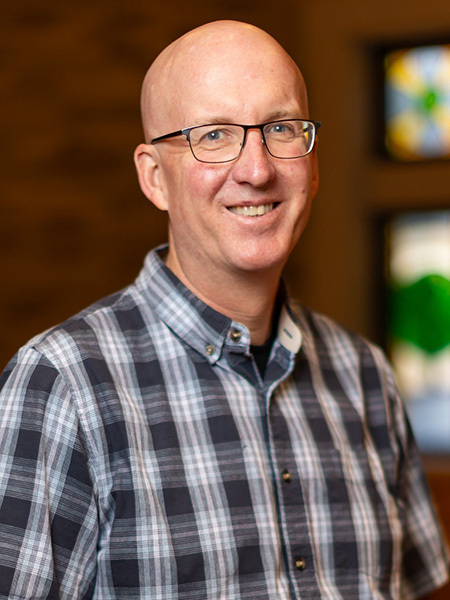
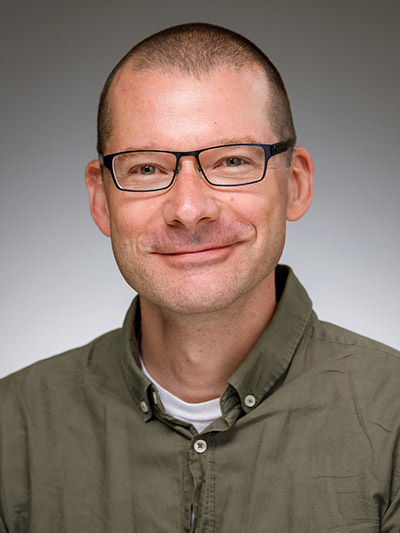
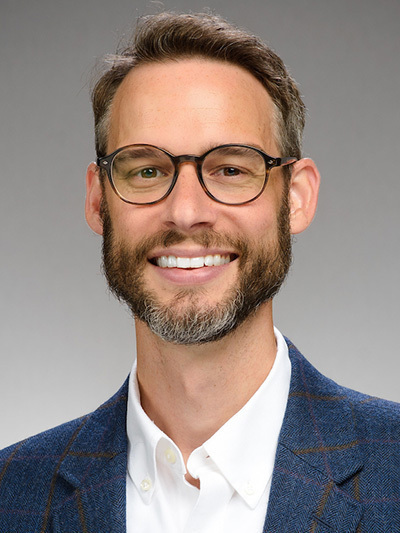
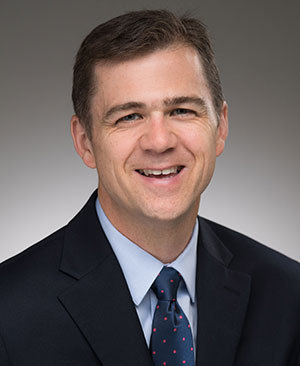
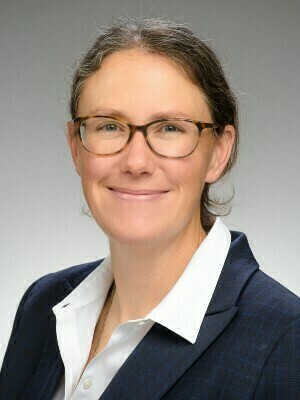
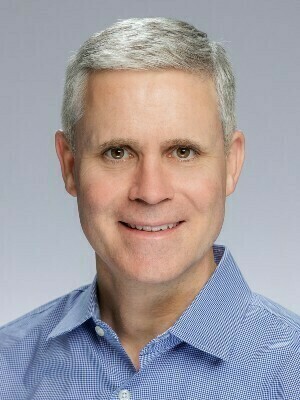
The first fellow to present his work was Michael Rea. Rea is a professor of philosophy and this year’s Hesburgh Women of Impact Humanities Fellow with his project Love, Beauty, and Objectification. This book explores the interplay among the three concepts in its title, asking how beauty might ground both love and objectification and teasing out the implications of this dynamic. Kate Kirkpatrick, a philosopher at Oxford University and author of Becoming Beauvoir: A Life (Bloomsbury, 2019), situated Love, Beauty, and Objectification with regards to Simone de Beauvoir’s arguments in her 1946 study The Second Sex. In particular, she explored the consequences of Rea’s work for concepts like “Love of Life” and “Will to Be.” Cristian Mihut, a philosopher at Bethel University and author of Gracious Forgiveness: A Theological Retrieval (Oxford University Press, 2023), posed several hypothetical test cases for Rea’s thinking about empathy in relation to objectifying behaviors and attitudes.
Reflecting on the experience, Rea expressed gratitude for his involvement in the fellows program. “I’m very grateful to the Franco Institute for bringing Kate and Cristian to provide comments. The discussion with Kate and Cris and with my Franco Institute colleagues was enjoyable and quite helpful,” he said. “I’ve really valued the opportunity this year to engage with the work of my colleagues in other disciplines, and I think that this fellowship program provides a tremendous benefit to the College and to the University.”
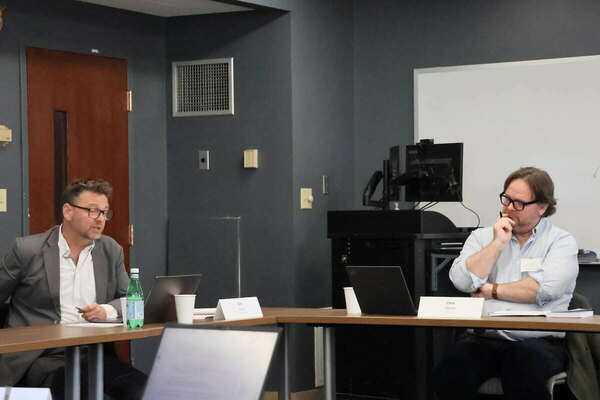
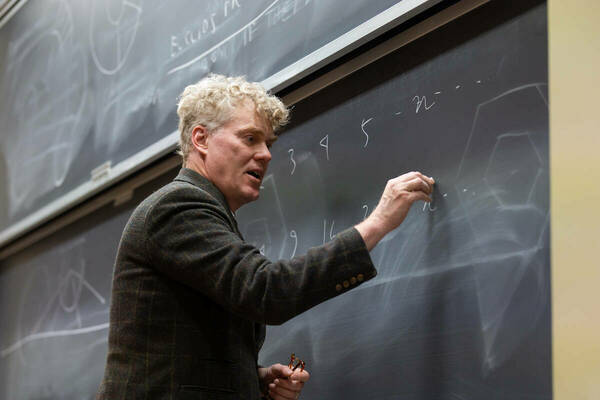
L-R: guest reviewer Chris Jones and faculty fellow Chris Abram
The conversation continued with Christopher Abram and his project Inventing Beowulf: Innovation and Tradition in the Post-Medieval Poem. Abram is professor of English and fellow of the Medieval Institute. He holds the Decrane Humanities Fellowship among this year’s cohort. His book aims to produce the first comprehensive, critical history of how the most famous Old English poem became a cultural phenomenon in the modern period, and how its changing status across the nineteenth through twenty-first centuries has materially affected the form and substance of the text. Chris Jones, an Old English scholar from the University of Utah, responded. Jones is author of Fossil Poetry: Anglo-Saxon and Linguistic Nativism in Nineteenth-century Poetry (Oxford University Press, 2018). In his comments, Jones praised Abram’s warm and lucid prose and anticipated the book’s warm reception alongside such works as Hugh Magennis’s Translating Beowulf: Modern Versions in English Verse (Boydell & Brewer, 2011). The other fellows joined in the conversation and entertained questions that Beowulf adaptations often raise, including the long debate over the first word of the manuscript ("hwaet") and the perceived undertones of Grendel’s mother and the much-contested depiction of her in Robert Zemeckis’s 2007 film with Angelina Jolie.
"Discussing my work with the other Faculty Fellows and my external reader at the Franco Seminar was one of the most productive experiences of my career," Abram shared. "We so often end up working in isolation in the humanities, stuck in our disciplinary ruts; it was wonderful to share my ideas with scholars who come from very different disciplinary backgrounds. My colleagues read my work carefully, sympathetically, and critically, and they all shared insights from their own fields that will make my book better. It was a pleasure and a privilege to participate," he said.
"The Franco Faculty Fellowship program this year created an exciting forum for interdisciplinary conversation,” said Kate Marshall, Franco Institute Director. On the group wrapping up the first year of the program, Marshall added, “All of our fellows advanced their projects significantly. We are thrilled to welcome a new cohort this fall."
The Franco Institute staff invites everyone to stay tuned for future announcements about the incoming 2026-2027 group of fellows, and we are grateful for the outgoing cohort’s participation, interdisciplinary collaboration, and innovative research.
Originally published by Jacob Schepers at franco.nd.edu on March 31, 2026.
]]>
Jacob Scheperstag:philosophy.nd.edu,2005:News/1803902026-03-28T21:53:00-04:002026-03-28T21:53:11-04:00Two Notre Dame faculty members win NEH fellowships for research on medieval Iberian liturgy and Kierkegaard’s <em>Fear and Trembling</em>
Two University of Notre Dame faculty members have been awarded fellowships from the National Endowment for the Humanities, continuing the University’s record success in winning support for humanities research.
During her NEH fellowship, Maloy will work on a monograph exploring the Old Hispanic rite, tentatively titled “Sounding the Saints in Early Medieval Iberia.” Jech will write a monograph that wrestles with the totality of Søren Kierkegaard’s seminal 1843 work, Fear and Trembling.
Rebecca Maloy
Maloy has studied medieval liturgy and chant, specifically Hispanic liturgy, for more than 15 years. She examines how liturgy and music influenced ideas about saints and sainthood on the Iberian Peninsula, a region with traditions of liturgical commemoration distinct from other parts of the medieval world.
Drawing from liturgical manuscripts, she will show how the text and melodies of Old Hispanic liturgy shaped the identities, beliefs, and agency of medieval communities.
For Maloy, studying worship practices from the past provides a fresh perspective on how worship can be done in the modern world. Medieval Christians understood the importance of music in worship, especially how belief could be shaped and amplified by the beauty of a melody.
“While earlier scholars have doubted whether chant melodies relate to the semantic content of their texts, the answer here is a resounding ‘yes!’” Maloy said. “The liturgies were designed to imprint key saintly values by making a maximum impact on the memory and senses.”
Maloy’s research has implications beyond her subfield, as studying devotion to the saints gives medievalists key insights into what mattered in medieval societies and how those priorities influenced historical events.
Maloy approaches her work having personally experienced the power of music on belief as director of Sacred Music at Notre Dame. The graduate program equips organ, choral conducting, and voice students with professional performance experience and theological training so they can become future music leaders in churches, concert halls, and schools and universities.
“One of the principles behind SMND is the idea that music can serve as a channel and a means of evangelization,” she said. “It’s very exciting to me to study how that was done in the Middle Ages,” she said.
Jech, meanwhile, will write a monograph tentatively titled “The Paradox of Faith: A Literary-Philosophical Commentary on Fear and Trembling,” which seeks to fill a gap in existing scholarly analysis of Kierkegaard’s most important and difficult work.
Alexander Jech
Existing commentaries and analyses of Fear and Trembling either operate at an introductory level or focus on only a subset of its themes, arguments, and ideas, Jech said, and these works almost always approach the philosophical, not the literary, side. After noticing this gap while preparing to teach a course on existentialism many years ago, Jech devoted significant time to considering how its parts worked together and how he could approach writing a detailed commentary that considers it as a whole.
“I realized there was a need to consider how it blends together literary and philosophical methods in pursuit of a religious topic,” Jech said. “The philosophical side has been so central that it’s been difficult to explain how it achieves its intellectual lightning strike — you need to consider both perspectives to do that.”
With the fellowship, Jech will spend time in Copenhagen, exploring archives of Kierkegaard’s manuscripts and notes to gain insight into his thought process while writing Fear and Trembling. Those notes also reference periodicals and other documents from Kierkegaard’s era that Jech intends to track down while in Denmark as well as talking with scholars of the Danish Golden Age about Danish poetry and the impact of Romanticism on 19th-century Danish culture.
An extended treatise on the nature of faith as demonstrated in Genesis 22, in which God commands Abraham to sacrifice his son Isaac, Fear and Trembling challenges “Sunday School definitions” of the concept and wrestles with what it means to truly believe in God. Jech hopes his book will be a means by which scholars of philosophy and literature, as well as educated lay people, can more thoroughly engage with the way Kierkegaard explores that concept.
“The paradox of faith, for Kierkegaard, has to do with fulfilling the passion of faith and not just understanding how pursuing it leads to being fulfilled,” he said. “Being faithful can mean that what you are doing seems to be undermining everything — Abraham raises the knife above the child of promise — but that’s the heart of the paradox. You try to do something, but you also seem to undermine it by how you pursue it, by depending on God for it. Abraham is the most intense version of this, but for Kierkegaard, that paradox applies to anyone who tries to live religiously, from Abraham to the person who simply tries to follow the Sermon on the Mount.”
Originally published by Josh Weinhold and Adah McMillan at al.nd.edu on March 27, 2026.
]]>
Josh Weinhold and Adah McMillantag:philosophy.nd.edu,2005:News/1789402026-02-03T16:01:05-05:002026-02-20T22:30:22-05:00Notre Dame philosophy professor to lead new collaborative research on critical thinking pedagogyPaul Blaschko leads a class in the First Lecture Series at Welcome Weekend, giving new Notre Dame students their first taste of academic life in the College of Arts & Letters. (Photo by Jon L. Hendricks/University of Notre Dame)
The University of Notre Dame has been awarded nearly $4 million in a four-year grant from the U.S. Department of Education (DOE) to fund a new initiative that will incorporate tools and strategies for teaching critical thinking into college classrooms around the country.
Supporting a project called Integrating Civil Discourse into the Curriculum at Public, Private, Community, and Historically Minority-Serving Colleges and Universities (ICDC), the grant comes out of the DOE’s Fund for the Improvement of Postsecondary Education Special Projects Program, which focuses on, among other priorities, protecting and promoting civil discourse in higher education.
In support of that mission, ICDC brings together a team of faculty from universities and colleges around the country with nonprofit leaders to integrate two online technologies that teach critical thinking into undergraduate curricula.
“We’re going to ask this question, ‘Can we expand the reach of effective critical thinking strategies in ways that could impact how we dialogue with each other on a national scale?’” said Paul Blaschko, an assistant teaching professor in the Department of Philosophy and director of the Sheedy Family Program in Economy, Enterprise, and Society. He and North Carolina State University professor Gary Comstock are leading ICDC as co-primary investigators.
Blaschko has been using ThinkArguments, one of ICDC’s two technological tools, for over three years to teach philosophical argumentation in the signature Notre Dame class God and the Good Life. Produced by nonprofit ThinkerAnalytix, ThinkArguments is an online course with 10 lessons that train students in argument mapping, a method of informal reasoning that visualizes the structure of an argument. The course has thousands of LSAT-inspired practice questions targeting different critical thinking skills.
“Teaching is a core part of Notre Dame’s mission, so to have an institutional stake in education in this country on a broader scale can be one crucial way we live out that mission.”
Blaschko noticed the impact of ThinkArguments in his classes the first time he used it.
“The arguments students were offering — it just seemed like something was clicking that hadn’t been clicking before,” he said.
To quantify that change, Blaschko started measuring students’ critical thinking gains with pre- and post-tests. He recorded an average growth rate of 16% — a significant improvement. It was something he wanted to replicate.
That’s where ICDC comes in. The grant, administered by Notre Dame Research, will fund summer workshops that convene faculty from around the country to train them in the basics of ThinkArguments and how to effectively integrate the technology into their courses. They’ll also use the tool Sway, an AI chat platform that coaches students with differing perspectives through difficult discussions. Disagree Wisely, a Florida nonprofit, leads research on Sway's educational impact and supports its deployment across institutions. The impact of incorporating the two technologies into hundreds of classrooms will be measured in the same way Blaschko did it.
The project has the potential to break new ground in higher education. While critical thinking skills are often touted as a key outcome of a humanities education, Blascko said, actually teaching and assessing critical thinking competence is challenging, especially in larger classes. ICDC’s strategies confront this issue by narrowing in on a concrete set of skills that can be applied in any situation involving a search for truth.
“Students are gaining habits of mind that they can apply in reading comprehension, writing, and verbal argumentation and dialogue, both in the classroom and outside of it,” Blaschko said.
Blaschko and the other members of ICDC’s steering committee estimate the project will reach more than 100,000 students just within the grant’s lifetime, with an even greater impact beyond the next four years as their research advances critical thinking education in the U.S.
“It’s really meaningful to be working with the Department of Education on the front lines of pedagogy, research, and practice,” Blaschko said. “Teaching is a core part of Notre Dame’s mission, so to have an institutional stake in education in this country on a broader scale can be one crucial way we live out that mission.”
Originally published by Adah McMillan at al.nd.edu on February 03, 2026.
]]>
Adah McMillantag:philosophy.nd.edu,2005:News/1760302025-10-24T16:26:00-04:002025-10-24T16:28:40-04:00In memoriam: Cornelius ‘Neil’ Delaney, professor of philosophy emeritusCornelius “Neil” Francis Delaney Sr., professor of philosophy emeritus at the University of Notre Dame, died in his sleep on Saturday, Oct. 18. He was 87.
Originally from Waterbury, Connecticut, Delaney was born to Irish immigrant parents. His father passed away when he was young, and he worked at a local pharmacy to help support his family. He initially entered the seminary after graduating high school, but left and began to focus on philosophy.
Delaney received his bachelor’s degree from St. John’s College in New York, his master’s in philosophy from Boston College, and his doctorate from Saint Louis University. He then joined the Notre Dame philosophy faculty, where he served for more than 50 years and held leadership positions, including department chair, director of the Notre Dame London program, and director of what is now known as the Glynn Family Honors Program for nearly 25 years.
“No one played a bigger role in the growth of Notre Dame's philosophy department than Neil,” said Jeff Speaks, professor of philosophy and former chair of the department. “He chaired the department from 1971 until 1982 and, not coincidentally, this was the period in which our philosophy department became a nationally and internationally recognized department.”
Delaney’s research was grounded in pragmatism and focused on political philosophy, legal philosophy, and the history of modern philosophy. He published more than 50 academic articles in various journals, as well as writing and editing several scholarly books. He was also very active in connecting with students, often encouraging and celebrating their accomplishments.
“We had a wonderful time discussing a variety of subjects, from novels to modern art to University politics, to which he himself made tremendous contributions,” said Paul Weithman, the Glynn Family Honors Professor of Philosophy, whose office was next to Delaney’s for a time. “He was a great source of advice when I was department chair, and he built up what became the Glynn Family Honors Program, where I had the good fortune to succeed him as co-director. Neil was a mentor and friend to whom I was tremendously indebted.”
“Philosophers can be boring; Neil was not,” Speaks said. “He was a great conversationalist, quick-witted, funny, and had a wide-ranging intellect. He was as at home talking about art or literature or Notre Dame football as about philosophy. He was the backbone of the department for decades and will be sorely missed.”
Delaney is preceded in death by his wife, Helen, and his son, Neil Jr. He is survived by his grandson, Prescott Spenser Delaney. He will be buried in a private ceremony at Notre Dame’s Cedar Grove Cemetery. A memorial Mass, open to the public, will be held at 3:30 p.m. Thursday, Nov. 6, at the Basilica of the Sacred Heart.
Originally published by Mary Kinney at al.nd.edu on October 24, 2025.
]]>
Mary Kinneytag:philosophy.nd.edu,2005:News/1750762025-09-18T14:33:00-04:002025-09-18T14:33:42-04:00Two summers, one calling: A Notre Dame student’s path back to India
When a place welcomes you once, it has a way of calling you back. For Ty Harrington '26—a program of liberal studies (PLS), philosophy, and theology major from Carmel, IN—that place was India. His first visit came through an Institute for Social Concerns fellowship at Govardhan Ecovillage (GEV), where he spent eight weeks studying the intersection of Indian philosophy, spirituality, and care for the earth. A year later, he returned to Mumbai to assist Rev. Mark Poorman, C.S.C., on a faculty research project. What began as a quiet summer in an ashram unfolded into a return journey that reshaped his perspective on faith, learning, and the wider world.
View of the Sahyadri Mountains from GEV, captured by Ty
A rejuvenating rhythm
Harrington still speaks with fondness about that first trip, which took him to GEV located in the Palghar district in the Sahyadri Mountains, a tranquil area about two and a half hours northeast of Mumbai. “It was an amazing opportunity to be in a beautiful place with wonderful people,” he said. Life at the ashram unfolded at a slower pace. “There was a feeling of calmness alongside streams of intellectual nourishment from the research and conversations. That balance created a very nice and rejuvenating rhythm of life.”
His project, supported by the Institute for Social Concerns, explored how Indian religious traditions form a philosophy of the earth. Immersed in an ISKCON community, he spent long days reading, interviewing, writing, and reflecting. The experience allowed him to produce a thoughtful humanities research paper, in addition to expanding his perspective and strengthening his Catholic faith.
An unexpected invitation
The following spring, an email from one of his professors changed Harrington’s summer plans. “I was shocked and found it hard to believe,” he recalled. “When I left India, I knew I wanted to come back, especially to Govardhan Ecovillage, but I thought it would be a long time. What are the chances that two of my summers at Notre Dame would be spent partially in India?”
This second opportunity brought him to Mumbai as an undergraduate research assistant on a high-profile faculty project examining the moral challenges that Catholic universities face around the world. Harrington joined Father Poorman at St. Xavier’s College to listen to students, faculty, and administrators and to explore how Catholic identity takes root in a global, multi-faith city.
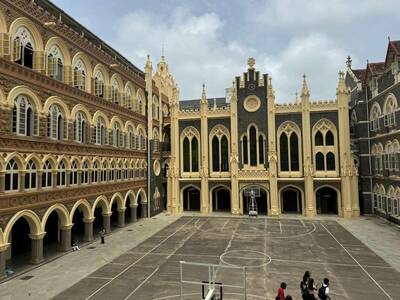
Days in Mumbai were full but purposeful. “We’d wake up, have breakfast, then spend five or six hours interviewing people on campus,” Harrington said. Breaks were brief, but he enjoyed walking through the college’s stone courtyards and chatting with students between sessions. Two conversations stand out: meeting the rector, Rev. Keith D’Souza, S.J., and speaking with a young Jesuit professor. “From a research perspective, those were fascinating,” he reflected, “but what stayed with me was how fortunate I felt to sit face-to-face with people from a completely different context about issues that matter deeply to both of us.”
The courtyard of the historic St. Xavier's College, where Ty and Fr. Poorman conducted their research
A city of scale and spirit
The contrast between a remote ashram and bustling Mumbai gave Harrington a new appreciation for India’s complexity. “Being right in the center of the action gave me a new perspective on the immensity of India and its incredible diversity,” he said. “Mumbai feels like a convergence of so many stories, cultures, and histories.”
The experience also enriched his faith. “Studying Indian philosophy and spirituality strengthened my Catholic faith,” Harrington noted. “Seeing the correlations and parallels between traditions gave me a lot of faith. Both trips gave me perspective and helped me see my own systems of thought in a more contextualized light.”
Relationships built across two summers remain at the heart of Harrington’s memories. At Govardhan Ecovillage, he formed a close friendship with Mohan, a monk who guided the Notre Dame group. “That friendship means a lot to me,” Harrington said. “I never thought I would be able to reconnect so soon, but I visited him again this summer.” In Mumbai, a dinner with the Jesuit community at St. Xavier’s offered another moment of genuine welcome and conversation that he will carry forward.
Advice for fellow students
Ty with his friend Mohan, a monk at GEV, whom he visited during his return to India
Harrington encourages classmates to approach India with intention and openness. “Reflect deeply on why you want to go,” he advised. “It is an intense adjustment and will require periods of adaptation. If you decide to go, be radically open. Do not treat it like a box to check. Go because you believe India has something to teach you, and you are willing to listen.”
He also urges students in the humanities to look toward India’s intellectual heritage. “India has such a rich tradition in philosophy and religion,” he said. “Thinking about the trajectory of world thought, India plays a primary role. There is so much to learn.”
Notre Dame’s presence in Mumbai continues to grow, with opportunities that range from summer and semester study abroad to Global Professional Experience internships, ND Bridge service-learning, ISC summer fellowships, and faculty-mentored research. Harrington’s two summers show what is possible when curiosity meets opportunity: one conversation leads to another, and one journey opens the door to a second.
“You discover your context is not the only context,” Harrington reflected. “That expands your heart and your mind.”
Editor’s note: For the backstory on Harrington’s first summer, see our earlier feature on his Govardhan Ecovillage fellowship.
Originally published by Hayden Mascarenhas at mumbai.nd.edu on September 16, 2025.
]]>
Hayden Mascarenhastag:philosophy.nd.edu,2005:News/1728292025-05-23T14:29:00-04:002025-05-23T14:29:21-04:00In memoriam: Alasdair MacIntyre, the Rev. John A. O’Brien senior research professor of philosophy emeritusAlasdair MacIntyre
Alasdair MacIntyre, the Rev. John A. O’Brien senior research professor of philosophy emeritus and a permanent senior distinguished research fellow at the de Nicola Center for Ethics and Culture, died on May 21, 2025. He was 96.
Widely regarded as the most important figure in modern virtue ethics, MacIntyre, a native of Glasgow, Scotland, was educated at Queen Mary College, London, and earned master’s degrees from the University of Manchester and the University of Oxford. He moved to the United States in the late 1960s and went on to teach at Brandeis University, Boston University, Wellesley College, Vanderbilt University and Duke University. In addition, he served as a visiting faculty member at Princeton University and Yale University and as a senior research fellow at London Metropolitan University’s Centre for Contemporary Aristotelian Studies in Ethics and Politics. He joined the faculty of Notre Dame in 1985 and was granted emeritus status in 2010. Following his retirement from teaching, MacIntyre remained domiciled at the de Nicola Center for Ethics and Culture as a permanent senior distinguished research fellow, where he continued to write and deliver an annual keynote address at the de Nicola Center’s Fall Conference through 2022.
“Alasdair MacIntyre demonstrated scholarly rigor and an alpine clarity of thought,” said Jennifer Newsome Martin, director of the de Nicola Center and the John J. Cavanaugh Associate Professor of the Humanities at the University of Notre Dame. “He was also a generous friend of the de Nicola Center in his years as our permanent senior distinguished research fellow in residence; what an honor it was that he chose the dCEC to be the locus of his scholarly work after retiring from the philosophy department at Notre Dame. We are all bereft at his passing.”
MacIntyre wrote or edited more than 23 books, including “After Virtue” (1981), the widely influential study of virtue ethics for which he is best known. That landmark work was followed by “Whose Justice? Which Rationality?” (1988), “Dependent Rational Animals” (1999), and “Ethics in the Conflicts of Modernity” (2016), in addition to several collections of essays and public talks, including his 1988 Gifford Lectures published as “Three Rival Versions of Moral Inquiry” (1990). He was a member of the American Academy of Arts & Sciences, member and former president of the American Philosophical Association, the British Academy, the Royal Irish Academy and the American Philosophical Society.
“Alasdair MacIntyre’s widespread impact on the world of ideas is impossible to overstate. We will be reading and learning from him for centuries to come,” said O. Carter Snead, the Charles E. Rice Professor of Law at the University of Notre Dame and former director of the de Nicola Center. “I owe him a deep personal debt of gratitude for his generosity to me as a mentor and treasured colleague at the de Nicola Center for Ethics and Culture. I will leave it to others to explore at length Alasdair’s unparalleled and sui generis intellectual legacy; instead, I would like to recall Alasdair's beautiful and inspiring personal concern for the flourishing of the people in his daily life. In our many conversations over the years he never missed an opportunity to inquire with genuine concern about my family and, in particular, our children. I will miss him dearly.”
John O’Callaghan, an associate professor of philosophy at Notre Dame and faculty fellow at the de Nicola Center, said, “When I think of Alasdair MacIntyre, I think of two words: gracious and humble. Not many will be surprised to hear him described as gracious, for many there are who benefited tremendously from his help and encouragement, me among them. But even more may be surprised, even shocked, to hear me describe him as humble. No doubt, when he entered the ring, he was intimidating, tenacious and at times even ferocious. But I was privileged to see his humility standing before the truth. If you want to know if someone loves the truth, look to their humility, their willingness to put their thoughts to the test and criticism of others, even others like me who found themselves stunned to have a great philosopher ask them to ‘comment on a draft of something I’m writing.’ Humility. Alasdair MacIntyre, gracious, humble and true.”
Martin concluded, “The academy, the University and the de Nicola Center are in Alasdair’s debt. His tremendous legacy, however, will continue to reverberate in the life of the Center, especially in its historic emphasis on traditions-based inquiry, in the habits of virtuous thought and practice cultivated in our integral student formation program and in the rich intellectual community and vigorous exchange of ideas for which his voice was so fundamental.”
Originally published by Kenneth Hallenius at ethicscenter.nd.edu on May 23, 2025.
]]>
Kenneth Halleniustag:philosophy.nd.edu,2005:News/1724922025-05-13T13:05:10-04:002025-05-13T13:05:10-04:00Holy Cross postulant Lane Poche ’25 finds his calling to be ‘a better person who loves’Lane Poche meets Pope Francis while studying abroad in Rome in April 2024. (Photo provided by Lane Poche)
When thinking about his future, Lane Poche turns to the teachings of Pope Francis.
Dilexit nos, the late Holy Father’s fourth encyclical, describes the challenges the modern person faces in finding their path in life. There are many forces, he writes, that push someone away from who they’re meant to be — and actually following one’s heart takes work and contemplation.
“What does my heart actually desire?” Poche, an Arts & Letters senior majoring in philosophy and theology, often asks himself. “What actually fulfills me? What actually brings me life?”
His answer? Taking the vows of poverty, chastity, and obedience to become a priest in the Congregation of Holy Cross.
“It’s where my desires and the Lord’s desires for me overlap,” he said.
Originally from Louisiana, Poche has wanted to be a priest since the fourth grade, but he found expressing his aspirations hasn’t always been easy. Forgoing marriage and wealth isn’t exactly a popular idea, and for much of his teens, Poche kept his dream to himself.
But now in the fourth year of his decade-long formation process, he can take pride in what he wants to do, thanks to the community of the Old College Undergraduate Seminary at the University of Notre Dame.
“In meeting other people who share the same desires and thoughts, I felt very affirmed,” Poche said. “I’m excited about it, and I’d love to give my life to it.”
Notre Dame is one of the few places in the United States where students fresh out of high school can attend seminary while studying at a major university. The opportunity to receive an exceptional education within a supportive intellectual and religious community was instrumental in the college decision for Poche.
“Education is the foundation of the Congregation of Holy Cross,” he said. “I knew that I could study here and get one of the best educations in the world.”
A passion for the work
Poche’s graduation in May will not only signify his achievement of obtaining a bachelor’s degree but will also mark his transition from postulant to novice.
Lane Poche receives the Eucharist during a Congregation of the Holy Cross backpacking pilgrimage in October 2023. (Photo provided by Lane Poche)
Poche has spent his senior year living in Moreau Seminary alongside Holy Cross priests, brother scholastics, and other postulants. He starts and ends each day with the liturgy of the hours, singing and praying alongside the seminary’s other residents.
“Sometimes when I’m having a bad day, just going to breakfast with the guys and seeing their joy or hearing about their days is something that draws me out of myself and brings me to a place of gratitude,” he said.
As part of their ministry, Poche and a group of his seminarian brothers work on campus with the Order of Christian Initiation for Adults (OCIA), a program for those who want to become Catholic. They also share meals with those who are unhoused at Our Lady of the Road, a drop-in center that provides basic resources, and meet with OCIA members at St. Adalbert Catholic School to pray and play soccer.
A large part of being a priest, Poche said, is working with and empathizing with others from various backgrounds. His ministry helps him develop that skill while providing a strong faith-based community.
While with OCIA, Poche was asked to give an hourlong presentation on grace in front of 100 people. At first, he was intimidated by the assignment, but as he began presenting, he entered a “flow state,” and fear left his mind.
In that moment, he knew a pastoral role was right for him.
“I started thinking about giving a sermon one day and being able to, hopefully, evoke things within people to wonder about God, wonder about the way they’re living,” he said. “The time it took to prepare for it and the love that I put into preparing for it — there’s nothing else I’d rather be doing right now.”
Finding his gifts
The five pillars of Holy Cross formation are heart, mind, family, zeal, and hope, so for Poche, education influences his path to priesthood.
“You can’t really separate the two,” Poche said. “In prayer, I’m always learning. In classes, I’m always bringing things that I’m learning into prayer.”
“I find fulfillment in drawing people to Christ in an explicit way; I find a joy in scripture; I find joy in the Mass. It’s something that’s really life-giving for me. I can’t help but share that.” - Lane Poche ’25
One of Poche’s favorite classes, Christian Traditions I, connected him with the history of his future life as a Holy Cross priest. The course is a requirement for theology majors, and students learn about the history of Christianity from the Acts of the Apostles to the Middle Ages. They study influential Christians like St. Benedict, who gave his life to his faith through monasticism, and St. Paul, who did the same through evangelism and martyrdom.
“What was so enriching about it was just seeing how differently the Lord can call us all — by what we’re suited to, by our own interests, by our own passions, and by what we’re good at,” Poche said.
Reading about the experiences of saints and historical figures showed Poche the myriad roads a religious life can take and compelled him to reflect on his own talents, which he said are still being unveiled to him.
“I find fulfillment in drawing people to Christ in an explicit way; I find a joy in scripture; I find joy in the Mass,” Poche said. “It’s something that’s really life-giving for me. I can’t help but share that.”
Learning humility and love
Poche’s study of the past bolstered what he learned from Ecclesiastes 1:9: “There is nothing new under the sun.”
Lane Poche lights a votive candle in the Grotto of Our Lady of Lourdes. (Photo by Jon Hendricks/University of Notre Dame)
He’s found that many people today tend to dismiss the history of how ideas and systems have evolved throughout time.
“There’s a notion of progress that we’re getting better and better and better, and one day, we’ll just be so good that we won’t need a creator,” he said. “But I think it’s a lie.”
Poche has learned through reading philosophy — some from hundreds or thousands of years ago — that many ideas that are considered novel are just repeating old teachings. Understanding this, he said, can lead to humility in knowing humans are not always progressing in every area of society.
“There’s stuff to learn from the past, and there’s a lot of work to be done now,” he said.
Beyond an appreciation of the past, Poche’s time at Notre Dame has also helped him develop an increased ability to act in love.
“I’m learning how to give more of myself, to make myself available to people,” he said.
After graduation, Poche will move to the Holy Cross Novitiate in Colorado for a year of prayer, frequent participation in the sacraments, and contemplative silence. He will then return to Notre Dame to study for his Master of Divinity degree before his ordination.
After that, he could be placed anywhere around the world — from South Bend to Peru — with any kind of assignment, such as a parish, homeless shelter, or college campus.
No matter what’s in store, Poche said, he will build on who he has become in the Old College.
“Being at Notre Dame,” he said, “has helped me become a better human being, a better Christian, a better person who loves.”
Originally published by Adah McMillan at al.nd.edu on May 13, 2025.
]]>
Adah McMillantag:philosophy.nd.edu,2005:News/1721882025-05-05T14:31:00-04:002025-05-06T13:39:48-04:00In memoriam: Karl Ameriks, the McMahon-Hank Professor of Philosophy EmeritusKarl Ameriks, the McMahon-Hank Professor of Philosophy Emeritus (Photo by Matt Cashore/University of Notre Dame)
Karl Ameriks, the McMahon-Hank Professor of Philosophy Emeritus at the University of Notre Dame, died on April 28 from pancreatic cancer. He was 77.
Born in post-World War II Germany, Ameriks’ family emigrated to the United States when he was a child, and he grew up in Detroit, Michigan. He received his bachelor’s and doctoral degrees from Yale University. He came to the Department of Philosophy at Notre Dame in 1973 during a formative time for the department, which had transitioned from a predominantly Thomist focus to the more analytical American philosophy in the 1960s.
“He joined the department at a time that was crucial to setting us on the path we've followed since,” said Paul Weithman, the Glynn Family Honors Professor of Philosophy and former chair of the department. “Any department would have been lucky to have him, but he was very happy here, and we were all much the better for it.”
During his 43-year career at Notre Dame, Ameriks predominantly focused on the history of modern philosophy, continental philosophy, and modern German philosophy. He dedicated much of his research to 18th-century German philosopher Immanuel Kant, about whom he has published multiple books, such as Kant's Moral and Legal Philosophy, Kant and the Historical Turn, and Reinhold: Letters on the Kantian Philosophy. He continued to actively research after his retirement in 2016, publishing books including Kantian Dignity and its Difficulties and Kantian Subjects: Critical Philosophy and Late Modernity.
Ameriks, his colleagues said, was a world-renowned scholar of Kant and German idealism — but also possessed a wide-ranging intellectual curiosity with boundless insight.
“He seemed to know everything about everyone in the history of philosophy, in politics, in literature, in history,” said Samuel Newlands, the Carl E. Koch Professor of Philosophy and chair of the department. “To have a conversation with him about any topic was a bracing, thrilling journey — you never quite knew where it was going, but you could be confident that it would be full of dry, sly humor, sharp insight, and unexpected twists and turns.”
In 2009, Ameriks was elected as a fellow of the American Academy of Arts and Sciences. A characteristically modest man, he deflected self-lauding remarks about this prestigious recognition by pointing to colleagues who received the distinction before him, saying he was merely pleased to “receive an honor that has come to others at Notre Dame who have always been quite an inspiration for me.”
In addition to his impressive scholarship, Ameriks was also personable. He was a beloved mentor for many graduate students, and he always prioritized time with family and friends. Colleagues described him as a bibliophile and a “scholar’s scholar” who constantly engaged in invigorating discussions.
“He was generous and gentle, always encouraging, and he was someone whose daily presence in Malloy Hall was a source of joy and delight for everyone who encountered him,” Newlands said. “He will be sorely missed.”
Ameriks is preceded in death by his parents and a brother. He is survived by his wife, Geraldine, an emerita associate teaching professor of Spanish at Notre Dame; two sons; three grandchildren; and his brother, John.
A memorial service will be held at 1 p.m. May 31 at Good Shepherd Lutheran Church, 1021 Manchester Drive, South Bend. Memorial contributions may be made in Amerik’s honor to the American Cancer Society, the Northern Food Bank of Indiana, and St. Jude’s Children’s Hospital.
Originally published by Mary Kinney at al.nd.edu on May 05, 2025.
]]>
Mary Kinneytag:philosophy.nd.edu,2005:News/1703752025-02-28T08:38:00-05:002025-02-28T08:38:17-05:00Remembering W. David Solomon, Founding Director of the Center for Ethics and Culture
The de Nicola Center for Ethics and Culture mourns the passing of its founding director, W. David Solomon, associate professor of philosophy emeritus at the University of Notre Dame, on February 26, 2025. He was 81.
Solomon received his B.A. from Baylor University and his doctorate in philosophy from the University of Texas before joining the Notre Dame faculty in 1968, where his teaching and research focused on virtue ethics, ethical theory, and medical ethics. In 1999, Professor Solomon founded the Center for Ethics and Culture, where he served as director until 2012. He retired from teaching in 2016 after almost 50 years at the University.
Jennifer Newsome Martin chats with Lou and David Solomon
“It is difficult to overstate the impact of David Solomon’s legacy at the University of Notre Dame,” said Jennifer Newsome Martin, current director of the de Nicola Center for Ethics and Culture. “His entire life was a cheerful testament not only to the pursuit of knowledge but also of wisdom and virtue. Those of us who hold dear the lively witness of the Catholic intellectual and moral tradition at Notre Dame—and beyond—remain ever in his debt.”
Solomon envisioned the Center for Ethics and Culture as an institution that would draw on the rich Catholic moral and intellectual tradition to adjudicate complex questions in the field of contemporary ethics. “Normative teaching and inquiry at Notre Dame should be distinguished by fidelity to the core convictions of the tradition of thought Notre Dame has inherited,” its early Task Force on Ethics stated: “that human beings are created in the image of a God who loves us and calls us to eternal life; that we therefore have a dignity which cannot be alienated, overridden, or ignored; and that the most vulnerable among us have the most urgent claim on the consciences of us all.”
In 2012, Solomon passed the directorship of the Center for Ethics and Culture to O. Carter Snead, Charles E. Rice Professor of Law at the University of Notre Dame.
O. Carter Snead and W. David Solomon
“David Solomon was, of course, one of Notre Dame's most beloved and dedicated teachers, a shining light of creativity and dynamism in its philosophy department, and the visionary founder of what is now called the de Nicola Center for Ethics and Culture,” Snead said. “And he was a tireless and courageous voice at Notre Dame on behalf of the intrinsic equal dignity of all members of the human family, born and unborn. But his greatest gift to us was as an exemplar and witness of life most fully lived—as a faithful son of the Church, devoted husband to his beloved Lou, loving father and grandfather, and unfailingly generous friend to us all.”
During his 13 years as director of the Center for Ethics and Culture, Solomon established the annual Fall Conference, now the University’s largest interdisciplinary academic conference, which gathers more than 1,200 guests and 150 speakers—both Catholic and those from other faith traditions—for three days of conversation and exchange on the most vexed questions of ethics, culture, and public policy today. Speakers have included such luminaries as Alasdair MacIntyre, John Finnis, Charles Taylor, Jean Bethke Elshtain, Michael Sandel, and Mary Ann Glendon. Under his guidance, the Center for Ethics and Culture also administered the University’s annual Medical Ethics Conference and established the Notre Dame Evangelium Vitae Medal, awarded annually on behalf of the University to heroic individuals whose life work has served to proclaim the gospel of life.
W. David Solomon at the dCEC's 2021 Winter Conference
An excellent academic administrator, Solomon’s passion for teaching and mentoring students quickly endeared him to undergraduate and graduate students alike. During his tenure at the University, Solomon served as the director of undergraduate studies in the Department of Philosophy, founded and directed the Arts & Letters/Science Honors Program, and directed the Notre Dame London Program.
At the graduate level, Solomon directed 36 doctoral dissertations in the department of philosophy, the most of any professor in the department's history, and taught the entry-level course "20th Century Ethical Theory.” Later in his career, more than 200 undergraduates each spring semester would take his signature ethics course, "Morality and Modernity," based on MacIntyre's seminal work After Virtue. He also taught medical ethics to more than 250 undergraduate students each year, as well as upper-division courses in contemporary ethics and special topics in ethics.
Following his retirement, Solomon continued to remain actively involved in the work of the Center, introducing MacIntyre’s popular keynote address at every Fall Conference and joining in the annual celebration of the Evangelium Vitae Medal. In 2016, through the generosity of its benefactors, the Center for Ethics and Culture established the graduate Solomon Fellowship, awarded each year to an outstanding doctoral student who shares his passion for Notre Dame’s distinctive Catholic character and mission. In 2019, the Center for Ethics and Culture was renamed the de Nicola Center for Ethics and Culture, following a transformative gift from Anthony and Christie de Nicola.
Speakers at a 2014 conference gather around W. David Solomon
A conference in Solomon’s honor at Notre Dame in 2014 led to the publication of Beyond the Self: Virtue Ethics and the Problem of Culture (Baylor University Press, 2019), with contributions from many of his graduate students and collaborators in the revival of virtue ethics.
“Some scholars as they move towards the end stages of their careers worry about whether what they have done for decades has mattered or made a difference,” wrote Rev. Bill Miscamble, C.S.C., in a 2016 essay in the Irish Rover on the occasion of Solomon's retirement. “But the good women and men gathered at that conference in 2014 are irrefutable evidence of David Solomon’s enduring and substantial contribution to philosophy at Notre Dame. …He has given of himself for his students, his colleagues, and his friends, and Notre Dame is a much better place because of him."
Born and raised a Southern Baptist, Solomon and his wife were received into the Catholic Church in May 2024. A funeral Mass will be celebrated on Friday, March 7, at 2:30 p.m. in the Basilica of the Sacred Heart at the University of Notre Dame; visitation will be held at Kaniewski Funeral Homes in South Bend on Thursday, March 6, from 4 p.m. to 7 p.m.
Originally published by Kenneth Hallenius at ethicscenter.nd.edu on February 27, 2025.
]]>
Kenneth Halleniustag:philosophy.nd.edu,2005:News/1703762025-02-26T08:38:00-05:002025-02-28T08:38:57-05:00Therese Cory delivers "Book that Changed My Life" Lecture on Josef Pieper
The de Nicola Center for Ethics and Culture hosted Notre Dame philosopher Therese Cory, director of the Jacques Maritain Center and member of the Pontifical Academy of St. Thomas Aquinas, for a lecture on Josef Pieper's Leisure, the Basis of Culture. The event, which was part of the Center's "Book that Changed My Life" lecture series for Sorin Fellows, took place on February 3, 2025, and filled the Center’s library to capacity.
Professor Cory’s research focuses on medieval theories of mind, cognition, and personhood, particularly in Thomas Aquinas and his contemporaries. Throughout her talk, she explained Pieper’s position and applied it to relevant aspects of culture today before personally narrating how the idea changed her life, concluduing with a critique informed by Catholic social teaching.
According to Cory, Pieper criticized his contemporary post–World War II society as being a "leisureless culture of total work," in which everything is valued instrumentally. Pieper contrasts this world of “total work” with culture described by Aristotle, who wrote that “we work in order to be at leisure.” The Greek word for “work” translates literally as “not-at-leisure,” Cory explained, whereas many today might think of leisure as “not work.” This orientation leads to a culture that is skeptical of contemplation or the liberal arts; Cory pointed out that the question most associated with saying that one is pursuing a degree in philosophy is, “What are you going to do with that?”
Professor Cory was careful to emphasize Pieper’s distinction between leisure and acedia, or a pause in activity for the purpose of regaining strength (to get back to work). Cory compared this to the “endless scrolling” or “inability to do anything but vegetate,” calling these a “numbing of existence that the world of total work imposes on our free time.” Leisure, on the other hand, is “an inner absence of preoccupation, a calm, an ability to let things go, to be quiet,” a “form of that stillness that is the necessary precondition for accepting reality” and “the disposition of receptive understanding, of contemplative beholding, and immersion in the real.”
Commenting on the difficulty of explaining this concept to an audience most familiar with acedia-punctuated total work, Cory compared it to being in the “flow” state of a sport or participating in a musical performance. According to Cory, Pieper argues that these events have three features. First, it occurs during non-activity, when one is not striving toward anything. Second, it is when one is considering things in a celebratory spirit. Lastly, it occurs “perpendicular to the world of total work.”
Cory related that she was first exposed to Pieper before her first semester of college. “As a college student, I would say this concept really gave me a framework around which to organize and make sense of my excitement about these liberal arts classes and conceptualize what I was doing in college in the first place…. This education opens up to you a portal to this humanizing moment. It's a celebratory union with reality and an attunement to being.” Pieper also changed the way that Cory viewed faith and worship. “Leisure consists,” according to Pieper, “in festival. But then leisure will derive its innermost possibility and justification from the very source from which festival and celebration derive theirs. And this is worship.”
Cory explained that this framework helped her understand the communal aspect of both leisure and worship. “[Pieper is] specifically writing to Christians, saying if you can't be at one with the world as the expression of God's glory, you're missing out on the very heart of what makes reality celebration worthy in the first place.”
Pieper overlooks some important aspects of the work/leisure distinction, according to Cory. “In a society that values true leisure,” she claimed, “work would not be so spiritually impoverished. All through the book, he treats work as something that's merely instrumental. It's a kind of drudgery that's imposed on you that you only do because you're trying to get something else. But if we look at Catholic social teaching, that's not really what we see.” Here she quoted Pope St. John Paul II: “Work thus belongs to the vocation of every person; indeed, man expresses and fulfils himself by working.”
Nevertheless, Cory re-emphasized the importance of Pieper’s thought. “I think Pieper is more relevant than ever. He continues to offer us a different vision that we can still work toward. Not a vision in which our lives are divided into this polarity of total work and escapism, but something different.”
This article was contributed by dCEC Sorin Fellow Will Grannis.
Watch a recording of Professor Cory's presentation here:
Originally published by Will Grannis at ethicscenter.nd.edu on February 18, 2025.
]]>
Will Grannistag:philosophy.nd.edu,2005:News/1694402025-01-22T15:54:00-05:002025-01-22T15:54:47-05:00Four Arts & Letters faculty continue Notre Dame’s record NEH fellowship successArts & Letters faculty won NEH fellowships for projects that will examine the history of Kurdish music and media, rethink Thomas Aquinas’ philosophical approach, unveil how the Catholic Church handled marital violence and separation in the 18th century, and further understand the cultural impact of Hurricane Maria. (Photo by Jon L. Hendricks/University of Notre Dame)
Four faculty members in the College of Arts & Letters have won National Endowment for the Humanities fellowships, extending the University of Notre Dame’s record success with the federal agency committed to supporting original research and scholarship.
Notre Dame and Johns Hopkins University were the only institutions to have four faculty win individual NEH fellowships this year, and Notre Dame faculty have won more NEH fellowships than any other private university in the country since 2000. Notre Dame’s success has been driven in large part due to faculty research support provided by the Institute for Scholarship in the Liberal Arts.
“I am delighted that the NEH has once again recognized the exceptional research projects our faculty are pursuing,” said Sarah Mustillo, the I.A. O’Shaughnessy Dean of the College of Arts & Letters. “These four awards underscore the high caliber of diverse scholarship across our disciplines and invaluable guidance offered by ISLA throughout the fellowship application process.”
Connecting Kurdish music, media, and culture
Jon Bullock, an assistant professor in the Department of Music.
For the past decade, Bullock has been conducting research on Kurdish music and broadcasting, a long-established but underexplored area of global culture.
Kurds are an ethnic group that predominantly span across Iran, Iraq, Turkey, and Syria and have faced varying degrees of linguistic, cultural, and political oppression. Because of this history, and because they have no nation-state of their own, Bullock said relatively little research has been done on Kurdish art and media.
In his book project, tentatively titled “Kurdish Broadcasting and the Power of Music on Air,” Bullock hopes to provide a historical overview of Kurdish music on the radio and analyze how its impact on Kurdish society helps scholars of music and media think more deeply about the power of music broadcasting as a whole.
“It’s not just trying to piece together a music history over the last 100 years among the Kurds,” Bullock said. “But also showing that music and media are intertwined and how that can lead to new perspectives on the affordances of music broadcasting, maybe in ways that we haven’t heard before.”
As an ethnomusicologist, Bullock was initially interested in the varying styles of Kurdish music that he describes as a “mosaic of related musical practices.” That led to him discovering the importance of radio broadcasting and understanding where and when the music was shared and what messages were being transmitted, especially during times of geopolitical fluctuation.
Through his work, Bullock hopes to show that the history of Kurdish media can ultimately help to contextualize the present moment of political uncertainty.
An essential part of the project, Bullock said, is centering Kurds in global narratives that shape and define the region.
“This is not just about how we paint a picture of Kurdish music as something unique — it’s about how this helps us to understand how Kurds see themselves in relation to the rest of the world at any given moment,” he said.
Over the past several years, Bullock has completed archival and ethnographic research in Kurdistan, reviewed radio programming and station records, and interviewed former employees who worked for Kurdish radio stations. Now, in his second year at Notre Dame and with support from the NEH, he will be able to complete his project fully.
“It’s been a very long journey of trying to just find things,” he said. “So when I heard I received the fellowship, I was shocked, surprised, and, of course, super grateful.”
Contextualizing Aquinas’ philosophical approach
Therese Cory, the John and Jean Oesterle Associate Professor of Thomistic Studies in the Department of Philosophy.
Cory, who studies medieval philosophy, is currently working on a large project that aims to challenge how scholars consider the mind of the great Catholic thinker Thomas Aquinas.
The director of the Jacques Maritain Center and its associated History of Philosophy Forum, Cory focuses her research on mind, self-consciousness, personhood, and the nature of knowing. She is particularly interested in Aquinas’ systematic approach to such topics.
The first portion of her current project is her tentatively titled book “Thinking as Being in Aquinas: Aquinas's Metaphysics of Mind,” which will examine the nature of the mind according to Aquinas. The NEH fellowship will help support a second book and final portion of the project, tentatively titled “Aquinas’ Mind-in-World.” In it, Cory will build off her understanding of Aquinas’ mind and examine how he understands intentionality, or the mind’s ability to enter into relationships with things outside itself.
To do so is intrinsically human, she said, but also something shared with other animals, and Aquinas considered intentionality to be the mind’s way of making itself part of the real world. While watching a football game, for example, a person in the crowd may imagine what it may be like to be a player on the field to better understand the game scenario. In doing so, Aquinas contended, that person also becomes a part of the game.
“We’re part of the world, too — we’re not just spectators,” Cory said. “That’s a really important insight, and it’s something that brings Aquinas closer to non-Western philosophies and Indigenous views that we would often not associate him with at all.”
In her research process, Cory aims to read and understand Aquinas through the historical context in which he lived. She contends that present-day thinkers have often erroneously read Aquinas’ theory of mind through the lens of modern philosophies, whose questions can be very different from his own. In her current project, Cory aims to fundamentally change and correct how scholars interpret his teachings.
“I’m arguing that’s been a huge mistake,” she said. “He really thinks about the mind in a fundamentally different way — he’s not asking those questions. So I’m trying to take the theory off that track and put it on a different track.”
Examining sexualized violence in early modern Catholicism
Ulrich Lehner, the William K. Warren Foundation Professor in the Department of Theology.
Lehner, a scholar of religious history and theology of the early modern era, is currently pursuing a project called “Bodies in Court,” which explores how Catholics from 1700 to 1800 confronted marital violence and separation. It highlights the intersections of sexualized violence, power dynamics, legal assessments, and religious values in Catholic regions of central Europe.
Lehner will examine ecclesiastical court records from Austrian, Swiss, German, and Czech archives — areas he is already familiar with from research he did for his previous book, Staged Chastity: Sexual Offenses in the Society of Jesus in the Seventeenth and Eighteenth Centuries (De Gruyter, 2023), which ultimately led to his current project.
“When I researched the history of sexual abuse among clergymen, I stumbled in the archives upon accounts of marital violence that had been adjudicated before ecclesiastical judges,” he said. “When I decided to read them, I was amazed by how detailed they were. They gave me a glimpse into the intimate lives of people who died centuries ago.”
Lehner was surprised to find accounts of women bravely speaking up about the abuse they suffered and the physical and emotional toll it took on them.
Because sexual violence is a relatively new area of research for historians, Lehner said, there is little known about how Catholics handled this issue. He hopes his project will shed more light on this gap in historical knowledge.
“It will not only provide new insights into the construction of views of body and sexuality, but also analyze the legal and theological background of sexualized violence, thus bringing a new aspect of history to light,” Ulrich wrote in his proposal. “This overlooked area of research promises to overturn many assumptions in standard narratives and contribute to the societal discussion about the abuse of power and its concealment in ecclesiastical contexts.”
Amplifying cultural expression after a disaster
Marisel Moreno, a professor of Spanish in the Department of Romance Languages and Literatures.
Hurricane Maria devastated Puerto Rico in Sept. 2017, leaving the U.S. territory reeling from its aftermath that can still be felt today.
The following spring, in partnership with the University of Michigan, Moreno, whose area of expertise is U.S. Latinx literature, and Spanish professor Tom Anderson, led and co-produced an online course and created the multimedia project “Listening to Puerto Rico,” in which they interviewed Puerto Ricans about the immediate impact of the Category 4 hurricane’s destruction.
“As a Puerto Rican born and raised in the archipelago but who has been living stateside for decades, I am one of the millions of Puerto Ricans in the diaspora who witnessed, from afar, the destruction of our homeland,” she said. “There were limited ways to help immediately following the hurricane, but in spring 2018 a unique opportunity arose to create awareness about Puerto Rico and the impact of the storm.”
Deriving inspiration from those interviews, Moreno is now focusing on her NEH-supported project, tentatively titled “Eye of the Storm: Hurricane Maria in Puerto Rican Cultural Production.” The book will focus on Puerto Rican literary and cultural expressions post-Maria, and Moreno said those aspects play a “crucial role by providing a counter-narrative to the dehumanizing rhetoric of the local and federal governments.”
“By examining the representation of the hurricane’s impact in literature and other art forms, I aim to untangle the links between colonialism, anti-Blackness, disaster capitalism, climate change, and migration,” she said. “It has been more than seven years since Hurricane Maria hit Puerto Rico, yet much of the archipelago is still experiencing the consequences of the storm — or what I call the ‘afterlives of disaster.’”
Puerto Rican cultural production, Moreno contends in her project, resists the colonial violence that reproduces the afterlives of disaster by being life-affirming and a testament to the survival of the Puerto Rican people.
This project, Moreno said, can also shed light on how cultural creation can uplift resistance to colonial violence and help imagine a decolonial future, especially for communities in the Global South. She also believes this is especially topical as vulnerable communities of color face challenges in light of globalization and climate change.
“I am extremely grateful to everyone who has supported me,” she said. “Winning this fellowship has given me a renewed sense of confidence in this project, which is very close to my heart.”
Originally published by Mary Kinney at al.nd.edu on January 22, 2025.
]]>
Mary Kinneytag:philosophy.nd.edu,2005:News/1667842024-09-20T08:15:00-04:002024-09-20T08:15:45-04:00Notre Dame to host conference on St. Thomas Aquinas, commemorating 800th anniversary of his birth
For centuries, the work of St. Thomas Aquinas has informed academic inquiry into issues of human dignity, freedom, economic development, work, poverty, the environment, and other matters of global significance.
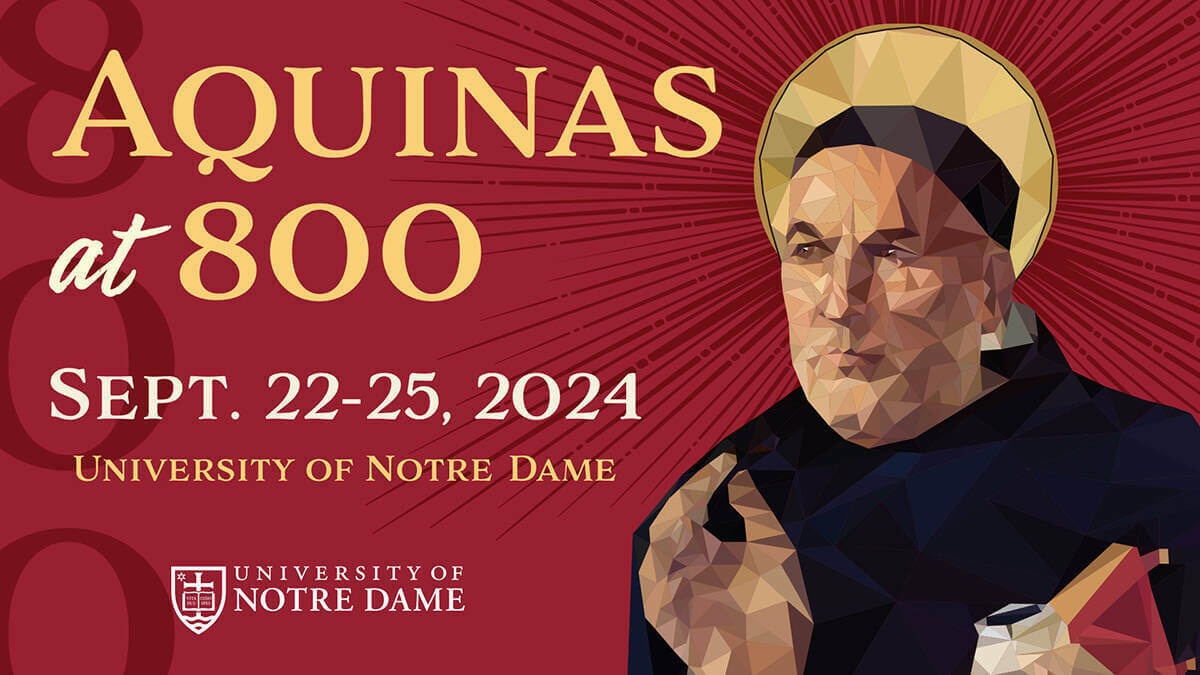
To commemorate the 800th anniversary of his birth, the University of Notre Dame will host a conference Sunday, Sept. 22, through Wednesday, Sept. 25, celebrating Aquinas’ enduring importance to contemporary cultural, philosophical and theological discussions.
“Aquinas at 800: ‘Ad multos annos’” will be the largest conference of its kind, with more than 500 in-person attendees and more than 150 speakers.
The event offers people who may have preconceived notions about Aquinas a chance to take another look, said Therese Cory, the John and Jean Oesterle Associate Professor of Thomistic Studies, the director of the Jacques Maritain Center and one of the event’s organizers.
“If they thought he wasn’t relevant anymore, this conference might offer them reason to think, ‘Wow, his thought is still flourishing and able to help us think through the problems that we have today,’” Cory said. “They’ll have a chance to see how wide and expansive his work really is.”
The conference will begin at 4 p.m. Sunday with an opening Mass at the University’s Basilica of the Sacred Heart. Rev. Kevin Grove, C.S.C., an associate professor of theology, will serve as celebrant.
Three esteemed faculty members from the Pontifical University of Saint Thomas Aquinas in Rome will present at the conference. Rev. Serge-Thomas Bonino, O.P., the dean of the faculty of philosophy and president of the Pontifical Academy of Saint Thomas Aquinas, and Rev. Thomas Joseph White, O.P., the university’s rector magnificus, will each offer a keynote address. Fr. Wojciech Giertych, O.P., a theologian of the Papal Household and professor of moral theology, will offer opening remarks.
A concluding Mass will be held at 5:15 p.m. Wednesday in the Basilica.
One of Aquinas’ most enduring and important contributions is his ability to bring together concepts that often appear to be in conflict, Cory said, such as faith and reason or human embodiment as flesh-and-blood creatures and human transcendence in communion with God.
“Holding those two dimensions at the same time has always been a challenge for philosophers, and for Aquinas, it informs everything he has to say about who we are as human beings,” Cory said. “I think that’s a crucial lesson for us today, because in our society we have a tendency to emphasize materialistic pleasures and consumerism at the expense of our more transcendent, spiritual needs. At the same time, we are in danger of over-abstractifying our lives as humans — communicating through screens and phones, living in an abstract space in our minds — and forgetting that we are embodied creatures.”
Likewise, Aquinas saw science and religion not as separate realms, but as deeply connected, Cory said. “Our scientific endeavors and our thinking about God have to be able to come together into a single space where we’re able to think and reason and talk with other people about what we’re learning and learn from them as well. Aquinas provides us with a model for a harmonious relationship between faith and reason.”
As a Catholic research institution, Notre Dame takes all branches of knowledge seriously — faith and reason, theology and philosophy, and religion and science — making the University an ideal choice to host this flagship event, Cory said.
“Notre Dame is also one of the best places in the world to do medieval philosophy research,” she said. “We have an incredibly strong community in philosophy and theology who work on medieval figures, and particularly on the thought of Aquinas. So, it made sense for us to take the lead in organizing this. We are thrilled to host what will be the largest gathering of scholars celebrating Aquinas during this anniversary year.
“And for our Notre Dame students, the conference allows them to see the sheer number of people who are working on Aquinas and the variety of disciplines, locations and institutions they represent. It lets students see that when they’re studying Aquinas, it’s not just an item on a syllabus — they’re part of this community, too.”
Originally published by Carrie Gates at news.nd.edu on September 17, 2024.
]]>
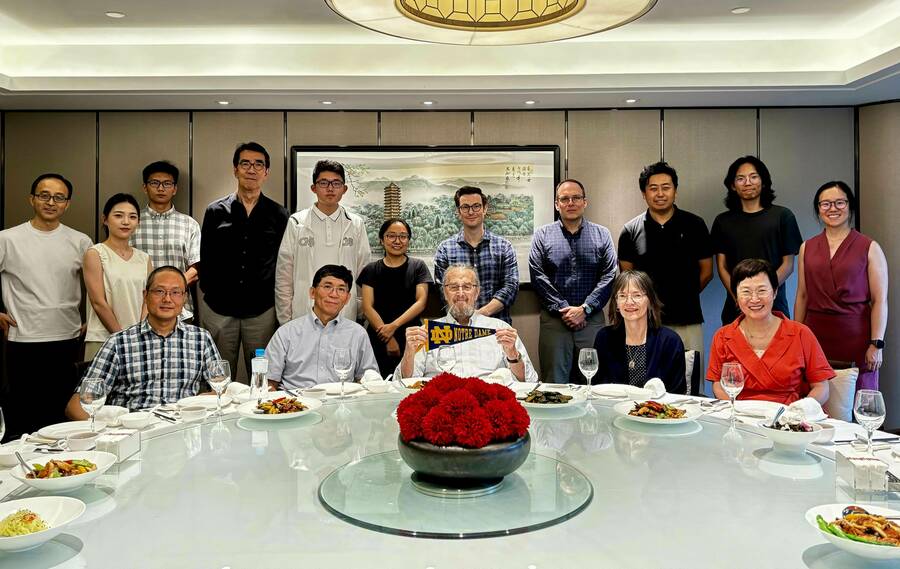
Carrie Gatestag:philosophy.nd.edu,2005:News/1666742024-09-17T13:11:00-04:002024-09-17T13:11:38-04:00First academic philosophy of science workshop solidifies connection between Notre Dame and Peking UniversityAcademic workshop panelists and participants gather for a meal.
This summer, Notre Dame Beijing and the Peking University (PKU) Department of Philosophy co-organized their first academic workshop in philosophy of science at Lee Shau Kee Humanities Building of PKU.
The theme of the event was “Einstein on the ‘Principle Theories & Constructive Theories’ Distinction.” About 20 Peking University students attended this conference in person, but the reach of the event extended far beyond the walls of the Lee Shau Kee Humanities Building. More than 9,000 scholars and students from universities all over China attended the conference via a live-streaming channel.
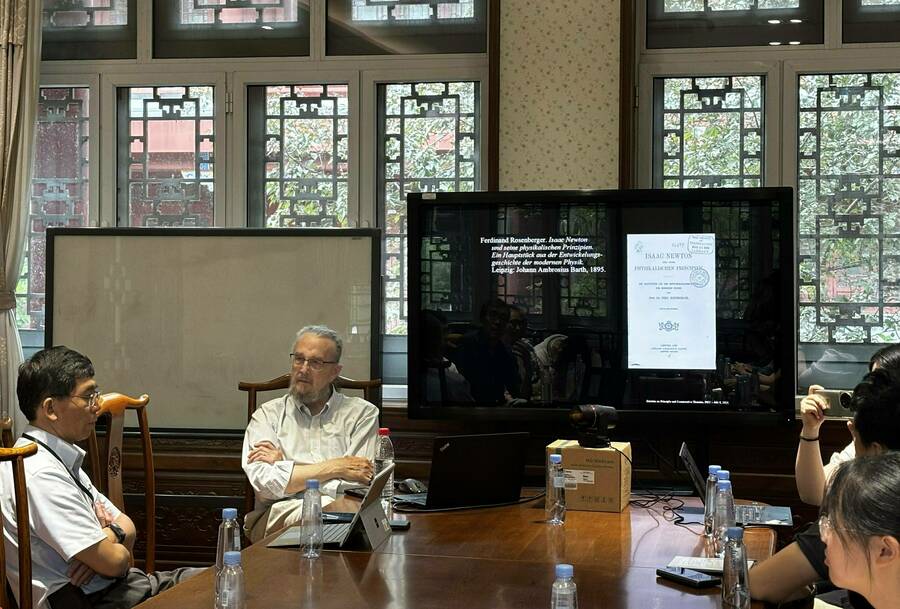
After opening remarks from Yanjing Wang, Ph.D., the vice-chair of the department of philosophy at PKU, Howard delivered the keynote speech at the event. His talk focused on his recent work on the history of “Principle Theories–Constructive Theories” distinction proposed by Albert Einstein.
Professor Don Howard delivers keynote speech.
Participants commented on topics including Einstein’s view on analytic and synthetic, this distinction’s actual impact on his research, and the contemporary rediscovery of Einstein’s contribution to the philosophy of sciences.
“That lecture was enlightening and the distinction really deepened my understanding of physical theories,” one undergraduate student from the School of Physics shared.
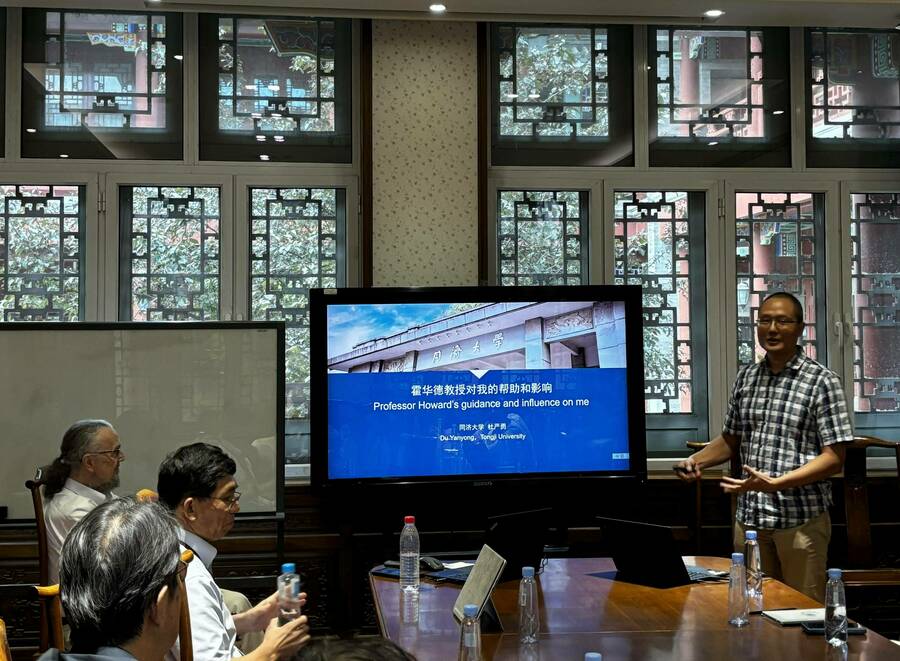
Throughout the workshop, invited panelists—leading scholars themselves—commented on Professor Howard's broad contributions to the field of philosophy. Professor Yanyong Du from Tongji University in Shanghai conveyed Howard’s foresight on the significance of Einstein’s social philosophy and AI ethics. Professor Danian Hu from Southern University of Science and Technology in Shenzhen reviewed the intricate history of Einstein studies and China, in which Howard played a remarkable role. Professor Chuang Liu from Fudan University in Shanghai highly appraised Howard’s generous contribution to the community of philosophy of physics. And Notre Dame alumnus and Wuhan University Professor Peter Finocchiaro talked about Howard’s help during his metaphysics research.
Professor Yanyong Du presents to workshop participants.
The conference concluded with closing remarks from Jingyu Wang, the executive director of Notre Dame Beijing. With insightful talks from renowned scholars and thousands tuning in through the livestream, it’s safe to say the workshop was a crowning moment of the joint summer philosophy program.
Reflecting on the work that went into creating the program, Yanjing Wang describes it as a “groundbreaking attempt in the context of the long-term exchange and cooperation between the two schools.” Wang credits much of the success to Howard, who has been a part of the planning efforts from the beginning, and whose knowledge and leadership have been vital to the new program.
While Howard will not be a speaker next year, the academic workshop will continue to be a prominent event of the program, thanks to Notre Dame Department of Philosophy Associate Professor Nicholas Teh taking up the helm. In summer 2025, Teh will take Howard’s place teaching at Peking University and will help organize the next academic workshop on the theme of philosophy of science.
“I am very happy to see that the initiative has received unanimous positive feedback from the teachers and students of both sides,” Yanjing Wang shares. “I hope that the connections and cooperation activities between the two universities will be more and more successful under the joint efforts of Peking University and Notre Dame Beijing.”
Originally published by Jessie Carson at beijing.nd.edu on September 11, 2024.
]]>
Jessie Carsontag:philosophy.nd.edu,2005:News/1629312024-05-29T14:39:00-04:002024-05-29T14:42:16-04:00Joel Hamkins wins award for textbook re-examining the art of proof-writingJoel David Hamkins is the John Cardinal O'Hara Professor of Logic in the Department of Philosophy.
University of Notre Dame mathematician and philosopher Joel David Hamkins was recently recognized for his ability to give readers “a look behind the curtain at the workings of the mind” of a mathematician through his work, Proof and the Art of Mathematics.
Hamkins, the John Cardinal O'Hara Professor of Logic in the Department of Philosophy, is the recipient of the 2024 Daniel Solow Author’s Award. The award — given by the Mathematical Association of America — recognizes authors of “outstanding undergraduate mathematics teaching materials,” such as textbooks, lecture notes, and other learning resources.
In his textbook, Hamkins re-examines the art of proof-writing and structures it around surprising and interesting mathematical topics rather than simply teaching proof methods. This innovative approach provides students and readers an opportunity to learn how to write proofs while understanding the subject in an engaging and inspiring way.
“The main audience for the book is aspiring mathematicians who want to learn how to write proofs,” Hamkins said. “But — because of the playful topics and inherent interest of the mathematics in the book — it has found a secondary audience amongst people who are not aspiring mathematicians, but just want to partake in the fascinating wonder of it all.”
According to the association, instructors who have integrated the book into their curriculum have praised it for showcasing the diverse and multifaceted nature of mathematics to their students.
“Students had not realized that math had so many different faces,” wrote one instructor. “They were amazed to discover the various ways of thinking involved.”
Previously a faculty member at Oxford University, Hamkins’ research focuses on mathematics and philosophy of the infinite, working on a broad spectrum of topics in logic and the philosophy of mathematics. He also explores set theory, potentialism, and modal model theory.
Hamkins is currently working on a new book project, tentatively titled “The Book of Infinity.” His other work includes Lectures on the Philosophy of Mathematics and journal articles on the set-theoretic multiverse, the modal logic of forcing, the dream solution of the continuum hypothesis, and transfinite game values in infinite chess.
“One of the great pleasures for any mathematician is to share the fascination and wonder of mathematics with those who are eager to learn it — to teach aspiring mathematical minds the art of mathematics, watching as they bend the logical universe to their purpose for the first time,” Hamkins said. “What a joy it has been for me to experience these moments with my students using my book Proof and the Art of Mathematics, and I am truly honored by the recognition of the Daniel Solow Award for this book. I am so glad to learn that others have understood so well what I was trying to do with the book and that they also have benefitted from it.”
Originally published by Mary Kinney at al.nd.edu on May 29, 2024.
]]>
Mary Kinneytag:philosophy.nd.edu,2005:News/1616122024-04-29T09:49:00-04:002024-04-29T10:55:38-04:00Guiding the next generation: Philosophy professor Michael Rea receives Arts & Letters Graduate Student Mentorship AwardMichael Rea is the Rev. John A. O’Brien Professor of Philosophy, director of the Center for Philosophy of Religion, and recipient of the 2024 College of Arts & Letters Graduate Student Mentorship Award.
When Michael Rea talks about mentorship, he likens it to spiritual direction.
“'It's not just helping someone through a particular philosophical project, " he said. “It's helping them to build an identity and a way of being within the profession.”
The Rev. John A. O’Brien Professor of Philosophy at the University of Notre Dame believes good graduate mentorship goes beyond helping students through their scholarly achievements — it also requires myriad traits like kindness, empathy, an ability to connect with students, and a willingness to be challenged and change.
It’s an approach that has resonated with his mentees — and helped them find success.
During his tenure, Rea has personally supervised 12 Ph.D students and is currently mentoring six. Those he has mentored have landed tenure-track jobs at prestigious programs such as Rutgers University, Fordham University, Yale-NUS in Singapore, the University of Missouri, Washington State University, Calvin University, San Jose State University, the University of Wyoming, and more.
“Collectively, they form something like a core of the next generation of young metaphysicians and philosophers of religion,” wrote Samuel Newlands, the Carl E. Koch Professor of Philosophy and chair of the department, in a letter nominating Rea for the award.
In recognition of his commitment to developing his students as scholars and people, Rea is the recipient of the 2024 College of Arts & LettersGraduate Student Mentorship Award. The honor recognizes a tenured faculty member who has demonstrated outstanding scholarly mentorship and care for students obtaining their master's and doctoral degrees. The award will be presented to Rea at the college’s spring faculty meeting at 3:30 p.m. Tuesday, May 7, in McKenna Hall.
Reflecting upon his mentorship style, Rea credits those who shaped him.
He initially came to Notre Dame for his doctoral degree because of the University’s known strength in the philosophy of religion and for its close connections between graduate students.
“Christian philosophy — and philosophy of religion more broadly — has always been a strength of this department, and there has always been a community here interested in thinking about those issues,” Rea said. “But also, setting aside particular research specialties, the community of this department has been a draw.”
Rea’s research focuses primarily on topics in philosophy of religion, analytic theology, metaphysics, and feminist philosophy. He has written or edited more than 15 books and 50 journal articles and has given numerous lectures around the world, including the 2017 Gifford Lectures at the University of St. Andrews.
During Rea’s time as a graduate student, he described working with advisor Alvin Plantinga — the John A. O'Brien Emeritus Professor of Philosophy and a Templeton Prize Laureate — as “transformative” and likened his admiration for the philosopher to how protestants admire C.S. Lewis.
“I benefitted a lot from being around him and seeing his style of doing philosophy, but he also really cared about his graduate students as people,” Rea said. “You got the sense that he wasn't just advising you on this project, but he cared about you as a person.”
While Plantinga is a brilliant philosopher and great role model, Rea said, his advising style was relatively “hands-off.” Rea mostly appreciated this approach, but he found there were times when he needed a heavier hand of guidance. For this, he leaned on philosophy professor Michael Loux, who also served as dean of Arts & Letters from 1983 to 1991.
“Mike was really more tuned into where I was at,” Rea said. “He saw I needed some help, and stepped in and helped. And that was a learning point — that the job of advisors is not to just be the ‘great man.’”
Expanding the purview
Rea also saw skills he admired in his peers, like Trenton Merricks, who was two years ahead of Rea in the Ph.D. program at Notre Dame and is now a philosopher at the University of Virginia. Merricks “was quite open about his vulnerabilities,” Rea said, which made him easy to relate to.
“He’s a really smart and successful guy, and to know some of what he was going through, I found that so helpful,” Rea said. “I carried that over into my mentoring style.”
His absorption of mentorship didn’t stop after graduate school. Perhaps the most important person he turns for mentoring throughout his career, he said, is Eleonore Stump, an emeritus professor of philosophy of religion, metaphysics, and medieval philosophy at Saint Louis University. Stump was known for serving as an informal mentor to many in Rea’s generation of Christian philosophers, and he dedicated his recent book The Hiddenness of God to her.
“Rea’s selfless pursuit of the intellectual growth of his students and his evident care for their well-being, combined with his extraordinary successes in their training and placement, sets him apart as a truly outstanding graduate advisor and as someone eminently worthy of this award.”
“She and her work have significantly impacted many of my philosophical and theological views, and I have also sought to emulate in the ways that I can what, for lack of better terminology, I might simply describe as her general ‘way of being’ in the profession,” Rea wrote in his dedication. “For all of this, too, I am thankful."
He also finds inspiration from the graduate students he works with. One particular student, Kathryn Pogin, was instrumental in shifting his interests and values by bringing to light discrimination within the discipline.
“She just helped pull back the curtain,” Rea said. “I learned a lot of things, but she was also pretty persistent in calling out my mistakes or my biased beliefs and encouraged me to think differently on a variety of issues that broadly related to feminism, climate for women, and the sorts of things that people get at when they say 'check your privilege.’”
Rea took his new enlightenment head-on. He is now a concurrent professor with the Gender Studies Program and a former chair of the philosophy department’s climate committee, which oversees its commitment to inclusivity.
“He was instrumental in initiating reforms to graduate recruiting and faculty mentoring, and he helped establish our third-party monitoring efforts to track our progress,” Newlands wrote in his nomination letter for Rea. “He is widely regarded by graduate students and faculty alike as an outspoken ally and advocate for women graduate students in our department.”
Defining success
When guiding students, Rea has found discussions that start off relating to work often become conversations about balancing personal life, as well. Newlands said he has witnessed students who have faced challenges become stronger under Rea’s guidance and tutelage.
“I feel like the people who end up being successful are the ones who work hard, try to draw appropriate boundaries between work and life outside of work, and treat it like a job they care about,” Rea said. “It’s finding the balance of the kind of job you care about, but also not letting it overtake everything else so you burn out.”
In addition to one-on-one mentoring, he has also served on more than a dozen dissertation committees, including at St. Andrews, the University of Chicago Divinity School, and Baylor University. Newlands said Rea is also sought after for advice among graduate students outside of Notre Dame. As director of the Center for Philosophy of Religion, Rea has brought in visiting graduate students from top programs such as Stanford University, the University of Pittsburgh, and Yale.
“Rea has been our most successful graduate mentor in philosophy over the past two decades,” Newlands wrote. “Rea’s selfless pursuit of the intellectual growth of his students and his evident care for their well-being, combined with his extraordinary successes in their training and placement, sets him apart as a truly outstanding graduate advisor and as someone eminently worthy of this award.”
Originally published by Mary Kinney at al.nd.edu on April 29, 2024.
]]>
Mary Kinneytag:philosophy.nd.edu,2005:News/1611802024-04-12T14:47:00-04:002024-04-19T15:17:45-04:00Philosophy professor chosen for prestigious Guggenheim FellowshipPhilosophy professor Barbara Montero has been awarded a 2024 Guggenheim Fellowship in recognition of her career achievements and exceptional promise.
Montero is one of just 188 scholars, scientists, and artists chosen from approximately 3,000 applicants for the fellowship that was created in 1925 to add to the educational, literary, artistic, and scientific power of the country.
Guggenheim Foundation President Edward Hirsch said the fellows are meeting the profound existential challenges facing humanity head-on and are “generating new possibilities and pathways across the broader culture.”
During Montero’s fellowship, she will write a draft of a book, tentatively titled “Things that Matter: Actual-World Metaphysics and the Mind-Body Problem.”
Montero read Tim Crane and Hugh Mellor's article, "There is no question of physicalism" when she was a graduate student and was inspired to think about the question of what, exactly, we mean when we talk about the physical world. She’ll grapple with that question in the book, which is currently under contract with Oxford University Press.
“I was also inspired by the Spanish philosopher, classicist, and writer Miguel de Unamuno's comment that those things that are deemed ‘not even worth refuting,’ are sometimes the very crux of the issue,” she said. “I hope to be addressing some of those things.
Montero’s prior research has focused on two different notions of the body — as a physical or material basis of the mind and as a moving, breathing, flesh, and blood instrument that people use when they run, walk, dance, and play.
]]>
Beth Staplestag:philosophy.nd.edu,2005:News/1591042024-01-10T14:06:54-05:002024-01-10T14:07:52-05:00Arts & Letters faculty continue record NEH success, winning three fellowships and a major grant
Three faculty members in the College of Arts & Letters have won National Endowment for the Humanities (NEH) fellowships, extending the University of Notre Dame’s record success with the federal agency committed to supporting original research and scholarship.
Since 2000, Notre Dame faculty have won more NEH fellowships than any other university in the country.
Additionally, a pair of A&L scholars — Katie Bugyis, the Rev. John A. O'Brien Associate Professor in the Program of Liberal Studies, and Margot Fassler, the Keough-Hesburgh Professor of Music History and Liturgy Emerita — have won a significant, three-year NEH Humanities Initiatives at Colleges and Universities grant to develop a website and to teach medieval liturgy.
“I am delighted and proud that the NEH has again supported our faculty members’ relevant and interesting projects,” said Sarah Mustillo, the I.A. O’Shaughnessy Dean of the College of Arts & Letters. “These four awards highlight the quality of diverse academic research conducted by our experts in multiple fields as well as the excellent support provided by the Institute for Scholarship in the Liberal Arts throughout the application process.”
A first-ever translation
Duarte will spend his fellowship editing, translating, and annotating Francisco Suárez’s “Metaphysical Disputation 30” (DM 30), which is a core part of The Metaphysical Disputations (DM), published in Latin in 1597.
Suárez, a philosopher and theologian, composed DM to provide a grounding in metaphysics — the study of reality and existence — that’s needed to study revelation-based theology.
Shane Duarte
DM 30, Duarte said, is devoted to the nature of God insofar as He can be known by reason unaided by revelation. It’s interesting, in part, Duarte said, because Suárez was a professor of theology and most of his works were informed by revelation.
Duarte will be the first person to translate the treatise. The volume he plans to publish will include a substantial introduction, and in his translation, he'll strive for a balance of readability and fidelity to the original text.
“Translation work is often treated as secondary, or of lesser value, but at the same time everyone working in the history of philosophy wishes that more texts were translated into English,” he said.
The translation could provide valuable insights to people who work on better-known philosophers like Rene Descartes, Duarte said. Suárez was an important thinker whose views influenced even philosophers who saw themselves as breaking from the Aristotelian tradition of which he was a part.
While Duarte’s prior work focused on later thinkers, he became convinced that a greater familiarity with Suárez's work would provide a better understanding of 17th-century European philosophy, as well as of life today.
“I tend to think contemporary philosophy benefits from an understanding of its own history, though not everyone in the field agrees,” he said. “For society? Well, I think intellectual traditions inform our understanding of the present, though again, not everyone agrees.”
When Duarte learned he had won an NEH fellowship, his initial reaction was disbelief.
“For someone like me,” he said, “who is neither tenured nor on the tenure track, winning an award like this is tremendously validating.”
A novel interpretation of a classical theory
Ogden, whose research focuses on classical Islamic philosophy, will write the first book specifically about 11th-century Muslim philosopher Avicenna’s theory of intellect.
Avicenna, who was also a physician, theorized that there were two types of intellect — the human intellect and the active intellect. Avicenna’s theory posited that active intellect was a single, eternal intellect ultimately responsible for all human understanding and for the major metaphysical components of the Earth.
Stephen Ogden
“Oftentimes when you explain it to nonexperts, they say, ‘That sounds like God,’” Ogden said. “It’s similar to God, but in Avicenna’s system, it’s a lower, semi-divine substance or intellect. It’s an intermediary between God and humanity.”
In his book — tentatively titled “Avicenna on Intellect”— Ogden will defend his novel interpretation of Avicenna’s theory as well as historically contextualize the theory with respect to Avicenna’s ancient predecessors and to later critiques.
The book will be a fitting companion piece to Ogden’s 2022 book, Averroes on Intellect: From Aristotelian Origins to Aquinas's Critique, which recently won the Journal of the History of Philosophy Book Prize.
Avicenna and Averroes, Ogden said, had two of the most important theories on intellect in classical Islamic philosophy, and they heavily influenced later Islamic, Christian, and Jewish philosophical traditions.
Evaluating the philosophical and historical reasons that Avicenna and others held their views continues to be important, Ogden said, because it helps modern readers consider their own preconceptions and biases.
“I think there's something valuable — I emphasize this with my students — in reading something that’s a thousand years old, 2,000 years old, or older,” he said. “A lot of things seem perfectly natural to our minds, given where we stand in history, but if read by an outsider a thousand years from now, they might not seem that obvious. We’ve gained much more empirical data, but philosophers and neuroscientists are still debating and exploring the nature of the human mind.”
Originally published by Beth Staples at al.nd.edu on January 10, 2024.
]]>
Christine Grandytag:philosophy.nd.edu,2005:News/1580042023-11-14T11:41:00-05:002023-11-14T11:49:40-05:00Philosopher Janet Kourany utilizes Fulbright to examine the importance of values in science
University of Notre Dame philosophy professor Janet Kourany, the 2023-24 Fulbright Canada Research Chair in Values and Science at the University of Calgary, is working on a book there this fall semester tentatively titled Bacon’s Promise.
Her book is about Renaissance philosopher Francis Bacon, a chief architect of modern science, and the promise that he and centuries of successors have made: Science, if supported by society, will improve the lot of humanity and make the world a better place.
Society has supported science, Kourany said, and science has improved humanity and made the world a better place. But she said it has also harmed the humanity it was supposed to help, and harmed some humans while helping others.
“In fact, many of the most pressing problems we face today, such as environmental pollution and global warming, racial, ethnic, and other sources of social unrest, the ever-present threat of cyberattacks, and much, much more are, I would suggest, at least partially of these sorts,” Kourany said.
“Medical research, for example, has devoted more than 90% of its resources into problems that affect only 10% of the world’s population,” she said.
A big part of the problem has to do with values — corporate values, fundamentalist Christian values, right-wing political values, and racist and sexist values — that have shaped so much of science, said Kourany, who is also a concurrent professor of gender studies.
And while scientists, science journalists, policymakers, historians, and philosophers of science have, at times, critiqued these values, Kourany said they haven’t identified and provided an effective rationale for alternative ones.
So, the problem continues.
This issue of identifying science’s values is called the new demarcation problem, and it’s a central question in philosophy of science.
The original demarcation problem — how to distinguish legitimate from illegitimate science — has been one of the most important questions in philosophy of science for centuries.
The new demarcation problem is far more modest but proves to be just as challenging, Kourany said. It seeks to distinguish legitimate from illegitimate value influences in science.
Bacon’s legacy might prove especially helpful here, Kourany said, because he provided an enduring framework for science. The framework included a vision of the benefits that science would produce, the way they would be produced, and a timeline of achievement — given that the enterprise was supported.
Most importantly, she said, Bacon's framework incorporated central tenets of Renaissance humanism — the idea of self-reliance and civic virtue, and a belief in the uniqueness, dignity, and value of human life — as an ultimate moral justification.
It also points the way to a more promising political philosophy of science and rationale for the social benefits of science. And over time, Kourany said the framework been corrected, updated, and shorn of its theological elements.
And while his moral vision — his ethics of science — also has needed further refinement, she said, thus far it has not received the attention it deserves.
That’s what she seeks to accomplish in Bacon’s Promise.
Kourany’s book research also builds on her regular courses, including Forbidden Knowledge, as well as Science and Social Values, and The Science-Gender Connection. In her classes, she and advanced science and philosophy students explore resonant and cutting-edge issues in science studies.
Philosophy can, and should, be of benefit during these extraordinary times, Kourany said.
“There’s still so much to be done,” she said. “And I want to help do it.”
Originally published by Beth Staples at al.nd.edu on November 14, 2023.
]]>
Beth Staplestag:philosophy.nd.edu,2005:News/1570612023-10-06T15:50:00-04:002023-10-06T15:50:51-04:00Notre Dame appoints three A&L faculty to lead new strategic initiatives on democracy, ethics, and poverty
Following the recent launch of the University of Notre Dame’s Strategic Framework, Provost John T. McGreevy this week announced the first three strategic initiatives emerging from that plan: Democracy, Ethics, and Poverty.
“Now the work begins to realize our ambitious vision for Notre Dame, said McGreevy, the Charles and Jill Fischer Provost. “These three University-led initiatives will be campuswide, building on existing strengths and encouraging the kind of institutional collaboration Notre Dame needs to reach its full potential and respond to some of the most complex challenges facing society today.”
David Campbell
Each initiative will be led by a faculty director, who will work closely with David Go, vice president and associate provost for academic strategy, and an executive committee that will include deans, center and institute directors, department chairs, and faculty experts. The faculty serving as strategic iniatitive directors were appointed to five-year terms beginning Sept. 1, 2023.
David Campbell, the Packey J. Dee Professor of American Democracy, will lead the new Notre Dame Democracy Initiative, a project to establish Notre Dame as a global leader in the study of democracy, a convenor for conversation about and actions to preserve democracy, and a model for the formation of civically engaged citizens and public servants. This initiative will connect research, education, and policy work across multiple units, including (but not limited to) the Department of Political Science, the Rooney Center for the Study of American Democracy, and the Kellogg Institute for International Studies, which has long been a leader in scholarship on democracy in Latin America. It will also extend beyond Notre Dame’s campus to Washington, D.C., closely connecting Notre Dame’s voice and work to policymakers and federal agencies.
Meghan Sullivan
Meghan Sullivan, the Wilsey Family Collegiate Professor of Philosophy and director of the Notre Dame Institute for Advanced Study (NDIAS), will direct the Notre Dame Ethics Initiative. The goal of the initiative is to make Notre Dame a preeminent global destination for the study of ethics, offering rigorous training for future generations of ethicists and moral leaders, a platform for engagement of the Catholic moral tradition with other modes of inquiry, and an opportunity to forge insights into some of the most significant ethical issues of our time. This initiative will connect and amplify the work of many units, including NDIAS, the Departments of Theology and Philosophy, and ethics centers across the campus focusing on different areas, including applied subjects such as business, environmental, and technology ethics and the ethics of development.
James Sullivan, professor of economics and director of the Wilson Sheehan Lab for Economic Opportunities, will direct the Notre Dame Poverty Initiative. The initiative will establish Notre Dame as a premier university for poverty-related research, student formation, and policy and program impact. This University-wide effort will bring together academic units that focus on poverty-related activities, including the Wilson Sheehan Lab for Economic Opportunities, the Pulte Institute for Global Development, and several departments, as well as students, faculty, and programs across campus that are involved in the fight against poverty.
James Sullivan
These initiatives all emerged from the most faculty-led strategic planning process in Notre Dame’s history. This process included the 107 proposals involving more than 700 unique faculty that were developed as part of the Moment to See, Courage to Act initiative, as well as discussions among the deans, members of the President’s Leadership Council, and executive officers. Democracy came directly out of Moment to See, Courage to Act. Poverty became the focus of one of the University-wide theme advisory committees that informed the Strategic Framework. Ethics was identified as an important priority by the Opportunities for Excellence theme advisory committee.
“These three initiatives are only a first step,” McGreevy said in a Sept. 6 message to campus. “As the Strategic Framework implementation gets underway, faculty, staff, and students will have opportunities to engage with multiple college and school initiatives linked to the framework, as well as initiatives begun at the University level. I am grateful to the deans of the colleges and schools for their participation in and leadership of this effort, to David Go for guiding this first phase, and to Dave, Meghan, and Jim for taking on the particular challenge of launching new initiatives.
“I hope you will join me in congratulating these colleagues on their new roles and for their willingness to advance our shared vision as the world’s leading global Catholic research university.”
Originally published by Kate Garry at provost.nd.edu on September 07, 2023.