tag:ftt.nd.edu,2005:/news-events/newstag:ftt.nd.edu,2005:/latestDepartment of Film, Television, and Theatre | News2026-06-15T14:55:00-04:00The Department of Film, Television, and Theatre's major and minors feature a high level of scholarship, hands-on courses, and state-of-the-art facilities.tag:ftt.nd.edu,2005:News/1825332026-06-15T14:55:00-04:002026-06-15T15:12:27-04:00Call for Proposals | 100 Years Strong but Forever 16: Reclaiming and Expanding Teen Entertainment History100 Years Strong but Forever 16: Reclaiming and Expanding Teen Entertainment History
A Symposium at the University of Notre Dame April 2–3, 2027
Summary
Teen entertainment was first developed in the United States via popular literature during the early twentieth century before gaining further momentum in radio, theatre, film, and comic books during World War II. By the early 1950s, teen-centered entertainment had found its way to American television, further contributing to the commodification of teen culture. The early postwar era saw a rise in teen entertainment in many countries, especially those in Europe, partially due to the United States’ cultural power abroad, along with the financial success of teen-centered entertainment properties and young people’s desire to see themselves represented.
As a result of an increase in transnational media flows during the late twentieth and early twenty-first centuries, teen entertainment is now produced and consumed in virtually every country around the world, helping to shape social constructions of adolescence, young people’s identities and cultural expressions, as well as adults’ engagements with teenagers. Regularly ignored, if not derided, by older audiences interested in more “sophisticated” forms of culture, the teen audience nonetheless continues to be one of the most lucrative markets for entertainment industries worldwide.
Until recently, the history of teen entertainment has been dominated by studies of U.S. films and television shows that feature white, heterosexual, able-bodied, middle-class youth. Minimal attention has been given to other countries, other entertainment media, and other ways of identifying and being a “teen.” Bringing together faculty and student scholars from around the world, this symposium aims not only to expand the field of teen entertainment history but also to honor and promote the research of scholars working to enrich this unique field of study.
Deadline for submissions
Friday, October 16, 2026, at 11:59 p.m. (US Eastern Daylight Time)
Acceptance notifications: mid-January 2027
Guidelines
The Program Committee is interested in promoting research on the history of teen entertainment, which we define broadly as popular literature, plays, films, radio programs, television series, comic books, and video games, as well as music, musicians, and other entertainers. Proposals that expand the study of teen entertainment history via attention to non-normative identities, intersectional perspectives, non-Western national frameworks, and/or globalization are especially welcome. Proposals focused on current teen entertainment are welcome but should take a historical perspective.
Proposals for open-call individual papers, preconstituted panels, and preconstituted roundtables are welcome.
Individual open-call paper proposals should include an abstract of 250 words, as well as contact information and a short bio (75–100 words) for all authors. Co-authored papers are welcome. (The Program Committee will assemble panels from accepted paper proposals. Volunteers to act as chairs are welcome.)
Preconstituted panel proposals should include a 250-word panel proposal as well as an abstract (250 words), bio (75–100 words), and contact information for each participant. Each panel should be made up of three to four papers (inclusive of the chair and, if applicable, one respondent). Panel co-chairs are welcome, as are paper co-authors and respondents. The chair can serve as the respondent.
Preconstituted roundtable proposals should include a 250-word proposal along with a bio (75–100 words) and contact info for each participant. Each roundtable should have four to six participants, inclusive of the chair and, if applicable, the co-chair.
The Program Committee includes Barbara Jane Brickman, Mary Celeste Kearney, Diana Leon-Boys, Sharon Ross, Timothy Shary, and Frances Smith.
Questions?
Please direct any questions to Mary Celeste Kearney (mckearney@nd.edu).
]]>
Todd Borufftag:ftt.nd.edu,2005:News/1818512026-05-18T08:11:00-04:002026-06-01T14:40:21-04:00Beyond the Game: Exploring Sports, Media, and Culture at Notre Dame
SMAC courses emphasize intersectionality. A special aspect of the minor is that faculty members represent dozens of different academic disciplines at Notre Dame. Walden highlights the excitement of figuring out connections between disciplines and asking profound questions about these subjects’ application to SMAC.
Especially considering the University’s strong football presence, Notre Dame is a good place to examine the phenomenon of “sport” in sport, media, and culture. In particular, the global and international dimensions of sport, in every instance from the Winter Olympics to the World Baseball Classic, challenge students to look at the bigger picture of how physical movement and image are intertwined around the world.
The Women's Network celebrates 50 Years of Women in Sports at Notre Dame, hosting a fireside chat with Head Women's Basketball Coach Niele Ivey '00
While students can explore organized and elite sport through the SMAC minor, they also navigate athleticism through physical fitness and recreational activities. Courses such as Recess Matters, taught by Professor Andrea Christensen, draw on theories of play and educational psychology, showcasing sport as a wider realm than we typically imagine it to be.
In terms of analyzing sports through media and digital tools, Walden says that SMAC courses emphasize changes in history to see how stories are crafted and audiences understand narratives. “We’re understanding what sport would look like without media. A lot of this happens with commentary, watching, and sharing. 40 years ago, being a sports fan was about watching games live. Now it’s fantasy leagues and highlight reels, which are made possible through media, platforms, and screens,” she says.
Ashley Barton '26 says the SMAC minor has allowed her to explore her passion for sports while simultaneously expanding her holistic education and making her a more well-rounded student. “Taking classes like The Business of Sports Media and Football in America deepened my appreciation for the meaningful influence that sports have in our lives," says Barton. “I have met so many great students who share similar but also very different interests, which has been super cool!”
Walden explains that solely focusing on the United States wouldn't encompass the interests of the global Notre Dame student body, so the courses aim to bring the international dimensions of sport to the forefront of the discussion. She says that in the future, the department wants to increase the reach of global sport even further in SMAC classes, while continuing to show international students on campus that SMAC is a place for them.
Students in the SMAC minor at Lucas Oil Stadium, home of the Indianapolis Colts
SMAC isn’t just about what’s going on inside the classroom, either. The minor organizes volunteer opportunities, offers guidance for internship opportunities, and hosts campus-wide events. Recent events have included a SMAC Talk with Dr. Brian Hainline, chief medical officer for the U.S. Tennis Association and the NCAA, as well as an open panel discussion on gender and queer representation in sports and media.
Another senior with a SMAC minor, Yuliana Beda '26 emphasizes that the minor has helped point her to the wide range of careers within the sports media industry, which transform her interests into genuine opportunities within that space. “The professors are amazing, passionate, knowledgeable, and [are] always pushing us to think critically about the evolving world of sports media," she says. "I’ve also really enjoyed hearing from guest speakers across different areas of the industry, as they’ve given me valuable insight into the many paths you can take within sports media."
Walden explains that there’s always a way to learn more and find answers to big questions posed in Notre Dame classes. Even if you aren’t able to commit to the minor, there are still ways to think through how various disciplines provide an outlet for discussions about culture, identity, and power. From taking an introductory level cultural studies class to conducting a creative project on sport, expanding that creative thinking serves as a fulfilling, meaningful practice.
Ultimately, SMAC fits into a Notre Dame education with its focus on the common good—through teaching others how to communicate with those who are different from them, providing a discussion space for talks about human flourishing, and exploring humans' fundamental rights to play and movement. As SMAC faculty and students constantly say when speaking about their studies, “It’s more than just a game.”
SMAC faculty and staff are also available for discussion, so prospective students are welcome to reach out before applying!
Originally published by Sarah Neus at admissions.nd.edu on May 18, 2026.
]]>
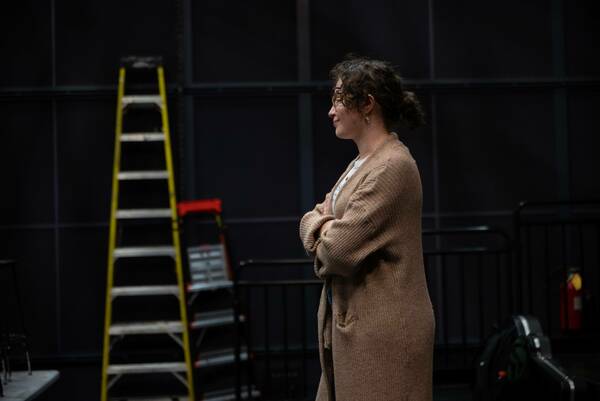
Sarah Neustag:ftt.nd.edu,2005:News/1816502026-05-11T12:21:00-04:002026-06-02T09:03:54-04:00Art through lived experiences: How Carolyn Dell ’26 found connection and collaboration as a film, television, and theatre majorSenior Carolyn Dell is a film, television, and theatre major who has a passion for stage management and directing. (Photo by Jon L. Hendricks/University of Notre Dame)
Carolyn Dell’s career path was ignited by a fireworks show.
As a sophomore in high school, Dell’s father — who worked in theme parks entertainment — gave her the opportunity to program part of a fireworks show at Six Flags.
Dell watched as her art lit up the sky and became the backdrop for a couple’s surprise engagement. That’s when she knew that, no matter what, she needed to continue making art.
“That memory is going to be part of their lives forever,” Dell said. “And I’m always going to be part of their lives through this work.”
What she didn’t know was that live entertainment would turn into the heart of her Notre Dame journey.
Though it meant long days heading from class to rehearsals, Dell was motivated by that same feeling that gripped her during the fireworks show— becoming part of people’s lives through a unique moment of connection.
“Whether it’s your hometown parade or a professional Broadway show, you’re connecting over a shared experience,” Dell said. “And that’s the important thing — having that shared human experience with other people’s lives in a moment that can’t be recreated.”
Learning to ‘just do the thing’
Born in South Bend but raised in San Antonio, Dell described her return to northern Indiana and Notre Dame’s campus as a homecoming.
“This place is just different, and you can feel it in person,” she said.
Early on as an undergraduate, Dell met with faculty members like television associate teaching professor Michael Kackman, who serves as the department director of undergraduate studies, who encouraged her to follow her passions.
Senior Carolyn Dell manages curtains in the DeBartolo Performance Arts Center on Notre Dame's campus. (Photo by Jon L. Hendricks/University of Notre Dame)
Initially considering a history major, Dell found the FTT major and her liberal arts education satisfied her interests through its interdisciplinary approach.
“You learn the practical, hard skills that you need to be successful in the industry, but you also cultivate your breadth of history with gender studies classes, history classes, math classes,” she said. “So that you’re able to more successfully interact with the art you’re making.”
From her very first semester, Dell was encouraged by her professors to “do the thing,” a phrase that Matt Hawkins, director of theatre and musical theatre and associate professor of the practice, is known for saying.
In her first year, Dell served as assistant stage manager for the department’s Steel Magnolias production. Though Dell was among the youngest members of the crew, she said, everyone was eager to share advice and help her discover her place.
“I never expected to have that level of responsibility in the department already,” she said. “But the professors were just so accommodating to my interests and my drive to want to be involved, to want to learn more.”
Dell was immediately drawn to the stage manager position because it allowed her to combine her self-described “type A” personality with her passion for art.
Stage managers handle everything from calling cast members to rehearsals and fittings, making sure props are in the right place, and even solving emergencies the day of the show — all in service of a smooth production.
“In stage management, I always say your creative process is making everyone else’s art cohesive into one vision for a live audience at the same time. While directing is standing back and telling everyone, ‘this is our goal and our direction, let’s see what you make.’” — Carolyn Dell, ’26
“You’re helping people create what they love,” she said.
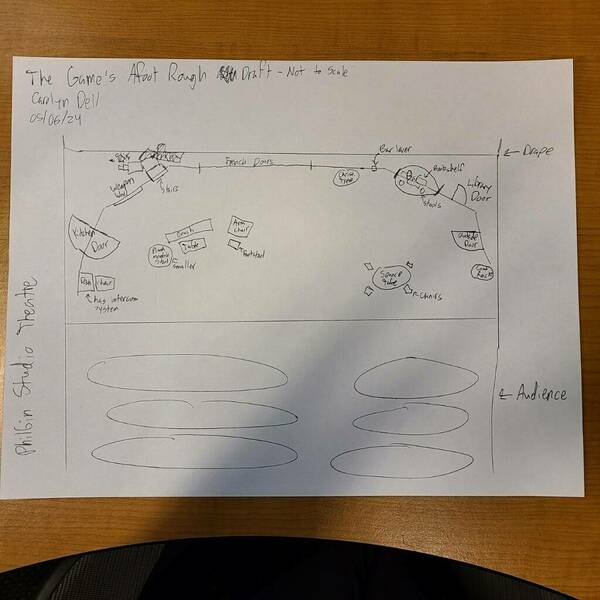
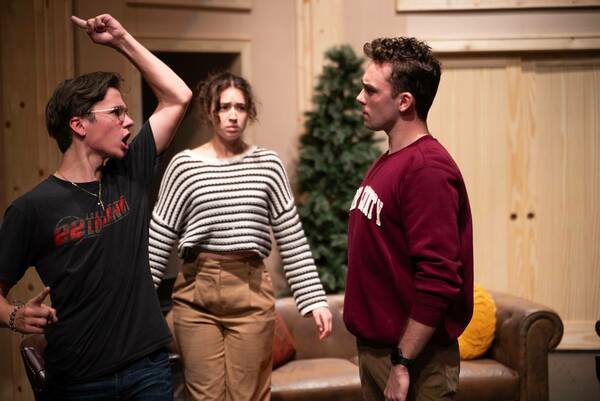
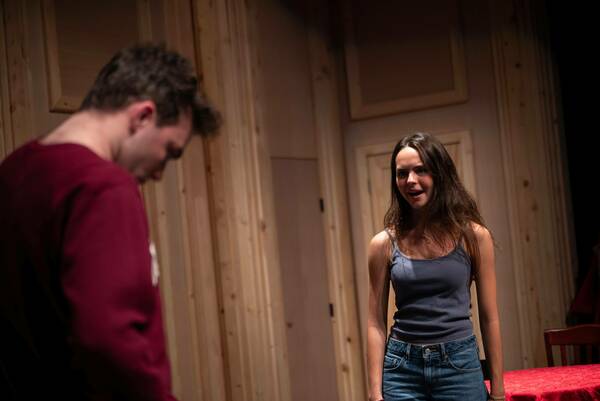
Soon, Dell wasn’t just helping others create — she was taking on a lead creative role. Dell was selected as the student director for the department’s fall show in her junior year. She pitched and directed The Game’s Afoot; orHolmes for the Holiday, a comedic murder-mystery.
“In stage management, I always say your creative process is making everyone else’s art cohesive into one vision for a live audience at the same time,” she said. “While directing is standing back and telling everyone, ‘this is our goal and our direction, let’s see what you make.’”
Dell enjoyed the process so much that she also directed Little Shop of Horrors for PEMCo the following fall. She even added a minor in musical theatre to better understand how to give meaningful directions and feedback for singers.
Though Dell’s time in theatre has been predominantly behind the scenes, her capstone project for the minor, advised by Hawkins, brought her own perspective to the stage. In a one-act performance, Dell recalled sequences from the campus productions she participated in, with footage from those productions playing behind her.
Dell said Hawkins gave her the encouragement and support to tell her own story and connect directly with the audience in a new way.
“That’s something that’s really special about this department — all the faculty, all of the staff as well, and all of the students are so excited to create and make new things,” she said. “And they are willing to help each other out to do those things.”
Gaining real-world experience
Though summer breaks could have been an intermission from Dell’s busy campus life, she stayed engaged with internships and gained real-world experience across themed entertainment and equity theatre productions.
Inspired by her family’s work, Dell spent a summer as a stage manager for musical shows and live entertainment attractions at Six Flags Fiesta Texas, and the next summer, she served as assistant stage manager of a union theatre production through the Notre Dame Shakespeare Festival.
“It gives students the opportunity to participate in this professional environment with professional standards as a summer internship,” Dell said.
In 2025, Dell interned at cruise line Royal Caribbean — a role she continued remotely, part-time, through her senior year. She applied her project management skills to a corporate live entertainment by consolidating wardrobe inventory, coordinating booking needs for auditions, and more.
Senior Carolyn Dell overlooks the auditorium at DeBartolo Performance Arts Center at Notre Dame. (Photo by Jon L. Hendricks/University of Notre Dame)
“Notre Dame really set me up to get all those internships, and to also be able to have the ability to access a lot of opportunities postgrad,” Dell said.
After graduation, Dell will begin a project management internship at Electronic Theater Controls, a company that designs and manufactures lighting equipment for live entertainment venues across the country.
Long-term, she sees herself staying in project or stage management, perhaps even going on tour with productions. And one day, she hopes to create her own productions — an idea that excited her in assistant professor Sarah Gitenstein’s class, Acting and Directing New Work for the Stage.
“Theater is always changing and evolving, and collaborating with playwrights is how you move the industry forward,” she said. “I’m excited to be able to collaborate on something that no one else has ever done.”
As the curtain closes on Dell’s time at Notre Dame, she can’t help but reminisce on all her favorite memories: dancing backstage with PEMCo before every performance, listening for a crewmate’s “Let’s go, girls” as their cue to move a 15-foot puppet across a stage, and even coming back to her residence hall after long rehearsals to chat her first-year roommate, who became one of her closest friends.
Though she’ll always feel a fondness for the people and productions that filled her time here, Dell said, she also feels prepared to start the next act of her life.
“Notre Dame really sets up arts majors to have a point of view on a subject,” she said. “And I think that’s going to serve me very, very well going into the workforce.”
Originally published by Hailey Oppenlander at al.nd.edu on May 11, 2026.
]]>
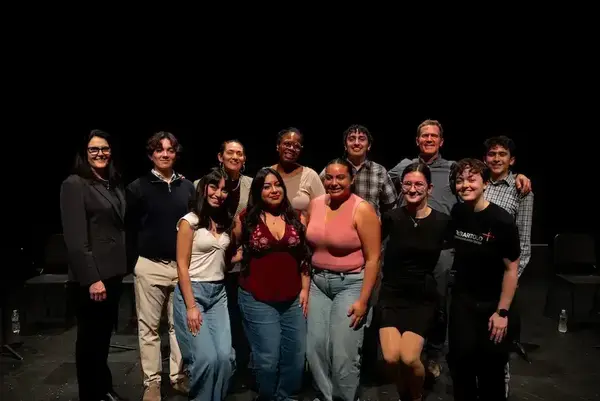
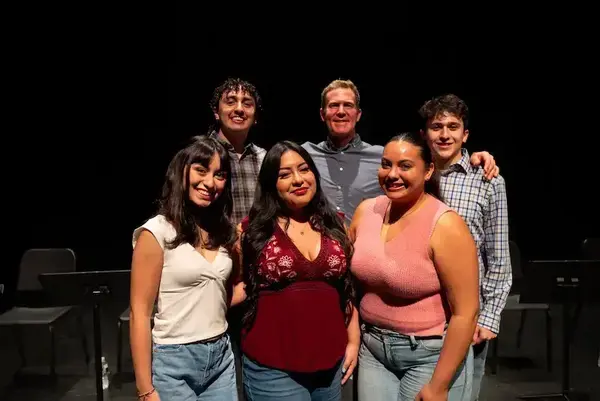
Hailey Oppenlandertag:ftt.nd.edu,2005:News/1811652026-04-28T09:32:00-04:002026-04-28T09:32:41-04:00Notre Dame alumna Dolores Díaz returns to campus for staged reading of George Washington’s Mexican BirthdayPlaywright Dolores Díaz (2nd row, 3rd from left) with University of Notre Dame students and faculty on stage at the DeBartolo Performing Arts Center following the staged reading of George Washington’s Mexican Birthday.
Playwright and University of Notre Dame alumna Dolores Díaz returned to campus on Thursday, March 26, for a staged reading of her play George Washington’s Mexican Birthday at the DeBartolo Performing Arts Center. Directed by Gabrielle Randle-Bent, the reading was followed by a post-show conversation moderated by Anne García-Romero, professor in the Department of Film, Television, and Theatre and ILS Faculty Fellow. Earlier that afternoon, Díaz also met with students for an informal conversation in the Julian Samora Lounge in Bond Hall. Díaz, a 2005 Notre Dame graduate, spoke with students about growing up in Laredo, Texas, her path from science to the arts, and the questions of identity and belonging that shape her work.
Set in Laredo, George Washington’s Mexican Birthday follows a group of high school students preparing for the city’s George Washington Birthday Celebration, a setting Díaz uses to explore identity, ambition, radicalization, and the pressures placed on Latiné students as they imagine their futures. The play was originally developed at the 2024 Goodman Theatre New Stages Festival. During her conversation with students in Bond Hall, Díaz reflected on how leaving home can make identity suddenly feel newly visible. “You don’t really think about our identity,” she said, “because it just feels like home.”
That tension between home, perception, and self-definition was central to the day’s conversations. Díaz told students that some of the play’s questions grew out of her own experience coming to Notre Dame and encountering new expectations around how identity is understood and categorized. She also spoke candidly about the challenge of finding belonging on campus, recalling that “it took me a while to find my people.” In another moment, she described her artistic interests as grounded in places where “identity is unstable enough that it is both serious and at times absurd,” a line that helps illuminate the play’s tone and its layered treatment of race, performance, and belonging.
The reading was co-sponsored by the Department of Film, Television, and Theatre, Letras Latinas, which is the Institute for Latino Studies’ literary initiative, the Franco Family Institute for Liberal Arts and the Public Good, and the Teaching Beyond the Classroom program provided by Mr. Earl Linehan and Mrs. Darielle Linehan. The event also grew out of a larger collaboration between ILS and FTT. In a February article previewing the program, Dr. Karen Richman, Director of Undergraduate Studies at ILS and Latino Studies Professor of the Practice, explained that the idea of inviting Díaz emerged after she and students in the Institute's Cross Cultural Leadership Program attended a Chicago production of Díaz’s Black Sunday in July 2024 and later shared dinner and conversation with the playwright. Richman called the prospect of bringing Díaz back to campus “an unforgettably inspired experience for all.”
For Francisco Aragón, director of Letras Latinas and Latino Studies Professor of the Practice, the event also opened up exciting possibilities for future programming. “When Letras Latinas had an office, and was headquartered in Washington, D.C., my love for the theater skyrocketed,” Aragón said. “So when ILS faculty member Karen Richman pitched the idea of bringing Dolores Díaz to campus to stage a reading of her play, I was all in. Plays are a literary art, after all. My hope is that staging a reading of George Washington’s Mexican Birthday was the beginning of a new trend.”
Student participation was central to the performance as well. The cast and production team included Notre Dame students Ryan Madrid, Eny Ramirez, Jenisse Jarquin, Diego Ramos, and Annika Fernandez, along with Notre Dame alumnus Timothy Merkle and local professional actor Jared Fernley. The visit also extended into the classroom, with Díaz and Randle-Bent visiting García-Romero’s “Playwriting” and “Adaptation” courses, as well as Sarah Gitenstein’s “Acting and Directing New Work for the Stage.” Gitenstein, an assistant professor in FTT, also served as a co-producer of the performance.
Student performers and faculty gather on stage following the staged reading of George Washington’s Mexican Birthday at the DeBartolo Performing Arts Center.
Annika Fernandez, an undergraduate who participated in the staged reading and played Magdalena Santos, said the experience pushed her into unfamiliar but rewarding territory. “Although I had no prior acting experience and felt hesitant at first, learning more about the storyline sparked my curiosity about the character and encouraged me to take on the role,” Fernandez said. She added that working with Díaz, Randle-Bent, and the rest of the cast was “truly a rewarding experience,” and that the rehearsal process revealed “the level of commitment and passion shared among the entire team.”
Stephania Sanchez, an ILS Latino Studies Merit Scholar, served as an undergraduate research assistant on the project, said the play’s themes resonated deeply. “Serving as an undergraduate research assistant on this project was especially meaningful, as its themes of Hispanic labeling, navigating multiple identities, and cultural celebration deeply resonated with me,” Sanchez said. “Bringing Dolores Díaz back to Notre Dame as an alumna felt powerful, and her work skillfully builds tension for characters you might initially dismiss and ultimately challenge your assumptions.” Sanchez added that students walked away with “a deeper understanding of identity and a renewed appreciation for storytelling as a way to humanize complex experiences.”
Díaz’s return to Notre Dame brought students into conversation not only with a working playwright, but with an alumna reflecting openly on the path that took her from South Texas to Notre Dame and eventually to the stage. In the Julian Samora Lounge, she offered one more piece of advice that seemed to resonate beyond playwriting itself: “Focus on the work, focus on what you can control.” For students navigating their own questions of identity, vocation, and voice, that message felt especially fitting.
Originally published by Parker Gaines at latinostudies.nd.edu on April 23, 2026.
]]>
Parker Gainestag:ftt.nd.edu,2005:News/1787362026-01-27T15:19:00-05:002026-06-02T09:05:08-04:00Using Canvas to Streamline the Path to Collaboration
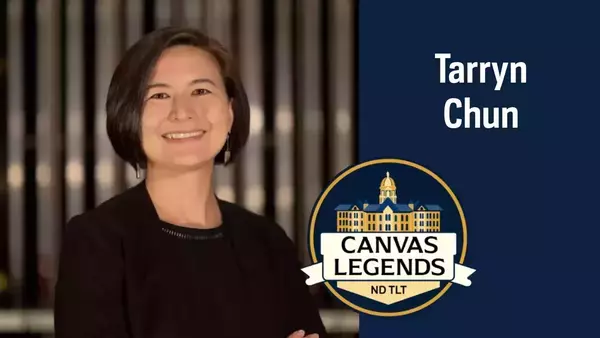
Canvas Legends is a program at Notre Dame where students recognize instructors for the extra work they’ve put into their Canvas course sites. While some faculty seem like “old pros” at using technology to teach, many stress that their process has simply been iterative over time; they tried something new one year, then added to it the following semester, to create what eventually became a very useful teaching tool.
When Tarryn Chun, associate professor in the Department of Film, Television, and Theatre, arrived at Notre Dame, she brought with her some insider knowledge: She had spent some of her grad school years migrating courses into Canvas. That experience taught her a fundamental truth that many educators miss—just because Canvas can do everything doesn't mean it should.
For Tarryn, a successful course site isn't about flashy features; it’s about reducing the “cognitive load” on students so they can focus on the learning exercises that will make them successful in the course.
The Architecture of “Less is More”
Tarryn’s philosophy begins with an intentional paring down of the digital workspace in her courses. She believes that the more tools visible to students on the Canvas course menu, the harder it is for them to find what they actually need. By hiding most content links (assignments, files, quizzes) and funneling everything through a single, streamlined path in Modules, she ensures that one location will keep students on track.
Within each module, she uses Canvas Pages to give context to the work students will be doing. “I have a page for each week that I update with the dates in a given semester,” she explains. “It has the assignments linked either to a PDF or to reserves.”
Engineering Accountability Through To-Dos
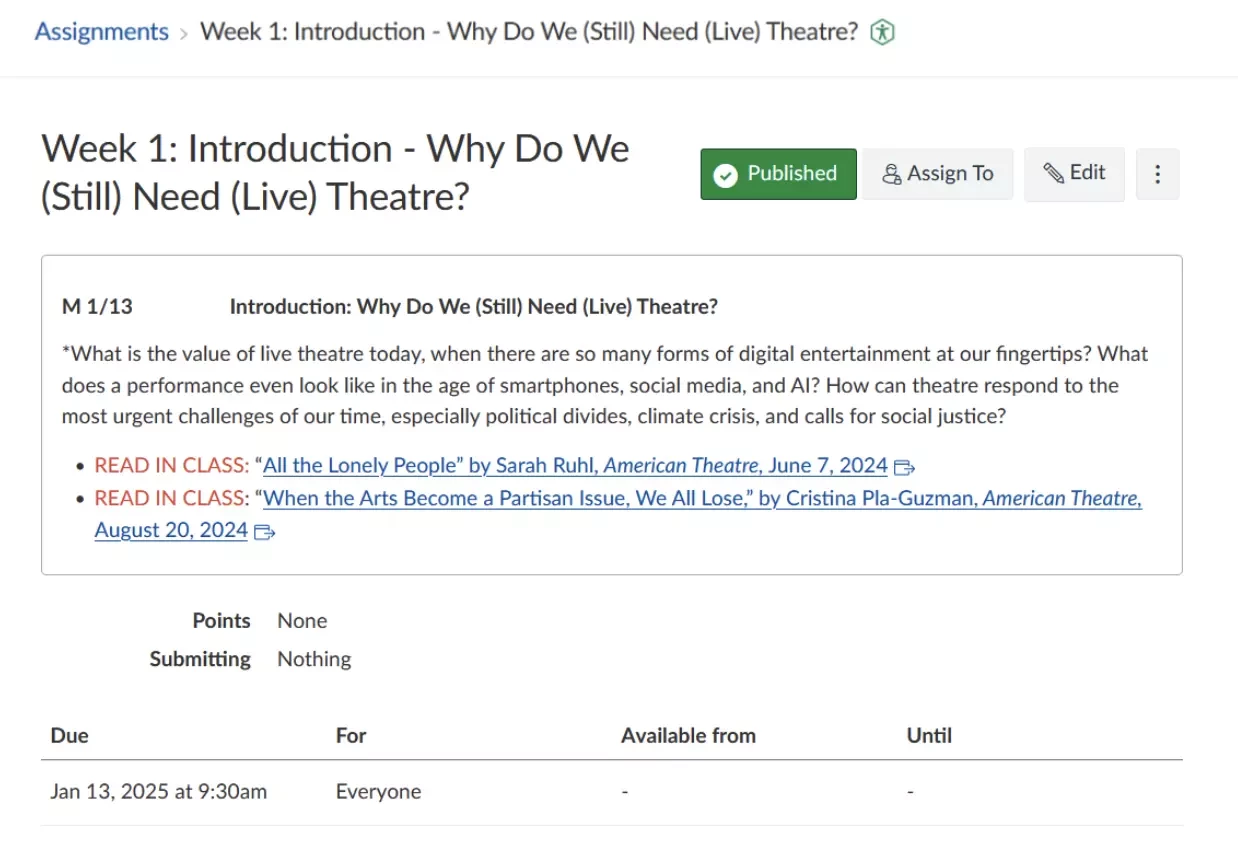
Making class prep an assignment, with a due date, to help students come prepared (click to expand).
In the humanities and arts, the biggest hurdle is often getting students to treat prep work with the same urgency as a final paper. In a ten-person, discussion-based class, “faking it” isn’t an option; you either watch the performance and read the text, or the conversation stalls. This is especially true for her first- and second-year students.
“I find getting them to stay on top of the material they’re supposed to cover before class that day is the biggest challenge,” Tarryn says. To solve this, she no longer lists readings as just a list of files in her course. “I post readings as an assignment within Modules that have what they need to watch and read and do in class linked in it.“
By adding due dates to the prep assignments, they appear in a student’s dashboard to-do list and calendar, keeping them top-of-mind in an otherwise busy week. By making prep work an assignment, it creates a digital “nudge” that moves preparation from an optional selection to a required task with an approaching deadline, ensuring that when students show up to class, they are ready to actually engage.
Creating a Collaborative Space in Canvas
Because Tarryn’s classes are highly collaborative, she looks for ways to allow students to display and react to each others’ work. One way she accomplishes this is by integrating a class Google Drive directly into the menu bar—managed easily through a course listserv—which gives students a workspace that feels integrated and simple to use.
“I am never confused about what is due when, and everything is incredibly clear and well thought out. If she says she will adjust something on the syllabus, it’s adjusted in Canvas, too. If she announces something in class that’s important, it ends up in announcements on Canvas, too. Consistent, accurate, reliable, clear. A true Canvas Legend.” —One of Tarryn’s Students
She also uses Canvas Discussion forums as a public gallery where students can upload videos, embed YouTube clips, or share written responses. The Discussions forum allows students to respond to each others’ submissions in a meaningful way, no matter what medium they choose. It isn’t just about turning in work for a class; it’s about seeing, appreciating, and being inspired by each others’ creative output. For Tarryn, the technology is at its best when it gets out of the way and lets the students’ collective creativity take center stage.
Originally published by Laura Cira at learning.nd.edu on January 27, 2026.
]]>
Laura Ciratag:ftt.nd.edu,2005:News/1779922025-12-16T11:37:00-05:002025-12-16T11:37:05-05:00Theatre historian honored for work that highlights the hidden stories of disability arts
For a historian, finding 20 boxes of archived source material is a pretty big deal. And when Patrick McKelvey found more than 150 boxes of papers stemming from just one man, he knew he’d struck gold.
Patrick McKelvey, associate professor of theatre in the Department of Film, Television, and Theatre
He was researching the history of disability and the arts at Yale University’s Beinecke Rare Book and Manuscript Library when he discovered Ron Whyte. Whyte was a disabled playwright and activist who McKelvey describes as “incredibly weird, prolific, and imaginative.” He ghostwrote Marvel comics, was nominated for a Pulitzer Prize, and founded an activist organization.
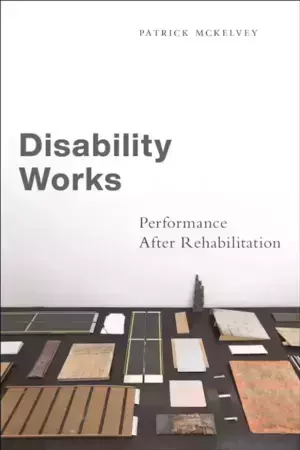
But McKelvey, who studies the social, cultural, and theatrical history of disability in the U.S., had never heard of him. And after reading Whyte’s story and realizing his place in the history of disability and the arts, McKelvey made the playwright a focal point of his first book, Disability Works: Performance After Rehabilitation.
“The book invites us to think about a deeper history of disability arts and culture movements,” McKelvey said.
Disability Works details the history of disability and performance in the United States between World War II and the passage of the Americans with Disabilities Act in 1990. Published last year, it covers an understudied yet foundational aspect of the Disability Rights Movement, and it has earned McKelvey considerable recognition for his research.
“The fact that my book could land with scholars in such a diverse array of disciplines was really meaningful,” said McKelvey, an associate professor of theatre in Notre Dame’s Department of Film, Television, and Theatre. “I’m really grateful for the recognition.”
‘A deeper history’
Disability performance as a research field has grown immensely in the 21st century, McKelvey said, but most of the work is focused on contemporary artists and initiatives. In his research, McKelvey has observed an assumption that a disability arts and culture movement emerged alongside civil rights activism in the 1970s, creating an environment in which disabled artists could make self-consciously political work.
“All that’s true, but there’s less recognition of the idea that there is a politically invested, socially conscious disability arts and culture movement that precedes disability rights movements,” McKelvey said.
Disability Works fills this gap, looking at the decades before the civil rights movements of the ’70s.
In that period, the U.S. government focused disability policy on vocational rehabilitation. This paradigm suggests that what makes a person disabled is less their physical, mental, or intellectual difference in itself, but rather how their difference impedes their ability to labor, McKelvey said.
To help people with disabilities enter the workforce, the U.S. Office of Vocational Rehabilitation created programs to provide them with job training, career counseling, and educational support. And that included investments in the arts — a place where they could find employment.
It’s difficult for most artists to earn a steady income, and disabled artists have the additional struggle of needing robust health insurance. The Comprehensive Employment and Training Act ultimately became a lifeline for disabled artists, McKelvey said, providing them with full-time, salaried employment for creating and teaching art in their local communities.
Whyte was employed by CETA for two years and was placed at the John Jay College of Criminal Justice in New York City as its playwright-in-residence.
“As that job title would suggest, he was supposed to write plays,” McKelvey said. “But he didn’t really write anything while he was employed.”
Instead, Whyte took advantage of the economic security — the first time in his life he had it — to fight for the rights of disabled artists through his own activist organization, the National Task Force for Disability and the Arts.
Discovering Whyte’s archival records forced McKelvey to reconceptualize his project. It became the story of government initiatives that preceded Whyte and how Whyte turned basic support into institutional contributions that still affect disability arts today.
“Disability Works is interested in the way disabled artists experienced government initiatives and resources in ways that are more invested in collective justice for disabled people,” McKelvey said. “Not just whether any individual disabled person gets a paycheck.”
Activism and performance intertwined
The arts and disability studies might initially seem a peculiar combination, but their histories are intertwined, McKelvey said.
During the disability rights movement, arts venues became spaces to test issues of equal access, such as how people with physical disabilities can enter buildings or how blind people can enjoy visual performances.
“Theatres become stand-ins for the ways in which disabled people are excluded from public life,” McKelvey said. “And a lot of disability activism in the 20th century took the form of performance, too.”
“This historical work is a gift I can provide that conversation."
McKelvey continues to work on this intersection in his next book, "Supporting Actors: AIDS, Infrastructure, Performance,” which he is drafting with support from the National Humanities Center as one of its 32 fellows for the 2025-26 academic year.
The book will share the story of the American theatre industry’s response to the AIDS epidemic, specifically how the Actors’ Fund — now called the Entertainment Community Fund — began to function as an AIDS service organization.
While these stories are personally interesting to McKelvey, a large part of why he researches disability arts history is because not many can. Though the field is growing, many disability arts scholars are artists themselves and focus on creating and theorizing their own work. Many are also disabled and therefore face barriers to completing archival research.
As someone with the physical ability and the institutional support to write history, McKelvey sees his work as an opportunity to ask new questions and tell hidden stories.
“This historical work is a gift I can provide that conversation,” he said.
Originally published by Adah McMillan at al.nd.edu on December 15, 2025.
]]>
Adah McMillantag:ftt.nd.edu,2005:News/1762322025-11-03T14:58:00-05:002025-11-03T14:58:29-05:00Two Notre Dame Faculty Members named finalists for the Barnard Hewitt Award for Outstanding Research in Theatre History
Two Notre Dame faculty members in the Department of Film, Television, and Theatre (FTT) are on the Short List of Finalists for the Barnard Hewitt Award through the American Society for Theatre Research. Tarryn Chun was nominated for Revolutionary Stagecraft: Theater, Technology, and Politics in Modern China and Patrick McKelvey for Disability Works: Performance After Rehabilitation. The final award will be announced in November. Both authors have already received outstanding recognition for their books.
Tarryn Chun is an Associate Professor and Director of Graduate Studies in the Department of FTT, holds a concurrent appointment in the Department of East Asian Languages and Cultures, and is a Faculty Fellow at the Liu Institute for Asia and Asian Studies. Her recent bookRevolutionary Stagecraft (University of Michigan Press, 2024) traces modern Chinese theatre history through stage technologies such as set design, lighting plots, and prop schematics to reveal the "complex and at times surprising ways in which Chinese theater artists and technicians of the 20th century envisioned and enacted their own revolutions through the materiality of the theater apparatus." Chun’s book previously won the George Freedley Memorial Award from the Theatre Library Association as well as the Outstanding Book Award from the Association for Theatre in Higher Education, which was announced in August.
Patrick McKelvey is Associate Professor of Theatre in the Department of FTT. Disability Works (NYU Press, 2024) examines the relationship between US disability policy and the disability arts and culture movement from 1960 - 1990, demonstrating how disabled artists and activists both embraced and reimagined rehabilitative resources of the time for their own practice and fostered more just institutions. McKelvey has already been awarded the Lilla A. Heston Award for Outstanding Scholarship in Interpretation and Performance Studies by the National Communication Association, the C.L.R. James Award from the Working-Class Studies Association, and the Book of the Year Award from the National Communication Association GLBTQ Communication Studies Division for Disability Works. He also received a 2025-26 National Humanities Center Fellowship to write his second book of disability performance history, Supporting Actors: Disability, Infrastructure, Performance.
Named for a theatre historian, professor, and the first editor of what is now Theatre Journal, the Barnard Hewitt Award for Outstanding Research in Theatre History is awarded each year to the best book in theatre history or associated disciplines published during the previous calendar year. The American Society for Theatre Research is a US-based organization that fosters contemporary and historical scholarship on worldwide theatre and performance through networking, awards, grants, fellowships, and prizes that support outstanding scholarship in the field.
Originally published by Laura Winkle at arts.nd.edu on November 03, 2025.
]]>
Laura Winkletag:ftt.nd.edu,2005:News/1746682025-09-02T22:34:00-04:002025-09-02T22:38:14-04:00Notre Dame First Time Fans premieres at prestigious LA Shorts International Film Festival
"Believe", the latest film in the inspirational First Time Fans series, premiered at the LA Shorts International FilmFestival on July 24. Written by Notre Dame alumnusConor Hanney, and directed by Ike Flitcraft & Tom Gault,"Believe" features the improvisational talents of actress Caley Versfelt, who won the Best Actor Award for her performance as a first time visitor to the Notre Dame campus.
Featured on ABC's "The Good Doctor", and a member of the first all-Down syndrome improv team (founded and directed by Hanney), Versfelt believes that actors with disabilities deserve more representation on screen.
"People with disabilities make up 20% of the population, yet the entertainment industry only hires 3% of them. But it is getting better. I would encourage the entertainment industry to continue on the path of hiring more people with authentic representation," she noted.
An educational initiative started in 2014, First Time Fans connects alumni filmmakers with current undergraduates to produce inspiring short films. Thirteen Film, Television, and Theatre majors comprised the student production crew for "Believe". The series of 18 short films is produced by Film, Television, and Theatre faculty member Ted Mandell.
"Believe" was made possible with funding provided by the Mary Pergola Parent and Dr. Thomas Parent Endowment for Excellence in Filmmaking, College of Arts and Letters Teaching Beyond the Classroom Grant Program, and the Notre Dame Alumni Association.
The LA Shorts International Film Festival ranks among the most prestigious and largest international short film festivals in the world. The festival is accredited by the Academy of Motion Pictures Arts & Sciences OSCAR®, the British Academy of Film and Television Arts BAFTA, the Academy of Canadian Cinema and Television ACCT Canadian Screen Awards, and the Academy of Motion Picture Arts and Sciences of Spain GOYA AWARDS. 69 LA Shorts filmmakers have earned Academy Award® nominations, with 18 taking home the Oscar.
The longest-running short film festival in Los Angeles, LA Shorts screens over 400 films and attracts 10,000 attendees each year including Hollywood industry professionals and emerging undiscovered independent filmmakers.
]]>
Tre Goodhuetag:ftt.nd.edu,2005:News/1744262025-09-02T18:11:00-04:002025-09-02T18:11:28-04:00AI & the Arts? Building Critical Literacy Through Creative EngagementThe Richard Rodgers Theatre in New York City, home of the musical Hamilton
In May 2023, the Writers Guild of America (WGA) went on strike against the Alliance of Motion Picture and Television Producers (AMPTP); two months later, the Screen Actors Guild-American Federation of Television and Radio Artists (SAG-AFTRA) followed suit. A key issue in both negotiations was generative artificial intelligence (GenAI)—specifically, the extent to which models like ChatGPT could replace human writers or replicate human voices and faces. The unions did win some protections, but the strikes have left lingering questions over what AI means for creative industries and the arts.
For those of us who teach in the arts, these questions loom large. How to prepare our students for creative careers in the age of AI? How to introduce them to the ethical complexities and deeper philosophical questions surrounding human vs. non-human artistic production? And how to balance developing students’ own creativity with building AI-related skills that (whether we like it or not) will be used in these industries?
Over the past two years, I have developed a final project for my course FTT 30706: Musical Theatre History that attempts to address these questions.1 The course primarily focuses on analyzing canonical musicals in relation to their historical context and the social, political, and cultural issues addressed by the shows.
For the final project, however, students use this knowledge as a foundation for creating a hypothetical new show in collaboration with GenAI. The primary goal of the project is to connect the history of the genre to its future, while exploring and critically evaluating how AI can be used in creative work.
This past semester, while participating in the Kaneb Center Course Design Academy (KCCDA), my personal goal was to increase the assignment’s level of transparency by ensuring the students understood how to do the project and how it connected to the course learning goals. In KCCDA, we devoted an early session to “Transparent Assignment Design” and the strong connection between communicating an assignment’s purpose, tasks, and criteria for success and students’ learning outcomes. While always helpful, transparency seems especially important in an experimental assignment that reaches beyond the immediate purview of course content.
For this assignment, students begin by pairing up with a classmate and brainstorming an idea for an entirely new musical, with shows and writers/composers we’ve studied serving as “inspirational touchstones.” The second part then asks them to work with text- and music-generating AI models to produce a scene and a song for their hypothetical musical. Along the way, I introduce basic prompt engineering and give plenty of time in class for working through issues that arise, and students are required to keep a log of AI interactions. The final product—which includes a team presentation and individual four–five-page papers—describes and evaluates their collaborations, reflects on what AI means for the future of musical theatre, and connects the project back to core course questions.
So far, the project has proved highly engaging and the AI-generated results decidedly mixed. Students report finding AI shockingly quick but frustrating to work with on creative pieces—it leans heavily on clichés and has trouble taking suggestions. Generating interesting, novel results can take hours of back-and-forth with the model. Students also commented on how asking it to create “in the style of” a famous composer or writer felt like plagiarism, since they could not stop the AI from directly lifting wording or musical phrases from material in its database.
Most came to the conclusion that they could not see AI fully replacing human creators in musical theatre anytime soon, nor do they want that to happen. They prefer to do it themselves.
These reflections contradict what seems to be the basis for much of the pedagogical frustration with AI—in other areas, students seem to prefer to have the AI do a task instead of doing it themselves. Creative, critically engaged projects might therefore help all faculty, regardless of discipline, to more effectively communicate the ethical quandaries of AI to students. AI’s artistic plagiarism feels like plagiarism in a way that unsettles students, while having it summarize readings or generate academic writing assignments often does not.
And in our current age of vibes, what could be a more persuasive argument?
Tarryn Chun is an associate professor in the Department of Film, Television, and Theatre and was a participant in the 2024–25 Kaneb Center Course Design Academy.
1 The course is a requirement for the FTT Musical Theatre Minor, and most students take it in their junior or senior years.
Originally published by Tarryn Chun at learning.nd.edu on August 21, 2025.
]]>
Tarryn Chuntag:ftt.nd.edu,2005:News/1742622025-08-11T17:37:00-04:002025-08-13T10:26:23-04:00Rethinking theater: Tarryn Chun wins book award for research combining theater, technology, and politicsTarryn Chun backstage at the DeBartolo Performing Arts Center. What's behind the scenes is the focus of the theater professor's research, which examines the intersection of theater, technology, and politics. (Photo by Myriam Nicodemus)
When studying theater, many scholars focus on the actors, director, or script. But Tarryn Chun points the spotlight backstage, asking, “How does it all happen?”
As one of the primary professional organizations for theater and performance studies, ATHE recognizes work that demonstrates complex engagement with many facets of the field and introduces new ways of thinking about theater. With her book examining the understudied area of theater technology, Chun’s research embodies the innovation ATHE seeks to foster.
“It’s a really big honor to be chosen from a large field and a group of books that I know to be excellent,” she said.
An associate professor in the University of Notre Dame’s Department of Film, Television, and Theatre, Chun triangulates three concepts in her book: theater, technology, and politics. Often overlooked, technology is crucial in theater productions — lighting units, mechanical sets, and digital projectors work alongside actors, costumes, and scripts to bring stories to life.
“There’s a whole apparatus backstage and a team of people helping to support the performance that the audience sees as a complete whole,” Chun said.
When it comes to politics, Chun said, theater has taken on many roles, including as a propagandist tool or a mode of opposition to governments and institutions. Her research shows that theater is constantly participating in or responding to politics across a wide range of historical, social, and cultural contexts.
Building on these connections, Revolutionary Stagecraft analyzes how the technology used in theater productions influences and is influenced by politics. Additionally, as a scholar of Chinese literature and culture, Chun demonstrates how early- to mid-20th century Chinese theater offers a particularly interesting lens through which to illustrate these dynamics.
“We always need to think of the arts — such clear articulations of human creativity — in conversation with the non-human tools and technologies that are being used to create them.”
— Tarryn Chun, associate professor of theater
In that time period, China experienced many political fluctuations — like the Second Sino-Japanese War, the Chinese Civil War, and the Cultural Revolution — and technological advancements — like electric lighting, new modes of public transportation, and upgraded communication systems.
Chinese theater artists started to use the new technologies, especially lighting systems, and simultaneously wrote theories about the artistic and aesthetic potential of these technologies in theater. The application, Chun said, is where the politics come through.
“The way a particular technology is used on the stage can connect to a political mission for the play,” she said.
In a time of political agitation, a production artist might choose to flood the stage with red light at the end of a performance to encourage revolutionary fervor. Or a socialist director might use fake neon lights in their depiction of the Western-influenced Shanghai to make the city’s capitalist past less appealing.
For Chun, understanding how politics have played into historical theater helps us perceive the messages being shared in present-day theater.
“It gives us a sense of the critique of our current moment, bubbling up from people who are very, very well attuned to their own contexts,” she said.
Chun’s next book, tentatively titled “Spectacle and Excess in Global Chinese Performance,” explores similar concerns as Revolutionary Stagecraft, but in the 21st century — the digital age.
The last 25 years have seen incredibly impactful technological changes, and Chun is interested in how those changes — especially regarding screens and social media — are shaping theater’s connection to culture and politics. Although this project will, again, work within the specific context of Chinese-speaking countries, Chun’s focus on technology furthers broader innovation in theater studies and the arts as a whole.
“We always need to think of the arts — such clear articulations of human creativity — in conversation with the non-human tools and technologies that are being used to create them,” Chun said.
Originally published by Adah McMillan at al.nd.edu on August 11, 2025.
]]>
Adah McMillantag:ftt.nd.edu,2005:News/1706022025-03-07T17:00:49-05:002026-05-12T14:27:00-04:00Award-winning actor, Mishawaka native Adam Driver visits with FTT, Robinson Center studentsActor Adam Driver visits with students at the Robinson Community Learning Center on Wednesday, Feb. 5, 2025. (Photo by Matt Cashore/University of Notre Dame)
The Robinson Community Learning Center (RCLC) welcomed a special visitor Wednesday (March 6): award-winning actor Adam Driver. Driver’s many film credits include Noah Baumbach’s Marriage Story, Spike Lee’s BlacKKKlansman, Ridley Scott’s The Last Duel, Michael Mann’s Ferrari, Martin Scorsese’s Silence, and Francis Ford Coppola’s recent Megalopolis, to name a few. He is widely known for his role as Kylo Ren in the Star Wars sequel trilogy.
Driver, who grew up in nearby Mishawaka, participated in a discussion about acting with members of the RCLC’s youth theater program, which offers lessons to area students in grades three through 12.
Held in the RCLC’s black box theater, the informal discussion was part of a daylong visit to the area for the Marine Corps veteran, who as a screen and stage actor is known for his versatility, physicality, and emotional depth.
In addition to visiting the RCLC, Driver also visited with Notre Dame Film, Television, and Theatre students, met with military veteran students on campus, and visited with drama students at his alma mater, Mishawaka High School.
During his visit to the RCLC, Driver, who has garnered award nominations for his on- and off-Broadway roles, watched as students took turns reading from the Hamlet soliloquy “To be, or not to be,” nodding and grinning throughout and clapping with appreciation afterward.
“Do you guys like it, does it make sense to you?” he asked of the famous Shakespearean monologue, in which the eponymous prince contemplates death and suicide.
“I’m pretty sure it’s about — he’s debating what the point of living is and — and if sleeping and death would be the same,” one of the students said.
“And the only reason we don’t embrace death is because we don’t know what happens after death,” said another.
He also talked about his formative years as a drama student at Mishawaka High School, where he first fell in love with the stage.
A student holds up an autograph from the actor Adam Driver on Wednesday, Feb. 5, 2025, at the Robinson Community Learning Center. (Photo by Matt Cashore/University of Notre Dame)
“High school was when I got excited about acting. … It felt like we could do whatever we wanted,” he said. “I liked misbehaving on stage, and I liked doing plays with my friends.”
At the same time, the Juilliard-trained actor underscored the importance of a formal education.
“Going to school was a big thing, because I didn’t know anything about acting,” he said. “I didn’t know a lot of plays, I didn’t have a way of working, I didn’t have a process. So going to school for four years to kind of develop a way to work was really helpful.”
In fact, he said, it was at Juilliard that he first studied Shakespeare.
“You guys know more Shakespeare than I did at your age,” he said.
Jennifer Jermano Miller is the theater and fine arts program director at the RCLC.
“I’m glad he spoke a little bit about his journey, because I think that’s really important for students to hear,” Jermano Miller said. “And I really love that he told the students that school is so important.”
Pointing to his modest upbringing far from the hustle and bustle of Hollywood, Driver, for his part, talked about feeling responsible — especially as he ages and grows professionally — for uplifting young and aspiring actors from similar backgrounds.
“I didn’t have anyone in the business. No one in my family was in the business; we didn’t have any access,” he said. “So especially in smaller towns, where it doesn’t feel like being an actor is a real possibility, if you can give someone a small push to pursue the arts, I think that’s important.”
Driver’s visit lasted about 45 minutes and included photos and autographs.
Earlier in the day, he discussed the art and business of acting as part of a panel discussion and Q&A with a group of about 40 students and faculty at the Philbin Studio Theatre in the DeBartolo Performing Arts Center on campus.
Seated between Chris Becker, associate professor of television, and Siiri Scott, head of acting and directing, he talked about choosing roles; the auditioning process; working with agents, lawyers and casting directors; the impact of streaming on the film industry; and navigating success.
About the modern motion picture viewing experience, he acknowledged the convenience of streaming but expressed a personal preference for the familiar comfort of a crowded theater.
Actor Adam Driver speaks to Film, Television and Theatre students on Wednesday, Feb. 5, 2025, at the University of Notre Dame. (Photo by Matt Cashore/University of Notre Dame)
“I still have faith in theater. That’s how I love to see films,” he said. “There’s nothing better than being in a room with a group of people watching a film.”
Driver’s visit was particularly special for Mason Kacmar, an FTT major from Cleveland.
The junior transfer student from the University of Southern California was an extra in “White Noise,” director Noah Baumbach’s absurdist drama starring Driver as a middling liberal arts professor with an irrational fear of death, alongside Greta Gerwig and Don Cheadle.
The movie, an adaptation of a Don DeLillo novel, filmed in Cleveland in 2021. Kacmar was in two scenes with Driver — one in a grocery store and one on the campus of the fictional College-on-the-Hill.
During the Q&A, Kacmar asked Driver what it was like to film so close to home.
“I definitely like shooting closer to home because of my family,” he said, noting that the crews are different in the Midwest compared with the coasts and especially Europe just “based on the culture.”
“Thank you,” Kacmar said.
“Yeah, well, good to see you,” Driver quipped, eliciting laughter from the students.
Driver’s visit was a complete surprise for the students, and when he entered the group broke into stunned applause. Kacmar, for his part, exclaimed loudly, “Oh, my God! Oh, my God!”
“It was really surreal seeing that it was him,” he said afterward. “I had no idea coming into this experience that it was going to be Adam Driver. And the fact that I actually got to be an extra in a film that he has done in my hometown of Cleveland was super special.”
Kacmar described Driver, who sat casually, legs crossed, nodding, gesturing, and laughing throughout the discussion, as “really grounded.”
“We all have our idea of what famous celebrities or actors are going to be like, but he just seemed like a chill guy that just wanted to talk with us. So I was just super grateful to have the experience,” he said.
Film, Television and Theatre students react to a surprise visit from the actor Adam Driver on Wednesday, Feb. 5, 2025, at the University of Notre Dame. (Photo by Matt Cashore/University of Notre Dame)
He said the opportunity to learn from someone as accomplished as Driver underscored the quality of the FTT program, which offers a unique mix of design and production, writing and performance, and history and theory.
“It continues to showcase Notre Dame’s alumni connections and just the way that their ability to network is top-notch, and that’s one of the reasons why I came here,” he said.
Driver took questions from about a dozen students during the 90-minute discussion, responding to every query with warmth and candor.
“The session felt like hanging out in an intimate masterclass,” Becker said. “The way he listened intently and responded to each student’s question showed just how genuine and down-to-earth he is.”
Driver met privately with veteran students later in the day, following his RCLC visit.
He and his wife, Joanne Tucker, formed Arts in the Armed Forces in 2006. Although the organization is no longer active, he still believes in honoring and enriching the lives of military members through strategic outreach and shared experiences in film and theater.
“There’s not a lot of systems in place where people can process their time being in the military,” he said. “So, for me, the arts was a massive way of kind of transitioning back into civilian life, because even though it seems polar opposite from the military, the process is very similar. It’s all about responding without thinking and working within a small group of people to accomplish something bigger than anyone’s particular role.”
Originally published by Erin Blasko at news.nd.edu on March 07, 2025.
]]>
Erin Blaskotag:ftt.nd.edu,2005:News/1697852025-02-04T18:30:00-05:002025-02-04T18:30:13-05:00Hannah Storm wins Pat Summerall Award
The Legends for Charity Dinner Presenting the Pat Summerall Award has been a Super Bowl weekend highlight for twenty years. This year, on February 6 and in partnership with St. Jude Children’s Research Hospital, the ceremony will honor an Irish legend: 1983 Notre Dame graduate Hannah Storm.
The Pat Summerall Award recognizes those who have made significant contributions to the sports world and their broader community, and Hannah Storm is only the second woman to receive this prestigious award, which she richly deserves for her exemplary career in sports journalism and dedicated support of charitable organizations. The sports world is a better place due to Hannah Storm’s contributions, and SMAC is proud to congratulate her on this outstanding honor!
Originally published by Ryan Murphy at smacminor.nd.edu on February 04, 2025.
]]>
Ryan Murphytag:ftt.nd.edu,2005:News/1697842025-02-04T18:29:00-05:002026-05-12T14:28:19-04:00How passion, pursuit, and persistence led television writer and producer Joe Piarulli ’09 to an Emmy nomination for <i> Cobra Kai </i>Joe Piarulli '09 is an Emmy-nominated executive producer, writer, and director for Netflix’s hit Cobra Kai, the legacy sequel to The Karate Kid.
Joe Piarulli knows a thing or two about what makes a good story.
The 2009 College of Arts & Letters graduate has worked on many TV shows throughout his career, such as Girls, It’s Always Sunny in Philadelphia, The Tick, F is for Family, and Obliterated.
But it might be his own story that’s scripted best — a tale of passion, pursuit, and persistence.
Over the past 14 years, Piarulli has worked his way up in the entertainment industry. Now, he’s an Emmy-nominated executive producer, writer, and director for Netflix’s hit Cobra Kai, the legacy sequel to The Karate Kid.
“I'm an Italian kid from New Jersey, so Cobra Kai is as close as you could get to writing your dream job,” he said.
Piarulli never thought he’d be writing for TV shows watched around the world, but he’s now telling the types of stories he loved growing up and will continue that work in a new upcoming movie project.
“It’s a high-energy, unpredictable life,” he said. “But it’s one of the best jobs in the world.”
From passion to tangible fruition
Piarulli always loved storytelling. As a child, he was constantly writing stories and watching movies or TV shows.
“My mom would take me to Blockbuster like every week, renting four or five movies. So by the time I was 14 or 15, I’d seen everything in the store,” he said.
At the University of Notre Dame, his interests led him to the student newspaper, The Observer, and he initially envisioned a career in journalism.
"Notre Dame did help me with getting a couple of internships, and that got me in the right starting spot out in LA."
“In journalism, you want to understand someone's point of view,” Piarulli said. “The more you can understand them, the better overall picture you’ll paint, and I think that’s true of TV also.”
Through the Department of Film, Television, and Theatre (FTT), Piarulli developed a deeper appreciation for and knowledge of film, taking courses in film history, theory, and production. Faculty such as associate teaching professor Ted Mandell provided Piarulli with critical hands-on experience that prepares students for the real world of production.
“I remember going out with our equipment in the freezing snow and shooting shorts and learning how the camera works, learning how to be on a set,” Piarulli said. “It is all extremely valuable knowledge now that I spend months a year on set.”
After graduating with majors in FTT and Italian, Piarulli decided to give Los Angeles and the entertainment business a chance, with assistance from Christine Becker, an associate professor of television who also serves as FTT’s internship coordinator.
“Notre Dame did help me with getting a couple of internships, and that got me in the right starting spot out in LA,” Piarulli said.
Piarulli’s first roles involved reading and analyzing scripts for talent agencies. He worked as an assistant to a television agent at Creative Artists Agency, where he is coincidentally now represented as a writer. Even these early experiences provided a glimpse of what a career in TV could become — when he would soon be the one working on such scripts.
“The phone never stops ringing all day, but you are getting to work with clients and you're seeing celebrities in the elevator,” he said. “That's when I kind of felt like I was really in LA, doing something.”
Putting the pieces together
Joe Piarulli '09 initially worked as a television assistant, but has since become an Emmy-nominated writer and producer.
One of Piarulli’s first major breakthroughs was working as an assistant to Jenni Konnor, the co-showrunner and writer for HBO’s Girls. In this role, he experienced firsthand what working on a set was like.
“We're filming in the neighborhoods where people love the show, and that was just the best,” he said. “That was really the crash course to see what it was like to be a working writer, producer, and showrunner.”
About a year later, Piarulli received a call from renowned screenwriter Dan Fogelman — known for his work on Cars, Tangled, Crazy, Stupid, Love, and the popular television show This is Us. Fogelman read one of Piarulli’s scripts and wanted to hire him and co-writer Luan Thomas as staff writers for the ABC musical comedy Galavant. There, Piarulli found himself surrounded by screenwriting industry idols.
“I was learning from people that had really been doing it in the golden age of sitcoms,” Piarulli said.
One of the key things Piarulli learned was the art of piecing a show together.
“When we get into the writer's room, it is like looking at a giant puzzle,” Piarulli said. “You have to figure out the main plot points that you need in the season, the main character arcs, then you're playing a game where you're zooming in and out of this puzzle and you're putting together little sections of it.”
Writing a season of a show can take between three-to-five months, Piarulli said, but once that’s finished, the job is far from over. Writers often incorporate notes from the showrunners and studio, and even work on set with the directors and actors.
“Somebody's gotta tell them what color you want the props to be, what kind of phone a character has, and how messed up their hair should be after a karate fight,” Piarulli said. “Everybody on a TV shoot needs those answers, and the writers and producers are the ones that have them.”
In addition to writing and producing, Piarulli was recently able to direct for the first time — one of Cobra Kai’s final episodes, which will premiere on Feb. 13.
“Directing was a goal that I've had for a long time,” he said. “And it was one of the coolest experiences you could hope for.”
Versatility and valuable experience
Joe Piarulli '09 poses with Cobra Kai actor William Zabka on set.
As Cobra Kai’s chapter comes to a close, Piarulli is energized by new projects and possibilities, including several developing projects with Sony Television, as well as a franchise movie with Sony Pictures Entertainment, details of which are still under wraps.
For Piarulli, studying FTT and Italian at Notre Dame was the perfect place to explore his creative potential.
“You had encouragement to write and tell stories and go out and make things, and you're in an environment with a lot of people that want to do that,” he said.
With the versatility that TV writing and producing demands, the breadth of a liberal arts education offered Piarulli the skills, connections, and confidence needed to pursue a challenging, but incredibly rewarding, career.
“Notre Dame made me feel like I could take a shot at a very, very competitive field,” he said. “And have a chance to make it.”
Originally published by Hailey Oppenlander at al.nd.edu on January 31, 2025.
]]>
Hailey Oppenlandertag:ftt.nd.edu,2005:News/1692612025-01-14T16:25:00-05:002025-02-24T11:38:52-05:00Call for Proposals | Beyond Our Screens: Reimagining Critical Media Literacy
Call For Proposals Beyond Our Screens: Reimagining Critical Media Literacy
A Symposium at the University of Notre Dame August 29-30, 2025
Proposal submission deadline: March 15, 2025
The Department of Film, Television, and Theatre at the University of Notre Dame invites proposals for its upcoming symposium, Reimagining Critical Media Literacy (August 29-30, 2025). As AI transforms our media landscape and misinformation challenges public discourse, traditional fact-checking approaches to media literacy have become insufficient. Today’s citizens require sophisticated critical thinking skills to navigate an increasingly complex digital environment, creating an urgent need and an opportunity to reimagine educational approaches. This symposium will explore innovative approaches to media education that address both the intellectual and emotional impact of media technologies while emphasizing user agency and ethical responsibility in digital spaces. The symposium’s keynote address will be delivered by Dr. Alison Trope, founder of the Critical Media Project.
We welcome proposals for 20-minute papers and multimodal presentations that offer practical strategies for empowering people as creative critical thinkers across all media platforms. Of particular interest are approaches that address contemporary challenges, including political volatility, educational infrastructure concerns, and rapidly evolving technology. Topics could include the following:
Pedagogical approaches that combine technical skills with critical thinking in media production
Methods for teaching algorithmic literacy and AI awareness
Community-based participatory approaches to media education
How critical media literacy interacts with gender, race, class, and other identity factors
The role of creative production in civic engagement and vice versa
The role of social media platforms in shaping media production and consumption
Addressing propaganda and extremism through critical screen literacy
Ethics and privacy considerations in youth-created digital media
Strategies for creating inclusive digital production spaces
Digital storytelling as a tool for developing critical consciousness
How to address digital divides and technology access in media education
Cross-cultural approaches to critical screen literacy
Approaches to teaching critical media literacy in non-traditional educational settings
The role of gaming and interactive media in developing critical media literacy
Historical perspectives on media literacy and their relationship to contemporary challenges
Assessment strategies for measuring critical media literacy outcomes
The impact of emerging technologies like AR and VR on media education
The role of libraries and museums in promoting critical media literacy
Submission Guidelines
Proposals should be submitted using this Google Form and must include:
- A presentation title
- A 250-300 word abstract
- 2-3 bibliographical references
Relevant Dates
Submission Deadline: March 15, 2025
Acceptance Notifications: March 31, 2025
Symposium events: August 29-30, 2025
If you have any questions, please contact Christine Becker at cbecker1@nd.edu.
]]>
Tre Goodhuetag:ftt.nd.edu,2005:News/1682102024-11-12T21:23:00-05:002024-12-03T10:34:36-05:00The Student Director Experience with FTT: An Interview with Carolyn DellCarolyn Dell
Carolyn Dell, a Film, Television, and Theatre major with a Theatre concentration, was selected by the Department of Film, Television, and Theatre's Theatre Committee as the 2024-2025 Student Director in the Spring of 2024. The student director opportunity gives a student the chance to direct a production in the Department's primary theatre season. This opportunity is special in the way that the student director receives the same level of faculty and staff support as if it were a faculty directing the show. The selected student works with all of the FTT design faculty to dress, build, and light the production, while also being advised by directing faculty during the rehearsal process.
This opportunity puts students in the drivers seat of their own production (which the student also pitches during the application process), and allows them to lead their own audition process, rehearsals, and allows them to have creative control over all elements of the production. Dell is the first student to be chosen for this new model of the student directed production and we sat down with her to discuss how the process has been going so far. Take a look at her answers below!
Q: What made you want to apply for the student director opportunity?
A: So, I was really excited. I was in the middle of auditions for A Chorus Line when the application form came out for student directors, and I was kind of deciding...like, wow, this is a really big project I'm already taking on. I was so excited for this new adventure with A Chorus Line, so I was already kind of in the mindset of trying something new and being excited for a very new thing because it was my first big show with the department.
I saw the application go out and I was like, man, this sounds like a really fun idea. I felt like it was always something I've wanted to try. I did a little bit of directing in high school for my mini senior thesis where I started a mini fundraiser for a scholarship. It was my goal to give scholarships back to younger high school students, and I was like, okay, that was fun, but it really wasn’t for me. It was more to accomplish a goal through the show. So I thought, wouldn’t it be interesting to do a show for me? So I got to thinking, okay, what kind of shows am I really into? So, when I began going through the director application I started reading some shows and reaching out to some faculty to figure out what direction I wanted to go in. The further I got into just considering the student director application I was like, no, this is going to be super fun - I should definitely submit for this.
The faculty were also just so wonderful and really supportive. They gave me advice, helped me with scripts, and I actually got to take some scripts from the script library before it officially reopened. My mindset going into this was that it was a new adventure, new opportunity, but also what really solidified my choice was the faculty being so excited and supportive as soon as I mentioned that I might be interested in directing. They were overwhelmingly supportive, and I think that is what pushed me over the edge.
Q: What was the experience like completing the application and choosing a show to pitch?
A: Oh my gosh, choosing a show was probably the hardest part of this process! Originally, I had this crazy, harebrained idea that I really wanted to do this show that I had seen a mini one act of in a high school competition called Woyzeck. It’s this crazy, dark, gritty story about a soldier being tortured by Nazis and having hallucinations and being ridiculed by his village. He ends up killing his wife in a suicide/murder - crazy, super dark psychological show. And I was like, yes, this is gonna be awesome. It was going to be gritty. It was going to be really dark. I had a vision for this metal/industrial gritty steampunk theme, and then I thought about it after the initial excitement faded and I was like, well, we’ve done a lot of dramas and if I’m going to do this student directed show and my selection is chosen, how am I going to fill out the season?
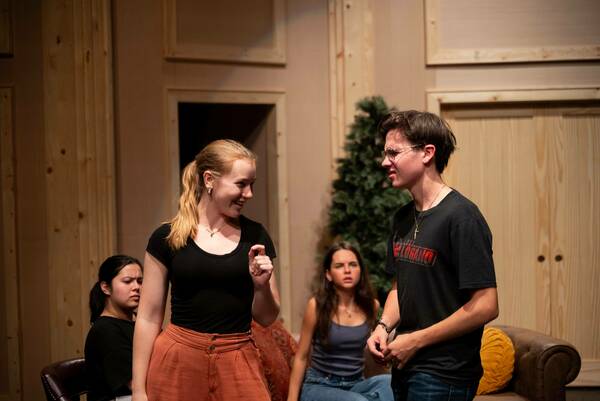
Left to Right: Grace Osoteo, Evelyn Berry, Josy Pitaro, Robert Fuller (Rehearsal Image)
So, then I was like, maybe this super dark show isn’t the direction to go in. I started thinking more and I was like, okay, logistically, it has a male lead that has to go into a really dark place and it has a lot of minor characters. Do I really want to do a show where it’s a very focused on one person with minor characters, or do I want to do a show that has everyone involved all of the time? With this student directed opportunity, if I got the opportunity to present something, I want everyone to feel really involved - I want everyone to have a challenge and I want them to feel like they’re equally contributing to the process. So, then I pivoted and said, okay, comedy. Comedy has a pretty big cast and it has a variety of characters. Everyone is important in a comedy versus a drama, so let’s explore some comedies!
I started getting into some farces and I had a lot of fun reading them. I came across The Play That Goes Wrong and I was like, oh my gosh, this is the perfect show. It’s a physical comedy, it’s got slapstick comedy, it has a big role for everyone, it has big technical requirements - this would be a challenge for the entire department. So I wrote a fifteen page dissertation about the show going into specific technical elements and how I would execute them, and I recruited kids to be interested in designing parts of it. It was super awesome and wonderful, and so I submitted it and the faculty were like, this is amazing, truly wonderful, but Saint Mary’s has taken the title for their upcoming season already.
I was like NO!!! As an aside, I was able to see the Saint Mary’s production and it was wonderful; I wish that I had been able to see it again because it was so much fun. So I was like, okay, cool, what now? And the faculty said, okay, we love your application, we loved your pitch. Can you find a different show in the same general genre and we can see if it’ll fit in with the season? And I was like, okay, physical comedy farce. Got it.
One of my favorite playwrights for a comedy farce is Ken Ludwig, like, Lend Me A Tenor, Moon Over Buffalo - just like really classic, really funny farces with really big, strong casts of characters. Ludwig’s work fits in with my exact goal and what I wanted to do, so I started reading and stumbled upon The Game’s Afoot or Holmes for the Holidays, and I was like, man, this is a pretty technically complex show with lots of characters. I kept reading and I was like, okay, this is pretty good. It was a pretty classic comedy, and when I got to the end there was a big twist and I was like, oh my gosh! I love this character with the twist and the fact that everyone’s on stage all the time and that we have two very different feeling acts in the show. I read it again and I was like, yeah, this is the show. And then I submitted it and the faculty approved it! Once I was able to get into it more after that I was like, yes, this is awesome and I am so excited. I was a little disappointed that the first show I pitched was unavailable, but now that I have gotten into the process, I've realized that, no, this was definitely meant to be. This was the show that was supposed to happen at this time. It fits the exact vibe I wanted - the rehearsal room is so fun and you have such a good time in rehearsal. We’re all working really hard and having a great time, and it’s like this is the show to facilitate the room I wanted. It was perfect.
So, that was kind of my big arc/journey from tortured soldier drama to a really fun Sherlock farce, but, you know, it only took me a month to figure it out!
Q: After being selected as the student director for this season, you were able to facilitate your own auditions. What was that like? Have you ever done that before?
A: It was so fun! It was also terrifying. It was the very beginning of the process - we had already had a few production meetings and had general concepts and I knew what the show was, but I didn’t have any of the cast of characters to fill it out. The faculty members that I was speaking with were like, casting is going to happen and everything is going to fall into place. And I was like, OH NO, CASTING IS GOING TO HAPPEN AND EVERYTHING’S GOING TO FALL INTO PLACE! This is the most important, vital part of the show!
So, in hindsight, I probably put a little too much weight onto it. Once I got into it I was like, oh, duh, this is auditions - this is great! I’ve worked as a stage manager on several department productions at this point, so I generally know how to run an audition room. However, I’m not usually the person choosing who makes it at the end. I’m just helping to facilitate it. So, I kind of knew the structure and I invited my friend Noah [Sim] to sit with me, which was wonderful. He’s directed a lot of student productions on campus, and so I asked if he wouldn’t mind coming in and sitting with me to observe and give me pointers on how I am handling the auditions as they go. It was really helpful to have someone be able to ask questions on, like, if I want the character Gillette to feel different as Sherlock versus Gillette, what questions should I ask? What verbiage do I have to use to get this actor to get that idea in their head quickly and efficiently?
Left to Right: Eli Gay, Madeline Bendzick (Rehearsal Image)
Also, you, Tre, sat in the room with me as well. Which was so wonderful and helpful because I was terrified of running my audition room by myself with no faculty in the room because it felt like I was just a crazy person sitting in the basement of DPAC, asking people to read me sides. So having you there was so helpful and calming, and it was wonderful to turn over to you after someone walked out of the room and be like, okay, awesome, I think we found our person. It was nice to get this reassurance because I had very strong ideas in my head of like, yes, this is what I want, but having a team to sit with I think is so important when going through the casting process. I was happy to have a team I could trust and bounce ideas off of, like, “I love how this person read for this character, but I also loved person C. Can these people all act together in the same room? Do they have the same types of readings of the character? Should I call this one back and ask them for a different reading to match this or is their reading actually closer to what the show is?” So, having a team to bounce ideas off of, I think, was probably the most helpful part of the audition process.
And all of the auditions were so wonderful! It was awesome because there wasn’t anyone in the room where it was like, oh my gosh, I know exactly who you’re going to be. It was like the process of everyone vying for these parts, and everyone was so prepared that it’s like, man, I really don’t know who’s going to be in these roles. Like, people came in with such fresh and wonderful ideas that it;s like the characters are flushing out during auditions. It was so terrifying, but it was wonderful.
Q: What has it been like to work with the faculty and staff in the Department of Film, Television, and Theatre to develop this show?
A: It has been an amazing experience having the department on my side! I have been banging down office doors and emailing people constantly. Just getting people to come into rehearsal, watch the show, tell me what you think. The faculty have also been giving me recommendations for, like, movies to watch and source material to read, and just provided inspiration in general. It’s just been so helpful because I feel like any time I turn my head and I’m like, man, I’m a little confused, suddenly someone pops up right next to me with exactly what I need to continue! It’s been so wonderful and helpful, and I don’t know how I’m going to fit everyone in the program with all of the acknowledgements I need to give.
Scenic Rough Sketch by Carolyn Dell
It’s just been amazing - especially right now with our set going up. Like, the walls are up, which is amazing. I had a thought about what the set would look when I submitted the show and sketched it out on a little napkin piece. I actually think it’s still in the production folder in the drive somewhere! I can’t imagine holding up the picture to the set and being like, oh my gosh, this is what I drew but very different; in fact better! It’s almost like magic when you think about it - the set coming to life before your eyes!
This faculty is just so talented and amazing, like, sitting down in meetings with them and then being like, “I have this wonderful idea, I’m really drawn to this, this show is pushing me this way.” It’s also been really fun to be a new director and have that experience because I’m not being totally led along by faculty - I have a lot of autonomy to direct this show as I would like. Of course, I’m not quite sure what’s going on all the time, and then the faculty are there to assist and catch on to ideas or concepts that I present and just rolling with it and improving and extrapolating - it’s just been such a helpful process and gives me such wonderful ideas.
Like Carys Kresny - she is so wonderful. She came into rehearsal a couple weeks ago and presented to me, like, oh, just make sure you know who’s important in this scene . It was just a passing remark and it has been stuck in my head the whole rest of this process. It’s like, oh yeah, one passing word from a faculty member stopping into rehearsal - and there've been multiple faculty members stopping in. Matt Hawkins, he’s been wonderful coming in and shooting some videos and photos. Tre, you’ve been there shooting photos, and it’s just been wonderful to have people in the room who are excited about the work and who are contributing to it. I don’t know who I would ever be able to do this production if I didn’t have faculty support going through it. It’s really a monster of a show in such a good way, and I can’t imagine going through this process and not being able to walk up to a faculty member at the end of class and be like, hey, there’s just something about this scene, can you think about it with me for a second? It has been immensely helpful having the support of the faculty and knowing, like, after this interview, I’m going to sneak down to the Philbin and chat with Kevin - it’s just like, wow, people are reaching out and asking questions, and are excited to provide information.
I don’t really have the word for all of this…I guess it’s like a blessing. My heart is so happy to have people excited about my little project. At first I was like, yes, me and all my friends and my cast - it’s so exciting. We’re putting on a show and I’m so excited, and then I was like, wait, no, this is a SHOW. Like this thing is happening. It’s not just my creative little idea I’ve been sleeping on for months, so that’s very exciting.
Left to Right: Robert Fuller, Esme Wickes, Will Rosemurgy
Q: In your opinion, what has been the best thing about this process?
A: Oh my gosh, the best thing about this process? If I had to pick one, well, the first thing that pops into my head was just so silly - it was that we got department provided Chipotle during auditions. And that was just like the start of like, oh my gosh, this is a real show. This is not just me and my harebrained ideas.
Oh, but probably my favorite part of this process has been just having the cast around. Which, I guess is not specific, but just walking into the room and everyone being so excited to be in the room is just so refreshing. Everyday we come into rehearsal and we do a check in where we say something about our day or something we’re excited about or something they’re doing that didn’t go super well and we want to improve upon it. I think just checking in with the cast everyday has been so helpful and so refreshing and wonderful. The vibe of the room is so good right now. I don’t know who started it (maybe some of the kids who work in the shop), but they’ve started this little phrase that goes, “if the game is afoot, then the foot is a (blank), so then it must be (blank).” And so, for example, I go, “let’s restart from the top,” and they go, “ well, if we’re restarting from the top and the top is a foot and the foot is the top than we’re starting from the top.” It’s just these crazy things that don’t quite make sense, but it’s just refreshing to see people excited about the work and coming in everyday ready to work hard.
It’s just the dedication of the cast, I guess is the one thing. The dedication of the cast is so immense, and I think it’s probably my favorite part.
Q: Conversely, what has been the most challenging part of developing the show?
A: Gosh, I would say probably the most challenging part about developing this show…it’s a funny, funny show when it’s written down, but it’s very witty humor. I think the hard part is finding out, like, with me and my cast, okay, this one scene, we’re talking about really, really devastating, sad character development, and then we flip the page and three lines later we’re having a really bad sexual innuendo joke. How do we get from A to B? How does that happen? I think that the most challenging part is just figuring out, like, how to navigate the script. It’s such a complex piece, which is so wonderful, and Ludwig is awesome at creating these really wonderful shows, but it’s so difficult as a director to be like, man, we’re showing you this emotional moment and then this really funny bit happens. How do we get there? Like, someone enters a scene and it’s totally different.
Left to Right: Will Rosemurgy, Josy Pitaro (Rehearsal Image)
So it’s like, how do I keep that going without this turning into a straight drama? Because it's a farce, but you could take several scenes from this show and toss it into one of your really serious drama pieces and it would fit perfectly. So, I think the most challenging part is just like really crunching it out with the performers and being like, oh my gosh, that’s a really dark place. Like, your wife has been dead for ten years? WHAT? How are we going to get over there now? So I think that’s probably been the most challenging part and something we’re really working through and digging through. This process is definitely just the arc of the show of dramatic and comedic and finding this place where both shine through.
Q: Would you recommend this experience to other students who are thinking about applying for the student director opportunity? If so, what advice would you give them?
A: Oh my gosh, I would definitely recommend it to other students…unless I decided to do it again then let me be the only application so I get it! But I would definitely recommend this to other students. Advice I would have is just be accepting of any ideas that come into your head, because, like I said earlier, I was going to do a really, really, dark show and now I’m doing a crazy farce. I think just not coming in with the idea that “this is the show I want to do and if I don’t do this show, I won’t do it.” I think coming in with an idea of what you want to accomplish as a director is a good place to start. Do I want to have an experience where I’m stretching myself out of my comfort zone? Do I have a goal for the department that I want to achieve with this show? Do I have a goal for myself? I think just stretching yourself through the application and finding something new through it is something I would recommend to people applying. I chose my really comfortable piece, and now I have this awesome, wonderful show where it’s like I can’t imagine another show in its place. So I definitely think just stretching yourself with the application is something important.
Q: Finally, what should audience members expect when heading into this production?
A: Expect to laugh! Expect a really fun show that’s just very different from the other FTT shows this season. Expect to walk into a heartwarming story and laugh and giggle and be like, wow, that was a runaway train. I have no idea where it was going, and then it finally crashed and I loved to watch it.
Ken Ludwig's The Game's Afoot or Holmes for the Holidays takes the stage in the Philbin Studio Theatre from Wednesday, November 20 - Sunday, November 24. Get your tickets today at performingarts.nd.edu.
]]>
Tre Goodhuetag:ftt.nd.edu,2005:News/1672122024-10-03T13:47:00-04:002024-10-03T13:47:45-04:00After ‘leaving everything behind,’ Sikharulidze crafts powerful on-screen stories depicting his native Georgia
In 1991, when the Soviet Union collapsed, 3-year-old George Sikharulidze and his family only had electricity for a few hours a day in Tbilisi, the capital of Georgia.
George Sikharulidze
Bread lines were long and jobs were scarce in the newly independent country.
But during the so-called dark decade that followed, Sikharulidze and a childhood friend were able to watch Braveheart and other American blockbusters — dubbed in Russian — over and over on TV.
“My grandma used to buy this newspaper that had the TV schedule for the following week, so we would circle the movies. And we would wait and hope that we had the electricity to watch them,” said Sikharulidze, an associate professor in the Department of Film, Television and Theatre at the University of Notre Dame.
“We loved every moment. We would anticipate each line of dialogue. There was this love of cinema at an early age.”
‘We’ve come up together’
Sikharulidze has parlayed his love of cinema into a teaching and award-winning career as a director and screenwriter.
It won Best Film in the parallels and encounters section at the Palic Film Festival in Serbia. And at the star-studded Karlovy Vary Film Festival in the Czech Republic, Panopticon was a Best Film nominee and earned the Ecumenical Jury prize for touching “the spiritual dimension of our existence, expressing the values of justice, human dignity, respect for the environment, peace, and solidarity."
Stars of Panopticon arrive at the Karlovy Vary Film Festival in the Czech Republic. Photograph courtesy of George Sikharulidze
Panopticon — which refers to a state of conscious visibility — will be shown at six more festivals this fall.
The film centers on Sandro, 16, who is left to his own devices when his father decides to leave for an Orthodox Christian monastery to become a monk in turbulent post-Soviet Georgia. As Sandro searches for meaning and belonging, he becomes involved with a radical ultra-right group and struggles to reconcile his devotion to God with his awakening sexuality. The film examines Sandro’s humanity and a society that can warp it.
Similar to Sikharulidze’s previous shorts, Panopticon focuses on his home country — his perpetual return there for stories, he said, is likely connected to the formative time in which he grew up.
“In a sense, I am as old as the independent Georgia,” he said. “The same way that Georgia was learning how to walk again, I was learning how to walk and talk. We’ve come up together.”
This summer, Sikharulidze was in Georgia to shoot one of his three in-progress feature projects — a movie about relationships — but filming was postponed due to the volatile political situation there.
In another project, he incorporates artificial intelligence and transhumanism as backdrops to questions of faith and the body-soul dichotomy. The third planned film is about two refugees, one from Ukraine and one from Georgia, who find love in their pursuit of the American dream.
“It’s essentially the story of my mother and step-father,” he said, “but set in contemporary times.”
‘Starting from zero’
Sikharulidze was 18 and a recent high school graduate when he arrived in the U.S. to join his mother, who had moved earlier to find work.
While watching The 400 Blows in a college film course, George Sikharulidze realized he also could tell his story. “That was the moment I decided, ‘I think I know what to do.'" Photograph courtesy of George Sikharulidze
While the move was potentially life-saving, Sikharulidze faced some initial challenges, including knowing only enough English to order food in a restaurant.
“It was quite difficult because you are leaving everything behind, everyone you ever knew, and you are starting from zero, a blank page,” he said. “I’m used to that — every new film feels like I'm starting from zero"
Enrolling at Bergen Community College in New Jersey proved to be a good start: He felt at home there as he learned English, met people from around the world, and earned an associate degree in liberal arts and humanities.
Then, in an elective film course at New York University, where he earned a bachelor’s degree in media, culture, and communication — Sikharulidze was transfixed watching François Truffaut’s The 400 Blows.
“There was a spark and I realized, or I felt, rather, that here was a filmmaker who made his first film — very personal to his story, his life, and his boyhood, and it moved me. Maybe I could tell my story in a similar way,” he said. “That was the moment I decided, ‘I think I know what to do.’”
‘I let them blossom’
Since joining the Notre Dame faculty last fall, he has taught the courses The Art of Film Directing, Directing Actors for Film and TV, and Writing the Short Film.
His own shorts include “Fatherland” (2018), a Sundance Film Festival selection; and “A New Year” (2017), and “Red Apples” (2016), which were Toronto International Film Festival selections.
Teaching undergraduates the basics of film sometimes presents Sikharulidze with an interesting paradox.
George Sikharulidze investigates with students how to build and direct a scene and how to tell a story. Photograph by Jon Hendricks
“On the one hand, I'm teaching the fundamentals of film language, and on the other, I’m searching as a filmmaker for new film language,” he said. “But it is always humbling to return to the basics of any language. There is something very profound in the simplicity of communication. It keeps me grounded as a filmmaker.”
Rather than impose ideas, Sikharulidze, who earned an MFA in film directing and screenwriting at Columbia University, investigates with students how to build and direct a scene and how to tell a story.
“Perhaps there is something in the mind of a student that’s never been seen before,” he said. “I let them blossom, otherwise we’ll just produce the same kind of storytellers over and over, and that’s not what art is about.”
Sikharulidze is excited to continue honing his craft at Notre Dame.
“I value interpersonal human connection the most, and the faculty made me feel at home,” he said. “What better place to be than the place where they respect your work as an artist and want you to succeed, both in your teaching and your filmmaking?”
Originally published by Beth Staples at al.nd.edu on October 03, 2024.
]]>
Beth Staplestag:ftt.nd.edu,2005:News/1606772024-03-21T17:39:00-04:002024-03-21T17:39:28-04:00Notre Dame Film, Television, and Theatre Presents A Chorus Line
Notre Dame’s Department of Film, Television, and Theatre (FTT) announces A Chorus Line, conceived and originally directed and choreographed by Michael Bennett, in the Patricia George Decio Theatre at the DeBartolo Performing Arts Center, April 18 - 21, 2024.
A Chorus Line examines one day in the lives of seventeen dancers, all vying for a spot in the "chorus line" of a Broadway musical. Born from real-life testimonies, audiences are allowed a glimpse into the lives of professional dancers as they bare their hopes, dreams, and ambitions on stage.
“While bringing to life the beloved music and characters of A Chorus Line, we hope to transport audience members to the present with this production,” says Matt Hawkins, FTT’s Acting Director of Theatre & Director of Musical Theatre, “the audition process is grueling work for actors and dancers, and we hope to showcase that reality on stage as we bring this production out of the 1970s and into 2024.”
The production is directed by Matt Hawkins, with lighting by Kevin Dreyer, scenic design by Marcus Stephens, costume design by Lynn Holbrook, choreography by Theresa Thomas, and poster art by Evelyn Berry.
PERFORMANCE SCHEDULE
Thursday, April 18 - Saturday, April 20 at 7:30 PM Sunday, April 21 at 2:30 PM
TICKETS
Student $7, Faculty/Staff/Senior (65+) $12, General $15
Tickets may be purchased online at http://performingarts.nd.edu, by phone at 574-631-2800, or in person at the DeBartolo Performing Arts Center ticket office. Ticket office hours are Monday-Friday, 12:00-6:00 pm.
PARKING
Free parking is available daily after 5:00 pm in the Stayer Center parking lot, just north of the DeBartolo Performing Arts Center. Patrons may now receive free event parking at the Eddy Street Commons Parking Garage by bringing your event tickets and parking ticket to the DPAC Ticket Office to receive a pre-paid parking voucher.
An accessible lot for disabled patrons is available immediately adjacent to the center; a valid hangtag or license plate is required. There is a ten-minute parking zone on the north drive of the center for ticket pick-up; during inclement weather you are welcome to drop off guests in this area and proceed to parking.
Notre Dame’s Department of Film, Television, and Theatre seeks to inspire intellectual inquiry and nurture creativity. We offer both a scholarly and a creative context for the general liberal arts student at Notre Dame as well as those students seeking intensive preparation for advanced study in these fields. The hands-on nature of our curriculum, coupled with a very high degree of student-faculty interaction, provides students with a singular educational opportunity at a university known for its teaching excellence. The FTT performance season is a direct outgrowth of the department’s academic program and an integral component of our students’ artistic development.
Find FTT on Facebook and Instagram @NDFTT
]]>
FTT Departmenttag:ftt.nd.edu,2005:News/1591032024-01-12T13:18:00-05:002024-01-23T15:18:20-05:00Film professor wins NEH fellowship, continuing record of success at Notre Dame & within the Department of Film, Television, and Theatre
Three faculty members in the College of Arts & Letters have won National Endowment for the Humanities (NEH) fellowships, extending the University of Notre Dame’s record success with the federal agency committed to supporting original research and scholarship.
Since 2000, Notre Dame faculty have won more NEH fellowships than any other university in the country.
Additionally, a pair of A&L scholars — Katie Bugyis, the Rev. John A. O'Brien Associate Professor in the Program of Liberal Studies, and Margot Fassler, the Keough-Hesburgh Professor of Music History and Liturgy Emerita — have won a significant, three-year NEH Humanities Initiatives at Colleges and Universities grant to develop a website and to teach medieval liturgy.
“I am delighted and proud that the NEH has again supported our faculty members’ relevant and interesting projects,” said Sarah Mustillo, the I.A. O’Shaughnessy Dean of the College of Arts & Letters. “These four awards highlight the quality of diverse academic research conducted by our experts in multiple fields as well as the excellent support provided by the Institute for Scholarship in the Liberal Arts throughout the application process.”
Kearney, who is a concurrent faculty member in gender studies and American studies, will examine portrayals of American teenage girlhood from the 1930s to the 1950s in her book project, tentatively titled “Designing and Redesigning the Junior Miss: The First Wave of U.S. Teen-Girl Entertainment.”
Mary Celeste Kearney
The idea for the project sparked when she was penning an entry about teen-centered shows for The Encyclopedia of Television and came across what may be the first short stories written about teen girls. These narratives, written by women, resist some of the stereotypes of teenage girlhood and were an important deviation from previous literature about female adolescence, Kearney said.
“Because these stories are episodic and the protagonists don't age, they allowed girls to be girls rather than showing them becoming women,” she said.
When men subsequently adapted some of the stories for stage, film, radio, and television, Kearney said, teen girl characters were altered to be more domestic and superficial in part because of prevailing identity politics, but also because of conventions and trends in performance and visual storytelling. Kearney explores both the continuities and discontinuities from those early stories, as well as in subsequent adaptations, in today’s teen girl entertainment culture.
“We can't really make sense of what's happening on the Disney Channel teen shows without understanding this early period,” she said. “When you focus on the past, you can begin to connect some dots.”
Part of that dot-connecting is researching representations of people of color in teen girl stories across mediums.
“Unbelievably, the first film to feature a Black teenage girl was not until 1968; the next one wasn’t until 1992,” Kearney said. “That’s how long whiteness has dominated this figure within popular American culture.”
There’s still much to be learned about the history of teen girls in entertainment. Because teen girls have long been devalued in U.S. society, Kearney said, there’s a dearth of archival material and research on the topic.
“The history of girl-centered entertainment is currently inadequate,” she wrote in her NEH proposal, “not only for understanding how the original designs of teen girlhood were produced and what they meant during that period, but also for comprehending the paradox of why the figure of the teen girl has both transformed over time and remained much the same.”
Originally published by Beth Staples at al.nd.edu on January 10, 2024.
]]>
Beth Staplestag:ftt.nd.edu,2005:News/1590662024-01-08T16:31:00-05:002024-01-16T15:01:24-05:00Notre Dame Film, Television, and Theatre Presents the 35th Annual Notre Dame Student Film Festival, January 26-28, 2024
The University of Notre Dame’s Department of Film, Television, and Theatre (FTT) announces the 35th Annual Notre Dame Student Film Festival, in the Browning Cinema at the DeBartolo Performing Arts Center, January 26-28, 2024.
An annual launching pad for student filmmakers as they begin their careers in the film, television, and entertainment industries, the Notre Dame Student Film Festival screens films that were made by undergraduate students during the past year as class projects in the Department of Film, Television, and Theatre. As in recent years, after each screening audience members will be invited to vote for their favorite film via text message. The Audience Choice Award will be presented to the student director(s) of the winning film after the final screening.
After spending months from concept to completion, more than 20 student directors will premiere over a dozen short films to the public for the first time.
“Filmed all over the country, and right here in South Bend, we are thrilled to present the premiere screenings of these undergraduate student films, many of which will go on to screen at film festivals nationally,” says festival founder and FTT faculty member Ted Mandell.
The festival has featured the first films of future award-winning filmmakers such as Peter Richardson (2011 Sundance Film Festival Grand Jury Award winner, How To Die in Oregon) and John Hibey (2012 Sundance Film Jury Award Winner for Short Filmmaking, Fishing Without Nets), as well as numerous others. It has served as the springboard for successful careers in every aspect of the industry, where ND Student Film Festival alumni have worked on everything from Saturday Night Live to La La Land.
Many films from past festivals have also been selected for national and international film festivals, including:
Waiting for Buffalo – 2023 Trinity Film Festival (Best Documentary)
Lily – 2023 Chicago/Midwest Emmys (Non-Fiction Short Form Student Production Award)
The Ismailzias – 2022 LA Documentary Short Film Festival (Best Sound & Music, Mar 2022)
Foss – 2022 Angeles Doc Film Festival (Feb. 2022 Best Student Documentary)
SandBranch – 2020 International Social Change Film Festival (Official Selection)
Tape Wizard – 2020 Portland Film Festival (Official Selection)
Shelter Me –2019 Arizona International Film Festival (Best Short Documentary), 2019 Atlanta ShortsFest Film Festival (Best Documentary Short)
Breaking the Cycle –2018 New York City Short Film Festival (Best Documentary Short), 2018 USA Film Festival (First Place Non-Fiction Short Film), 2018 Ivy Film Festival (Best U.S. Undergraduate Documentary)
Peace at the Pipeline – 2017 San Pedro International Film Festival, 2017 Riverside International Film Festival
2024 Notre Dame Student Film Festival featured films:
Small Parts (Hank McNeil, Aidan O’Malley, JP Spoonmore)
Leggo my Lego.
After The Race (Joyce Fu, Paulina Rey, Claire Schaffler)
A one woman non-profit finds homes for retired sled dogs in Alaska.
Nearness of You (Josh Vo)
A college student leaves behind his love on the way to London.
A Dash of Paper & A Pinch of Spice (Joyce Fu, Julian Gamboa)
A grocery store romance.
The Ballad of Bart (Victoria Dominesey, Ian Oh)
Prison was just the prelude for a Nashville musician.
Lost And Not Found (Elizabeth Maroshick, Isabel R Maiz)
You were supposed to come find me.
Bajo El Sol (Micaela Alvarado, Ryan Lin)
An immigrant couple starts a street vending business in Santa Ana, CA.
Whispers Of The Keys (Rob Corrato, Patrick Kennedy)
Don’t read your roommates’ research paper.
The Mayor Of Idyllwild (Ben Bailey, Riley Mandell)
The most popular politician in California speaks no words.
Three Hands (John Adkins, Chloe Stafford, Margaret Murray)
Four women, one poker game, and the boyfriend upstairs
A Double Shot (Alexx Johnson, Mariana Taskey)
A rosy romance with a whole latte love.
Island Zero (Ryan Broussard, Josh Sisolak)
The mayor of a tiny island in the Chesapeake Bay tries to keep the town from going under.
April Showers (Micaela Kastor)
It’s hard to wash away the memories.
Confishion (Alexx Johnson, Thomas Larson)
A fish story of biblical proportions...sort of.
TICKETS
Tickets for the Notre Dame Student Film Festival are $7 for the general public; $6 for faculty, staff, and seniors (65+); and $4 for students. Tickets may be purchased by phone at 574-631-2800, in person at the DeBartolo Performing Arts Center ticket office (M-F, 12:00 – 6:00 pm), or online at performingarts.nd.edu.
SCREENINGS
Friday, January 26 at 6:30 pm Saturday, January 27 at 6:30 pm Sunday, January 28 at 7:00 pm* *Audience Choice Award will be presented after the 7:00 pm screening on Sunday, January 28.
Running Time: Approximately 120 min. Some films contain mature content.
PARKING
Free parking is available daily after 5:00 pm in the Stayer Center parking lot, just north of the DeBartolo Performing Arts Center. Patrons may now receive free event parking at the Eddy Street Commons Parking Garage by bringing your event tickets and parking ticket to the DPAC Ticket Office to receive a pre-paid parking voucher.
An accessible lot for disabled patrons is available immediately adjacent to the center; a valid hangtag or license plate is required. There is a ten-minute parking zone on the north drive of the center for ticket pick-up; during inclement weather you are welcome to drop off guests in this area and proceed to parking.
Notre Dame’s Department of Film, Television, and Theatre seeks to inspire intellectual inquiry and nurture creativity. We offer both a scholarly and a creative context for the general liberal arts student at Notre Dame as well as those students seeking intensive preparation for advanced study in these fields. The hands-on nature of our curriculum, coupled with a very high degree of student-faculty interaction, provides students with a singular educational opportunity at a university known for its teaching excellence. The Notre Dame Student Film Festival is a direct outgrowth of the department’s academic program and an integral component of our students’ artistic development.
Find FTT on Facebook and Instagram @NDFTT
]]>
FTT Departmenttag:ftt.nd.edu,2005:News/1590412024-01-05T13:31:00-05:002024-01-05T13:31:41-05:00Assistant professor Tarryn Chun chosen for public intellectuals program focused on US-China relationsTarryn Chun, an assistant professor in the Department of Film, Television, and Theatre, has been selected by the National Committee on U.S.-China Relations to join a group of thought leaders focused on improving understanding and cooperation between the two countries.
She is one of 20 fellows chosen for the eighth cohort of the Public Intellectuals Program (PIP), which works to increase U.S. understanding of China by strengthening connections between academics, policymakers, opinion leaders, and the public.
Tarryn Chun (Photo by Myriam Nicodemus)
Chun — whose expertise is in Chinese theatre and performance, as well as connections between Chinese theatre and technology — said she feels validated, gratified, and humbled by the selection.
The role of PIP is an important one, she said, especially considering the deterioration of U.S.-China relations during the COVID-19 pandemic.
“And that means that those of us who have expertise in China, and Chinese culture, have all the more responsibility to contribute to knowledge and understanding on both sides.”
A goal of the nonpartisan nonprofit’s fellowship program is to help Americans learn more about China than what appears on television news tickers. Chun said she looks forward to doing her part by sharing her research with a broader audience, for a broader impact.
“The importance of cultural diplomacy and cultural exchange and the extent to which theatre, film, music, and other arts create on-the-ground connections between people and cultures — that’s something I think I can contribute to the discussion,” she said.
In 2022, Chun won a National Endowment for the Humanities fellowship for her research project, “Spectacle and Excess in Global Chinese Performance,” which examines the use of digital technologies — including during the opening ceremonies during the 2008 and 2022 Olympics in Beijing — for artistic, commercial, social, and political ends.
Her fellowship and the resulting in-progress book mesh well with PIP’s consideration of China through a global lens.
Chun said she’s also interested in learning more about the ways in which a tech war between the U.S. and China could affect the performing arts. For instance, high-tech backstage theatre gadgetry uses technologies that the U.S. is restricting due to security concerns.
“This will start to influence the people I work with who are trying to make art using technologies that depend on these basic components,” she said.
Tarryn Chun in the Philbin Studio Theatre in the DeBartolo Performing Arts Center. (Photo by Myriam Nicodemus)
The two-year PIP enrichment program began in early December in Washington, D.C., where the cohort of experts in politics, economics, security studies, culture, and history gathered to meet each other as well as policymakers, embassy officials, and thought leaders. During the next 18 months, fellows are slated to attend training on the West Coast, travel to the People’s Republic of China and other locations in Asia, and return to D.C. for another workshop.
Chun is the third Notre Dame faculty member to be chosen for the Public Intellectuals Program. Karrie Koesel, an associate professor of political science, was in the fourth cohort in 2014; and Kyle Jaros, an associate professor in the Keough School of Global Affairs who holds a concurrent appointment in the Department of Political Science, was in the seventh cohort in 2021.
“Once you're a PIP fellow you're always a PIP fellow,” Chun said. “The expectation is that one will continue to be a public intellectual and to use the platform we’ve gained to share our expertise.”
Originally published by Beth Staples at al.nd.edu on January 04, 2024.