<?xml version="1.0" encoding="UTF-8"?>
<?xml-stylesheet type="text/xsl" href="/stylesheets/feed.atom.xml" media="screen"?>
<feed xml:lang="en-US" xmlns="http://www.w3.org/2005/Atom">
  <id>tag:al.nd.edu,2005:/news/latest-news/category/the-arts</id>
  <link rel="alternate" type="text/html" href="https://al.nd.edu"/>
  <link rel="self" type="application/atom+xml" href="https://al.nd.edu/news/latest-news/category/the-arts.atom"/>
  <id>tag:al.nd.edu,2005:/latest</id>
  <title>Arts | College of Arts &amp; Letters | Latest News</title>
  <updated>2026-02-16T15:18:00-05:00</updated>
  <link rel="alternate" type="text/html" href="https://al.nd.edu/"/>
  <link rel="self" type="application/atom+xml" href="https://al.nd.edu//news/latest-news.atom"/>
  <subtitle>Notre Dame’s College of Arts and Letters challenges graduate and undergraduate students in the liberal arts to ask the great questions as they pursue their intellectual passions in the arts, humanities, and social sciences.</subtitle>
  <entry>
    <id>tag:al.nd.edu,2005:News/179319</id>
    <published>2026-02-16T15:18:00-05:00</published>
    <updated>2026-02-17T17:18:41-05:00</updated>
    <link rel="alternate" type="text/html" href="https://al.nd.edu/news/latest-news/solarium-2025-showcases-the-art-and-creative-writing-of-notre-dames-mfa-students/"/>
    <title>Solarium 25 showcases the art and creative writing of Notre Dame’s MFA students</title>
    <summary type="text">
      <![CDATA[The beauty of fine art, the story the artist tells, and the emotions it stirs in the viewer are on full display at the Graduate School in Bond Hall. These works, selected for the Graduate School's annual fine arts show, Solarium 25, feature a juried sampling of artistic explorations created by eight talented University of Notre Dame master of fine arts students.]]>
    </summary>
    <content type="html">
      <![CDATA[<figure class="image image-right"><img src="https://graduateschool.nd.edu/assets/642278/500x/2025_solarium_reception_042.jpg" alt="Three people talk in a yellow room with art. The center woman in a white knitted sweater and glasses holds a brochure, looking intently at the woman on the right." width="500" height="333"></figure>
<p>The beauty of fine art, the story the artist tells, and the emotions it stirs in the viewer are on full display at the <a href="https://graduateschool.nd.edu/">Graduate School</a> in Bond Hall. These works, selected for the Graduate School’s annual fine arts show, Solarium 25, feature a juried sampling of artistic explorations created by eight talented University of Notre Dame master of fine arts students. This signature event is held each spring, and this year’s event was made even bigger, as students in the English master of fine arts (MFA) program — also known as the creative writing program — were chosen to view the art and write an ekphrastic reflection, which is displayed alongside the original piece.</p>
<p>Solarium 25’s opening reception took place on March 5, with artists, writers, and nearly 100 members of the Notre Dame community in attendance to celebrate the work.</p>
<p>“Today, we recognize the importance of the unique and powerful contributions of Notre Dame’s MFA students in art, design, and writing to our University,” said <a href="https://graduateschool.nd.edu/about/michael-hildreth/">Michael Hildreth, Ph.D.</a>, dean of the Graduate School, associate provost and vice president for graduate studies, and professor of the Department of Physics and Astronomy, “and we honor and celebrate the many ways these students research, interrogate, and interact with events in our world today and with the very experience of being human.”</p>
<p>“The opportunity to collaborate with the Graduate School and foreground the research produced by our MFA students in studio and design is one of the highlights of our spring semester each year,” added <a href="https://artdept.nd.edu/people/jason-lahr/">Jason Lahr</a>, associate professor in the <a href="https://artdept.nd.edu/">Department of Art, Art History, and Design</a> and director of graduate studies for the MFA programs in studio art and design. “Not only do our students gain recognition for their work, but they also gain valuable professional experience through the process of hosting jurors from the Graduate School in their studios and in collaborating in the installation of their work.”</p>
<h2><strong>Exploring modern problems</strong></h2>
<p>The students featured in Solarium 25 utilize their art to explore some of the most pressing issues of contemporary life. One theme that appears is the examination of gender roles that compartmentalize or even erase women’s achievements in science or art. Another overarching theme is personal autonomy, particularly when that autonomy is compromised, threatened, or even denied by governments or one’s fellow humans. The creative writing students also creatively responded to these themes in their ekphrastic reflections.</p>
<p>What is an ekphrastic reflection? <a href="https://english.nd.edu/people/paul-cunningham/">Paul Cunningham</a>, creative writing program manager in the <a href="https://english.nd.edu/people/paul-cunningham/">Department of English</a>, said that in the past, the term “ekphrasis” has been defined as “a literary device in which a painting, sculpture, or other work of visual art is described in detail. Think Keats’s ‘Ode on a Grecian Urn,’” he suggested. Today, Cunningham said, “writers use ekphrasis to translate existing visual artworks into new poems and stories.”</p>
<p>The pairings — the artist and the creative writer chosen to write about the exhibit — are listed below.</p>
<table style="margin-left: auto; margin-right: auto;" border="1">
<tbody>
<tr>
<th><strong>Artist</strong></th>
<th><strong>Writer</strong></th>
</tr>
<tr>
<td>Norah Ruth Amstutz (Ceramics): <a href="https://graduateschool.nd.edu/assets/642273/original/2025_solarium_reception_057.jpg">The Last Supper (excerpt)</a>
</td>
<td>Daryna Gladun: <a href="https://graduateschool.nd.edu/assets/626639/sol25_ekphrasis_daryna_gladun_amstutz_.pdf">Porcelan Memory welcomes Norah Ruth Amstutz to The Last Supper</a>
</td>
</tr>
<tr>
<td>Sara Motallebi (Visual Communication Design): <a href="https://graduateschool.nd.edu/assets/642271/original/2025_solarium_reception_1104.jpg">Flow, Interrupted</a>
</td>
<td>Isabelle Boutiette: <a href="https://graduateschool.nd.edu/assets/626638/sol25_ekphrasis_isabelle_boutiette_motallebi_.pdf">OR CROSSING STREETS LIKE LETTERS</a>
</td>
</tr>
<tr>
<td>Lucy Schultz (Industrial Design): <a href="https://graduateschool.nd.edu/assets/642287/original/2025_solarium_reception_039.jpg">Away Home</a>
</td>
<td>Proph Dauda: <a href="https://graduateschool.nd.edu/assets/626640/sol25_ekphrasis_proph_dauda_schultz_.pdf"><span style="font-family: -apple-system, BlinkMacSystemFont, 'Segoe UI', Roboto, Helvetica, Arial, sans-serif;">THIS PAINTING IS A RAFT TO MY HOME</span></a>
</td>
</tr>
<tr>
<td>Griffin Liu (Sculpture): <a href="https://graduateschool.nd.edu/assets/642266/original/2025_solarium_reception_100.jpg">No Exit</a>
</td>
<td>Adriana Toledano Kolteniuk: <a href="https://graduateschool.nd.edu/assets/626635/sol25_ekphrasis_adriana_toledano_kolteniuk_liu_.pdf">(2) Two (NO) EXIT</a>
</td>
</tr>
<tr>
<td>Thomas Callahan (Photography): <a href="https://graduateschool.nd.edu/assets/642274/original/2025_solarium_reception_053.jpg">a list of things I want</a>
</td>
<td>
<p>Ryan Phung: <a href="https://graduateschool.nd.edu/assets/626631/sol25_ekphrasis_ryan_phung_callahan_.pdf">List of things yet to know they will become a list, beings</a></p>
</td>
</tr>
<tr>
<td>Heidi Dargle (Visual Communication Design): <a href="https://graduateschool.nd.edu/assets/642282/original/2025_solarium_reception_058.jpg">Miss Atomic</a>
</td>
<td>Oli Peters:
<p style="display: inline !important;"><a href="https://graduateschool.nd.edu/assets/626641/sol25_ekphrasis_oli_peters_dargle_.pdf">Miss A-Bomb</a></p>
</td>
</tr>
<tr>
<td>Claire Murphy (Painting): <a href="https://graduateschool.nd.edu/assets/642276/original/2025_solarium_reception_055.jpg">Intervention</a>
</td>
<td>Emilaino Gomez: <a href="https://graduateschool.nd.edu/assets/626636/sol25_ekphrasis_emiliano_gomez_murphy_.pdf">APAPHASIS</a>
</td>
</tr>
<tr>
<td>Emma Brooks (Design): <a href="https://graduateschool.nd.edu/assets/642267/original/2025_solarium_reception_1103.jpg">Joy, Activism, &amp; Buttons</a>
</td>
<td>Helen Quah: <a href="https://graduateschool.nd.edu/assets/626637/sol25_ekphrasis_helen_quah_brooks_.pdf">Safety Pin</a>
</td>
</tr>
</tbody>
</table>
<p>The creative writers had just short of 20 hours to craft their response of 300 words or fewer, and the results were impressive.</p>
<p>“When students are face-to-face with a different visual medium, they elevate their diction, allowing them to try stylistic risks they might not normally take,” Cunningham said.</p>
<h2>Solarium 25 art and ekphrastic award winners</h2>
<p>Visual artists Griffin Lui, Sara Motallebi, and Emma Brooks claimed top prizes.</p>
<p>Isabel Boutiette, Helen Quah, and Oli Peters won the top awards for their ekphrastic reflection pieces.</p>
<h3>
<strong>Best in Show: Griffin Liu (sculpture), </strong><strong><em>No Exit</em></strong>
</h3>
<figure class="image image-right"><img src="https://graduateschool.nd.edu/assets/642266/500x/2025_solarium_reception_100.jpg" alt="A man in a black 'A|AH|D' sweatshirt and bandana stands in front of a wall with a miniature, rusted metal fire escape art piece." width="500" height="379">
<figcaption>Griffin Liu, MFA in studio art (sculpture) with his work, titled <em>No Exit</em>.</figcaption>
</figure>
<p>Through a surreal miniature landscape titled <em>No Exit</em>, sculptor <a href="https://www.bygriffinliu.com/">Griffin Liu</a> said he aimed “to explore the tension between governmental control and human agency.” <a href="https://www.instagram.com/bygriffinliu/">Liu</a>, who drew from personal experience as a political refugee, crafted two exit doors connected by a fire escape, creating a sense of entrapment despite the promise of escape. The piece features both doors bearing exit signs, yet they lead nowhere. It includes precision-cut shapes for the railings and doors, as well as laser-cut signs, ensuring architectural accuracy. Even the most minor details were painstakingly tended to as Liu used acrylic paint to weather the surfaces, enhancing the worn, aged appearance and reinforcing the feeling of an unsettling, trapped atmosphere. His installation will undoubtedly resonate with many at a time of great turmoil in the United States and worldwide.</p>
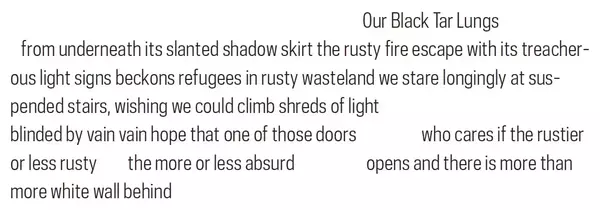
<p>Creative writing student <a href="https://english.nd.edu/people/graduate-students/adriana-toledano-kolteniuk/">Adriana Toledzano Kolternik</a> artfully composed the <a href="https://graduateschool.nd.edu/assets/626635/sol25_ekphrasis_adriana_toledano_kolteniuk_liu_.pdf">ekphrastic reflection</a> accompanying Liu’s sculpture. The ending fragment of her composition:</p>
<figure class="image image-center"><img src="https://graduateschool.nd.edu/assets/648866/toledano_kolteniuk_excerpt.webp" alt="An image showing an excerpt of the poem '(2) Two (NO) EXIT' by Adriana Toledano Kolteniuk on a white background. The excerpt consists of six lines with irregular spacing, particularly in the last three lines where there are large gaps between phrases. The text reads:Our Black Tar Lungsfrom underneath its slanted shadow skirt the rusty fire escape with its treacherous light signs beckons refugees in rusty wasteland we stare longingly at suspended stairs, wishing we could climb shreds of lightblinded by vain vain hope that one of those doors who cares if the rustieror less rusty the more or less absurd opens and there is more thanmore white wall behind" width="500" height="175"></figure>
<h3>
<strong>Best Artist: Sara Motallebi (Visual Communication Design),</strong><strong><em> Flow, Interrupted</em></strong>
</h3>
<figure class="image image-right"><img src="https://graduateschool.nd.edu/assets/642271/500x/2025_solarium_reception_1104.jpg" alt="A woman in a dark pinstripe blazer stands confidently in front of a grid of 16 artistic black-and-white portraits printed on clear square panels with scattered letters and incomplete images of faces." width="500" height="346">
<figcaption>Sara Motallebi, MFA design student, with her work, <em>Flow, Interrupted</em>.</figcaption>
</figure>
<p><a href="https://www.instagram.com/saarmot/">Sara Motallebi</a> probes memory, trauma, and identity in her installation <em>Flow, Interrupted</em><em>.</em></p>
<p>Motallebi’s art draws on memories surrounding the death of 22-year-old Jina Mahsa Amini on September 16, 2022 — a death widely believed to be at the hands of the Islamic Republic regime’s notorious morality police for Amini’s alleged improper hijab. Amini’s death sparked the Women, Life, Freedom movement, which was met with brutal repression and resulted in at least 500 deaths in Iran, human rights groups estimate.</p>
<p>Motallebi’s installation takes up the theme of “digital amnesia.” Many Iranians, Motallebi included, erased photos from their phones, “an action born of fear, survival, and resistance.” The artist’s work uses monoprints of the same image of Nika, a 16-year-old protester. Through layers of transparent prints, shadows, and text, fragmented images blur what is present and what has been erased.</p>
<p>“It invites viewers to reflect on the fragility of remembrance and the persistence of resistance against erasure,” Motallebi said.</p>
<p>Creative writing MFA student Isabel Boutiette, who received first place honors for her creative writing about Motallebi’s piece in the Solarium show<strong> </strong><a href="https://graduateschool.nd.edu/assets/626638/sol25_ekphrasis_isabelle_boutiette_motallebi_.pdf">OR CROSSING STREETS LIKE LETTERS</a>, describes her process of response to the installation: “It was important to me to integrate Sara’s idea of erasure and absence into the work. I wanted each quatrain in the sequence to leave open-ended, signaling a gap in the text. I tried to incorporate the violence of what her work bore witness to, and I really wanted to draw attention to the importance and power of ‘witness’ in her work, even under the pressures of state-backed erasure and censorship.”</p>
<h3>
<strong>People’s Choice: Emma Brooks (Design), </strong><strong><em>Joy, Activism, &amp; Buttons</em></strong>
</h3>
<figure class="image image-right"><img src="https://graduateschool.nd.edu/assets/642267/500x/2025_solarium_reception_1103.jpg" alt="A smiling woman in a black floral-print dress stands next to an artwork made of numerous small, colorful, circular pins or buttons arranged in a radial pattern on a light-colored wall." width="500" height="265">
<figcaption>Emma Brooks, MFA design student, with her work, <em>Joy, Activism, &amp; Buttons</em>.</figcaption>
</figure>
<p><a href="https://www.instagram.com/emma_brooks_creative">Emma Brooks</a> won the People’s Choice Award for <em>Joy, Activism, &amp; Buttons</em>, a unique and joyful work designed to spark activism. Brooks produced her installation through a collaboration with Goshen College’s Prevention Intervention Network (PIN), using pinback buttons as the primary medium, along with stickers, door hangers, and T-shirts, all while promoting a message of consent and aiming to dismantle rape culture. Two examples of text on the buttons: “We look out for each other” and “Consent is my cup of tea.” Brooks also designed a toolkit to empower the PIN students, featuring custom stamps, ink, and button templates to create their own buttons. It is a weighty topic, but Brooks also infused her work with another quality: joy.</p>
<p>“The experience of creating the buttons together is enriching, fun, and joyful while ensuring consistency and reinforcing PIN’s brand recognition,” she said.</p>
<p>Brooks explained that she is inspired by the work of designer Ingrid Fetell Lee and her philosophy around the aesthetics of joy.</p>
<p>“Activism can be heavy,” Brooks said. “Joy is more sustainable, as it embodies the drive for life itself.”</p>
<p>Creative writing student <a href="https://english.nd.edu/people/graduate-students/helen-quah/">Helen Quah’s</a> accompanying ekphrastic reflection, titled <em><a href="https://graduateschool.nd.edu/assets/626637/sol25_ekphrasis_helen_quah_brooks_.pdf">Safety Pin</a></em>, was awarded first runner-up honors in the Solarium show. In it, she describes sensations and memories linked to the swallowing of a pin and waiting for “a jolt of pain or tingly itch” that would “get me wondering about the little creature.” This symbol of the safety pin, she explained, “a small sharp everyday object, was a way for mine and Emma’s work to collide, exploring ideas of concealment, shame, and their relation to violence against women.”</p>
<p>Furthermore, Quah found great joy in the intertwining of their work during Solarium 25.</p>
<p>“I found this Solarium ekphrasis a really enjoyable challenge to engage deeply with the work of Emma Brooks,” she said. “Her constellation of pin badges and stamps aimed to promote discussions about women’s safety and consent, which was remarkable. I found myself quickly engaging with the art through a fiction story that focused on the image and object of the safety pin from a first-person, young girl’s perspective.”</p>
<h3><strong>Ekphrastic reflection: second runner up, Oli Peters</strong></h3>
<p>Oli Peters, who won second-runner-up honors for her ekphrastic reflection, “<a href="https://graduateschool.nd.edu/assets/626641/sol25_ekphrasis_oli_peters_dargle_.pdf">Miss A-Bomb</a>,” imaginatively crafted a character to bring <a href="https://www.instagram.com/heididargle/">Heidi Dargle’s</a> museum-style exhibit <em><a href="https://graduateschool.nd.edu/assets/642282/original/2025_solarium_reception_058.jpg">Miss Atomic</a> </em>to life.<em> </em>Peters provides this context for her work:</p>
<p style="padding-left: 40px;"><em>I hoped to communicate the complexity and layeredness of Dargle’s piece. I attempted to do this by turning Miss Atomic into a character and generating a narrative that began with her winning the pageant. From there, I was able to weave in some of the striking details that the artist presented in her work: the lipstick-stained uranium tea cup, the images of the women who survived the A-bomb blast then traveled to the US to get corrective plastic surgery, the gas mask, the history-forgotten women who helped put the bomb together. I also wanted to harness the strange and contradictory version of femininity that Miss Atomic represented, which Heidi adeptly probed and questioned. </em></p>
<p>In every pairing, artists representing completely different mediums found a powerful way to come together and tell a story. Whether they were chosen as winners, learned a new perspective, solidified their own, or honed their creative skills, they all walked away with a richer understanding of art, ekphrastic reflections, and perhaps themselves.</p>
<ul id="gallery-902" class="gallery-lb gallery-902" data-count="20">
<li><a href="https://graduateschool.nd.edu/assets/642283/fullsize/2025_solarium_reception_028.jpg" title="Solarium 2025" data-title="Solarium 2025"><img src="https://graduateschool.nd.edu/assets/642283/300x300/2025_solarium_reception_028.jpg" alt="Three women converse in a bright yellow room. The central woman in a gray, off-the-shoulder top smiles, looking at the woman on the right with long black hair. Artwork can be seen in the background." width="300" height="300" loading="lazy"></a></li>
<li><a href="https://graduateschool.nd.edu/assets/642285/fullsize/2025_solarium_reception_035.jpg" title="Michael Hildreth, dean of the Graduate School, associate provost and vice president for graduate studies" data-title="Michael Hildreth, dean of the Graduate School, associate provost and vice president for graduate studies"><img src="https://graduateschool.nd.edu/assets/642285/300x300/2025_solarium_reception_035.jpg" alt="Three adults talk near a closed door in a yellow room. A man in a suit jacket holds a glass, smiling at the man on the right, while a woman in a black blazer stands between them." width="300" height="300" loading="lazy"></a></li>
<li><a href="https://graduateschool.nd.edu/assets/642284/fullsize/2025_solarium_reception_017.jpg" title="Solarium 2025" data-title="Solarium 2025"><img src="https://graduateschool.nd.edu/assets/642284/300x300/2025_solarium_reception_017.jpg" alt='A woman in a gray "Notre Dame Irish" sweatshirt smiles with arms crossed, while surrounded by a diverse group of people mingling at a reception.' width="300" height="300" loading="lazy"></a></li>
<li><a href="https://graduateschool.nd.edu/assets/642271/fullsize/2025_solarium_reception_1104.jpg" title="Sara Motallebi, MFA design student" data-title="Sara Motallebi, MFA design student"><img src="https://graduateschool.nd.edu/assets/642271/300x300/2025_solarium_reception_1104.jpg" alt="A woman in a dark pinstripe blazer stands confidently in front of a grid of 16 artistic black-and-white portraits printed on clear square panels with scattered letters and incomplete images of faces." width="300" height="300" loading="lazy"></a></li>
<li><a href="https://graduateschool.nd.edu/assets/642287/fullsize/2025_solarium_reception_039.jpg" title="Lucy Schultz, MFA in Industrial Design" data-title="Lucy Schultz, MFA in Industrial Design"><img src="https://graduateschool.nd.edu/assets/642287/300x300/2025_solarium_reception_039.jpg" alt="A woman in a gray 'Notre Dame Irish' sweatshirt with earbuds over her shoulder smiles, standing beneath a painting of white clouds in a blue sky above a field of green grass." width="300" height="300" loading="lazy"></a></li>
<li><a href="https://graduateschool.nd.edu/assets/642286/fullsize/2025_solarium_reception_029.jpg" title="Title:" a="" list="" of="" things="" i="" want="" by="" thomas="" callahan="" mfa="" in="" studio="" art="" data-title='Title: "a list of things I want" by Thomas Callahan, MFA in studio art (photography)'><img src="https://graduateschool.nd.edu/assets/642286/300x300/2025_solarium_reception_029.jpg" alt="Two women look at a large, vertical, abstract-like photograph of out of focus, sun-dappled green and orange foliage on a bright yellow wall." width="300" height="300" loading="lazy"></a></li>
<li><a href="https://graduateschool.nd.edu/assets/642267/fullsize/2025_solarium_reception_1103.jpg" title="Emma Brooks, MFA design student" data-title="Emma Brooks, MFA design student"><img src="https://graduateschool.nd.edu/assets/642267/300x300/2025_solarium_reception_1103.jpg" alt="A smiling woman in a black floral-print dress stands next to an artwork made of numerous small, colorful, circular pins or buttons arranged in a radial pattern on a light-colored wall." width="300" height="300" loading="lazy"></a></li>
<li><a href="https://graduateschool.nd.edu/assets/642280/fullsize/2025_solarium_reception_087.jpg" title="Dean Hildreth congratulates Sara Motallebi, who won the" best="" artist="" award.="" data-title='Dean Hildreth congratulates Sara Motallebi, who won the "Best Artist" award.'><img src="https://graduateschool.nd.edu/assets/642280/300x300/2025_solarium_reception_087.jpg" alt="A man in a suit jacket and blue shirt is smiling and shaking hands with a woman in a black pinstripe blazer, holding a certificate in his other hand." width="300" height="300" loading="lazy"></a></li>
<li><a href="https://graduateschool.nd.edu/assets/642278/fullsize/2025_solarium_reception_042.jpg" title="" data-title=""><img src="https://graduateschool.nd.edu/assets/642278/300x300/2025_solarium_reception_042.jpg" alt="Three people talk in a yellow room with art. The center woman in a white knitted sweater and glasses holds a brochure, looking intently at the woman on the right." width="300" height="300" loading="lazy"></a></li>
<li><a href="https://graduateschool.nd.edu/assets/642279/fullsize/2025_solarium_reception_043.jpg" title="" data-title=""><img src="https://graduateschool.nd.edu/assets/642279/300x300/2025_solarium_reception_043.jpg" alt="Three people stand talking at a reception. A woman in a red plaid blazer holds a glass, listening to the two men on either side of her. Art on the walls behind them is visible." width="300" height="300" loading="lazy"></a></li>
<li><a href="https://graduateschool.nd.edu/assets/642281/fullsize/2025_solarium_reception_074.jpg" title="Michael Hildreth, dean of the Graduate School, announced three artist awards at the reception." data-title="Michael Hildreth, dean of the Graduate School, announced three artist awards at the reception."><img src="https://graduateschool.nd.edu/assets/642281/300x300/2025_solarium_reception_074.jpg" alt="A man in a black suit jacket and blue shirt is speaking, holding an envelope, with a large, out of focus photo of foliage behind him" width="300" height="300" loading="lazy"></a></li>
<li><a href="https://graduateschool.nd.edu/assets/642282/fullsize/2025_solarium_reception_058.jpg" title="Heidi Dargle, MFA design student, with her work, 'Miss Atomic'" data-title="Heidi Dargle, MFA design student, with her work, 'Miss Atomic'"><img src="https://graduateschool.nd.edu/assets/642282/300x300/2025_solarium_reception_058.jpg" alt="A smiling woman in a patterned shirt and jeans stands next to a tall art installation featuring historic artifacts and photos, including a large one titled 'Miss Atomic'." width="300" height="300" loading="lazy"></a></li>
<li><a href="https://graduateschool.nd.edu/assets/642273/fullsize/2025_solarium_reception_057.jpg" title="Norah Amstustsz, MFA in studio art (ceramics)" data-title="Norah Amstustsz, MFA in studio art (ceramics)"><img src="https://graduateschool.nd.edu/assets/642273/300x300/2025_solarium_reception_057.jpg" alt="A woman in a brown tweed jacket over a floral shirt stands in front of white pedestals holding three large, ceramic vases decorated with faces that are surrounded by shapes." width="300" height="300" loading="lazy"></a></li>
<li><a href="https://graduateschool.nd.edu/assets/642266/fullsize/2025_solarium_reception_100.jpg" title="Griffin Liu, MFA in studio art (sculpture), with his work, titled" no="" exit="" data-title='Griffin Liu, MFA in studio art (sculpture), with his work, titled "No Exit"'><img src="https://graduateschool.nd.edu/assets/642266/300x300/2025_solarium_reception_100.jpg" alt="A man in a black 'A|AH|D' sweatshirt and bandana stands in front of a wall with a miniature, rusted metal fire escape art piece." width="300" height="300" loading="lazy"></a></li>
<li><a href="https://graduateschool.nd.edu/assets/642274/fullsize/2025_solarium_reception_053.jpg" title="Thomas Callahan, MFA in studio art (photography)" data-title="Thomas Callahan, MFA in studio art (photography)"><img src="https://graduateschool.nd.edu/assets/642274/300x300/2025_solarium_reception_053.jpg" alt="A bearded man in a green shirt and orange pants smiles, standing beneath a large, out of focus vertical photograph of sunlit green and orange foliage." width="300" height="300" loading="lazy"></a></li>
<li><a href="https://graduateschool.nd.edu/assets/642275/fullsize/2025_solarium_reception_048.jpg" title="" data-title=""><img src="https://graduateschool.nd.edu/assets/642275/300x300/2025_solarium_reception_048.jpg" alt="Three women talk near a counter at a reception. The woman in the center, wearing a black floral dress, laughs while holding a drink. Several other attendees mingle in the background." width="300" height="300" loading="lazy"></a></li>
<li><a href="https://graduateschool.nd.edu/assets/642276/fullsize/2025_solarium_reception_055.jpg" title="Claire Murphy, MFA Painting" data-title="Claire Murphy, MFA Painting"><img src="https://graduateschool.nd.edu/assets/642276/300x300/2025_solarium_reception_055.jpg" alt="A woman in a blue sweater and white pants stands below a large, colorful abstract painting dominated by white, swirling brushstrokes." width="300" height="300" loading="lazy"></a></li>
<li><a href="https://graduateschool.nd.edu/assets/642268/fullsize/2025_solarium_reception_127.jpg" title="" data-title=""><img src="https://graduateschool.nd.edu/assets/642268/300x300/2025_solarium_reception_127.jpg" alt="A woman gestures animatedly while talking to two men at a reception; one of the men wears a baseball cap and the other, in a plaid shirt, holds a golden-colored beverage in a glass." width="300" height="300" loading="lazy"></a></li>
<li><a href="https://graduateschool.nd.edu/assets/642270/fullsize/2025_solarium_reception_1128.jpg" title="" data-title=""><img src="https://graduateschool.nd.edu/assets/642270/300x300/2025_solarium_reception_1128.jpg" alt="Attendees mingle in a brightly lit, expansive reception room featuring a second-floor balcony and a central chandelier. A man in a black jacket talks to a woman holding a red beverage." width="300" height="300" loading="lazy"></a></li>
<li><a href="https://graduateschool.nd.edu/assets/642269/fullsize/2025_solarium_reception_1125.jpg" title="" data-title=""><img src="https://graduateschool.nd.edu/assets/642269/300x300/2025_solarium_reception_1125.jpg" alt="Three attendees engage in a lively conversation at a reception. The woman on the left, wearing a striped top and a headband, smiles while talking and holding a glass." width="300" height="300" loading="lazy"></a></li>
</ul>
<p class="attribution">Originally published by <span class="rel-author">The Graduate School</span> at <span class="rel-source"><a href="https://graduateschool.nd.edu/news/solarium-2025-showcases-the-art-and-creative-writing-of-notre-dames-mfa-students/">graduateschool.nd.edu</a></span> on <span class="rel-pubdate">February 13, 2026</span>.</p>]]>
    </content>
    <link rel="enclosure" type="image/jpeg" href="https://al.nd.edu/assets/649344/2025_solarium_reception_042.jpg" title="Three people talk in a yellow room with art. The center woman in a white knitted sweater and glasses holds a brochure, looking intently at the woman on the right."/>
    <author>
      <name>The Graduate School</name>
    </author>
  </entry>
  <entry>
    <id>tag:al.nd.edu,2005:News/178969</id>
    <published>2026-02-09T08:15:00-05:00</published>
    <updated>2026-03-03T11:01:50-05:00</updated>
    <link rel="alternate" type="text/html" href="https://al.nd.edu/news/latest-news/seeing-the-synapses-click-electronic-music-professor-pushes-the-limits-of-creativity-in-himself-and-his-students/"/>
    <title>‘Seeing the synapses click’: Electronic music professor pushes the limits of creativity in himself and his students</title>
    <summary type="text">
      <![CDATA[Notre Dame professor David Bird uses digital tools as instruments, composing works that explore how humans interact with technology. His music invites audiences to think more critically about the technologies shaping everyday life.]]>
    </summary>
    <content type="html">
      <![CDATA[<figure class="image image-default"><img src="https://al.nd.edu/assets/647519/fullsize/dsc05344.jpg" alt="Three people observe a glowing wireframe projection of an arm and hand on a dark screen. A man in the foreground adjusts a device, while a woman in a yellow shirt and a man in glasses watch the blue-highlighted digital hand." width="1200" height="800">
<figcaption>A performance of David Bird's piece “Decoder.” Following a written score, three performers play MIDI drum pads that trigger randomized notes. (Photo provided by David Bird)</figcaption>
</figure>
<p><a href="https://music.nd.edu/people/david-bird/">David Bird</a>’s office contains shelves of vintage synthesizers, electronic drum pads, cables, speakers, microphones, and headphones alongside academic books and a clock repurposed from an old VCR that sometimes works.</p>
<p>But the most essential tool in the room is the computer on Bird’s desk — that’s where the magic happens.</p>
<p>An assistant professor in Notre Dame’s <a href="https://music.nd.edu/">Department of Music</a>, Bird specializes in music technology and digital media. So while the equipment in his half-office, half-tech room brings his music into the world, the computer is his real instrument.</p>
<p>With each piece, he pushes the boundaries of musical performance with the aid of digital tools.</p>
<p>“I’m trying to convey a more detailed, personalized, thoughtful engagement with technology,” he said.</p>
<p>Many of Bird’s compositions explore the relationship between humans and technology, often through musicians interacting with novel technological systems on stage.</p>
<blockquote class="pull">
<p>“To be the ‘electronic music person’ at Notre Dame is a real honor, and it’s always exciting.”</p>
</blockquote>
<p>In his piece “<a href="https://davidbird.tv/decoder">Decoder</a>,” three performers play MIDI drum pads, following a musical score written by Bird, while sitting side by side on a dark stage behind holographic projections. At first glance, each performer independently and uniformly creates their part of the music, with the expectation that, if they play their notes perfectly, every performance will present the same polished piece.</p>
<p>But with Bird’s technology in the mix, that couldn’t be further from the truth. He’s coded the setup so that every note is randomized, producing a different sound with each performance. The performers can also influence each other’s music, though that’s also out of their control.</p>
<p>“One person’s impulse might trigger a glitch sound, or it might turn on or off or change the sound of another performer,” Bird said. “And because none of them are ever looking at each other, they never fully know what is happening.”</p>
<p>This illustrates the “strange, sometimes insidious” ways people are connected to each other through technology, he said. Using technology can feel private and individualized, but in reality, everyone is both influencing and being influenced by others, creating a dynamic that is difficult to predict or control.</p>
<p>Like all of his music, “Decoder” is both personal and purposeful: a space for Bird to examine his own thoughts while also pushing listeners to reconsider how they interact with technology.</p>
<p>“I want to encourage people to be creative with technology because so much work with technology is often just rehashing the same stuff,” Bird said. “I also want people to, in a bigger way, be critical about their relationship with technology — to not just accept what’s given to them.”</p>
<h2 dir="ltr">Finding his niche</h2>
<figure class="image image-right"><img src="https://al.nd.edu/assets/647623/fullsize/2v3a2943.jpg" alt="A person wearing dark clothing and glasses plays a black keyboard. The scene is bathed in red light, with a bright white light tube angled in the upper left." width="300" height="400">
<figcaption>David Bird</figcaption>
</figure>
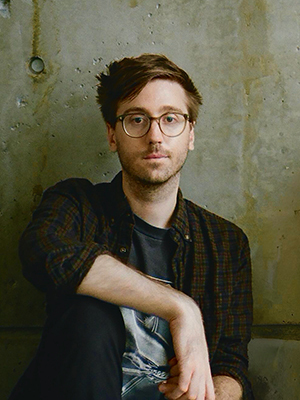
<p>Back in grade school, Bird was less into abstract depictions of complex modern issues and more into skateboarding. He just wasn’t very good at it.</p>
<p>So instead of hitting the half-pipe, Bird hit “record” on his camera.</p>
<p>Filming and editing skateboarding videos and other DIY video projects became Bird’s passion — and the place where he first began to appreciate the power of music.</p>
<p>“I found that I really liked putting music to these videos,” he said. “There was so much expressive potential, and I started wanting to compose music for different environments — movie scenes in my head or other audiovisual projects.”</p>
<p>Bird started spending his free time in his parents’ at-home graphic design studio, where he could use their office computers to multitrack his compositions. He moved from skateboard video soundtracks to his own concept albums, with folders full of experimentation in between.</p>
<p>“Every project has pushed my practice further in different ways,” Bird said. “What I’m proud of is the accumulation of skills and practices that has brought me into an area where I’m able to do something that’s really unique.”</p>
<p>An example of this expanded practice is Bird’s integration of light into his music. He treats light as an instrument or as a member of the ensemble. He began with strobe lights in his piece “Drop,” in which lights are timed to flash in the dark alongside the music of a string octet.</p>
<p>Later, he explored the combination of light and sound in “<a href="https://davidbird.tv/dark-ethnography">Dark Ethnography</a>” by modifying flashlights to trigger musical sounds. Written for the Switzerland-based Ensemble Vortex, the piece features four performers using flashlights in a semi-improvised, semi-choreographed performance with one cellist.</p>
<p>“To morph that into something that felt really personalized and expressive and poetic in its own way — that felt like a big achievement for me,” he said.</p>
<h2 dir="ltr">Creating spaces for expression</h2>
<p>While he’s always enjoyed creating music, it took Bird a while to find out how much he loves teaching.</p>
<p>Wary of public speaking, Bird did not initially imagine a career in teaching, instead gravitating toward more behind-the-scenes work in film scoring or music production. But helping peers with their creative projects and eventually leading technical workshops transformed his perspective. It was life-changing.</p>
<p>“I got the confidence and fulfillment of seeing students engage with something — seeing the synapses click,” he said.</p>
<p>Now Bird gets to watch students engage with electronic music — often for their first time — while teaching Introduction to Electronic Music and Music Production.</p>
<figure class="image image-left"><img src="https://al.nd.edu/assets/647626/fullsize/20250915_jlh_music_electronics_workshop_017.jpg" alt="Four students in a bright classroom with a large screen displaying code. Three are seated, surrounded by wires and colorful electronic pedals. One student touches a glowing white light tube, another gives a thumbs up, and one stands observing the setup." width="600" height="400">
<figcaption>Students in the class Computer Music Programming experiment with a system of strobe lights and foot pedals in a hands-on workshop with Beyond This Point, a Chicago-based percussion ensemble. (Photo by Jon L. Hendricks/University of Notre Dame)</figcaption>
</figure>
<p>Unlike many music classes, the course covers both composition and production, using electronic instruments while also exploring the history of the medium. Bird has students exercise the skills they learn in class with creative projects, like a remix song using public domain material or sound design for movie scenes he’s stripped of their original soundtracks.</p>
<p>Last year, the class collaborated with the <a href="https://raclinmurphymuseum.nd.edu/">Raclin Murphy Museum of Art</a> for another project that paired each student with a sculpture in the <a href="https://raclinmurphymuseum.nd.edu/explore/sculpture-park/">Hayes Family Sculpture Park</a>. The students composed and produced electronic music pieces inspired by their assigned sculptures, and Bird put them into a soundwalk app so visitors could listen to the students’ work while walking through the park.</p>
<p>“It’s really important for me to create environments where the students can challenge themselves and explore different ways of expressing their ideas,” he said.</p>
<p>Last semester, Bird started teaching a more advanced class, Computer Music Programming, that focuses on constructing complex electronic music systems, similar to what he creates for pieces like “Decoder” and “Dark Ethnography.” He teaches students how to build drum machines, algorithmic pitch generators, synthesizers, and other electronic instruments that they can customize to fit their individual creative visions.</p>
<p>As part of the lecture series Sonifying the Body: Embodied Technologies in Electronic Music Performance, supported by a large grant from the <a href="https://franco.nd.edu/">Franco Family Institute for Liberal Arts and the Public Good</a>, the Computer Music Programming class had the opportunity to learn from Beyond This Point, a Chicago-based percussion ensemble that integrates electronic music, lighting, and improvisation into their performances.</p>
<p>Beyond This Point led a hands-on workshop revealing the software behind their electronic music systems — from musical bubble wrap and strobe lights triggered by drum pads to lamps that shape and manipulate sound. Students watched and listened to the ensemble perform on these systems, then had the chance to try them out themselves.</p>
<p>For Bird, the workshop was a way to show students the exciting potential of their art and push them to try new techniques. Seeing students chase their curiosity reminds him why he loves his field and why he’s committed to cultivating an electronic music space at Notre Dame.</p>
<p>“The students here are really talented and super smart,” Bird said. “To be the ‘electronic music person’ at Notre Dame is a real honor, and it’s always exciting.”</p>]]>
    </content>
    <link rel="enclosure" type="image/jpeg" href="https://al.nd.edu/assets/647519/dsc05344.jpg" title="Three people observe a glowing wireframe projection of an arm and hand on a dark screen. A man in the foreground adjusts a device, while a woman in a yellow shirt and a man in glasses watch the blue-highlighted digital hand."/>
    <author>
      <name>Adah McMillan</name>
    </author>
  </entry>
  <entry>
    <id>tag:al.nd.edu,2005:News/178127</id>
    <published>2026-01-05T08:30:00-05:00</published>
    <updated>2025-12-19T12:49:15-05:00</updated>
    <link rel="alternate" type="text/html" href="https://al.nd.edu/news/latest-news/arts-initiative-partners-with-franco-institute-to-fund-practice-based-faculty-research-in-the-arts/"/>
    <title>Arts Initiative partners with Franco Institute to fund practice-based faculty research in the arts</title>
    <summary type="text">
      <![CDATA[…]]>
    </summary>
    <content type="html">
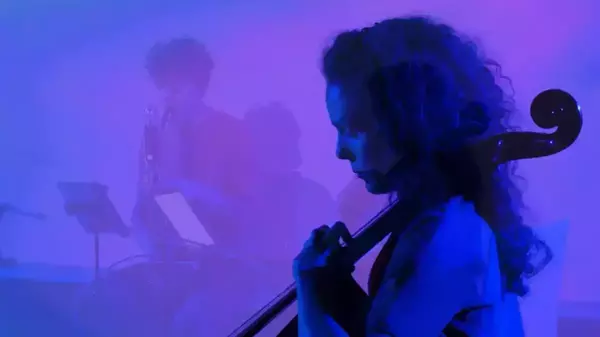
      <![CDATA[<figure class="image image-right"><img src="https://arts.nd.edu/assets/642528/david_bird_cove_for_web.webp" alt="A person with dark, curly hair and a headset mic plays a cello, focused under vibrant blue and purple lighting. Another musician, indistinctly visible in the blurry background, plays a wind instrument." width="600" height="337">
<figcaption><em>Cove</em>. David Bird + lovemusic. 2021.</figcaption>
</figure>
<p>Inspired by a shared commitment to arts research, the <a href="https://strategicframework.nd.edu/initiatives/arts/">Notre Dame Arts Initiative</a> has partnered  with the<a href="https://franco.nd.edu/"> Franco Family Institute for Liberal Arts and the Public Good</a> to jointly invite and fund practice-based arts research projects in any medium that are directed by faculty in the College of Arts &amp; Letters.</p>
<p>Requests up to $4,000 are invited on a rolling basis through the <a href="https://franco.nd.edu/funding/faculty/franco-institute-funding-opportunities/small-creative-and-performing-arts-grant/">Small Creative and Performing Arts Grants</a> program. Requests up to $25,000 are awarded twice annually (October and February) through the <a href="https://franco.nd.edu/funding/faculty/franco-institute-funding-opportunities/large-creative-performing-arts-grants/">Large Creative and Performing Arts Grants</a> program.</p>
<p>Special consideration will be given to projects that align with one or more of the Arts Initiative’s thematic priorities:</p>
<ul>
<li dir="ltr" aria-level="1">
<p><strong>Arts in Action</strong> advances socially engaged creative practice, with an emphasis on the role of the visual arts, performing arts, literature, and architecture in producing more just and equitable societies.</p>
</li>
<li dir="ltr" aria-level="1">
<p><strong>Sense and Transcendence</strong> centers on the production and study of sacred images, objects, spaces, texts, and performances and examines their uses in ritual and devotional practice, evangelization, instruction, and community-building.</p>
</li>
<li dir="ltr" aria-level="1">
<p><strong>Techne Futures</strong> promotes experimental inquiry and modes of making at the intersection of the visual, literary, and performing arts, design, science, and technology.</p>
</li>
</ul>
<p>The Franco Institute advances research in the arts, humanities, and social sciences by supporting faculty, graduate students, and undergraduate students in Notre Dame’s College of Arts &amp; Letters with internal funding, proposal development, and conference support. “Like the Arts Initiative, the Franco Institute is a champion for the critical role of creative practice in arts research,” said <a href="https://artdept.nd.edu/people/michael-schreffler/">Michael Schreffler</a>, director of the Arts Initiative. “This collaboration allows us to further mobilize the transformative power of the arts to advance knowledge and expand faculty access to research funding.”</p>
<p>Applications for the Small and Large Creative and Performing Arts Grants are currently open, and all regular Notre Dame faculty with a primary appointment in the College of Arts &amp; Letters, regardless of department or rank, are eligible to apply. Applications must be received at least one month prior to the start of the proposed research or creative work.</p>
<p><a href="https://franco.nd.edu/funding/faculty/franco-institute-funding-opportunities/#arts-projects" class="btn btn-cta btn--cta">Learn more and apply here</a></p>
<p class="attribution">Originally published by <span class="rel-author">Laura Winkle</span> at <span class="rel-source"><a href="https://arts.nd.edu/news/arts-initiative-partners-with-franco-institute-to-fund-practice-based-faculty-research-in-the-arts/">arts.nd.edu</a></span> on <span class="rel-pubdate">December 16, 2025</span>.</p>]]>
    </content>
    <link rel="enclosure" type="image/webp" href="https://al.nd.edu/assets/643207/david_bird_cove_for_web.webp" title="A person with dark, curly hair and a headset mic plays a cello, focused under vibrant blue and purple lighting. Another musician, indistinctly visible in the blurry background, plays a wind instrument."/>
    <author>
      <name>Laura Winkle</name>
    </author>
  </entry>
  <entry>
    <id>tag:al.nd.edu,2005:News/178126</id>
    <published>2025-12-19T12:25:00-05:00</published>
    <updated>2025-12-19T12:27:32-05:00</updated>
    <link rel="alternate" type="text/html" href="https://al.nd.edu/news/latest-news/notre-dame-joins-alliance-for-the-arts-in-research-universities-a2ru/"/>
    <title>Notre Dame joins Alliance for the Arts in Research Universities (a2ru)</title>
    <summary type="text">
      <![CDATA[“Arts-activated and informed campuses like Notre Dame are critical to strengthen the national fabric of the arts in higher education.” - Maryrose Flanigan, a2ru Executive Director  The University of Notre Dame has joined over 40 colleges and universities…]]>
    </summary>
    <content type="html">
      <![CDATA[<blockquote class="pull">
<p>“Arts-activated and informed campuses like Notre Dame are critical to strengthen the national fabric of the arts in higher education.”</p>
<p>- Maryrose Flanigan, a2ru Executive Director</p>
</blockquote>
<p>The University of Notre Dame has joined over 40 colleges and universities driving arts research in higher education through a new institutional membership with Alliance for the Arts in Research Universities (<a href="https://a2ru.org/">a2ru</a>). The organization, which is affiliated with the University of Michigan, advances arts-integrative research, curricula, programs, and creative practice to articulate and expand the vital role of higher education in our global society.</p>
<p>“We are thrilled to welcome the University of Notre Dame to the a2ru network,” said Maryrose Flanigan, executive director of a2ru. “We look forward to sharing - and learning from - its diverse arts ecosystem, boosted by an ambitious arts initiative. Arts-activated and informed campuses like Notre Dame are critical to strengthen the national fabric of the arts in higher education. They demonstrate how the arts uniquely benefit society in practice and research, and they are well-positioned to provide students with a holistic education and rewarding careers.”</p>
<figure class="image image-left"><img src="https://arts.nd.edu/assets/643110/20250424_jlh_arts_chem_only_connect_for_web.jpeg" alt='A young man in a green Notre Dame "March On To Victory" football t-shirt focuses on a rectangular object on a purple-lit lab table. His gloved right hand rests near the object, which is illuminated by an adjustable lamp. Other students are blurred in the background.' width="600" height="410">
<figcaption>Notre Dame course Only Connect Chemistry and Art was co-taught by Bahram Moasser and Michael Schreffler. Photo by Jon L. Hendricks.</figcaption>
</figure>
<p>Joining a2ru was an early priority of the <a href="https://strategicframework.nd.edu/initiatives/arts/">Arts Initiative</a>, launched in 2024 after the arts were identified as a focus area in the University’s <a href="https://strategicframework.nd.edu/">2023 Strategic Framework</a>. The Arts Initiative brings together the people and programs of the University’s extended arts community to foster interdisciplinary collaboration and define the arts as a central part of campus and community life. “In addition to our local emphasis on campus and community, the Arts Initiative’s work is part of a larger effort within higher education to advocate for the arts as integral to intellectual and public life,” explained Rebecca Struch, managing director of the Arts Initiative. “The partnership with a2ru connects Notre Dame’s efforts to a national network that amplifies our commitment to transcending conventional boundaries — between art forms and across disciplines - and provides new opportunities for faculty and student engagement.”</p>
<p>The Arts Initiative is already expanding excellence in the arts through faculty research and teaching grants, postdoctoral and student fellowships, visiting artists and artists-in-residence, and interdisciplinary arts convenings, including the upcoming <a href="https://artsbiennial.nd.edu/">2027 Notre Dame Arts Biennial</a>. With a2ru, Notre Dame affiliates now have access to new opportunities for networking and professional development in the arts, annual conference participation, travel grants, scholar awards, and additional member resources that support and amplify research in the arts.</p>
<p>“As an institutional member of a2ru, I look forward to the many ways Notre Dame’s arts community will both contribute and gain valuable insights on the future of cross-disciplinary collaboration in the arts,” said Arts Initiative director Michael Schreffler.</p>
<p>Any person with a Notre Dame email address is invited to <a href="https://a2ru.org/become-a-member/">participate in the a2ru network </a>at no additional cost.<strong id="docs-internal-guid-2ec0840c-7fff-c422-4ca7-66f72e058030"> </strong> Those interested in learning more about the benefits of a2ru may <a href="https://notredame.zoom.us/meeting/register/Drw1Zw_LQsinUxlw2oCrbg">register here</a> for the upcoming information session co-led by Maryrose Flanigan and Rebecca Struch in February.</p>
<p class="attribution">Originally published by <span class="rel-author">Laura Winkle</span> at <span class="rel-source"><a href="https://arts.nd.edu/news/notre-dame-joins-alliance-for-the-arts-in-research-universities-a2ru/">arts.nd.edu</a></span> on <span class="rel-pubdate">December 18, 2025</span>.</p>]]>
    </content>
    <link rel="enclosure" type="image/jpeg" href="https://al.nd.edu/assets/643204/20250424_jlh_arts_chem_only_connect_for_web.jpeg" title="A young man in a green Notre Dame &quot;March On To Victory&quot; football t-shirt focuses on a rectangular object on a purple-lit lab table. His gloved right hand rests near the object, which is illuminated by an adjustable lamp. Other students are blurred in the background."/>
    <author>
      <name>Laura Winkle</name>
    </author>
  </entry>
  <entry>
    <id>tag:al.nd.edu,2005:News/176296</id>
    <published>2025-11-05T14:41:00-05:00</published>
    <updated>2025-11-05T14:51:11-05:00</updated>
    <link rel="alternate" type="text/html" href="https://al.nd.edu/news/latest-news/four-faculty-teams-awarded-grants-in-support-of-arts-research-and-creative-practice/"/>
    <title>Four faculty teams awarded grants in support of arts research and creative practice</title>
    <summary type="text">
      <![CDATA[Four collaborative faculty teams that represent seven different departments across Notre Dame’s campus have been awarded Notre Dame Arts Initiative grants in support of arts research and creative practice. The grants, awarded this year, will conclude in 2027. They support the Arts Initiative…]]>
    </summary>
    <content type="html">
      <![CDATA[<p>Four collaborative faculty teams that represent seven different departments across Notre Dame’s campus have been awarded Notre Dame Arts Initiative grants in support of arts research and creative practice.</p>
<p>The grants, awarded this year, will conclude in 2027. They support the Arts Initiative in its <a href="https://strategicframework.nd.edu/initiatives/arts/research-themes/">three research priority </a>areas: Arts in Action centers the arts in pursuit of social transformation, Sense and Transcendence examines the role of the arts in ritual and devotional practice, and Techne Futures engages the intersection of science, technology, and the arts.</p>
<p>"The Arts Initiative is proud to support these innovative projects that advance knowledge and promise to inspire productive, interdisciplinary dialogue," said Michael Schreffler,  director of the Arts Initiative. We look forward to following their progress and celebrating their contributions to Notre Dame's thriving arts ecosystem."</p>
<h2>2025-27 Faculty Grant Awardees</h2>
<h3>Cafecitos: Motherhood and Migration Stories of Trauma and Joy through Art, Literature, and Community Building</h3>
<p><strong>Principal Investigators: </strong><a href="https://romancelanguages.nd.edu/people/faculty/vanesa-miseres/">Vanesa Miseres</a>, associate professor of Spanish in the Department of Romance Languages and Literatures, and <a href="https://anthropology.nd.edu/people/faculty/vania-smith-oka/">Vania Smith</a>, professor in the Department of Anthropology</p>
<p><strong>Arts Initiative Research Theme: </strong>Arts in Action</p>
<p>This project explores the arts as narrative and healing tools among migrant Latina mothers in South Bend, Indiana. Building upon two years of cafecitos (coffee gatherings) at La Casa de Amistad, a community center in South Bend, this second phase hosts internationally recognized Latina artists to guide participants in artistic explorations. By employing creative practices—such as collage, poetry, photography, and textile arts — and visits from Latina artists including Lourdes Almeida, Claudia Bernardi, Carmen Mariscal, and María Pichot—this project fosters collective storytelling and community building that enables participants to articulate both trauma and joy in ways that traditional academic or policy discourses often overlook. A resulting book will feature artwork and testimonies and provide a model for scholars, practitioners, and community organizers interested in intersectional approaches to Latina motherhood, migration, and reproductive justice.</p>
<h3>Melting Time in The Digital Cave: An Interactive Multimedia Installation</h3>
<p><strong>Principal Investigators:</strong> <a href="https://ftt.nd.edu/people/faculty/cecilia-kim/">Cecilia Kim</a>, assistant professor of film in the Department of Film, Television, and Theatre, and <a href="https://music.nd.edu/people/david-bird/">David Bird</a>, assistant professor of music technology and digital media in the Department of Music</p>
<p><strong>Arts Initiative Research Theme: </strong>Techne Futures</p>
<p>Melting Time in the Digital Cave explores the sensory and spatial qualities of a cave as a framework for examining extractivist labor, digital preservation, and data accumulation. Integrating high-resolution video, spatialized audio, and live performance, the project reimagines the cave as both a historical site of human activity and a metaphor for digital storage and cultural memory. Melting Time builds on Bird’s and Kim’s interdisciplinary work in music composition, performance, and video art by combining field recording from geological caves, performances by the vocal ensemble Ekmeles, and moving image art into an immersive, responsive digital cave. By slowing down time and countering digital fatigue, Melting Time encourages viewers to reconsider the intersections of technology, materiality, and temporality in an era dominated by accelerated digital culture. Scheduled for a major U.S. contemporary art space in Fall 2027, following a preview at the <a href="https://research.nd.edu/news-and-events/news/notre-dame-plans-inaugural-arts-biennial-for-spring-2027/">Notre Dame Arts Initiative Biennial</a> in spring 2027, the installation aims to expand the creative possibilities of large-scale media art.</p>
<h3>The Last Man at 200 - Imagining the Future After Environmental Disaster</h3>
<p><strong>Principal Investigators: </strong><a href="https://politicalscience.nd.edu/people/eileen-hunt-botting/">Eileen Hunt</a>, professor in the Department of Political Science, <a href="https://english.nd.edu/people/roy-scranton/">Roy Scranton</a>, associate professor in the Department of English and director of <a href="https://environmentalhumanities.nd.edu/">Notre Dame’s Environmental Humanities Initiative</a>, <a href="https://ftt.nd.edu/people/faculty/ricky-herbst/">Ricky Herbst</a>, cinema program director at the DeBartolo Performing Arts Center and term teaching professor of film in the Department of Film, Television, and Theatre, and <a href="https://english.nd.edu/people/yasmin-solomonescu/">Yasmin Solomonescu</a>, associate professor in the Department of English.</p>
<p><strong>Arts Initiative Research Theme: </strong>Techne Futures</p>
<p>Marking the bicentennial of Mary Shelley’s <em>The Last Man</em> (1826), this project brings together faculty and students from Notre Dame and universities around the world to explore the enduring legacies of Shelley’s text by showing its artistic and philosophical resonances with one of the most important works of environmental and disaster literature of this century, Canadian author Emily St. John Mandel’s <em>Station Eleven</em> (2014). The award-winning novel inspired the HBO series of the same name in 2021, and The Last Man at 200 will bring Mandel to Notre Dame during a globally broadcast conference in fall 2026. The conference convening will also support Eileen Hunt’s forthcoming edited publication, the first book devoted to Mary Shelley’s genre-defining post-apocalyptic pandemic novel and its legacies.</p>
<h3>The Work of Human Hands: Liturgy and the Arts</h3>
<p><strong>Principal Investigators: </strong><a href="https://t.e2ma.net/click/03214l/sx4we19c/cdmcd2">Kimberly Belcher</a>, associate professor in the Department of Theology, and <a href="https://t.e2ma.net/click/03214l/sx4we19c/s5mcd2">Rebecca Maloy</a>, J.W. van Gorkom Professor of Music and director of Sacred Music at Notre Dame</p>
<p><strong>Arts Initiative Research Theme:</strong> Sense and Transcendence</p>
<p>The Work of Human Hands is a research and teaching project that considers liturgy as an avenue for artistic engagement, spiritual practice, and health and well-being. The project convenes Notre Dame graduate students, faculty, and visiting scholars through a speaker series to deepen inquiry around texts, music, visual art, and architecture as it relates to communal worship. The speaker series will host two international scholars on campus in spring 2026.</p>
<h2>Additional Support for Arts-Integrated Research and Teaching</h2>
<p>Four of the grants recently awarded by the <a href="https://strategicframework.nd.edu/news/notre-dame-announces-2025-strategic-framework-grant-recipients/">Strategic Framework Grant (SFG) Program</a> also support collaborative, cross-disciplinary research and teaching projects that center artistic inquiry and creative production.</p>
<p><a href="https://theology.nd.edu/people/ann-w-astell/">Sr. Ann Astell</a>, the John Cardinal O’Hara Professor of Theology, and co-principal investigator <a href="https://theology.nd.edu/people/jenny-martin/">Jennifer Newsome Martin</a>, the John J. Cavanaugh Associate Professor of the Humanities and Director of the de Nicola Center for Ethics and Culture, both in the Department of Theology, will lead a research and creative works project titled “Saint Hildegard’s Illustrated Prayer Book (ca. 1180): A Prayer Book for Today.”</p>
<p><a href="https://sacredmusic.nd.edu/people/faculty/cynthia-katsarelis/">Cynthia Katsarelis</a>, assistant professor of the practice in conducting in the Sacred Music program, and co-principal investigator <a href="https://biology.nd.edu/people/lee-rafuse-haines/">Lee Haines</a>, associate research professor in the Department of Biological Sciences, will lead a research and creative works project titled “​​Symphonic Wings: A Story of Peril and Promise.”</p>
<p><a href="https://ftt.nd.edu/people/faculty/michael-kackman/">Michael Kackman</a>, associate teaching professor in film, television, and theatre, will develop an integration course titled The Mediated Climate: Critical Media Literacy and the Climate Crisis.</p>
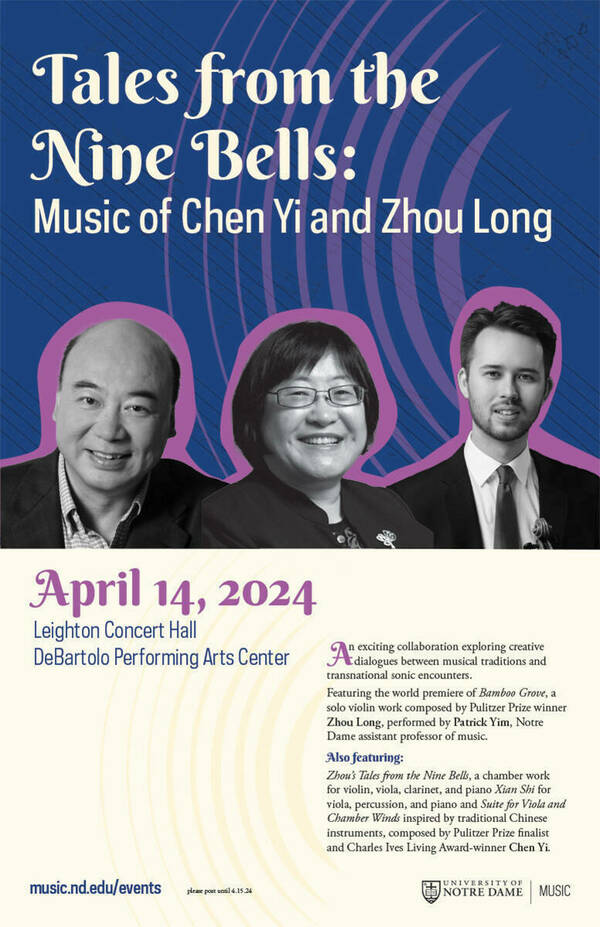
<p><a href="https://music.nd.edu/people/patrick-yim/">Patrick Yim</a>, assistant professor of violin and viola in the Department of Music, will lead a research and creative practice project titled “Beyond Orientalism: Contemporary Classical Music at the Global Crossroads in Chinese-American Composer Zhou Long’s First Violin Concerto.” Yim will be joined by co-principal investigators Zhou Long, Bonfils Distinguished Research Professor of Composition at the University of Missouri-Kansas City Conservatory of Music and Dance, and Chen Yi, Lorena Cravens/Millsap/Missouri Distinguished Professor at the University of Missouri-Kansas City Conservatory of Music and Dance.</p>
<p class="attribution">Originally published by <span class="rel-author">Emily Monacelli Guzman</span> at <span class="rel-source"><a href="https://strategicframework.nd.edu/news/four-faculty-teams-awarded-grants-in-support-of-arts-research-and-creative-practice/">strategicframework.nd.edu</a></span> on <span class="rel-pubdate">November 05, 2025</span>.</p>]]>
    </content>
    <link rel="enclosure" type="image/jpeg" href="https://al.nd.edu/assets/637304/notre_dame_campus_sunrise.jpg" title="An East aerial view of Notre Dame Campus just as the sun is rising. The Basilica is rising at the front, with the main building and library in the background."/>
    <author>
      <name>Emily Monacelli Guzman</name>
    </author>
  </entry>
  <entry>
    <id>tag:al.nd.edu,2005:News/175167</id>
    <published>2025-09-23T09:30:00-04:00</published>
    <updated>2025-09-22T16:04:10-04:00</updated>
    <link rel="alternate" type="text/html" href="https://al.nd.edu/news/latest-news/in-tandem-what-an-art-historian-and-chemist-learned-by-teaching-a-class-together/"/>
    <title>In Tandem: What an art historian and chemist learned by teaching a class together</title>
    <summary type="text">
      <![CDATA[How do you bridge the gap between two drastically different fields? For a Notre Dame art historian and chemist, all it took was sharing a classroom for…]]>
    </summary>
    <content type="html">
      <![CDATA[<p><iframe width="1200" height="673" src="https://www.youtube.com/embed/iFBvpO2Eh6g?feature=youtu" allowfullscreen="allowfullscreen"></iframe></p>
<p>How do you bridge the gap between two drastically different fields? For a Notre Dame art historian and chemist, all it took was sharing a classroom for a semester.</p>
<p>Only Connect Chemistry and Art is a course that integrates human experiences by exploring the intersection of two disciplines that, nevertheless, share surprising aspects in common. Taught by <a href="https://artdept.nd.edu/people/michael-schreffler/">Michael Schreffler</a>, a professor of art history and associate dean for the arts in the <a href="http://al.nd.edu/">College of Arts &amp; Letters</a>, and <a href="https://chemistry.nd.edu/people/bahram-moasser/">Bahram Moasser</a>, a teaching professor in the <a href="https://chemistry.nd.edu/">Department of Chemistry &amp; Biochemistry</a> with the <a href="http://science.nd.edu/">College of Science</a>, the class explores how art and chemistry enrich each other and, at a deeper level, have a common approach to inquiry.</p>
<p>A new College of Arts &amp; Letters video series titled “In Tandem” showcases the importance and value of interdisciplinary research and teaching. In this first installment, Schreffler and Moasser discuss how they began working together, the surprising connections they’ve discovered between art and science, and the ways in which exploring another field has broadened their perspective.</p>
<p>The title of the course is drawn from the epigraph of the E.M. Forster novel <em>Howard’s End</em>, which, through the phrase “Only connect!”, extols the virtues of bringing disparate elements together. Schreffler, who is also the director of Notre Dame’s <a href="https://strategicframework.nd.edu/initiatives/arts/">Arts Initiative</a>, and Moasser have taught the course the past two spring semesters, and no prerequisites are necessary. It fulfills the Core Integration Ways of Knowing requirement in Notre Dame’s Core Curriculum, and is ideal for any student looking to explore connections between disciplines.</p>]]>
    </content>
    <link rel="enclosure" type="image/jpeg" href="https://al.nd.edu/assets/631325/intandemthumb_1200x.jpg" title="In Tandem Chemistry &amp; Art graphic with two men. On the left, a smiling man with glasses wears a maroon polo shirt. On the right, a man with a serious expression wears a dark blazer. The University of Notre Dame and Arts &amp; Letters logos are in the center.  The background is light green."/>
    <author>
      <name>College of Arts and Letters</name>
    </author>
  </entry>
  <entry>
    <id>tag:al.nd.edu,2005:News/174590</id>
    <published>2025-08-28T11:45:00-04:00</published>
    <updated>2025-08-28T11:47:42-04:00</updated>
    <link rel="alternate" type="text/html" href="https://al.nd.edu/news/latest-news/collecting-more-than-trash-researchers-equip-local-garbage-trucks-to-gather-data-on-urban-heat-island-effect/"/>
    <title>Collecting more than trash: Researchers equip local garbage trucks to gather data on urban heat island effect</title>
    <summary type="text">
      <![CDATA[To help identify — and ultimately mitigate — heat islands in South Bend, a team of University of Notre Dame researchers has partnered with the city to collect data using a novel method: garbage trucks. Ming Hu, the associate dean for research, scholarship and creative work in Notre Dame’s School of Architecture; Jason Carley, an assistant professor of industrial design; and Siavash Ghorbany, a doctoral student in civil and environmental engineering, have designed and deployed sensors on the city’s fleet of garbage trucks that can continuously monitor and record data on temperature and humidity as the trucks complete their normal routes.]]>
    </summary>
    <content type="html">
      <![CDATA[<figure class="image image-right"><img src="https://news.nd.edu/assets/627795/ghorbany_sb.jpg" alt="A person with long dark hair pulled back installs a gray device under a large truck using a screwdriver." width="600" height="400">
<figcaption>Siavash Ghorbany, a doctoral student in civil and environmental engineering, installs a sensor on a City of South Bend garbage truck. Photo provided.</figcaption>
</figure>
<p>When heat waves hit, they don’t hit evenly. Cities often experience significantly higher temperatures than nearby rural areas, and areas with more pavement and concrete and fewer trees are more severely impacted.</p>
<p>These urban heat islands, which disproportionately affect lower-income neighborhoods, <a href="https://www.epa.gov/green-infrastructure/reduce-heat-islands">increase air pollution and energy costs, as well as heat-related illnesses and deaths</a>.</p>
<p>To help identify — and ultimately mitigate — heat islands in South Bend, a team of University of Notre Dame researchers has partnered with the city to collect data using a novel method: garbage trucks.</p>
<p><a href="https://architecture.nd.edu/about/directory/ming-hu/">Ming Hu</a>, the associate dean for research, scholarship and creative work in Notre Dame’s School of Architecture; <a href="https://artdept.nd.edu/people/jason-carley/">Jason Carley</a>, an assistant professor of industrial design; and <a href="https://lucyinstitute.nd.edu/people/graduate-scholars/2024-2026-lucy-graduate-scholars-cohort/siavash-ghorbany/">Siavash Ghorbany</a>, a doctoral student in civil and environmental engineering, have designed and deployed sensors on the city’s fleet of garbage trucks that can continuously monitor and record data on temperature and humidity as the trucks complete their normal routes.</p>
<p>The use of garbage trucks as mobile weather research stations offers some distinct advantages and challenges, Carley said. Because garbage trucks run the same route every week, they allow the researchers to gather consistent, detailed data in neighborhoods throughout the city.</p>
<p>“The more challenging part of the study is that you have to have this advanced technology out in the elements, in the rain, on a moving truck,” he said. “So, some of it has to be waterproofed, but the rest of it needs to have access to ambient air and be protected from direct sunlight.”</p>
<p>Carley, who designed custom housing for the sensors, also needed to ensure the housing was secure, was customized to different types of trucks in the fleet, and would allow for accurate temperature data without interference from the garbage truck itself. After he finalized his design this summer, the sensors were deployed at the beginning of August.</p>
<p>The collaboration between the University and the city began in 2023, Hu said, with discussions on how to use emerging sensor technologies to better understand a range of environmental stressors facing the city, including urban heat island effects and air quality.</p>
<p>“The data collected, along with the resulting analytical tools, will support the city in allocating both financial and physical resources — like tree planting — and in planning for greater resilience as extreme weather conditions intensify,” Hu said.</p>
<p>Identifying heat islands within the city is especially important, Carley noted, because extreme heat is most likely to impact vulnerable populations, including lower-income families and the elderly.</p>
<figure class="image image-left"><img src="https://al.nd.edu/assets/627803/sb_sensor.jpg" alt='A gray SENSE SB Extreme Heat sensor, labeled "Heat Sensor Kit: 572", mounted on a white garbage truck next to an amber warning light.' width="600" height="400"></figure>
<p>“Air conditioning is expensive and energy intensive, so it may not be something lower-income residents have as much access to,” Carley said. “When you have hot temperatures outside and inside the home, it becomes a public health issue. Adding green spaces and trees is important not just for recreation or aesthetics, but to protect the health of residents.”</p>
<p>The research builds on work that Hu and Ghorbany completed at Notre Dame last year <a href="https://www.mdpi.com/2075-5309/14/9/2751">to determine where heat islands might exist on campus</a>. As they collected data, Ghorbany developed a model, fine-tuned for the Notre Dame campus, that uses satellite imagery to measure building density, materials, and vegetation coverage through segmentation and computer vision techniques. He then used machine learning to identify areas with the highest potential for experiencing a heat island effect.</p>
<p>“This project allows us to test our model on a larger scale, in the city of South Bend,” Ghorbany said. “If it works as we expect it to, we can eventually move to using the model to predict these effects, instead of logging data each time, which is close to impossible for larger cities. By quickly identifying these areas, we can help cities focus their efforts on reducing the temperature by increasing the tree canopy or implementing building renovations.”</p>
<p>The sensors will remain in place during August and September, after which Ghorbany and Hu will analyze the data. Once the analysis is complete, the team will present its findings to the City of South Bend’s Office of Sustainability and share them with South Bend residents.</p>
<p>The researchers also hope to expand the project in future phases to measure air quality and other markers of public health.</p>
<p>“Our work consistently shows that the built environment is not just a physical setting, but a determinant of health,” Hu said. “By linking fine-grained environmental data with building and neighborhood characteristics, we can reveal where risks are concentrated and how design or policy interventions can reduce them. Projects like this one in South Bend demonstrate how data collection at the street level can ultimately guide healthier, more resilient cities nationwide.”</p>
<p><em><strong>Contact: </strong>Carrie Gates, associate director of media relations, 574-993-9220, <a href="mailto:c.gates@nd.edu">c.gates@nd.edu</a></em></p>
<p class="attribution">Originally published by <span class="rel-author">Carrie Gates</span> at <span class="rel-source"><a href="https://news.nd.edu/news/collecting-more-than-trash-researchers-equip-local-garbage-trucks-to-gather-data-on-urban-heat-island-effect/">news.nd.edu</a></span> on <span class="rel-pubdate">August 28, 2025</span>.</p>]]>
    </content>
    <link rel="enclosure" type="image/jpeg" href="https://al.nd.edu/assets/627803/sb_sensor.jpg" title="A gray SENSE SB Extreme Heat sensor, labeled &quot;Heat Sensor Kit: 572&quot;, mounted on a white garbage truck next to an amber warning light."/>
    <author>
      <name>Carrie Gates</name>
    </author>
  </entry>
  <entry>
    <id>tag:al.nd.edu,2005:News/174033</id>
    <published>2025-07-28T18:00:00-04:00</published>
    <updated>2025-07-31T09:18:59-04:00</updated>
    <link rel="alternate" type="text/html" href="https://al.nd.edu/news/latest-news/painting-inspiration-kathryn-turner-95-finds-her-artistic-path-at-notre-dame/"/>
    <title>Painting inspiration: Kathryn Turner ’95 finds her artistic path</title>
    <summary type="text">
      <![CDATA[Kathryn Turner ’95 spent her childhood roaming the acres of her family’s ranch inside Grand Teton National Park in Wyoming. First, she rode on the same horse as her mom, Mary Kay Brady SMC ’64, as the family worked around the ranch, and then, by the time she was three, she was riding…]]>
    </summary>
    <content type="html">
      <![CDATA[<p><strong>Kathryn Turner ’95</strong> spent her childhood roaming the acres of her family’s ranch inside Grand Teton National Park in Wyoming. First, she rode on the same horse as her mom, Mary Kay Brady SMC ’64, as the family worked around the ranch, and then, by the time she was three, she was riding her own horse. As Turner got older, a sketchbook was her constant companion as she observed the changing seasons and wildlife at the Triangle X Ranch, where she is part of the fourth generation in the family business.</p>
<p>“I was knitted into this community of family working together with the land, very much tied to a sense of place. With the beauty and the legacy of the West, I was shaped by that,” Turner said. “I am deeply attuned to beauty, and I think that’s why I’m here: to capture beauty. Art became my language to express what I was, what I loved, and what I appreciated about what I was surrounded with in the natural world. It became my way of understanding the natural world.”</p>
<p>She knew that she wanted to be an artist since those childhood days spent sketching on the ranch. Her family’s land has inspired her art all her life. Today, she lives near the ranch and is an award-winning painter, with her own gallery in nearby Jackson and her art on display at exhibitions in museums around the country.</p>
<p>Back in the ’90s, when the time came to choose a college, Turner wasn’t quite sure the University of Notre Dame was the place for her to reach her artistic goals. But with a Saint Mary’s graduate for a mom and a Notre Dame graduate, John Turner ’64, for a dad, plus a scholarship in hand, Turner moved from Wyoming to South Bend.</p>
<p>“It was very challenging for me to go from Jackson Hole to South Bend in August — it was so hot,” she recalled. “Thank God for the lakes. I would take my paints to the lakeshore.”</p>
<figure class="image image-left"><img src="https://al.nd.edu/assets/623763/img_3796_400x.jpg" alt="Woman wearing a Notre Dame baseball cap, gray t-shirt, and blue shorts smiles while sketching by a stream, with a watercolor palette at her side and a treeline and mountains in the background." width="266" height="400">
<figcaption>Photo provided.</figcaption>
</figure>
<p>And more often than not, you’d find her at the <a href="https://raclinmurphymuseum.nd.edu/">Snite Museum of Art </a>in the center of campus. “I was somebody who just wore out the halls of the Snite Museum,” said Turner, who was a <a href="https://pls.nd.edu/">Program of Liberal Studies</a> major. “For such a small museum, it had such a high caliber of art, and it was right in the middle of our lives. Even if I just had a few moments, I would go and check out one piece of art and sit with it. The Snite Museum was a great teacher of mine.”</p>
<p>And it wasn’t just the museum where she connected with her love of art: She sang with the folk choir, took dance classes at her mom’s alma mater across the street, did illustrations for The Observer, and had her own art studio space in<a href="https://artdept.nd.edu/about/our-facilities/"> Riley Hall</a>.</p>
<p>Sometimes, she’d sell her football tickets to take advantage of four hours of quiet time in the studio while the rest of the student body cheered on the Irish in the stadium — though she says her brother, Mark Turner ’97, was exasperated by that decision. She also spent a semester in Rome through Saint Mary’s, enrolled in drawing and art history classes that took her all over the city.</p>
<p>“I was at Notre Dame at a time when there was more art being developed. You had to work a little harder than maybe a business student would have had to; it wasn’t spoon-fed,” Turner said. “But there was also freedom in that I felt like I could create what I needed for a funky art student at Notre Dame.”</p>
<p>After graduation, she headed to the University of Virginia to earn a master’s degree in education. She worked at the Smithsonian and taught art at a Catholic school, an experience she loved, but the ranch in Wyoming lured her home.</p>
<p>“When I moved back, I worked at the National Museum of Wildlife Art; that was my day job. But every minute I could, I was very committed and devoted to learning how to paint and draw. Luckily, in a place like Jackson Hole, which has a special focus on culture and art, it attracts artists from all over the world, so I was able to study from really noted artists who were drawn to this place,” Turner said. “How lucky am I — to be back in my little, tiny town, but with really exceptional art influences.”</p>
<p>She also had all the supplies she needed for the job, thanks to her father’s Notre Dame roommate, Nick Rassas ’66, an All-American football player for the Irish who went on to play in the NFL.</p>
<p>“Nick and Dad have always been like brothers, and I called him up sharing my dream of returning to Wyoming to realize my dream of being an artist,” Turner said. “Unbeknownst to me, Nick secretly shipped out to Wyoming all the art supplies that an aspiring artist might ever need to make her start. I am still using these top-quality supplies today, 25 years later — Notre Dame is indeed family.”</p>
<p>She’s owned the <a href="https://turnerfineart.com/?srsltid=AfmBOoqqBQDgm2n-oKpBf2EYfc3woBRQpvDI0UjF-ByiYbOy_7V0FSQh">Turner Fine Art Gallery</a> in Jackson for 20 years, and is still part of the family business at the ranch, where she has a standing weekly horseback ride with her dad. It's a balancing act, running a small business alongside making art, and she is very disciplined about maintaining time in her schedule to paint. “Without discipline and deadlines, no art would get done in my world,” Turner said.</p>
<figure class="image image-right"><img src="https://al.nd.edu/assets/623764/kathryn_mapes_turner_rain_on_the_snake_river_400x.jpg" alt="Misty, purple-hued mountains rise above a calm lake and a dark shoreline with a few trees." width="400" height="249">
<figcaption>Photo provided.</figcaption>
</figure>
<p>“I have this belief that I’m in the service industry, and that I need to give the art what it requires to serve the world, to serve beauty,” she continued. “I believe the world needs art, and I’m just making my contribution in service.”</p>
<p>This service mindset was shaped at Notre Dame, where she was inspired by her fellow Domers to strive for excellence.</p>
<p>“That's such a thread through everything that Notre Dame does, from the academics to the athletics to the music and architecture. I found Notre Dame incredibly inspiring,” said Turner, who has the word “excellence” emblazoned on the wall of her studio as a reminder.</p>
<p>Turner’s impressionist paintings chronicle a life lived with the land on her family’s ranch, and she hopes to inspire viewers to ponder their connection with the natural world.</p>
<p>“I want to make art that will give pause to the viewer in such a way that moves them emotionally to care in a deeper way,” she said. “Ultimately, my goal is to create art that is a reminder that we share this planet with other beings, and just offer a way of meditation, or a reminder or a reflection of this interconnectedness.”</p>
<p><em>Originally published by <a href="https://weare.nd.edu/stories/authors/maura-sullivan-hill-11/">Maura Sullivan Hill ’90</a> at <a href="https://weare.nd.edu/">weare.nd.edu</a>, a digital publication from the Notre Dame Alumni Association telling stories of Domers doing good in the world.</em></p>]]>
    </content>
    <link rel="enclosure" type="image/jpeg" href="https://al.nd.edu/assets/623765/kathrynturner_1200x.jpg" title="A woman wearing a red and brown plaid shirt smiles as she works at a table in her art studio.  Containers of paint brushes, pencils, and other art supplies surround her, and various artwork pieces are tacked to the wall behind her."/>
    <author>
      <name>Maura Sullivan Hill ’11</name>
    </author>
  </entry>
  <entry>
    <id>tag:al.nd.edu,2005:News/172890</id>
    <published>2025-05-28T09:27:00-04:00</published>
    <updated>2025-05-28T09:28:26-04:00</updated>
    <link rel="alternate" type="text/html" href="https://al.nd.edu/news/latest-news/notre-dame-rising-senior-rocio-colon-cotto-named-2025-beinecke-scholar/"/>
    <title>Arts &amp; Letters rising senior Rocío Colón Cotto named 2025 Beinecke Scholar</title>
    <summary type="text">
      <![CDATA[University of Notre Dame rising senior Rocío Colón Cotto has been awarded a Beinecke Scholarship worth $35,000 in support of her graduate education. She is Notre Dame’s 10th Beinecke Scholar overall and second since 2023.]]>
    </summary>
    <content type="html">
      <![CDATA[<p>University of Notre Dame rising senior Rocío Colón Cotto has been awarded a Beinecke Scholarship worth $35,000 in support of her graduate education. She is Notre Dame’s 10th Beinecke Scholar overall and second since 2023.</p>
<p>Colón Cotto worked closely with the <a href="https://cuse.nd.edu">Flatley Center for Undergraduate Scholarly Engagement</a> (CUSE) in applying for the award, which is available to juniors at participating institutions in the U.S.</p>
<p>“Congratulations to Rocío. Over the past two years, I have had the pleasure of watching her passion for art conservation develop,” said Emily Buika Hunt, assistant director of scholarly development at CUSE. “The decisions she has made about her coursework, research projects and extracurriculars have been guided by her genuine intellectual curiosity and artistic talent. These wise decisions have put her in the position to become a future leader in her field.”</p>
<p>Colón Cotto is an <a href="https://artdept.nd.edu/">art history</a> and <a href="https://eastasian.nd.edu/chinese/">Chinese</a> major with a studio art minor from San Juan, Puerto Rico.</p>
<p>A <a href="https://cuse.nd.edu/sorin-scholars/">Sorin Scholar</a>, she is a research assistant in the <a href="https://rarebooks.library.nd.edu/">Rare Books &amp; Special Collections section</a> of the <a href="https://www.library.nd.edu/">Hesburgh Libraries</a>; a teaching assistant to Professor <a href="https://chemistry.nd.edu/people/bahram-moasser/">Bahram Moasser</a> in the <a href="https://chemistry.nd.edu/people/bahram-moasser/">Department of Chemistry and Biochemistry</a>; a student programming committee member at the <a href="https://raclinmurphymuseum.nd.edu/">Raclin Murphy Museum of Art</a>; and a technical lead and announcer for WSND, the student-run campus radio station.</p>
<p>Away from campus, she participated in an immersive summer language program through Princeton University in China and studied abroad in the United Kingdom through Notre Dame London, where she served as a program and engagement team intern with the Dulwich Picture Gallery, the oldest public art gallery in England.</p>
<p>As an artist and researcher, she is interested in the utility of paper as a medium. She is also interested in how paper ages with time and exposure to the environment, from water and heat to light and humidity.</p>
<p>Under the tutelage of <a href="https://artdept.nd.edu/people/tatiana-reinoza/">Tatiana Reinoza</a>, the Notre Dame du Lac Assistant Professor of Art History, she researched the cover of “La cortada,” a handmade book published in Cuba and housed in Rare Books &amp; Special Collections. She also experimented with papier-mâché sculpture, drawing, and various printmaking techniques.</p>
<p>Building on these experiences, she plans to pursue a graduate degree in paper conservation, connecting her interest in paper and art history with her passion for Mandarin Chinese as a way to preserve ink, watercolor, and other traditional East Asian artwork.</p>
<blockquote>
<p>“I’m beyond excited to pursue a career in art conservation, a field where I can make meaningful contributions as an artist and researcher."</p>
</blockquote>
<p>Following that, she intends to become an East Asian art conservator, exploring the intersection of studio art, art history, and Mandarin while safeguarding access to East Asian culture and history for future generations. She will also continue to explore and advance paper techniques in her own work.</p>
<p>“In a world that faces constant environmental and political challenges, it’s vital for us to value and preserve our global cultural heritage,” Colón Cotto said. “I’m beyond excited to pursue a career in art conservation, a field where I can make meaningful contributions as an artist and researcher. Thanks to the Beinecke Scholarship, my goal of pursuing graduate studies in conservation is now achievable. I am profoundly grateful to the CUSE staff, my family, friends, and professors for their unwavering support.”</p>
<p>Established by the board of directors of the Sperry and Hutchinson Co. in 1971, the Beinecke Scholarship seeks to encourage and enable highly motivated students to “be courageous in the selection of a graduate course of study in the arts, humanities, and social sciences.”</p>
<p>For more on this and other scholarship opportunities, visit <a href="https://cuse.nd.edu">cuse.nd.edu</a>.<a href="mailto:eblasko@nd.edu"></a><em> </em></p>
<p class="attribution">Originally published by <span class="rel-author">Erin Blasko</span> at <span class="rel-source"><a href="https://news.nd.edu/news/notre-dame-rising-senior-rocio-colon-cotto-named-2025-beinecke-scholar/">news.nd.edu</a></span> on <span class="rel-pubdate">May 28, 2025</span>.</p>]]>
    </content>
    <link rel="enclosure" type="image/png" href="https://al.nd.edu/assets/617954/img_6048.png" title="Headshot of a young person with tight, dark curly hair, brown eyes, and a broad smile against a plain gray background."/>
    <author>
      <name>Erin Blasko</name>
    </author>
  </entry>
  <entry>
    <id>tag:al.nd.edu,2005:News/169653</id>
    <published>2025-01-31T10:34:00-05:00</published>
    <updated>2025-01-31T10:34:17-05:00</updated>
    <link rel="alternate" type="text/html" href="https://al.nd.edu/news/latest-news/how-passion-pursuit-and-persistence-led-television-writer-and-producer-joe-piarulli-09-to-an-emmy-nomination-for-i-cobra-kai-i/"/>
    <title>How passion, pursuit, and persistence led television writer and producer Joe Piarulli ’09 to an Emmy nomination for &lt;i&gt; Cobra Kai &lt;/i&gt;</title>
    <summary type="text">
      <![CDATA[…]]>
    </summary>
    <content type="html">
      <![CDATA[<figure class="image image-right"><img src="https://al.nd.edu/assets/603297/dsc05278_copy_2_1_600x.jpg" alt="A person with curly brown hair wears white headphones and adjusts them with their right hand. They are wearing a teal t-shirt and a light gray patterned overshirt draped over their left shoulder. They appear to be monitoring audio from a camera setup. A boom mic and audio recorder are visible in the foreground." width="450" height="600">
<figcaption>Joe Piarulli '09 is an Emmy-nominated executive producer, writer, and director for Netflix’s hit Cobra Kai, the legacy sequel to The Karate Kid.</figcaption>
</figure>
<p>Joe Piarulli knows a thing or two about what makes a good story.</p>
<p>The 2009 <a href="http://al.nd.edu/">College of Arts &amp; Letters</a> graduate has worked on many TV shows throughout his career, such as <em>Girls</em>, <em>It’s Always Sunny in Philadelphia</em>, <em>The Tick, F is for Family</em>, and <em>Obliterated.</em></p>
<p>But it might be his own story that’s scripted best — a tale of passion, pursuit, and persistence.</p>
<p>Over the past 14 years, Piarulli has worked his way up in the entertainment industry. Now, he’s an Emmy-nominated executive producer, writer, and director for Netflix’s hit <em>Cobra Kai,</em> the legacy sequel to <em>The Karate Kid</em>.</p>
<p>“I'm an Italian kid from New Jersey, so <em>Cobra Kai</em> is as close as you could get to writing your dream job,” he said.</p>
<p>Piarulli never thought he’d be writing for TV shows watched around the world, but he’s now telling the types of stories he loved growing up and will continue that work in a new upcoming movie project.</p>
<p>“It’s a high-energy, unpredictable life,” he said. “But it’s one of the best jobs in the world.”</p>
<h2><strong>From passion to tangible fruition</strong></h2>
<p>Piarulli always loved storytelling. As a child, he was constantly writing stories and watching movies or TV shows.</p>
<p>“My mom would take me to Blockbuster like every week, renting four or five movies. So by the time I was 14 or 15, I’d seen everything in the store,” he said.</p>
<p>At the University of Notre Dame, his interests led him to the student newspaper, <a href="https://www.ndsmcobserver.com/"><em>The Observer</em></a>, and he initially envisioned a career in journalism.</p>
<blockquote class="pull">
<p>"Notre Dame did help me with getting a couple of internships, and that got me in the right starting spot out in LA."</p>
</blockquote>
<p>“In journalism, you want to understand someone's point of view,” Piarulli said. “The more you can understand them, the better overall picture you’ll paint, and I think that’s true of TV also.”</p>
<p>Through the <a href="https://ftt.nd.edu/">Department of Film, Television, and Theatre (FTT)</a>, Piarulli developed a deeper appreciation for and knowledge of film, taking courses in film history, theory, and production. Faculty such as associate teaching professor <a href="https://ftt.nd.edu/people/faculty/ted-mandell/">Ted Mandell</a> provided Piarulli with critical hands-on experience that prepares students for the real world of production.</p>
<p>“I remember going out with our equipment in the freezing snow and shooting shorts and learning how the camera works, learning how to be on a set,” Piarulli said. “It is all extremely valuable knowledge now that I spend months a year on set.”</p>
<p>After graduating with majors in FTT and <a href="https://romancelanguages.nd.edu/undergraduate/italian/">Italian</a>, Piarulli decided to give Los Angeles and the entertainment business a chance, with assistance from <a href="https://ftt.nd.edu/people/faculty/christine-becker/">Christine Becker</a>, an associate professor of television who also serves as FTT’s internship coordinator.</p>
<p>“Notre Dame did help me with getting a couple of internships, and that got me in the right starting spot out in LA,” Piarulli said.</p>
<p>Piarulli’s first roles involved reading and analyzing scripts for talent agencies. He worked as an assistant to a television agent at Creative Artists Agency, where he is coincidentally now represented as a writer. Even these early experiences provided a glimpse of what a career in TV could become — when he would soon be the one working on such scripts.</p>
<p>“The phone never stops ringing all day, but you are getting to work with clients and you're seeing celebrities in the elevator,” he said. “That's when I kind of felt like I was really in LA, doing something.”</p>
<h2><strong>Putting the pieces together</strong></h2>
<figure class="image image-left"><img src="https://al.nd.edu/assets/603292/img_7854_1_600x.jpg" alt="Joe Piarulli '09 smiles and holds a film slate for Cobra Kai Season 5 in front of a thatched structure on set. He wears a light tan linen shirt, white headphones around his neck, and a black shoulder strap for the slate. The slate displays information such as the take, scene, and director." width="450" height="600">
<figcaption>Joe Piarulli '09 initially worked as a television assistant, but has since become an Emmy-nominated writer and producer.</figcaption>
</figure>
<p>One of Piarulli’s first major breakthroughs was working as an assistant to Jenni Konnor, the co-showrunner and writer for HBO’s <em>Girls</em>. In this role, he experienced firsthand what working on a set was like.</p>
<p>“We're filming in the neighborhoods where people love the show, and that was just the best,” he said. “That was really the crash course to see what it was like to be a working writer, producer, and showrunner.”</p>
<p>About a year later, Piarulli received a call from renowned screenwriter Dan Fogelman — known for his work on <em>Cars, Tangled, Crazy, Stupid, Love, </em>and the popular television show <em>This is Us. </em>Fogelman read one of Piarulli’s scripts and wanted to hire him and co-writer Luan Thomas as staff writers for the ABC musical comedy <em>Galavant</em>. There, Piarulli found himself surrounded by screenwriting industry idols.</p>
<p>“I was learning from people that had really been doing it in the golden age of sitcoms,” Piarulli said.</p>
<p>One of the key things Piarulli learned was the art of piecing a show together.</p>
<p>“When we get into the writer's room, it is like looking at a giant puzzle,” Piarulli said. “You have to figure out the main plot points that you need in the season, the main character arcs, then you're playing a game where you're zooming in and out of this puzzle and you're putting together little sections of it.”</p>
<p>Writing a season of a show can take between three-to-five months, Piarulli said, but once that’s finished, the job is far from over. Writers often incorporate notes from the showrunners and studio, and even work on set with the directors and actors.</p>
<p>“Somebody's gotta tell them what color you want the props to be, what kind of phone a character has, and how messed up their hair should be after a karate fight,” Piarulli said. “Everybody on a TV shoot needs those answers, and the writers and producers are the ones that have them.”</p>
<p>In addition to writing and producing, Piarulli was recently able to direct for the first time — one of <em>Cobra Kai</em>’s final episodes, which will premiere on Feb. 13.</p>
<p>“Directing was a goal that I've had for a long time,” he said. “And it was one of the coolest experiences you could hope for.”</p>
<h2><strong>Versatility and valuable experience</strong></h2>
<figure class="image image-right"><img src="https://al.nd.edu/assets/603291/img_0830_1_600x.jpg" alt="At night, actor William Zabka smiles and has his arm around another man who's also smiling. Zabka holds two small bottles in his left hand. The man next to him is wearing a black &quot;Cobra Kai&quot; headband. A building is visible in the background." width="600" height="450">
<figcaption>Joe Piarulli '09 poses with Cobra Kai actor William Zabka on set.</figcaption>
</figure>
<p>As <em>Cobra Kai’</em>s chapter comes to a close, Piarulli is energized by new projects and possibilities, including several developing projects with Sony Television, as well as a franchise movie with Sony Pictures Entertainment, details of which are still under wraps.</p>
<p>For Piarulli, studying FTT and Italian at Notre Dame was the perfect place to explore his creative potential.</p>
<p>“You had encouragement to write and tell stories and go out and make things, and you're in an environment with a lot of people that want to do that,” he said.</p>
<p>With the versatility that TV writing and producing demands, the breadth of a liberal arts education offered Piarulli the skills, connections, and confidence needed to pursue a challenging, but incredibly rewarding, career.</p>
<p>“Notre Dame made me feel like I could take a shot at a very, very competitive field,” he said. <br>“And have a chance to make it.”</p>]]>
    </content>
    <link rel="enclosure" type="image/jpeg" href="https://al.nd.edu/assets/603293/dsc05278_copy_2_1_1200x.jpg" title="Joe Piarulli '09, presenting as a man with curly brown hair, wears white Sony headphones and a teal t-shirt. They hold the headphones to their ear with their right hand while looking downwards, likely listening intently to audio from a nearby recording device. A blurred staircase is visible in the background."/>
    <author>
      <name>Hailey Oppenlander</name>
    </author>
  </entry>
  <entry>
    <id>tag:al.nd.edu,2005:News/168920</id>
    <published>2024-12-30T00:00:00-05:00</published>
    <updated>2024-12-20T09:26:29-05:00</updated>
    <link rel="alternate" type="text/html" href="https://al.nd.edu/news/latest-news/the-top-five-most-read-arts-letters-stories-from-2024/"/>
    <title>The top five most-read Arts &amp; Letters stories from 2024</title>
    <summary type="text">
      <![CDATA[As we look to the new year, we reflect and celebrate the top five most-read stories from the College of Arts &amp; Letters in 2024.  Students stand…]]>
    </summary>
    <content type="html">
      <![CDATA[<p>As we look to the new year, we reflect and celebrate the top five most-read stories from the College of Arts &amp; Letters in 2024.</p>
<figure class="image image-right"><img src="https://al.nd.edu/assets/512627/beyond_the_dome_p2c.jpg" alt="Beyond The Dome P2c" width="600" height="400">
<figcaption>Students stand at Beyond the Dome programming. (Photo provided.)</figcaption>
</figure>
<h3>
<strong>#5: </strong>How the College of Arts and Letters’ Beyond the Dome Program helped shaped my career discernment path</h3>
<p>These days, when people ask me what I plan to do with my major in English after graduation, I usually grin and say, “Whatever I want.” But it wasn’t always that way.</p>
<p>The truth is, when I chose English, I didn’t know what I wanted to do with my life. All I knew is that for the next four years I wanted to do something I liked.</p>
<p>English always made sense to me — fitting words together, crafting cool sentences, cooking quirky poems, reading a sentence in a book, and it feels like sheer gravy.</p>
<p>But at the start of my sophomore year, this thing that always made sense to me — English — stopped making so much sense to me. I found myself answering to people at parties who asked me flippantly, “What in the world are you going to do with an English degree?”</p>
<p>Then one day I stumbled upon room 119 of O'Shaughnessy Hall where I met Jared Mrozinske, the Director of <a href="https://al.nd.edu/careers/">Beyond the Dome</a>, the career development program for the College of Arts &amp; Letters.</p>
<p>I think I almost cried after I first met with him because 1. I’m a big crybaby, and 2. He was one of the first people at Notre Dame to tell me that not only was being in the <a href="https://al.nd.edu/">College of Arts &amp; Letters </a>cool, but it was advantageous for my future career.</p>
<p><a href="https://al.nd.edu/news/latest-news/majors-careers-college-oh-my-how-the-college-of-arts-and-letters-beyond-the-dome-program-helped-shape-my-career-discernment-path/" class="btn btn-lg btn-cta">Read more </a></p>
<figure class="image image-right"><img src="https://al.nd.edu/assets/596306/fr_kevin_grove_class_1_1200x.jpg" alt="Fr. Kevin Grove, presenting as white male with red hair in a black shirt with a clerical collar smiles at a blurred audience seated in a large lecture hall. He holds his hands clasped in front of him." width="600" height="450">
<figcaption>Fr. Grove teaches Foundations of Theology in DeBartolo classroom building. (Photo by Matt Cashore/University of Notre Dame)</figcaption>
</figure>
<h3>
<strong>#4: </strong>‘Theology helps provide the words’: Rev. Kevin Grove, C.S.C., teaches students how to engage meaningfully</h3>
<div class="m_-2248967454277244562e2ma-p-div">Three times a semester, <a href="https://theology.nd.edu/people/kevin-g-grove-csc/">Rev. Kevin Grove, C.S.C.</a>, hosts his "hummus office hours" in South Dining Hall where he makes a vat of the blended chickpeas, and about a hundred of his students attend to discuss classwork, eat the snack with pita bread, and engage with the associate professor of theology.</div>
<div class="m_-2248967454277244562e2ma-p-div"> </div>
<div class="m_-2248967454277244562e2ma-p-div">His passion for connecting with students in multifaceted ways has generated campus cultural phenomena — from standing-room-only crowds in lecture halls for discussions of St. Augustine’s <em>Confessions</em> to discussion groups competitively recreating iconic cultural works — that reveal how eager students are to engage meaningfully with theology.</div>
<div class="m_-2248967454277244562e2ma-p-div"> </div>
<div class="m_-2248967454277244562e2ma-p-div">Fostering that engagement is among the reasons Fr. Grove has won the 2024 <a href="https://al.nd.edu/about/college-awards/sheedy-excellence-in-teaching-award/">Sheedy Award for Excellence in Teaching</a>, the Notre Dame College of Arts &amp; Letters' highest teaching honor.</div>
<div class="m_-2248967454277244562e2ma-p-div"> </div>
<div class="m_-2248967454277244562e2ma-p-div">“Fr. Grove’s impact on his students, including myself, is nothing short of transformative,” wrote senior Evelyn Hemler in her nomination letter. “He not only teaches theology, but also helps us navigate the complexities of life with faith and grace. His dedication to nurturing our spiritual growth makes him an invaluable asset to the Notre Dame community.”</div>
<div class="m_-2248967454277244562e2ma-p-div"> </div>
<div class="m_-2248967454277244562e2ma-p-div"><a href="https://al.nd.edu/news/latest-news/theology-helps-provide-the-words-rev-kevin-grove-c-s-c-teaches-students-how-to-engage-meaningfully/" class="btn btn-cta">Read more about his impact</a></div>
<div class="m_-2248967454277244562e2ma-p-div">
<figure class="image image-right"><img src="https://al.nd.edu/assets/562275/tasende1200x.jpg" alt="Isabela “Isa” Tasende" width="600" height="451">
<figcaption>Isabela “Isa” Tasende was University of Notre Dame's Class of 2024 valedictorian. She majored in economics and political science. (Photo provided.)</figcaption>
</figure>
<h3>
<strong>#3: </strong>Arts &amp; Letters senior Isa Tasende connects political science and economics with law, research, and consulting</h3>
<p><a href="https://news.nd.edu/news/isa-tasende-2024-valedictory-address/">Isabela “Isa” Tasende</a> believes today’s most pressing issues — immigration, violence against women, private business influences — are best understood and addressed from an interdisciplinary perspective.</p>
<p>“We live in a world of hyperspecialization, and the lack of interdisciplinary understanding, I think, has led to big gaps in people not knowing how to talk to each other about these issues,” she said.</p>
<p>Originally from Panama, Tasende has always had an interest in understanding policy and helping people. Now a senior at the University of Notre Dame, she majors in <a href="https://politicalscience.nd.edu/">political science</a> and <a href="https://economics.nd.edu/">economics</a> and has a minor in <a href="https://theology.nd.edu/">theology</a>. The diverse coursework has led to opportunities in law, research, and consulting — and they’ve equipped her to tackle worldwide problems from a more connected perspective.</p>
<p>“I’m all about filling the gaps,” Tasende said. “Between public, private, civil society; between different disciplines. I think a more interconnected world is a more efficient one.”</p>
<p><a href="https://al.nd.edu/news/latest-news/arts-letters-senior-isa-tasende-connects-political-science-and-economics-with-law-research-and-consulting/" class="btn btn-cta">Read more about her experiences</a></p>
<figure class="image image-right"><img src="https://al.nd.edu/assets/597692/o_shag_west_window_800x_1_.jpg" alt="Three stained-glass windows depict Gorgias Cicero, Aristotle Porphyry, and Priscianus Donatus. Each window features the name inscribed at the top and contains symbolic imagery representing their contributions to rhetoric, philosophy, and grammar.  The vibrant colors and geometric designs create a striking visual display." width="600" height="450">
<figcaption>Stained glass window on the west side of the O'Shaughnessy Great Hall. (Photo by Matt Cashore/University of Notre Dame)</figcaption>
</figure>
<h3>
<strong>#2: </strong>Arts &amp; Letters faculty continue record NEH success, winning three fellowships and a major grant</h3>
<p>Three faculty members in the <a href="https://al.nd.edu/">College of Arts &amp; Letters</a> have won <a href="https://www.neh.gov/">National Endowment for the Humanities</a> (NEH) fellowships, extending the University of Notre Dame’s record success with the federal agency committed to supporting original research and scholarship.</p>
<p><a href="https://philosophy.nd.edu/people/faculty/shane-duarte/">Shane Duarte</a>, an associate professor of the practice in the <a href="https://philosophy.nd.edu/">Department of Philosophy</a>; <a href="https://ftt.nd.edu/people/faculty/mary-celeste-kearney/">Mary Celeste Kearney</a>, an associate professor of <a href="https://ftt.nd.edu/">film, television, and theatre</a>; and <a href="https://philosophy.nd.edu/people/faculty/stephen-ogden/">Stephen Ogden</a>, the Tracey Family Associate Professor of Philosophy, are among the 82 scholars to be awarded the competitive fellowships, which were announced Tuesday.</p>
<p>Additionally, a pair of A&amp;L scholars — <a href="https://pls.nd.edu/people/katie-bugyis/">Katie Bugyis</a>, the Rev. John A. O'Brien Associate Professor in the <a href="https://pls.nd.edu/">Program of Liberal Studies</a>, and <a href="https://sacredmusic.nd.edu/people/faculty/margot-e-fassler/">Margot Fassler</a>, the Keough-Hesburgh Professor of Music History and Liturgy Emerita — have won a significant, three-year NEH Humanities Initiatives at Colleges and Universities grant to develop a website and to teach medieval liturgy.</p>
<p>“I am delighted and proud that the NEH has again supported our faculty members’ relevant and interesting projects,” said Sarah Mustillo, the I.A. O’Shaughnessy Dean of the <a href="http://al.nd.edu/">College of Arts &amp; Letters</a>. “These four awards highlight the quality of diverse academic research conducted by our experts in multiple fields as well as the excellent support provided by the <a href="https://isla.nd.edu/">Institute for Scholarship in the Liberal Arts</a> throughout the application process.”</p>
<p><a href="https://al.nd.edu/news/latest-news/arts-letters-faculty-continue-record-neh-success-winning-three-fellowships-and-a-major-grant/" class="btn btn-cta">Read more about their award-winning reseach </a></p>
<figure class="image image-right"><img src="https://al.nd.edu/assets/589809/ryan_twardzik_1200x.jpg" alt="Ryan Twardzik, presenting as a white male with long brown hair wearing a white suit, relaxes on furniture from his Drip collection." width="600" height="450">
<figcaption>Ryan Twardzik relaxes on furniture from his Drip collection. (Photo by John Corrales, Jeepney Media.)</figcaption>
</figure>
<h3>
<strong>#1: </strong>From Miami to Milan: Designer Ryan Twardzik ’16 showcases his furniture that makes people happy</h3>
<p>Lego bricks were a childhood favorite of <a href="https://www.unformstudio.com/about">Ryan Twardzik</a> ’16; he used the interlocking plastic pieces to give form to his creative ideas.</p>
<p>These days, some of his furniture pieces — which have been featured in shows from Miami to Milan — give a nod to those building blocks. Like Legos, his bold furniture is fun to interact with.</p>
<p>“It’s wild to show off furniture you made that brings joy to people,” said Twardzik, who earned a <a href="https://artdept.nd.edu/undergraduate/design/requirements/#BFA_industrial">BFA in design</a> with a concentration in industrial design at the <a href="https://www.nd.edu/">University of Notre Dame</a>. “These are pieces that beckon to be touched, to be used."</p>
<p><a href="https://al.nd.edu/news/latest-news/from-miami-to-milan-designer-ryan-twardzik-16-showcases-his-furniture-that-makes-people-happy/" class="btn btn-cta">Read more about how Arts &amp; Letters shaped his craft and path</a></p>
</div>]]>
    </content>
    <link rel="enclosure" type="image/jpeg" href="https://al.nd.edu/assets/597691/o_shag_north_window_1200x.jpg" title="Stained glass window with sixteen colorful panels, four across and four down, depicting symbols of the Liberal Arts and their patrons, including Tubal Cain, Boethius, Euclid, Ptolemy, Atlas, Apuleius, Nichomachus. Each panel features artistic representations of tools and concepts related to music, geometry, astronomy, arithmetic, rhetoric, grammar, and logic."/>
    <author>
      <name>College of Arts and Letters</name>
    </author>
  </entry>
  <entry>
    <id>tag:al.nd.edu,2005:News/167168</id>
    <published>2024-10-03T05:28:00-04:00</published>
    <updated>2024-11-01T12:16:27-04:00</updated>
    <link rel="alternate" type="text/html" href="https://al.nd.edu/news/latest-news/after-leaving-everything-behind-notre-dame-film-professor-crafts-powerful-on-screen-stories-depicting-his-native-georgia/"/>
    <title>After ‘leaving everything behind,’ Notre Dame film professor crafts powerful on-screen stories depicting his native Georgia</title>
    <summary type="text">
      <![CDATA[In 1991, when the Soviet Union collapsed, 3-year-old George Sikharulidze and his family only had electricity for a few hours a day in Tbilisi, the capital of Georgia. …]]>
    </summary>
    <content type="html">
      <![CDATA[<p>In 1991, when the Soviet Union collapsed, 3-year-old <a href="https://ftt.nd.edu/people/faculty/george-sikharulidze/">George Sikharulidze</a> and his family only had electricity for a few hours a day in Tbilisi, the capital of Georgia.</p>
<figure class="image image-right"><img src="https://al.nd.edu/assets/588406/george_sikharulidze_copy.jpg" alt="A man with brown hair and beard and pink T-shirt and dark blue button-up shirt" width="500" height="500">
<figcaption>George Sikharulidze</figcaption>
</figure>
<p>Bread lines were long and jobs were scarce in the newly independent country.</p>
<p>But during the so-called dark decade that followed, Sikharulidze and a childhood friend were able to watch<em> Braveheart</em> and other American blockbusters — dubbed in Russian — over and over on TV.</p>
<p>“My grandma used to buy this newspaper that had the TV schedule for the following week, so we would circle the movies. And we would wait and hope that we had the electricity to watch them,” said Sikharulidze, an associate professor in the <a href="https://ftt.nd.edu/">Department of Film, Television and Theatre</a> at the <a href="https://www.nd.edu/">University of Notre Dame</a>.</p>
<p>“We loved every moment. We would anticipate each line of dialogue. There was this love of cinema at an early age.”</p>
<h3><strong>‘We’ve come up together’</strong></h3>
<p>Sikharulidze has parlayed his love of cinema into a teaching and award-winning career as a director and screenwriter.</p>
<p>His first feature film, <em><a href="https://www.imdb.com/title/tt21958116/">Panopticon</a> </em>(2024), which he developed at the <a href="https://cinemadedemain.festival-cannes.com/en/supporting/the-residence/">Cannes Film Festival Cinéfondation Writing Residency,</a> <a href="https://vimeo.com/981376354/83a1dee6c3?share=copy">dazzled</a> at two July festivals and has received praise in <em>Variety</em>, <em>The Film Stage</em>, and RogerEbert.com.</p>
<p>It won Best Film in the parallels and encounters section at the <a href="https://palicfilmfestival.com/en/daily-program/panopticon/672">Palic Film Festival</a> in Serbia. And at the star-studded <a href="https://www.kviff.com/en/homepage">Karlovy Vary Film Festival</a> in the Czech Republic, <em>Panopticon</em> was a <a href="https://www.imdb.com/event/ev0000384/2024/1?ref_=ttawd_ev_1">Best Film</a> nominee and earned the Ecumenical Jury prize for touching “the spiritual dimension of our existence, expressing the values of justice, human dignity, respect for the environment, peace, and solidarity."</p>
<figure class="image image-left"><em><img src="https://al.nd.edu/assets/588410/georgefestivals.jpg" alt="Ten people stand on a red carpet to be photographed." width="600" height="403"></em>
<figcaption>Stars of <em>Panopticon </em>arrive at the Karlovy Vary Film Festival in the Czech Republic. Photograph courtesy of George Sikharulidze</figcaption>
</figure>
<p><em>Panopticon</em> — which refers to a state of conscious visibility — will be shown at six more festivals this fall. It will also be shown at the <a href="https://performingarts.nd.edu/event/17622/panopticon-2024/?fbclid=IwY2xjawGR3F5leHRuA2FlbQIxMAABHRlKZepUzoU60-5f_cLSgOlkE_ouy1IEbFtGICbcKsPMAq_NV9vosfKy_Q_aem_Ozsm6nwpzyzFGgMP4IFC9w">DeBartolo Performing Arts Center on Saturday, Nov. 2.</a></p>
<p>The film centers on Sandro, 16, who is left to his own devices when his father decides to leave for an Orthodox Christian monastery to become a monk in turbulent post-Soviet Georgia. As Sandro searches for meaning and belonging, he becomes involved with a radical ultra-right group and struggles to reconcile his devotion to God with his awakening sexuality. The film examines Sandro’s humanity and a society that can warp it.</p>
<p>Similar to Sikharulidze’s previous shorts, <em>Panopticon</em> focuses on his home country — his perpetual return there for stories, he said, is likely connected to the formative time in which he grew up.</p>
<p>“In a sense, I am as old as the independent Georgia,” he said. “The same way that Georgia was learning how to walk again, I was learning how to walk and talk. We’ve come up together.”</p>
<p>This summer, Sikharulidze was in Georgia to shoot one of his three in-progress feature projects — a movie about relationships — but filming was postponed due to the volatile political situation there.</p>
<p>In another project, he incorporates artificial intelligence and transhumanism as backdrops to questions of faith and the body-soul dichotomy. The third planned film is about two refugees, one from Ukraine and one from Georgia, who find love in their pursuit of the American dream.</p>
<p>“It’s essentially the story of my mother and step-father,” he said, “but set in contemporary times.”</p>
<h3><strong>‘Starting from zero’</strong></h3>
<p>Sikharulidze was 18 and a recent high school graduate when he arrived in the U.S. to join his mother, who had moved earlier to find work.</p>
<figure class="image image-right"><img src="https://al.nd.edu/assets/588436/georgedirectsjpg.jpg" alt="Two men stand outside a barn." width="600" height="757">
<figcaption>While watching <em>The 400 Blows</em> in a college film course, George Sikharulidze realized he also could tell his story. “That was the moment I decided, ‘I think I know what to do.'" Photograph courtesy of George Sikharulidze</figcaption>
</figure>
<p>While the move was potentially life-saving, Sikharulidze faced some initial challenges, including knowing only enough English to order food in a restaurant.</p>
<p>“It was quite difficult because you are leaving everything behind, everyone you ever knew, and you are starting from zero, a blank page,” he said. “I’m used to that — every new film feels like I'm starting from zero"</p>
<p>Enrolling at Bergen Community College in New Jersey proved to be a good start: He felt at home there as he learned English, met people from around the world, and earned an associate degree in liberal arts and humanities.</p>
<p>Then, in an elective film course at New York University, where he earned a bachelor’s degree in media, culture, and communication — Sikharulidze was transfixed watching François Truffaut’s <em>The 400 Blows</em>.</p>
<p>“There was a spark and I realized, or I felt, rather, that here was a filmmaker who made his first film — very personal to his story, his life, and his boyhood, and it moved me. Maybe I could tell my story in a similar way,” he said. “That was the moment I decided, ‘I think I know what to do.’”</p>
<h3><strong>‘I let them blossom’</strong></h3>
<p>Since joining the Notre Dame faculty last fall, he has taught the courses The Art of Film Directing, Directing Actors for Film and TV, and Writing the Short Film.</p>
<p>His own shorts include “<a href="https://www.imdb.com/title/tt7433560/">Fatherland</a>” (2018), a Sundance Film Festival selection; and “<a href="https://www.imdb.com/title/tt19246540/">A New Year</a>” (2017), and “<a href="https://www.imdb.com/title/tt5690914/">Red Apples</a>” (2016), which were Toronto International Film Festival selections.</p>
<p>Teaching undergraduates the basics of film sometimes presents Sikharulidze with an interesting paradox.</p>
<figure class="image image-left"><img src="https://al.nd.edu/assets/588407/georgeclass.jpg" alt="A man in a dark blue shirt points to a screen." width="600" height="336">
<figcaption>George Sikharulidze investigates with students how to build and direct a scene and how to tell a story. Photograph by Jon Hendricks</figcaption>
</figure>
<p>“On the one hand, I'm teaching the fundamentals of film language, and on the other, I’m searching as a filmmaker for new film language,” he said. “But it is always humbling to return to the basics of any language. There is something very profound in the simplicity of communication. It keeps me grounded as a filmmaker.”</p>
<p>Rather than impose ideas, Sikharulidze, who earned an MFA in film directing and screenwriting at Columbia University, investigates with students how to build and direct a scene and how to tell a story.</p>
<p>“Perhaps there is something in the mind of a student that’s never been seen before,” he said. “I let them blossom, otherwise we’ll just produce the same kind of storytellers over and over, and that’s not what art is about.”</p>
<p>Sikharulidze is excited to continue honing his craft at Notre Dame.</p>
<p>“I value interpersonal human connection the most, and the faculty made me feel at home,” he said. “What better place to be than the place where they respect your work as an artist and want you to succeed, both in your teaching and your filmmaking?”</p>]]>
    </content>
    <link rel="enclosure" type="image/jpeg" href="https://al.nd.edu/assets/588423/georgeonsite.jpg" title="A man in a white shirt and a hat talks with people outside on a movie set."/>
    <author>
      <name>Beth Staples</name>
    </author>
  </entry>
  <entry>
    <id>tag:al.nd.edu,2005:News/165184</id>
    <published>2024-08-20T11:24:00-04:00</published>
    <updated>2024-08-22T11:22:22-04:00</updated>
    <link rel="alternate" type="text/html" href="https://al.nd.edu/news/latest-news/michael-schreffler-appointed-director-of-new-notre-dame-arts-initiative/"/>
    <title>Associate Dean for the Arts Michael Schreffler appointed director of new Notre Dame Arts Initiative</title>
    <summary type="text">
      <![CDATA[Michael Schreffler, director of Notre Dame’s…]]>
    </summary>
    <content type="html">
      <![CDATA[<figure class="image image-right"><img src="https://al.nd.edu/assets/579365/michael_schreffler_300.jpg" alt="Michael Schreffler, director of Notre Dame’s Arts Initiative and associate dean for the arts in the College of Arts and Letters" width="300" height="366">
<figcaption>Michael Schreffler, director of Notre Dame’s Arts Initiative and associate dean for the arts in the College of Arts &amp; Letters</figcaption>
</figure>
<p>Art historian and College of Arts &amp; Letters Associate Dean for the Arts <a href="https://artdept.nd.edu/people/michael-schreffler/">Michael Schreffler</a> has been named director of the University of Notre Dame’s new <a href="https://strategicframework.nd.edu/initiatives/arts/">Arts Initiative</a> emerging from “<a href="https://strategicframework.nd.edu/">Notre Dame 2033: A Strategic Framework</a>.”</p>
<p><a href="https://strategicframework.nd.edu/initiatives/">One of several University-wide priorities outlined in the framework</a>, the Arts Initiative, also known as Arts@ND, will spearhead collaborative research projects in the arts, promote strategic curricular innovation and stage high-visibility events with substantial community outreach.</p>
<p>“Scholars at Notre Dame are producing groundbreaking research and innovative creative work in the arts, and Arts@ND will amplify the impact of this work and foster its growth,” Schreffler said. “We will do this by building on existing areas of strength and advancing the successes of early-stage collaborative projects with colleagues from the sciences, engineering and other parts of the University. Our ultimate goal is for the University to be recognized as a beacon in the landscape of research and creative practice in the arts.”</p>
<p>A key part of the initiative is the establishment of a biennial arts festival that engages faculty, students and staff from all parts of the University and opens Notre Dame’s doors to the local community and the world. The Notre Dame Arts Biennale will include a major exhibition, performances, an academic conference, visiting artists and speakers, curricular tie-ins, and substantial campus and community involvement. Each iteration of it will be thematically aligned with the University’s mission and strategic priorities and with the research goals of Arts@ND. The plan is to announce the theme for the first biennial in spring 2025, with the festival to take place across the spring 2027 semester.</p>
<p>The initiative’s leadership structure includes an <a href="https://strategicframework.nd.edu/initiatives/arts/">executive committee</a>, a research and curricular strategy committee and a biennial committee. These teams of faculty and staff campus arts leaders will work closely with the director to plan the inaugural festival and guide strategic investments. Together they will advance the Arts@ND goals of making the arts an integral part of a Notre Dame education and making the University a preeminent locus of arts research and creative practice.</p>
<p>While the Arts Initiative is new, the University’s commitment to the arts is longstanding and deeply rooted in its Catholic identity and its mission to educate the whole person — mind, body and soul, Schreffler said.</p>
<p>“This effort aligns with the Church’s long and distinguished tradition of placing the arts at the center of devotional and intellectual practice,” he said. “The visual and performing arts invite communal experiences that bring us together physically and emotionally, create shared understanding and sense of meaning, and have the potential to cross social and partisan divides. The arts shed light on complex and sometimes difficult issues and at the same time they inspire and bring joy.”</p>
<p>As a professor in the Department of Art, Art History &amp; Design, Schreffler’s scholarly work focuses on Spanish colonial art and architectural history. His most recent book, “Cuzco: Incas, Spaniards, and the Making of a Colonial City,” <a href="https://al.nd.edu/news/latest-news/schreffler-wins-society-of-architectural-historians-book-award-for-research-on-colonializations-impact-on-peruvian-city/">won the 2023 Spiro Kostof Book Award from the Society of Architectural Historians</a>.</p>
<p>As <a href="https://al.nd.edu/about/people/michael-schreffler/">associate dean for the arts in the College of Arts and Letters</a>, Schreffler oversees the Departments of <a href="https://artdept.nd.edu/">Art, Art History and Design</a>, <a href="https://ftt.nd.edu/">Film, Television and Theatre</a>, and <a href="https://music.nd.edu/">Music</a>, as well as the <a href="https://shakespeare.nd.edu/">Shakespeare at Notre Dame</a> and <a href="https://sacredmusic.nd.edu/">Sacred Music at Notre Dame</a> programs. He will continue in that role during his three-year appointment as director of the Arts Initiative. A search is underway for a full-time managing director for the initiative who will begin work this fall.</p>
<p>The Arts Initiative’s launch comes at an exciting time of increased energy and collaboration among Notre Dame’s arts departments and programs, Schreffler said, pointing to the unified <a href="http://arts.nd.edu">Arts@ND</a> website launched last year and the <a href="https://raclinmurphymuseum.nd.edu/">new Raclin Murphy Museum of Art.</a> The museum anchors <a href="https://www.nd.edu/stories/raclin-murphy-opening/arts-gateway/">the Arts Gateway</a> area at the southern edge of campus, along with the <a href="https://performingarts.nd.edu/">DeBartolo Performing Arts Center</a>, <a href="https://architecture.nd.edu/about/our-new-home/">Walsh Family Hall of Architecture</a> and <a href="https://sacredmusic.nd.edu/about/our-venues/">O’Neill Hall of Music and Sacred Music</a>. Future plans call for the construction of a new building in the Arts Gateway to house the Department of Art, Art History and Design along with additional space for the museum and an administrative office for the biennial, creating more opportunities for synergy.</p>
<p>“The arts at Notre Dame have never been stronger, with remarkable facilities, superb faculty, talented students, dedicated staff and increasing engagement with South Bend and the region,” said <a href="https://provost.nd.edu/people/charles-and-jill-fischer-provost/">John T. McGreevy</a>, the Charles and Jill Fischer Provost. “The challenge in the next generation is to build on our collective resources to create compelling interdisciplinary programs that provide intellectually rich arts experiences to the Notre Dame community and beyond. Under Michael Schreffler’s leadership, the Arts Initiative will help us work together as an institution to do just that.”</p>
<p class="attribution">Originally published by <span class="rel-author">Kate Garry</span> at <span class="rel-source"><a href="https://news.nd.edu/news/michael-schreffler-appointed-director-of-new-notre-dame-arts-initiative/">news.nd.edu</a></span> on <span class="rel-pubdate">August 20, 2024</span>.</p>]]>
    </content>
    <link rel="enclosure" type="image/jpeg" href="https://al.nd.edu/assets/579756/michael_schreffler.jpg" title="Michael Schreffler, Director of Notre Dame’s Arts Initiative and Associate Dean for the Arts in the College of Arts and Letters"/>
    <author>
      <name>Kate Garry</name>
    </author>
  </entry>
  <entry>
    <id>tag:al.nd.edu,2005:News/164650</id>
    <published>2024-08-02T09:32:00-04:00</published>
    <updated>2024-08-02T09:32:34-04:00</updated>
    <link rel="alternate" type="text/html" href="https://al.nd.edu/news/latest-news/design-professors-work-highlighting-foundry-field-community-baseball-project-earns-awards-for-excellence-and-social-impact/"/>
    <title>Design professor’s work highlighting Foundry Field community baseball project earns awards for excellence and social impact</title>
    <summary type="text">
      <![CDATA[“It's also been incredible to make connections with community members whose families were part of this history,” said Clinton Carlson. “To see and hear their excitement for the stories of their father or grandfather being shared makes me really grateful to be a part of Foundry Field.”]]>
    </summary>
    <content type="html">
      <![CDATA[<p>A University of Notre Dame professor has won two global awards for his visual designs that showcase the creation of a community baseball field in South Bend and celebrate early 20th-century Black baseball players in the city.</p>
<p><a href="https://artdept.nd.edu/people/clinton-carlson/">Clinton Carlson</a>, the Robert P. Sedlack, Jr. Associate Professor in the <a href="https://artdept.nd.edu/">Department of Art, Art History &amp; Design</a>, earned a first-place <a href="https://www.printmag.com/print-awards/print-awards-2024-spotlight-winners-in-type-illustration-logos-book-design-social-impact-more/">PRINT Award for Design for Social Impact</a> and a <a href="https://www.commarts.com/">Communication Arts</a> Award of Excellence for his designs, which include the <a href="https://foundryfield.org/">Foundry Field</a> logo and posters of the <a href="https://www.nd.edu/stories/in-the-presence-of-giants/">Foundry Giants</a>.</p>
<p>“These awards do give the project some validation and credibility in the design world, but more importantly, I hope it exhibits an alternative way in which designers can work with communities,” he said.</p>
<p>To generate knowledge about and excitement for the project, Carlson created designs for the Foundry Field <a href="https://foundryfield.org/">website</a>, brochures, <a href="https://www.instagram.com/foundryfield/">social media</a>, shirts, and other promotional items, such as a label for local brewery Crooked Ewe’s small-batch beer, Foundry Field Porter.</p>
<figure class="image image-left"><img src="https://al.nd.edu/assets/576936/clinton_carlson.jpg" alt="A man with glasses and a beard looks at the camera." width="600" height="600">
<figcaption>Clinton Carlson</figcaption>
</figure>
<p>The PRINT award is for the outfield murals, public art, and workshops, and the Communication Arts award recognizes the entire package of 30-plus designs.</p>
<p><a href="https://clintoncarlson.com/">Carlson</a>’s love and knowledge of the game informed his period-based reproductions and materials.</p>
<p>“I grew up with a dad who told stories of the Brooklyn Dodgers, and I have always observed and studied the historical artifacts of baseball — uniforms, stadiums, logos, typography, and advertising,” he said.</p>
<p>“That interest in the ways in which design was intersecting with baseball at historical points has really helped guide the design for Foundry Field.”</p>
<p>Students in a Baseball in America course taught by <a href="https://americanstudies.nd.edu/faculty/katherine-walden/">Katherine Walden</a>, assistant teaching professor of <a href="https://americanstudies.nd.edu/">American studies</a>, researched those historical points, as well as the Giants, a team of Black players working in the Studebaker factory’s foundry who played in South Bend in the 1920s and ’30s. The students also explored questions of identity, power, and representation in the sport.</p>
<figure class="image image-right"><img src="https://al.nd.edu/assets/576939/foundry_baseball_murals_05jpg.jpg" alt="A youth in a shite T-shirt and a Notre Dame student in a blue T-shirt sit on the floor." width="500" height="341">
<figcaption>A youth in the Boys &amp; Girls Club of St. Joseph County works on a paper cutout with a Notre Dame student. Photo by Matt Cashore</figcaption>
</figure>
<p>Carlson and Notre Dame design students Kenny Garrett, Neve Harrison, Kiaya Jones, Taylor Li, Catie Procyk, and Jennifer Santana utilized that research to create posters of Giants ballplayers with children at the Boys &amp; Girls Club of St. Joseph County. The posters are now on the outfield wall.</p>
<p>“This project has shown the value of students working alongside the community, contributing to something that will exist in the community for years to come,” Carlson said.</p>
<p>“They feel a real sense of contribution.”</p>
<p>So, too, does Carlson, who said he’s never worked on a project that was more integrated into the community, or more attentive to its needs and wishes.</p>
<p>“It's also been incredible to make connections with community members whose families were part of this history,” he said.</p>
<figure class="image image-left"><img src="https://al.nd.edu/assets/576937/foundry_logo.jpg" alt='"Foundry Field, Home of the Giants" logo is on a green wall.' width="600" height="422">
<figcaption>Clinton Carlson's love and knowledge of the game informed his period-based reproductions and materials.</figcaption>
</figure>
<p>“To see and hear their excitement for the stories of their father or grandfather being shared makes me really grateful to be a part of Foundry Field.”</p>
<p>Carlson and Walden continue to be part of the evolving project.</p>
<p> Their Foundry Field research proposal was one of five inaugural 2024 <a href="https://al.nd.edu/news/latest-news/five-interdisciplinary-research-proposals-selected-for-inaugural-arts-letters-research-innovation-labs/">Research Innovation Labs</a> selected by the <a href="https://al.nd.edu/">College of Arts &amp; Letters</a>’ <a href="https://isla.nd.edu/">Institute for Scholarship in the Liberal Arts</a> to conduct thought-provoking cross-disciplinary research that has a lasting impact.</p>
<p>They’ll use the ballpark and its public art as the starting point “to foster greater engagement with historical and contemporary issues of race, representation, and access in South Bend.”</p>]]>
    </content>
    <link rel="enclosure" type="image/jpeg" href="https://al.nd.edu/assets/576935/foundryfieldmcjpg.jpg" title="Paper cutouts of Black baseball players on a green outfield wall."/>
    <author>
      <name>Beth Staples</name>
    </author>
  </entry>
  <entry>
    <id>tag:al.nd.edu,2005:News/163812</id>
    <published>2024-07-02T09:59:00-04:00</published>
    <updated>2024-07-02T10:55:36-04:00</updated>
    <link rel="alternate" type="text/html" href="https://al.nd.edu/news/latest-news/theatre-scholar-shines-spotlight-on-chinas-entanglement-of-technology-political-agendas-and-performing-arts/"/>
    <title>Video: Theatre scholar shines spotlight on China’s entanglement of technology, political agendas, and performing arts</title>
    <summary type="text">
      <![CDATA[“I like to reveal what's unseen,” said Tarryn Chun, whose latest book traces how technological advances in iconic Chinese theatre performances have influenced the aesthetics of theatre and how Chinese artists conceive of the theatre as a political tool.]]>
    </summary>
    <content type="html">
      <![CDATA[<p><iframe width="1200" height="673" src="https://www.youtube.com/embed/G794pw39JdE" allowfullscreen="allowfullscreen"></iframe></p>
<p><a href="https://ftt.nd.edu/people/faculty/tarryn-chun/">Tarryn Chun</a>’s research provides backstage access to explore technological advances as well as social, political, cultural, and economic forces at work behind the scenes of Chinese theatre productions.</p>
<p>“I like to reveal what's unseen,” said Chun, an assistant professor in the <a href="https://ftt.nd.edu/">Department of Film, Television, and Theatre</a> at the University of Notre Dame. “It's another way of thinking about giving voice to what is unvoiced.”</p>
<p>Chun does just that in her 2024 book, <em><a href="https://press.umich.edu/Books/R/Revolutionary-Stagecraft3">Revolutionary Stagecraft; Theater, Technology, and Politics in Modern China</a></em>, by tracing how technological advances in iconic performances from the 1920s to the 1970s — including the representation of a nuclear bomb detonating onstage — have influenced the aesthetics of theatre and how Chinese artists conceive of the theatre as a political tool.</p>
<p>“We see a kind of fantasy of technological control. The idea that if you make the light the exact right shade of bright red, it will galvanize political feeling in the audience,” Chun said. “I look at this dynamic between envisioning how a technology might be used on stage and how it was actually put into practice.”</p>
<p>In 2022, she won a <a href="https://al.nd.edu/news/latest-news/neh-awards-three-fellowships-and-a-digital-scholarship-grant-to-arts-letters-faculty-continuing-notre-dames-record-success/">National Endowment for the Humanities</a> fellowship for her current book project, “Spectacle in Excess in Global Chinese Performance.” In it, she examines recent large-scale displays and performances — including the 2008 Beijing Olympics Opening Ceremony — from the People's Republic of China, as well as Taiwan and the global diaspora.</p>
<p>Their striking aesthetics connect to China's emphasis on technological research and development, she said, as well as to the state's interest in using the arts as a form of persuasion and social control.</p>
<p><a href="https://www.nd.edu/">Notre Dame</a> is a fantastic place to conduct her research, said Chun, a <a href="https://www.ncuscr.org/program/public-intellectuals-program/">Public Intellectual Program Fellow</a> who works to improve understanding and cooperation between China and the United States.</p>
<p>She said the University and the <a href="https://al.nd.edu/">College of Arts &amp; Letters</a> both place an emphasis “on the international way of thinking both about the hyperlocal, and how we connect to the bigger world around us.”<strong id="docs-internal-guid-9292d790-7fff-4420-cd14-5ce558204f31"></strong></p>]]>
    </content>
    <link rel="enclosure" type="image/jpeg" href="https://al.nd.edu/assets/573112/tarryn600x.jpg" title="A woman with black hair wearing a black shirt looks out into a theatre."/>
    <author>
      <name>Jon Hendricks</name>
    </author>
  </entry>
  <entry>
    <id>tag:al.nd.edu,2005:News/161004</id>
    <published>2024-04-04T15:00:00-04:00</published>
    <updated>2024-04-04T15:28:43-04:00</updated>
    <link rel="alternate" type="text/html" href="https://al.nd.edu/news/latest-news/five-interdisciplinary-research-proposals-selected-for-inaugural-arts-letters-research-innovation-labs/"/>
    <title>Five interdisciplinary research proposals selected for inaugural Arts &amp; Letters Research Innovation Labs</title>
    <summary type="text">
      <![CDATA[The University of Notre Dame College of Arts &amp; Letters and Institute for Scholarship in the Liberal Arts (ISLA) has selected five research proposals that will foster innovation, encourage interdisciplinary research, and answer the world’s most crucial questions to comprise its inaugural group of Research Innovation Labs.]]>
    </summary>
    <content type="html">
      <![CDATA[<p>The University of Notre Dame College of Arts &amp; Letters and <a href="https://isla.nd.edu/">Institute for Scholarship in the Liberal Arts (ISLA)</a> have selected five research proposals that will foster innovation, encourage interdisciplinary research, and answer the world’s most crucial questions to comprise its inaugural group of <a href="https://isla.nd.edu/for-faculty/funding-opportunities/research-innovation-labs/?utm_source=newsletter&amp;utm_medium=email&amp;utm_content=Research%20Innovation%20Labs&amp;utm_campaign=A%26L%20Research%20Innovation%20Labs">Research Innovation Labs.</a></p>
<p>The University’s <a href="https://strategicframework.nd.edu/notre-dame-2033-a-strategic-framework/">strategic framework</a> placed a strong emphasis on integrative work and Arts &amp; Letters leadership created these labs to encourage faculty to conduct thought-provoking research across disciplines. The labs will take two forms — the Humanities Research Labs and Strategic Theme Labs.</p>
<p>“These winning proposals exemplify how cross-disciplinary research can have lasting impact,” said <a href="https://al.nd.edu/about/people/sarah-mustillo/">Sarah Mustillo</a>, the I.A. O’Shaughnessy Dean of the <a href="http://al.nd.edu/">College of Arts &amp; Letters</a>. “I am so excited to foster this thoughtful work and continue our commitment to support faculty who tackle big questions and aim to address fundamental issues.”</p>
<p>The Humanities Research Labs will allow researchers to ask “big questions” as they pertain to subjects such as Africana studies, American studies, history, liberal studies, philosophy, and theology.</p>
<p>The 2024 Humanities Research Labs include:</p>
<ul class="ul1">
<li class="li2">
<a href="https://genderstudies.nd.edu/people/concurrent-and-ta/pam-butler/">Pamela Butler</a>, associate director of the Gender Studies Program, and <a href="https://sociology.nd.edu/people/anna-haskins/">Anna Haskins</a>, the Andrew V. Tackes Associate Professor of Sociology and associate director of Notre Dame's Initiative on Race and Resilience, will create the Carceral Studies Research Lab. The lab will bring together Notre Dame researchers who study, teach, and work with community organizations related to policing, surveillance, and incarceration. A goal of the project is to go beyond the University and “transform all of our research, in collaboration with off-campus practitioners and partners whose work is already transforming our communities.”</li>
<li class="li1">
<a href="https://americanstudies.nd.edu/faculty/katherine-walden/">Katherine Walden</a>, assistant teaching professor in the Department of American Studies, and <a href="https://artdept.nd.edu/people/clinton-carlson/">Clinton Carlson</a>, the Robert P. Sedlack Jr. Associate Professor of Design, will research the impact of the <a href="https://foundryfield.org/">Foundry Field project</a> — a collaborative community project that created a new South Bend public-access baseball field in Southeast Park that honors the Foundry Giants, a team of Black players who worked in the Studebaker Foundry in the 1920s and 1930s. In their Foundry Field: Baseball, History &amp; Community in South Bend Lab, Walden and Carlson said their lab exists “in dialogue with local and regional history, using the physical field site and public art as a starting point to foster greater engagement with historical and contemporary issues of race, representation, and access in South Bend.”</li>
</ul>
<p>The Strategic Theme Labs will aim to answer questions that align with the University’s campuswide strategic themes of poverty, democracy, and ethics.</p>
<p>The 2024 Strategic Theme Labs include:</p>
<ul class="ul1">
<li class="li2">
<a href="https://pls.nd.edu/people/thomas-a-stapleford/">Thomas Stapleford</a>, associate professor in the Program of Liberal Studies, and <a href="https://reilly.nd.edu/people/patrick-gamez/">Patrick Gamez</a>, assistant teaching professor and director of the A&amp;L Dual Degree Program in the John J. Reilly Center for Science, Technology, and Values, will examine the impact of artificial intelligence (AI), specifically large language models like ChatGPT, on the humanities. For their Generative AI for the Humanities Lab, the researchers plan to “treat generative AI, pragmatically and heuristically, as an agent, and to employ the methods of the humanities in particular to understand its agential nature.”</li>
<li class="li2">
<a href="https://politicalscience.nd.edu/people/christina-wolbrecht/">Christina Wolbrecht</a>, professor of political science and the C. Robert and Margaret Hanley Family Director of the Notre Dame Washington Program, and <a href="https://economics.nd.edu/people/lakshmi-iyer/">Lakshmi Iyer</a>, professor of economics and global affairs, will form the Representation of Women Lab, to “advance the understanding of the causes and consequences of women’s representation and activism, with a particular focus on the factors that encourage or discourage women from entering politics.”</li>
<li class="li1">
<a href="https://politicalscience.nd.edu/people/jaimie-bleck/">Jaimie Bleck</a>, associate professor of political science, and <a href="https://politicalscience.nd.edu/people/bernard-forjwuor/">Bernard Forjwuor</a>, assistant professor of Africana studies, will create the African Governance Innovations Lab, in which they will research — with an interdisciplinary perspective — the historical periods, cultural movements, and philosophical thoughts that have contributed to the decline of democracy in Africa.</li>
</ul>
<p><a href="https://al.nd.edu/about/people/kate-marshall/">Kate Marshall</a>, associate dean for research and strategic initiatives and director of ISLA, said they received a broad range of applications from scholars across the college who proposed transformative work both in and across their disciplines.</p>
<p>“The inaugural year of the Research Innovation Labs competition has been outstanding,” she said.</p>
<p>Proposals were evaluated on four criteria — interdisciplinarity, collaboration, excellence, and impact. Marshall said the successful applicants demonstrated how their approach will ignite new conversations across campus and have an impact on the surrounding community.</p>
<p>Each research lab will last for two consecutive years, and the lead faculty will be awarded two-course releases, a $15,000 grant per year, and access to a new Project Studio space in the ISLA office located on the third floor of O’Shaughnessy Hall.</p>
<p>“We can't wait to help get all of these projects going and look forward to next year's cycle,” said Marshall. “This program is a terrific showcase for transformative research in the college.”</p>]]>
    </content>
    <link rel="enclosure" type="image/jpeg" href="https://al.nd.edu/assets/545259/isla_labs_header_final_2_.jpg" title="ISLA Labs Header Final"/>
    <author>
      <name>Mary Kinney</name>
    </author>
  </entry>
  <entry>
    <id>tag:al.nd.edu,2005:News/160975</id>
    <published>2024-04-03T17:00:00-04:00</published>
    <updated>2024-04-03T17:18:19-04:00</updated>
    <link rel="alternate" type="text/html" href="https://al.nd.edu/news/latest-news/notre-dame-to-host-us-poet-laureate-ada-limon-and-poets-carmen-gimenez-and-heidi-andrea-restrepo-rhodes/"/>
    <title>Notre Dame to host US Poet Laureate Ada Limón and poets Carmen Giménez and heidi andrea restrepo rhodes</title>
    <summary type="text">
      <![CDATA[The University of Notre Dame’s Institute for Latino Studies (ILS) and Creative Writing Program will present a poetry reading and discussion on Wednesday (April 10) at 4:30 p.m. The event, which takes place in the Reyes Family Board Room in McKenna Hall, is free and open to the public.]]>
    </summary>
    <content type="html">
      <![CDATA[<figure class="image image-right"><img src="https://al.nd.edu/assets/564037/letraslatinas_poster2.jpg" alt="a Letras Latinas poster" width="600" height="927"></figure>
<p>The University of Notre Dame’s <a href="https://latinostudies.nd.edu/">Institute for Latino Studies</a> (ILS) and <a href="https://english.nd.edu/creative-writing/">Creative Writing Program</a> will present a poetry reading and discussion on Wednesday (April 10) at 4:30 p.m., featuring Ada Limón, the U.S. Poet Laureate; Carmen Giménez, executive director and publisher of Graywolf Press; and poet and scholar heidi andrea restrepo rhodes, who uses they/them pronouns and styles their name with all lowercase letters.</p>
<p>The event, which takes place in the Reyes Family Board Room in McKenna Hall, is free and open to the public. It will be moderated by Laura Villareal, a poet and Letras Latinas associate. A reception and book signing will follow at 6 p.m.</p>
<p>The discussion is part of a yearlong celebration of the 20th anniversary of <a href="https://latinostudies.nd.edu/news-events/letras-latinas/">Letras Latinas</a> — a literary initiative within ILS that strives to enhance the visibility, appreciation and study of Latino literature on and off campus.</p>
<p>“Throughout the life of the institute, there have been initiatives that have come and gone. But Letras Latinas is the longest standing and is still here 20 years later,” said <a href="https://latinostudies.nd.edu/people/personnel/francisco-aragon/">Francisco Aragón</a>, founder and director of the initiative. “I’m really proud of our longevity and I think this program has burnished the institute’s reputation both within the Latino literary community and nationally.”</p>
<p>The Letras Latinas initiative, which emphasizes programs that support newer voices, has also helped forge connections between the three poets, Aragón said. Limón and Giménez have each served as a final judge for two national poetry prizes administered by the initiative. Limón selected the winner of the Andres Montoya Poetry Prize in 2018, and Giménez chose the winner of the Lorca Latinx Poetry Prize in 2022.</p>
<p>“Both Ada and Carmen, years apart and independent of each other, selected heidi as the winner of those two prizes,” he said. “So, on April 10, they will both be reading with the same emerging poet they selected, which makes this roster very special.”</p>
<p>In addition to the public event, Limón, Giménez and rhodes will spend time visiting with undergraduate and graduate creative writing and poetry classes while on campus.</p>
<p>“It is a really meaningful experience when our students get to interact with writers they’ve been studying in their classes,” Aragón said. “Part of the mission of Letras Latins is to not only enhance the education of our students, but to create situations where writers are in community with each other. So, I’m particularly excited that these three poets will be able to spend this time here, forming bonds with each other and connecting with our students.”</p>
<p>Limón is the author of six books of poetry, including “The Carrying,” which won the National Book Critics Circle Award for Poetry. As the 24th Poet Laureate of The United States, her signature project, “You Are Here,” focuses on how poetry can help connect us to the natural world. Giménez is the author of numerous poetry collections, including “Milk and Filth,” a finalist for the NBCC Award in Poetry, and “Be Recorder,” which was a finalist for the 2019 National Book Award in Poetry, the PEN Open Book Award, the Audre Lorde Award for Lesbian Poetry and the Los Angeles Times Book Prize. She is publisher and executive director of Graywolf Press. A poet, scholar, educator and cultural worker, rhodes won the 2018 Andrés Montoya Poetry Prize for their poetry collection, “The Inheritance of Haunting.” They are a 2023 recipient of the Creative Capital Award, a VONA alum, and have received fellowships from Zoeglossia, CantoMundo, Radar, and Yale’s Center for the Study of Race, Indigeneity, and Transnational Migration.</p>
<p>The event is the fourth in a series of nine events in 2024 commemorating the initiative’s 20th anniversary, featuring a total of more than 20 poets. Following the series, Aragón and Villareal will guest edit a folio of the poets’ work, which will be published in the December 2024 issue of Poetry Magazine.</p>
<p class="attribution">Originally published by <span class="rel-author">Carrie Gates</span> at <span class="rel-source"><a href="https://news.nd.edu/news/notre-dame-to-host-us-poet-laureate-ada-limon-and-poets-carmen-gimenez-and-heidi-andrea-restrepo-rhodes/">news.nd.edu</a></span> on <span class="rel-pubdate">April 03, 2024</span>.</p>]]>
    </content>
    <link rel="enclosure" type="image/jpeg" href="https://al.nd.edu/assets/564035/letras_latinas_poets.jpg" title=""/>
    <author>
      <name>Carrie Gates</name>
    </author>
  </entry>
  <entry>
    <id>tag:al.nd.edu,2005:News/160958</id>
    <published>2024-04-03T11:48:00-04:00</published>
    <updated>2024-04-03T17:23:26-04:00</updated>
    <link rel="alternate" type="text/html" href="https://al.nd.edu/news/latest-news/notre-dame-internationals-global-citizenship-series-april-2024/"/>
    <title>Concert to showcase Notre Dame violinist Patrick Yim and award-winning composers Chen Li and Zhou Long</title>
    <summary type="text">
      <![CDATA[For Notre Dame International’s 2024 Global Citizenship Series in April, we highlight an innovative concert and a beloved film series — both presented…]]>
    </summary>
    <content type="html">
      <![CDATA[<p>For <a href="https://international.nd.edu/news-stories/news/notre-dame-international-encourages-global-citizenship-as-a-2024-new-years-resolution/">Notre Dame International’s 2024 Global Citizenship Series</a> in April, we highlight an innovative concert and a beloved film series — both presented at Notre Dame’s DeBartolo Performing Arts Center.<a href="https://performingarts.nd.edu/event/16019/tales-from-the-nine-bells/"></a></p>
<figure class="image image-right"><img src="https://al.nd.edu/assets/563978/600x/nine_bells_music_event_poster.jpg" alt="Tales from the Nine Bells poster" width="600" height="927"></figure>
<h4>
<a href="https://performingarts.nd.edu/event/16019/tales-from-the-nine-bells/">Tales from the Nine Bells: Music of Chen Yi and Zhou Long</a>— Sunday, April 14, 4 p.m., Leighton Concert Hall</h4>
<p>“This concert is a dream project,” says<a href="https://music.nd.edu/people/patrick-yim/"> Patrick Yim</a>, assistant professor of violin in the <a href="https://music.nd.edu/">Department of Music</a>, “and not only because of the fame of the composers whose works we will perform. The music to be played — by 12 musicians in total — explores interactions between the musical traditions of East and West."</p>
<p>The concert will showcase the creative ingenuity of two of the most celebrated Chinese-American composers active today: Chen Yi, the 2006 Pulitzer Prize Finalist and Charles Ives Living Award, and Zhou Long, winner of the 2011 Pulitzer Prize for music. Both are currently on the faculty of the University of Missouri-Kansas City Conservatory.</p>
<p>Chen and Zhou’s work is transformative in that they use traditional Chinese culture, such as poetry, folk music, calligraphy, and language, as a starting point for their music.</p>
<p>"By translating Chinese folk culture, including traditional music, traditional instruments, and legends, into music for the Western instruments and ensembles, Chen and Zhou challenge our understanding of the affordances of these instruments,” Yim says.</p>
<p>The concert will open with Zhou’s haunting, atmospheric Tales from the Nine Bells, a chamber work for violin, viola, clarinet, and piano commissioned by the Chamber Music Society of Lincoln Center. The piece is inspired by a Chinese folk legend in which bells ring out untouched by humans. Three musicians will join Yim for a performance of the title piece.</p>
<p>“Percussive piano techniques, glassy string sounds, and a highly expressive clarinet,” writes Zhou in his program notes, “are representative of the wind that carries the ringing of the bells and makes for a delicately colored, gripping work that brings to light the largely unexplored nuances of the instruments.”</p>
<p>Then, Yim will perform the world premiere of Bamboo Grove, a newly composed solo violin work by Zhou.</p>
<p>The concert’s second half features the viola in two works by Chen: Xian Shi for viola, percussion, and piano (the first viola concerto by a Chinese composer) and Suite for Viola and Chamber Winds inspired by traditional Chinese instruments.</p>
<p>Composers Chen and Zhou are well-versed in the musical traditions of China and the U.S. Both trained at the elite Central Conservatory of Music in Beijing and Columbia University in New York, with their craft and artistry appreciated around the globe. The Cleveland Orchestra, the New York Philharmonic, and Yo-Yo Ma are just a few of the ensembles/musicians who have performed their works.</p>
<p>In a special appearance at the April 14th concert, Chen and Zhou will provide insight into their works from the stage.</p>
<p>You can read more and purchase tickets to the concert<a href="https://performingarts.nd.edu/event/16019/tales-from-the-nine-bells/"> on the DPAC site.</a></p>
<p>The next day, the composers will give a public lecture titled "<a href="https://music.nd.edu/news-events/events/2024/04/15/lecture-cultural-confluence-in-the-music-of-chen-yi-and-zhou-long/">Cultural Confluence in the Music of Chen Yi and Zhou Long</a>," Monday, April 15, 2024, at noon, in the LaBar Performance Hall, sponsored by the Liu Institute for Asia and Asian Studies and the Department of Music.</p>
<p>There is an interesting origin story for the Tales from the Nine Bells concert — one, Yim says, that “showcases the power of interconnections at a premier research university like Notre Dame.”</p>
<figure class="image image-left"><img src="https://al.nd.edu/assets/563964/dc_patrick_yim_400x400.jpg" alt="Patrick Yim" width="400" height="400"></figure>
<p>Yim received a <a href="https://research.nd.edu/our-services/funding-opportunities/faculty/internal-grants-programs/rsp-rg/">Faculty Research Support</a> grant from <a href="https://research.nd.edu/">Notre Dame Research</a> in 2022 for funding to bring the composers and guest musicians to Notre Dame for a week of activities that includes rehearsals with the composers, professionally recording the pieces with Grammy Award-winning producer Jesse Lewis, and performing the public concert on April 14. All events take place at the Leighton Concert Hall at DPAC, the site of world-class performance facilities. Chen and Zhou will also engage with Notre Dame composition and performance students in a public masterclass on April 12.</p>
<p>“The recording itself is groundbreaking,” explains Yim. “This will be the first time that Tales from the Nine Bells has been recorded, as well as the other three pieces on the program. Because the recording will be made under the supervision of the composers, it should be regarded as an authoritative interpretation of these work — one that will set the standard for all future performances.”</p>
<p>Also of note, in a second grant, this one from Notre Dame International under its <a href="https://international.nd.edu/faculty-research/grants-and-funding/asia-research-collaboration-grant/">Asia Research Collaboration Grant program</a>, Yim was awarded funding to continue his exploration of the dialogues possible between Eastern and Western instruments and musical traditions. In January 2024, the grant supported a performance in Hong Kong with a colleague and a second performance at Notre Dame in February. <a href="https://www.youtube.com/watch?v=VcIa0R7m8aw">Watch the performance</a> of CHAN Hing-yan: Autumn Comes for Violin and Sheng. Yim advises that doing so would be an excellent preparation for the April 14th concert.</p>
<h4>Nanovic European Film Series – Thursday evenings at the DeBartolo Performing Arts Center’s Browning Cinema throughout April</h4>
<p>Since 2005, the <a href="https://nanovic.nd.edu/">Nanovic Institute for European Studies</a> has partnered with the Debartolo Performing Art Center to use film as a lens to tell European stories. This spring, the film series focuses on the “margins”/“peripheries” of Europe.</p>
<p>Four films will be screened every Thursday in April at 6:30 p.m.:</p>
<p>April 4: <a href="https://performingarts.nd.edu/event/16817/summer-1993-2017/">Summer 1993</a> (Spain)</p>
<p>April 11: <a href="https://performingarts.nd.edu/event/16821/murina-2022/">Murina</a> (Croatia)</p>
<p>April 18 (Begins at 7 p.m.): <a href="https://performingarts.nd.edu/event/16825/chevalier-2022/">Chevalier</a> (France)</p>
<p>April 25: <a href="https://performingarts.nd.edu/event/16829/the-quiet-migration-2023/">The Quiet Migration</a> (Denmark)</p>
<p>The screenings are free but ticketed. More information can be found on the <a href="https://performingarts.nd.edu/film-series/63/nanovic-film-series/">DPAC website. </a></p>
<p class="attribution">Originally published by <span class="rel-author">Mary Hendriksen</span> at <span class="rel-source"><a href="https://international.nd.edu/news-stories/news/notre-dame-internationals-global-citizenship-series-april-2024/">international.nd.edu</a></span> on <span class="rel-pubdate">April 01, 2024</span>.</p>]]>
    </content>
    <link rel="enclosure" type="image/jpeg" href="https://al.nd.edu/assets/563964/dc_patrick_yim_400x400.jpg" title="Patrick Yim"/>
    <author>
      <name>Mary Hendriksen</name>
    </author>
  </entry>
  <entry>
    <id>tag:al.nd.edu,2005:News/160203</id>
    <published>2024-02-28T06:50:00-05:00</published>
    <updated>2024-02-28T09:09:11-05:00</updated>
    <link rel="alternate" type="text/html" href="https://al.nd.edu/news/latest-news/we-survived-david-martin-irr-artist-in-residence-celebrates-potawatomi-resilience-through-dancing-painting/"/>
    <title>‘We survived’: David Martin, IRR artist-in-residence, celebrates Potawatomi resilience through dancing, painting</title>
    <summary type="text">
      <![CDATA[David…]]>
    </summary>
    <content type="html">
      <![CDATA[<figure class="image image-default"><img src="https://al.nd.edu/assets/559907/1200x/davidmartinpainting1.jpg" alt="David Martin, wearing glasses and a black T-shirt, stands with his hands on his hips looking at the camera. His large brown painting-in -progress is behind him." width="600" height="400">
<figcaption>David Martin has a studio in Riley Hall in which to work on his passion project. Photo by Jon Hendricks</figcaption>
</figure>
<p>In 1837, when artist George Winter sketched a live Potawatomi dance social in northern Indiana, there was a consensus that Indigenous people would soon be extinct, said <a href="https://raceandresilience.nd.edu/people/david-martin/">David Martin</a>, a citizen of the Pokagon Band of Potawatomi, or <a href="https://www.iampotawatomi.com/">Pokégnek Bodéwadmik</a>.</p>
<p>“Native Americans as a whole, or the culture at least,” said Martin, the 2023-24 artist-in-residence with the <a href="https://raceandresilience.nd.edu/">Initiative on Race and Resilience</a> in Notre Dame’s <a href="https://al.nd.edu/">College of Arts &amp; Letters</a>. “In order for us to survive, we would have to become Americanized.”</p>
<p>One reason for the consensus was that U.S. officials were taking Indigenous children from their families and putting them in government- and church-run <a href="https://americanindian.si.edu/nk360/code-talkers/boarding-schools/">assimilation boarding schools</a>.</p>
<p>Another was that U.S. soldiers were forcing Native Americans from their homelands in the East to land west of the Mississippi River.</p>
<p>“A lot of culture was lost,” Martin said. “Even in my lifetime, it was against the law for me to dance.”</p>
<h3>‘We made it’</h3>
<p>The Pokagon Band of Potawatomi ultimately proved the consensus wrong. Today, the federally recognized tribe has more than 6,000 citizens.</p>
<p>And more than 185 years after Winter sketched what some believed could be the last Potawatomi social in Indiana, Martin is helping to revitalize Potawatomi culture through the arts.</p>
<figure class="image image-right"><img src="https://al.nd.edu/assets/559929/georgewinter2.jpg" alt="An aged and ripped live sketch is of Potawatomi people in traditional regalia dancing, standing, and sitting on a log in 1837." width="600" height="384">
<figcaption>English artist George Winter live-sketched an 1837 Potawatomi dance social in Indiana.</figcaption>
</figure>
<p>This fall, he organized and participated in two tribal dance and drum presentations on campus, one to celebrate <a href="https://think.nd.edu/native-american-heritage-month-dance-and-drum-performance/#:~:text=In%20honor%20and%20celebration%20of,performance%20on%20November%208%2C%202023.">Native American Heritage Month</a> and another to mark the opening of the <a href="https://raclinmurphymuseum.nd.edu/">Raclin Murphy Museum of Art</a>, where he is a member of the Indigenous Consultation Committee.</p>
<p>As IRR artist-in-residence, Martin also visits classes, opens his studio to students, supports the Native American Student Association, provides perspective as a <a href="https://turbot-tunny-8n2t.squarespace.com/">working artist</a>, and shares his culture, including through his paintings.</p>
<p>In his Riley Hall studio on campus, Martin works on his passion project — a 12-foot-by-6-foot oil on canvas that modernizes Winter’s sparse 1837 pencil drawing. One update includes changing Winter’s depiction of Indigenous people sitting on a log to tribal leaders relaxing in lawn chairs.</p>
<p>“Just to show that we survived. We made it,” he said. “We have issues that all minorities have, but we’re definitely on the upswing, and I want to represent that in this painting.”</p>
<p>Martin also updates tradition in his beadwork, other paintings, and tattoos.</p>
<p>“That’s my general philosophy. If you're a surviving, thriving, growing culture, you have to evolve to keep from becoming stagnant,” he said.</p>
<p>Understanding the past, though, is vital. And Martin is an educational resource on campus.</p>
<figure class="image image-left"><img src="https://al.nd.edu/assets/559933/davidmartinclass.jpg" alt="A man with glasses and wearing a dark gray T-shirt leans over to give instruction to a student working on a beading project. Small plastic cups with a variety of colored beads are on the table." width="600" height="527">
<figcaption>David Martin provides instruction in an Art and Social Change course. Photo by Jon Hendricks</figcaption>
</figure>
<p>During a recent class visit, he noted to students that a novel’s period drawing of an Indigenous village in Chicago incorrectly included tepees.</p>
<p>“That’s not what it looked like in real life. We had wigwams and permanent log structures,” said Martin, whose Potawatomi name is Mamanjigosid Minosino.</p>
<p>Students sometimes ask him about a variety of topics, including Native American history.</p>
<p>“They can tell maybe they were taught something wrong, and they’re looking to correct it on their own accord,” Martin said. “If they ask me, I fill in the gaps. While I'm here, I’m just trying to humanize Native Americans to students and faculty who are not Native American.”</p>
<h3>‘This is what we do’</h3>
<p>Art has been important to Martin since his childhood — even before he recognized that beadwork and making Native American dance regalia were creative pursuits.</p>
<p>“Back then, almost everybody — you and your family — worked on outfits together,” he said. “And I thought, ‘This is what we do.’ It wasn’t until later in life I realized, ‘Oh yes, this is an art.’”</p>
<p>Martin’s work has earned acclaim in multiple mediums. His beadwork has been showcased at the Indiana Statehouse, South Bend Museum of Art, and the Snite Museum of Art, and his tattoos have won numerous national awards.</p>
<p>Martin learned to tattoo nearly 30 years ago; for the trained illustrator, it was a way to both support his family and remain involved with art.</p>
<p>“Our drum (drumming and dancing group) traveled a lot back then, in Oklahoma and Florida, so any time we went to a powwow, I tattooed Natives all night Saturday in my hotel room,” he said.</p>
<p>The former owner of Bicycle Tattoo &amp; Piercing in South Bend also uses his talents for social good. While Martin hasn’t experienced discrimination directly, he said everyone around him has — including his children, who are Potawatomi and African American. In 2017, when white supremacists marched in Virginia, he and colleagues offered to <a href="https://www.grottonetwork.com/stories/tattoo-artists-how-to-end-racism">cover up racist tattoos</a> for free.</p>
<p>“It was the one thing we could do that was real and that could make an actual impact,” he said. “I think we really changed some lives.”</p>
<h3>‘Dancing helped bring us back’</h3>
<figure class="image image-right"><img src="https://al.nd.edu/assets/559930/bj_raclinopeningdavidmartin.jpg" alt="People look on as an Indigenous youngster dances and her colorful regalia is suspended in air." width="600" height="400">
<figcaption>A youngster takes part in a tribal dance during grand-opening festivities at Raclin Murphy Museum of Art. Photo by Barbara Johnston</figcaption>
</figure>
<p>These days, Martin befriends people with opposing viewpoints, including those who argue that Native American mascots aren’t offensive. Martin even invited one such tattoo client to a powwow.</p>
<p>“It's easier to have a logical, friendly discourse if you’re friends first. It might be as simple as sharing food,” he said. “And now that we’re friends, he’s probably not comfortable calling my mom a redskin.”</p>
<p>Martin, who has a solo show, <a href="https://southbendart.org/the-continuation-of-the-potawatomi-culture-by-david-martin/">The Continuation Of The Potawatomi Culture</a>, through March 24, 2024, at the South Bend Museum of Art, is continuing to work on his remake of Winter’s sketch of the Potawatomi dance.</p>
<p>“Winter recorded us dancing, thinking it was the end, that we were going extinct,” Martin said. “But over the years, dancing is almost universally what has helped bring Indigenous people back to their culture. I want to show that.”</p>
<p> </p>
<figure class="image image-left">
<figcaption></figcaption>
</figure>
<p> </p>]]>
    </content>
    <link rel="enclosure" type="image/jpeg" href="https://al.nd.edu/assets/559907/davidmartinpainting1.jpg" title="David Martin, wearing glasses and a black T-shirt, stands with his hands on his hips looking at the camera. His large brown painting-in -progress is behind him."/>
    <author>
      <name>Beth Staples</name>
    </author>
  </entry>
  <entry>
    <id>tag:al.nd.edu,2005:News/158747</id>
    <published>2023-12-13T14:57:00-05:00</published>
    <updated>2023-12-13T15:25:53-05:00</updated>
    <link rel="alternate" type="text/html" href="https://al.nd.edu/news/latest-news/a-ticking-clock-first-ground-based-survey-of-damage-to-ukrainian-cultural-sites-reveals-severity-need-for-urgency/"/>
    <title>‘A ticking clock’: Ground-based survey research by A&amp;L faculty shows severity of damage to Ukrainian cultural sites, need for urgency</title>
    <summary type="text">
      <![CDATA[Ian Kuijt, a professor in the Department of Anthropology, and William Donaruma, a professor of the practice in the Department of Film, Television and Theatre, visited Ukraine to document the extent of the damage to cultural sites including churches, schools, opera houses, libraries and archaeological sites. Their findings were recently published in the journal Antiquity.]]>
    </summary>
    <content type="html">
      <![CDATA[<figure class="image image-default"><img src="https://news.nd.edu/assets/551352/fullsize/oster_1200.jpg" alt="Oster 1200">
<figcaption>During the war, a large trench has been dug through the foundation of St. George Chapel, an 11th-century church in Oster, Ukraine</figcaption>
</figure>
<p>The war in Ukraine is not just a war against a people, but a war on culture.</p>
<p>And after nearly two years of fighting, it is destroying Ukraine’s cultural heritage on a scale not seen since World War II, according to new research by University of Notre Dame faculty members <a href="https://anthropology.nd.edu/people/faculty/ian-kuijt/">Ian Kuijt</a> and <a href="https://ftt.nd.edu/people/faculty/william-donaruma/">William Donaruma</a>.</p>
<figure class="image image-right"><img src="https://news.nd.edu/assets/551351/donaruma_kuijt_1200.jpg" alt="Donaruma Kuijt 1200" width="600" height="338">
<figcaption>William Donaruma, professor of the practice in Film, Television, and Theatre, and Ian Kuijt, professor in anthropology</figcaption>
</figure>
<p>Kuijt, a professor in the <a href="https://anthropology.nd.edu/">Department of Anthropology</a>, and Donaruma, a professor of the practice in the <a href="https://ftt.nd.edu/">Department of Film, Television and Theatre</a>, visited Ukraine to see firsthand and begin to document the extent of the damage to cultural sites including churches, schools, opera houses, libraries, and archaeological sites.</p>
<p>Working in collaboration with researchers from the Taras Shevchenko National University of Kyiv, the Institute of Archaeology at the National Academy of Sciences of Ukraine, and the University of Wyoming, the team completed the first ground-based survey of the region since the invasion. Their findings were <a href="https://www.cambridge.org/core/journals/antiquity/article/tools-of-war-conflict-and-the-destruction-of-ukrainian-cultural-heritage/49CD4A3FA298780A79C025541C78CF5A">recently published in the journal Antiquity</a>.</p>
<p>“The intent by the Russians is essentially obliterating Ukrainian culture, heritage and history,” Kuijt said. “They have been targeting cultural features of society that have no military capability, no hardened infrastructures that would be used in defense. And there are many researchers who have started doing work with satellite and aerial photos, but at some point, you have to go into the field to truly get a sense of the damage.”</p>
<p>Kuijt and Donaruma visited liberated areas in Ukraine to assess, film, and document the destruction. Their interdisciplinary collaboration allowed Kuijt, an archaeologist, and Donaruma, a narrative and documentary filmmaker, to provide a more holistic view of the conditions in Ukraine’s built environment.</p>
<p>Walking through the ruins, Kuijt said, revealed more widespread and far more extensive damage than the team anticipated. They also found that the devastation not only exists above ground from missile strikes, but also extends below the surface due to the widespread trench systems used by military forces.</p>
<figure class="image image-left"><img src="https://news.nd.edu/assets/551350/donaruma_300.jpg" alt="Donaruma 300" width="300" height="400">
<figcaption>Donaruma in Ukraine</figcaption>
</figure>
<p>The researchers mapped out the substantial damage incurred by churches and historic buildings from as early as the 11th and 12th centuries. Architectural monuments and UNESCO-listed heritage sites — even those that have appeared fairly intact in satellite imagery — have also suffered.</p>
<p>“Beyond the destruction and damage, particularly in populated, civilian areas, we were astonished to see the amount of preparation and defense of cultural heritage sites and objects,” Donaruma said. “Large sheets of metal covered stained-glass windows. Fortified cages covered statues, and museums were boxing artifacts for storage.”</p>
<p>For every church the researchers found in similar condition, Kuijt estimated there are three to four other archaeological sites below ground that are also impacted.</p>
<p>Despite modern military advancements such as satellites, drones and tanks, much of the war in Ukraine is reliant on trenches and bunkers — which has resulted in digging and tunneling through the ground, often underneath or right up to the foundations of crucial heritage sites. This has likely destroyed thousands of archaeological spaces, according to Kuijt, including medieval cemeteries and Bronze Age settlements.</p>
<p>This first hit home for Kuijt and Donaruma when visiting a previously unknown graveyard near St. George Chapel in Oster. There, team members discovered that the trench system had exposed the foundations of the 11th-century church and portions of the cemetery associated with it.</p>
<p>Further explorations revealed that other burial mounds and cemetery sites in the region have been affected by both missile strikes and underground trench systems, including one of the largest 11th-century necropolises in Ukraine.</p>
<p>The region has played a key role throughout human history, Kuijt said, as a crossroads of ancient people, culture, religion, language and literature for thousands of years.</p>
<figure class="image image-right"><img src="https://news.nd.edu/assets/551353/kuijt_300.jpg" alt="Kuijt 300" width="300" height="400">
<figcaption>Kuijt in Ukraine</figcaption>
</figure>
<p>“Some of our best understanding of Paleolithic and Neolithic times was formed around the Black Sea,” he said. “This is where Bronze Age villagers created structures and villages that traded pottery with people from Turkey, Georgia and other places. Vikings moved through and traded in these areas. The emergence of specific forms of Christianity occurred here, along with the construction of its churches — including ritual and religious life that is unique in this area. So, in many ways, this should be viewed as a global heritage.”</p>
<p>Because the war in Ukraine is ongoing, the researchers know that further destruction is likely, especially in the eastern and southern areas of the country where the most intense battles are currently happening. However, it is critical to begin assessing the damage now, even as it continues to occur, the researchers said.</p>
<p>“There is very much a ticking clock,” Kuijt said. “This is essentially cultural triage. We need to assess which antiquities are the most important and the least damaged, and how we can allocate resources to try to protect those as best we can.”</p>
<p>While they anticipate that it may be five to 10 years before archaeologists will be able to truly sort out how much damage has taken place, Kuijt and Donaruma are hopeful their work will help to begin documenting all that the Ukrainian people have lost — and to prevent or minimize the ongoing devastation.</p>
<p>“Ian and I are both longing to return to Ukraine to continue <a href="https://fightingfor.nd.edu/2023/fighting-for-our-cultural-heritage/">our work with Ukrainian archeologists and students</a> to keep the world apprised of the war and impact it has on lives and cultural heritage,” Donaruma said. “We have made so many friends in Ukraine in a short period of time that our passion to help and continue this work is of the utmost importance.”</p>
<p><em><strong>Contact: </strong>Tracy DeStazio, associate director of media relations, 574-631-9958, <a href="mailto:tdestazi@nd.edu">tdestazi@nd.edu</a><br></em></p>
<p><em><strong>Contact: </strong>Carrie Gates, associate director of media relations, 574-631-4313, <a href="mailto:c.gates@nd.edu">c.gates@nd.edu</a><br></em></p>
<p class="attribution">Originally published by <span class="rel-author">Tracy DeStazio and Carrie Gates</span> at <span class="rel-source"><a href="https://news.nd.edu/news/a-ticking-clock-first-ground-based-survey-of-damage-to-ukrainian-cultural-sites-reveals-severity-need-for-urgency/">news.nd.edu</a></span> on <span class="rel-pubdate">December 13, 2023</span>.</p>]]>
    </content>
    <link rel="enclosure" type="image/jpeg" href="https://al.nd.edu/assets/551400/donaruma_kuijt_1200.jpg" title="Donaruma Kuijt 1200"/>
    <author>
      <name>Tracy DeStazio and Carrie Gates</name>
    </author>
  </entry>
</feed>