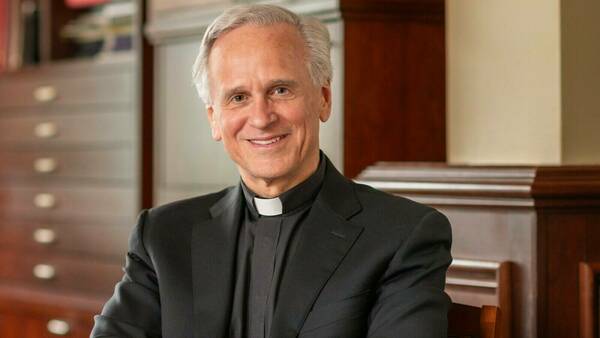
tag:al.nd.edu,2005:/news/latest-news/category/catholicismtag:al.nd.edu,2005:/latestCatholicism | College of Arts & Letters | Latest News2026-03-03T10:52:00-05:00Notre Dame’s College of Arts and Letters challenges graduate and undergraduate students in the liberal arts to ask the great questions as they pursue their intellectual passions in the arts, humanities, and social sciences.tag:al.nd.edu,2005:News/1796652026-03-03T10:52:00-05:002026-03-03T10:52:18-05:00Rev. Gregory Haake, C.S.C., appointed vice president for mission engagement and Church affairsRev. Gregory Haake, C.S.C.
“Knowing that he will build on Father Austin’s many accomplishments as vice president over the past five years, I am delighted that Father Greg has agreed to take on this important leadership role,” Father Dowd said. “Father Greg is widely admired for his scholarly achievements, his deep commitment to Notre Dame’s mission, and his pastoral gifts. He is uniquely situated to work closely with me and with colleagues across the University to steward and deepen Notre Dame’s Catholic mission and to forge strategic partnerships both at the University and beyond in service of the Church. I am truly grateful to both Father Greg and Father Austin, my brother priests in the Congregation of Holy Cross, for their unfailing support and dedicated service.”
A specialist in 16th-century France, Father Haake focuses his research on the intersection of religion, politics, and literature — specifically on how discourse can be used to achieve ideological and religious goals. As the religious superior of the Holy Cross priests and brothers at Notre Dame, he has served as an ex officio Fellow and Trustee of the University and as a member of the President’s Leadership Council.
“I am honored by Father Bob’s invitation to serve as the vice president for mission engagement and Church affairs,” Father Haake said. “Notre Dame’s Catholic and Holy Cross mission contributes deeply to what makes this University special and embeds us firmly within the life and tradition of the Church. On both fronts, Notre Dame has unique opportunities, and I look forward to helping the University to fulfill its mission on campus and beyond.”
Father Haake received both a bachelor’s and a Master of Divinity degree from Notre Dame, a Master of Arts from Middlebury College, and a doctorate from Stanford University. He was ordained a priest of the Congregation of Holy Cross, the University’s founding order, in 2007, and he joined the faculty at Notre Dame in 2015. Father Haake is a priest-in-residence in Coyle Hall.
Father Collins was appointed vice president for mission engagement in 2021. Among many other accomplishments, he has played an important role in building relationships with Church leaders in the U.S. and around the world and developing programs for faculty and staff aimed at deepening their understanding of Notre Dame’s Catholic mission. Prior to serving as vice president, Father Collins served as religious superior of Holy Cross priests and brothers at Notre Dame and as an ex officio Trustee and Fellow of the University from 2015 to 2020, and as chair of the Department of Art, Art History and Design from 1997 to 2003. Father Collins has been a faculty member since 1985.
Contact: Carrie Gates, associate director of media relations, c.gates@nd.edu, 574-993-9220
Originally published by Andrew Barlow at news.nd.edu on March 03, 2026.
]]>
Andrew Barlowtag:al.nd.edu,2005:News/1793082026-02-19T08:30:00-05:002026-02-17T16:30:31-05:00New research from Notre Dame theologian and Vatican working group explores how to ‘reclaim human agency’ in age of AIPaul Scherz, the Our Lady of Guadalupe College Professor of Theology and the ND–IBM Tech Ethics Lab Program Chair (Photo by Matt Cashore/University of Notre Dame)
One of the fundamental promises of artificial intelligence is that it will strengthen human agency by freeing us from mundane, repetitive tasks.
However, a new publication, co-edited by University of Notre Dame theologian Paul Scherz, argues that promise “rings hollow” in the face of efforts by technology companies to manipulate consumers — and ultimately deprive them of agency.
The book, Reclaiming Human Agency in the Age of Artificial Intelligence, is the second in a series created by the Vatican’s AI Research Group for the Centre for Digital Culture. Part of the Holy See’s Dicastery for Culture and Education, the group is composed of scholars from across North America who represent a range of disciplines from theology and philosophy to computer science and business.
“We wanted to examine the idea of how AI affects human actions, human freedom, and the ability of people to develop virtues — which we classified under the heading of human agency,” said Scherz, the Our Lady of Guadalupe College Professor of Theology and the ND–IBM Tech Ethics Lab Program Chair. “This is such an important topic right now because one of the most hyped developments that we’re hearing about right now is ‘agentic’ AI — or AI that will take action for people.
“We think it’s important to distinguish what the differences are between these AI agents and true human agents — and how the AI we have now is affecting our actions.”
In Reclaiming Human Agency, Scherz, co-editor Brian Patrick Green of Santa Clara University, and their fellow research group members cite potentially problematic issues with the technology, including addictive applications, “surveillance capitalism” that exploits users’ personal data for profit, widespread de-skilling in the workplace as complex tasks are handed over to AI, and the growth of algorithmic governance — where social media algorithms influence what people buy, how they perceive events, and even how they vote.
They also assert that human agency should not be seen in terms of “freedom from” tasks, but in “freedom for” pursuing the good, seeking excellence and purpose by building flourishing relationships with others and with God.
“This book is really an attempt to look at a number of these problems that AI is raising but, at the same time, to examine the opportunities that AI could provide to improve our ability to act,” Scherz said. “We wanted to come up with a set of strategies that would enable AI to serve human agency in the best way possible and ensure that it isn’t undermined.”
For Scherz, who holds a doctoral degree in genetics from Harvard University and a doctoral degree in moral theology from Notre Dame, this research builds on his work at the intersection of religion and science. While researching the Human Genome Project for his 2024 book The Ethics of Precision Medicine, Scherz began exploring the ways that precision medicine used data analytic technologies.
“When I was invited by the Vatican to be part of this group in 2020, I was already looking at the problems that were arising around AI in that framework, how it was affecting physicians, and how it might affect patients’ actions and their views of themselves,” he said. “It felt like a natural next step to begin looking at AI’s impacts more broadly in relation to the Catholic understanding of a human person.”
Notre Dame hosted a plenary session of the AI research group and Bishop Paul Tighe, secretary of the Vatican’s Dicastery for Culture and Education, last summer. The session, hosted by the de Nicola Center for Ethics and Culture, not only allowed the researchers to work together on forthcoming publications, but to engage with Notre Dame faculty and students.
The University — which recently received a $50 million grant to further develop a faith-based approach to AI ethics — is an ideal place to explore the field, Scherz noted, because of both its Catholic character and academic excellence.
“As one of the world’s leading Catholic universities, Notre Dame brings the resources of the Catholic tradition to bear on this issue — which Pope Leo XIV has said is one of the defining issues of our time,” Scherz said. “And with our expertise in computer science, theology, philosophy, and the history and philosophy of science, we are well-positioned to be a leader in these conversations.”
The AI research group is now working on a book focused on AI and education and will be looking next at AI’s effects on labor and the philosophies and ideologies that are active in Silicon Valley.
Contact: Carrie Gates, associate director of media relations, c.gates@nd.edu or 574-993-9220
Originally published by Carrie Gates at news.nd.edu on February 17, 2026.
]]>
Carrie Gatestag:al.nd.edu,2005:News/1786582026-01-23T10:01:20-05:002026-01-23T10:01:20-05:00Lilly Endowment makes $5 million grant to Notre Dame to strengthen recruitment and discernment process for future Catholic leaders
The University of Notre Dame has received a $5 million grant from Lilly Endowment Inc. to support a new project aimed at bolstering the talent pipeline for theological leadership within the Catholic Church through the Department of Theology’s Master of Arts and Master of Divinity programs.
Through the department’s initiative, New Horizons: Educating and Forming Tomorrow’s Catholic Leaders, led by Rev. Kevin Grove, C.S.C., an associate professor of theology, Notre Dame seeks to establish a sustainable, collaborative effort to mentor and support emerging Catholic leaders. Over the next five years, the program plans to support 24 students entering the M.A. program and 20 entering the M.Div. program, as well as guiding 100 other individuals through the church leadership discernment process.
In doing so, the program aims to enhance support structures, provide clearer pathways for study, and alleviate financial barriers, particularly for promising leaders in underserved communities and mission dioceses. Program leaders hope that this new model will create an opportunity to reshape ministry formation at Notre Dame well beyond the five-year funding period.
“This grant connects Notre Dame’s world-class Department of Theology with leading partners where the Catholic Church is growing and in need of well-formed, dynamic Church leaders,” Grove said. “Together, we will work to recruit, form, educate, support, and place these future ministers. We are exceptionally grateful to the Lilly Endowment for providing us the chance to reimagine how lay church leaders are raised up, formed and placed.”
The New Horizons program plans to target highly committed young adult leaders embedded in communities that represent potential future growth for the Church, including through outreach partnerships with the Catholic Extension Society; the Fellowship of Catholic University Students (FOCUS); Iskali, a nonprofit focused on engagement with Latino Catholic young adults; and the dioceses and programs served by Notre Dame's McGrath Institute for Church Life. It will then provide cohort-based discernment opportunities in which participants experience Notre Dame’s M.A. and M.Div. programs as they consider pursuing graduate studies.
New Horizons will provide full tuition support for M.A. students and stipends for M.Div. students, making these programs affordable and accessible, then help participants develop robust networks to facilitate post-graduation job placements.
In addition to Grove, the New Horizons leadership team includes Catherine Cavadini, teaching professor of theology and director of the M.A. program; Kristin Haas, assistant teaching professor and associate director of the program; and Todd Walatka, teaching professor and assistant chair for graduate studies.
The New Horizons program is being funded through Lilly Endowment’s Pathways for Tomorrow Initiative. Launched in 2021, it has provided grants totaling more than $700 million to support theological schools across the United States and Canada as they respond to the most pressing challenges they face while preparing pastoral leaders. The grant to Notre Dame is one of 45 that was approved in this competitive round of funding.
Notre Dame previously received a $7.9 million grant through Pathways for Tomorrow in support of Haciendo Caminos, a partnership with Boston College that includes 16 other Catholic institutions in efforts to identify and form the next generation of pastoral leaders to serve U.S. Catholics, while rooted in the Latino experience.
Lilly Endowment Inc. is a private foundation created in 1937 by J.K. Lilly Sr. and his sons Eli and J.K. Jr. through gifts of stock in their pharmaceutical business, Eli Lilly and Company. While those gifts remain the financial bedrock of the Endowment, it is a separate entity from the company, with a distinct governing board, staff, and location. In keeping with the founders’ wishes, the Endowment supports the causes of community development, education, and religion and maintains a special commitment to its hometown, Indianapolis, and home state, Indiana. A principal aim of the Endowment’s religion grantmaking is to deepen and enrich the lives of Christians in the United States, primarily by seeking out and supporting efforts that enhance the vitality of congregations and strengthen the pastoral and lay leadership of Christian communities. The Endowment also seeks to improve public understanding of diverse religious traditions by supporting fair and accurate portrayals of the role religion plays in the United States and across the globe.
Contact: Carrie Gates, associate director of media relations, c.gates@nd.edu or 574-993-9220
Originally published by Josh Weinhold at news.nd.edu on January 23, 2026.
]]>
Josh Weinholdtag:al.nd.edu,2005:News/1784492026-01-16T09:06:00-05:002026-01-21T13:45:57-05:00Doing justice, delivering change — Institute for Social Concerns launches interdisciplinary minor
“Whatever you value, be committed to it and let nothing distract you from this goal. The uncommitted life, like Plato’s unexamined life, is not worth living.” —Rev. Theodore Hesburgh, C.S.C., 1979
Inspired by the legacy of Fr. Hesburgh, the Institute for Social Concern’s Justice & Society Minor invites students into an interdisciplinary community of scholars committed to a more just world. The minor is designed for students who refuse to accept the world simply as it is. It is for students who aspire to be the spark for change.
The minor brings together classical theoretical inquiry and contemporary practical application. As society faces increasingly complex challenges, students engage different classical and contemporary theories of what is right, just, and fair while gaining the research skills that are essential to create meaningful change.
“We believe that a commitment to justice is a fundamental lens through which to understand, experience, and, indeed, change the world,” said Suzanne Shanahan, the Leo and Arlene Hawk Executive Director of the institute.
“Whether pursuing a degree in engineering or English, students gain a foundational understanding of justice with which to enhance their degree,” she said. “The minor forms leaders of consequence through a constructive collision of perspectives where business and biology majors grapple with wicked problems, bringing their unique expertise to the table.”
“A commitment to justice is a fundamental lens through which to understand, experience, and, indeed, change the world.”
Dan Graff, professor of the practice at the institute and co-director of the minor, noted that the minor is “rooted in the institute’s commitment to combining rigorous academic inquiry with authentic community engagement.”
He added that “the minor synthesizes traditional interdisciplinary scholarship with practitioner knowledge and wisdom to help students imagine and promote uniquely just solutions to today’s most pressing social problems.”
The curriculum is structured to allow students to build on their current majors, adding a robust understanding of what justice is and how it intersects with pressing issues such as emerging technology, global migration, and labor practices. Students master the foundations of historical and contemporary theories of justice while learning how to use data and inquiry to foster a more just world.
“Injustice doesn’t respect departmental boundaries. It is deep-rooted and complex,” Graff said. “To eradicate it, students must learn to build upon — and then transcend — their major expertise.”
The program consists of a 15-credit pathway, beginning with a foundational course titled Doing Justice, taught by Graff. The dynamic course offered this spring is a deep dive into the different theories of justice but also introduces a set of contemporary and historical case studies in the form of memoirs, plays, and exhibits for students to apply the theoretical traditions.
Students then select three elective courses from across the institute and University. In this way, they customize their education and supplement their understanding of justice through diverse perspectives and disciplines.
The culmination of the minor is a collaborative capstone studio called Delivering Justice. In this course, students transition from classroom inquiry to public scholarship. They develop tangible projects — such as policy memos, op-eds, or exhibits — based on the original research they have conducted throughout the program.
This emphasis on public-facing work ensures that students graduate with a portfolio that demonstrates their ability to communicate complex ideas to a wider audience and implement justice-oriented solutions in their future careers across fields and professions.
“Students learn to see the people impacted by injustice as names and not numbers.”
“Motivated by Catholic social teaching, our core courses move students from theory to informed action,” explained Connie Snyder Mick, professor of the practice and co-director of the minor. Eschewing lifeless abstraction, Mick emphasizes that students in the minor approach questions of justice by getting proximate to those most affected.
“Students learn to see the people impacted by injustice as names and not numbers,” Mick said. “And through collaborative research, they draw from, integrate, and refine the skills they bring from their major to advance the cause of justice in society.”
]]>
Cramer, Davidtag:al.nd.edu,2005:News/1768072025-12-08T09:00:00-05:002026-03-03T10:58:29-05:00Liturgical scholar examines how, across centuries, physical manuscripts can influence and shape faithInnocent Smith, O.P., joined Notre Dame's Department of Theology as an assistant professor. His work centers on the historical interconnection between the law of prayer (lex orandi) and the law of belief (lex credendi), the principle that the way Christians worship forms their beliefs. (Photo by Jon L. Hendricks/University of Notre Dame)
Innocent Smith, O.P., feels perfectly at home among the colorful bindings that line the Medieval Institute Library on the seventh floor of the University of Notre Dame’s Hesburgh Library. Books aren’t just how he does his research — they’re the subject of his research, as well.
As a Dominican priest, Fr. Smith views liturgy not merely as a ritual, but as a profound and tangible intersection of heaven and earth, drawing on art, music, and the full spectrum of human expression. Liturgy — the public, communal act of worship and sacrament in the Catholic Church — “takes in everything that it means to be human, as well as everything that God wants to reveal to us,” he said.
That theological conviction forms the bedrock of his scholarly focus — the history of medieval liturgical books.
Fr. Smith joined the Department of Theology as an assistant professor this year, after teaching at the Pontifical Faculty of the Immaculate Conception in Washington, D.C., and St. Mary’s Seminary and University in Baltimore. His intellectual journey began at Notre Dame as an undergraduate studying music and philosophy, continued when he entered the Order of Preachers after graduation in 2008 and was ordained a priest in 2015, then furthered when he completed his Ph.D. at the University of Regensburg in Germany.
“Looking back on my time in seminary, pastoral ministry, and doctoral studies, I have been blessed to experience a fruitful intersection of study, prayer, and ministry,” he said. “Celebrating the liturgy inspires me to try to understand the history and theology of the liturgy more deeply, and my research has often enabled me to come to the liturgy with a renewed understanding of the mysteries of the Church.”
His work centers on the historical interconnection between the law of prayer (lex orandi) and the law of belief (lex credendi), the principle that the way Christians worship forms their beliefs. He studies historical examples of how Christian worship traditions have dynamically influenced theological understanding, demonstrating that this interaction is not a niche topic but a universal process that every Christian participates in.
A key example of this is found in his current study of St. Thomas Aquinas, who is often mischaracterized as a purely abstract, reason-driven thinker. Fr. Smith’s research, however, reveals how deeply liturgical the theologian’s entire life and work truly was. He has found evidence that Aquinas’ idea of who God is — particularly as a merciful being — is profoundly shaped by his liturgical experience, as he repeatedly quotes liturgical prayers about God’s mercy throughout his texts.
“The way we pray influences how we believe, and the way we believe influences how we pray,” he said.
An object and an instrument
Fr. Smith’s method for answering this central question is intensely material and interdisciplinary. Fr. Smith specializes in the history of liturgical books, including missals and medieval manuscripts, and how their physical structure and artistic composition contribute to their theological content.
He is fascinated by the book as a whole entity, moving beyond the traditional scholarly tendency to study text, art, or physicality in isolation.
“I’m interested in how all of these things fit together, how the book is an object as well as, in a sense, an instrument,” Fr. Smith said.
His doctoral research and monograph, for example, focused on the “Bible missal” — a type of book that combined texts for Mass with biblical texts — illuminating how profoundly biblical the liturgy of the Middle Ages was. He argues that the complementary nature of the liturgical and scriptural texts within those manuscripts “underscores the deep continuity between scriptural revelation and the sacraments of the Church.”
“One thing I want to do is to empower the students to pursue their own research and their own interests in a way that is academically serious."
That research emphasis directly informs his teaching. In his doctoral seminar on medieval liturgy, Fr. Smith brings graduate students into the Hesburgh Libraries’ Rare Books & Special Collections to pore over original medieval manuscripts. He emphasizes that this hands-on study is crucial and reinforces the concept that liturgy is central to the Church's historical worship and self-understanding.
By interacting with the physical manuscripts, Fr. Smith believes, students can appreciate the integrated beauty of the books and ultimately interpret critical editions and digital facsimiles more responsibly.
“One thing I want to do is to empower the students to pursue their own research and their own interests in a way that is academically serious,” he said.
Notre Dame provides the ideal environment to propel Fr. Smith’s research forward by offering unparalleled resources and a unique sense of institutional continuity. His early love for liturgical studies — specifically medieval chant — was fostered at Notre Dame, and he was particularly inspired by professors Calvin Bower, Alexander Blachly, and Sabine MacCormack.
Today, working alongside some of these same scholars, he is diving deeper into the Gregorian tradition — a well-researched and practiced area in the Sacred Music at Notre Dame program.
“Singing Gregorian chant allows for a kind of meditation on the words of scripture in a very intense way, and sometimes the musical elements will bring out hidden depths of the texts themselves,” Fr. Smith said.
He also examines the broader cultural impact of this music tradition by highlighting potential connections between the liturgical practice of song and the early development of opera in Western culture.
A renewal and an inspiration
Innocent Smith, O.P., feels perfectly at home among the colorful bindings that line the Medieval Institute Library on the seventh floor of the University of Notre Dame’s Hesburgh Library. (Photo by Jon L. Hendricks/University of Notre Dame)
Beyond the academic collaboration, Fr. Smith’s return highlights the University's long-standing support. As an undergraduate discerning his vocation, Notre Dame provided crucial research grants to study early manuscripts in Philadelphia and Rome — experiences that laid the groundwork for his Dominican priesthood and academic career.
He plans to continue this legacy and foster a learning environment in which students can pursue their own deeply rooted interests.
“All of my personal life as a Dominican friar and my academic work as a professor really merge in this celebration of the liturgy and the study of it,” he said.
Fr. Smith hopes his ongoing work will shed light on how the Church’s diverse liturgical traditions continue to shape contemporary faith. He acknowledges that history alone cannot solve modern problems, but it can provide vital resources and inspiration for current debates.
“The study of the past can be a source of renewal, as well as a source of inspiration,” he said. “It’s not just a matter of restoring some ideal past, but rather we take inspiration from a variety of sources and figure out what is appropriate today.”
Liturgy has both a past and a future, and by studying the diversity of medieval liturgical practices, Fr. Smith hopes his work will help show the creative dynamic between tradition and innovation that has characterized every era of growth in the Church's life.
“There’s a beautiful line in the Catechism of the Catholic Church,” he said, “about how there are different forms of liturgy because no single form of the liturgy can exhaust the entire mystery of Christ.”
]]>
Joy Noel Lightcaptag:al.nd.edu,2005:News/1756812025-10-10T10:52:00-04:002025-10-30T10:24:22-04:00Notre Dame experts offer insight on Pope Leo XIV's <i> Dilexi Te </i>
On Thursday, Oct. 9, Pope Leo XIV issued his first major document, Dilexi Te (“I Have Loved You”), addressed to all Christians and divided into five chapters. The document, which was signed on the feast day of St. Francis of Assisi, was started by Pope Francis and completed by Pope Leo. It reiterates the Gospel call to respond to the needs of the poor, create more just and equitable social and economic conditions in the world, and heed the voices of those on the margins.
“As Pope Leo writes, ‘In every rejected migrant, it is Christ himself who knocks at the door of the community.’ Pope Leo challenges us to respond with compassion and courage. In a world building higher walls, he urges us to build longer bridges. In a world increasingly fragmented, he calls us to be a unifying presence. And in a world paralyzed by fear, he invites us to promote justice, foster solidarity and help build a civilization of love — one that reflects God’s love for all creatures.”
“The exhortation is much needed in our divisive and polarizing times, where wealth has increased along with inequality,” Lantigua said. “It offers a profoundly biblical theology of poverty that recognizes both the evil of material poverty but also the saving power of voluntary poverty, both of which were embodied in Christ, the Church’s suffering founder.”
Suzanne Mulligan: A spotlight on increasing inequality
“A feature of ‘Dilexi Te’ is Leo’s insistence that the poor must be heard when it comes to social transformation. Local wisdom and the lived experiences of those on the margins ought to inform strategy. Moreover, human dignity is enhanced when people have a voice, when they have some say over their lives, and when their wisdom and lived experiences help shape public decision-making. After all, ‘the poor are at the heart of the Church,’ Leo tells us in ‘Dilexi Te,’ and so their participation is not only pragmatic but is also a way of affirming their dignity and sacredness.”
Jim Sullivan: ‘Love for the poor must move us to act — and to act wisely’
“Here at Notre Dame, we are called to cultivate a disciplined sensibility to the poverty, injustice and oppression that burden the lives of so many. And, as a research university, one of the ways we fulfill that calling is by working to create a world intolerant of poverty by expanding knowledge about how to solve it.”
“As we look to the future, Pope Leo’s words portend a renewed emphasis for his papacy on education, equity and formation. This document signals that the Church under his leadership intends to emphasize education as foundational to the Church’s mission, not as an optional ministry, but as a core form of service to the poor and to society. For those of us in Catholic education, we are called now to listen deeply, to act faithfully and to affirm the dignity of every child.”
Originally published by Carrie Gates at news.nd.edu on October 10, 2025.
]]>
Carrie Gatestag:al.nd.edu,2005:News/1713902025-08-12T11:46:00-04:002025-04-03T11:47:09-04:00Video: Notre Dame’s Rebecca Maloy rediscovers lost liturgy, shedding light on the power of ancient Iberian chant
Rebecca Maloy is the J.W. van Gorkom Professor of Music and director of the Sacred Music at Notre Dame program. A specialist in medieval liturgy and chant, she focuses her research on a liturgy that was practiced on the Iberian Peninsula between the 7th and 11th centuries. Her approach incorporates diverse perspectives, including musical analysis, notational paleography, the relationship between words and music, and the intersections between liturgical texts and patristic theology.
Her recent work examines how the multisensory experience through liturgy and music instilled theological meaning and shaped Christians in the seventh-century time period.
Video transcription:
Rebecca Malloy: My research has focused on this chant and liturgy tradition that was practiced on the Iberian Peninsula between the seventh and 11th centuries. It had not received a huge amount of attention from music scholars primarily because it's written in a kind of notation that shows you the direction of the melody but not the specific pitches. And it's such a shame that we can't hear what the melodies actually sounded like.
I got fascinated by this chant tradition originally because I was looking at texts alone. And so I
was intrigued by how the Old Testament was reworked to kind of convey a Christian interpretation of it. And that's not really so normal in Roman chant — in Roman chant they tend to just use the psalms directly. And this was all these massive interventions into the text to promote a particular interpretation of them and it got me thinking, ‘Who did this and why?’
I looked really closely at what was happening in the seventh century to create this liturgy. The Visigothic rulers of Iberia had converted from — what's normally called Aryan Christianity to Nicene Christianity, or also called Orthodox Christianity — and they were very interested in that time period in creating a whole society that kind of cohered around those Nicene Christian beliefs. And it really leads me to think that they were using sound as a way to instill theological meaning and to shape Christians in this period of time.
My collaborator Emma Hornby and I, when we were first working on this music, we decided to look at this genre that's only sung in Lent. And it was all based on passages of Jeremiah and Job and Isaiah. And it was all the same melody running all the way through the Lenton season. Everything that was saying something like, ‘His enemies have turned against him’ was reworded to be in the first person to say, ‘My enemies have turned against me.’ That ‘me’ that first person voice speaking was the penitent sinner in the first half of Lent. And then the second half of Lent you're still singing the same melodies, you're still emphasizing the first person voice, but now it's the voice of Christ speaking. And so you as a penitent sinner are kind of united, like orally, to the voice of Christ. The memory is so central to this because you have to remember that you're singing the same melody three times a week. And of course you will after six weeks are up. And so it really unifies your voice as the church with the voice of Christ.
The creators of the liturgy were so attentive to how these texts fell on the ear, and how they were delivered through melody in a very strategic way. The people within the liturgy, they stood, they kneeled, they were quiet, they paid attention to their breath. And, of course, I'm paying the most attention to sound as a musicologist, but when you think of the liturgy as multisensory experience, it must have just been so moving to sit in a church and be a part of that.
Notre Dame has a fantastic group of people who work on liturgy and they are housed in many different departments. There is so much potential here for interdisciplinary dialogue around the kinds of questions that I'm interested in. Sacred Music at Notre Dame is a program that sits at that intersection between the disciplines, especially music and theology. And my hope is that our students can go out and promote exactly this multisensory experience through the liturgy that I'm studying in my own work.
]]>
Jon Hendrickstag:al.nd.edu,2005:News/1710032025-05-21T10:25:00-04:002025-05-13T11:13:51-04:00Video: Historian Sarah Shortall captures connections between secular and religious thought
Sarah Shortall is an associate professor in the Department of History at the University of Notre Dame. She studies the intellectual and cultural history of modern Europe, particularly the relationship between religion and politics.
Shortall’s first book, and the book she’s currently working on, both explore the role of Catholic thought in secular spaces. For her, there is no better place than Notre Dame for studying the history of Catholicism.
Video transcription:
Sarah Shortall: My name is Sarah Shortall, I’m a historian of modern European thought. I’m especially interested in the relationship between Catholicism and broader developments in European philosophy and politics.
My first book, called Soldiers of God in a Secular World, explored the political role of theology after the separation of church and state in France. It explored how Catholic theologians engaged with the relationship between Catholicism and modernity and, in grappling with that, also made much wider contributions to political debates about fascism and communism, colonialism and capitalism, and democracy and human rights. They reshaped French intellectual life more broadly through their theological work.
I’m currently working on a book project that explores the role of Catholic thought in the development of global consciousness since the Second World War. I’m interested in how Catholic visions of the globe as an ecological, theological, and political problem have interacted with secular forms of global consciousness.
I try to focus less on the central institutions of the church like the Vatican, and instead on more marginal figures within the church.
One of the chapters, for example, focuses on the influence of this Jesuit priest who was also a paleontologist — Pierre Teilhard de Chardin — and his influence at the United Nations.
I was really struck and surprised by how many people — and what an extraordinary range of people — were influenced by Teilhard de Chardin. Five of eight secretaries general, for example, mention him, but also writers like Don DeLillo, Flannery O’Connor; artists like Salvador Dali; environmentalists; scientists.
A figure like him — precisely because he is somewhat marginal from Catholic orthodoxy — actually allows us to see all kinds of connections that we wouldn’t normally see between secular and religious thought.
I think of teaching and research as deeply intertwined. Whenever I broach a new research topic, I often develop a new course to complement it. And what better way to develop knowledge of a new field than in conversation with really bright undergraduate and graduate students that we have here?
I can’t really imagine a better place to study the history of Catholicism than Notre Dame. There are just such wonderful resources here for scholars in developing research proposals and grant proposals. It really is the best place to do the kind of work that I do.
]]>
Jon Hendrickstag:al.nd.edu,2005:News/1722602025-05-13T07:30:00-04:002025-05-14T11:06:10-04:00Holy Cross postulant Lane Poche ’25 finds his calling to be ‘a better person who loves’Lane Poche meets Pope Francis while studying abroad in Rome in April 2024. (Photo provided by Lane Poche)
When thinking about his future, Lane Poche turns to the teachings of Pope Francis.
Dilexit nos, the late Holy Father’s fourth encyclical, describes the challenges the modern person faces in finding their path in life. There are many forces, he writes, that push someone away from who they’re meant to be — and actually following one’s heart takes work and contemplation.
“What does my heart actually desire?” Poche, an Arts & Letters senior majoring in philosophy and theology, often asks himself. “What actually fulfills me? What actually brings me life?”
His answer? Taking the vows of poverty, chastity, and obedience to become a priest in the Congregation of Holy Cross.
“It’s where my desires and the Lord’s desires for me overlap,” he said.
Originally from Louisiana, Poche has wanted to be a priest since the fourth grade, but he found expressing his aspirations hasn’t always been easy. Forgoing marriage and wealth isn’t exactly a popular idea, and for much of his teens, Poche kept his dream to himself.
But now in the fourth year of his decade-long formation process, he can take pride in what he wants to do, thanks to the community of the Old College Undergraduate Seminary at the University of Notre Dame.
“In meeting other people who share the same desires and thoughts, I felt very affirmed,” Poche said. “I’m excited about it, and I’d love to give my life to it.”
Notre Dame is one of the few places in the United States where students fresh out of high school can attend seminary while studying at a major university. The opportunity to receive an exceptional education within a supportive intellectual and religious community was instrumental in the college decision for Poche.
“Education is the foundation of the Congregation of Holy Cross,” he said. “I knew that I could study here and get one of the best educations in the world.”
A passion for the work
Poche’s graduation in May will not only signify his achievement of obtaining a bachelor’s degree but will also mark his transition from postulant to novice.
Lane Poche receives the Eucharist during a Congregation of the Holy Cross backpacking pilgrimage in October 2023. (Photo provided by Lane Poche)
Poche has spent his senior year living in Moreau Seminary alongside Holy Cross priests, brother scholastics, and other postulants. He starts and ends each day with the liturgy of the hours, singing and praying alongside the seminary’s other residents.
“Sometimes when I’m having a bad day, just going to breakfast with the guys and seeing their joy or hearing about their days is something that draws me out of myself and brings me to a place of gratitude,” he said.
As part of their ministry, Poche and a group of his seminarian brothers work on campus with the Order of Christian Initiation for Adults (OCIA), a program for those who want to become Catholic. They also share meals with those who are unhoused at Our Lady of the Road, a drop-in center that provides basic resources, and meet with OCIA members at St. Adalbert Catholic School to pray and play soccer.
A large part of being a priest, Poche said, is working with and empathizing with others from various backgrounds. His ministry helps him develop that skill while providing a strong faith-based community.
While with OCIA, Poche was asked to give an hourlong presentation on grace in front of 100 people. At first, he was intimidated by the assignment, but as he began presenting, he entered a “flow state,” and fear left his mind.
In that moment, he knew a pastoral role was right for him.
“I started thinking about giving a sermon one day and being able to, hopefully, evoke things within people to wonder about God, wonder about the way they’re living,” he said. “The time it took to prepare for it and the love that I put into preparing for it — there’s nothing else I’d rather be doing right now.”
Finding his gifts
The five pillars of Holy Cross formation are heart, mind, family, zeal, and hope, so for Poche, education influences his path to priesthood.
“You can’t really separate the two,” said Poche, who is a Sorin Fellow in the de Nicola Center for Ethics and Culture. “In prayer, I’m always learning. In classes, I’m always bringing things that I’m learning into prayer.”
“I find fulfillment in drawing people to Christ in an explicit way; I find a joy in scripture; I find joy in the Mass. It’s something that’s really life-giving for me. I can’t help but share that.” - Lane Poche ’25
One of Poche’s favorite classes, Christian Traditions I, connected him with the history of his future life as a Holy Cross priest. The course is a requirement for theology majors, and students learn about the history of Christianity from the Acts of the Apostles to the Middle Ages. They study influential Christians like St. Benedict, who gave his life to his faith through monasticism, and St. Paul, who did the same through evangelism and martyrdom.
“What was so enriching about it was just seeing how differently the Lord can call us all — by what we’re suited to, by our own interests, by our own passions, and by what we’re good at,” Poche said.
Reading about the experiences of saints and historical figures showed Poche the myriad roads a religious life can take and compelled him to reflect on his own talents, which he said are still being unveiled to him.
“I find fulfillment in drawing people to Christ in an explicit way; I find a joy in scripture; I find joy in the Mass,” Poche said. “It’s something that’s really life-giving for me. I can’t help but share that.”
Learning humility and love
Poche’s study of the past bolstered what he learned from Ecclesiastes 1:9: “There is nothing new under the sun.”
Lane Poche lights a votive candle in the Grotto of Our Lady of Lourdes. (Photo by Jon Hendricks/University of Notre Dame)
He’s found that many people today tend to dismiss the history of how ideas and systems have evolved throughout time.
“There’s a notion of progress that we’re getting better and better and better, and one day, we’ll just be so good that we won’t need a creator,” he said. “But I think it’s a lie.”
Poche has learned through reading philosophy — some from hundreds or thousands of years ago — that many ideas that are considered novel are just repeating old teachings. Understanding this, he said, can lead to humility in knowing humans are not always progressing in every area of society.
“There’s stuff to learn from the past, and there’s a lot of work to be done now,” he said.
Beyond an appreciation of the past, Poche’s time at Notre Dame has also helped him develop an increased ability to act in love.
“I’m learning how to give more of myself, to make myself available to people,” he said.
After graduation, Poche will move to the Holy Cross Novitiate in Colorado for a year of prayer, frequent participation in the sacraments, and contemplative silence. He will then return to Notre Dame to study for his Master of Divinity degree before his ordination.
After that, he could be placed anywhere around the world — from South Bend to Peru — with any kind of assignment, such as a parish, homeless shelter, or college campus.
No matter what’s in store, Poche said, he will build on who he has become in the Old College.
“Being at Notre Dame,” he said, “has helped me become a better human being, a better Christian, a better person who loves.”
]]>
Adah McMillantag:al.nd.edu,2005:News/1717772025-04-21T15:42:00-04:002025-04-30T14:25:53-04:00Notre Dame faculty experts reflect on life and legacy of Pope Francis
On April 21, Pope Francis died at the age of 88. Born Jorge Mario Bergoglio in 1936 in Argentina, he entered the Society of Jesus in 1958, was ordained a Catholic priest in 1969 and became the archbishop of Buenos Aires in 1998. In 2001, Pope John Paul II named him a cardinal. Following the resignation of Pope Benedict XVI, Pope Francis was elected as his successor on March 13, 2013.
As the University of Notre Dame joins the Church and the world in mourning Pope Francis’ death, the University’s faculty experts reflect on his papacy, life and legacy.
“Pope Francis was the first pope from the Global South, now Catholicism’s demographic center, and that has been hugely meaningful,” said John McGreevy, the Charles and Jill Fischer Provost and Francis A. McAnaney Professor of History. “This is reflected in his focus on the poor — a core theme of Latin American theology since the 1970s — and on migrants and the environment. It is also reflected in his commitment to ‘inculturation’ of the liturgy and Catholic life into local, often Indigenous cultures.”
According to McGreevy, Pope Francis also did more than any predecessor to “diminish the monarchical dimensions of the papacy.”
“His informal personal style, the willingness to carry his own luggage and live in Santa Marta, all reflected a caution about the idea of the pope as a prince of sorts,” McGreevy said. “He is continuing the legacy of John Paul II and Benedict XVI here, but in a much more pronounced way.”
In contemplating Pope Francis’ legacy, Rev. Daniel Groody, C.S.C., vice president and associate provost, turned to the pope’s own words: “Jesus Christ is the face of the Father’s Mercy,” wrote Pope Francis in Misericordiae Vultus. “These words might well sum up the mystery of the Christian faith.”
“Pope Francis has reminded us throughout his life and through his words, gestures and actions that the Gospel message is fundamentally about God’s mercy,” Father Groody said. “For this reason, he chose as his motto ‘Miserando atque eligendo,’ which means, ‘The Lord looked on him with merciful love and called him.’ While alluding to Matthew’s call, he makes these words his own when he becomes a priest. This vision has always been at the core of his pastoral work, and it took on a global significance when he was elected pope.”
“He is the first Jesuit pope, the first South American pope, and the first pope to write a social encyclical on the environment,” Lantingua said. “He is also the first pope of the 21st century who did not attend and participate in the momentous global meeting of over 2,000 bishops known as the Second Vatican Council (1962-1965). With nearly 60 percent of those bishops at Vatican II coming from outside Europe, and nearly half of those outside Europe from Latin America, the papacy of Francis appears to be a sign of the times for a religion that comprises one-fifth of the world’s population, most of which resides outside of Western Europe and in the global South.”
Kathleen Sprows Cummings, a professor of American studies and history, concurred, saying, “For evidence of the impact Pope Francis has had on the global Church, we have to look no further than our own University.
“The late pope’s priorities have shaped Notre Dame’s strategic initiatives in profound ways,” she added. “Through its commitments to alleviating poverty and fostering health and well-being, Notre Dame has joined Pope Francis as a champion of human flourishing, especially within vulnerable populations. It would be impossible to conceptualize research on global Catholicism without reference to the first pope from the Americas, and what his life and legacy teach us about the church in the Global South.”
The bells in the Basilica of the Sacred Heart tolled to mourn the death of the Holy Father at 9 a.m. EDT Apr. 21. The doors have been draped in black bunting, and a photo of Pope Francis has been placed in the sanctuary.
Media Contact: Carrie Gates, associate director of media relations, c.gates@nd.edu, 574-993-9220
Originally published by Carrie Gates at news.nd.edu on April 21, 2025.
]]>
Carrie Gatestag:al.nd.edu,2005:News/1702422025-02-23T10:04:17-05:002025-02-23T10:04:17-05:00In memoriam: Larry Cunningham, the John A. O’Brien Professor of Theology EmeritusLarry Cunningham
In one of his many essays for Notre Dame Magazine, the renowned and prolific theologian Larry Cunningham wrote in his often self-deprecating way about his dependence on students to solve his technological trials.
“To my students,” he wrote in 2008 at age 72, “I fear I appear to be a slightly bumbling grandfather type. … I would not know how to send a text message if my life depended on it. Only last year did I realize that the same phone not only took pictures but could transmit them. When I ask students to help me with computer problems, they give me pitying glances as they punch a key or two to get me out of my computer conundrum. They all walk around with buds in their ears attached to wires … whereas the only bud that will go into my ear will most likely be attached to hearing aid.”
He then went on to describe his deep passion for his vocation. “I am a much better teacher today than I was decades ago because I have never lost my passion for learning. … Nor have I lost my passion for teaching and learning (two sides of the same coin) nor my desire to touch that place in (students’) minds and hearts for that love of learning which, even though they may not know it explicitly, is the desire for God. …
“I have never doubted for a moment that being a teacher was a rare gift given to me. To be paid to do what I do, which is to follow my passion in the company of the young, makes me feel to be among the elect who have found themselves in a place where they were meant to be. The only word that covers it is gratitude.”
Cunningham, the John A. O’Brien Professor of Theology Emeritus, died Feb. 20 in South Bend. He was 89.
“Larry graced our campus for more than 35 years and was a dedicated administrator, a beloved teacher, a cherished colleague, and a most generous citizen of the University. We will always be grateful for his service, which helped shape what Notre Dame is today,” Rev. John I. Jenkins, C.S.C., president emeritus, said. “Our prayers are with his wife, Cecilia, their family and his many, many friends. May God grant him eternal rest.”
Raised in Florida, Cunningham explored entering the priesthood while earning a bachelor’s degree at Saint Bernard’s Seminary in New York. He then attended the Pontifical Gregorian University in Rome, where he earned a licentiate in sacred theology, followed by his studies at Florida State, acquiring a master’s degree in literature and a doctorate in humanities. Along the way he decided he “would make a better academic than a priest.”
With that, he began his more than 55-year career in academe. The first 21 years were at Florida State; in 1987, he moved to Notre Dame, where he was the John A. O’Brien Professor of Theology (emeritus since 2012). He was a scholar of systematic theology and culture, Christian spirituality and the history of Christian spirituality. He was adept at explaining the complex details of Catholic Church history, liturgy, teaching, governance and spiritual life and was frequently quoted on such subjects by journalists in leading media outlets.
Chair of Notre Dame’s Department of Theology from 1992 to 1997, Cunningham was an award-winning teacher and the recipient of numerous honors for his writing from the Catholic Press Association. He received honorary degrees from Bellarmine University, Neumann College, and Saint Anselm College, and the University of Portland bestowed upon him its highest honor, the Christus Magister (Christ the Teacher) Medal.
“Larry will be remembered as a beloved departmental colleague and university citizen,” said John Cavadini, professor of theology and McGrath-Cavadini Director of the McGrath Institute for Church Life. “As chair of the theology department, he laid the foundation for the flourishing undergraduate program in theology we enjoy today. As a theologian and scholar he will be remembered for his contributions, especially, to the history of spirituality and mystical theology. He was an authority on all things Catholic, universally consulted, known at once for his devotion to the Church and for his cosmopolitan spirit, for his presence in scholarly and popular theological venues, for his vocational counseling of so many ministry and doctoral students, and for his kindly soul. May he rest in peace and may his memory be a blessing to us.”
Cunningham wrote or edited more than 25 books, his first titled “Brother Francis: Writings by and About Saint Francis of Assisi,” published in 1972. Among his many other books are “Mother of God,” “Catholic Prayer,” “Thomas Merton: Spiritual Master,” “John Henry Newman: Heart Speaks to Heart,” and “Things Seen and Unseen.”
Millions of lay readers benefited from the perspectives and insights Cunningham shared in dictionaries and encyclopedias of religion and in more than 400 articles in periodicals worldwide, including The Tablet, America, The Christian Century, U.S. Catholic, Church, Spirituality (Ireland), The Bridge (Asia), The Merton Seasonal, and Commonweal, for which he was the literary columnist for many years.
The citation accompanying the Christus Magister Medal read in part: “If the primary task of a committed Catholic life is to share the genius of the Word, so that many more hearts might be opened and souls saved, then Lawrence Cunningham has served well and faithfully.”
Indeed, he did.
Cunningham is survived by his wife, Cecilia, of South Bend, Indiana; daughters Sarah Mary Cunningham of New York City, and Julia Clare Cunningham (Steve Uknuis) of Los Angeles; and granddaughter Mazzy Uknuis of Los Angeles.
A funeral Mass will be celebrated at 9:30 a.m. Tuesday (Feb. 25) in the Basilica of the Sacred Heart on Notre Dame’s campus.
Originally published by Dennis Brown at news.nd.edu on February 21, 2025.
]]>
Dennis Browntag:al.nd.edu,2005:News/1689202024-12-30T00:00:00-05:002024-12-20T09:26:29-05:00The top five most-read Arts & Letters stories from 2024
As we look to the new year, we reflect and celebrate the top five most-read stories from the College of Arts & Letters in 2024.
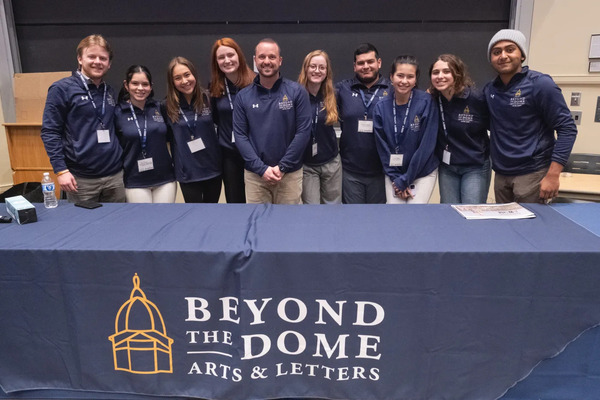
Students stand at Beyond the Dome programming. (Photo provided.)
#5: How the College of Arts and Letters’ Beyond the Dome Program helped shaped my career discernment path
These days, when people ask me what I plan to do with my major in English after graduation, I usually grin and say, “Whatever I want.” But it wasn’t always that way.
The truth is, when I chose English, I didn’t know what I wanted to do with my life. All I knew is that for the next four years I wanted to do something I liked.
English always made sense to me — fitting words together, crafting cool sentences, cooking quirky poems, reading a sentence in a book, and it feels like sheer gravy.
But at the start of my sophomore year, this thing that always made sense to me — English — stopped making so much sense to me. I found myself answering to people at parties who asked me flippantly, “What in the world are you going to do with an English degree?”
Then one day I stumbled upon room 119 of O'Shaughnessy Hall where I met Jared Mrozinske, the Director of Beyond the Dome, the career development program for the College of Arts & Letters.
I think I almost cried after I first met with him because 1. I’m a big crybaby, and 2. He was one of the first people at Notre Dame to tell me that not only was being in the College of Arts & Letters cool, but it was advantageous for my future career.
Fr. Grove teaches Foundations of Theology in DeBartolo classroom building. (Photo by Matt Cashore/University of Notre Dame)
#4: ‘Theology helps provide the words’: Rev. Kevin Grove, C.S.C., teaches students how to engage meaningfully
Three times a semester, Rev. Kevin Grove, C.S.C., hosts his "hummus office hours" in South Dining Hall where he makes a vat of the blended chickpeas, and about a hundred of his students attend to discuss classwork, eat the snack with pita bread, and engage with the associate professor of theology.
His passion for connecting with students in multifaceted ways has generated campus cultural phenomena — from standing-room-only crowds in lecture halls for discussions of St. Augustine’s Confessions to discussion groups competitively recreating iconic cultural works — that reveal how eager students are to engage meaningfully with theology.
Fostering that engagement is among the reasons Fr. Grove has won the 2024 Sheedy Award for Excellence in Teaching, the Notre Dame College of Arts & Letters' highest teaching honor.
“Fr. Grove’s impact on his students, including myself, is nothing short of transformative,” wrote senior Evelyn Hemler in her nomination letter. “He not only teaches theology, but also helps us navigate the complexities of life with faith and grace. His dedication to nurturing our spiritual growth makes him an invaluable asset to the Notre Dame community.”
Isabela “Isa” Tasende was University of Notre Dame's Class of 2024 valedictorian. She majored in economics and political science. (Photo provided.)
#3: Arts & Letters senior Isa Tasende connects political science and economics with law, research, and consulting
Isabela “Isa” Tasende believes today’s most pressing issues — immigration, violence against women, private business influences — are best understood and addressed from an interdisciplinary perspective.
“We live in a world of hyperspecialization, and the lack of interdisciplinary understanding, I think, has led to big gaps in people not knowing how to talk to each other about these issues,” she said.
Originally from Panama, Tasende has always had an interest in understanding policy and helping people. Now a senior at the University of Notre Dame, she majors in political science and economics and has a minor in theology. The diverse coursework has led to opportunities in law, research, and consulting — and they’ve equipped her to tackle worldwide problems from a more connected perspective.
“I’m all about filling the gaps,” Tasende said. “Between public, private, civil society; between different disciplines. I think a more interconnected world is a more efficient one.”
Stained glass window on the west side of the O'Shaughnessy Great Hall. (Photo by Matt Cashore/University of Notre Dame)
#2: Arts & Letters faculty continue record NEH success, winning three fellowships and a major grant
Three faculty members in the College of Arts & Letters have won National Endowment for the Humanities (NEH) fellowships, extending the University of Notre Dame’s record success with the federal agency committed to supporting original research and scholarship.
Additionally, a pair of A&L scholars — Katie Bugyis, the Rev. John A. O'Brien Associate Professor in the Program of Liberal Studies, and Margot Fassler, the Keough-Hesburgh Professor of Music History and Liturgy Emerita — have won a significant, three-year NEH Humanities Initiatives at Colleges and Universities grant to develop a website and to teach medieval liturgy.
“I am delighted and proud that the NEH has again supported our faculty members’ relevant and interesting projects,” said Sarah Mustillo, the I.A. O’Shaughnessy Dean of the College of Arts & Letters. “These four awards highlight the quality of diverse academic research conducted by our experts in multiple fields as well as the excellent support provided by the Institute for Scholarship in the Liberal Arts throughout the application process.”
Ryan Twardzik relaxes on furniture from his Drip collection. (Photo by John Corrales, Jeepney Media.)
#1: From Miami to Milan: Designer Ryan Twardzik ’16 showcases his furniture that makes people happy
Lego bricks were a childhood favorite of Ryan Twardzik ’16; he used the interlocking plastic pieces to give form to his creative ideas.
These days, some of his furniture pieces — which have been featured in shows from Miami to Milan — give a nod to those building blocks. Like Legos, his bold furniture is fun to interact with.
“It’s wild to show off furniture you made that brings joy to people,” said Twardzik, who earned a BFA in design with a concentration in industrial design at the University of Notre Dame. “These are pieces that beckon to be touched, to be used."
]]>
College of Arts and Letterstag:al.nd.edu,2005:News/1687282024-12-27T00:00:00-05:002024-12-19T15:43:58-05:00The top five most-watched A&L videos of 2024
As we look to the new year, we reflect and celebrate the top five most-watched videos from the College of Arts & Letters in 2024.
#5: What is the Bachelor of Arts in Computer Science Major?
#4: College of Arts & Letters' Senior Reflections
#3: Uncovering the Aramaic Dead Sea Scrolls with theology associate professor Daniel Machiela
#2: Christianity's presence in the early years of Islam with Gabriel Reynolds, the Jerome J. Crowley and Rosaleen G. Crowley Professor of Theology
#1: The Creative Writing Program
]]>
Jon Hendrickstag:al.nd.edu,2005:News/1685322024-11-27T11:30:00-05:002025-03-04T14:35:45-05:00‘Theology helps provide the words’: Rev. Kevin Grove, C.S.C., teaches students how to engage meaningfullyFr. Kevin Grove, C.S.C. hosts “hummus office hours” in the evening in the west dining room of South Dining Hall for students in his Foundations of Theology class. Fr. Grove makes his own hummus and students can enjoy a snack and check in on class matters and questions. (Photo by Matt Cashore/University of Notre Dame)
Three times a semester, Rev. Kevin Grove, C.S.C., reserves the west wing of South Dining Hall to make a vat of hummus.
Raised on a grain farm in central Montana, Grove gets regular shipments of chickpeas from his brother, which he then soaks, combines with garlic, olive oil, tahini, salt, cumin, and lemon, then pulsates until smooth.
“Fr. Grove’s impact on his students, including myself, is nothing short of transformative. He not only teaches theology, but also helps us navigate the complexities of life with faith and grace. His dedication to nurturing our spiritual growth makes him an invaluable asset to the Notre Dame community.”
— Evelyn Hemler, senior
As he finishes the soup-pot quantity of blended chickpeas, about a hundred of Fr. Grove’s students attend the “hummus office hours” to discuss classwork, eat the snack with pita bread, and engage with the University of Notre Dame associate professor of theology.
“It allows me to connect my home to my work,” Fr. Grove said. “And, fundamentally, what I love about this is making connections for students not only to religious material, and to text and scripture and theological questions, but to culture as well.”
That passion for connecting with students has generated campus cultural phenomena — from standing-room-only crowds in lecture halls for discussions of St. Augustine’s Confessions to discussion groups competitively recreating iconic cultural works — that reveal how eager students are to engage meaningfully with theology.
Created in 1970, the award is named for Rev. Charles E. Sheedy, C.S.C., who served as dean of the College from 1952 to 1968. It is given to a faculty member who demonstrates sustained excellence in research and instruction, motivates and enriches students with innovative and creative teaching methods, and has influenced teaching and learning.
Fr. Grove will be recognized at a ceremony and reception at McKenna Hall on Tuesday, Dec. 3, beginning at 3:30 p.m.
More than 125 of Fr. Grove’s former students wrote in support of his nomination for the award, noting his influence through challenging them intellectually and bonding with them personally.
“Fr. Grove’s impact on his students, including myself, is nothing short of transformative,” wrote senior Evelyn Hemler in her nomination letter. “He not only teaches theology, but also helps us navigate the complexities of life with faith and grace. His dedication to nurturing our spiritual growth makes him an invaluable asset to the Notre Dame community.”
‘A treasured experience’
Fr. Grove is ordained by Bishop Daniel Jenky, C.S.C., in the Basilica of the Sacred Heart on April 10, 2010. (Photo by Matt Cashore/University of Notre Dame)
“Holy Cross’ mission of education work as being a way of changing society for the better was very attractive to me,” he said.
He received his Bachelor of Arts in philosophy, theology, and English literature from Seattle University and was ordained as a Holy Cross priest in 2010. Before joining the Notre Dame faculty, he received his doctorate in theology from Trinity College at the University of Cambridge and was a postdoctoral researcher at L’Institut Catholique in Paris and a fellow at the then-named Notre Dame Institute for Advanced Study.
Fr. Grove received his Master of Divinity degree from Notre Dame, a program that he now oversees as its director. The program trains people to become lay ministers and Holy Cross priests and brothers in the Catholic Church, including work in ministry-focused roles in colleges, high schools, or nonprofit organizations.
“It’s a joy to walk along with ministers who are preparing to meet the Church in this day and age and be fully aware of all the joys and challenges that it brings,” he said.
“It’s a joy to walk along with ministers who are preparing to meet the Church in this day and age and be fully aware of all the joys and challenges that it brings."
— Rev. Kevin Grove, C.S.C.
In his Sacramental Theology course — regarded by many M.Div. students as one of the more challenging and rewarding courses in the program — Fr. Grove aims to shift their mindset on the sacraments. He challenges students to stop thinking of the seven sacraments as boxes to check in Catholic life, and instead view them as distinct vantage points that collectively create one coherent view of God's grace.
“And consider,” he said, “how it is that those being equipped for ministry might be of assistance to those looking to see the world with more clarity from these vantage points.”
Fr. Grove also teaches a doctoral seminar, Memory and Desire, that examines how the mind knows God in ancient and new settings, which aligns with his own research interests in systematic theology, including the meaning of memory in the Catholic context and the influences of St. Augustine.
The 5th-century theologian wrote extensively on topics like original sin, grace, free will, and the nature of the Church and profoundly shaped Christian theology. His work Confessions is an autobiographical account of his conversion, and a piece that Fr. Grove has studied extensively.
“Augustine speaks about ‘beauty ever ancient, ever new,’ and I've encountered that in teaching our students in general, but in particular with our first-years,” Fr. Grove said. “But I've also encountered it, especially, through a class on St. Augustine which was a treasured experience.”
Conversation through Confessions
Fr. Grove teaching his Foundations of Theology class in a DeBartolo Hall classroom. (Photo by Matt Cashore/University of Notre Dame)
The journey to that class began last spring, when a student living in Dunne Hall, where Fr. Grove is priest-in-residence, approached him and asked if they could read Confessions together.
Initially ecstatic about the idea, Fr. Grove agreed. But he quickly became concerned the student would stop coming to chat once the pressures of the semester became overwhelming.
“So we devised how we could make it into a one-credit class, so that he would have to come,” Fr. Grove said. “Then the assignment at the end would be to write a Confessions-style spiritual autobiography.”
The proposed discussion-style course was initially intended only for a handful of students — but then 180 signed up. As word spread about the class and a waitlist formed, what was meant to be a casual guided discussion on well-worn dorm couches soon ballooned into 450 students gathering weekly in one of the University’s largest classrooms.
“It was the highest energy, most extraordinary blessing of a lecture hall ever,” he said “And, in a beautiful way, it was an extraordinary example of what a Notre Dame lecture hall may be. I left it thinking ‘Gosh, I must be one of the luckiest professors in the world to have been given something like this.’”
When submitting their spiritual autobiography at the end of the semester, students had the option of including their mailing address, so Fr. Grove could write and send a response to their reflection. He thought only a few would take him up on the offer — but he spent most of the summer hand-writing hundreds of letters in reply.
“It was a life-changing experience, because it gave me a view into the church and young people today,” he said. “They were strikingly honest, and it’s always really edifying to me how our students are willing to think critically and beautifully about the spiritual part of their lives — and how theology can help give them the tools to do that.”
Deep questions, complicated answers
For the past three years, Fr. Grove has also taught Foundations of Theology, a large lecture-style course that fulfills a theology requirement in the Core Curriculum and involves students from a wide range of intellectual, religious, and cultural backgrounds.
"Fr. Grove empowers and inspires his students to inhabit the intellectual life with vigor. And he incorporates all the social and spiritual dimensions of life that make our work as students meaningful to each of us individually and meaningful to the world, which we hope to change for the better."
— Maria Sermersheim, Ph.D. student
As a result, Fr. Grove sees it as his challenge to help all students see how theology can help them ask big questions — such as what it means to be created, what it means to be human, how the things we love shape our lives, and how some things can bring us closer together and drive us farther apart.
“These are deep human questions that divine revelation — which is the study of faith seeking understanding of theology — helps to provide insight into,” Fr. Grove said. “For first-year students, it is not only an introduction into how to ask good questions, but how it is that the wisdom traditions of the Bible provide really interesting and complicated answers that challenge whomever might be engaging.”
As he designed his version of Foundations of Theology, Fr. Grove was inspired by Gary Anderson, the Hesburgh Professor of Catholic Thought, to take students on a journey through the Bible that makes the text fresh and new. One way he accomplishes this is by showcasing art, music, and architecture, then relating it to theology.
And to make the large class feel more personal, Fr. Grove assigns seats so students sit with others who live in their residence hall. Leveraging a distinct aspect of Notre Dame community culture also helps conversations about theology go beyond the classroom, including in weekly discussion sessions led in residence halls by students who have taken the course previously.
As a way of ensuring the discussion groups were actually happening, Fr. Grove requires them to submit a photo of their meetings. One week, inspired by Fr. Grove’s ability to relate theology to art, the women of Pasquerilla East Hall sent a photo of their group recreating Micheangelo's Expulsion from the Garden of Eden.
“I was so surprised and impressed by it, that for 15 seconds at the beginning of the next class, I put it up on the screen — just to say, ‘I appreciate that you’re all doing this, and bravo,’” he said. “And, unexpectedly, I created something of an arms race.”
Now, at the start of nearly every class, he highlights some of the best submissions from students masterfully recreating famous cultural pieces.
“It just sort of meets young people in the digital form of expression that is fun for them,” he said.
Notre Dame students from Dunne Hall recreate Leonardo da Vinci's The Last Supper. (Photo provided.)
As much as he wants his students to connect with one another, Fr. Grove also wants students to feel a connection with him, no matter the size of the course. On the first day of class, he aims to memorize all students’ names — from doctoral and M.Div. students to first-years — to instill confidence and make the Notre Dame experience a personal one.
“Fr. Grove empowers and inspires his students to inhabit the intellectual life with vigor,” said Ph.D. student Maria Sermersheim. “And he incorporates all the social and spiritual dimensions of life that make our work as students meaningful to each of us individually and meaningful to the world, which we hope to change for the better."
Over time, the opportunities for connection Fr. Grove fosters have taught him important lessons, as well — especially the impact that social media has on students with feelings of isolation, anxiety, depression, burnout, and unfulfillment.
The weight of digital culture had a place in many of the students’ Confessions-style autobiographical reflections, but many of them indicated that reading St. Augustine helped them arrive at an understanding of God that helped remedy their overarching, complicated feelings about their place in the world.
“Theology,” he said, “helps provide the words for that.”
Fr. Grove has merely, but profoundly, provided the connection.
“Even outside of his classes, or his beloved hummus office hours, Fr. Grove is always available and willing to engage in learning and questions,” said junior Rowan McDonnell. “The best testament to this aspect of his character: you will never see Fr. Grove walking alone on campus. But if you do, he will not be alone for long as he will join you.”
]]>
Mary Kinneytag:al.nd.edu,2005:News/1677212024-10-23T14:37:00-04:002024-10-25T11:44:41-04:00In memoriam: Rev. Gustavo Gutiérrez, O.P., renowned Notre Dame theologian, father of ‘liberation theology’
In his 1971 book A Theology of Liberation: History, Politics, and Salvation, the Peruvian Dominican priest and University of Notre Dame theologian Gustavo Gutiérrez called on Christians to accompany and learn from the impoverished among us, significantly advancing the concept known as the preferential option for the poor.
Now, more than 50 years later, Father Gutiérrez’s landmark volume and the liberation theology movement he inspired has more than stood the test of time and is regarded by many as one of the 100 most important theological works of the 20th century. In 2021, Michael E. Lee, who earned Notre Dame graduate degrees under Father Gutiérrez and is now a professor of theology at Fordham University, put it this way: “In the way that it offers both a diagnosis of our world’s ills and a vision for the way that the church can help transform them, ‘A Theology of Liberation’ remains as relevant today as it was half a century ago.”
Rev. Gustavo Gutiérrez, O.P., professor emeritus of theology at Notre Dame and widely regarded as the “father of liberation theology,” died Tuesday, Oct. 22, in Lima, Peru. He was 96.
“Father Gustavo was a beloved member of the Notre Dame community, and we join with his family and fellow Dominicans in giving thanks to God for his extraordinary life," said University President Rev. Robert A. Dowd, C.S.C. “His invaluable contributions as a scholar and theologian and his commitment as a priest to living out the Gospel Call are an inspiration to us all.”
Rev. Daniel Groody, C.S.C., professor of theology and global affairs and vice president and associate provost for undergraduate education at Notre Dame, said of the work of his friend and colleague: “The heart of a ‘Theology of Liberation’ is God’s love, God’s life and God’s creation. What was most important for Gustavo was not liberation theology, but the liberation of people. He combined a profound sense of the unmerited gift of God’s love with the urgency of solidarity with those society considers the least important.”
Born in Lima, Father Gutiérrez initially planned to become a psychiatrist and studied at the National University of San Marcos in Peru and l’Université Catholique de Louvain in Belgium. Sensing a call to the priesthood, he took up philosophical and theological studies at l’Université Catholique de Lyon in France. He was ordained a priest in the Diocese of Lima in 1959 and returned to his hometown to serve in a parish and teach at the Pontifical Catholic University of Peru. He entered the Order of Preachers (the Dominicans) in 2001, and soon after began teaching at Notre Dame, where he held the title of John Cardinal O’Hara Professor of Theology. He lived for the last several years in Lima.
A Conversation with Gustavo Gutierrez, O.P., chaired by Rev. Daniel G. Groody, C.S.C., Associate Professor of Theology, Notre Dame in the Hesburgh Center auditorium. (Photo by Barbara Johnston/University of Notre Dame)
In addition to theology and philosophy, Father Gutiérrez examined throughout the 1960s the work of a wide range of secular thinkers. The sum of his study, as well as his understanding of the Gospel message and personal experience with poverty in Peru, influenced his thoughts on socio-economic inequality, leading to his groundbreaking book, first published in Spanish in 1971 and, two years later, in English and other languages.
In response to the God who first loved us in our poverty, Father Gutiérrez wrote that liberation theology seeks to articulate the gift of Christian faith and the corresponding demand to create a world that reflects God’s care for it. This, he said, entails reordering the world through the promotion of social justice and, especially, the accompaniment of the poor and vulnerable.
That vision — which has always been at the heart of Christianity — challenged social norms and conventional theological paradigms, creating controversy inside and outside the Catholic Church. The Vatican’s Congregation for the Doctrine of the Faith, led by then-Cardinal Joseph Ratzinger (later Pope Benedict XVI), investigated Father Gutiérrez’s theology, and, while the resulting teachings challenged the abuses of liberation theology that some proposed, the centrality of liberation in the life of faith was reaffirmed by the Vatican and Father Gutiérrez’s writings were cleared of any doctrinal error.
While some have maintained their suspicions of liberation theology, the criticisms within the official Church had largely dissipated by 2014 when Father Gutiérrez received a warm and enthusiastic ovation when introduced at a Vatican ceremony celebrating the publication of Poor for the Poor: The Mission of the Church, a book to which he contributed two chapters and for which Pope Francis wrote the introduction.
Father Groody noted that the driving force behind Father Gutiérrez’s theology was not secular or political ideology, but rather a spiritual vision, flowing from God’s utterly gratuitous love for all human beings. He lamented the fact that so few people “know the profound spirituality that forged Father Gutiérrez’s theological vision.”
In part to address past misunderstanding and misinterpretation, Father Groody in 2011 selected, edited and arranged excerpts of Father Gutiérrez’s most significant spiritual works in an anthology that includes On Job: God-Talk and the Suffering of the Innocent, We Drink from Our Own Wells: The Spiritual Journey of a People, and The God of Life.
For his part, Father Gutiérrez once said: “The theology of liberation is about God. God’s love and God’s life are, ultimately, its only theme.”
Father Gutiérrez was the recipient of numerous awards, including the Legion of Honor from France, and he was inducted in 2002 into the American Academy of Arts and Sciences, the nation’s leading learned society. Leo Guardado, an assistant professor at Fordham who studied under Father Gutiérrez at Notre Dame, has worked with him on the completion of his final book, to be published in coming months.
While working on the anthology, Father Groody asked his friend and colleague how he would like his life and work to be remembered.
After first demurring, Father Gutiérrez said: “I hope my life in the end tries to give testimony to the message of the Gospel: Above all, that God loves all people, especially those that the world considers most insignificant.”
]]>
Dennis Browntag:al.nd.edu,2005:News/1673322024-10-08T11:59:00-04:002024-10-08T12:02:56-04:00de Nicola Center to award 2025 Evangelium Vitae Medal to Anthony and Phyllis LauingerPhyllis and Anthony Lauinger
The de Nicola Center for Ethics and Culture will award the 2025 Notre Dame Evangelium Vitae Medal — the nation’s most important award for heroes of the pro-life movement — to Anthony J. and Phyllis W. Lauinger of Tulsa, Oklahoma, at a Mass and dinner on May 3, 2025, at the University of Notre Dame.
“Tony and Phyllis Lauinger have worked side-by-side for more than 50 years to defend the inherent equal dignity of all members of the human family, born and unborn,” said Jennifer Newsome Martin, the John J. Cavanaugh Associate Professor of the Program of Liberal Studies, associate professor in the Department of Theology and director of the de Nicola Center for Ethics and Culture. “Through their professional efforts and personal witness, especially in their local community and in their home state of Oklahoma, Tony and Phyllis have consistently modeled the self-emptying love that the Notre Dame Evangelium Vitae Medal was created to honor and celebrate.”
Tony and Phyllis Lauinger, together with a small group of close friends, co-founded Tulsans for Life in 1973. Tony has served as state chairman of Oklahomans for Life since 1978 and vice president of the National Right to Life Committee since 1995, which seeks to defend human life through education, legislation, and public policy. As a physician, Phyllis has dedicated her medical expertise to providing free health care to Tulsa’s uninsured through Xavier Medical Clinic and has delivered pro-life lectures to various audiences. They are the parents of eight children and grandparents to 19.
“The Lauingers are a witness to the power of love to transform the world,” said Rev. Robert A. Dowd, C.S.C., president of the University of Notre Dame. “In their married life together, as parents and grandparents, and in their professional work to promote care and protection for the unborn, their mothers and their families, they model Pope St. John Paul II’s teaching in Evangelium Vitae that ‘the family is summoned to proclaim, celebrate and serve the Gospel of life.’”
Tony is a native of Tulsa and graduated from Georgetown University in Washington, D.C. After meeting Phyllis during her medical studies at Columbia University Medical School in New York, the couple married in 1971. A few months after their first daughter, Elizabeth, was born, the Supreme Court decision in Roe v. Wade expanded abortion access across the United States. As parents of a newborn, Tony and Phyllis were galvanized into action by the Supreme Court’s ruling.
“Not long after that tragic day in 1973, Phyllis, by then a physician, and I were asked to give a talk at our church about abortion,” Tony wrote in a 1995 essay for National Right to Life News. “We didn’t know much about it, except that it was terribly, tragically wrong, but we hurriedly got some materials and started to learn.”
Tony and Phyllis soon gathered a group of friends in their living room to discuss what they might do to support women and families through both direct action and the democratic process. The group they started, Tulsans For Life, eventually became part of Oklahomans for Life.
Tony and Phyllis have been part of the Notre Dame family since 1990, when their daughter Elizabeth enrolled in the School of Architecture. All eight of their children have graduated from Notre Dame, and Tony and Phyllis have served on the executive advisory committee of the de Nicola Center for Ethics and Culture since 2012.
“Elizabeth, who used to play on the living room floor during our Tulsans For Life meetings, graduated from the University of Notre Dame in 1995,” wrote Tony. “I can’t help but be grateful that the same daughter whose timely birth led her parents into the right-to-life movement later charted a course that led her brothers and sisters to the school named for, in the words of the alma mater, ‘Notre Dame, our Mother.’”
The Notre Dame Evangelium Vitae Medal, named after Pope John Paul II’s 1995 encyclical, is the nation’s most important lifetime achievement award for heroes of the pro-life movement, honoring individuals whose efforts have advanced the Gospel of Life by steadfastly affirming and defending the sanctity of human life from its earliest stages.
Previous recipients of the medal include Dr. Elvira Parravicini, founder of the Neonatal Comfort Care Program at Columbia University Medical Center; Robert P. George, legal philosopher and political theorist; Dr. John Bruchalski, founder of Tepeyac OB/GYN; Vicki Thorn, founder of Project Rachel post-abortion healing ministry; the Women’s Care Center Foundation; Mother Agnes Mary Donovan and the Sisters of Life; Congressman Chris Smith, co-chair of the Bipartisan Congressional Pro-Life Caucus, and his wife, Marie Smith, director of the Parliamentary Network for Critical Issues; Supreme Knight Carl Anderson and the Knights of Columbus; the Little Sisters of the Poor; the Jérôme Lejeune Foundation; Mary Ann Glendon, Learned Hand Professor of Law, Emerita, at Harvard University; Helen Alvaré, Robert A. Levy Endowed Chair in Law and Liberty at the Antonin Scalia School of Law, George Mason University; and Richard Doerflinger, former associate director of the secretariat for pro-life activities at the U.S. Conference of Catholic Bishops.
Announced annually on Respect Life Sunday, the first Sunday of October, the Notre Dame Evangelium Vitae award consists of a specially commissioned medal and a $10,000 prize presented at a banquet following a celebratory Mass in the Basilica of the Sacred Heart. For more information about the medal, visit ethicscenter.nd.edu/programs/culture-of-life/evangelium-vitae-medal/.
]]>
Kenneth Halleniustag:al.nd.edu,2005:News/1667372024-09-19T14:21:00-04:002024-09-19T14:21:51-04:00Notre Dame theologian to receive 2024 Ratzinger Prize from VaticanCyril O’Regan, the Catherine F. Huisking Professor of Theology at the University of Notre Dame, has been selected to receive the 2024 Ratzinger Prize in Theology, widely regarded as the most prestigious award in the field.
Pietro Parolin, the Vatican’s secretary of state, will present the award to O’Regan and to sculptor Etsurō Sotoo during a ceremony at the Apostolic Palace in Vatican City on Nov. 22. Both winners will also have an audience with Pope Francis earlier that day.
“I am delighted and also feel incredibly honored given the caliber of scholars and thinkers who have received it before me,” O’Regan said of the recognition.
O’Regan is the second theologian from Notre Dame to receive the Ratzinger Prize. Rev. Brian E. Daley, S.J., the Catherine F. Huisking Professor of Theology emeritus received the award in 2012 from Pope Benedict XVI.
Nicknamed the “Nobel of Theology,” the Ratzinger Prize was established in 2010 and is the principal initiative of The Joseph Ratzinger (Benedict XVI) Vatican Foundation. It is awarded to “scholars who have distinguished themselves with particular merit in the activity of publication and/or scientific research.” In recent years, the scope has also expanded to include awardees who practice the arts with Christian inspiration.
In announcing the award, the Vatican recognized O’Regan for both his attentive teaching and research, noting that he “has devoted several important articles to the figure and teaching of Joseph Ratzinger-Benedict XVI.” O’Regan spoke of Benedict XVI’s legacy in April at a conference co-hosted by Notre Dame’s de Nicola Center for Ethics and Culture and the Joseph Ratzinger (Benedict XVI) Vatican Foundation.
O’Regan is an internationally recognized scholar in systematic theology, the history of Christianity and, particularly, the intersection of theology and continental philosophy in the modern period. He has written numerous articles and books, including “The Heterodox Hegel,” “Gnostic Return in Modernity,” “Theology and the Spaces of Apocalyptic,” “The Anatomy of Misremembering: Balthasar’s Response to Philosophical Modernity” and a forthcoming work titled “Newman and Ratzinger.”
Born in Ireland, O’Regan earned bachelor’s and master’s degrees in philosophy from University College Dublin. He then completed a doctoral degree in theology at Yale University and served as a professor of religious studies at the university. O’Regan joined Notre Dame’s Department of Theology in 1999, where he has taught both undergraduate and graduate-level courses, been a part of nearly 150 dissertation committees and continued his research.
“The theology department has been able to integrate scholarship into the complex mission of educating our students in the Christian tradition, while being open to other faiths, and realizing the challenges and opportunities presented by the modern world,” he said. “ As a theologian, I could not imagine being anywhere else.”
Originally published by Carrie Gates and Mary Kinney at news.nd.edu on September 18, 2024.
]]>
Carrie Gates and Mary Kinneytag:al.nd.edu,2005:News/1666862024-09-17T12:00:00-04:002024-09-17T19:50:28-04:00Notre Dame to host conference on St. Thomas Aquinas, commemorating 800th anniversary of his birth
For centuries, the work of St. Thomas Aquinas has informed academic inquiry into issues of human dignity, freedom, economic development, work, poverty, the environment, and other matters of global significance.
To commemorate the 800th anniversary of his birth, the University of Notre Dame will host a conference Sunday, Sept. 22, through Wednesday, Sept. 25, celebrating Aquinas’ enduring importance to contemporary cultural, philosophical and theological discussions.
“Aquinas at 800: ‘Ad multos annos’” will be the largest conference of its kind, with more than 500 in-person attendees and more than 150 speakers.
The event offers people who may have preconceived notions about Aquinas a chance to take another look, said Therese Cory, the John and Jean Oesterle Associate Professor of Thomistic Studies, the director of the Jacques Maritain Center and one of the event’s organizers.
“If they thought he wasn’t relevant anymore, this conference might offer them reason to think, ‘Wow, his thought is still flourishing and able to help us think through the problems that we have today,’” Cory said. “They’ll have a chance to see how wide and expansive his work really is.”
The conference will begin at 4 p.m. Sunday with an opening Mass at the University’s Basilica of the Sacred Heart. Rev. Kevin Grove, C.S.C., an associate professor of theology, will serve as celebrant.
Three esteemed faculty members from the Pontifical University of Saint Thomas Aquinas in Rome will present at the conference. Rev. Serge-Thomas Bonino, O.P., the dean of the faculty of philosophy and president of the Pontifical Academy of Saint Thomas Aquinas, and Rev. Thomas Joseph White, O.P., the university’s rector magnificus, will each offer a keynote address. Fr. Wojciech Giertych, O.P., a theologian of the Papal Household and professor of moral theology, will offer opening remarks.
A concluding Mass will be held at 5:15 p.m. Wednesday in the Basilica.
One of Aquinas’ most enduring and important contributions is his ability to bring together concepts that often appear to be in conflict, Cory said, such as faith and reason or human embodiment as flesh-and-blood creatures and human transcendence in communion with God.
“Holding those two dimensions at the same time has always been a challenge for philosophers, and for Aquinas, it informs everything he has to say about who we are as human beings,” Cory said. “I think that’s a crucial lesson for us today, because in our society we have a tendency to emphasize materialistic pleasures and consumerism at the expense of our more transcendent, spiritual needs. At the same time, we are in danger of over-abstractifying our lives as humans — communicating through screens and phones, living in an abstract space in our minds — and forgetting that we are embodied creatures.”
Likewise, Aquinas saw science and religion not as separate realms, but as deeply connected, Cory said. “Our scientific endeavors and our thinking about God have to be able to come together into a single space where we’re able to think and reason and talk with other people about what we’re learning and learn from them as well. Aquinas provides us with a model for a harmonious relationship between faith and reason.”
As a Catholic research institution, Notre Dame takes all branches of knowledge seriously — faith and reason, theology and philosophy, and religion and science — making the University an ideal choice to host this flagship event, Cory said.
“Notre Dame is also one of the best places in the world to do medieval philosophy research,” she said. “We have an incredibly strong community in philosophy and theology who work on medieval figures, and particularly on the thought of Aquinas. So, it made sense for us to take the lead in organizing this. We are thrilled to host what will be the largest gathering of scholars celebrating Aquinas during this anniversary year.
“And for our Notre Dame students, the conference allows them to see the sheer number of people who are working on Aquinas and the variety of disciplines, locations and institutions they represent. It lets students see that when they’re studying Aquinas, it’s not just an item on a syllabus — they’re part of this community, too.”
Originally published by Carrie Gates at news.nd.edu on September 17, 2024.
]]>
Carrie Gatestag:al.nd.edu,2005:News/1641272024-07-10T15:44:00-04:002024-07-10T15:44:26-04:00A place in history: Spanish immersion teachers get firsthand look into American history and government
On a breezy early summer day, a group of Latina teachers walking through Washington, DC, happened upon a life-size bronze sculpture of 140 migrants huddled together in a small boat, titled “Angels Unawares.”
They found the sculpture — a second casting of the original in St. Peter’s Square commissioned by Pope Francis to honor migrants and refugees — on their first day in the city, after attending Mass at the Basilica of the National Shrine of the Immaculate Conception nearby.
It felt like a sign.
The 15 teachers, who are almost all immigrants to the US themselves, were in DC to learn more about American history and government, with support from Notre Dame’s English as a New Language program through the Alliance for Catholic Education (ACE). But first, they took a moment to reflect on their own journeys and how they fit into the larger history of migration—from the Holy Family to the present day.
Originally published by Carrie Gates at news.nd.edu on July 08, 2024.
]]>
Carrie Gatestag:al.nd.edu,2005:News/1610892024-04-09T11:50:00-04:002024-04-09T11:54:39-04:00University of Notre Dame to establish Jenkins Center for Virtue Ethics
The University of Notre Dame today announced the establishment of the Rev. John I. Jenkins, C.S.C., Center for Virtue Ethics, a signature element of the Notre Dame Ethics Initiative emerging from the University’s strategic framework.
The Jenkins Center for Virtue Ethics will support preeminent scholars whose research advances human flourishing in both moral and spiritual contexts, facilitate the development of undergraduate courses exploring topics such as justice and the common good, and deepen the ethical formation of Notre Dame students and faculty. The center will also play a transformative role in public discussion, drawing citizens into meaningful dialogue informed by virtue ethics — one of the most powerful and enduring contributions of the Catholic philosophical tradition.
“As a professor of philosophy and as the president of Notre Dame for 19 years, Father Jenkins has devoted his career to building a world-class research university where both faith and reason are brought to bear on the most pressing questions of our day,” said Jack Brennan, chair of the University’s Board of Trustees. “The Jenkins Center for Virtue Ethics will advance his work by creating a dedicated arena in which the enduring relevance of virtue ethics thrives, where faith and reason flourish, and where major moral ideas unite people, rather than divide them.”
The center will be an essential part of the Notre Dame Ethics Initiative, a University-wide effort to establish Notre Dame as a premier global destination for the study of ethics, offering superb training for future generations of ethicists and moral leaders, a platform for engagement of the Catholic moral tradition with other modes of inquiry, and an opportunity to forge insights into some of the most significant ethical issues of our time. Virtue ethics will be a key area of focus for the initiative, as well as technology ethics, business ethics and environmental ethics, among others.
“Virtue ethics tells us that the moral life is not simply about discrete actions properly performed, nor about achieving laudable results in the world, but about becoming a certain kind of person,” Father Jenkins said. “In an age of moral confusion and uncertainty, this center will provide a powerful voice and compelling vision.”
A system of ethical inquiry focused on human flourishing, virtue ethics began with Plato and Aristotle and became the philosophical foundation of Christianity through the work of Augustine and Aquinas. It was reinvigorated in the 20th century by Catholic philosophers such as Elizabeth Anscombe and Alasdair MacIntyre, who was an endowed chair in Notre Dame’s Department of Philosophy for nearly two decades.
“Through the Jenkins Center for Virtue Ethics, Notre Dame will be at the forefront of new research in virtue ethics, continuing the long history of Catholic thought leadership in this field,” said Meghan Sullivan, the Ethics Initiative director and Wilsey Family College Professor of Philosophy.
“Father Jenkins’ legacy will thrive and expand through this center, ensuring that his deep commitment to civil dialogue, intellectual and spiritual humility, human flourishing, and the common good will be at the core of Notre Dame’s work in the world.”
Originally published by Kate Garry and Laura Moran Walton at news.nd.edu on April 09, 2024.