

<?xml version="1.0" encoding="UTF-8"?>
<?xml-stylesheet type="text/xsl" media="screen" href="/~d/styles/rss2full.xsl"?><?xml-stylesheet type="text/css" media="screen" href="http://feeds.feedburner.com/~d/styles/itemcontent.css"?><rss xmlns:content="http://purl.org/rss/1.0/modules/content/" xmlns:wfw="http://wellformedweb.org/CommentAPI/" xmlns:dc="http://purl.org/dc/elements/1.1/" xmlns:atom="http://www.w3.org/2005/Atom" xmlns:sy="http://purl.org/rss/1.0/modules/syndication/" xmlns:slash="http://purl.org/rss/1.0/modules/slash/" xmlns:feedburner="http://rssnamespace.org/feedburner/ext/1.0" version="2.0">

<channel>
	<title>Art21 Blog</title>
	
	<link>http://blog.art21.org</link>
	<description>The Official Blog of Art21, Inc. and the &lt;i&gt;Art in the Twenty-First Century&lt;/i&gt; PBS series</description>
	<lastBuildDate>Sat, 18 May 2013 15:00:12 +0000</lastBuildDate>
	<language>en-US</language>
	<sy:updatePeriod>hourly</sy:updatePeriod>
	<sy:updateFrequency>1</sy:updateFrequency>
	<generator>http://wordpress.org/?v=3.5.1</generator>
		<atom10:link xmlns:atom10="http://www.w3.org/2005/Atom" rel="self" type="application/rss+xml" href="http://feeds.feedburner.com/Art21Blog" /><feedburner:info uri="art21blog" /><atom10:link xmlns:atom10="http://www.w3.org/2005/Atom" rel="hub" href="http://pubsubhubbub.appspot.com/" /><item>
		<title>Week in Review 05.18.13</title>
		<link>http://feedproxy.google.com/~r/Art21Blog/~3/864hDfct8NI/</link>
		<comments>http://blog.art21.org/2013/05/18/week-in-review-05-18-13/#comments</comments>
		<pubDate>Sat, 18 May 2013 15:00:12 +0000</pubDate>
		<dc:creator>Art21</dc:creator>
				<category><![CDATA[Week in Review]]></category>

		<guid isPermaLink="false">http://blog.art21.org/?p=79675</guid>
		<description><![CDATA[Take a second look at the week on the Art21 Blog.]]></description>
				<content:encoded><![CDATA[<p>Take a second look at the week on the Art21 Blog:</p>
<p><a href="http://blog.art21.org/?attachment_id=79681" rel="attachment wp-att-79681"><img class="aligncenter size-full wp-image-79681" alt="WIR_05.17.13" src="http://blog.art21.org/wp-content/uploads/2013/05/WIR_05.17.13.png" width="500" height="401" /></a></p>
<p><a title="Weekly Roundup 205" href="http://blog.art21.org/2013/05/13/weekly-roundup-205/" target="_blank"><strong>Weekly Roundup</strong></a><br />
Nettrice Gaskins gathered our art news for the week, with Ai Wei Wei in the Hong Kong group show <em>A Journal of the Plague Year. Fear, ghosts, rebels. SARS, Leslie and the Hong Kong story</em>, the late Mike Kelley&#8217;s final Detroit installation <em>Mobile Homestead</em>, and Maya Lin&#8217;s interview in <em>Time Style</em>.</p>
<p><a title="New Kids on the Block Mapping Soulville with Aisha Cousins" href="http://blog.art21.org/2013/05/13/new-kids-on-the-block-mapping-soulville-with-aisha-cousins/" target="_blank"><strong>New Kids on the Block | “Mapping Soulville” with Aisha Cousins</strong></a><br />
Jacquelyn Gleisner followed new projects by Brooklyn artist Aisha Cousins, including a living memorial to Malcolm X in Bed-Stuy.</p>
<p><a title="Pulling Things Forward" href="http://blog.art21.org/2013/05/14/pulling-things-forward/" target="_blank"><strong>Pulling Things Forward</strong></a><br />
Blogger-in-Residence Danielle Sommer discussed Cherry and Martin&#8217;s 2011 exhibition <i>Pacific Standard Time: Art in L.A. 1945–1980</i> and its inspiration, Peter Bunnell’s controversial 1970 exhibition <i>Photography into Sculpture&#8211;</i>a breakthrough in hindsight.</p>
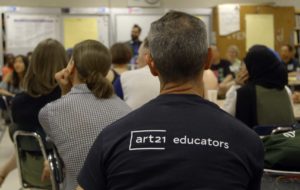
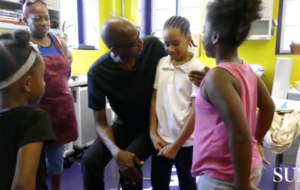
<p><a title="Connecting Teachers and Artists Year Five of Art21 Educators" href="http://blog.art21.org/2013/05/15/connecting-teachers-and-artists-year-five-of-art21-educators/" target="_blank"><strong>Connecting Teachers and Artists: Year Five of Art21 Educators</strong></a><br />
Jessica Hamlin announced a new year of our Art21 Educators program, in which participants from varied disciplines meet for intense summer workshops. In-depth profiles of the selected educators are forthcoming.</p>
<p><a title="100 Artists Looking at Los Angeles Escaping the Corporate Frame" href="http://blog.art21.org/2013/05/16/looking-at-los-angeles-escaping-the-corporate-frame/" target="_blank"><strong>100 Artists | Looking at Los Angeles: Escaping the Corporate Frame</strong></a><br />
Catherine Wagley wrote on the history of James Turrel, one of our 100 Artists, and his mid-century engagement (and later disenchantment) with the manipulation of perception.</p>
<p><a title="Exclusive James Turrell Revisits Second Meeting" href="http://blog.art21.org/2013/05/17/exclusive-james-turrell-revisits-second-meeting/" target="_blank"><strong>Exclusive | James Turrell Revisits “Second Meeting”</strong></a><br />
Art21 Associate Producer Ian Forster introduced our newest <em>Exclusive</em> and considered the challenges of capturing James Turrel&#8217;s work on film.</p>
<p><strong>Art21<em> Access</em> Screenings</strong><br />
<em id="__mceDel"><em>Access 100 Artists—</em></em>the global campaign celebrating a decade of artists in our documentary series <em>Art in the Twenty-First Century</em>—heads to Greece this weekend for <a title="Art-Athina 2013" href="http://www.art-athina.gr/2013/" target="_blank">Art-Athina</a>. Trusted Art 21 friend Kika Kyriakakaou will be documenting the <em>Access</em> booth on <a title="!00 Artists Athens Tumblr" href="http://100artists-athens.tumblr.com/" target="_blank">tumblr</a>, and we thank her for it! Plus, <em>Access</em> events continue in Springfield, Illinois, where the <a title="Springfield Art Association" href="http://www.springfieldart.org/" target="_blank">Springfield Art Association</a> will hold their next screening this Friday<em id="__mceDel"><em>, </em></em>May 24th<em>.</em><em id="__mceDel"><em><br />
</em></em></p>
<p>Want to host an <em>Access</em> event of your own? Be sure to visit <a title="Art21 Access" href="http://www.art21.org/access" target="_blank">www.art21.org/access</a> or contact access@art21.org to find out more!</p>
<p><em><a href="http://blog.art21.org/2013/05/18/week-in-review-05-18-13/">"Week in Review 05.18.13" originally appeared on the Art21 Blog</a></em></p><p>Subscribe to Art21 for mobile on <a href="http://www.google.com/producer/editions/CAow2t3hAg/art21">Google Currents</a></p><div class="feedflare">
<a href="http://feeds.feedburner.com/~ff/Art21Blog?a=864hDfct8NI:8tX3aT7BgPo:yIl2AUoC8zA"><img src="http://feeds.feedburner.com/~ff/Art21Blog?d=yIl2AUoC8zA" border="0"></img></a>
</div><img src="http://feeds.feedburner.com/~r/Art21Blog/~4/864hDfct8NI" height="1" width="1"/>]]></content:encoded>
			<wfw:commentRss>http://blog.art21.org/2013/05/18/week-in-review-05-18-13/feed/</wfw:commentRss>
		<slash:comments>0</slash:comments>
	
		<image>
			<url>http://blog.art21.org/wp-content/uploads/2013/05/WIR.05.17.13-360x202.png</url>
			<width>360</width>
			<height>202</height>
			<type>image/png</type>
		</image>
		<feedburner:origLink>http://blog.art21.org/2013/05/18/week-in-review-05-18-13/</feedburner:origLink></item>
		<item>
		<title>Exclusive | James Turrell Revisits “Second Meeting”</title>
		<link>http://feedproxy.google.com/~r/Art21Blog/~3/u5D4Lrnm4GE/</link>
		<comments>http://blog.art21.org/2013/05/17/exclusive-james-turrell-revisits-second-meeting/#comments</comments>
		<pubDate>Fri, 17 May 2013 17:00:46 +0000</pubDate>
		<dc:creator>Ian Forster</dc:creator>
				<category><![CDATA[Exclusive]]></category>
		<category><![CDATA[James Turrell]]></category>
		<category><![CDATA[perception]]></category>
		<category><![CDATA[Second Meeting]]></category>
		<category><![CDATA[skyspace]]></category>

		<guid isPermaLink="false">http://blog.art21.org/?p=79640</guid>
		<description><![CDATA["When sitting inside Second Meeting you’re not only looking at the sky—you’re also observing how your eyes and mind perceive color."]]></description>
				<content:encoded><![CDATA[<div id="attachment_79670" class="wp-caption aligncenter" style="width: 510px"><a href="http://blog.art21.org/2013/05/17/exclusive-james-turrell-revisits-second-meeting/turrell-3/" rel="attachment wp-att-79670"><img class="size-full wp-image-79670" alt="James Turrell, “Second Meeting” interior, 1989. Production stills from the series Exclusive. © Art21, Inc. 2013. Cinematography by Marc Levy." src="http://blog.art21.org/wp-content/uploads/2013/05/Turrell.gif" width="500" height="281" /></a><p class="wp-caption-text">James Turrell, “Second Meeting” interior, 1989. Production stills from the series Exclusive. © Art21, Inc. 2013. Cinematography by Marc Levy.</p></div>
<p><i>“We don&#8217;t normally look at light; we&#8217;re generally looking at something light reveals.”</i></p>
<p>Filmed in early 2013, this new <i>Exclusive</i> shows artist James Turrell <a href="http://blog.art21.org/2013/05/01/change-begins-with-hindsight-announcing-art21-blog-themes/" target="_blank">revisiting</a> one of his first skyspaces, <i>Second Meeting</i> (1989), at the home of private collectors in Los Angeles, California. <i>Second Meeting</i> was originally installed at the Museum of Contemporary Art, Los Angeles in 1986. In the film, Turrell explains what initially led him to work with light, and how his skyspaces encourage examination of our own visual perceptions.</p>
<p>When the Art21 team goes out to film, we aim to convey the in person experience of an object or installation. Every work poses unique challenges. <a href="http://www.art21.org/images/rackstraw-downes/production-still-from-balance-2012-21" target="_blank">Rackstraw Downes’</a>s elongated paintings can appear bowed through wide-angle lenses. Without the right microphones, important sounds in Ann Hamilton’s multisensory installation <a href="http://blog.art21.org/2013/04/19/exclusive-ann-hamilton-the-event-of-a-thread/" target="_blank"><i>the event of a thread</i></a> would go unnoticed. Subtle variations in <a href="http://www.art21.org/images/robert-ryman/production-still-from-paradox-2007-22" target="_blank">Robert Ryman</a>’s delicately painted white-on-white canvases can be especially difficult to capture and without them we lose the essence of his work. In my opinion, James Turrell’s installations are the most difficult to convey in documentary film.</p>
<p><span id="more-79640"></span></p>
<div id="attachment_79646" class="wp-caption aligncenter" style="width: 510px"><a href="http://blog.art21.org/2013/05/17/exclusive-james-turrell-revisits-second-meeting/james-turrell-5-copy/" rel="attachment wp-att-79646"><img class="size-full wp-image-79646" alt="James Turrell 5 copy" src="http://blog.art21.org/wp-content/uploads/2013/05/James-Turrell-5-copy.jpg" width="500" height="281" /></a><p class="wp-caption-text">Artist James Turrell seated inside “Second Meeting” (1989). Production still from the series Exclusive. © Art21, Inc. 2013. Cinematography by Marc Levy.<em id="__mceDel" style="text-align: left; font-size: 13px; line-height: 19px;"><br /></em></p></div>
<p>When sitting inside <i>Second Meeting</i> you’re not only looking at the sky—you’re also observing how your eyes and mind perceive color. At dusk, tungsten bulbs cast a warm hue on the white walls that surround the opening in the ceiling, altering one’s perspective of this blue field. Turrell isn’t trying to trick us though—the mechanics of <i>Second Meeting</i> are straightforward and obvious. Rather, he encourages us to look inward and acknowledge that we form our own perceptions and thus can change them.</p>
<p>In the space, the walls fill your field of vision as you look upward. But as you watch our film, the walls only take up a few inches of your screen. With less of your field of vision occupied by warmly lit walls, your perception is not easily shifted. We simulated the experience as best we could, in this case, through time-lapse photography, but in the end the affect of <i>Second Meeting</i> simply cannot be recreated.</p>
<p><i>Second Meeting</i> sits on private residential property. However, New York residents and visitors can find a nearly identical installation at <a href="http://momaps1.org/exhibitions/view/170" target="_blank">MoMA PS1</a> in Queens, where it has been on public view since 1986. Concurrent retrospectives of Turrell’s work are also opening soon at the <a href="http://www.guggenheim.org/new-york/exhibitions/upcoming/james-turrell" target="_blank">Guggenheim</a> in New York, the <a href="http://www.lacma.org/art/exhibition/james-turrell-retrospective" target="_blank">Los Angeles County Museum of Art</a>, and the <a href="http://www.mfah.org/exhibitions/james-turrell-retrospective/" target="_blank">Museum of Fine Arts, Houston</a>. Go and experience the work for yourself.</p>
<p align="center"><object width="500" height="281" classid="clsid:d27cdb6e-ae6d-11cf-96b8-444553540000" codebase="http://download.macromedia.com/pub/shockwave/cabs/flash/swflash.cab#version=6,0,40,0"><param name="allowFullScreen" value="true" /><param name="allowscriptaccess" value="always" /><param name="src" value="http://www.youtube.com/v/_BuJpDXkMz8?hl=en_US&amp;version=3&amp;rel=0" /><param name="allowfullscreen" value="true" /><embed width="500" height="281" type="application/x-shockwave-flash" src="http://www.youtube.com/v/_BuJpDXkMz8?hl=en_US&amp;version=3&amp;rel=0" allowFullScreen="true" allowscriptaccess="always" allowfullscreen="true" /></object></p>
<p><em><a href="http://blog.art21.org/2013/05/17/exclusive-james-turrell-revisits-second-meeting/">"Exclusive | James Turrell Revisits &#8220;Second Meeting&#8221;" originally appeared on the Art21 Blog</a></em></p><p>Subscribe to Art21 for mobile on <a href="http://www.google.com/producer/editions/CAow2t3hAg/art21">Google Currents</a></p><div class="feedflare">
<a href="http://feeds.feedburner.com/~ff/Art21Blog?a=u5D4Lrnm4GE:ke4MxRaVnv0:yIl2AUoC8zA"><img src="http://feeds.feedburner.com/~ff/Art21Blog?d=yIl2AUoC8zA" border="0"></img></a>
</div><img src="http://feeds.feedburner.com/~r/Art21Blog/~4/u5D4Lrnm4GE" height="1" width="1"/>]]></content:encoded>
			<wfw:commentRss>http://blog.art21.org/2013/05/17/exclusive-james-turrell-revisits-second-meeting/feed/</wfw:commentRss>
		<slash:comments>0</slash:comments>
	
		<image>
			<url>http://blog.art21.org/wp-content/uploads/2013/05/James-Turrell-Gif-360x202.gif</url>
			<width>360</width>
			<height>202</height>
			<type>image/gif</type>
		</image>
		<feedburner:origLink>http://blog.art21.org/2013/05/17/exclusive-james-turrell-revisits-second-meeting/</feedburner:origLink></item>
		<item>
		<title>100 Artists | Looking at Los Angeles: Escaping the Corporate Frame</title>
		<link>http://feedproxy.google.com/~r/Art21Blog/~3/Rap8kQzEJ8U/</link>
		<comments>http://blog.art21.org/2013/05/16/looking-at-los-angeles-escaping-the-corporate-frame/#comments</comments>
		<pubDate>Thu, 16 May 2013 15:28:18 +0000</pubDate>
		<dc:creator>Catherine Wagley</dc:creator>
				<category><![CDATA[> Looking at Los Angeles]]></category>
		<category><![CDATA[James Turrell]]></category>
		<category><![CDATA[Los Angeles]]></category>
		<category><![CDATA[100 Artists]]></category>
		<category><![CDATA[alpha conditioning]]></category>
		<category><![CDATA[Art and Technology Program]]></category>
		<category><![CDATA[corporations]]></category>
		<category><![CDATA[hindsight]]></category>
		<category><![CDATA[LACMA]]></category>
		<category><![CDATA[science]]></category>

		<guid isPermaLink="false">http://blog.art21.org/?p=79609</guid>
		<description><![CDATA[More than 40 years ago James Turrell and Robert Irwin teamed up on a "hair-raising" art and technology initiative. Columnist Catherine Wagely looks back.]]></description>
				<content:encoded><![CDATA[<p><a href="http://www.art21.org/100artists" target="_blank">100 Artists</a><em> is a yearlong celebration of the 100 artists who have appeared to date in Art21′s award-winning film series </em>Art in the Twenty-First Century<em>. Throughout 2013, we are dedicating two to three days to each artist on our social media platforms—Twitter, Facebook, Tumblr, and here on the Art21 Blog. Our current featured artist is <a href="http://www.art21.org/artists/james-turrell" target="_blank">James Turrell</a>.</em></p>
<div id="attachment_79612" class="wp-caption aligncenter" style="width: 510px"><a href="http://blog.art21.org/2013/05/16/looking-at-los-angeles-escaping-the-corporate-frame/irwin-and-turrell-in-the-anechoic-chamber-courtesy-lacma/" rel="attachment wp-att-79612"><img class="size-full wp-image-79612    " alt="Robert Irwin and James Turrell in the anechoic chamber during their collaboration with Garrett Corporation. Courtesy Los Angeles County Museum of Art." src="http://blog.art21.org/wp-content/uploads/2013/05/Irwin-and-Turrell-in-the-anechoic-chamber.-Courtesy-LACMA.jpg" width="500" height="328" /></a><p class="wp-caption-text">James Turrell (seated) and Robert Irwin (standing) in the anechoic chamber during their collaboration with Garrett Corporation. Courtesy Los Angeles County Museum of Art.</p></div>
<p>Maurice Tuchman, the Los Angeles County Museum of Art’s first modern art curator, went down to Torrance, California one day in July of 1969. Associate curator Jane Livingston and assistant curator Gail Scott came with him, and all three underwent &#8220;alpha conditioning.&#8221;</p>
<p>Artists <a href="http://www.art21.org/artists/james-turrell" target="_blank">James Turrell</a> and Robert Irwin had designed alpha conditioning and a series of other experiments with Dr. Ed Wortz of the Garrett Corporation as part of LACMA’s Art and Technology Program (1967-1971). The initiative and resulting exhibition—&#8221;this hair-raising idea,&#8221; Livingston called it in <a href="http://blog.art21.org/2013/05/01/change-begins-with-hindsight-announcing-art21-blog-themes/" target="_blank">retrospect</a> [1]—involved pairing artists with corporations and asking artists to collaborate with company scientists or engineers. At the time, Tuchman said he imagined artists moving around corporations as if in their own studios.</p>
<p>&#8220;I believed it was the process of interchange between artist and company that was most significant, rather than whatever tangible results might quickly occur,&#8221; Tuchman wrote in 1970 [2]. But a later interview with Irwin, as well as early reports on the processes of other artists in the program, suggest Tuchman may have eased into this belief—maybe when he began to realize that only 15 or so of the 76 artist-participants would make something tangible enough to show. It’s this intangibility that makes the Art and Technology show persistently interesting: Why did corporate settings and an expanded range of hi-tech resources push artists, even those who decidedly made objects in their usual practices, toward indeterminate, impossibly conceptual projects?</p>
<div id="attachment_79610" class="wp-caption aligncenter" style="width: 510px"><a href="http://blog.art21.org/2013/05/16/looking-at-los-angeles-escaping-the-corporate-frame/headshort-of-participants-from-the-cover-of-the-report-on-art-and-technology-courtesy-lacma/" rel="attachment wp-att-79610"><img class="size-full wp-image-79610   " alt="Headshots of participants from the cover of the Report on Art and Technology. Courtesy LACMA" src="http://blog.art21.org/wp-content/uploads/2013/05/Headshort-of-participants-from-the-cover-of-the-Report-on-Art-and-Technology.-Courtesy-LACMA.jpg" width="500" height="649" /></a><p class="wp-caption-text">Headshots of participants from the cover of the Report on Art and Technology. Courtesy Los Angeles County Museum of Art.</p></div>
<p><img title="More..." alt="" src="http://blog.art21.org/wp-includes/js/tinymce/plugins/wordpress/img/trans.gif" />For alpha conditioning, Wortz hooked the curators up, one at a time, for thirty minutes each, to an electroencephalography machine, also known as an EEG. They sat in a reclining chair—a comfortable one, as Turrell, Irwin and Wortz specify in their notes—and put on glasses with a white light attached to the rim. Then they closed their eyes. Through their eyelids, they could see the light go on each time their alpha rhythms, or brain waves, went down to 8-12 cycles per second, putting them in meditative states. The best photo from this day shows Livingston, reclining and half-smiling while Wortz puts electrodes on her forehead. She looks relaxed. But would she still be a few moments later with a machine constantly informing her how relaxed or not she was? After returning to the museum, all three curators “experienced inexplicable sensations of anxiety or a sense of mental dislocation or dissociation,” says the report Livingston later wrote.</p>
<p><span id="more-79609"></span></p>
<p>Neil Armstrong walked on the moon that same July. And Wortz, who worked just south of LAX in Garrett’s Life Sciences Department, had been developing &#8220;life support systems for lunar missions&#8221; using NASA money. Trained as a psychologist, he thought often about perceptual dilemmas: Would the bigness of the lunar surface disorient an astronaut? How do you prepare yourself to step out into that much space?</p>
<p>It made sense that Robert Irwin and James Turrell would intrigue him. At that point, Irwin was crafting translucent white disks out of acrylic lacquer, installing overlapping groups of them against white walls. Sometimes, even when you were in front of them, it looked as though they weren’t actually there, and Irwin objected to anyone taking pictures of them. &#8220;I am concerned with specifics and reject the generalities of photographs,&#8221; Irwin told <i>ArtForum</i> in 1965.</p>
<p>Turrell had been working in the empty Mendota Hotel in Santa Monica since 1966, closing up all the windows after renting it out and experimenting with projections in corners or lights shining through cut-open walls—anything that made space look dimensional in an unfamiliar way. Both artists, as they would write together in a 1969 memo, wanted &#8220;people to perceive their perceptions.&#8221;</p>
<p>With Wortz as their main contact at Garrett, they experimented sensory deprivation chambers, meditation processes and ganzfields (fields of sight with no objects in them to focus on), measuring the reactions volunteers had to various sensory experiments. At first, they thought they would build some kind of sound-free anechoic chamber for the LACMA show, but reading through the notes, memos and interview transcripts from the last stretch of the project, is like watching the three men gradually disengage themselves from goals and order.</p>
<div id="attachment_79611" class="wp-caption aligncenter" style="width: 510px"><a href="http://blog.art21.org/2013/05/16/looking-at-los-angeles-escaping-the-corporate-frame/irwin-and-turrell-in-the-anechoic-chamber-during-their-collaboration-with-garrett-courtesy-lacma/" rel="attachment wp-att-79611"><img class="size-full wp-image-79611  " alt="James Turrell (left) and Robert Irwin (right) in the anechoic chamber during their collaboration with Garrett Corporation. Courtesy Los Angeles County Museum of Art." src="http://blog.art21.org/wp-content/uploads/2013/05/Irwin-and-Turrell-in-the-anechoic-chamber-during-their-collaboration-with-Garrett.-Courtesy-LACMA.jpg" width="500" height="333" /></a><p class="wp-caption-text">James Turrell (left) and Robert Irwin (right) in the anechoic chamber during their collaboration with Garrett Corporation. Courtesy Los Angeles County Museum of Art.</p></div>
<p>This has to be part of what makes the Irwin-Turrell-Wortz collaboration so fascinating: they started out wanting to manipulate perception for research purposes. But all three of them &#8220;became less inclined though spring and into summer of ‘69 to carry out [their] original plan&#8221; and more &#8220;deeply involved in the highly personal experience<i> itself </i>of intimate collaboration.&#8221; [3] Then Turrell abruptly &#8220;abdicated,&#8221; as both Livingston and Irwin put it, which makes it sound like Turrell had relinquished a kind of power. &#8220;All of this is very Pavlovian,&#8221; Turrell said later, vaguely explaining his abdication. &#8220;You&#8217;re not really asking much of the person, or yourself. And all you can watch are the surface responses.&#8221;</p>
<p>Last year, Livingston spoke on a panel at the Getty Museum and remembered with a hint of sarcasm, the goals of Art and Technology: &#8220;Here we [were] in the middle of a huge industrial complex,&#8221; she said, &#8220;and wouldn’t it be wonderful if we could maybe make the new world happen?&#8221;</p>
<p>Maybe they did, thoug, , or at least gave some blueprints for how art could and couldn’t interact with the corporate world. The Irwin-Turrell-Wortz collaboration—which went from a goal-oriented art-science marriage to an exiting of the corporate frame by artists and company man (Wortz would soon become a Buddhist therapist specializing in helping artists)—feels like a muscular response to the growing inability to tell where corporate interests and art and science begin.</p>
<div>
<hr align="left" size="1" width="33%" />
<div>
<p>[1] “Modern Art in Los Angeles—Women Curators in Los Angeles,” panel discussion, Getty Center, Los Angeles, October 26, 2011.</p>
</div>
<div>
<p>[2] Maurice Tuchman, “Introduction,” in <a href="http://www.lacma.org/sites/all/themes/custom/lacma/reading_room/A_Report_on_the_Art_and_Technology_Program_of_the_Los_Angeles_County_Museum_of_Art_1967_8211_1971.html#page/n0/mode/2up" target="_blank"><i>A Report on the Art and Technology Program of the Los Angeles County Museum of Art, 1967–1971</i></a>, ed. Maurice Tuchman (Los Angeles: LACMA, 1971).</p>
</div>
<div>
<p>[3] <i>A Report on the Art and Technology Program of the Los Angeles County Museum of Art, 1967–1971</i>.</p>
</div>
</div>
<p><em><a href="http://blog.art21.org/2013/05/16/looking-at-los-angeles-escaping-the-corporate-frame/">"100 Artists | Looking at Los Angeles: Escaping the Corporate Frame" originally appeared on the Art21 Blog</a></em></p><p>Subscribe to Art21 for mobile on <a href="http://www.google.com/producer/editions/CAow2t3hAg/art21">Google Currents</a></p><div class="feedflare">
<a href="http://feeds.feedburner.com/~ff/Art21Blog?a=Rap8kQzEJ8U:WaWm6ICRaqQ:yIl2AUoC8zA"><img src="http://feeds.feedburner.com/~ff/Art21Blog?d=yIl2AUoC8zA" border="0"></img></a>
</div><img src="http://feeds.feedburner.com/~r/Art21Blog/~4/Rap8kQzEJ8U" height="1" width="1"/>]]></content:encoded>
			<wfw:commentRss>http://blog.art21.org/2013/05/16/looking-at-los-angeles-escaping-the-corporate-frame/feed/</wfw:commentRss>
		<slash:comments>0</slash:comments>
	
		<image>
			<url>http://blog.art21.org/wp-content/uploads/2013/05/Headshort-of-participants-from-the-cover-of-the-Report-on-Art-and-Technology.-Courtesy-LACMA-360x202.jpg</url>
			<width>360</width>
			<height>202</height>
			<type>image/jpeg</type>
		</image>
		<feedburner:origLink>http://blog.art21.org/2013/05/16/looking-at-los-angeles-escaping-the-corporate-frame/</feedburner:origLink></item>
		<item>
		<title>Connecting Teachers and Artists: Year Five of Art21 Educators</title>
		<link>http://feedproxy.google.com/~r/Art21Blog/~3/gpzU1xe20sE/</link>
		<comments>http://blog.art21.org/2013/05/15/connecting-teachers-and-artists-year-five-of-art21-educators/#comments</comments>
		<pubDate>Wed, 15 May 2013 18:40:12 +0000</pubDate>
		<dc:creator>Jessica Hamlin</dc:creator>
				<category><![CDATA[> Teaching with Contemporary Art]]></category>
		<category><![CDATA[New York City]]></category>
		<category><![CDATA[Art21 Educators]]></category>
		<category><![CDATA[teachers]]></category>

		<guid isPermaLink="false">http://blog.art21.org/?p=79563</guid>
		<description><![CDATA[Announcing twelve exceptional new teachers in the Art21 Educators program.]]></description>
				<content:encoded><![CDATA[<p><a href="http://blog.art21.org/2013/05/15/connecting-teachers-and-artists-year-five-of-art21-educators/photo-grid-for-jess-intro-blog-post-copy/" rel="attachment wp-att-79578"><img class="aligncenter size-full wp-image-79578" alt="Photo Grid for Jess intro blog post copy" src="http://blog.art21.org/wp-content/uploads/2013/05/Photo-Grid-for-Jess-intro-blog-post-copy.jpg" width="500" height="280" /></a> <a href="http://blog.art21.org/2013/05/15/connecting-teachers-and-artists-year-five-of-art21-educators/photo-grid-for-jess-intro-blog-post2/" rel="attachment wp-att-79586"><img class="aligncenter size-full wp-image-79586" alt="Photo Grid for Jess intro blog post2" src="http://blog.art21.org/wp-content/uploads/2013/05/Photo-Grid-for-Jess-intro-blog-post2.jpg" width="500" height="280" /></a></p>
<p>Spring is that time of year when anyone in school, students and teachers alike, are in a frenzied countdown, holding their collective breath until they are officially out for the summer.</p>
<p>Art21 is excited to announce that soon after the big exhale, an exceptional group of teachers will join us in New York City for the fifth year of <a href="http://www.art21.org/teach/participate/art21-educators" target="_blank">Art21 Educators</a>.</p>
<p>Art21 Educators is a program for practicing teachers, museum educators, artists, and university faculty from a wide range of disciplines. Our alumni and new participants comprise a dynamic community (75 and growing) who are curious and passionate about contemporary art, and committed to transforming education through the work of living artists.</p>
<p>All educators are required to apply with a partner who can provide additional support and feedback, as well as opportunities for collaborative and interdisciplinary teaching. Six pairs are selected annually. Our 2013-2014 Art21 Educators are:</p>
<p><strong>Renee Bareno + Sara Fromboluti</strong>, The Aaron School, New York, NY<br />
<strong>Carol Barker</strong> +<strong> Anna Grimes</strong>, Turquoise Trail Charter School, Santa Fe, NM<br />
<strong>Thomas Dareneau +</strong><strong> Domenic Frunzi</strong>, Boyertown Area High School, Boyertown, PA<br />
<strong>Rebecca Belleville</strong> + <strong>Eric Pugh</strong>, Maritime Industries Academy, and Baltimore Polytechnic Institute, Baltimore, MD, respectively<br />
<strong>Ryan Schmidt</strong> + <strong>Erin Shafkind</strong>, South Shore PreK-8, and Nathan Hale High School, Seattle, WA, respectively<br />
<strong>Alyssa Greenberg</strong> + <strong>Rebecca Mir</strong>, Jane Addams Hull House Museum, Chicago, IL, and Voelker Orth Museum, Bird Sanctuary and Victorian Garden, Queens, NY, respectively</p>
<p>This July, the group will meet for the first time to participate in eight intense days of workshops and discussions about Art21’s films and curricular resources, which includes visits to galleries, museums, and artists’ studios for intimate conversations with curators and Art21-featured artists. After the summer, we’ll continue working as a group (though virtually) to share the different ways that we are introducing contemporary art and artists in classrooms throughout the country.</p>
<p>Congratulations to this year&#8217;s participants!</p>
<p><i>Editor’s Note</i><em>: In the coming weeks, we’ll post in-depth profiles of our 2013-2014 Art21 Educators, <em>telling you more about their interests and lives as teachers.</em></em></p>
<p><em><a href="http://blog.art21.org/2013/05/15/connecting-teachers-and-artists-year-five-of-art21-educators/">"Connecting Teachers and Artists: Year Five of Art21 Educators" originally appeared on the Art21 Blog</a></em></p><p>Subscribe to Art21 for mobile on <a href="http://www.google.com/producer/editions/CAow2t3hAg/art21">Google Currents</a></p><div class="feedflare">
<a href="http://feeds.feedburner.com/~ff/Art21Blog?a=gpzU1xe20sE:ZtMFgjWbDVM:yIl2AUoC8zA"><img src="http://feeds.feedburner.com/~ff/Art21Blog?d=yIl2AUoC8zA" border="0"></img></a>
</div><img src="http://feeds.feedburner.com/~r/Art21Blog/~4/gpzU1xe20sE" height="1" width="1"/>]]></content:encoded>
			<wfw:commentRss>http://blog.art21.org/2013/05/15/connecting-teachers-and-artists-year-five-of-art21-educators/feed/</wfw:commentRss>
		<slash:comments>0</slash:comments>
	
		<image>
			<url>http://blog.art21.org/wp-content/uploads/2013/05/Photo-Grid-for-Jess-intro-blog-post-copy-360x202.jpg</url>
			<width>360</width>
			<height>202</height>
			<type>image/jpeg</type>
		</image>
		<feedburner:origLink>http://blog.art21.org/2013/05/15/connecting-teachers-and-artists-year-five-of-art21-educators/</feedburner:origLink></item>
		<item>
		<title>Pulling Things Forward</title>
		<link>http://feedproxy.google.com/~r/Art21Blog/~3/r8ptR0fbiO4/</link>
		<comments>http://blog.art21.org/2013/05/14/pulling-things-forward/#comments</comments>
		<pubDate>Tue, 14 May 2013 15:40:38 +0000</pubDate>
		<dc:creator>Danielle Sommer</dc:creator>
				<category><![CDATA[Guest Blog]]></category>
		<category><![CDATA[hindsight]]></category>
		<category><![CDATA[Mary Leigh Cherry]]></category>
		<category><![CDATA[Pacific Standard Time]]></category>
		<category><![CDATA[Philip Martin]]></category>
		<category><![CDATA[Photography into Sculpture]]></category>

		<guid isPermaLink="false">http://blog.art21.org/?p=79550</guid>
		<description><![CDATA["...the clumsiest narratives are often the narratives that assume prescribed movement from A to B. "]]></description>
				<content:encoded><![CDATA[<div id="attachment_79551" class="wp-caption aligncenter" style="width: 510px"><a href="http://blog.art21.org/2013/05/14/pulling-things-forward/sommer_hindsight2_image1/" rel="attachment wp-att-79551"><img class="size-full wp-image-79551" alt="Carl Cheng, U.N. of C., 1967. Film, molded plastic, Styrofoam and Plexiglas; 15 x 20.75 x 9 inches. Image courtesy of Cherry and Martin." src="http://blog.art21.org/wp-content/uploads/2013/05/Sommer_hindsight2_image1.jpg" width="500" height="355" /></a><p class="wp-caption-text">Carl Cheng, &#8220;U.N. of C.,&#8221; 1967. Film, molded plastic, Styrofoam and Plexiglas. 15 x 20.75 x 9 in. Courtesy Cherry and Martin.</p></div>
<p>In the fall of 2011, the Los Angeles gallery Cherry and Martin offered its visitors the chance to relive a once-in-a-lifetime experience. As part of <a href="http://www.pacificstandardtime.org/" target="_blank"><i>Pacific Standard Time: Art in L.A. 1945–1980</i></a>, gallerists Philip Martin and Mary Leigh Cherry presented selected works from curator Peter Bunnell’s 1970 exhibition, <i>Photography into Sculpture</i>, including some of the first examples of artists working with photographs in a “fully dimensional” manner.</p>
<p>The original exhibition, which<i> </i>debuted at the <a href="http://www.moma.org/docs/press_archives/4438/releases/MOMA_1970_Jan-June_0035_36.pdf?2010" target="_blank">Museum of Modern Art, New York</a>, with a roster of primarily West Coast- and L.A.-based artists, shocked and appalled its audience, winning scorn from many critics. Hilton Kramer, for instance, insisted that the integrity of the photographic process had been compromised. Forty years later, however, most of the show’s reviewers comment instead on the exhibition’s continued relevance and surprising freshness. Carl Cheng’s dioramas of molded plastic photographic figures and Michael de Courcy’s tower of photo boxes seemed as intriguing in 2011 as they did in 1970. What critics seem to disagree on was what word to use to describe the show. Was it a “re-staging,” a “revision,” or simply a “reprise?”</p>
<p>In an interview, gallerist Philip Martin made it clear that the goal was never to simply reach back into the past and recreate the minutiae of the original exhibition. “You want the work to live and to be present as current objects,” Martin stated. “It doesn’t feel like historical material to me.” At the same time, the effect of Cherry and Martin’s decisions to pull the exhibition forward—to apply the lens of <a href="http://blog.art21.org/2013/05/01/change-begins-with-hindsight-announcing-art21-blog-themes/" target="_blank">hindsight</a>—can’t be ignored. “Art history is a narrative. It’s a story that we’re clearly always retelling ourselves. As a gallerist, as a curator, you’re trying to create a narrative that sparks people’s interest so they can see things afresh.”</p>
<p><span id="more-79550"></span></p>
<p>When asked if the recent version of <i>Photography into Sculpture</i> revised history, Martin replied, “I’m not really sure what that means. I would assume that means you’re saying to people that history is not what they thought it was. I suppose to some degree that’s true, but at the same time, I think that to reach back and say ‘Hey, we couldn’t read this object, or we were reading it in a different way&#8230;’ That’s a statement of the present.”</p>
<p>There’s a famous photograph from 1913 called <i>The Smoker</i>. The smoker sits in profile, his face double-exposed with his hairline lost against the black background. His left hand is raised toward the camera, grasping an indistinguishable object. His right hand—actually, both hands—seem to be in multiple places at once, leaving blurry motion trails across the photograph, an effect the photographer, Italian Futurist Anton Bragaglia (1890–1960), carefully cultivated by leaving the shutter open for long periods. The same technique transforms the sitter’s cigarette and cigarette smoke into solid, white cords that snake from lap to mouth.</p>
<div id="attachment_79552" class="wp-caption aligncenter" style="width: 510px"><a href="http://blog.art21.org/2013/05/14/pulling-things-forward/sommer_hindsight2_image2/" rel="attachment wp-att-79552"><img class="size-full wp-image-79552" alt="Michael de Courcy, untitled, 1970-2011. Photoserigraph and corrugated cardboard boxes. 12 x 12 x 12 inches each box; overall dimensions variable. Image courtesy of Cherry and Martin." src="http://blog.art21.org/wp-content/uploads/2013/05/Sommer_hindsight2_image2.jpg" width="500" height="595" /></a><p class="wp-caption-text">Michael de Courcy. &#8220;untitled,&#8221; 1970-2011. Photoserigraph and corrugated cardboard boxes. 12 x 12 x 12 in each box; overall dimensions variable. Courtesy Cherry and Martin.</p></div>
<p>The image is an example of what Bragaglia called photodynamism, a process developed by Anton and his brother, Arturo, in reaction to the chronophotography of Etienne-Jules Marey. Chronophotography, according to Bragaglia, only interested itself in “the precise reconstruction of movement,” while photodynamism’s concern was with “the area of movement which produces sensation, the memory of which still palpitates in our awareness.”</p>
<p>It occurs to me again that there are competing versions of <a href="http://blog.art21.org/2013/05/01/change-begins-with-hindsight-announcing-art21-blog-themes/" target="_blank">hindsight</a>. One presumes distance from what came before, along with a more precise, Marey-esque catalogue of movement (of causes and effects). The second—the sight on a gun as it links my eye and my target—involves the messiness of Benjamin’s flash and the conflated instant, of multiple layers of time pierced by the same arrow. In this version, the second we loose our arrow, we enter Bragaglia’s landscape, where the legibility of individual objects and trajectories is compromised and nothing is as important as the connective tissue that vibrates between and around things.</p>
<p>There is no prescription for the results of such an encounter, but perhaps this is a way we can have our cake and eat it too—to steal fire and bring our past along. After all, the clumsiest narratives are often the narratives that assume prescribed movement from A to B. Perhaps what makes shows like Cherry and Martin’s stand above the rest is that they don’t.</p>
<p><em><a href="http://blog.art21.org/2013/05/14/pulling-things-forward/">"Pulling Things Forward" originally appeared on the Art21 Blog</a></em></p><p>Subscribe to Art21 for mobile on <a href="http://www.google.com/producer/editions/CAow2t3hAg/art21">Google Currents</a></p><div class="feedflare">
<a href="http://feeds.feedburner.com/~ff/Art21Blog?a=r8ptR0fbiO4:oYyFn_j4tYI:yIl2AUoC8zA"><img src="http://feeds.feedburner.com/~ff/Art21Blog?d=yIl2AUoC8zA" border="0"></img></a>
</div><img src="http://feeds.feedburner.com/~r/Art21Blog/~4/r8ptR0fbiO4" height="1" width="1"/>]]></content:encoded>
			<wfw:commentRss>http://blog.art21.org/2013/05/14/pulling-things-forward/feed/</wfw:commentRss>
		<slash:comments>0</slash:comments>
	
		<image>
			<url>http://blog.art21.org/wp-content/uploads/2013/05/Sommer_hindsight2_image1-360x202.jpg</url>
			<width>360</width>
			<height>202</height>
			<type>image/jpeg</type>
		</image>
		<feedburner:origLink>http://blog.art21.org/2013/05/14/pulling-things-forward/</feedburner:origLink></item>
		<item>
		<title>New Kids on the Block | “Mapping Soulville” with Aisha Cousins</title>
		<link>http://feedproxy.google.com/~r/Art21Blog/~3/Hx3DMRUJgEE/</link>
		<comments>http://blog.art21.org/2013/05/13/new-kids-on-the-block-mapping-soulville-with-aisha-cousins/#comments</comments>
		<pubDate>Mon, 13 May 2013 18:20:19 +0000</pubDate>
		<dc:creator>Jacquelyn Gleisner</dc:creator>
				<category><![CDATA[> New Kids on the Block]]></category>

		<guid isPermaLink="false">http://blog.art21.org/?p=79482</guid>
		<description><![CDATA[Mapping the life of Malcolm X at the intersection of New York's past and present. #Art #Community #Change]]></description>
				<content:encoded><![CDATA[<p style="text-align: left;"><a href="http://blog.art21.org/2013/04/08/new-kids-on-the-block-summer-wheat-and-her-flight-from-the-cowboy-space-gangsters/nkotb002-7/" rel="attachment wp-att-78450"><img class="aligncenter size-full wp-image-78450" alt="nkotb002" src="http://blog.art21.org/wp-content/uploads/2013/04/nkotb002.gif" width="500" height="500" /></a></p>
<p style="text-align: left;">Next month, Brooklyn-based Aisha Cousins begins her four-month tenure as one of three Artists-in-Residence for the non-profit organization <a href="http://www.laundromatproject.org/" target="_blank">The Laundromat Project</a>. As part of the initiative’s Create Change Program, Cousins will<i> </i>temporarily transform a Brooklyn laundromat into a community art center. Marmy’s Laundromat, situated on the <a href="https://maps.google.com/maps?q=Malcolm+X+Boulevard+and+Putnam+Avenue+Brooklyn&amp;ie=UTF-8&amp;hq=&amp;hnear=0x89c25c737cab2db5:0x33b0c6b445001fc6,Putnam+Ave+%26+Malcolm+X+Blvd,+Brooklyn,+NY+11221&amp;gl=us&amp;ei=GVuJUY6LNKHY0gGE-4CQAw&amp;ved=0CDYQ8gEwAA" target="_blank">corner of Malcom X Boulevard and Putnam Avenue</a> in Bed-Stuy, will continue as a fully-functioning laundromat, while doubling as the base for Cousin’s community-based practice. The residency will culminate with a site-specific, socially-minded work that will commemorate the life of the human rights activist Malcolm X.</p>
<div id="attachment_79486" class="wp-caption aligncenter" style="width: 510px"><a href="http://blog.art21.org/2013/05/13/new-kids-on-the-block-mapping-soulville-with-aisha-cousins/nkotb_ac_1/" rel="attachment wp-att-79486"><img class="size-full wp-image-79486" alt="NKOTB_AC_1" src="http://blog.art21.org/wp-content/uploads/2013/05/NKOTB_AC_1.jpg" width="500" height="375" /></a><p class="wp-caption-text">Aisha Cousins, 2013.</p></div>
<p>Before next November, Cousins will draft and execute a “performance score”—an open-ended set of <a href="http://sayitloudguide.wordpress.com/2012/01/08/sit/" target="_blank">instructions</a> for a live art project. Her next score, called <em>Mapping Soulville</em>, draws inspiration from the book <i>Soul City</i>, written by the American writer and critic Touré. The setting for this allegorical tale is an unknown town where black culture, especially music, is exalted. Cousins will likewise entreat Bed-Stuy residents to envision a neighborhood in which an icon is celebrated. Together, Cousins and the community will select new names for the streets that bisect Malcolm X Boulevard, having reflected on the events and significance of Malcolm X’s life. Cousins will then petition for the renaming of the streets, resulting in a peripatetic meditation and homage to the life of Malcolm Little.</p>
<p><span id="more-79482"></span></p>
<div id="attachment_79487" class="wp-caption aligncenter" style="width: 510px"><a href="http://blog.art21.org/2013/05/13/new-kids-on-the-block-mapping-soulville-with-aisha-cousins/nkotb_ac_3/" rel="attachment wp-att-79487"><img class="size-full wp-image-79487" alt="NKOTB_AC_3" src="http://blog.art21.org/wp-content/uploads/2013/05/NKOTB_AC_3.jpg" width="500" height="686" /></a><p class="wp-caption-text">Aisha Cousins. &#8220;BedStuy resident performing another Malcolm X inspired score from the SAY IT LOUD series,&#8221; Summer 2012. Courtesy the artist.</p></div>
<p>A powerful symbol for the Bed-Stuy community, Malcolm X is the namesake for both the school El Hajj Malik El Shabazz Elementary and Malcolm X Boulevard in Bed-Stuy. The different names denote distinct periods of his evolution, as it was marked by many monikers over his lifetime. Born Malcolm Little in Omaha, Nebraska in 1925, he became Detroit Red as a hustler in Boston, Malcolm X as a member of the Nation of Islam, and finally, El-Hajj Malik El-Shabazz following his pilgrimage to Mecca in April 1964. Icons are, by nature, flat, but the atrocities of racial unrest Malcolm X witnessed throughout the civil rights movement, the mistakes he made as a young man involved with crime and the humility he expressed for his transgressions give depth to this symbol. History is static, but the dynamic <a href="http://blog.art21.org/2013/05/01/change-begins-with-hindsight-announcing-art21-blog-themes/" target="_blank">hindsight</a> of Malcolm X illustrates that potent insight can be distilled from the most poisoned past.</p>
<p><em>Mapping Soulville</em> endeavors to heighten a symbolic presence onto the streets of Bed-Stuy. Cousins explained, “It’s irresponsible for me as an artist to cut open old wounds and walk away.” Rather Cousins’s next project will open and allow participants to walk within a continuing conversation. The performance will attempt to expose and more importantly, refocus history, presenting a real-time exercise in community empowerment.</p>
<div id="attachment_79483" class="wp-caption aligncenter" style="width: 510px"><a href="http://blog.art21.org/2013/05/13/new-kids-on-the-block-mapping-soulville-with-aisha-cousins/nkotb_ac_2/" rel="attachment wp-att-79483"><img class="size-full wp-image-79483" alt="NKOTB_AC_2" src="http://blog.art21.org/wp-content/uploads/2013/05/NKOTB_AC_2.jpg" width="500" height="682" /></a><p class="wp-caption-text">Nyoh Tittle, owner of Marmy Laundromat, shares his favorite Malcolm X quote. Courtesy the artist.</p></div>
<p><i>Aisha Cousins (born 1978, Boston) has exhibited her performance-based works at numerous institutions including the Museum Of Contemporary African Diasporan Arts, the Brooklyn Museum of Art, Houston’s Project Row Houses, and Kitchen. She will be a Create Change Artist-in-Residence from June 1 to October 19, 2013. </i></p>
<p><em><a href="http://blog.art21.org/2013/05/13/new-kids-on-the-block-mapping-soulville-with-aisha-cousins/">"New Kids on the Block | “Mapping Soulville” with Aisha Cousins" originally appeared on the Art21 Blog</a></em></p><p>Subscribe to Art21 for mobile on <a href="http://www.google.com/producer/editions/CAow2t3hAg/art21">Google Currents</a></p><div class="feedflare">
<a href="http://feeds.feedburner.com/~ff/Art21Blog?a=Hx3DMRUJgEE:PmN3-NhnnuY:yIl2AUoC8zA"><img src="http://feeds.feedburner.com/~ff/Art21Blog?d=yIl2AUoC8zA" border="0"></img></a>
</div><img src="http://feeds.feedburner.com/~r/Art21Blog/~4/Hx3DMRUJgEE" height="1" width="1"/>]]></content:encoded>
			<wfw:commentRss>http://blog.art21.org/2013/05/13/new-kids-on-the-block-mapping-soulville-with-aisha-cousins/feed/</wfw:commentRss>
		<slash:comments>1</slash:comments>
	
		<image>
			<url>http://blog.art21.org/wp-content/uploads/2013/05/NKOTB_AC_2-360x202.jpg</url>
			<width>360</width>
			<height>202</height>
			<type>image/jpeg</type>
		</image>
		<feedburner:origLink>http://blog.art21.org/2013/05/13/new-kids-on-the-block-mapping-soulville-with-aisha-cousins/</feedburner:origLink></item>
		<item>
		<title>Weekly Roundup</title>
		<link>http://feedproxy.google.com/~r/Art21Blog/~3/FGoClVXeDGk/</link>
		<comments>http://blog.art21.org/2013/05/13/weekly-roundup-205/#comments</comments>
		<pubDate>Mon, 13 May 2013 16:13:04 +0000</pubDate>
		<dc:creator>Nettrice Gaskins</dc:creator>
				<category><![CDATA[> The Weekly Roundup]]></category>
		<category><![CDATA[Ai Weiwei]]></category>
		<category><![CDATA[Charles Atlas]]></category>
		<category><![CDATA[Cindy Sherman]]></category>
		<category><![CDATA[Iñigo Manglano-Ovalle]]></category>
		<category><![CDATA[James Turrell]]></category>
		<category><![CDATA[Janine Antoni]]></category>
		<category><![CDATA[Jeff Koons]]></category>
		<category><![CDATA[Maya Lin]]></category>
		<category><![CDATA[Mike Kelley]]></category>

		<guid isPermaLink="false">http://blog.art21.org/?p=79532</guid>
		<description><![CDATA[Jeff Koons layers ancient sculptures and popular images, Charles Atlas collaborates with sound artists, Ai Wei Wei explores medical disaster in Hong Kong, and more.]]></description>
				<content:encoded><![CDATA[<div id="attachment_79533" class="wp-caption aligncenter" style="width: 510px"><a href="http://blog.art21.org/2013/05/13/weekly-roundup-205/09d1f52bdc500ea2dceb8160467c2c66/" rel="attachment wp-att-79533"><img class="size-medium wp-image-79533 " alt="Jeff Koons. &quot;Antiquity 3,&quot; 2009–11. Oil on canvas 102 x 138 in. Courtesy the artist and Gagosian New York." src="http://blog.art21.org/wp-content/uploads/2013/05/09d1f52bdc500ea2dceb8160467c2c66-500x370.jpg" width="500" height="370" /></a><p class="wp-caption-text">Jeff Koons. &#8220;Antiquity 3,&#8221; 2009–11. Oil on canvas 102 x 138 in. Courtesy the artist and Gagosian New York.</p></div>
<p>In this week&#8217;s roundup Jeff Koons layers ancient sculptures and popular images, Charles Atlas collaborates with sound artists, Ai Wei Wei explores medical disaster in Hong Kong, Maya Lin is interviewed, and more.</p>
<ul>
<li><a title="Koons" href="http://www.art21.org/artists/jeff-koons" target="_blank">Jeff Koons</a>&#8216;s first major solo exhibition is up at Gagosian (New York, NY). <a title="Koons show" href="http://www.gagosian.com/exhibitions/jeff-koons--may-11-2013" target="_blank"><em>New Paintings and Sculpture</em></a> features <em>The Antiquity paintings</em> (2009–13) in which Koons layers scenes from famous ancient sculptures with images and figures of popular culture. Here, he explores the back and forth movement between two and three dimensions that underpin the artist&#8217;s work. The exhibition runs through June 29.</li>
</ul>
<ul>
<li><a title="Atlas" href="http://www.art21.org/artists/charles-atlas" target="_blank">Charles Atlas</a> collaborated with the sound artists New Humans on a multimedia project for <em><a title="Frieze Sounds Atlas" href="http://friezeprojectsny.org/sounds/charles-atlas-and-new-humans" target="_blank">Frieze Sounds 2013</a></em> (New York, NY). Atlas and New Humans present a new aural experience, utilizing electronically fractured vocals. Displaying a poem-like babble of unrelated words, the work articulates the flow of materials, information and people extracted from distant places. The sound project is available for download <a title="Atlas sound project" href="http://friezenewyork.com/uploads/programme/files/atlas_new_humans_final.mp3" target="_blank">here</a>.</li>
</ul>
<ul>
<li><a title="Ai" href="http://www.art21.org/artists/ai-weiwei" target="_blank">Ai Wei Wei</a> will be part of a group exhibition at Para Site and Sheung Wan Civic Centre Exhibition Hall (Hong Kong). <a title="Ai show" href="http://www.para-site.org.hk/en/exhibitions/2013/journal-plague-year-fear-ghosts-rebels-sars-leslie-and-hong-kong-story" target="_blank"><em>A Journal of the Plague Year. Fear, ghosts, rebels. SARS, Leslie and the Hong Kong story</em></a> starts with the events that affected Hong Kong in the spring of 2003. Ai&#8217;s piece explores anti-mainland sentiment, seen by organizers as an indirect consequence of a severe acute respiratory syndrome outbreak. The show runs May 16–July 20.</li>
</ul>
<ul>
<li><a title="Antoni" href="http://www.art21.org/artists/janine-antoni" target="_blank">Janine Antoni</a> and Anastasia Ax will discuss their work as part of <a title="Antoni talk" href="http://www.iscp-nyc.org/events/current/1139.html" target="_blank"><em>Brooklyn Commons</em></a> (NYC), a discussion series at the International Studio &amp; Curatorial Program (Brooklyn, NY) that presents intellectual and artistic pairings between the established Brooklyn-based artist community and ISCP residents. Antoni and Ax will consider sculptural production in relation to process and the body. The event takes place May 14 at 6:3opm.</li>
</ul>
<ul>
<li><a title="Kelley" href="http://www.art21.org/artists/mike-kelley" target="_blank">Mike Kelley</a>&#8216;s last major installation officially opened at the Museum of Contemporary Art Detroit. <a title="Kelley homestead" href="http://www.mocadetroit.org/upcomingexhibitions.html" target="_blank"><em>Mobile Homestead</em></a> represents the fruition of a shared dream—for the artist, the friends who miss him, the museum that will tend to his memory, and a community that begins in the Motor City and potentially extends throughout the world. The show is on view through July 28.</li>
</ul>
<p><span id="more-79532"></span></p>
<ul>
<li><a title="Turrell show" href="http://www.academyartmuseum.org/exhibitions/exhib_james_turrell.html" target="_blank"><em>James Turrell Perspectives</em></a> is currently on view at the Academy Art Museum (Easton, MD). The exhibition featuring the premier of <a title="Turrell" href="http://www.art21.org/artists/james-turrell" target="_blank">James Turrell</a>&#8216;s new installation entitled <em>St. Elmo’s Light</em> and also includes a room of holograms, a selection of photographs and plans and a set of bronze and plaster models related to the Roden Crater project in Arizona. The exhibition runs through July 7.</li>
</ul>
<ul>
<li><a title="Manglano-Ovalle" href="http://www.art21.org/artists/i%C3%B1igo-manglano-ovalle" target="_blank">Iñigo Manglano-Ovalle</a> created a site-specific work for the Carré d&#8217;Art-Musée d&#8217;art contemporain (Nîmes, France) to commemorate the museum&#8217;s design by Norman Foster. This show provides insight into a contemporary architect who is inspired by modern art and emergent creative work. <em><a title="Manglano-Ovalle show" href="http://www.nimes.fr/index.php?id=554" target="_blank">MOVING &#8211; Norman Foster on Art</a> </em>closes September 15.</li>
</ul>
<ul>
<li><a title="Sherman" href="http://www.art21.org/artists/cindy-sherman" target="_blank">Cindy Sherman</a>&#8216;s traveling retrospective survey is currently at the Dallas Museum of Art (Dallas, TX). <a title="Sherman at DMA" href="http://dallasmuseumofart.org/View/CurrentExhibitions/dma_442996" target="_blank"><em>Cindy Sherman</em></a> traces the artist’s career from the mid-1970s to the present. The show brings together some 160 key photographs from a variety of the artist’s acclaimed bodies of work, for which she created myriad constructed characters and tableaus. The exhibition runs through June 9.</li>
</ul>
<ul>
<li><a title="Lin" href="http://www.art21.org/artists/maya-lin" target="_blank">Maya Lin</a> was interviewed for <em>Time Style</em>. In &#8221;<a title="Lin TIME article" href="http://style.time.com/2013/05/02/the-creative-mind-qa-with-artist-and-architect-maya-lin/#ixzz2Sx6G8QfX" target="_blank">The Creative Mind</a>&#8220; she talks about new works in her exhibition <em><a title="Lin show" href="http://www.pacegallery.com/london/exhibitions/12583/maya-lin" target="_blank">Here and There</a> </em>on view at Pace Gallery New York through June 22. &#8221;What’s invisible we tend not to think about,&#8221; she says &#8220;so I’ve made sculptures that reveal the terrain below sea level.&#8221;</li>
</ul>
<p><em><a href="http://blog.art21.org/2013/05/13/weekly-roundup-205/">"Weekly Roundup" originally appeared on the Art21 Blog</a></em></p><p>Subscribe to Art21 for mobile on <a href="http://www.google.com/producer/editions/CAow2t3hAg/art21">Google Currents</a></p><div class="feedflare">
<a href="http://feeds.feedburner.com/~ff/Art21Blog?a=FGoClVXeDGk:_BOVw3WnM70:yIl2AUoC8zA"><img src="http://feeds.feedburner.com/~ff/Art21Blog?d=yIl2AUoC8zA" border="0"></img></a>
</div><img src="http://feeds.feedburner.com/~r/Art21Blog/~4/FGoClVXeDGk" height="1" width="1"/>]]></content:encoded>
			<wfw:commentRss>http://blog.art21.org/2013/05/13/weekly-roundup-205/feed/</wfw:commentRss>
		<slash:comments>0</slash:comments>
<enclosure url="http://friezenewyork.com/uploads/programme/files/atlas_new_humans_final.mp3" length="13128974" type="audio/mpeg" />
	
		<image>
			<url>http://blog.art21.org/wp-content/uploads/2013/05/09d1f52bdc500ea2dceb8160467c2c66-360x202.jpg</url>
			<width>360</width>
			<height>202</height>
			<type>image/jpeg</type>
		</image>
		<feedburner:origLink>http://blog.art21.org/2013/05/13/weekly-roundup-205/</feedburner:origLink></item>
		<item>
		<title>Week in Review 05.11.13</title>
		<link>http://feedproxy.google.com/~r/Art21Blog/~3/IbpG1Fa9Fbo/</link>
		<comments>http://blog.art21.org/2013/05/11/week-in-review-05-11-13/#comments</comments>
		<pubDate>Sat, 11 May 2013 15:00:15 +0000</pubDate>
		<dc:creator>Art21</dc:creator>
				<category><![CDATA[Week in Review]]></category>

		<guid isPermaLink="false">http://blog.art21.org/?p=79518</guid>
		<description><![CDATA[The Weekly Roundup, Teaching with Contemporary Art, Gimmer Shelter, Art21 Access Screenings, and more this week on the Art21 Blog. ]]></description>
				<content:encoded><![CDATA[<p>Here are a few things we covered this week on the Art21 Blog:</p>
<p><em id="__mceDel"><a href="http://blog.art21.org/2013/05/11/week-in-review-05-11-13/wir-05-11-13/" rel="attachment wp-att-79522"><img class="aligncenter size-full wp-image-79522" alt="WiR 05.11.13" src="http://blog.art21.org/wp-content/uploads/2013/05/WiR-05.11.13.png" width="500" height="395" /></a></em></p>
<p><a title="Weekly Roundup 204" href="http://blog.art21.org/2013/05/06/weekly-roundup-204/" target="_blank"><strong>Weekly Roundup</strong></a><br />
Nettrice Gaskins got the big events of the week in order, with Cao Fei&#8217;s giant pig <em>House of Treasures</em> in West Kowloon, Julia Mehretu&#8217;s exhibition of new work <em>Liminal Squared </em>in New York and London, the New Museum&#8217;s nostalgic group show <em>NYC 1993: Experimental Jet Set, Trash and No Star, </em>and Kara Walker&#8217;s installation <em>The Nigger Huck Finn Pursues Happiness Beyond the Narrow Constraints of your Overdetermined Thesis on Freedom – Drawn and Quartered by Mister Kara Walkerberry, with Condolences to The Authors </em>at Sikkema Jenkins &amp; Co.</p>
<p><a title="Five Years of Teaching with Contemporary Art" href="http://blog.art21.org/2013/05/08/five-years-of-teaching-with-contemporary-art/" target="_blank"><strong>Teaching with Contemporary Art | Five Years of Teaching with Contemporary Art</strong></a><br />
Joe Fusaro celebrated a milestone of his writing on art education and considered his journey from unsure beginnings to a new, more reflective path ahead.</p>
<p><a title="Of Consequence Santiago Sierra's &quot;Veterans&quot; at Team Gallery" href="http://blog.art21.org/2013/05/09/of-consequence-santiago-sierras-veterans-at-team-gallery/" target="_blank"><strong>Gimme Shelter | Of Consequence <strong>|</strong> Santiago Sierra&#8217;s &#8220;Veterans&#8221; at Team Gallery</strong></a><br />
Marissa Perel considered the retrospection of soldiers in Santiago Sierra&#8217;s intriguing and ambiguous Team Gallery exhibition <em>Veterans</em>.</p>
<p><strong>Art21<em> Access</em> Screenings</strong><br />
<em id="__mceDel"><em>Access 100 Artists—</em></em>the global campaign celebrating a decade of artists in our documentary series <em>Art in the Twenty-First Century</em>—rolls on to sunny Los Angeles tomorrow for a screening of &#8220;Identity&#8221; followed by the full-length <em>William Kentridge: Anything Is Possible. </em>The event will take place at <a title="LACMA Art21 Screening" href="https://www.lacma.org/event/art21-screening-0" target="_blank">LACMA&#8217;s</a> Brown Auditorium at 2pm. Then, from May 16th – 19th, we are very excited for <a title="Art-Athina 2013" href="http://www.art-athina.gr/2013/" target="_blank">Art-Athina</a> in Athens, Greece, where <em>Access</em> events will be held in the Faliro pavilion. And in the beautiful state of Wyoming, be on the lookout for screenings of Season 1&#8242;s &#8220;Consumption,&#8221; &#8220;Place,&#8221; and &#8220;Identity&#8221; held by our friends at the <a title="Lander Art Center" href="http://www.landerartcenter.com/" target="_blank">Lander Art Center.</a><em id="__mceDel"><em><br />
</em></em></p>
<p>Make sure to visit <a title="Art21 Access" href="http://www.art21.org/access" target="_blank">www.art21.org/access</a> or contact access@art21.org to host an <em>Access</em> event near you this spring!</p>
<p><em><a href="http://blog.art21.org/2013/05/11/week-in-review-05-11-13/">"Week in Review 05.11.13" originally appeared on the Art21 Blog</a></em></p><p>Subscribe to Art21 for mobile on <a href="http://www.google.com/producer/editions/CAow2t3hAg/art21">Google Currents</a></p><div class="feedflare">
<a href="http://feeds.feedburner.com/~ff/Art21Blog?a=IbpG1Fa9Fbo:acDmHy-rO3E:yIl2AUoC8zA"><img src="http://feeds.feedburner.com/~ff/Art21Blog?d=yIl2AUoC8zA" border="0"></img></a>
</div><img src="http://feeds.feedburner.com/~r/Art21Blog/~4/IbpG1Fa9Fbo" height="1" width="1"/>]]></content:encoded>
			<wfw:commentRss>http://blog.art21.org/2013/05/11/week-in-review-05-11-13/feed/</wfw:commentRss>
		<slash:comments>1</slash:comments>
	
		<image>
			<url>http://blog.art21.org/wp-content/uploads/2013/05/WiR-05.11.13-360x202.png</url>
			<width>360</width>
			<height>202</height>
			<type>image/png</type>
		</image>
		<feedburner:origLink>http://blog.art21.org/2013/05/11/week-in-review-05-11-13/</feedburner:origLink></item>
		<item>
		<title>Of Consequence: Santiago Sierra’s “Veterans” at Team Gallery</title>
		<link>http://feedproxy.google.com/~r/Art21Blog/~3/-oDJCGJuJ-Y/</link>
		<comments>http://blog.art21.org/2013/05/09/of-consequence-santiago-sierras-veterans-at-team-gallery/#comments</comments>
		<pubDate>Thu, 09 May 2013 16:00:54 +0000</pubDate>
		<dc:creator>Marissa Perel</dc:creator>
				<category><![CDATA[> Gimme Shelter: Performance Now]]></category>
		<category><![CDATA[Exhibitions]]></category>
		<category><![CDATA[New York City]]></category>

		<guid isPermaLink="false">http://blog.art21.org/?p=79467</guid>
		<description><![CDATA[Santiago Sierra’s third solo exhibition at Team Gallery, Veterans, displays nine photographs of war veterans standing in corners. ]]></description>
				<content:encoded><![CDATA[<div id="attachment_79468" class="wp-caption aligncenter" style="width: 510px"><a href="http://blog.art21.org/2013/05/09/of-consequence-santiago-sierras-veterans-at-team-gallery/created-with-gimp/" rel="attachment wp-att-79468"><img class="size-full wp-image-79468" alt="Created with GIMP" src="http://blog.art21.org/wp-content/uploads/2013/05/SS-13-columbian.jpg" width="500" height="997" /></a><p class="wp-caption-text">Santiago Sierra, &#8220;Veteran of the War of Colombia Facing the Corner, Centro Colombo Americano, Bogota, Colombia, November 2011,&#8221; 2013. Unique digital lambda print 79 x 39.5 in. Courtesy Team Gallery</p></div>
<p>Santiago Sierra’s third solo exhibition at Team Gallery, <i><a href="http://www.teamgal.com/exhibitions/253/veterans" target="_blank">Veterans</a>, </i>displays nine photographs of war veterans standing in corners. All that is visible are the backs of their bodies; their hands are clasped either behind or in front of them. Some are in uniform, and some are not. Some are accessorized, wearing for example, a watch or cowboy hat. One veteran in particular stands in plain clothes holding a cane, signifying a possible combat wound.</p>
<p>In <i>Veterans,</i> the concept of retrospection, not only in terms of combat, but also in terms of showing the hindside of the body, reveals an acute relevance to the Art21 Blog&#8217;s current theme, <a href="http://blog.art21.org/2013/05/01/change-begins-with-hindsight-announcing-art21-blog-themes/" target="_blank">hindsight</a>. Then, there is the relevance of these bodies to this column: Sierra’s photographs are documents of performances.</p>
<p>For the past two years, Sierra has solicited veterans living in the cities where his shows are located to pose for thirty minutes in the corners of galleries and museums. As is the customary exchange, Sierra remunerated the veterans with an amount equivalent to their wages as soldiers.</p>
<p>The exhibition both serves and negates performance as the experience of live bodies in front of an audience. By way of virtual bodies, as seen in photographs and thus as records of memory, <i>Veterans</i> disturbs the idea of performance as a live act. A double hindsight reveals itself in the performance-document; the first is from the perspective of the viewer looking at the veterans’ backs, and the second is from the perspective of the veterans. Although the viewer cannot know where the veterans’ gazes are directed, it is possible to imagine that they are not looking at the floor or the wall but inward, remembering their experiences of war.</p>
<p><span id="more-79467"></span></p>
<div id="attachment_79470" class="wp-caption aligncenter" style="width: 510px"><a href="http://blog.art21.org/2013/05/09/of-consequence-santiago-sierras-veterans-at-team-gallery/ss-13-install-1/" rel="attachment wp-att-79470"><img class="size-full wp-image-79470" alt="SS 13 install 1" src="http://blog.art21.org/wp-content/uploads/2013/05/SS-13-install-1.jpg" width="500" height="349" /></a><p class="wp-caption-text">&#8220;Veterans&#8221; installation. Courtesy Team Gallery.</p></div>
<p>Team Gallery’s press release describes the veterans’ positions as both an enactment of “children’s punishment” and “silent protest.” One word that came to my mind was “refusal”—a refusal to face the world and uphold an image of patriotism. These portraits are unattached to notions of triumph or failure that we read through media. The veterans’ postures do not indicate their attitudes about their actions in war or what the outcomes of those actions may have been. They are merely working for Sierra, doing what they are told, and then walking away.</p>
<div id="attachment_79471" class="wp-caption aligncenter" style="width: 510px"><a href="http://blog.art21.org/2013/05/09/of-consequence-santiago-sierras-veterans-at-team-gallery/ss-13-ukraine/" rel="attachment wp-att-79471"><img class="size-full wp-image-79471" alt="SS 13 Ukraine" src="http://blog.art21.org/wp-content/uploads/2013/05/SS-13-Ukraine.jpg" width="500" height="997" /></a><p class="wp-caption-text">Santiago Sierra, &#8220;Veteran of the War of Afghanistan Facing the Corner, Art Point, Donetsk. Ukraine. December 2011,&#8221; 2013. Unique digital lambda print. 79 x 39.5 in. Courtesy Team Gallery</p></div>
<p>Given the way these veterans are positioned, it is not possible to formulate a value judgment or message about war, nor can we glean Sierra’s perspective on these issues. Although <i>Veterans</i> connects to the artist’s past works on labor and performance, such as <a href="http://www.santiago-sierra.com/200212_1024.php" target="_blank"><i>Hiring and Arrangement of 30 Workers In Relation To Skin Color </i></a>(2002) and<i> <a href="http://www.santiago-sierra.com/200801_1024.php" target="_blank">Group of Persons Facing The Wall and Person Facing Into A Corner</a></i> (2002/2008), the realities of his current subjects point to something different. What is shown and simultaneously not shown here are the veterans’ beliefs and principles. We do not know if these beliefs carried them into combat, helped them get through it, or failed them; or if those principles remain or have since collapsed. As in much of Sierra&#8217;s work, the viewer is confronted with human survival, wherein human or inhuman behavior becomes harder to define. <i>Veterans</i> collapses this binary further, daring the viewer to take a position.</p>
<p>Veterans <em>is on view at <a href="http://www.teamgal.com/" target="_blank">Team Gallery</a> in New York City through May 25, 2013.</em></p>
<p><em><a href="http://blog.art21.org/2013/05/09/of-consequence-santiago-sierras-veterans-at-team-gallery/">"Of Consequence: Santiago Sierra’s &#8220;Veterans&#8221; at Team Gallery" originally appeared on the Art21 Blog</a></em></p><p>Subscribe to Art21 for mobile on <a href="http://www.google.com/producer/editions/CAow2t3hAg/art21">Google Currents</a></p><div class="feedflare">
<a href="http://feeds.feedburner.com/~ff/Art21Blog?a=-oDJCGJuJ-Y:nQOF8vhctOI:yIl2AUoC8zA"><img src="http://feeds.feedburner.com/~ff/Art21Blog?d=yIl2AUoC8zA" border="0"></img></a>
</div><img src="http://feeds.feedburner.com/~r/Art21Blog/~4/-oDJCGJuJ-Y" height="1" width="1"/>]]></content:encoded>
			<wfw:commentRss>http://blog.art21.org/2013/05/09/of-consequence-santiago-sierras-veterans-at-team-gallery/feed/</wfw:commentRss>
		<slash:comments>1</slash:comments>
	
		<image>
			<url>http://blog.art21.org/wp-content/uploads/2013/05/SS-13-columbian-360x202.jpg</url>
			<width>360</width>
			<height>202</height>
			<type>image/jpeg</type>
		</image>
		<feedburner:origLink>http://blog.art21.org/2013/05/09/of-consequence-santiago-sierras-veterans-at-team-gallery/</feedburner:origLink></item>
		<item>
		<title>Five Years of Teaching with Contemporary Art</title>
		<link>http://feedproxy.google.com/~r/Art21Blog/~3/9YkjcH4jnWE/</link>
		<comments>http://blog.art21.org/2013/05/08/five-years-of-teaching-with-contemporary-art/#comments</comments>
		<pubDate>Wed, 08 May 2013 18:00:19 +0000</pubDate>
		<dc:creator>Joe Fusaro</dc:creator>
				<category><![CDATA[> Teaching with Contemporary Art]]></category>
		<category><![CDATA[Education]]></category>
		<category><![CDATA[Eleanor Antin]]></category>
		<category><![CDATA[Interviews]]></category>
		<category><![CDATA[Janine Antoni]]></category>
		<category><![CDATA[Oliver Herring]]></category>

		<guid isPermaLink="false">http://blog.art21.org/?p=79509</guid>
		<description><![CDATA[When I go back to my first post, I had only a vague idea about how I was going to write on teaching with contemporary art. ]]></description>
				<content:encoded><![CDATA[<div id="attachment_79510" class="wp-caption aligncenter" style="width: 421px"><a href="http://blog.art21.org/2013/05/08/five-years-of-teaching-with-contemporary-art/herring-sculpt2-001/" rel="attachment wp-att-79510"><img class="size-full wp-image-79510" alt="Oliver Herring, &quot;PATRICK,&quot; 2004, Courtesy Meulensteen, New York" src="http://blog.art21.org/wp-content/uploads/2013/05/herring-sculpt2-001.jpg" width="411" height="540" /></a><p class="wp-caption-text">Oliver Herring, &#8220;PATRICK,&#8221; 2004, Courtesy Meulensteen, New York</p></div>
<p><a href="http://blog.art21.org/2013/05/01/change-begins-with-hindsight-announcing-art21-blog-themes/" target="_blank">Hindsight</a> is all about understanding something after it has happened. When I go back to my <a title="Teaching with Contemporary Art An Introduction" href="http://blog.art21.org/2008/05/07/teaching-with-contemporary-art-an-introduction/" target="_blank">very first post</a> for this column on May 7, 2008 I had only a vague idea about how I was going to write a weekly column that focused on teaching with contemporary art. I had plenty I wanted to share as a new member of Art21’s education team, but was a little doubtful regarding how deep the well was. I mean… every week?</p>
<p>But now I understand the rhythm became a teaching tool for me. It sort of forced reflection when I needed it and allowed for me to share things when it was exciting to do so. Five years and 284 posts later, here we are, in a new place on the Art21 blog, with thematic writing every eight weeks, and Teaching with Contemporary Art posting every other Wednesday afternoon instead of weekly. I can’t say a lightening of the load is unwelcome. It offers an opportunity for digging deeper into the thematic strands Art21 will offer readers and it also allows a little extra time to do the pausing and reflecting that lead to better-quality posts.</p>
<p>Thinking about the column recently, one thing I realized is how much I love interviews. I love preparing them, participating in them and even occasionally transcribing them (with two fingers, of course). During these past five years I have been lucky enough to share conversations on the blog with <a title="Interview with Eleanor Antin Part 2" href="http://blog.art21.org/2009/01/15/interview-with-eleanor-antin-part-2/" target="_blank">Eleanor Antin</a>, <a title="Talking with Janine Antoni and Getting Set For Naea Part One" href="http://blog.art21.org/2012/02/22/talking-with-janine-antoni-and-getting-set-for-naea-part-one/" target="_blank">Janine Antoni</a> (<a title="Talking with Janine Antoni Part Two" href="http://blog.art21.org/2009/10/14/talking-with-janine-antoni-part-two/" target="_blank">twice</a>… talk about doubling your pleasure), <a title="Talking with Esopus Editor Tod Lippy Part Two" href="http://blog.art21.org/2010/03/03/talking-with-esopus-editor-tod-lippy-part-two/" target="_blank">Tod Lippy</a> of Esopus, and <a title="An Interview with Jessica Hoffmann Davis Part Two" href="http://blog.art21.org/2012/09/26/an-interview-with-jessica-hoffmann-davis-part-two/" target="_blank">Jessica Hoffmann Davis</a>, not to mention unique and inspiring teachers such as <a title="Talking with Art21 Educators Julia Coppersmith and Maureen Hergott" href="http://blog.art21.org/2012/01/18/talking-with-art21-educators-julia-coppersmith-and-maureen-hergott/" target="_blank">Maureen Hergott and Julia CopperSmith</a>.  I’ve learned from talking with each of them that good questions and actual dialogue allow for moments of understanding that really <em>can</em> change practice. More specifically, I think about things like Janine Antoni’s comment on creativity and risk:</p>
<blockquote><p>The thing that I’m interested in is that the creative process is never in a straight line, so if you teach in a straight line you won’t get the best results. To create you have to be out on a limb and to teach requires the same risk.</p></blockquote>
<p>Looking backward I can’t help but look forward. Five years from now I hope to still be writing this column, perhaps in a different form. I look forward to more interviews with Art21 artists and contemporary art educators, especially those in our <a title="Art21 Educators" href="http://www.art21.org/teach/participate/art21-educators" target="_blank">Art21 Educators program</a>. But more than anything else, I look forward to a slow change in the tide, where American education becomes less obsessed with quantification and more obsessed with quality of experience. And I look forward to sharing the place that new visions of art education will have in the shift.</p>
<p>See you in two weeks.</p>
<p><em><a href="http://blog.art21.org/2013/05/08/five-years-of-teaching-with-contemporary-art/">"Five Years of Teaching with Contemporary Art" originally appeared on the Art21 Blog</a></em></p><p>Subscribe to Art21 for mobile on <a href="http://www.google.com/producer/editions/CAow2t3hAg/art21">Google Currents</a></p><div class="feedflare">
<a href="http://feeds.feedburner.com/~ff/Art21Blog?a=9YkjcH4jnWE:tV24vZE-rC4:yIl2AUoC8zA"><img src="http://feeds.feedburner.com/~ff/Art21Blog?d=yIl2AUoC8zA" border="0"></img></a>
</div><img src="http://feeds.feedburner.com/~r/Art21Blog/~4/9YkjcH4jnWE" height="1" width="1"/>]]></content:encoded>
			<wfw:commentRss>http://blog.art21.org/2013/05/08/five-years-of-teaching-with-contemporary-art/feed/</wfw:commentRss>
		<slash:comments>3</slash:comments>
	
		<image>
			<url>http://blog.art21.org/wp-content/uploads/2013/05/herring-sculpt2-001-360x202.jpg</url>
			<width>360</width>
			<height>202</height>
			<type>image/jpeg</type>
		</image>
		<feedburner:origLink>http://blog.art21.org/2013/05/08/five-years-of-teaching-with-contemporary-art/</feedburner:origLink></item>
	</channel>
</rss><!-- WP Super Cache is installed but broken. The path to wp-cache-phase1.php in wp-content/advanced-cache.php must be fixed! -->