tag:ansari.nd.edu,2005:/news-events/newstag:ansari.nd.edu,2005:/latestAnsari Institute for Global Engagement with Religion | News2026-04-15T13:36:00-04:00The Ansari Institute for Global Engagement with Religion is dedicated to studying, learning from, and collaborating with religious communities worldwide for the common good.tag:ansari.nd.edu,2005:News/1808252026-04-15T13:36:00-04:002026-04-15T13:36:57-04:00Interfaith Dinner: A Celebration of Many Faiths at Notre Dame
The Ansari Institute was pleased to host an Interfaith Dinner on Tuesday, March 31, welcoming faculty, staff, and students from across the University of Notre Dame. The evening fostered joyful community building and featured guest speakers from the Hindu, Jewish, Christian, Muslim, and Baha’i traditions, who shared insights into their respective faiths. Beginning with Asr prayers, the gathering served as a meaningful bridge between sacred seasons, falling near the end of Ramadan and Nowruz and at the start of Passover and Holy Week. The Ansari Institute is especially grateful to the Notre Dame Law School for their vital support in hosting this annual tradition.
]]>
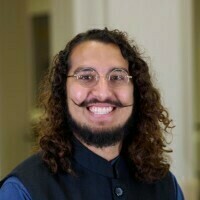
Rebekah Gotag:ansari.nd.edu,2005:News/1788512026-04-07T10:00:00-04:002026-02-23T14:21:58-05:00Thahir Jamal Kiliyamannil: Formations of the Muslim Minority in IndiaDr. Thahir Jamal Kiliyamannil is an Ansari Institute Global Fellow who recently completed his PhD at the University of Hyderabad, India. His doctoral thesis, titled “Islam, State, and Sovereignty: Genealogy of Muslim Subject Formation in Malabar,” traces the minoritization of Muslims in India, examining Muslim engagements with state, sovereignty, and law in the colonial and postcolonial contexts in South India. He was formerly a COMPOSE Fellow (2025) at Universitas Islam Internasional Indonesia, a DAAD PhD Visiting Fellow (2022) at the Centre for Modern Indian Studies, University of Göttingen, and an Erasmus Fellow (2021) at the Berlin Graduate School of Muslim Cultures and Societies, Freie Universität Berlin. Currently, he serves as an Assistant Professor at SRM University-AP, India. His areas of research interest include Islam, sovereignty, governmentality, religion, state, and minority discourses. He is presently working on his first monograph, tentatively titled Formations of Minority: Afterlives of Law, Governance, and Colonial Sovereignty in India.
Tell me a little bit about yourself and your background, and how you ended up here today.
I come from Malappuram district in Kerala, India. I did my primary schooling nearby, and the medium of instruction was Malayalam, my native language. As almost everybody in the area did, I also attended a madrasa, which provided me with customary religious training. Later, I moved to an English-medium school. Until I finished school, my ambition was to become an astrophysicist. But during my higher secondary years, my orientation completely changed. I became interested in writing and journalism, which pushed me to pursue a bachelor’s in English literature, with audiovisual communication and journalism as complementary courses. I also started writing for some small magazines and local newspapers.
After my graduation, I moved to Hyderabad. It was the first time I left my district for education, and that was a major turning point in my academic life. I joined the English and Foreign Languages University in Hyderabad, where I completed my Master’s in English, specializing in cultural studies. During this period, I was introduced to different aspects of English literature and cultural studies: the possibilities of language and writing, the scope of literature beyond classical texts, and the importance of studying culture. I started reading literary texts as a way of understanding society, power, and history. Also, it was the first time I got introduced to research. Until then, I did not really know what research meant.
During my Master’s, I became more curious about studying my own community, Muslims. So, I started working on short pieces, in which I tried to explore the questions about Muslim subjectivity. I also became concerned with the social aspects of caste and religion. At the same time, I was active in student politics, engaging in community empowerment with anti-caste and anti-racist orientations. In the Indian context, as you know, caste often works as a racialized structure, making these engagements closely connected to my academic interests.
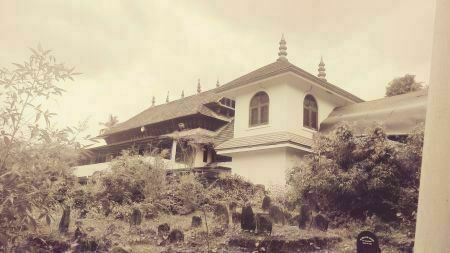
Malappuram Valiyangadi Masjid, a historically significant mosque in Malabar, Kerala.
These interests developed into my MPhil research at the University of Hyderabad, in which I analyzed a Malayalam newspaper called Madhyamam, run by a Muslim group in Kerala. I studied the period between 1987 and 1993 to understand how Madhyamam imagines Muslim subjectivity. This period is important because it coincides with major events in Indian Muslim history, particularly the demolition of the Babri Masjid in 1992, formation of new Muslim movements, and new forms of community articulations.
After my MPhil, taking the questions of Muslim subjectivity forward, I briefly joined a research project on ‘egalitarianism’ at Manipal University in collaboration with the University of Bergen in Norway. Although my participation in the project was brief, it introduced me to social anthropology, which later became very important to my thinking.
News photograph of a rally organized by the Babri Masjid Coordination Committee.
I then returned to the University of Hyderabad for my PhD. I was affiliated with the Centre for Comparative Literature, and it gave me the opportunity to do interdisciplinary work, moving across different fields: cultural history, political theory, religious studies, and political theology. Initially, my research focused on the formation of new Muslim movements, and changes in their articulation, after the Babri Masjid demolition. A noticeable example is the change in the names of the organization before and after 1992, from having explicitly Islamic names to increasingly adopting a secular and constitutional pattern in naming. Likewise, citizenship rights became a central anchoring point of Muslim articulations.
At first, I approached this as a contemporary change and primarily a question of language. But as I worked further, I realized that this mode of articulating Muslim politics is not contemporary, and it involves a deeper question of how the Muslim community was engaging with the state. We see a similar mode of articulating Muslim politics in the 1930s during nationalist struggles and the Indian Constituent Assembly, when the Muslim community was engaging with the British state and the emergent Indian nation-state.
Extract from a weekly report of the Director of the Intelligence Bureau, Government of India, 1923.
I understood that the ‘rights question’ was not something new; it was always already there. I began to see my primary question: how the Muslim community engages with power and the state, in different contexts?
This realization made me rethink my entire project.
This was in the third year of my PhD. I began tracing this engagement historically, moving back to the colonial and even pre-colonial periods. I was becoming a sort of historian, a cultural historian!! I looked at how Muslim communities in regions like Malabar interacted with different colonial powers – the Portuguese, the Dutch, the British – and later with nationalist and postcolonial state formations. What became clear is that during the pre-colonial period, Muslim communities exercised certain forms of sovereignty. With colonial rule, especially under the British, this relationship changed fundamentally. Sovereignty was reorganized, and Muslim engagement with local rulers got reshuffled.
The British also intervened in the Muslim networks with the Ottoman Caliphate, which gradually led to what I understand as the emergence of Muslim nationalism. Consequently, Muslims increasingly came to be governed as minorities. So, the central focus of my PhD was to trace this transformation of Muslims from being a community with forms of sovereignty to a community governed as a minority. In other words, it is to understand the genealogy of Muslim subject formation. Now, I would confidently argue that the post-1990s turn toward secular and constitutional language is part of this longer historical process of minoritization.
The project and questions kept expanding and changing. To move through different disciplines and to trace this longer history, I needed time. I took 8 years to finish my PhD! During this period, I also spent a year in Germany on a fellowship. That was extremely important for me. It gave me distance from the field and the space to reflect and write, and it helped me refine the overall direction of the research.
What do you hope to accomplish in the next year as a Global Fellow, and how do you think being part of an international cohort will help you?
Thahir Jamal at the tomb of Syed Fadl in Istanbul.
I want to develop my thesis into a book. The thesis is quite long; more than 400 pages! I do not want it to remain only as a thesis. When I started thinking about turning it into a book, I realized it needs serious reworking to narrow the focus, bring in more post-Indian-state-formation debates to tighten the argument, rethink the structure, and sharpen the conceptual focus.
It was during this time that I saw the call for the Ansari Institute Global Fellows program. What attracted me was also the mentorship aspect. Getting feedback from scholars outside my immediate academic context is very important for this project, especially because my work sits at the intersection of literature, religious studies, history, and political theory. I am fortunate to have been selected for this fellowship.
Being part of an international cohort is also extremely useful. Although my research is grounded in South India, the questions I am dealing with, such as minority formation, colonialism and nationalism, sovereignty and governance, are not limited to Indian contexts. Engaging with scholars working on different contexts is helping me clarify what is specific about my case and what speaks to a broader global audience.
So, for me, this fellowship year is really a space to pause and consolidate the years of work I have already done. It is time to rethink the project more carefully and gradually transform the thesis into a book. That’s my hope.
]]>
Rebekah Gotag:ansari.nd.edu,2005:News/1804042026-04-02T14:39:00-04:002026-04-02T14:40:00-04:00The Intersection of Faith and Sustainability: Insights from Seed Global Development
On January 28, 2026, The Ansari Institute for Global Engagement with Religion, held a colloquium entitled, “The Intersection of Faith and Sustainability” in collaboration with Seed Global Development. Practitioners from Seed Global Development and students from the Keough School Master of Global Affairs (MGA) program gathered to discuss how faith and religion influence communities’ views on sustainability and their responses to development challenges.
Seed Global Development is a newly established social impact consultancy firm founded by former MGA students. Headquartered in the United Arab Emirates, the firm works at the intersection of climate resilience, sustainable agriculture, and inclusive policy advisory. Rooted in commitments to human dignity and the common good, Seed seeks to bridge research, policy, and community practice.
Sustainability efforts are often framed in technical or policy-driven terms. But as climate change intensifies, food systems grow more fragile, and inequalities deepen, the wager of this symposium was that a broader perspective is needed to face the challenges ahead. Faith traditions, religious leaders, and community institutions continue to influence values, behavior, and collective action worldwide. Sometimes this influence is visible in advocacy spaces. At other times, it is embedded quietly in local practices and community norms. In either case, however, reflecting on traditions and practices offers an opportunity to think more broadly about what makes sustainability efforts effective.
The faith-sustainability nexus in policy and practice
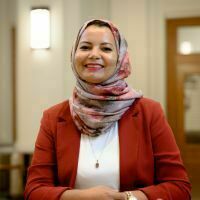
Olfa Jelassi, Strategy and Partnerships Lead at Seed Global Development and a 2024 MGA graduate, began the discussion by introducing the connection between faith and sustainability. Drawing on her experience in climate advocacy and development, she described how faith-based organizations add moral authority, social trust, and institutional strength to sustainability work.
From international climate negotiations to local food systems programming, faith actors are increasingly recognized as key stakeholders. Jelassi highlighted the growing presence of faith organizations at global climate conferences and noted that major religious institutions mobilize significant financial and social resources to aid sustainability initiatives. In the United States alone, donations to religious organizations totaled approximately 145 billion dollars in 2023, far exceeding contributions directed specifically to environmental causes. While these funds are not necessarily directed toward environmental initiatives, the scale of financial resources controlled by religious institutions highlights their potential to influence sustainability outcomes. Faith-based organizations not only fund social programs, but also manage extensive networks of schools, hospitals, land, and community programs, all of which shape community behaviors, resource use, and local development pathways. As Jelassi argued, mobilizing even a small portion of these financial and institutional resources toward climate and sustainability initiatives could have significant impacts on advancing the SDGs. Globally, faith-based organizations reach an estimated 80 percent of the world’s population through networks of schools, hospitals, land holdings, and community centers. These resources, Jelassi contended, can be mobilized to support sustainability initiatives.
While these funds are not necessarily directed toward environmental initiatives, the scale of financial resources controlled by religious institutions highlights their potential to influence sustainability outcomes. Faith-based organizations not only fund social programs, but also manage extensive networks of schools, hospitals, land, and community programs, all of which shape community behaviors, resource use, and local development pathways. As Jelassi argued, mobilizing even a small portion of these financial and institutional resources toward climate and sustainability initiatives could have significant impacts on advancing the SDGs.
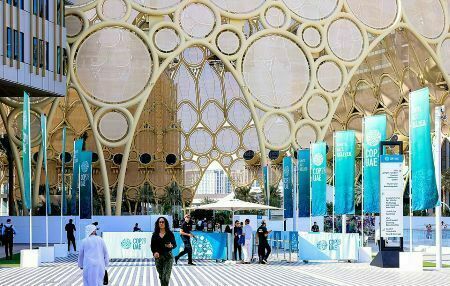
UNCTAD at the United National Climate Change Conference - COP28, via Wikimedia Commons
One example of such mobilizations are those members of faith communities who have actively engaged in climate advocacy at the global level. Since the formation of an interfaith caucus at COP14 in 2008, faith-based organizations have maintained a consistent presence in climate negotiations. Pope Francis’s encyclical Laudato Si’ framed climate action as a moral duty to both people and the planet, reinforcing climate justice as a faith-rooted responsibility. At COP28 in 2023, nearly 100 faith-based organizations participated in the first-ever Faith Pavilion, which included a video address from the Pope. These examples demonstrate that faith actors are not peripheral observers but engaged participants who are shaping global climate discourse. Scholars such as Kristian Noll have argued that a just climate transition cannot succeed without faith organizations, as they connect local communities, manage resources, and translate climate justice principles into moral and social action.
Jelassi stressed that faith traditions provide values that technocratic approaches alone do not. They are involved in sustainability through ethical commitments such as caring for the common good, looking out for future generations, and protecting the natural world. When these values are combined with strong social networks and local trust, they can drive climate advocacy, food security, and poverty reduction.
Jelassi urged students to change how they think about working with faith groups. Instead of bringing them to the table just for appearances, development professionals should recognize their strengths and work together with them in meaningful ways. Sustainable solutions often depend on changing behaviors and building community trust, areas where faith communities can play a key role.
Sustainability as a space for interfaith cooperation: lived experiences from Bangladesh
Chad Stout, an MGA student in sustainable development, shared his experience working with the Mennonite Central Committee in Bangladesh. As a Christian international NGO in a religiously diverse setting, MCC worked with both faith-based and secular local groups on projects in food security, livelihoods, education, and peacebuilding.
Stout described how his organization framed sustainability as having the right relationships among people, God, and the earth. This religious perspective shaped their understanding of climate change and justice, especially in Bangladesh, where Christians form a small minority. Project teams had to remain attentive to the religious composition of the communities they served. In practical terms, this meant being sensitive to livestock distribution preferences and social norms. More deeply, it required navigating social cohesion among Christian, Hindu, and Muslim participants.
"Interfaith Walk at COP28" by Albin Hillert/LWF is licensed under CC BY-SA 4.0.
Stout noticed that sustainability projects often helped people find common ground. When facing shared problems such as declining water tables and lower crop yields, people from different faiths developed a sense of shared purpose. These programs not only tackled resource shortages but also helped build stronger community ties.
Faith as everyday governance in Upper Mustang, Nepal
Suraj Parajuli, an MGA student in governance and policy, shared insights from his fieldwork in Upper Mustang, a high-altitude area of Nepal. In this remote and fragile place, sustainability is not just a policy idea but a daily practice for survival.
While conducting public health research with older adults in the region, Parajuli noticed that there were no formal environmental regulations. Despite this fact, for centuries, local communities have managed limited water, fragile soil, and harsh winters successfully
Parajuli found that Buddhist faith provides a set of values that make it possible to manage sustainability. Old irrigation channels called kulos are seen as shared heritage, not private property. Taking more water than your share is not just inefficient but morally wrong because it upsets the balance and brings negative karma. People follow the rules not because of official penalties, but because their faith shapes their sense of responsibility.
A similar pattern is evident in farming practices. Crop rotation, organic fertilization, and controlled grazing are based on values such as moderation and avoiding harm. Monasteries and local leaders help guide planting and resource use. Here, faith shapes ethics, ethics guide actions, and these actions help keep ecosystems healthy.
Parajuli argued that development policies should recognize and include traditional knowledge. Approaches that respect local beliefs are more likely to get community support and succeed over the long term.
Faith as both a challenge and an enabler
Shiza Kamil, an MGA student in sustainable development, shared her experience from two years of working on lung health in underserved areas of Pakistan. In rural province Sindh, where Hindu communities are a religious minority, her team started out approaching these communities cautiously to make sure to respect their religious and cultural norms. However, these communities were very close-knit and worked well together, which made tuberculosis screening programs more effective.
In contrast, working in Karachi, Pakistan’s largest metropolitan city, where family and community structures looked different, there were different challenges. In one district with strong religious conservatism, women were not allowed to leave their homes. To address this, Kamil and her team set up women-only tuberculosis screening camps, creating safe spaces that respected social norms and still provided care.
These different experiences highlighted a main theme of the colloquium: faith is never neutral in development work. It can create obstacles, but it can also build trust, encourage participation, and support lasting change. Sustainability efforts work best when they take these factors into account.
Bridging ethics and action
The discussion ended by returning to Seed Global Development’s mission. As noted previously, Seed works to connect research, policy, and community practice in climate resilience and sustainable food systems. The organization is committed to human dignity and the common good, aiming to translate ethical principles into concrete development outcomes.
Somapura Mahavihara, a UNESCO World Heritage site and a significant Buddhist monastery in Naogaon, Bangladesh via Wikimedia Commons
Seed Global Development’s projects, such as reviewing the United Arab Emirates Food Systems NDC Scorecard and contributing to a global report on modern slavery, demonstrate this approach in action. In each case, Seed brings together environmental, social, and religious considerations rather than treating them separately.
The colloquium highlighted an important point: sustainability is not just technical or scientific. It is also ethical, cultural, and spiritual. When faith shapes values and those values guide behavior, communities are better able to find solutions that are fair, inclusive, and lasting.
Noll, K. (2024, November 15). Why engaging faith-based organisations at this year’s climate negotiations is important. London School of Economics Grantham Research Institute.
]]>
Shiza Kamiltag:ansari.nd.edu,2005:News/1806012026-03-31T15:16:00-04:002026-04-02T15:16:34-04:00Vice president and associate provost Rev. Daniel Groody, C.S.C., appointed by Pope Leo XIV to Dicastery for Promoting Integral Human Development
Pope Leo XIV has appointed Rev. Daniel Groody, C.S.C., the vice president and associate provost for undergraduate education and professor of theology and global affairs at the University of Notre Dame, as a member of the Dicastery for Promoting Integral Human Development, the Vatican announced today.
Established by the late Pope Francis in 2016, the Dicastery for Promoting Integral Human Development supports the Church’s worldwide efforts in the areas of human dignity and human rights, economic justice, care for creation, migration and displacement, as well as peace, conflict and humanitarian crises.
As a dicastery member, Father Groody will contribute to the body’s ongoing discernment process that will help orient the Church’s mission and priorities. He will continue in his roles at Notre Dame while serving the dicastery.
While numerous Notre Dame faculty members have served the Vatican as consultants to dicasteries and have been named to pontifical academies and commissions, Father Groody’s appointment is a distinct honor, noted University President Rev. Robert A. Dowd, C.S.C.
“To be called upon by the Holy See to serve in this capacity is a testament to Father Groody’s deep commitment to leadership in service of the most vulnerable among us. This appointment is also an affirmation of Notre Dame’s ongoing contributions to Catholic social thought, to integral ecology and to forming leaders dedicated to the common good,” Father Dowd said. “I am profoundly grateful for Father Groody’s dedication to the University and to the Church, and I am confident that his leadership will be a tremendous blessing as he helps to guide the Church in these areas.”
The most notable precedent in Notre Dame history is the appointment of then-President Rev. Theodore M. Hesburgh, C.S.C., as a member of the Pontifical Council for Culture by Pope St. John Paul II in 1983.
“I am truly honored and humbled by Pope Leo’s appointment,” Father Groody said. “My vocation is to serve, together with my colleagues at Notre Dame and around the world. The work of the Dicastery for Promoting Integral Human Development is vital to informing the Church’s response to the world’s most vulnerable people and the most pressing global challenges of our time.”
Father Groody’s academic and pastoral work has focused in part on migration, theology, refugees and human displacement — areas that are directly relevant to the mandate of the Dicastery for Promoting Integral Human Development. An internationally recognized expert on migration, Father Groody is also an award-winning author, teacher and documentary film producer. He has written four books and numerous articles and has edited or co-edited five books. His works have been translated into nine languages.
Father Groody’s most recent book, “A Theology of Migration: The Bodies of Refugees and the Body of Christ,” includes an introduction written by Pope Francis and received first-place recognition from the Catholic Press Association.
This announcement follows Father Groody’s appointment under Pope Francis in 2025 to the General Council of the Laudato Si’ Higher Education Center in Castel Gandolfo, which is now known as Borgo Laudato Si’.
Contact: Carrie Gates, associate director of media relations, 574-993-9220, c.gates@nd.edu
Originally published by Carrie Gates at news.nd.edu on March 30, 2026.
]]>
Carrie Gatestag:ansari.nd.edu,2005:News/1802952026-03-25T14:35:00-04:002026-03-25T14:38:04-04:00Understanding nationalism: Global affairs class connects today’s policy debates to historical contextStudents take an active role in leading discussions. Sophomore Ally Brown appreciates hearing insights from classmates of different nationalities and backgrounds.
A brash politician tells voters they’ve been sidelined by special interests, casting himself as a strongman who can solve the nation’s ills. He attacks urban elites and appeals to rural residents who feel left behind, claiming he will fix what ails their communities and restore national greatness.
That’s the case study Keough School professor Rose Luminiello and her students have gathered to discuss in their policy lab on the ideas, ideologies and realities of nationalism. They’re analyzing how Hungarian Prime Minister Viktor Orbán led his party to power in 2010 by using a selective vision of national identity that marginalizes those outside it.
At a time when nationalism is having a global resurgence, the class offers an opportunity to examine what it promises and how it persuades — and what that means for who belongs, who is excluded and what policy looks like. Luminiello leads students to synthesize the readings and articulate what Orbán’s example reveals about this broader trend and how it might shape the future.
Dr. Luminiello is a faculty fellow with the Ansari Institute for Global Engagement with Religion. Read the full story here.
]]>
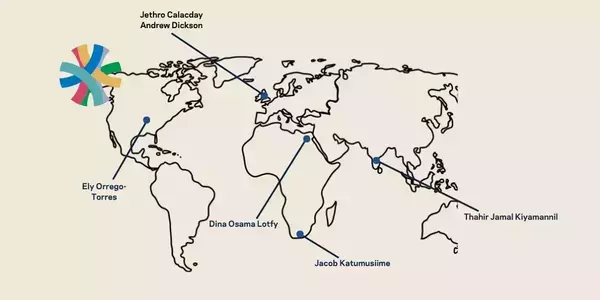
Josh Stowetag:ansari.nd.edu,2005:News/1793912026-03-02T10:00:00-05:002026-03-02T13:17:12-05:00Ely Orrego Torres: Transnational Religio-Spiritual NetworksDr. Ely Orrego Torres is an Ansari Institute Global Fellow and Postdoctoral Researcher at Lund University. Her research brings together international relations and political theory to explore the intersections of religion and politics in the global arena. She earned her Ph.D. in Political Science from Northwestern University in 2025. She is currently working on her first book, which examines the politics of religious freedom and secularism in the Americas between 2017 and 2023, with a focus on transnational and regional networks and the religio-spiritual actors participating in the Organization of American States (OAS). Her work has been published in journals including Social Compass and Philosophy and Global Affairs. Outside of academia, she is a passionate foodie who enjoys exploring new restaurants, experimenting with recipes, and trying street food from around the world.
Tell me a little bit about your research, and how you landed on your research topic.
In my dissertation, I studied the politics of religious freedom and secularism in the Americas between 2017 and 2023. I focus particularly on transnational and regional networks that I call “Transnational Religio-spiritual Networks (TRSNs)”. In particular, I research these networks in one venue, which is an international organization, the Organization of American States, the OAS.
For those who don't know, the OAS is the main hemispheric organization of the Americas that gathers most of the sovereign states from the Americas, including North, Central, and the Caribbean, and South America. The OAS is based on multilateralism, dialogue and creating a common agenda. I analyzed these networks in three interconnected dimensions of the OAS. First, I studied them as part of the international organization– why and how they access and participate here. Secondly, the Inter-American Human Rights System as an international tribunal, considering, for example, the Inter-American Court of Human Rights. Then, third, I focus on the participation of civil society through an open and democratic dialogue called the “Dialogue with Civil Society,” which is their main venue of advocacy.
Over the last years, there has been an important rise of these networks, especially religious networks in international venues, and the use of the language of religious freedom in the Latin Americas. So basically I'm trying to see and to respond to questions, like, “what does religious freedom do in the context of the OAS? Why do they use the language of religious freedom? How is this discourse and practice of religious freedom produced, mobilized, or contested within these transnational and international arenas?”
In that sense, one of my main contributions is that this is the first study of its kind to focus exclusively on the OAS. While similar forms of mobilization are taking place in other contexts—such as the European Union, the United Nations, or before the European Court of Human Rights—my research shifts the lens to the Americas, examining how these dynamics are happening within the OAS specifically.
Venue of the “Dialogue with Civil Society” organized by the OAS in Lima, Peru (October 2022).
And how did I get into this topic? I usually tell two stories. The first one is quite personal. Before starting my PhD in the United States, I had barely encountered the concept of “religious freedom” as a distinct legal or political issue in conversations. In Latin America—at least from my perspective growing up in Chile—it simply wasn’t a central topic of discussion. When I arrived in the US, however, religious freedom seemed to be everywhere: in discussions of the First Amendment, constitutional law, and public debates more broadly. That contrast really intrigued me, and it led me to ask why religious freedom occupies such a prominent place in the US context in particular, but also in the Americas. The second story is connected to my previous involvement with an NGO. In 2019, just before starting my PhD, I attended the General Assembly in Medellín, Colombia. I participated as part of the “Coalition of Religions, Beliefs, and Spiritualities”, a coalition that brought together different religions, beliefs, and spiritualities from the Latin Americas. That experience ended up becoming one of the two core cases in my research. The other case I examine is the Ibero-American Congress for Life and Family.
Something that also got me into this topic was a desire to better understand the plurality of religious networks in Latin America. These networks are often treated as if they speak with a single or singular perspective. Yet, something that I really wanted to explain in my dissertation is that even the politics of religious freedom –which is fairly widespread across the region– is understood and mobilized in very different ways by different actors. They organize differently, they use the language of human rights differently, but it is still a powerful political language across these diverse contexts.
What have been your findings? And, as a political scientist, has your research been more qualitative or quantitative?
Conducting fieldwork at a regional event in Uruguay (November 2022).
My project is grounded in ethnography. So, that is also one of my contributions. Conducting ethnography as a political scientist is something relatively new in the field, especially in international relations. Political science is not very broadly understood as a field of ethnography, but I’m particularly interested in what ethnography can reveal when applied to international organizations like the OAS. I used a multi-sited ethnographic approach that combined in-person and virtual fieldwork. During my research period, COVID disrupted many planned meetings, which meant that some of my fieldwork shifted online. I participated in many events and gatherings, including official OAS meetings such as the General Assembly and the Dialogue with Civil Society, public demonstrations, rallies, and informal gatherings. Then, I also participated in regional meetings with the particular actors that I was researching in countries like Mexico, United States, Argentina, Chile, and Uruguay. Across these sites, I relied on participant observation, interviews, and discourse analysis—particularly because the Dialogue with Civil Society changes each year, with different participants and dynamics, making it a key space for observing how these issues are articulated and contested.
I would say my work makes three main contributions. The first is that it examines how transnational religious and spiritual networks—particularly those with a Protestant Evangelical background—mobilize at the international level. Most existing scholarship has focused either on Catholic and Orthodox alliances or on Evangelical actors operating primarily at the domestic level, in cases such as Brazil, Guatemala, or, more recently, Argentina. What I’m especially interested in is the growing presence of Protestant Evangelical networks in international venues and how they participate in these spaces while articulating a Protestant Evangelical identity.
The second contribution speaks to broader debates in international relations on activism within international organizations. Much of the existing literature looks at well-known transnational organizations such as Amnesty International or Greenpeace, usually in the context of promoting democratic values or advancing human rights. What my research highlights is a different dynamic: forms of activism that seek to reshape the liberal order itself, often pushing back against advances in gender and sexual rights within international organizations like the OAS. The cases I study—the Ibero-American Congress for Life and Family and the Coalition for Religion, Beliefs, and Spiritualities—are not well-known names or big transnational actors. They are not Amnesty or Greenpeace. Yet, despite their relatively small size, they are influential within the OAS. In that sense, my work shows how less visible actors can still shape democratic participation and influence civil society dynamics in the regional, diplomatic and deliberative spaces.
Rally outside the official event of the OAS General Assembly in Lima, Peru (October 2022).
Finally, as I mentioned earlier regarding the plurality of actors in the Americas, my work pushes for a more nuanced understanding of religious actors in the international arena. Especially with the rise of Protestant Evangelical groups, there is often an assumption that they are all uniformly conservative or aligned with the far right. And this is not right, and sometimes an oversimplification. Especially at the OAS, you can see a wide range of actors who share a Protestant Evangelical background but differ significantly in their theologies, discourses, strategies, and motivations. What I ultimately aim to propose is a framework that takes this diversity seriously—one that resists treating these actors as a single bloc. We really need to contextualize them when analyzing their political engagement at the international level.
How have you found the Global Fellowship to be helpful in your scholarship and moving forward converting your dissertation into a book?
Public demonstration outside the official event of the OAS Summit of the Americas in Los Angeles, CA (June 2022)
Amazing! It has been a great experience learning more about the different scholarship of my colleagues, the Global Fellows. I think that it's very important to speak to our different audiences. That, to me, is one of the fellowship’s main contributions: we all come from diverse disciplinary and personal backgrounds, and that diversity pushes us to think more carefully about how we communicate our research.
Our books should reach out to different audiences so that someone outside our specific field can read them and say, “yeah, I understand why this matters.” That can be challenging, especially after years of writing primarily for a dissertation committee. Now, we have to write for a larger audience. In that regard, I received valuable feedback on the presentation I gave this quarter. It has really shaped how I’m thinking about the project going forward.
I also think that having an academic community like this really matters, because academic work can be quite lonely. During my academic journey, I’ve come to see academia as a deeply collaborative space. Writing our first book requires a lot of feedback—especially because, while we’re trained to write dissertations, we’re not necessarily trained to write books. In that sense, the mentors and faculty involved in the fellowship have been incredibly helpful, both in offering substantive feedback and in helping us navigate the broader process of turning a dissertation into a book.
I’m especially excited because I’ve met some of the Global Fellows before at other events—Dina at a summer school in Rome, Andrew at a conference, and Jethro at a summer program in Belgium. I’m really looking forward to seeing them again in person in June for the symposium and to sharing this space with such inspiring colleagues. I’m also very grateful for this fellowship because it allows us to complement our main work without having to relocate to Notre Dame, which is particularly meaningful given the current global situation.
Next semester you move to Sweden for a two-year postdoc. Can you share more about that?
Conducting fieldwork at a Protestant Evangelical Church in the outskirts of Mexico City during COVID times (September 2022).
Sure. I feel very fortunate to be starting a new position as a postdoctoral researcher on the project “Scripture and Secularism” led by Professor Hannah Strømmen, who recently wrote a book called The Bibles of the Far Right. I’ll also be working closely with Professor Valentin Jeutner from the Faculty of Law. I'm going to be working on their project that is mostly dedicated to the reception of the Bible in political contexts, which aligns perfectly with my research interests.
It's an interdisciplinary postdoc, and I will be at the Center for Theology and Religious Studies and the Faculty of Law. I am probably going to be one of the few political scientists there. But I'm super excited, because the Ansari Fellowship helped me realize how much I want to engage with interdisciplinary questions, especially at the intersection of religious studies, theology, and politics. So I think that I will be in the right place to continue working on that.
Conducting fieldwork at the “Dialogue with Civil Society” organized by the OAS in Washington DC (July 2023).
I’m also looking forward to learning more about the political situation in the Nordic countries. My work has given me some insight into continental Europe –especially Spain, due to its connections with transnational networks and France, during my time as a visiting scholar at Sciences Po. This postdoc will give me the opportunity to expand my understanding in a new regional context.
In my project, I’ll be working on two new chapters for my book. The first will focus on domestic legislation in selected countries in the Americas—probably Peru, Guatemala, and Mexico. I plan to examine how the actors I’ve studied at the international level are operating within their own national contexts. It’s a bit like comparative politics in reverse: after studying these networks at the OAS, I’m now looking at what they’re doing domestically. This is something I often hear feedback on at conferences—people are interested in my OAS research but ask, “What’s happening in individual countries?,” “Are they really influential in their countries?” I didn’t have the time to explore that in depth during my PhD, so over the next two years I’ll focus on these case studies, looking at how politicians and members engage in national politics. I’m particularly interested in the Union of Christian Parliamentarians, associated with the Ibero-American Congress for Life and Family. They form a fascinating network of elected officials across countries who influence legislation and even invoke Biblical resources in their advocacy.
The second chapter will broaden my research by exploring Trans-Atlantic connections between the Americas and Europe, looking at how religious and political networks operate across these regions and influence one another. I’m particularly interested in tracing the ways actors in Europe engage with similar networks in the Americas, and how ideas, strategies, and political frameworks circulate across these contexts. Because at the end, there is a global aspect of these networks.
I’m very grateful for the opportunity to conduct research in Sweden, which will allow me to immerse myself in the European side. This experience will help me develop a more comparative and international perspective in my work, and it’s an exciting opportunity to strengthen the global relevance of my research as I continue advancing my academic career.
]]>
Rebekah Gotag:ansari.nd.edu,2005:News/1795792026-02-27T09:06:00-05:002026-02-27T09:07:03-05:00From Karachi to the Keough School: Siblings find community and path to global impactSiblings Saad and Shiza Kamil are students in Notre Dame’s Master of Global Affairs program. Both are majoring in sustainable development.
Saad and Shiza Kamil are more than 7,000 miles from their parents in Pakistan, but the first-generation college students have found a second home at Notre Dame’s Keough School of Global Affairs.
Whether consulting on team projects, learning from leading development experts or bonding with classmates over potlucks and Notre Dame football, they’re continually immersed in a tight-knit campus community committed to making a difference.
The Kamil siblings both have connections to the Ansari Institute. Saad was an intern with Religions for Peace his first year. Shiza is a policy and practice intern this academic year. Read the full story here.
]]>
Josh Stowetag:ansari.nd.edu,2005:News/1789332026-02-03T15:19:00-05:002026-02-03T15:19:37-05:00From colonial history to modern borders: rethinking the global impact of migrants and mobility
Megan Vogt is a senior double major in political science and history who is deeply interested in the intersection of these two fields. In the fall she took a course on migrants and mobility, taught by Keough School professor Rose Luminiello, a faculty affiliate of the school's Ansari Institute for Global Engagement with Religion. Initially she imagined something technical, perhaps focused on maps, geography and historical migration patterns. Instead, Megan writes that the class turned into a "deeply human exploration" of how human movement has served as a defining force in global history.
]]>
Megan Vogttag:ansari.nd.edu,2005:News/1783972026-01-27T13:43:00-05:002026-03-05T15:07:33-05:00Jacob Katumusiime: How do we explain the violence of some religious movements?Dr. Jacob Katumusiime is Ansai Institute Global Fellow and a Postdoctoral Fellow at the University of Johannesburg. Jacob is the 2024 Winner of the Rahamon Bello Award for the Best PhD in African and Diaspora Studies. He researches on the intersections of Culture and Politics, navigating questions of colonialism, postcolonialism and decolonization, and exploring issues of identity, citizenship, social movements, political violence and diasporic lives. Jacob holds an Interdisciplinary PhD in Social Studies, a Master of Philosophy in Social Studies and a Bachelor of Arts with Education (First Class) from Makerere University, Uganda.
Please tell me a little bit about yourself and the project that led you to the Global Fellows.
Jacob is my name. Jacob Katumusiime! I hold an Interdisciplinary PhD in Social Studies. I majored in Cultural studies and minored in Political studies.
My PhD work was an attempt to look at the intersection between religion and politics. But I had to get an entry point. That entry point was something that confounds me: the proliferation of independent religious movements in post-colonial Africa.
Here in Africa we have very many religious movements especially breaking away from the institutionalized church; the institutionalized church being the Catholic Church, the Protestant Church, and the Orthodox Church. We have over 10,000 independent religious movements that have broken away from the church in Africa. So the question becomes, how do we understand the emergence of these religious movements? And how do we understand specifically the movements’ turn to violence? That is how I conceived my PhD research, and I focused specifically on this particular religious movement called the Movement for the Restoration of the Ten Commandments of God (MRTCG).
Ironical police public notice published on April 9, 2000 in search of the leaders of the Movement for the Restoration of the Ten Commandments of God.
The Movement for the Restoration of the Ten Commandments of God was a religious movement that broke away from the Catholic Church in Uganda in 1989, and then formally became an independent NGO in 1993. On March 17th, 2000, this religious movement committed an act of what, in my work, I call mass murder-suicide. I call it mass murder-suicide because the leaders of the movement gathered all the members of the religious movement in a church, locked themselves in too, and then burned themselves up. So the leaders committed an act of mass murder, but they also committed suicide. That's why I call it mass murder-suicide. Over 600 members of that religious movement perished on that day.
In the aftermath of this incident, international media, national media, religious scholars, were all thinking that this was an act of mass suicide because the leaders had died. But then when the authorities started investigations into the religious movements’ last days, they realized that before this inferno in which 600 people died, over 400 other people had also been earlier killed and buried in mass graves around the different places affiliated to the religious movement. With this discovery, the narrative changed from mass suicide, to mass murder.
And when the authorities recognized that one particular leader of the religious movement, Joseph Kibweteere, was not seen at the site of the inferno where the other leaders had perished, the mass murder narrative became stabilized.
This is how I enter into the research work that I do about the religious movement. How can we tell this story properly? How can we make the emergence of this religious movement, and its eruption into violence thinkable?
English cover page of the Movement for the Restoration of the Ten Commandments of God book
I have wanted to build from this case, of the Movement for the Restoration of the Ten Commandments of God, to speak about many other religious movements that we see arising. You shall, for example, recall the most recent horror of the Shakahola Forest incident in Kenya where members of the Good News International Ministries church perished in an act of death-fasting. Up to now, 2025, the Kenyan government is discovering mass graves related to the religious movement.
And my argument is that the proliferation of these religious movements and their occasional propulsion into violence is thinkable within the separatist legacy of the colonial state. The separationist legacy being this enduring logic of governance that the colonial state instituted, where you define people, divide them, and rule over them. So, you shall find that these religious movements arise because of feelings of marginalization at different levels. And the people who feel marginalized choose to create movements such as these. Marginalization also often fuels the movements’ resort to violence.
And when you study this Movement for the Restoration of the Ten Commandments of God, it enables you to understand the connection between religion and politics. Look, the modern secular state has tried to tell us that there's this separation between the church and the state. But when you look at the formation of these religious movements you see how the state is often involved in their formation.
Can you tell me more about that?
Look, when the Movement for the Restoration of the Ten Commandments of God was formed, breaking away from the Catholic Church, the major contention was the marginalization of Banyaruguru Priests from the Bishopric of Mbarara Catholic Diocese - now an Archdiocese, in Ankole. In two decades, Banyaruguru Catholic priests were twice passed over for the Bishopric in favour of the Banyankole ethnic majority. The Banyaruguru, it was argued, are non-native to Ankole. This is colonial nation-state politics at play. The Banyaruguru Catholic Priests, Father Paul Ikazire, Father Dominic Kataribaabo would link up with other frustrated members of the Postcolonial Ugandan state, to form a break away religious movement which, while it was a critique against the Catholic Church in Uganda, it was in reality a critique of the nature of governance in the Postcolony. This religious movement was not fully legitimate because the state and the church were against it. So between 1989, when the religious movement was founded, and 1993, it was struggling. It had numbers, but remained operating underground. In 1993, however, the state gave it a certificate of registration as a non-governmental organization, as an NGO, which legitimized its operations.
Jacob at Kabumba Catholic Center, a Catholic Church built by Joseph Kibwetere on land donated by him to the Catholic Church
This is how most of these religious movements proliferate because they get these certificates of registration as non-governmental organizations. So, this is how the state really promotes these various religious movements. It manufactures them. And in post-colonial Africa, these religious movements also lend their support to governments. Their survival depends on them voting for governments that have enabled them to become legitimate - to become stakeholders. So it's often a two-way thing. The state is deeply involved - in both its politics and its policies.
Now, there is a gentleman called Joseph Kibwetere, who is the most renowned member of this religious movement, and whom we could think about. In fact, my Book Manuscript is titled, The Separationist Legacy: Joseph Kibweteere, Independent Religious Movements and Violence in Post-Colonial Africa.
Joseph Kibweteere was a rich man for his time. He had a 24-room bungalow. At that time, the 1960s, he was a rich guy. And not just rich, but educated. By 1960, Uganda was in the struggle for independence and party politics was introduced, and Kibwetere subscribed to the Democratic Party. And during that time, the Democratic Party in Uganda was largely a Catholic entity.
There was another party called the UPC (Uganda People's Congress), which was largely Protestant. So religion and politics were moving side by side. The British colonial state would help the UPC take over power in Uganda, a thing that frustrated the Catholic community. Joseph Kibwetere, a devout Catholic and Democratic Party stalwart is frustrated.
Ruins of the Movement for the Restoration of the Ten Commandments of God church at the Kanugu site
Being a teacher by training, and observing how Catholics were also being denied admission into Protestant schools, he began a school, Nyakazinga Junior Secondary School, as the first private school in the region of Ankole. He starts admitting Catholics so as to empower them. He believed that with education, individuals would be able to better their lives. His frustrations however continued.
As luck would have it, there was a military coup in Uganda in 1971 and Idi Amin Dada took over power. When Amin took over power, he favored the Democratic Party, which had been demobilized by the UPC government, and the Muslims. So the Muslims and Catholics came into power, and the protestants were pushed out. Catholics like Kibwetere received various political positions during this period. Then in 1979 Amin's government was overthrown, and the UPC government came back to power in 1980. When UPC came back to power, there was a manhunt for everyone who had supported the previous Amin government, and Kibwetere was one of the key members of the previous government so he ran into internal exile. He had gained a lot from the previous government. But while he was in exile, the UPC really destroyed his fortunes.
When the UPC government fell in 1985, Joseph Kibwetere returned from exile, only to find his fortunes gone. This disillusionment led him to visions of the Virgin Mary, in which he was told that this world has gone astray and it needs to go back to the Ten Commandments of God.
Jacob with Peter Ahimbisibwe (in white), the sole survivor of the inferno, and his father
So, how was the state involved? You can see that this man was pushed to disillusionment by the state. It is the state that pushed him to start imagining and or receiving these visions of Mary or to start looking for recourse, and he finds it in religion. The Catholic Church in Uganda however refuses to acknowledge the proliferating visions of the Virgin Mary. The other disgruntled Banyaruguru Catholic priests however chose to give the Marian seers legitimacy. Kibwetere joined them, and soon they created a movement. Kibwetere is a man who still has a lot of land and plantations. He could tentatively feed the movement off his farm and finances. The priests could offer spiritual leadership to the movement. And so, this is what became the Movement for the Restoration of the Ten Commandments of God.
Now you are currently in Johannesburg, South Africa, correct? And you are a member of our Ansari Institute Global Fellows cohort. Can you tell me about your book proposal and what you plan to do in the year ahead?
Yes, I am a Postdoctoral Fellow in the Center for Education Rights and Transformation (CERT) at the University of Johannesburg for a year-long and renewable fellowship, and my hope is to publish and find a permanent job by the end of this fellowship. I am so honoured to now be a member of the Ansari Institute Global Fellows cohort. I only can give God the Glory. What else can I say? To imagine that one can come from as far as Nyamitanga, and become an affiliate of Notre Dame, is grace upon grace!
I plan to use this opportunity to finalize my book, which shall have seven sections. The introduction traverses the debates on religion, new religious movements, politics, violence, and also questions of justice, especially that we are talking about a movement that orchestrated the death of over 1000 people. The Introduction Chapter is really to map the different contours of the debates related to religion and violence. I also conceptualize the Separationist Legacy.
Then in Chapter One, I go back to the pre-colonial, to the pre-modern world, to show how religious movements existed, or religion was practiced. Of course, there is a challenge in using the concept ‘religion’ in the pre-colonial world, because religion is a modern conception, but we can talk about spirituality or faith, and talk about what religious praxis in the pre-colonial world was like.
Jacob with Mr. Beddah & Mrs. Coletta Byarugaba, the immediate neighbors of the to the MRTCG Camp in Kanungu .JPG
The Second Chapter will be a chapter on Joseph Kibweteere, the main man, the guy who is most remembered for this movement. I will write Joseph Kibwetere's biography and put him in his context. And as I've tried to explain to you, this was a disillusioned man. He was not a born monster, as many narratives project him. I do not celebrate him and neither do I criminalize him. I attempt to humanize him.
The Third Chapter will move from Kibwetere to the religious movement – how the movement began. In this, I trace the Banyaruguru Catholic priests involved. I will talk about Fr. Dominic Kataribaabo, and then Fr. Paul Ikazire, who would later leave the religious movement at the threat of excommunication from the Catholic Church. I also talk about one of the female leaders of the religious movement, Credonia Mwerinde. I contextualize these subjects of the postcolonial state and how they came to form the breakaway religious movement.
In Chapter Four, I move on to talk about the violence. How do we explain the violence of this religious movement? For a people who were calling us to heed to Virgin Mary’s summon to return to the Ten Commandments of God, how do we explain that they committed this mass murder-suicide? I contextualize this violence in the separationist legacy. I show that it is partly the state regulation and victimization of religious movements that led to these acts of violence.
I then move on to the chapter on justice. Chapter Seven. Here, I ask a question: How do we seek justice in such circumstances?
Preface to one of the other books of the MRTCG, titled 'Okutoonzya Kwa Ishento Abaikiriza'
Then my Last Chapter is really an overriding reflection on religious movements in post-colonial Africa now.
How do you think working with a cohort of other thinkers, even though they're not specifically in your field – they're not even specifically in your country – how do you think that will help you in this process?
I am glad that, even when we are in different contexts, we can start to see similar themes. For example, the theme of Leadership in the Catholic Church or Governance of the Postcolonial State. My fellow Global Fellows illuminate my understanding of the workings of the Catholic Church. So, I now have a more global understanding of the Catholic Church and other religious institutions. It is interesting that the more our local contexts are different, the more they are similar. This shall help me in making theoretical interventions. The Ansari Global Institute Fellowship is giving me an opportunity for Comparative Studies in Religion and Politics.
Look, there are things about my research work that I might not be able to see because of my location and biases, but the Ansari fellows and mentors shall help me with a third eye. Someone who does not know anything about what I am writing about is able to look at my work with an eagle’s eye, so they are able to see what I can't easily see. So, it shall open my eyes to themes and debates, and help me to nuance the study.
And finally, engaging in the numerous debates will help reinforce some of the ideas I'm building, and I may also get even more ideas.
]]>
Rebekah Gotag:ansari.nd.edu,2005:News/1783932026-01-13T12:22:00-05:002026-01-13T12:22:41-05:00Jethro Calacday: U.S. empire facilitated by the Catholic ChurchDr. Jethro A. E. A. Calacday is an Ansari Institute Global Fellow and a scholar of global history whose research explores the entanglement of religion and empire in the making of the modern world. He works on the histories of the US in the World, the Philippines, Papal diplomacy, global Catholicism, and Southeast Asia. His first monograph-in-progress, Catholic Empire: The American Colonial State and the Roman Catholic Church in the Transimperial Philippines, examines how the Roman Catholic Church facilitated the rise of US empire at the end of the nineteenth century, whilst revealing that the US was subsumed within older patterns of empire and religion despite its disavowal of the Spanish empire. This first monograph is based on his Cambridge dissertation "American Imperialism and the Roman Catholic Church in the Philippines," which was recognised by the Society for Historians of American Foreign Relations (SHAFR) in 2024 with its Marilyn B Young Fellowship. His scholarly works have appeared in Diplomatic History, Church History, Philippine Studies: Historical and Ethnographic Viewpoints, H-Net, and Saysay: The Journal of Bikol History.
Tell me a little bit about yourself and your background, and how you ended up doing the work that you do.
My name's Jethro Calacday, and I'm a recent PhD in history from Trinity College, Cambridge.
If I were to interpret my trajectory so far, I would say that it has been a journey of constant discovery and intellectual expansion. I come from the Philippines, and grew up in the countryside in Albay; so I'm a provincial boy. I went to a Catholic seminary in the local diocese for high school with the aim of becoming a diocesan priest. But at the end of high school, I thought that I wanted to become a Jesuit. So, I went to the Jesuit university in Manila, majored in history, but at the end of the program, I discovered my love for academia. So, again, my trajectory changed.
I wanted to do academic work as a way of satisfying a need to create. After a year of working as an editorial assistant at my alma mater, Ateneo de Manila University, I went to Yale Divinity School in 2019 to get my Master of Arts in Religion. I got a scholarship and spent two years there during the pandemic.
That period at Yale was very instructive because it broadened my horizon as a historian. Geographically, it expanded my vista, because if you're a historian or you study the humanities in the Global South, in the “Third World”, the expectation is that you will study your own country. There are hardly any programs, even in the top universities, that study other parts of the world or other humanistic fields, excepting theology and philosophy. But during my time at Yale, I was able to read about Latin America, South Asia, and early modern Europe. I learned Latin and Spanish more deeply. I was also exposed to theoretical approaches to religion and secularism. Most importantly, I was introduced to American religious history.
Last day of archival research in the US, Harvard University, 28 September 2023.
Nevertheless, I was intellectually drawn back to the Philippines, but this time, employing a broader, global perspective. In 2021, I began doctoral studies at Cambridge under the supervision of Andrew Preston, one of the major figures in the study of American foreign relations history. I settled on a project that asks, “Why did the Catholic Church continue to be an influential institution in the Philippines when the Americans took over, despite the imposition of church-state separation?”
Before the Americans came in 1898, the Spanish colonial state controlled the church through the system of the Patronato Real, Royal Patronage. This system, which developed from the fifteenth century as Spain became a global empire, empowered the Crown to appoint bishops and oversee church property and revenue. However, even when the US defeated Spain in 1898 and installed a putatively secular state, I was left wondering why the Catholic Church’s influence survived. How did it survive?
I became keenly interested in answering these “why” and “how” questions because they ultimately reveal how power and empire works. Whereas the convention now in US empire studies has been to interpret rhetoric, culture, and ideas, I wanted to examine actual structures that supported the imperial edifice of the US.
Moreover, my interest in Catholic history is largely informed by my upbringing. In the province, the church is a central fact of life. Holidays and public gatherings are either overtly Catholic or Catholic-inflected. I also grew up in a devout Catholic family. In a sense, studying the history of Catholicism was a way of understanding myself.
Can you talk a little bit about what your findings have been through your dissertation process, and why you think the Catholic Church remained influential or continues to be influential in the Philippines?
Just a brief background on the Philippines:
The Philippines is a Southeast Asian, archipelagic nation. From the early modern period to the modern period it was colonized by three successive imperial regimes. From 1565 to 1898, you have the Spanish. The Philippines was one of the last colonies that the Spanish empire shedded. The Philippine Revolution in 1898 toppled three centuries of Spanish rule. Then from 1898 to 1946, you have the Americans. The Philippines is perhaps the largest, colonial outpost of the United States–as it is larger than the island nation of Puerto Rico. Then from 1942 to 1945, you have the Japanese during World War II. They occupied the Philippines and expelled the Americans briefly. So three successive regimes. That's the setting.
Archival research in Jaro, Iloilo, March 2023. “Dionisio” refers to Cardinal Dennis Dougherty of Philadelphia who was bishop of Jaro from 1908 to 1915.
It's an imperial setting that, although artificial, shows the place of the Philippines in world history. Of course, this is not to say that the Philippines only became significant because of European contact. Prior to the invasion of Spain, the inhabitants of the islands that we now know as the Philippines were trading with their Asian neighbors. Before Christianity arrived, Islamic missionaries converted a major portion of the population: in fact, the southern islands of the archipelago are still predominantly Muslim. As part of Southeast Asia, some islands trace linkages to other neighbours through what the great O. W. Wolters termed the mandala political system–a system of alliances that expanded or contracted “in concertina-like fashion.” Given the early development of maritime navigation, precolonial natives migrated widely, such that the linguistic affinity of Philippine languages (we have at least eight major languages) extends beyond Asia to reach the Pacific Islands and even Madagascar. So these prove the pre-Hispanic global setting of the present-day Philippines.
Nevertheless, my point is that I prefer to think of the Philippines in terms of world history. How can the Philippines, long considered a periphery in humanistic study, answer broader questions about church-state separation, church-state relations, secularism, American empire, and the global Catholic Church? How does studying the Philippines change our views about those big topics?
The argument that I settled with is: U.S. empire at the beginning of the twentieth century was facilitated by the Roman Catholic Church. And the Philippines is not only a case study, but an essential part of the evidence to prove that point. My dissertation shows that the United States used the structures of the institutional church to project its power on the new colony.
Archival research at US National Archives, July 2023. This is a copy of a memorandum between Cardinal Rafael Merry del Val, Vatican Secretary of State, and William Howard Taft, US Secretary of War.
This argument flies in the face of established historiography. First, the history of American foreign relations has for so long emphasized the role of Protestant missionaries and divines in US politics and empire. Second, the history of the Philippines has been conventionally perceived as a transition from a “Spanish Catholic past” to an “American secular” dispensation. My research contradicts these longheld assumptions.
The evidence to support this rather counterintuitive assertion came from more than 25 archives and repositories in the US, the UK, Spain, the Philippines, and, most importantly, the Vatican. These sources ranged from diplomatic correspondence, financial ledgers and even prayer books and flyers. The global scope of the evidence necessitated that I learn more languages–the major ones being Latin, French, Italian, Spanish. In the Philippines, I had to learn Cebuano and Hiligaynon in addition to my native Bicol language and the lingua franca, Tagalog. Funny: I had to learn Cebuano on the spot when I was in Cebu for a week. Ditto French on my first day in the Vatican archives.
My insistence on language acquisition and assiduous study of locales is a way for me to merge the expansive perspective of global/world/imperial history with area studies. We cannot be truly global historians if we do not pay attention to local context. Likewise, we cannot understand local contexts apart from a global frame.
I make my case by also innovating conceptually: first, I propose the concept of transimperialism. Currently, transimperialism, or the trans-imperial, is understood as the relation of empires. That could mean formal state-to-state relations, but it could also be informal, such as those relations related to culture or those outside formal structures.
However, I conceive of transimperialism as the inter-borrowing of techniques of imperial domination between two empires across time. So time is the grid. So, what you have here in the Philippine case is transition – transition and succession (in time) from Spain to the United States. You see that very clearly in US colonial rule that didn’t really overhaul Spanish practices completely, but redeployed them. For instance, the United States has a common law tradition but when it came to the Philippines McKinley and his government decided to fuse Anglo-American common law with Spanish civil law (similar to Louisiana). So, in fact, there are two legal systems in the Philippines operating simultaneously. Hybrid.
Another example would be the United States mimicking the Spanish setup that centralized all executive power in the Governor General, which was quite different from what we see in the ideal US political setup. In the US mainland, the structure is federal. Yet in the US colonial Philippines, the American regime honored the structures of municipal and provincial governments that the Spanish colonial state made subservient to the Governor General in Manila.
Last day at the Vatican archives, 2 December 2022.
As I mentioned above, Spain had this system of church-state union called the Patronato Real. This system, especially in the eighteenth century under Bourbon rulers, gave the Spanish monarch and state immense powers over church policy. The Patronato had two very important facets: first is the appointment of ecclesiastics, i.e., of bishops, parish priests, abbots, canons, and so on.The king or his representatives selected the candidates, with the pope simply preconizing these choices.
In addition to regulating personnel, the crown also supported the church financially by not only providing the salaries of priests and the funds for the upkeep of the church, but also overseeing the exaction of stole fees and the licensing of new religious establishments. Internal revenue, in particular, had specific appropriations for the church through separate taxes called the diezmos prediales (tithes) and the sanctorum.
What I found out in my work is that these patterns of control remained under American rule. Inconceivable, since we know that the US presented itself as the opposite of “theocratic” and “backward” Spain (read: Black Legend). For instance, President Teddy Roosevelt and then-Civil Governor of the Philippines William Howard Taft put forward names of American clergy to be appointed as papal representatives and bishops in the islands. President William McKinley requested the Vatican for the appointment of Archbishop Placide Louis Chapelle (of New Orleans) as apostolic delegate to the Philippines (later on, Chapelle had a falling out with Taft and Secretary of War Elihu Root).
The most prominent example of this Patronato/control dynamic surviving under the Americans would be the Friar Lands Purchase of 1903. The US government approached Pope Leo XIII in 1902 to negotiate the terms for this, sending Taft for the errand. I show empirically that the purchase was simply the pretext for the main demand of the Americans which was the expulsion of Spanish friars who were detested by the natives. The continued presence of these friars (Dominicans, Augustinians, Augustinian Recollects, and Franciscans) were deemed by the Americans an impediment to pacification.
Under Roosevelt's presidency the US government forcibly expropriated 450,000 acres of agricultural estates that the Spanish friars owned in the Philippines, invoking the power of eminent domain. In 1903, the US government, with the cooperation of the Holy See, compelled the Spanish friars to sell their lands for USD 7 million.
First day in Rome, 5 September 2022.
Furthermore–-and most intriguingly–the Roosevelt administration urged the Pope to create what is termed in Vatican documentation as the Fondo Filipine, the Philippine Fund, to support the Catholic Church in the Philippines now without financial aid from official sources. The US saw it as a strategy to keep the church–whose influence they wanted to harness–on good financial footing. The fund was created, with much bickering between the Spanish friars and the Vatican, from a portion of the entire friar lands purchase sum. It was put under the supervision of the Amministrazione dei Beni della Santa Sede (Administration for the Assets of the Holy See), and was invested in the Banco di Roma. The interests from the principal were sent back to the Philippines to support cash poor bishops and their dioceses.
So you are currently done with your dissertation and your goal now is to make this into a monograph. Tell me a little bit about what you are hoping to do in this next year as an Ansari Global Fellow.
I want to restructure the chapters of the dissertation, because they're very long. The rich documentation numbed me to the fact that I was writing way too much for a British PhD. So, in terms of the nitty-gritty of the editing process, it's really a matter of dividing the chapters and removing the bits that are very technical. However, I'm also going to reinsert a revised version of a published paper; I am also going to write a new chapter. Both of these didn’t make it to the dissertation.
The other thing that I want to do is to overhaul the introduction and sharpen my claim. I want to see the through line more clearly and to articulate that very effectively in a few pages.
My hope is to have a draft of the monograph by early summer or autumn 2026, at the end of my Ansari stint. The (rather ambitious) goal is to submit the manuscript for peer review shortly thereafter because I want to move on to the next project.The workshopping that we are doing as part of the Global Fellows program will help me accomplish that.
I proposed a very big dissertation at Cambridge. In reality, my final dissertation only tells the first half of the story I wanted to convey. The other half will be written as a second monograph as soon as I finish this first one.
Tell me about how the Ansari Global Fellows program will benefit your research.
I was really lucky to have gotten this fellowship. As all academics know, the job market today is really bad, and to get this opportunity to sit down, write, and think is a marvel. I don't even have to relocate, for which I am very thankful. Having the dissertation done is just half the battle. The other half is overhauling it and polishing it to make it tell the story effectively. The fellowship is helping me do that.
I do have other responsibilities, though. Currently, I'm remotely teaching (pro bono) Philippine history to Catholic seminarians. I am also supervising for two Cambridge courses this academic year.
]]>
Rebekah Gotag:ansari.nd.edu,2005:News/1783102026-01-09T09:30:00-05:002026-01-26T15:26:58-05:00Is a Perfect World Possible? Ansari Institute Co-Sponsors Utopias Conference
Is a perfect world possible?
What is the ideal society? What policies, practices, procedures, and structures are required to obtain that ideal? Might the pursuit of perfectionism become the enemy of the good? These questions were the focus of a conference that took place at Notre Dame Beijing on December 20, 2025. “Utopias and Their Pursuits” was organized by Liang Cai, an Associate Professor of History at the University of Notre Dame with financial and program support from the Ansari Institute for Global Engagement with Religion and the Franco Family Institute for Liberal Arts and the Public Good.
The conference brought Catholic, Islamic, Greco-Roman, and Chinese thought and historical experience into conversation with each other. Themes included philosophical and theological considerations and critiques of utopia; policies and events guided by utopian ideals; and the ways that utopian ideals inform current world discourse. Twenty scholars from seventeen different academic institutions participated over two days of presentations and discussion kicked off by two keynotes: the first from Yuri Pines, the Renmin University of China, and Michael W. Lipson Professor in Chinese Studies at Hebrew University of Jerusalem, titled “Between Utopianism and Realism: Early Chinese Political Thought” and the second from Keith Knapp, Professor of History at the The Citadel on “Confucian Utopian Egalitarianism: The Equalization of Fields System (Juntian zhi 均田制) and Its Ideological Origins.”
One of the organizers of the conference, Professor Alex Hsu, Assistant Teaching Professor at the Ansari Institute spoke about how the conference was imagined. “Liang and Mahan and I cooked up this idea to organize conferences to reconsider utopia. First, we wanted to acknowledge that utopias can have deep philosophical, civilizational, and religious roots: there is real wisdom about societal perfection in our core "axial age" texts that contemporary Christians, Muslims, Buddhists, Confucians, etc. want to draw on in making the world a better (but maybe always imperfect?) place. Second, we wanted to create an opportunity for civilizational dialogue around religious visions of social engineering.”
Professor Liang Cai explained her interest in Utopian studies in an interview about utopianism and confusionism: “I'm interested in how philosophical thoughts of utopia play out in history. Confucianism is a utopia-oriented philosophy and religion, and Confucians strive for a perfect society. They want to create a world where people pursue virtue as their primary life goal. If everybody is virtuous, then, they believe, everything, including the universe, would be in harmony. Not only do Confucians elaborate on their utopian thoughts on paper, but once they entrenched their position in the political realm, they also integrated their doctrines into the imperial legal system and crafted their philosophy into imperial policies. My research examines how the real-world - society and individuals who are always imperfect - responded to or were shaped by those perfect visions of society.”
Alexander Beihammer of the University of Notre Dame commented that this was one of the best conferences he has attended and expressed his hope to work with Notre Dame Beijing in the future. Simon Wolfgang Fuchs of the Hebrew University of Jerusalem remarked, “The breadth of topics and speakers was wonderful and the conference organizers did an admirable job of hosting us so generously. Utopias and Their Pursuits raised many issues that will surely stay with me for the foreseeable future.” Professor Jinyu Liu of Emory University stated, “Thank you to everyone in Beijing and South Bend for making the conference a memorable, enjoyable, and productive event. Thank you as well to the sponsors for the marvelous hospitality and generosity.”
Participants also had the opportunity to visit the Great Wall on an outing organized by Notre Dame Beijing Executive Director, Jingyu Wang. According to Wang, it was fitting that the conference be held in Beijing. “For years,” Wang said, “Notre Dame Beijing has served as a vital hub in China for the University of Notre Dame, showcasing the groundbreaking academic achievements of ND faculty while uniting students, scholars, and educators from around the world. This dynamic global presence has been instrumental in sparking meaningful conversations, building cross-cultural connections, and promoting mutual understanding across borders. We were honored to host this three-day international conference featuring scholars and graduate students from Notre Dame, China, Europe, and peer institutions like the University of Pennsylvania and Fudan University – that sparked vital exchanges on a comparative history of the east and west."
Professor Cai expressed gratitude for the hospitality of Notre Dame Beijing. “Notre Dame Beijing provides a safe and supportive or a sanctuary space for the discussion of academic topics in China. Because of the independence that Notre Dame Beijing possesses, there is no need to seek administrative approval from any local institutions to hold academic conferences. This independence helps secure freedom of speech and freedom of thought.”
Professor Levi Checketts, a University of Notre Dame alum and now a professor at Hong Kong Baptist University also spoke about his institution’s co-sponsorship: “Hong Kong Baptist University is happy to have co-hosted this conference on utopianism with the University of Notre Dame in Beijing. As one of the few Christian universities in China, we were excited for this opportunity to work closely with such a well known Catholic university in the US. As global scholars gathered to discuss Eastern and Western visions of ideal societies, we hope that our own contributions brought both important insights and contributed to facilitating further conversations between Chinese and Western scholars.”
Professor Hsu affirmed the importance of hosting these conversations on utopian ideals, noting that the conference between Catholic, Cinfucian, and scholars of Chinese thought could just be the beginning of ongoing dialogue that compares utopian thought. “We are hoping that having scholars discuss and appraise different species of utopian ideas and their successes and failures, we can not only work around "civilizational clashes" that seem to define the multipolar world right now, we can eventually open the door for the global scholarly community to work together to help achieve what seems impossible.”
Participants in the conference are affiliated with institutions including the University of Notre Dame, the University of Crete, Emory University, NYU Shanghai, the University of California, Santa Barbara, Chongqing University, the University of Texas at Austin, Leiden University, the University of Naples “L’Orientale,” the Academy of Korean Studies, Hong Kong Baptist University, the University of Louisville, the Hebrew University of Jerusalem, and the University of Pennsylvania. It was sponsored by the Ansari Institute for Global Engagement with Religion, the Franco Family Institute for Liberal Arts and the Public Good, the Kellogg Institute for International Studies, Notre Dame Global, the Medieval Institute, and the Center for Applied Ethics at Hong Kong Baptist University. The full schedule for Utopias and Their Pursuits can be viewed here.
]]>
Rebekah Gotag:ansari.nd.edu,2005:News/1762192025-11-03T11:42:00-05:002025-11-05T16:22:36-05:00Ansari Institute Launches Global Fellows program
The Ansari Institute for Global Engagement with Religion is pleased to announce the launch of its inaugural class of Global Fellows. Six holders of newly minted PhDs are participating in a year-long process of transforming their dissertations into monographs, by subjecting their manuscripts-in-progress to the constructive criticism of their peers and senior colleagues in the study of “religion and global politics,” broadly considered. For the majority of the 2025-’26 academic year, they work from their current locations around the world and gather virtually on a regular basis. They will meet in person for a culminating conference at year’s end.
“The Ansari Institute is committed to fostering interdisciplinary scholarship that examines the complex roles of religion in global affairs,” noted Executive Director, Mahan Mirza. “This innovative program introduces a new kind of fellowship that brings scholars residing across the world as active members of our scholarly community. It advances our aspiration to be a truly global institution of higher learning that integrates dynamic modes of collaboration and engagement for the generation of new knowledge.”
Collectively the six global fellows hail from the disciplines of political science, international relations, history, sociology, and comparative literature; their works-in-progress draw on relevant insights and literatures of theology, religious studies and postcolonial studies. Their narratives and arguments address, inter alia, the conditions under which religious organizations and movements foster democratic or autocratic systems, religious warrants for political violence, the integration of religious communities and interests into statecraft, international diplomacy and debates over religious freedom, and attempts by civil society to advance integral human development. The authors paint on a global and regional canvas that features cases from India, Mexico, North Africa, East Africa, the Philippines and the United Kingdom.
Selected from a competitive pool of international applicants, this group of early-career scholars has begun bi-weekly cohort meetings with a select group of senior scholars from Notre Dame and other universities who serve as their mentors. Each mentor participates in the virtual seminars and advises their mentee throughout the fellowship year.
A key component of the Global Fellows Program is a culminating academic symposium, to be held in Rome in late June, that will feature sessions dedicated to the themes addressed in the work of the global fellows. The event will allow the authors to present their work to a wider community of scholars prior to publication.
The global fellows celebrate the opportunity provided by the program to expand their networks and build an intellectual community dedicated to advancing the subfield of global religion and politics. Current fellow Andrew Dickson observes that “there are lots of shared challenges we are going to face, which means that there is much to learn from each other's work.” The cohort represents several areas of specialization, Dickson adds: “We're doing such different things – for example, I am new to the fascinating scholarship on religious freedom in South America.This is the closest I've ever come to having a group of colleagues that together are focused on this discipline of religion and politics and how the various methods and subject areas complement one another.“
The program, which opened applications in late July and began in earnest in early September, is already showing promise of being worthy of replication. As current fellow Jethro Calacday remarks “it is a marvel to have this opportunity to focus — to just sit down and write and think in collaboration with peers. I don't even have to relocate, which I am very thankful for.”
Read more about each of the global fellows ahead:
Jethro Calacday PhD: Trinity College, Cambridge Discipline: History Current Location: Cambridge, UK Project: Jethro seeks to revise our understanding of the agency of the Catholic Church in advancing U.S. imperial ambitions in the Philippines at the turn of the twentieth century.
Andrew Dickson PhD: School of Global Studies, University of Sussex Discipline: International Relations Current Location: London, UK Project: Andrew’s work analyzes and evaluates the paradigms by which the British Foreign, Commonwealth and Development Office engages with religion around the globe.
Jacob Katumusiime PhD: Makerere University (Kampala, Uganda) Discipline: Interdisciplinary PhD (Religion and Politics) Current Location: Johannesburg, South Africa Project: Jacob seeks to make sense of independent religious movements in Africa, and the occasional eruption of extreme violence, locating them in the Separationist Legacy of Colonialism.
Thahir Jamal Kiliyamannil PhD: University of Hyderabad, India Discipline: Comparative Literature Current Location: Hyderabad, India Project: Thahir is interrogating and revisings accounts of the historical process whereby Muslims became minority subjects in South India.
Dina Osama Lotfy PhD: Cairo University, Egypt Discipline: Political Science Current Location: Cairo, Egypt Project: Dina is mapping the roles that religious groups play in patterns of autocratization in North Africa and beyond.
Ely Orrego-Torres PhD: Northwestern University Discipline: Political Science Current Location: Chicago, IL Project: Ely is scrutinizing how transnational civil society actors enact and contest "religious freedom" within the Organization of American States.
As a researcher, Mohammad Rashidujjaman Rifat can see the blind spots in today’s technologies, and he’s eager to work with marginalized communities to address them.
He can explain, for instance, why artificial intelligence often fails to include indigenous perspectives, or how a well-meaning campaign to curb digital hate speech ultimately fizzled.
These are insights he brings to Notre Dame as an expert on ethical AI and human-computer interaction — an expert who is passionate about ensuring new technologies emphasize values like adaptability, equity and pluralism.
“I want to work with frequently overlooked communities, including faith communities and communities in the Global South, to co-design and co-develop technologies that meet their needs and support their flourishing,” said Rifat, assistant professor of tech ethics and global affairs.
Rifat developed his perspective at an early age. As a child in Bangladesh, he grew up Muslim in a predominantly Hindu neighborhood and quickly grasped the importance of understanding other cultures. As a young computer science student in a resource-constrained country, he saw firsthand how well-meaning interventions that didn’t incorporate local insights often failed.
Now, as a scholar, Rifat wants to ensure that new technologies are inclusively designed so they can work more effectively for more of the world’s people. He draws on critical social science in his work, seeking to understand and address societal structures, power dynamics and social inequalities.
“When technologists think more inclusively about the people they want to serve and engage them in the design of the technologies, they can generate more effective solutions that support human dignity,” Rifat said.
What would this look like for AI? Rifat said it should include training large language models like ChatGPT or Gemini to use inputs from indigenous and traditional cultures. Right now, he said, multiple barriers prevent AI tools from accessing historically marginalized knowledge systems.
For instance, a community might lack access to the technologies that AI uses to scrape data. Or, it might rely on oral histories rather than written ones, meaning that it doesn’t produce data in a format that current AI technologies can use. But Rifat believes this exclusion isn’t necessary and he advocates for a more thoughtful approach to tech design, one that proactively seeks content from indigenous and traditional communities.
Effective AI might also include more input from people in the communities it is meant to serve, Rifat said. For instance, he recalled a lesson he learned from studying a North American research group that wanted to address faith-based violence in South Asia.
The group’s researchers collected YouTube comments to help train a machine learning model to identify Islamophobic speech, Rifat said. But they relied on a hierarchical management structure in which South Asian data annotators deferred to supervisors who lacked their cultural awareness. The result, he said, was that the people with the deepest expertise in spotting problematic language had the least influence in training the new technology to flag it.
Such examples reinforce technologists’ blind spots, Rifat said: By privileging their own cultural perspectives and assumptions, they risk missing out on innovations that engage communities as problem-solving collaborators who bring valuable insights to the table.
“Right now, technology too often reverts to a universalist framework that fails to consider underrepresented religious and cultural perspectives,” Rifat said. “It is much more effective to be pluralist and co-design a technology with the community for which it needs to work. I am excited to be at a place like Notre Dame that understands the value of this global intercultural perspective.”
Rifat brings recognized expertise to his new role at Notre Dame. His award-winning published work has dealt with a variety of technological fields including human-computer interaction; computer-supported cooperative work and social computing; information and communication technologies for development; and fairness, accountability and transparency.
Originally published by Josh Stowe at keough.nd.edu on August 25, 2025.
]]>
Josh Stowetag:ansari.nd.edu,2005:News/1748202025-09-10T11:44:00-04:002025-09-10T11:44:59-04:00Ten new faculty join Keough School of Global AffairsNew Keough School faculty include, left to right: Saad Gulzar, Helge-Johannes Marahrens, Rebecca Hardin, Amy Hsin, Mohammad Rashidujjaman Rifat, Rose Luminiello, Dahjin Kim and Brenda Samaniego de la Parra. (Not pictured, Ken Kollman, Isaac Mbiti)
The Keough School of Global Affairs is welcoming 10 new faculty members with expertise in political science, economics, migration, sustainable development, technology ethics and more. They join a distinguished group of Keough School faculty whose teaching, research and global partnerships prepare students to confront today’s most pressing challenges.
“We are thrilled to welcome this extraordinary group of scholars to the Keough School and Notre Dame,” said Mary Gallagher, Marilyn Keough Dean. “They bring a combination of academic rigor and real-world experience that will strengthen our research, deepen our global partnerships and enrich the education of Notre Dame students as they prepare to lead in a complex world.”
Read about the Keough School’s newest faculty:
Saad Gulzar, Associate Professor of Political Science and Global Affairs Saad Gulzar studies political economy, comparative politics, development, and environmental governance and conservation, with a regional focus on South Asia. His recent work, published in “Nature,” highlights how air pollution in South Asia can be reduced by incentivizing government bureaucrats to decrease crop residue burning. Prior to coming to Notre Dame, Gulzar was a faculty member at Princeton University. He holds a joint appointment in the Department of Political Science within the College of Arts and Letters and is a faculty fellow of the Keough School’s Kellogg Institute for International Studies.
Rebecca Hardin, Professor of Sustainable Development Rebecca Hardin’s work focuses on the intersection of environmental and digital justice, with the goal of engaging less formally educated specialists’ priorities and perspectives in addressing health, climate, food, energy and water challenges. Hardin is the director of Gala, an online collaborative learning platform focused on sustainability education. She joins the Keough School from the University of Michigan’s School for Environment and Sustainability. During the fall 2025 semester, she will teach the undergraduate policy lab course Innovation Ecosystems: Poverty and Creativity, Constraints and Collaborations. Hardin is a core faculty affiliate of the Keough School’s Pulte Institute for Global Development.
Amy Hsin, Professor of Migration A sociologist and social demographer, Amy Hsin studies the intersection of immigration, race and ethnicity, education and social inequality in the United States. Her work examines how structural forces — such as immigration policy, immigration status, racial stratification and economic inequality — shape educational outcomes, labor market trajectories and family life. Hsin is completing a book manuscript titled "Beyond Dreamers: School, Work, and Identity among Diverse Undocumented New Yorkers" that highlights the racial, national and class diversity of undocumented youth in New York City. Previously a faculty member at the City University of New York, Queens College, Hsin served on New York City Mayor Bill de Blasio’s School Diversity Advisory Group and was named to City & State New York’s Education Power 100 list. She is an affiliate of the Keough School’s Klau Institute for Civil and Human Rights.
Dahjin Kim, Assistant Professor of Asian Studies and Global Affairs Dahjin holds a Ph.D. in political science from Washington University in St. Louis. A scholar of comparative politics, she examines political communication in online environments, with a particular focus on misinformation and its correction within online communities. Kim’s dissertation investigates how leveraging online group identities can enhance the effectiveness of misinformation corrections among community members. More broadly, her work explores elite communication behaviors and public opinion on social media. She is an affiliate of the Keough School’s Liu Institute for Asia and Asian Studies.
Ken Kollman, Professor of Political Science Ken Kollman will join the Keough School in January 2026. He comes to Notre Dame from the University of Michigan, where he is the Frederick G. L. Huetwell Professor and Professor of Political Science. A scholar of American politics and comparative politics, Kollman studies political parties and elections. He is co-author of the book “Dynamic Partisanship: How and Why Voter Loyalties Change” (University of Chicago Press), which examines changing patterns of partisanship in the United States, the United Kingdom, Canada and Australia over the last 50 years. Kollman will hold a joint appointment in the Department of Political Science within the College of Arts and Letters. He is a 1988 Notre Dame graduate.
Rose Luminiello, Assistant Teaching Professor Rose Luminello is a comparative and intellectual historian of modern Europe and migration, with a focus on the intellectual and social histories of Catholic political protest and resistance in Ireland and Poland. Specifically, she studies Catholic social teaching and its foundations in the papacy and philosophy of Pope Leo XIII and the 1891 encyclical “Rerum Novarum,” setting these in the global context of Catholic political engagement. Luminello, who holds a Ph.D. in history from the University of Aberdeen in Scotland, joins the Keough School in a new capacity after serving as visiting assistant research professor at the school’s Keough-Naughton Institute for Irish Studies during the 2024-2025 academic year. She is a faculty fellow of the Keough School’s Ansari Institute for Global Engagement with Religion. During the fall 2025 semester, Luminello will teach the undergraduate courses Migrants and Mobility in the Age of Mass Movement and Catholic Social Teaching & “the People.”
Helge-Johannes Marahrens, Assistant Professor of Computational Social Science Helge-Johannes Marahrens researches social science, data science and statistics, with the goal of expanding the methodological toolkit of social scientists, especially through use of machine learning, natural language processing, large language models, causal inference, networks and spatial analysis. He also focuses on the impact of globalization on inequality at the city level. To examine these dynamics, he uses tools from network science, geography and computational social science. Marahrens, who holds a Ph.D. in sociology from Indiana University, has worked at Facebook’s core data science group and also was a postdoctoral fellow in the Massive Data Institute at Georgetown University. During the fall semester he will teach Quantitative Analysis in the Master of Global Affairs program.
Isaac Mbiti, Professor of Poverty and Education Isaac Mbiti studies African economic development, particularly the role of education policies such as free primary education and teacher performance pay programs, as well as the potential for new technologies such as mobile phones to incite development. His ongoing research projects in East and West Africa evaluate policies that aim to improve the livelihoods of African youth through training programs. In addition to publishing work in numerous academic journals, Mbiti has authored several policy reports for the Kenyan government, the World Bank and nongovernmental organizations such as the International Rescue Committee. Mbiti is a core faculty affiliate of the Keough School’s Pulte Institute for Global Development and holds a Ph.D. in economics from Brown University. Prior to coming to Notre Dame, he was a faculty member in the Frank Batten School of Leadership and Public Policy at the University of Virginia.
Mohammad Rashidujjaman Rifat, Assistant Professor of Tech Ethics and Global Affairs Mohammad Rashidujjaman Rifat researches human-computer interaction, AI ethics, and critical social science through work that spans the Global North and South. He studies and builds sociotechnical systems that accommodate plural ethical, cultural and religious worldviews. Combining computational techniques with qualitative methods, he designs and develops systems to address societal problems that arise from diverse — and often conflicting — values. Rifat holds a concurrent appointment in the Department of Computer Science and Engineering within the College of Engineering. He also is a faculty fellow of the Keough School's McKenna Center for Human Development and Global Business and Ansari Institute for Global Engagement with Religion as well as Notre Dame's Institute for Ethics and Common Good. He holds a Ph.D. in computer science from the University of Toronto and a doctoral specialization in South Asian Studies.
Brenda Samaniego de la Parra, Assistant Professor of Development Economics Brenda Samaniego de la Parra researches different work arrangements between workers and firms with a special focus on informality, how these arrangements respond to shocks, and their implications for wages and employment dynamics. An external consultant for the World Bank and the International Labour Organization, she also studies the root of differences in firms’ performance and barriers to growth in developing countries. Prior to joining the Keough School, Samaniego de la Parra was a faculty member at the University of California, Santa Cruz; a visiting scholar at the Federal Reserve Bank of St. Louis; an associate at Cornerstone Research, an economic consulting firm and a special projects deputy director for the National Banking and Securities Commission in Mexico. She holds a Ph.D. in economics from the University of Chicago and is a core faculty affiliate of the Keough School's Pulte Institute for Global Development. This fall, she is teaching Microeconomics for Policy Evaluation in the Master of Global Affairs program.
A warm welcome to all our new Keough School faculty!
Originally published by Renée LaReau at keough.nd.edu on August 26, 2025.
]]>
Renée LaReautag:ansari.nd.edu,2005:News/1742652025-08-12T08:20:00-04:002025-08-12T08:20:10-04:00Religion and peace: A conversation with imam and scholar A. Rashied OmarRashied Omar was one of the religious leaders who met with Nelson Mandela in 1999 to commemorate his historic presidency. As an activist and a leader, Mandela played a crucial role in South Africa’s transition from Apartheid to a multiracial democracy.
As a young man in 1970s South Africa, A. Rashied Omar saw firsthand how Apartheid assaulted human dignity. He took a stand against its systemic racism, first as a high school student and later as an imam. Omar drew on his faith to work for change, collaborating with activists from multiple religious traditions.
In this conversation, Omar, associate teaching professor of Islamic studies and peacebuilding in the Keough School of Global Affairs, shares how this experience profoundly shaped him.
He also talks about how he discovered a new career as a scholar after encountering a supportive intellectual community at Notre Dame. And he explores how his pastoral work as an imam continues to ground his scholarship in grassroots perspectives.
Your passion for social justice draws from your faith tradition. Talk a bit about that.
In the late 1980s, Omar marched in the funeral procession of anti-Apartheid activist who was killed by police. Pictured to his left is his mentor, Imam Gassan Solomon, who helped inspire his social justice activism.
In 1976, I was in the final year of my high school career in South Africa during Apartheid when I got caught up in national student protests. I was a student leader, protesting against the way the Apartheid system demeaned people of color and assaulted their human dignity. I was imprisoned for a short period, put on trial and suspended from school. That was really what I would call my baptism into social justice activism.
The Apartheid system was built on physical violence as well as structural violence that was unsustainable. So that led me onto this journey of sustainable peacebuilding. Ultimately I think peace and justice are two sides of the same coin: you cannot have real sustainable peace without justice. And during the period of my incarceration and court trials, I found great sustenance in my faith commitment as a Muslim.
During this period, I was spending a lot of time at the Claremont Main Road Mosque in Cape Town. It had a strong history of anti-Apartheid work and witnessing for justice. One of the Claremont imams, Abdullah Haron, was imprisoned for his anti-apartheid activism and had been tortured to death in 1969. After I got involved I eventually became the understudy to Imam Gassan Solomon. In 1985, he was hounded by the police for his anti-Apartheid leadership and went into exile. I had to step up as his protege to become the next imam. So I stood on the shoulders of great individuals. And that’s the kind of spiritual well that I drank from.
You also met Archbishop Desmond Tutu, who was a prominent anti-Apartheid activist. How did that influence you?
As a young imam in Cape Town, Omar collaborated with Archbishop Desmond Tutu on anti-Apartheid activism. The two remained close, and Omar invited Tutu to speak at Notre Dame in 2003.
I was appointed as an imam at the Claremont Main Road Mosque in 1986, the same year that Rev. Tutu was named the first Black Anglican Archbishop of Cape Town. As archbishop, he lived in a designated residence within a mile of my mosque. In the late 1980s, I had the privilege of joining him for consultative meetings where we would strategize about our anti-Apartheid protest marches and racial justice campaigns. Through these activities, I came to know Archbishop Tutu and drew inspiration from his prophetic witness for social justice.
I remember on one occasion he had been invited for dinner at one of my congregant’s homes, and we shared a sumptuous meal together with Mama Leah Tutu and the rest of the Tutu family. That evening, he fondly referred to me as his “Muslim son.” He remains a huge influence on how I think about my work.
How did you find Notre Dame and begin to study peacebuilding?
In 1994, South Africa transitioned from Apartheid to a nonracial democracy under President Mandela. As an imam, I quickly discovered there were new challenges for peacebuilding. It turns out that we had negative peace, the absence of violence and conflict, and we now needed to work toward positive peace, a kind of social justice that involved restitution, forgiveness and reconciliation. During Apartheid, we had a theology of resistance; now, we needed a theology of reconstruction. And I found myself lacking in the intellectual and theological skills needed to fulfill this responsibility.
It was then that I met Rev. Oliver Williams, C.S.C, a Catholic priest from Notre Dame who was working in Cape Town, and he invited me to deliver a lecture at Notre Dame. As soon as I got back home, I applied to study for a master’s degree in international peace studies at the University, and ultimately I was accepted. I knew nothing about Notre Dame, but I knew I needed the skills the program would teach me, so I came here.
The experience provided me with an opportunity to reenergize myself and to strengthen my intellectual abilities. It also enabled me to become part of a vibrant intellectual community. I met people like John Paul Lederach, a pioneering peace scholar and practitioner who served as a mentor to me, and Scott Appleby, a top historian of religion who led the Kroc Institute for International Peace Studies and went on to serve as founding dean of the Keough School. Notre Dame is now my home.
Notre Dame embraces religion. How has that enriched your experience?
Omar is pictured with Ebrahim Rasool, former South African ambassador to the United States, and Rev. Theodore M. Hesburgh, C.S.C. , former president of Notre Dame. As a scholar, Omar has drawn inspiration from Hesburgh’s vision of religious peacebuilding.
I have flourished in this environment. I have been continually inspired by the interfaith focus of the late Rev. Theodore M. Hesburgh, C.S.C.
Father Ted always welcomed me. He used to say, “Rashied, I'm so happy you are here. I want Notre Dame to be a place where Muslim scholars and scholars from all faiths will come and do all their thinking and learn from each other and go on to be religious peacebuilders.”
Religious traditions emphasize human dignity — a foundational concept for the Keough School. How do you see that?
Integral human development, the idea of holistically promoting the dignity of each person and the whole person, is a wonderful concept. It resonates deeply with me as a scholar of Islam. In Arabic, we call it “karamat al-insan,” or human dignity that is God-given.
And if you can affirm the human dignity of all people, irrespective of their nationality, irrespective of their religion or whatever divides us as human beings, that’s a powerful concept for peacebuilding. It’s also one that integrates into every aspect of our lives, from economic development to our intellectual and spiritual experience.
Affirming human dignity in this holistic way is a meaningful concept that flows from multiple religious traditions and can guide us as we work to make a difference in the world.
You have continued to practice both as a cleric and a scholar. How has that shaped your thinking?
Omar leads prayers at the Claremont Main Road Mosque in Cape Town, South Africa.
I’ve been fortunate to teach both graduate and undergraduate students over the years and to continue working part-time as an imam at my mosque. Generally, I spend the fall in Cape Town and the spring here on campus in South Bend. And this has been a wonderful opportunity for me to remain engaged at the grassroots level.
This is particularly valuable to me as a scholar of peace studies. As scholars in this discipline, my colleagues and I are values-oriented: We want to address injustice in all of its forms and we want to promote justice. So, coming from South Africa, and being an imam and a peacebuilder, has given me the opportunity of being in touch with issues on the ground.
For me this means peacebuilding from the ground up, drawing on local contexts and perspectives rather than theorizing in the abstract. That approach continues to inform my work.
Omar is a core faculty member at the Keough School's Kroc Institute for International Peace Studies and a faculty fellow of the school’s Ansari Institute for Global Engagement with Religion.
Originally published by Josh Stowe at keough.nd.edu on August 11, 2025.
]]>
Josh Stowetag:ansari.nd.edu,2005:News/1736182025-06-30T09:22:00-04:002025-06-30T09:22:09-04:00Connecting faith & global development: Keough School education prepared graduate to make an impact helping vulnerable children
Seiko Kanda works as a program coordinator at World Vision, an international nongovernmental organization dedicated to supporting vulnerable children through development and humanitarian efforts.
In this conversation, Kanda, a 2020 graduate of the Keough School’s Master of Global Affairs program, shares how his education prepared him for a career in the nongovernmental organization sector — and how it deepened his understanding of religion and its role in global development and humanitarian work.
What are your primary responsibilities in your role now? What are the best parts and what do you find challenging?
My responsibilities include overseeing projects in countries within my portfolio — mainly in Latin America, but also in parts of Africa and Asia. I am based in World Vision’s Japan office and manage projects funded by grants and private donations.
As a coordinator, I see myself as a connector who links donors with field projects and facilitates project design, implementation and reporting. I help acquire funds for projects and also manage projects in a variety of sectors, including education, livelihoods, health and climate action as well as water, sanitation and hygiene (WASH).
What I find most rewarding is when our work helps connect people who want to create positive change in the lives of children. It’s especially fulfilling to link resources and capacity to help support big goals. Also, I really appreciate the mission. I think people of all backgrounds and perspectives can unite behind the challenge of helping children.
One of the challenges we face is the growing need to explore new and innovative forms of partnership in response to the evolving aid landscape. As we adapt to shifting norms and expectations, we continually seek creative approaches to meet the increasing needs faced by children around the world.
What skills or knowledge from the Master of Global Affairs program do you draw upon in your current position?
Looking back, the International Nongovernmental Organization Management course, taught by Professor Hal Culbertson, was especially helpful in preparing for my career. The course was highly practical, focusing on group work to develop proposals and budgets for projects, and the lectures and discussions helped me grasp key concepts. The class provided me with a helpful perspective on the nongovernmental organization sector even before I joined World Vision.
More broadly, the entire master of global affairs experience — including my involvement with the Keough School’s Ansari Institute for Global Engagement with Religion — shaped my understanding of how non-material aspects of aid, such as values and worldviews, matter in development and humanitarian efforts. By connecting with the institute, attending its events and seeking out other opportunities on campus, I encountered people from diverse faith and spiritual backgrounds, all committed to fostering meaningful engagement between religion and global affairs.
Seiko Kanda is pictured during a 2024 visit to Tanzania for his work with World Vision. Kanda’s education deepened his understanding of religion’s role in global development and humanitarian work, preparing him for a career in the NGO sector.
This experience recently inspired me to lead an initiative in my office to better integrate faith dimensions into development and humanitarian work. More recently, my Devex op-ed on religious literacy was shaped by the insights I gained from various Keough School classes, including the Integral Human Development course taught by Professor Clemens Sedmak.
Why did you choose the Master of Global Affairs program at the Keough School?
While looking at the previous cohorts of the program on the website, I was fascinated by the diversity of students’ backgrounds, which I thought made for a really compelling community with all kinds of knowledge and expertise. I thought that was really intellectually stimulating, and I wanted to be a part of that. I was also drawn to Notre Dame’s strong academic reputation, particularly in religious studies and Latin American studies. And the generous funding made it possible to pursue my degree without worrying about financing.
Which aspects of the Master of Global Affairs program impacted you the most?
The most memorable learning came from engaging with classmates from all over the world. Our conversations — sometimes marked by stark differences, other times by unexpected common ground — felt like a snapshot of the world in one room. Those daily interactions reminded me just how much insight can come from truly listening to others. Even now, five years after graduation, I still carry the voices of my cohort with me. Some of them, with whom I am still in touch, continue to inspire me to push beyond easy answers and toward deeper reflection.
What advice do you have for someone who is considering a Master of Global Affairs?
Take advantage of the opportunity to learn from distinguished faculty in the Keough School’s collaborative, hands-on environment. This will greatly enrich your academic experience.
Also, know that the Keough School is a welcoming and supportive community that will empower you to thrive. Before coming here as a student, I had never lived in an English-speaking country and had limited professional experience. But the faculty and students were incredibly supportive, providing assistance to anyone who was eager to learn. I believe this culture of care is a core part of what makes the Keough School special, and I’m confident you’ll be warmly welcomed and supported in your professional journey.
Master of Global Affairs Program
The two-year master of global affairs degree provides rigorous professional training, close engagement with policymakers, multi-disciplinary faculty and a network of students from around the world, alongside extended fieldwork with global partners working to address global challenges.
Originally published by Josh Stowe at keough.nd.edu on June 12, 2025.
]]>
Josh Stowetag:ansari.nd.edu,2005:News/1728502025-05-27T09:33:00-04:002025-05-27T09:33:42-04:00Notre Dame to confer six honorary degrees at Commencement
The University of Notre Dame will confer honorary degrees on five distinguished leaders in science, business, literature and media at its 180th University Commencement Ceremony on May 18. A sixth honorary degree will be bestowed on Adm. Christopher Grady, the Vice Chairman and Acting Chairman of the Joint Chiefs of Staff, who will deliver the principal Commencement address.
The honorees are:
Dr. Rafat Ansari
Dr. Rafat Ansari (doctor of science)
Dr. Rafat Ansari, a South Bend oncologist and hematologist, has been an extraordinary community leader for more than four decades. Ansari, who grew up in Pakistan, attended medical school at Liaquat University of Medical and Health Sciences before coming to the U.S. to complete his medical residency. In 1984, Ansari helped found the Hoosier Cancer Research Network, a research nonprofit that streamlines the clinical trials process for cancer patients. Inspired by their daughter, Ansari and his wife, Dr. Zoreen Ansari, funded the launch of the Sonya Ansari Center for Autism in 2008, which supports the flourishing of those with autism and their families through a wide range of services. Ansari was also instrumental in the creation of the center at Notre Dame that bears his family’s name, the Ansari Institute for Global Engagement with Religion, dedicated to studying, learning from and collaborating with religious communities worldwide. In recognition of his many contributions to the community, he was inducted in the South Bend Community Hall of Fame.
Stephen Brogan
Stephen Brogan (doctor of laws)
Stephen Brogan is the former managing partner of Jones Day, an international law firm with a broad and extensive law practice in complex litigation, including securities, banking, contests for corporate control, corporate criminal investigations and product liability matters. During his tenure as managing partner, Brogan was instrumental in expanding the firm’s commitment to pro bono work. Prior to becoming partner-in-charge of Jones Day’s Washington, D.C., office, he served as deputy assistant attorney general in the U.S. Department of Justice for two years. He returned to the firm and was named managing partner in 2002. He holds a bachelor’s degree from Boston College and a J.D. from Notre Dame Law School. Brogan has served as a member of Notre Dame’s Board of Trustees since 2007, and was a member of the University’s Board of Fellows, its highest governing body, from 2020 to 2024.
David Brooks
David Brooks (doctor of laws)
Renowned author and political and cultural commentator David Brooks was born in Toronto and raised in New York City. Brooks began his career as a police reporter in Chicago and, in 1986, joined The Wall Street Journal, rising to become an editor of the paper’s opinion page. He joined The New York Times as an op-ed columnist in 2003, where he has written about politics, culture and the social sciences and has been a prominent voice advocating for democracy, civility and strategies for helping all people to be deeply seen and known. He has been a frequent commentator on “The NewsHour with Jim Lehrer” (later called “PBS News Hour”) and has written six nonfiction books. In 2010, he was elected a fellow of the American Academy of Arts and Sciences, and serves as senior adviser at the Leadership and Society Initiative at the University of Chicago, where he was previously a member of the school’s board of trustees. When he was a senior fellow at Yale University’s Jackson School of Global Affairs, he taught courses in philosophical humility. Brooks graduated from the University of Chicago with a bachelor’s degree in history.
Teresa Lambe
Teresa Lambe (doctor of science)
Teresa Lambe played a critical role in the fight against COVID-19 as a principal investigator in the Oxford/AstraZeneca vaccine program. She codesigned the vaccine, led preclinical studies and spearheaded the research required for regulatory approval. The Oxford/AstraZeneca vaccine is estimated to have saved more than 6 million lives in 2021 alone. Lambe, the Calleva Head of Vaccine Immunology at the University of Oxford, currently focuses her research on developing and testing vaccines against a number of outbreak pathogens, including Ebola virus, Marburg virus disease and coronaviruses. A passionate advocate for women in STEM fields, Lambe has sought to support future leaders through the Teresa Lambe Bursary Fund established in her hometown of Kilcullen, Ireland. Her scientific excellence has been recognized with numerous honors, including an honorary appointment as Officer of the Order of the British Empire for her service to sciences and public health in the 2021 Queen’s Birthday Honors and the Presidential Distinguished Service Award for the Irish Abroad in 2022. In 2024, she was named a fellow of the Academy of Medical Sciences. Lambe completed a joint honors bachelor’s degree in pharmacology and genetics and a doctoral degree at University College Dublin.
Alice McDermott
Alice McDermott (doctor of letters)
Alice McDermott, born in Brooklyn, New York, to first-generation Irish American parents, is the author of nine critically acclaimed and New York Times-bestselling novels and a collection of essays. She received the National Book Award for her 1998 novel “Charming Billy” and has been a finalist for the Pulitzer Prize three times, for her books “That Night,” “At Weddings and Wakes” and “After This.” In 2013, she was inducted into the New York State Writers Hall of Fame, and in 2024, she was inducted into the American Academy of Arts and Letters. Among numerous prizes, McDermott is the recipient of the F. Scott Fitzgerald Award, the Seamus Heaney Award for Arts and Letters and the Eugene O’Neill Lifetime Achievement Award from Irish American Writers & Artists Inc. Her latest novel, “Absolution,” received the 2024 Mark Twain American Voice in Literature Award. She served for many years as the Richard A. Macksey Professor of the Humanities at Johns Hopkins University before stepping down in 2019. McDermott received her bachelor’s degree from the State University of New York at Oswego and a master’s of arts from the University of New Hampshire.
Editor's note: This article has been updated. Sister Rafaella Petrini was also scheduled to receive an honorary degree but, due to the passing of Pope Francis, Sr. Petrini has elected to defer the honor until May 2026.
Originally published by Carrie Gates at news.nd.edu on April 10, 2025.
]]>
Carrie Gatestag:ansari.nd.edu,2005:News/1705652025-03-06T17:12:00-05:002025-03-06T17:12:07-05:00Through respectful dialogue and encounter, students learn about the Israeli-Palestinian conflict and work for peace
For Tess Jacob, a University of Notre Dame senior majoring in global affairs, a recent intercultural encounter in Rome provided a deeply humanizing way to understand the Israeli-Palestinian conflict.
The February trip, which included fellow Notre Dame students as well as both Arab and Jewish students from The Hebrew University of Jerusalem and Tel Aviv University, did not focus on the grim statistics of the conflict or the unrelenting shock of media headlines.
Notre Dame senior Tess Jacob helps paint a mural, one of the activities that enabled a diverse group of students to bond and build trust during their time in Rome.
Instead, the trip focused on the importance of understanding narratives, pursuing respectful dialogue and developing a deeper understanding of people who hold different perspectives. In this way, it built upon the University of Notre Dame’s larger focus on civil dialogue and the empathetic, people-first approach it has taken to teaching and learning about the conflict.
“My academic career at Notre Dame has involved reading, writing and talking about conflict, but I have never had an opportunity like this to meet and engage with the people who are living through it,” Jacob said. “This was a unique experience. It was about building a space where people felt comfortable in expressing their views and also being able to see each other in a different light. Ultimately, this provided the foundation for a nuanced and empathetic dialogue that was enriching and enlightening.”
Seeing shared humanity
And that, according to Notre Dame professors Mahan Mirza and Tzvi Novick, was the goal of the trip: An encounter that humanized people directly impacted by a deeply entrenched global conflict.
The two instructors co-teach a related class on the conflict, “Israel, Palestine, and What We Owe Each Other,” and co-lead a series of related talks as part of this year’s Notre Dame Forum. Mirza and Novick co-led the trip along with Elitzur A. Bar-Asher Siegal, a colleague at The Hebrew University of Jerusalem.
Together, the three instructors drew on their experience of bringing different audiences together in dialogue, working with partner organizations to facilitate an impactful encounter. In addition to participating in dialogue sessions, attendees pursued a variety of connection-building activities, such as painting a mural, touring Rome’s landmarks and attending an audience with Pope Francis.
“As I have processed the horrors of the violence in the region, I have recently found myself struggling to keep hope alive,” said Mirza, teaching professor in Notre Dame’s Keough School of Global Affairs and executive director of the school’s Ansari Institute for Global Engagement with Religion. “But after witnessing the transformation of students as they learn with and about each other through this kind of powerful encounter, and after seeing them imagine a different kind of future together, it becomes impossible not to hope.”
The encounter made the conflict real, said Novick, the Abrams Professor of Jewish Thought and Culture in Notre Dame’s Department of Theology. And it also made the humanity of others real — something Novick said can change the way people think about the conflict.
Notre Dame professors Tzvi Novick, left, and Mahan Mirza, right, water a lemon tree, a symbol of hope and reconciliation. In teaching about the Israeli-Palestinian conflict, they have focused on empowering students to understand different narratives and pursue respectful dialogue.
“You simply can't speak or think about the conflict in the same way when, for every statement that someone makes about a Palestinian or an Israeli, you can call to mind the name and something of the personality, and the personal story, of someone whom you sat down to a meal with, or spoke with directly, or painted a painting with,” Novick said. “There were plenty of strong words and raised voices throughout our conversations; these were not kumbaya circles by any means. And yet, everyone sat and ate with each other and genuinely appreciated the opportunity to learn more about each other.”
Students said they gained tangible benefits from the experience. For Majdulin Mujahed, a Palestinian student from Tel Aviv University, it was a chance to move past cultural barriers and truly see other people.
“Everyone has a veiled window into their identity and self-perception and it becomes slightly more visible at moments of challenge or comfort,” Mujahed said. “This setting allowed me to glimpse beyond that veil and form a more intricate image of the person before me. I was thus able to understand the other’s narrative on a deeper level.”
For Tomy Stockman, a Jewish student from the Hebrew University of Jerusalem, the experience provided chances to authentically bond with people from different backgrounds, and to witness fellow participants doing so.
“I saw an Arab student and a Jewish student, who just a moment ago had a major argument about fundamental principles of this conflict, comfort each other in their frustration moments afterward, and then share a pasta dinner an hour later,” Stockman said. “This has shown me that building fruitful dialogue is only possible through creating a sense of community — being able to disagree but sticking together through the pain with mutual understanding and love.”
Max Kitchell, a first-year global affairs and economics major from Notre Dame, appreciated the opportunity to take his learning experience beyond the classroom and hear others’ perspectives. The result, he discovered, was a deeper, richer understanding of the human side of conflict.
“I think it is easy to say, ‘I've taken all the classes, I've gone to all the lectures, I've read the books, what more is there to understand?’” Kitchell said. “But this dialogue experience showed me how little I still understood. There is always more nuance, more complexity to grasp; dialogue reveals layers.”
Working for empathy and peace
One of the emotional highlights of the trip, participants said, was an audience with Pope Francis, during which students presented him with a heartfelt letter, handwritten in four languages: Arabic, English, Hebrew and Spanish.
The intercultural encounter sought to build a space where students felt comfortable expressing their views, providing a foundation for empathetic understanding around the Israeli-Palestinian conflict.
“We came to seek not consensus but the capacity to understand each other,” the students wrote. “We emerge from this journey with deeper connections with one another, and thus with hope. As these encounters have shown us, honest cross-cultural conversations help us see each others’ dignity through and in our differences.
“May the Church continue to support these encounters for other communities and ours. Please join us in praying for the courage to dialogue and for peace.”
That meeting underscored the importance of dialogue and encounter, something Annika Singh, a sophomore economics major from Notre Dame, experienced repeatedly on the trip.
“Though each day had disagreements and tension, the group was united in its commitment to honesty and empathy with each other,” Singh said. “I've returned from this experience empowered to engage in conversations with people I may disagree with, keeping in mind that we all have common hopes and values we can work toward together.”
Partnerships make experience possible
The trip was made possible thanks to the generous support of many partners. Notre Dame worked with Middle Meets, an organization co-founded by Stockman that includes Jewish and Arab university students at The Hebrew University of Jerusalem and Tel Aviv University, under the guidance of Professor Bar-Asher Siegal.
The encounter also received generous support from Scholas Occurentes, an international organization founded by Pope Francis that seeks to create a culture of encounter by bringing young people from different backgrounds together in dialogue; and from Notre Dame Global, which hosted a gathering at Notre Dame Rome.
Watch: Highlights from the Rome Intercultural Encounter
Special thanks to Scholas Occurentes, one of Notre Dame’s partners in organizing this trip, for producing this video.
Originally published by Josh Stowe at keough.nd.edu on March 06, 2025.
]]>
Josh Stowetag:ansari.nd.edu,2005:News/1695112025-01-27T12:35:00-05:002025-02-03T12:32:04-05:00Understanding the Experience of Jewish People in RomeNotre Dame student Jonathan Mendez takes a selfie in Rome.
Jonathan Mendez is a junior studying abroad in Toledo, Spain. He is majoring in Psychology and Spanish, with a minor in Theology and is also a Sorin Scholar. The Ansari Institute for Global Engagement with Religion is pleased to have been able to provide a grant to support his research in Rome.
As a Catholic studentat the University of Notre Dame, I believe that it is essential to understand and learn from other religions in an effort to better understand mine. That is why, while studying abroad in Toledo, Spain, I decided to travel to Rome. With Vatican City at its center, Rome was the obvious choice to learn more about Catholicism. More specifically, I was curious in studying the historical relationship between the Catholic Church and the Jewish people living in Rome. Demographically, there are 35,000 Jews in Italy, 13,500 of them living in Rome. In order to learn more about the Jewish people, I explored the historic Jewish quarters of the city, along with the Jewish Museum and the Great Synagogue in the center of it.
There were many posters around town posted in solidarity with the Israeli hostages held in Gaza since October 7, 2023.
The history of the Jewish people in Europe is one unfortunately marked with discrimination and persecution. With the Crusades in 1095, Jewish people were expelled from many European countries, and falsely blamed for many of the problems facing the continent during that time. In 1215, Jews were forbidden from holding many jobs except for money lending for interest, which was forbidden to Christians. During Spain’s Reconquista in the late 1400s, they were forced to convert or be expelled from the country. As a result of this, many Jews took refuge in Rome. However, in the 1500s, with the rise of the Catholic/Counter-Reformation, rulers of many cities confined the Jews into ghettos, enclosing them into neighborhoods with limited freedoms. The ghettos were established in the papal states when Pope Paul IV Carafa issued a Papal bull titled “Cum nimis absurdum.” A Papal bull is an official decree issued by the Pope of the Catholic Church, and this bull revoked all rights of the Jewish community, establishing a plethora of strict rules they must follow. One such rule was that Jews were required to wear a yellow badge so that they could be recognized. Under Napoleon’s rule (1798-1799 and 1808-1814), the Jews reclaimed some of their civil rights, but lost them again once the French left and the ghetto was extended in 1824. Although the ghetto’s gates and walls were dismantled in 1848, the harsh living conditions in the city remained until 1870. Those in Rome were the last of the Western European Jews granted full rights as citizens of their own country.
A flag of Israel hangs on the wall.
The Great Synagogue of Rome was inaugurated on July 28th, 1904, and became the symbol of Jewish freedom within the city. Pope John Paul II stated that the Jewish people were “our greatest brothers,” and that a new relationship would be forged. To establish this new connection between the Catholic Church and the Jewish people in Rome, he visited the Great Synagogue on April 13th, 1986, starting a tradition. On January 17th, 2010, Pope Benedict XVI visited the temple, and Pope Francis visited on January 16th, 2016.
By exploring the local shops and restaurants within the community, I was able to learn more about their customs and culture. There were plenty of restaurants within the community, all following the Jewish dietary laws, especially that it is kosher, or suitable for Jewish people to eat. Walking around, some of the women had yellow pins on, a symbol of solidarity with Israeli hostages held in Gaza since October 7, 2023. There were many posters around the town showing pictures of the hostages or those killed during the war.
A picture inside the Great Temple. Mendez received a tour of it in English and wore a traditional Jewish yamaka. In Orthodox Judaism, the men and women pray separately.
I was able to interview two Jewish women in the community to understand their perspective on the Catholic Church. To converse with them, I showed them a questionnaire I made in English that I translated to Italian. The first woman was named Sofia*, who works as a baker. Although she has a positive relationship with the Catholic tourists of the city, she has a negative relationship with the Catholic clergy around her. She believes that Jewish and Catholic residents do not have a positive relationship in the city, and that their relationship is now weaker with the conflict in Israel. She does not think that the Jewish population has historically been treated well in Rome. I also spoke with a woman named Mia* who worked at the Jewish museum. She agreed that the Jewish people have good relationships with their Catholic neighbors, but that they were not adequately represented by their government representatives or the media. She is in agreement with Fiorela that the Jewish population has historically not been treated well in Rome.
Overall, being able to learn more about the relationship between the Catholic Church and the Jewish people in Rome was an incredible opportunity. I believe that it is important to come to terms with the fact that the Catholic Popes did not always treat the Jewish population well, so that actions like this do not occur in the future. Furthermore, I learned that in Judaism, giving to the poor is “tzedakah”, an act of justice and one of the main obligations of Jewish religious and social life. This reminds me a lot of Catholic Social Teachings, just one of the many similarities between these two faiths and a reminder to treat everyone with respect and the inherent dignity they deserve.
*Note names have been changed to protect anonimity.
]]>
Jonathan Mendeztag:ansari.nd.edu,2005:News/1695092025-01-24T13:25:00-05:002025-01-24T13:25:31-05:00Catholic-Shi'a Dialogue Launches for the Spring
The Ansari Institute for Global Engagement with Religion is pleased to announce a Spring 2025 program focused on Shi’a-Catholic Dialogue, to tackle global challenges at the intersection of religion, ethics, and democracy. The program promotes the goals outlined by the University of Notre Dame’s initiative on Global Catholicism, as outlined in its Strategic Framework, emphasizing a commitment to making the most meaningful contributions to questions of national and international concern. The dialogue focuses on both theological and practical topics, seeking to build better understanding while also engaging questions of pragmatism.
قناة التغيير, CC BY 3.0 , via Wikimedia Commons
As the world’s most global, multicultural, and multilingual institution, Catholicism promotes interfaith dialogue with leaders and thinkers. The University of Notre Dame’s Democracy Initiative and Ethics Initiative establish it as a premier global destination for civically engaged global citizenship and moral leadership to forge insights into some of the most significant issues of our time. Shi’a Islam is the second largest branch of Islam with adherents located primarily in Iran, Iraq, Yemen, and Lebanon.
The Shi’a-Catholic Dialogue Series builds a platform for interfaith engagement between Catholic scholars and leaders and Shi’a scholars and clerics in three key areas, each inflected by the theologies and social teachings of the respective traditions: dialogue among civilizations, geopolitical dialogue, and gender dialogue. The task is to center the dialogues against the background of contemporary Shi’a-Catholic perspectives on the good society, geopolitical tensions, and human rights. The goal is to advance Catholic social teachings on contending visions of “the world as it should be.”
Gabriel Reynolds
The Ansari Institute strives to build compassionate dialogue across our many differences. “In the past few decades, scholars and world leaders have suggested that there is a ‘clash of civilizations’ and called for a 'dialogue among civilizations.’ 9/11 brought to the fore the urgency of such a dialogue with the Muslim world. But we have never spent time really understanding what a dialogue among nations and civilizations really meant and what its parameters might be,” says Mahan Mirza, the Ansari Institute's Executive Director.
Banafsheh Keynoush
This dialogue series will be co-led by Gabriel Reynolds, Jerome J. Crowley and Rosaleen G. Crowley Professor of Theology at Notre Dame and a faculty fellow at the Ansari Institute, and Banafsheh Keynoush, an affiliate faculty member at the Ansari Institute.
“We welcome dialogue to address several key questions in each of the thematic dialogues we explore, so that rather than having endless discussions, we can find a few good answers to help build social justice,” said Banafsheh Keynoush.
Gabriel Reynolds, who served on the Pontifical Council for Interreligious Dialogue, said in a recent interview: “The beautiful and challenging thing for the Catholic Church is that it is tasked by Christ Himself with the faith that the Gospel has given and the Church's principal responsibility is to preserve and share that faith with the world. But then the other element of the Church's experience is always listening to what's happening in the world today.”
Pascal Coste, Public domain, via Wikimedia Commons
This will not be the first dialogue among Catholics and Shi’a thinkers. The Vatican-Shi’a Dialogue on Social Justice under Pope John Paul II has expanded over the years to engage with Shi’a leaders in the Middle East, and it culminated in a visit to Iraq by Pope Francis in 2021. The Ansari Institute at the University of Notre Dame will build on these initiatives to address key topics on theology, civilizational dialogue, geopolitical challenges and opportunities, and gender issues to encourage faith-based conversations on democracy, ethics and social justice.